Project Report
On
Movers & Packers Management System
Introduction
Packers and Movers Management System is software which provide an interactive
platform between users and packers and Movers Company. This project provides
best and reliable services in relocating. Users can book the services through this web
portal.
In proposed system we do not have to maintain everything manually. Through this
system if any enquiry occurs it is corresponding entries is done automatically
because database management system gives facility of having relationship between
the tables.
In proposed system we do not have to maintain record manually.
Advantages of proposed System
Easy to generate report.
It is very much faster than manual system.
Easy and fastest record finding technique.
It is very much flexible to work.
Man power required is very less.
Data can be stored for a longer period.
In this project, weuse PHP and MySQL database. It has two modules
1. User
2. Admin
User:user can view the website and checkoutthe information about movers and
packers services and they can also enquiry and request for the servicewhich he/she
wants to avail.
Admin Module
Admin is the super user of the website who can manage everything on the
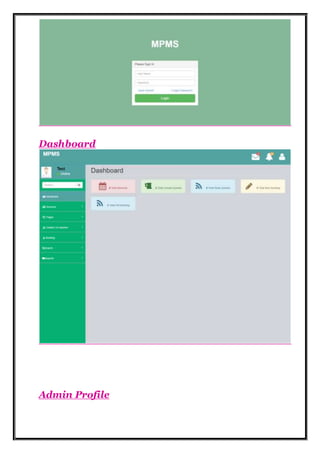
website. Admin can log in through the login page
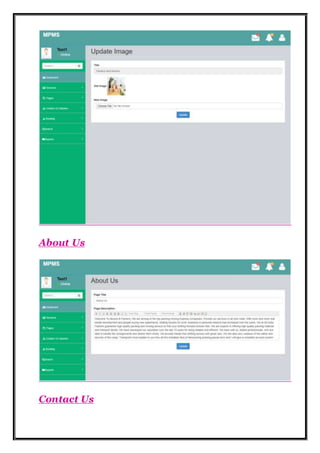
Dashboard: In this section, admin can see all detail in brief like the total
services, Total unread queries, Total read queries, Total new booking and Total
old booking
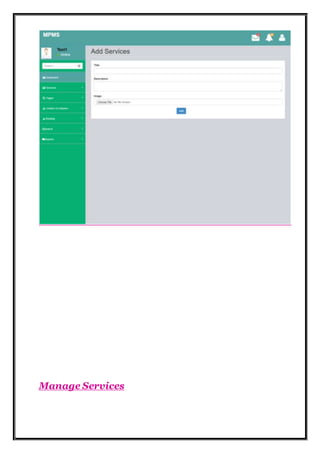
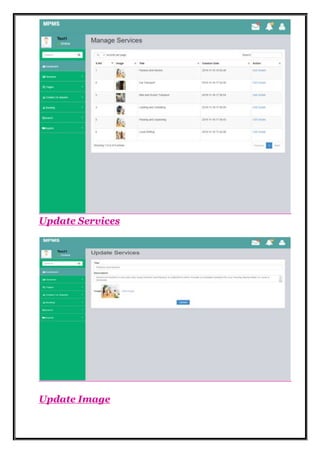
Services: In this section, admin can mange services (add/update).
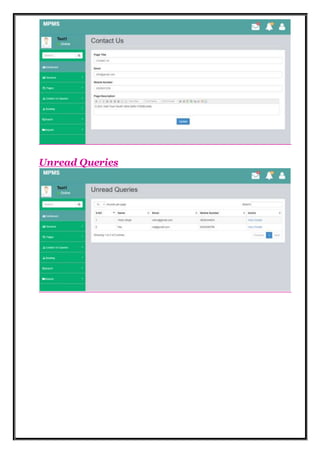
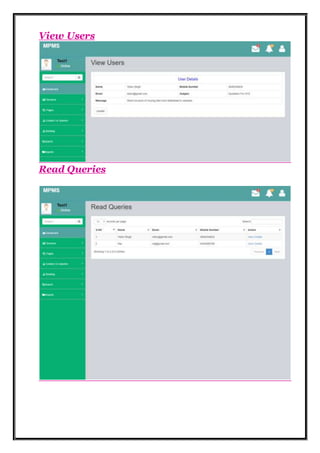
Pages: In this section, admin can manage about us and contact us pages.
Contactus Queries: In this section, admin can view and maintain the Queries.
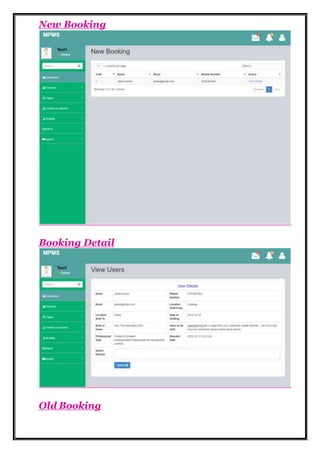
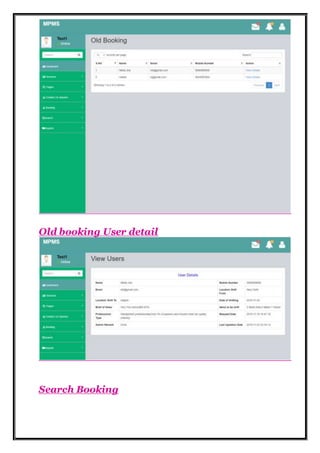
Booking: In this section, admin can view new and old booking and also give
remark.
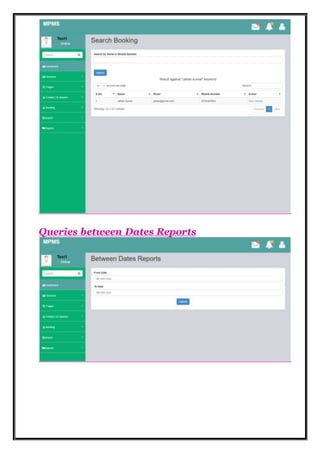
Search: In this section, admin can search booking details with the help of name
and mobile number of users.
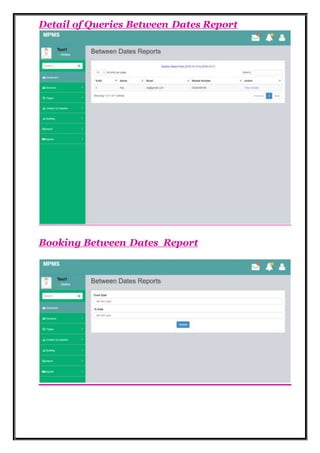
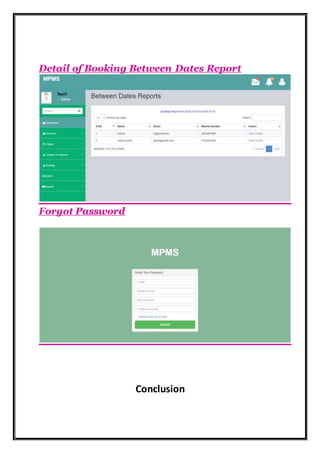
Reports: In this section, admin can view booking and queries in a particular
periods.
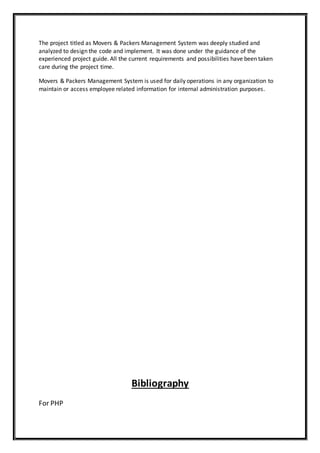
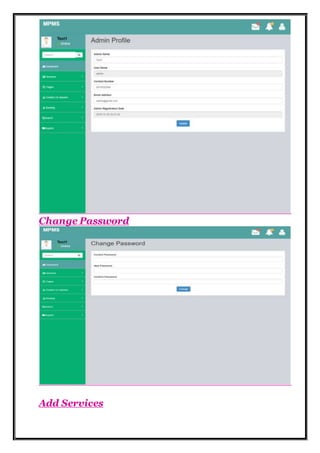
Admin can also update his profile, change the password and recover the
password.
Abstract
Movers & Packers is a project which is developed to provide an interactive
platform between users and packers and Movers Company/Organization. This
project provides best and reliable services in relocating. Users can book the services
through this web portal. This Project provides useful information to users in the
process of relocating their house. . Packers and movers agency works according to
the needs and requirement of the customers and provide them the desirable results.
The packers and movers company uses best quality packing materials to pack goods
in such a way that all goods remain in safe condition during transit &moving services
assure the safe delivery of goods at destination.
Objectives
Easy to generate report booking and queries.
Providean interactive platformbetween clients and packers and Movers
Company.
Itis very much faster than manual system.
Easy and fastestrecord finding technique.
Itis very much flexible to work.
Itis very user oriented.
Data can be stored for a longer period.
System Requirements
Hardwarerequirement:-
This softwarerequires following minimum hardwareconfiguration:
 Processor: Pentium-iv and above
 RAM: 256 MB
 Hard Disk: 4.3GB
 Floppy Disk: 1.44 MB
 CD Drive
 Monitor-15” Color Monitor
SoftwareRequirement:-
1. OS : Windows XP
2.PHP Triad (PHP, MySQL, Apache, and PHPMyAdmin)
Software Features
PHP TRIAD
PHPTriad installs a complete working PHP/MySQL server environment on Windows
platforms (9x/ NT). Installs PHP, MySQL, Apache, and PHPMyAdmin.
PHP
PHP is a scripting language originally designed for producing dynamic web pages. It
has evolved to include a command line interface capability and can be used in
standalone graphical applications. While PHP was originally created by Rasmus
Lerdorf in 1995, themain implementation of PHP is now produced by The PHP Group
and serves as the de facto standard for PHP as there is no formal specification. PHP is
free software released under the PHP License, however it is incompatible with the
GNU General Public License (GPL), due to restrictions on the usage of the term PHP.
It is a widely-used general-purpose scripting language that is especially suited for
web development and can be embedded into HTML. It generally runs on a web
server, taking PHP code as its input and creating web pages as output. It can be
deployed on most web servers and on almost every operating system and platform
free of charge. PHP is installed on more than 20 million websites and 1 million web
servers.
PHP originally stood for Personal Home Page. It began in 1994 as a set of Common
Gateway Interface binaries written in the C programming language by the
Danish/Greenlandic programmer Rasmus Lerdorf. Lerdorf initially created these
Personal Home Page Tools to replace a small set of Perl scripts he had been using to
maintain his personal homepage. The tools were used to perform tasks such as
displaying his résumé and recording how much traffic his page was receiving. He
combined these binaries with his Form Interpreter to create PHP/FI, which had more
functionality. PHP/FI included a larger implementation for the C programming
language and could communicate with databases, enabling the building of simple,
dynamic web applications.
Lerdorf released PHP publicly on June 8, 1995 to accelerate bug location and improve
the code. This release was named PHP version 2 and already had the basic
functionality that PHP has today. This included Perl-like variables, form handling, and
the ability to embed HTML. The syntax was similar to Perl but was more limited,
simpler, and less consistent. Zeev Suraski and Andi Gutmans, two Israeli developers
at the Technion IIT, rewrote the parser in 1997 and formed the base of PHP 3,
changing the language’s name to the recursive initialism PHP: Hypertext
Preprocessor. The development team officially released PHP/FI 2 in November 1997
after months of beta testing. Afterwards, public testing of PHP 3 began, and the
official launch came in June 1998. Suraskiand Gutmans then started a new rewrite of
PHP’s core, producing the Zend Engine in 1999. They also founded Zend Technologies
in Ramat Gan, Israel.
On May 22, 2000, PHP 4, powered by the Zend Engine 1.0, was released. On July 13,
2004, PHP 5 was released, powered by the new Zend Engine II. PHP 5 included new
features such as improved support for object-oriented programming, the PHP Data
Objects extension (which defines a lightweight and consistent interface for accessing
databases), and numerous performance enhancements. The most recent update
released by The PHP Group is for the older PHP version 4 code branch.
In 2008, PHP 5 became the only stable version under development. Late static
binding has been missing from PHP and will be added in version 5.3. PHP 6 is under
development alongside PHP 5. Major changes include the removal of
register_globals, magic quotes, and safe mode. The reason for the removals was
because register_globals had given way to security holes, and magic quotes had an
unpredictable nature, and was best avoided. Instead, to escape characters, Magic
quotes may be substituted with the addslashes() function, or more appropriately an
escape mechanism specific to the database vendor itself like
mysqli_real_escape_string() for MySQL.
PHP does not have complete native support for Unicode or multibyte strings;
Unicode support will be included in PHP 6. Many high profile open source projects
ceased to support PHP 4 in new code as of February 5, 2008, due to the GoPHP5
initiative, provided by a consortiumof PHP developers promoting the transition from
PHP 4 to PHP 5. It runs in both 32-bit and 64-bit environments, but on Windows the
only official distribution is 32-bit, requiring Windows 32-bit compatibility mode to be
enabled while using IIS in a 64-bit Windows environment. There is a third-party
distribution available for 64-bit Windows.
Syntax
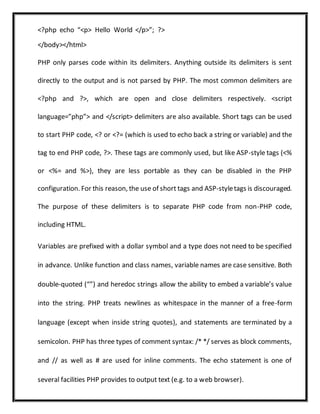
<html>
<head>
<title>PHP Test</title>
</head>
<body>
<?php echo “<p> Hello World </p>”; ?>
</body></html>
PHP only parses code within its delimiters. Anything outside its delimiters is sent
directly to the output and is not parsed by PHP. The most common delimiters are
<?php and ?>, which are open and close delimiters respectively. <script
language=”php”> and </script> delimiters are also available. Short tags can be used
to start PHP code, <? or <?= (which is used to echo back a string or variable) and the
tag to end PHP code, ?>. These tags are commonly used, but like ASP-style tags (<%
or <%= and %>), they are less portable as they can be disabled in the PHP
configuration. For this reason, the use of short tags and ASP-styletags is discouraged.
The purpose of these delimiters is to separate PHP code from non-PHP code,
including HTML.
Variables are prefixed with a dollar symbol and a type does not need to be specified
in advance. Unlike function and class names, variable names are case sensitive. Both
double-quoted (“”) and heredoc strings allow the ability to embed a variable’s value
into the string. PHP treats newlines as whitespace in the manner of a free-form
language (except when inside string quotes), and statements are terminated by a
semicolon. PHP has three types of comment syntax: /* */ serves as block comments,
and // as well as # are used for inline comments. The echo statement is one of
several facilities PHP provides to output text (e.g. to a web browser).
In terms of keywords and language syntax, PHP is similar to most high level
languages that follow the C style syntax. If conditions, for and while loops, and
function returns are similar in syntax to languages such as C, C++, Java and Perl.
MySQL
What is a database?
Quite simply, it’s an organized collection of data. A database management system
(DBMS) such as Access, FileMaker Pro, Oracle or SQL Server provides you with the
software tools you need to organize that data in a flexible manner. It includes
facilities to add, modify or delete data from the database, ask questions (or queries)
about the data stored in the database and produce reports summarizing selected
contents.
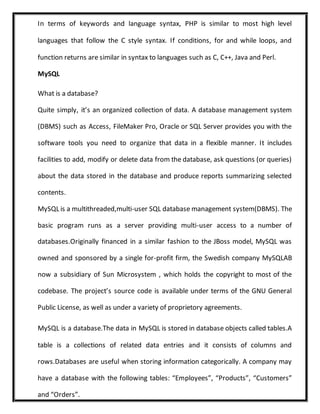
MySQL is a multithreaded,multi-user SQL database management system(DBMS). The
basic program runs as a server providing multi-user access to a number of
databases.Originally financed in a similar fashion to the JBoss model, MySQL was
owned and sponsored by a single for-profit firm, the Swedish company MySQLAB
now a subsidiary of Sun Microsystem , which holds the copyright to most of the
codebase. The project’s source code is available under terms of the GNU General
Public License, as well as under a variety of proprietory agreements.
MySQL is a database.The data in MySQL is stored in database objects called tables.A
table is a collections of related data entries and it consists of columns and
rows.Databases are useful when storing information categorically. A company may
have a database with the following tables: “Employees”, “Products”, “Customers”
and “Orders”.
DatabaseTables
A database most often contains one or more tables. Each table is identified by a
name (e.g. “Customers” or “Orders”). Tables contain records (rows) with data.
Queries
A query is a question or a request. With MySQL, we can query a database for specific
information and have a record set returned.
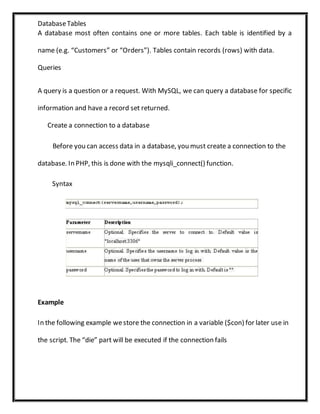
Create a connection to a database
Before you can access data in a database, you must create a connection to the
database. In PHP, this is done with the mysqli_connect() function.
Syntax
Example
In the following example westore the connection in a variable ($con) for later use in
the script. The “die” part will be executed if the connection fails
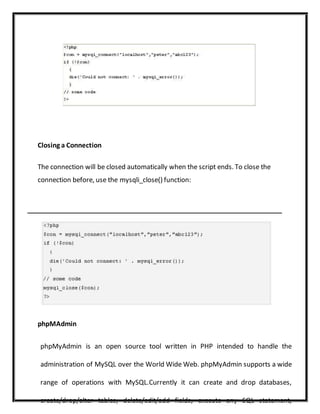
Closing a Connection
The connection will be closed automatically when the script ends. To close the
connection before, use the mysqli_close() function:
phpMAdmin
phpMyAdmin is an open source tool written in PHP intended to handle the
administration of MySQL over the World Wide Web. phpMyAdmin supports a wide
range of operations with MySQL.Currently it can create and drop databases,
create/drop/alter tables, delete/edit/add fields, execute any SQL statement,
manage users and permissions, and manage keys on fields. while you still have the
ability to directly execute any SQL statement. phpMyAdmin can manage a whole
MySQL server (needs a super-user) as well as a single database. To accomplish the
latter you’llneed a properly set up MySQL user who can read/write only the desired
database. It’s up to you to look up the appropriate part in the MySQL manual.
phpMyAdmin can:
· browseand drop databases, tables, views, fields and indexes
· create, copy, drop, rename and alter databases, tables, fields and indexes
· maintenance server, databases and tables, with proposals on server
configuration
· execute, edit and bookmark any SQL-statement, even batch-queries
· load text files into tables
· create and read dumps of tables
· export data to various formats: CSV, XML, PDF, ISO/IEC26300 -
OpenDocumentText and Spreadsheet, Word, Excel and LA
TEX formats
· administer multiple servers
· manage MySQL users and privileges
· check referential integrity in MyISAMtables
· using Query-by-example(QBE), create complex queries automatically
connecting required tables
· create PDF graphics of your Databaselayout
· search globally in a database or a subsetof it
· transformstored data into any format using a set of predefined
functions, like displaying BLOB-data as image or download-link
· supportInnoDBtables and foreign keys
· supportmysqli, the improved MySQL extension
Apache Web server
Often referred to as simply Apache, a public-domain open source Web server
developed by a loosely-knit group of programmers. The first version of Apache, based
on the NCSA httpd Web server, was developed in 1995.
Core development of the Apache Web server is performed by a group of about 20
volunteer programmers, called the Apache Group. However, becausethe sourcecode is
freely available, anyone can adapt the server for specific needs, and there is a large
public library of Apache add-ons. In many respects, development of Apache is similar to
development of the Linux operating system.
The original version of Apache was written for UNIX, but there are now versions that
run under OS/ 2, Windows and other platforms. The name is a tribute to the Native
American Apache Indian tribe, a tribe well known for its endurance and skill in warfare.
A common misunderstanding is that it was called Apache because it was developed
from existing NCSA code plus various patches, hence the name a patchy server, or
Apache server.
Apache consistently rates as the world’s most popular Web server according to analyst
surveys. Apache has attracted so much interest because it is full-featured, reliable, and
free. Originally developed for UNIX™ operating systems, Apache has been updated to
run on Windows, OS/2, and other platforms. One aspect of Apache that some site
administrators find confusing — especially thoseunfamiliar with UNIX-stylesoftware —
is its configuration scheme. Instead of using a point-and-click graphic user interface
(GUI) or Windows Registry keys as most other modern software packages, Apache
generally relies on simple text files for its configuration settings.
System Analysis and Design
FEASIBILITY STUDY
A feasibility analysis is undertaken to determine the possibility or probability of
either improving the existing system or developing a completely new system.
It helps to obtain an overview of the problem and to get rough assessment of
whether feasible solution exists.
There are three aspects in feasibility study portion of the preliminary investigation.
1) Operational feasibility
2) Technical feasibility
3) Economical feasibility
Operational feasibility:-
It is a measure of how well a proposed system solves the problems, and takes
advantages of the opportunities identified during scope definition and how it
satisfies the requirements identified in the requirements analysis phase of
system development.
Operational feasibility covers two aspects. One is the technical performance
aspect and other is the acceptance within the organization. Operational
feasibility determines how the proposed system will fit the current operations
and what, if any job restructuring and retraining may be needed to implement
the system.
In the system operational feasibility checks, whether the user who is going to
use the system is able to work with the software with which the system id
coded and also the mind of the user going to use system. If the user does not
understand or is able to work on the system further development is waste.
The system is easy to learn and it will require a very short time to learn the
operation of the system for a person having knowledge in accounting. So that
system was operationally feasible
Technical feasibility :-
This involves questions such as whether the technology needed for the system
exists, how difficult it will be to build, and whether the firm has enough
experience using that technology. The assessment is based on an outline
design of system requirements in terms of Input, Processes, Output, Fields,
Programs, and Procedures. This can be quantified in terms of volumes of data,
trends, frequency of updating, etc. in order to estimate whether the new
system will perform adequately or not.
The technical feasibility in the proposed system deals with the technology used
in the system. It deals with the hardware and software used in the system
whether they are of latest technology or not. It happens that after a system is
prepared a new technology arises and the user wants the system based on that
technology. Thus it is important to check the system to be technically feasible.
The minimum memory requirement is 32MB of RAM while 64MB is better to
have for better performance. As far as software is concerned, MySQL and PHP
should be installed on the server.
Economic feasibility :-
Economic analysis is the most frequently used method for evaluating the
effectiveness of a new system. More commonly known as cost/benefit
analysis, the procedure is to determine the benefits and savings that are
expected from a candidate system and compare them with costs. If benefits
outweigh costs, then the decision is made to design and implement the
system.
Implementation of this system will be a lifetime investment, which will ensure
returns to the store of good services and market value throughout the future.
So the system is found economically feasible.
Project Designing
Design Document
 The entire systemis projected with a physicaldiagram which specifics
the actual storageparameters that are physically necessary for any
database to be stored on to the disk. The overall systems existential
idea is derived fromthis diagram.
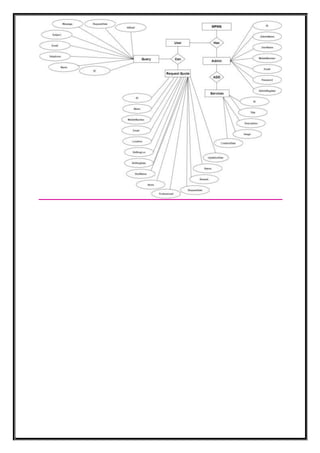
 The relation upon the system is structurethrough a conceptual ER-
Diagram, which not only specifics the existential entities but also the
standard relations through which the system exists and the
cardinalities that are necessary for the system state to continue.
 The content level DFD is provided to havean idea of the functional
inputs and outputs that are achieved through the system. The system
depicts the input and output standards at the high level of the systems
existence.
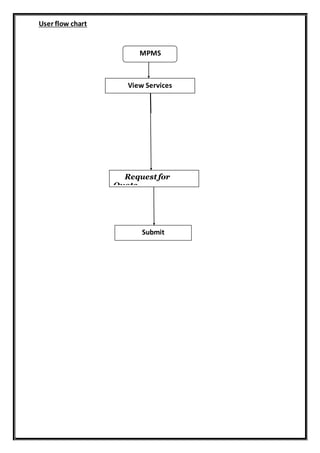
User flow chart
MPMS
View Services
Submit
Request for
Quote
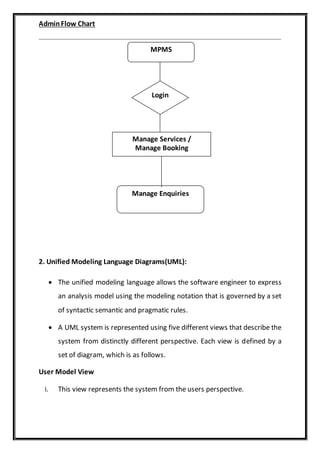
AdminFlow Chart
2. Unified Modeling Language Diagrams(UML):
 The unified modeling language allows the software engineer to express
an analysis model using the modeling notation that is governed by a set
of syntactic semantic and pragmatic rules.
 A UML system is represented using five different views that describe the
system from distinctly different perspective. Each view is defined by a
set of diagram, which is as follows.
User Model View
i. This view represents the system from the users perspective.
MPMS
Login
Manage Services /
Manage Booking
Manage Enquiries
ii. The analysis representation describes a usage scenario from the end-
users perspective.
Structural model view
 In this model the data and functionality are arrived from inside the
system.
 This model view models the static structures.
Behavioral Model View
 It represents the dynamic of behavioral as parts of the system,
depicting the interactions of collection between various structural
elements described in the user model and structural model view.
Implementation Model View
 In this the structural and behavioral as parts of the system are
represented as they are to be built.
Environmental Model View
In this the structural and behavioral aspects of the environment in which the
system is to be implemented are represented.
UML is specifically constructed through two different domains they are
 UML Analysis modeling, which focuses on the user model and
structuralmodel views of the system?
 UML design modeling, which focuses on the behavioralmodeling,
implementation modeling and environmental model views.
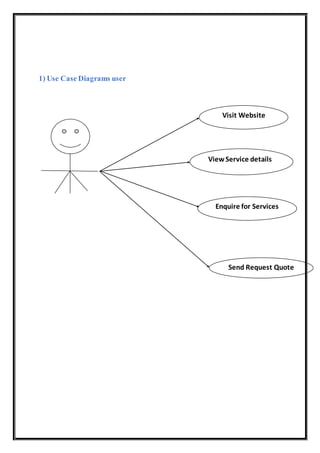
1) Use Case Diagrams user
Visit Website
View Service details
Enquire for Services
Send Request Quote
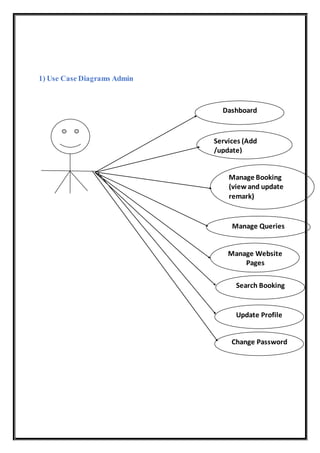
1) Use Case Diagrams Admin
Dashboard
Services (Add
/update)
Manage Booking
(view and update
remark)
Manage Queries
Manage Website
Pages
Search Booking
Change Password
Update Profile
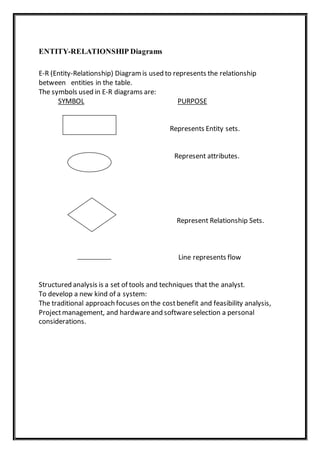
ENTITY-RELATIONSHIP Diagrams
E-R (Entity-Relationship) Diagram is used to represents the relationship
between entities in the table.
The symbols used in E-R diagrams are:
SYMBOL PURPOSE
Represents Entity sets.
Represent attributes.
Represent Relationship Sets.
Line represents flow
Structured analysis is a set of tools and techniques that the analyst.
To develop a new kind of a system:
The traditional approach focuses on the costbenefit and feasibility analysis,
Projectmanagement, and hardwareand softwareselection a personal
considerations.
DATABASE DESIGN
The data in the system has to be stored and retrieved from database.
Designing the database is part of system design. Data elements and data
structures to be stored have been identified at analysis stage. They are
structured and put together to design the data storage and retrieval system.
A database is a collection of interrelated data stored with minimum
redundancy to serve many users quickly and efficiently. The general objective
is to make database access easy, quick, inexpensive and flexible for the user.
Relationships are established between the data items and unnecessary data
items are removed. Normalization is done to get an internal consistency of
data and to have minimum redundancy and maximum stability. This ensures
minimizing data storage required, minimizing chances of data inconsistencies
and optimizing for updates. The MS Access database has been chosen for
developing the relevant databases.
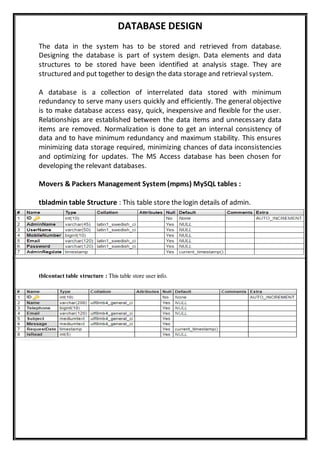
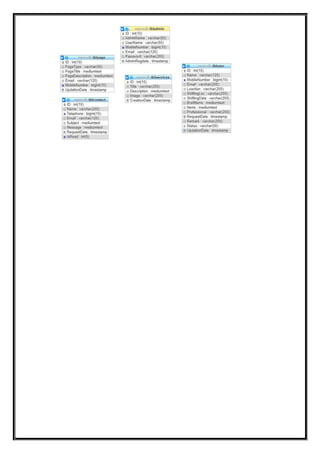
Movers & Packers Management System (mpms) MySQL tables :
tbladmin table Structure : This table store the login details of admin.
tblcontact table structure : This table store user info.
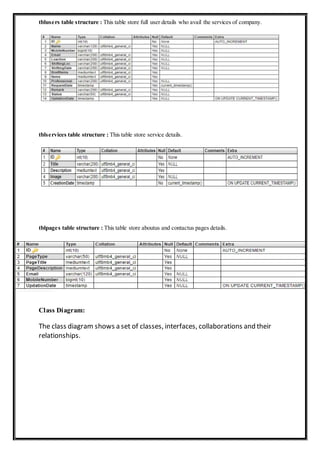
tblusers table structure : This table store full user details who avail the services of company.
tblservices table structure : This table store service details.
tblpages table structure : This table store aboutus and contactus pages details.
Class Diagram:
The class diagram shows a set of classes, interfaces, collaborations and their
relationships.
Testing
System testing is a series of different test whose primary purpose is to fully exercise
computer based system.
We can say that it will run according to its specifications and in the way users expect. Special
test data are input for processing, and the results examined. A limited number of users may be
allowed to use the system so that analyst can see whether they try to use it in unforeseen
ways. It is desirable to discover any surprises before the organization implements the system
and depends on it.
 We follow Black Box testing.
 Black box testing attempts to find errors in following
 Incorrect or missing function
 Interface errors
 Errors in data structure
 Initialization and termination errors
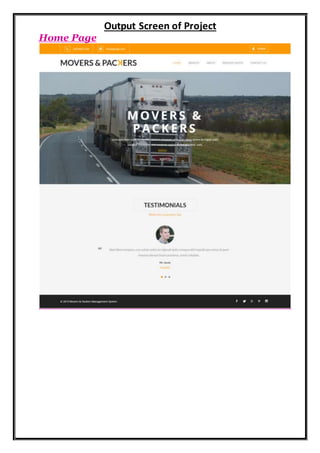
Output Screen of Project
Home Page
Services
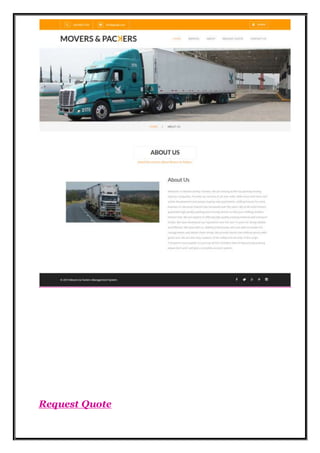
About Us
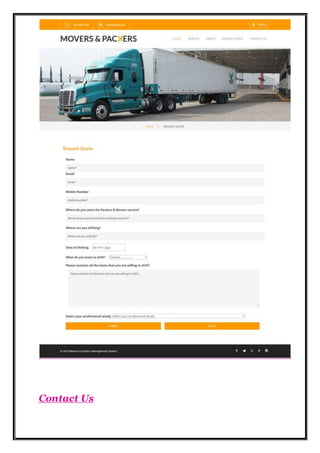
Request Quote
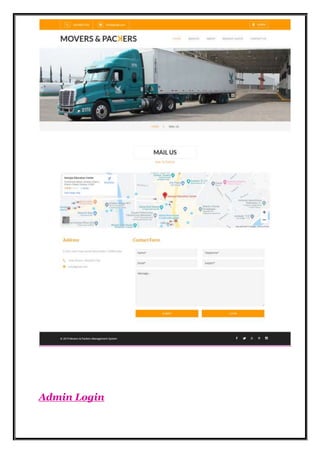
Contact Us
Admin Login
Dashboard
Admin Profile
Change Password
Add Services
Manage Services
Update Services
Update Image
About Us
Contact Us
Unread Queries
View Users
Read Queries
New Booking
Booking Detail
Old Booking
Old booking User detail
Search Booking
Queries between Dates Reports
Detail of Queries Between Dates Report
Booking Between Dates Report
Detail of Booking Between Dates Report
Forgot Password
Conclusion
The project titled as Movers & Packers Management System was deeply studied and
analyzed to design the code and implement. It was done under the guidance of the
experienced project guide. All the current requirements and possibilities have been taken
care during the project time.
Movers & Packers Management System is used for daily operations in any organization to
maintain or access employee related information for internal administration purposes.
Bibliography
For PHP
https://www.w3schools.com/php/default.asp
https://www.sitepoint.com/php/
https://www.php.net/
For MySQL
https://www.mysql.com/
http://www.mysqltutorial.org
For XAMPP
https://www.apachefriends.org/download.html

Report.docx

  • 1.
    Project Report On Movers &Packers Management System
  • 2.
    Introduction Packers and MoversManagement System is software which provide an interactive platform between users and packers and Movers Company. This project provides best and reliable services in relocating. Users can book the services through this web portal. In proposed system we do not have to maintain everything manually. Through this system if any enquiry occurs it is corresponding entries is done automatically because database management system gives facility of having relationship between the tables. In proposed system we do not have to maintain record manually. Advantages of proposed System Easy to generate report. It is very much faster than manual system. Easy and fastest record finding technique. It is very much flexible to work. Man power required is very less. Data can be stored for a longer period. In this project, weuse PHP and MySQL database. It has two modules 1. User 2. Admin User:user can view the website and checkoutthe information about movers and packers services and they can also enquiry and request for the servicewhich he/she wants to avail.
  • 3.
    Admin Module Admin isthe super user of the website who can manage everything on the website. Admin can log in through the login page Dashboard: In this section, admin can see all detail in brief like the total services, Total unread queries, Total read queries, Total new booking and Total old booking Services: In this section, admin can mange services (add/update). Pages: In this section, admin can manage about us and contact us pages. Contactus Queries: In this section, admin can view and maintain the Queries. Booking: In this section, admin can view new and old booking and also give remark. Search: In this section, admin can search booking details with the help of name and mobile number of users. Reports: In this section, admin can view booking and queries in a particular periods. Admin can also update his profile, change the password and recover the password.
  • 4.
    Abstract Movers & Packersis a project which is developed to provide an interactive platform between users and packers and Movers Company/Organization. This project provides best and reliable services in relocating. Users can book the services through this web portal. This Project provides useful information to users in the process of relocating their house. . Packers and movers agency works according to the needs and requirement of the customers and provide them the desirable results. The packers and movers company uses best quality packing materials to pack goods in such a way that all goods remain in safe condition during transit &moving services assure the safe delivery of goods at destination. Objectives Easy to generate report booking and queries. Providean interactive platformbetween clients and packers and Movers Company. Itis very much faster than manual system. Easy and fastestrecord finding technique. Itis very much flexible to work. Itis very user oriented. Data can be stored for a longer period.
  • 5.
    System Requirements Hardwarerequirement:- This softwarerequiresfollowing minimum hardwareconfiguration:  Processor: Pentium-iv and above  RAM: 256 MB  Hard Disk: 4.3GB  Floppy Disk: 1.44 MB  CD Drive  Monitor-15” Color Monitor SoftwareRequirement:- 1. OS : Windows XP 2.PHP Triad (PHP, MySQL, Apache, and PHPMyAdmin) Software Features PHP TRIAD PHPTriad installs a complete working PHP/MySQL server environment on Windows platforms (9x/ NT). Installs PHP, MySQL, Apache, and PHPMyAdmin.
  • 6.
    PHP PHP is ascripting language originally designed for producing dynamic web pages. It has evolved to include a command line interface capability and can be used in standalone graphical applications. While PHP was originally created by Rasmus Lerdorf in 1995, themain implementation of PHP is now produced by The PHP Group and serves as the de facto standard for PHP as there is no formal specification. PHP is free software released under the PHP License, however it is incompatible with the GNU General Public License (GPL), due to restrictions on the usage of the term PHP. It is a widely-used general-purpose scripting language that is especially suited for web development and can be embedded into HTML. It generally runs on a web server, taking PHP code as its input and creating web pages as output. It can be deployed on most web servers and on almost every operating system and platform free of charge. PHP is installed on more than 20 million websites and 1 million web servers. PHP originally stood for Personal Home Page. It began in 1994 as a set of Common Gateway Interface binaries written in the C programming language by the Danish/Greenlandic programmer Rasmus Lerdorf. Lerdorf initially created these Personal Home Page Tools to replace a small set of Perl scripts he had been using to maintain his personal homepage. The tools were used to perform tasks such as displaying his résumé and recording how much traffic his page was receiving. He combined these binaries with his Form Interpreter to create PHP/FI, which had more
  • 7.
    functionality. PHP/FI includeda larger implementation for the C programming language and could communicate with databases, enabling the building of simple, dynamic web applications. Lerdorf released PHP publicly on June 8, 1995 to accelerate bug location and improve the code. This release was named PHP version 2 and already had the basic functionality that PHP has today. This included Perl-like variables, form handling, and the ability to embed HTML. The syntax was similar to Perl but was more limited, simpler, and less consistent. Zeev Suraski and Andi Gutmans, two Israeli developers at the Technion IIT, rewrote the parser in 1997 and formed the base of PHP 3, changing the language’s name to the recursive initialism PHP: Hypertext Preprocessor. The development team officially released PHP/FI 2 in November 1997 after months of beta testing. Afterwards, public testing of PHP 3 began, and the official launch came in June 1998. Suraskiand Gutmans then started a new rewrite of PHP’s core, producing the Zend Engine in 1999. They also founded Zend Technologies in Ramat Gan, Israel. On May 22, 2000, PHP 4, powered by the Zend Engine 1.0, was released. On July 13, 2004, PHP 5 was released, powered by the new Zend Engine II. PHP 5 included new features such as improved support for object-oriented programming, the PHP Data Objects extension (which defines a lightweight and consistent interface for accessing databases), and numerous performance enhancements. The most recent update released by The PHP Group is for the older PHP version 4 code branch.
  • 8.
    In 2008, PHP5 became the only stable version under development. Late static binding has been missing from PHP and will be added in version 5.3. PHP 6 is under development alongside PHP 5. Major changes include the removal of register_globals, magic quotes, and safe mode. The reason for the removals was because register_globals had given way to security holes, and magic quotes had an unpredictable nature, and was best avoided. Instead, to escape characters, Magic quotes may be substituted with the addslashes() function, or more appropriately an escape mechanism specific to the database vendor itself like mysqli_real_escape_string() for MySQL. PHP does not have complete native support for Unicode or multibyte strings; Unicode support will be included in PHP 6. Many high profile open source projects ceased to support PHP 4 in new code as of February 5, 2008, due to the GoPHP5 initiative, provided by a consortiumof PHP developers promoting the transition from PHP 4 to PHP 5. It runs in both 32-bit and 64-bit environments, but on Windows the only official distribution is 32-bit, requiring Windows 32-bit compatibility mode to be enabled while using IIS in a 64-bit Windows environment. There is a third-party distribution available for 64-bit Windows. Syntax <html> <head> <title>PHP Test</title> </head> <body>
  • 9.
    <?php echo “<p>Hello World </p>”; ?> </body></html> PHP only parses code within its delimiters. Anything outside its delimiters is sent directly to the output and is not parsed by PHP. The most common delimiters are <?php and ?>, which are open and close delimiters respectively. <script language=”php”> and </script> delimiters are also available. Short tags can be used to start PHP code, <? or <?= (which is used to echo back a string or variable) and the tag to end PHP code, ?>. These tags are commonly used, but like ASP-style tags (<% or <%= and %>), they are less portable as they can be disabled in the PHP configuration. For this reason, the use of short tags and ASP-styletags is discouraged. The purpose of these delimiters is to separate PHP code from non-PHP code, including HTML. Variables are prefixed with a dollar symbol and a type does not need to be specified in advance. Unlike function and class names, variable names are case sensitive. Both double-quoted (“”) and heredoc strings allow the ability to embed a variable’s value into the string. PHP treats newlines as whitespace in the manner of a free-form language (except when inside string quotes), and statements are terminated by a semicolon. PHP has three types of comment syntax: /* */ serves as block comments, and // as well as # are used for inline comments. The echo statement is one of several facilities PHP provides to output text (e.g. to a web browser).
  • 10.
    In terms ofkeywords and language syntax, PHP is similar to most high level languages that follow the C style syntax. If conditions, for and while loops, and function returns are similar in syntax to languages such as C, C++, Java and Perl. MySQL What is a database? Quite simply, it’s an organized collection of data. A database management system (DBMS) such as Access, FileMaker Pro, Oracle or SQL Server provides you with the software tools you need to organize that data in a flexible manner. It includes facilities to add, modify or delete data from the database, ask questions (or queries) about the data stored in the database and produce reports summarizing selected contents. MySQL is a multithreaded,multi-user SQL database management system(DBMS). The basic program runs as a server providing multi-user access to a number of databases.Originally financed in a similar fashion to the JBoss model, MySQL was owned and sponsored by a single for-profit firm, the Swedish company MySQLAB now a subsidiary of Sun Microsystem , which holds the copyright to most of the codebase. The project’s source code is available under terms of the GNU General Public License, as well as under a variety of proprietory agreements. MySQL is a database.The data in MySQL is stored in database objects called tables.A table is a collections of related data entries and it consists of columns and rows.Databases are useful when storing information categorically. A company may have a database with the following tables: “Employees”, “Products”, “Customers” and “Orders”.
  • 11.
    DatabaseTables A database mostoften contains one or more tables. Each table is identified by a name (e.g. “Customers” or “Orders”). Tables contain records (rows) with data. Queries A query is a question or a request. With MySQL, we can query a database for specific information and have a record set returned. Create a connection to a database Before you can access data in a database, you must create a connection to the database. In PHP, this is done with the mysqli_connect() function. Syntax Example In the following example westore the connection in a variable ($con) for later use in the script. The “die” part will be executed if the connection fails
  • 12.
    Closing a Connection Theconnection will be closed automatically when the script ends. To close the connection before, use the mysqli_close() function: phpMAdmin phpMyAdmin is an open source tool written in PHP intended to handle the administration of MySQL over the World Wide Web. phpMyAdmin supports a wide range of operations with MySQL.Currently it can create and drop databases, create/drop/alter tables, delete/edit/add fields, execute any SQL statement,
  • 13.
    manage users andpermissions, and manage keys on fields. while you still have the ability to directly execute any SQL statement. phpMyAdmin can manage a whole MySQL server (needs a super-user) as well as a single database. To accomplish the latter you’llneed a properly set up MySQL user who can read/write only the desired database. It’s up to you to look up the appropriate part in the MySQL manual. phpMyAdmin can: · browseand drop databases, tables, views, fields and indexes · create, copy, drop, rename and alter databases, tables, fields and indexes · maintenance server, databases and tables, with proposals on server configuration · execute, edit and bookmark any SQL-statement, even batch-queries · load text files into tables · create and read dumps of tables · export data to various formats: CSV, XML, PDF, ISO/IEC26300 - OpenDocumentText and Spreadsheet, Word, Excel and LA TEX formats · administer multiple servers · manage MySQL users and privileges · check referential integrity in MyISAMtables · using Query-by-example(QBE), create complex queries automatically connecting required tables · create PDF graphics of your Databaselayout
  • 14.
    · search globallyin a database or a subsetof it · transformstored data into any format using a set of predefined functions, like displaying BLOB-data as image or download-link · supportInnoDBtables and foreign keys · supportmysqli, the improved MySQL extension Apache Web server Often referred to as simply Apache, a public-domain open source Web server developed by a loosely-knit group of programmers. The first version of Apache, based on the NCSA httpd Web server, was developed in 1995. Core development of the Apache Web server is performed by a group of about 20 volunteer programmers, called the Apache Group. However, becausethe sourcecode is freely available, anyone can adapt the server for specific needs, and there is a large public library of Apache add-ons. In many respects, development of Apache is similar to development of the Linux operating system. The original version of Apache was written for UNIX, but there are now versions that run under OS/ 2, Windows and other platforms. The name is a tribute to the Native American Apache Indian tribe, a tribe well known for its endurance and skill in warfare. A common misunderstanding is that it was called Apache because it was developed from existing NCSA code plus various patches, hence the name a patchy server, or Apache server.
  • 15.
    Apache consistently ratesas the world’s most popular Web server according to analyst surveys. Apache has attracted so much interest because it is full-featured, reliable, and free. Originally developed for UNIX™ operating systems, Apache has been updated to run on Windows, OS/2, and other platforms. One aspect of Apache that some site administrators find confusing — especially thoseunfamiliar with UNIX-stylesoftware — is its configuration scheme. Instead of using a point-and-click graphic user interface (GUI) or Windows Registry keys as most other modern software packages, Apache generally relies on simple text files for its configuration settings.
  • 16.
    System Analysis andDesign FEASIBILITY STUDY A feasibility analysis is undertaken to determine the possibility or probability of either improving the existing system or developing a completely new system. It helps to obtain an overview of the problem and to get rough assessment of whether feasible solution exists. There are three aspects in feasibility study portion of the preliminary investigation. 1) Operational feasibility 2) Technical feasibility 3) Economical feasibility Operational feasibility:- It is a measure of how well a proposed system solves the problems, and takes advantages of the opportunities identified during scope definition and how it satisfies the requirements identified in the requirements analysis phase of system development. Operational feasibility covers two aspects. One is the technical performance aspect and other is the acceptance within the organization. Operational feasibility determines how the proposed system will fit the current operations and what, if any job restructuring and retraining may be needed to implement the system. In the system operational feasibility checks, whether the user who is going to use the system is able to work with the software with which the system id coded and also the mind of the user going to use system. If the user does not understand or is able to work on the system further development is waste.
  • 17.
    The system iseasy to learn and it will require a very short time to learn the operation of the system for a person having knowledge in accounting. So that system was operationally feasible Technical feasibility :- This involves questions such as whether the technology needed for the system exists, how difficult it will be to build, and whether the firm has enough experience using that technology. The assessment is based on an outline design of system requirements in terms of Input, Processes, Output, Fields, Programs, and Procedures. This can be quantified in terms of volumes of data, trends, frequency of updating, etc. in order to estimate whether the new system will perform adequately or not. The technical feasibility in the proposed system deals with the technology used in the system. It deals with the hardware and software used in the system whether they are of latest technology or not. It happens that after a system is prepared a new technology arises and the user wants the system based on that technology. Thus it is important to check the system to be technically feasible. The minimum memory requirement is 32MB of RAM while 64MB is better to have for better performance. As far as software is concerned, MySQL and PHP should be installed on the server. Economic feasibility :- Economic analysis is the most frequently used method for evaluating the effectiveness of a new system. More commonly known as cost/benefit
  • 18.
    analysis, the procedureis to determine the benefits and savings that are expected from a candidate system and compare them with costs. If benefits outweigh costs, then the decision is made to design and implement the system. Implementation of this system will be a lifetime investment, which will ensure returns to the store of good services and market value throughout the future. So the system is found economically feasible.
  • 19.
    Project Designing Design Document The entire systemis projected with a physicaldiagram which specifics the actual storageparameters that are physically necessary for any database to be stored on to the disk. The overall systems existential idea is derived fromthis diagram.  The relation upon the system is structurethrough a conceptual ER- Diagram, which not only specifics the existential entities but also the standard relations through which the system exists and the cardinalities that are necessary for the system state to continue.  The content level DFD is provided to havean idea of the functional inputs and outputs that are achieved through the system. The system depicts the input and output standards at the high level of the systems existence.
  • 20.
    User flow chart MPMS ViewServices Submit Request for Quote
  • 21.
    AdminFlow Chart 2. UnifiedModeling Language Diagrams(UML):  The unified modeling language allows the software engineer to express an analysis model using the modeling notation that is governed by a set of syntactic semantic and pragmatic rules.  A UML system is represented using five different views that describe the system from distinctly different perspective. Each view is defined by a set of diagram, which is as follows. User Model View i. This view represents the system from the users perspective. MPMS Login Manage Services / Manage Booking Manage Enquiries
  • 22.
    ii. The analysisrepresentation describes a usage scenario from the end- users perspective. Structural model view  In this model the data and functionality are arrived from inside the system.  This model view models the static structures. Behavioral Model View  It represents the dynamic of behavioral as parts of the system, depicting the interactions of collection between various structural elements described in the user model and structural model view. Implementation Model View  In this the structural and behavioral as parts of the system are represented as they are to be built. Environmental Model View In this the structural and behavioral aspects of the environment in which the system is to be implemented are represented. UML is specifically constructed through two different domains they are  UML Analysis modeling, which focuses on the user model and structuralmodel views of the system?  UML design modeling, which focuses on the behavioralmodeling, implementation modeling and environmental model views.
  • 23.
    1) Use CaseDiagrams user Visit Website View Service details Enquire for Services Send Request Quote
  • 24.
    1) Use CaseDiagrams Admin Dashboard Services (Add /update) Manage Booking (view and update remark) Manage Queries Manage Website Pages Search Booking Change Password Update Profile
  • 25.
    ENTITY-RELATIONSHIP Diagrams E-R (Entity-Relationship)Diagram is used to represents the relationship between entities in the table. The symbols used in E-R diagrams are: SYMBOL PURPOSE Represents Entity sets. Represent attributes. Represent Relationship Sets. Line represents flow Structured analysis is a set of tools and techniques that the analyst. To develop a new kind of a system: The traditional approach focuses on the costbenefit and feasibility analysis, Projectmanagement, and hardwareand softwareselection a personal considerations.
  • 27.
    DATABASE DESIGN The datain the system has to be stored and retrieved from database. Designing the database is part of system design. Data elements and data structures to be stored have been identified at analysis stage. They are structured and put together to design the data storage and retrieval system. A database is a collection of interrelated data stored with minimum redundancy to serve many users quickly and efficiently. The general objective is to make database access easy, quick, inexpensive and flexible for the user. Relationships are established between the data items and unnecessary data items are removed. Normalization is done to get an internal consistency of data and to have minimum redundancy and maximum stability. This ensures minimizing data storage required, minimizing chances of data inconsistencies and optimizing for updates. The MS Access database has been chosen for developing the relevant databases. Movers & Packers Management System (mpms) MySQL tables : tbladmin table Structure : This table store the login details of admin. tblcontact table structure : This table store user info.
  • 28.
    tblusers table structure: This table store full user details who avail the services of company. tblservices table structure : This table store service details. tblpages table structure : This table store aboutus and contactus pages details. Class Diagram: The class diagram shows a set of classes, interfaces, collaborations and their relationships.
  • 30.
    Testing System testing isa series of different test whose primary purpose is to fully exercise computer based system. We can say that it will run according to its specifications and in the way users expect. Special test data are input for processing, and the results examined. A limited number of users may be allowed to use the system so that analyst can see whether they try to use it in unforeseen ways. It is desirable to discover any surprises before the organization implements the system and depends on it.  We follow Black Box testing.  Black box testing attempts to find errors in following  Incorrect or missing function  Interface errors  Errors in data structure  Initialization and termination errors
  • 31.
    Output Screen ofProject Home Page
  • 32.
  • 33.
  • 34.
  • 35.
  • 36.
  • 37.
  • 38.
  • 39.
  • 40.
  • 41.
  • 42.
  • 43.
  • 44.
    Old booking Userdetail Search Booking
  • 45.
  • 46.
    Detail of QueriesBetween Dates Report Booking Between Dates Report
  • 47.
    Detail of BookingBetween Dates Report Forgot Password Conclusion
  • 48.
    The project titledas Movers & Packers Management System was deeply studied and analyzed to design the code and implement. It was done under the guidance of the experienced project guide. All the current requirements and possibilities have been taken care during the project time. Movers & Packers Management System is used for daily operations in any organization to maintain or access employee related information for internal administration purposes. Bibliography For PHP
  • 49.