Eng. Y. Kishanthan
C.Eng, B.Sc. Eng (Hons), MIE (SL), MIET (UK), MIEEE (UK)
 Developing listening competencies
 Introduction to Cover Letters and CVs
 Writing CV
 Completing the job application
 Cover letters
 Preparing for interview
 Meetings
 Summary writing
 Writing Short Reports
By the end of this session, you should be able
to:
 Identify different types of CVs and the
rationale for choosing one or another
 Understand how to produce an effective CV for
a range of different purposes
WHAT IS A RESUME?
A summary of your qualifications
 Education
 Experiences (all types!!!)
 Skills
Marketing tool + an advertisement on you!
 Know your audience
 Be prepared to spend ample time preparing
resume
Most often used when applying for
employment
 Can be used to apply for a internship,
graduate or professional school or leadership
positions in particular organizations
 A screening tool with the 10-20 second scan
 Resume + Interview + References + Job Offer
 Comprehensive biographical statement
 Usually 3 or more pages in length
 Emphasizes qualifications and activities
 Should address roles such as teaching,
research, service, professional associations
and presentations
 In the United States, a curriculum vitae is
used primarily when applying for
academic, scientific, or research
positions. It is also applicable when
applying for fellowships or grants
 When seeking a job in Europe, the Middle
East, Africa, or Asia, expect to submit a
CV rather than a resume
 CV will give chance to evaluate yourself
 CVs are mostly used to screen candidates
for interview
 CVs are the first introducer to the
interviewer and explains your complete
background
 Chronological (order of occurrence in time)
 Skills
 Mix of the two
 Traditional approach
 Can be useful if you have work experience
directly related to the job/sector you’re
applying for
 Skills should be referred to in various
sections of the CV
 There is a danger that the chronological CV
can be dry to read
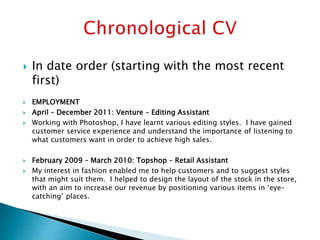
 In date order (starting with the most recent
first)
 EMPLOYMENT
 April – December 2011: Venture – Editing Assistant
 Working with Photoshop, I have learnt various editing styles. I have gained
customer service experience and understand the importance of listening to
what customers want in order to achieve high sales.
 February 2009 – March 2010: Topshop – Retail Assistant
 My interest in fashion enabled me to help customers and to suggest styles
that might suit them. I helped to design the layout of the stock in the store,
with an aim to increase our revenue by positioning various items in ‘eye-
catching’ places.
 Includes a separate skills section
 Focuses on the skills and attributes you have
which are relevant to the job
 Useful if you have limited or unrelated work
experience
 Can be more dynamic and interesting to read
than a chronological CV
 May result in minimal details in other
sections, therefore creating an imbalanced
structure
 Focusing on skills e.g.
 SKILLS
• Attention to detail – as an Editing Assistant at Venture, I needed to prove
that I could spot any mistakes or flaws in the photographs, as well as being
attentive to the requests of the customers
• Computer skills – I regularly used Photoshop during my time at Venture. I
am also a competent user of Microsoft Office, which I proved throughout my
time as a Retail Assistant at Topshop, where I was often required to produce
reports on our sales
• Customer service – in all of my roles, customer service has been of key
importance. I have experience of dealing with difficult customers, and try to
ensure that every customer is satisfied with the service they have received.
 Choose the best and most relevant elements
of chronological and skills-based CVs
 Includes a separate but shorter skills section
than in pure “skills” CV
 Allows space to include some commentary
within the work experience section
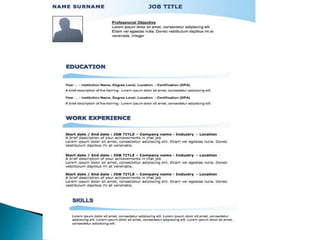
 Personal details
 Personal profile/career objective
 Education and qualifications
 Professional Qualifications
 Work experience
 Project Experiences
 Skills profile (Personal/Technical)
 Interests/extra curricular activities
 Achievements
 Publications
 References
 Name (as a heading rather than ‘CV’)
 Website/online portfolio/CV
 Address (term-time and home)
 Telephone number
 Email address
◦ Make sure this is a professional email address
 The following are not requirements, but if you wish, you
can include:
◦ Nationality
◦ Sex
◦ Date of birth
 Might also be called “career objective” or
“summary”
 Purpose is to highlight key points that you
want an employer to know about you (e.g.
skills, experience, career objective)
 Less is more. 1 – 3 sentences, maximum of
4 lines
 Strong, positive language
 Avoid a list of superlatives
Examples:
 A highly motivated BSc ______ student looking
for a work placement in……………. . I have
strong problem-solving skills and a logical
and analytical approach.
 A ______ undergraduate with substantial
work experience in ……………, looking for an
opportunity to develop a career in …………….
 Start with the most recent
 Don’t forget your current study
◦ Mention relevant modules
◦ You might like to mention top marks
 Include the years of study
 Primary school not needed
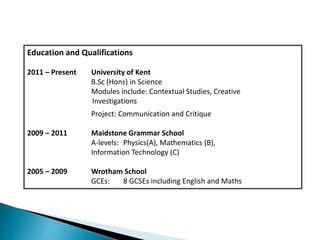
Education and Qualifications
2011 – Present University of Kent
B.Sc (Hons) in Science
Modules include: Contextual Studies, Creative
Investigations
Project: Communication and Critique
2009 – 2011 Maidstone Grammar School
A-levels: Physics(A), Mathematics (B),
Information Technology (C)
2005 – 2009 Wrotham School
GCEs: 8 GCSEs including English and Maths
 There is no need to list every job you’ve
ever had – detail the most relevant
 Don’t just list your duties – sell your skills.
Which skills are relevant to the
position/company you are applying to?
 Dates, name of company, position and
skills:
Example:
September 2009 – present
Recruitment administrator (part-time) – NHS
Trust, London
 Drafting letters ensuring clarity, accuracy and
clear presentation
 Organising interview schedules and liaising
with external agencies regarding work permits
and criminal record checks
 Communicating effectively both face to face
and on the telephone
 Accurately maintaining office information
systems
 Skills-based and combination CVs will have
separate skills sections
 Chronological CVs need to include references to
skills throughout the CV i.e. in all or some of the
education, work experience, interests sections
 Include skills which are relevant and of interest to
the job/employer/sector
 Always provide evidence for skills
 Make links between your skills and the job –
show how you are a good match with the job
requirements
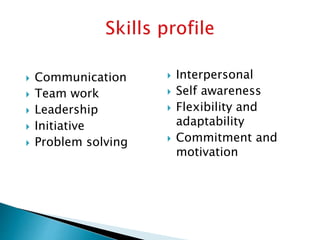
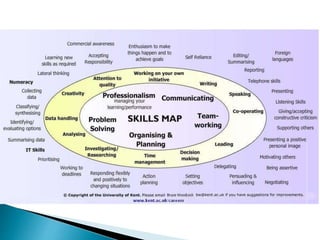
 Communication
 Team work
 Leadership
 Initiative
 Problem solving
 Interpersonal
 Self awareness
 Flexibility and
adaptability
 Commitment and
motivation
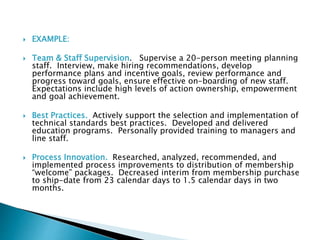
 EXAMPLE:
 Team & Staff Supervision. Supervise a 20-person meeting planning
staff. Interview, make hiring recommendations, develop
performance plans and incentive goals, review performance and
progress toward goals, ensure effective on-boarding of new staff.
Expectations include high levels of action ownership, empowerment
and goal achievement.
 Best Practices. Actively support the selection and implementation of
technical standards best practices. Developed and delivered
education programs. Personally provided training to managers and
line staff.
 Process Innovation. Researched, analyzed, recommended, and
implemented process improvements to distribution of membership
“welcome” packages. Decreased interim from membership purchase
to ship-date from 23 calendar days to 1.5 calendar days in two
months.
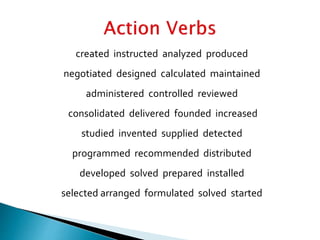
created instructed analyzed produced
negotiated designed calculated maintained
administered controlled reviewed
consolidated delivered founded increased
studied invented supplied detected
programmed recommended distributed
developed solved prepared installed
selected arranged formulated solved started
 Choose interests and activities which can demonstrate skills
relevant to the job such as:
• Teamwork
• Organising
• Commitment
• Your intellectual abilities
• Your personality
• Your artistic ability
 Ideally, one academic and your manager
 Ask permission from your reference and let
them know what position(s) you’ve applied
for
 Use relevant references if possible
 You can say ‘references available on
request’ rather than including contact
details if you wish
 The first visual impression of your CV is important
 For standard CVs, use plain white A4 paper
 Do not double side
 Keep your CV to two sides of paper
 Check your spelling
 Use bullet points and bold font but in moderation
 Formatting – make sure it’s consistent
 Size 10-12 font (depending on font style)
 Clear font e.g. Arial, Calibri
 Focus on accomplishments
 Target your CV to that job/company
 Use short, concise sentences
 Consider your audience
1. Avoid folding your CV
2. Don’t include irrelevant information –
previous Salary, unproofed awards, prizes and
publications etc.
3. Say what you did, not what you think
4. Personal information – marital status,
religion, health, native place etc.
5. Avoid unusual font size, stylish letters,
graphics, underlining and unusual spacing
etc.
6. Avoid repeating information
7. Avoid personal pronouns (I, my, me)
8. Don’t outsource, do it yourself
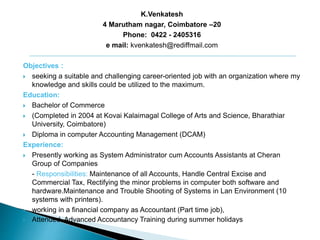
K.Venkatesh
4 Marutham nagar, Coimbatore –20
Phone: 0422 - 2405316
e mail: kvenkatesh@rediffmail.com
Objectives :
 seeking a suitable and challenging career-oriented job with an organization where my
knowledge and skills could be utilized to the maximum.
Education:
 Bachelor of Commerce
 (Completed in 2004 at Kovai Kalaimagal College of Arts and Science, Bharathiar
University, Coimbatore)
 Diploma in computer Accounting Management (DCAM)
Experience:
 Presently working as System Administrator cum Accounts Assistants at Cheran
Group of Companies
- Responsibilities: Maintenance of all Accounts, Handle Central Excise and
Commercial Tax, Rectifying the minor problems in computer both software and
hardware.Maintenance and Trouble Shooting of Systems in Lan Environment (10
systems with printers).
 working in a financial company as Accountant (Part time job),
 Attended Advanced Accountancy Training during summer holidays
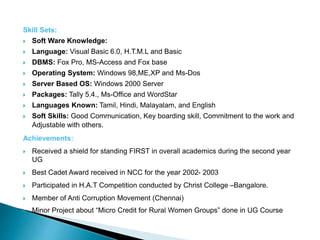
Skill Sets:
 Soft Ware Knowledge:
 Language: Visual Basic 6.0, H.T.M.L and Basic
 DBMS: Fox Pro, MS-Access and Fox base
 Operating System: Windows 98,ME,XP and Ms-Dos
 Server Based OS: Windows 2000 Server
 Packages: Tally 5.4., Ms-Office and WordStar
 Languages Known: Tamil, Hindi, Malayalam, and English
 Soft Skills: Good Communication, Key boarding skill, Commitment to the work and
Adjustable with others.
Achievements:
 Received a shield for standing FIRST in overall academics during the second year
UG
 Best Cadet Award received in NCC for the year 2002- 2003
 Participated in H.A.T Competition conducted by Christ College –Bangalore.
 Member of Anti Corruption Movement (Chennai)
 Minor Project about “Micro Credit for Rural Women Groups” done in UG Course
Check that your CV is: -
 Easy to read – logical, clear, organised
 Focused – targeted at the opportunity
 Prioritised – it gives the most important and
relevant information towards the beginning
 Positive – it includes pro-active language
 Correct – free of spelling mistakes and other
errors
“ Each job is different and each employer will
be looking for different things. You need to
find out what these are and emphasise the
relevant parts of your CV. This will obviously
take more of your time but can make all the
difference”

Report Writing - ID 41005 - L1.pptx

  • 1.
    Eng. Y. Kishanthan C.Eng,B.Sc. Eng (Hons), MIE (SL), MIET (UK), MIEEE (UK)
  • 2.
     Developing listeningcompetencies  Introduction to Cover Letters and CVs  Writing CV  Completing the job application  Cover letters  Preparing for interview  Meetings  Summary writing  Writing Short Reports
  • 4.
    By the endof this session, you should be able to:  Identify different types of CVs and the rationale for choosing one or another  Understand how to produce an effective CV for a range of different purposes
  • 5.
    WHAT IS ARESUME? A summary of your qualifications  Education  Experiences (all types!!!)  Skills Marketing tool + an advertisement on you!  Know your audience  Be prepared to spend ample time preparing resume
  • 6.
    Most often usedwhen applying for employment  Can be used to apply for a internship, graduate or professional school or leadership positions in particular organizations  A screening tool with the 10-20 second scan  Resume + Interview + References + Job Offer
  • 7.
     Comprehensive biographicalstatement  Usually 3 or more pages in length  Emphasizes qualifications and activities  Should address roles such as teaching, research, service, professional associations and presentations
  • 8.
     In theUnited States, a curriculum vitae is used primarily when applying for academic, scientific, or research positions. It is also applicable when applying for fellowships or grants  When seeking a job in Europe, the Middle East, Africa, or Asia, expect to submit a CV rather than a resume
  • 9.
     CV willgive chance to evaluate yourself  CVs are mostly used to screen candidates for interview  CVs are the first introducer to the interviewer and explains your complete background
  • 10.
     Chronological (orderof occurrence in time)  Skills  Mix of the two
  • 11.
     Traditional approach Can be useful if you have work experience directly related to the job/sector you’re applying for  Skills should be referred to in various sections of the CV  There is a danger that the chronological CV can be dry to read
  • 12.
     In dateorder (starting with the most recent first)  EMPLOYMENT  April – December 2011: Venture – Editing Assistant  Working with Photoshop, I have learnt various editing styles. I have gained customer service experience and understand the importance of listening to what customers want in order to achieve high sales.  February 2009 – March 2010: Topshop – Retail Assistant  My interest in fashion enabled me to help customers and to suggest styles that might suit them. I helped to design the layout of the stock in the store, with an aim to increase our revenue by positioning various items in ‘eye- catching’ places.
  • 13.
     Includes aseparate skills section  Focuses on the skills and attributes you have which are relevant to the job  Useful if you have limited or unrelated work experience  Can be more dynamic and interesting to read than a chronological CV  May result in minimal details in other sections, therefore creating an imbalanced structure
  • 14.
     Focusing onskills e.g.  SKILLS • Attention to detail – as an Editing Assistant at Venture, I needed to prove that I could spot any mistakes or flaws in the photographs, as well as being attentive to the requests of the customers • Computer skills – I regularly used Photoshop during my time at Venture. I am also a competent user of Microsoft Office, which I proved throughout my time as a Retail Assistant at Topshop, where I was often required to produce reports on our sales • Customer service – in all of my roles, customer service has been of key importance. I have experience of dealing with difficult customers, and try to ensure that every customer is satisfied with the service they have received.
  • 15.
     Choose thebest and most relevant elements of chronological and skills-based CVs  Includes a separate but shorter skills section than in pure “skills” CV  Allows space to include some commentary within the work experience section
  • 16.
     Personal details Personal profile/career objective  Education and qualifications  Professional Qualifications  Work experience  Project Experiences  Skills profile (Personal/Technical)  Interests/extra curricular activities  Achievements  Publications  References
  • 17.
     Name (asa heading rather than ‘CV’)  Website/online portfolio/CV  Address (term-time and home)  Telephone number  Email address ◦ Make sure this is a professional email address  The following are not requirements, but if you wish, you can include: ◦ Nationality ◦ Sex ◦ Date of birth
  • 18.
     Might alsobe called “career objective” or “summary”  Purpose is to highlight key points that you want an employer to know about you (e.g. skills, experience, career objective)  Less is more. 1 – 3 sentences, maximum of 4 lines  Strong, positive language  Avoid a list of superlatives
  • 19.
    Examples:  A highlymotivated BSc ______ student looking for a work placement in……………. . I have strong problem-solving skills and a logical and analytical approach.  A ______ undergraduate with substantial work experience in ……………, looking for an opportunity to develop a career in …………….
  • 20.
     Start withthe most recent  Don’t forget your current study ◦ Mention relevant modules ◦ You might like to mention top marks  Include the years of study  Primary school not needed
  • 21.
    Education and Qualifications 2011– Present University of Kent B.Sc (Hons) in Science Modules include: Contextual Studies, Creative Investigations Project: Communication and Critique 2009 – 2011 Maidstone Grammar School A-levels: Physics(A), Mathematics (B), Information Technology (C) 2005 – 2009 Wrotham School GCEs: 8 GCSEs including English and Maths
  • 22.
     There isno need to list every job you’ve ever had – detail the most relevant  Don’t just list your duties – sell your skills. Which skills are relevant to the position/company you are applying to?  Dates, name of company, position and skills:
  • 23.
    Example: September 2009 –present Recruitment administrator (part-time) – NHS Trust, London  Drafting letters ensuring clarity, accuracy and clear presentation  Organising interview schedules and liaising with external agencies regarding work permits and criminal record checks  Communicating effectively both face to face and on the telephone  Accurately maintaining office information systems
  • 24.
     Skills-based andcombination CVs will have separate skills sections  Chronological CVs need to include references to skills throughout the CV i.e. in all or some of the education, work experience, interests sections  Include skills which are relevant and of interest to the job/employer/sector  Always provide evidence for skills  Make links between your skills and the job – show how you are a good match with the job requirements
  • 25.
     Communication  Teamwork  Leadership  Initiative  Problem solving  Interpersonal  Self awareness  Flexibility and adaptability  Commitment and motivation
  • 27.
     EXAMPLE:  Team& Staff Supervision. Supervise a 20-person meeting planning staff. Interview, make hiring recommendations, develop performance plans and incentive goals, review performance and progress toward goals, ensure effective on-boarding of new staff. Expectations include high levels of action ownership, empowerment and goal achievement.  Best Practices. Actively support the selection and implementation of technical standards best practices. Developed and delivered education programs. Personally provided training to managers and line staff.  Process Innovation. Researched, analyzed, recommended, and implemented process improvements to distribution of membership “welcome” packages. Decreased interim from membership purchase to ship-date from 23 calendar days to 1.5 calendar days in two months.
  • 28.
    created instructed analyzedproduced negotiated designed calculated maintained administered controlled reviewed consolidated delivered founded increased studied invented supplied detected programmed recommended distributed developed solved prepared installed selected arranged formulated solved started
  • 29.
     Choose interestsand activities which can demonstrate skills relevant to the job such as: • Teamwork • Organising • Commitment • Your intellectual abilities • Your personality • Your artistic ability
  • 30.
     Ideally, oneacademic and your manager  Ask permission from your reference and let them know what position(s) you’ve applied for  Use relevant references if possible  You can say ‘references available on request’ rather than including contact details if you wish
  • 31.
     The firstvisual impression of your CV is important  For standard CVs, use plain white A4 paper  Do not double side  Keep your CV to two sides of paper  Check your spelling  Use bullet points and bold font but in moderation
  • 32.
     Formatting –make sure it’s consistent  Size 10-12 font (depending on font style)  Clear font e.g. Arial, Calibri  Focus on accomplishments  Target your CV to that job/company  Use short, concise sentences  Consider your audience
  • 33.
    1. Avoid foldingyour CV 2. Don’t include irrelevant information – previous Salary, unproofed awards, prizes and publications etc. 3. Say what you did, not what you think 4. Personal information – marital status, religion, health, native place etc. 5. Avoid unusual font size, stylish letters, graphics, underlining and unusual spacing etc. 6. Avoid repeating information 7. Avoid personal pronouns (I, my, me) 8. Don’t outsource, do it yourself
  • 35.
    K.Venkatesh 4 Marutham nagar,Coimbatore –20 Phone: 0422 - 2405316 e mail: kvenkatesh@rediffmail.com Objectives :  seeking a suitable and challenging career-oriented job with an organization where my knowledge and skills could be utilized to the maximum. Education:  Bachelor of Commerce  (Completed in 2004 at Kovai Kalaimagal College of Arts and Science, Bharathiar University, Coimbatore)  Diploma in computer Accounting Management (DCAM) Experience:  Presently working as System Administrator cum Accounts Assistants at Cheran Group of Companies - Responsibilities: Maintenance of all Accounts, Handle Central Excise and Commercial Tax, Rectifying the minor problems in computer both software and hardware.Maintenance and Trouble Shooting of Systems in Lan Environment (10 systems with printers).  working in a financial company as Accountant (Part time job),  Attended Advanced Accountancy Training during summer holidays
  • 36.
    Skill Sets:  SoftWare Knowledge:  Language: Visual Basic 6.0, H.T.M.L and Basic  DBMS: Fox Pro, MS-Access and Fox base  Operating System: Windows 98,ME,XP and Ms-Dos  Server Based OS: Windows 2000 Server  Packages: Tally 5.4., Ms-Office and WordStar  Languages Known: Tamil, Hindi, Malayalam, and English  Soft Skills: Good Communication, Key boarding skill, Commitment to the work and Adjustable with others. Achievements:  Received a shield for standing FIRST in overall academics during the second year UG  Best Cadet Award received in NCC for the year 2002- 2003  Participated in H.A.T Competition conducted by Christ College –Bangalore.  Member of Anti Corruption Movement (Chennai)  Minor Project about “Micro Credit for Rural Women Groups” done in UG Course
  • 37.
    Check that yourCV is: -  Easy to read – logical, clear, organised  Focused – targeted at the opportunity  Prioritised – it gives the most important and relevant information towards the beginning  Positive – it includes pro-active language  Correct – free of spelling mistakes and other errors
  • 38.
    “ Each jobis different and each employer will be looking for different things. You need to find out what these are and emphasise the relevant parts of your CV. This will obviously take more of your time but can make all the difference”