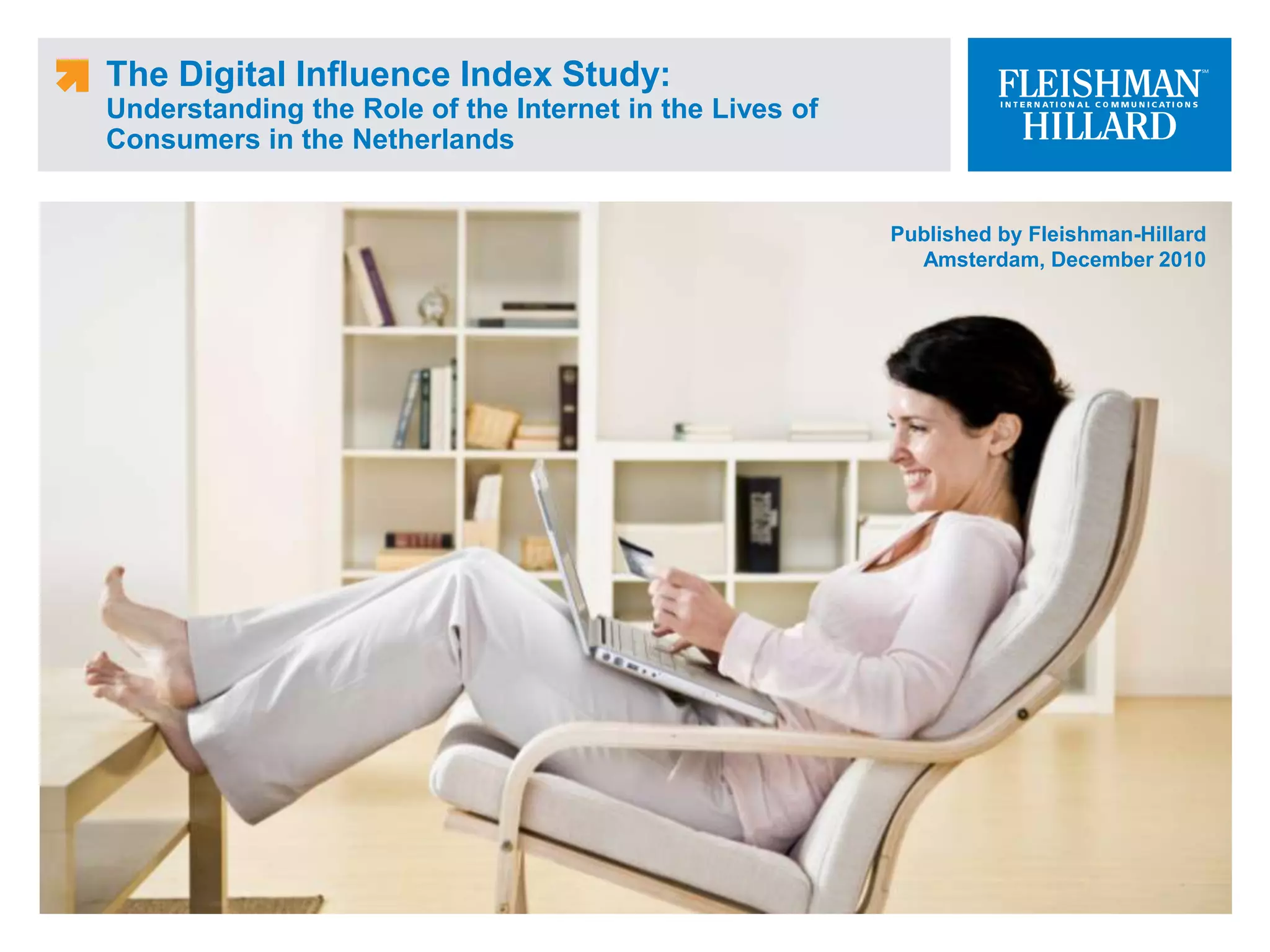
The Digital Influence Index Study:Understanding the Role of the Internet in the Lives of Consumers in the NetherlandsPublished by Fleishman-HillardAmsterdam, December 2010
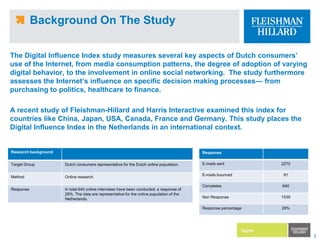
Background On The StudyThe Digital Influence Index study measures several key aspects of Dutch consumers’ use of the Internet, from media consumption patterns, the degree of adoption of varying digital behavior, to the involvement in online social networking.  The study furthermore assesses the Internet’s influence on specific decision making processes— from purchasing to politics, healthcare to finance.A recent study of Fleishman-Hillard and Harris Interactive examined this index for countries like China, Japan, USA, Canada, France and Germany. This study places the Digital Influence Index in the Netherlands in an international context.
Key Findings
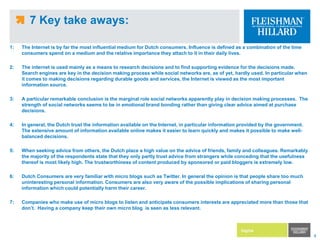
7 Key take aways: 1: 	The Internet is by far the most influential medium for Dutch consumers. Influence is defined as a combination of the time consumers spend on a medium and the relative importance they attach to it in their daily lives. 2:	The internet is used mainly as a means to research decisions and to find supporting evidence for the decisions made. Search engines are key in the decision making process while social networks are, as of yet, hardly used. In particular when it comes to making decisions regarding durable goods and services, the Internet is viewed as the most important information source. 3:	A particular remarkable conclusion is the marginal role social networks apparently play in decision making processes.  The strength of social networks seems to be in emotional brand bonding rather than giving clear advice aimed at purchase decisions.4:	In general, the Dutch trust the information available on the Internet, in particular information provided by the government. The extensive amount of information available online makes it easier to learn quickly and makes it possible to make well-balanced decisions. 5:	When seeking advice from others, the Dutch place a high value on the advice of friends, family and colleagues. Remarkably the majority of the respondents state that they only partly trust advice from strangers while conceding that the usefulness thereof is most likely high. The trustworthiness of content produced by sponsored or paid bloggers is extremely low.6:	Dutch Consumers are very familiar with micro blogs such as Twitter. In general the opinion is that people share too much uninteresting personal information. Consumers are also very aware of the possible implications of sharing personal information which could potentially harm their career. 7:	Companies who make use of micro blogs to listen and anticipate consumers interests are appreciated more than those that don’t.  Having a company keep their own micro blog  is seen as less relevant.
Digital Influence
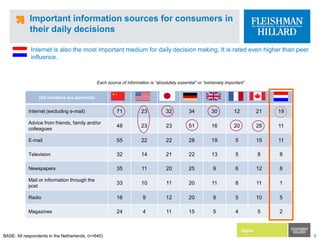
Important information sources for consumers in their daily decisionsInternet is also the most important medium for daily decision making. It is rated even higher than peer influence.Each source of information is “absolutely essential” or “extremely important”BASE: All respondents in the Netherlands, (n=640)
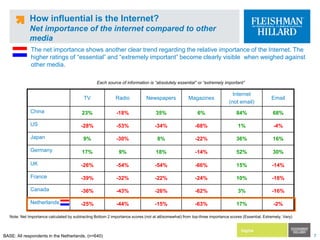
How influential is the Internet? Net importance of the internet compared to other mediaThe net importance shows another clear trend regarding the relative importance of the Internet. The higher ratings of “essential” and “extremely important” become clearly visible  when weighed against other media.Each source of information is “absolutely essential” or “extremely important”Note: Net Importance calculated by subtracting Bottom 2 importance scores (not at all/somewhat) from top-three importance scores (Essential, Extremely, Very)BASE: All respondents in the Netherlands, (n=640)
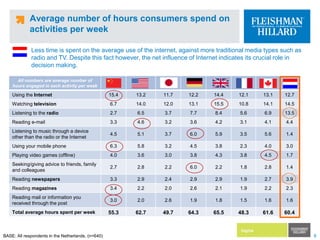
Average number of hours consumers spend on activities per weekLess time is spent on the average use of the internet, against more traditional media types such as radio and TV. Despite this fact however, the net influence of Internet indicates its crucial role in decision making.BASE: All respondents in the Netherlands, (n=640)
Impact on Decisions
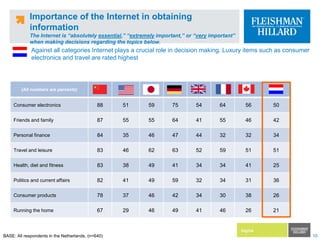
Importance of the Internet in obtaining informationThe Internet is “absolutely essential,” “extremely important,” or “very important” when making decisions regarding the topics below.Against all categories Internet plays a crucial role in decision making. Luxury items such as consumer electronics and travel are rated highestBASE: All respondents in the Netherlands, (n=640)
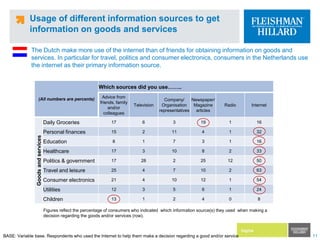
Usage of different information sources to get information on goods and servicesThe Dutch make more use of the internet than of friends for obtaining information on goods and services. In particular for travel, politics and consumer electronics, consumers in the Netherlands use the internet as their primary information source.Figures reflect the percentage of consumers who indicated  which information source(s) they used  when making a decision regarding the goods and/or services (row). BASE: Variable base. Respondents who used the Internet to help them make a decision regarding a good and/or service
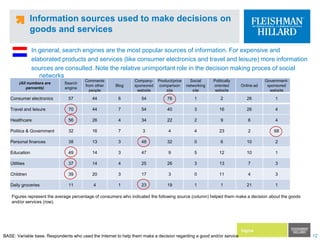
Information sources used to make decisions on goods and servicesIn general, search engines are the most popular sources of information. For expensive and elaborated products and services (like consumer electronics and travel and leisure) more informationsources are consulted. Note the relative unimportant role in the decision making proces of social networksFigures represent the average percentage of consumers who indicated the following source (column) helped them make a decision about the goods and/or services (row).BASE: Variable base. Respondents who used the Internet to help them make a decision regarding a good and/or service
Information and Trust
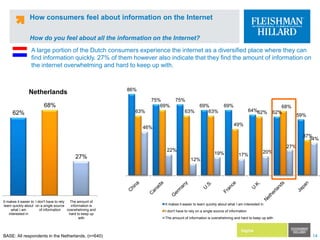
How consumers feel about information on the InternetHow do you feel about all the information on the Internet?A large portion of the Dutch consumers experience the internet as a diversified place where they can find information quickly. 27% of them however also indicate that they find the amount of information on the internet overwhelming and hard to keep up with.BASE: All respondents in the Netherlands, (n=640)
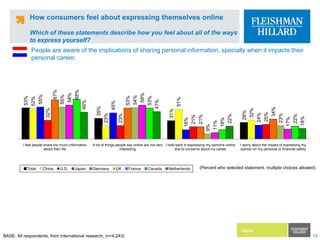
How consumers feel about expressing themselves onlineWhich of these statements describe how you feel about all of the ways to express yourself?People are aware of the implications of sharing personal information, specially when it impacts their personal career. (Percent who selected statement. multiple choices allowed)BASE: All respondents, from international research, (n=4,243)
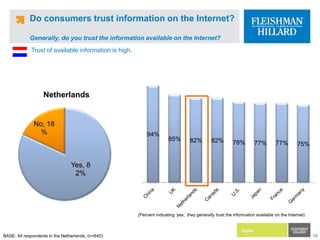
Do consumers trust information on the Internet?Generally, do you trust the information available on the Internet?Trust of available information is high.(Percent indicating ‘yes,’ they generally trust the information available on the Internet)BASE: All respondents in the Netherlands, (n=640)
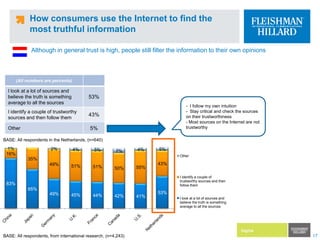
How consumers use the Internet to find the most truthful informationAlthough in general trust is high, people still filter the information to their own opinions  I follow my own intuition
  Stay critical and check the sources on their trustworthiness
 Most sources on the Internet are not trustworthyBASE: All respondents in the Netherlands, (n=640)BASE: All respondents, from international research, (n=4,243)
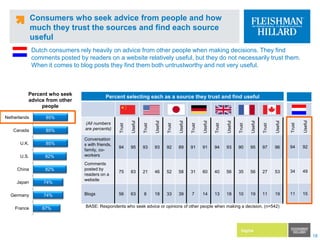
Consumers who seek advice from people and how much they trust the sources and find each source usefulDutch consumers rely heavily on advice from other people when making decisions. They find comments posted by readers on a website relatively useful, but they do not necessarily trust them. When it comes to blog posts they find them both untrustworthy and not very useful.BASE: Respondents who seek advice or opinions of other people when making a decision, (n=542)
MicroBlogs

Report digital influence index netherlands

  • 1.
    The Digital InfluenceIndex Study:Understanding the Role of the Internet in the Lives of Consumers in the NetherlandsPublished by Fleishman-HillardAmsterdam, December 2010
  • 2.
    Background On TheStudyThe Digital Influence Index study measures several key aspects of Dutch consumers’ use of the Internet, from media consumption patterns, the degree of adoption of varying digital behavior, to the involvement in online social networking. The study furthermore assesses the Internet’s influence on specific decision making processes— from purchasing to politics, healthcare to finance.A recent study of Fleishman-Hillard and Harris Interactive examined this index for countries like China, Japan, USA, Canada, France and Germany. This study places the Digital Influence Index in the Netherlands in an international context.
  • 3.
  • 4.
    7 Key takeaways: 1: The Internet is by far the most influential medium for Dutch consumers. Influence is defined as a combination of the time consumers spend on a medium and the relative importance they attach to it in their daily lives. 2: The internet is used mainly as a means to research decisions and to find supporting evidence for the decisions made. Search engines are key in the decision making process while social networks are, as of yet, hardly used. In particular when it comes to making decisions regarding durable goods and services, the Internet is viewed as the most important information source. 3: A particular remarkable conclusion is the marginal role social networks apparently play in decision making processes. The strength of social networks seems to be in emotional brand bonding rather than giving clear advice aimed at purchase decisions.4: In general, the Dutch trust the information available on the Internet, in particular information provided by the government. The extensive amount of information available online makes it easier to learn quickly and makes it possible to make well-balanced decisions. 5: When seeking advice from others, the Dutch place a high value on the advice of friends, family and colleagues. Remarkably the majority of the respondents state that they only partly trust advice from strangers while conceding that the usefulness thereof is most likely high. The trustworthiness of content produced by sponsored or paid bloggers is extremely low.6: Dutch Consumers are very familiar with micro blogs such as Twitter. In general the opinion is that people share too much uninteresting personal information. Consumers are also very aware of the possible implications of sharing personal information which could potentially harm their career. 7: Companies who make use of micro blogs to listen and anticipate consumers interests are appreciated more than those that don’t. Having a company keep their own micro blog is seen as less relevant.
  • 5.
  • 6.
    Important information sourcesfor consumers in their daily decisionsInternet is also the most important medium for daily decision making. It is rated even higher than peer influence.Each source of information is “absolutely essential” or “extremely important”BASE: All respondents in the Netherlands, (n=640)
  • 7.
    How influential isthe Internet? Net importance of the internet compared to other mediaThe net importance shows another clear trend regarding the relative importance of the Internet. The higher ratings of “essential” and “extremely important” become clearly visible when weighed against other media.Each source of information is “absolutely essential” or “extremely important”Note: Net Importance calculated by subtracting Bottom 2 importance scores (not at all/somewhat) from top-three importance scores (Essential, Extremely, Very)BASE: All respondents in the Netherlands, (n=640)
  • 8.
    Average number ofhours consumers spend on activities per weekLess time is spent on the average use of the internet, against more traditional media types such as radio and TV. Despite this fact however, the net influence of Internet indicates its crucial role in decision making.BASE: All respondents in the Netherlands, (n=640)
  • 9.
  • 10.
    Importance of theInternet in obtaining informationThe Internet is “absolutely essential,” “extremely important,” or “very important” when making decisions regarding the topics below.Against all categories Internet plays a crucial role in decision making. Luxury items such as consumer electronics and travel are rated highestBASE: All respondents in the Netherlands, (n=640)
  • 11.
    Usage of differentinformation sources to get information on goods and servicesThe Dutch make more use of the internet than of friends for obtaining information on goods and services. In particular for travel, politics and consumer electronics, consumers in the Netherlands use the internet as their primary information source.Figures reflect the percentage of consumers who indicated which information source(s) they used when making a decision regarding the goods and/or services (row). BASE: Variable base. Respondents who used the Internet to help them make a decision regarding a good and/or service
  • 12.
    Information sources usedto make decisions on goods and servicesIn general, search engines are the most popular sources of information. For expensive and elaborated products and services (like consumer electronics and travel and leisure) more informationsources are consulted. Note the relative unimportant role in the decision making proces of social networksFigures represent the average percentage of consumers who indicated the following source (column) helped them make a decision about the goods and/or services (row).BASE: Variable base. Respondents who used the Internet to help them make a decision regarding a good and/or service
  • 13.
  • 14.
    How consumers feelabout information on the InternetHow do you feel about all the information on the Internet?A large portion of the Dutch consumers experience the internet as a diversified place where they can find information quickly. 27% of them however also indicate that they find the amount of information on the internet overwhelming and hard to keep up with.BASE: All respondents in the Netherlands, (n=640)
  • 15.
    How consumers feelabout expressing themselves onlineWhich of these statements describe how you feel about all of the ways to express yourself?People are aware of the implications of sharing personal information, specially when it impacts their personal career. (Percent who selected statement. multiple choices allowed)BASE: All respondents, from international research, (n=4,243)
  • 16.
    Do consumers trustinformation on the Internet?Generally, do you trust the information available on the Internet?Trust of available information is high.(Percent indicating ‘yes,’ they generally trust the information available on the Internet)BASE: All respondents in the Netherlands, (n=640)
  • 17.
    How consumers usethe Internet to find the most truthful informationAlthough in general trust is high, people still filter the information to their own opinions I follow my own intuition
  • 18.
    Staycritical and check the sources on their trustworthiness
  • 19.
    Most sourceson the Internet are not trustworthyBASE: All respondents in the Netherlands, (n=640)BASE: All respondents, from international research, (n=4,243)
  • 20.
    Consumers who seekadvice from people and how much they trust the sources and find each source usefulDutch consumers rely heavily on advice from other people when making decisions. They find comments posted by readers on a website relatively useful, but they do not necessarily trust them. When it comes to blog posts they find them both untrustworthy and not very useful.BASE: Respondents who seek advice or opinions of other people when making a decision, (n=542)
  • 21.