Consumers and the Future of Sustainability


                               SUSTAINABILITYLOGOTYPE FOR PRINT ONLY
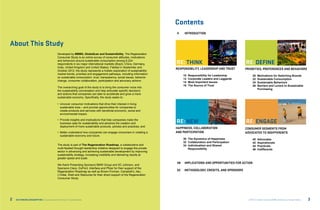
Contents
                                                                                                                           4	INTRODUCTION


About This Study
                                             Developed by BBMG, GlobeScan and SustainAbility, The Regeneration
                                             Consumer Study is an online survey of consumer attitudes, motivations
                                             and behaviors around sustainable consumption among 6,224
                                             respondents in six major international markets (Brazil, China, Germany,               THINK                                        define
                                             India, United Kingdom and United States). Fielded in September and
                                                                                                                           Responsibility, Leadership and Trust        Priorities, Preferences and Behaviors
                                             October 2012, the study represents a holistic exploration of sustainability
                                                                                                                                 				
                                             market trends, priorities and engagement pathways, including information
                                                                                                                                 10	 Responsibility for Leadership           20	 Motivations for Switching Brands
                                             on sustainable consumption, trust, transparency, social issues, behavior
                                                                                                                                 12	 Corporate Leaders and Laggards          22	 Sustainable Consumption
                                             change, consumer collaboration, participation and advocacy actions.
                                                                                                                                 14	 Most Important Issues                   24	 Sustainable Behaviors
                                                                                                                                 16	 The Source of Trust                     26	 Barriers and Levers to Sustainable 		
                                             The overarching goal of the study is to bring the consumer voice into
                                                                                                                                                                             	Purchasing
                                             the sustainability conversation and help articulate specific decisions
                                             and actions that companies can take to accelerate and grow a more
                                             sustainable economy. Specifically, the study seeks to:

                                             •	 Uncover consumer motivations that drive their interest in living
                                                sustainable lives – and provide opportunities for companies to
                                                create products and services with beneficial economic, social and
                                                environmental impact;

                                             •	 Provide insights and implications that help companies make the
                                                business case for sustainability and advance the creation and                      NEW                                          ENGAGE
                                                deployment of more sustainable products, policies and practices; and
                                                                                                                           Happiness, Collaboration                    Consumer Segments from
                                             •	 Better understand how companies can engage consumers in creating a         and Participation                           Advocates to Indifferents
                                                sustainable economy and future.
                                                                                                                                 30	 The Dynamics of Happiness               40	Advocates
                                                                                                                                 32	 Collaboration and Participation         42	Aspirationals
                                             The study is part of The Regeneration Roadmap, a collaborative and                  34	 Individualism and Shared 			            44	Practicals
                                             multi-faceted thought leadership initiative designed to engage the private          	Responsibility                             46	Indifferents
                                             sector in advancing and achieving sustainable development by improving
                                             sustainability strategy, increasing credibility and delivering results at
                                             greater speed and scale.
                                                                                                                           48	 IMPLICATIONS AND OPPORTUNITIES FOR ACTION
                                             We thank Presenting Sponsors BMW Group and SC Johnson, and
                                             Sponsors Cisco, DuPont, Interface and Pfizer for their support of the
                                             Regeneration Roadmap as well as Brown-Forman, Campbell’s, Itau,               52	   METHODOLOGY, CREDITS, and SPONSORS
                                             L’Oréal, Shell and Starbucks for their direct support of the Regeneration
                                             Consumer Study.


2   RE:THINKING CONSUMPTION Consumers and the Future of Sustainability                                                                                                   ©2012 All rights reserved BBMG, GlobeScan, SustainAbility   3
Introduction
                                             Twenty years after the first Rio Earth Summit, the global economy and
                                             natural environment face unprecedented stresses as scarce resources
                                             are stretched to meet growing needs.

                                             Economists brace for “peak everything” and “the end of growth” while
                                             citizens around the world question ways of doing business that prioritize
                                             short-term, transactional, profit-only thinking over long-term, transparent
                                             and trusted relationships that drive shared value.
                                                                                                                           Consumers are
                                             Global challenges persist from climate change and safe drinking water to
                                             jobs, health and education, while demographers expect profound social
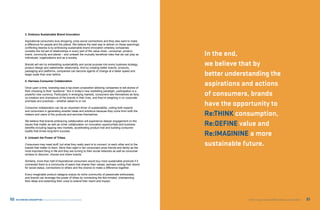
                                                                                                                           Re:THINKING consumption,
                                             and environmental impacts as two billion more people will live on the
                                             planet by 2050.                                                               Re:DEFINING success and
                                             Amidst all this, new research with over 6,000 consumers across six
                                             countries provides evidence that a new marketplace is rising. That
                                             attitudes and behaviors are shifting. That opportunities for collaboration
                                                                                                                           Re:IMAGINING the future of a
                                             are expanding. And that a new cadre of enterprising brands is seizing the
                                             moment to innovate smarter, safer, cleaner and greener solutions.             more sustainable economy.
                                             As mission-driven brands focus on taking sustainability to scale and the
                                             largest corporations leverage their capabilities to advance sustainability,
                                             the role of consumers has never been more important — not as passive
                                             targets of the latest marketing promotion, but as the greatest potential
                                             force for value generation and change.

                                             While significant barriers to more sustainable consumption remain – from
                                             perceptions of product performance, to high prices, skepticism about
                                             product claims and a lack of knowledge about what makes a product
                                             socially or environmentally responsible – there are pathways to progress.

                                             Like never before, consumers are uniting deeply held principles with
                                             everyday pragmatism, demonstrating a sense of purpose with more
                                             active participation to help create solutions that can improve their own
                                             lives while creating a more sustainable economy that can benefit all.


4   RE:THINKING CONSUMPTION Consumers and the Future of Sustainability                                                             RE:THINKING CONSUMPTION ©2012 All rights reserved BBMG, GlobeScan, SustainAbility   5
Summary of Key Findings
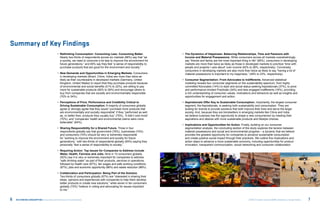
                                             •	 Rethinking Consumption: Consuming Less. Consuming Better.                     •	 The Dynamics of Happiness: Balancing Relationships, Time and Passions with
                                                Nearly two-thirds of respondents across six markets (66%) say that “as           Income and Material Possessions. While consumers across all markets overwhelmingly
                                                a society, we need to consume a lot less to improve the environment for          say “friends and family are the most important thing in life” (85%), consumers in developing
                                                future generations,” and 65% say they feel “a sense of responsibility to         markets are more than twice as likely as those in developed markets to prioritize “time with
                                                purchase products that are good for the environment and society.”                people and projects I care about” over income (62% to 28%, respectively). Conversely,
                                                                                                                                 consumers in developing markets are also more than twice as likely to say “having a lot of
                                             •	 New Demands and Opportunities in Emerging Markets. Consumers                     material possessions is important to my happiness,” (49% to 23%, respectively).
                                                in developing markets (Brazil, China, India) are more than twice as
                                                likely as their counterparts in developed markets (Germany, United            •	 Consumer Segmentation: From Advocates to Indifferents. Advanced statistical
                                                Kingdom, United States) to report that they purchase products because            modeling reveals four consumer segments on the sustainability spectrum, from highly
                                                of environmental and social benefits (51% to 22%), are willing to pay            committed Advocates (14%) to style and social status-seeking Aspirationals (37%), to price
                                                more for sustainable products (60% to 26%) and encourage others to               and performance-minded Practicals (34%) and less engaged Indifferents (16%), providing
                                                buy from companies that are socially and environmentally responsible             a rich understanding of consumer values, motivations and behaviors as well as insights and
                                                (70% to 34%).                                                                    opportunities for engagement and action.

                                             •	 Perceptions of Price, Performance and Credibility Critical to                 •	 Aspirationals Offer Key to Sustainable Consumption. Importantly, the largest consumer
                                                Driving Sustainable Consumption. A majority of consumers globally                segment, the Aspirationals, is seeking both sustainability and consumption. They are
                                                agree or strongly agree that they would “purchase more products that             looking for brands to provide solutions that both improve their lives and serve the larger
                                                are environmentally and socially responsible” if they “performed as well         society. And, because they are trendsetters in emerging markets like China and India,
                                                as, or better than, products they usually buy” (75%), “it didn’t cost more”      we believe business has the opportunity to shape a new consumerism by meeting their
                                                (70%), and “companies’ health and environmental claims were more                 aspirations and desires with more sustainable products and lifestyle choices.
                                                believable” (64%).
                                                                                                                              •	 Implications and Opportunities for Action. Finally, building on our consumer
                                             •	 Sharing Responsibility for a Shared Future. Three in four                        segmentation analysis, the concluding section of the study explores the tension between
                                                respondents globally say that government (76%), businesses (74%)                 material possessions and social and environmental progress – a dynamic that we believe
                                                and consumers (74%) should be very or extremely responsible                      provides the greatest opportunity for companies to advance sustainable consumption
                                                for “working to improve the environment and society for future                   and create positive social impact through their practices. We outline five implications and
                                                generations,” with two-thirds of respondents globally (65%) saying they          action steps to advance a more sustainable economy, including opportunities for product
                                                personally “feel a sense of responsibility to society.”                          innovation, transparent communication, social networking and consumer collaboration.

                                             •	 Requiring Action: Top Issues for Companies to Address Include
                                                Water, Health, Fairness and Jobs. Nine in 10 consumers globally
                                                (92%) say it is very or extremely important for companies to address
                                                “safe drinking water” as part of their products, services or operations,
                                                followed by health care (87%), fair wages and safe working conditions
                                                (87%), jobs and economic opportunity (86%) and waste reduction (86%).

                                             •	 Collaboration and Participation: Being Part of the Solution.
                                                Two-thirds of consumers globally (67%) are “interested in sharing their
                                                ideas, opinions and experiences with companies to help them develop
                                                better products or create new solutions,” while seven in ten consumers
                                                globally (72%) “believe in voting and advocating for issues important
                                                to me.”


6   RE:THINKING CONSUMPTION Consumers and the Future of Sustainability                                                                                                               ©2012 All rights reserved BBMG, GlobeScan, SustainAbility   7
Responsibility,
THINK   Leadership and Trust
THINK                                                                                                 Sector Responsibility
                                                                                                                                                          All 6 Markets         Developed Countries               Developing Countries

Responsibility for Leadership                                                                                                          Government
                                                                                                                                                                                                                           76%
                                                                                                                                                                                                                         72%
                                                                                                                                                                                                                             79%
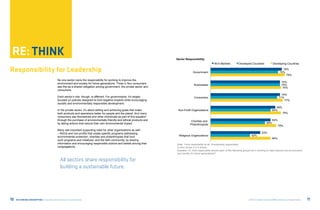
                                              No one sector owns the responsibility for working to improve the
                                                                                                                                                                                                                           74%
                                              environment and society for future generations. Three in four consumers
                                                                                                                                        Businesses                                                                         74%
                                              see this as a shared obligation among government, the private sector and                                                                                                      75%
                                              consumers.
                                                                                                                                                                                                                          74%
                                              Each sector’s role, though, is different. For governments, it’s largely                   Consumers                                                                       71%
                                              focused on policies designed to limit negative impacts while encouraging                                                                                                      77%
                                              socially and environmentally responsible development.
                                                                                                                                                                                                                    69%
                                              In the private sector, it’s about setting and achieving goals that make      Non-Profit Organizations                                                              64%
                                              both products and operations better for people and the planet. And many                                                                                                       75%
                                              consumers see themselves and other individuals as part of this equation
                                              through the purchase of environmentally friendly and ethical products and               Charities and                                                              64%
                                              by taking actions that reduce their own environmental impact.                                                                                                58%
                                                                                                                                     Philanthropists                                                                   70%
                                              Many see important supporting roles for other organizations as well
                                              – NGOs and non-profits that create specific programs addressing                                                                                         53%
                                              environmental protection; charities and philanthropies that fund              Religious Organizations                                        42%
                                                                                                                                                                                                                 64%
                                              such programs and initiatives; and the faith community, by sharing
                                              information and encouraging responsible actions and beliefs among their     Note: 1=not responsible at all, 5=extremely responsible
                                              congregations.                                                              % who chose 4 or 5 shown
                                                                                                                          Question 12: How responsible should each of the following groups be in working to help improve the environment
                                                                                                                          and society for future generations?

                                              	 All sectors share responsibility for
                                                building a sustainable future.


10   RE:THINKING CONSUMPTION Consumers and the Future of Sustainability                                                                                                                 ©2012 All rights reserved BBMG, GlobeScan, SustainAbility   11
Brand Leaders and Laggards (All 6 Markets)
                                                                                                                                                          2.0          2.5            3.0            3.5                     4.0              4.5         5.0   Leader

                                                                                                                                               Google                                                                                  4.2
                                                                                                                                                 Apple                                                                               4.1
                                                                                                                                                 BMW                                                                           4.0


                     THINK
                                                                                                                              Procter & Gamble (P&G)                                                                          4.0
                                                                                                                                            Coca-Cola                                                                         4.0
                                                                                                                                           Volkswagen                                                                        3.9
                                                                                                                                             Walmart*                                                                        3.9
                                                                                                                                             Facebook                                                                        3.9

Corporate Leaders and Laggards                                                                                                                      HP
                                                                                                                                           SC Johnson                                                                    3.9
                                                                                                                                                                                                                             3.9


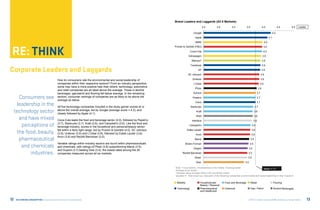
                                               How do consumers rate the environmental and social leadership of                               Unilever                                                                   3.9
                                               companies within their respective sectors? From an industry perspective,                         L’Oréal                                                                 3.8
                                               some may have a more positive halo than others: technology, automotive
                                                                                                                                                 Pfizer                                                                3.8
                                               and retail companies are all rated above the average. Those in alcohol
                                               beverages, gas/petrol and flooring fall below average. In the remaining                         DuPont                                                              3.7

        Consumers see                          sectors, consumer rankings of companies are as likely to be above the
                                               average as below.
                                                                                                                                               Pepsico                                                             3.7


       leadership in the                       All five technology companies included in the study garner scores at or
                                                                                                                                                 Cisco
                                                                                                                                             Starbucks
                                                                                                                                                                                                                   3.7
                                                                                                                                                                                                                 3.7

     technology sector                         above the overall average, led by Google (average score = 4.2), and
                                               closely followed by Apple (4.1).
                                                                                                                                                  Kraft                                                          3.6
                                                                                                                                                  Shell                                                          3.6
        and have mixed                         Coca-Cola leads the food and beverage sector (4.0), followed by PepsiCo                        Interface                                                        3.6

         perceptions of                        (3.7), Starbucks (3.7), Kraft (3.6), and Campbell’s (3.6). Like the food and
                                               beverage industry, scores in the household and personal/beauty sector
                                                                                                                                            Campbell’s                                                      3.6
                                               fall within a fairly tight range, led by Proctor & Gamble (4.0), SC Johnson                Estée Lauder                                                      3.6
       the food, beauty,                       (3.9), Unilever (3.9) and L’Oréal (3.8), followed by Esteé Lauder (3.6),                           Avon                                                     3.6
                                               Avon (3.6) and Reckitt Benckiser (3.5).
        pharmaceutical                                                                                                                           Merck                                                     3.5
                                               Variable ratings within industry sectors are found within pharmaceuticals               Brown-Forman                                                      3.5
         and chemicals                         and chemicals, with ratings of Pfizer (3.8) outperforming Merck (3.5),
                                                                                                                                                Diageo                                                   3.5
                                               and Dupont (3.7) besting Dow (3.4), the lowest rated among the 29
             industries.                       companies measured across all six markets.                                           Reckitt Benckiser                                                  3.5
                                                                                                                                                 Shaw                                                 3.5
                                                                                                                                                  Dow                                              3.4

                                                                                                                              Note: 1=very behind, 3=somewhere in the middle, 5=strong leader                       Mean = 3.7
                                                                                                                              Average score shown
                                                                                                                              *Walmart rating includes ASDA (UK) and Bharti (India)
                                                                                                                              Question 4: How would you rate each of the following companies’ environmental and social leadership in their industry?


                                                                                                                               Mobility               Household and            Food and Beverage           Retail                          Flooring
                                                                                                                                                      Beauty / Personal
                                                                                                                               Technology             Pharmaceutical           Chemical                    Gas / Petrol                    Alcohol Beverages
                                                                                                                                                      and Healthcare


12    RE:THINKING CONSUMPTION Consumers and the Future of Sustainability                                                                                                                               ©2012 All rights reserved BBMG, GlobeScan, SustainAbility         13
Most Important Issues
                                                                                                                                                                                               All 6 Markets
                                                                                                                                Most Important Issues
                                                                                                                                                    Safe drinking water                                                                                                  92%
                                                                                                                                                            HealthcareDeveloped Countries                                   Developing Countries                   87%
                                                                                                                                                                                                                                                                              90%
                                                                                                                                   Fair wages and safe working drinking water
                                                                                                                                                         Safe conditions                                                                                           87%         93%
                                                                                                                                                                                                                                                                    83%
                                                                                                                                                                  Health care


                        THINK
                                                                                                                                           Jobs and economic opportunity                                                                                           86%        92%
                                                                                                                                                                                                                                                                         87%
                                                                                                                                        Fair wages and safeWaste reduction
                                                                                                                                                            working conditions                                                                                     86%   87%
   Most Important Issues                                                                                                                                                                                                                                                85%
                                                                                                                                                    Jobs and economic opportunity
                                                                                                                                                                   Education                                                                                       86%87%
                                                           All 6 Markets
                                                                                                                                                                                                                                                                        84%
                                 Safe drinking water                                                        92%                                            Waste reduction
                                                                                                                                                Ingredient transparency                                                                                            86%88%
                                                                                                                                                                                                                                                                    82%
                                            Healthcare                                                   87%                                                     Education
                                                                                                                               Renewable and alternative energy sources                                                                                            85%    90%


    Most Important Issues
         Fair wages and safe working conditions                                                          87%                                            Ingredient transparency
                                                                                                                                                               Human rights
                                                                                                                                  Renewable and alternative energy sources
                                                                                                                          Conservation of wildlife and environmental habitats
                                                                                                                                                                                                                                                                   84%
                                                                                                                                                                                                                                                                 84% 88%
                                                                                                                                                                                                                                                                   81%
                                                                                                                                                                                                                                                                          90%
                   Jobs and economic opportunity                                                        86%                                                                                                                                                    82%
                                                                                                                                                                                                                                                                   81%
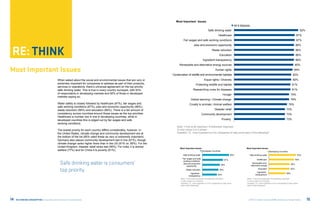
                                   Waste reduction asked about the social and environmental issues that are very or
                                               When                                                        86%                                        Equal rights Human rights
                                                                                                                                                                   / Diversity                                                                                 82%       87%

                                               extremely important for companies to address as part of their products,       Conservation of wildlife and environmental habitats                                                                                80%
                                          Education                                                        86%                               Protecting wildlife and habitat                                                                                  81% 84%
                                               services or operations, there’s universal agreement on the top priority:                                                                                                                                          79%
                           Ingredient transparency                                                         86%
                                               safe drinking water. This is true in every country surveyed, with 93%                      ResearchingEqual rights / Diversity
                                                                                                                                                          cures for diseases                                                                                  81%       85%
                                                                                                                                                                                                                                                               78%
     Renewable and alternative energy sources  of respondents in developing markets and 90% of those in developed
                                                                                                          85%                                         Protecting wildlife and habitat
                                                                                                                                                                          Hunger                                                                             79% 83%
                                               markets saying so.                                                                                                                                                                                                79%
                                      Human rights                                                        84%                                   Researching cures for diseases
                                                                                                                                           Global warming / Climate change                                                                                   79%   82%
                                                                                                                                                                                                                                                                 79%
                                               Water safety is closely followed by healthcare (87%), fair wages and
Conservation of wildlife and environmental habitats                                                     82%                                                              Hunger
                                                                                                                                          Cruelty to animals / Animal welfare                                                                              76%   79%
                                               safe working conditions (87%), jobs and economic opportunity (86%),                                Global warming / Climate Change                                                                          71%
                                                                                                                                                                Disaster relief                                                                        73%               86%
                             Equal rights / Diversity reduction (86%) and education (86%). There is a82%amount of
                                               waste                                                     fair
                                                                                                                                                                                                                                                             78%
                                               consistency across countries around these issues as the top priorities.
                    Protecting wildlife and habitat                                                     81%                                    Cruelty to animals development
                                                                                                                                                     Community / Animal welfare                                                                        73%73%
                                               Healthcare is number two in line in developing countries, while in                                                   Disaster relief                                                                   66%
                                                                                                                                                                      Poverty                                                                          73%         80%
                 Researching cures for diseases                                                         81%
                                               developed countries this is edged out by fair wages and safe
                                                                                                                                                                                                                                                     65%
                                               working conditions.
                                             Hunger                                                    79%                                                   Community development                                                                                 81%
                                                                                                                             Note: 1=not at all important, 5=extremely important
                                                                                                                                                                         Poverty                                                                           71%
                                                                                                                                                                                                                                                             74%
                Global warming / Climate change                                                   79%
                                           The lowest priority for each country differs considerably, however. In            % who chose 4 or 5 shown
                                              the United States, climate change and community development are at             Question 13: How important is it for companies to help solve each of the following?
               Cruelty to animals / Animal welfare                                                  76%                         Note: 1=not at all important, 5=extremely important
                                              the bottom of the list (65% rated these as very or extremely important).
                                     Disaster Germany also places community development last73% (67%), though
                                               relief                                                                           % who chose 4 or 5 shown
                                                                                                   in line                      Question 13: How important is it for companies to help solve each of the following?
                         Community developmentclimate change ranks higher there than in the US (81% vs. 65%). For the
                                                                                                  73%
                                              United Kingdom, disaster relief ranks last (56%). For India, it is animal
                                          Poverty (77%) and for China it is poverty (61%). 73%                                  Most Important Issues                                                    Most Important Issues
                                              welfare                                                                                                   Developed Countries                                                         Developing Countries
                                                                                                                                  Safe drinking water                                     90%               Safe drinking water                                     93%
   Note: 1=not at all important, 5=extremely important
   % who chose 4 or 5 shown                                                                                                       Fair wages and safe                                                                Healthcare                                    92%
                                                                                                                                                                                    87%
                                                    	Safe drinking water is consumers’
                                                                                                                                   working conditions
   Question 13: How important is it for companies to help solve each of the following?                                            Jobs and economic                                                             Renewable and
                                                                                                                                                                               85%                                                                           90%
                                                                                                                                       opportunity                                                             alternative energy

                                                     top priority.                                                                    Waste reduction
                                                                                                                                           Ingredient
                                                                                                                                                                              84%                                     Education
                                                                                                                                                                                                                     Ingredient
                                                                                                                                                                                                                                                       88%
                                                                                                                                                                                                                                                             90%

                                                                                                                                                                            84%                                    transparency
                                                                                                                                         transparency
                                                                                                                                Note: 1=not at all important, 5=extremely important                      Note: 1=not at all important, 5=extremely important
                                                                                                                                % who chose 4 or 5 shown                                                 % who chose 4 or 5 shown
                                                                                                                                Question 13: How important is it for companies to help solve             Question 13: How important is it for companies to help solve
                                                                                                                                each of the following?                                                   each of the following?


    14   RE:THINKING CONSUMPTION Consumers and the Future of Sustainability                                                                                                                                ©2012 All rights reserved BBMG, GlobeScan, SustainAbility            15
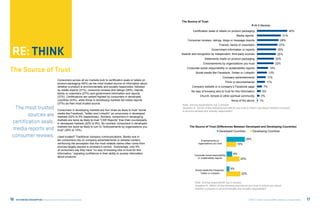
The Source of Trust
                                                                                                                                                                                            All 6 Markets
                                                                                                                                    Certification seals or labels on product packaging                                          40%
                                                                                                                                                                            Media reports                                31%
                                                                                                                               Consumer reviews, ratings, blogs or message boards                                      28%


                    THINK
                                                                                                                                                             Friends, family or coworkers                             27%
                                                                                                                                                     Government information or reports                              25%
                                                                                                                           Awards and recognition by independent, third-party sources                               25%
                                                                                                                                               Statements made on product packaging                               22%
                                                                                                                                             Endorsements by organizations you trust                             22%

The Source of Trust                                                                                                            Corporate social responsibility or sustainability reports
                                                                                                                                      Social media like Facebook, Twitter or LinkedIn
                                                                                                                                                                                                           15%
                                                                                                                                                                                                          13%
                                                                                                                                                                  Company advertisements                 11%
                                              Consumers across all six markets look to certification seals or labels on
                                              product packaging (40%) as the most trusted source of information about                                              Films or documentaries               11%
                                              whether a product is environmentally and socially responsible, followed              Company website or a company’s Facebook page                      7%
                                              by media reports (31%), consumer reviews and ratings (28%), friends,                No way of knowing who to trust for this information              5%
                                              family or coworkers (27%) and government information and reports
                                              (27%). Certifications are ranked highest by consumers in developed                          Church, temple or other spiritual community             3%
                                              countries (43%), while those in developing markets list media reports                                                     None of the above       1%
                                              (37%) as their most trusted source.
                                                                                                                           Note: Among respondents' top 3 choices
  The most trusted                            Consumers in developing markets are four times as likely to trust “social
                                                                                                                           Question 9: Which of the following sources do you trust to inform you about whether a product
                                                                                                                           is environmentally and socially responsible?
         sources are                          media like Facebook, Twitter and LinkedIn” as consumers in developed
                                              markets (22% to 5% respectively). Similarly, consumers in developing
 certification seals,                         markets are twice as likely to trust “CSR Reports” than their counterparts
                                              in developed markets (20% to 9%). By contrast, consumers in developed
                                              markets are twice as likely to turn to “endorsements by organizations you          The Source of Trust (Differences Between Developed and Developing Countries)
 media reports and                            trust” (29% to 15%).                                                                                           Developed Countries         Developing Countries
 consumer reviews.                            Least trusted? Traditional company communications. Barely one in
                                              ten consumers rely on company advertisements or website content,                                                                     29%
                                                                                                                                          Endorsements by
                                              reinforcing the perception that the most reliable claims often come from                  organizations you trust             15%
                                              sources largely beyond a company’s control. Surprisingly, only 5%
                                              of consumers say they have “no way of knowing who to trust for this
                                              information,” signaling confidence in their ability to access information                                                  9%
                                                                                                                                     Corporate social responsibility
                                              about products.                                                                           or sustainability reports              20%


                                                                                                                                                                       5%
                                                                                                                                     Social media like Facebook,
                                                                                                                                          Twitter or LinkedIn                  22%


                                                                                                                                     Note: Among respondents' top 3 choices
                                                                                                                                     Question 9: Which of the following sources do you trust to inform you about
                                                                                                                                     whether a product is environmentally and socially responsible?


16   RE:THINKING CONSUMPTION Consumers and the Future of Sustainability                                                                                                              ©2012 All rights reserved BBMG, GlobeScan, SustainAbility   17
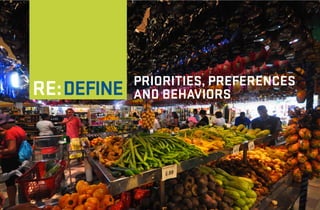
Priorities, Preferences
define   and Behaviors
define
                                                                                                                              Motivations for Switching Brands
                                                                                                                                              All 6 Markets         Developed Countries                  Developing Countries
                                                                                                                                                                                                                       56%
                                                                                                                                 Product performance / Quality                                                   49%
                                                                                                                                                                                                                              64%
                                                                                                                                                                                                                      54%


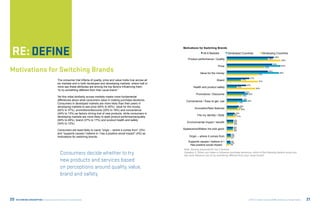
Motivations for Switching Brands
                                                                                                                                                           Price                                             45%
                                                                                                                                                                                                                              64%

                                                                                                                                                                                                                49%
                                                                                                                                           Value for the money                                       37%
                                                                                                                                                                                                                             62%

                                                                                                                                                                                            27%
                                              The consumer trial trifecta of quality, price and value holds true across all                               Brand                     17%
                                                                                                                                                                                                     37%
                                              six markets and in both developed and developing markets, where half or
                                                                                                                                                                                          23%
                                              more say these attributes are among the top factors influencing them                    Health and product safety               12%
                                                                                                                                                                                                  34%
                                              “to try something different from their usual brand.”
                                                                                                                                                                                      22%
                                                                                                                                        Promotions / Discounts                      18%
                                                                                                                                                                                        25%
                                              Yet this initial similarity across markets masks more fundamental
                                              differences about what consumers value in making purchase decisions.                                                                  19%
                                                                                                                                Convenience / Easy to get, use                13%
                                                                                                                                                                                          24%
                                              Consumers in developed markets are more likely than their peers in
                                              developing markets to see price (64% to 45%), value for the money                                                                15%
                                                                                                                                       Innovation/New features                13%
                                                                                                                                                                                16%
                                              (62% to 37%), promotions/discounts (25% to 18%) and convenience
                                              (24% to 13%) as factors driving trial of new products, while consumers in                                                    10%
                                                                                                                                         Fits my identity / Style         8%
                                              developing markets are more likely to seek product performance/quality                                                        11%
                                              (64% to 49%), brand (37% to 17%) and product health and safety                                                             8%
                                              (34% to 12%).                                                                     Environmental impact / benefit           8%
                                                                                                                                                                         8%
                                                                                                                                                                         8%
                                              Consumers are least likely to name “origin – where it comes from” (5%)          Appearance/Makes me look good              7%
                                                                                                                                                                         8%
                                              and “supports causes I believe in / has a positive social impact” (4%) as                                                5%
                                              motivations for switching brands.                                                   Origin – where it comes from          5%
                                                                                                                                                                       4%

                                                                                                                                 Supports causes I believe in /        4%
                                                                                                                                                                        5%
                                                                                                                                  Has positive social impact          3%

                                                                                                                              Note: Among respondents' top 3 choices
                                               	Consumers decide whether to try                                               Question 2: When you make or influence purchase decisions, which of the following factors would you
                                                                                                                              say most influence you to try something different from your usual brand?

                                                new products and services based
                                                on perceptions around quality, value,
                                                brand and safety.


20   RE:THINKING CONSUMPTION Consumers and the Future of Sustainability                                                                                                                    ©2012 All rights reserved BBMG, GlobeScan, SustainAbility   21
define
                                                                                                                            Sustainable Consumption
                                                                                                                                             All 6 Markets            Developed Countries            Developing Countries
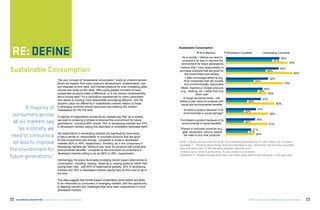
                                                                                                                               As a society, I believe we need to                                                        66%
                                                                                                                               consume a lot less to improve the                                                 57%
                                                                                                                              environment for future generations                                                                  76%

Sustainable Consumption                                                                                                     I believe that I have responsibility to
                                                                                                                            purchase products that are good for
                                                                                                                                  the environment and society
                                                                                                                                                                                                          49%
                                                                                                                                                                                                                        65%
                                                                                                                                                                                                                                       82%
                                                                                                                                  I often encourage others to buy                                           52%
                                              The very concept of “sustainable consumption” holds an inherent tension            from companies that are socially                           34%
                                              driven by impacts from each product’s development, dissemination, use              and environmentally responsible                                                            70%
                                              and disposal on one hand, and market pressure for ever increasing sales         Made, repaired or reused products
                                              volume and scale on the other. Will buying greater numbers of more                                                                                    45%
                                                                                                                             (e.g., clothing, etc.) rather than buy                              39%
                                              sustainable products make a difference, or is the solution fundamentally                      them new*                                                 50%
                                              about buying less? It’s a conundrum experienced by many consumers                 In tough economic times, I am
                                              who aspire to practice more responsible purchasing behavior, and the                                                                                  43%
                                                                                                                            willing to pay more for products with                     26%
                                              dynamic plays out differently in established markets relative to those          social and environmental benefits                                                     60%
         A majority of                        in emerging countries where consumers are entering the modern
                                              marketplace for the first time.                                                  Avoided a product because of its                                37%
                                                                                                                                                                                   22%
  consumers across                            A majority of respondents across all six markets say that “as a society,
                                                                                                                               environmental or social damage*                                              52%

                                                                                                                                                                                              36%
  all six markets say                         we need to consume a lot less to improve the environment for future
                                              generations,” including 66% overall, 76% in developing markets and 57%
                                                                                                                            Purchased a product because of its
                                                                                                                             environmental or social benefits*
                                                                                                                                                                                   22%
                                                                                                                                                                                                            51%
                                              in developed markets saying this describes or completely describes them.
     “as a society, we                                                                                                       Shared or borrowed products (e.g.,
                                                                                                                              gear, equipment, cars) to reduce
                                                                                                                                                                                         31%
                                                                                                                                                                                       27%
                                              Yet respondents in developing markets are significantly more likely
 need to consume a                            to feel a sense of “responsibility to purchase products that are good
                                                                                                                               the need to buy new products*                               35%

                                              for the environment and society,” compared to those in developed
  lot less to improve                         markets (82% to 49%, respectively). Similarly, six in ten consumers in
                                                                                                                            Note: 1=does not describe me at all, 5=completely describes me,% who chose 4 or 5 shown
                                                                                                                            Question 7; Thinking about things that are important to you, and those that are less important,
                                              developing markets are “willing to pay more for products with social and
the environment for                           environmental benefits,” compared to the one-fourth of consumers in
                                                                                                                            how well does each of the following phrases describe you?
                                                                                                                            1=never done, 5=do it all the time, % who chose 4 or 5 shown
                                              developed markets willing to do so (60% to 26%, respectively).
future generations.”                                                                                                        *Question 8: Please indicate how often you have done each of the following in the past year.
                                              Interestingly, the study illuminates emerging trends toward alternatives to
                                              consumption, including “making, repairing or reusing products rather than
                                              buying them new,” with 45% of respondents globally, 50% in developing
                                              markets and 39% in developed markets saying they do this most or all of
                                              the time.

                                              The data suggest that trends toward sustainable consumption are likely
                                              to be influenced by consumers in emerging markets, with the opportunity
                                              to leapfrog barriers and challenges that have been experienced in more
                                              developed markets.


22   RE:THINKING CONSUMPTION Consumers and the Future of Sustainability                                                                                                               ©2012 All rights reserved BBMG, GlobeScan, SustainAbility   23
define                                                                                                Sustainable Behaviors
                                                                                                                                          All 6 Markets             Developed Countries              Developing Countries

Sustainable Behaviors                                                                                                             Recycled materials that can
                                                                                                                                          be recycled                                                           55%
                                                                                                                                                                                                                   61%
                                                                                                                                                                                                                     66%

                                                                                                                              Used my own reusable shopping                                                         61%
                                              The two most common sustainable behaviors among all consumers                   bags, rather than accepting bags                                                       62%
                                              surveyed are recycling and using reusable shopping bags. Six in ten                 from the store or market                                                         59%
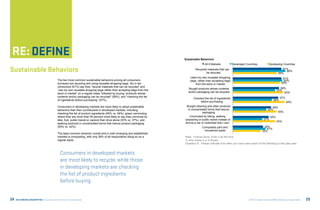
                                              consumers (61%) say they “recycle materials that can be recycled” and
                                                                                                                            Bought products whose contents                                                      58%
                                              “use my own reusable shopping bags rather than accepting bags from the                                                                                          53%
                                                                                                                            and/or packaging can be recycled                                                      63%
                                              store or market” on a regular basis, followed by buying “products whose
                                              contents and/or packaging can be recycled” (58%), and “checking the list                                                                                           57%
                                                                                                                                 Checked the list of ingredients
                                              of ingredients before purchasing” (57%).                                                                                                                    49%
                                                                                                                                      before purchasing                                                                 65%
                                              Consumers in developing markets are more likely to adopt sustainable         Bought cleaning and other products                                          48%
                                              behaviors than their counterparts in developed markets, including             in concentrated forms that reduce                                       42%
                                                                                                                                         packaging                                                              55%
                                              checking the list of product ingredients (65% vs. 49%), green commuting,
                                              where they are more than 50 percent more likely to say they commute by          Commuted by biking, walking,                                             45%
                                              bike, foot, public transit or carpool than drive alone (53% vs. 37%), and   carpooling or public transit instead of                               37%
                                                                                                                                                                                                              53%
                                              seeking products in concentrated forms that reduce product packaging        driving a car or motorbike that I own
                                              (55% vs. 42%).                                                                            Composted yard and                                      38%
                                                                                                                                                                                                  41%
                                                                                                                                         household waste                                      35%
                                              The least common behavior overall and in both emerging and established
                                              markets is composting, with only 38% of all respondents doing so on a       Note: 1=never done, 5=do it all the time
                                              regular basis.                                                              % who chose 4 or 5 shown
                                                                                                                          Question 8: Please indicate how often you have done each of the following in the past year.


                                               	Consumers in developed markets
                                                are most likely to recycle, while those
                                                in developing markets are checking
                                                the list of product ingredients
                                                before buying.


24   RE:THINKING CONSUMPTION Consumers and the Future of Sustainability                                                                                                         ©2012 All rights reserved BBMG, GlobeScan, SustainAbility   25
define
                                                                                                                           Barriers and Levers to Sustainable Purchasing
                                                                                                                                                   All 6 Markets    Developed Countries                     Developing Countries
                                                                                                                             The products performed at least as                                                                 75%
                                                                                                                             well as (or better than) the products                                                               76%
                                                                                                                                        you usually buy                                                                         74%


Barriers and Levers to                                                                                                                         It didn’t cost more
                                                                                                                                                                                                                     61%
                                                                                                                                                                                                                            70%
                                                                                                                                                                                                                                   78%


Sustainable Purchasing                                                                                                         Companies’ environmental and
                                                                                                                             health claims were more believable
                                                                                                                                                                                                                       64%
                                                                                                                                                                                                                        65%
                                                                                                                                                                                                                       64%
                                              How can brands overcome common barriers to purchasing more                    You had a better understanding of                                                          63%
                                              sustainable products?                                                        what makes products environmentally                                                  55%
                                                                                                                                 and socially responsible                                                                     72%
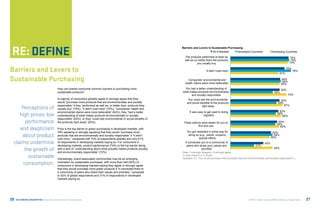
                                              A majority of consumers globally agree or strongly agree that they              You could responsible
                                                                                                                                        see the environmental                                                         63%
                                              would “purchase more products that are environmentally and socially             and social benefits of the products                                                   59%
                                              responsible” if they “performed as well as, or better than, products they                                                                                                 67%
     Perceptions of                           usually buy” (75%), “it didn’t cost more” (70%), “companies’ health and
                                                                                                                                          right away

                                              environmental claims were more believable” (64%), they “had a better              It was easy to get used to doing                                                     62%
    high prices, low                          understanding of what makes products environmentally or socially                             regularly
                                                                                                                                                                                                                   59%
                                                                                                                                                                                                                       65%
                                              responsible” (63%), or they “could see environmental or social benefits of
       performance                            the products right away” (63%).                                               These options were easier for you to                                                   60%
                                                                                                                                                                                                                  58%
                                                                                                                                       find and use                                                                 62%
    and skepticism                            Price is the top barrier to green purchasing in developed markets, with
                                                                                                                              You got rewarded in some way for
                                              78% agreeing or strongly agreeing that they would “purchase more                                                                                               52%
     about product                            products that are environmentally and socially responsible” if “it didn’t
                                              cost more,” compared with 70% of respondents globally and only 61%
                                                                                                                               doing so (e.g., points, coupons,
                                                                                                                                        special offers)
                                                                                                                                                                                                              54%
                                                                                                                                                                                                            50%

 claims undermine                             of respondents in developing markets saying so. For consumers in
                                              developing markets, product performance (74%) is the top barrier along
                                                                                                                             It connected you to a community of
                                                                                                                              peers who share your values and                              31%
                                                                                                                                                                                                     42%

      the growth of                           with a lack of “understanding about what actually makes products socially
                                              and environmentally responsible” (72%).
                                                                                                                                          priorities
                                                                                                                           Note: 1=strongly disagree, 5=strongly agree
                                                                                                                                                                                                               54%


        sustainable                           Interestingly, brand-associated communities may be an emerging
                                                                                                                           % who chose 4 or 5 shown
                                                                                                                           Question 10: You would purchase more products that are environmentally and socially responsible if…

      consumption.                            motivation for sustainable purchases, with more than half (54%) of
                                              consumers in developing markets saying they agree or strongly agree
                                              that they would purchase more green products if “it connected them to
                                              a community of peers who share their values and priorities,” compared
                                              to 42% of global respondents and 31% of respondents in developed
                                              markets saying so.


26   RE:THINKING CONSUMPTION Consumers and the Future of Sustainability                                                                                                             ©2012 All rights reserved BBMG, GlobeScan, SustainAbility   27
Happiness, Collaboration
NEW   and Participation
NEW                                                                                                    The Dynamics of Happiness

                                                                                                                                            All 6 Markets          Developed Countries             Developing Countries

The Dynamics of Happiness                                                                                                       Friends and family are                                                                                 85%
                                                                                                                               more important to me than                                                                              83%
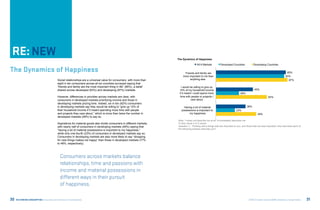
                                              Social relationships are a universal value for consumers, with more than               anything else                                                                                      87%
                                              eight in ten consumers across all six countries surveyed saying that
                                              “friends and family are the most important thing in life” (85%), a belief       I would be willing to give up
                                              shared across developed (83%) and developing (87%) markets.                   10% of my household income                                              45%
                                                                                                                            if it meant I could spend more                            28%
                                              However, differences in priorities across markets are clear, with              time with people or projects I                                                        62%
                                              consumers in developed markets prioritizing income and those in                          care about
                                              developing markets prizing time. Indeed, six in ten (62%) consumers
                                              in developing markets say they would be willing to “give up 10% of                Having a lot of material                                    36%
                                              their household income if it meant spending more time with people               possessions is important to                         23%
                                              and projects they care about,” which is more than twice the number in                 my happiness                                                       49%
                                              developed markets (28%) to say so.
                                                                                                                           Note: 1=does not describe me at all, 5=completely describes me
                                              Aspirations for material goods also divide consumers in different markets,   % who chose 4 or 5 shown
                                              with nearly half of consumers in developing markets (49%) saying that        Question 7; Thinking about things that are important to you, and those that are less important, how well does each of
                                                                                                                           the following phrases describe you?
                                              “having a lot of material possessions is important to my happiness,”
                                              while only one-fourth (23%) of consumers in developed markets say so.
                                              Consumers in developing markets are also more likely to say “shopping
                                              for new things makes me happy” than those in developed markets (77%
                                              to 48%, respectively).


                                               	Consumers across markets balance
                                                relationships, time and passions with
                                                income and material possessions in
                                                different ways in their pursuit
                                                of happiness.

30   RE:THINKING CONSUMPTION Consumers and the Future of Sustainability                                                                                                                       ©2012 All rights reserved BBMG, GlobeScan, SustainAbility   31
NEW
                                                                                                                         Collaboration and Participation

                                                                                                                                             All 6 Markets            Developed Countries                Developing Countries


                                                                                                                                                                                                                                     72%
                                                                                                                         I believe in voting and advocating

Collaboration and Participation
                                                                                                                                                                                                                                67%
                                                                                                                             for issues important to me
                                                                                                                                                                                                                                         77%


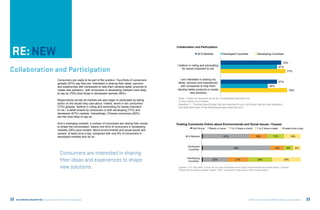
                                              Consumers are ready to be part of the solution. Two-thirds of consumers      I am interested in sharing my
                                                                                                                         ideas, opinions and experiences                                                                        67%
                                              globally (67%) say they are “interested in sharing their ideas, opinions
                                              and experiences with companies to help them develop better products or       with companies to help them                                                                56%
                                              create new solutions,” with consumers in developing markets more likely    develop better products or create                                                                                 79%
                                              to say so (79%) than those in developed markets (56%).                               new solutions

                                                                                                                          Note: 1=does not describe me at all, 5=completely describes me
                                              Respondents across all markets are also eager to participate by taking      % who chose 4 or 5 shown
                                              action on the issues they care about. Indeed, seven in ten consumers        Question 7; Thinking about things that are important to you, and those that are less important,
                                              (72%) globally “believe in voting and advocating for issues important       how well does each of the following phrases describe you?
                                              to me,” a belief shared by consumers in both developing (77%) and
                                              developed (67%) markets. Interestingly, Chinese consumers (80%)
                                              are the most likely to say so.

                                              And in emerging markets, a number of consumers are raising their voices    Posting Comments Online about Environmental and Social Issues / Causes
                                              to shape the conversation. Nearly one-third of consumers in developing
                                                                                                                                       Don't Know        Rarely or never      1 to 2 times a month      1 to 2 times a week         At least once a day
                                              markets (29%) post content “about environmental and social issues and
                                              causes” at least once a day, compared with only 8% of consumers in
                                              developed markets who do so.                                                       All 6 Markets                         47%                             18%                17%                 18%


                                                                                                                                   Developed
                                                                                                                                                                                 68%                                        14%          9%       8%
                                                                                                                                   Countries
                                               	Consumers are interested in sharing
                                                their ideas and experiences to shape                                               Developing
                                                                                                                                    Countries
                                                                                                                                                            25%                    21%                   24%                          29%


                                                new solutions.                                                            Question 11b: How often, if at all, do you post comments online about environmental and social issues / causes?
                                                                                                                          (These may be status updates, tweets, “likes,” comments, blog posts or other social media.)


32   RE:THINKING CONSUMPTION Consumers and the Future of Sustainability                                                                                                                         ©2012 All rights reserved BBMG, GlobeScan, SustainAbility   33
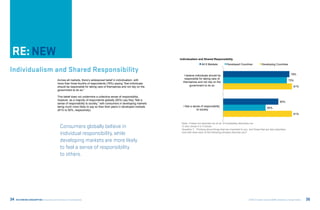
NEW                                                                                                   Individualism and Shared Responsibility
                                                                                                                                             All 6 Markets         Developed Countries               Developing Countries

Individualism and Shared Responsibility                                                                                                                                                                                              78%
                                                                                                                             I believe individuals should be
                                                                                                                             responsible for taking care of
                                              Across all markets, there’s widespread belief in individualism, with                                                                                                                75%
                                                                                                                            themselves and not rely on the
                                              more than three-fourths of respondents (78%) saying “that individuals
                                              should be responsible for taking care of themselves and not rely on the             government to do so                                                                                  81%
                                              government to do so.”

                                              This belief does not undermine a collective sense of responsibility,
                                              however, as a majority of respondents globally (65%) say they “feel a
                                                                                                                                                                                                                         65%
                                              sense of responsibility to society,” with consumers in developing markets
                                              being much more likely to say so than their peers in developed markets        I feel a sense of responsibility
                                                                                                                                                                                                           50%
                                              (81% to 50%, respectively).                                                               to society
                                                                                                                                                                                                                                       81%


                                                                                                                           Note: 1=does not describe me at all, 5=completely describes me
                                               	Consumers globally believe in                                              % who chose 4 or 5 shown
                                                                                                                           Question 7; Thinking about things that are important to you, and those that are less important,
                                                individual responsibility, while                                           how well does each of the following phrases describe you?


                                                developing markets are more likely
                                                to feel a sense of responsibility
                                                to others.


34   RE:THINKING CONSUMPTION Consumers and the Future of Sustainability                                                                                                                ©2012 All rights reserved BBMG, GlobeScan, SustainAbility   35
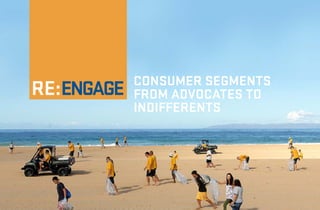
Consumer Segments
engage   from Advocates to
         Indifferents
ENGAGE                                                                                            Consumer Segmentation
                                                                                                                                 Practicals                Aspirationals             Advocates                       Indifferents

Consumer Segmentation                                                                                                  All 6
                                                                                                                                               34%                                37%                             14%                16%
                                                                                                                      Markets
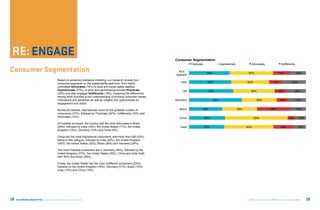
                                              Based on advanced statistical modeling, our research reveals four
                                              consumer segments on the sustainability spectrum, from highly              USA                   36%                               32%                        11%                  22%
                                              committed Advocates (14%) to style and social status seeking
                                              Aspirationals (37%), to price and performance-minded Practicals             UK                    37%                                 35%                          10%                18%
                                              (34%) and less engaged Indifferents (16%). Exploring the differences
                                              among them provides a rich understanding of evolving consumer values,
                                              motivations and behaviors as well as insights and opportunities for     Germany                        45%                                  29%                      10%              17%
                                              engagement and action.

                                              Across all markets, Aspirationals count for the greatest number of        Brazil            28%                              29%                           28%                         15%
                                              consumers (37%), followed by Practicals (34%), Indifferents (16%) and
                                              Advocates (14%).                                                          China                 30%                                      53%                                    6%        10%
                                              Of markets surveyed, the country with the most Advocates is Brazil
                                              (28%), followed by India (16%), the United States (11%), the United        India                30%                                42%                                16%                12%
                                              Kingdom (10%), Germany (10%) and China (6%)

                                              China has the most Aspirational consumers, with more than half (53%)
                                              falling in this category, followed by India (42%), the United Kingdom
                                              (35%), the United States (32%), Brazil (29%) and Germany (29%).

                                              The most Practical consumers are in Germany (45%), followed by the
                                              United Kingdom (37%), the United States (36%), China and India (both
                                              with 30%) and Brazil (28%).

                                              Finally, the United States has the most Indifferent consumers (22%),
                                              followed by the United Kingdom (18%), Germany (17%), Brazil (15%)
                                              India (12%) and China (10%).


38   RE:THINKING CONSUMPTION Consumers and the Future of Sustainability                                                                                                           ©2012 All rights reserved BBMG, GlobeScan, SustainAbility   39
DEMOGRAPHIC PROFILE:

                                                                                                                            •	 48% Male / 52% Female

                                                                                                                            •	 27% are Millennials

                                                                                                                            •	 38% have a child under 17 years


                    ENGAGE
                                                                                                                            •	 Least likely to be retired (13%)

                                                                                                                            •	 More urban (52% live in a major city)


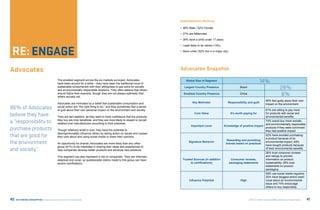
Advocates                                                                                                                   Advocates Snapshot
                                              The smallest segment across the six markets surveyed, Advocates
                                              have been around for a while – they have been the traditional locus of
                                                                                                                                 Global Size of Segment                                           14%
                                              sustainable consumerism with their willingness to pay extra for socially
                                              and environmentally responsible solutions. They often believe that others
                                                                                                                               Largest Country Presence                       Brazil                                     28%
                                              should follow their example, though they are not always optimistic that
                                              others actually will.
                                                                                                                              Smallest Country Presence                       China                                       6%
                                                                                                                                                                                                         59% feel guilty about their own
                                              Advocates are motivated by a belief that sustainable consumption and                    Key Motivator                 Responsibility and guilt
                                                                                                                                                                                                         impact on the environment
86% of Advocates                              social action are “the right thing to do,” and they sometimes feel a sense
                                              of guilt about their own personal impact on the environment and society.                                                                                   61% are willing to pay more
believe they have                             They are fact seekers, as they want to have confidence that the products
                                                                                                                                        Core Value                     It’s worth paying for             for products with social and
                                                                                                                                                                                                         environmental benefits

a “responsibility to                          they buy are truly beneficial, and they are more likely to reward or punish
                                              retailers and manufacturers according to their practices.
                                                                                                                                                                                               74% would buy more socially
                                                                                                                                                                                               and environmentally responsible
                                                                                                                                     Important Lever              Knowledge of positive impact
purchase products                             Though relatively small in size, they have the potential to
                                                                                                                                                                                               products if they were convinced
                                                                                                                                                                                               they had positive impact
                                              disproportionately influence others by taking action on issues and causes
that are good for                             they care about and using social media to share their opinions.
                                                                                                                                                                                                         52% have avoided purchasing
                                                                                                                                                                                                         a product because of its
                                                                                                                                                                   Rewarding and punishing
the environment                               An opportunity for brands, Advocates are more likely than any other
                                                                                                                                   Signature Behavior
                                                                                                                                                                   brands based on practices
                                                                                                                                                                                                         environmental impact; 49%
                                                                                                                                                                                                         have bought products because
                                              group (81%) to be interested in sharing their ideas and experiences to
and society.”                                 help companies develop better products and advance new solutions.
                                                                                                                                                                                                         of their environmental benefits
                                                                                                                                                                                                         26% trust consumer reviews
                                              This segment can also represent a risk to companies. They are informed,                                                                                    and ratings to provide
                                              skeptical and vocal, so questionable claims made to this group can have         Trusted Sources (in addition              Consumer reviews,                information on product
                                              severe ramifications.                                                                 to certifications)                 packaging statements              sustainability, 25% trust
                                                                                                                                                                                                         statements on product
                                                                                                                                                                                                         packaging
                                                                                                                                                                                                         59% use social media regularly,
                                                                                                                                                                                                         25% have blogged and/or been
                                                                                                                                   Influence Potential                         High                      vocal about an environmental
                                                                                                                                                                                                         issue and 74% encourage
                                                                                                                                                                                                         others to buy responsibly


40   RE:THINKING CONSUMPTION Consumers and the Future of Sustainability                                                                                                                ©2012 All rights reserved BBMG, GlobeScan, SustainAbility   41
DEMOGRAPHIC PROFILE:

                                                                                                                              •	 Male 49% / Female 51%

                                                                                                                              •	 26% are Millennials

                                                                                                                              •	 Most likely to have a child under 17 years (40%)


                    ENGAGE
                                                                                                                              •	 14% are retirees

                                                                                                                              •	 Most urban (54% live in a major city)


Aspirationals                                                                                                                 Aspirationals Snapshot

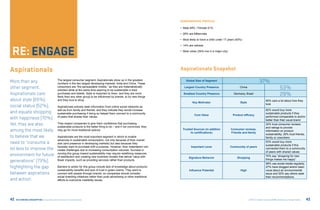
More than any                                 The largest consumer segment, Aspirationals show up in the greatest
                                              numbers in the two largest developing markets, India and China. These
                                                                                                                                  Global Size of Segment                                          37%
other segment,                                consumers are “the persuadable middle,” as they are materialistically
                                              oriented while at the same time aspiring to be sustainable in their
                                                                                                                                 Largest Country Presence                      China                                     53%
Aspirationals care                            purchases and beliefs. Style is important to them, and they are more              Smallest Country Presence                  Germany, Brazil                               29%
                                              likely than any other group to be influenced by brands, to try new things
about style (65%),                            and they love to shop. 
                                                                                                                                        Key Motivator                          Style
                                                                                                                                                                                                         65% care a lot about how they
                                                                                                                                                                                                         look
social status (52%),                          Aspirationals actively seek information from online social networks as
                                              well as from family and friends, and they indicate they would increase                                                                                     82% would buy more
and equate shopping                           sustainable purchasing if doing so helped them connect to a community                                                                                      sustainable products if they
                                                                                                                                         Core Value                       Product efficacy
                                                                                                                                                                                                         performed comparable to and/or
with happiness (70%).                         of peers that shares their values.
                                                                                                                                                                                                         better than their usual brand
Yet, they are also                            They expect companies to give them confidence that purchasing
                                              sustainable products is the better thing to do – and if not convinced, they
                                                                                                                                                                                                         32% trust consumer reviews
                                                                                                                                                                                                         and ratings to provide
among the most likely                         may go for more traditional options.                                              Trusted Sources (in addition
                                                                                                                                      to certifications)
                                                                                                                                                                         Consumer reviews,
                                                                                                                                                                         Friends and family
                                                                                                                                                                                                         information on product
                                                                                                                                                                                                         sustainability; 28% trust friends,
to believe that we                            Aspirationals are the most important segment in which to enable                                                                                            family or coworkers
                                              advances in sustainable consumption, not only because of their overall
need to “consume a                            size (and presence in developing markets) but also because they
                                                                                                                                                                                                         53% would buy more
                                                                                                                                                                                                         sustainable products if this
                                              honestly want to purchase with a purpose. However, their materialism can                Important Lever                    Community of peers
lot less to improve the                       create challenges due to increasing consumption volumes. Success in
                                                                                                                                                                                                         connected them to a community
                                                                                                                                                                                                         of peers with shared values
environment for future                        moving this group toward sustainability may require redefining measures
                                              of satisfaction and creating new business models that deliver value with                                                                                   70% say “shopping for new
                                                                                                                                     Signature Behavior                      Shopping
                                                                                                                                                                                                         things makes me happy”
generations” (73%),                           fewer impacts, such as providing services rather than products.
                                                                                                                                                                                                         58% use social media regularly,
highlighting the gap                          Barriers to action for this group include lack of knowledge about products’                                                                                27% have blogged and/or been
                                              sustainability benefits and lack of trust in green claims. They want to                Influence Potential                        High                     vocal about an environmental
between aspirations                           connect with people through brands, so companies should consider                                                                                           issue and 52% say others seek
                                              social branding initiatives rather than push advertising or other traditional                                                                              their recommendations
and action.                                   efforts to overcome credibility issues.


42   RE:THINKING CONSUMPTION Consumers and the Future of Sustainability                                                                                                                ©2012 All rights reserved BBMG, GlobeScan, SustainAbility   43
DEMOGRAPHIC PROFILE:

                                                                                                                           •	 Male 49% / Female 51%

                                                                                                                           •	 29% are Millennials

                                                                                                                           •	 33% have a child under 17 years


                    ENGAGE
                                                                                                                           •	 More likely than other segments to be retired (18%)

                                                                                                                           •	 Less urban (57% live in a suburb, small town or rural area)


Practicals                                                                                                                 Practicals Snapshot
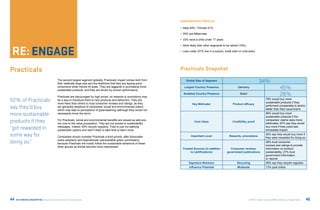
                                              The second largest segment globally, Practicals’ impact comes both from
                                              their relatively large size and the likelihood that they are tipping-point
                                                                                                                               Global Size of Segment                                           34%
                                              consumers when trends hit scale. They are laggards in purchasing more
                                              sustainable products, and they are driven by proven performance.
                                                                                                                              Largest Country Presence                    Germany                                      45%
                                              Practicals are discouraged by high prices, so rewards or promotions may
                                                                                                                             Smallest Country Presence                      Brazil                                     28%
52% of Practicals                             be a way to introduce them to new products and behaviors. They are
                                              more likely than others to trust consumer reviews and ratings, as they
                                                                                                                                                                                                       78% would buy more
                                                                                                                                                                                                       sustainable products if they
                                                                                                                                    Key Motivator                     Product efficacy
say they’d buy                                are generally skeptical of companies’ social and environmental claims,
                                              which may lead to perceptions of greenwashing (although they would not
                                                                                                                                                                                                       performed comparable to and/or
                                                                                                                                                                                                       better than their usual brand

more sustainable                              necessarily know the term).                                                                                                                              68% would buy more
                                                                                                                                                                                                       sustainable products if the
products if they                              For Practicals, social and environmental benefits are viewed as add-ons,
                                              not core to the value proposition. They are not averse to sustainability
                                                                                                                                      Core Value                      Credibility, proof
                                                                                                                                                                                                       companies’ claims were more
                                                                                                                                                                                                       believable; 67% say they would
“got rewarded in                              messages. Indeed, 60% recycle regularly. They’re just not seeking
                                              sustainable options and aren’t likely to take time to learn more.
                                                                                                                                                                                                       buy more if they could see
                                                                                                                                                                                                       immediate impact

some way for                                  Companies should consider Practicals a third priority, after Advocates               Important Lever                 Rewards, promotions
                                                                                                                                                                                                       52% say they would buy more if
                                                                                                                                                                                                       they were rewarded for doing so
                                              (early adopters) and Aspirationals (persuadable green purchasers),
doing so.”                                    because Practicals will mostly follow the sustainable behaviors of these
                                                                                                                                                                                                       28% trust consumer
                                                                                                                                                                                                       reviews and ratings to provide
                                              other groups as trends become more mainstream.
                                                                                                                             Trusted Sources (in addition          Consumer reviews,                   information on product
                                                                                                                                   to certifications)            government publications               sustainability; 27% trust
                                                                                                                                                                                                       government information
                                                                                                                                                                                                       or reports
                                                                                                                                  Signature Behavior                      Recycling                    59% say they recycle regularly
                                                                                                                                  Influence Potential                     Moderate                     13% post online


44   RE:THINKING CONSUMPTION Consumers and the Future of Sustainability                                                                                                              ©2012 All rights reserved BBMG, GlobeScan, SustainAbility   45
DEMOGRAPHIC PROFILE:

                                                                                                                               •	 Male 56 % / Female 44%

                                                                                                                               •	 30% are Millennials

                                                                                                                               •	 33% have a child under 17 years


                    ENGAGE
                                                                                                                               •	 More likely than other segments to be retired (18%)

                                                                                                                               •	 Least urban (60% live in a suburb, small town or rural area)


Indifferents                                                                                                                   Indifferents Snapshot
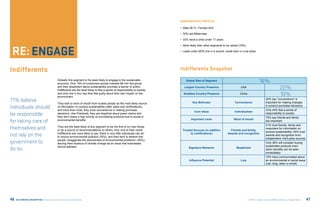
                                              Globally this segment is the least likely to engage in the sustainable
                                              economy. Only 16% of consumers across markets fall into this group
                                                                                                                                   Global Size of Segment                                          16%
                                              and their skepticism about sustainability provides a barrier to action.
                                              Indifferents are the least likely to feel a sense of responsibility to society
                                                                                                                                  Largest Country Presence                       USA                                      22%
                                              and only one in four say they feel guilty about their own impact on the
                                              environment.
                                                                                                                                 Smallest Country Presence                      China                                     10%
71% believe                                   They look to word of mouth from trusted people as the most likely source                   Key Motivator                      Convenience
                                                                                                                                                                                                          20% say “convenience” is
                                                                                                                                                                                                          important for making changes
individuals should                            of information on product sustainability (after seals and certifications),
                                              and more than most, they prize convenience in making purchase
                                                                                                                                                                                                          in product purchase decisions
                                                                                                                                                                                                          Only 44% feel a sense of
                                                                                                                                          Core Value                        Individualism
be responsible                                decisions. Like Practicals, they are skeptical about green claims and
                                              they don’t place a high priority on purchasing products due to social or
                                                                                                                                                                                                          responsibility to society
                                                                                                                                                                                                          75% say friends and family
                                                                                                                                       Important Lever                     Word of mouth
for taking care of                            environmental benefits.                                                                                                                                     are important
                                                                                                                                                                                                          31% trust friends, family and
themselves and                                They are the least likely of any segment to be the first to try new things
                                              or be a source of recommendations to others. And, true to their name,              Trusted Sources (in addition           Friends and family,
                                                                                                                                                                                                          coworkers for information on
                                                                                                                                                                                                          product sustainability; 24% trust
not rely on the                               Indifferents are more likely to say “there is very little individuals can do”
                                              to reduce environmental pollution (35%), and they tend to believe that
                                                                                                                                       to certifications)             Awards and recognition
                                                                                                                                                                                                          awards and recognition from
                                                                                                                                                                                                          independent, third party sources
                                              people “exaggerate the seriousness of environmental problems” (36%),
government to                                 leaving them dubious of climate change as an issue that businesses                                                                                          Only 36% will consider buying
                                              should address.                                                                                                                                             sustainable products even
do so.                                                                                                                                Signature Behavior                     Skepticism
                                                                                                                                                                                                          when benefits can be seen
                                                                                                                                                                                                          immediately
                                                                                                                                                                                                          15% have communicated about
                                                                                                                                      Influence Potential                        Low                      an environmental or social issue
                                                                                                                                                                                                          (call, blog, letter or email)


46   RE:THINKING CONSUMPTION Consumers and the Future of Sustainability                                                                                                                 ©2012 All rights reserved BBMG, GlobeScan, SustainAbility   47
Regeneration Consumer Segments


                                                                                                                                                                                            J
                                                                                                                                                                                       Aspirationals


Implications and Opportunities for Action
                                              The Regeneration Consumer Study reveals the important role consumers


                                                                                                                                         Materialism
                                              are playing on the path to sustainability, as well as opportunities to                                     J    Indifferents
                                              address barriers to sustainable consumption and seize promising
                                                                                                                                                                                Practicals
                                                                                                                                                                                    J
                                              pathways forward.

                                              On one hand, consumers across all six markets are calling for brands to
                                              innovate, saying they would purchase more socially and environmentally
                                              responsible products if only they performed better, cost less and had
                                              more believable claims. There is no surprise here.


                                                                                                                                                                                                                             trr2012_segmap
                                                                                                                                                                                                    Advocates
                                              But on the other hand, consumers are ready to do their part, believing
                                              that, as a society, we need to consume a lot less and work to improve                                                                                      J
                                              the environment and society for future generations. They believe that
                                              companies should address social and environmental issues like water,                                     -1.4                                                            1.2
                                              healthcare and fair wages through their products, practices and policies.                                                      Environmentalism
                                              And, they are interested in lending their ideas, opinions and experiences
                                              to help companies create better products and new solutions.
                                                                                                                            To realize this moment, following are five implications that present
                                              Our analysis has identified a set of consumers that we think represents a     opportunities for action:
                                              vital opportunity to advance sustainable consumption in the future. Their
                                              desire to both shop for better products and help better the planet is clear   1. Deliver Total Value
                                              in our consumer segmentation model.
                                                                                                                            Making a product that’s good for our planet is important, but, for consumers, it’s not enough.
                                              The Aspirationals, the largest consumer segment, are seeking to               Aspirational consumers crave what we call ‘total value’: products that deliver practical
                                              reconcile the tendency toward materialism with their social and               benefits like price and quality but that also negate buyer’s remorse by providing societal
                                              environmental values (see figure on opposite page). Understanding             and environmental good and provide “tribal benefits” that help them feel connected to a
                                              this dynamic tension – between material possessions and social and            larger community that shares their values. Brands that hit on all three categories – and
                                              environmental progress – provides the greatest opportunity to create          effectively communicate as much – will be rewarded with the loyalty of these consumers,
                                              positive impact through consumers’ purchasing decisions and                   particularly in emerging markets like Brazil, India and China. 
                                              social actions.
                                                                                                                            2. Connect Back Story to Brand Story
                                              As the largest consumer segment in Brazil, China and India, Aspirationals
                                              represent hundreds of millions of consumers – growing to perhaps billions     Aspirational consumers are asking both “What’s in it for me?” and “What’s in it for we?”
                                              by 2050. And we believe that any forward-thinking brand should prioritize     They’re thinking – and reading, and blogging and tweeting – about their purchases and the
                                              reaching them to redefine value, earn their trust and inspire them to lead    causes that impact their families, communities and planet.
                                              their peers.
                                                                                                                            Done right, brands can connect with consumers on a deeper level and win their respect by
                                                                                                                            telling the larger story behind their products. Sustainability-minded marketers will invite them
                                                                                                                            to discover and experience the life cycle of their products, the people who make them, and the
                                                                                                                            social and environmental progress that’s being accomplished over time. Consumers expect
                                                                                                                            transparency and authenticity. Brands can build credibility by sharing the good, acknowledging
                                                                                                                            the bad and inviting new ideas and solutions to tackle challenges together.


48   RE:THINKING CONSUMPTION Consumers and the Future of Sustainability                                                                                                                      ©2012 All rights reserved BBMG, GlobeScan, SustainAbility   49
3. Embrace Sustainable Brand Innovation

              Aspirational consumers love shopping, prize social connections and they also want to make
              a difference for people and the planet. We believe the best way to deliver on these seemingly
              conflicting desires is by embracing sustainable brand innovation whereby companies

                                                                                                               In the end,
              consider the full set of relationships in every part of the value chain –consumer, product,
              brand, community and planet – and unleash the mutually beneficial roles that we can play as
              individuals, organizations and as a society.

              Brands will win by embedding sustainability and social purpose into every business strategy,
              product design and stakeholder relationship. And by creating better brands, products,
                                                                                                               we believe that by
              packaging and platforms, companies can become agents of change at a faster speed and
              larger scale than ever before.                                                                   better understanding the
              4. Harness Consumer Collaboration

              Once upon a time, branding was a top-down proposition allowing companies to tell stories of
                                                                                                               aspirations and actions
              their choosing to their “audience.” But in today’s new marketing paradigm, participation is a
              powerful new currency. Particularly in emerging markets, consumers see themselves as fans,
              co-creators and champions of the brands in their lives, and they’re weighing in on corporate
                                                                                                               of consumers, brands
              promises and practices – whether asked to or not.

              Consumer collaboration can be an important driver of sustainability, uniting both experts
                                                                                                               have the opportunity to
              and consumers in generating smarter ideas and solutions because they come from both the
              makers and users of the products and services themselves.                                        Re:THINK consumption,
              We believe that brands embracing collaboration will experience deeper engagement on the
              issues that matter as well as richer collaboration on innovation opportunities and business
              benefits including tapping new markets, accelerating product trial and building consumer
                                                                                                               Re:DEFINE value and
              loyalty that drives long-term success.

              5. Unleash the Power of Tribes
                                                                                                               Re:IMAGININE a more
              Consumers may need stuff, but what they really want is to connect: to each other and to the
              brands that matter to them. More than eight in ten consumers prize friends and family as the
                                                                                                               sustainable future.
              most important thing in life and they are turning to their social networks as well as consumer
              reviews to discover, choose and share brands.

              Similarly, more than half of Aspirational consumers would buy more sustainable products if it
              connected them to a community of peers that shares their values, perhaps uniting their desire
              for social status, connections to others and the chance to make a difference together.

              Every imaginable product category enjoys its niche community of passionate enthusiasts,
              and brands can leverage the power of tribes by connecting the like-minded, championing
              their ideas and extending their voice to extend their reach and impact.


50   RE:THINKING CONSUMPTION Consumers and the Future of Sustainability                                                     ©2012 All rights reserved BBMG, GlobeScan, SustainAbility   51
METHODOLOGY:

  Developed by BBMG, GlobeScan and SustainAbility, The Regeneration Consumer Study is an online survey of
  consumer attitudes, motivations and behaviors around sustainable consumption among 6,224 respondents in six major
  international markets (Brazil, China, Germany, India, United Kingdom and United States). Fielded in September and
  October 2012, the study represents a holistic exploration of sustainability market trends, priorities and engagement
  pathways, including information on sustainable consumption, trust, transparency, social issues, behavior change,
  consumer collaboration, participation and advocacy actions. Data across all six international markets reflect a margin
  of error of +/- 1.3 percent. Specific country-level data reflect a margin of error of +/- 3.1 percent.


  CREDITS AND SPONSORS

  Written by Raphael Bemporad, Amy Hebard and Daniel Bressler at BBMG
  Creative Direction: Mitch Baranowski at BBMG
  Art Direction: Jess Oswald, Meng Shui at BBMG
  Designers: Lauren Houston, Meng Shui at BBMG
  Research Team: Eugene Kritski, Crystal Yang and Lorena Lara at GlobeScan; Amy Hebard at BBMG
  Regeneration Roadmap Team: Chris Coulter and Eric Whan at GlobeScan; Mark Lee and Lindsay Clinton at SustainAbility

  Re:Think photo courtesy of Kintarojoe via www.flickr.com.
  Re:Define photo courtesy of Karen Blumberg via www.flickr.com/photos/specialkrb/5574533078/.
  Re:New photo courtesy of Anurag Agnihotri via www.flickr.com.
  Re:Engage photo courtesy of Mass Communication Specialist 1st Class Jay C. Pugh of the US Navy via www.flickr.com.


  REGENERATION ROADMAP PRESENTING SPONSORS:


  REGENERATION ROADMAP SPONSORS:


  REGENERATION CONSUMER STUDY SPONSORS:


                                                                                                  SUSTAINABILITYLOGOTYPE FOR PRINT ONLY


RE:THINKING CONSUMPTION Consumers and the Future of Sustainability
©2012 All rights reserved BBMG, GlobeScan, SustainAbility

Regeneration Roadmap: Rethinking Consumption

  • 1.
    Consumers and theFuture of Sustainability SUSTAINABILITYLOGOTYPE FOR PRINT ONLY
  • 2.
    Contents 4 INTRODUCTION About This Study Developed by BBMG, GlobeScan and SustainAbility, The Regeneration Consumer Study is an online survey of consumer attitudes, motivations and behaviors around sustainable consumption among 6,224 respondents in six major international markets (Brazil, China, Germany, THINK define India, United Kingdom and United States). Fielded in September and Responsibility, Leadership and Trust Priorities, Preferences and Behaviors October 2012, the study represents a holistic exploration of sustainability market trends, priorities and engagement pathways, including information 10 Responsibility for Leadership 20 Motivations for Switching Brands on sustainable consumption, trust, transparency, social issues, behavior 12 Corporate Leaders and Laggards 22 Sustainable Consumption change, consumer collaboration, participation and advocacy actions. 14 Most Important Issues 24 Sustainable Behaviors 16 The Source of Trust 26 Barriers and Levers to Sustainable The overarching goal of the study is to bring the consumer voice into Purchasing the sustainability conversation and help articulate specific decisions and actions that companies can take to accelerate and grow a more sustainable economy. Specifically, the study seeks to: • Uncover consumer motivations that drive their interest in living sustainable lives – and provide opportunities for companies to create products and services with beneficial economic, social and environmental impact; • Provide insights and implications that help companies make the business case for sustainability and advance the creation and NEW ENGAGE deployment of more sustainable products, policies and practices; and Happiness, Collaboration Consumer Segments from • Better understand how companies can engage consumers in creating a and Participation Advocates to Indifferents sustainable economy and future. 30 The Dynamics of Happiness 40 Advocates 32 Collaboration and Participation 42 Aspirationals The study is part of The Regeneration Roadmap, a collaborative and 34 Individualism and Shared 44 Practicals multi-faceted thought leadership initiative designed to engage the private Responsibility 46 Indifferents sector in advancing and achieving sustainable development by improving sustainability strategy, increasing credibility and delivering results at greater speed and scale. 48 IMPLICATIONS AND OPPORTUNITIES FOR ACTION We thank Presenting Sponsors BMW Group and SC Johnson, and Sponsors Cisco, DuPont, Interface and Pfizer for their support of the Regeneration Roadmap as well as Brown-Forman, Campbell’s, Itau, 52 METHODOLOGY, CREDITS, and SPONSORS L’Oréal, Shell and Starbucks for their direct support of the Regeneration Consumer Study. 2 RE:THINKING CONSUMPTION Consumers and the Future of Sustainability ©2012 All rights reserved BBMG, GlobeScan, SustainAbility 3
  • 3.
    Introduction Twenty years after the first Rio Earth Summit, the global economy and natural environment face unprecedented stresses as scarce resources are stretched to meet growing needs. Economists brace for “peak everything” and “the end of growth” while citizens around the world question ways of doing business that prioritize short-term, transactional, profit-only thinking over long-term, transparent and trusted relationships that drive shared value. Consumers are Global challenges persist from climate change and safe drinking water to jobs, health and education, while demographers expect profound social Re:THINKING consumption, and environmental impacts as two billion more people will live on the planet by 2050. Re:DEFINING success and Amidst all this, new research with over 6,000 consumers across six countries provides evidence that a new marketplace is rising. That attitudes and behaviors are shifting. That opportunities for collaboration Re:IMAGINING the future of a are expanding. And that a new cadre of enterprising brands is seizing the moment to innovate smarter, safer, cleaner and greener solutions. more sustainable economy. As mission-driven brands focus on taking sustainability to scale and the largest corporations leverage their capabilities to advance sustainability, the role of consumers has never been more important — not as passive targets of the latest marketing promotion, but as the greatest potential force for value generation and change. While significant barriers to more sustainable consumption remain – from perceptions of product performance, to high prices, skepticism about product claims and a lack of knowledge about what makes a product socially or environmentally responsible – there are pathways to progress. Like never before, consumers are uniting deeply held principles with everyday pragmatism, demonstrating a sense of purpose with more active participation to help create solutions that can improve their own lives while creating a more sustainable economy that can benefit all. 4 RE:THINKING CONSUMPTION Consumers and the Future of Sustainability RE:THINKING CONSUMPTION ©2012 All rights reserved BBMG, GlobeScan, SustainAbility 5
  • 4.
    Summary of KeyFindings • Rethinking Consumption: Consuming Less. Consuming Better. • The Dynamics of Happiness: Balancing Relationships, Time and Passions with Nearly two-thirds of respondents across six markets (66%) say that “as Income and Material Possessions. While consumers across all markets overwhelmingly a society, we need to consume a lot less to improve the environment for say “friends and family are the most important thing in life” (85%), consumers in developing future generations,” and 65% say they feel “a sense of responsibility to markets are more than twice as likely as those in developed markets to prioritize “time with purchase products that are good for the environment and society.” people and projects I care about” over income (62% to 28%, respectively). Conversely, consumers in developing markets are also more than twice as likely to say “having a lot of • New Demands and Opportunities in Emerging Markets. Consumers material possessions is important to my happiness,” (49% to 23%, respectively). in developing markets (Brazil, China, India) are more than twice as likely as their counterparts in developed markets (Germany, United • Consumer Segmentation: From Advocates to Indifferents. Advanced statistical Kingdom, United States) to report that they purchase products because modeling reveals four consumer segments on the sustainability spectrum, from highly of environmental and social benefits (51% to 22%), are willing to pay committed Advocates (14%) to style and social status-seeking Aspirationals (37%), to price more for sustainable products (60% to 26%) and encourage others to and performance-minded Practicals (34%) and less engaged Indifferents (16%), providing buy from companies that are socially and environmentally responsible a rich understanding of consumer values, motivations and behaviors as well as insights and (70% to 34%). opportunities for engagement and action. • Perceptions of Price, Performance and Credibility Critical to • Aspirationals Offer Key to Sustainable Consumption. Importantly, the largest consumer Driving Sustainable Consumption. A majority of consumers globally segment, the Aspirationals, is seeking both sustainability and consumption. They are agree or strongly agree that they would “purchase more products that looking for brands to provide solutions that both improve their lives and serve the larger are environmentally and socially responsible” if they “performed as well society. And, because they are trendsetters in emerging markets like China and India, as, or better than, products they usually buy” (75%), “it didn’t cost more” we believe business has the opportunity to shape a new consumerism by meeting their (70%), and “companies’ health and environmental claims were more aspirations and desires with more sustainable products and lifestyle choices. believable” (64%). • Implications and Opportunities for Action. Finally, building on our consumer • Sharing Responsibility for a Shared Future. Three in four segmentation analysis, the concluding section of the study explores the tension between respondents globally say that government (76%), businesses (74%) material possessions and social and environmental progress – a dynamic that we believe and consumers (74%) should be very or extremely responsible provides the greatest opportunity for companies to advance sustainable consumption for “working to improve the environment and society for future and create positive social impact through their practices. We outline five implications and generations,” with two-thirds of respondents globally (65%) saying they action steps to advance a more sustainable economy, including opportunities for product personally “feel a sense of responsibility to society.” innovation, transparent communication, social networking and consumer collaboration. • Requiring Action: Top Issues for Companies to Address Include Water, Health, Fairness and Jobs. Nine in 10 consumers globally (92%) say it is very or extremely important for companies to address “safe drinking water” as part of their products, services or operations, followed by health care (87%), fair wages and safe working conditions (87%), jobs and economic opportunity (86%) and waste reduction (86%). • Collaboration and Participation: Being Part of the Solution. Two-thirds of consumers globally (67%) are “interested in sharing their ideas, opinions and experiences with companies to help them develop better products or create new solutions,” while seven in ten consumers globally (72%) “believe in voting and advocating for issues important to me.” 6 RE:THINKING CONSUMPTION Consumers and the Future of Sustainability ©2012 All rights reserved BBMG, GlobeScan, SustainAbility 7
  • 5.
    Responsibility, THINK Leadership and Trust
  • 6.
    THINK Sector Responsibility All 6 Markets Developed Countries Developing Countries Responsibility for Leadership Government 76% 72% 79% No one sector owns the responsibility for working to improve the 74% environment and society for future generations. Three in four consumers Businesses 74% see this as a shared obligation among government, the private sector and 75% consumers. 74% Each sector’s role, though, is different. For governments, it’s largely Consumers 71% focused on policies designed to limit negative impacts while encouraging 77% socially and environmentally responsible development. 69% In the private sector, it’s about setting and achieving goals that make Non-Profit Organizations 64% both products and operations better for people and the planet. And many 75% consumers see themselves and other individuals as part of this equation through the purchase of environmentally friendly and ethical products and Charities and 64% by taking actions that reduce their own environmental impact. 58% Philanthropists 70% Many see important supporting roles for other organizations as well – NGOs and non-profits that create specific programs addressing 53% environmental protection; charities and philanthropies that fund Religious Organizations 42% 64% such programs and initiatives; and the faith community, by sharing information and encouraging responsible actions and beliefs among their Note: 1=not responsible at all, 5=extremely responsible congregations. % who chose 4 or 5 shown Question 12: How responsible should each of the following groups be in working to help improve the environment and society for future generations? All sectors share responsibility for building a sustainable future. 10 RE:THINKING CONSUMPTION Consumers and the Future of Sustainability ©2012 All rights reserved BBMG, GlobeScan, SustainAbility 11
  • 7.
    Brand Leaders andLaggards (All 6 Markets) 2.0 2.5 3.0 3.5 4.0 4.5 5.0 Leader Google 4.2 Apple 4.1 BMW 4.0 THINK Procter & Gamble (P&G) 4.0 Coca-Cola 4.0 Volkswagen 3.9 Walmart* 3.9 Facebook 3.9 Corporate Leaders and Laggards HP SC Johnson 3.9 3.9 How do consumers rate the environmental and social leadership of Unilever 3.9 companies within their respective sectors? From an industry perspective, L’Oréal 3.8 some may have a more positive halo than others: technology, automotive Pfizer 3.8 and retail companies are all rated above the average. Those in alcohol beverages, gas/petrol and flooring fall below average. In the remaining DuPont 3.7 Consumers see sectors, consumer rankings of companies are as likely to be above the average as below. Pepsico 3.7 leadership in the All five technology companies included in the study garner scores at or Cisco Starbucks 3.7 3.7 technology sector above the overall average, led by Google (average score = 4.2), and closely followed by Apple (4.1). Kraft 3.6 Shell 3.6 and have mixed Coca-Cola leads the food and beverage sector (4.0), followed by PepsiCo Interface 3.6 perceptions of (3.7), Starbucks (3.7), Kraft (3.6), and Campbell’s (3.6). Like the food and beverage industry, scores in the household and personal/beauty sector Campbell’s 3.6 fall within a fairly tight range, led by Proctor & Gamble (4.0), SC Johnson Estée Lauder 3.6 the food, beauty, (3.9), Unilever (3.9) and L’Oréal (3.8), followed by Esteé Lauder (3.6), Avon 3.6 Avon (3.6) and Reckitt Benckiser (3.5). pharmaceutical Merck 3.5 Variable ratings within industry sectors are found within pharmaceuticals Brown-Forman 3.5 and chemicals and chemicals, with ratings of Pfizer (3.8) outperforming Merck (3.5), Diageo 3.5 and Dupont (3.7) besting Dow (3.4), the lowest rated among the 29 industries. companies measured across all six markets. Reckitt Benckiser 3.5 Shaw 3.5 Dow 3.4 Note: 1=very behind, 3=somewhere in the middle, 5=strong leader Mean = 3.7 Average score shown *Walmart rating includes ASDA (UK) and Bharti (India) Question 4: How would you rate each of the following companies’ environmental and social leadership in their industry? Mobility Household and Food and Beverage Retail Flooring Beauty / Personal Technology Pharmaceutical Chemical Gas / Petrol Alcohol Beverages and Healthcare 12 RE:THINKING CONSUMPTION Consumers and the Future of Sustainability ©2012 All rights reserved BBMG, GlobeScan, SustainAbility 13
  • 8.
    Most Important Issues All 6 Markets Most Important Issues Safe drinking water 92% HealthcareDeveloped Countries Developing Countries 87% 90% Fair wages and safe working drinking water Safe conditions 87% 93% 83% Health care THINK Jobs and economic opportunity 86% 92% 87% Fair wages and safeWaste reduction working conditions 86% 87% Most Important Issues 85% Jobs and economic opportunity Education 86%87% All 6 Markets 84% Safe drinking water 92% Waste reduction Ingredient transparency 86%88% 82% Healthcare 87% Education Renewable and alternative energy sources 85% 90% Most Important Issues Fair wages and safe working conditions 87% Ingredient transparency Human rights Renewable and alternative energy sources Conservation of wildlife and environmental habitats 84% 84% 88% 81% 90% Jobs and economic opportunity 86% 82% 81% Waste reduction asked about the social and environmental issues that are very or When 86% Equal rights Human rights / Diversity 82% 87% extremely important for companies to address as part of their products, Conservation of wildlife and environmental habitats 80% Education 86% Protecting wildlife and habitat 81% 84% services or operations, there’s universal agreement on the top priority: 79% Ingredient transparency 86% safe drinking water. This is true in every country surveyed, with 93% ResearchingEqual rights / Diversity cures for diseases 81% 85% 78% Renewable and alternative energy sources of respondents in developing markets and 90% of those in developed 85% Protecting wildlife and habitat Hunger 79% 83% markets saying so. 79% Human rights 84% Researching cures for diseases Global warming / Climate change 79% 82% 79% Water safety is closely followed by healthcare (87%), fair wages and Conservation of wildlife and environmental habitats 82% Hunger Cruelty to animals / Animal welfare 76% 79% safe working conditions (87%), jobs and economic opportunity (86%), Global warming / Climate Change 71% Disaster relief 73% 86% Equal rights / Diversity reduction (86%) and education (86%). There is a82%amount of waste fair 78% consistency across countries around these issues as the top priorities. Protecting wildlife and habitat 81% Cruelty to animals development Community / Animal welfare 73%73% Healthcare is number two in line in developing countries, while in Disaster relief 66% Poverty 73% 80% Researching cures for diseases 81% developed countries this is edged out by fair wages and safe 65% working conditions. Hunger 79% Community development 81% Note: 1=not at all important, 5=extremely important Poverty 71% 74% Global warming / Climate change 79% The lowest priority for each country differs considerably, however. In % who chose 4 or 5 shown the United States, climate change and community development are at Question 13: How important is it for companies to help solve each of the following? Cruelty to animals / Animal welfare 76% Note: 1=not at all important, 5=extremely important the bottom of the list (65% rated these as very or extremely important). Disaster Germany also places community development last73% (67%), though relief % who chose 4 or 5 shown in line Question 13: How important is it for companies to help solve each of the following? Community developmentclimate change ranks higher there than in the US (81% vs. 65%). For the 73% United Kingdom, disaster relief ranks last (56%). For India, it is animal Poverty (77%) and for China it is poverty (61%). 73% Most Important Issues Most Important Issues welfare Developed Countries Developing Countries Safe drinking water 90% Safe drinking water 93% Note: 1=not at all important, 5=extremely important % who chose 4 or 5 shown Fair wages and safe Healthcare 92% 87% Safe drinking water is consumers’ working conditions Question 13: How important is it for companies to help solve each of the following? Jobs and economic Renewable and 85% 90% opportunity alternative energy top priority. Waste reduction Ingredient 84% Education Ingredient 88% 90% 84% transparency transparency Note: 1=not at all important, 5=extremely important Note: 1=not at all important, 5=extremely important % who chose 4 or 5 shown % who chose 4 or 5 shown Question 13: How important is it for companies to help solve Question 13: How important is it for companies to help solve each of the following? each of the following? 14 RE:THINKING CONSUMPTION Consumers and the Future of Sustainability ©2012 All rights reserved BBMG, GlobeScan, SustainAbility 15
  • 9.
    The Source ofTrust All 6 Markets Certification seals or labels on product packaging 40% Media reports 31% Consumer reviews, ratings, blogs or message boards 28% THINK Friends, family or coworkers 27% Government information or reports 25% Awards and recognition by independent, third-party sources 25% Statements made on product packaging 22% Endorsements by organizations you trust 22% The Source of Trust Corporate social responsibility or sustainability reports Social media like Facebook, Twitter or LinkedIn 15% 13% Company advertisements 11% Consumers across all six markets look to certification seals or labels on product packaging (40%) as the most trusted source of information about Films or documentaries 11% whether a product is environmentally and socially responsible, followed Company website or a company’s Facebook page 7% by media reports (31%), consumer reviews and ratings (28%), friends, No way of knowing who to trust for this information 5% family or coworkers (27%) and government information and reports (27%). Certifications are ranked highest by consumers in developed Church, temple or other spiritual community 3% countries (43%), while those in developing markets list media reports None of the above 1% (37%) as their most trusted source. Note: Among respondents' top 3 choices The most trusted Consumers in developing markets are four times as likely to trust “social Question 9: Which of the following sources do you trust to inform you about whether a product is environmentally and socially responsible? sources are media like Facebook, Twitter and LinkedIn” as consumers in developed markets (22% to 5% respectively). Similarly, consumers in developing certification seals, markets are twice as likely to trust “CSR Reports” than their counterparts in developed markets (20% to 9%). By contrast, consumers in developed markets are twice as likely to turn to “endorsements by organizations you The Source of Trust (Differences Between Developed and Developing Countries) media reports and trust” (29% to 15%). Developed Countries Developing Countries consumer reviews. Least trusted? Traditional company communications. Barely one in ten consumers rely on company advertisements or website content, 29% Endorsements by reinforcing the perception that the most reliable claims often come from organizations you trust 15% sources largely beyond a company’s control. Surprisingly, only 5% of consumers say they have “no way of knowing who to trust for this information,” signaling confidence in their ability to access information 9% Corporate social responsibility about products. or sustainability reports 20% 5% Social media like Facebook, Twitter or LinkedIn 22% Note: Among respondents' top 3 choices Question 9: Which of the following sources do you trust to inform you about whether a product is environmentally and socially responsible? 16 RE:THINKING CONSUMPTION Consumers and the Future of Sustainability ©2012 All rights reserved BBMG, GlobeScan, SustainAbility 17
  • 10.
  • 11.
    define Motivations for Switching Brands All 6 Markets Developed Countries Developing Countries 56% Product performance / Quality 49% 64% 54% Motivations for Switching Brands Price 45% 64% 49% Value for the money 37% 62% 27% The consumer trial trifecta of quality, price and value holds true across all Brand 17% 37% six markets and in both developed and developing markets, where half or 23% more say these attributes are among the top factors influencing them Health and product safety 12% 34% “to try something different from their usual brand.” 22% Promotions / Discounts 18% 25% Yet this initial similarity across markets masks more fundamental differences about what consumers value in making purchase decisions. 19% Convenience / Easy to get, use 13% 24% Consumers in developed markets are more likely than their peers in developing markets to see price (64% to 45%), value for the money 15% Innovation/New features 13% 16% (62% to 37%), promotions/discounts (25% to 18%) and convenience (24% to 13%) as factors driving trial of new products, while consumers in 10% Fits my identity / Style 8% developing markets are more likely to seek product performance/quality 11% (64% to 49%), brand (37% to 17%) and product health and safety 8% (34% to 12%). Environmental impact / benefit 8% 8% 8% Consumers are least likely to name “origin – where it comes from” (5%) Appearance/Makes me look good 7% 8% and “supports causes I believe in / has a positive social impact” (4%) as 5% motivations for switching brands. Origin – where it comes from 5% 4% Supports causes I believe in / 4% 5% Has positive social impact 3% Note: Among respondents' top 3 choices Consumers decide whether to try Question 2: When you make or influence purchase decisions, which of the following factors would you say most influence you to try something different from your usual brand? new products and services based on perceptions around quality, value, brand and safety. 20 RE:THINKING CONSUMPTION Consumers and the Future of Sustainability ©2012 All rights reserved BBMG, GlobeScan, SustainAbility 21
  • 12.
    define Sustainable Consumption All 6 Markets Developed Countries Developing Countries As a society, I believe we need to 66% consume a lot less to improve the 57% environment for future generations 76% Sustainable Consumption I believe that I have responsibility to purchase products that are good for the environment and society 49% 65% 82% I often encourage others to buy 52% The very concept of “sustainable consumption” holds an inherent tension from companies that are socially 34% driven by impacts from each product’s development, dissemination, use and environmentally responsible 70% and disposal on one hand, and market pressure for ever increasing sales Made, repaired or reused products volume and scale on the other. Will buying greater numbers of more 45% (e.g., clothing, etc.) rather than buy 39% sustainable products make a difference, or is the solution fundamentally them new* 50% about buying less? It’s a conundrum experienced by many consumers In tough economic times, I am who aspire to practice more responsible purchasing behavior, and the 43% willing to pay more for products with 26% dynamic plays out differently in established markets relative to those social and environmental benefits 60% A majority of in emerging countries where consumers are entering the modern marketplace for the first time. Avoided a product because of its 37% 22% consumers across A majority of respondents across all six markets say that “as a society, environmental or social damage* 52% 36% all six markets say we need to consume a lot less to improve the environment for future generations,” including 66% overall, 76% in developing markets and 57% Purchased a product because of its environmental or social benefits* 22% 51% in developed markets saying this describes or completely describes them. “as a society, we Shared or borrowed products (e.g., gear, equipment, cars) to reduce 31% 27% Yet respondents in developing markets are significantly more likely need to consume a to feel a sense of “responsibility to purchase products that are good the need to buy new products* 35% for the environment and society,” compared to those in developed lot less to improve markets (82% to 49%, respectively). Similarly, six in ten consumers in Note: 1=does not describe me at all, 5=completely describes me,% who chose 4 or 5 shown Question 7; Thinking about things that are important to you, and those that are less important, developing markets are “willing to pay more for products with social and the environment for environmental benefits,” compared to the one-fourth of consumers in how well does each of the following phrases describe you? 1=never done, 5=do it all the time, % who chose 4 or 5 shown developed markets willing to do so (60% to 26%, respectively). future generations.” *Question 8: Please indicate how often you have done each of the following in the past year. Interestingly, the study illuminates emerging trends toward alternatives to consumption, including “making, repairing or reusing products rather than buying them new,” with 45% of respondents globally, 50% in developing markets and 39% in developed markets saying they do this most or all of the time. The data suggest that trends toward sustainable consumption are likely to be influenced by consumers in emerging markets, with the opportunity to leapfrog barriers and challenges that have been experienced in more developed markets. 22 RE:THINKING CONSUMPTION Consumers and the Future of Sustainability ©2012 All rights reserved BBMG, GlobeScan, SustainAbility 23
  • 13.
    define Sustainable Behaviors All 6 Markets Developed Countries Developing Countries Sustainable Behaviors Recycled materials that can be recycled 55% 61% 66% Used my own reusable shopping 61% The two most common sustainable behaviors among all consumers bags, rather than accepting bags 62% surveyed are recycling and using reusable shopping bags. Six in ten from the store or market 59% consumers (61%) say they “recycle materials that can be recycled” and Bought products whose contents 58% “use my own reusable shopping bags rather than accepting bags from the 53% and/or packaging can be recycled 63% store or market” on a regular basis, followed by buying “products whose contents and/or packaging can be recycled” (58%), and “checking the list 57% Checked the list of ingredients of ingredients before purchasing” (57%). 49% before purchasing 65% Consumers in developing markets are more likely to adopt sustainable Bought cleaning and other products 48% behaviors than their counterparts in developed markets, including in concentrated forms that reduce 42% packaging 55% checking the list of product ingredients (65% vs. 49%), green commuting, where they are more than 50 percent more likely to say they commute by Commuted by biking, walking, 45% bike, foot, public transit or carpool than drive alone (53% vs. 37%), and carpooling or public transit instead of 37% 53% seeking products in concentrated forms that reduce product packaging driving a car or motorbike that I own (55% vs. 42%). Composted yard and 38% 41% household waste 35% The least common behavior overall and in both emerging and established markets is composting, with only 38% of all respondents doing so on a Note: 1=never done, 5=do it all the time regular basis. % who chose 4 or 5 shown Question 8: Please indicate how often you have done each of the following in the past year. Consumers in developed markets are most likely to recycle, while those in developing markets are checking the list of product ingredients before buying. 24 RE:THINKING CONSUMPTION Consumers and the Future of Sustainability ©2012 All rights reserved BBMG, GlobeScan, SustainAbility 25
  • 14.
    define Barriers and Levers to Sustainable Purchasing All 6 Markets Developed Countries Developing Countries The products performed at least as 75% well as (or better than) the products 76% you usually buy 74% Barriers and Levers to It didn’t cost more 61% 70% 78% Sustainable Purchasing Companies’ environmental and health claims were more believable 64% 65% 64% How can brands overcome common barriers to purchasing more You had a better understanding of 63% sustainable products? what makes products environmentally 55% and socially responsible 72% A majority of consumers globally agree or strongly agree that they You could responsible see the environmental 63% would “purchase more products that are environmentally and socially and social benefits of the products 59% responsible” if they “performed as well as, or better than, products they 67% Perceptions of usually buy” (75%), “it didn’t cost more” (70%), “companies’ health and right away environmental claims were more believable” (64%), they “had a better It was easy to get used to doing 62% high prices, low understanding of what makes products environmentally or socially regularly 59% 65% responsible” (63%), or they “could see environmental or social benefits of performance the products right away” (63%). These options were easier for you to 60% 58% find and use 62% and skepticism Price is the top barrier to green purchasing in developed markets, with You got rewarded in some way for 78% agreeing or strongly agreeing that they would “purchase more 52% about product products that are environmentally and socially responsible” if “it didn’t cost more,” compared with 70% of respondents globally and only 61% doing so (e.g., points, coupons, special offers) 54% 50% claims undermine of respondents in developing markets saying so. For consumers in developing markets, product performance (74%) is the top barrier along It connected you to a community of peers who share your values and 31% 42% the growth of with a lack of “understanding about what actually makes products socially and environmentally responsible” (72%). priorities Note: 1=strongly disagree, 5=strongly agree 54% sustainable Interestingly, brand-associated communities may be an emerging % who chose 4 or 5 shown Question 10: You would purchase more products that are environmentally and socially responsible if… consumption. motivation for sustainable purchases, with more than half (54%) of consumers in developing markets saying they agree or strongly agree that they would purchase more green products if “it connected them to a community of peers who share their values and priorities,” compared to 42% of global respondents and 31% of respondents in developed markets saying so. 26 RE:THINKING CONSUMPTION Consumers and the Future of Sustainability ©2012 All rights reserved BBMG, GlobeScan, SustainAbility 27
  • 15.
  • 16.
    NEW The Dynamics of Happiness All 6 Markets Developed Countries Developing Countries The Dynamics of Happiness Friends and family are 85% more important to me than 83% Social relationships are a universal value for consumers, with more than anything else 87% eight in ten consumers across all six countries surveyed saying that “friends and family are the most important thing in life” (85%), a belief I would be willing to give up shared across developed (83%) and developing (87%) markets. 10% of my household income 45% if it meant I could spend more 28% However, differences in priorities across markets are clear, with time with people or projects I 62% consumers in developed markets prioritizing income and those in care about developing markets prizing time. Indeed, six in ten (62%) consumers in developing markets say they would be willing to “give up 10% of Having a lot of material 36% their household income if it meant spending more time with people possessions is important to 23% and projects they care about,” which is more than twice the number in my happiness 49% developed markets (28%) to say so. Note: 1=does not describe me at all, 5=completely describes me Aspirations for material goods also divide consumers in different markets, % who chose 4 or 5 shown with nearly half of consumers in developing markets (49%) saying that Question 7; Thinking about things that are important to you, and those that are less important, how well does each of the following phrases describe you? “having a lot of material possessions is important to my happiness,” while only one-fourth (23%) of consumers in developed markets say so. Consumers in developing markets are also more likely to say “shopping for new things makes me happy” than those in developed markets (77% to 48%, respectively). Consumers across markets balance relationships, time and passions with income and material possessions in different ways in their pursuit of happiness. 30 RE:THINKING CONSUMPTION Consumers and the Future of Sustainability ©2012 All rights reserved BBMG, GlobeScan, SustainAbility 31
  • 17.
    NEW Collaboration and Participation All 6 Markets Developed Countries Developing Countries 72% I believe in voting and advocating Collaboration and Participation 67% for issues important to me 77% Consumers are ready to be part of the solution. Two-thirds of consumers I am interested in sharing my ideas, opinions and experiences 67% globally (67%) say they are “interested in sharing their ideas, opinions and experiences with companies to help them develop better products or with companies to help them 56% create new solutions,” with consumers in developing markets more likely develop better products or create 79% to say so (79%) than those in developed markets (56%). new solutions Note: 1=does not describe me at all, 5=completely describes me Respondents across all markets are also eager to participate by taking % who chose 4 or 5 shown action on the issues they care about. Indeed, seven in ten consumers Question 7; Thinking about things that are important to you, and those that are less important, (72%) globally “believe in voting and advocating for issues important how well does each of the following phrases describe you? to me,” a belief shared by consumers in both developing (77%) and developed (67%) markets. Interestingly, Chinese consumers (80%) are the most likely to say so. And in emerging markets, a number of consumers are raising their voices Posting Comments Online about Environmental and Social Issues / Causes to shape the conversation. Nearly one-third of consumers in developing Don't Know Rarely or never 1 to 2 times a month 1 to 2 times a week At least once a day markets (29%) post content “about environmental and social issues and causes” at least once a day, compared with only 8% of consumers in developed markets who do so. All 6 Markets 47% 18% 17% 18% Developed 68% 14% 9% 8% Countries Consumers are interested in sharing their ideas and experiences to shape Developing Countries 25% 21% 24% 29% new solutions. Question 11b: How often, if at all, do you post comments online about environmental and social issues / causes? (These may be status updates, tweets, “likes,” comments, blog posts or other social media.) 32 RE:THINKING CONSUMPTION Consumers and the Future of Sustainability ©2012 All rights reserved BBMG, GlobeScan, SustainAbility 33
  • 18.
    NEW Individualism and Shared Responsibility All 6 Markets Developed Countries Developing Countries Individualism and Shared Responsibility 78% I believe individuals should be responsible for taking care of Across all markets, there’s widespread belief in individualism, with 75% themselves and not rely on the more than three-fourths of respondents (78%) saying “that individuals should be responsible for taking care of themselves and not rely on the government to do so 81% government to do so.” This belief does not undermine a collective sense of responsibility, however, as a majority of respondents globally (65%) say they “feel a 65% sense of responsibility to society,” with consumers in developing markets being much more likely to say so than their peers in developed markets I feel a sense of responsibility 50% (81% to 50%, respectively). to society 81% Note: 1=does not describe me at all, 5=completely describes me Consumers globally believe in % who chose 4 or 5 shown Question 7; Thinking about things that are important to you, and those that are less important, individual responsibility, while how well does each of the following phrases describe you? developing markets are more likely to feel a sense of responsibility to others. 34 RE:THINKING CONSUMPTION Consumers and the Future of Sustainability ©2012 All rights reserved BBMG, GlobeScan, SustainAbility 35
  • 19.
    Consumer Segments engage from Advocates to Indifferents
  • 20.
    ENGAGE Consumer Segmentation Practicals Aspirationals Advocates Indifferents Consumer Segmentation All 6 34% 37% 14% 16% Markets Based on advanced statistical modeling, our research reveals four consumer segments on the sustainability spectrum, from highly USA 36% 32% 11% 22% committed Advocates (14%) to style and social status seeking Aspirationals (37%), to price and performance-minded Practicals UK 37% 35% 10% 18% (34%) and less engaged Indifferents (16%). Exploring the differences among them provides a rich understanding of evolving consumer values, motivations and behaviors as well as insights and opportunities for Germany 45% 29% 10% 17% engagement and action. Across all markets, Aspirationals count for the greatest number of Brazil 28% 29% 28% 15% consumers (37%), followed by Practicals (34%), Indifferents (16%) and Advocates (14%). China 30% 53% 6% 10% Of markets surveyed, the country with the most Advocates is Brazil (28%), followed by India (16%), the United States (11%), the United India 30% 42% 16% 12% Kingdom (10%), Germany (10%) and China (6%) China has the most Aspirational consumers, with more than half (53%) falling in this category, followed by India (42%), the United Kingdom (35%), the United States (32%), Brazil (29%) and Germany (29%). The most Practical consumers are in Germany (45%), followed by the United Kingdom (37%), the United States (36%), China and India (both with 30%) and Brazil (28%). Finally, the United States has the most Indifferent consumers (22%), followed by the United Kingdom (18%), Germany (17%), Brazil (15%) India (12%) and China (10%). 38 RE:THINKING CONSUMPTION Consumers and the Future of Sustainability ©2012 All rights reserved BBMG, GlobeScan, SustainAbility 39
  • 21.
    DEMOGRAPHIC PROFILE: • 48% Male / 52% Female • 27% are Millennials • 38% have a child under 17 years ENGAGE • Least likely to be retired (13%) • More urban (52% live in a major city) Advocates Advocates Snapshot The smallest segment across the six markets surveyed, Advocates have been around for a while – they have been the traditional locus of Global Size of Segment 14% sustainable consumerism with their willingness to pay extra for socially and environmentally responsible solutions. They often believe that others Largest Country Presence Brazil 28% should follow their example, though they are not always optimistic that others actually will. Smallest Country Presence China 6% 59% feel guilty about their own Advocates are motivated by a belief that sustainable consumption and Key Motivator Responsibility and guilt impact on the environment 86% of Advocates social action are “the right thing to do,” and they sometimes feel a sense of guilt about their own personal impact on the environment and society. 61% are willing to pay more believe they have They are fact seekers, as they want to have confidence that the products Core Value It’s worth paying for for products with social and environmental benefits a “responsibility to they buy are truly beneficial, and they are more likely to reward or punish retailers and manufacturers according to their practices. 74% would buy more socially and environmentally responsible Important Lever Knowledge of positive impact purchase products Though relatively small in size, they have the potential to products if they were convinced they had positive impact disproportionately influence others by taking action on issues and causes that are good for they care about and using social media to share their opinions. 52% have avoided purchasing a product because of its Rewarding and punishing the environment An opportunity for brands, Advocates are more likely than any other Signature Behavior brands based on practices environmental impact; 49% have bought products because group (81%) to be interested in sharing their ideas and experiences to and society.” help companies develop better products and advance new solutions. of their environmental benefits 26% trust consumer reviews This segment can also represent a risk to companies. They are informed, and ratings to provide skeptical and vocal, so questionable claims made to this group can have Trusted Sources (in addition Consumer reviews, information on product severe ramifications. to certifications) packaging statements sustainability, 25% trust statements on product packaging 59% use social media regularly, 25% have blogged and/or been Influence Potential High vocal about an environmental issue and 74% encourage others to buy responsibly 40 RE:THINKING CONSUMPTION Consumers and the Future of Sustainability ©2012 All rights reserved BBMG, GlobeScan, SustainAbility 41
  • 22.
    DEMOGRAPHIC PROFILE: • Male 49% / Female 51% • 26% are Millennials • Most likely to have a child under 17 years (40%) ENGAGE • 14% are retirees • Most urban (54% live in a major city) Aspirationals Aspirationals Snapshot More than any The largest consumer segment, Aspirationals show up in the greatest numbers in the two largest developing markets, India and China. These Global Size of Segment 37% other segment, consumers are “the persuadable middle,” as they are materialistically oriented while at the same time aspiring to be sustainable in their Largest Country Presence China 53% Aspirationals care purchases and beliefs. Style is important to them, and they are more Smallest Country Presence Germany, Brazil 29% likely than any other group to be influenced by brands, to try new things about style (65%), and they love to shop.  Key Motivator Style 65% care a lot about how they look social status (52%), Aspirationals actively seek information from online social networks as well as from family and friends, and they indicate they would increase 82% would buy more and equate shopping sustainable purchasing if doing so helped them connect to a community sustainable products if they Core Value Product efficacy performed comparable to and/or with happiness (70%). of peers that shares their values. better than their usual brand Yet, they are also They expect companies to give them confidence that purchasing sustainable products is the better thing to do – and if not convinced, they 32% trust consumer reviews and ratings to provide among the most likely may go for more traditional options.  Trusted Sources (in addition to certifications) Consumer reviews, Friends and family information on product sustainability; 28% trust friends, to believe that we Aspirationals are the most important segment in which to enable family or coworkers advances in sustainable consumption, not only because of their overall need to “consume a size (and presence in developing markets) but also because they 53% would buy more sustainable products if this honestly want to purchase with a purpose. However, their materialism can Important Lever Community of peers lot less to improve the create challenges due to increasing consumption volumes. Success in connected them to a community of peers with shared values environment for future moving this group toward sustainability may require redefining measures of satisfaction and creating new business models that deliver value with 70% say “shopping for new Signature Behavior Shopping things makes me happy” generations” (73%), fewer impacts, such as providing services rather than products. 58% use social media regularly, highlighting the gap Barriers to action for this group include lack of knowledge about products’ 27% have blogged and/or been sustainability benefits and lack of trust in green claims. They want to Influence Potential High vocal about an environmental between aspirations connect with people through brands, so companies should consider issue and 52% say others seek social branding initiatives rather than push advertising or other traditional their recommendations and action. efforts to overcome credibility issues. 42 RE:THINKING CONSUMPTION Consumers and the Future of Sustainability ©2012 All rights reserved BBMG, GlobeScan, SustainAbility 43
  • 23.
    DEMOGRAPHIC PROFILE: • Male 49% / Female 51% • 29% are Millennials • 33% have a child under 17 years ENGAGE • More likely than other segments to be retired (18%) • Less urban (57% live in a suburb, small town or rural area) Practicals Practicals Snapshot The second largest segment globally, Practicals’ impact comes both from their relatively large size and the likelihood that they are tipping-point Global Size of Segment 34% consumers when trends hit scale. They are laggards in purchasing more sustainable products, and they are driven by proven performance. Largest Country Presence Germany 45% Practicals are discouraged by high prices, so rewards or promotions may Smallest Country Presence Brazil 28% 52% of Practicals be a way to introduce them to new products and behaviors. They are more likely than others to trust consumer reviews and ratings, as they 78% would buy more sustainable products if they Key Motivator Product efficacy say they’d buy are generally skeptical of companies’ social and environmental claims, which may lead to perceptions of greenwashing (although they would not performed comparable to and/or better than their usual brand more sustainable necessarily know the term). 68% would buy more sustainable products if the products if they For Practicals, social and environmental benefits are viewed as add-ons, not core to the value proposition. They are not averse to sustainability Core Value Credibility, proof companies’ claims were more believable; 67% say they would “got rewarded in messages. Indeed, 60% recycle regularly. They’re just not seeking sustainable options and aren’t likely to take time to learn more. buy more if they could see immediate impact some way for Companies should consider Practicals a third priority, after Advocates Important Lever Rewards, promotions 52% say they would buy more if they were rewarded for doing so (early adopters) and Aspirationals (persuadable green purchasers), doing so.” because Practicals will mostly follow the sustainable behaviors of these 28% trust consumer reviews and ratings to provide other groups as trends become more mainstream. Trusted Sources (in addition Consumer reviews, information on product to certifications) government publications sustainability; 27% trust government information or reports Signature Behavior Recycling 59% say they recycle regularly Influence Potential Moderate 13% post online 44 RE:THINKING CONSUMPTION Consumers and the Future of Sustainability ©2012 All rights reserved BBMG, GlobeScan, SustainAbility 45
  • 24.
    DEMOGRAPHIC PROFILE: • Male 56 % / Female 44% • 30% are Millennials • 33% have a child under 17 years ENGAGE • More likely than other segments to be retired (18%) • Least urban (60% live in a suburb, small town or rural area) Indifferents Indifferents Snapshot Globally this segment is the least likely to engage in the sustainable economy. Only 16% of consumers across markets fall into this group Global Size of Segment 16% and their skepticism about sustainability provides a barrier to action. Indifferents are the least likely to feel a sense of responsibility to society Largest Country Presence USA 22% and only one in four say they feel guilty about their own impact on the environment. Smallest Country Presence China 10% 71% believe They look to word of mouth from trusted people as the most likely source Key Motivator Convenience 20% say “convenience” is important for making changes individuals should of information on product sustainability (after seals and certifications), and more than most, they prize convenience in making purchase in product purchase decisions Only 44% feel a sense of Core Value Individualism be responsible decisions. Like Practicals, they are skeptical about green claims and they don’t place a high priority on purchasing products due to social or responsibility to society 75% say friends and family Important Lever Word of mouth for taking care of environmental benefits. are important 31% trust friends, family and themselves and They are the least likely of any segment to be the first to try new things or be a source of recommendations to others. And, true to their name, Trusted Sources (in addition Friends and family, coworkers for information on product sustainability; 24% trust not rely on the Indifferents are more likely to say “there is very little individuals can do” to reduce environmental pollution (35%), and they tend to believe that to certifications) Awards and recognition awards and recognition from independent, third party sources people “exaggerate the seriousness of environmental problems” (36%), government to leaving them dubious of climate change as an issue that businesses Only 36% will consider buying should address. sustainable products even do so. Signature Behavior Skepticism when benefits can be seen immediately 15% have communicated about Influence Potential Low an environmental or social issue (call, blog, letter or email) 46 RE:THINKING CONSUMPTION Consumers and the Future of Sustainability ©2012 All rights reserved BBMG, GlobeScan, SustainAbility 47
  • 25.
    Regeneration Consumer Segments J Aspirationals Implications and Opportunities for Action The Regeneration Consumer Study reveals the important role consumers Materialism are playing on the path to sustainability, as well as opportunities to J Indifferents address barriers to sustainable consumption and seize promising Practicals J pathways forward. On one hand, consumers across all six markets are calling for brands to innovate, saying they would purchase more socially and environmentally responsible products if only they performed better, cost less and had more believable claims. There is no surprise here. trr2012_segmap Advocates But on the other hand, consumers are ready to do their part, believing that, as a society, we need to consume a lot less and work to improve J the environment and society for future generations. They believe that companies should address social and environmental issues like water, -1.4 1.2 healthcare and fair wages through their products, practices and policies. Environmentalism And, they are interested in lending their ideas, opinions and experiences to help companies create better products and new solutions. To realize this moment, following are five implications that present Our analysis has identified a set of consumers that we think represents a opportunities for action: vital opportunity to advance sustainable consumption in the future. Their desire to both shop for better products and help better the planet is clear 1. Deliver Total Value in our consumer segmentation model. Making a product that’s good for our planet is important, but, for consumers, it’s not enough. The Aspirationals, the largest consumer segment, are seeking to Aspirational consumers crave what we call ‘total value’: products that deliver practical reconcile the tendency toward materialism with their social and benefits like price and quality but that also negate buyer’s remorse by providing societal environmental values (see figure on opposite page). Understanding and environmental good and provide “tribal benefits” that help them feel connected to a this dynamic tension – between material possessions and social and larger community that shares their values. Brands that hit on all three categories – and environmental progress – provides the greatest opportunity to create effectively communicate as much – will be rewarded with the loyalty of these consumers, positive impact through consumers’ purchasing decisions and particularly in emerging markets like Brazil, India and China.  social actions. 2. Connect Back Story to Brand Story As the largest consumer segment in Brazil, China and India, Aspirationals represent hundreds of millions of consumers – growing to perhaps billions Aspirational consumers are asking both “What’s in it for me?” and “What’s in it for we?” by 2050. And we believe that any forward-thinking brand should prioritize They’re thinking – and reading, and blogging and tweeting – about their purchases and the reaching them to redefine value, earn their trust and inspire them to lead causes that impact their families, communities and planet. their peers. Done right, brands can connect with consumers on a deeper level and win their respect by telling the larger story behind their products. Sustainability-minded marketers will invite them to discover and experience the life cycle of their products, the people who make them, and the social and environmental progress that’s being accomplished over time. Consumers expect transparency and authenticity. Brands can build credibility by sharing the good, acknowledging the bad and inviting new ideas and solutions to tackle challenges together. 48 RE:THINKING CONSUMPTION Consumers and the Future of Sustainability ©2012 All rights reserved BBMG, GlobeScan, SustainAbility 49
  • 26.
    3. Embrace SustainableBrand Innovation Aspirational consumers love shopping, prize social connections and they also want to make a difference for people and the planet. We believe the best way to deliver on these seemingly conflicting desires is by embracing sustainable brand innovation whereby companies In the end, consider the full set of relationships in every part of the value chain –consumer, product, brand, community and planet – and unleash the mutually beneficial roles that we can play as individuals, organizations and as a society. Brands will win by embedding sustainability and social purpose into every business strategy, product design and stakeholder relationship. And by creating better brands, products, we believe that by packaging and platforms, companies can become agents of change at a faster speed and larger scale than ever before. better understanding the 4. Harness Consumer Collaboration Once upon a time, branding was a top-down proposition allowing companies to tell stories of aspirations and actions their choosing to their “audience.” But in today’s new marketing paradigm, participation is a powerful new currency. Particularly in emerging markets, consumers see themselves as fans, co-creators and champions of the brands in their lives, and they’re weighing in on corporate of consumers, brands promises and practices – whether asked to or not. Consumer collaboration can be an important driver of sustainability, uniting both experts have the opportunity to and consumers in generating smarter ideas and solutions because they come from both the makers and users of the products and services themselves. Re:THINK consumption, We believe that brands embracing collaboration will experience deeper engagement on the issues that matter as well as richer collaboration on innovation opportunities and business benefits including tapping new markets, accelerating product trial and building consumer Re:DEFINE value and loyalty that drives long-term success. 5. Unleash the Power of Tribes Re:IMAGININE a more Consumers may need stuff, but what they really want is to connect: to each other and to the brands that matter to them. More than eight in ten consumers prize friends and family as the sustainable future. most important thing in life and they are turning to their social networks as well as consumer reviews to discover, choose and share brands. Similarly, more than half of Aspirational consumers would buy more sustainable products if it connected them to a community of peers that shares their values, perhaps uniting their desire for social status, connections to others and the chance to make a difference together. Every imaginable product category enjoys its niche community of passionate enthusiasts, and brands can leverage the power of tribes by connecting the like-minded, championing their ideas and extending their voice to extend their reach and impact. 50 RE:THINKING CONSUMPTION Consumers and the Future of Sustainability ©2012 All rights reserved BBMG, GlobeScan, SustainAbility 51
  • 27.
    METHODOLOGY: Developedby BBMG, GlobeScan and SustainAbility, The Regeneration Consumer Study is an online survey of consumer attitudes, motivations and behaviors around sustainable consumption among 6,224 respondents in six major international markets (Brazil, China, Germany, India, United Kingdom and United States). Fielded in September and October 2012, the study represents a holistic exploration of sustainability market trends, priorities and engagement pathways, including information on sustainable consumption, trust, transparency, social issues, behavior change, consumer collaboration, participation and advocacy actions. Data across all six international markets reflect a margin of error of +/- 1.3 percent. Specific country-level data reflect a margin of error of +/- 3.1 percent. CREDITS AND SPONSORS Written by Raphael Bemporad, Amy Hebard and Daniel Bressler at BBMG Creative Direction: Mitch Baranowski at BBMG Art Direction: Jess Oswald, Meng Shui at BBMG Designers: Lauren Houston, Meng Shui at BBMG Research Team: Eugene Kritski, Crystal Yang and Lorena Lara at GlobeScan; Amy Hebard at BBMG Regeneration Roadmap Team: Chris Coulter and Eric Whan at GlobeScan; Mark Lee and Lindsay Clinton at SustainAbility Re:Think photo courtesy of Kintarojoe via www.flickr.com. Re:Define photo courtesy of Karen Blumberg via www.flickr.com/photos/specialkrb/5574533078/. Re:New photo courtesy of Anurag Agnihotri via www.flickr.com. Re:Engage photo courtesy of Mass Communication Specialist 1st Class Jay C. Pugh of the US Navy via www.flickr.com. REGENERATION ROADMAP PRESENTING SPONSORS: REGENERATION ROADMAP SPONSORS: REGENERATION CONSUMER STUDY SPONSORS: SUSTAINABILITYLOGOTYPE FOR PRINT ONLY RE:THINKING CONSUMPTION Consumers and the Future of Sustainability ©2012 All rights reserved BBMG, GlobeScan, SustainAbility