Refrigeration and Air Conditioning
Refrigeration: Refrigeration is a process of
removal of heat from a space where it is
unwanted and transferring the same to the
surrounding environment where it makes little
or no difference.
Air Conditioning: Air conditioning can be define
as the process of simultaneous control of
temperature, humidity, cleanliness and air
motion.
Application
1. Air Conditioning of Residential and official
buildings
2. Industrial Air Conditioning
3. Spot heating
4. Spot cooling
5. Environmental laboratories
6. Printing
7. Textiles
Application
8. Precision parts and clean rooms
9. Photographic products
10. Computer rooms
11. Air conditioning of vehicles
12. Food storage and distribution
Unit and COP
The standard unit of refrigeration is ton
refrigeration or simply ton denoted by TR.
1 TR = 2000 lb×144 Btu/lb
24 hour
= 12000 Btu/hr = 200 Btu/min
= 12000
3.968
= 3024.2 K cal/hr = 50.4 K cal/min

50 K cal/min
TR= It is equivalent to the rate of heat transfer needed to produce 1 ton (2000 lbs) of ice
at 320 F from water at 320 F in one day, i.e., 24 hours.
If Btu ton unit is expressed into S I system, it is found to be 210 KJ/min or 3.5 K W.
COP
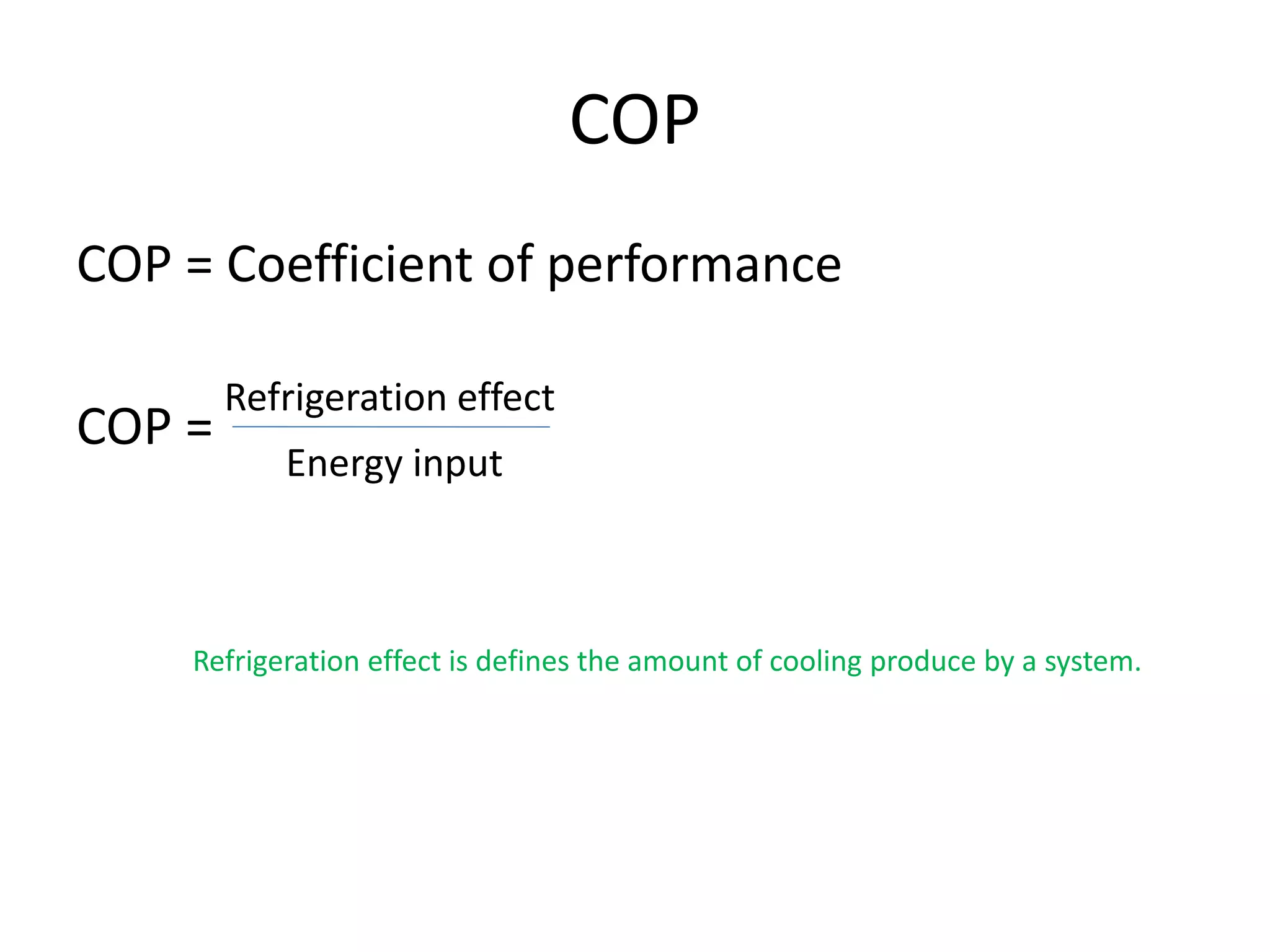
COP = Coefficient of performance
COP =
Refrigeration effect
Energy input
Refrigeration effect is defines the amount of cooling produce by a system.
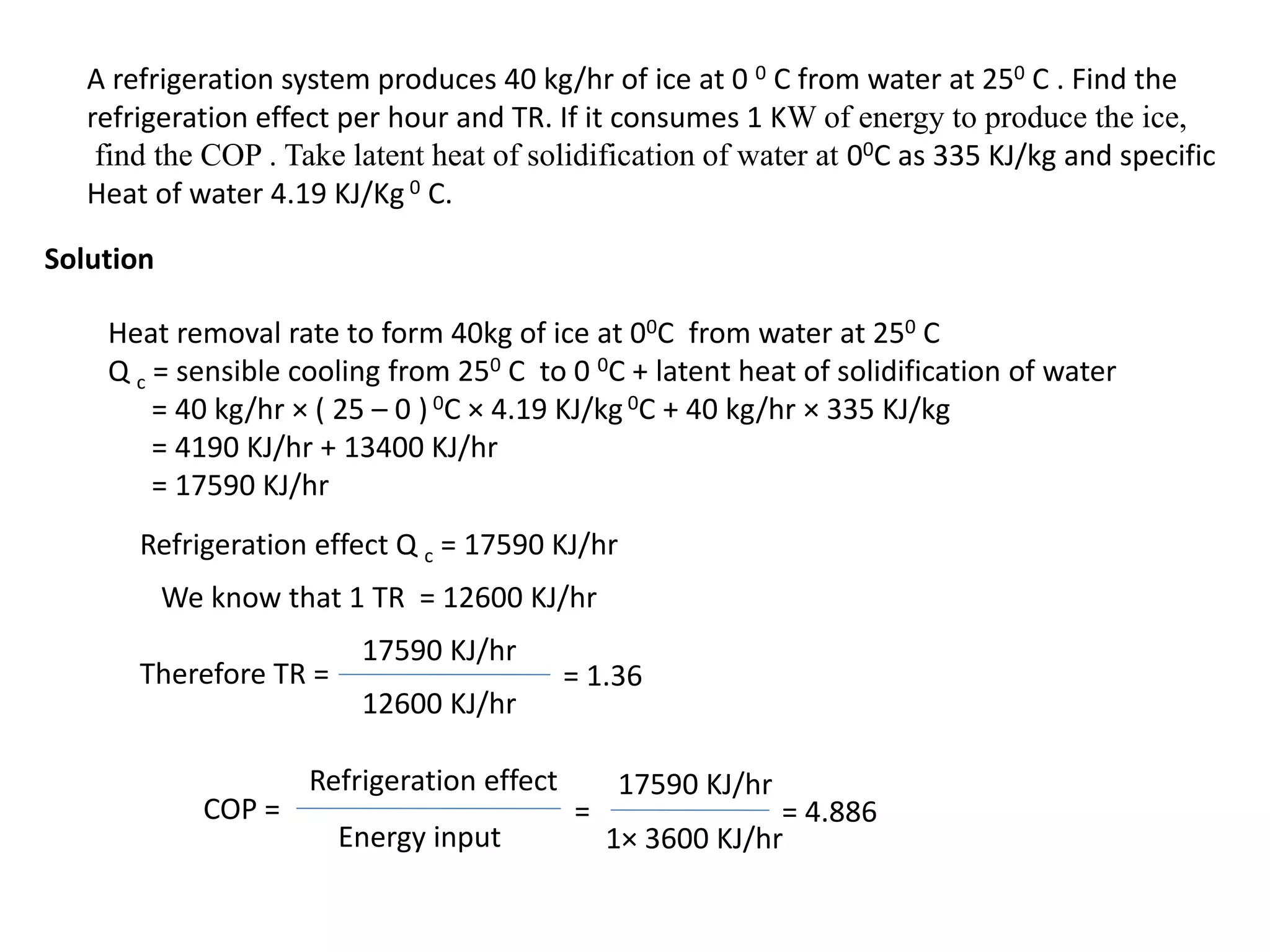
A refrigeration system produces 40 kg/hr of ice at 0 0 C from water at 250 C . Find the
refrigeration effect per hour and TR. If it consumes 1 KW of energy to produce the ice,
find the COP . Take latent heat of solidification of water at 00C as 335 KJ/kg and specific
Heat of water 4.19 KJ/Kg 0 C.
Solution
Heat removal rate to form 40kg of ice at 00C from water at 250 C
Q c = sensible cooling from 250 C to 0 0C + latent heat of solidification of water
= 40 kg/hr × ( 25 – 0 ) 0C × 4.19 KJ/kg 0C + 40 kg/hr × 335 KJ/kg
= 4190 KJ/hr + 13400 KJ/hr
= 17590 KJ/hr
Refrigeration effect Q c = 17590 KJ/hr
We know that 1 TR = 12600 KJ/hr
Therefore TR =
17590 KJ/hr
12600 KJ/hr
= 1.36
1× 3600 KJ/hr
17590 KJ/hr
COP =
Refrigeration effect
Energy input
= = 4.886
200 kg of ice at – 100 C is placed in a bunker to cool some vegetables . 24 hours later the ice
Has melted into water at 50 C . What is the average rate of cooling in KJ/hr and TR provided
By the ice ? Assume specific heat of ice = 1.94 KJ/kg0 C, specific heat of water = 4.1868 KJ/kg0 C,
latent heat of fusion of ice = 335 KJ/kg.
solution
Rate of heat addition to 200 kg ice at – 100 C to form water at 50 C
Q c = ( sensible heat gain of ice from – 100 C to 00 C + latent heat of melting of ice + sensible
heat gain of water from 00 C to 50 C)/time
= ( 200 kg × (0 – ( - 10 )) 0 C × 1.94KJ/kg.0 C + 200 kg. × 335 KJ/kg.
+ 200 kg.× ( 5 – 0 )0 C × 4.1868 KJ/kg.0 C ) / 24 hr
= 3127.78 KJ/hr
Capacity =
3127.78 KJ/hr
12600 KJ/hr
= 0.248 TR
Types of refrigeration system
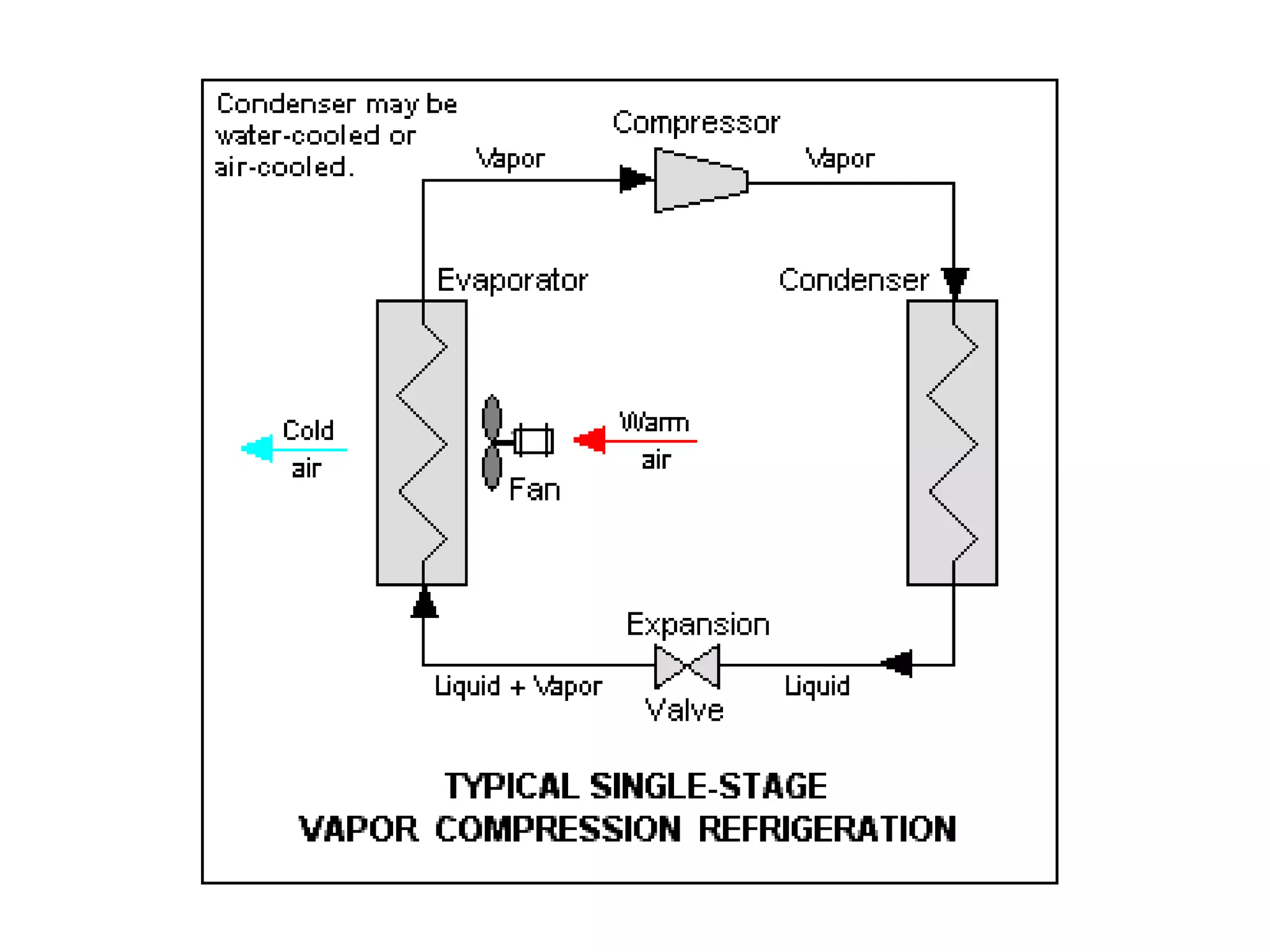
1. Vapour compression refrigeration system:
It is an improved type of air refrigeration system in
which a suitable working substance, termed as
refrigerant, is used. It condenses and evaporates at
temperature and pressures close to the atmospheric
condition. The refrigerant used, does not leave the
systems, but is circulated throughout the systems
alternately condensing and evaporating.
In evaporating, the refrigerant absorbs its latent heat
from the brine which is used for circulating it around
the cold chamber. While condensing, it gives out its
latent heat to the circulating water of the cooler.
Types of refrigeration system
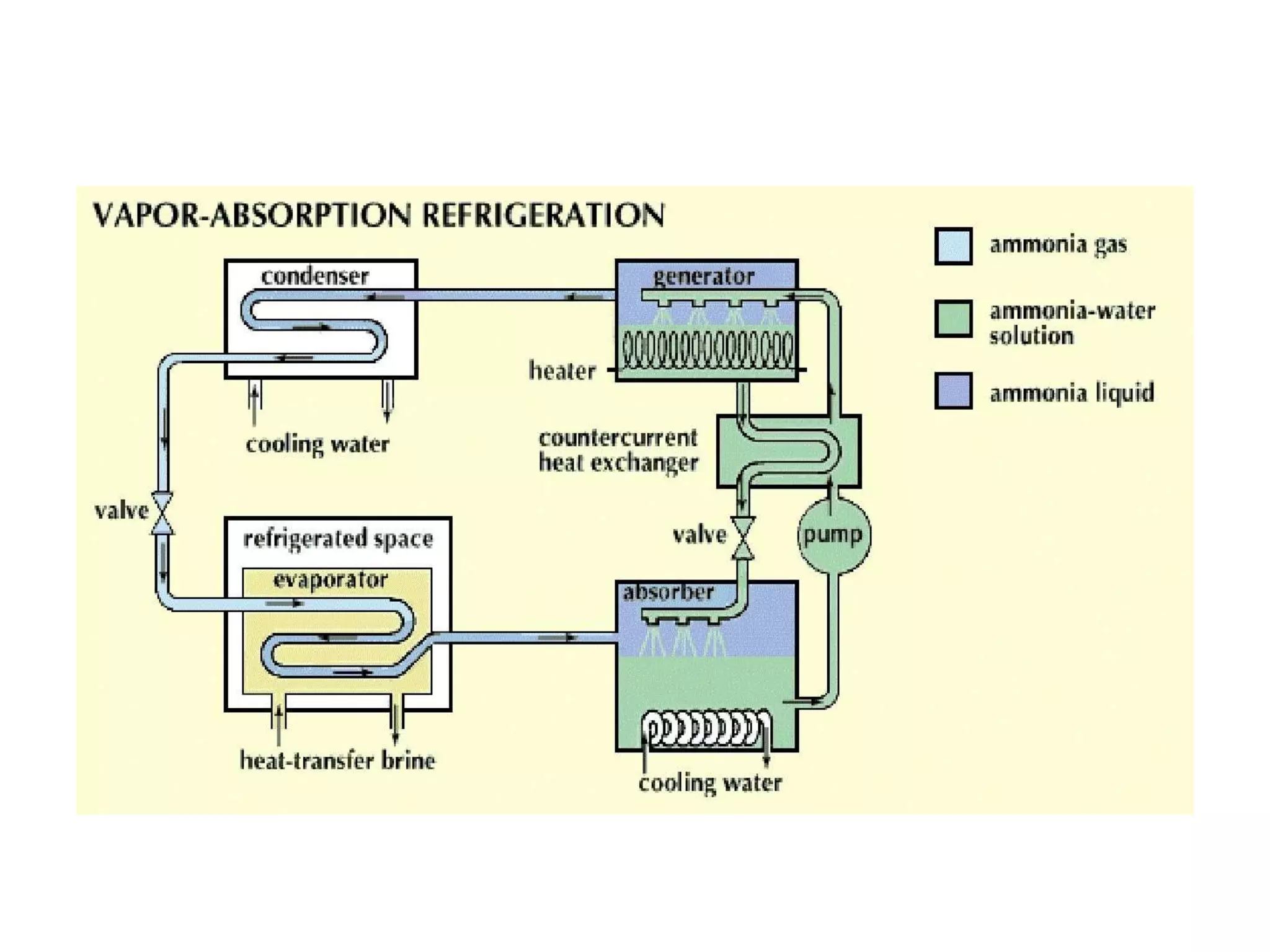
2. Vapour absorption refrigeration system: The idea of a vapour
absorption refrigeration system is to avoid compression of the
refrigerant. In this type of refrigeration system, the vapour
produced by the evaporation of the refrigerant, in the cold
chamber, passes into a vessel containing a homogeneous mixture of
ammonia and water. In this chamber, the vapour is absorbed, which
maintains constant low pressure, thus facilitating its further
evaporation.
The refrigerant is liberated in the vapour state subsequently by the
direct application of heat.
The low pressure ammonia vapour, leaving the evaporator, enters
the absorber where it is absorbed in the weak ammonia solution.
The strong ammonia solution is then pumped to the generator,
where a high pressure and temperature is maintained.
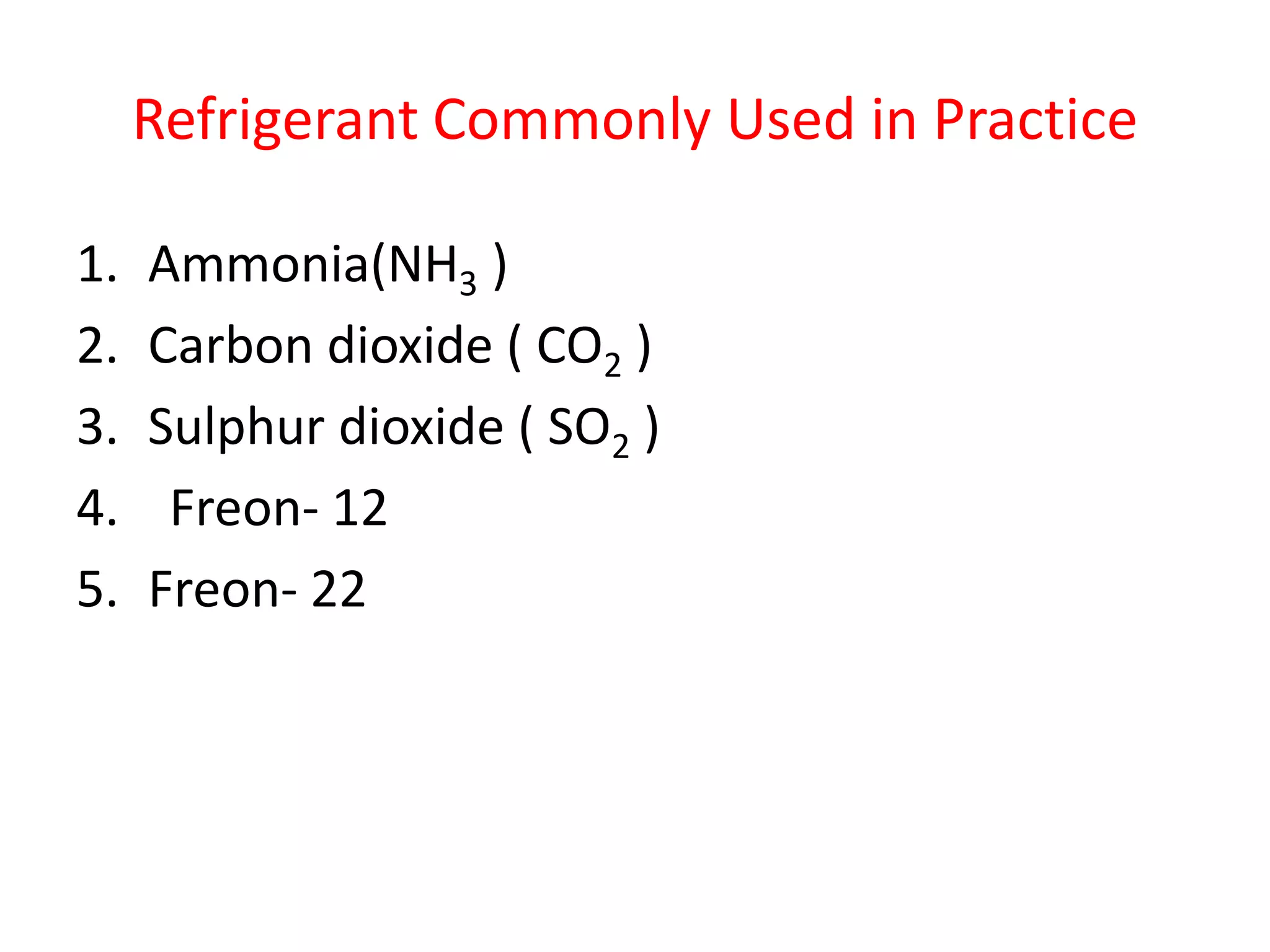
Refrigerant Commonly Used in Practice
1. Ammonia(NH3 )
2. Carbon dioxide ( CO2 )
3. Sulphur dioxide ( SO2 )
4. Freon- 12
5. Freon- 22
Ideal properties for a refrigerant
1. High latent heat of vaporization.
2. High critical temperature.
3. Non –corrosive, non-toxic and non flammable.
4. Critical temperature and triple point outside the working range.
5. Compatibility with component materials and lubricating oil.
6. Reasonable working pressures.
7. High dielectric strength.
8. Low cost.
9. Low boiling point.
10. Low specific heat of liquid.
11. Low specific volume of vapour.
12. Easy of leak detection.
13. Environmentally friendly.
Refrigeration Cycles
Air Refrigerator working on Reversed Carnot
Cycle
1. Isentropic expansion
2. Isothermal expansion
3. Isentropic compression
4. Isothermal comprssion
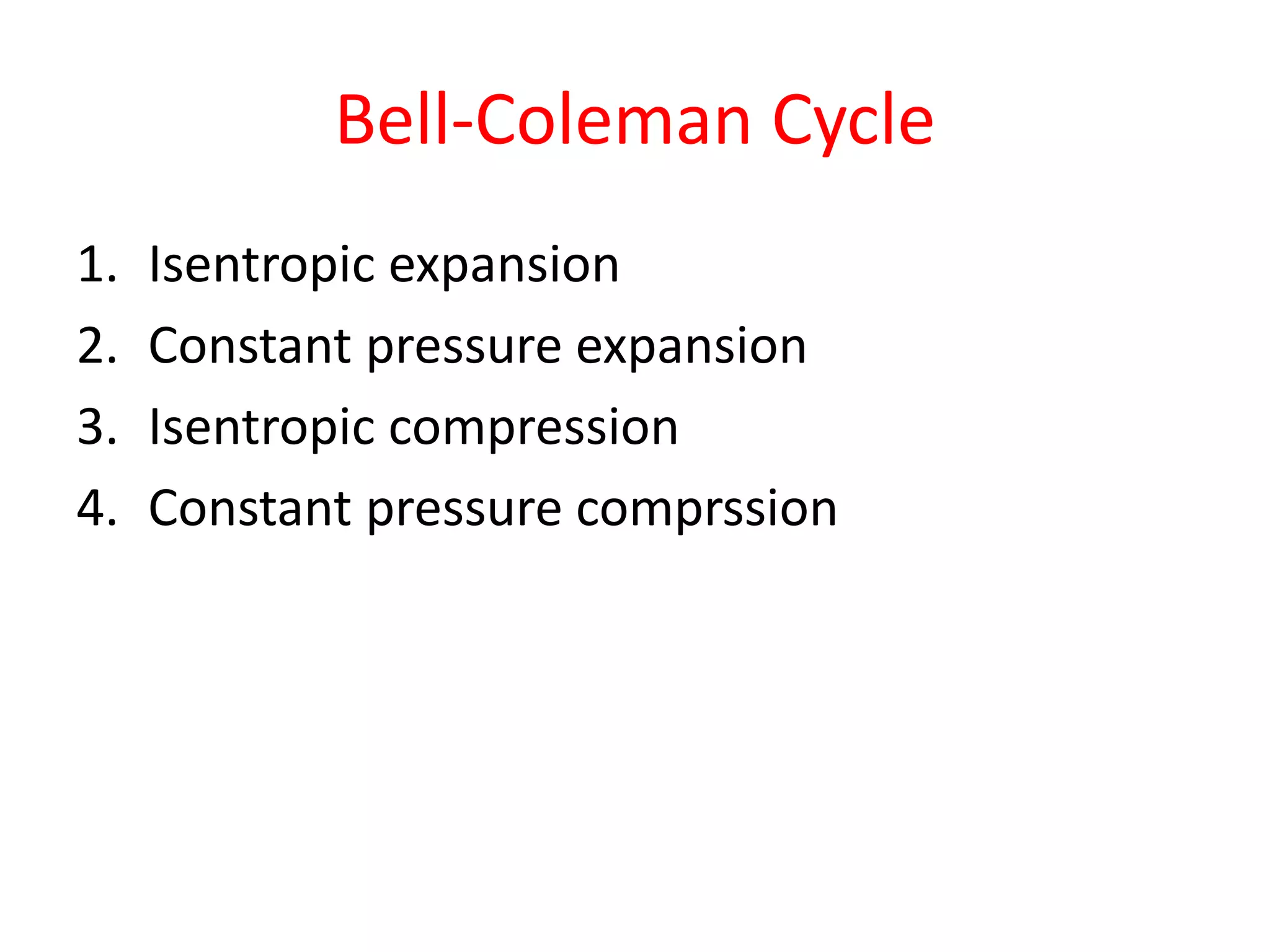
Bell-Coleman Cycle
1. Isentropic expansion
2. Constant pressure expansion
3. Isentropic compression
4. Constant pressure comprssion
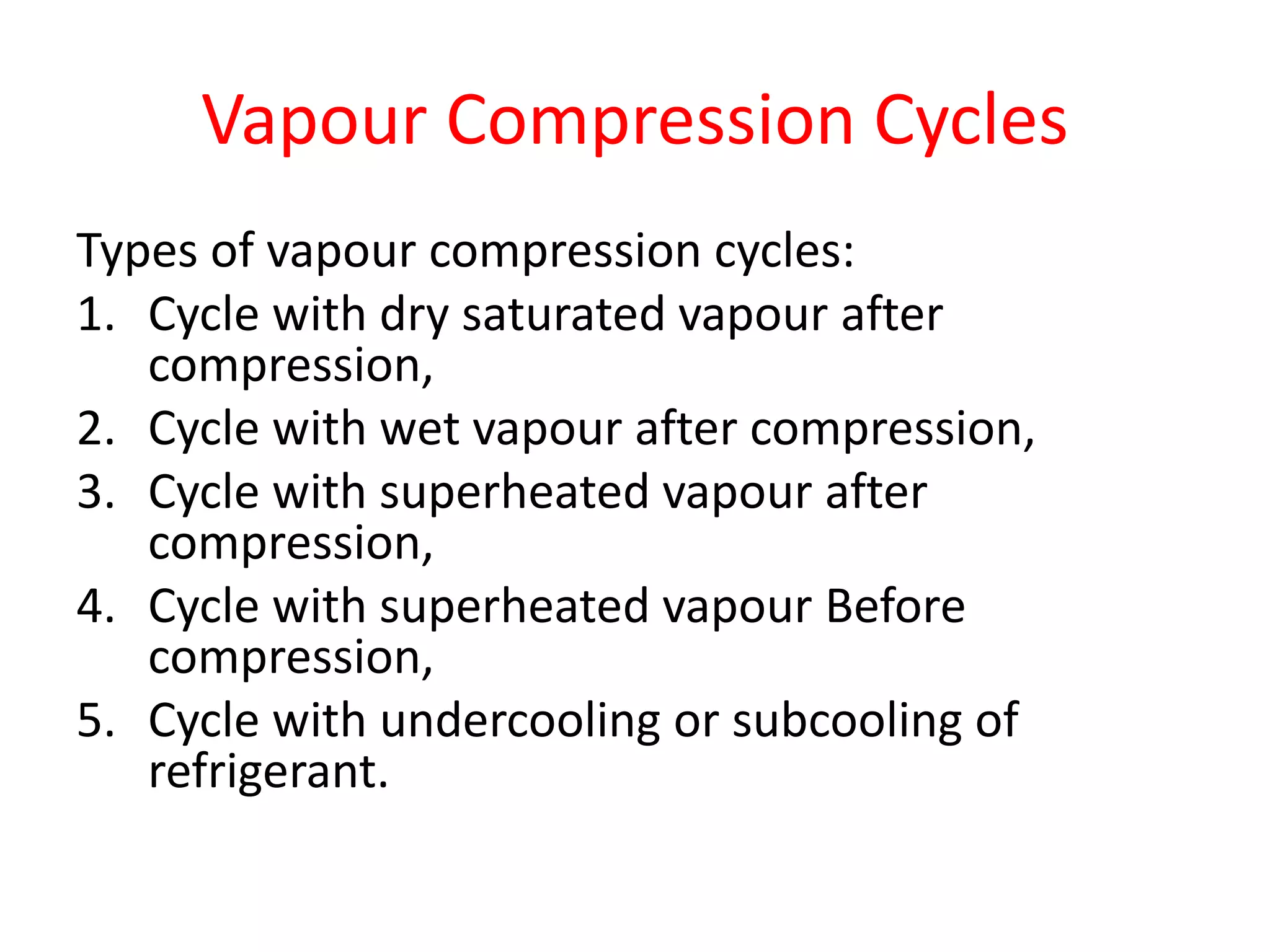
Vapour Compression Cycles
Types of vapour compression cycles:
1. Cycle with dry saturated vapour after
compression,
2. Cycle with wet vapour after compression,
3. Cycle with superheated vapour after
compression,
4. Cycle with superheated vapour Before
compression,
5. Cycle with undercooling or subcooling of
refrigerant.
refrigerator and Air Condition

refrigerator and Air Condition

  • 1.
    Refrigeration and AirConditioning Refrigeration: Refrigeration is a process of removal of heat from a space where it is unwanted and transferring the same to the surrounding environment where it makes little or no difference. Air Conditioning: Air conditioning can be define as the process of simultaneous control of temperature, humidity, cleanliness and air motion.
  • 2.
    Application 1. Air Conditioningof Residential and official buildings 2. Industrial Air Conditioning 3. Spot heating 4. Spot cooling 5. Environmental laboratories 6. Printing 7. Textiles
  • 3.
    Application 8. Precision partsand clean rooms 9. Photographic products 10. Computer rooms 11. Air conditioning of vehicles 12. Food storage and distribution
  • 4.
    Unit and COP Thestandard unit of refrigeration is ton refrigeration or simply ton denoted by TR. 1 TR = 2000 lb×144 Btu/lb 24 hour = 12000 Btu/hr = 200 Btu/min = 12000 3.968 = 3024.2 K cal/hr = 50.4 K cal/min 50 K cal/min TR= It is equivalent to the rate of heat transfer needed to produce 1 ton (2000 lbs) of ice at 320 F from water at 320 F in one day, i.e., 24 hours. If Btu ton unit is expressed into S I system, it is found to be 210 KJ/min or 3.5 K W.
  • 5.
    COP COP = Coefficientof performance COP = Refrigeration effect Energy input Refrigeration effect is defines the amount of cooling produce by a system.
  • 6.
    A refrigeration systemproduces 40 kg/hr of ice at 0 0 C from water at 250 C . Find the refrigeration effect per hour and TR. If it consumes 1 KW of energy to produce the ice, find the COP . Take latent heat of solidification of water at 00C as 335 KJ/kg and specific Heat of water 4.19 KJ/Kg 0 C. Solution Heat removal rate to form 40kg of ice at 00C from water at 250 C Q c = sensible cooling from 250 C to 0 0C + latent heat of solidification of water = 40 kg/hr × ( 25 – 0 ) 0C × 4.19 KJ/kg 0C + 40 kg/hr × 335 KJ/kg = 4190 KJ/hr + 13400 KJ/hr = 17590 KJ/hr Refrigeration effect Q c = 17590 KJ/hr We know that 1 TR = 12600 KJ/hr Therefore TR = 17590 KJ/hr 12600 KJ/hr = 1.36 1× 3600 KJ/hr 17590 KJ/hr COP = Refrigeration effect Energy input = = 4.886
  • 7.
    200 kg ofice at – 100 C is placed in a bunker to cool some vegetables . 24 hours later the ice Has melted into water at 50 C . What is the average rate of cooling in KJ/hr and TR provided By the ice ? Assume specific heat of ice = 1.94 KJ/kg0 C, specific heat of water = 4.1868 KJ/kg0 C, latent heat of fusion of ice = 335 KJ/kg. solution Rate of heat addition to 200 kg ice at – 100 C to form water at 50 C Q c = ( sensible heat gain of ice from – 100 C to 00 C + latent heat of melting of ice + sensible heat gain of water from 00 C to 50 C)/time = ( 200 kg × (0 – ( - 10 )) 0 C × 1.94KJ/kg.0 C + 200 kg. × 335 KJ/kg. + 200 kg.× ( 5 – 0 )0 C × 4.1868 KJ/kg.0 C ) / 24 hr = 3127.78 KJ/hr Capacity = 3127.78 KJ/hr 12600 KJ/hr = 0.248 TR
  • 8.
    Types of refrigerationsystem 1. Vapour compression refrigeration system: It is an improved type of air refrigeration system in which a suitable working substance, termed as refrigerant, is used. It condenses and evaporates at temperature and pressures close to the atmospheric condition. The refrigerant used, does not leave the systems, but is circulated throughout the systems alternately condensing and evaporating. In evaporating, the refrigerant absorbs its latent heat from the brine which is used for circulating it around the cold chamber. While condensing, it gives out its latent heat to the circulating water of the cooler.
  • 11.
    Types of refrigerationsystem 2. Vapour absorption refrigeration system: The idea of a vapour absorption refrigeration system is to avoid compression of the refrigerant. In this type of refrigeration system, the vapour produced by the evaporation of the refrigerant, in the cold chamber, passes into a vessel containing a homogeneous mixture of ammonia and water. In this chamber, the vapour is absorbed, which maintains constant low pressure, thus facilitating its further evaporation. The refrigerant is liberated in the vapour state subsequently by the direct application of heat. The low pressure ammonia vapour, leaving the evaporator, enters the absorber where it is absorbed in the weak ammonia solution. The strong ammonia solution is then pumped to the generator, where a high pressure and temperature is maintained.
  • 14.
    Refrigerant Commonly Usedin Practice 1. Ammonia(NH3 ) 2. Carbon dioxide ( CO2 ) 3. Sulphur dioxide ( SO2 ) 4. Freon- 12 5. Freon- 22
  • 15.
    Ideal properties fora refrigerant 1. High latent heat of vaporization. 2. High critical temperature. 3. Non –corrosive, non-toxic and non flammable. 4. Critical temperature and triple point outside the working range. 5. Compatibility with component materials and lubricating oil. 6. Reasonable working pressures. 7. High dielectric strength. 8. Low cost. 9. Low boiling point. 10. Low specific heat of liquid. 11. Low specific volume of vapour. 12. Easy of leak detection. 13. Environmentally friendly.
  • 16.
    Refrigeration Cycles Air Refrigeratorworking on Reversed Carnot Cycle 1. Isentropic expansion 2. Isothermal expansion 3. Isentropic compression 4. Isothermal comprssion
  • 17.
    Bell-Coleman Cycle 1. Isentropicexpansion 2. Constant pressure expansion 3. Isentropic compression 4. Constant pressure comprssion
  • 18.
    Vapour Compression Cycles Typesof vapour compression cycles: 1. Cycle with dry saturated vapour after compression, 2. Cycle with wet vapour after compression, 3. Cycle with superheated vapour after compression, 4. Cycle with superheated vapour Before compression, 5. Cycle with undercooling or subcooling of refrigerant.