REFRIGERATION SYSTEMS
VAPOR REFRIGERATION SYSTEMS
The purpose of a refrigeration system is to maintain a system at a temperature 
below the temperature of its surroundings.
CARNOT REFRIGERATION CYCLE
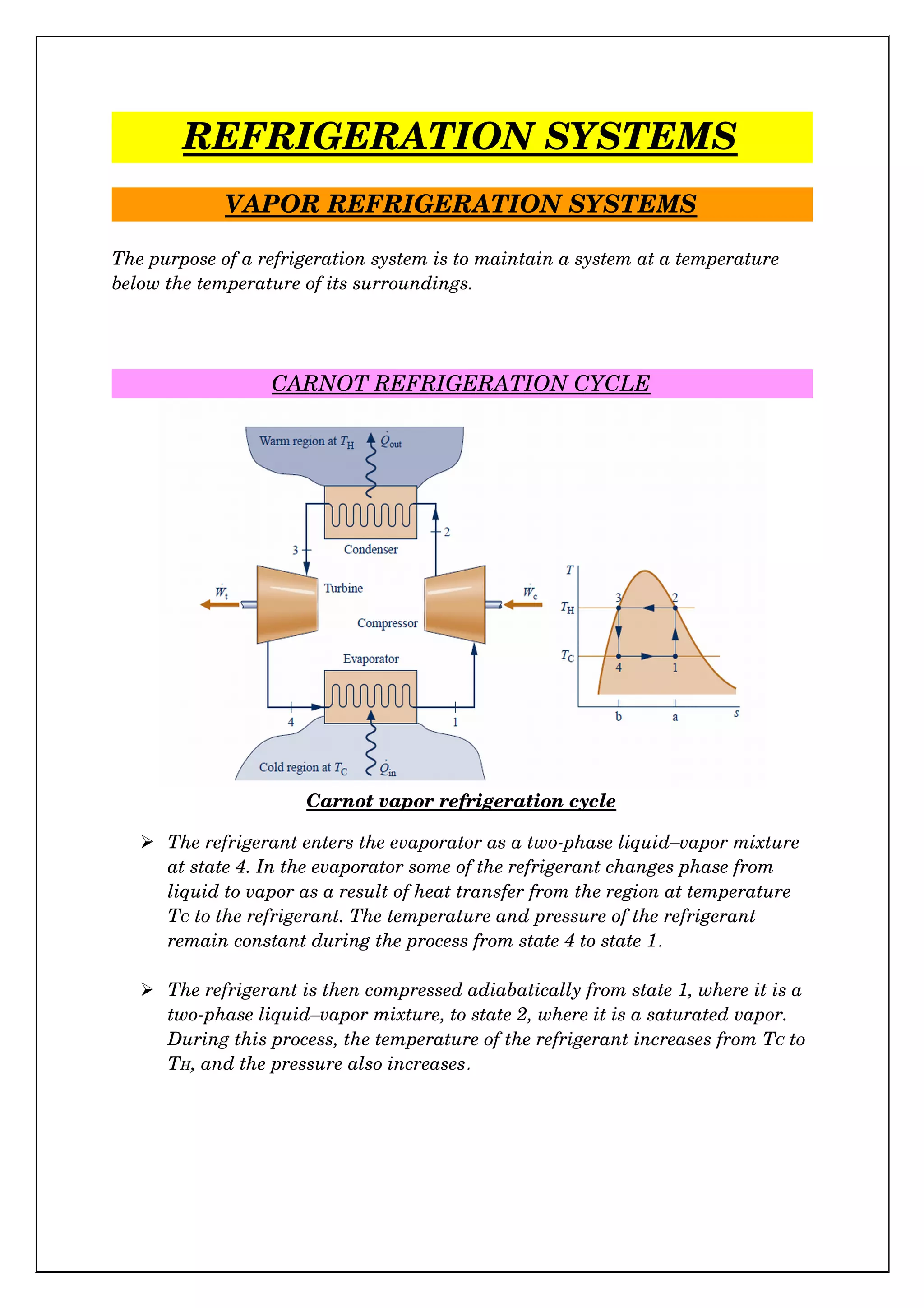
Carnot vapor refrigeration cycle
 The refrigerant enters the evaporator as a two­phase liquid–vapor mixture 
at state 4. In the evaporator some of the refrigerant changes phase from 
liquid to vapor as a result of heat transfer from the region at temperature 
TC to the refrigerant. The temperature and pressure of the refrigerant 
remain constant during the process from state 4 to state 1.
 The refrigerant is then compressed adiabatically from state 1, where it is a 
two­phase liquid–vapor mixture, to state 2, where it is a saturated vapor. 
During this process, the temperature of the refrigerant increases from TC to
TH, and the pressure also increases.
 The refrigerant passes from the compressor into the condenser, where it 
changes phase from saturated vapor to saturated liquid as a result of heat 
transfer to the region at temperature TH. The temperature and pressure 
remain constant in the process from state 2 to state 3
 The refrigerant returns to the state at the inlet of the evaporator by 
expanding adiabatically through a turbine. In this process, from state 3 to 
state 4, the temperature decreases from TH to TC, and there is a decrease in 
pressure.
Area 1–a–b–4–1 is the heat added to the refrigerant from the cold region per unit 
mass of refrigerant flowing. Area 2–a–b–3–2 is the heat rejected from the 
refrigerant to the warm region per unit mass of refrigerant flowing. The enclosed 
area 1–2–3–4–1 is the net heat transfer from the refrigerant. The net heat transfer
from the refrigerant equals the net work done on the refrigerant. The net work is 
the difference between the compressor work input and the turbine work output
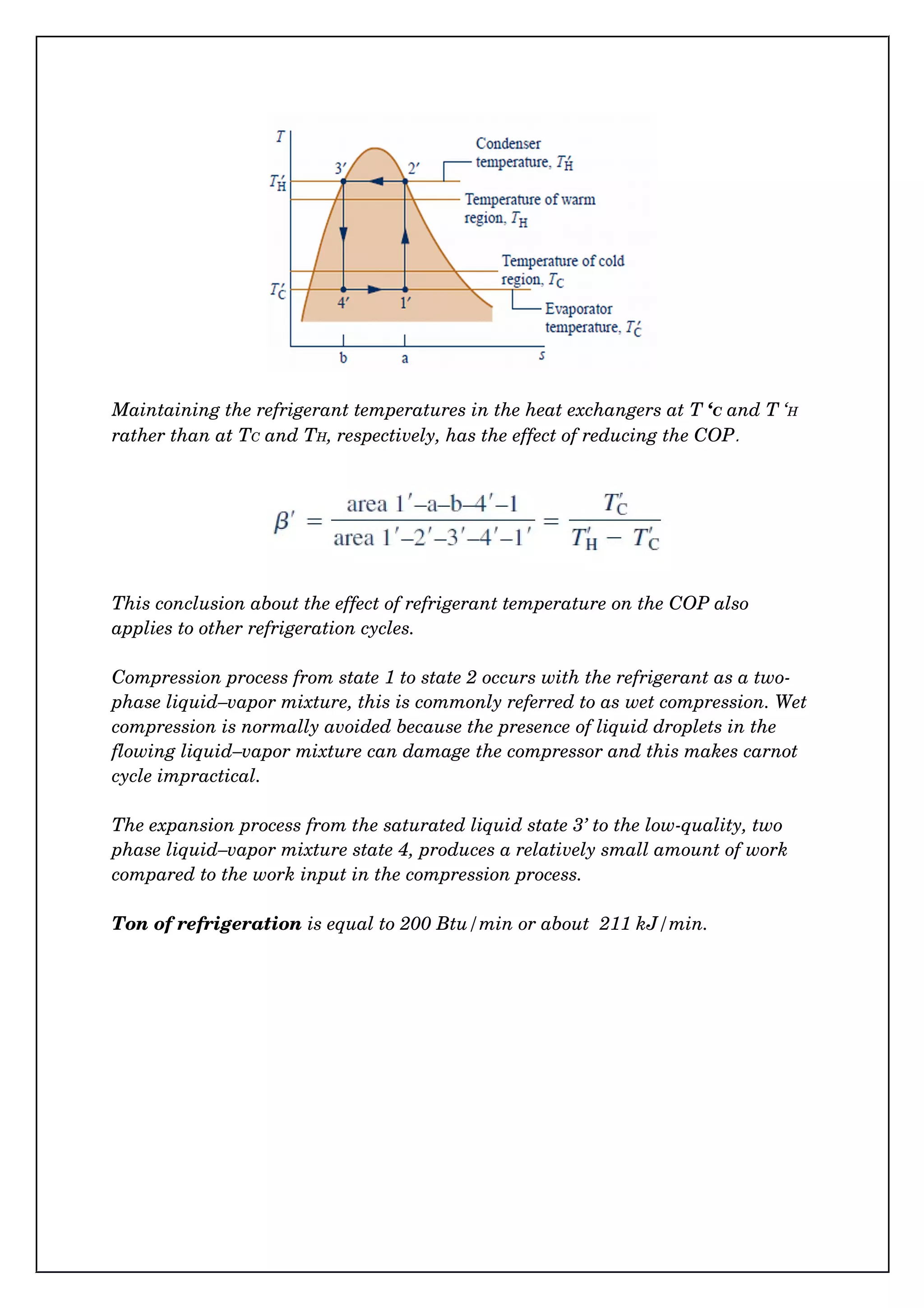
COP­ The coefficient of performance   β of any refrigeration cycle is the ratio of the 
refrigeration effect to the net work input required to achieve that effect.
DEPARTURES FROM THE CARNOT CYCLE
Actual vapor refrigeration systems depart significantly from the Carnot cycle and 
have coefficients of performance lower than Carnot.
The ways actual systems depart from the Carnot cycle are­
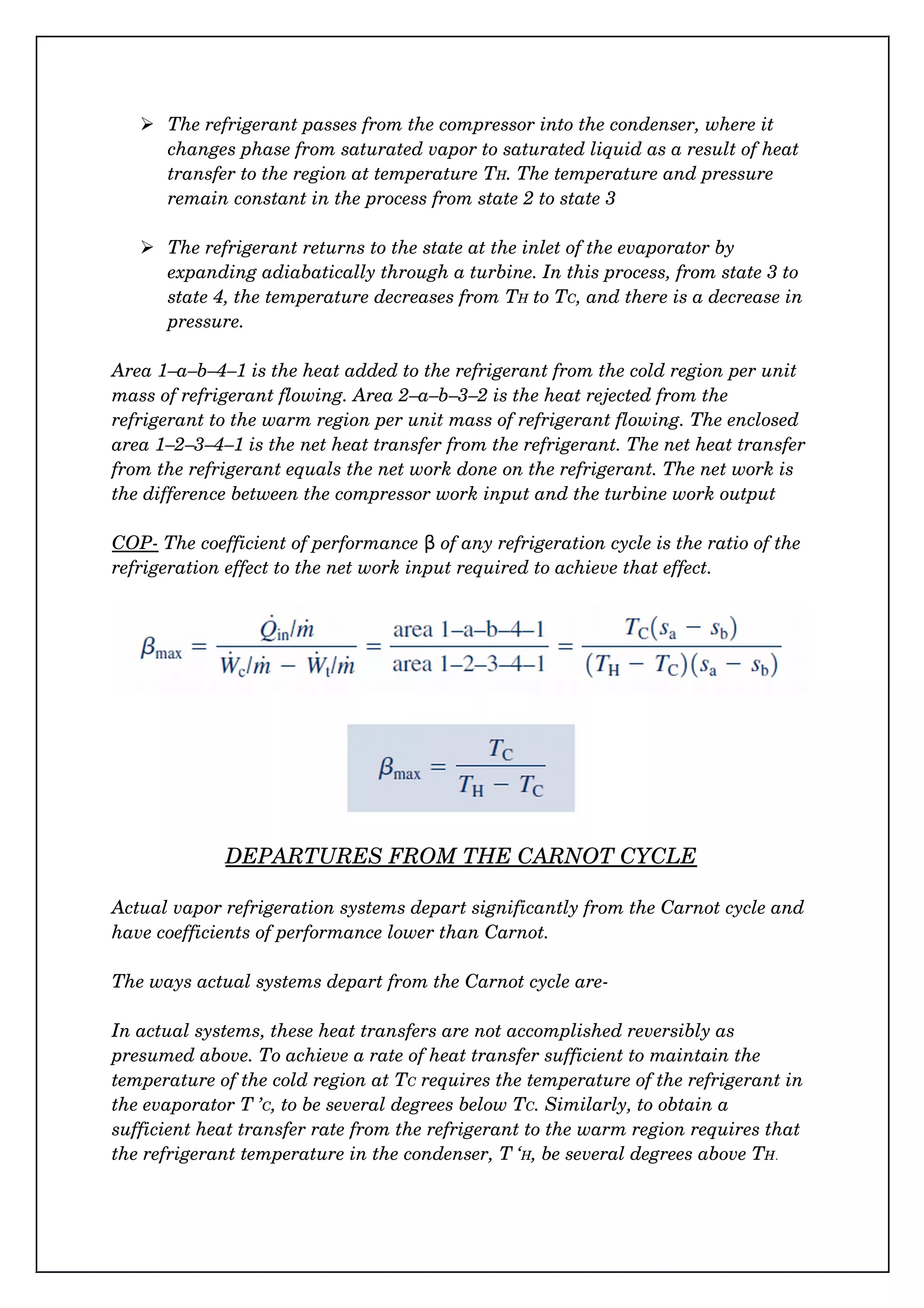
In actual systems, these heat transfers are not accomplished reversibly as 
presumed above. To achieve a rate of heat transfer sufficient to maintain the 
temperature of the cold region at TC requires the temperature of the refrigerant in 
the evaporator T ’C, to be several degrees below TC. Similarly, to obtain a 
sufficient heat transfer rate from the refrigerant to the warm region requires that 
the refrigerant temperature in the condenser, T ‘H, be several degrees above TH.
Maintaining the refrigerant temperatures in the heat exchangers at T ‘C and T ‘H 
rather than at TC and TH, respectively, has the effect of reducing the COP.
This conclusion about the effect of refrigerant temperature on the COP also 
applies to other refrigeration cycles.
Compression process from state 1 to state 2 occurs with the refrigerant as a two­
phase liquid–vapor mixture, this is commonly referred to as wet compression. Wet
compression is normally avoided because the presence of liquid droplets in the 
flowing liquid–vapor mixture can damage the compressor and this makes carnot 
cycle impractical.
The expansion process from the saturated liquid state 3’ to the low­quality, two 
phase liquid–vapor mixture state 4, produces a relatively small amount of work 
compared to the work input in the compression process.
Ton of refrigeration is equal to 200 Btu/min or about  211 kJ/min.
VAPOR COMPRESSION REFRIGERATION SYSTEMS
Vapor­compression refrigeration systems are the most common refrigeration 
systems in use today.
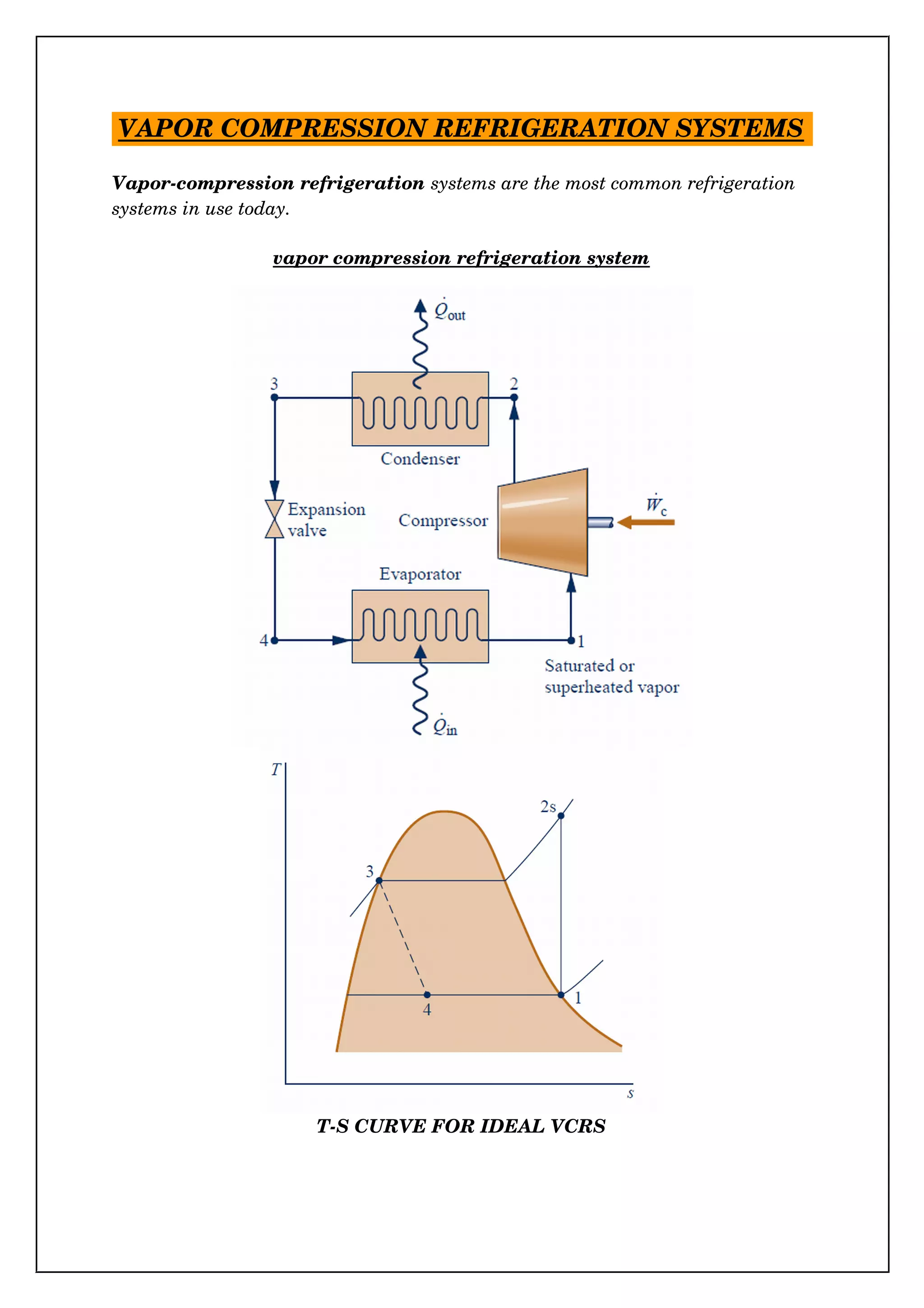
vapor compression refrigeration system
T­S CURVE FOR IDEAL VCRS
WORK AND HEAT TRANSFERS
 As the refrigerant passes through the evaporator, heat transfer from the 
refrigerated space results in the vaporization of the refrigerant.
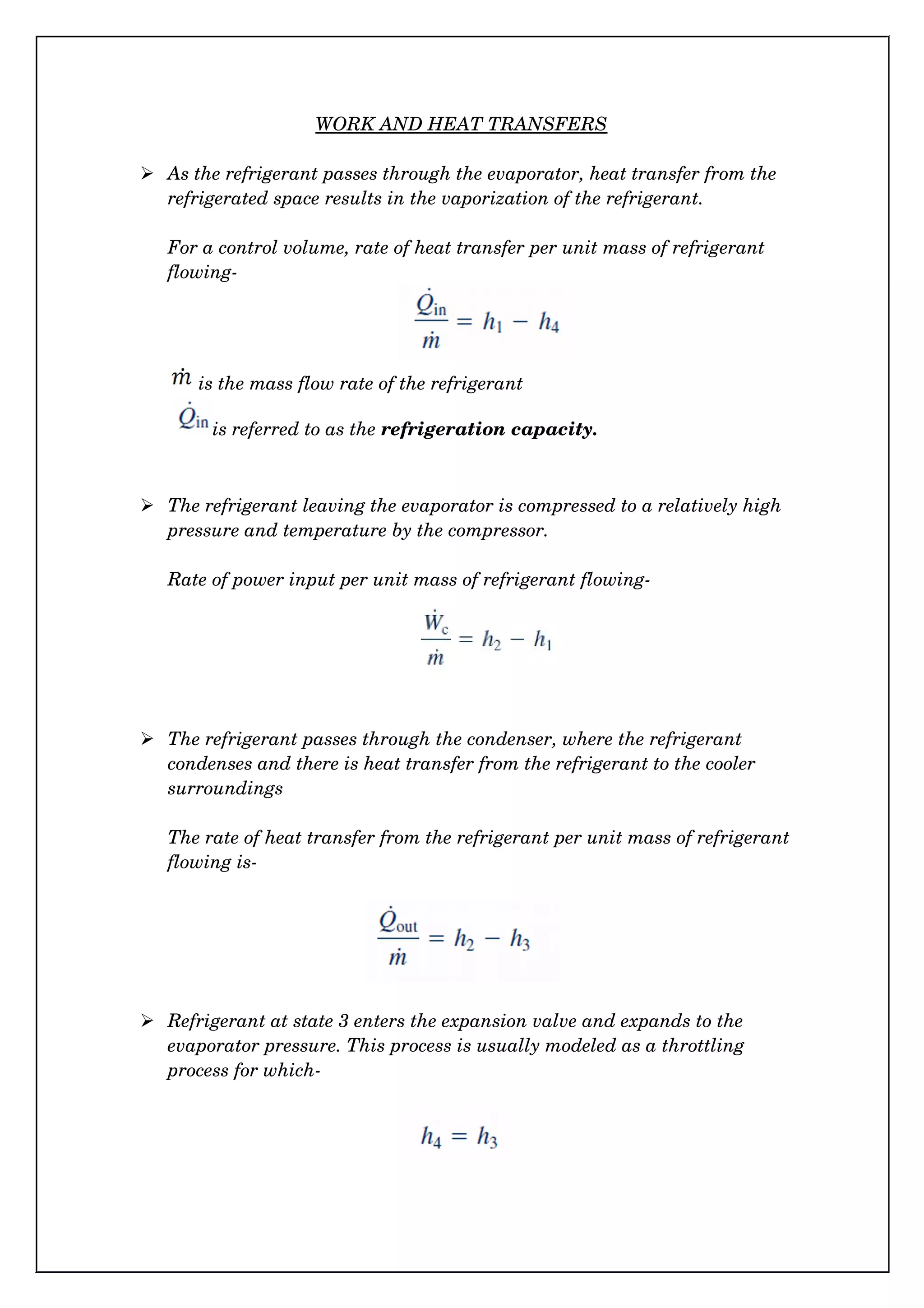
For a control volume, rate of heat transfer per unit mass of refrigerant 
flowing­
is the mass flow rate of the refrigerant
  is referred to as the refrigeration capacity.
 The refrigerant leaving the evaporator is compressed to a relatively high 
pressure and temperature by the compressor.
Rate of power input per unit mass of refrigerant flowing­
 The refrigerant passes through the condenser, where the refrigerant 
condenses and there is heat transfer from the refrigerant to the cooler 
surroundings
The rate of heat transfer from the refrigerant per unit mass of refrigerant 
flowing is­
 Refrigerant at state 3 enters the expansion valve and expands to the 
evaporator pressure. This process is usually modeled as a throttling 
process for which­
The refrigerant pressure decreases in the irreversible adiabatic expansion, 
and there is an accompanying increase in specific entropy. The refrigerant 
exits the valve at state 4 as a two­phase liquid–vapor mixture.
In the vapor­compression system, the net power input is equal to the compressor 
power, since the expansion valve involves no power input or output
  
Therefore COP of VCRS is­
Dry compression is presumed
Process 1–2s Isentropic compression of the refrigerant from state 1 to the 
condenser pressure at state 2s.
Process 2s–3: Heat transfer from the refrigerant as it flows at constant pressure 
through the condenser
Process 3–4: Throttling process from state 3 to a two­phase liquid–vapor mixture
at 4.
Process 4–1: Heat transfer to the refrigerant as it flows at constant pressure 
through the evaporator to complete the cycle
PERFORMANCE OF ACTUAL VAPOR­COMPRESSION SYSTEMS
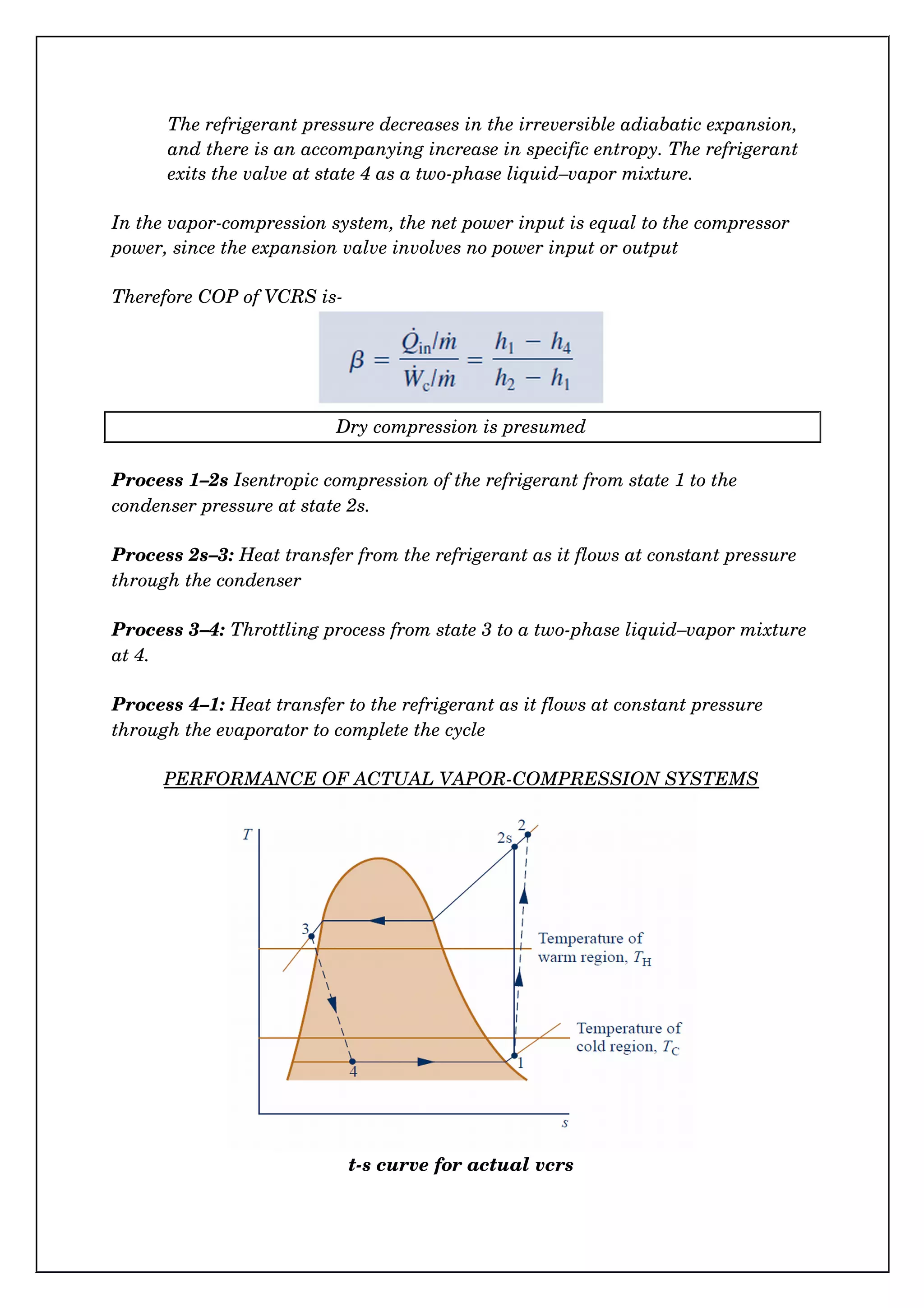
t­s curve for actual vcrs
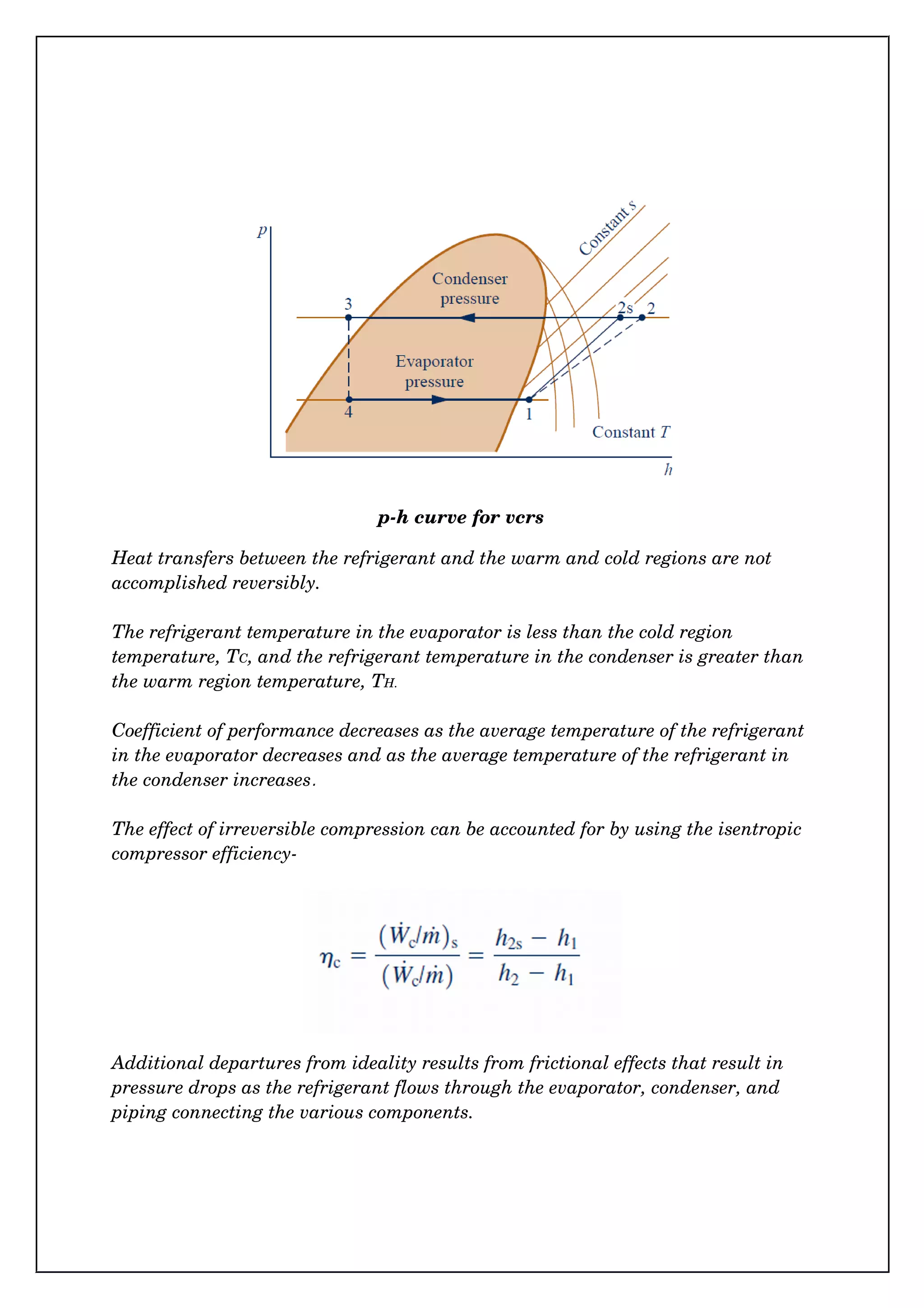
p­h curve for vcrs
Heat transfers between the refrigerant and the warm and cold regions are not 
accomplished reversibly.
The refrigerant temperature in the evaporator is less than the cold region 
temperature, TC, and the refrigerant temperature in the condenser is greater than 
the warm region temperature, TH.
Coefficient of performance decreases as the average temperature of the refrigerant 
in the evaporator decreases and as the average temperature of the refrigerant in 
the condenser increases.
The effect of irreversible compression can be accounted for by using the isentropic 
compressor efficiency­
Additional departures from ideality results from frictional effects that result in 
pressure drops as the refrigerant flows through the evaporator, condenser, and 
piping connecting the various components.
ABSORPTION REFRIGERATION
These cycles have some features in common with the vapor­compression cycles but
differs in following  important respects­
 Instead of compressing a vapor between the evaporator and the condenser, 
the refrigerant of an absorption system is absorbed by a secondary 
substance, called an absorbent, to form a liquid solution. The liquid 
solution is then pumped to the higher pressure. Because the average 
specific volume of the liquid solution is much less than that of the 
refrigerant vapor, significantly less work is required so, absorption 
refrigeration systems have the advantage of relatively small work input 
compared to vapor­compression systems. 
 The other main difference between absorption and vapor­compression 
systems is that some means must be introduced in absorption systems to 
retrieve the refrigerant vapor from the liquid solution before the refrigerant
enters the condenser. This involves heat transfer from a relatively high­
temperature source. Natural gas or some other fuel can be burned to 
provide the heat source, and there have been practical applications of 
absorption refrigeration using alternative energy sources such as solar and
geothermal energy.
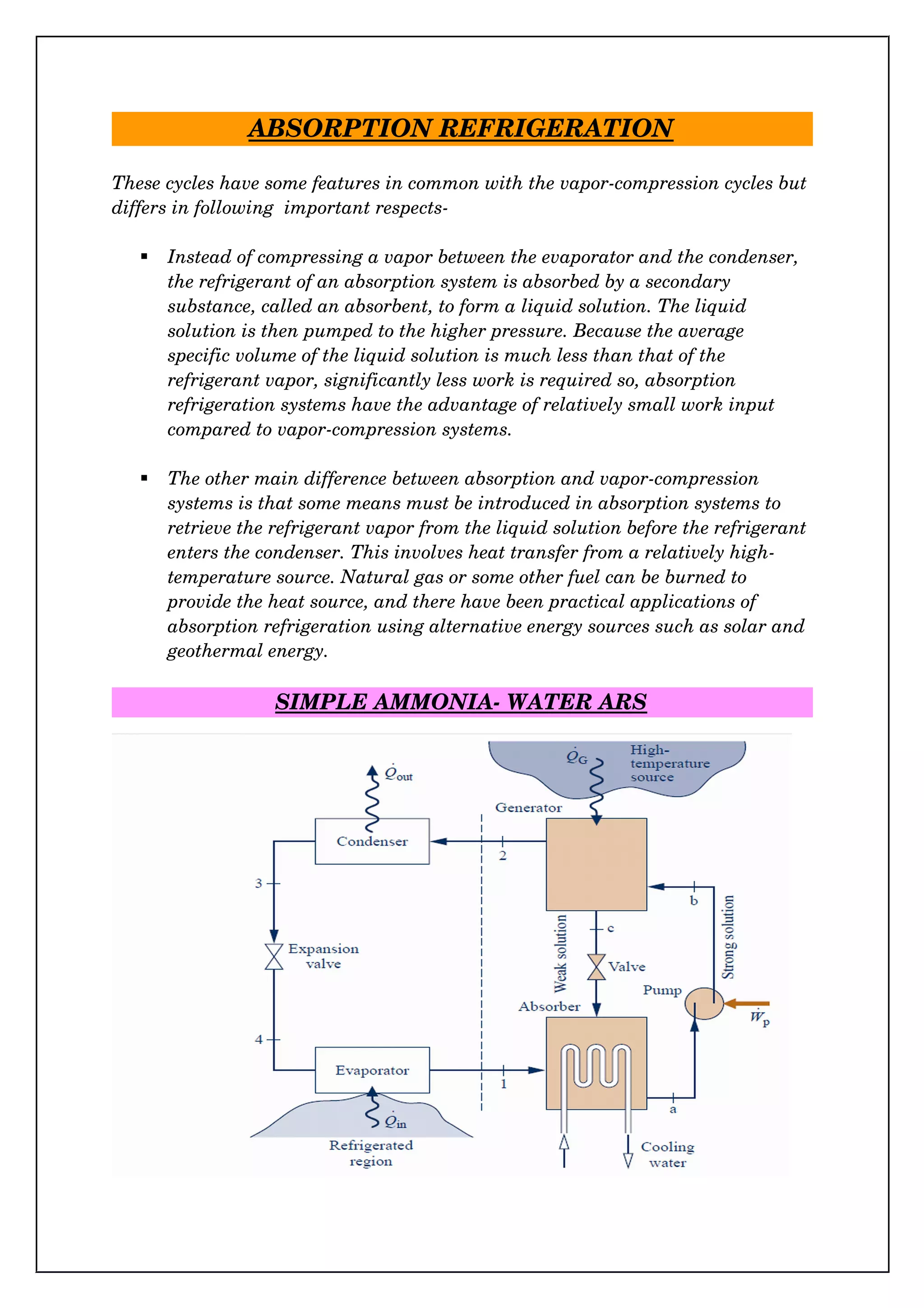
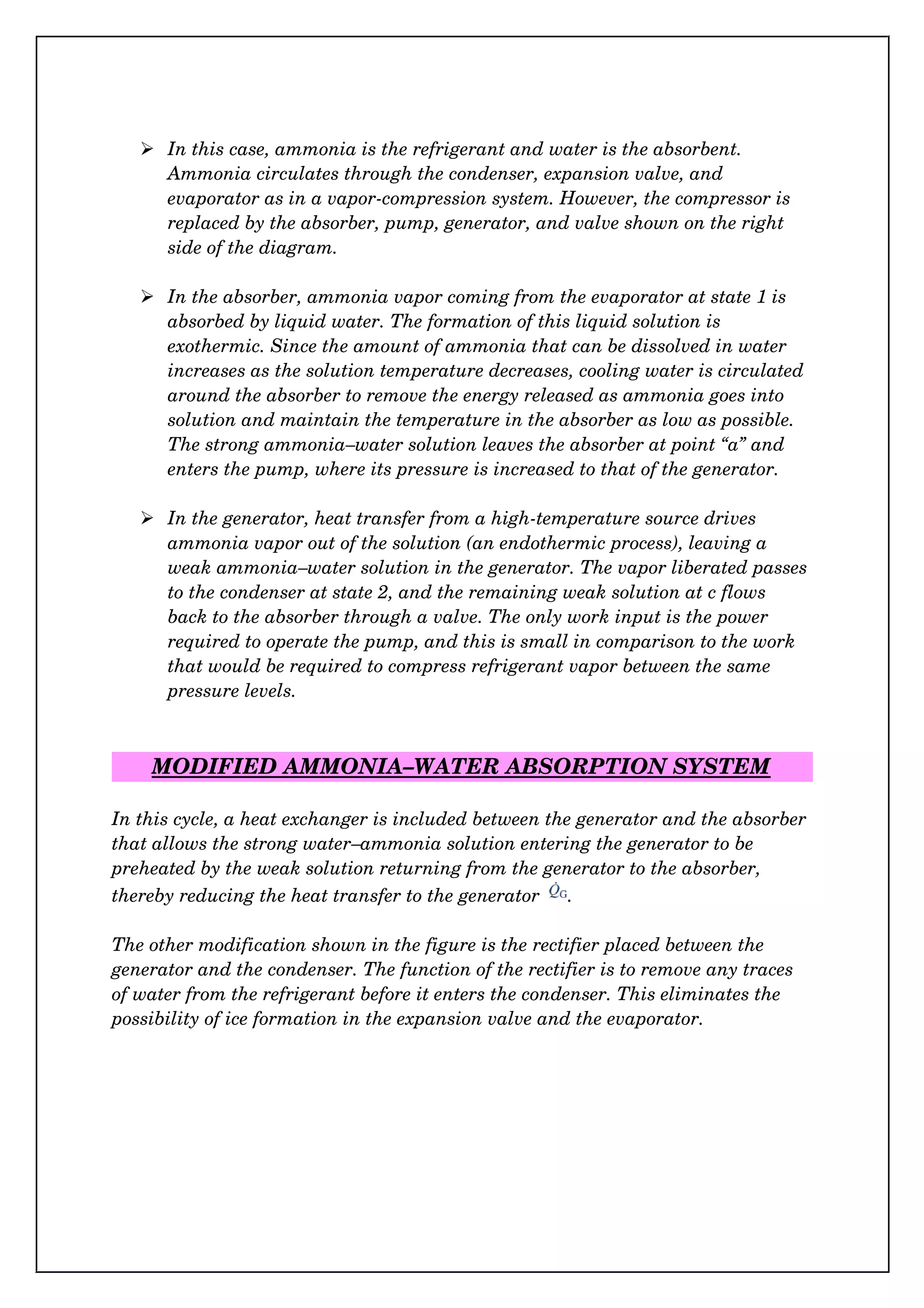
SIMPLE AMMONIA­ WATER ARS
 In this case, ammonia is the refrigerant and water is the absorbent. 
Ammonia circulates through the condenser, expansion valve, and 
evaporator as in a vapor­compression system. However, the compressor is 
replaced by the absorber, pump, generator, and valve shown on the right 
side of the diagram. 
 In the absorber, ammonia vapor coming from the evaporator at state 1 is 
absorbed by liquid water. The formation of this liquid solution is 
exothermic. Since the amount of ammonia that can be dissolved in water 
increases as the solution temperature decreases, cooling water is circulated 
around the absorber to remove the energy released as ammonia goes into 
solution and maintain the temperature in the absorber as low as possible. 
The strong ammonia–water solution leaves the absorber at point “a” and 
enters the pump, where its pressure is increased to that of the generator.
 In the generator, heat transfer from a high­temperature source drives 
ammonia vapor out of the solution (an endothermic process), leaving a 
weak ammonia–water solution in the generator. The vapor liberated passes
to the condenser at state 2, and the remaining weak solution at c flows 
back to the absorber through a valve. The only work input is the power 
required to operate the pump, and this is small in comparison to the work 
that would be required to compress refrigerant vapor between the same 
pressure levels.
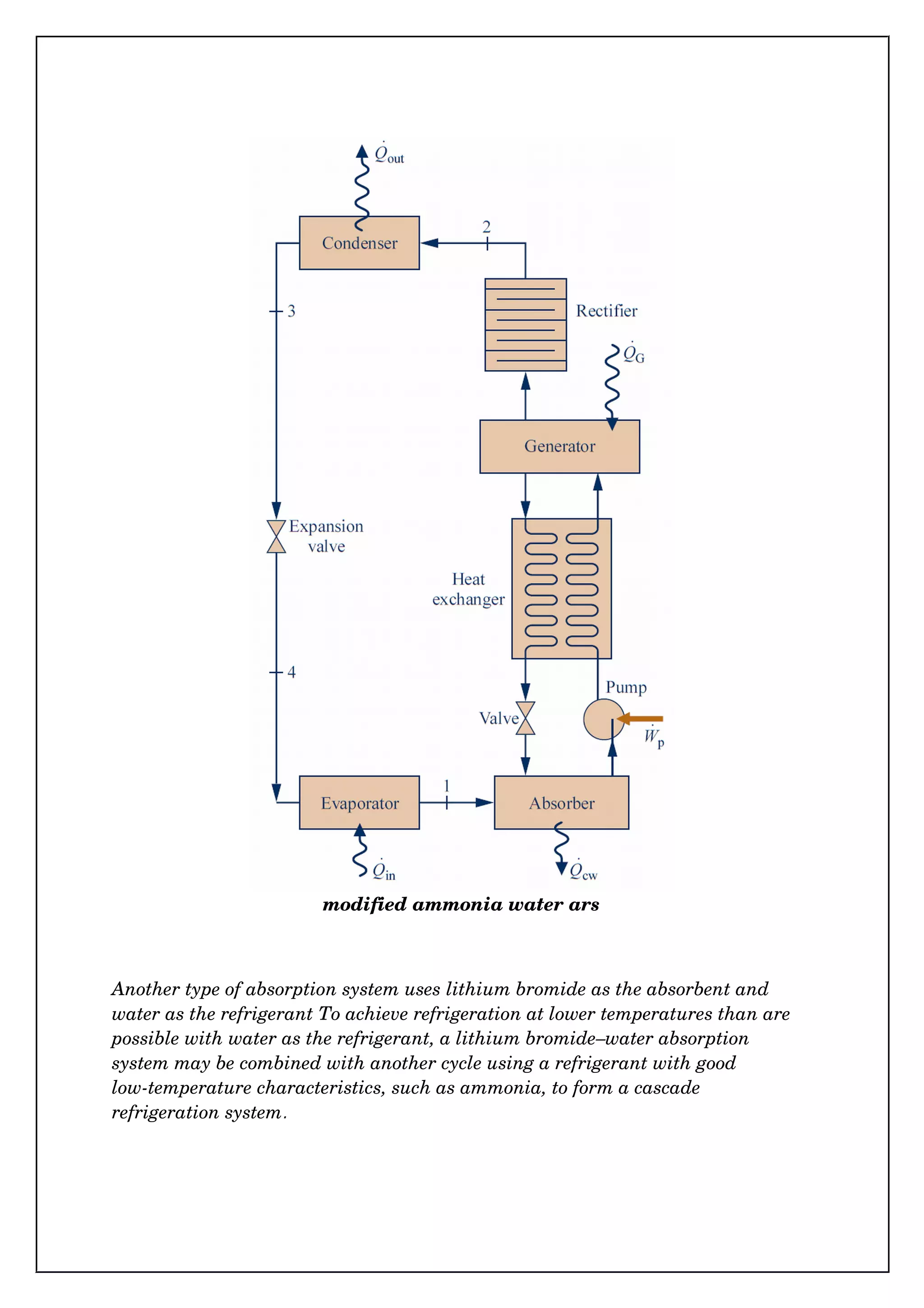
MODIFIED AMMONIA–WATER ABSORPTION SYSTEM
In this cycle, a heat exchanger is included between the generator and the absorber
that allows the strong water–ammonia solution entering the generator to be 
preheated by the weak solution returning from the generator to the absorber, 
thereby reducing the heat transfer to the generator  .
The other modification shown in the figure is the rectifier placed between the 
generator and the condenser. The function of the rectifier is to remove any traces 
of water from the refrigerant before it enters the condenser. This eliminates the 
possibility of ice formation in the expansion valve and the evaporator.
modified ammonia water ars
Another type of absorption system uses lithium bromide as the absorbent and 
water as the refrigerant To achieve refrigeration at lower temperatures than are 
possible with water as the refrigerant, a lithium bromide–water absorption 
system may be combined with another cycle using a refrigerant with good 
low­temperature characteristics, such as ammonia, to form a cascade 
refrigeration system.
GAS REFRIGERATION SYSTEMS
In gas refrigeration systems working fluid remains a gas throughout. They are
used to achieve very low temperatures for the liquefaction of air and other gases 
and for other specialized applications such as aircraft cabin cooling.
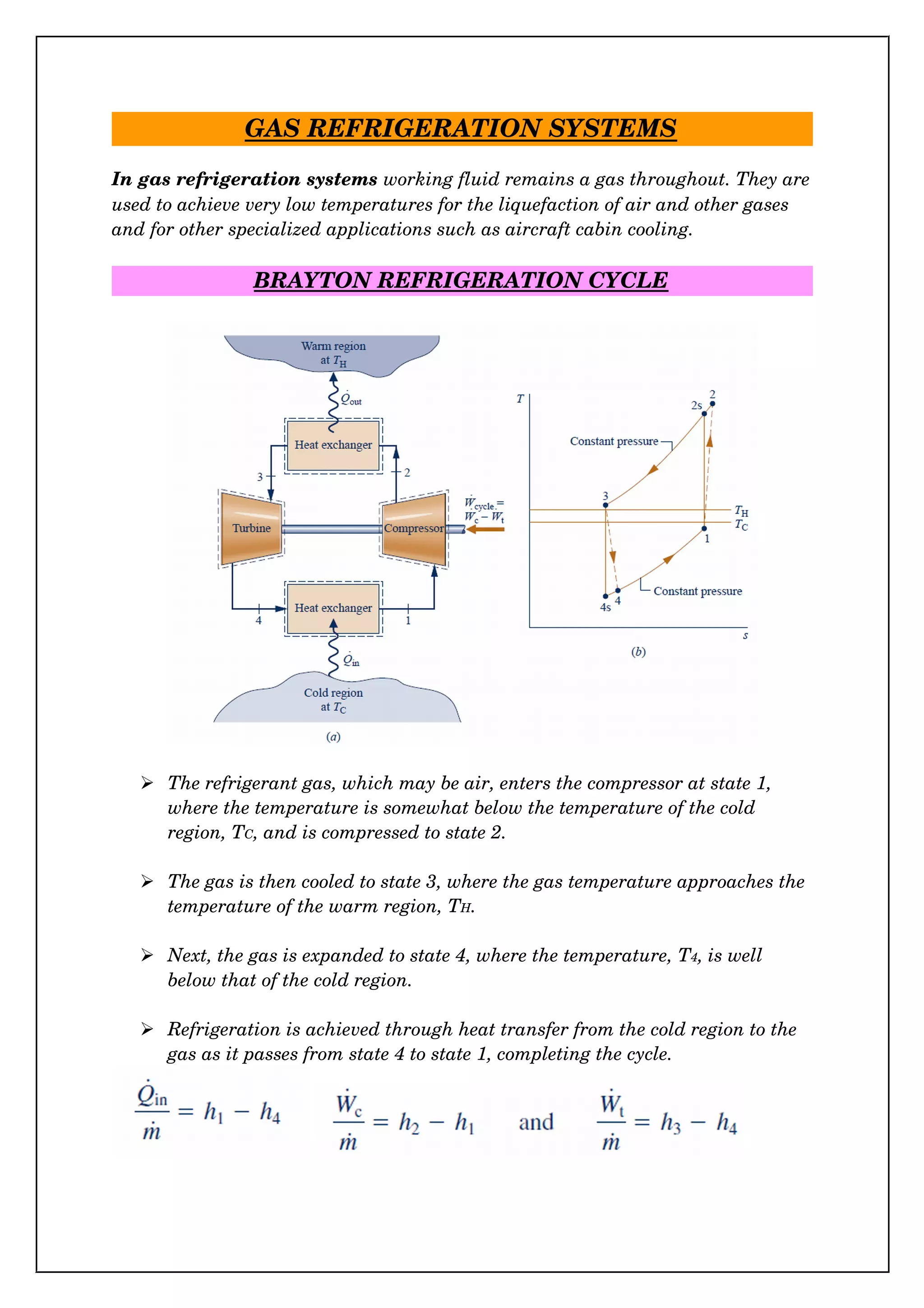
BRAYTON REFRIGERATION CYCLE
 The refrigerant gas, which may be air, enters the compressor at state 1, 
where the temperature is somewhat below the temperature of the cold 
region, TC, and is compressed to state 2.
 The gas is then cooled to state 3, where the gas temperature approaches the
temperature of the warm region, TH.
 Next, the gas is expanded to state 4, where the temperature, T4, is well 
below that of the cold region.
 Refrigeration is achieved through heat transfer from the cold region to the 
gas as it passes from state 4 to state 1, completing the cycle.
 
COP is­
The magnitude of the work developed by the turbine of a Brayton refrigeration 
cycle is typically significant relative to the compressor work input.
To obtain even moderate refrigeration capacities with the Brayton refrigeration 
cycle, equipment capable of achieving relatively high pressures and volumetric 
flow rates is needed.
For most applications involving air conditioning and for ordinary refrigeration 
processes, vapor­compression systems can be built more cheaply and can operate 
with higher coefficients of performance than gas refrigeration systems
Gas refrigeration systems can be used to achieve temperatures of about 21508C 
(22408F), which are well below the temperatures normally obtained with vapor 
systems.
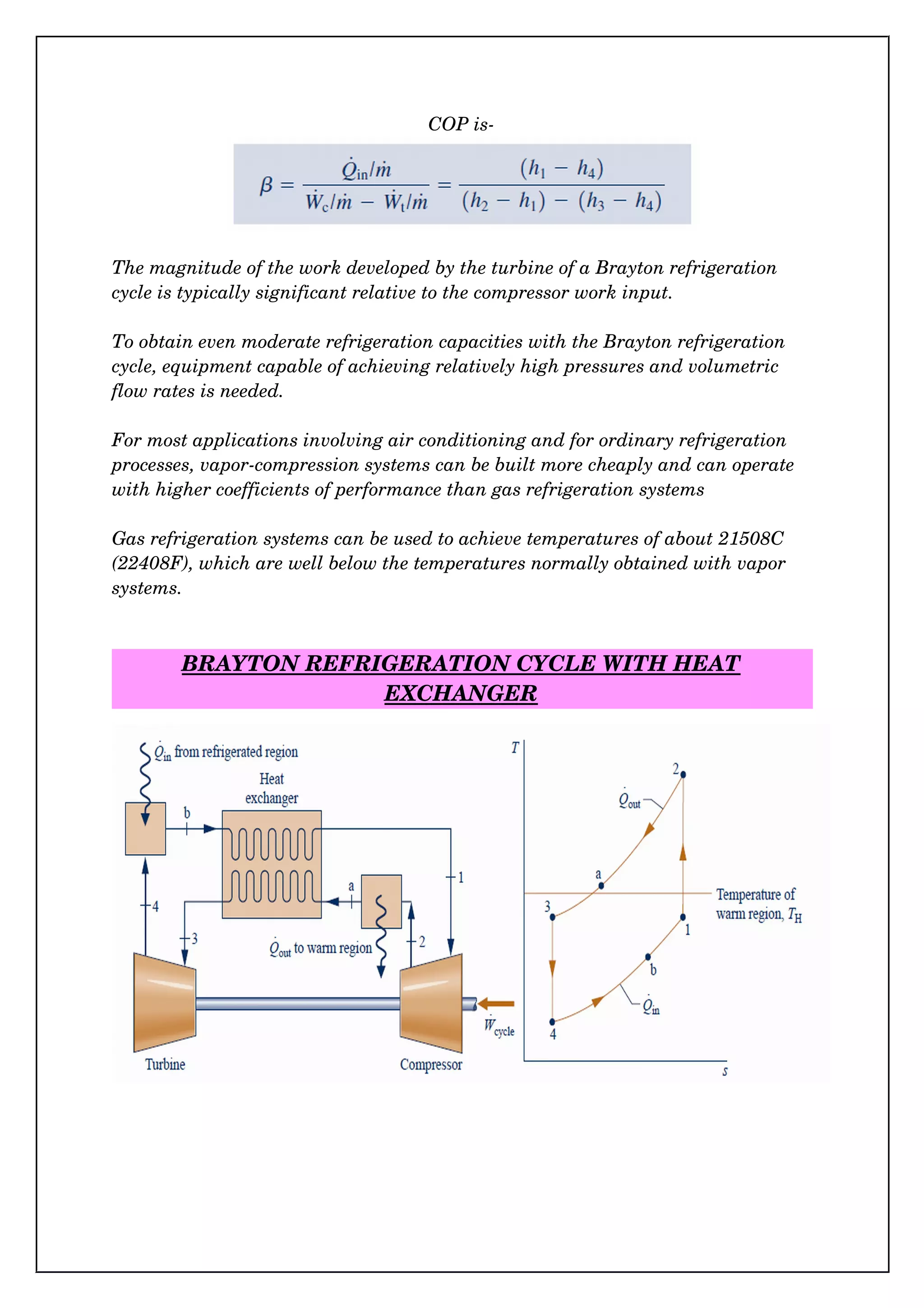
BRAYTON REFRIGERATION CYCLE WITH HEAT
EXCHANGER
The heat exchanger allows the air exiting the compressor at state 2 to cool below 
the warm region temperature TH giving a low turbine inlet temperature, T3.
Without the heat exchanger, air could be cooled only close to TH, as represented on
the figure by state a.
In the subsequent expansion through the turbine, the air achieves a much lower 
temperature at state 4 than would have been possible without the heat exchanger
Accordingly, the refrigeration effect, achieved from state 4 to state b, occurs at a 
correspondingly lower average temperature.
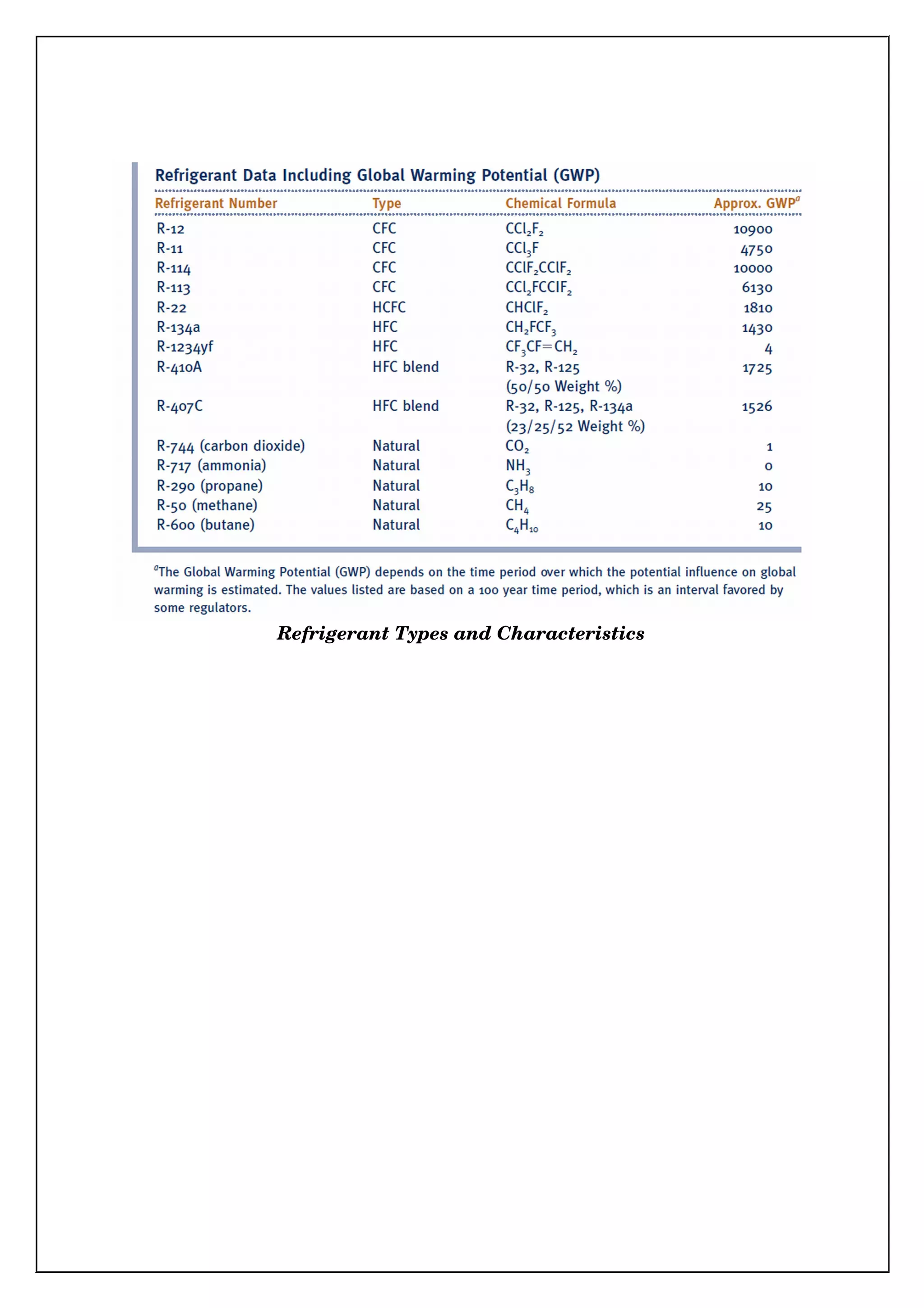
SELECTING REFRIGERANTS
Refrigerant selection for a wide range of refrigeration and air­conditioning 
applications is generally based on three factors­
1) Performance­It refers to providing the required cooling or heating capacity 
reliably and cost effectively
2) Safety­ It refers to avoiding hazards such as toxicity and flammability
3) Environmental impact­ It primarily refers to using refrigerants that do not 
harm the stratospheric ozone layer or contribute significantly to global 
climate change.
The selection of a refrigerant is based partly on the suitability of its pressure–
temperature relationship in the range of the particular application. It is generally
desirable to avoid excessively low pressures in the evaporator and excessively high
pressures in the condenser.
Other considerations in refrigerant selection include chemical stability, 
corrosiveness, and cost.
The type of compressor also affects the choice of refrigerant. Centrifugal 
compressors are best suited for low evaporator pressures and refrigerants with 
large specific volumes at low pressure. Reciprocating compressors perform better 
over large pressure ranges and are better able to handle low specific volume 
refrigerants.
Refrigerant Types and Characteristics

Introduction to refrigeration systems