Referencing – Footnote style


In-text referencing
There are many variations of the footnoting system. Always follow information given to you by your
lecturer. Here are some guidelines:

•        The easiest way to format your footnotes is to use the Microsoft Word referencing tool. (Insert>
         reference> footnote). If you are not using this application use a superscript—1. Then type the
         corresponding number at the bottom of the page, citing all the bibliographic information.
•        The first time a source is cited include the author's full name, the title of the work and publication
         details (see examples below). Subsequent references to the same work can usually be in a shortened
         form (but check with your lecturer first about suitable abbreviations).
•        Include page numbers at the end of the footnote only when quoting, not when you paraphrase.
Example
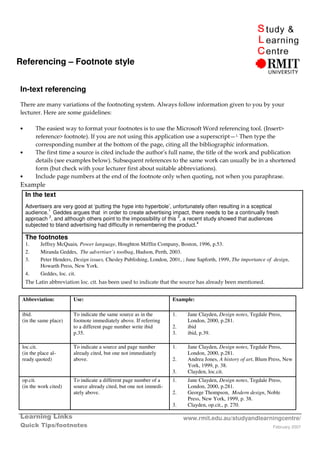
    In the text
    Advertisers are very good at ‘putting the hype into hyperbole’, unfortunately often resulting in a sceptical
    audience.1 Geddes argues that in order to create advertising impact, there needs to be a continually fresh
    approach 2, and although others point to the impossibility of this 3, a recent study showed that audiences
    subjected to bland advertising had difficulty in remembering the product.4

    The footnotes
    1.    Jeffrey McQuain, Power language, Houghton Mifflin Company, Boston, 1996, p.53.
    2.    Miranda Geddes, The advertiser’s toolbag, Hudson, Perth, 2003.
    3.    Peter Henders, Design issues, Chesley Publishing, London, 2001, ; June Sapforth, 1999, The importance of design,
          Howarth Press, New York.
    4.    Geddes, loc. cit.
    The Latin abbreviation loc. cit. has been used to indicate that the source has already been mentioned.


 Abbreviation:          Use:                                         Example:

 ibid.                  To indicate the same source as in the        1.     Jane Clayden, Design notes, Tegdale Press,
 (in the same place)    footnote immediately above. If referring            London, 2000, p.281.
                        to a different page number write ibid        2.     ibid
                        p.35.                                        3.     ibid, p.39.

 loc.cit.               To indicate a source and page number         1.     Jane Clayden, Design notes, Tegdale Press,
 (in the place al-      already cited, but one not immediately              London, 2000, p.281.
 ready quoted)          above.                                       2.     Andrea Jones, A history of art, Blum Press, New
                                                                            York, 1999, p. 38.
                                                                     3.     Clayden, loc.cit.
 op.cit.                To indicate a different page number of a     1.     Jane Clayden, Design notes, Tegdale Press,
 (in the work cited)    source already cited, but one not immedi-           London, 2000, p.281.
                        ately above.                                 2.     George Thompson, Modern design, Noble
                                                                            Press, New York, 1999, p. 38.
                                                                     3.     Clayden, op.cit., p. 270.

Learning Links                                                            www.rmit.edu.au/studyandlearningcentre/
Quick Tips/footnotes                                                                                              February 2007
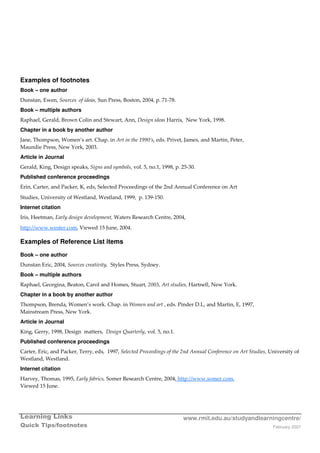
Examples of footnotes
Book – one author
Dunstan, Ewen, Sources of ideas, Sun Press, Boston, 2004, p. 71-78.
Book – multiple authors
Raphael, Gerald, Brown Colin and Stewart, Ann, Design ideas Harris, New York, 1998.
Chapter in a book by another author
Jane, Thompson, Women’s art. Chap. in Art in the 1990’s, eds. Privet, James, and Martin, Peter,
Maundie Press, New York, 2003.
Article in Journal
Gerald, King, Design speaks, Signs and symbols, vol. 5, no.1, 1998, p. 25-30.
Published conference proceedings
Erin, Carter, and Packer, K, eds, Selected Proceedings of the 2nd Annual Conference on Art
Studies, University of Westland, Westland, 1999, p. 139-150.
Internet citation
Iris, Heetman, Early design development, Waters Research Centre, 2004,
http://www.wester.com, Viewed 15 June, 2004.

Examples of Reference List items
Book – one author
Dunstan Eric, 2004, Sources creativity, Styles Press, Sydney.
Book – multiple authors
Raphael, Georgina, Beaton, Carol and Homes, Stuart, 2003, Art studies, Hartnell, New York.
Chapter in a book by another author
Thompson, Brenda, Women’s work. Chap. in Women and art , eds. Pinder D.L, and Martin, E, 1997,
Mainstream Press, New York.
Article in Journal
King, Gerry, 1998, Design matters, Design Quarterly, vol. 5, no.1.
Published conference proceedings
Carter, Eric, and Packer, Terry, eds, 1997, Selected Proceedings of the 2nd Annual Conference on Art Studies, University of
Westland, Westland.
Internet citation
Harvey, Thomas, 1995, Early fabrics, Somer Research Centre, 2004, http://www.somer.com,
Viewed 15 June.


Learning Links                                                         www.rmit.edu.au/studyandlearningcentre/
Quick Tips/footnotes                                                                                           February 2007

Referencing footnote

  • 1.
    Referencing – Footnotestyle In-text referencing There are many variations of the footnoting system. Always follow information given to you by your lecturer. Here are some guidelines: • The easiest way to format your footnotes is to use the Microsoft Word referencing tool. (Insert> reference> footnote). If you are not using this application use a superscript—1. Then type the corresponding number at the bottom of the page, citing all the bibliographic information. • The first time a source is cited include the author's full name, the title of the work and publication details (see examples below). Subsequent references to the same work can usually be in a shortened form (but check with your lecturer first about suitable abbreviations). • Include page numbers at the end of the footnote only when quoting, not when you paraphrase. Example In the text Advertisers are very good at ‘putting the hype into hyperbole’, unfortunately often resulting in a sceptical audience.1 Geddes argues that in order to create advertising impact, there needs to be a continually fresh approach 2, and although others point to the impossibility of this 3, a recent study showed that audiences subjected to bland advertising had difficulty in remembering the product.4 The footnotes 1. Jeffrey McQuain, Power language, Houghton Mifflin Company, Boston, 1996, p.53. 2. Miranda Geddes, The advertiser’s toolbag, Hudson, Perth, 2003. 3. Peter Henders, Design issues, Chesley Publishing, London, 2001, ; June Sapforth, 1999, The importance of design, Howarth Press, New York. 4. Geddes, loc. cit. The Latin abbreviation loc. cit. has been used to indicate that the source has already been mentioned. Abbreviation: Use: Example: ibid. To indicate the same source as in the 1. Jane Clayden, Design notes, Tegdale Press, (in the same place) footnote immediately above. If referring London, 2000, p.281. to a different page number write ibid 2. ibid p.35. 3. ibid, p.39. loc.cit. To indicate a source and page number 1. Jane Clayden, Design notes, Tegdale Press, (in the place al- already cited, but one not immediately London, 2000, p.281. ready quoted) above. 2. Andrea Jones, A history of art, Blum Press, New York, 1999, p. 38. 3. Clayden, loc.cit. op.cit. To indicate a different page number of a 1. Jane Clayden, Design notes, Tegdale Press, (in the work cited) source already cited, but one not immedi- London, 2000, p.281. ately above. 2. George Thompson, Modern design, Noble Press, New York, 1999, p. 38. 3. Clayden, op.cit., p. 270. Learning Links www.rmit.edu.au/studyandlearningcentre/ Quick Tips/footnotes February 2007
  • 2.
    Examples of footnotes Book– one author Dunstan, Ewen, Sources of ideas, Sun Press, Boston, 2004, p. 71-78. Book – multiple authors Raphael, Gerald, Brown Colin and Stewart, Ann, Design ideas Harris, New York, 1998. Chapter in a book by another author Jane, Thompson, Women’s art. Chap. in Art in the 1990’s, eds. Privet, James, and Martin, Peter, Maundie Press, New York, 2003. Article in Journal Gerald, King, Design speaks, Signs and symbols, vol. 5, no.1, 1998, p. 25-30. Published conference proceedings Erin, Carter, and Packer, K, eds, Selected Proceedings of the 2nd Annual Conference on Art Studies, University of Westland, Westland, 1999, p. 139-150. Internet citation Iris, Heetman, Early design development, Waters Research Centre, 2004, http://www.wester.com, Viewed 15 June, 2004. Examples of Reference List items Book – one author Dunstan Eric, 2004, Sources creativity, Styles Press, Sydney. Book – multiple authors Raphael, Georgina, Beaton, Carol and Homes, Stuart, 2003, Art studies, Hartnell, New York. Chapter in a book by another author Thompson, Brenda, Women’s work. Chap. in Women and art , eds. Pinder D.L, and Martin, E, 1997, Mainstream Press, New York. Article in Journal King, Gerry, 1998, Design matters, Design Quarterly, vol. 5, no.1. Published conference proceedings Carter, Eric, and Packer, Terry, eds, 1997, Selected Proceedings of the 2nd Annual Conference on Art Studies, University of Westland, Westland. Internet citation Harvey, Thomas, 1995, Early fabrics, Somer Research Centre, 2004, http://www.somer.com, Viewed 15 June. Learning Links www.rmit.edu.au/studyandlearningcentre/ Quick Tips/footnotes February 2007