Copyright © 2006
Pearson Education Canada Inc.
Chapter 12
Reference Groups and Family
Consumer Behaviour
Canadian Edition
Schiffman/Kanuk/Das
Copyright © 2006 Pearson Education Canada Inc.
12-2
What is a Group?
 Two or more people who interact to
accomplish either individual or mutual
goals
Copyright © 2006 Pearson Education Canada Inc.
12-3
Reference Group
 A person or group that serves as a point of
comparison (or reference) for an individual
in the formation of either general or specific
values, attitudes, or behaviour.
Copyright © 2006 Pearson Education Canada Inc.
12-4
Types of Reference Groups
 Classified by:
– Membership
• Symbolic
– Extent of interaction
• Direct versus indirect
– Nature of attraction
• Aspirational versus dissociative
– Degree of formality
• Formal versus informal
Copyright © 2006 Pearson Education Canada Inc.
12-5
Types of Reference Group
Influence
 Informational Influence
– When a member of reference group provides
information used to make purchase decisions
 Normative Influence
– When we conform to group norms in order to
belong to that group
 Identification Influence
– When we identify with, and internalize, a group’s
values and behaviours
Copyright © 2006 Pearson Education Canada Inc.
12-6
Factors Encouraging Conformity:
A Reference Group Must ...
 Inform or make the individual aware of a
specific product or brand
 Provide the individual with the opportunity to
compare his or her own thinking with the
attitudes and behaviour of the group
 Influence the individual to adopt attitudes and
behaviour that are consistent with the norms of
the group
 Legitimize the decision to use the same
products as the group
Copyright © 2006 Pearson Education Canada Inc.
12-7
Selected Consumer-Related
Reference Groups
 Friendship groups
 Shopping groups
 Work groups
 Virtual groups or communities
 Brand communities
 Consumer-action groups
 celebrities
Copyright © 2006 Pearson Education Canada Inc.
12-8
Copyright © 2006 Pearson Education Canada Inc.
12-9
Reference Groups and Marketing
Strategy
 Recognize the extent of reference group
influence in a situation
 Identify the most effective type of reference
group influence
 Identify possible reference group members
to use in promotions
 Attempt to increase reference group
influence
Copyright © 2006 Pearson Education Canada Inc.
12-10
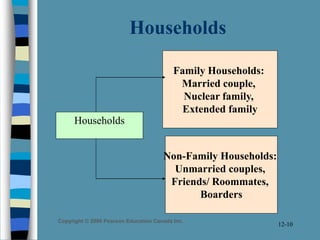
Households
Households
Family Households:
Married couple,
Nuclear family,
Extended family
Non-Family Households:
Unmarried couples,
Friends/ Roommates,
Boarders
Copyright © 2006 Pearson Education Canada Inc.
12-11
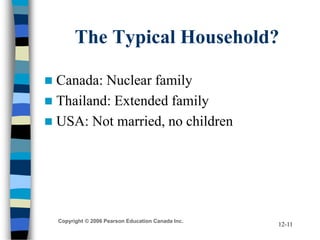
The Typical Household?
 Canada: Nuclear family
 Thailand: Extended family
 USA: Not married, no children
Copyright © 2006 Pearson Education Canada Inc.
12-12
The Family Life Cycle
 Traditional Family Life Cycle
– Stage I: Bachelorhood
– Stage II: Honeymooners
– Stage III: Parenthood
– Stage IV: Post-parenthood
– Stage V: Dissolution
 Modifications - the Nontraditional FLC
Copyright © 2006 Pearson Education Canada Inc.
12-13
Copyright © 2006 Pearson Education Canada Inc.
12-14
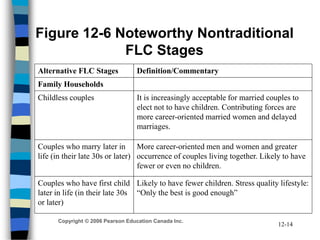
Figure 12-6 Noteworthy Nontraditional
FLC Stages
Family Households
Childless couples It is increasingly acceptable for married couples to
elect not to have children. Contributing forces are
more career-oriented married women and delayed
marriages.
Couples who marry later in
life (in their late 30s or later)
More career-oriented men and women and greater
occurrence of couples living together. Likely to have
fewer or even no children.
Couples who have first child
later in life (in their late 30s
or later)
Likely to have fewer children. Stress quality lifestyle:
“Only the best is good enough”
Alternative FLC Stages Definition/Commentary
Copyright © 2006 Pearson Education Canada Inc.
12-15
Figure 12-6 (continued)
Family Households
Single parents II Young man or woman who has one or more children
out of wedlock.
Single parents III A single person who adopts one or more children.
Extended family Young single-adult children who return home to
avoid the expenses of living alone while establishing
their careers. Divorced daughter or son and
grandchild(ren) return home to parents. Frail elderly
parents who move in with children. Newlyweds
living with in-laws.
Alternative FLC Stages Definition/Commentary
Single parents I High divorce rates (about 50%) contribute to a
portion of single-parent households
Copyright © 2006 Pearson Education Canada Inc.
12-16
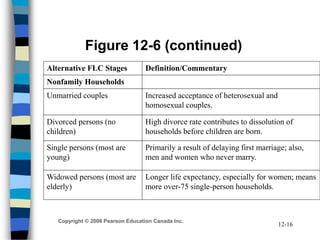
Figure 12-6 (continued)
Nonfamily Households
Unmarried couples Increased acceptance of heterosexual and
homosexual couples.
Divorced persons (no
children)
High divorce rate contributes to dissolution of
households before children are born.
Single persons (most are
young)
Primarily a result of delaying first marriage; also,
men and women who never marry.
Alternative FLC Stages Definition/Commentary
Widowed persons (most are
elderly)
Longer life expectancy, especially for women; means
more over-75 single-person households.
Copyright © 2006 Pearson Education Canada Inc.
12-17
Copyright © 2006 Pearson Education Canada Inc.
12-18
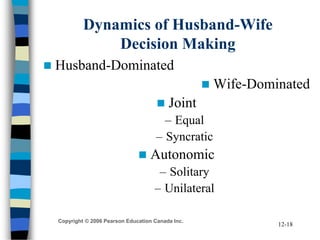
Dynamics of Husband-Wife
Decision Making
 Husband-Dominated
 Wife-Dominated
 Joint
– Equal
– Syncratic
 Autonomic
– Solitary
– Unilateral
Copyright © 2006 Pearson Education Canada Inc.
12-19
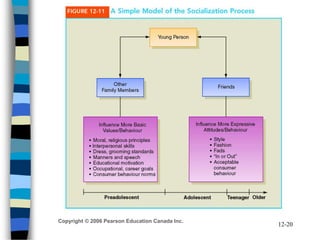
Consumer Socialization
 The process by which children acquire the
skills, knowledge, and attitudes necessary to
function as consumers.
Copyright © 2006 Pearson Education Canada Inc.
12-20
Copyright © 2006 Pearson Education Canada Inc.
12-21
Other Functions of the Family
 Economic well-being
 Emotional support
 Suitable family lifestyles
Copyright © 2006 Pearson Education Canada Inc.
12-22
Family and Marketing Strategy
 Use the FLC for segmentation and positioning
 Recognize the diverse consumption roles within
the family
 Understand and use the dynamics of husband-wife
decision making
 Understand and use the consumer socialization
role played by the family
 Recognize the changing nature of Canadian
families.

reference-groups-and-family-influences.pptx

  • 1.
    Copyright © 2006 PearsonEducation Canada Inc. Chapter 12 Reference Groups and Family Consumer Behaviour Canadian Edition Schiffman/Kanuk/Das
  • 2.
    Copyright © 2006Pearson Education Canada Inc. 12-2 What is a Group?  Two or more people who interact to accomplish either individual or mutual goals
  • 3.
    Copyright © 2006Pearson Education Canada Inc. 12-3 Reference Group  A person or group that serves as a point of comparison (or reference) for an individual in the formation of either general or specific values, attitudes, or behaviour.
  • 4.
    Copyright © 2006Pearson Education Canada Inc. 12-4 Types of Reference Groups  Classified by: – Membership • Symbolic – Extent of interaction • Direct versus indirect – Nature of attraction • Aspirational versus dissociative – Degree of formality • Formal versus informal
  • 5.
    Copyright © 2006Pearson Education Canada Inc. 12-5 Types of Reference Group Influence  Informational Influence – When a member of reference group provides information used to make purchase decisions  Normative Influence – When we conform to group norms in order to belong to that group  Identification Influence – When we identify with, and internalize, a group’s values and behaviours
  • 6.
    Copyright © 2006Pearson Education Canada Inc. 12-6 Factors Encouraging Conformity: A Reference Group Must ...  Inform or make the individual aware of a specific product or brand  Provide the individual with the opportunity to compare his or her own thinking with the attitudes and behaviour of the group  Influence the individual to adopt attitudes and behaviour that are consistent with the norms of the group  Legitimize the decision to use the same products as the group
  • 7.
    Copyright © 2006Pearson Education Canada Inc. 12-7 Selected Consumer-Related Reference Groups  Friendship groups  Shopping groups  Work groups  Virtual groups or communities  Brand communities  Consumer-action groups  celebrities
  • 8.
    Copyright © 2006Pearson Education Canada Inc. 12-8
  • 9.
    Copyright © 2006Pearson Education Canada Inc. 12-9 Reference Groups and Marketing Strategy  Recognize the extent of reference group influence in a situation  Identify the most effective type of reference group influence  Identify possible reference group members to use in promotions  Attempt to increase reference group influence
  • 10.
    Copyright © 2006Pearson Education Canada Inc. 12-10 Households Households Family Households: Married couple, Nuclear family, Extended family Non-Family Households: Unmarried couples, Friends/ Roommates, Boarders
  • 11.
    Copyright © 2006Pearson Education Canada Inc. 12-11 The Typical Household?  Canada: Nuclear family  Thailand: Extended family  USA: Not married, no children
  • 12.
    Copyright © 2006Pearson Education Canada Inc. 12-12 The Family Life Cycle  Traditional Family Life Cycle – Stage I: Bachelorhood – Stage II: Honeymooners – Stage III: Parenthood – Stage IV: Post-parenthood – Stage V: Dissolution  Modifications - the Nontraditional FLC
  • 13.
    Copyright © 2006Pearson Education Canada Inc. 12-13
  • 14.
    Copyright © 2006Pearson Education Canada Inc. 12-14 Figure 12-6 Noteworthy Nontraditional FLC Stages Family Households Childless couples It is increasingly acceptable for married couples to elect not to have children. Contributing forces are more career-oriented married women and delayed marriages. Couples who marry later in life (in their late 30s or later) More career-oriented men and women and greater occurrence of couples living together. Likely to have fewer or even no children. Couples who have first child later in life (in their late 30s or later) Likely to have fewer children. Stress quality lifestyle: “Only the best is good enough” Alternative FLC Stages Definition/Commentary
  • 15.
    Copyright © 2006Pearson Education Canada Inc. 12-15 Figure 12-6 (continued) Family Households Single parents II Young man or woman who has one or more children out of wedlock. Single parents III A single person who adopts one or more children. Extended family Young single-adult children who return home to avoid the expenses of living alone while establishing their careers. Divorced daughter or son and grandchild(ren) return home to parents. Frail elderly parents who move in with children. Newlyweds living with in-laws. Alternative FLC Stages Definition/Commentary Single parents I High divorce rates (about 50%) contribute to a portion of single-parent households
  • 16.
    Copyright © 2006Pearson Education Canada Inc. 12-16 Figure 12-6 (continued) Nonfamily Households Unmarried couples Increased acceptance of heterosexual and homosexual couples. Divorced persons (no children) High divorce rate contributes to dissolution of households before children are born. Single persons (most are young) Primarily a result of delaying first marriage; also, men and women who never marry. Alternative FLC Stages Definition/Commentary Widowed persons (most are elderly) Longer life expectancy, especially for women; means more over-75 single-person households.
  • 17.
    Copyright © 2006Pearson Education Canada Inc. 12-17
  • 18.
    Copyright © 2006Pearson Education Canada Inc. 12-18 Dynamics of Husband-Wife Decision Making  Husband-Dominated  Wife-Dominated  Joint – Equal – Syncratic  Autonomic – Solitary – Unilateral
  • 19.
    Copyright © 2006Pearson Education Canada Inc. 12-19 Consumer Socialization  The process by which children acquire the skills, knowledge, and attitudes necessary to function as consumers.
  • 20.
    Copyright © 2006Pearson Education Canada Inc. 12-20
  • 21.
    Copyright © 2006Pearson Education Canada Inc. 12-21 Other Functions of the Family  Economic well-being  Emotional support  Suitable family lifestyles
  • 22.
    Copyright © 2006Pearson Education Canada Inc. 12-22 Family and Marketing Strategy  Use the FLC for segmentation and positioning  Recognize the diverse consumption roles within the family  Understand and use the dynamics of husband-wife decision making  Understand and use the consumer socialization role played by the family  Recognize the changing nature of Canadian families.