Apprenticeships’ popularity are
growing
• A survey by the
Department for Business,
Innovation and Skills
found that 72% of
businesses said an
apprentice improved
their product or service
quality.
• 81% said they would
recommend them to
others.
Taking on an apprentice is a
commitment
Employers commit to:
 a new member of staff
 their training and development
• Depending on which basis you employ the apprentice,
this can affect their rights.
Taking on an apprentice is a
commitment
In short, when
employing an
apprentice,
employers need to
avoid setting up a
contract by default
conferring additional
rights on their
trainees.
So what’s the best way to employ
an apprentice?
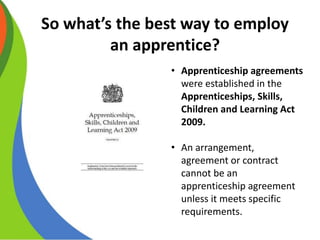
• Apprenticeship agreements
were established in the
Apprenticeships, Skills,
Children and Learning Act
2009.
• An arrangement,
agreement or contract
cannot be an
apprenticeship agreement
unless it meets specific
requirements.
So what’s the best way to employ
an apprentice?
• For example, it must be
in writing and must state
it is entered into in
connection with a
qualifying
apprenticeship.
• This approach is the
simplest and most
effective way to employ
an apprentice.
What do I need to avoid when
employing an apprentice?
• Often employers will try to
use their standard
contracts and change the
job title or heading to
“apprentice”.
• This meets the
requirement for the
agreement to be in writing,
but fails to include all the
required clauses,
unintentionally creating an
apprenticeship contract.
What’s the problem with an
apprenticeship contract?
The key difference
between an
apprenticeship contract
and an apprenticeship
agreement is that the
contract puts the
‘training’ at the centre of
contract and places the
onus on the employer to
deliver that training.
What’s the problem with an
apprenticeship contract?
• Apprentices who are
employed under an
apprenticeship agreement
can be treated like
ordinary employees and
the normal unfair
dismissal rules apply.
• Apprentices who have
apprenticeship contracts
have additional rights.
What’s the problem with an
apprenticeship contract?
• If the apprentice
breaches the contract,
this does not necessarily
mean the employer can
stop the training.
• They can only be
dismissed fairly for
misconduct if they are
effectively unteachable.
What’s the problem with an
apprenticeship contract?
• An apprenticeship
contract cannot be
terminated because of
redundancy unless the
employer’s business
closes or fundamentally
changes.
• It cannot simply be that
the need for apprentices
in the business has
reduced, as with ordinary
employees.
What’s the problem with an
apprenticeship contract?
If ‘unfairly’ dismissed, it
is likely the apprentice
will be awarded more
compensation to reflect
the loss of earnings
under the
apprenticeship contract
plus the loss of potential
future earnings.
By ensuring you set
up an apprenticeship
agreement correctly,
you can enjoy the
many benefits of
employing an
apprentice without
the risks.
Tweet @SafarazAli
Connect with Safaraz Ali

Reducing risk when taking on an apprentice

  • 2.
    Apprenticeships’ popularity are growing •A survey by the Department for Business, Innovation and Skills found that 72% of businesses said an apprentice improved their product or service quality. • 81% said they would recommend them to others.
  • 3.
    Taking on anapprentice is a commitment Employers commit to:  a new member of staff  their training and development • Depending on which basis you employ the apprentice, this can affect their rights.
  • 4.
    Taking on anapprentice is a commitment In short, when employing an apprentice, employers need to avoid setting up a contract by default conferring additional rights on their trainees.
  • 5.
    So what’s thebest way to employ an apprentice? • Apprenticeship agreements were established in the Apprenticeships, Skills, Children and Learning Act 2009. • An arrangement, agreement or contract cannot be an apprenticeship agreement unless it meets specific requirements.
  • 6.
    So what’s thebest way to employ an apprentice? • For example, it must be in writing and must state it is entered into in connection with a qualifying apprenticeship. • This approach is the simplest and most effective way to employ an apprentice.
  • 7.
    What do Ineed to avoid when employing an apprentice? • Often employers will try to use their standard contracts and change the job title or heading to “apprentice”. • This meets the requirement for the agreement to be in writing, but fails to include all the required clauses, unintentionally creating an apprenticeship contract.
  • 8.
    What’s the problemwith an apprenticeship contract? The key difference between an apprenticeship contract and an apprenticeship agreement is that the contract puts the ‘training’ at the centre of contract and places the onus on the employer to deliver that training.
  • 9.
    What’s the problemwith an apprenticeship contract? • Apprentices who are employed under an apprenticeship agreement can be treated like ordinary employees and the normal unfair dismissal rules apply. • Apprentices who have apprenticeship contracts have additional rights.
  • 10.
    What’s the problemwith an apprenticeship contract? • If the apprentice breaches the contract, this does not necessarily mean the employer can stop the training. • They can only be dismissed fairly for misconduct if they are effectively unteachable.
  • 11.
    What’s the problemwith an apprenticeship contract? • An apprenticeship contract cannot be terminated because of redundancy unless the employer’s business closes or fundamentally changes. • It cannot simply be that the need for apprentices in the business has reduced, as with ordinary employees.
  • 12.
    What’s the problemwith an apprenticeship contract? If ‘unfairly’ dismissed, it is likely the apprentice will be awarded more compensation to reflect the loss of earnings under the apprenticeship contract plus the loss of potential future earnings.
  • 13.
    By ensuring youset up an apprenticeship agreement correctly, you can enjoy the many benefits of employing an apprentice without the risks. Tweet @SafarazAli Connect with Safaraz Ali