Redis Stack For Application Modernization Anonymous
1.
Redis Stack ForApplication Modernization
Anonymous download
https://ebookbell.com/product/redis-stack-for-application-
modernization-anonymous-55290586
Explore and download more ebooks at ebookbell.com
2.
Here are somerecommended products that we believe you will be
interested in. You can click the link to download.
Redis Stack For Application Modernization Build Realtime Multimodel
Applications At Any Scale With Redis 1st Fugaro Luigi
https://ebookbell.com/product/redis-stack-for-application-
modernization-build-realtime-multimodel-applications-at-any-scale-
with-redis-1st-fugaro-luigi-54671798
Redis Cookbook Tiago Macedo Fred Oliveira
https://ebookbell.com/product/redis-cookbook-tiago-macedo-fred-
oliveira-2427038
Redis In Action Pappsc Josiah L Carlson
https://ebookbell.com/product/redis-in-action-pappsc-josiah-l-
carlson-4318044
Redis Essentials Harness The Power Of Redis To Integrate And Manage
Your Projects Efficiently Maxwell Dayvson Da Silva
https://ebookbell.com/product/redis-essentials-harness-the-power-of-
redis-to-integrate-and-manage-your-projects-efficiently-maxwell-
dayvson-da-silva-50194982
3.
Redis For DummiesLimited Edition Steve Suehring
https://ebookbell.com/product/redis-for-dummies-limited-edition-steve-
suehring-11571694
Redis 4x Cookbook Pengcheng Huang Zuofei Wang
https://ebookbell.com/product/redis-4x-cookbook-pengcheng-huang-
zuofei-wang-48806292
Redis Tutorials Point
https://ebookbell.com/product/redis-tutorials-point-12142314
Learning Redis Vinoo Das
https://ebookbell.com/product/learning-redis-vinoo-das-5207534
Mastering Redis Jeremy Nelson
https://ebookbell.com/product/mastering-redis-jeremy-nelson-38473450
Production reference: 1151223
Publishedby Packt Publishing Ltd.
Grosvenor House
11 St Paul’s Square
Birmingham
B3 1RB, UK.
ISBN 978-1-83763-818-5
www.packtpub.com
8.
Dedications are alwaystough. To mention or not to mention your beloved ones is the real
dilemma. Unfortunately, this year I lost a special person in my life, so I decided to dedicate this
book to him – Grazie Oscarino.
Dedicated to Angela,my remarkable 101-year-old grandmother. Your enduring patience,
infectious good humor, melodious singing voice, and quiet resilience have imparted invaluable
life lessons. This book is a tribute to you.
11.
– Mirko Ortensi
Contributors
Aboutthe authors
Luigi Fugaro’s computer science career began with a fascination for video games on the Vic 20 and
Atari ST1040, where he enjoyed manipulating game code. This interest sparked his journey into
programming, leading to a varied career in mastering numerous languages, including Fortran, Java,
Go, Delphi, Visual Basic, and Python. While he is ambivalent about JavaScript and doesn’t consider
HTML a programming language, he appreciates its utility.
Luigi’s career expanded into observability, monitoring, and data management, with significant
experiences at Red Hat and Redis, where he understood the importance of application performance.
Despite many side projects, most unfinished, Luigi’s notable contributions to literature reflect his
enduring passion and drive for technology and innovation in computer science.
In the journey of crafting a book, a myriad of dynamics come into play, mirroring the numerous
individuals who grace our daily lives. This holds particularly true for my family, including my
children, Giada, Filippo, and Viola. I’ve borrowed time from them – moments that I couldn’t spend by
their side. Yet, they are the spark that kindles my hope and fuels my drive to be better. For this gift,
my gratitude and love for them knows no bounds.
Mirko Ortensi wrote his first lines of code on a Commodore 64 in Basic when he was 10. It was
love at first sight. Eventually, he earned a degree in electronic engineering and a master’s degree in
software engineering at Università Politecnica delle Marche in Italy in 2002, with a thesis about
pattern recognition at UPC in Barcelona, Spain. Mirko’s career has spanned several roles in software
and services businesses, encompassing development and testing, system management, and support,
mainly centered around databases and distributed systems. As a senior technical enablement architect
at Redis, Mirko shares technical knowledge about Redis’s products, services, and features.
I extend heartfelt thanks to my incredible family – my loving wife, children, and Gizmo the cat – for
their unwavering patience and support during the countless hours I disappeared into the world of
writing and coding. Your understanding and encouragement were my pillars throughout this journey.
Luigi and Mirko express their deep gratitude to everyone at Redis who contributed to this book. They
extend special thanks to Alexandre Vasseur, David Maier, Tal Shkolnik, Raffaele Landoni, Cody
Henshaw, Myra El-Bayoumi, Claudia Di Martino, and all the contributors to Redis open source.
12.
Additionally, they thankPackt for believing in this project, particularly Heramb Bhavsar, Kirti Pisat,
and Manikandan Kurup for their support throughout Luigi and Mirko’s journey.
About the reviewer
Sumit Shatwara, a solution architect, brings a wealth of expertise from his previous role at Redis,
the global leader in real-time data platforms. At Redis, Sumit led the charge in designing and building
cutting-edge, real-time data solutions, driving technology sales, and serving as a trusted advisor to
enterprise clients within the banking, financial services, and digital native sectors. Sumit’s extensive
career spans experiences with renowned companies such as Red Hat, NetApp, and Capgemini, where
he facilitated the adoption of cloud-native technologies for numerous clients. Sumit’s future
aspirations include becoming an artificial intelligence specialist and ultimately establishing himself
as a thought leader in the realms of data and AI.
Part 1: Introductionto Redis Stack
1
Introducing Redis Stack
Technical requirements
Exploring the history of Redis
The open source project
From key-value to multi-model real-time databases
Primary key lookup
Secondary key lookup
Pipelining
Using functions
Using indexes
Redis Stack capabilities
So, what is Redis Stack?
Redis Stack deployment types
Summary
2
Developing Modern Use Cases with Redis Stack
Technical requirements
Caching, rate-limiting, geo-positioning, and other Redis
traditional use cases
Caching
Session store
Rate limiter
15.
Leaderboards
Data deduplication
Geo-positioning
Message processingand delivery
Going beyond the real-time cache with Redis Stack
Querying, indexing, and search
Monitoring and analysis
Fraud detection
Feature store for machine learning
Designing microservice architectures with Redis Stack
API gateway
Summary
3
Getting Started with Redis Stack
Installing Redis Stack using binary packages
Installing Redis Stack using native packages
macOS-native package
Linux-native package
Running Redis Stack using Docker
Using Redis Cloud
Installing RedisInsight
Installing the Redis Stack client libraries
Java client library
JavaScript client library
Python client library
Golang client library
C#/.NET client library
16.
Running health checks
Summary
4
SettingUp Client Libraries
Technical requirements
Redis Stack client libraries
Programming in Python using redis-py
Storing information in Redis Stack using Python
Redis OM for Python
Programming in Java using Jedis
Storing information in Redis Stack using Java
Redis OM for Java
Programming in JavaScript using node-redis
Redis OM for JavaScript
Programming in Go using go-redis
Storing information in Redis Stack using Go
Programming in C#/.NET using NRedisStack
Storing information in Redis Stack using C#/.NET
Redis OM for C#/.NET
Summary
17.
Part 2: DataModeling
5
Redis Stack as a Document Store
Technical requirements
Storing and querying documents in Redis Stack
The dialect and other configuration parameters
The query language
Simple terms
Using field modifiers
Intersection of results (AND)
Union of results (OR)
Exact query matches
Stop words
Negation and purely negative queries
Prefix, infix, and suffix queries
Wildcard matching
Fuzzy matching
Numeric filters
Tag filters
Geospatial filters
Aggregation and transformation
Cursor-based requests
Faceted search using aggregations
Updating an index in production
Temporary indexes
Additional commands
18.
Working with Hashes
Highlightingand summarizing
Synonyms support
Spellchecking
Auto-completion
Phonetic matching
Working with JSON
The JSONPath syntax
Indexing a JSON document
Indexing arrays and objects
Multi-value indexing
Extracting partial data from JSON documents
Redis Stack as a recommendation engine
Recommendation using scores
Redis Stack as a session store
Redis data structures for session data
Additional Redis data structures
Modeling key-value pairs
Modeling objects
Modeling collections
Session management for real-time applications
Summary
6
Redis Stack as a Vector Database
Technical requirements
Vector embeddings for unstructured data modeling
Storing the embeddings
19.
Hashes
JSON
Indexing the embeddings
Thealgorithms – FLAT and HNSW
Type
Index dimension
Distance metrics
Performing similarity search
Performing hybrid queries
Performing VSS range queries
Recommendations based on visual search
Integrating Redis with generative AI
Summary
7
Redis Stack as a Time Series Database
Technical requirements
Why Redis Stack for Time Series?
Working with time series
Adding labels to data points
Aggregation framework
Compaction rules for Time Series
Summary
8
Understanding Probabilistic Data Structures
Technical requirements
Part 3: FromDevelopment to Production
9
The Programmability of Redis Stack
Technical requirements
The single-threaded architecture
Programming complex business logic with Redis Stack
Lua scripting
Redis functions
Triggers and functions
Anatomy of a function
Working with data
Batch processing
Asynchronous functions
Cluster awareness
Keyspace triggers
Stream triggers
Comparing Lua scripts, Lua functions, and JavaScript functions
Summary
10
RedisInsight – the Data Management GUI
Technical requirements
Connecting to the Redis Stack database
Browsing keys
Interacting with data
22.
Analyzing data
Troubleshooting PubSubchannels
Summary
11
Using Redis Stack as a Primary Database
Technical requirements
What is a primary database?
Redis as a primary database
The BASE and ACID properties
The BASE properties
The ACID properties
Configuring Redis for durability, consistency, and availability
Configuring snapshots
Configuring AOF
Configuring high availability
Configuring consistency
Summary
12
Managing Development and Production Environments
Technical requirements
Redis Stack as a development environment
HA
Scalability
Security
Limitations
23.
Preparing for productionwith Redis Enterprise
Redis Enterprise architecture
A multi-tenancy architecture
HA
Horizontal and vertical scalability and dynamic auto-tiering
Security hardening
Observability and monitoring
Redis Cloud – an enterprise-ready Redis DBaaS
Summary
Index
Other Books You May Enjoy
24.
Preface
Redis Stack forApplication Modernization is written by industry experts from Redis, making this an
insightful reference for database administrators and developers, with best practices to administer and
manage the server, scalability, high availability, data integrity, stored functions, and more.
Modern applications require efficient operational and analytical capabilities and must ensure
predictable performance regardless of the workload. Redis is a de facto standard caching system,
with real-time response and flexible data types that fulfill all the different data modeling
requirements. This book introduces you to Redis Stack, an extension of Redis presented in 2022, and
it guides you through the multiple data modeling capabilities, together with examples to perform real-
time queries and searches. Redis Stack represents a new approach to providing a rich data modeling
experience all within the same database server.
You will learn how to model and search your data in the JSON and hash data types and work with
features such as vector search, which adds semantic search capabilities to your application (for
example, to search for similar texts, images, or audio files). You will understand how to use the
probabilistic Bloom filters to resolve efficiently recurrent big data problems. Next, we dive into the
strengths of Redis Stack as a data platform, show use cases to manage database events, and introduce
stream processing features. Scenarios to use Redis Stack in microservices architectures complete the
picture.
25.
Who this bookis for
This book is for software developers, software architects, and database administrators who want to
discover the powerful real-time, multi-model capabilities of the Redis Stack database.
You will work with JSON and hash documents, vectors, time series models, probabilistic data
structures, and stream processing, with an eye on the performance and security of the database and
the integrity of the data.
The prerequisite to reading this book is a basic understanding of Redis and databases in general and
software development skills in at least one of the Java, Python, C#, Golang, or JavaScript languages.
26.
What this bookcovers
Chapter 1, Introducing Redis Stack, introduces you to Redis Stack, its differences with Redis, and
why Redis can’t be considered as a caching system only, but a full-fledged database, augmenting and
replacing relational databases in many use cases.
Chapter 2, Resolving Use Cases with Redis Stack, explores how Redis Stack extends Redis’s well-
known capabilities thanks to its modular architecture, thus becoming a document store, a vector
database, and a time series database. The probabilistic data types help to efficiently resolve many
problems. Redis Stack is a modern real-time solution that can replace traditional relational databases
in many use cases.
Chapter 3, Getting Started with Redis Stack, teaches you how Redis Stack can be installed in a
variety of methods and on the most popular operative systems. This means that Redis Stack can be
installed easily on Linux, macOS, and Windows systems using native installation packages (Linux
tarballs are also available). Docker images are also available in Docker Hub. In addition, Redis Stack
is available as a service with Redis Cloud.
Chapter 4, Setting Up Client Libraries, describes how the Redis Stack ecosystem provides a set of
client libraries to ease developers’ lives. Those include libraries for the most used programming
languages such as Python, Java, GoLang, C#, and JavaScript. In addition to client libraries, Redis
provides a framework used for object mapping: Redis OM.
Chapter 5, Redis Stack as a Document Store, presents Redis Stack’s capability to perform real-time
queries and searches against the hash and JSON types. From full-text to tagging, from aggregation to
auto-completion, and the new vector search, Redis Stack can be used as a document store with
advanced features.
Chapter 6, Redis Stack as a Vector Database, highlights why, among the advanced search features of
Redis Stack, Vector Search stands as a core feature and deserves a chapter on its own. You will learn
data modeling concepts and how to perform similarity searches for recommendation engines.
Chapter 7, Redis Stack as a Time Series Database, explains how Redis Stack, as a multi-model, real-
time data structure server, can store data using data points for time series. Each data point can be
enriched by adding metadata, known as labels. Each data point can have multiple labels that can be
used for filtering, searching, querying, and aggregations using the built-in reducer functions.
Chapter 8, Understanding Probabilistic Data Structures, explores probabilistic data structures, which
are a group of data structures that give a very reasonable approximation of an answer in just a
fraction of the usual time and use very little memory. Questions such as “Has the user paid from this
27.
location already?”, “Whatare the 10 players with the highest score?”, or “How many unique users
have played this song?” address the typical use cases for these data structures
Chapter 9, Programmability of Redis Stack, describes how, in addition to the traditional Redis Lua
scripts and functions, Redis Stack includes a JavaScript serverless engine for transaction, batch, and
event-driven data processing, allowing users to write and run their functions on data stored in Redis.
With this capability, the database reacts to events occurring in the data while taking advantage of
different Redis data structures and modules and promoting interoperability between them.
Chapter 10, RedisInsight – the Data Management GUI, covers RedisInsight, which is a graphical
desktop manager that connects to Redis Stack databases and offers useful visualization tools for the
different data models that can be stored.
Chapter 11, Using Redis Stack as a Primary Database, explains how Redis, as the leading real-time
database, is used often as an in-memory cache, backed by a primary database. However, Redis Stack
extends Redis with multi-model capabilities and is a good fit in many use cases to replace a
traditional relational database. In this chapter, you will learn about the configuration to work with
Redis Stack as the only primary database serving multi-model applications
Chapter 12, Managing Development and Production Environments, explains how moving from a
development environment to deploying and running Redis at scale and monitoring the systems where
the databases are running requires effort and the implementation of several maintenance duties. Redis
Enterprise and Redis Cloud alleviate system and database administrators from their duties and can be
managed using an intuitive UI.
To get the most out of this book
It is important that you have an understanding of database platforms, specifically in the areas of data
insertion, updating, and deletion. Additionally, having a basic knowledge of SQL would be
beneficial. You should also be comfortable with executing commands using a command-line
interface, and familiarity with Unix-like systems is a plus. Prior experience with Redis or similar
technologies is not required.
Software/hardware covered in the book Operating system requirements
Redis Stack 7.2 or later Windows, macOS, or Linux
RedisInsight 2.36 or later Windows, macOS, or Linux
28.
If you areusing the digital version of this book, we advise you to type the code yourself or
access the code from the book’s GitHub repository (a link is available in the next section).
Doing so will help you avoid any potential errors related to the copying and pasting of code.
Download the example code files
You can download the example code files for this book from GitHub at
https://github.com/PacktPublishing/Redis-Stack-for-Application-Modernization. If there’s an update
to the code, it will be updated in the GitHub repository.
We also have other code bundles from our rich catalog of books and videos available at
https://github.com/PacktPublishing/. Check them out!
Conventions used
There are a number of text conventions used throughout this book.
Code in text: Indicates code words in text, database table names, folder names, filenames, file
extensions, pathnames, dummy URLs, user input, and Twitter handles. Here is an example:
“However, since Python version 3.3, a tool named virtualenv was integrated into Python’s standard
library.”
A block of code is set as follows:
client = redis.Redis(host='127.0.0.1', port=6379,
username='<YOUR_USERNAME>',
password='<YOUR_PASSWORD>')
client.set("Redis", "Stack")
print(client.get("Redis"))
When we wish to draw your attention to a particular part of a code block, the relevant lines or items
are set in bold:
<dependency>
<groupId>redis.clients</groupId>
<artifactId>jedis</artifactId>
<version>5.0.0</version>
</dependency>
Any command-line input or output is written as follows:
$ apt install python3.9-venv
Bold: Indicates a new term, an important word, or words that you see onscreen. For instance, words
in menus or dialog boxes appear in bold. Here is an example: “The application prompts you first to
29.
establish a connectionwith a Redis database. Start this process by clicking on the ADD REDIS
DATABASE button.”
Tips or important notes
Appear like this.
Get in touch
Feedback from our readers is always welcome.
General feedback: If you have questions about any aspect of this book, email us at
customercare@packtpub.com and mention the book title in the subject of your message.
Errata: Although we have taken every care to ensure the accuracy of our content, mistakes do
happen. If you have found a mistake in this book, we would be grateful if you would report this to us.
Please visit www.packtpub.com/support/errata and fill in the form.
Piracy: If you come across any illegal copies of our works in any form on the internet, we would be
grateful if you would provide us with the location address or website name. Please contact us at
copyright@packt.com with a link to the material.
If you are interested in becoming an author: If there is a topic that you have expertise in and you
are interested in either writing or contributing to a book, please visit authors.packtpub.com.
Share Your Thoughts
Once you’ve read Redis Stack for Application Modernization, we’d love to hear your thoughts!
Please click here to go straight to the Amazon review page for this book and share your feedback.
Your review is important to us and the tech community and will help us make sure we’re delivering
excellent quality content.
Download a free PDF copy of this book
Thanks for purchasing this book!
Do you like to read on the go but are unable to carry your print books everywhere?
Is your eBook purchase not compatible with the device of your choice?
Don’t worry, now with every Packt book you get a DRM-free PDF version of that book at no cost.
30.
Read anywhere, anyplace, on any device. Search, copy, and paste code from your favorite technical
books directly into your application.
The perks don’t stop there, you can get exclusive access to discounts, newsletters, and great free
content in your inbox daily
Follow these simple steps to get the benefits:
1. Scan the QR code or visit the link below
https://packt.link/free-ebook/9781837638185
2. Submit your proof of purchase
3. That’s it! We’ll send your free PDF and other benefits to your email directly
31.
Part 1: Introductionto Redis Stack
Redis Stack combines the core features of Redis with its most successful capabilities, offering a
comprehensive understanding of Redis fundamentals and advanced functionalities. It distinguishes
itself from Redis by its modular architecture, expanding its capabilities to serve as a document store,
vector database, and time-series database. Redis Stack is versatile, functioning as an in-memory real-
time cache, session store, leaderboard storage, and message broker. Its probabilistic data types
enhance problem-solving efficiency, positioning it as a modern alternative to traditional relational
databases for various applications.
The installation of Redis Stack is straightforward across popular operating systems such as Linux,
macOS, and Windows, with native packages and Docker images available. To support developers,
Redis Stack includes client libraries for major programming languages such as Python, Go, C#, Java,
and JavaScript, along with the Redis OM framework for object mapping. This makes Redis Stack a
user-friendly and adaptable solution for real-time data processing and management needs.
This part contains the following chapters:
Chapter 1, Introducing Redis Stack
Chapter 2, Developing Modern Use Cases with Redis Stack
Chapter 3, Getting Started with Redis Stack
Chapter 4, Setting Up Client Libraries
32.
1
Introducing Redis Stack
Redishas achieved several important milestones since its inception in 2009, from taking the lead as
the most popular key-value data store, according to the ranking published every month by the website
DB-Engines (and the sixth among all database systems), up to establishing the record as the most
downloaded container image on Docker. Not to mention that Redis has been the most loved database
for five years in a row, according to the Developer Survey published by Stack Overflow in the years
2016-2021. And, for sure, you, or a friend of yours, have used it for some reason, work, or hobby.
If you are reading this book, chances are you have programmed an application using a Redis server,
or at least you know what it is and what it is used for. In this chapter, we’ll recap what made Redis
the most famous caching system in the world and we’ll share some anecdotes about the development
undertaken by its creator, Salvatore Sanfilippo. We won’t stay long on the story of Redis, though,
because this book is about application modernization. As you read through, you will discover how
the original database, designed for speed and simplicity, has evolved to resolve many of the new
challenges of this age, without compromising on the ease of adoption, flexibility, and, above all,
speed.
Redis Stack is an extension of Redis presented in 2022, which introduces JSON, vector, and time
series data modeling capabilities, all supporting real-time queries and searches. Redis Stack
represents a new approach to providing a rich data modeling experience all within the same database
server. It introduces features such as vector similarity search to query structured and unstructured
data (for example, text, images, or audio files) and delivers probabilistic Bloom filters to efficiently
resolve recurrent big data problems. Redis Stack is also a data platform that supports event-driven
programming and introduces stream processing features. By the end of this chapter, you will
understand what Redis Stack is and how it enhances the Redis server with many new capabilities.
Above all, you will learn the motivation behind Redis Stack and why multi-model databases can
increase the speed of technological innovation for organizations of all sizes. In this chapter, we are
going to cover the following topics:
Exploring the history of Redis
The open source project
From key-value to multi-model real-time databases
Redis Stack deployment types
33.
Technical requirements
To followalong with the examples in the chapter, you will need the following:
Redis Stack Server version 7.2 or later installed on your development environment. Alternatively, you can create a free Redis
Cloud subscription to achieve a free plan and use a managed Redis Stack database. Refer to Chapter 3, Getting Started with Redis
Stack.
The dataset used in the examples – a conversion of the rows in the popular MySQL World database to Redis Hash data types. Find
and download it from this book’s repository if you’d like to test the examples that we propose in this chapter:
https://github.com/PacktPublishing/Redis-Stack-for-Application-Modernization.
Exploring the history of Redis
Redis was conceived and designed in 2009 by the Italian software engineer Salvatore Sanfilippo as a
solution to scaling LLOOGG, an online analytics server co-founded with Fabio Pitrola that
empowered web admins to track user activities. Challenged by the scalability limitations of MySQL,
Salvatore decided to rethink the concept of key-value storage and design something that would
(admittedly) be different from Memcached, while preserving its simplicity and speed. The first beta
release was shared on Google Code on February 25, 2009. A few months later, in September 2009,
the first stable release, Redis 1.0, was published as a tar package of less than 200 KB.
Redis has been designed to offer an alternative for problems where relational databases (RDBMSs)
are not a good fit because there is something wrong if we use an RDBMS for all kinds of work.
However, in comparison to other data storage options that became popular when the NoSQL wave
shook the world of databases (Memcached, the key-value data store released in 2003, or MongoDB,
the document store released in 2009, and many more), Redis has its roots in computer science and
makes a rich variety of data structures available. This is one of the distinguishing features of Redis
and the likely reason that fostered its adoption by software engineers and developers – presenting
data structures such as hashes, lists, sets, bitmaps, and so on that are familiar to software engineers so
they could transfer the programming logic to data modeling without any lengthy and computationally
expensive data transformation. Viewed in this light, we could say that Redis is about persisting the
data structures of a programming language. An example of the simplicity of storing a Python
dictionary in a Redis hash data structure follows:
user = {"name":"John",
"surname":"Smith",
"company":"Redis",
"department":"Sales"}
r.hset("user:{}".format(str(2345)), mapping=user)
In the same way, adding elements to a Redis Set can be done using Python lists:
languages = ['Python', 'C++', 'JavaScript']
34.
r.sadd("coding", *languages)
In theseexamples, the user dictionary and the languages list are stored without transformations, and
this is one of the advantages that Redis data structures offer to developers: simplifying data modeling
and reducing the transformational overhead required to convert the data in a format that can be
mapped to the data store (thus reducing the so-called impedance mismatch).
There was a short gap between the first release and its adoption by Instagram and GitHub. If we try
to dig into the reasons that made Redis so popular, we can mention a few, among which we count the
speed and simplicity of deployment. Beyond the user experience, Redis is an act of dedication and
passion, and as we read in Redis’s own manifesto, code is like poetry; it’s not just something we
write to reach some practical result. People love beautiful stories and simplicity and everybody
should fight against complexity.
What is surely true is that Redis is an idea to solve problems where relational databases, still tied to
rigid paradigms, wouldn’t fit the purpose. It is the product of creativity, inspiration, and love for
things done manually, where good design and craftsmanship intertwine to accomplish something that
simply works. An intimate artwork. And we like to recall Salvatore’s words about the creative
approach when writing Redis:
My wife claims I wrote it mostly while sitting on the WC for the first years, on a MacBook Air 11.
Would be nice to tell her she is wrong, but she happens to be perfectly right about the matter.
From the most-used thinking room in Sicily to becoming the most-loved and used key-value database
in the world, this is the story we have decided to tell in this book, and we are sure you will find the
journey through the pages an exciting adventure.
One of the guiding principles behind Redis is being open source and driven by a community of
enthusiast contributors. We’ll explore that in the next section.
The open source project
The success of a technical project is always measurable in terms of the innovation of the proposal,
simplicity of use, exhaustive documentation, high performance, low footprint, and stability, among
other aspects. However, and this is true for many things, at the end of the day what matters is the
capacity to resolve a problem and the impact of the solution. Organizations that decide to add new
technology to their stack face several challenges to understand, prototype, validate, and set up a plan
to deploy test environments together with a release strategy, a maintenance plan, and, finally, a plan
to develop competence. Success stories require careful planning. From these many perspectives,
Redis is considered first-in-class, and in this book, we will expose many of the reasons that made
35.
Redis the de-factostandard among the in-memory data stores in the world. But even before digging
into the features of Redis Stack, Redis, as an open source project, has undoubtedly added value to
many businesses:
A variety of options exist to get it running close to the application. It is available as a managed service in every public cloud
provider, it can be installed from the source code or as a binary file, and Docker images are available for all the versions and
flavors.
It has good documentation and a command reference, together with examples (from the https://redis.io/ website).
It is straightforward to set up and test. The source code is self-contained and does not depend on external libraries.
Client libraries for the most popular programming languages are available and supported (Java, JavaScript, Python, Go, and
C#/.NET).
The well-known and permissive BSD license grants the freedom to use, modify, and distribute Redis, among other advantages.
Users can test and run Redis in production without any concerns.
These reasons, together with the fact that it’s very easy to learn Redis, make it an attractive option to
set up and use. On a computer configured to build C projects, pulling the source code from the
GitHub repository, compiling it, and running the server can be done in less than a minute:
git clone https://github.com/redis/redis.git
cd redis/
make
./src/redis-server &
./src/redis-cli PING
PONG
The open source project delivers the core Redis server plus additional utilities, such as these:
redis-cli, the command-line interface to administer the server and manage the data. This utility assists also in configuring scalable
deployments with Redis Cluster and high availability with replication and Sentinel. Among other features, it includes auto-
completion, online help for single commands (for example, HELP HSET), or by group of commands (for example, HELP
@hash, to learn about the commands that can be used with the Hash data structure). Just type HELP to understand how to make
use of the online help.
redis-benchmark, a simple benchmarking utility to perform batches of tests for different data structures. Useful to evaluate how
well the server performs on determined hardware.
redis-sentinel, the agent that automates the management of replicated topologies and provides clients with a discovery service.
create-cluster, a utility useful to set up a Redis Cluster environment for testing.
redis-check-rdb and redis-check-aof, utilities to health check AOF and RDB persistence files.
Now that we have reviewed the basic principles behind Redis and its utilities, we are ready to dive
into the world of data modeling. This journey will take us from relational databases to Redis core
data structures, and we will see how the multi-model capabilities of Redis Stack simplify many data
modeling problems.
36.
From key-value tomulti-model real-time databases
The core data structures that are available out of the box in the Redis server solve a variety of
problems when it comes to mapping entities and relationships. To start with concrete examples of
modeling using Redis, the usual option to store an object is the Hash data structure, while collections
can be stored using Sets, Sorted Sets, or Lists (among other options because a collection can be
modeled in several other ways). In this section, we will introduce the multi-model features of Redis
Stack using a comprehensive approach, which may be useful for those who are used to storing data
using the relational paradigm, which implies organizing the data in rows and columns of a table.
Consider the requirement to model a list of cities. Using the relational data model, we can define a
table using the SQL data definition language (DDL) instruction CREATE TABLE as follows:
CREATE TABLE `city` (
`ID` int NOT NULL AUTO_INCREMENT,
`Name` char(35) NOT NULL DEFAULT '',
`CountryCode` char(3) NOT NULL DEFAULT '',
`District` char(20) NOT NULL DEFAULT '',
`Population` int NOT NULL DEFAULT '0',
PRIMARY KEY (`ID`),
KEY `CountryCode` (`CountryCode`)
)
This table definition defines attributes for the city entity and specifies a primary key on an integer
identifier (a surrogate key, in this case, provided the uniqueness of the attributes is not guaranteed for
the city entity). The DDL command also defines an index on the CountryCode attribute. Data
encoding, collation, and the specific technology adopted as the storage engine are not relevant in this
context. We are focused on understanding the model and the ability that we have to query it.
Primary key lookup
Primary key lookup is the most efficient way to access data in a relational table. Filtering the table on
the primary key attribute is as easy as executing the SQL SELECT statement:
SELECT * FROM city WHERE ID=653;
+-----+--------+-------------+----------+------------+
| ID | Name | CountryCode | District | Population |
+-----+--------+-------------+----------+------------+
| 653 | Madrid | ESP | Madrid | 2879052 |
+-----+--------+-------------+----------+------------+
1 row in set (0.00 sec)
Modeling a city using one of the Redis core data structures leads to mapping the data in the SQL
table to Hashes, so we can store the attributes as field-value pairs, with the key name including the
primary key:
37.
127.0.0.1:6379> HSET city:653Name "Madrid" CountryCode "ESP" District "Madrid" Population
2879052
The HGETALL command can be used to retrieve the entire hash with minimal overhead
(HGETALL has direct access to the value in the Redis keyspace):
HGETALL city:653
1) "Name"
2) "Madrid"
3) "CountryCode"
4) "ESP"
5) "District"
6) "Madrid"
7) "Population"
8) "2879052"
In addition, we can limit the bandwidth usage caused by the entire row transfer to the client and
select only specific attributes. The SQL syntax is as follows:
SELECT Name, Population FROM city WHERE ID=653;
+--------+------------+
| Name | Population |
+--------+------------+
| Madrid | 2879052 |
+--------+------------+
1 row in set (0.00 sec)
In this analogy between the relational model and Redis, the command is HGET (or HMGET for
multiple values):
127.0.0.1:6379> HMGET city:653 Name Population
1) "Madrid"
2) "2879052"
While we need to extract data based on the primary key identifier, the solution is at hand in both the
relational database and in Redis. Things get more complicated if we want to perform lookup and
search queries on the dataset. In the next examples, we’ll see how the complexity and performance of
such operations may vary substantially.
Secondary key lookup
Primary key lookups are efficient: after all, the primary key is an index, and it guarantees direct
access to the table row. But what if we want to search for cities by filtering on an attribute? Let’s try
an indexed search against our relational database over the CountryCode column, which has a
secondary index:
mysql> SELECT Name FROM city WHERE CountryCode = "ESP";
+--------------------------------+
| Name |
+--------------------------------+
38.
| Madrid |
|Barcelona |
| [...] |
+--------------------------------+
59 rows in set (0.02 sec)
This is an efficient search because the table defines an index on the CountryCode column. To
continue the comparison of the relational database versus Redis, we will need to execute the same
query against the stored Hashes. For this demonstration, we will assume that we have migrated the
city table to Hashes in the Redis server. By design, Redis has no secondary indexing feature for any
of the core data structures, which means that we should scan all the Hashes prefixed by the “city:”
namespace, then read the city name from every Hash and check whether it matches our search term.
The following example performs a non-blocking scan of the keyspace, filtering on the key name
(“city:*”) in batches of configurable size (three, in the example):
127.0.0.1:6379> SCAN 0 MATCH city:* COUNT 3
1) "512"
2) 1) "city:4019"
2) "city:9"
3) "city:103"
The client should now extract the CountryCode value from every city, compare it to the search term,
and repeat until the scan is concluded. This is obviously a time-consuming and expensive approach.
There are ways to improve the efficiency of such batched operations. We will explore three standard
options and then show how to resolve the problem using the Redis Stack capabilities:
Pipelining
Using functions
Using indexes
Redis Stack capabilities
We will look at these in detail next.
Pipelining
The first approach to reducing the overhead of the search operation is to use pipelining, which is
supported by all major client libraries. Pipelining collects a batch of commands, delivers them to the
server, and collects the outputs from the server immediately before returning the result to the client.
This option dramatically reduces the latency of the overall operation, as it saves on the roundtrip time
to the server (an analogy that works is going to the supermarket once to purchase 30 items rather than
going 30 times and purchasing one item on every visit). The pros and cons of pipelining are as
follows:
39.
Pros: Saves onroundtrip time and does not block the server, as the server executes a batch of commands and returns the results to
the client. Therefore, it increases overall system throughput. Pipelining is especially useful when batching operations.
Cons: The complexity of the operation is proportional to the number and complexity of the operations in the pipeline that are
executed by the server. This may increase the memory usage on the server, as it keeps the intermediate results in memory until all
commands in the pipeline are processed. The client manages multiple responses, which adds complexity to its business logic,
especially when it has to deal with errors of some operations in the pipeline.
Using functions
Lua scripting and functions (functions were introduced in Redis 7.0 and represent an evolution of
Lua scripting for remote server execution) help to offload the client and remove network latency. The
search is local to the server and close to the data (equivalent to the concept of stored procedures). The
following function is an example of local search:
#!lua name=mylib
local function city_by_cc(keys, args)
local match, cursor = {}, "0";
repeat
local ret = redis.call("SCAN", cursor, "MATCH", "city:*", "COUNT", 100);
local cities = ret[2];
for i = 1, #cities do
local keyname = cities[i];
local ccode = redis.call('HMGET',keyname,'Name','CountryCode')
if ccode[2] == args[1] then
match[#match + 1] = ccode[1];
end;
end;
cursor = ret[1];
until cursor == "0";
return match;
end
redis.register_function('city_by_cc', city_by_cc)
In this function, we do the following:
1. We perform a scan of the entire keyspace, filtering by the “city:*” prefix, which means that we will iterate through all the keys in
the Redis server database.
2. For every key returned by the SCAN command, we retrieve the name and CountryCode of the city using the HMGET
command.
3. If CountryCode matches our search filter, we add the city to an output array.
4. When the scan is completed, we return the array to the client.
Type the code into the mylib.lua file and import the library as follows:
cat mylib.lua | redis-cli -x FUNCTION LOAD
The function can be invoked using the following command:
127.0.0.1:6379> FCALL city_by_cc 0 "ESP"
1) "A Coruxf1a (La Coruxf1a)"
40.
2) "Almerxeda"
[...]
59) "Barakaldo"
Thepros and cons of using functions are as follows:
Pros: The operation is executed on the server, and the client does not experiment with any overhead.
Cons: The complexity of the operation is linear, and the function (like any other Lua script or function) blocks the server. Any
other concurrent operation must wait until the execution of the function is completed. Long scans make the server appear stuck to
other clients.
Using indexes
Data scans, wherever they are executed (client or server side), are slow and ineffective in satisfying
real-time requirements. This is especially true when the keyspace stores millions of keys or more. An
alternative approach for search operations using the Redis core data structures is to create a
secondary index. There are many options to do this using Redis collections. As an example, we can
create an index of Spanish cities using a Set as follows:
SADD city:esp "Sevilla" "Madrid" "Barcelona" "Valencia" "Bilbao" "Las Palmas de Gran
Canaria"
This data structure has interesting properties for our needs. We can retrieve all the Spanish cities in a
single command:
127.0.0.1:6379> SMEMBERS city:esp
1) "Madrid"
2) "Sevilla"
3) "Valencia"
4) "Barcelona"
5) "Bilbao"
6) "Las Palmas de Gran Canaria"
Or we can check whether a specific city is in Spain using SISMEMBER, a constant time-complexity
command:
127.0.0.1:6379> SISMEMBER city:esp "Madrid"
(integer) 1
And we can even search the index for cities having a name that matches a pattern:
127.0.0.1:6379> SSCAN city:esp 0 MATCH B*
1) "0"
2) 1) "Barcelona"
2) "Bilbao"
We can refine our search requirements and design an index that considers the population. In such a
case we could use a Sorted Set and Set the population as the score:
127.0.0.1:6379> ZADD city:esp 2879052 "Madrid" 701927 "Sevilla" 1503451 "Barcelona" 739412
41.
"Valencia" 357589 "Bilbao"354757 "Las Palmas de Gran Canaria"
(integer) 6
The main feature of the Sorted Set data structure is that its members are stored in an ordered tree-like
structure (Redis uses a skiplist data structure), and with that, it is possible to execute low-complexity
range searches. As an example, let’s retrieve Spanish cities with more than 2 million inhabitants:
127.0.0.1:6379> ZRANGE city:esp 2000000 +inf BYSCORE
1) "Madrid"
We can also check whether a city belongs to the index of Spanish cities:
127.0.0.1:6379> ZRANK city:esp Madrid
(integer) 5
In the former example, the ZRANK command informs us that the city Madrid belongs to the index
and is fifth highest in the ranking. This solution resolves the overhead caused by having to scan the
entire keyspace looking for matches.
The drawback of such a manual approach to indexing the data is that indexes need to reflect the data
at any time. Considering scenarios where we want to add or remove a city from our database, we
need to perform the two operations of removing the city Hash and updating the index, atomically. We
can use a Redis transaction to perform atomic changes on both the data and the index:
127.0.0.1:6379> MULTI
OK
127.0.0.1:6379(TX)> DEL city:653
QUEUED
127.0.0.1:6379(TX)> ZREM city:esp "Madrid"
QUEUED
127.0.0.1:6379(TX)> EXEC
1) (integer) 1
2) (integer) 1
Custom secondary indexes come at a price, though, because complex searches become hard to
manage using multiple data structures. Indexes must be maintained, and the complexity of such
solutions may get out of hand, putting the consistency of search operations at risk. The pros and cons
of using indexing are as follows:
Pros: Simple and fast search operations are possible using Redis core data structures to create a secondary index
Cons: The secondary index needs to be maintained, and search operations on multiple fields (what is called a composite index in
relational databases) are not immediate and need thoughtful planning, implementation, and maintenance
Next, we will examine the capabilities of Redis Stack.
Redis Stack capabilities
42.
Caching is oneof the frequent use cases for which Redis shines as the best-in-class storage solution.
This is because it stores data in memory, and offers real-time performance. It is also lightweight, as
data structures are optimized to consume little memory. Redis does not need any complex
configuration or maintenance and it is open source, so there is no reason not to give it a try. As a real-
time data storage, it seems plausible that complex search operations may not be the primary use case
users are interested in when using Redis. After all, fast retrieval of data by key is what made Redis so
versatile as a cache or as a session store.
However, if in addition to the ability to use core data structures to store the data, we ensure that fast
searches can be performed (besides primary key lookup), it is possible to think beyond the basic
caching use case and start looking at Redis as a full-fledged database, capable of high-speed searches.
So far, we have presented simple and common search problems and both solutions using the
traditional SQL approach and possible data modeling strategies using Redis core data structures. In
the following sections, we will show how Redis Stack resolves query and search use cases and
extends the core features of Redis with an integrated modeling and developing experience. We will
introduce the following capabilities:
Querying, indexing, and searching documents
Time series data modeling
Probabilistic data structures
Programmability
Let’s discuss each of these capabilities in detail.
Querying, indexing, and searching documents
Redis Stack complements Redis with the ability to create secondary indexes on Hashes or JSON
documents, the two document types supported by Redis Stack. The search examples seen so far can
be resolved with the indexing features. To perform an indexed search, we create an index against the
hashes modeling the cities using the following syntax:
FT.CREATE city_idx
ON HASH
PREFIX 1 city:
SCHEMA Name AS name TEXT
CountryCode AS countrycode TAG SORTABLE
Population AS population NUMERIC SORTABLE
The FT.CREATE command instructs the server to perform the following operations:
1. Create an index for the desired values of the Hash document.
2. Scan the keyspace and retrieve the documents prefixed by the “hash:” string.
3. Create the index corresponding to the desired data structure and, as specified by the FT.CREATE command, the Hash in this
case. The indexes defined in this example are of the following types:
43.
TEXT, which enablesfull-text search on the Name field
TAG SORTABLE, which enables an exact-match search against the CountryCode field and enables high-
performance sorting by the value of the attribute
NUMERIC SORTABLE, which enables range queries against the Population field and enables high-performance
sorting by the value of the attribute
As soon as the indexing operation against the relevant data – all the keys prefixed by “hash:”– is
completed, we can execute the queries and searches seen so far, and more. The syntax in the
following example executes a search of all the cities with the value “ESP” in the TAG field type and
returns only the name of the cities, sorted in lexicographical order. Finally, the first three results are
returned using the LIMIT option. Note that this query is executed against the new city_idx index,
and not directly against the data:
127.0.0.1:6379> FT.SEARCH city_idx '@countrycode:{ESP}' RETURN 1 name SORTBY name LIMIT 0
3
1) (integer) 59
2) "city:670"
3) 1) "name"
2) "A Coruxc3xb1a (La Coruxc3xb1a)"
4) "city:690"
5) 1) "name"
2) "Albacete"
6) "city:687"
7) 1) "name"
2) "Alcalxc3xa1 de Henares"
It is possible to combine several textual queries/filters in the same index. Using exact-match and full-
text search, we can verify whether Madrid is a Spanish city:
127.0.0.1:6379> FT.SEARCH city_idx '@name:Madrid @countrycode:{ESP}' RETURN 1 name
1) (integer) 1
2) "city:653"
3) 1) "name"
2) "Madrid"
In a previous example, the range search was executed using the ZRANGE data structure. Using the
indexing capability of Redis Stack, we can execute range searches using the NUMERIC field type.
So, if we want to retrieve the Spanish cities with more than 2 million inhabitants, we will write the
following search query:
127.0.0.1:6379> FT.SEARCH city_idx '@countrycode:{ESP}' FILTER population 2000000 +inf
RETURN 1 name
1) (integer) 1
2) "city:653"
3) 1) "name"
2) "Madrid"
Redis Stack offers flexibility and concise syntax to combine several field types, of which we have
seen only a limited but representative number of examples. Once the index is created, the user can go
44.
ahead and useit, and add new documents or update existing ones. The database maintains the indexes
updated synchronously as soon as documents are created or changed.
Besides full-text, exact-match, and range searches, we can also perform data aggregation (as we
would in a relational database using the GROUP BY statement). If we would like to retrieve the
three most populated countries, sorted in descending order, we would solve the problem in SQL as
follows:
SELECT CountryCode,
SUM(Population) AS sum
FROM city
GROUP BY CountryCode
ORDER BY sum DESC
LIMIT 3;
+-------------+-----------+
| CountryCode | sum |
+-------------+-----------+
| CHN | 175953614 |
| IND | 123298526 |
| BRA | 85876862 |
+-------------+-----------+
3 rows in set (0.01 sec)
We can perform complex aggregations with the FT.AGGREGATE command. Using the following
command, we can perform a real-time search and aggregation to compute the total population of the
top three countries by summing up the inhabitants of the cities per country:
127.0.0.1:6379> FT.AGGREGATE city_idx * GROUPBY 1 @countrycode REDUCE SUM 1 @population AS
sum SORTBY 2 @sum DESC LIMIT 0 3
1) (integer) 232
2) 1) "countrycode"
2) "chn"
3) "sum"
4) "175953614"
3) 1) "countrycode"
2) "ind"
3) "sum"
4) "123298526"
4) 1) "countrycode"
2) "bra"
3) "sum"
4) "85876862"
To summarize this brief introduction where we addressed the search and aggregation capabilities, it is
worth mentioning that there are multiple types of searches, such as phonetic matching, auto-
completion suggestions, geo searches, or a spellchecker to help design great applications. We will
cover them in depth in Chapter 5, Redis Stack as a Document Store, where we showcase Redis Stack
as a document store.
Besides modeling objects as Hash, it is possible to store, update, and retrieve JSON documents. The
JSON format needs no introduction, as it permeates data pipelines including heterogeneous
45.
subsystems, protocols, databases,and so on. Redis Stack delivers this capability out of the box and
manages JSON documents in a similar way to Hashes, which means that it is possible to store, index,
and search JSON objects and work with them using JSONPath syntax:
1. To illustrate the syntax to store, search, and retrieve JSON data along the lines of the previous examples, let’s store city objects
formatted as JSON:
JSON.SET city:653 $ '{"Name":"Madrid", "CountryCode":"ESP", "District":"Madrid",
"Population":2879052}'
JSON.SET city:5 $ '{"Name":"Amsterdam", "CountryCode":"NLD", "District":"Noord-
Holland", "Population":731200}'
JSON.SET city:1451 $ '{"Name":"Tel Aviv-Jaffa", "CountryCode":"ISR", "District":"Tel
Aviv", "Population":348100}'
2. We don’t need anything else to start working with the JSON documents stored in Redis Stack. We can then perform basic retrieval
operations on entire documents:
127.0.0.1:6379> JSON.GET city:653
"
{"Name":"Madrid","CountryCode":"ESP","District":"Madrid","Population":28
79052}"
3. We can also retrieve the desired property (or multiple properties at once) stored on a certain path, with fast access guaranteed,
because the document is stored in a tree structure:
127.0.0.1:6379> JSON.GET city:653 $.Name
"["Madrid"]"
127.0.0.1:6379> JSON.GET city:653 $.Name $.CountryCode
"{"$.Name":["Madrid"],"$.CountryCode":["ESP"]}"
4. As we have seen for Hash documents, we can index JSON documents using a similar syntax and perform search operations. The
following command creates an index for all the JSON documents with the city: prefix in the database:
FT.CREATE city_idx ON JSON PREFIX 1 city: SCHEMA $.Name AS name TEXT $.CountryCode AS
countrycode TAG SORTABLE $.Population AS population NUMERIC SORTABLE
5. And using the FT.SEARCH command with an identical syntax as seen for the Hash documents, we can perform search
operations:
127.0.0.1:6379> FT.SEARCH city_idx '@countrycode:{ESP}' FILTER population 2000000 +inf
RETURN 1 name
1) (integer) 1
2) "city:653"
3) 1) "name"
2) "Madrid"
Unlike Hash documents, the JSON supports nested levels (up to 128) and can store properties,
objects, arrays, and geographical locations at any level in a tree-like structure, so the JSON format
opens up a variety of use cases using a compact and flexible data structure.
Time series data modeling
Time series databases do not need any long introduction: they are data structures that can store data
points happening at a certain time, indicated by a Unix timestamp expressed in milliseconds, with an
associated numeric data value, typically with double precision. This data structure applies to many
46.
use cases, suchas monitoring entities over time or tracking user activities for a determined service.
Redis Stack has an integrated time series database that offers many useful features to manage the data
points, for querying and searching, and provides convenient formatting commands for data
processing and visualization. Beginning with time series modeling is straightforward:
1. We can create a time series from the command-line interface (or from any of the client libraries that support time series):
TS.CREATE "app:monitor:temp"
2. Storing samples into the time series can be done with the TS.ADD command. If we would like to store the temperature measured
by the sensor of a meteorological station captured every few seconds, the commands would be as follows:
127.0.0.1:6379> "TS.ADD" "app:monitor:temp" "*" "20"
(integer) 1675632813307
127.0.0.1:6379> "TS.ADD" "app:monitor:temp" "*" "20"
(integer) 1675632818179
127.0.0.1:6379> "TS.ADD" "app:monitor:temp" "*" "20"
(integer) 1675632824174
127.0.0.1:6379> "TS.ADD" "app:monitor:temp" "*" "20.1"
(integer) 1675632829519
127.0.0.1:6379> "TS.ADD" "app:monitor:temp" "*" "20"
(integer) 1675632835052
3. We are instructing the database to insert the sample at the current time, so we specify the * argument. We can finally retrieve the
samples stored in the time series for the desired interval:
127.0.0.1:6379> "TS.RANGE" "app:monitor:temp" "1675632818179" "1675632829519"
1) 1) (integer) 1675632818179
2) 20
2) 1) (integer) 1675632824174
2) 20
3) 1) (integer) 1675632829519
2) 20.1
We have just scratched the surface of using time series with Redis Stack, because data may be
aggregated, down-sampled, and indexed to address many different uses.
Probabilistic data structures
Deterministic data structures – all those structures that store and return the same data that was stored
(such as Strings, Sets, Hashes, and the rest of Redis structures) – are a good solution for standard
amounts of data, but they may become inadequate due to the constantly growing volumes of data that
systems must handle. Redis offers several options to store and present data to extract different types
of insights. Strings are an example because they can be encoded as integers and used as counters:
127.0.0.1:6379> INCR cnt
(integer) 1
127.0.0.1:6379> INCRBY cnt 3
(integer) 4
Strings can also be managed down to the bit level to store multiple integer counters of variable length
and stored at different offsets of a single string to reduce storage overheads using the bitfield data
47.
structure:
127.0.0.1:6379> BITFIELD cntINCRBY i5 0 5
1) (integer) 5
127.0.0.1:6379> BITFIELD cnt INCRBY i5 0 5
1) (integer) 10
127.0.0.1:6379> BITFIELD cnt GET i5 0
1) (integer) 10
Regular counters, sets, and hash tables perform well for any amount of data but handling large
amounts of data represents a challenge to scale the resources of the machine where Redis Stack is
running, because of its memory requirements.
Deterministic data structures have given way to probabilistic data structures because of the need to
scale up to large quantities of data and give a reasonably approximated answer to questions such as
the following:
How many different pages has the user visited so far?
What are the top players with the highest score?
Has the user already seen this ad?
How many unique values have appeared so far in the data stream?
How many values in the data stream are smaller than a given value?
In the attempt to give an answer to the first question in the list, we could calculate the hash of the
URL of the visited page and store it in a Redis collection, such as a Set, and then retrieve the
cardinality of the structure using the SCARD command. While this solution works very well (and is
deterministically exact), scaling it to many users and many visited pages represents a cost.
Let’s consider an example with a probabilistic data structure. HyperLogLog estimates the cardinality
of a set with minimal memory usage and computational overhead without compromising the
accuracy of the results, while consuming only a fraction of memory and CPU, so you would count
the visited pages and get an estimation as follows:
127.0.0.1:6379> PFADD pages "https://redis.com/" "https://redis.io/docs/stack/bloom/"
"https://redis.io/docs/data-types/hyperloglogs/"
(integer) 1
127.0.0.1:6379> PFCOUNT pages
(integer) 3
Redis reports the following memory usage for HyperLogLog:
127.0.0.1:6379> MEMORY USAGE pages
(integer) 96
Attempting to resolve the same problem using a Set and storing the hashes for these URLs would be
done as follows:
48.
127.0.0.1:6379> SADD hashpages"522195171ed14f78e1f33f84a98f0de6"
"f5518a82f8be40e2994fdca7f71e090d" "c4e78b8c136f6e1baf454b7192e89cd1"
(integer) 3
127.0.0.1:6379> MEMORY USAGE hashpages
(integer) 336
Probabilistic data structures trade accuracy for time and space efficiency and give an answer to this
and other questions by addressing several data analysis problems against big amounts of data and,
most relevantly, efficiently.
Programmability
Redis Stack embeds a serverless engine for event-driven data processing allowing users to write and
run their own functions on data stored in Redis. The functions are implemented in JavaScript and
executed by the engine upon user invocation or in response to events such as changes to data,
execution of commands, or when events are added to a Redis Stream data structure. It is also possible
to configure timed executions, so periodical maintenance operations can be scheduled.
Redis Stack minimizes the execution time by running the functions as close as possible to the data,
improving data locality, minimizing network congestion, and increasing the overall throughput of the
system.
With this capability, it is possible to implement event-driven data flows, thus opening the doors to
many use cases, such as the following:
1. A basic library including a function can be implemented in text files, as in the following snippet:
#!js api_version=1.0 name=lib
redis.registerFunction('hello', function(){
return 'Hello Gears!';
});
2. The lib.js file containing this function can then be imported into Redis Stack:
redis-cli -x TFUNCTION LOAD < ./lib.js
3. It can then be executed on demand from the command-line interface:
127.0.0.1:6379> TFCALL lib.hello 0
"Hello Gears!"
4. Things become more interesting if we subscribe to data changes as follows:
redis.registerKeySpaceTrigger("key_logger", "user:", function(client, data){
if (data.event == 'del'){
client.call("INCR", "removed");
redis.log(JSON.stringify(data));
redis.log("A user has been removed");
}
});
In this function, we do the following:
49.
We are subscribingto events against the keys prefixed by the “user:” namespace
We check the command that triggered the event, and if it is a deletion, we act and specify what’s going to happen next
The triggered action will be the increment of a counter, and it will also write a message into the server’s log
5. To test this function, we proceed to create and delete a user profile:
127.0.0.1:6379> HSET user:123 name "John" last "Smith"
(integer) 2
127.0.0.1:6379> DEL user:123
(integer) 1
6. A quick check of the server’s log verifies that the condition has been met, and the information logged:
299:M 05 Feb 2023 19:13:09.004 * <redisgears_2>
{"event":"del","key":"user:123","key_raw":{}}
299:M 05 Feb 2023 19:13:09.005 * <redisgears_2> A user has been removed
And the counter has increased:
127.0.0.1:6379> GET removed
"1"
Through this book, we will come to understand the differences between Lua scripts, Redis functions,
and JavaScript functions, and we will explore the many possible programmability features along with
proposals to resolve challenging problems with simple solutions.
So, what is Redis Stack?
Redis Stack combines the speed and stability of the Redis server with a set of well-established
capabilities and integrates them into a compact solution that is easy to install and manage – Redis
Stack Server. The RedisInsight desktop application is a visualization tool and data manager that
complements Redis Stack Server with a set of functionalities useful for visualizing data stored by
different models as well as providing interactive tutorials with popular examples, and more.
To complete the picture, the Redis Stack Client SDK includes the most popular client libraries to
develop against Redis Stack in the Java, Python, and JavaScript programming languages.
Figure 1.1 – The Redis Stack logo
Redis Stack empowers users with the liberty to use it for free in development and production
environments and merges the open source BSD-licensed Redis with search and query capabilities,
50.
JSON support, timeseries handling, and probabilistic data structures. It is available under a dual
license, specifically the Redis Source Available License (RSALv2) and the Server Side Public
License (SSPL).
So, in a few examples, we have introduced new possibilities to modernize applications, and now we
owe you an answer to the original question, “What is Redis Stack?”
Key-value storage
To define what Redis Stack is, we need to go back for a moment to its origins, because Redis is the
spinal cord of Redis Stack. Redis was born as in-memory storage to accelerate massive amounts of
queries and achieve sub-millisecond latency while optimizing memory usage and maximizing the
ease of adoption and administration. It appeared at the same time as other solutions taking part in the
NoSQL wave and deviating from relational modeling. While the key-value Memcached store was an
already established solution, Redis became popular too as a type of key-value storage. So, we can
surely say that Redis Stack can be used as a key-value store.
Data structure server
However, considering Redis Stack as a simple key-value data store is reductive. Redis is best known
for its flexibility in storing collections such as Hashes, Sets, Sorted Sets or Lists, Bitmaps and
Bitfields, Streams, HyperLogLog probabilistic data structures, and geo indexes. And, together with
data structures, its efficient low-complexity algorithms make storing and searching data a joy for
developers. We can certainly say that Redis Stack is also a data structure store.
Multi-model database
The features introduced so far are integrated into Redis Stack Server and extend the Redis server,
turning the data structure server into a multi-model database. This provides a rich data modeling
experience where multiple heterogeneous data structures such as documents, vectors, and time series
coexist in the same database. Software architects will appreciate the variety of possibilities for
designing new solutions without multiple specialized databases and software developers will be
empowered with a rich set of client libraries that improve the ease of software design. Database
administrators will discover how shallow the learning curve is to learn to administer a single database
rather than installing, configuring, and maintaining several data stores.
Data platform
The characteristics discussed so far, together with stream processing and the possibility to execute
JavaScript functions for event-driven development, push Redis Stack beyond the boundaries of the
multi-model database definition. Combining Redis, the key-value data store that is popular as a
cache, with advanced data structures and multi-model design, and with the capability of a message
broker with event-driven programming features, turns Redis Stack into a powerful data platform.
51.
We have completedthe Redis Stack walk-through, and to conclude this chapter, we will briefly
discuss how to install it using different methods.
Redis Stack deployment types
We have completed an overview of Redis Stack and its key differentiators from the Redis server. In
the next chapters, we will dive into the many use cases that can be solved and will discuss lots of
examples and code snippets. For the time being, you can start planning your next Redis Stack-based
modern application and think about the platform that will host the data store.
Redis Stack is available on all main operating systems (Linux, Mac, Windows) in binary format. It is
also available as a Docker image, so you can start it right now by launching a container on your
machine as follows:
docker run -d --name redis-stack-server -p 6379:6379 redis/redis-stack-server:latest
Redis Stack is free, and you can install, manage, and deploy it in production without any license fee.
It’s Redis, after all. You can also install RedisInsight and connect it to Redis Stack Server to see how
easy is to bring your data under control.
If you don’t want to install Redis Stack, you can also create a free Redis Cloud account at
https://redis.com/try-free/. You can get a 30 MB forever-free database and a public endpoint to use it
from your laptop. No VPN is needed, and no certificate setup is required. You can choose where to
create your free instance, for example on Amazon AWS, Google Cloud, or Microsoft Azure.
Be prepared, because if you haven’t already thought, “I didn’t know that Redis could do this,” we will
surprise you with the many things you will be able to do, for free, with Redis Stack!
Summary
In this chapter, we have introduced Redis Stack starting from its foundation, the open source Redis
server. We have introduced the multi-model approach of Redis Stack with examples, and we have
performed simple searches beyond primary key lookup. You have learned about the syntax of the
commands to use Redis Stack as a document store capable of storing Hash and JSON documents, and
as a time series store, to store data points and search through them. Finally, we explored probabilistic
data structures and have shown examples of database programmability.
In Chapter 2, Developing Modern Use Cases with Redis Stack, we will see that Redis Stack can be
used in many different scenarios. From an in-memory, real-time cache and session store, to storing
leaderboards, or being used as a message broker in a microservice architecture, you will learn that
52.
Redis Stack canbe a better fit than deploying multiple specialized databases and messaging
solutions.
53.
2
Developing Modern UseCases with Redis Stack
Redis Stack can be used in many different scenarios. While Redis is traditionally used as an in-
memory real-time cache and as a session store, or it can be used to store leaderboards or act as a
message broker using different core data structures, Redis Stack extends Redis’s well-known
features, thus becoming a flexible solution to many emerging problems. In this chapter, we will
present an overview of the traditional use cases so that you will find solutions to classical problems.
We will focus on the new use cases that are possible using Redis Stack’s multi-model capabilities.
In this chapter, you will learn how Redis Stack can prevent denial-of-service (DoS) attacks or spot
attempts of fraud, thus helping secure the stability of an application and the confidentiality of data.
You will also discover how to track the nearest available bikes of the urban bike-sharing service and
how to efficiently count all the user authentications over a certain period, from tracking the
temperature of thousands of meteorological stations or analyzing massive volumes of trades of a
stock market to computing statistical analysis over time series. You will also learn how to build a
recommendation engine using object recognition and audio matching. You will understand how Redis
Stack can replace monolithic data layers by adapting to the different requirements of a microservice
architecture. These and many more problems can be solved using Redis Stack.
In this chapter, we are going to cover the following topics:
Caching, rate-limiting, geo-positioning, and other Redis traditional use cases
Going beyond the real-time cache with Redis Stack
Redis Stack for microservice architectures
Technical requirements
To follow along with the examples in the chapter, you will need to install Redis Stack Server 7.2 or a
later version on your development environment. Alternatively, you can create a free Redis Cloud
subscription to get a free plan and use a managed Redis Stack database.
Caching, rate-limiting, geo-positioning, and other Redis
traditional use cases
54.
Implementing the manyuse cases that companies demand from their technical staff requires a
technological stack and a competence development plan to sustain the efforts of designing,
implementing, testing, and maintaining a solution. Evaluating and benchmarking the different options
is time-consuming, and introducing a new technology demands processes and often increases the
time to market for new features and products, thus slowing down the innovation and competitiveness
of a company. Redis Stack is often regarded as a Swiss Army knife when it comes to solving
different problems. As a data structures server, it allows you to transfer many responsibilities from
application servers or specialized databases to a single, compact database server. In this section, we
will recap the classical use cases that made Redis popular. Those uses include the following:
Caching
Session store
Rate limiter
Leaderboards
Data deduplication
Geo-positioning
Message processing and delivery
Let’s go through each of these in turn.
Caching
Speed and flexibility are among the features that made Redis the most popular cache in the world. As
an in-memory data store, with additional features such as data persistence, high availability, and
scalability, Redis can survive massive failures and reload data from disk, failover to a replica, and
scale beyond a single machine if configured as a cluster. Redis is also easy to set up and maintain,
and it’s self-contained: everything you need to set up a full-fledged caching layer is there in the open
source package.
Data can be cached using different data structures, each with different trade-offs. It is possible to
cache data in strings, as follows:
127.0.0.1:6379> GET "wp:posts:3288"
"O:8:"stdClass":23:
{s:2:"ID";s:4:"3288";s:11:"post_author";s:1:"2";s:9:"post_date";s:19:"2016-03-
29 22:15:41";s:13:"post_date_gmt";s:19:"2016-03-29
21:15:41";s:12:"post_content";s:6519:"La fxc3xadsica cuxc3xa1ntica indica
quexc2xa0la realidad es un conjunto de posibilidades potencialmente infinitas. Con los
xc3xbaltimos desconcertantes descubrimientos, nos damos cuenta siempre..."
eye turned backtowards her, and held the bit in a firm grip between
his teeth. This time the shake was no use; he would not loose his
grip, and the bit was useless. They are nearing the end of the Row,
and she remembers, shudderingly, the heavy iron gates, between
which it would be impossible to steer him. If she could but turn him
into the Drive, and so head up towards the Serpentine bridge! A
touch with her leg and a sharp tug at the rein; the Irish horse rises
like a bird at the iron bars, but touches them with his fore-feet, and
falls headlong into the Drive, rolling over on to his rider, who lies
there crushed and motionless.
CHAPTER XXXVI.
"BE SURE YOUR SIN WILL FIND YOU OUT."
When Mr. Scadgers walked into the lobby of the Tin-Tax Office
soon after noon on the day on which Mr. Beresford had announced
to Mr. Simnel his intention of taking some decisive step in the
Schröder business, he asked to be shown to Mr. Simnel. The
abruptness and audacity of this demand struck dismay into the
breasts of the attendant messengers; they could scarcely believe
their ears. Mr. Scadgers was not unknown in the classic regions of
Rutland House: in all the various departments of that grand
governmental hive he drove a roaring trade; and though it was
mostly carried on by correspondence, or through agents, yet he
occasionally appeared in person on the scene, notably on Quarter-
days, for the purpose of "bouncing" an instalment out of recalcitrant
debtors. So, had he inquired for any of the junior clerks, or for any
recognised black sheep of higher standing, he would have been
57.
quietly shown intothe waiting-room apportioned for the reception of
the public, and a light-heeled Mercury would have been torn from
the perusal of the newspaper, and, with his tongue in his cheek,
have been started off to summon the indebted one. But when Mr.
Simnel's name was mentioned, it was quite a different thing. The
head messenger, who had never before attended to Mr. Scadgers,
condescended to listen to what he had to say, at the same time
deadening any hopes which might have been entertained with a
chilling shoulder-shrug. "I'll see, sir," said he,---"I'll see; but I think
the Seckittary is partic'lar engaged just now: if you'll take a seat, sir,
I'll let him have your name; but--" "That's all; you tell him I'm here,"
said Mr. Scadgers, simply; "I'll stand the racket about his seeing me
or not." The chief messenger shook his head as he walked slowly
towards the secretarial apartment: he knew that no business in Mr.
Scadgers's peculiar line could be on foot between that worthy and
Mr. Simnel; for did not he, the chief messenger, take the Secretary's
pass-book to the bank; did he not pay-in moneys, and get cash for
his master's cheques; and was he not consequently aware that a
very capital balance was always standing in Mr. Simnel's name?
What could it be? The chief messenger's astonishment was
increased when he received his orders to show the "party of the
name of Scadgers" in at once to the secretarial presence; was at its
height when, bidden to send for a cab, he saw the Secretary and Mr.
Scadgers drive away together.
Arrived at Austin Friars, Mr. Simnel bade his companion wait in the
outer office, while he himself was shown into the sanctum. He found
Mr. Townshend somewhat aged and broken, but invested with all
such relics of his former haughtiness as he could command. He
received his visitor with studied cold politeness, pointed him to a
chair, and waited for him to speak.
"I was sorry," began Simnel, "to be compelled to ask you to return
home; but the fact is that the business was urgent, and I had no
alternative. You comprehend?"
58.
"I comprehend, sir,"answered Mr. Townshend, "that the last time I
saw you you proved yourself possessed of a secret, on the keeping
of which depends my--almost my life! The possession of this secret
enables you to dictate terms to me at your own convenience. Your
convenience is now. You ordered me to come here to hear your
terms, and I am here. Isn't that so?"
"You put matters a little harshly, Mr. Townshend; as, when you
have heard what you are pleased to call my terms, I think you will
allow. I do not come merely to dictate terms to you, as I at one time
thought I should. There are wheels within wheels in my scheme;
and I must take off the front, and show you the whole scheme at
work before you will be able to see the mechanism of it. The last
time I had the pleasure of talking with you, you asked me what I
wanted; I told you nothing. Since then I have made up my mind. I
want justice!"
"Justice!" echoed the old man, turning deadly white; "justice!"
"Justice!" said Simnel; "not on any one though, merely for
somebody. Pardon my again asking about that door. Nobody to
listen, eh? All right! Last time I was here I had a notion in my head,
which has since resolved itself into a certainty, and into the pivot on
which all my action turns. I must bore you with old memories once
more, I'm afraid. You recollect that, while you were at
Combcardingham with our old friends Piggott and Wells, you formed
an acquaintance with a very pretty girl--a 'hand' in one of the
factories? You shake your head, eh? it is a long time since, and these
sort of things get pushed from one's mind by other affairs, and--
however, I think you'll recollect her when I mention her name. Does
the name Ann Moore convey to you--Ah! I thought so! I'll wait a
minute, if you please; there's no hurry."
"Go on, sir; go on!" said Mr. Townshend, whose face was hidden
in, and supported by, his hands.
59.
"An attachment sprungup between you and Ann Moore, I think,
which was the cause of great distress to her only relation, a brother,
with whom she lived. This brother and you exchanged words--if not
blows--on this subject, and the result was that the girl left her
brother and went to live with you. Did you speak?"
If he had spoken, he did not repeat what he had said, but sat
there still and silent.
"She had been living with you for about a year when that
unfortunate affair of the acceptance happened. You were obliged to
leave Combcardingham; but you were not obliged, so far as I can
make out, to leave it as you did--without giving her the least notion
of your intention; without leaving her one shilling to support herself
or your little child! She could not go back to the factory; she had not
been there since the child's birth; and she was weak and ill, and
unable to do the work. So she and the child starved."
"Great God!" cried the old man, looking up in horror--"starved?"
"Well--for all you had to do with it! You're just as much a murderer
as if they actually had perished of want, leaving them as you did But
they didn't. Neighbours found them out only just in time; found out
her brother; and he, when he found you'd gone off, came round and
took his sister to his heart again. He was a printer just starting for
himself, and he took his sister--she'd always been his favourite--to
his new home; and there she died three weeks after her arrival."
"Died? Ann died? not of--"
"No, not of starvation, if you mean that; they said she died of a
broken heart at having been deserted by the man she worshipped;
but we know by medical science that that's an impossibility--don't
we? At all events, she died; and then the printer, who was a rising
man, looked after the little girl. He looked after her in an odd way.
He had a foster-brother, who was a rider in a circus; and when the
60.
little girl wassix years old he placed her with the circus-people,
where she remained until he started her in life on her own account."
"She lived, then?"
"Oh dear, yes; lived considerably; lives now and flourishes, and
does extremely well. You have heard of a riding-mistress and
horsebreaker, Miss Kate Mellon?"
"I have heard of such a person; and I have not heard--"
"Steady, please! Kate Mellon is Ann Moore's daughter. I need not
point out her relationship to you. You shake your head. Proofs of
course you want? I've taken the liberty of ringing the bell. Be good
enough," added Mr. Simnel, to the clerk who appeared, "to tell that
person who is waiting outside to step in. Do you recognise him?" he
asked of Mr. Townshend, as Scadgers entered the room.
Mr. Townshend, shading his eyes with his hand, looked long at the
new-comer, and then said, "It is George Moore!"
"Right enough, sir," said Mr. Scadgers; "though it's many a long
day since we met; and we're neither of us so young as then. Lord
bless me! when I look at the Runner--we used to call him the
'Runner' because of Townshend of Bow Street, which was a
nickname for him," added he, turning to Mr. Simnel,--"when I look at
the Runner, and think how long it is since I left my mark on him
about--"
"We won't trouble you for details," interrupted Mr. Simnel; "this
gentleman acknowledges you as George Moore. Will you state
whether you are the brother of Ann Moore; and if so, what became
of her and her child?"
"Ann Moore was my sister," said Scadgers in a low voice, "as this
man knows well enough. After he left the town suddenly and
without giving her any notice, without leaving her any money,
61.
without--there, though it'sso long ago, it makes me mad now when
I think of it. When he left her starving and penniless, I took such
care of her and the little one as best I could. Then--poor Ann died,
and the child came to me. Young Phil Fox was my foster-brother;
and he saw the little girl, and his wife took a sort of fancy to her,
having none of their own. So I apprenticed her to old Fox, and she
was with him for years, until I had got on in life and made some
money; and then I thought I'd do what was right by the child, not
letting myself be known in the matter, for I couldn't get over poor
Ann's disgrace; and I fetched her away and had her put to business
for herself."
"You didn't have her called by her mother's or her father's name, I
believe?"
"No; her mother's name was shame to me; her father's would
have been worse; so I called her Kate Mellon, after my mother's
people; and by that name she's gone ever since."
"Thank you. You hear this testimony, Mr. Townshend; you--"
"I hear! I hear!" said the old man testily. "I hear what may
possibly be a clever story arranged between two men for the
purposes of extortion--"
The black cloud settled on Mr. Simnel's face; but before he could
speak, Scadgers burst in: "Extortion: if I'd wanted any thing of you,
Mr. George Townshend, shouldn't I have had it years ago? I've
known where you've been and what money you've been making for
the last eighteen years; and if I'd wanted any thing of you, I could
have come down on you at any time. But I scorned it for me or for
my sister's flesh and blood, just as I scorn it now! Extortion! why--"
"There! you're very naturally annoyed and excited, my good sir;
but I think we shall bring Mr. Townshend to reason," said Mr. Simnel.
"I don't think I need detain you any longer. I shall see you in a very
short time, and, I hope, have some satisfactory news to
62.
communicate. Good-day!" andMr. Simnel shook hands with Mr.
Scadgers, who made a very curt bow to Mr. Townshend, and
departed. Then Simnel turned to the old man, and said, "I make
every allowance for your annoyance in this matter, Mr. Townshend;
but you can no longer really doubt the truth of this statement."
"And suppose I admit it, sir; what then? To what end have you
hunted up this story and--and the other, which you hold in terrorem
over me? What views of yours am I to meet: What price am I to pay
for past follies?"
"Follies is an easy word," said Simnel, with a grim smile; "but I
don't think my proposition is a hard one. I am attached to Miss
Moore--Kate Mellon--call her what you like--your daughter, I mean--
honourably attached to her; but you, as a man of the world, will see
that it would be impossible for me to marry a girl who is simply
known for her eccentricity and her daring; who has no position in
society--no relations--no any thing which the world demands, save
money, and even of that she has not sufficient. You follow me?"
"Yes, sir, yes," said Mr. Townshend, who had again buried his face
in his hands.
"Well, then, what I propose," said Simnel, who was getting
annoyed at the old man's manner, "and what, moreover, I intend, by
means of the hold which I have over you, to carry out, is this: you
must acknowledge this young lady as your daughter; take her to
your house, and let her live there for a month or two; let our
wedding--a formal wedding, with all friends invited--take place from
there; and you must give her ten thousand pounds."
"I refuse!" said Mr. Townshend; "I entirely refuse; I--"
"Oh, no, you don't," interrupted Mr. Simnel; "you'll think better of
it. Why shouldn't you? You gave Mrs. Schröder, who didn't want it at
all, twenty thousand; but you're not so well off just now, I know."
63.
"How do youknow that, you who are so well-informed on all my
affairs?"
"Well, I think I know pretty nearly every shilling you have out,"
said Simnel, rubbing his knee; "and Cotopaxis and Tierra del Fuegos
have gone down like water lately. No; as matters stand, I'll be
content with ten thousand."
"I did not so much mean about the money. I do not say that I
would not pay the sum you name to be rid of the annoyance; but I
will never undergo the humiliation of acknowledging that
connexion."
"Better that than the humiliation of standing in the Old-Bailey
dock! Better that than stone-quarrying at Portland at your time of
life, sir, I can tell you, besides humiliation. Nonsense! It is not as if
the acknowledging this daughter would hurt the prospects of the
other. She has done with you now. If she marries again, it will be as
Mr. Schröder's widow, without reference to you. Don't you
understand?" ("He didn't like that allusion to Portland," said Simnel
to himself. "I distinctly heard his teeth chatter as I said the word.")
"I did not so much mean about the money. I do not say that I
would not pay the sum you name to be rid of the annoyance; but I
will never undergo the humiliation of acknowledging that
connexion."
"Better that than the humiliation of standing in the Old-Bailey
dock! Better that than stone-quarrying at Portland at your time of
life, sir, I can tell you, besides humiliation. Nonsense! It is not as if
the acknowledging this daughter would hurt the prospects of the
other. She has done with you now. If she marries again, it will be as
Mr. Schröder's widow, without reference to you. Don't you
understand?" ("He didn't like that allusion to Portland," said Simnel
to himself. "I distinctly heard his teeth chatter as I said the word.")
"And suppose I were to consent to this proposition, sir," said the old
64.
man in atremulous voice, "what guarantee have I that you might
not come upon me at some future time for more money, or the
gratification of some other wish; and that, on my refusal, you might
not betray that horrible secret which you hold?"
"Now, my dear sir, there your usual sound common-sense has for
once deserted you. Is it likely that, when once you are my father-in-
law, I should proclaim a gentleman whose connexion with me I had
taken so much pains to make public, as--pardon me--as a felon?"
Mr. Townshend cowered back in his chair, as Simnel, leaning
forward to impart additional earnestness to his manner, uttered
these last words. For a minute or two there was a dead silence; then
the old-man, with a terrible effort at collecting himself, asked, "When
do you require an answer to this demand?"
"An answer? Immediately! I cannot conceive that there can be any
question as to the answer to be returned. I am sure that you, my
good sir, could not be mad enough to object to what is, under all the
circumstances, really a very reasonable proposition. I merely want
you to pass your word to agree to what I have placed before you,
and we will then settle the time for carrying the arrangement into
effect."
"What delay will you grant me?"
"Now, upon my word, Mr. Townshend," said Simnel, in a semi-
offended tone, "this is scarcely polite. You ask for delay, as though
you were ordered for execution, instead of having what might have
been a very unpleasant affair settled in a thoroughly satisfactory
manner."
"You must pardon me, sir," said Mr. Townshend; "I am an old man
now. I am broken with illness; and this interview has been too much
for me. Pray end it as speedily as possible." Indeed he looked as
wan and haggard as a corpse.
65.
"Poor devil!" thoughtSimnel, "I pity him thoroughly. But there
must be no shrinking now, and no delay, or that Schröder-Beresford
business may fall through; and then--" "I must get you to act at
once, then, Mr. Townshend, if you please," he said aloud. "Your
daughter had better come to you at once, and we can then be
married in a month or six weeks' time."
Mr. Townshend bowed his head. "As you please, sir; perhaps you
will see me again to-morrow, or the day after. Just now I can settle
nothing; my head is gone." And so the interview ended.
"I must keep him to it, by Jove!" soliloquised Mr. Simnel; "and
pretty tight too, or it will fall through yet. He looked horribly ill, and
he'll be going off the hooks without any recognition or any
settlement, and then we should be neatly in the hole; for, of course,
not one single soul would believe the story of Kitty's birth, though
told by me and sworn to by Scadgers. And now I must let her know
the whole truth, and ask for the reward. It's been a hard fight, and it
isn't won yet."
CHAPTER XXXVII.
MINISTERING ANGELS.
A crowd gathered round her in an instant. A nursery-maid, with
her shrieking, frightened, inquisitive charges; a man who had been
reading a book, and who still retained it open in his hand; a Life-
guardsman who, jauntily striding along with a cane under his arm,
had seen the horse jump and fall, and had him by the bridle so soon
66.
as he staggeredto his feet, after rolling; a few vagrant boys, who
came whooping from under the trees where they had been at play;
and two old gentlemen, who had been silently pacing up and down
together. Flecked with foam, covered with gravel, and bleeding at
the knees and mouth, Balthazar stood trembling all over; and now
and then looking down in wonder at his mistress who lay there, her
head supported on a man's knee, her face deadly white, with one
small thread of blood trickling down her forehead. The man on
whose knee she lay passed his hand rapidly down her side and in
the region of her heart. He was a park-keeper--a big brown-bearded
man, whose decorated breast showed what deadly service he had
seen--a stalwart giant with the heart of a child, for the tears were in
his eyes, and his voice was any thing but steady as he looked up and
said, "It beats yet!" It was to the guardsman he said it--the
guardsman, who gave Balthazar's bit a wrench, and who muttered
hearty curses on the horse for spoiling the beauty of such a comely
lass.
"All your fault, you blunder-headed brute, it was! The lady sat him
like a bird, but he got the bit between his teeth and came bolting
down the Row; and when she tried to turn him over the rails, he
jumped short, the beast, and went slap on to his head. Yarr!" and he
gave the horse another chuck in the mouth, and looked as if he
would have liked nothing so well as to punish him on the spot.
As he spoke, a carriage drawn by a pair of horses came whirling
down the Drive. It contained two ladies, one of whom, seeing the
crowd, sat up, and pointed it out to her companion. Then they both
looked eagerly out, and checked the coachman just as they reached
the spot. By his mistress's orders the footman descended, inquired
what had happened, and returned to the carriage to report. The
next minute Alice Schröder, closely followed by Barbara Churchill,
was kneeling by Kate Mellon's side.
What was it?--how had it happened?--who was the lady?--did any
one know her?--had a doctor been sent for? These questions were
67.
asked in abreath, and almost as speedily answered. The story of the
accident, so much of it at least as had been witnessed, was
narrated. The park-keeper knew the lady by sight as a constant rider
in the Row, always splendidly mounted, generally with other ladies,
who, he thought, were pupils like; real ladies, the latter, and no
doubt about it; for he thought he saw a glimmer of distrust in
Barbara's eye; and this poor lady regularly like one of themselves.
Poor lady! always so affable, giving "Good morning" to him and the
other park-keepers--never knew her name, no; but no harm in her--
one of the right sort, take his word for it. Had a doctor been sent
for? Yes; two of the vagrant boys had been started off by the man
with the book to fetch the nearest surgeon; but in the mean time
several other persons had come up; among them a tall thin
gentleman on an old white horse. This gentleman dismounted at
once, quietly pushed his way through the crowd, knelt down by poor
Kate Mellon's senseless body, and placed his finger on her pulse;
then, looking up with a grave, thoughtful, professional smile into
Mrs. Schröder's face, said:
"You are a friend of this lady's?"
"Only in my desire to serve her," said poor little Alice, who was the
best-hearted little creature in the world, and who was bursting with
philanthropy. "Why do you ask?"
"Simply that she must be moved to the nearest house as quietly
and as quickly as possible. I am Dr. B.," continued the gentleman,
naming a well-known physician; "but this is a surgeon's case, and
should be seen by a surgeon at once. I fear St. George's is almost
too far off."
"St. George's!" said Alice. "Oh, she must not go to an hospital;
she--"
"My dear lady," said the old physician, "she could not go to any
place so good; but it is a little far off."
68.
"Then let hergo to my house," said Alice. "I live close here--in
Saxe-Coburg Square--just through Queen's Gate. Let us take her
there at once, and--"
"My dear young lady," said Dr. B., "you scarcely know what trouble
you are entailing on yourself. This poor girl is in a very bad way, I
am sure, from the mere cursory examination I have been able to
make. And--and, pardon me," he added, glancing at Alice's widow's-
cap, "but you, surely, have seen enough trouble already for one so
young."
"Will you be kind enough to superintend her being lifted into the
carriage?" was all Alice said in reply. And the doctor bowed, and
looked at her with a wonderfully benevolent expression out of his
keen gray eyes.
Where had Barbara been during this colloquy? Where, but at the
side of the prostrate figure, staunching the little stream of blood that
welled slowly from the wound in the forehead, and bathing the
deadly-cold brow and the limp hands with water that had been
fetched from the neighbouring Serpentine. And then, at the doctor's
suggestion, the park-keeper fetched a hurdle from the enclosure,
and this they stretched across the seats of the carriage, and,
covering it with Shawls and cloaks and wraps, lifted on to it the
prostrate form of Kate Mellon, and with Alice and Barbara attendant
on her, and the doctor riding close by, they drove slowly away.
Informed by the doctor that it would be dangerous to attempt to
carry the patient upstairs, Mrs. Schröder had sent the footman on
with instructions; and by the time they arrived at the house they
found that a bed had been prepared in the library, a room on the
ground floor, unused since Mr. Schröder's death. As they passed
through Queen's Gate Dr. B. had cantered off, promising to return in
a minute, and they had scarcely laid poor Kitty on the bed before he
appeared, followed by a handsome bald-headed man, with a keen
69.
eye and asmile of singular sweetness, wham he introduced as Mr.
Slade, the celebrated surgeon of St. Vitus's.
"I thought I recognised Slade's cab standing at a door in Prince's
Terrace. He drives the most runaway horse in the most easily over-
turned vehicle in London; but I suppose he thinks he can set his own
neck when he breaks it, which he is safe to do sooner or later; so I
rode round, and fortunately caught him just as he was coming out.
And now I'll leave the case in his hands; it would be impossible to
leave it in better." And so saying, Dr. B. bowed to the ladies,
exchanged a laugh and a pinch of snuff with his brother-
professional, and took his leave.
Mr. Slade then approached the bed, and made a rapid examination
of the patient, the others watching him anxiously. His face revealed
nothing, nor did he speak until he sent one of the servants for a
small square box, which was, he said, in his carriage. While waiting
for this, Alice took heart to speak to him, and ask him if the case
was very serious.
"Very," was his quiet reply. "Could scarcely be worse."
"But there is hope?"
"There is always hope," said the old man, his lace lighting up with
his sweet grave smile; "but this is a very bad case. The poor girl's
ribs are severely fractured, and there is concussion here," pointing to
the head, "which causes her insensibility. The box--thank you. Now,
ladies, will you kindly leave the room, and I will join you presently."
When he came into the drawing-room, he said, "It is a compound
fracture, and of a very bad kind. I fear she will never pull through; if
she does, she must never dream of work again. I presume you
ladies have been pupils of hers?"
"Pupils!" said Alice; "no, indeed; was she a governess?"
70.
"We do noteven know this poor lady's name," said Barbara; "we
saw the accident, and Mrs. Schröder had her brought here at once."
"Mrs. Schröder is an angel of mercy," said Mr. Slade, with an old-
fashioned bow. "This poor girl lying downstairs is Miss Mellon, a
riding-mistress; a most correct and proper person, I've always
heard, and one who had a great deal to do in breaking and training
horses. I've often seen her in the Park; she rode splendidly; and I
cannot conceive how this accident occurred."
"Do you think her senses will return--that she will be able to
express any wishes--before--"
"I should think so," said Mr. Slade, not permitting Barbara to finish
the sentence; "I think she will probably recover from the concussion,
and then she will be sensible. It is the fracture I fear. I'll send a man
to her place in Down Street, to let them know where she is, and I'll
look round again this evening."
SO there Kate Mellon lay helpless, senseless, motionless, watched
over unconsciously by two women, one of whom she hated deeply,
and by the other of whom she was held in the greatest detestation.
There she lay through the dreary afternoon, through the long
evening,--when Mr. Slade came again bringing with him one of the
hospital-nurses,--and through the dead solemn night. Very early the
next morning, between seven and eight, Barbara, on her way from
her bedroom to the library, was surprised to see Mr. Slade enter the
hall, and expressed her surprise.
"Well, it is early," said the kind-hearted surgeon; "but, my dear
Mrs. Churchill, I've taken a great interest in this poor girl; and as I
always take a constitutional round the Park before breakfast, I
thought I'd just run across and see her.--Well, nurse, what news?
None, eh? Just raise that curtain the least bit--that'll do. Hm! she'll
get rid of the concussion; but--hm! well, well, not our will, but
Thine; hm, hm! Any body come after her yesterday?"
71.
"An old bailiffor stud-groom," said Barbara, "came down in the
evening, and entreated to be allowed to see his Mistress. I told him
that was impossible, and explained the state of things to him myself.
Poor fellow, he was dreadfully overcome, the tears rolled down his
cheeks, and he bemoaned his mistress's fate most bitterly."
"Hm! right not to let him see her then; could have done no good.
But she'll probably come to her senses during the day, and then, if
she asks to see any body--well, send for them. The refusal might
irritate her, and--and it can make very little difference."
"You think then she is--in danger?" asked Barbara.
"My dear young lady," said he, taking her hand, "in the greatest
danger. If inflammation of the lungs sets in, as I much fear it will,
nothing can save her.--Nurse, I'll write a prescription for a cordial. If
she speaks, and sends for any one, give it to her just before they
come. It will revive her for a time."
About midday, when Alice had gone out for a little air, and Barbara
was left alone with the nurse and the patient, there came a groan
from the bed, and running up together, they found Kate with her
eyes open, staring vaguely before her. After a few minutes she
spoke, in a hoarse strange voice.
"What's this?" she said. "Have I missed my tip at the ribbons and
had a spill? Lord, how old Fox will give it me! A-h, my side! This
must have been a bad cropper, eh? Hollo! I was fancying I was at
the old circus, again. Where am I? who are you? what has
happened?"
"You are, with friends," said Barbara, kneeling by the bed; "you
have had an accident, and--"
"Ah, now I recollect! the Irish horse bolted and blundered at the
rails! How long ago was it?"
72.
"Yesterday, about thistime."
"And I was brought here--to your house! What a kind voice you've
got! and I'm bad, eh? I know I must be from the pain I'm in; my
side hurts me most awful. Has the doctor seen me? what doctor?"
"Mr. Slade: you've heard of him?"
"Oh, yes, seen him often; drives a rat-tailed bay in a D'Orsay cab;
goes the pace; often wondered he didn't break his neck. What does
he--oh! my side!" She groaned deeply, and while groaning seemed
to drop off into a heavy stertorous slumber.
When she roused again Mr. Slade was standing over her holding
her pulse. "Well," he asked in a gentle voice, "you know me? Ah, of
course you do! I've seen you taking stock of my old rattletrap, as
you've spun by me, and laughing at my nag. Pain still? kind of
pressure, eh? Yes, yes, my poor lass, I know what you mean; so
dreadfully weak too; yes, yes. What, danger? Wen, my dear, there's
always danger in these cases; and one never knows. Not afraid? no,
my brave girl, I know your courage; but--well, there's no harm in
settling any little matters which--eh? if in God's will we come all
right, there's no harm done, and,---yes, yes; rest now a bit; I'll see
you again to-night." And Mr. Slade hurried into his carriage, blowing
his Rose very loudly indeed with his red-silk pocket-handkerchief,
and with two large tears on his spectacle-glasses..
When the door had shut behind him, Kate called the nurse in a
feeble voice, and bade her send for the lady to whom she had
previously spoken. In answer to this call, Barbara was speedily by
the bedside.
"You--you don't mind my sending for you! do you, dear?" asked
Kate, in a low tremulous voice.
"Mind, my poor child,--mind! of course not. What is it, dear?"
73.
"I want youto--do you mind, giving me your hand? I can't reach it
myself--so, dear; thank you. I want you to do something for me. I--
I'm dying, dear--oh, don't shrink from me--I know it; he tried to hide
it from me, that kind old man, and bless him for it! but I saw how he
looked at the nurse, and I heard her whispering to him behind the
screen. I don't fear it, dear. I know--well, never mind! I want to see
two people before I go; and I want you to send for them and let
them come here, and let me talk to them--will you, dear?"
"Why, of course, of course," said Barbara, the tears streaming
down her cheeks; "but you mustn't talk in this way,--you mustn't
give way so--no one can tell how this will turn out."
"I can," said Kate quietly. "I seemed to know it when I heard the
click of that horse's shoes against the iron railing. It all rose before
me in an instant, and I knew I was a dead woman. You can't
conceive--I haven't said much--but you can't conceive what torture
I'm going through with my side. It burns and burns, and presses--
there! I won't say any more about it. Now, dear, will you put down
the names of the people who are to be sent to?"
"I shall recollect them; tell me now."
"Well, Mr. Simnel, Tin-Tax Office, Rutland House--"
"Yes; and--"
"And Frank Churchill, Esq.--oh, how your grasp tightens on my
hand! Frank Churchill, Esq., Statesman newspaper-office--in the City
somewhere--they'll find it. What is the matter, dear? You heard me?"
"Yes," said Barbara faintly; "they shall be sent for at once."
"At last," said she to herself when she had regained her own
room, after despatching the messenger--"at last I shall be enabled
to fathom this horrible mystery, and to show those who have
doubted, that I was not wrong, after all, in taking the decisive step
74.
which I did.If this wretched creature prove to be--as I suppose she
will--Frank's correspondent both at Bissett and at home; if--and yet
Mr. Slade said he believed her to be a perfectly correct and proper
person, else he would not have permitted her to be received here.
Mr. Slade's belief--what is that worth? Is it possible that--no! Here is
a woman, poor creature, believing herself to be on her deathbed,
and sending for my husband,--a woman of whose existence I have
never heard, who is obviously not a person of society, and yet who--
great Heavens, if it be proved!--if the worst that I have dared to
imagine be proved! And yet lately I have felt that that is impossible,
in thinking over Frank's character and ways of life, in thinking over
all he has said of dishonour and deception, I have felt certain that--
and yet here is this woman sending for him not to his private
house,--'Statesman office, somewhere in the City--they'll find it.'
Statesman Office! That's where the first letter was addressed, and
redirected to Bissett; and the second letter,--the envelope, I mean,--
now I think of it, was sent to the same place. It must be the same.
And yet how sweet, and patient, and resigned she is! how quiet and
calm, and--Frank Churchill, Esq.--no mistake in both the names! Who
is the other man, I wonder? Frank Churchill! what an extraordinary
fate has planned this for us! I'll see their interview, and hear all that
she has to say; and then if--of course it can't be otherwise--what
other solution can there be? If Frank has intrigued with this--and she
going to die too; lying there at the point of death, and looking up
into my face with so much gratitude and affection--oh, Heaven direct
me! I'm at my wits'-end!" and Barbara threw herself on her bed and
wept bitterly.
The short dim twilight had faded into dusk before the cab
containing the messenger and the two gentlemen whom he had
been sent to fetch arrived at the house. They were ushered at once
into the dining-room, where they were received by Pilkington the
butler, who produced refreshment. That being declined, they were
shown into the library. In the middle of the room stood the bed in
deep shadow; across the far end of the room stood a large folding
screen, almost hidden by which was a woman with her back to
75.
them, bending overa table and apparently engaged in compounding
some medicine or drink. A shaded lamp placed on a table between
the bed and the screen shed a dim light throughout the room. As the
door opened, Mr. Simnel entered first, with a faltering step, strode
swiftly to the bedside, and then dropped on to his knees, burying his
face in his hands. Kate moved her arm with great difficulty until her
hand rested on his head, and then she said, half trustingly, half
reproachfully, "Robert!" There was no spoken reply, but the man's
big strong frame heaved up and down convulsively, and the tears
came rushing thick as rain through his closed fingers.
"Robert, my poor fellow! you must not give way so; you'll break
me down. I hadn't a notion you--and yet how faithfully you've
served! I saw it, Robert; I knew it long ago, when--ah, well, all over
now; all over now, Robert, eh?--What, Guardy, you here too! That's
well. Ah, I feel so much more composed now I see your dear solemn
old face. You came at once."
"Came at once, my poor child--my poor dear child--" and
Churchill's voice failed him and he stopped.
"Now, Guardy, come! You won't have much more trouble with your
bothering charge, and you must be steady now. It gives me fresh
courage, I declare, to hear your solemn voice and to know that
you're at my very side for all sorts of serious advice.--Now, Robert,
you know that I'm in a bad way; that I'm going to--no, no, be a
man, Robert; you'll upset me, if you give way so,--Guardy, this
gentleman, Mr. Simnel, has been very, very kind to me for a long,
long time. He wanted to marry me, Guardy; and wanted me to have
a proper place as his wife, and so he's been hunting up all about my
friends and my birth and that, and he's found out a lot. But he
doesn't know about you, Guardy; and as I wanted to tell him about
that, and to settle one other thing, I sent for you both to-night. The-
-the medicine!--ask nurse--I'm a little faint!"
76.
Both men rose;but Simnel was nearest, and it was into his hand
that the woman behind the screen placed the glass. When Kate had
swallowed the cordial, she said, in firmer tones:
"I told you, Robert, that when I left old Fox's circus I was fetched
away by two gentlemen, an old fellow and another. This is the other.
When we got to the hotel that night, the old man said to me, 'Never
you mind who I am, my lass; you won't see me any more after I've
once started you in town; but you will see this gentleman, and you'll
have to send to him whenever you want advice or any thing else.
He's your guardian,' he said, 'and he'll look after you.' I recollect I
laughed, and said he looked very young, and giggled out some girl's
nonsense; but he--I can see you now, Guardy!--put his hand on my
head and told me he was much older than I, and that he'd had
plenty of experience to teach him the ways of the world. I've never
seen the old man since; but, oh, how often I've sent for Guardy! I've
worried him day and night, written to him whenever I wanted to
know any thing: how to treat swells who wouldn't pay, or who were
getting troublesome in other ways; when I wanted the landlord
seen, or fresh land bought; when--good Lord! when I lost heart
over--something--and thought of giving the place up, and selling off
and going away, he's kept me as straight as a die; he's never shown
the least ill-temper with all my worryings and fidgettings; he's
always shown me what to do for the best--and has been my kindest
and least selfish and best friend."
"You say too much, Kate," said Churchill; "any thing I have done
you have repaid long since by your good sense and docility."
"You could never be repaid, sir, I see plainly enough," said Simnel;
"there are few men who would have so acquitted themselves of each
a charge, and I shall ever honour and esteem you for it. But may I
ask how you came to be known to the other person of this story,
who from some knowledge I guess to be Scadgers the bill-
discounter?"
77.
"It is easilyexplained. When I arrived in London from Germany,
and determined to make my bread by literature, I wrote where I
could, and for what I could get. Some article of mine was seen by
Mr. Scadgers. who then owned, amongst other lucrative
speculations, a weekly newspaper and a cheap periodical. Pleased
with what he had read--or had recommended to him more likely--he
sent for me, and after a little discussion, made me editor and
manager of both his literary speculations. He paid liberally, and
seemed pleased with all I did; then wanted me to undertake the
management of others of his affairs, which I declined. But one night
in his office he told me the story of this girl--incidentally, as a
suggestion for a tale for the paper, I believe; and so interested me
that I suggested his removing her from the life she was then
leading, and giving her a chance of doing something for herself.
After some discussion he agreed, on the understanding that he
should never appear in the matter; but that if he provided the
necessary funds, I would manage the whole business and undertake
a kind of guardianship of the girl. I hesitated, until I saw her at the
circus; then, being somewhat of a physiognomist, and thinking I saw
in her face promise of what was wanted--honesty, endurance, and a
power of keeping straight in front of adverse circumstances--I
consented. The rest you know."
"Will you take my hand, Mr. Churchill?" said Simnel in a low voice;
"God Almighty bless you for--for your kindness and your trust!"
"That's right!" said Kate on whom the action had not passed
unobserved--"shake hands, you two, good fellows both of you! And
now look here--but one word! I didn't catch all you said, Guardy, but
you and Robert seem to have made it all right. And now I want to
tell you about something--about--when I'm gone, you know--oh, you
silly fellow, Robert, how can I speak if you go on so!--I've put away
some money, you know; and I want you to have it, Guardy. You're
married, some one told me; and you'll want all that; and you won't
despise it, eh? You know it's all honestly come by, and you've seen
how it's been made--my accounts, you know, you used to say they
78.
Welcome to ourwebsite – the perfect destination for book lovers and
knowledge seekers. We believe that every book holds a new world,
offering opportunities for learning, discovery, and personal growth.
That’s why we are dedicated to bringing you a diverse collection of
books, ranging from classic literature and specialized publications to
self-development guides and children's books.
More than just a book-buying platform, we strive to be a bridge
connecting you with timeless cultural and intellectual values. With an
elegant, user-friendly interface and a smart search system, you can
quickly find the books that best suit your interests. Additionally,
our special promotions and home delivery services help you save time
and fully enjoy the joy of reading.
Join us on a journey of knowledge exploration, passion nurturing, and
personal growth every day!
ebookbell.com























![Technical requirements
To follow along with the examples in the chapter, you will need the following:
Redis Stack Server version 7.2 or later installed on your development environment. Alternatively, you can create a free Redis
Cloud subscription to achieve a free plan and use a managed Redis Stack database. Refer to Chapter 3, Getting Started with Redis
Stack.
The dataset used in the examples – a conversion of the rows in the popular MySQL World database to Redis Hash data types. Find
and download it from this book’s repository if you’d like to test the examples that we propose in this chapter:
https://github.com/PacktPublishing/Redis-Stack-for-Application-Modernization.
Exploring the history of Redis
Redis was conceived and designed in 2009 by the Italian software engineer Salvatore Sanfilippo as a
solution to scaling LLOOGG, an online analytics server co-founded with Fabio Pitrola that
empowered web admins to track user activities. Challenged by the scalability limitations of MySQL,
Salvatore decided to rethink the concept of key-value storage and design something that would
(admittedly) be different from Memcached, while preserving its simplicity and speed. The first beta
release was shared on Google Code on February 25, 2009. A few months later, in September 2009,
the first stable release, Redis 1.0, was published as a tar package of less than 200 KB.
Redis has been designed to offer an alternative for problems where relational databases (RDBMSs)
are not a good fit because there is something wrong if we use an RDBMS for all kinds of work.
However, in comparison to other data storage options that became popular when the NoSQL wave
shook the world of databases (Memcached, the key-value data store released in 2003, or MongoDB,
the document store released in 2009, and many more), Redis has its roots in computer science and
makes a rich variety of data structures available. This is one of the distinguishing features of Redis
and the likely reason that fostered its adoption by software engineers and developers – presenting
data structures such as hashes, lists, sets, bitmaps, and so on that are familiar to software engineers so
they could transfer the programming logic to data modeling without any lengthy and computationally
expensive data transformation. Viewed in this light, we could say that Redis is about persisting the
data structures of a programming language. An example of the simplicity of storing a Python
dictionary in a Redis hash data structure follows:
user = {"name":"John",
"surname":"Smith",
"company":"Redis",
"department":"Sales"}
r.hset("user:{}".format(str(2345)), mapping=user)
In the same way, adding elements to a Redis Set can be done using Python lists:
languages = ['Python', 'C++', 'JavaScript']](https://image.slidesharecdn.com/27645293-250518004128-99f90fa8/85/Redis-Stack-For-Application-Modernization-Anonymous-33-320.jpg)



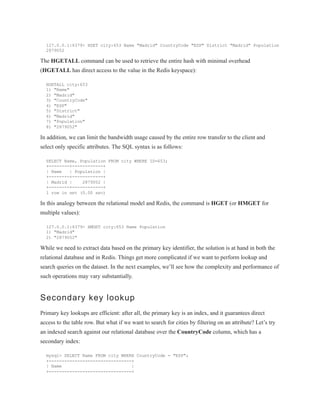
![| Madrid |
| Barcelona |
| [...] |
+--------------------------------+
59 rows in set (0.02 sec)
This is an efficient search because the table defines an index on the CountryCode column. To
continue the comparison of the relational database versus Redis, we will need to execute the same
query against the stored Hashes. For this demonstration, we will assume that we have migrated the
city table to Hashes in the Redis server. By design, Redis has no secondary indexing feature for any
of the core data structures, which means that we should scan all the Hashes prefixed by the “city:”
namespace, then read the city name from every Hash and check whether it matches our search term.
The following example performs a non-blocking scan of the keyspace, filtering on the key name
(“city:*”) in batches of configurable size (three, in the example):
127.0.0.1:6379> SCAN 0 MATCH city:* COUNT 3
1) "512"
2) 1) "city:4019"
2) "city:9"
3) "city:103"
The client should now extract the CountryCode value from every city, compare it to the search term,
and repeat until the scan is concluded. This is obviously a time-consuming and expensive approach.
There are ways to improve the efficiency of such batched operations. We will explore three standard
options and then show how to resolve the problem using the Redis Stack capabilities:
Pipelining
Using functions
Using indexes
Redis Stack capabilities
We will look at these in detail next.
Pipelining
The first approach to reducing the overhead of the search operation is to use pipelining, which is
supported by all major client libraries. Pipelining collects a batch of commands, delivers them to the
server, and collects the outputs from the server immediately before returning the result to the client.
This option dramatically reduces the latency of the overall operation, as it saves on the roundtrip time
to the server (an analogy that works is going to the supermarket once to purchase 30 items rather than
going 30 times and purchasing one item on every visit). The pros and cons of pipelining are as
follows:](https://image.slidesharecdn.com/27645293-250518004128-99f90fa8/85/Redis-Stack-For-Application-Modernization-Anonymous-38-320.jpg)
![Pros: Saves on roundtrip time and does not block the server, as the server executes a batch of commands and returns the results to
the client. Therefore, it increases overall system throughput. Pipelining is especially useful when batching operations.
Cons: The complexity of the operation is proportional to the number and complexity of the operations in the pipeline that are
executed by the server. This may increase the memory usage on the server, as it keeps the intermediate results in memory until all
commands in the pipeline are processed. The client manages multiple responses, which adds complexity to its business logic,
especially when it has to deal with errors of some operations in the pipeline.
Using functions
Lua scripting and functions (functions were introduced in Redis 7.0 and represent an evolution of
Lua scripting for remote server execution) help to offload the client and remove network latency. The
search is local to the server and close to the data (equivalent to the concept of stored procedures). The
following function is an example of local search:
#!lua name=mylib
local function city_by_cc(keys, args)
local match, cursor = {}, "0";
repeat
local ret = redis.call("SCAN", cursor, "MATCH", "city:*", "COUNT", 100);
local cities = ret[2];
for i = 1, #cities do
local keyname = cities[i];
local ccode = redis.call('HMGET',keyname,'Name','CountryCode')
if ccode[2] == args[1] then
match[#match + 1] = ccode[1];
end;
end;
cursor = ret[1];
until cursor == "0";
return match;
end
redis.register_function('city_by_cc', city_by_cc)
In this function, we do the following:
1. We perform a scan of the entire keyspace, filtering by the “city:*” prefix, which means that we will iterate through all the keys in
the Redis server database.
2. For every key returned by the SCAN command, we retrieve the name and CountryCode of the city using the HMGET
command.
3. If CountryCode matches our search filter, we add the city to an output array.
4. When the scan is completed, we return the array to the client.
Type the code into the mylib.lua file and import the library as follows:
cat mylib.lua | redis-cli -x FUNCTION LOAD
The function can be invoked using the following command:
127.0.0.1:6379> FCALL city_by_cc 0 "ESP"
1) "A Coruxf1a (La Coruxf1a)"](https://image.slidesharecdn.com/27645293-250518004128-99f90fa8/85/Redis-Stack-For-Application-Modernization-Anonymous-39-320.jpg)
![2) "Almerxeda"
[...]
59) "Barakaldo"
The pros and cons of using functions are as follows:
Pros: The operation is executed on the server, and the client does not experiment with any overhead.
Cons: The complexity of the operation is linear, and the function (like any other Lua script or function) blocks the server. Any
other concurrent operation must wait until the execution of the function is completed. Long scans make the server appear stuck to
other clients.
Using indexes
Data scans, wherever they are executed (client or server side), are slow and ineffective in satisfying
real-time requirements. This is especially true when the keyspace stores millions of keys or more. An
alternative approach for search operations using the Redis core data structures is to create a
secondary index. There are many options to do this using Redis collections. As an example, we can
create an index of Spanish cities using a Set as follows:
SADD city:esp "Sevilla" "Madrid" "Barcelona" "Valencia" "Bilbao" "Las Palmas de Gran
Canaria"
This data structure has interesting properties for our needs. We can retrieve all the Spanish cities in a
single command:
127.0.0.1:6379> SMEMBERS city:esp
1) "Madrid"
2) "Sevilla"
3) "Valencia"
4) "Barcelona"
5) "Bilbao"
6) "Las Palmas de Gran Canaria"
Or we can check whether a specific city is in Spain using SISMEMBER, a constant time-complexity
command:
127.0.0.1:6379> SISMEMBER city:esp "Madrid"
(integer) 1
And we can even search the index for cities having a name that matches a pattern:
127.0.0.1:6379> SSCAN city:esp 0 MATCH B*
1) "0"
2) 1) "Barcelona"
2) "Bilbao"
We can refine our search requirements and design an index that considers the population. In such a
case we could use a Sorted Set and Set the population as the score:
127.0.0.1:6379> ZADD city:esp 2879052 "Madrid" 701927 "Sevilla" 1503451 "Barcelona" 739412](https://image.slidesharecdn.com/27645293-250518004128-99f90fa8/85/Redis-Stack-For-Application-Modernization-Anonymous-40-320.jpg)
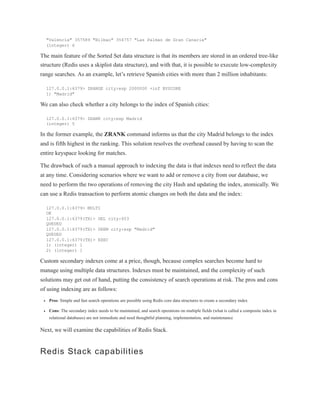
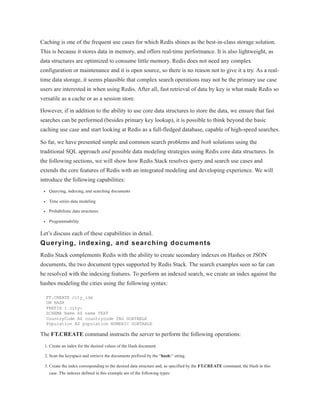
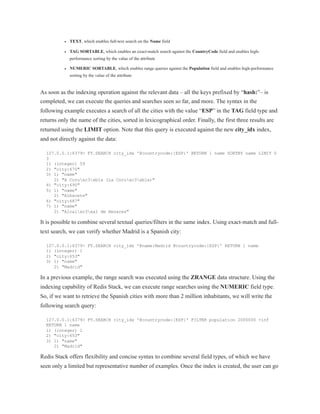

![subsystems, protocols, databases, and so on. Redis Stack delivers this capability out of the box and
manages JSON documents in a similar way to Hashes, which means that it is possible to store, index,
and search JSON objects and work with them using JSONPath syntax:
1. To illustrate the syntax to store, search, and retrieve JSON data along the lines of the previous examples, let’s store city objects
formatted as JSON:
JSON.SET city:653 $ '{"Name":"Madrid", "CountryCode":"ESP", "District":"Madrid",
"Population":2879052}'
JSON.SET city:5 $ '{"Name":"Amsterdam", "CountryCode":"NLD", "District":"Noord-
Holland", "Population":731200}'
JSON.SET city:1451 $ '{"Name":"Tel Aviv-Jaffa", "CountryCode":"ISR", "District":"Tel
Aviv", "Population":348100}'
2. We don’t need anything else to start working with the JSON documents stored in Redis Stack. We can then perform basic retrieval
operations on entire documents:
127.0.0.1:6379> JSON.GET city:653
"
{"Name":"Madrid","CountryCode":"ESP","District":"Madrid","Population":28
79052}"
3. We can also retrieve the desired property (or multiple properties at once) stored on a certain path, with fast access guaranteed,
because the document is stored in a tree structure:
127.0.0.1:6379> JSON.GET city:653 $.Name
"["Madrid"]"
127.0.0.1:6379> JSON.GET city:653 $.Name $.CountryCode
"{"$.Name":["Madrid"],"$.CountryCode":["ESP"]}"
4. As we have seen for Hash documents, we can index JSON documents using a similar syntax and perform search operations. The
following command creates an index for all the JSON documents with the city: prefix in the database:
FT.CREATE city_idx ON JSON PREFIX 1 city: SCHEMA $.Name AS name TEXT $.CountryCode AS
countrycode TAG SORTABLE $.Population AS population NUMERIC SORTABLE
5. And using the FT.SEARCH command with an identical syntax as seen for the Hash documents, we can perform search
operations:
127.0.0.1:6379> FT.SEARCH city_idx '@countrycode:{ESP}' FILTER population 2000000 +inf
RETURN 1 name
1) (integer) 1
2) "city:653"
3) 1) "name"
2) "Madrid"
Unlike Hash documents, the JSON supports nested levels (up to 128) and can store properties,
objects, arrays, and geographical locations at any level in a tree-like structure, so the JSON format
opens up a variety of use cases using a compact and flexible data structure.
Time series data modeling
Time series databases do not need any long introduction: they are data structures that can store data
points happening at a certain time, indicated by a Unix timestamp expressed in milliseconds, with an
associated numeric data value, typically with double precision. This data structure applies to many](https://image.slidesharecdn.com/27645293-250518004128-99f90fa8/85/Redis-Stack-For-Application-Modernization-Anonymous-45-320.jpg)
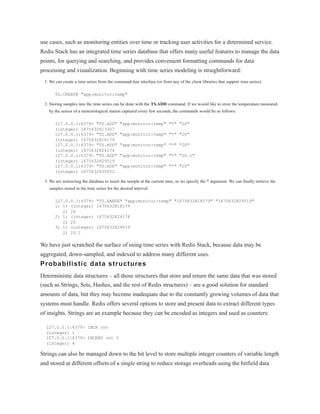
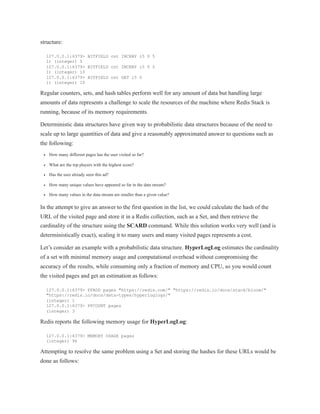
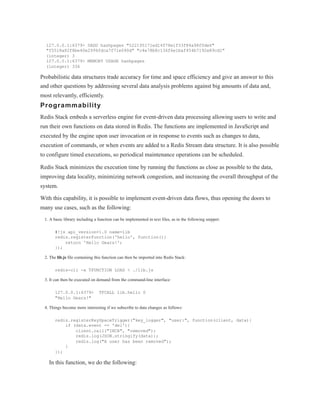
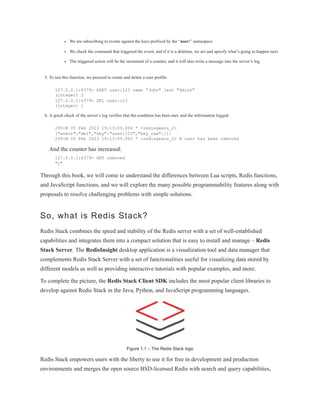

























![[Redis conf18] The Versatility of Redis](https://cdn.slidesharecdn.com/ss_thumbnails/redisconf18theversatilityofredispoweringourcriticalbusinessusingredis-180430114117-thumbnail.jpg?width=640&height=640&fit=bounds)


