PRESENTED BY
PRESENTED BY
• This presentation reflects the analysis and views of Mauro Calderara. No recipient
should interpret this presentation to represent the general views of Citadel or its
personnel. Facts, analysis, and views presented in this presentation have not been
reviewed by, and may not reflect information known to, other Citadel professionals.
• Assumptions, opinions, views, and estimates constitute Mr. Calderara’s judgment as
of the date given and are subject to change without notice and without any duty to
update. Citadel is not responsible for any errors or omissions contained in this
presentation and accepts no liability whatsoever for any direct or consequential
loss arising from your use of this presentation or its contents.
• This document and the information it contains may not be disclosed to any persons
other than those for whom it is intended, nor should this document or the
information it contains be copied, distributed, or redistributed, in whole or in part,
without the prior written consent of Citadel.
• Any castle trademarks, service marks and logos used in this document are
trademarks or service marks or registered trademarks or service marks of Citadel.
PRESENTED BY
Show unconventional use patterns to
provide a different angle on redis
Main idea of this talk
Show unconventional* use patterns to
provide a different angle on redis
Show unconventional* use patterns to
provide a different angle** on redis
PRESENTED BY
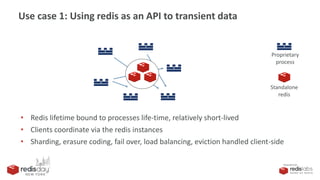
Use case 1: Using redis as an API to transient data
Proprietary
process
Standalone
redis
• Redis lifetime bound to processes life-time, relatively short-lived
• Clients coordinate via the redis instances
• Sharding, erasure coding, fail over, load balancing, eviction handled client-side
PRESENTED BY
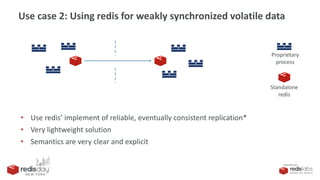
Use case 2: Using redis for weakly synchronized volatile data
Proprietary
process
Standalone
redis
• Use redis’ implement of reliable, eventually consistent replication*
• Very lightweight solution
• Semantics are very clear and explicit
PRESENTED BY
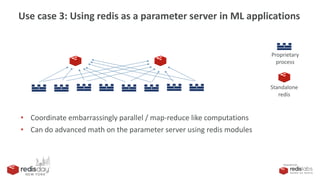
Use case 3: Using redis as a parameter server in ML applications
Proprietary
process
Standalone
redis
• Coordinate embarrassingly parallel / map-reduce like computations
• Can do advanced math on the parameter server using redis modules
PRESENTED BY
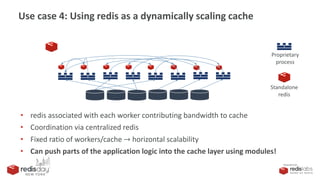
Use case 4: Using redis as a dynamically scaling cache
Proprietary
process
Standalone
redis
• redis associated with each worker contributing bandwidth to cache
• Coordination via centralized redis
• Fixed ratio of workers/cache → horizontal scalability
• Can push parts of the application logic into the cache layer using modules!
PRESENTED BY
Why use redis for this?
• I can understand it
• I can modify it
• Redis has implemented a very nice box of network, scheduling, data structures,
persistence, replication, expiration parts that are generic → quick to deliver
• Very lightweight and fast
• Can embed complicate logic through writing your own modules
• Very useful for generic process coordination through LUA scripts
PRESENTED BY
Modifications we did
• ACLs (going to be in mainline redis)
• Modules (now in mainline redis)
• Optimizations for bulk data in server and client
• Multi-threaded I/O (going to be in mainline redis but differently)
• Other, minor things
• Considering: redis as a library / embedded redis
PRESENTED BY
Takeaway
One can also think of redis as more of a protocol
and library than a service
• Great that it is so lightweight
• Can often stay away from complex architectures
• Hard to overestimate the impact of small, well written, modifiable code base
Thank you!
Thank you!

A Quantitative Trader's Perspective

  • 1.
  • 2.
    PRESENTED BY • Thispresentation reflects the analysis and views of Mauro Calderara. No recipient should interpret this presentation to represent the general views of Citadel or its personnel. Facts, analysis, and views presented in this presentation have not been reviewed by, and may not reflect information known to, other Citadel professionals. • Assumptions, opinions, views, and estimates constitute Mr. Calderara’s judgment as of the date given and are subject to change without notice and without any duty to update. Citadel is not responsible for any errors or omissions contained in this presentation and accepts no liability whatsoever for any direct or consequential loss arising from your use of this presentation or its contents. • This document and the information it contains may not be disclosed to any persons other than those for whom it is intended, nor should this document or the information it contains be copied, distributed, or redistributed, in whole or in part, without the prior written consent of Citadel. • Any castle trademarks, service marks and logos used in this document are trademarks or service marks or registered trademarks or service marks of Citadel.
  • 3.
    PRESENTED BY Show unconventionaluse patterns to provide a different angle on redis Main idea of this talk Show unconventional* use patterns to provide a different angle on redis Show unconventional* use patterns to provide a different angle** on redis
  • 4.
    PRESENTED BY Use case1: Using redis as an API to transient data Proprietary process Standalone redis • Redis lifetime bound to processes life-time, relatively short-lived • Clients coordinate via the redis instances • Sharding, erasure coding, fail over, load balancing, eviction handled client-side
  • 5.
    PRESENTED BY Use case2: Using redis for weakly synchronized volatile data Proprietary process Standalone redis • Use redis’ implement of reliable, eventually consistent replication* • Very lightweight solution • Semantics are very clear and explicit
  • 6.
    PRESENTED BY Use case3: Using redis as a parameter server in ML applications Proprietary process Standalone redis • Coordinate embarrassingly parallel / map-reduce like computations • Can do advanced math on the parameter server using redis modules
  • 7.
    PRESENTED BY Use case4: Using redis as a dynamically scaling cache Proprietary process Standalone redis • redis associated with each worker contributing bandwidth to cache • Coordination via centralized redis • Fixed ratio of workers/cache → horizontal scalability • Can push parts of the application logic into the cache layer using modules!
  • 8.
    PRESENTED BY Why useredis for this? • I can understand it • I can modify it • Redis has implemented a very nice box of network, scheduling, data structures, persistence, replication, expiration parts that are generic → quick to deliver • Very lightweight and fast • Can embed complicate logic through writing your own modules • Very useful for generic process coordination through LUA scripts
  • 9.
    PRESENTED BY Modifications wedid • ACLs (going to be in mainline redis) • Modules (now in mainline redis) • Optimizations for bulk data in server and client • Multi-threaded I/O (going to be in mainline redis but differently) • Other, minor things • Considering: redis as a library / embedded redis
  • 10.
    PRESENTED BY Takeaway One canalso think of redis as more of a protocol and library than a service • Great that it is so lightweight • Can often stay away from complex architectures • Hard to overestimate the impact of small, well written, modifiable code base
  • 11.