www.jornadasaludinvestiga.es
SESIÓN 2
ALIANZAS CIENTÍFICAS EN LA I+i EN
SALUD
Red COST TINNET: Tinnitus heterogeneity
José Antonio Lopez Escamez
UGC ORL Hospital Universitario Granada
Centro de Genómica e Investigación Oncologica
(Genyo)
Instituto Investigación Biosanitaria Granada
ibs.Granada
Investigación biomédica = co-laborar
Trabajo en equipo = Networking
Estrategia de trabajo= combinar expertise
• Investigadores
• Asociaciones de pacientes
• Entidades públicas
• Empresas privadas
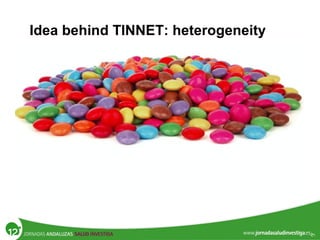
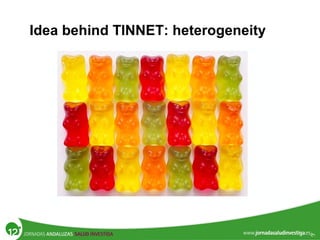
Idea behind TINNET: heterogeneity
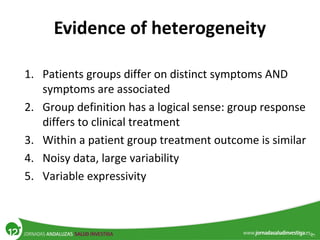
Evidence of heterogeneity
1. Patients groups differ on distinct symptoms AND
symptoms are associated
2. Group definition has a logical sense: group response
differs to clinical treatment
3. Within a patient group treatment outcome is similar
4. Noisy data, large variability
5. Variable expressivity
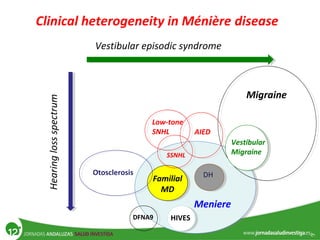
Clinical heterogeneity in Ménière disease
DH
Migraine
AIED
Familial
MD
Meniere
Vestibular
Migraine
Low-tone
SNHL
Otosclerosis
SSNHL
Vestibular episodic syndrome
Hearinglossspectrum
HIVESDFNA9
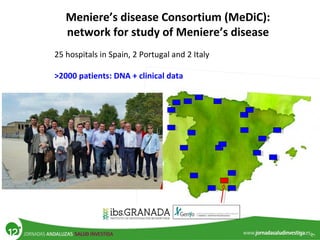
Meniere’s disease Consortium (MeDiC):
network for study of Meniere’s disease
25 hospitals in Spain, 2 Portugal and 2 Italy
>2000 patients: DNA + clinical data
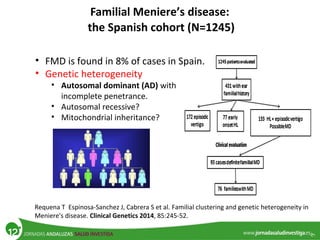
Familial Meniere’s disease:
the Spanish cohort (N=1245)
• FMD is found in 8% of cases in Spain.
• Genetic heterogeneity
• Autosomal dominant (AD) with
incomplete penetrance.
• Autosomal recessive?
• Mitochondrial inheritance?
Requena T Espinosa-Sanchez J, Cabrera S et al. Familial clustering and genetic heterogeneity in
Meniere's disease. Clinical Genetics 2014, 85:245-52.
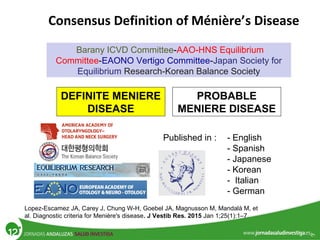
Consensus Definition of Ménière’s Disease
Barany ICVD Committee-AAO-HNS Equilibrium
Committee-EAONO Vertigo Committee-Japan Society for
Equilibrium Research-Korean Balance Society
DEFINITE MENIERE
DISEASE
PROBABLE
MENIERE DISEASE
Lopez-Escamez JA, Carey J, Chung W-H, Goebel JA, Magnusson M, Mandalà M, et
al. Diagnostic criteria for Menière's disease. J Vestib Res. 2015 Jan 1;25(1):1–7.
Published in : - English
- Spanish
- Japanese
- Korean
- Italian
- German
Diagnostic criteria for Ménière’s disease
Definite Ménière’s disease:
A. Two or more spontaneous episodes of vertigo lasting
20 minutes to 12h
B. Audiometrically documented low to middle
frequencies SNHL in the affected ear on at least one
occasion before, during or after one of the episodes of
vertigo
C. Fluctuating aural symptoms (hearing, tinnitus or
fullness) in the affected ear
D. Other causes excluded
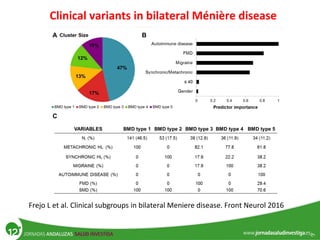
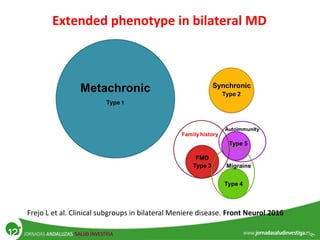
Clinical variants in bilateral Ménière disease
Frejo L et al. Clinical subgroups in bilateral Meniere disease. Front Neurol 2016
Extended phenotype in bilateral MD
Frejo L et al. Clinical subgroups in bilateral Meniere disease. Front Neurol 2016
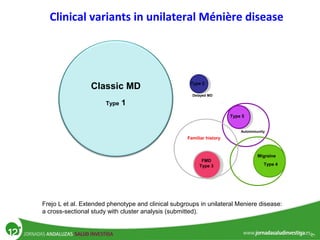
Familiar history
Type 1
Classic MD
Type 5
Type 4
FMD
Type 3
Delayed MD
Type 2
Migraine
Autoimmunity
Clinical variants in unilateral Ménière disease
Frejo L et al. Extended phenotype and clinical subgroups in unilateral Meniere disease:
a cross-sectional study with cluster analysis (submitted).
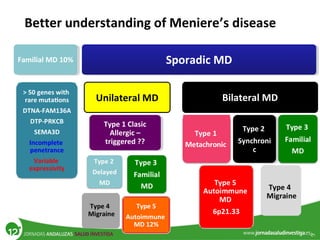
Better understanding of Meniere’s disease
Familial MD 10% Sporadic MD
Type 1 Clasic
Allergic –
triggered ??
Bilateral MD
Type 2
Synchroni
c
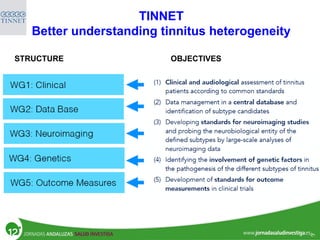
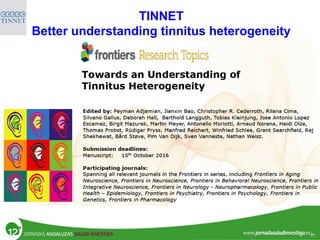
Better understanding tinnitus heterogeneity
(TINNET) BM1306
http://tinnet.tinnitusresearch.net/
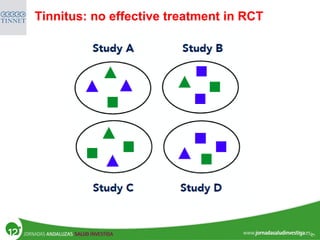
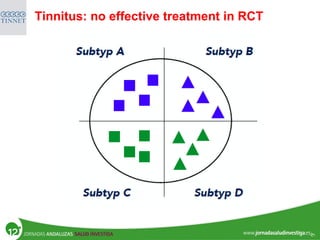
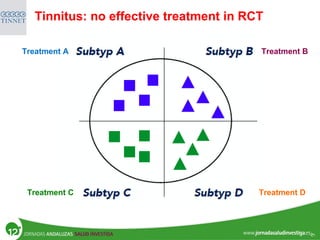
Tinnitus: no effective treatment in RCT
Treatment A
Treatment C
Treatment B
Treatment D
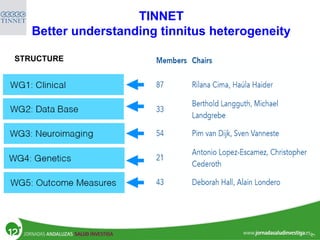
STRUCTURE OBJECTIVES
TINNET
Better understanding tinnitus heterogeneity
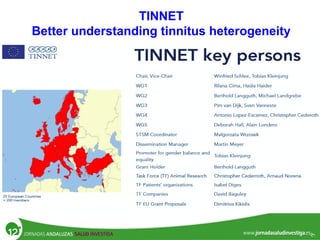
STRUCTURE OBJECTIVES
TINNET
Better understanding tinnitus heterogeneity
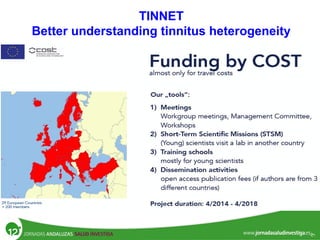
TINNET
Better understanding tinnitus heterogeneity
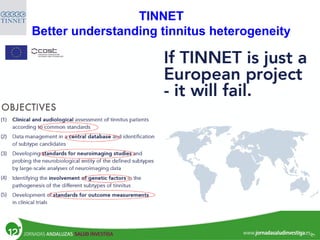
TINNET
Better understanding tinnitus heterogeneity
TINNET
Better understanding tinnitus heterogeneity
TINNET
Better understanding tinnitus heterogeneity
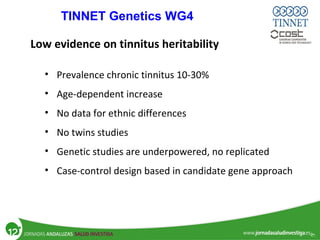
• Prevalence chronic tinnitus 10-30%
• Age-dependent increase
• No data for ethnic differences
• No twins studies
• Genetic studies are underpowered, no replicated
• Case-control design based in candidate gene approach
Low evidence on tinnitus heritability
TINNET Genetics WG4
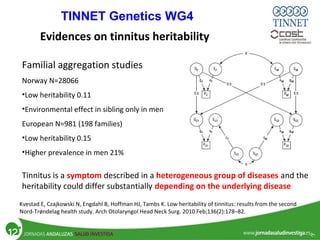
Familial aggregation studies
Norway N=28066
•Low heritability 0.11
•Environmental effect in sibling only in men
European N=981 (198 families)
•Low heritability 0.15
•Higher prevalence in men 21%
Evidences on tinnitus heritability
Kvestad E, Czajkowski N, Engdahl B, Hoffman HJ, Tambs K. Low heritability of tinnitus: results from the second
Nord-Trøndelag health study. Arch Otolaryngol Head Neck Surg. 2010 Feb;136(2):178–82.
Tinnitus is a symptom described in a heterogeneous group of diseases and the
heritability could differ substantially depending on the underlying disease
TINNET Genetics WG4
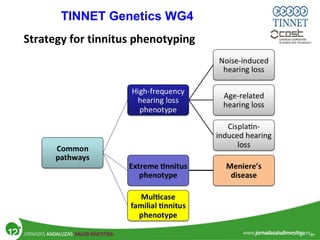
Strategy for tinnitus phenotyping
TINNET Genetics WG4
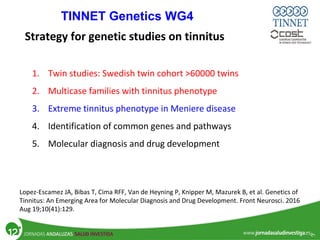
1. Twin studies: Swedish twin cohort >60000 twins
2. Multicase families with tinnitus phenotype
3. Extreme tinnitus phenotype in Meniere disease
4. Identification of common genes and pathways
5. Molecular diagnosis and drug development
Strategy for genetic studies on tinnitus
Lopez-Escamez JA, Bibas T, Cima RFF, Van de Heyning P, Knipper M, Mazurek B, et al. Genetics of
Tinnitus: An Emerging Area for Molecular Diagnosis and Drug Development. Front Neurosci. 2016
Aug 19;10(41):129.
TINNET Genetics WG4
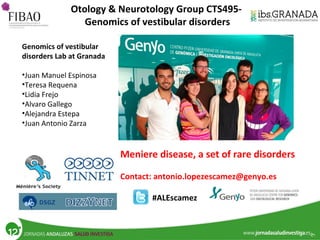
Otology & Neurotology Group CTS495-
Genomics of vestibular disorders
Genomics of vestibular
disorders Lab at Granada
•Juan Manuel Espinosa
•Teresa Requena
•Lidia Frejo
•Alvaro Gallego
•Alejandra Estepa
•Juan Antonio Zarza
Meniere disease, a set of rare disorders
Contact: antonio.lopezescamez@genyo.es
#ALEscamez

Red COST TINNET - JSI2016

  • 1.
    www.jornadasaludinvestiga.es SESIÓN 2 ALIANZAS CIENTÍFICASEN LA I+i EN SALUD Red COST TINNET: Tinnitus heterogeneity José Antonio Lopez Escamez UGC ORL Hospital Universitario Granada Centro de Genómica e Investigación Oncologica (Genyo) Instituto Investigación Biosanitaria Granada ibs.Granada
  • 2.
    Investigación biomédica =co-laborar Trabajo en equipo = Networking Estrategia de trabajo= combinar expertise • Investigadores • Asociaciones de pacientes • Entidades públicas • Empresas privadas
  • 3.
    Idea behind TINNET:heterogeneity
  • 4.
    Idea behind TINNET:heterogeneity
  • 5.
    Idea behind TINNET:heterogeneity
  • 6.
    Evidence of heterogeneity 1.Patients groups differ on distinct symptoms AND symptoms are associated 2. Group definition has a logical sense: group response differs to clinical treatment 3. Within a patient group treatment outcome is similar 4. Noisy data, large variability 5. Variable expressivity
  • 7.
    Clinical heterogeneity inMénière disease DH Migraine AIED Familial MD Meniere Vestibular Migraine Low-tone SNHL Otosclerosis SSNHL Vestibular episodic syndrome Hearinglossspectrum HIVESDFNA9
  • 8.
    Meniere’s disease Consortium(MeDiC): network for study of Meniere’s disease 25 hospitals in Spain, 2 Portugal and 2 Italy >2000 patients: DNA + clinical data
  • 9.
    Familial Meniere’s disease: theSpanish cohort (N=1245) • FMD is found in 8% of cases in Spain. • Genetic heterogeneity • Autosomal dominant (AD) with incomplete penetrance. • Autosomal recessive? • Mitochondrial inheritance? Requena T Espinosa-Sanchez J, Cabrera S et al. Familial clustering and genetic heterogeneity in Meniere's disease. Clinical Genetics 2014, 85:245-52.
  • 10.
    Consensus Definition ofMénière’s Disease Barany ICVD Committee-AAO-HNS Equilibrium Committee-EAONO Vertigo Committee-Japan Society for Equilibrium Research-Korean Balance Society DEFINITE MENIERE DISEASE PROBABLE MENIERE DISEASE Lopez-Escamez JA, Carey J, Chung W-H, Goebel JA, Magnusson M, Mandalà M, et al. Diagnostic criteria for Menière's disease. J Vestib Res. 2015 Jan 1;25(1):1–7. Published in : - English - Spanish - Japanese - Korean - Italian - German
  • 11.
    Diagnostic criteria forMénière’s disease Definite Ménière’s disease: A. Two or more spontaneous episodes of vertigo lasting 20 minutes to 12h B. Audiometrically documented low to middle frequencies SNHL in the affected ear on at least one occasion before, during or after one of the episodes of vertigo C. Fluctuating aural symptoms (hearing, tinnitus or fullness) in the affected ear D. Other causes excluded
  • 12.
    Clinical variants inbilateral Ménière disease Frejo L et al. Clinical subgroups in bilateral Meniere disease. Front Neurol 2016
  • 13.
    Extended phenotype inbilateral MD Frejo L et al. Clinical subgroups in bilateral Meniere disease. Front Neurol 2016
  • 14.
    Familiar history Type 1 ClassicMD Type 5 Type 4 FMD Type 3 Delayed MD Type 2 Migraine Autoimmunity Clinical variants in unilateral Ménière disease Frejo L et al. Extended phenotype and clinical subgroups in unilateral Meniere disease: a cross-sectional study with cluster analysis (submitted).
  • 15.
    Better understanding ofMeniere’s disease Familial MD 10% Sporadic MD Type 1 Clasic Allergic – triggered ?? Bilateral MD Type 2 Synchroni c
  • 16.
    Better understanding tinnitusheterogeneity (TINNET) BM1306 http://tinnet.tinnitusresearch.net/
  • 17.
    Tinnitus: no effectivetreatment in RCT
  • 18.
    Tinnitus: no effectivetreatment in RCT
  • 19.
    Tinnitus: no effectivetreatment in RCT Treatment A Treatment C Treatment B Treatment D
  • 20.
  • 21.
  • 22.
  • 23.
  • 24.
  • 25.
  • 26.
    • Prevalence chronictinnitus 10-30% • Age-dependent increase • No data for ethnic differences • No twins studies • Genetic studies are underpowered, no replicated • Case-control design based in candidate gene approach Low evidence on tinnitus heritability TINNET Genetics WG4
  • 27.
    Familial aggregation studies NorwayN=28066 •Low heritability 0.11 •Environmental effect in sibling only in men European N=981 (198 families) •Low heritability 0.15 •Higher prevalence in men 21% Evidences on tinnitus heritability Kvestad E, Czajkowski N, Engdahl B, Hoffman HJ, Tambs K. Low heritability of tinnitus: results from the second Nord-Trøndelag health study. Arch Otolaryngol Head Neck Surg. 2010 Feb;136(2):178–82. Tinnitus is a symptom described in a heterogeneous group of diseases and the heritability could differ substantially depending on the underlying disease TINNET Genetics WG4
  • 28.
    Strategy for tinnitusphenotyping TINNET Genetics WG4
  • 29.
    1. Twin studies:Swedish twin cohort >60000 twins 2. Multicase families with tinnitus phenotype 3. Extreme tinnitus phenotype in Meniere disease 4. Identification of common genes and pathways 5. Molecular diagnosis and drug development Strategy for genetic studies on tinnitus Lopez-Escamez JA, Bibas T, Cima RFF, Van de Heyning P, Knipper M, Mazurek B, et al. Genetics of Tinnitus: An Emerging Area for Molecular Diagnosis and Drug Development. Front Neurosci. 2016 Aug 19;10(41):129. TINNET Genetics WG4
  • 30.
    Otology & NeurotologyGroup CTS495- Genomics of vestibular disorders Genomics of vestibular disorders Lab at Granada •Juan Manuel Espinosa •Teresa Requena •Lidia Frejo •Alvaro Gallego •Alejandra Estepa •Juan Antonio Zarza Meniere disease, a set of rare disorders Contact: antonio.lopezescamez@genyo.es #ALEscamez

Editor's Notes

  • #8 Really it’s more complicated due to clinical heterogeneity of Ménière’s disease. I mean, there are other disease which clinical are similar to Meniere. FMD are probably the best patients to define new candidate gene for MD
  • #10 Mitochondrial inheritance or maternal imprinting  In some of the pedigrees with sucessive generation analyzed it’s found more maternal inheritance that paternal.