Guidelines for preventive
activities in general practice
9th edition
racgp.org.au Healthy Profession.
Healthy Australia.
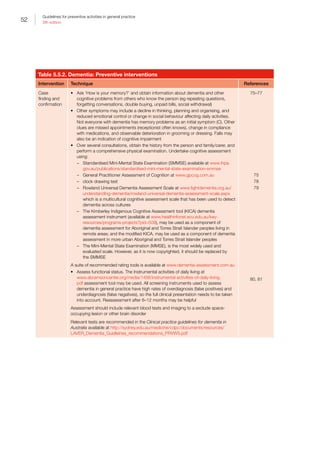
Over
25years
of preventive health
advice
Guidelines for preventive activities in general practice, 9th edition
Disclaimer
The information set out in this publication is current at the date of first publication and is intended for use as
a guide of a general nature only and may or may not be relevant to particular patients or circumstances. Nor
is this publication exhaustive of the subject matter. Persons implementing any recommendations contained
in this publication must exercise their own independent skill or judgement or seek appropriate professional
advice relevant to their own particular circumstances when so doing. Compliance with any recommendations
cannot of itself guarantee discharge of the duty of care owed to patients and others coming into contact with
the health professional and the premises from which the health professional operates.
Whilst the text is directed to health professionals possessing appropriate qualifications and skills in
ascertaining and discharging their professional (including legal) duties, it is not to be regarded as clinical
advice and, in particular, is no substitute for a full examination and consideration of medical history in reaching
a diagnosis and treatment based on accepted clinical practices.
Accordingly, The Royal Australian College of General Practitioners (RACGP) and its employees and agents
shall have no liability (including without limitation liability by reason of negligence) to any users of the
information contained in this publication for any loss or damage (consequential or otherwise), cost or expense
incurred or arising by reason of any person using or relying on the information contained in this publication
and whether caused by reason of any error, negligent act, omission or misrepresentation in the information.
Recommended citation
The Royal Australian College of General Practitioners. Guidelines for preventive activities in general practice.
9th edn. East Melbourne, Vic: RACGP, 2016.
The Royal Australian College of General Practitioners
100 Wellington Parade
East Melbourne, Victoria 3002 Australia
Tel 03 8699 0414
Fax 03 8699 0400
www.racgp.org.au
ISBN: 978-0-86906-451-1 (Print)
ISBN: 978-0-86906-452-8 (Web)
First edition published 1989
Second edition published 1993
Third edition published 1994
Fourth edition published 1996
Fifth edition published 2001
Fifth edition (updated) published 2002
Sixth edition published 2005
Seventh edition published 2009
Eighth edition published 2012
Ninth edition published 2016
Cover image © istockphoto/skodonnell
© The Royal Australian College of General Practitioners, 2016.
We recognise the traditional custodians of the land and sea on which we work and live.
Guidelines for preventive
activities in general practice
9th edition
i
Guidelines for preventive activities in general practice
9th edition
i
Acknowledgements
The Royal Australian College of General Practitioners (RACGP) gratefully acknowledges the generous contribution
of the following authors, contributors and reviewers of the Guidelines for preventive activities in general practice
(Red Book), 9th edn.
Red Book Editorial Committee
Professor Nicholas Zwar
Chair, Red Book Editorial Committee
School of Public Health and Community Medicine,
University of New South Wales, New South Wales
Dr Evan Ackermann
Chair, RACGP Expert Committee – Quality Care
Professor Mark Harris
Centre for Primary Health Care and Equity,
University of New South Wales
RACGP Expert Committee – Quality Care
Dr Meredith Arcus
Deputy Executive Director, Medical Services,
Sir Charles Gairdner and Osborne Park Health Care
Group, Western Australia
Associate Professor Pauline Chiarelli
School of Health Sciences, University of Newcastle,
New South Wales
Professor Chris Del Mar
Faculty of Health Sciences and Medicine,
Bond University, Queensland
Professor Jon Emery
Department of General Practice,
University of Melbourne, Victoria
Associate Professor Michael Fasher
Adjunct Associate Professor, University of Sydney,
New South Wales; and Conjoint Associate Professor,
University of Western Sydney, New South Wales
Associate Professor John Furler
Department of General Practice,
University of Melbourne, Victoria
Dr Caroline Johnson
Department of General Practice,
University of Melbourne, Victoria
RACGP Expert Committee – Quality Care
Professor Claire Jackson
Director, Centres for Primary Care Reform
Research Excellence
Professor in Primary Care Research, Chair,
Metro North Primary Health Network
Past President, The Royal Australian College of
General Practitioners (2010–12)
Associate Professor John Litt
Department of General Practice,
Flinders University, South Australia
Deputy Chair, RACGP Expert Committee –
Quality Care
Professor Danielle Mazza
Department of General Practice,
School of Primary Care,
Monash University, Victoria
RACGP Expert Committee – Quality Care
Professor Dimity Pond
Professor of General Practice,
School of Medicine and Public Health,
University of Newcastle, New South Wales
Associate Professor Jane Smith
Head of General Practice Discipline,
Faculty of Health Science and Medicine,
Bond University, Queensland
Professor Nigel Stocks
Head of Discipline – General Practice,
University of Adelaide, Adelaide
Dr Christine Walker
Executive Officer, Chronic Illness Alliance
Professor Tania Winzenberg
Chair, RACGP Expert Committee – Research
Professor of Chronic Disease Management,
Menzies Institute for Medical Research and Faculty
of Health, University of Tasmania, Tasmania
ii
Guidelines for preventive activities in general practice
9th edition
Conflicts of interest
This publication has been produced in accordance with the rules and processes outlined in the RACGP Conflict of
Interest (COI) Policy. The RACGP COI Policy is available at www.racgp.org.au/support/policies/organisational
Contributors
Associate Professor Lena Sanci
Department of General Practice,
University of Melbourne, Victoria
Professor Lindy Clemson
Professor in Ageing and Occupational Therapy,
University of Sydney, New South Wales
Dr Magdalena Simonis
RACGP Expert Committee – Quality Care
Reviewers
We gratefully acknowledge the expert reviewers
and representatives from the organisations who
contributed scholarly feedback.
Members of RACGP Aboriginal and Torres Strait
Islander Health
Associate Professor Anne Abbott
School of Public Health and Preventive Medicine,
Monash University, Victoria
Dr Stuart Aitken
Gold Coast Sexual Health Clinic, Queensland
Professor Craig Anderson
George Institute for Global Health, New South Wales
Associate Professor Nick Antic
Clinical Director of the Adelaide Institute
for Sleep Health
President Australasian Sleep Association,
South Australia
Professor Kaarin Anstey
ANU College of Medicine, Biology  Environment,
Australian Capital Territory
Associate Professor Kristine Barlow-Stewart
Genetic Medicine, Northern Clinical School,
Sydney Medical School, New South Wales
Professor Adrian Bauman
School of Public Health, University of Sydney,
New South Wales
Dr Glenise Berry
Australian  New Zealand Society for Geriatric
Medicine, New South Wales
Associate Professor Mark Bolland
School of Medicine, University of Auckland,
New Zealand
Dr Chris Bourne
Sydney Sexual Health Centre,
Sydney Hospital, New South Wales
Professor Hanny Calache
Centre for Population Health Research,
Deakin University, Victoria
Professor Henry Brodaty
Dementia Collaborative Research Centre,
University of New South Wales and Prince of Wales
Hospital, New South Wales
Professor Ian Caterson
Boden Institute, Charles Perkins Centre,
University of Sydney, New South Wales
Professor Derek Chew
Professor of Cardiology, Flinders University,
Flinders Medical Centre, South Australia
Professor Rufus Clarke
Faculty of Public Health Medicine,
Royal Australasian College of Physicians,
New South Wales
Professor Jacqueline Close
Consultant Geriatrician, Prince of Wales Hospital,
Director, Falls and Injury Prevention Group, NeuRA,
University of New South Wales, New South Wales
Professor Stephen Colagiuri
Director, Boden Institute, University of Sydney,
New South Wales
Dr Gary Deed
Chair, RACGP Specific Interests – Diabetes Network
Dr Joanne Dixon
National Clinical Director, Clinical Leader Genetic
Services, Genetic Health Service New Zealand
iii
Guidelines for preventive activities in general practice
9th edition
Professor Jenny Doust
Faculty of Health Sciences and Medicine,
Bond University, Queensland
Professor Peter Ebeling
Head of the Department of Medicine,
Monash Medical Centre, Victoria
Associate Professor Matt Edwards
Department of Paediatrics,
University of Western Sydney, New South Wales
Professor John Eisman
Director of Clinical Translation and Advanced
Education, Garvan Institute of Medical Research,
Darlinghurst, New South Wales
Dr Ben Ewald
Senior Lecturer in Epidemiology and General
Practitioner, Centre for Clinical Epidemiology
and Biostatistics, University of Newcastle,
New South Wales
Professor Kwun Fong
Prince Charles Hospital, Department of
Thoracic Medicine, Queensland
Professor Peter Frith
Respiratory Medicine, Flinders University,
South Australia
Clinical Professor Jack Goldblatt
School of Paediatrics and Child Health,
University of Western Australia, Western Australia
Professor Jonathon Golledge
Head of the Vascular Biology Unit, School of Medicine
and Dentistry, James Cook University, Queensland
Professor Paul Glasziou
Professor of Evidence-Based Medicine, Faculty of
Health Sciences and Medicine, Bond University,
Queensland
Associate Professor Jane Halliday
Public Health Genetics, Murdoch Childrens Research
Institute, Victoria
Dr James Harvey
Council member of Royal Australian and New Zealand
College of Obstetricians and Gynaecologists,
South Australia
Associate Professor Kelsey Hegarty
Department of General Practice,
University of Melbourne, Victoria
Ms Cristy Henderson
Assistant Director, Bowel Screening Section, Cancer
and Palliative Care Branch, Population Health  Sport
Division, Department of Health
Dr Elizabeth Hindmarsh
General Practitioner, New South Wales
Associate Professor Warrick Inder
Department of Diabetes and Endocrinology,
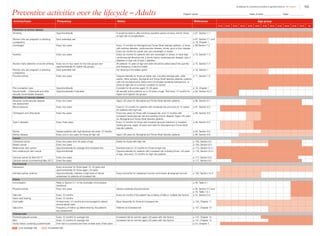
Princess Alexandra Hospital, Queensland
Professor Stephen Lord
Senior Principal Research Fellow, Neuroscience
Research Australia, New South Wales
Professor Finlay Macrae
Head, Colorectal Medicine and Genetics,
Royal Melbourne Hospital, Victoria
Professor, Department of Medicine, University of
Melbourne, Royal Melbourne Hospital, Victoria
Dr Catherine Mandel
MRI Radiologist, Swinburne University of Technology
Honorary Senior Fellow, Department of Radiology,
University of Melbourne, Victoria
Professor Rebecca Mason
Professor of Endocrine Physiology,
School of Medical Sciences, Sydney Medical School,
University of Sydney, New South Wales
Clinical Professor Richard Mendelson
Royal Perth Hospital, University of Western Australia,
Western Australia
Professor Sylvia Metcalfe
Genetics Education  Health Research,
Murdoch Childrens Research Institute, Victoria
Dr Mark Morgan
General Practitioner, South Australia
Senior Lecturer, Discipline of General Practice,
University of Adelaide, South Australia
Professor Paul Norman
Winthrop Professor of Vascular Surgery,
University of Western Australia, Western Australia
Professor Mark Nelson
Chair, Discipline of General Practice,
University of Tasmania, Tasmania
Professional Research Fellow, Menzies Research
Institute, University of Tasmania, Tasmania
Mark Nevin
Senior Executive Officer, Faculty of Clinical Radiology,
Royal Australian and New Zealand College of
Radiologists, New South Wales
Professor Doug McEvoy
Senior Director, Adelaide Institute for Sleep Health;
Staff Consultant in Sleep and Respiratory Medicine
at Repatriation General Hospital and Flinders Medical
Centre, South Australia
Dr Nicki Murdoch
President, Paediatrics  Child Division, Royal
Australasian College of Physicians, New South Wales
Professor Frank Oberklaid
Director, Centre for Community Child Health,
Royal Children’s Hospital, Victoria
iv
Guidelines for preventive activities in general practice
9th edition
Dr Jan Orman
GP Services Consultant, Black Dog Institute,
Prince of Wales Hospital, New South Wales
Professor Kelly Phillips
Peter MacCallum Cancer Centre, Victoria
Professor Matthew Peters
Head of Respiratory Medicine,
Concord Hospital, New South Wales
Professor Ian Reid
Deputy Dean, Faculty of Medical and Health
Sciences, University of Auckland, New Zealand
Professor Ann Roche
National Centre for Education and Training on
Addiction, Flinders University, South Australia
Professor John Saunders
Consultant Physician in Internal Medicine and
Addiction Medicine, New South Wales
Professor Virginia Schmied
School of Nursing and Midwifery,
University of Western Sydney, New South Wales
Associate Professor Jonathan Shaw
Baker IDI Heart  Diabetes Institute, Victoria
Professor Maria Fiatarone Singh
Chair of Exercise and Sport Science, Exercise, Health
and Performance Group, Faculty of Health Sciences,
Sydney Medical School, New South Wales
Associate Professor John Slavotinek
Gastroenterologist
Honorary Senior Associate,
Cancer Council Victoria, Victoria
Professor Denis Spelman
Deputy Director, Clinical Infectious Diseases Unit
and Head, Microbiology Department,
Monash University, Victoria
Professor James St John
Gastroenterologist
Honorary Senior Associate,
Cancer Council Victoria, Victoria
Dr Michael Tam
Staff Specialist, General Practice,
University of New South Wales, New South Wales
Dr Wendy Tsui
RACGP Fellow, Family  Sports Medicine Centre,
New South Wales
Dr Angela Taft
Professor and Director, Judith Lumley Centre,
La Trobe University, Victoria
Dr Brendan White
Australian Dental Association (NSW Branch),
New South Wales
Clinical Associate Professor Liz Wylie
Medicine and Pharmacology Royal Perth Hospital
Unit, University of Western Australia, Western Australia
Professor Graeme Young
Flinders Centre for Innovation in Cancer,
Flinders University, South Australia
Professor Helen Zorbas
Chief Executive Officer, Cancer Australia,
New South Wales
Australian  New Zealand Society for Geriatric
Medicine Council
Australasian Sleep Association
Australian Diabetes Society
Australian Dental Association
Cancer and Palliative Care Branch, Population
Health  Sport Division, Department of Health
Cancer Australia
Cancer Council Victoria
Centre for Population Health, NSW Ministry of
Health, Harm Reduction and Viral Hepatitis Branch
Continence Foundation of Australia
Haemochromatosis Society Australia
Human Genetics Society of Australasia
Dental Health Services Victoria
Exercise  Sports Science Australia
Kidney Health Australia
National Stroke Foundation
National Heart Foundation of Australia
NSW STI Programs Unit, Sydney Sexual Health
Centre, Sydney Hospital, New South Wales
Optometry Australia
Royal Australian and New Zealand College of
Obstetricians and Gynaecologists
Representatives from Cancer Council Victoria
Royal Australian and New Zealand College of
Radiologists
Royal Australian College of Ophthalmologists
SANE Australia
Urological Society of Australia and New Zealand
v
Guidelines for preventive activities in general practice
9th edition
v
Acronyms
13vPCV 13-valent pneumococcal conjugate vaccine
23vPPV 23-valent pneumococcal polysaccharide
vaccine
AAA abdominal aortic aneurysm
ABCD asymmetry, border, colour, diameter
ABI ankle:brachial index
ABS Australian Bureau of Statistics
ACE angiotensin converting enzyme
ACIR Australian Childhood Immunisation Register
ACR albumin-to-creatinine ratio
ACS asymptomatic carotid artery stenosis
ADHD attention deficit hyperactivity disorder
AEDC Australian Early Development Census
AF atrial fibrillation
ALA alpha-linolenic acid
AMD aged-related macular degeneration
APC adenomatous polyposis coli
ApoE apolipoprotein E
ARB angiotensin receptor blocker
ASCIA Australasian Society of Clinical Immunology
and Allergy
AUDIT-C Alcohol Use Disorders Identification Test –
Consumption
AUSDRISK Australian type 2 diabetes risk assessment
tool
BCG Bacillus Calmette-Guérin
BMD bone mineral density
BMI body mass index
BNP B-type natriuretic peptide
BP blood pressure
BRCA1 breast cancer susceptibility gene 1
BRCA2 breast cancer susceptibility gene 2
BUA broadband ultrasound attenuation
CA cancer antigen
CA125 cancer antigen 125
CAD coronary artery disease
CALD culturally and linguistically diverse
CCTA coronary computed tomography angiography
CEA carotid endarterectomy
CEITC Centre for Excellence in Indigenous
Tobacco Control
CF cystic fibrosis
CHD coronary heart disease
CKD chronic kidney disease
CDK-EPI Chronic Kidney Disease Epidemiology
Collaboration
COPD chronic obstructive pulmonary disease
CRC colorectal cancer
CRP C-reactive protein
CT computed tomography
CVD cardiovascular disease
DALY
DASH
disability-adjusted life year
dietary approaches to stop hypertension
DBP diastolic blood pressure
DNA deoxyribonucleic acid
DLCN Dutch Lipid Clinic Network (criteria)
DPA docosapentaenoic acid
DRE digital rectal examination
DT diphtheria, tetanus
DTPa diphtheria, tetanus, acellular pertussis
(child version)
dTpa diphtheria, tetanus, acellular pertussis
(adolescent/adult version)
DXA dual-energy X-ray absorptiometry
ECG electrocardiogram
EFG elevated, firm, growing for more than
one month
eGFR estimated glomerular filtration rate
EPDS Edinburgh Postnatal Depression Scale
ESRD end-stage renal disease
FAP familial adenomatous polyposis
FH familial hypercholesterolaemia
FHSQ family history screening questionnaire
FOBT faecal occult blood test
GP general practitioner
GPCOG general practitioner assessment
of cognition
HbA1c glycated haemoglobin
HCG human chorionic gonadotrophin
HDL high-density lipoprotein
vi
Guidelines for preventive activities in general practice
9th edition
vi
HDL-C high-density lipoprotein-cholesterol
HHC hereditary haemochromatosis
Hib haemophilus influenzae type b
HIV human immunodeficiency virus
HNPCC hereditary non-polyposis colon cancer
HPV human papillomavirus
hsCRP high sensitivity C-reactive protein
HSIL high-grade squamous intraepithelial lesion
IADL instrumental activities of daily living
IBIS International Breast Cancer Intervention Study
IFG impaired fasting glucose
IGT impaired glucose tolerance
IPV inactivated polio vaccine
IS intussusception
KICA Kimberley Indigenous Cognitive Assessment
tool
LDL low-density lipoprotein
LDL-C low-density lipoprotein-cholesterol
LSIL low-grade squamous intraepithelial lesion
LUTS lower urinary tract symptoms
LVH left ventricular hypertrophy
MBS Medicare Benefits Schedule
MCH mean corpuscular haemoglobin
MCV mean corpuscular volume
MI myocardial infarction
MMR measles, mumps and rubella
MMRV measles, mumps, rubella and varicella
MMSE mini-mental state examination
MRI magnetic resonance imaging
MS multiple sclerosis
MSM men who have sex with men
MSU mid-stream urine
MTHFR methylenetetrahydrofolate reductase
MUKSB Modified UK Simon Broome (criteria)
NAAT nucleic acid amplification test
NHMRC National Health and Medical Research
Council
NIP National Immunisation Program
NIPS National Immunisation Program Schedule
NIPT non-invasive prenatal test
NMSC non-melanocytic skin cancer
NTD neural tube defect
Pap test Papanicolaou test
OSA obstructive sleep apnoea
PBS Pharmaceutical Benefits Scheme
PCR polymerase chain reaction
PEDS parents’ evaluation of developmental status
PET-CT positron emission tomography – computed
tomography
PLCO Prostate, Lung, Colorectal and Ovarian trial
PND postnatal depression
PVD peripheral vascular disease
RACGP The Royal Australian College of General
Practitioners
RCT randomised controlled trial
SBP systolic blood pressure
SCC squamous cell carcinoma
SES socioeconomic status
SIDS sudden infant death syndrome
SMMSE standardised mini-mental state examination
SNAP smoking, nutrition, alcohol, physical activity
SNP single nucleotide polymorphism
SOS speed of sound
SPF sun protection factor
SSRI selective serotonin reuptake inhibitor
STI sexually transmissible infection
SUDI sudden unexpected death in infancy
T2D type 2 diabetes
TB tuberculosis
TG triglyceride
TGA Therapeutic Goods Administration
TIA transient ischaemic attack
TUGT timed up and go test
UACR urine albumin-to-creatinine ratio
UKCTOCS UK Collaborative Trial of Ovarian Cancer
Screening
USPSTF US Preventive Services Task Force
UV ultraviolet
VIVAS Vaccination Information and Vaccination
Administration System
VV varicella vaccination
VZV varicella zoster virus
WHO World Health Organization
vii
Guidelines for preventive activities in general practice
9th edition
1. Contents
Acknowledgements	 i
Red Book Editorial Committee 	 i
Conflicts of interest	 ii
Contributors	ii
Reviewers	ii
Acronyms	 v
I.	Introduction	 1
The Red Book 	 3
The Australian experience	 3
Benefits and harms of preventive health activities 	 4
Prevention in the practice population	 5
Screening versus case finding	 6
Opportunistic versus systematic prevention	 6
Screening principles	 7
II.	 Patient education and health literacy	 8
Impact of patient education	 8
Approaches to patient education	 8
Health inequity	 9
Supporting patient education and health literacy in disadvantaged groups 	 10
III.	 Development of the Red Book	 11
Recommendations	11
IV.	 How to use the Red Book	 12
Organisational detail	 12
References – Chapters I–IV	 14
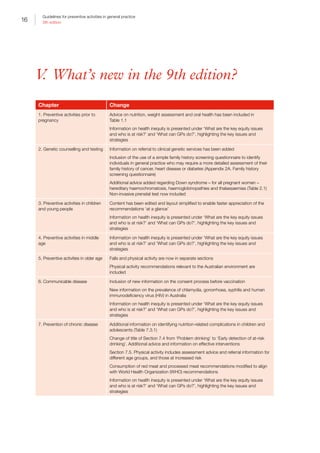
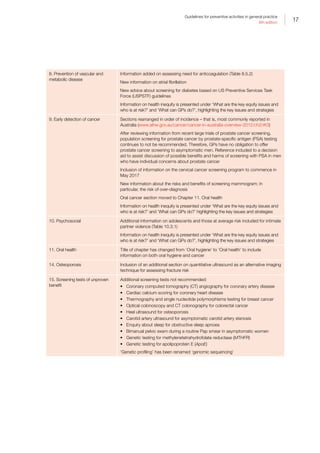
V.	 What’s new in the 9th edition?	 16
1.	 Preventive activities prior to pregnancy	 18
References	22
2.	 Genetic counselling and testing	 24
References	28
Appendix 2A. Family history screening questionnaire	 29
Appendix 2B. Dutch Lipid Clinic Network Criteria for making a diagnosis of familial
hypercholestrolaemia in adults	 30
3.	 Preventive activities in children and young people	 32
References	38
Appendix 3A ‘Red flag’ early intervention referral guide	 41
4.	 Preventive activities in middle age	 42
References	44
viii
Guidelines for preventive activities in general practice
9th edition
5.	 Preventive activities in older age	 45
5.1 Immunisation	 46
5.2 Physical activity	 46
5.3 Falls	 47
5.4 Visual and hearing impairment	 50
5.5 Dementia	 51
References	53
6.	 Communicable diseases	 57
6.1 Immunisation	 57
6.2 Sexually transmissible infections	 61
References	64
7.	 Prevention of chronic disease	 66
7.1 Smoking	 67
7.2 Overweight	 69
7.3 Nutrition	 73
7.4 Early detection of at-risk drinking	 75
7.5 Physical activity	 77
References	80
8.	 Prevention of vascular and metabolic disease	 85
8.1 Assessment of absolute cardiovascular disease risk	 86
8.2 Blood pressure	 87
8.3 Cholesterol and other lipids	 89
8.4 Type 2 diabetes	 92
8.5 Stroke	 94
8.6 Kidney disease	 95
8.7 Atrial fibrillation	 97
References	98
Appendix 8A. Australian cardiovascular disease risk charts	 102
9.	 Early detection of cancers	 104
9.1 Prostate cancer	 104
9.2 Colorectal cancer	 105
9.3 Breast cancer	 109
9.4 Skin cancer	 113
9.5 Cervical cancer	 117
9.6 Ovarian cancer	 121
9.7 Testicular cancer	 121
References	122
10.	Psychosocial	 126
10.1 Depression	 127
10.2 Suicide	 129
10.3 Intimate partner violence	 130
References	132
ix
Guidelines for preventive activities in general practice
9th edition
11.	 Oral health	 134
References	 136
12.	 Glaucoma	 137
References	 137
13.	 Urinary incontinence	 138
References	 139
Appendix 13A. The 3 Incontinence Questions (3IQ)	 140
14.	 Osteoporosis	 141
References	 145
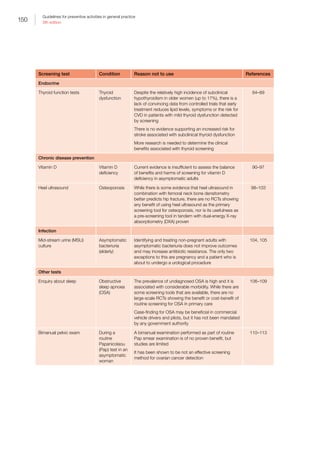
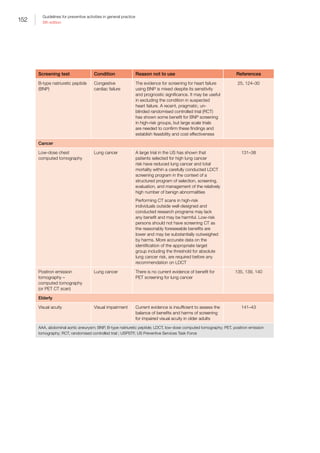
15.	 Screening tests of unproven benefit	 147
References	 153
Lifecycle chart	 158
1
Guidelines for preventive activities in general practice
9th edition
I. Introduction
General practice is at the forefront of healthcare in Australia and in a pivotal position to deliver preventive
healthcare. More than 137 million general practice consultations take place annually in Australia and 85% of the
Australian population consult a general practitioner (GP) at least once a year.1
Preventive healthcare is an important
activity in general practice. It includes the prevention of illness, the early detection of specific disease, and the
promotion and maintenance of health. The partnership between GP and patient can help people reach their goals
of maintaining or improving health. Preventive care is also critical in addressing the health disparities faced by
disadvantaged and vulnerable population groups.
Prevention of illness is the key to Australia’s future health – both individually and collectively. About 32% of
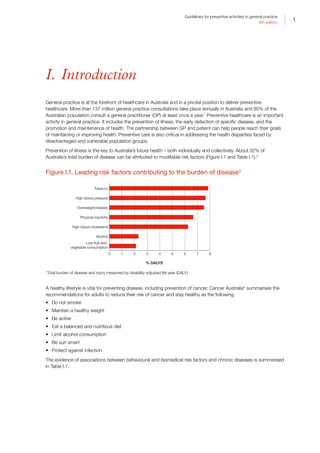
Australia’s total burden of disease can be attributed to modifiable risk factors (Figure I.1 and Table I.1).2
Figure I.1. Leading risk factors contributing to the burden of disease3
*Total burden of disease and injury measured by disability-adjusted life year (DALY)
A healthy lifestyle is vital for preventing disease, including prevention of cancer. Cancer Australia4
summarises the
recommendations for adults to reduce their risk of cancer and stay healthy as the following:
•	 Do not smoke
•	 Maintain a healthy weight
•	 Be active
•	 Eat a balanced and nutritious diet
•	 Limit alcohol consumption
•	 Be sun smart
•	 Protect against infection
The evidence of associations between behavioural and biomedical risk factors and chronic diseases is summarised
in Table I.1.
0 1 2 3 4 5 6 7 8
Low fruit and
vegetable consumption
Alcohol
High blood cholesterol
Physical inactivity
Overweight/obesity
High blood pressure
Tobacco
% DALYS*
2
Guidelines for preventive activities in general practice
9th edition
Table I.1. Strong evidence of direct associations between selected chronic diseases and
behavioural and biomedical risk factors5
Chronic
disease
Behavioural
Tobacco
smoking
Behavioural
Insufficient
physical
activity
Behavioural
Excessive
alcohol
consumption
Behavioural
Dietary risks
Biomedical
Obesity
Biomedical
High blood
pressure
Biomedical
Abnormal
blood lipids
CVD • • — •*
• • •
Stroke • • • — • • •
Type 2 diabetes • • — •*
• — —
Osteoporosis • • • •†
— — —
Colorectal
cancer
• — • •‡
• — —
Oral health •§
— •||
•#
— — —
CKD • — — — • • —
Breast cancer
(female)
— — • — •**
— —
Depression — — — — • — —
Osteoarthritis — — — — • — —
Rheumatoid
arthritis
• — — — — — —
Lung cancer • — — — — — —
Cervical cancer††
• — — — — — —
COPD • — — — — — —
Asthma • — — — — — —
• Strong evidence in support of a direct association between the chronic disease and risk factor
— There is either not a direct association or the evidence for a direct association is not strong
*For coronary heart disease and type 2 diabetes, dietary risks relate to high intake of saturated fat
†
For osteoporosis, dietary risks relate to insufficient calcium and vitamin D. The recommendation is to enhance vitamin D levels through
adequate sun exposure and/or supplements if required
‡
For colorectal cancer (CRC), dietary risks relate to high intakes of processed (preserved) meat. In addition, a high intake of red meat
is associated with an increased risk of CRC. The Australian dietary guidelines (ADG) therefore recommend that processed meat intake
should be limited (also because of its high saturated fat content). In addition, to enhance dietary variety and reduce some of the health
risks associated with consuming red meat, the ADG recommend Australian adults should consume up to a maximum of 455 g per week
(one serve [65 g] per day) of lean red meats
§
The evidence for tobacco smoking and oral health relate to oral cancer and adult periodontal diseases
||
The evidence for excessive alcohol consumption and oral health relate to oral cancer
#
For oral health, dietary risks relate to amount and frequency of free sugars for dental caries, soft drinks and fruit juices for dental erosion,
excess fluoride for enamel developmental defects, and deficiency of vitamin C for periodontal disease
**
The evidence for obesity and breast cancer is for postmenopausal women
††
Persistent infection with the human papillomavirus (HPV) is a central cause of cervical cancer. HPV infection is not identified in Table I.1
as it only includes those risk factors that are implicated in more than one chronic disease and have the greatest prevalence within the
population. It is important to recognise that the behavioural risk factors of multiple sexual partners and early age at initiation of sexual
activity reflect the probability of being infected with HPV
The chronic diseases included in Table I.1 are those that currently contribute the most to burden of disease and/or are the focus of
ongoing national surveillance efforts
The behavioural and biomedical risk factors included in Table I.1 are those that are implicated in more than one chronic disease and
have the greatest prevalence within the population
ADG, Australian dietary guidelines; CKD, chronic kidney disease; COPD, chronic obstructive pulmonary disease; CRC, colorectal cancer;
CVD, cardiovascular disease; HPV, human papillomavirus
Reproduced with permission from Australian Institute of Health and Welfare. Chronic disease risk factors. Canberra: AIHW, 2016
3
Guidelines for preventive activities in general practice
9th edition
The Red Book
The Royal Australian College of General Practitioners (RACGP) has published the Guidelines for preventive activities
in general practice (Red Book) since 1989 to support evidence-based preventive activities in primary care. The Red
Book is now widely accepted as the main guide to the provision of preventive care in Australian general practice.
Purpose
The Red Book is designed to provide the general practice team with guidance on opportunistic and proactive
preventive care. It provides a comprehensive and concise set of recommendations for patients in general practice
with additional information about tailoring advice depending on risk and need. The Red Book provides the evidence
and reasons for the efficient and effective use of healthcare resources in general practice.
The Red Book’s companion publication, National guide to a preventive health assessment for Aboriginal and Torres
Strait Islander people, 2nd edn, is intended for all health professionals delivering primary healthcare to Aboriginal
and Torres Strait Islander peoples.
Scope
The Red Book covers primary (preventing the initial occurrence of a disorder) and secondary (preventive early
detection and intervention) activities. These guidelines focus on preventive activities applicable to substantial portions
of the general practice population rather than specific subgroups. This means, in general, recommendations apply
to asymptomatic (low-risk) people. However, there is an emphasis on equity, with recommendations aimed at major
disadvantaged groups at higher risk of disease and those who are less likely to receive preventive care.
These guidelines do not include:
•	 detailed information on the management of risk factors or disease (eg what medications to use when treating
hypertension)
•	 information about the prevention of infectious diseases. This information has been limited largely to immunisation
and some sexually transmissible infections (STIs).
There is limited advice about travel medicine. This information can be obtained from the Centers for Disease
Control and Prevention at wwwnc.cdc.gov/travel or World Health Organization (WHO) International Travel and
Health at www.who.int/ith/en
The Australian experience
The role of general practice in prevention has been recognised by the Council of Australian Governments (COAG)6
and in the Australian Government’s National Preventative Health Strategy and National Primary Health Care
Strategic Framework.2,7
Deaths and hospitalisations from preventable illness have continued to decline in Australia. However, the leading
causes of death and disability in Australia are preventable or able to be delayed by early treatment and intervention
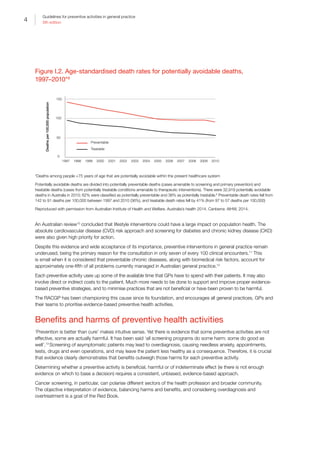
(Figure I.2).8
4
Guidelines for preventive activities in general practice
9th edition
Figure I.2. Age-standardised death rates for potentially avoidable deaths,
1997–2010*9
1997
150
100
50
0
1998 1999 2000 2001 2002 2003 2004 2005 2006 2007 2008 2009 2010
Deathsper100,000population
Treatable
Preventable
Age-standardised death rates for potentially avoidable deaths, 1997–2010
*Deaths among people 75 years of age that are potentially avoidable within the present healthcare system
Potentially avoidable deaths are divided into potentially preventable deaths (cases amenable to screening and primary prevention) and
treatable deaths (cases from potentially treatable conditions amenable to therapeutic interventions). There were 32,919 potentially avoidable
deaths in Australia in 2010; 62% were classified as potentially preventable and 38% as potentially treatable.8
Preventable death rates fell from
142 to 91 deaths per 100,000 between 1997 and 2010 (36%), and treatable death rates fell by 41% (from 97 to 57 deaths per 100,000)
Reproduced with permission from Australian Institute of Health and Welfare. Australia’s health 2014. Canberra: AIHW, 2014.
An Australian review10
concluded that lifestyle interventions could have a large impact on population health. The
absolute cardiovascular disease (CVD) risk approach and screening for diabetes and chronic kidney disease (CKD)
were also given high priority for action.
Despite this evidence and wide acceptance of its importance, preventive interventions in general practice remain
underused, being the primary reason for the consultation in only seven of every 100 clinical encounters.11
This
is small when it is considered that preventable chronic diseases, along with biomedical risk factors, account for
approximately one-fifth of all problems currently managed in Australian general practice.12
Each preventive activity uses up some of the available time that GPs have to spend with their patients. It may also
involve direct or indirect costs to the patient. Much more needs to be done to support and improve proper evidence-
based preventive strategies, and to minimise practices that are not beneficial or have been proven to be harmful.
The RACGP has been championing this cause since its foundation, and encourages all general practices, GPs and
their teams to prioritise evidence-based preventive health activities.
Benefits and harms of preventive health activities
‘Prevention is better than cure’ makes intuitive sense. Yet there is evidence that some preventive activities are not
effective, some are actually harmful. It has been said ‘all screening programs do some harm; some do good as
well’.13
Screening of asymptomatic patients may lead to overdiagnosis, causing needless anxiety, appointments,
tests, drugs and even operations, and may leave the patient less healthy as a consequence. Therefore, it is crucial
that evidence clearly demonstrates that benefits outweigh those harms for each preventive activity.
Determining whether a preventive activity is beneficial, harmful or of indeterminate effect (ie there is not enough
evidence on which to base a decision) requires a consistent, unbiased, evidence-based approach.
Cancer screening, in particular, can polarise different sectors of the health profession and broader community.
The objective interpretation of evidence, balancing harms and benefits, and considering overdiagnosis and
overtreatment is a goal of the Red Book.
5
Guidelines for preventive activities in general practice
9th edition
In the Red Book, the RACGP provides information to assist GPs in caring for their patients, including in areas
where the evidence is uncertain or contentious. Screening activities are only recommended where evidence
demonstrates that benefits outweigh harms. Chapter 15 provides some guidance on common tests where this is
not the case or where the evidence is either unclear or not available.
Prevention in the practice population
The risk of illness and disease is associated with a range of factors that operate on the individual across the
lifecycle. For example, poor nutrition and lack of antenatal care during pregnancy are associated with later risk
of chronic diseases in the child. Risk behaviours in childhood may become entrenched, leading to progressive
physiological changes that can cause chronic diseases in later life. All these factors are in turn influenced by the
social determinants of health, which operate at the local community and broader societal levels; these are poverty,
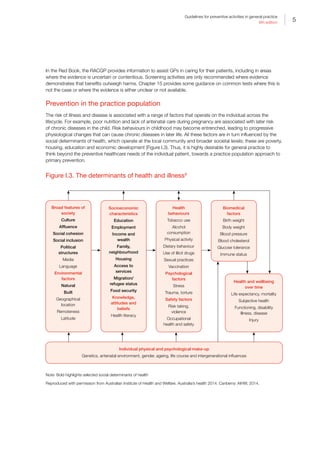
housing, education and economic development (Figure I.3). Thus, it is highly desirable for general practice to
think beyond the preventive healthcare needs of the individual patient, towards a practice population approach to
primary prevention.
Figure I.3. The determinants of health and illness9
Broad features of
society
Culture
Affluence
Social cohesion
Social inclusion
Political
structures
Media
Language
Environmental
factors
Natural
Built
Geographical
location
Remoteness
Latitude
Socioeconomic
characteristics
Education
Employment
Income and
wealth
Family,
neighbourhood
Housing
Access to
services
Migration/
refugee status
Food security
Knowledge,
attitudes and
beliefs
Health literacy
Health
behaviours
Tobacco use
Alcohol
consumption
Physical activity
Dietary behaviour
Use of illicit drugs
Sexual practices
Vaccination
Psychological
factors
Stress
Trauma, torture
Safety factors
Risk taking,
violence
Occupational
health and safety
Biomedical
factors
Birth weight
Body weight
Blood pressure
Blood cholesterol
Glucose tolerance
Immune status
Health and wellbeing
over time
Life expectancy, mortality
Subjective health
Functioning, disability
Illness, disease
Injury
Individual physical and psychological make-up
Genetics, antenatal environment, gender, ageing, life course and intergenerational influences
Note: Bold highlights selected social determinants of health
Reproduced with permission from Australian Institute of Health and Welfare. Australia’s health 2014. Canberra: AIHW, 2014.
6
Guidelines for preventive activities in general practice
9th edition
General practice has a practical role to play in addressing these determinants and helping to break the cycle that
may exist linking social and economic factors to illness and injury. This requires a systematic approach across
the whole practice population, not just for those who seek out or are most receptive to preventive care. This may
include auditing medical records to identify those who are missing out, using special strategies to support patients
with low literacy, and being proactive in following up patients who are most at risk. It will usually require teamwork
within the practice as well as links with other services.
General practice also has a broader role in facilitating health improvement for vulnerable and disadvantaged groups
in the local community, in association with other services and providers. In some cases, this may involve advocacy
for their needs. Information on local vulnerable and disadvantaged groups and their access to healthcare can be
obtained from local Primary Health Networks (PHNs) or state and territory health networks. Measures to improve
access to preventive healthcare by Aboriginal and Torres Strait Islander peoples are especially important given their
higher burden of disease and the barriers that exist to preventive healthcare. More information is available in the
National guide to preventive health assessment for Aboriginal and Torres Strait Islander people, 2nd edn.
Screening versus case finding
Many clinicians confuse screening and case-finding tests. Screening is defined as ‘the examination of
asymptomatic people in order to classify them as likely or unlikely to have a disease’.14
The primary purpose of
screening tests is to detect early disease in apparently healthy individuals.
Case finding is the examination of an individual or group suspected of having, or at risk of, the condition. Case
finding is a targeted approach to identifying conditions in select patients who may already have symptoms.15
A diagnostic test is any kind of medical test performed to establish the presence (or absence) of disease as a basis
for treatment decisions in symptomatic or screen-positive individuals (confirmatory test). Examples include taking
a mid-stream urine (MSU) sample for evaluation of a urinary tract infection and performing a mammogram for a
suspicious breast lump.
Screening and case finding carry different ethical obligations. If a clinician initiates screening in asymptomatic
individuals, there needs to be conclusive evidence that the procedure can positively affect the natural history of
the disorder. Moreover, the risks of screening must be carefully considered as the patient has not asked the health
professional for assistance.
This situation is somewhat different from case finding, where the patient has presented with a particular problem
or has asked for some level of assistance. In this situation, there is no guarantee of benefit of the tests undertaken.
It could be argued that there is at least some implied exposure to risk (eg performing colonoscopy to investigate
abdominal pain).
Opportunistic versus systematic prevention
Most preventive activities are undertaken in Australia opportunistically – that is when patients present for other
reasons, and the preventive activity is an add-on.16
This approach is supported by evidence, which shows that
visits just for ‘a general check-up’ are not effective or necessary.17
However, systematic approaches to register and recall patients for some specific targeted conditions are
worthwhile – including childhood immunisations; and screening for cervical, breast and colorectal cancers (CRC),
and diabetes. Proactive recall of patients for screening is warranted for high-risk groups, those who may have
difficulty accessing services and for conditions where population coverage has been identified by the government
as a public health priority.15
7
Guidelines for preventive activities in general practice
9th edition
Screening principles
The World Health Organization (WHO) has produced guidelines18,19
for the effectiveness of screening programs.
These and the National Health Service’s (NHS) guidelines20
in the UK have been kept in mind in the development of
recommendations about screening in the Red Book.
Condition
•	 It should be an important health problem.
•	 It should have a recognisable latent or early symptomatic stage.
•	 The natural history of the condition, including development from latent to declared disease, should be
adequately understood.
Test
•	 It should be simple, safe, precise and validated.
•	 It should be acceptable to the target population.
•	 The distribution of test values in the target population should be known and a suitable cut-off level defined
and agreed.
Treatment
•	 There should be an effective treatment for patients identified, with evidence that early treatment leads to
better outcomes.
•	 There should be an agreed policy on who should be treated and how they should be treated.
Outcome
•	 There should be evidence of improved mortality, morbidity or quality of life as a result of screening, and the
benefits of screening should outweigh the harm.
•	 The cost of case finding (including diagnosis and treatment of patients who are diagnosed) should be
economically balanced in relation to possible expenditure on medical care as a whole.
Consumers
•	 Consumers should be informed of the evidence so they can make an informed choice about participation.
In Australia, there is an increasing number of Medicare Benefits Schedule (MBS) items for health assessments in
particular population groups: Aboriginal and Torres Strait Islander children and adults, refugees, people with an
intellectual disability, those aged 45–49 years (with a risk factor), and those aged ≥75 years. There is evidence that
these assessments improve the likelihood of preventive care being received.21
However, it is important that such
‘health checks’ involve preventive interventions where there is clear evidence of their effectiveness.
8
Guidelines for preventive activities in general practice
9th edition
II.  Patient education and health literacy
Impact of patient education
Patient education and counselling contribute to behaviour change for the primary prevention of disease.21
More
broadly, they may also help to create greater ‘health literacy’ – the knowledge and skills patients require to maintain
their own health, including use of health services. The use of behavioural techniques, especially for self-monitoring,
is recommended, as is the use of personal communication and written or other audiovisual materials.22
Patients view the general practitioner (GP) as a key first contact and credible source of preventive advice. Factors
that increase the effectiveness of patient education delivered by GPs include:
•	 assessing the patient’s health literacy23
•	 the patient’s sense of trust in their GP24
•	 face-to-face delivery25
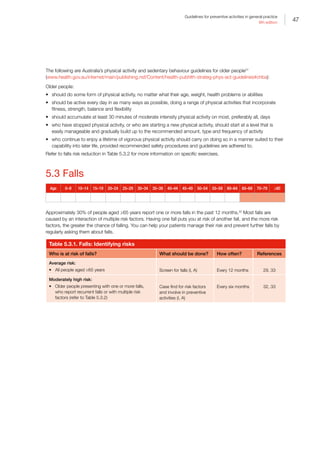
•	 patient involvement in decision making26–28
•	 highlighting the benefits and costs29,30
•	 strategies to help the patient remember what they have been told31
•	 tailoring the information to the patient’s interest in change32
•	 strategies that address the difficulty in adherence28,33
•	 the use of decision aids.34
Many preventive activities involve a change in health-related behaviour. In general practice, it may take at least six
to eight sessions to discuss and see changes to diet, physical activity or weight loss. This will often require referral,
which should be followed up by the general practice. As the patient plays a large role in making this happen, it is
useful to facilitate more active inclusion of patients in their care. This process is an essential component of self-
management support strategies35,36
and has the potential to increase the patient’s responsibility for their health. In
addition, it:
•	 enhances the quality of communication37,38
•	 enhances the doctor–patient consultation26
•	 can reduce the cost of aspects of care through better informed patients27
•	 increases the demand and use of appropriate referral to other health professionals and agencies38
•	 increases adherence to recommended preventive activities and therapeutic regimens.38,39
For those whose first language is not English, a professional interpreter should be considered.
Approaches to patient education
Patients need to develop their own understanding of the problem and what can be done about it. For simple
behavioural changes, such as having a cervical cancer screening test, patients weigh up the perceived benefits and
costs.40
These benefits and costs may include answers to the following questions:
•	 How big is the problem to the individual?
•	 What are the consequences of not doing the test?
•	 What are the benefits?
•	 What are the barriers?
Some health education may require more complex actions over a period of time, such as changing diet, stopping
smoking or increasing physical activity.
9
Guidelines for preventive activities in general practice
9th edition
There are a number of theoretical approaches to understanding and supporting behaviour change including the:
•	 Theory of planned behaviour41
•	 Health belief model42
•	 capability, opportunity and motivation (COM-B) system, which has been proposed by Michie et al as a way of
representing the necessary conditions for behaviour change to occur43
•	 ‘stages of change model’,44
which proposes five stages of change, which are viewed as a cyclical, ongoing
process during which the person has differing levels of motivation or readiness to change, and the ability to relapse
or repeat a stage. Although there is a lack of evidence for greater effectiveness of stage-based approaches,45
this model provides a useful framework for clinicians to identify patients’ interest in behaviour change in the
consultation and to provide tailored support in a way that is time efficient and likely to be well received.46
Support from the GP and/or practice nurse may involve motivational interviewing. This is an evidence-based
counselling technique based on a therapeutic partnership that acknowledges and explores the patient’s
ambivalence about a behaviour in a way that allows them to clarify what goals are important to them and to
organise their reasons in a way that supports actions.
Motivational interviewing is a counselling philosophy that values patient autonomy and mutual respect, and the use
of open-ended questions, affirmations, reflection and summarising.47
Further information about motivational interviewing and its application in general practice can be found in The Royal
Australian College of General Practitioners’ (RACGP) Smoking, nutrition, alcohol and physical activity (SNAP): A
population health guide to behavioural risk factors in general practice (www.racgp.org.au/your-practice/guidelines/
snap) and Putting prevention into practice: Guidelines for the implementation of prevention in the general practice
setting (Green Book; www.racgp.org.au/your-practice/guidelines/greenbook).
Health inequity
It is well recognised that socioeconomic disadvantage has a profound impact on people’s health, and GPs are
often in a good position to confront this.48
However, poverty is not evenly spread across Australia, and it is likely that GPs who see some patients with
socioeconomic disadvantage will see many. Similarly, GPs are not evenly spread with respect to poverty. The
Australian Bureau of Statistics (ABS) have shown that, in 2006, 11% of GPs worked in the most disadvantaged
areas, while 24% worked in the least disadvantaged.49
Healthcare in communities that are socioeconomically deprived is often complex. As well as having more chronic
health conditions, and more health behaviours leading to increased risk, there may be a lack of local support and
infrastructure to improve the situation. General practices are often one of the few resources patients have to call on.
There are often significant personal and social barriers to achieving change. As well as good communication skills,
GPs may need to help patients navigate health, housing, welfare and legal systems. This often makes for more-
frequent, longer, more-complex consultations. However, the long-term relationships GPs develop with patients are
significant enablers for patients who are socioeconomically deprived to be able to make changes.
Health equity issues are more complex than just socioeconomic factors. There are specific issues for Aboriginal and
Torres Strait Islander peoples, where an ongoing history of colonisation, dispossession and racism interact with a
lack of economic opportunity. The National guide to a preventive health assessment for Aboriginal and Torres Strait
Islander people, 2nd edn50
provides extensive detail on specific preventive care issues facing Aboriginal and Torres
Strait Islander peoples, and the health equity material canvassed here should be read in conjunction with those
guidelines. They provide much more in-depth and important guidance on preventive healthcare strategies that are
recommended for practitioners working with Aboriginal and Torres Strait Islander peoples and communities. In
addition, GPs should optimise their use of Medicare Benefits Schedule (MBS) Item 715 that supports health checks
in Aboriginal and Torres Strait Islander peoples and their use of Close the Gap provisions in ensuring affordable
access to medicines. GPs should also proactively address cost barriers to referral to other services faced by
Aboriginal and Torres Strait Islander peoples.
10
Guidelines for preventive activities in general practice
9th edition
Supporting patient education and health literacy in
disadvantaged groups
What are the key equity issues and who is at risk?
•	 The complex needs and health problems of disadvantaged groups, and the interactions between social,
psychological, environmental and physical determinants of health mean that special effort is required for patient
education to be effective.
•	 Socioeconomic disadvantage and low health literacy are linked. Health literacy is a key factor in how patient
education leads to patient empowerment. It allows individuals to access, understand and use information to
negotiate the health system and support self-management.51
Health literacy is important as low health literacy is
associated with poorer health outcomes and lower utilisation of health services such as screening and preventive
care.
•	 Other groups that require particular focus in patient education include Aboriginal and Torres Strait Islander
peoples and culturally and linguistically diverse (CALD) groups.52
What can GPs do?
A range of strategies can be used by GPs to help patients with low health literacy and to promote health-related
behaviour changes.51,53
These include:
•	 specific communication techniques such as asking patients to ‘teach back’ what has been taught to them and
the ‘ask me 3’ health education program based on three patient-led questions54
(https://npsf.site-ym.com/
default.asp?page=askme3)
•	 motivational interviewing and counselling techniques
•	 plain-language and culturally appropriate written materials (explicitly asking about reading skills may be important)
•	 use of web-based or computer-based programs (explicitly asking about internet access, eg at home or through a
library may be important)
•	 helping patients navigate the healthcare system to improve access to care, for example, by working in
collaboration with other services such as community health centres and consumer organisations to access
community health and group education programs.
Effective patient education for CALD populations means ensuring that health services and messages are accessible
and relevant. GPs should:
•	 offer interpreter services during consultations. There is good evidence that interpreter services improve care
experience and clinical outcomes55
•	 use patient education materials in plain English or those that are culturally and linguistically sensitive (eg have a
range of patient material in relevant different languages in your practice)
•	 link individuals to specific community-based health programs.56,57
Cultural competence is important in providing appropriate patient education to all communities. This is particularly
important in working with Aboriginal and Torres Strait Islander communities.58
It is important for GPs to better
appreciate Aboriginal and Torres Strait Islander peoples’ perspectives on health, culture and history, and provide
services within a culturally appropriate framework.59
This could be facilitated through:
•	 reading about the history and impact of colonisation on Aboriginal and Torres Strait Islander peoples and their
health, nationally and locally60
•	 arranging Aboriginal and Torres Strait Islander cultural awareness training for themselves and practice staff
(www.racgp.org.au/yourracgp/faculties/aboriginal/education/resources-for-gps-and-practice-staff/cultural-
awareness)
•	 linking your practice and Aboriginal and Torres Strait Islander patients to local Aboriginal community controlled
health services61
•	 developing relationships with your local Aboriginal and Torres Strait Islander community, and resources, people
and services that can provide you with assistance and cultural mentorship.
11
Guidelines for preventive activities in general practice
9th edition
III.  Development of the Red Book
The Red Book, 9th edn, has been developed by a team of general practitioners (GPs) and experts to ensure
that the content is the most valuable and useful for GPs and their teams. The content broadly conforms to the
highest evidence-based standards according to the principles underlying the Appraisal of Guidelines Research and
Evaluation (AGREE) tool.62,63
The dimensions addressed are:
•	 scope and purpose
•	 clarity of presentation
•	 rigour of development
•	 stakeholder involvement
•	 applicability
•	 editorial independence.
The Red Book maintains developmental rigour, editorial independence, and relevance and applicability to general
practice.
Recommendations
The recommendations in the Red Book are based on current, evidence-based guidelines for preventive
activities. Focus has been on those most relevant to Australian general practice. Usually, this means that the
recommendations are based on Australian guidelines such as those endorsed by the National Health and Medical
Research Council (NHMRC).
Where NHMRC guidelines are not available or recent, other sources have been used, such as guidelines from the
National Heart Foundation of Australia, Canadian or US preventive guidelines, or the results of systematic reviews.
References to support these recommendations are listed. However, particular references may relate only to part of
the recommendation (eg only relating to one of the high-risk groups listed), and other references in the section may
have been considered in formulating the overall recommendation.
These recommendations are based on the best available information at the time of writing (May 2015 to May 2016).
Any updated information will be posted on The Royal Australian College of General Practitioners’ (RACGP) website.
More information and guidelines can be found on the NHMRC website www.nhmrc.gov.au/guidelines-publications,
the Australian Government clinical guidelines portal (www.clinicalguidelines.gov.au) and the Cochrane Collaboration
website (www.cochrane.org).
12
Guidelines for preventive activities in general practice
9th edition
IV. How to use the Red Book
The Red Book is designed to be used in a number of ways, all of which can be useful in day-to-day general
practice. The Red Book can be used as a:
•	 guide to establish who is most at risk and for whom screening or preventive care is most appropriate
•	 refresher to check the latest recommendations
•	 reminder to check at a glance what preventive activities are to be performed in various age groups and
how often
•	 checklist of preventive activities used according to an individual patient’s health profile
•	 patient education tool, to demonstrate to patients the evidence that exists for preventive activities
•	 study guide – a comprehensive list of references is provided in each chapter. This allows more in-depth
information on a particular topic.
Organisational detail
The information in the Red Book is organised into three levels.
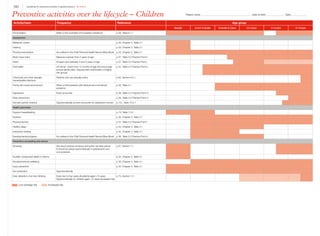
The first level is the lifecycle chart, which highlights when preventive activities should be performed and the
optimum frequency for each activity. The lifecycle chart is organised by age and clinical topic. Simply check the
column under a particular age group to see what activities should be considered for the patient. The preventive
activities that are recommended for everyone within a particular age range, and for which there is sound research
evidence, are shaded in red. Activities to be performed only in patients with risk factors or where the evidence is
not as strong are shaded in light red or pink.
A copy of this chart can be downloaded and attached to the patient record as a systematic reminder for preventive
activities. General practitioners (GPs) can also use it as a wall chart or keep it handy on the desk.
The second level is more detailed and presents a summary of recommendations in addition to tables that identify
what preventive care should be provided for particular groups in the population. This edition of the Red Book
adopts the existing National Health and Medical Research Council (NHMRC) levels of evidence and grades of
recommendations.64
Future editions will consider adopting the GRADE system (www.gradeworkinggroup.org) for
evaluating the quality of evidence for outcomes reported in systematic reviews.
Recommendations in the tables are graded according to the levels of evidence and strength of recommendation.
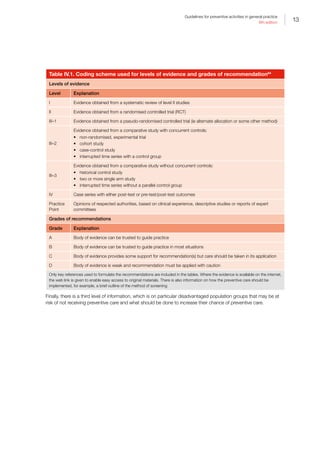
The levels of evidence are coded by the roman numerals I–IV while the strength of recommendation is coded by
the letters A–D. Practice Points are employed where no good evidence is available. Refer to Table IV.1 for more
information.
13
Guidelines for preventive activities in general practice
9th edition
Table IV.1. Coding scheme used for levels of evidence and grades of recommendation64
Levels of evidence
Level Explanation
I Evidence obtained from a systematic review of level II studies
II Evidence obtained from a randomised controlled trial (RCT)
III–1 Evidence obtained from a pseudo-randomised controlled trial (ie alternate allocation or some other method)
III–2
Evidence obtained from a comparative study with concurrent controls:
•	 non-randomised, experimental trial
•	 cohort study
•	 case-control study
•	 interrupted time series with a control group
III–3
Evidence obtained from a comparative study without concurrent controls:
•	 historical control study
•	 two or more single arm study
•	 interrupted time series without a parallel control group
IV Case series with either post-test or pre-test/post-test outcomes
Practice
Point
Opinions of respected authorities, based on clinical experience, descriptive studies or reports of expert
committees
Grades of recommendations
Grade Explanation
A Body of evidence can be trusted to guide practice
B Body of evidence can be trusted to guide practice in most situations
C Body of evidence provides some support for recommendation(s) but care should be taken in its application
D Body of evidence is weak and recommendation must be applied with caution
Only key references used to formulate the recommendations are included in the tables. Where the evidence is available on the internet,
the web link is given to enable easy access to original materials. There is also information on how the preventive care should be
implemented, for example, a brief outline of the method of screening
Finally, there is a third level of information, which is on particular disadvantaged population groups that may be at
risk of not receiving preventive care and what should be done to increase their chance of preventive care.
14
Guidelines for preventive activities in general practice
9th edition
References – Chapters I–IV
1.	 Britt H MG, Henderson J, Bayram C, et al. General
practice activity in Australia 2014–15. Sydney: Sydney
University Press, 2015.
2.	 Australian Government Preventative Health Taskforce.
Australia: The healthiest country by 2020 – National
preventative health strategy. Canberra: Commonwealth
of Australia, 2009. Available at www.preventativehealth.
org.au/internet/preventativehealth/publishing.nsf/content/
AEC223A781D64FF0CA2575FD00075DD0/$File/nphs-
overview.pdf [Accessed 15 December 2015].
3.	 Begg S, Vos T BB, Stevenson C, Stanley L, Lopez AD.
The burden of disease and injury in Australia 2003.
Canberra: AIHW, 2007.
4.	 Cancer Australia. Cancer Australia position statements.
Surrey Hills, NSW: Cancer Australia, 2016. Available at
https://canceraustralia.gov.au/publications-and-resources/
position-statements/lifestyle-risk-factors-and-primary-
prevention-cancer [Accessed 5 May 2016].
5.	 Australian Institute of Health and Welfare. Chronic disease
risk factors. Canberra: AIHW, 2016. Available at www.
aihw.gov.au/chronic-diseases/risk-factors [Accessed 3
May 2016].
6.	 Council of Australian Governments Health Services.
Promoting good health, prevention and early intervention.
Canberra: COAG, 2006. Available at www.health.gov.
au/internet/budget/publishing.nsf/Content/budget2006-
hfact37.htm [Accessed 15 December 2015].
7.	 Department of Health. National Primary Health Care
Strategic Framework. Canberra: DOH, 2013. Available at
www.health.gov.au/internet/main/publishing.nsf/Content/
nphc-strategic-framework [Accessed 18 March 2016].
8.	 Steering Committee for the Review of Government Service
Provision. National agreement performance information
2011–12: National healthcare agreement. Canberra:
Productivity Commission, 2011.
9.	 Australian Institute of Health and Welfare. Australia’s health
2014. Canberra: AIHW, 2014.
10.	 Vos T, Carter R, Barendregt J, et al. Assessing cost-
effectiveness in prevention (ACE–Prevention): Final report.
Herston, Qld: University of Queensland; and Burwood,
Vic: Deakin University, 2010.
11.	 Mazza D, Shand LK, Warren N, Keleher H, Browning CJ,
Bruce EJ. General practice and preventive health care:
A view through the eyes of community members. Med J
Aust 2011;195(4):180–83.
12.	 Australian Institute of Health and Welfare. Chronic diseases
and associated risk factors in Australia. Canberra:
AIHW, 2006. Available at www.aihw.gov.au/publication-
detail/?id=6442467914 [Accessed 5 May 2016].
13.	 Gray JA, Patnick J, Blanks RG. Maximising
benefit and minimising harm of screening. BMJ
2008;336(7642):480–83.
14.	 Morrison AS. Screening. In: Rothman KJ, Greenland
S, Lash TL, editors. Modern epidemiology, 2nd edn.
Philadelphia: Lippincott-Raven,1998.
15.	 Aldrich R, Kemp L, Williams JS, et al. Using
socioeconomic evidence in clinical practice guidelines.
BMJ 2003;327(7426):1283–85.
16.	 The Royal Australian College of General Practitioners.
Smoking, nutrition, alcohol, physical activity (SNAP): A
population health guide to behavioural risk factors in general
practice. 2nd edn. East Melbourne, Vic: RACGP, 2015.
17.	 Krogsbøll LT, Jørgensen KJ, Grønhøj Larsen C, Gøtzsche
PC. General health checks in adults for reducing morbidity
and mortality from disease: Cochrane systematic review
and meta-analysis. BMJ 2012;345:e7191.
18.	 World Health Organization. Screening for various cancers.
Geneva: WHO, 2008. Available at www.who.int/cancer/
detection/variouscancer/en [Accessed 3 May 2016].
19.	 Wilson J, Jungner Y. Principles and practices of screening
for disease. Geneva: World Health Organization, 1968.
20.	 UK National Health Services. What is screening? London:
UK National Screening Committee, 2015. Available at
www.nhs.uk/Livewell/Screening/Pages/screening.
aspx#what-is [Accessed 6 January 2016].
21.	 Bouleware LE, Barnes GJ, Wilson RF, et al. Systematic
review: The value of the periodic health evaluation. Ann
Intern Med 2007;146:289–300.
22.	 Dolan M, Simons-Morton D, Ramirez G, Frankowski R,
Green L, Mains D. A meta-analysis of trials evaluating
patient education and counselling for three groups
of preventive health behaviors. Patient Educ Couns
1997;32(3):157–73.
23.	 Nutbeam D. Building health literacy in Australia. Med J
Aust 2009;191(10):525–26.
24.	 Trachtenberg F, Dugan E, Hall M. How patients’ trust
relates to their involvement in medical care. J Fam Pract
2005;54(4):344–52.
25.	 Ellis S, Speroff T, Dittus R, Brown A, Pichert J, Elasy T.
Diabetes patient education: A meta-analysis and meta-
regression. Pat Educ Couns 2004;52(1):97–105.
26.	 Lewin S, Skea Z, Entwistle V, Zwarenstein M, Dick J.
Interventions for providers to promote a patient-centred
approach in clinical consultations. Cochrane Database
Syst Rev 2002;4: CD003267.
27.	 Mead N, Bower P. Patient-centred consultations
and outcomes in primary care. Patient Educ Couns
2002;48(1):51–61.
28.	 Rao J, Weinberger M, Kroenke K. Visit-specific
expectations and patient-centred outcomes: Literature
review. Arch Fam Med 2000;9(10):1149–55.
29.	 Schauffler H, Rodriguez T, Milstein A. Health education
and patient satisfaction. J Fam Pract 1996;42(1):62–68.
30.	 Littell J, Girvin H. Stages of change: A critique. Behav
Modif 2002;26(2):223–73.
31.	 Ley P, editor. Patients’ understanding and recall in clinical
communication failure. London: Academic Press, 1983.
32.	 Steptoe A, Kerry S, Rink E, Hilton S. The impact of
behavioral counseling on stage of change in fat intake,
physical activity, and cigarette smoking in adults at
15
Guidelines for preventive activities in general practice
9th edition
increased risk of coronary heart disease. Am J Public
Health 2001;91(2):265–69.
33.	 Branch L, Rabiner D. Rediscovering the patient’s role
in receiving health promotion services. Med Care
2000;38(1):70–77.
34.	 O’Connor AM, Bennett CL, Stacey D, et al. Decision aids
for people facing health treatment or screening decisions.
Cochrane Database Syst Rev 2009;3:CD001431.
35.	 Warsi A, Wang P, LaValley M, Avorn J, Solomon D. Self-
management education programs in chronic disease:
A systematic review and methodologic critique of the
literature. Arch Intern Med 2004;164(15):1641–49.
36.	 Ofman J, Badamgarav E, Henning J, et al. Does disease
management improve clinical and economic outcomes in
patients with chronic diseases? A systematic review. Am J
Med 2004;117(3):182–92.
37.	 Joos S, Hickam D, Gordon G, Baker L. Effects of
physician communication intervention on patient care
outcomes. J Gen Intern Med 1996;11(3):147–55.
38.	 Hibbard J. Engaging health care consumers to improve
quality of care. Med Care 2003;41(1 Suppl):I61–70.
39.	 Bodenheimer T, Wagner E, Grumbach K. Improving
primary care for patients with chronic illness. JAMA
2002;288(14):1775–79.
40.	 Rosenstock I. The health belief model and preventative
health behaviour. Health Educ Monogr 1974;2:27–57.
41.	 Armitage CJ, Conner M. Efficacy of the theory of planned
behaviour: A meta-analytic review. Br J Soc Psychol
2001;40(Pt 4):471–99.
42.	 Janz NK, Becker MH. The health belief model: A decade
later. Health Educ Q 1984;11(1):1–47.
43.	 Michie S, van Stralen MM, West R. The behaviour change
wheel: A new method for characterising and designing
behaviour change interventions. Implement Sci 2011;6:42.
44.	 Cassidy C. Using the transtheoretical model to facilitate
behaviour change in patients with chronic illness. J Am
Acad Nurse Pract 1999;11(7):281.
45.	 Cahill K, Lancaster T, Green N. Stage-based interventions
for smoking cessation. Cochrane Database Syst Rev
2010;11:CD004492.
46.	 Prochaska JO, Velicer WF, Redding C, et al. Stage-
based expert systems to guide a population of primary
care patients to quit smoking, eat healthier, prevent skin
cancer, and receive regular mammograms. Prev Med
2005;41(2):406–16.
47.	 Miller WR, Rollnick S. Motivational interviewing – Helping
people change. 3rd edn. New York: Guildford Press,
2012.
48.	 Watt G, Brown G, Budd J, et al. General practitioners
at the deep end: The experience and views of general
practitioners working in the most severely deprived areas
of Scotland. Occasional paper. Edinburgh: Royal College
of General Practitioners, 2012.
49.	 Australian Bureau of Statistics. Australian social trends,
Mar 2010. Canberra: ABS, 2010. Available at www.abs.
gov.au/AUSSTATS/abs@.nsf/Lookup/4102.0Main+Featur
es30Mar+2010 [Accessed 29 April 2016].
50.	 National Aboriginal Community Controlled Health
Organisation and The Royal Australian College of General
Practitioners. National guide to a preventive health
assessment for Aboriginal and Torres Strait Islander
people. 2nd edn. South Melbourne, Vic: RACGP, 2012.
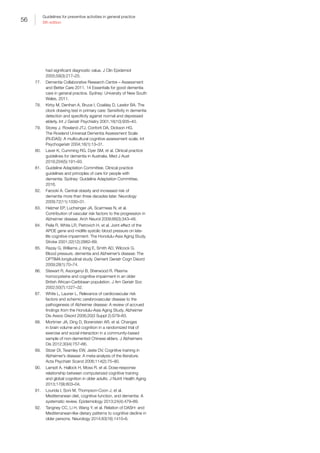
51.	 Harris M, Taggart J, Williams A, et al. Effective
interventions to improve health literacy in the management
of lifestyle risk factors in primary health care. Paper
presented at 6th Health Service  Policy Research
Conference. Brisbane: Health Service  Policy Research
Conference, 2009.
52.	 Rodriguez V, Andrade AD, Garcia-Retamero R, et al.
Health literacy, numeracy, and graphical literacy among
veterans in primary care and their effect on shared
decision making and trust in physicians. J Health
Commun 2013;18:273–89.
53.	 Harris M, Kidd M, Snowdon T. New models of primary
and community care to meet the challenges of chronic
disease management and prevention: A discussion
paper for NHHRC: National Health and Hospitals Reform
Commission. Canbera: Australian Government, 2008.
54.	 Adams RJ, Stocks NP, Wilson DH, et al. Health literacy:
A new concept for general practice? Aust Fam Physician
2009;38(3):144–47.
55.	 Karliner LS, Jacobs EA, Chen AH, Mutha S. Do
professional interpreters improve clinical care for patients
with limited English proficiency? A systematic review of the
literature. Health Serv Res 2007;42(2):727–54.
56.	 Belintxon M, Lopez-Dicastillo O. The challenges of health
promotion in a multicultural society: A narrative review. An
Sist Sanit Navar 2014;37(3):401–09.
57.	 Ethnic Communities’ Council of Victoria. An investment
not an expense: Enhancing health literacy in culturally
and linguistically diverse communities. Carlton, Vic: Ethnic
Communities’ Council of Victoria, 2012.
58.	 Abbott P, Reath J, Gordon E, et al. General practitioner
supervisor assessment and teaching of registrars
consulting with Aboriginal patients – Is cultural
competence adequately considered? BMC Med Educ
2014;14:167.
59.	 Vass A, Mitchell A, Dhurrkay Y. Health literacy and
Australian indigenous peoples: An analysis of the role
of language and worldview. Health Promot J Aust
2011;22(1):33–37.
60.	 Eckermann A, Dowd T, Chong E, Nixon L, Gray R. Binan
Goonj: Bridging cultures in Aboriginal health. 3rd edn.
Chatswood, NSW: Elsevier Australia, 2010.
61.	 Ware VA. Improving the accessibility of health services
in urban and regional settings for Indigenous people.
Canberra: Australian Institute for Health and Welfare,
2013.
62.	 Harris MF, Bailey L, Snowdon T, et al. Developing
the guidelines for preventive care – Two decades of
experience. Aust Fam Physician 2010;39(1–2):63–65.
63.	 Development and validation of an international appraisal
instrument for assessing the quality of clinical practice
guidelines: The AGREE project. Qual Saf Health Care
2003;12(1):18–23.
64.	 National Health and Medical Research Council.
NHMRC additional levels of evidence and grades for
recommendations for developers of guidelines. Canberra:
NHMRC, 2009. Available at www.nhmrc.gov.au/guidelines-
publications/information-guideline-developers/resources-
guideline-developers [Accessed 6 January 2016].
16
Guidelines for preventive activities in general practice
9th edition
V. What’s new in the 9th edition?
Chapter Change
1. Preventive activities prior to
pregnancy
Advice on nutrition, weight assessment and oral health has been included in
Table 1.1
Information on health inequity is presented under ‘What are the key equity issues
and who is at risk?’ and ‘What can GPs do?’, highlighting the key issues and
strategies
2. Genetic counselling and testing Information on referral to clinical genetic services has been added
Inclusion of the use of a simple family history screening questionnaire to identify
individuals in general practice who may require a more detailed assessment of their
family history of cancer, heart disease or diabetes (Appendix 2A. Family history
screening questionnaire)
Additional advice added regarding Down syndrome – for all pregnant women –
hereditary haemochromatosis, haemoglobinopathies and thalassaemias (Table 2.1)
Non-invasive prenatal test now included
3. Preventive activities in children
and young people
Content has been edited and layout simplified to enable faster appreciation of the
recommendations ‘at a glance’
Information on health inequity is presented under ‘What are the key equity issues
and who is at risk?’ and ‘What can GPs do?’, highlighting the key issues and
strategies
4. Preventive activities in middle
age
Information on health inequity is presented under ‘What are the key equity issues
and who is at risk?’ and ‘What can GPs do?’, highlighting the key issues and
strategies
5. Preventive activities in older age Falls and physical activity are now in separate sections
Physical activity recommendations relevant to the Australian environment are
included
6. Communicable disease Inclusion of new information on the consent process before vaccination
New information on the prevalence of chlamydia, gonorrhoea, syphilis and human
immunodeficiency virus (HIV) in Australia
Information on health inequity is presented under ‘What are the key equity issues
and who is at risk?’ and ‘What can GPs do?’, highlighting the key issues and
strategies
7. Prevention of chronic disease Additional information on identifying nutrition-related complications in children and
adolescents (Table 7.3.1)
Change of title of Section 7.4 from ‘Problem drinking’ to ‘Early detection of at-risk
drinking’. Additional advice and information on effective interventions
Section 7.5. Physical activity includes assessment advice and referral information for
different age groups, and those at increased risk
Consumption of red meat and processed meat recommendations modified to align
with World Health Organization (WHO) recommendations
Information on health inequity is presented under ‘What are the key equity issues
and who is at risk?’ and ‘What can GPs do?’, highlighting the key issues and
strategies
17
Guidelines for preventive activities in general practice
9th edition
8. Prevention of vascular and
metabolic disease
Information added on assessing need for anticoagulation (Table 8.5.2)
New information on atrial fibrillation
New advice about screening for diabetes based on US Preventive Services Task
Force (USPSTF) guidelines
Information on health inequity is presented under ‘What are the key equity issues and
who is at risk?’ and ‘What can GPs do?’, highlighting the key issues and strategies
9. Early detection of cancer Sections rearranged in order of incidence – that is, most commonly reported in
Australia (www.aihw.gov.au/cancer/cancer-in-australia-overview-2012/ch2/#t3)
After reviewing information from recent large trials of prostate cancer screening,
population screening for prostate cancer by prostate-specific antigen (PSA) testing
continues to not be recommended. Therefore, GPs have no obligation to offer
prostate cancer screening to asymptomatic men. Reference included to a decision
aid to assist discussion of possible benefits and harms of screening with PSA in men
who have individual concerns about prostate cancer
Inclusion of information on the cervical cancer screening program to commence in
May 2017
New information about the risks and benefits of screening mammogram; in
particular, the risk of over-diagnosis
Oral cancer section moved to Chapter 11. Oral health
Information on health inequity is presented under ‘What are the key equity issues and
who is at risk?’ and ‘What can GPs do?’ highlighting the key issues and strategies
10. Psychosocial Additional information on adolescents and those at average risk included for intimate
partner violence (Table 10.3.1)
Information on health inequity is presented under ‘What are the key equity issues and
who is at risk?’ and ‘What can GPs do?’, highlighting the key issues and strategies
11. Oral health Title of chapter has changed from ‘Oral hygiene’ to ‘Oral health’ to include
information on both oral hygiene and cancer
14. Osteoporosis Inclusion of an additional section on quantitative ultrasound as an alternative imaging
technique for assessing fracture risk
15. Screening tests of unproven
benefit
Additional screening tests not recommended:
•	 Coronary computed tomography (CT) angiography for coronary artery disease
•	 Cardiac calcium scoring for coronary heart disease
•	 Thermography and single nucleotide polymorphisms testing for breast cancer
•	 Optical colonoscopy and CT colonography for colorectal cancer
•	 Heel ultrasound for osteoporosis
•	 Carotid artery ultrasound for asymptomatic carotid artery stenosis
•	 Enquiry about sleep for obstructive sleep apnoea
•	 Bimanual pelvic exam during a routine Pap smear in asymptomatic women
•	 Genetic testing for methylenetetrahydrofolate reductase (MTHFR)
•	 Genetic testing for apolipoprotein E (ApoE)
‘Genetic profiling’ has been renamed ‘genomic sequencing’
18
Guidelines for preventive activities in general practice
9th edition
1. Preventive activities prior to
pregnancy
Age 2 2–3 4–9 10–14 15–19 20–24 25–29 30–34 35–39 40–44 45–49 50–54 55–59 60–64 ≥65
Every woman of reproductive age should be considered for preconception care (C). This consists of interventions
that aim to identify and modify biomedical, behavioural and social risks to a woman’s health or pregnancy
outcome through prevention and management.1
Preconception care should include reproductive planning and the
effective use of contraception to prevent unplanned pregnancy (A), smoking cessation (A)2
and advice to consider
abstinence from alcohol (especially if planning a pregnancy, or if the woman could become pregnant or is in the
early stages of pregnancy),3
folic acid and iodine supplementation (A),4,5
nutrition and weight assessment,6
review of
immunisation status (C),7
medications (B),8
oral health,9
and chronic medical conditions, especially glucose control
in patients with diabetes (B).10
There is evidence to demonstrate improved birth outcomes with preconception healthcare in women with diabetes,
phenylketonuria and nutritional deficiency,11
as well as benefit from the use of folate supplementation12
and a
reduction in maternal anxiety.13
Below is information about all the potential interventions in preconception care that
expert groups have recommended (C).
What does preconception care include?
Medical issues
Reproductive life plan
Assist your patients to develop a reproductive life plan that includes whether they want to have children. If they do,
discuss the number, spacing and timing of intended children, and provide effective contraception to enable the
implementation of this plan and reduce the risk of an unplanned pregnancy. If relevant, discuss reduction in fertility
with advancing maternal age.
Reproductive history
Ask if there have been any problems with previous pregnancies such as infant death, fetal loss, birth defects
(particularly neural tube defects [NTD]), low birth weight, preterm birth, or gestational diabetes. Also, if there are any
ongoing risks that could lead to a recurrence in a future pregnancy.
Medical history
Ask if there are any medical conditions that may affect future pregnancies. Are chronic conditions such as diabetes,
thyroid disease, hypertension, epilepsy and thrombophilia well managed? Consider if current management is
optimal for early pregnancy given that early embryogenesis will occur prior to any consultation in pregnancy.
Medication use
Review all current medications for teratogenic effects, including over-the-counter medications, vitamins and
supplements.
19
Guidelines for preventive activities in general practice
9th edition
Genetic/family history (also refer to Chapter 2. Genetic counselling and testing)
Increased frequency of intellectual disability, multiple pregnancy losses, stillbirth or early death, and children with
congenital abnormalities may suggest the presence of genetically determined disease. Patients of particular
ethnic backgrounds may be at increased risk and can benefit from genetic testing for specific conditions. Possible
consanguinity (eg cousins married to each other) should be explored, for example, by asking, ‘Is there any chance
that a relative of yours might be related to someone in your partner’s family?’ General practitioners (GPs) should
consider referral to, or consultation with, a genetic service for testing because test results, which rely on sensitivity,
specificity and positive predictive value, are not straightforward. Testing often involves complex ethical, social and
legal issues. The time on waiting lists for genetic services is usually longer than one month, so direct consultation
and liaison by telephone are necessary when the genetic advice could affect a current pregnancy. Provide
opportunity for carrier screening for genetic conditions (eg cystic fibrosis, haemoglobinopathies) and referral for
genetic counselling based upon risk factors.
General physical assessment
Conduct a breast examination and, if it is due, perform a cervical screening test (eg Papanicolaou [Pap] test) before
pregnancy. Also assess body mass index (BMI) and blood pressure (BP), and check the oral cavity.
Substance use
Ask about tobacco, alcohol and illegal drug use. Offer counselling and referral for specialised assistance when use
is identified.
Vaccinations
The need for vaccination, particularly for hepatitis B, rubella and varicella, should be assessed as part of any pre‐
conception health check. Vaccinations can prevent some infections that may be contracted during pregnancy,
and relevant serological testing can be undertaken to ascertain immunity to hepatitis B and rubella. Routine
serological testing for varicella does not provide a reliable measure of vaccine-induced immunity; however, it can
indicate whether natural immunity has occurred due to prior infection. Women receiving live viral vaccines such
as measles, mumps and rubella (MMR) and varicella should be advised against becoming pregnant within 28
days of vaccination. It is also important that women of child‐bearing age who present for immunisation should
be questioned regarding the possibility of pregnancy as part of the routine pre-vaccination screening, to avoid
inadvertent administration of a vaccine(s) not recommended in pregnancy (refer to Section 2.1.4 Pre‐vaccination
screening in the Australian immunisation handbook, 10th edn). Recommended preconception vaccinations are:
•	 MMR
•	 varicella (in those without a clear history of chickenpox or who are non-immune on testing)
•	 influenza (recommended during pregnancy)
•	 diphtheria, tetanus, acellular pertussis (dTpa; to protect newborn from pertussis).
Lifestyle issues
Family planning
Based on the patient’s reproductive life plan (refer to above), discuss fertility awareness and how fertility reduces
with age, chance of conception, the risk of infertility, and fetal abnormality. For patients not planning to become
pregnant, discuss effective contraception and emergency contraceptive options.
Folic acid supplementation
Women should take a 0.4–0.5 mg per day supplement of folic acid for at least one month prior to pregnancy,
and for the first three months after conception. Where there is a known increased risk of NTD (ie patients
taking anticonvulsant medication, or with pre-pregnancy diabetes mellitus, previous child or family history of
NTD, 5-methyltetrahydrofolate deficiency or BMI 30 kg/m2
) or a risk of malabsorption, a 5 mg daily dose is
recommended.14
20
Guidelines for preventive activities in general practice
9th edition
Iodine supplementation
Women who are pregnant, breastfeeding or considering pregnancy should take an iodine supplement of 150 μg
each day.5
Healthy weight, nutrition and exercise
Discuss weight management and caution against being overweight or underweight. Recommend regular,
moderate-intensity exercise and assess risk of nutritional deficiencies (eg vegan diet, lactose intolerance, and
calcium, iron or vitamin D deficiency due to lack of sun exposure).
Psychosocial health
Discuss perinatal mental health, including anxiety and depression, pre‐existing mental health conditions,
psychological or psychiatric assessment and treatment, use of medication, and the risk of exacerbation of mood
disorders in pregnancy and postpartum. Mental health screening should include a psychosocial assessment.
Smoking, alcohol and illegal drug cessation (as indicated)
Smoking,15
illegal drug16
and excessive alcohol use17
during pregnancy can have serious consequences for an
unborn child and should be stopped prior to conception.
Healthy environments
Repeated exposure to hazardous toxins in the household and workplace environment can affect fertility and
increase the risk of miscarriage and birth defects. Discuss the avoidance of TORCH infections: Toxoplasmosis,
Other (eg syphilis, varicella, mumps, parvovirus and human immunodeficiency virus [HIV], listeriosis), Rubella,
Cytomegalovirus and Herpes simplex.
•	 Toxoplasmosis: Avoid cat litter, garden soil, raw/undercooked meat and unpasteurised milk products; wash all
fruit and vegetables.
•	 Cytomegalovirus, parvovirus B19 (fifth disease): Discuss the importance of frequent hand-washing. Those who
work with children or in the healthcare sector can further reduce risk by using gloves when changing nappies.
•	 Listeriosis: Avoid paté, soft cheeses (eg feta, brie, blue vein), prepackaged salads, deli meats and chilled/
smoked seafood. Wash all fruit and vegetables before eating. Refer to Food Standards Australia New Zealand
(www.foodstandards.gov.au/consumer/generalissues/pregnancy/Pages/default.aspx) regarding folate, listeria
and mercury.
•	 Fish: Limit fish containing high levels of mercury. Refer to www.betterhealth.vic.gov.au/health/healthyliving/
mercury-in-fish
21
Guidelines for preventive activities in general practice
9th edition
Table 1.1. Preconception: Preventive interventions
Intervention Technique References
Folate
supplementation
Most women: 0.5 mg/day supplementation, beginning ideally at least one month
prior to conception and continuing for the first trimester
High-risk women: 5 mg/day supplementation, ideally beginning at least one month
prior to conception and continuing for the first trimester
4, 18–20
Iodine
supplementation
All women who are pregnant, breastfeeding or considering pregnancy should take
an iodine supplement of 150 μg each day
5, 14
Nutrition
and weight
assessment
All women, especially those who become pregnant in adolescence or have closely-
spaced pregnancies (interpregnancy interval less than six months), require nutritional
assessment and appropriate intervention in the preconception period with an
emphasis on optimising maternal body mass index (BMI) and micronutrient reserves
6, 21
Check oral cavity
and referral
Ask the woman if she has bleeding gums, swellings, sensitive teeth, loose teeth,
holes in teeth, broken teeth, toothache, or any other problems in the mouth
Check oral cavity to confirm. Reassure the patient that it is safe to have a range of
dental treatments during pregnancy
Smoking
cessation
Inform women who smoke that tobacco affects fetal growth and advise them to
stop smoking. Evidence exists to suggest improved cognitive ability in children of
mothers who quit smoking during gestation (III, A). Consider pharmacotherapy when
a pregnant woman is otherwise unable to quit, and when the likelihood and benefits
of cessation outweigh the risks of pharmacotherapy and potential continued smoking
22
Alcohol and illicit
drug use
For women who are pregnant or planning a pregnancy, not drinking is the safest
option. The risk of harm to the fetus is highest when there is high, frequent maternal
alcohol intake. The risk of harm to the fetus is likely to be low if a woman has
consumed only small amounts of alcohol before she knew she was pregnant. Inform
pregnant women that illicit drugs may harm the fetus and advise them to avoid use
1
Interpregnancy
interval
Perinatal outcomes are worse with interpregnancy intervals 18 months or 59
months; the outcomes affected are preterm birth, low birth weight and small size for
gestational age
23
Chronic diseases Optimise control of existing chronic diseases (eg diabetes, hypertension, epilepsy).
Avoid teratogenic medications
18
BMI, body mass index
22
Guidelines for preventive activities in general practice
9th edition
Health inequity
What are the key equity issues and who is at risk?
Preconception care is especially important to adolescents and young women in vulnerable populations.24
Adolescent parenthood is more common in low socioeconomic groups and Aboriginal and Torres Strait Islander
communities, and is associated with poor birth outcomes and adverse health effects, including mental health
issues and substance misuse.25–29
Decreased folate supplementation is associated with being a woman from a lower socioeconomic group, being
an Aboriginal and Torres Strait Islander person, or being younger or from a rural area.30
Awareness of folic acid is
related to income, educational level and younger age.31,32
Other dietary supplements may follow similar gradients.
Smoking and alcohol use in pregnancy show socioeconomic gradients. Women who are young, on a low
income and of low socioeconomic status, Aboriginal and Torres Strait Islander women, single mothers, and
women experiencing addiction, violence and mental health issues are all more likely to smoke during pregnancy.33,34
Women from culturally and linguistically diverse (CALD) backgrounds are more likely to experience poorer perinatal
outcomes.36–38
What can GPs do?
•	 Provide youth-friendly care to adolescent parents through non-judgemental, competent, considerate and
respectful advice and services.39
•	 Offer women culturally appropriate resources, including in the mother’s own language, about health issues
and the health system, and consider the use of interpreters.
•	 Link women into English language and perinatal education courses, and offer cultural brokerage through
maternity liaison officers or bilingual health workers wherever possible.39
•	 Refer to ‘Antenatal care for Aboriginal and Torres Strait Islander women’ in the Australian Health Ministers’
Advisory Council’s Clinical practice guidelines: Antenatal care – Module 1.39
•	 Refer to the general principles of providing patient education and supporting health literacy in disadvantaged
groups.
References
1.	 Johnson K, Posner SF, Biermann J, et al.
Recommendations to improve preconception health
and health care – United States. MMWR Recomm Rep
2006;55(RR-6):1–23.
2.	 Lumley J, Chamberlain C, Dowswell T, Oliver S, Oakley
L, Watson L. Interventions for promoting smoking
cessation during pregnancy. Cochrane Database Syst
Rev 2009;3:CD001055.
3.	 National Health and Medical Research Council. Australian
guidelines to reduce health risks from drinking alcohol.
Canberra: NHMRC, 2009.
4.	 Lumley J, Watson L, Watson M, Bower C. Periconceptual
supplementation with folate and/or multivitamins for
preventing neural tube defects. Cochrane Database Syst
Rev 2001;3:CD001056.
5.	 National Health and Medical Research Council. Iodine
supplementation for pregnant and breastfeeding women.
Canberra: NHMRC, 2010. Available at www.nhmrc.
gov.au/_files_nhmrc/file/publications/synopses/new45_
statement.pdf [Accessed 8 December 2015].
6.	 Dean SV, Lassi ZS, Imam AM, Bhutta ZA. Preconception
care: Nutritional risks and interventions. Reprod Health
2014;11 Suppl 3:S3.
7.	 Australian Technical Advisory Group on Immunisation
(ATAGI). The Australian immunisation handbook. 10th edn
(2015 update). Canberra: Department of Health, 2015.
8.	 Australian Department of Health and Aged Care.
Prescribing medicines in pregnancy. 4th edn. Canberra:
Therapeutic Goods Administration, 1999.
9.	 Rogers JG. Evidence-based oral health promotion
resource. Melbourne: Prevention and Population Health
Branch, Department of Health, 2011.
10.	 Korenbrot CC, Steinberg A, Bender C, Newberry S.
Preconception care: A systematic review. Matern Child
Health Journal 2002;6(2):75–88.
11.	 Gjerdingen DK, Fontaine P. Preconception health care: A
critical task for family physicians. J Am Board Fam Pract
1991;4(4):237–50.
12.	 Hodgetts VA, Morris RK, Francis A, Gardosi J, Ismail
KM. Effectiveness of folic acid supplementation in
23
Guidelines for preventive activities in general practice
9th edition
pregnancy on reducing the risk of small-for-gestational
age neonates: A population study, systematic review and
meta-analysis. BJOG 2015;122(4):478–90.
13.	 de Jong-Potjer LC, Elsinga J, le Cessie S, et al. GP-
initiated preconception counselling in a randomised
controlled trial does not induce anxiety. BMC Fam Pract
2006;7:66.
14.	 The Royal Australian and New Zealand College of
Obstetricians and Gynaecologists. Vitamin and mineral
supplementation and pregnancy (C-Obs 25), November
2014, amended May 2015. East Melbourne, Vic:
RANZCOG, 2015. Available at www.ranzcog.edu.au/
doc/vitamin-and-mineral-supplementation-in-pregnancy.
html [Accessed 5 September 2015].
15.	 The Royal Australian and New Zealand College of
Obstetricians and Gynaecologists. Women and smoking
(C-Obs 53). East Melbourne, Vic: RANZCOG, 2011.
Available at www.ranzcog.edu.au/college-statements-
guidelines.html [Accessed 27 May 2016].
16.	 The Royal Australian and New Zealand College of
Obstetricians and Gynaecologists. Substance use in
pregnancy (C-Obs 55). East Melbourne, Vic: RANZCOG,
2013. Available at www.ranzcog.edu.au/college-
statements-guidelines.html [Accessed 27 May 2016].
17.	 The Royal Australian and New Zealand College of
Obstetricians and Gynaecologists. Alcohol in pregnancy
(C-Obs 54). East Melbourne, Vic: RANZCOG, 2014.
Available at www.ranzcog.edu.au/college-statements-
guidelines.html [Accessed 27 May 2016].
18.	 National Institute for Health and Care Excellence.
Diabetes in pregnancy: Management of diabetes and
its complications from preconception to the postnatal
period. London: NICE, 2015.
19.	 Wilson RD, Johnson JA, Wyatt P, et al. Pre-conceptional
vitamin/folic acid supplementation 2007: The use
of folic acid in combination with a multivitamin
supplement for the prevention of neural tube defects
and other congenital anomalies. J Obstet Gynaecol Can
2007;29(12):1003–26.
20.	 US Preventive Services Task Force. Guide to clinical
preventive services: Report of the US Preventive Services
Task Force. 2nd edn. Alexandria, VA: Williams  Wilkins,
2002.
21.	 Opray N, Grivell RM, Deussen AR, Dodd JM. Directed
preconception health programs and interventions for
improving pregnancy outcomes for women who are
overweight or obese. Cochrane Database Syst Rev
2015;7:CD010932.
22.	 The Royal Australian College of General Practitioners.
Supporting smoking cessation: A guide for health
professionals. Melbourne: RACGP, 2011.
23.	 Conde-Agudelo A, Rosas-Bermúdez A, Kafury-
Goeta AC. Birth spacing and risk of adverse perinatal
outcomes: A meta-analysis. JAMA 2006;295:1809–23.
24.	 Hanson MA, Gluckman PD, Ma RCW, Matzen P, Biesma
RG. Early life opportunities for prevention of diabetes in
low and middle income countries. BMC Public Health
2012;12.
25.	 Hodgkinson S, Beers L, Southammakosane C, Lewin
A. Addressing the mental health needs of pregnant and
parenting adolescents. Pediatrics 2014;133(1):114–22.
26.	 Payne NA, Anastas JW. The mental health needs of
low-income pregnant teens: A nursing-social work
partnership in care. Research on Social Work Practice
2015 Sep;25(5):595–606.
27.	 Penman-Aguilar A, Carter M, Snead MC, Kourtis AP.
Socioeconomic disadvantage as a social determinant of
teen childbearing in the US Public Health Reports 2013;
128:5–22.
28.	 Hilder L, Zhichao Z, Parker M, Jahan S, Chambers
G. Australia’s mothers and babies 2012. Canberra:
Australian Institute of Health and Welfare, 2014.
29.	 Middleton P. Preventing infant deaths among Aboriginal
and teenage women in South Australia. Adelaide: The
Strategic Health Research Program Team, The University
of Adelaide, 2009.
30.	 Australian Institute of Health and Welfare. Mandatory folic
acid and iodine fortification in Australia and New Zealand:
Baseline report for monitoring. Canberra: AIHW, 2011.
31.	 Hage CN, Jalloul M, Sabbah M, Adib SM. Awareness
and intake of folic acid for the prevention of neural tube
defects among Lebanese women of childbearing age.
Matern Child Health 2012;16(1):258–65.
32.	 Rasmussen MM, Clemmensen D. Folic acid
supplementation in pregnant women. Dan Med Bull
2010;57(1):A4134
33.	 Borland T, Babayan A, Irfan S, Schwartz R. Exploring the
adequacy of smoking cessation support for pregnant and
postpartum women. BMC Public Health 2013;13:472
34.	 Cui Y, Shooshtari S, Forget EL, Clara I, Cheung KF.
Smoking during pregnancy: Findings from the 2009–
2010 Canadian Community Health Survey. PLOS ONE
2014;9(1):e84640
35.	 Burns L, Breen C, Bower C, O’ Leary C, Elliott EJ.
Counting fetal alcohol spectrum disorder in Australia:
The evidence and the challenges. Drug Alcohol Rev
2013;32(5):461–67.
36.	 Laws P, Li Z, Sullivan E. Australia’s mothers and babies
2008. Canberra: Australian Institute of Health and
Welfare, 2010.
37.	 O’Mahony JM, Donnelly TT. How does gender influence
immigrant and refugee women’s postpartum depression
help-seeking experiences? J Psychiatr Ment Health Nurs
2013;20(8):714–25.
38.	 O’Mahony JM, Donnelly TT, Bouchal SR, Este D. Cultural
background and socioeconomic influence of immigrant
and refugee women coping with postpartum depression.
J Immigr Minor Health 2013;15(2):300–14.
39.	 Australian Health Ministers’ Advisory Council. Clinical
practice guidelines: Antenatal care – Module 1. Canberra:
Department of Health and Ageing, 2012.
24
Guidelines for preventive activities in general practice
9th edition
2. Genetic counselling and testing
Age 0–9 10–14 15–19 20–24 25–29 30–34 35–39 40–44 45–49 50–54 55–59 60–64 65–69 70–79 ≥80
Genetic testing can be used for various purposes, from preconception planning (refer to Chapter 1. Preventive
activities prior to pregnancy), during pregnancy, for neonates (newborn screening), during childhood and right
through to adult-onset familial diseases (eg cancer, cardiac and neurodegenerative diseases).
In order to identify patients who may be at risk of a genetic disorder, a comprehensive family history must be taken
from all patients, and this should be regularly updated. A family history should include first-degree and second-
degree relatives on both sides of the family and ethnic background. Age of onset of disease and age of death
should be recorded where available.
Increased frequency and early onset of cancers in families, premature ischaemic heart disease or sudden cardiac
death, intellectual disability, multiple pregnancy losses, stillbirth or early death, and children with congenital
abnormalities may suggest the presence of genetically determined disease. Patients of particular ethnic
backgrounds may be at increased risk and may benefit from genetic testing for specific conditions. Possible
consanguinity (eg cousins married to each other) should be explored, for example, by asking, ‘Is there any chance
that a relative of yours might be related to someone in your partner’s family?’ General Practitioners (GPs) should
consider referral to, or consultation with, a genetic service (general or cancer genetics) for testing because test
results, which rely on sensitivity, specificity and positive predictive value, are not straightforward. Testing often
involves complex ethical, social and legal issues. The time on waiting lists for genetic services is usually longer than
one month, so direct consultation and liaison by telephone are necessary when the genetic advice could affect a
current pregnancy. On the basis of current evidence, whole genome sequencing is not recommended in low-risk
general practice populations (refer to Chapter 15. Screening tests of unproven benefit).
Clinical genetic services provide testing, diagnosis, management and counselling for a wide range of genetic
conditions. Reasons for referral include:
•	 diagnosis of a genetic condition
•	 family history of a genetic condition
•	 recurrence risk counselling (eg risk of recurrence in a future pregnancy)
•	 pregnancy counselling (eg preconception, consanguinity)
•	 prenatal screening and testing
•	 presymptomatic and predictive testing for adult-onset disorders (eg cancer)
•	 discussions surrounding genetic testing
•	 arranging of genetic testing.
Services such as paternity testing or genetic testing/management of very common genetic conditions (eg
haemochromatosis) are not provided by clinical genetic services.
Use of a simple family history screening questionnaire (FHSQ) can help identify individuals who may require a
more detailed assessment of their family history of cancer, heart disease or diabetes (refer to Appendix 2A. Family
history screening questionnaire for a published and validated FHSQ).1
This tool can be used as part of the patient
assessment at their first visit to a practice. If a patient is uncertain about their family history, they can be asked
to discuss the FHSQ with their relatives prior to completing the questionnaire. For patients with low literacy,
the FHSQ may need to be completed with the support of a healthcare professional. A positive response to any
question requires follow-up with a more detailed assessment of the family history. As family history can change, it is
recommended that the FHSQ be repeated at least three every years.
25
Guidelines for preventive activities in general practice
9th edition
Table 2.1. Genetic testing: Identifying risks
Who is at risk? What should be done? How often? References
Cystic fibrosis (CF)
Increased probability:
•	 Northern European or Ashkenazi
Jewish ancestry
•	 Family history of CF or a relative with a
known CF mutation
•	 Where partner is affected or a known
carrier of CF
•	 Partners from Northern European
or Ashkenazi Jewish backgrounds
who are consanguineous (eg cousins
married to each other)
•	 Men with infertility suspected or due to
congenital absence of the vas deferens
Offer referral for genetic
counselling and carrier testing
(III, B)
If patient is pregnant, contact
genetic services to organise
screening in first trimester
Test couple for carrier
status if planning
pregnancy or in first
trimester
2–5
Down syndrome
Probability:
•	 All pregnant women
Combined maternal serum and
ultrasound screening in first
trimester*
Maternal serum screening in
second trimester†
(C)
Non-invasive prenatal test (NIPT)‡
First or second
trimester
3, 6–11
Significantly increased probability:
•	 Women who had a previous Down
syndrome pregnancy
•	 Women with positive maternal serum
screening/nuchal translucency
ultrasound, NIPT in first trimester
or maternal serum screening in
second trimester
•	 Parent with a chromosomal
rearrangement (eg balanced
translocation of chromosome 21)
Fetal diagnostic genetic testing
(C)
Offer referral for genetic
counselling
First or second
trimester
10
Fragile X syndrome
Increased probability
Children or adults of either sex with one or
more of the following features:
•	 developmental delay including
intellectual disability of unknown cause
•	 autistic-like features
•	 attention deficit hyperactivity disorder
(ADHD)
•	 speech and language problems
•	 social and emotional problems, such as
aggression or shyness
•	 a female with a history of primary
ovarian insufficiency or premature
menopause (aged 40 years)
•	 adults with ataxia, balance problems
and parkinsonism
•	 relative with a fragile X mutation
Deoxyribonucleic acid (DNA)
test for fragile X and karyotype/
comparative genomic
hybridisation by microarray
for other possible causes of
developmental delay
Refer to genetic services for
genetic counselling and testing
at-risk family (I, A)
(IV, B)
(IV, A)
Any age for diagnosis
Prior to pregnancy to
ascertain carrier status
and reproductive risk
3, 12, 13
14–16
17
26
Guidelines for preventive activities in general practice
9th edition
Who is at risk? What should be done? How often? References
Haemoglobinopathies and thalassaemias
Increased probability:
•	 People from any of the following ethnic
backgrounds: Southern European,
African, Middle Eastern, Chinese, Indian
subcontinent, Central and South-east
Asian, Pacific Islander, New Zealand
Maori, South American, Caribbean, and
some northern Western Australian and
Northern Territory Aboriginal and Torres
Strait Islander communities
Test for mean corpuscular
volume (MCV), mean corpuscular
haemoglobin (MCH) and ferritin
Haemoglobin electrophoresis
(III, B)
Blood for deoxyribonucleic acid
(DNA) studies
Arrange partner testing if: MCV
≤80 fL and/or MCH ≤27 pg and/
or abnormal haemoglobin (Hb)
electrophoresis
Test couple for
carrier status prior to
pregnancy or in first
trimester
3, 18–20
Breast and ovarian cancer Refer to Section 9.3. Breast cancer
Colon cancer Refer to Section 9.2. Colorectal cancer
Familial hypercholesterolaemia (FH)
Increased probability:
•	 Premature ischaemic heart disease (ie
ischaemic heart disease in men aged
55 years and women aged 60 years)
•	 First-degree relative with premature
ischaemic heart disease (men aged
55 years and women aged 60 years)
•	 Total cholesterol 7.5 mmol/L or low
density lipoprotein-cholesterol (LDL-C)
4.9 mmol/L
•	 First-degree relative with a total
cholesterol 7.5 mmol/L or LDL-C
4.9 mmol/L
•	 Tendon xanthomata or arcus cornealis
at 45 years of age
Assess their probability of
having FH using the Dutch
Lipid Clinic Network (DLCN)
criteria or Modified UK Simon
Broome (MUKSB) criteria (III,
B) (Appendix 2B. Dutch Lipid
Clinic Network Criteria for
making a diagnosis of Familial
Hypercholestroloaemia in adults)
Offer referral to a lipid disorders
clinic if DLCN score ≥3 or the
MUKSB suggests possible FH
First presentation 21, 22
27
Guidelines for preventive activities in general practice
9th edition
Who is at risk? What should be done? How often? References
Hereditary haemochromatosis (HHC)
Increased probability:
•	 All first-degree relatives of patients with
HHC who are C282Y homozygous or
C282Y/H63D compound heterozygous
Positive family history –
asymptomatic and symptomatic
For patients aged 18 years, test
for HFE mutations, transferrin
saturation and serum ferritin to
simultaneously assess future
and current risk of iron overload
(C). Medicare Benefits Schedule
(MBS) rebate applies if affected
relative is first-degree relative;
no MBS rebate applies for more
distant relatives
If HFE mutation tests show
C282Y homozygous or C282Y/
H63D compound heterozygous
result, arrange for all of that
patient’s first degree relatives
aged 18 years to have tests for
HFE mutations and transferrin
saturation and serum ferritin (C).
MBS rebate applies
Aged 18 years at first
presentation
Although
abnormalities in
transferrin saturation
and serum ferritin may
occur at 18 years
of age in patients
with HHC, morbidity
from significant
iron overload is
exceedingly rare
before the age of 18
years
9, 23–29
Consider in these patients:
•	 Patients with conditions that could be
a complication of haemochromatosis
(eg arthritis, chronic fatigue, erectile
dysfunction, early menopause,
cirrhosis, hepatocellular carcinoma,
cardiomyopathy, diabetes mellitus)
•	 Patients with liver disease of unknown
cause, including those with suspected
alcoholic liver disease
•	 Patients with a family history of
haemochromatosis, liver cancer,
unexplained early death from liver or
heart failure
•	 Patients with porphyria cutanea tarda
and chondrocalcinosis (‘pseudogout’)
Other patients – asymptomatic
and symptomatic
For patients aged 18 years, test
transferrin saturation and serum
ferritin
If transferrin saturation 45%
or serum ferritin 250 µg/L on
repeated testing, test for HFE
mutations. MBS rebate applies
The ideal sample for testing
transferrin saturation and serum
ferritin is early morning fasting
blood test with iron supplements
withheld for 24 hours
*First trimester Down syndrome screening:
•	 free beta human chorionic gonadotrophin (HCG), pregnancy associated plasma protein at 10–12 weeks (this also provides risk for
trisomy 18 and Edwards syndrome)
•	 nuchal translucency screen at 11 weeks, 3 days to 13 weeks, 6 days
•	 NIPT‡
from 10 weeks for trisomy 21, 18 and 13; not available for MBS rebate. Tests for fetal DNA in maternal blood
†
Second trimester serum screening:
•	 beta HCG, unconjugated oestriol, alpha-fetoprotein and inhibin A, ideally at 15–17 weeks; also gives risk for Edward syndrome and
neural tube defects (NTDs)
ADHD, attention deficit hyperactivity disorder; CF, cystic fibrosis; DLCN, Dutch Lipid Clinic Network; DNA, deoxyribonucleic acid; FH,
familial hypercholesterolaemia; Hb, haemoglobin; HCG, human chorionic gonadotrophin; HHC, hereditary haemochromatosis; LDL-C,
low density lipoprotein-cholesterol; MCH, mean corpuscular haemoglobin; MCV, mean corpuscular volume; MUKSB, Modified UK
Simon Broome; NIPT, non-invasive prenatal test; NTD, neural tube defect
28
Guidelines for preventive activities in general practice
9th edition
References
1.	 Emery JD, Reid G, Prevost AT, Ravine D, Walter FM.
Development and validation of a family history screening
questionnaire in Australian primary care. Ann Fam Med
2014;12(3):241–49.
2.	 Southern KW, Merelle MM, Dankert-Roelse JE,
Nagelkerke AD. Newborn screening for cystic fibrosis.
Cochrane Database Syst Rev 2009;1:CD001402.
3.	 The Royal Australian and New Zealand College of
Obstetricians and Gynaecologists. Prenatal screening
and diagnosis of chromosomal and genetic abnormalities
in the fetus in pregnancy (C-Obs 59). East Melbourne,
Vic: RANZCOG, 2011. Available at www.ranzcog.edu.au/
college-statements-guidelines.html [Accessed 19 April
2016].
4.	 Ioannou L, McClaren BJ, Massie J, et al. Population-
based carrier screening for cystic fibrosis: A
systematic review of 23 years of research. Genet Med
2014;16(3):207–16.
5.	 Delatycki M, Burke J, Christie L, et al. Population based
carrier screening for cystic fibrosis. Position statement.
Alexandria, New South Wales: Human Genetics Society
of Australasia, 2013.
6.	 The American College of Obstetricians and Gynecologists
Committee on Genetics and The Society for Maternal-
Fetal Medicine Publications Committee. Committee
opinion no. 545: Noninvasive prenatal testing for fetal
aneuploidy. Obstet Gynecol 2012;120(6):1532–34.
7.	 Woolcock J, Grivell R. Noninvasive prenatal testing. Aust
Fam Physician 2014 Jul;43(7):432–34.
8.	 Bianchi DW, Parker RL, Wentworth J, et al. DNA
sequencing versus standard prenatal aneuploidy
screening. N Engl J Med 2014;370(9):799–808.
9.	 Genetics Education in Medicine Consortium. Genetics
in family medicine: The Australian handbook for general
practitioners. Canberra: Biotechnology Australia, 2008.
Available at www.nhmrc.gov.au/_files_nhmrc/file/
your_health/egenetics/genetics_in_family_mdicine.pdf
[Accessed 15 April 2016].
10.	 Facher J, Robin N. Genetic counselling in primary care.
What questions are patients likely to ask, and how should
they be answered. Postgrad Med 2000;107(3):59–66.
11.	 Dick P. Periodic health examination, 1996 update. 1.
Prenatal screening for and diagnosis of Down syndrome.
Canadian Task Force on the Periodic Health Examination.
CMAJ 1996;154(4):465–79.
12.	 Cohen J, Lennox N. Fragile X syndrome. In: Lennox N,
Diggens J, editors. Management guidelines: People with
developmental and intellectual disabilities. Melbourne:
Therapeutic Guidelines Limited, 1999.
13.	 Mefford HC, Batshaw ML, Hoffman EP. Genomics,
intellectual disability, and autism. N Engl J Med
2012;366(8):733–43.
14.	 Murray A, Schoemaker MJ, Bennett CE, et al.
Population-based estimates of the prevalence of
FMR1 expansion mutations in women with early
menopause and primary ovarian insufficiency. Genet Med
2014;16(1):19–24.
15.	 Laml T, Preyer O, Umek W, Hengstschlager M. Genetic
disorders in premature ovarian failure. Hum Reprod
Update 2002;8(5):483–91.
16.	 Better Health Channel. Menopause – Premature (early
menopause). Melbourne: Better Health Channel,
2003. Available at www.betterhealth.vic.gov.au/bhcv2/
bhcarticles.nsf/pages/Menopause_premature_early_
menopause [Accessed 15 April 2016].
17.	 Jacquemont S, Hagerman RJ, Leehey MA, Hall DA.
Penetrance of the fragile X–associated tremor/ataxia
syndrome in a premutation carrier population. JAMA
2004;291(4):460–69.
18.	 Dormandy E, Bryan S, Gulliford MC, et al. Antenatal
screening for haemoglobinopathies in primary
care: A cohort study and cluster randomised trial
to inform a simulation model. The Screening for
Haemoglobinopathies in First Trimester (SHIFT) trial.
Health Technol Assess 2010;14(20):1–160.
19.	 Cunningham F, Bowden D. Suggested protocol
for pre-conceptual and antenatal carrier testing for
haemoglobinopathies. Clayton, Vic: Monash Medical
Centre, 2013.
20.	 Pagon RA, Bird TD, Dolan CR, Stephens K AM, editors.
GeneReviews. Seattle: University of Washington, 2010.
21.	 Sullivan D, Watts G, Hamilton-Craig I, and members
of the Cardiovascular Genetic Diseases Writing Group.
Guidelines for the diagnosis and management of familial
hypercholesterolaemia. Sydney: Cardiac Society of
Australia and New Zealand, 2013.
22.	 Watts GF, Sullivan DR, Poplawski N, et al. Familial
hypercholesterolaemia: A model of care for Australasia.
Atheroscler Suppl 2011;12(2):221–63.
23.	 Crawford D, Macdonald D. Haemochromatosis. 3rd edn.
Mount Waverley, Vic: Digestive Health Foundation and
the Gastroenterological Society of Australia, 2007.
24.	 Powell LW, Dixon JL, Ramm GA, Purdie DM.
Screening for hemochromatosis in asymptomatic
subjects with or without a family history. Arch Int Med
2006;166(3):294–303.
25.	 Delatycki MB, Powell LW, Allen KJ. Hereditary
hemochromatosis genetic testing of at-risk children:
What is the appropriate age? Genet Test 2004;8(2):98–
103.
26.	 Whitlock EP, Garlitz BA, Harris EL, Beil TL, Smith PR.
Screening for hereditary hemochromatosis: A systematic
review for the US Preventive Services Task Force. Ann
Intern Med 2006 Aug 1;145(3):209–23.
27.	 EASL clinical practice guidelines for HFE
hemochromatosis. J Hepatol 2010;53(1):3–22.
28.	 Bacon BR, Adams PC, Kowdley KV, Powell LW, Tavill AS,
American Association for the Study of Liver Diseases.
Diagnosis and management of hemochromatosis: 2011
practice guideline by the American Association for the
Study of Liver Diseases. Hepatology 2011;54(1):328–43.
29.	 Goot K, Hazeldine S, Bentley P, Olynyk J, Crawford D.
Elevated serum ferritin – What should GPs know? Aust
Fam Physician 2012;41(12):945–49.
29
Guidelines for preventive activities in general practice
9th edition
Appendix 2A. Family history screening questionnaire
The use of a simple family history screening questionnaire (FHSQ) can help identify individuals who may require a
more detailed assessment of their family history of cancer, heart disease or diabetes.1
This tool can be used as part of the patient’s assessment at their first visit to a practice. If patients are uncertain about
their family history, they can be asked to discuss the FHSQ with their relatives prior to completing the questionnaire.
For patients with low literacy, the FHSQ may need to be completed with the support of a healthcare professional.
A positive response to any question requires follow-up with a more detailed assessment of the family history. As
family history can change it is recommended that the FHSQ be repeated at least every three years.
This risk assessment focuses on your close relatives including parents, children,
brothers and sisters who are either living or dead. Yes No
Have any of your close relatives had heart disease before 60 years of age?
‘Heart disease’ includes cardiovascular disease, heart attack, angina and bypass surgery.
Have any of your close relatives had diabetes?
‘Diabetes’ is also known as type 2 diabetes or non-insulin dependent diabetes.
Do you have any close relatives who had melanoma?
Have any of your close relatives had bowel cancer before 55 years of age?
Do you have more than one relative on the same side of the family who had bowel cancer at
any age?
Please think about your parents, children, brothers, sisters, grandparents, aunts, uncles, nieces,
nephews and grandchildren.*
Have any of your close male relatives had prostate cancer before 60 years of age?
Have any of your close female relatives had ovarian cancer?
Have any of your close relatives had breast cancer before 50 years of age?
Do you have more than one relative on the same side of your family who has had breast cancer
at any age?
Please think about your parents, children, brothers, sisters, grandparents, aunts, uncles, nieces,
nephews and grandchildren.*
*Only first-degree and second-degree relatives need be considered in this screening questionnaire
Reproduced with permission from Emery JD, Reid G, Prevost AT, Ravine D, Walter FM. Development and validation of a family
history screening questionnaire in Australian primary care. Ann Fam Med 2014;12(3):241–49. Available at www.annfammed.org/
content/12/3/241.long
30
Guidelines for preventive activities in general practice
9th edition
Appendix 2B. Dutch Lipid Clinic Network Criteria for making
a diagnosis of familial hypercholestrolaemia in adults
Score
Family history
First-degree relative with known premature coronary and/or vascular disease (men aged 55 years and
women aged 60 years)
or
First-degree relative with known low-density lipoprotein-cholesterol (LDL-C) above the 95th percentile
for age and sex
1
First-degree relative with tendinous xanthomata and/or arcus cornealis
or
Children aged 18 years with LDL-C above the 95th percentile for age and sex
2
Clinical history
Patient with premature coronary artery disease (ages as above) 2
Patient with premature cerebral or peripheral vascular disease (as above) 1
Physical examination
Tendinous xanthomata 6
Arcus cornealis prior to 45 years of age 4
LDL-C (mmol/L)
LDL-C ≥8.5 8
LDL-C 6.5–8.4 5
LDL-C 5.0–6.4 3
LDL-C 4.0–4.9 1
Deoxyribonucleic acid (DNA) analysis: Functional mutation in the low-density lipoprotein receptor (LDLR),
apolipoprotein B (APOB) or proprotein convertase subtilisin/kexin type 9 (PCSK9) gene
8
Stratification Total score
Definite familial hypercholesterolaemia (FH) ≥8
Probable FH 6–7
Possible FH 3–5
Unlikely FH 3
ApoB, apolipoprotein B; DNA, deoxyribonucleic acid; FH, familial hypercholesterolaemia; LDL-C, low-density lipoprotein-cholesterol;
LDLR, low-density lipoprotein receptor; PCSK9, proprotein convertase subtilisin/kexin type 9
Reproduced with permission from Elsevier from Watts GF, Sullivan DR, Poplawski N, et al. Familial Hypercholesterolaemia Australasia
Network Consensus Group (Australian Atherosclerosis Society). Familial hypercholesterolaemia: A model of care for Australasia.
Atheroscler Suppl 2011;12(2):221–63.
31
Guidelines for preventive activities in general practice
9th edition
Modified UK Simon Broome criteria
1.	 Deoxyribonucleic acid (DNA) mutation
2.	 Tendon xanthomas in patient or first-degree or second-degree relative
3.	 Family history myocardial infarction (MI) 50 years of age in second-degree relative or 60 years of age in
first-degree relative
4.	 Family history of cholesterol 7.5 in first-degree or second-degree relative
5.	 Cholesterol 7.5 (adult) or 6.7 (aged 16 years)
6.	 Low-density lipoprotein-cholesterol 4.9 (adult) or 4.0 (aged 16 years)
Definite: (5 or 6) + 1
Probable: (5 or 6) + 2
Possible familial hypercholesterolaemia: (5 or 6) + (3 or 4)
32
Guidelines for preventive activities in general practice
9th edition
3. Preventive activities in children and
young people
Age 0–9 10–14 15–19 20–24 25–29 30–34 35–39 40–44 45–49 50–54 55–59 60–64 65–69 70–79 ≥80
Early intervention
Prevention and health promotion in the early years, from conception to 5 years of age, is important for an
individual’s lifelong health and wellbeing.1
It may also be an opportunity to redress health inequalities.2,3
In
adolescence, neurodevelopmental studies support the value of early intervention to prevent ongoing harm.4
Many infants and children visit their general practitioner (GP) frequently, and adolescents visit at least once a year.5
This frequent contact provides opportunities for disease prevention and health promotion.
Evidence provides moderate support for the hypothesis that ‘accessible, family-centred, continuous,
comprehensive, coordinated, compassionate and culturally effective care improves health outcomes for children
with special healthcare needs’.6
There is also evidence that supports the beneficial impact of similar care for
children without special healthcare needs.7,8
Health inequity
What are the key equity issues and who is at risk?
•	 Low socioeconomic status (SES) is associated with increased childhood morbidity and mortality.9
This includes
higher rates of death from neonatal hypoxia, sudden unexpected death in infancy (SUDI), prematurity-related
disorders, and accidental and non-accidental injury;10,11
hospitalisations related to asthma;12
and risk of child
abuse.13
Low SES is also associated with overweight and obesity in children.14
•	 While there has been a decline in infant mortality since the 1990s, infant mortality in Aboriginal and Torres
Strait Islander peoples is more than twice that of non-Indigenous children,10
in part due to pregnancy, labour
and delivery complications, and trauma and congenital malformations.15
Aboriginal and Torres Strait Islander
infants have higher rates of death from SUDI.16
They are also more likely to be born premature or with low birth
weight17,18
and are more likely to be hospitalised before 1 year of age.19
•	 Aboriginal and Torres Strait Islander peoples and people from socioeconomically disadvantaged backgrounds
are more likely to experience low immunisation rates.20
What can GPs do?
•	 Refer to the general strategies for supporting patient education and health literacy in disadvantaged groups.
•	 Consider advocating for and supporting community-based strategies or policies for health promoting changes
within the environments in which families live (eg school-based programs targeting nutrition and physical
activity).21–27
•	 Use resources supporting the provision of culturally competent care to adolescents from culturally diverse
backgrounds.28
33
Guidelines for preventive activities in general practice
9th edition
Table 3.1. Age-related health checks in children and young people
Age What should be done? References
Neonatal •	 Promote immunisation as per recommendations in the Australian immunisation handbook
at www.immunise.health.gov.au/internet/immunise/publishing.nsf/Content/Handbook10-
home
•	 Vitamin K as per recommendations by the National Health and Medical Research Council
(NHMRC) at www.nhmrc.gov.au/guidelines-publications/ch39
Assessment
•	 Metabolic screen (IV, B)
•	 Universal hearing screen
•	 Physical exam as outlined in the Child Personal Health Record (C; refer to Practice Point
a in Table 3.2)
•	 Identify family strengths, elicit concerns and promote parental confidence, competence
and mental health (C)
Preventive counselling and advice
Injury prevention: Promote protection from accidental and non-accidental injury. This
includes protecting against the risks of:
•	 passive smoking
•	 sudden unexpected death in infancy (SUDI)
•	 use of appropriate restraints in motor vehicles
29
30
31
32
31, 33
2, 4, 6,
12 and 18
months; and
3 years
•	 Immunisation as per the Australian immunisation handbook at www.immunise.health.gov.
au/internet/immunise/publishing.nsf/Content/Handbook10-home (A)
•	 Immunisation includes seeking informed consent and identifying Aboriginal and Torres
Strait Islander babies, infants and toddlers
Assessment
•	 Physical exam as outlined in the Child Personal Health Record (C; refer to Practice Point a in
Table 3.2). This includes regular measurement, plotting and interpreting of length, weight and
head circumference on growth charts. Include body mass index (BMI) from 2 years of age
•	 When a baby or child is presented as a ‘problem’, assessment should include parental
mental health, family functioning, the possibility of domestic violence and adequacy of
social support (C; refer to Practice Point b in Table 3.2)
•	 From 12 months, ‘Lift the lip’ dental check (C; refer to Practice Point e in Table 3.2)
Health promotion
•	 Support breastfeeding (refer to Practice Point c in Table 3.2 for introduction of solids and
reduction of food allergy)
•	 Promote healthy eating in the second year of life as per Australian dietary guidelines at
www.nhmrc.gov.au/guidelines-publications/n55
•	 Promote physical activity as per Australian recommendations for children aged 0–5 years
•	 Promote healthy sleep
•	 www.sleephealthfoundation.org.au
•	 http://raisingchildren.net.au
•	 Enquire about developmental progress including behaviours that suggest normal hearing
and vision (refer to Practice Point d in Table 3.2)
•	 From 6 months of age, consider the use of tools such as Parents’ evaluation of
developmental status (PEDS) and the Early intervention referral guide (refer to Appendix
3A. ‘Red flag’ early intervention referral guide)
•	 Promote early interactive reading with children
•	 Promote secure attachment
Preventive counselling and advice
•	 Injury prevention: Promote protection from accidental and non-accidental injury
•	 The Royal Children’s Hospital Melbourne has advice for parents and carers of children from
birth to 5 years at www.rch.org.au/uploadedFiles/Main/Content/safetycentre/fact_sheets/
Growing%20Safely%20DL%20brochure_WEB%20secure.pdf
•	 Promote sun protection (refer to Section 9.4. Skin cancer)
31
34
35, 36
37, 38
31
34
Guidelines for preventive activities in general practice
9th edition
Age What should be done? References
3.5–5 years •	 Promote immunisation as per recommendations in the Australian immunisation
handbook at www.immunise.health.gov.au/internet/immunise/publishing.nsf/Content/
Handbook10-home
•	 Recommendations include seeking informed consent and identifying Aboriginal and
Torres Strait Islander babies, infants and toddlers
•	 Use the Australian Early Development Census (AEDC) to determine the vulnerabilities of
children 0–5 years of age in your community
Available at www.aedc.gov.au/resources/resources-accessible/aedc-user-guide-local-
government
Assessment
•	 Physical exam (include checking vision and calculating BMI; refer to Practice Point g and
j in Table 3.2)
•	 ‘Lift the lip’ dental check (C; refer to Practice Point e in Table 3.2)
•	 Promote healthy eating, drinking and physical activity (refer to Practice Point f in
Table 3.2)
•	 Promote healthy sleep as per advice from 6 months of age
•	 If behaviour is a concern, consider the quality of family functioning and the possible
contribution of factors in the child’s wider social environment (C; refer to Practice Point h
and i in Table 3.2)
•	 Elicit concerns regarding development, social and emotional wellbeing (refer to Practice
Point l in Table 3.2)
Preventive counselling and advice
•	 Injury prevention: Promote protection from accidental and non-accidental injury
•	 Promote sun protection (refer to Section 9.4. Skin cancer)
39
40, 41
36
42
6–13
years
Assessment
•	 Measure growth and BMI routinely (B; refer to Practice Point k in Table 3.2).
•	 Promote oral health
•	 Promote healthy eating and drinking
•	 ‘Lift the lip’ dental check (C; refer to Practice Point e in Table 3.2). Encourage regular
dental reviews
•	 Promote healthy physical exercise and reduction of sedentary behaviour
•	 Enquire about progress at school as an index of wellbeing (C)
•	 When behaviour is a concern, explore possible contributing factors within the family and
the wider social environment
Preventive counselling and advice
•	 Injury prevention – Harm minimisation (II). The Royal Children’s Hospital Melbourne has
advice for parents of children 6–12 years of age at
www.rch.org.au/uploadedFiles/Main/Content/safetycentre/ChildSafetyHandbook.pdf
•	 Promote social and emotional wellbeing (C)
•	 Promote sun protection (refer to Section 9.4. Skin cancer)
40, 41
36
43
35
Guidelines for preventive activities in general practice
9th edition
Age What should be done? References
14–19
years
•	 Promote immunisation as per the Australian immunisation handbook at
www.immunise.health.gov.au (A). Note the electronic version of the handbook is regularly
updated in between editions of the hardcopy
Assessment
•	 Measure growth and BMI routinely (B; refer to Practice Point k in Table 3.2)
•	 Promote healthy eating, drinking, physical activity and sleep
•	 Screen sexually active young people for Sexually Transmissible Infections (STIs; refer to
Section 6.2.1. Chlamydia and other STIs)
Preventive counselling and advice
•	 Assess for risky behaviours (refer to Practice Point m in Table 3.2). In one study, risky
behaviours occurred in 90% of young Australians attending a general practice
•	 Promote oral health (also refer to Chapter 11. Oral health)
•	 Use models of care that facilitate the transition of young people with chronic disease
or disability from tertiary paediatric care to effective primary care with access to adult
specialist care. The NSW Agency for Clinical Innovation has models of care for transition
for most paediatric centres across Australia
•	 www.trapeze.org.au/content/gps
•	 www.aci.health.nsw.gov.au/networks/transition-care
•	 Ask about smoking and provide a strong anti-smoking message (III, C; refer to Section
7.1. Smoking)
44, 45
36, 43
32,46,47
64
AEDC, Australian Early Development Census; BMI, body mass index; NHMRC, National Health and Medical Research Council;
PEDS, parents’ evaluation of developmental status; SUDI, sudden unexpected death in infancy
36
Guidelines for preventive activities in general practice
9th edition
Table 3.2. Explanatory notes for Practice Points
Practice
Point Comment
a Physical exam
•	 Complete the Child Personal Health Record, which is given at birth in New South Wales,31
or refer to
relevant programs in individual states and territories
Note: parents value reviewing completed growth charts
b At present, there is insufficient evidence for either benefit or harm in screening for postnatal depression (PND).
However, PND is known to have an unfavourable impact on the quality of attachment and family functioning.
Further, there are evidence-based interventions for PND48
and improving the quality of mother–infant interaction
adversely affected by PND.49,50
GPs should be alert to the possibility of impaired parental mental health and
family dysfunction. Visit www.beyondblue.org.au/the-facts/pregnancy-and-early-parenthood
Table 10.1.2 and Section 10.3. Intimate partner violence
c The Australasian Society of Clinical Immunology and Allergy’s (ASCIA) 2016 Guidelines for allergy prevention
in infants supports the introduction of complementary ‘solid’ foods within four to six months of age and
preferably while breastfeeding.51
The introduction of allergenic food should not be delayed. However,
the ASCIA position is in conflict with the 2012 National Health and Medical Research Council (NHMRC)
guideline, which recommends exclusive breastfeeding until 6 months of age35
The new ASCIA guidelines provide:
•	 good evidence* that introducing peanut into the diet of infants who already have severe eczema and/or
egg allergy before 12 months of age can reduce the risk of these infants developing peanut allergy
•	 moderate evidence†
that introducing cooked egg into an infant’s diet before 8 months of age, where there
is a family history of allergy, can reduce the risk of developing egg allergy. Raw egg is not recommended
Also refer to Table 7.3.2
*High/good/strong evidence means convincing evidence from well-conducted studies, or many well-
conducted studies results pooled into a large analysis (meta-analysis)
†
Moderate evidence means evidence from reasonably well-conducted studies or well-conducted single
studies
d Developmental progress
Early intervention presupposes early detection. Prior to 3 years of age, the rate of attaining developmental
milestones varies so much that the simple application of screening ‘tools’ would excessively detect
developmental delay (false positive). This risk is reduced after 3 years of age
In the earliest years, guides to developmental progress can be used to initiate an ongoing conversation with
parents to elicit their concerns about their child’s progress52,53
Developmental milestone assessments are outlined in the Child Personal Health Record, which is provided
at birth in New South Wales
A tool, such as the Parents’ evaluation of developmental status (PEDS), can be used on a regular basis
to identify any concerns about their child’s development. The information gathered helps the GP gain a
better understanding of the progress of each child. Further information on the PEDS questionnaire can be
accessed at www.rch.org.au/ccch/peds
The value of the PEDS may be increased if used in conjunction with:
•	 Learn the signs – Act early at www.cdc.gov/ncbddd/actearly/index.html
•	 Red flags early intervention guide at www.health.qld.gov.au/cq/child-development/docs/red-flag-a3-
poster-banana.pdf (refer to Appendix 3A. ‘Red flag’ early intervention referral guide). Information on the
Ages and Stages Questionnaire is available at http://agesandstages.com
37
Guidelines for preventive activities in general practice
9th edition
Practice
Point Comment
e ‘Lift the lip’ screening tool for the prevention and early detection of tooth decay in children:
•	 Complete and also teach parents to simply lift the top lip of their child, looking for signs of tooth decay
(eg white lines on top of the teeth below the gumline, or discolouration of the teeth that cannot be
brushed off). Encourage parents to complete once a month
•	 Encourage dental hygiene twice a day: No toothpaste 17 months of age and low fluoride toothpaste up
to 5 years of age
•	 Encourage dental visits annually after 12 months of age
Also refer to Chapter 11. Oral health
f The latest Australian recommendations for healthy eating, drinking and physical exercise are summarised in
The Royal Australian College of General Practitioners’ (RACGP) Smoking, nutrition, alcohol and physical activity
(SNAP): A population guide to the behavioural risk factors in general practice, 2nd edn, in particular, Table 1554
Nutrition for babies:
www.eatforhealth.gov.au/sites/default/files/files/the_guidelines/n55e_infant_brochure.pdf
Nutrition for children:
www.eatforhealth.gov.au/sites/default/files/files/the_guidelines/n55f_children_brochure.pdf
g The American Academy of Pediatrics has recommended the annual plotting of body mass index (BMI) for all
patients aged ≥2 years. Be aware that small errors in measuring either height/length or weight cause large
errors in the position of the calculated BMI on the BMI percentile chart. This is because percentile lines are
crowded together in the preschool ages
h An Australian randomised controlled trial (RCT) demonstrated that a coordinated cross-agency system of
parenting support, which included general practice, produced meaningful effects at the population level56
i For pre-school children, family support and parenting programs continue to be the most effective method
of preventing the onset of emotional and behavioural problems, which predispose to mental illness in later
childhood and adolescence32,56
j The US Preventive Services Task Force (USPSTF) concludes with moderate certainty that vision screening
for all children at least once between 3 and 5 years of age to detect the presence of amblyopia or its risk
factors has a moderate net benefit.57
The USPSTF concludes that the benefits of vision screening for
children aged 3 years are uncertain, and that the balance of benefits and harms cannot be determined for
this age group
k The USPSTF recommends that clinicians screen children aged ≥6 years for obesity and offer them or refer
them to comprehensive, intensive behavioural interventions to promote improvement in weight status (B)45
•	 There is a moderate net benefit for screening children aged 6–18 years
•	 As a screening tool, BMI is an ‘acceptable measure for identifying children and adolescents with excess
weight’45
•	 ‘Overweight’ is having a BMI between the 85th and 94th percentiles for the individual’s age and gender
•	 ‘Obesity’ is having a BMI 95th percentile for age and gender
l Mental, emotional, behavioural disorder in Australian young people
•	 Fifty per cent of adult disorders have onset by 14 years of age
•	 Between 14% and 18% of children and young people experience mental health problems of clinical
significance
•	 Depression and coping with stress are priorities for:
–– 16% of those aged 11–14 years
–– 21% of those aged 15–19 years58
•	 The USPSTF recommends the screening of adolescents (aged 12–18 years) for major depressive
disorder when systems are in place to ensure accurate diagnosis, psychotherapy (cognitive, behavioural
or interpersonal) and follow-up (B)59
•	 Risk factors for major depressive disorder include parental depression, having comorbid mental health or
chronic medical conditions, and having experienced a major negative life event59
38
Guidelines for preventive activities in general practice
9th edition
Practice
Point Comment
m Assess for risky behaviours
Promoting health and minimising harm is a whole-of-community opportunity and responsibility. Celebrating
strengths, explaining confidentiality (including its limits) and using the HE2
ADS3
framework60
(refer to below)
to explore with young people the context in which they live are strategies that are likely to improve the
clinician’s capacity to promote health and minimise morbidity (C):61,62
–– Home
–– Education/employment
–– Eating and exercise
–– Activities
–– Drugs
–– Sexuality
–– Suicide
–– Safety
•	 Young people who present frequently are at higher risk of having a mental health problem63
•	 Provide messages that encourage delay in initiation of potentially risky behaviours and, at the same
time, promote risk-reduction strategies if adolescents choose to engage or are already engaging in the
behaviour
•	 Use principles of motivational interviewing in the assessment and discussion of risky health behaviours
with adolescent patients (including safe practice for those who are sexually active)
•	 Be familiar with the resources in the community that provide harm reduction programs for substance
abuse, pregnancy prevention, injury prevention and road safety
•	 Be familiar with resources in the community that provide parenting skills training for parents of young
people
•	 Advocate for the introduction, further development and evaluation of evidence-based prevention and
treatment programs that use a harm reduction philosophy in schools and communities (C)
ASCIA, Australasian Society of Clinical Immunology and Allergy; BMI, body mass index; NHMRC, National Health and Medical
Research Council; PEDS, parents’ evaluation of developmental status; PND, postnatal depression; RCT, randomised controlled trial;
USPSTF, US Preventive Services Task Force
References
1.	 Centre for Community Child Health. Early childhood
and the lifecourse. Parkville, Vic: The Royal Children’s
Hospital, Melbourne, 2006. Available at www.rch.org.
au/emplibrary/ccch/PB1_Earlychood_lifecourse.pdf
[Accessed 25 May 2016].
2.	 Marmot M. Fair society, healthy lives – The Marmot
review. London: University College London, 2010.
Available at www.instituteofhealthequity.org/projects/fair-
society-healthy-lives-the-marmot-review [Accessed 25
May 2016].
3.	 Hayes A. The ‘two worlds’ of Australian childhoods:
Current research insights into early opportunities,
challenges and life chances. Melbourne: National
Investment for the Early Years/Centre for Community
Child Health Conference and The Royal Children’s
Hospital, Melbourne, 2011.
4.	 Patton GC, Viner R. Pubertal transitions in health. Lancet
2007;369(9567):1130–39.
5.	 Tylee A, Haller DM, Graham T, Churchill R, Sanci
LA. Youth-friendly primary-care services: How are
we doing and what more needs to be done? Lancet
2007;369(9572):1565–73.
6.	 Kuhlthau KA, Bloom S, Van Cleave J, et al. Evidence
for family-centered care for children with special
health care needs: A systematic review. Acad Pediatr
2011;11(2):136–43.
7.	 Hadland SE, Long WE. A systematic review of the
medical home for children without special health care
needs. Matern Child Health J 2014;18(4):891–98.
8.	 Long WE, Bauchner H, Sege RD, Cabral HJ, Garg A. The
value of the medical home for children without special
health care needs. Pediatrics 2012;129(1):87–98.
9.	 Barros FC, Victora CG, Scherpbier RW, Gwatkin D.
Health and nutrition of children: Equity and social
determinants. In: Blas E, Kurup AS, editors. Equity, social
determinants and public health programmes. Geneva:
World Health Organization, 2010; p. 49–75.
10.	 Australian Institute of Health and Welfare.. Australia’s
health 2014. Canberra: AIHW, 2014.
39
Guidelines for preventive activities in general practice
9th edition
11.	 Australian Institute of Health and Welfare. The health and
welfare of Australia’s Aboriginal and Torres Strait Islander
peoples 2015. Canberra: AIHW, 2015.
12.	 McGrath RJ, Stransky ML, Seavey JW. The impact of
socioeconomic factors on asthma hospitalization rates by
rural classification. J Community Health 2011;36(3):495–
503.
13.	 Friedman E, Billick SB. Unintentional child neglect:
Literature review and observational study. Psychiatric Q
2015;86(2):253–59.
14.	 O’Dea JA, Chiang HW, Peralta LR. Socioeconomic
patterns of overweight, obesity but not thinness persist
from childhood to adolescence in a 6-year longitudinal
cohort of Australian schoolchildren from 2007 to 2012.
BMC Public Health 2014;14:222.
15.	 Australian Institute of Health and Welfare. Aboriginal and
Torres Strait Islander health performance framework
2012: Detailed analyses. Canberra: AIHW, 2013.
16.	 Steering Committee for the Review of Government
Service Provision. Overcoming Indigenous disadvantage:
Key indicators 2014. Canberra: Productivity Commission,
2014.
17.	 Australian Health Ministers’ Advisory Council. Clinical
practice guidelines: Antenatal care – Module 1. Canberra:
Department of Health and Ageing, 2012.
18.	 Shah PS, Zao J, Al-Wassia H, Shah V. Pregnancy and
neonatal outcomes of aboriginal women: A systematic
review and meta-analysis. Womens Health Issues
2011;21(1):28–39.
19.	 Bar-Zeev SJ, Kruske SG, Barclay LM, Bar-Zeev NH,
Carapetis JR, Kildea SV. Use of health services by remote
dwelling Aboriginal infants in tropical northern Australia: A
retrospective cohort study. BMC Pediatr 2012;12:19.
20.	 Ward K, Chow MYK, King C, Leask J. Strategies to
improve vaccination uptake in Australia, a systematic
review of types and effectiveness. Aust N Z J Public
Health 2012;36(4):369–77.
21.	 Beauchamp A, Backholer K, Magliano D, Peeters A. The
effect of obesity prevention interventions according to
socioeconomic position: A systematic review. Obes Rev
2014;15(7):541–54.
22.	 Kimbro RT, Denney JT. Neighborhood context and racial/
ethnic differences in young children’s obesity: Structural
barriers to interventions. Soc Sci Med 2013;95:97–105.
23.	 Barr-Anderson DJ, Singleton C, Cotwright CJ, Floyd MF,
Affuso O. Outside-of-school time obesity prevention and
treatment interventions in African American youth. Obes
Rev 2014;15(Suppl 4):26–45.
24.	 Hoelscher DM, Springer AE, Ranjit N, et al. Reductions in
child obesity among disadvantaged school children with
community involvement: The Travis County CATCH Trial.
Obesity 2010;18(Suppl 1):S36–44.
25.	 King KM, Ling JY. Results of a 3-year, nutrition and
physical activity intervention for children in rural, low-
socioeconomic status elementary schools. Health Edu
Res 2015;30(4):647–59.
26.	 Lubans DR, Morgan PJ, Okely AD, et al. Preventing
obesity among adolescent girls. Arch Pediatr Adolesc
Med 2012;166(9):821–27.
27.	 Magnusson MB, Sjoberg A, Kjellgren KI, Lissner L.
Childhood obesity and prevention in different socio-
economic contexts. Prev Med 2011;53(6):402–07.
28.	 Chown P, Kang M, Sanci L, Newnham V, Bennett DL.
Adolescent health: Enhancing the skills of general
practitioners in caring for young people from culturally
diverse backgrounds, GP resource kit. 2nd edn. Sydney:
NSW Centre for the Advancement of Adolescent Health
and Transcultural Mental Health Centre, 2008.
29.	 National Health and Medical Research Council. Child
health screening and surveillance: A critical review of the
evidence. Report no. CH42. Canberra: NHMRC, 2002.
30.	 Department of Health. National framework for neonatal
hearing screening. Canberra: DoH, 2013. Available at
http://health.gov.au/internet/main/publishing.nsf/Content/
neonatal-hearing-screening [Accessed 15 December
2015].
31.	 NSW Health. Child personal health record (Blue
Book). Sydney: NSW Health, 2015. Available at www.
kidsfamilies.health.nsw.gov.au/media/296430/phr_blue-
book_2015_web.pdf [Accessed 15 December 2015].
32.	 The Royal Australian and New Zealand College of
Psychiatrists. Report from the Faculty of child and
adolescent psychiatry. Prevention and early intervention
of mental illness in infants, children and adolescents:
Planning strategies for Australia and New Zealand.
Melbourne: RANZCP, 2010.
33.	 SIDS and Kids. Safe sleeping: A guide to assist sleeping
your baby safely. Malvern, Vic: SIDS and kids, 2014.
Available at www.sidsandkids.org/wp-content/uploads/
SIDS053-Safe-Sleeping-Long-Brochure-Updates-web.pdf
[Accessed 15 December 2015].
34.	 Douglas PS, Hiscock H. The unsettled baby: Crying out
for an integrated, multidisciplinary primary care approach.
Med J Aust 2010 Nov 1;193(9):533–36.
35.	 National Health and Medical Research Council. Infant
feeding guidelines: Information for health workers.
Canberra: NHMRC, 2012.
36.	 National Health and Medical Research Council. Australian
dietary guidelines. Canberra: NHMRC, 2013.
37.	 Duursma E, Augustyn M, Zuckerman B. Reading
aloud to children: The evidence. Arch Dis Child
2008;93(7):544–47.
38.	 Sim S, Berthelsen D. Shared book reading by parents
with young children: Evidence-based practice.
Australasian J Early Childhood 2014;39(1):50–55.
39.	 Cheng TL, Emmanuel MA, Levy DJ, Jenkins RR. Child
health disparities: What can a clinician do? Pediatrics
2015;136(5):961–68.
40.	 NSW Health. Early childhood oral health guidelines for
child health professionals. Sydney: Centre for Oral Health
Strategy, 2014. Available at www0.health.nsw.gov.au/
policies/gl/2014/pdf/GL2014_020.pdf [Accessed 21
March 2016].
41.	 Rogers JG. Evidence-based oral health promotion
resource. Melbourne: Prevention and Population Health
Branch, Department of Health (Vic), 2011.
42.	 Sleep Health Foundation. Sleep shack. Blacktown, NSW:
Sleep Foundation, 2015. Available at
40
Guidelines for preventive activities in general practice
9th edition
www.sleephealthfoundation.org.au/public-information/
more/sleepshack.html [Accessed 25 May 2016].
43.	 Department of Health. Australia’s physical activity and
sedentary behaviour guidelines, 2014. Canberra: DOH,
2014. Available at www.health.gov.au/internet/main/
publishing.nsf/content/health-pubhlth-strateg-phys-act-
guidelines [Accessed 21 March 2016].
44.	 National Institute for Health and Care Excellence. CG43
Obesity: Guidance on the prevention, identification,
assessment and management of overweight and obesity
in adults and children. London: NICE, 2006.
45.	 Barton M. Screening for obesity in children
and adolescents: US Preventive Services Task
Force recommendation statement. Pediatrics
2010;125(2):361–67.
46.	 Kendrick D. Preventing injuries in children: Cluster
randomized controlled trial in primary care. BMJ
1999;318(7189):980–83.
47.	 Clamp M, Kendrick D. A randomized controlled trial of
general practitioner safety advice for families with children
under 5 years. BMJ 1998;316(7144):1576–79.
48.	 beyondblue. Clinical practice guidelines for depression
and related disorders – Anxiety, bipolar disorder and
puerperal psychosis – in the perinatal period. A guideline
for primary care health professionals. Hawthorn, Vic:
beyondblue, 2011. Available at www.beyondblue.org.
au/health-professionals/clinical-practice-guidelines
[Accessed 21 March 2016].
49.	 Bakermans-Kranenburg MJ, van IJzendoorn MH,
Juffer F. Less is more: Meta-analyses of sensitivity
and attachment interventions in early childhood.
Psychological Bulletin 2003;129(2):195–215.
50.	 Milgrom J, Ericksen J, McCarthy RM, Gemmill AW.
Stressful impact of depression on early mother–infant
relations. Stress Health 2006;22:229–38.
51.	 Australasian Society of Clinical Immunology and Allergy.
Guidelines for allergy prevention in infants. Balgowlah,
NSW: ASCIA 2016. Available at www.allergy.org.au/
images/pcc/ASCIA_PCC_Guidelines_Allergy_Prevention_
Infants_2016.pdf [Accessed 21 March 2016].
52.	 Glascoe FP. If you don’t ask: Parents may not tell:
Noticing problems vs expressing concerns. Arch Pediatr
Adolesc Med 2006;160:220.
53.	 McLean K, Goldfeld S, Molloy C, Wake M, Oberklaid
F. Screening and surveillance in early childhood health:
Rapid review of evidence for effectiveness and efficiency
of models. Ultimo, NSW: The Sax Institute, 2014.
54.	 The Royal Australian College of General Practitioners.
Smoking, nutrition, alcohol, physical activity (SNAP): A
population health guide to behavioural risk factors in
general practice. 2nd edn. East Melbourne, Vic: RACGP,
2015.
55.	 Sanders MR, Ralph A, Thompson R, et al. Every family: A
public health approach to promoting children’s wellbeing.
Brisbane: University of Queensland, 2007.
56.	 Brookes-Gunn J, Berlin LJ, Fuligni AS. Early childhood
intervention programs: What about the family? In:
Shonkoff JP, Meisels SJ, editors. Handbook of early
childhood intervention. 2nd edn. New York: Cambridge
University Press, 2000; p. 549–88.
57.	 US Preventive Services Task Force. Screening for
visual impairment in children ages 1 to 5 years: Topic
page. Rockville, MD: USPSTF, 2011. Available at www.
uspreventiveservicestaskforce.org/uspstf/uspsvsch.htm
[Accessed 25 May 2016]
58.	 Australian Infant Child Adolescent and Family Mental
Health Association. Improving the mental health of
infants, children and adolescents in Australia. Position
paper of the Australian Infant, Child, Adolescent
and Family Mental Health Association Ltd. Adelaide:
AICAFMHA, 2011. Available at www.emergingminds.
com.au/images/About-Us/AICAFMHA_pos_paper_final.
pdf [Accessed 25 May 2016].
59.	 US Preventive Services Task Force. Depression
in children and adolescents: Screening.
Rockville, MD: USPSTF, 2016. Available at www.
uspreventiveservicestaskforce.org/uspstf/uspschdepr.
htm [Accessed 25 May 2016 June].
60.	 Goldenring J, Rosen D. Getting into adolescent heads:
An essential update. Contemp Pediatr 2004;21:64.
61.	 McDermott B, Baigent M, Chanen A, et al. beyondblue
Expert Working Committee, Clinical practice guidelines:
Depression in adolescents and young adults. Hawthorn,
Vic: beyondblue, 2010.
62.	 Sanci L, Chondros P, Sawyer S, et al. Responding
to young people’s health risks in primary care:
A cluster randomised trial of training clinicians in
screening and motivational interviewing . PLOS ONE
2015;10(9):e0137581.
63.	 McNeill YL, Gillies ML, Wood SF. Fifteen year olds at risk
of parasuicide or suicide: How can we identify them in
general practice? Fam Pract 2002;19(5):461–65.
64.	 Stanton A, Grimshaw G. Tobacco cessation interventions
for young people. Cochrane Database Syst Rev
2013;8:CD003289.
41
Guidelines for preventive activities in general practice
9th edition
Appendix 3A ‘Red flag’ early intervention referral guide
Reproduced with permission from Queensland Health from Central Queensland Hospital and Health Service. The Red Flag: Early intervention
referral guide for children 0–5 years. Brisbane: Central Queensland Hospital and Health Service, 2016. Available at www.health.qld.gov.au/cq/
child-development/docs/red-flag-a3-poster-banana.pdf [Accessed 15 July 2016].
Parents - If there are Red Flags call your Family Doctor or Child Health Nurse
Professionals - REFER EARLY − DO NOT WAIT
Red Flag referral guidelines
6 months 9 months 12 months 18 months 2 years 3 years 4 years 5 years
Red Flags at
any stage
Social /
Emotional
Does not smile
or squeal in
response to
people
Not sharing
enjoyment with
others using eye
contact or facial
expression
Does not notice
someone new
Does not play
early turn taking
games (e.g.
peekaboo,
rolling a ball)
Lacks interest
in playing and
interacting with
others
When playing
with toys tends
to bang, drop,
or throw them
rather than use
them for their
purpose (e.g
cuddle doll,
build blocks)
No interest in
pretend play or
other children
Difficulties in
noticing and
understanding
feelings in
themselves
and others (e.g.
happy, sad)
Unwilling /
unable to play
cooperatively
Play is different
than their
friends Not achieving
indicated
developmental
milestones
Strong parent
concerns
Significant loss
of skills
Lack of response
to sound or
visual stimuli
Poor interaction
with adults or
other children
Difference
between right
and left sides of
body in strength,
movement or
tone
Loose and floppy
movements (low
tone) or stiff
and tense (high
tone)
Communication
Lack of or limited eye contact
Not starting
to babble (e.g
adah; oogoo)
No gestures
(e.g. pointing,
showing,
waving)
Not using 2 part
babble (e.g.
gaga, arma)
No babbled
phrases that
sound like
talking
No response to
familiar words
No clear words
Cannot
understand
short requests
eg. ‘Where is the
ball?’
Does not have at
least 50 words
Not putting
words together
eg. ‘push car’
Most of what is
said is not easily
understood
Speech difficult
to understand
Not using simple
sentences e.g.
big car go
Speech difficult
to understand
Unable to follow
directions with 2
steps
Difficulty telling
a parent what is
wrong
Cannot answer
questions
in a simple
conversation
Fine Motor
and Cognition
Not reaching
for and holding
(grasping) toys
Hands frequently
clenched
Unable to hold
and/or release
toys
Cannot move toy
from one hand
to another
Majority of
nutrition still
liquid/puree
Cannot chew
solid food
Unable to pick
up small items
using index
finger and
thumb
Not holding or
scribbling with a
crayon
Does not
attempt to tower
blocks
No interest in
self care skills
eg. feeding,
dressing
Difficulty
helping with
self care skills
(e.g. feeding,
dressing)
Difficulty
manipulating
small objects
e.g. threading
beads
Not toilet trained
by day
Unable to draw
lines and circles
Concerns from
teacher about
school readiness
Not independent
with eating and
dressing
Cannot draw
simple pictures
(e.g. stick
person)
Gross Motor
Not rolling
Not holding
head and
shoulders up
when on tummy
Not sitting
without support
Not moving
eg. creeping or
crawling motion
Does not take
weight well on
legs when held
by an adult
Not crawling or
bottom shuffling
Not pulling to
stand
Not standing
holding on to
furniture
Not attempting
to walk without
support
Not standing
alone
Unable to run
Unable to use
stairs holding on
Unable to throw
a ball
Not running well
Cannot walk up
and down stairs
Cannot kick or
throw a ball
Cannot jump
with 2 feet
together
Cannot pedal a
tricycle
Cannot catch,
throw or kick a
ball
Cannot balance
well standing on
one leg
Awkward
when walking,
running,
climbing and
using stairs
Ball skills are
very different to
their peers
Unable to hop
5 times on each
foot
The “Red Flag”
Early Intervention Referral Guide
for children 0 – 5 years
How to use this resource
This resource is a tool to help you to determine
whether a child may have developmental
delays. It will allow you to refer early before the
child begins to struggle to achieve tasks usually
managed by children of the same age.
Step 1:
Find the child’s age across the top of the
table below.
Step 2:
Read through the list and identify if the child is
demonstrating any of the Red Flags at their
age level.
Step 3:
If the child is between age levels (e.g. 2 yrs 5
months) check the lower age level for Red Flags
(ie. 2 yrs)
When to be concerned?
One or more Red Flags (in any area) is a sign
of delayed development.
Who to go to?
Parents:
If you have concerns about your child’s
development, please contact your
Family Doctor or
Child Health Nurse Phone: (07) 4992 7000
Health Professionals:
If you have screened and identified any
Red Flags, please contact your local Child
Development Service.
Who helps with these Red Flags?
Children aged 0 – 5 years who have a
developmental concern, may benefit from the
services from any of the following:
•	 Paediatrician
•	 Speech Pathologist
•	 Occupational Therapist
•	 Physiotherapist
•	 Social Worker
•	 Psychologist
•	 Dietitian
Local Child Development Service
Banana Community and Allied Health Services
Phone (07) 4992 7000
Office Hours 8.00 am to 4.30 pm
Monday to Friday
www.health.qld.gov.au/cq/child-development
Developed by: Child Development Program, Children’s Health Services in conjunction with GPpartners.
Adapted by Central Queensland Hospital and Health Service 2015. Print ID P1000 05052015 v1.0
42
Guidelines for preventive activities in general practice
9th edition
4. Preventive activities in middle age
Age 0–9 10–14 15–19 20–24 25–29 30–34 35–39 40–44 45–49 50–54 55–59 60–64 65–69 70–79 ≥80
The recommended specific activities for low-risk patients in the 45–64 years age group are listed in Table 4.1.
Patients should be offered these opportunistically, or at two-year to five-year intervals.
Planned health checks in general practice of middle-aged adults have been demonstrated to improve the
frequency of the management of smoking, nutrition, alcohol and physical activity (SNAP) behavioural risk factors;
screening for cervical and colorectal cancer (CRC); and hyperlipidaemia.1–3
There is also evidence that Aboriginal and Torres Strait Islander health checks improve early detection of diabetes
and provision of preventive care.4
However, there is mixed evidence for the effectiveness of interventions to address
multiple risk factors.5
These checks may be facilitated by the involvement of practice nurses.6–8
Interventions should
be tailored to the level of risk, and the use of the 5As framework (Ask, Assess, Advise and agree, Assist, Arrange
follow-up) is recommended as a guide to their delivery in primary healthcare.9
Health inequity
What are the key equity issues and who is at risk?
•	 Midlife, between 45 and 64 years of age, is particularly a time of determining patient risk factors and offering
screening for health conditions. Multimorbidity, particularly physical–mental health comorbidity, is an important
issue in middle aged populations. Social disadvantage can hasten the onset of multimorbidity by about 10–15
years, suggesting screening should start earlier in high-risk populations, including Aboriginal and Torres Strait
Islander peoples (eg at 30 years of age). This may be a critical time for preventive interventions to reduce later
life chronic illness.10
•	 The impact of income-related inequalities on the prevalence of common mental health disorders and
psychological distress is particularly seen in middle aged people.11
What can GPs do?
•	 Refer to the general principles of providing patient education and supporting health literacy in disadvantaged
groups.
•	 Be aware that disadvantaged groups may be less likely to access health checks,12
so proactive efforts to go
outside the practice (eg to workplaces) may be needed or preventive care may be built in opportunistically to
routine consultations.
•	 Actively manage vulnerable patients by recalling patients by phone or text messages for preventive care.
43
Guidelines for preventive activities in general practice
9th edition
Table 4.1. Age-related health checks for low-risk patients in middle age
Age What should be done Chapters
45–49 years Ask about:
•	 Smoking, nutrition, alcohol and physical activity (SNAP), and readiness to change
•	 possible depression but do not routinely screen unless staff‑assisted depression care
supports are in place
•	 early signs of skin cancer
•	 preconception care
•	 completing a family history screening questionnaire
Measure:
•	 weight, height (to calculate body mass index [BMI]) and waist circumference
•	 blood pressure (BP)
•	 fasting lipids
Perform:
•	 Papanicolaou (Pap) test every two years (until April 2017)
•	 Human papillomavirus (HPV) test every five years (from May 2017)
•	 mammogram for women dependent on her individual degree of risk
•	 23–valent pneumococcal polysaccharide vaccine (23vPPV) and influenza vaccination
for all Aboriginal and Torres Strait Islander peoples
•	 Influenza and diphtheria, tetanus, and acellular pertussis (dTpa adolescent/adult
version) vaccination for pregnant women
•	 genetic testing as part of preconception planning
Calculate:
•	 risk of diabetes using the Australian type 2 diabetes risk assessment tool (AUSDRISK)
•	 review fracture risk factors for osteoporosis for women aged 45 years of age
•	 absolute cardiovascular risk
Chapter 7
Chapter 10
Section 9.4
Chapter 1
Chapter 2
Section 7.2
Section 8.2
Section 8.3
Section 9.5
Section 9.3
Chapter 6
Chapter 6
Chapter 2
Section 8.4
Chapter 14
Section 8.1
50–64 years Ask about:
•	 SNAP and readiness to change
•	 possible depression but do not routinely screen unless staff-assisted depression care
supports are in place
•	 early signs of skin cancer
•	 completing a family history screening questionnaire
Measure:
•	 weight, height (to calculate BMI) and waist circumference
•	 BP
•	 fasting lipids
Perform:
•	 Colorectal cancer (CRC) screening with faecal occult blood testing (FOBT) at least
every two years
•	 Pap test every two years (until April 2017)
•	 HPV test every five years (from May 2017)
•	 mammography for women dependent on individual degree of risk
•	 23vPPV and influenza vaccination for all Aboriginal and Torres Strait Islander peoples
•	 vaccination for diphtheria, tetanus (DT); dTpa should be used in place of DT when
providing booster tetanus immunisations
Calculate:
•	 risk of diabetes using AUSDRISK
•	 review fracture risk factors for osteoporosis for women aged 45 years and men aged
50 years
•	 absolute cardiovascular risk
Chapter 7
Chapter 10
Section 9.4
Chapter 2
Section 7.2
Section 8.2
Section 8.3
Section 9.2
Section 9.5
Section 9.3
Chapter 6
Chapter 6
Section 8.4
Chapter 14
Section 8.1
23vPPV, 23-valent pneumococcal polysaccharide vaccine; AUSDRISK, Australian type 2 diabetes risk assessment tool; BMI, body
mass index; BP, blood pressure; DT, diphtheria, tetanus; dTpa, diphtheria, tetanus, and acellular pertussis(adolescent/adult version);
HPV, human papillomavirus; Pap, Papanicolaou; SNAP, smoking, nutrition, alcohol and physical activity
44
Guidelines for preventive activities in general practice
9th edition
Table 4.2. Preventive interventions in middle age
Intervention Technique
Health education Tailor health advice or education to the patient’s risk, stage of change and health literacy
(Chapter II. Patient education and health literacy)
Practice organisation Use clinical audit to identify patients who have not had preventive activity. Recall to
practice or opportunistically arrange a 45–49 years health assessment
References
1.	 Boulware LE, Marinopolous S, Phillips KA, et al.
Systematic review: The value of the periodic health
evaluation. Ann Intern Med 2007;146(4):289–300.
2.	 Dowell AC, Ochera JJ, Hilton SR, et al. Prevention in
practice: Results of a 2-year follow-up of routine health
promotion interventions in general practice. Fam Pract
1996 Aug;13(4):357–62.
3.	 Imperial Cancer Research Fund OXCHECK Study Group.
Effectiveness of health checks conducted by nurses in
primary care: Final results of the OXCHECK study. BMJ
1995;310(6987):1099–104.
4.	 Spurling GK, Hayman NE, Cooney AL. Adult health
checks for Indigenous Australians: The first year’s
experience from the Inala Indigenous Health Service.
Med J Aust 2009;190(10):562–64.
5.	 Eriksson MK, Franks PW, Eliasson M. A 3-year
randomized trial of lifestyle intervention for cardiovascular
risk reduction in the primary care setting: The Swedish
Bjorknas study. PLOS ONE 2009;4(4):e5195.
6.	 Raftery JP, Yao GL, Murchie P, Campbell NC, Ritchie
LD. Cost effectiveness of nurse led secondary
prevention clinics for coronary heart disease in primary
care: Follow up of a randomised controlled trial. BMJ
2005;330(7493):707.
7.	 Family Heart Study Group. Randomised controlled trial
evaluating cardiovascular screening and intervention in
general practice: Principal results of British family heart
study. BMJ 1994;308(6924):313–20.
8.	 Engberg M, Christensen B, Karlsmose B, Lous J,
Lauritzen T. General health screenings to improve
cardiovascular risk profiles: A randomized controlled trial
in general practice with 5-year follow-up. J Fam Pract
2002;51(6):546–52.
9.	 World Health Organization. Screening for various
cancers. Geneva: WHO, 2008. Available at www.who.
int/cancer/detection/variouscancer/en/ [Accessed 3
May 2016].
10.	 Barnett K, Mercer SW, Norbury M, Watt G, Wyke
S, Guthrie B. Epidemiology of multimorbidity
and implications for health care, research, and
medical education: A cross-sectional study. Lancet
2012;380(9836):37–43.
11.	 Lang IA, Llewellyn DJ, Hubbard RE, Langa KM, Melzer D.
Income and the midlife peak in common mental disorder
prevalence. Psychol Med 2011;41(7):1365–72.
12.	 Dryden R, Williams B, McCowan C, Themessl-Huber M.
What do we know about who does and does not attend
general health checks? Findings from a narrative scoping
review. BMC Public Health 2012;12(1):1–23.
45
Guidelines for preventive activities in general practice
9th edition
5. Preventive activities in older age
Older people are at increased risk of multiple chronic conditions that may impair their function and quality of life. Those
living alone, with difficulties accessing healthcare, with poor mobility and with limited financial support are particularly
vulnerable.1
Their health problems may be exacerbated by poor nutrition, poor oral health,2
lack of physical activity,3
taking multiple medications4,5
and lack of sun exposure,6
all of which can be addressed in preventive activities.
Older people may rely on the help and support of carers and family. Carers, particularly carers for people with
dementia or depression, are at risk of depression, anxiety, emotional distress, loneliness and isolation, but their
healthcare needs are often overlooked.7–11
Their need for support should be assessed when possible (C) and
appropriate referral instituted.12
Carer support resources are helpful for carer wellbeing and may delay the need for
the older person who is receiving care to be relocated to a residential facility.7,13–15
People should be advised to plan as much as possible for their care as they get older to prevent family disruption
in episodes of illness as well as unpleasant and undesired acute care interventions. This includes organising
wills, financial enduring power of attorney, and the equivalent documentation for health and care (called enduring
guardianship in some jurisdictions), and an advance care plan.16
The Royal Australian College of General
Practitioners’ (RACGP) position statement on the incorporation of advance care planning into routine general
practice is available at www.racgp.org.au/download/documents/Policies/Clinical/advancedcareplanning_
positionstatement.pdf
Medication-related problems may cause unnecessary hospital admissions, adverse drug reactions and other
adverse outcomes for older people living in the community.17
General practitioners (GPs) should review medications
in older people, particularly for vulnerable groups. Vulnerability factors include:
•	 recent discharge from hospital or other facility
•	 significant changes made to medication treatment regimen in the past three months
•	 high-risk drug groups (eg those with a narrow therapeutic index and those that cause xerostomia)
•	 confusion/cognitive impairment or dementia
•	 other causes of difficulty managing medications including literacy, language issues, dexterity problems, sight
impairment
•	 inability to manage therapeutic devices
•	 history of falls
•	 currently taking five or more regular medications
•	 taking 12 doses of medication per day
•	 patients attending multiple doctors including GPs and specialists
•	 disease states where medication management is an important process of care (chronic kidney disease,
congestive cardiac failure)18
•	 multiple chronic medical problems
•	 regular use of alcohol
•	 previous adverse drug reaction
•	 anticholinergic load.
GPs may consider a medication review, in particular focusing on reducing medications and anticholinergic load.
The most successful interventions were delivered by small numbers of pharmacists working in close liaison with
primary care doctors (III, C).19
The review should include consideration of the need for each medication; issues
around patient compliance and understanding of the medication; screening for side effects, particularly falls and
cognitive impairment; and consideration of the use of aids such as dosette boxes and Webster packaging. A
review of the combined anticholinergic and sedative loads of the medications may also be done, as anticholinergic
and sedative loads increase the rate of confusion and other adverse side effects.20–23
This process is often referred
to as ‘deprescribing’.24
46
Guidelines for preventive activities in general practice
9th edition
5.1 Immunisation
Age 0–9 10–14 15–19 20–24 25–29 30–34 35–39 40–44 45–49 50–54 55–59 60–64 65–69 70–79 ≥80
Influenza immunisation is recommended for adults aged 65 years, according to the Australian immunisation
handbook (which is regularly updated and available at www.immunise.health.gov.au/internet/immunise/publishing.
nsf/Content/Handbook10-home). However, the benefits are modest, with a number needed to treat of 71 people in
the general population for influenza vaccination to prevent a single episode of influenza in older age.25
Table 5.1. Immunisation: Preventive interventions in older age
Intervention Technique References
Vaccination: Influenza Annual influenza vaccination in the pre-flu season months (III, C) 26
Vaccination: Pneumococcal 23-valent pneumococcal polysaccharide vaccine (23vPPV) is
recommended for the prevention of invasive pneumococcal disease
(II, B)
Vaccination should be done opportunistically. One dose is currently
recommended, except for those who have a condition that predisposes
them to an increased risk of invasive pneumococcal disease
Refer to www.health.gov.au/internet/immunise/publishing.nsf/content/
older-australians
27
Vaccination: Herpes zoster A single dose of zoster vaccine is recommended for adults aged 60
years (II, B)
Also refer to Section 6.1. Immunisation
28
23vPPV, 23-valent pneumococcal polysaccharide vaccine
5.2 Physical activity
Age 0–9 10–14 15–19 20–24 25–29 30–34 35–39 40–44 45–49 50–54 55–59 60–64 65–69 70–79 ≥80
Advice about moderate physical activity is recommended for all older people (A).29
In addition, vigorous physical
activity offers additional benefits for those without specific contraindications such as unstable, advanced or terminal
illness. For the older person, physical activity provides many benefits, as well as minimising some of the limitations
of later life.30
Benefits include:
•	 maintaining or improving physical function and independent living
•	 improving social interactions, quality of life, sleep and reducing depression
•	 building and maintaining healthy bones, muscles and joints, reducing the risk of injuries from falls
•	 reducing the risk of heart disease, stroke, high blood pressure, type 2 diabetes, some cancers and vascular
disease and Alzheimer’s dementia
•	 improving management of lung disease, heart disease, arthritis, osteoporosis, kidney disease, stroke, cancer,
and other chronic conditions.
47
Guidelines for preventive activities in general practice
9th edition
The following are Australia’s physical activity and sedentary behaviour guidelines for older people31
(www.health.gov.au/internet/main/publishing.nsf/Content/health-pubhlth-strateg-phys-act-guidelines#chba):
Older people:
•	 should do some form of physical activity, no matter what their age, weight, health problems or abilities
•	 should be active every day in as many ways as possible, doing a range of physical activities that incorporate
fitness, strength, balance and flexibility
•	 should accumulate at least 30 minutes of moderate intensity physical activity on most, preferably all, days
•	 who have stopped physical activity, or who are starting a new physical activity, should start at a level that is
easily manageable and gradually build up to the recommended amount, type and frequency of activity
•	 who continue to enjoy a lifetime of vigorous physical activity should carry on doing so in a manner suited to their
capability into later life, provided recommended safety procedures and guidelines are adhered to.
Refer to falls risk reduction in Table 5.3.2 for more information on specific exercises.
5.3 Falls
Age 0–9 10–14 15–19 20–24 25–29 30–34 35–39 40–44 45–49 50–54 55–59 60–64 65–69 70–79 ≥80
Approximately 30% of people aged ≥65 years report one or more falls in the past 12 months.32
Most falls are
caused by an interaction of multiple risk factors. Having one fall puts you at risk of another fall, and the more risk
factors, the greater the chance of falling. You can help your patients manage their risk and prevent further falls by
regularly asking them about falls.
Table 5.3.1. Falls: Identifying risks
Who is at risk of falls? What should be done? How often? References
Average risk:
•	 All people aged ≥65 years Screen for falls (I, A) Every 12 months 29, 33
Moderately high risk:
•	 Older people presenting with one or more falls,
who report recurrent falls or with multiple risk
factors (refer to Table 5.3.2)
Case find for risk factors
and involve in preventive
activities (I, A)
Every six months 32, 33
48
Guidelines for preventive activities in general practice
9th edition
Table 5.3.2. Falls: Preventive interventions
Intervention Technique References
Screening for
falls risk
Case finding
questions
about risk
factors to be
used in those
at moderately
high risk
Ask the following three screening questions:
1.	 Have you had two or more falls in the past 12 months?
2.	 Are you presenting following a fall?
3.	 Are you having difficulty with walking or balance?
If the answers to any of these are positive, complete a multifactorial risk
assessment including obtaining relevant medical history, completing a physical
examination, and performing cognitive and functional assessments
•	 History should include:
–– detailed history of falls (eg how many falls?, at home or outdoors?,
patient perception of causes, any fear of falling)
–– multiple medications, and specific medications (eg psychotropic
medications)
–– impaired gait, balance and mobility
–– foot pain and deformities, and unsafe footwear
–– home hazards
–– bifocal or multifocal spectacle use
–– incontinence
–– recent discharge from hospital
–– chronic illness such as stroke, multiple sclerosis (MS), Parkinson’s
disease, cognitive impairment/dementia
–– vitamin D deficiency/poor sun exposure if housebound or in a care
facility
•	 Physical examination should include:
–– impaired visual acuity, including cataracts
–– reduced visual fields
–– muscle weakness
–– neurological impairment
–– cardiac dysrhythmias
–– postural hypotension
–– six-metre walk, balance, sit-to-stand*
•	 Cognitive and functional impairments should include:
–– dementia/cognitive impairment assessment (eg General Practitioner
Assessment of Cognition [GPCOG])
–– activities of daily living and home assessment as appropriate (eg by
occupational therapist)
–– falls risk–assessment tools
–– if unsteady, gait and mobility assessment by physiotherapist
There are many fall risk–assessment tools. However, reports from researchers
are variable, so no single tool can be recommended for implementation in all
settings or for all subpopulations within each setting
Also refer to Chapter 13. Urinary incontinence
32, 34–36
29, 32, 33, 37
29
38, 39
49
Guidelines for preventive activities in general practice
9th edition
Intervention Technique References
Falls risk
reduction
Prescribe or refer for a home-based exercise program and/or encourage
participation in a community-based exercise program, particularly targeting
balance and which may include strength and endurance (I)
For specific exercises to reduce the risk of falls, refer to www.racgp.org.au/
your-practice/guidelines/handi/interventions/musculoskeletal/exercises-for-
falls-prevention
Patients who report unsteadiness or are at higher risk of falls should be
referred to a health professional for individual exercise prescription. Referral
should specify fall prevention
Exercise programs targeting non–English-speaking patients may need to
address cultural norms about appropriate levels of physical activity
Exercise guidelines for fall prevention recommend the following:
•	 Exercise that specifically challenges balance is the most effective physical
activity intervention to prevent falls
•	 Exercise needs to be done for at least two hours per week and continue as
a lifetime activity
•	 Fall prevention exercises can be home-based or a group program.
•	 Walking or strength training as a single intervention does not appear to
prevent falls
Regularly review medication. Encourage patients to keep a medication review
card. Reduce dose to address side effects and dose sensitivity, and stop
medications that are no longer needed
Medications that can promote falls include psychotropic medications, and
medications with anticholinergic activity, sedation effects and hypotensive
effects or orthostatic hypotensive side effects
Also refer to Chapter 14. Osteoporosis
A home assessment should be considered for those at moderately high to
high risk of falls. Occupational therapy interventions can reduce fall hazards,
raise awareness of fall risk and implement safety strategies. Referral should
specify fall prevention
Other risk factors should be managed actively including:
•	 using a multidisciplinary team (eg podiatrist regarding foot problems,
optometrist regarding avoidance of multifocal lenses, physiotherapist or
nurse regarding urge incontinence)
•	 referring to relevant medical specialists (eg ophthalmologist for cataract
surgery, cardiologist for consideration of pacemaker)
•	 investigating the causes of dizziness
40–47
29, 33
41
48, 49
33
29, 33
29, 33
*Two simple tests are the repeated chair standing test and alternate step test. The repeated chair standing test
measures how quickly an older person can rise from a chair five times without using the arms. A time of 12 seconds
indicates an increased fall risk. The alternate step test measures how quickly an older person can alternate steps (left,
right, left, etc) onto an 18 cm high step a total of eight times. A time 10 seconds indicates an increased fall risk. The
Quickscreen assessment tool, developed and validated for use in an Australian population, includes these tests as well
as simple assessments of medication use, vision, sensation and balance. This is available at www.neura.edu.au/wp-
content/uploads/2016/05/QuickScreen-Information-Order-Form_1.pdf
GPCOG, General Practitioner Assessment of Cognition; MS, multiple sclerosis
50
Guidelines for preventive activities in general practice
9th edition
5.4 Visual and hearing impairment
Age 0–9 10–14 15–19 20–24 25–29 30–34 35–39 40–44 45–49 50–54 55–59 60–64 65–69 70–79 ≥80
Visual acuity should be assessed from 65 years of age using the Snellen chart (B) in those with symptoms or who
request it. There is no evidence that screening of asymptomatic older people results in improved vision.50,51
Hearing loss is a common problem among older individuals and is associated with significant physical, functional
and mental health consequences. Annual questioning about hearing impairment is recommended with people aged
65 years (B).
In some states and territories, there are legal requirements for annual assessment (eg driving aged 70 years).52
Eye disease and visual impairment increase three-fold with each decade of life after 40 years of age. They are often
accompanied by isolation, depression and poorer social relationships, and are strongly associated with falls and hip
fractures.53
It should be determined whether the patient is wearing up-to-date prescription spectacles, and whether
there is a possibility of falls because the patient is no longer capable of managing a bifocal, trifocal or multifocal
prescription. People at greater risk of visual loss are older people and those with diabetes and a family history of
vision impairment; such history should be sought. Smoking (current or previous) increases the risk of age-related
macular degeneration.54
Cataracts are the most common eye disease in Australians aged ≥65 years (42% of
cases of visual impairment), followed by age-related macular degeneration (AMD; 30%), diabetic retinopathy and
glaucoma. The leading causes of blindness in those aged ≥65 years are AMD (55%), glaucoma (16%) and diabetic
retinopathy (16%).55,56
Table 5.4.1. Visual and hearing impairment: Identifying risks
Who is at higher risk of hearing loss?
What should be
done? How often? References
People ≥65 years of age Screen for hearing
impairment (II, B)
Every 12 months 57
Table 5.4.2. Visual and hearing impairment: Preventive interventions
Intervention Technique References
Visual impairment: Case finding Use a Snellen chart to screen for visual impairment in the elderly
if requested, or indicated by symptoms or history. There is no
evidence that screening asymptomatic older people results in
improvements in vision
Also refer to Chapter 12. Glaucoma
50
Hearing impairment screening A whispered voice out of the field of vision (at 0.5 m) or finger
rub at 5 cm has a high sensitivity for hearing loss, as does a
single question about hearing difficulty
58
51
Guidelines for preventive activities in general practice
9th edition
5.5 Dementia
Age 0–9 10–14 15–19 20–24 25–29 30–34 35–39 40–44 45–49 50–54 55–59 60–64 65–69 70–79 ≥80
With people aged 65 years, clinicians should be alert to the symptoms and signs of dementia. These may
be detected opportunistically and assessed using questions addressed to the person and/or their carer (C).
Depression and dementia may co-exist. When a person has dementia, adequate support is required for the
person, carer and family. Counselling and education are important. Management priorities will vary from patient to
patient, but there may be a need to consider medical management of dementia, behaviour and comorbidity, legal
and financial planning, current work situation, driving, and advance care planning.59
Table 5.5.1. Dementia: Identifying risks
Who is at risk? What should be done? How often? References
Average risk:
•	 Those without symptoms No evidence of benefit from
screening (II, C)
N/A 60, 61
Moderate risk:
•	 Those with symptoms (refer to Table 5.5.2)
•	 Risk increases with increasing age
•	 A family history of Alzheimer’s disease
•	 People with history of repeated head trauma
•	 People with Down syndrome
•	 Those with elevated cardiovascular risk (eg heart
disease, stroke, hypertension, obesity, diabetes,
elevated homocysteine, elevated cholesterol,
smoking, sedentary lifestyle)
•	 Those with depression or a history of depression
•	 People with low levels of education
•	 Aboriginal and Torres Strait Islander peoples
Case finding and early
intervention (III, C)
Note that culturally safe
practices should be adopted
with this community
N/A 62–64
65
66–69
64
70–74
52
Guidelines for preventive activities in general practice
9th edition
Table 5.5.2. Dementia: Preventive interventions
Intervention Technique References
Case
finding and
confirmation
•	 Ask ‘How is your memory?’ and obtain information about dementia and other
cognitive problems from others who know the person (eg repeating questions,
forgetting conversations, double buying, unpaid bills, social withdrawal)
•	 Other symptoms may include a decline in thinking, planning and organising, and
reduced emotional control or change in social behaviour affecting daily activities.
Not everyone with dementia has memory problems as an initial symptom (C). Other
clues are missed appointments (receptionist often knows), change in compliance
with medications, and observable deterioration in grooming or dressing. Falls may
also be an indication of cognitive impairment
•	 Over several consultations, obtain the history from the person and family/carer, and
perform a comprehensive physical examination. Undertake cognitive assessment
using:
–– Standardised Mini-Mental State Examination (SMMSE) available at www.ihpa.
gov.au/publications/standardised-mini-mental-state-examination-smmse
–– General Practitioner Assessment of Cognition at www.gpcog.com.au
–– clock drawing test
–– Rowland Universal Dementia Assessment Scale at www.fightdementia.org.au/
understanding-dementia/rowland-universal-dementia-assessment-scale.aspx
which is a multicultural cognitive assessment scale that has been used to detect
dementia across cultures
–– The Kimberley Indigenous Cognitive Assessment tool (KICA) dementia
assessment instrument (available at www.healthinfonet.ecu.edu.au/key-
resources/programs-projects?pid=509), may be used as a component of
dementia assessment for Aboriginal and Torres Strait Islander peoples living in
remote areas; and the modified KICA, may be used as a component of dementia
assessment in more urban Aboriginal and Torres Strait Islander peoples
–– The Mini-Mental State Examination (MMSE), is the most widely used and
evaluated scale. However, as it is now copyrighted, it should be replaced by
the SMMSE
A suite of recommended rating tools is available at www.dementia-assessment.com.au
•	 Assess functional status. The Instrumental activities of daily living at
www.abramsoncenter.org/media/1456/instrumental-activities-of-daily-living.
pdf assessment tool may be used. All screening instruments used to assess
dementia in general practice have high rates of overdiagnosis (false positives) and
underdiagnosis (false negatives), so the full clinical presentation needs to be taken
into account. Reassessment after 6–12 months may be helpful
Assessment should include relevant blood tests and imaging to a exclude space-
occupying lesion or other brain disorder
Relevant tests are recommended in the Clinical practice guidelines for dementia in
Australia available at http://sydney.edu.au/medicine/cdpc/documents/resources/
LAVER_Dementia_Guidleines_recommendations_PRVW5.pdf
75–77
75
78
79
80, 81
53
Guidelines for preventive activities in general practice
9th edition
Intervention Technique References
Early
intervention
and
prevention
Evidence is growing that attention to cardiovascular disease (CVD) risk factors may
improve cognitive function and/or reduce dementia risk. There is sufficient evidence
now for clinicians to recommend the following strategies for early intervention and
prevention of dementia:
•	 increased physical activity (eg 150 minutes per week of moderate-intensity walking
or equivalent)
•	 social engagement (increased number of social activities per week)
•	 cognitive training and rehabilitation
•	 diet – the Mediterranean and the Dietary Approaches to Stop Hypertension (DASH)
diets have been shown to be protective against cognitive decline
•	 smoking cessation
•	 management of vascular risk factors (refer to Chapter 8. Prevention of vascular and
metabolic disease)
•	 use of the risk assessment tool developed by the Collaborative Research Centre,
which is based on dementia prevention, and takes about 15 minutes to fill out and
provides a good overview for all the possible risks for dementia, for discussion with
the GP available at http://anuadri.anu.edu.au
Refer to Chapter 7. Prevention of chronic disease, Chapter 8. Prevention of vascular
and metabolic disease, and Chapter 10. Psychosocial
68, 69, 82–87
88
89, 90
91, 92
67
66, 68
CVD, cardiovascular disease; DASH, Dietary Aproaches to Stop Hypertension; KICA, Kimberley Indigenous Cognitive Assessment;
MMSE, Mini-Mental State Examination; SMMSE, Standardised Mini-Mental State Examination
References
1.	 Elwan A. Poverty and disability: A survey of the literature.
Washington, DC: World Bank, 1999. Available at http://
siteresources.worldbank.org/INTPOVERTY/Resources/
WDR/Background/elwan.pdf [Accessed 16 December
2015].
2.	 Petersen PE, Yamamoto T. Improving the oral health
of older people: The approach of the WHO Global Oral
Health Programme. Community Dent Oral Epidemiol
2005;33(2):81–92.
3.	 Warburton DE, Nicol CW, Bredin SS. Health benefits of
physical activity: The evidence. CMAJ 2006;174(6):801–
09.
4.	 Hajjar ER, Cafiero AC, Hanlon JT. Polypharmacy in elderly
patients. Am J Geriatr Pharmacother 2007;5(4):345–51.
5.	 Kharicha K, Iliffe S, Harari D, Swift C, Gillmann G, Stuck
AE. Health risk appraisal in older people 1: Are older
people living alone an ‘at-risk’ group? Br J Gen Pract
2007;57(537):271–76.
6.	 Holick MF. Sunlight and vitamin D for bone health and
prevention of autoimmune diseases, cancers, and
cardiovascular disease. Am J Clin Nutr 2004;80(6
Suppl):1678s–88s.
7.	 Department of Health and Ageing. The carer experience:
An essential guide for carers of people with dementia.
Canberra: DoHA, 2002.
8.	 Argimon J, Limon E, Vila J, Cabezas C. Health-related
quality of life in carers of patients with dementia. Fam
Prac 2004;21(4):454–57.
9.	 Hare P. Keeping carers healthy: The role of community
nurses and colleagues. Br J Community Nurs
2004;9(4):155–59.
10.	 Mafullul Y. Burden of informal carers of mentally
infirm elderly in Lancashire. East African Med J
2002;79(6):291–98.
11.	 Smith L, Norrie J, Kerr SM, Lawrence IM. Impact and
influence on caregiver outcomes at one year post-stroke.
Cerebrovasc Dis 2004;18(2):145–53.
12.	 Bruce D, Paley G, Underwood PJ, Roberts D.
Communication problems between dementia carers and
general practitioners: Effect on access to community
support services. Med J Aust 2002;177(4):186–88.
13.	 Australian Bureau of Statistics. Disability, ageing and
carers, Australia: Summary of findings. Canberra: ABS,
2012. Available at www.abs.gov.au/AUSSTATS/abs@.
nsf/Lookup/4430.0Main+Features12012?OpenDocume
nt [Accessed 15 December 2015].
14.	 Droes R, Breebaart E, Meiland FJM, van Tilburg
W. Effect of meeting centres support program on
feelings of competence of family carers and delay of
institutionalization of people with dementia. Aging Ment
Health 2004;8(3):2001–11.
15.	 Marriott A, Donaldson C, Tarrier N, Burns A. Effectiveness
of cognitive-behavioural family intervention in reducing
the burden of care in carers of patients with Alzheimer’s
disease. Br J Psychiatry 2000;176:557–62.
16.	 Fried TR, Bullock K, Iannone L, O’Leary JR.
Understanding advance care planning as a process
54
Guidelines for preventive activities in general practice
9th edition
of health behavior change. J Am Geriatr Soc
2009;57(9):1547–55.
17.	 Jano E, Aparasu RR. Healthcare outcomes associated
with beers’ criteria: A systematic review. Ann
Pharmacother 2007;41(3):438–47.
18.	 Easton K, Morgan T, Williamson M. Medication safety
in the community: A review of the literature. Sydney:
National Prescribing Service, 2009.
19.	 Holland R, Smith R, Harvey I. Where now for pharmacist
led medication review? J Epidemiol Community Health
2006;60(2):92–93.
20.	 Lechevallier-Michel N, Molimard M, Dartigues
JF, Fabrigoule C, Fourrier-Reglat A. Drugs with
anticholinergic properties and cognitive performance in
the elderly: Results from the PAQUID Study. Br J Clin
Pharmacol 2005;59(2):143–51.
21.	 Gray SL, Anderson ML, Dublin S, et al. Cumulative
use of strong anticholinergics and incident dementia:
A prospective cohort study. JAMA Intern Med
2015;175(3):401–07.
22.	 Kalisch Ellett LM, Pratt NL, Ramsay EN, Barratt JD,
Roughead EE. Multiple anticholinergic medication use
and risk of hospital admission for confusion or dementia.
J Am Geriatr Soc 2014;62(10):1916–22.
23.	 Salahudeen MS, Hilmer SN, Nishtala PS. Comparison of
anticholinergic risk scales and associations with adverse
health outcomes in older people. J Am Geriatr Soc
2015;63(1):85–90.
24.	 Scott IA, Hilmer SN, Reeve E, et al. Reducing
inappropriate polypharmacy: The process of
deprescribing. JAMA Intern Med 2015;175(5):827–34.
25.	 Jefferson T, Di Pietrantonj C, Rivetti A, Bawazeer
GA, Al-Ansary LA, Ferroni E. Vaccines for preventing
influenza in healthy adults. Cochrane Database Syst Rev
2014;3:CD001269.
26.	 Jefferson T, Di Pietrantonj C, Al-Ansary LA, Ferroni
E, Thorning S, Thomas RE. Vaccines for preventing
influenza in the elderly. Cochrane Database Syst Rev
2010;7:CD004876.
27.	 Moberley S, Holden J, Tatham DP, Andrews RM.
Vaccines for preventing pneumococcal infection in adults.
Cochrane Database Syst Rev 2008;1:CD000422.
28.	 Harpaz R, Ortega-Sanchez IR, Seward JF. Prevention
of herpes zoster: Recommendations of the Advisory
Committee on Immunization Practices (ACIP). MMWR
Recomm Rep 2008;57(RR–5):1–30; quiz CE2–4.
29.	 Panel on Prevention of Falls in Older Persons, American
Geriatrics Society, British Geriatrics Society. Summary of
the updated American Geriatrics Society/British Geriatrics
Society clinical practice guideline for prevention of falls in
older persons. J Am Geriatr Soc 2011;59(1):148–57.
30.	 Nelson M, Rejeski W, Blair S, et al. Physical activity
and public health in older adults: Recommendation
from the American College of Sports Medicine and the
American Heart Association. Med Sci Sports Exerc
2007;39(8):1435–45.
31.	 Department of Health. Australia’s physical activity and
sedentary behaviour guidelines. Canberra: DoH, 2014.
Available at www.health.gov.au/internet/main/publishing.
nsf/content/health-pubhlth-strateg-phys-act-guidelines
[Accessed 21 March 2016].
32.	 National Falls Prevention for Older People Initiative. An
analysis of research on preventing falls and falls injury in
older people: Community, residential care and hospital
settings. Canberra: Department of Health and Ageing,
2004.
33.	 Gillespie LD, Robertson MC, Gillespie WJ, et al.
Interventions for preventing falls in older people living
in the community. Cochrane Database Syst Rev
2012;9:CD007146.
34.	 Coleman AL, Stone K, Ewing SK, et al. Higher risk of
multiple falls among elderly women who lose visual
acuity. Ophthalmology 2004;111(5):857–62.
35.	 Hodge W, Horsley T, Albiani D, et al. The consequences
of waiting for cataract surgery: A systematic review. Can
Med Assoc J 2007;176(9):1285–90.
36.	 National Institute for Health and Care Excellence. Falls
– Assessment and prevention of falls in older people.
London: NICE, 2013.
37.	 Scott V, Votova K, Scanlan A, Close J. Multifactorial and
functional mobility assessment tools for fall risk among
older adults in community, home-support, long-term and
acute care settings. Age Ageing 2007;36(2):130–39.
38.	 Tiedemann A, Lord SR, Sherrington C. The development
and validation of a brief performance-based fall risk
assessment tool for use in primary care. J Gerontol A Biol
Sci Med Sci 2010;65(8):896–903.
39.	 Tiedemann A, Shimada H, Sherrington C, Murray S, Lord
S. The comparative ability of eight functional mobility
tests for predicting falls in community-dwelling older
people. Age Ageing 2008;37(4):430–35.
40.	 Australian Commission on Safety and Quality in Health
Care. Preventing falls and harm from falls in older
people: Best practice guidelines for Australian hospitals,
residential aged care facilities and community care.
Sydney: ACSQHC, 2009.
41.	 Borschmann K, Moore K, Russell M, et al. Overcoming
barriers to physical activity among culturally and
linguistically diverse older adults: A randomised controlled
trial. Australas J Ageing 2010;29(2):77–80.
42.	 Cameron ID, Murray GR, Gillespie LD, et al. Interventions
for preventing falls in older people in nursing care
facilities and hospitals. Cochrane Database Syst Rev
2010;1:CD005465.
43.	 Gillespie LD, Robertson MC, Gillespie WJ, et al.
Interventions for preventing falls in older people living
in the community. Cochrane Database Syst Rev
2009;2:CD007146.
44.	 Sherrington C, Whitney J, Lord S, Herbert R, Cumming
R, Close J. Effective exercise for the prevention of falls: A
systematic review and meta-analysis. J Am Geriatr Soc
2008;56(12):2234–43.
45.	 US Preventive Services Task Force. Prevention of falls in
community-dwelling older adults. Rockville, MD: USPSTF,
2012. Available at www.uspreventiveservicestaskforce.
org/uspstf/uspsfalls.htm [Accessed 15 December 2015].
46.	 Wyman JF, Croghan CF, Nachreiner NM, et al.
Effectiveness of education and individualized counseling
in reducing environmental hazards in the homes of
community-dwelling older women. J Am Geriatr Soc
2007;55(10):1548–56.
55
Guidelines for preventive activities in general practice
9th edition
47.	 Zijlstra GA, van Haastregt JC, van Rossum E, van Eijk
JT, Yardley L, Kempen GI. Interventions to reduce fear
of falling in community-living older people: A systematic
review. J Am Geriatr Soc 2007;55(4):603–15.
48.	 Sherrington C, Lord S, JCT C. Best-practice
recommendations for physical activity to prevent falls in
older adults: An evidence check rapid review brokered by
the Sax Institute for the Centre for Health Advancement.
Sydney: Department of Health, 2008. Available at www.
saxinstitute.org.au [Accessed 15 May 2016].
49.	 Tiedemann A, Sherrington C, Close JC, Lord SR.
Exercise and Sports Science Australia position statement
on exercise and falls prevention in older people. J Sci
Med Sport 2011; 14(6):489–95.
50.	 Smeeth L, Iliffe S. Community screening for visual
impairment in the elderly. Cochrane Database Syst Rev
2006;3:CD001054.
51.	 US Preventive Services Task Force. Impaired visual acuity
in older adults: Screening. Rockville, MD: USPSTF, 2016.
Available at www.uspreventiveservicestaskforce.org/
Page/Document/UpdateSummaryFinal/impaired-visual-
acuity-in-older-adults-screening#consider [Accessed 23
May 2016].
52.	 Austroads. Assessing fitness to drive for commercial
and private vehicle drivers. Sydney: Austroads, 2012
(as amended up to 30 June 2014). Available at www.
onlinepublications.austroads.com.au/items/AP-G56-13
[Accessed 15 December 2015].
53.	 Taylor H, Keeffe J. Updates in medicine: Ophthalmology.
Med J Aust 2002;176(1):29.
54.	 Smith W, Mitchell P, Leeder SR. Smoking and age-related
maculopathy. The Blue Mountains Eye Study. Arch
Ophthalmol 1996;114(12):1518–23.
55.	 Australian Institute of Health and Welfare. Australia’s
health 2006. Canberra: AIHW, 2006.
56.	 Tapp RJ, Shaw JE, Harper CA, et al. The prevalence of
and factors associated with diabetic retinopathy in the
Australian population. Diabetes Care 2003;26(6):1731–37.
57.	 US Preventive Services Task Force. Screening for hearing
loss in older adults. Rockville MD: USPSTF, 2011.
Available at www.uspreventiveservicestaskforce.org/
uspstf/uspshear.htm#top [Accessed 15 December 2015].
58.	 Moyer VA. Screening for hearing loss in older adults:
US Preventive Services Task Force recommendation
statement. Ann Intern Med 2012;157(9):655–61.
59.	 The Royal Australian College of General Practitioners,
NSW Health. Care of patients with dementia in general
practice: Guidelines. Sydney: Department of Health,
2003.
60.	 Boustani M, Peterson B, Hanson L, et al. Screening for
dementia in primary care: A summary of the evidence for
the US Preventive Services Task Force. Ann Intern Med
2003;138(1):927–37.
61.	 National Collaborating Centre for Mental Health.
Dementia: A NICE-SCIE Guideline on supporting people
with dementia and their carers in health and social
care. London: National Institute for Health and Care
Excellence, 2007.
62.	 Gao S, Hendrie HC, Hall KS, Hui S. The relationship
between age, sex and the incidence of dementia and
Alzheimer disease: A metaanalysis. Arch Gen Psychiatry
1998;55(9):809–15.
63.	 Lautenschlager NT, Cupples LA, Rao VS, et al. Risk of
dementia among relatives of Alzheimer’s disease patients
in the MIRAGE study: What is in store for the oldest old?
Neurology 1996;46(3):641–50.
64.	 Lenoir H, Dufouil C, Auriacombe S, et al. Depression
history, depressive symptoms, and incident dementia:
The 3C Study. J Alzheimers Dis 2011;26(1):27–38.
65.	 Fleminger S, Oliver DL, Lovestone S, Rabe-Hesketh
S, Giora A. Head injury as a risk factor for Alzheimer’s
disease: The evidence ten years on; a partial replication.
J Neurol Neurosurg Psychiatry 2003;74(7):857–62.
66.	 Anstey KJ, Eramudugolla R, Hosking DE, Lautenschlager
NT, Dixon RA. Bridging the translation gap: From
dementia risk assessment to advice on risk reduction. J
Prev Alzheimers Dis 2015;2(3):189–98.
67.	 Anstey KJ, von Sanden C, Salim A, O’Kearney R.
Smoking as a risk factor for dementia and cognitive
decline: A meta-analysis of prospective studies. Am J
Epidemiol 2007;166(4):367–78.
68.	 Alzheimer’s Disease International. World Alzheimer
report 2014. Dementia and risk reduction. An analysis
of protective and modifiable risk factors. London:
Alzheimer’s Disease International, 2014.
69.	 Beydoun MA, Beydoun HA, Gamaldo AA, Teel A,
Zonderman AB, Wang Y. Epidemiologic studies of
modifiable factors associated with cognition and
dementia: Systematic review and meta-analysis. BMC
Public Health 2014;14:643.
70.	 Flicker L, Holdsworth K. Aboriginal and Torres Strait
Islander people and dementia: A review of the research.
A report for Alzheimer’s Australia. North Ryde, NSW:
Alzheimer’s Australia, 2014.
71.	 Broe T, Wall S. The Koori dementia care project (KDCP):
Final report. Sydney: Dementia Collaborative Research
Centres, 2013. Available at: www.dementiaresearch.org.
au/images/dcrc/output-files/1288-cb55_final_report_
with_amendments.pdf
72.	 Smith K, Flicker L, Lautenschlager NT, et al. High
prevalence of dementia and cognitive impairment in
Indigenous Australians. Neurology 2008;71(19):1470–73.
73.	 Australian Health Ministers’ Advisory Council. Standing
Committee on Aboriginal and Torres Strait Islander Health
Working Party. AHMAC cultural respect framework for
Aboriginal and Torres Strait Islander health, 2004–2009.
Canberra: AHMAC, 2004.
74.	 Smith K, Flicker L, Shadforth G, et al. ‘Gotta be sit down
and worked out together’: Views of Aboriginal caregivers
and service providers on ways to improve dementia
care for Aboriginal Australians. Rural Remote Health.
2011;11:1650: Available at www.rrh.org.au/articles/
subviewnew.asp?ArticleID=1650 [Accessed 26 January
2016].
75.	 Brodaty H, Pond D, Kemp NM, Luscombe GS, Harding
L. The GPCOG: A new screening test for dementia
designed for general practice. J Am Geriatr Soc
2002;50(3):530–34.
76.	 DeLepeleire J, Heyrman J, Baro F, Buntinx F. A
combination of tests for the diagnosis of dementia
56
Guidelines for preventive activities in general practice
9th edition
had significant diagnostic value. J Clin Epidemiol
2005;58(3):217–25.
77.	 Dementia Collaborative Research Centre – Assessment
and Better Care 2011. 14 Essentials for good dementia
care in general practice. Sydney: University of New South
Wales, 2011.
78.	 Kirby M, Denihan A, Bruce I, Coakley D, Lawlor BA. The
clock drawing test in primary care: Sensitivity in dementia
detection and specificity against normal and depressed
elderly. Int J Geriatr Psychiatry 2001;16(10):935–40.
79.	 Storey J, Rowland JTJ, Conforti DA, Dickson HG.
The Rowland Universal Dementia Assessment Scale
(RUDAS): A multicultural cognitive assessment scale. Int
Psychogeriatr 2004;16(1):13–31.
80.	 Laver K, Cumming RG, Dyer SM, et al. Clinical practice
guidelines for dementia in Australia. Med J Aust
2016;204(5):191–93.
81.	 Guideline Adaptation Committee. Clinical practice
guidelines and principles of care for people with
dementia. Sydney: Guideline Adaptation Committee,
2016.
82.	 Farooki A. Central obesity and increased risk of
dementia more than three decades later. Neurology
2009;72(11):1030–31.
83.	 Helzner EP, Luchsinger JA, Scarmeas N, et al.
Contribution of vascular risk factors to the progression in
Alzheimer disease. Arch Neurol 2009;66(3):343–48.
84.	 Peila R, White LR, Petrovich H, et al. Joint effect of the
APOE gene and midlife systolic blood pressure on late-
life cognitive impairment: The Honolulu-Asia Aging Study.
Stroke 2001;32(12):2882–89.
85.	 Razay G, Williams J, King E, Smith AD, Wilcock G.
Blood pressure, dementia and Alzheimer’s disease: The
OPTIMA longitudinal study. Dement Geriatr Cogn Disord
2009;28(1):70–74.
86.	 Stewart R, Asonganyi B, Sherwood R. Plasma
homocysteine and cognitive impairment in an older
British African-Caribbean population. J Am Geriatr Soc
2002;50(7):1227–32.
87.	 White L, Launer L. Relevance of cardiovascular risk
factors and schemic cerebrovascular disease to the
pathogenesis of Alzheimer disease: A review of accrued
findings from the Honolulu-Asia Aging Study. Alzheimer
Dis Assoc Disord 2006;20(3 Suppl 2):S79–83.
88.	 Mortimer JA, Ding D, Borenstein AR, et al. Changes
in brain volume and cognition in a randomized trial of
exercise and social interaction in a community-based
sample of non-demented Chinese elders. J Alzheimers
Dis 2012;30(4):757–66.
89.	 Sitzer DI, Twamley EW, Jeste DV. Cognitive training in
Alzheimer’s disease: A meta-analysis of the literature.
Acta Psychiatr Scand 2006;114(2):75–90.
90.	 Lampit A, Hallock H, Moss R, et al. Dose-response
relationship between computerized cognitive training
and global cognition in older adults. J Nutrit Health Aging
2013;17(9):803–04.
91.	 Lourida I, Soni M, Thompson-Coon J, et al.
Mediterranean diet, cognitive function, and dementia: A
systematic review. Epidemiology 2013;24(4):479–89.
92.	 Tangney CC, Li H, Wang Y, et al. Relation of DASH- and
Mediterranean-like dietary patterns to cognitive decline in
older persons. Neurology 2014;83(16):1410–6.
57
Guidelines for preventive activities in general practice
9th edition
6. Communicable diseases
General practitioners (GPs) have an important role in the prevention and management of communicable diseases.
This includes advice on prevention, immunisation, early detection and management.
The use of immunisation information systems1
such as the Australian Childhood Immunisation Register (ACIR) and
Vaccination Information and Vaccination Administration System (VIVAS) in Queensland helps raise immunisation
rates. The available information in these databases helps to create recall-and-reminder systems and individual
immunisation records within GP electronic medical records. An adult immunisation register is planned from
September 2016.2
Updates on communicable diseases and notification requirements are available from the Department of Health at
www.health.gov.au/internet/main/publishing.nsf/Content/cda-surveil-nndss-casedefs-distype.htm
Notification of particular infectious diseases to state public health units is mandatory (the law overrides all privacy
regulations). This is almost completely automated by pathology laboratories, but for clinically diagnosed infections
such as varicella and herpes zoster, the GP is required to notify the relevant authority.
6.1 Immunisation
Age Birth 2 2–3 4–9 10–14 15–19 20–24 25–29 30–34 35–39 40–44 45–49 50–54 55–59 60–64 ≥65
Immunisation is recommended from birth for all children, and at particular ages throughout life, according to the
Australian immunisation handbook (this is updated regularly at www.health.gov.au/internet/immunise/publishing.
nsf/Content/Handbook10-home).
Consent
Consent should be sought from someone with legal capacity before each vaccination. The individual providing
consent should have the intellectual capacity to understand specific information and agree voluntarily without
pressure, coercion or manipulation. The consent process should include written advice about benefits and harms
of the vaccines, risk of not having the vaccine, and what to do after receiving the vaccine. Information on providing
valid consent is available at www.immunise.health.gov.au/internet/immunise/publishing.nsf/Content/Handbook10-
home~handbook10part2~handbook10-2-1#2-1-3
The National Immunisation Program Schedule (NIPS) lists the recommended funded vaccines for all Australian
residents. There may be other vaccines that are not funded but are recommended in the Australian immunisation
handbook, depending on occupation or travel. There may be variability in vaccines recommended/funded (eg
hepatitis A vaccine).
Vaccination for special high-risk groups
Adults or children who develop asplenia, human immunodeficiency virus (HIV) infection or a haematological
malignancy, or who have received a bone marrow or other transplant, may not be fit for some vaccinations, or may
require additional or repeat vaccinations.
58
Guidelines for preventive activities in general practice
9th edition
Health inequity
What are the key equity issues and who is at risk?
GPs need to be aware of groups with lower levels of age-appropriate immunisation.3
Socioeconomic
characteristics associated with lower immunisation rates at 12 months4
include:
•	 being Aboriginal or Torres Strait Islander
•	 being born overseas
•	 no private health insurance
•	 being in the highest or lowest socioeconomic quintile
•	 being of low birth weight and singleton birth.
All of these factors were also associated with lower immunisation coverage at 24 months, with the exception of low
birth weight, which was only significant in the very low birth weight category.
What can GPs do?
Evidence supports a number of strategies in improving immunisation rates that could reduce inequities if efforts
were focused on at-risk groups:
•	 audit of immunisation coverage of at-risk groups in the practice
•	 use of recall-and-reminder systems and catch-up plans, with a focus on at-risk groups
•	 integrating vaccination status checks into routine health assessments for those target population groups.
Table 6.1.1. Summary of the main requirements from the National Immunisation Program
Schedule
Age Vaccine
Birth* Hepatitis B (hep B)
6–8 weeks Hepatitis B, diphtheria, tetanus, acellular pertussis (whooping cough), haemophilus
influenzae type b, inactivated poliomyelitis (polio; hepB-DTPa-Hib-IPV)
Pneumococcal conjugate (13vPCV)
Rotavirus (dose 1 of Rotarix or RotaTeq)†
4 months Hepatitis B, diphtheria, tetanus, acellular pertussis (whooping cough), haemophilus
influenzae type b, inactivated poliomyelitis (polio; hepB-DTPa-Hib-IPV)
Pneumococcal conjugate (13vPCV)
Rotavirus (dose 2 Rotarix or RotaTeq)†
6 months Hepatitis B, diphtheria, tetanus, acellular pertussis (whooping cough), haemophilus
influenzae type b, inactivated poliomyelitis (polio; hepB-DTPa-Hib-IPV)
Pneumococcal conjugate (13vPCV)
Rotavirus (dose 3 for RotaTeq recipients only)†
≥6 months Influenza annually (for those at risk of serious complications of influenza – eg Aboriginal
and Torres Strait Islander peoples)
12 months Haemophilus influenzae type b and meningococcal C (Hib-MenC)
Measles, mumps and rubella (MMR)
Pneumococcal conjugate (13vPCV) booster (only for medically at-risk groups)
59
Guidelines for preventive activities in general practice
9th edition
Age Vaccine
12–18 months Hepatitis A (for Aboriginal and Torres Strait Islander peoples in the Northern Territory,
Queensland, South Australia and Western Australia only)
Pneumococcal conjugate (13vPCV; for Aboriginal and Torres Strait Islander peoples in
the Northern Territory, Queensland, South Australia and Western Australia only)
18 months Measles, mumps, rubella and varicella (chickenpox; MMRV)
Diphtheria, tetanus, acellular pertussis (whooping cough; DTPa)
18–24 months Hepatitis A (for Aboriginal and Torres Strait Islander peoples in the Northern Territory,
Queensland, South Australia and Western Australia only)
4 years‡
Diphtheria, tetanus, acellular pertussis (whooping cough) and inactivated poliomyelitis
(polio; DTPa-IPV)
Measles, mumps and rubella (MMR; if MMRV vaccine was not given at 18 months of
age)
Pneumococcal polysaccharide (23vPPV; only for medically high-risk groups)
10–15 years
School-based programs +/–
GP catch-up
Hepatitis B (two adult doses for those not vaccinated against hepatitis B)
Varicella (catch up until all immunised)
Human papillomavirus (HPV; three doses over six months)
Diphtheria, tetanus and acellular pertussis (dTpa is the adult/adolescent vaccine)
15–49 years Influenza annually (for Aboriginal and Torres Strait Islander peoples)
Pneumococcal polysaccharide (23vPPV; for Aboriginal and Torres Strait Islander people
who are medically at risk)
Pregnant women Influenza
Diphtheria, tetanus and acellular pertussis (dTpa) from 28 weeks (up to 38 weeks
acceptable). Note that this is recommended for all but funding is variable
50 years and over Influenza (for Aboriginal and Torres Strait Islander peoples)
Pneumococcal polysaccharide (23vPPV; for Aboriginal and Torres Strait Islander
peoples)
65 years and over Influenza
Pneumococcal polysaccharide (23vPPV)
*Hep B vaccine (dose 1 or 0) should ideally be given to all infants within 24 hours of birth, but at most within seven days of birth.
Infants born to hepatitis B surface antigen (HBsAg)–positive mothers should be given hepatitis B immune globulin (HBIG) and a
dose of monovalent hepatitis B vaccine on the day of birth (preferably within 12 hours of birth and certainly within 48 hours). Further
information at www.health.gov.au/internet/immunise/publishing.nsf/Content/Handbook10-home
†
Rotavirus vaccines are contraindicated in infants with a history of intussusception (IS), or predisposing abnormality to IS, or severe
combined immunodeficiency. Rotavirus vaccines are time limited and differ in number of doses and timing: catch-up may not be possible
‡
MMR dose 2 remains at 4 years of age for children not immunised with MMRV at 18 months
60
Guidelines for preventive activities in general practice
9th edition
Table 6.1.2. Vaccines recommended but not funded in National Immunisation Program
Age Vaccine
Soon after birth Bacillus Calmette–Guérin (BCG; Aboriginal and Torres Strait Islander peoples in higher risk areas
of the Northern Territory, Queensland, and parts of northern South Australia). Infants born to
migrants from country with high risk of tuberculosis (TB) – look up individual state and territory
guidelines
2 years and
between 15 and 19
years of age
Meningococcal B vaccine recommended for highest incidence age groups from 6 weeks of age
Any age from 12
months
Varicella – A second dose of vaccine, at least one month after first dose, provides improved
protection from varicella
Parents and carers
of infants aged 6
months
Diphtheria, tetanus and acellular pertussis (dTpa) is recommended to protect the infant from
pertussis. To maximise the protection of infants, parents and carers should get immunised before
the birth. The dTpa vaccine can be given at any time after vaccination with diphtheria, tetanus
(DT), and may be given again five years after previous dTpa
50 years and 65
years
Travellers of any age
dTpa should be used in place of DT when providing booster tetanus immunisations ≥50 years of
age. This booster dose is recommended if no tetanus immunisation was received in the previous
10 years, or no previous dTpa
60 years A single dose of zoster vaccine is recommended for prevention of shingles
All healthcare
workers
dTpa
Hepatitis B (and hepatitis A in some jurisdictions)
Annual influenza
Measles, mumps and rubella (MMR; if not immune)
Varicella (if not immune)
Men who have sex
with men
People who inject
drugs
Hepatitis A and B
Immunisation information resources include:
•	 NIPS, available at
www.immunise.health.gov.au/internet/immunise/publishing.nsf/Content/national-immunisation-program-schedule
•	 Australian immunisation handbook, available at www.immunise.health.gov.au/internet/immunise/publishing.nsf/
Content/Handbook10-home
•	 Australian Childhood Immunisation Register (ACIR), available at www.humanservices.gov.au/customer/services/
medicare/australian-childhood-immunisation-register, by email (acir@humanservices.gov.au) or telephone (1800
653 809). The ACIR can be used to obtain information on the vaccination history of individuals from birth to 7
years of age given since 1 January 1996
•	 National Centre for Immunisation Research  Surveillance, available at www.ncirs.edu.au
Notification of adverse events
The reporting of adverse events following vaccinations varies geographically. It is possible to report directly to the
Therapeutic Goods Administration (TGA) from anywhere in Australia by telephone on 1800 044 114, or online at
www.tga.gov.au/hp/problem-medicine-reporting-reactions.htm
61
Guidelines for preventive activities in general practice
9th edition
6.2 Sexually transmissible infections
Sexually transmissible infections (STIs) are frequently seen in general practice, especially chlamydia, which is
typically asymptomatic.5,6
It is important to detect it early in order to prevent transmission to others and minimise
potential complications, such as infertility. It may also be appropriate to screen for other STIs. The individual’s age,
sexual behaviour and community HIV or STI prevalence all influence the level of risk, and should influence the
choice of STI screening tests. For additional resources specific to Aboriginal and Torres Strait Islander peoples, The
Royal Australian College of General Practitioners’ (RACGP) National guide to a preventive health assessment for
Aboriginal and Torres Strait Islander people, 2nd edn, includes information about sexual health and blood-borne
viruses (www.racgp.org.au/your-practice/guidelines/national-guide).
Sexual health consultation
Many patients and doctors feel uncomfortable discussing sexual histories even when indicated or the patient is
requesting STI testing. Taking a sexual history is an important part of the assessment and management of STIs,
and it should not be a barrier to offering STI testing.7
A non-judgmental attitude and environment will facilitate disclosures on sexual matters.8
It is important to ask open-
ended questions and to avoid assumptions about sexual orientation, by using the term ‘partner’. Gentle enquiry
about recent sexual activity, gender, number of partners, contraception (including use of condoms), travel history,
and immunisation status helps to inform decision making. Additionally, ask about the risk for blood-borne viruses
(hepatitis B, C, and HIV), such as injecting drug use, tattooing and piercing. Investigations should be explained, and
patients should be asked for consent before tests such as HIV or hepatitis C are ordered.
Contact tracing
Contact tracing is essential in reducing the transmission of STIs and HIV. It is the responsibility of the diagnosing
clinician to facilitate the process of notifying current and past partners. This may be through a direct approach from
the patient, their treating health professional, or by using online partner notification services available such as:
•	 www.letthemknow.org.au
•	 www.thedramadownunder.info/notify (for men who have sex with men [MSM])
•	 www.bettertoknow.org.au (for Aboriginal and Torres Strait Islander youths).
For more information and to determine ‘how far back to trace’, refer to the contact tracing manual at the
Australasian Society of HIV, Viral Hepatitis and Sexual Health Medicine’s (ASHM) website at http://contacttracing.
ashm.org.au or the Contact Tracing Tool for General Practitioners at NSW STI Programs Unit's website at http://
stipu.nsw.gov.au/wp-content/uploads/GP-Contact-Tracing-Tool.pdf
For HIV contact tracing, seek assistance from local sexual health services.
In the case of a notifiable condition, the patient should be informed that case notification to public health authorities
will occur. Notification should be made as set by the department of health in the relevant state or territory.
62
Guidelines for preventive activities in general practice
9th edition
6.2.1 Chlamydia and other STIs
Age 0–9 10–14 15–19 20–24 25–29 30–34 35–39 40–44 45–49 50–54 55–59 60–64 65–69 70–79 ≥ 80
More than 80% of chlamydia infections occur in people 29 years of age.9
Screening for chlamydia infection in
all sexually active people up to 29 years of age is recommended because of increased prevalence and risk of
complications.10
In asymptomatic, sexually active people up to 29 years of age, the overall absolute risk of infection
is approximately 5% for chlamydia and 0.5% for gonorrhoea.
The ranked risk for specific infections per 100,000 in general population/Aboriginal and Torres Strait Islander
populations:11
•	 Chlamydia (371/1341)
•	 Gonorrhoea (49/858)
•	 Hepatitis B (23/50)
•	 Syphilis (8/32)
•	 HIV (4/6)
A large proportion of young people will attend primary care clinics each year, and this presents the opportunity
to normalise sexual health care as part of usual general practice.10
Younger sexually active youths should not be
excluded from case finding, or identifying any safety or abuse issues. This may involve a complete psychosocial
(HE2
ADS3
)12
risk assessment as discussed in Table 3.2.
Women with untreated chlamydia infections have a 2–8% risk of infertility.13
Other STIs to consider screening for
in higher risk individuals are gonorrhoea, HIV and syphilis.14
The risk for gonorrhoea, HIV and syphilis is low for
heterosexuals in all major cities in Australia and New Zealand,15
but rates of gonorrhoea and syphilis are higher
among MSM. The individual’s age and sexual habits, and community STI prevalence all influence the level of risk
and should guide STI testing recommendations for patients (refer to Tables 6.2.1.1 and 6.2.1.2 for guidance).
MSM should be screened for gonorrhoea, chlamydia, syphilis and HIV every 12 months. Screening should be
performed more often if they have multiple sexual contacts. Most MSM with STIs have no symptoms.16
Aboriginal and Torres Strait Islander peoples are at higher risk and should also be screened for gonorrhoea,
chlamydia, syphilis and HIV.
Screening for hepatitis C should be provided if the patient is HIV positive or there is a history of injecting drug use,
as this increases the risk of transmission.16
All pregnant women should be screened for hepatitis B, C, HIV and syphilis.14,17,18
Consider screening pregnant
women up to 29 years of age for chlamydia (and also gonorrhoea, if the patient is at high risk).17–20
63
Guidelines for preventive activities in general practice
9th edition
Table 6.2.1.1. Sexually transmissible infections: Identifying risks
Risk assessment of asymptomatic
sexually active person What should be done? How often? References
Low–average risk:
•	 Heterosexual asymptomatic up to 29 years
of age requesting sexually transmissible
infection (STI) check up
Urine, cervical or genital swab
polymerase chain reaction
(PCR; or self-collected) for
chlamydia
Consider other infections
based on risk assessment
Opportunistically if
indicated (evidence
is unclear on testing
interval)
5
Medium–high risk:
•	 20 years of age
•	 Rural and remote
As above
Consider other infections,
particularly gonorrhoea
and syphilis, based on risk
assessment
Opportunistically if
indicated (evidence
is unclear on testing
interval)
6, 10, 11,
21–26
Higher risk:
•	 Aboriginal or Torres Strait Islander peoples
Testing for chlamydia,
gonorrhoea, syphilis
Serology for human
immunodeficiency virus (HIV),
syphilis and, if the person is
not vaccinated or immune,
hepatitis A and B (III)
Offer hepatitis A and B
vaccination (III, B)
Every 12 months
(evidence is unclear
on testing interval)
27
Other higher risk:
•	 People who inject drugs
•	 Sex workers
Testing for chlamydia,
gonorrhoea, syphilis; Serology
for HIV, syphilis; if the person
is not vaccinated or immune,
hepatitis A and B
Offer hepatitis A and B
vaccination (III, B)
Hepatitis C testing if the
patient injects drugs
Every 12 months
(evidence is unclear
on testing interval)
Highest risk:
•	 Asymptomatic men who have sex with men
•	 Highest risk in those who:
–– have unprotected anal sex
–– had 10 partners in past six months
–– participate in group sex or use
recreational drugs during sex
Urine, throat and rectal swab
for chlamydia PCR
Throat and rectal swab for
gonorrhoea PCR (III, B)
Serology for HIV, syphilis and,
if the person is not vaccinated
or immune, hepatitis A and B
Offer hepatitis A and B
vaccinations (III, B)
Every 12 months
and three to six
monthly in higher
risk men
5, 16, 28
Sexual contacts from the last six months of
women and men with an STI
For how far back to trace, refer to
Contact Tracing Tool for General Practice
Test and treat contacts
presumptively (II, A)
Consider other infections
based on risk assessment
such as gonorrhoea, hepatitis
B (if not vaccinated), syphilis
and HIV (III, B)
If chlamydia
infection found (and
treated), repeating
testing to check for
re-infection after
3–12 months may
be appropriate
29–32
HIV, human immunodeficiency virus; PCR, polymerase chain reaction; STI, sexually transmissible infection
64
Guidelines for preventive activities in general practice
9th edition
Table 6.2.1.2. Tests to detect sexually transmissible infections
Test Technique References
Nucleic acid
amplification test
most commonly by
polymerase chain
reaction (PCR)
The first 20 mL of urine passed at any time of day, and at least 20 minutes
since last voiding
PCR testing can be performed on urine, throat, endocervix rectum, or
vagina (whichever are indicated)
33
5, 15, 30, 34
Gonorrhoea
microscopy, culture
and sensitivity (MCS)
If the suspected clinical diagnosis is gonorrhoea, an MCS is required to
guide antibiotic treatment
11
MCS, microscopy, culture and sensitivity; PCR, polymerase chain reaction
Implementation
Chlamydia is the most common and curable STI in Australia. Notification rates per 100,000 increased from 35.4 in
1993 to 363 in 2011, and has been steady since; 78% of those infected are aged 15–29 years.11
Young Aboriginal
and Torres Strait Islander peoples have higher infection rates especially in regional and remote areas, with a
substantially increased risk of chlamydia, gonorrhoea and syphilis.10
Screening sexually active women 25 years of age for chlamydia on an annual basis has been shown to halve the
infection and complication rates.11,13,35
Treatment of partners and contact tracing
All partners of those infected should be tested and treated presumptively. A systematic review has shown that
providing patient-delivered partner therapy to index cases is more effective in reducing infection rates than paper-
based methods of contact tracing.36
There is no single optimal strategy for contact tracing. Getting assistance from
the local sexual health services is recommended for HIV and syphilis because it leads to more contacts being tested
and treated.35
Referral to sexual health services should be considered for problematic or repeated infections.37
It is important to ensure current sexual partners are treated simultaneously. Untreated pregnant women infected
with chlamydia have a 20–50% chance of infecting their infant at delivery.38
References
1.	 Community Preventive Services Task Force (USA).
Recommendation for use of immunization information
systems to increase vaccination rates. J Public Health
Manag Pract 2015;21(3):249–52.
2.	 Department of Health. Update: Expansion of Australia’s
immunisation registers. Canberra: DoH, 2015. Available
at www.immunise.health.gov.au/internet/immunise/
publishing.nsf/Content/news-20152310 [Accessed 13
May 2016].
3.	 Ward K, Chow MYK, King C, Leask J. Strategies to
improve vaccination uptake in Australia, a systematic
review of types and effectiveness. Aust N Z J Public
Health 2012;36(4):369–77.
4.	 Haynes K, Stone C. Predictors of incomplete
immunisation in Victorian children. Aust N Z J Public
Health 2004;28(1):72–79.
5.	 Australasian Society for HIV, Viral Hepatitis and Sexual
Health Medicine. HIV, viral hepatitis and STIs: A guide for
primary care. Sydney: ASHM, 2014.
6.	 Kong FY, Guy RJ, Hocking JS, et al. Australian general
practitioner chlamydia testing rates among young people.
Med J Aust 2011;194(5):249–52.
7.	 Pavlin NL, Parker R, Fairley CK, Gunn JM, Hocking
J. Take the sex out of STI screening! Views of young
women on implementing chlamydia screening in general
practice. BMC Infect Dis 2008;8:62.
8.	 Preswell N, Barton D. Taking a sexual history. Aust Fam
Physician 2000;29(5):533–39.
9.	 Department of Health. Third national sexually transmissible
infections strategy 2014–2017. Canberra: DoH, 2014.
Available at www.health.gov.au/internet/main/publishing.
nsf/Content/ohp-bbvs-sti [Accessed 23 May 2016].
10.	 Guy RJ, Ali H, Liu B, Hocking J, Donovan B, Kaldor J.
Genital chlamydia infection in young people: A review of
the evidence. Sydney: The Kirby Institute, 2011.
11.	 The Kirby Institute. HIV, viral hepatitis and sexually
transmissible infections in Australia: Annual surveillance
report 2015. Sydney: The Kirby Institute, 2015.
65
Guidelines for preventive activities in general practice
9th edition
12.	 Goldenring J, Rosen D. Getting into adolescent
heads: An essential update. Contemp Pediatrics
2004;21(64):64–90.
13.	 Hocking J, Fairley C. Need for screening for genital
chlamydia trachomatis infection in Australia. Aust N Z J
Public Health 2003;27(1):80–81.
14.	 Meyers D, Wolff T, Gregory K, Marion L. USPSTF
recommendations for STI screening. Am Fam Physician
2008;77(6):819–24.
15.	 Cook RL, Hutchison SL, Ostergaard L. Systematic
review: Noninvasive testing for Chlamydia trachomatis
and Neisseria gonorrhoeae. Ann Intern Med
2005;142(11):914–25.
16.	 Templeton DJ, Read P, Varma R, Bourne C. Australian
sexually transmissible infection and HIV testing guidelines
for asymptomatic men who have sex with men 2014: A
review of the evidence. Sex Health 2014;11(3):217–29.
17.	 Australian Health Ministers’ Advisory Council. Clinical
practice guidelines: Antenatal care – Module II. Canberra:
AHMAC, 2014.
18.	 The Royal Australian and New Zealand College of
Obstetricians and Gynaecologists. Routine antenatal
assessment in the absence of pregnancy complications.
East Melbourne, Vic: RANZCOG, 2016. Available at
www.ranzcog.edu.au/college-statements-guidelines.
html#obstetrics [Accessed 28 April 2016].
19.	 Cheney K, Wray L. Chlamydia and associated factors
in an under 20s antenatal population. Aust NZ J Obstet
Gynaecol 2008;48(1):40–43.
20.	 Chen MY, Fairley CK, De Guingand D, et al. Screening
pregnant women for chlamydia: What are the predictors
of infection? Sex Transm Infect 2009;85(1):31–35.
21.	 Scholes D, Stergachis A, Heidrich FE, Andrilla H.
Prevention of pelvic inflammatory disease by screening
for cervical chlamydial infection. N Eng J Med
1996;334(21):1362–66.
22.	 Queensland Health. Indigenous sexual health service
report for Brisbane Southside. Brisbane: Communicable
Disease Unit, 2004.
23.	 Low N, McCarthy A, Macleod J, Salisbury C.
Epidemiological, social, diagnostic and economic
evaluation of population screening for genital chlamydial
infection. Health Technol Assess 2007;11(8):1–165.
24.	 Heal C, Jones B, Veitch C, Lamb S, Hodgens S.
Screening for chlamydia in general practice. Aust Fam
Physician 2002;31(8):779–82.
25.	 Hayman N. Chlamydia PCR screening in an Indigenous
health general practice clinic in Brisbane 2002–3.
Brisbane, 2004.
26.	 Uddin RN, Ryder N, McNulty AM, Wray L, Donovan B.
Trichomonas vaginalis infection among women in a low
prevalence setting. Sex Health 2011;8(1):65–68.
27.	 The Kirby Institute. Bloodborne viral and sexually
transmitted infections in Aboriginal and Torres Strait
Islander people: Surveillance and evaluation report.
Sydney: The Kirby Institute, 2014.
28.	 Whiley DM, Garland SM, Harnett G, et al. Exploring
‘best practice’ for nucleic acid detection of Neisseria
gonorrhoeae. Sex Health 2008;5(1):17–23.
29.	 Whittington WL, Kent C, Kissinger P, Oh MK.
Determinants of persistent and recurrent chlamydia
trachomatis infection in young women: Results
of a multicenter cohort study. Sex Transm Dis
2001;28(2):117–23.
30.	 Orr DP, Johnston K, Brizendine E, Katz B. Subsequent
sexually transmitted infection in urban adolescents
and young adults. Arch Pediatr Adolesc Med
2001;155(8):947–53.
31.	 Guy R, Wand H, Franklin N, et al. Re-testing for
chlamydia at sexual health services in Australia, 2004–08.
Sex Health 2011;8(2):242–47.
32.	 Centers for Disease Control and Prevention. Sexually
transmitted diseases treatment guidelines. MMWR
2006;55:38–40.
33.	 Kwan B, Ryder N, Knight V, et al. Sensitivity of
20-minute voiding intervals in men testing for Chlamydia
trachomatis. Sex Transm Dis 2012;39(5):405–06.
34.	 Watson E, Templeton A, Russell I, Paavonen J. The
accuracy and efficacy of screening tests for Chlamydia
trachomatis: A systematic review. J Med Microbiol
2002;51(12):1021–31.
35.	 Ferreira A, Young T, Mathews C, Zunza M, Low N.
Strategies for partner notification for sexually transmitted
infections, including HIV. Cochrane Database Syst Rev
2013;10:CD002843.
36.	 Trelle S, Shang A, Nartey L, Cassel J, Low N. Improved
effectiveness of partner notification for patients with
sexually transmitted infections: Systematic review. BMJ
2007;334(7589):354.
37.	 Burnet Insitute. Partner notification of sexually transmitted
infections in New South Wales: An informed literature
review. Melbourne: Centre for Population Health, 2010.
Available at http://stipu.nsw.gov.au/wp-content/uploads/
NSW_STI_PN_PDF.pdf [Accessed 28 January 2016].
38.	 Honey E, Augood C, Templeton A, et al. Cost
effectiveness of screening for Chlamydia trachomatis:
A review of published studies. Sex Transm Infect
2002;78(6):406–12.
66
Guidelines for preventive activities in general practice
9th edition
7. Prevention of chronic disease
The lifestyle risk factors of smoking, nutrition, alcohol and physical activity (SNAP) are common among patients
attending general practice.1
They contribute significantly to the burden of disease, largely due to their effect on
the incidence and complications of chronic diseases such as diabetes, cardiovascular disease (CVD), chronic
respiratory disease and some cancers.2
General practitioners (GPs) and their teams can make an important
contribution to managing each of the SNAP lifestyle behaviours, including smoking,3,4
dietary change,5
hazardous
drinking,6
physical activity7,8
and weight.9,10
Each of these risk factors may interact with the others throughout the lifecycle and need to be considered together
rather than separately.11
The 5As is an internationally accepted framework for organising the assessment and
management of behavioural risk factors in primary healthcare.12–14
It consists of the following:
•	 Ask – A systematic approach to asking all patients about their SNAP, which may occur opportunistically as they
present for other conditions and/or by recall for health checks.
•	 Assess – Assess readiness to change, and dependence (for smoking and alcohol).
•	 Advise – Provide brief, non-judgemental advice with patient education materials.
•	 Assist/agree – Work with the patient to set agreed goals for behaviour change; provide motivational
interviewing; refer to telephone support services, group lifestyle programs or individual providers (eg dietitian or
exercise physiologist); consider pharmacotherapy.
•	 Arrange – Regular follow-up visits to monitor maintenance and prevent relapse.
Progress along the pathway from assessment and advice to goal setting, referral and follow-up is associated with
increased patient motivation and behaviour change.15
A number of evidence-based preventive care guidelines are
based on the 5As framework.9
Health inequity
What are the key equity issues and who is at risk?
•	 The greatest burden of chronic illness is experienced by socioeconomically disadvantaged groups, including
Aboriginal and Torres Strait Islander peoples, who access preventive healthcare less frequently than other
groups.16–18
Aboriginal and Torres Strait Islander peoples have a significantly lower life expectancy at birth than
non-Indigenous Australians. This is attributable, to a significant extent, to inequities in prevalence and care for
chronic diseases.19,20
This gap appears to be widening and is the widest seen globally between Indigenous and
non-Indigenous populations.21
Multimorbidity is more common in disadvantaged groups and is associated with
higher levels of psychosocial stress.22,23
•	 The uptake of preventive and screening services in primary healthcare is significantly related to higher levels of
education, health motivation, and self-rated health, as well as to particular cultural groups. Immigrant groups
undergo fewer preventive consultations and screening tests, and have overall less primary care utilisation.24
Aboriginal and Torres Strait Islander peoples and socioeconomically deprived people have higher risks of
disease, but are less likely to be offered preventive interventions.25
•	 Socioeconomic disadvantage is associated with higher rates of smoking and alcohol use, poorer diets and
lower levels of physical activity. The higher rates are a product of social, environmental and individual factors.
•	 Smoking rates show significant inequities across groups. Most disadvantaged groups continue to have higher
smoking rates. Smoking status varies by education level, employment status, socioeconomic status (SES),
geographic location and Indigenous status.26,27
Nationally, the prevalence of smoking among Aboriginal and
Torres Strait Islander peoples (45%) is more than double that of non-Indigenous Australians, and is up to 82% in
remote communities.28,29
Smoking is also more prevalent in people with long-term mental illness.30
67
Guidelines for preventive activities in general practice
9th edition
•	 Overweight and obesity rates are higher in socioeconomically disadvantaged groups and the gap is
widening.31–33
Aboriginal and Torres Strait Islander peoples have higher rates of being overweight and obese
as well as a higher incidence of vascular disease.34
Aboriginal and Torres Strait Islander communities in remote
regions face significant access barriers to nutritious and affordable food.35,36
Nutritious food tends to cost more
in rural and remote areas, and cost may also be an issue in low SES groups.37,38
Low-income groups are less
likely to be offered interventions to prevent being overweight.39
•	 Alcohol may produce a greater burden of harm in more socially disadvantaged groups partly through the more
hazardous pattern of drinking and partly through reduced access to resources to mitigate harm.40–43
Recognition
and treatment are also impeded by the social stigma associated with problematic use of alcohol.44–46
What can GPs do?
•	 Interventions targeting Aboriginal and Torres Strait Islander peoples could include individual and group
interventions delivered in primary healthcare and community settings to promote improved health literacy and
awareness of behavioural risk factors.47
Financial assistance to enable healthier food choices may be effective.48
The Centre for Excellence in Indigenous Tobacco Control (CEITC) provides resources and strategies at
www.ceitc.org.au Improvements in physical activity for Aboriginal and Torres Strait Islander patients may
be achieved by linking health advice with locally available and appropriate community sport and recreation
programs, as well as social support programs such as group activities.34,49
•	 Provide motivational interviewing for at-risk patients with low SES.50–52
Individual behavioural counselling is
more likely to be effective for patients from disadvantaged backgrounds if linked to community resources, and
if financial and access barriers are addressed.53,54
Interventions to improve physical activity among socially
disadvantaged patients would ideally be linked to community programs that improve the physical environment,
are culturally acceptable and address cost barriers.55–57
Supportive provider attitudes are also important in
building self-efficacy among patients from these groups.58
•	 Be aware that behavioural risk factors are not simply a matter of ‘individual lifestyle choices’. For example,
racism and stress may be drivers of smoking for Aboriginal and Torres Strait Islander peoples and dietary
choices may be shaped significantly by availability, cost and distribution of healthy food.
•	 Quality improvement activities, especially clinical audit and practice plans, can help improve the assessment and
recording of behavioural risk factors.59
7.1 Smoking
Age 0–9 10–14 15–19 20–24 25–29 30–34 35–39 40–44 45–49 50–54 55–59 60–64 65–69 70–79 ≥ 80
Smoking status and interest in quitting should be assessed and documented in the medical record for every patient
10 years of age.3,13,60
All patients who smoke, regardless of the amount they smoke, should be offered smoking
cessation advice. This should include the following actions:
•	 Ask about their interest in quitting (B).
•	 Advise to stop smoking (A), agreeing on quit goals and offer pharmacotherapy to all patients smoking more than
10 cigarettes per day unless contraindicated, especially if there is evidence of nicotine dependence (A).
•	 Offer referral to a proactive telephone call-back cessation service (eg Quitline 13 7848; A).
•	 Follow up to support maintenance and prevent relapse using self-help or pharmacotherapy (A).
To assess nicotine dependence, ask about the:60
•	 number of minutes between waking and smoking the first cigarette
•	 number of cigarettes smoked a day (there is a high likelihood of nicotine dependence if the person smokes
within 30 minutes of waking and smokes more than 10–15 cigarettes a day)
•	 type of craving or withdrawal symptoms experienced in previous quit attempts.
68
Guidelines for preventive activities in general practice
9th edition
Table 7.1.1. Smoking: Identifying risks
Who is at risk? What should be done? How often? References
Average risk:
•	 Everyone 10
years of age
Ask about quantity and frequency of smoking
(I, A). Offer smoking cessation advice, set quit
goals, offer pharmacotherapy, referral and
follow-up as appropriate (II, A)
Opportunistically* (III, C) 60
High risk of
complications:
•	 Aboriginal and
Torres Strait
Islander peoples
•	 People with
smoking-related
disease
Offer smoking cessation advice. Agree on quit
goals, offer pharmacotherapy and culturally
appropriate referral and support
(II, A)
(I, A)
Opportunistically, ideally
at every visit* (III, C)
61
Patients requiring different interventions to those at average risk
•	 People with mental
illness
•	 People with other
drug-related
dependencies
Make careful use of pharmacotherapy, because
of the significant impact of nicotine and nicotine
withdrawal on drug metabolism (I, A)†
Add mood management to behavioural support in
those with current or past depression
Opportunistically, ideally
every visit* (III, C)
62
•	 Pregnant women Offer smoking cessation advice, agree on quit
goals, offer referral to a quit program (I, A). Also
refer to Chapter 1. Preventive activities prior to
pregnancy
At each antenatal visit
(III, C)
•	 Parents of young
babies and
children
Offer smoking cessation advice. If the parent is
unable to quit, advise to:
•	 smoke away from children
•	 not smoke in confined spaces with children
(eg when driving) (I, A)
Opportunistically, ideally
every visit* (III, C)
•	 Adolescents and
young people
Ask about smoking and provide a strong
antismoking message (III, C)
Opportunistically (III, C) 63
*Refer to Appendix 9. Effect of smoking abstinence on medications in the New Zealand smoking cessation guidelines 2007 at
www.treatobacco.net/de/uploads/documents/Treatment%20Guidelines/New%20Zealand%20treatment%20guidelines%20in%20
English%202007.pdf
†
While enquiry about smoking should occur at every opportunity, be aware of patient sensitivity. Non-judgmental enquiry about
smoking is associated with greater patient satisfaction64–66
Implementation
At an individual patient level, GPs and their teams can influence smoking rates by systematically providing
opportunistic advice and offering support to all attending patients who smoke.67
Where this is insufficient,
other effective treatment strategies include referral to the Quitline,68
pharmacotherapy69,70
and motivational
interviewing.71,72
Tobacco use is most effectively treated with a comprehensive approach involving behavioural
support and pharmacotherapy. Combined pharmacotherapy and behavioural support increases the success of
smoking cessation.73
Pregnant women find it especially difficult to quit; pregnancy alters nicotine metabolism and heightens
withdrawal symptoms and the support from partners is an important element in quitting. Higher smoking rates in
disadvantaged individuals reflect greater neighbourhood disadvantage, less social support, greater negative effect
69
Guidelines for preventive activities in general practice
9th edition
and lower self-efficacy.21,28
Removing access barriers and providing incentives to motivate patients to quit may
improve quit rates.
Patients should be reviewed within one week and again after one month of stopping smoking in order to help
increase the long-term chance of quitting.
There is a lack of consistent, bias-free evidence that acupuncture, acupressure or laser therapy have sustained
benefit on smoking cessation for longer than six months.74
There is insufficient evidence that electronic cigarettes
(e-cigarettes) help smokers to stop smoking when compared with nicotine patches or placebo.75
The CEITC provides resources and strategies at www.ceitc.org.au
7.2 Overweight
Age 0–9 10–14 15–19 20–24 25–29 30–34 35–39 40–44 45–49 50–54 55–59 60–64 65–69 70–79 ≥ 80
Body mass index (BMI) and waist circumference should be measured every two years and recorded in the
medical record (A). On its own, BMI may be misleading, especially in older people and muscular individuals, and
classifications may need to be adjusted for some ethnic groups.9
Waist circumference is a stronger predictor of
CVD and diabetes than weight alone.76,77
Patients who are overweight or obese should be offered individual lifestyle education and skills training (A).9
Restrictive dieting is not recommended for children and most adolescents who have not completed their growth
spurt.9
A modest loss of 5–10% of starting body weight in adults who are overweight is sufficient to achieve some
health benefits.9,78
70
Guidelines for preventive activities in general practice
9th edition
Table 7.2.1. Obesity-related complications: Identifying risks
Who is at risk? What should be done? How often? References
Average risk:
Adults Assess body mass index (BMI) and waist
circumference in all adults 18 years of age (I, A)
Offer education on nutrition and physical activity (I, A)
Every two years (IV, D) 78
Adolescents Assess weight and height using age-specific BMI
charts (either Centers for Disease Control and
Prevention [CDC] or World Health Organization
[WHO]; Practice Point)
Involve parents, carers and families in lifestyle change
(Practice Point)
Every two years 9
Children Aged 2 years: Assess weight and height using age
specific BMI charts (either CDC or WHO;
Practice Point)
Aged 2 years: Monitor growth using WHO growth
charts (Practice Point)
Involve parents, carers and families in lifestyle change
At times of child
health surveillance or
immunisation
9
Increased risk:
•	 Aboriginal and
Torres Strait
Islander peoples
and people from
the Pacific Islands
•	 Patients with
existing diabetes
or cardiovascular
disease, stroke,
gout or liver
disease
Assess BMI and waist circumference in all adults
aged 18 years (I, B)
Offer individual or group-based education on nutrition
and physical activity (II, A)
Every 12 months
(IV, D)
49
Identified risk:
•	 Adults who are
overweight or
obese
Assess weight and waist circumference (I, B)
Develop weight management plan* (II, B)
Offer behaviour-oriented interventions to assist with
weight loss (I, B)
Consider referral for:
•	 self-management support
•	 coaching in an individual or group-based diet
•	 physical activity program
•	 allied health provider (eg dietitian, exercise
physiologist, psychologist)
Every six months†
(III, C)
9, 79
•	 Children and
adolescents who
are overweight or
obese
Recommend lifestyle change including reducing
energy intake and sedentary behaviour, and
increased physical activity and measures to support
behaviour change (II, B)
80
*Refer to the National Health and Medical Research Council’s (NHMRC) Clinical practice guidelines for the management of overweight
and obesity in adults, adolescents and children in Australia.9
The plan should include frequent contact (not necessarily in general
practice), realistic targets and monitoring for at least 12 months
†
Review impact on changes in behaviour in two weeks
BMI, body mass index; CDC, Centers for Disease Control and Prevention; NHMRC, National Health and Medical Research Council;
WHO, World Health Organization
71
Guidelines for preventive activities in general practice
9th edition
Table 7.2.2. Overweight and obesity: Assessment and preventive interventions
Assessment Technique References
Body mass
index (BMI)
BMI = body weight in kilograms divided by the square of height in metres. BMI of ≥25 kg/m2
conveys increased risk
Waist
circumference
An adult’s waist circumference is measured halfway between the inferior margin of
the last rib and the crest of the ilium in the mid-axillary plane over bare skin. The
measurement is taken at the end of normal expiration
≥94 cm in males and ≥80 cm in females conveys increased risk
≥102 cm in males and ≥88 cm in females conveys high risk
9
Weight
reduction in
adults (5As
approach)
Ask patients what concerns they have about their weight and if they tried to lose weight
in the past
Assess BMI, waist circumference, diet, physical activity, motivation to change and
health literacy
Advise that weight loss can have health benefits, including reduced blood pressure and
prevention of diabetes in high-risk patients. Advise the risks of being overweight and a
lifestyle program that includes reduced caloric intake (aiming for 600 kcal or 2500 kJ energy
deficit) and increased physical activity (increasing to 60 minutes at moderate intensity five
days per week), supported by behavioural counselling
Assist/Agree: Discuss goals, including a realistic initial target of 5% weight loss and
specific measurable changes to diet and physical activity. Make contact (eg visit, phone)
two weeks after commencing weight loss to determine adherence and if goals are
being met. If no response (1 kg weight or 1 cm waist reduction) after three months,
consider alternative approaches, including referral to lifestyle programs or coaching.
These programs may be face to face or delivered by phone
Arrange: After achieving initial weight loss, advise that patients may regain weight
without a maintenance program that includes support, monitoring and relapse
prevention
Consider very low energy diets if there is no response to lifestyle programs. Bariatric
surgery may be considered in patients who fail lifestyle interventions and who have
a BMI 35 kg/m2
with comorbidities, such as poorly controlled diabetes, who are
expected to improve with weight reduction
9, 81
BMI, body mass index
72
Guidelines for preventive activities in general practice
9th edition
Table 7.2.3. Nutrition: Healthy weight: Body mass index (kg/m2
)82
Classification Body mass index (BMI; kg/m2
) Risk of morbidities
Underweight 18.5 Increased
Normal weight 18.5–24.9 Low
Overweight 25.0–29.9 Increased
Obese I 30.0–34.9 Moderate
Obese II 35–39.9 Severe
Obese III ≥40.0 Very severe
BMI, body mass index
Implementation
Consider and offer adult patients a range of treatment options. Individual education and simple behavioural
interventions are appropriate for some patients, while behavioural approaches may be more appropriate for those
with disordered eating patterns. Behaviour change techniques include goal setting, self-monitoring of behaviour
and progress, stimulus control (eg recognising and avoiding triggers that prompt unplanned eating), cognitive
restructuring (modifying unhelpful thoughts or thinking patterns) or problem-solving, and relapse prevention and
management.9
Telephone coaching has been demonstrated to be comparable with face-to-face techniques and is available in
most states.83,84
For adolescents and children, lifestyle programs should focus on parents, carers and families. Advise that weight
maintenance is an acceptable approach in most situations for children who are overweight or obese. Recommend
lifestyle changes, including reducing energy intake and sedentary behaviour, and increasing physical activity based
on current Australian dietary and physical activity guidelines.9
For more information, refer to The Royal Australian College of General Practitioners’ (RACGP) Smoking, Nutrition,
Alcohol and Physical activity (SNAP): A population health guide to behavioural risk82
and National Health and
Medical Reserach Council’s (NHMRC) Clinical practice guidelines for the management of overweight and obesity in
adults, adolescents and children in Australia.9
73
Guidelines for preventive activities in general practice
9th edition
7.3 Nutrition
Age 0–9 10–14 15–19 20–24 25–29 30–34 35–39 40–44 45–49 50–54 55–59 60–64 65–69 70–79 ≥ 80
Ask adults how many portions of fruits or vegetables they eat in a day and advise to follow the NHMRC’s Australian
dietary guidelines (B).85
Brief advice should be given to eat two serves of fruit and five serves of vegetables per day
(2 + 5 portions), and to limit sugar, saturated fat, salt and alcohol.
Breastfeeding should be promoted as the most appropriate method for feeding infants (and one that offers
protection against infection and some chronic diseases).85
Refer to Chapter 3. Preventive activities in children and
young people for nutrition-related recommendations.
Table 7.3.1. Nutrition-related complications: Identifying risk
Who is at risk? What should be done? How often? References
Average risk:
Adults Ask about the number of portions of fruits and
vegetables eaten per day, and the amount of
sugar (including sweetened drinks), salt and
alcohol, and saturated fat intake (II, B)
All patients should be advised to follow the
Australian dietary guidelines (www.nhmrc.gov.
au/guidelines-publications/n55), and eat at
least five serves of vegetables and two serves
of fruit per day (II, B)
Every two years
(IV, D)
9, 86
Children and adolescents Assess growth using the World Health
Organization (WHO) weight-for-age and
height-for-age charts up to 2 years of age,
and body mass index (BMI) for age charts
from 2 to 16 years of age
Advise patients to follow Australian dietary
guidelines, including eating high quantities of
vegetables, fruit, wholegrain cereals, poultry,
fish, eggs and low fat milk, yoghurt and
cheese products, and less discretionary food
choices including sugary soft drinks
At times of
child health
surveillance or
immunisation
until 5 years of
age then every
two years
85
High risk:
•	 Overweight or obese
•	 High cardiovascular disease
(CVD) absolute risk (15%)
•	 A past or first-degree family
history of CVD (including stroke)
before 60 years of age. For
personal history the age does
not matter
•	 Type 2 diabetes or high risk for
diabetes
Provide lifestyle advice to limit intake of foods
containing saturated fat, added salt, added
sugars (including sugary drinks) and alcohol,
and increase serves of fruit and vegetables.
(Refer to Section 7.2. Overweight for dietary
recommendations for overweight and obesity;
II, B)
Provide self-help nutrition education materials
and refer to a dietitian, group diet program or
phone coaching (II, B)
Every six months
(Practice Point)
85, 87
BMI, body mass index; WHO, World Health Organization
74
Guidelines for preventive activities in general practice
9th edition
Table 7.3.2. Nutrition-related complications: Preventive interventions
Intervention Technique References
Vitamin supplements Vitamin supplementation is not of established value in asymptomatic
individuals* (with the exception of folate and iodine in pregnancy). Routine
screening for vitamin D deficiency is not recommended in low-risk populations
85
Dietary
recommendations
Enjoy a wide variety of foods each day, including:
•	 five serves of vegetables (of different types and colours, and legumes/
beans) and two serves of fruit
•	 grain or cereals (mostly wholegrain and/or high fibre varieties such as
breads, rice, pasta, noodles, polenta, couscous, oats, quinoa and barley)
•	 lean meats, fish, poultry, eggs, tofu, nuts and seeds
and
•	 drink plenty of water.
Take care to:
•	 limit saturated fat and reduce salt
•	 limit alcohol intake
•	 avoid sugary beverages including soft drink and limit fruit juices
•	 limit sugars and foods containing added sugars
•	 limit red meat (three to four times per week) and limit or avoid
processed meat
•	 care for food: prepare and store it safely
•	 encourage and support breastfeeding
For specific advice, especially patients with specific conditions, refer to a
dietitian
The National Heart Foundation of Australia has a number of nutrition position
statements at http://heartfoundation.org.au/for-professionals/food-and-
nutrition/position-statements
In children, overweight or obesity is associated with sweet drink consumption,
and dental problems are associated with consumption of fatty foods and
sweet drinks
85
88
89
Encourage
breastfeeding
Encourage and support exclusive breastfeeding until 4 to 6 months of age
(there is current controversy about when to introduce foods; refer to Practice
Point c in Table 3.2). It is recommended that breastfeeding continue until 12
months of age and thereafter as long as is mutually desired
85
*Prevalence of nutritional deficiency is high in certain groups, such as people with alcohol dependence and the elderly living alone
or in institutions.
For further information, refer to the RACGP’s SNAP guide, 2nd edn,82
and NHMRC’s Australian dietary guidelines.85
75
Guidelines for preventive activities in general practice
9th edition
7.4 Early detection of at-risk drinking
Age 0–9 10–14 15–19 20–24 25–29 30–34 35–39 40–44 45–49 50–54 55–59 60–64 65–69 70–79 ≥ 80
All patients should be asked about the quantity and frequency of alcohol intake from 15 years of age (A).6
Those
with at-risk patterns of alcohol consumption should be offered brief advice on the risk in drinking (A).90
Motivational
interviewing is both a useful and effective counselling strategy to facilitate a decrease of alcohol intake to low-risk
drinking (I, B).91–94
Table 7.4.1. Alcohol-related complications: Identifying risk
Who is at risk? What should be done? How often? References
Low risk:*
•	 All patients aged 15 years
Ask about the quantity and frequency of
alcohol intake (II, B)
The alcohol use disorder identification
test-consumption (AUDIT-C) tool can be
used to assess this (II, B)
Advise if drinking alcohol to drink two
drinks or less per day or less and no
more than four drinks on any one
occasion (II, B)
Every two to four years
(III, C)
6, 95
Increased risk:
•	 Children and adolescents
Advise children aged 15 years not to
drink (III, B)
Advise young people aged 15–17 years
to delay drinking as long as possible
(III, B)
Opportunistically (III, C) 6, 96, 97
•	 Older people†
Inform that there is an increased risk of
potential harm from drinking (III, B)
Opportunistically (III, C) 98, 99
•	 Young adults, who have
a higher risk of accidents
and injuries
100, 101
•	 People with a family history
of alcohol dependence
102, 103
•	 Individuals who are
participating in or
supervising risky activities
(eg driving, boating,
extreme sports, diving,
using illicit drugs)
Advise that non-drinking is the safest
option: driving (I, A), other areas (III, C)
Opportunistically (III, C) 104–106
•	 Women who are pregnant
or planning a pregnancy
(refer to Chapter 1.
Preventive activities prior
to pregnancy)
Advise that non-drinking is the safest
option
At each antenatal visit (III, C) 107, 108
76
Guidelines for preventive activities in general practice
9th edition
Who is at risk? What should be done? How often? References
•	 People with a physical
condition made worse by
alcohol:
–– pancreatitis
–– diabetes
–– hepatitis/chronic liver
disease
–– hypertension
–– sleep disorders
–– sexual dysfunction
–– other major organ
disease
Advise that non-drinking is the safest
option (II–IV, B)
Advise those with hypertension, or taking
antihypertensive medication, to limit
alcohol intake to no more than two (for
men) or one (for women) standard drinks
per day (II, B)
Opportunistically (III, C)
6
109
110, 111
6, 112
6, 113
114, 115
•	 People with a mental
health problem made
worse by alcohol (eg
anxiety and depression)
Assess whether there are possible
harmful interactions between their
medications and alcohol (II, A)
Opportunistically (III, C) 116–118
•	 People taking multiple
medications
Opportunistically (III, C) 119, 120
*There is some variability between the levels of low-risk drinking in the drinking guidelines for each country. The Australian
guidelines, to be updated in 2016, represent the modal (or most common) recommendation. Refer to www.iard.org/wp-content/
uploads/2016/02/Drinking-Guidelines-General-Population.pdf
†
Older people who have a higher risk of falls and are more likely to be taking medication.121
AUDIT-C, alcohol use disorder identification test-consumption
Table 7.4.2. What advice, and to whom, should be provided?
What advice should be given to adults who drink alcohol? References
•	 Advise to limit their drinking to two drinks or less per day, and no more than four drinks on any one
occasion (II, B)
•	 Counsel everybody who consumes alcohol about the dangers of operating a motor vehicle or
performing other potentially dangerous activities after drinking (II, B)
•	 Provide simple advice to reduce alcohol consumption to all patients drinking at potentially risky or
high-risk levels (I, A)
•	 Advise pregnant women not to drink alcohol (ie there are no safe drinking levels)
6
77
Guidelines for preventive activities in general practice
9th edition
Table 7.4.3. Strategies to increase effectiveness
Intervention Technique References
Screening •	 Early detection of at-risk drinking may be improved by asking patients about their
drinking more frequently. New patient registration, health assessment, chronic
disease or mental health assessments and care planning are acceptable times for
enquiry
122, 123
Brief
intervention
•	 Screening and brief advice in general practice has been demonstrated to have
resulted in a reduction in drinking of about four to six standard drinks per week
for men
•	 While there is no clear dose-response curve for spending more time counselling
subjects who are drinking at risky levels, the minimum time to achieve some
impact is between five and 15 minutes. Although some have argued that
screening, of itself, constitutes a brief intervention, the impact of interventions of
less than five minutes is less clear
•	 Components of effective interventions include:
–– motivational interviewing, especially being more person-centred and eliciting
change talk
–– asking about drinking and its consequences
–– personalised feedback about impact on health
–– goal setting
90, 124–126
126–129
124, 130, 131
Management of
dependence or
heavy drinking
•	 Brief interventions and routine GP care are likely to be insufficient for patients
with alcohol dependence or heavy drinking. Such patients should be referred to a
drug and alcohol service
132
Implementation
There is some evidence from earlier systematic reviews that for every 10 hazardous drinkers treated using brief
interventions, one will reduce drinking to low-risk levels.102,133,134
For more information, refer to the RACGP’s SNAP
guide, 2nd edn.82
7.5 Physical activity
Age 0–9 10–14 15–19 20–24 25–29 30–34 35–39 40–44 45–49 50–54 55–59 60–64 65–69 70–79 ≥ 80
Ask about the patient's current level of physical activity and sedentary behaviour, and assess against current
guidelines.
Provide age-specific advice on meeting recommended levels of sedentary behaviour and physical activity.
The message that any physical activity is better than none is important. If a patient does not already engage in regular
physical activity, they can be encouraged to start by doing some, and then gradually build up to the recommended
amount.135
Advice, written physical activity materials and referral should be tailored to age (refer to Table 7.5.1).
78
Guidelines for preventive activities in general practice
9th edition
Table 7.5.1. Physical activity: Assessment, advice and referral
Age and risk group What should be done? How often? References
Children 0–5 years of age From birth, encourage physical activity,
particularly supervised floor-based play in safe
environments
Toddlers and pre-schoolers should be physically
active every day for at least three hours, spread
throughout the day (Practice Point)
Recommend children 2 years of age not
spend time in front of screens. From two to five
years of age recommend limiting screen time to
one hour per day (Practice Point)
At times of child
health surveillance
or immunisation
(Practice Point)
136
Children 5–17 years of age Ask questions regarding current level of activity
and sedentary behaviour, and assess against
current guidelines (II, A)
Recommend accumulating 60 minutes of a
variety of moderate or vigorous aerobic physical
activity per day (I, A) and muscle strengthening
activity three days a week (II, A)
Recommend limiting or breaking up sitting time
and use of screens to no more than two hours
a day (Practice Point)
Opportunistically 136
Adults 18–64 years of age Ask questions regarding current level of activity
and sedentary behaviour, and assess against
current guidelines (II, A)
Recommend doing some activity on most
days of the week. Accumulate 2.5–5 hours of
moderate intensity physical activity, 1.25–2.5
hours of vigorous intensity physical activity, or
a combination of these per week (III, A). Do
muscle strengthening activities at least two days
a week (I, A)
Avoid prolonged sitting and break up periods of
sitting (III, C)
Every two years
(III, C)
135
People ≥65 years of age Ask questions regarding current level of activity
and sedentary behaviour, and assess against
current guidelines (II, A)
Recommend some physical activity every day
that improves fitness, strength, balance and
flexibility (III, C)
Gradually increase amount and frequency
(Practice Point)
Accumulate at least 30 minutes of moderate
activity on most days (III, C; refer to Section 5.2.
Physical activity)
Every two years 137, 138
79
Guidelines for preventive activities in general practice
9th edition
Age and risk group What should be done? How often? References
Increased risk
•	 Those at higher risk include
teenage girls, older adults,
office workers, Aboriginal
and Torres Strait Islander
peoples, and people from
low socioeconomic and
non–English-speaking
backgrounds
•	 Those with or at high risk
of a chronic condition or
cancer (refer to Chapter 8.
Prevention of vascular and
metabolic disease, and
Chapter 9. Cancer)
Ask questions regarding current level of activity
and sedentary behaviour and assess against
current guidelines (III, C)
Provide brief interventions (refer to below)
and age-appropriate written physical activity
materials (III, C)
Refer to an exercise or physical activity
professional or program if appropriate brief
interventions within the general practice cannot
be offered (I, D) or if preferred by the patient
(Practice Point)
Programs with additional behaviour change
support may be more beneficial (III, C)
At least two
yearly and
opportunistically
(IV, D)
139–141
142, 143
Table 7.5.2. Physical inactivity interventions
Assessment and
intervention Technique References
Brief interventions to
increase levels of physical
activity
Some of the components of interventions in general practice that have
been shown to have short-term benefit in changing behaviour related to
physical activity include:
•	 at least two sessions of face-to-face provision of brief advice or
counselling on exercise with supporting written materials
•	 written prescription for exercise and/or supplementary advice or
counselling by telephone
•	 pedometer step target that is incremental and agreed with the patient 142, 144
Physical activity program Structured programs of physical activity education and exercise may
be delivered as individual or group program and over several sessions.
The National Heart Foundation of Australia’s program is available at
http://heartmoves.heartfoundation.org.au and some local councils have
information on local physical activity programs. Exercise physiologists are
listed at www.essa.org.au
Non–face-to-face programs using telephone or internet have been
demonstrated to be effective in adults 50 years of age
It should be noted that there is limited research examining the effectiveness
of exercise referral and none comparing exercise referrals to general
practice-based physical activity interventions
145, 146
143, 147
Implementation
Physically inactive patients may be referred to physical activity programs or classes run by local community
organisations. Those who have a chronic medical condition and complex needs may benefit from referral to an
accredited exercise physiologist or physiotherapist. For more information, refer to the RACGP’s SNAP guide,
2nd edn.82
80
Guidelines for preventive activities in general practice
9th edition
References
1.	 Britt H, Miller G, Henderson J, et al. A decade of
Australian general practice activity 2003–04 to 2012–13.
Sydney: Sydney University Press, 2013.
2.	 World Health Organization. Preventing chronic diseases.
A vital investment. Geneva: WHO, 2005. Available at
www.who.int/chp/chronic_disease_report/full_report.pdf
[Accessed 10 October 2015].
3.	 Fiore M, Jaen CR, Bake TB, et al. Treating tobacco
use and dependence: 2008 Update. Rockville, MD:
Department of Health and Human Services, Public Health
Service, 2008.
4.	 van Schayck OC, Pinnock H, Ostrem A, et al. IPCRG
Consensus statement: Tackling the smoking epidemic –
Practical guidance for primary care. Prim Care Respir J
2008;17(3):185–93.
5.	 Greaves CJ, Sheppard KE, Abraham C, et al. Systematic
review of reviews of intervention components associated
with increased effectiveness in dietary and physical
activity interventions. BMC Public Health 2011;11(1):119.
6.	 National Health and Medical Research Council. Australian
guidelines to reduce health risks from drinking alcohol.
Canberra: NHMRC, 2009.
7.	 Conn VS, Hafdahl AR, Mehr DR. Interventions to increase
physical activity among healthy adults: Meta-analysis of
outcomes. Am J Public Health 2011;101(4):751–58.
8.	 Foster C, Hillsdon M, Thorogood M. Interventions for
promoting physical activity. Cochrane Database Syst Rev
2009;1:CD003180.
9.	 National Health and Medical Research Council. Clinical
practice guidelines for the management of overweight
and obesity in adults, adolescents and children in
Australia. Canberra: NHMRC, 2013.
10.	 Wadden TA, Volger S, Sarwer DB, et al. A two-year
randomized trial of obesity treatment in primary care
practice. N Engl J Med 2011;365(21):1969–79.
11.	 Goldstein MG, Whitlock EP, DePue J, Planning
Committee of the Addressing Multiple Behavioral Risk
Factors in Primary Care P. Multiple behavioral risk factor
interventions in primary care. Summary of research
evidence. Am J Prev Med 2004;27(2 Suppl):61–79.
12.	 Dosh SA, Holtrap JS, Torres T, Arnold AK, Bauman
J, White LL. Changing organizational constructs into
function tools: An assessment of the 5A’s in primary care
practices. Ann Fam Med 2005;3(Suppl 2):S50–52.
13.	 Hung DY, Shelley DR. Multilevel analysis of the chronic
care model and the 5A services for treating tobacco
use in urban primary care clinics. Health Serv Res
2009;44(1):103–27.
14.	 Rueda-Clausen CF, Benterud E, Bond T, Olszowka R,
Vallis MT, Sharma AM. Effect of implementing the 5As
of Obesity management framework on provider–patient
interactions in primary care. Clin Obes 2014;4(1):39–44.
15.	 Jay M, Gillespie C, Schlair S, Sherman S, Kalet A.
Physicians’ use of the 5As in counseling obese patients:
Is the quality of counseling associated with patients’
motivation and intention to lose weight? BMC Health
Serv Res 2010;10:159.
16.	 Mendis S, Banerjee A. Cardiovascular disease. In: Blas E,
Kurup AS, editors. Equity, social determinants and public
health programmes. Geneva: World Health Organization,
2010.
17.	 Cass A, Snelling P, Brown A. Preventing chronic disease
to close the gap in life expectancy for Indigenous
Australians. In: Baur LA, Twigg SM, Magnusson RS,
editors. Modern epidemic: Expert perspectives on
obesity and diabetes. Sydney: Sydney University Press,
2012:120–8.
18.	 Oprea L, Cojocaru D, Sandu A, Bulgaru-Iliescu D. The
chronic care model (CCM) and the social gradient in
health. Revista De Cercetare Si Interventie Sociala
2013;41:176–89.
19.	 Australian Institute of Health and Welfare. Life expectancy
of Aboriginal and Torres Strait Islander people. Canberra:
AIHW, 2015. Available at www.aihw.gov.au/deaths/life-
expectancy/#indigenous [Accessed 10 October 2015].
20.	 Australian Institute of Health and Welfare. Contribution
of chronic disease to the gap in adult mortality between
Aboriginal and Torres Strait Islander to other Australians.
Canberra: AIHW, 2010.
21.	 Zhao Y, Condon JR, Guthridge S, You J. Living longer
with a greater health burden – Changes in the burden of
disease and injury in the Northern Territory Indigenous
population between 1994–1998 and 1999–2003. Aust N
Z J Public Health 2010;34:S93–S98.
22.	 Mercer SW, Guthrie B, Furler J, Watt G, Hart JT.
Multimorbidity and the inverse care law in primary care.
BMJ 2012;344:e4152.
23.	 Mercer SW, Watt GCM. The inverse care law: Clinical
primary care encounters in deprived and affluent areas of
Scotland. Ann Fam Med 2007;5(6):503–10.
24.	 Benyamini Y, Blumstein T, Boyko V, Lerner-Geva L.
Cultural and educational disparities in the use of primary
and preventive health care services among midlife
women in Israel. Womens Health Issues 2008;18(4):257–
66.
25.	 Australian Institute of Health and Welfare. Access to
health services for Aboriginal and Torres Strait Islander
people. Canberra: AIHW, 2011.
26.	 Australian Institute of Health and Welfare. The health and
welfare of Australia’s Aboriginal and Torres Strait Islander
Peoples 2015. Canberra: AIHW, 2015.
27.	 Evans SD, Sheffer CE, Bickel WK, et al. The process
of adapting the evidence-based treatment for tobacco
dependence for smokers of lower socioeconomic status.
J Addict Res Ther 2015;6(1):219.
28.	 DiGiacomo M, Davidson PM, Abbott PA, Davison
J, Moore L, Thompson SC. Smoking cessation in
indigenous populations of Australia, New Zealand,
Canada, and the United States: Elements of effective
interventions. Int J Environ Res Public Health
2011;8(2):388–410.
29.	 Robertson J, Stevenson L, Usher K, Devine S, Clough
A. A review of trends in Indigenous Australian tobacco
research (from 2004 to 2013), its associated outputs
81
Guidelines for preventive activities in general practice
9th edition
and evidence of research translation. Nicotine Tob Res
2015;17(8):1039–48.
30.	 Bowden JA, Miller CL, Hiller JA. Smoking and mental
illness: A population study in South Australia. Aust N Z J
Psychiatry 2011;45(4):325–31.
31.	 Barriuso L, Miqueleiz E, Albaladejo R, Villanueva R,
Santos JM, Regidor E. Socioeconomic position and
childhood-adolescent weight status in rich countries:
A systematic review, 1990–2013. BMC Pediatr
2015;15(1):129.
32.	 Krueger PM, Reither EN. Mind the gap: Race/ethnic
and socioeconomic disparities in obesity. Curr Diab Rep
2015;15(11):95.
33.	 Sommer I, Griebler U, Mahlknecht P, et al.
Socioeconomic inequalities in non-communicable
diseases and their risk factors: An overview of systematic
reviews. BMC Public Health 2015;15(1):914.
34.	 Schultz R. Prevalences of overweight and obesity among
children in remote Aboriginal communities in central
Australia. Rural Remote Health 2012;12:1872.
35.	 Brimblecombe JK, O’Dea K. The role of energy cost in
food choices for an Aboriginal population in northern
Australia. Med J Aust 2009;190(10):549–51.
36.	 Lo YT, Chang YH, Lee MS, Wahlqvist ML. Health and
nutrition economics: Diet costs are associated with diet
quality. Asia Pac J Clin Nutr 2009;18(4):598–604.
37.	 Brimblecombe J, Ferguson M, Liberato SC, O’Dea K,
Riley M. Optimisation modelling to assess cost of dietary
improvement in remote Aboriginal Australia. PLOS ONE
2013;8(12):e83587.
38.	 Chaufan C, Constantino S, Davis M. ‘It’s a full time
job being poor’: Understanding barriers to diabetes
prevention in immigrant communities in the USA. Critical
Public Health 2012;22(2):147–58.
39.	 Australian Institute of Health and Welfare. Australia’s
health 2014. Canberra: AIHW, 2014.
40.	 Antai D, Lopez GB, Antai J, Anthony DS. Alcohol drinking
patterns and differences in alcohol-related harm: A
population-based study of the United States. Biomed
Res Int 2014;2014:853410.
41.	 Calabria B, Doran CM, Vos T, Shakeshaft AP, Hall W.
Epidemiology of alcohol-related burden of disease
among Indigenous Australians. Aust N Z J Public Health
2010;34 Suppl 1:S47–51.
42.	 Probst C, Roerecke M, Behrendt S, Rehm J. Gender
differences in socioeconomic inequality of alcohol-
attributable mortality: A systematic review and meta-
analysis. Drug Alcohol Rev 2015;34(3):267–77.
43.	 Livingston M. Socioeconomic differences in
alcoholrelated risk-taking behaviours. Drug Alcohol Rev
2014;33(6):588–95.
44.	 Probst C, Manthey J, Martinez A, Rehm J. Alcohol
use disorder severity and reported reasons not to
seek treatment: A cross-sectional study in European
primary care practices. Subst Abuse Treat Prev Policy
2015;10:32.
45.	 Romo LK, Dinsmore DR, Watterson TC. ‘Coming out’
as an alcoholic: How former problem drinkers negotiate
disclosure of their nondrinking identity. Health Commun
2016;31(3):336–45.
46.	 Walter T, Ford A, Templeton L, Valentine C, Velleman
R. Compassion or stigma? How adults bereaved by
alcohol or drugs experience services. Health Soc Care
Community 2015.
47.	 Taggart J, Williams A, Dennis S, et al. A systematic
review of interventions in primary care to improve health
literacy for chronic disease behavioral risk factors. BMC
Fam Pract 2012;13(1):49.
48.	 Adams K, Paasse G, Clinch D. Peer-support preferences
and readiness-to-change behaviour for chronic disease
prevention in an urban Indigenous population. Australian
Social Work 2011;64(1):55–67.
49.	 National Aboriginal Community Controlled Health
Organisation and The Royal Australian College of General
Practitioners. National guide to a preventive health
assessment for Aboriginal and Torres Strait Islander
people. 2nd edn. East Melbourne, Vic: The Royal
Australian College of General Practitioners, 2012.
50.	 Ackerman E, Falsetti SA, Lewis P, Hawkins AO,
Heinschel JA. Motivational interviewing: A behavioral
counseling intervention for the family medicine provider.
Fam Med 2011;43(8):582–85.
51.	 Fioravanti G, Rotella F, Cresci B, et al. Motivational
enhancement therapy in obese patients: A promising
application. Obes Res Clin Pract 2015;9(5):536–38.
52.	 Hardcastle S, Blake N, Hagger MS. The effectiveness
of a motivational interviewing primary-care based
intervention on physical activity and predictors of
change in a disadvantaged community. J Behav Med
2012;35(3):318–33.
53.	 Bull ER, Dombrowski SU, McCleary N, Johnston M. Are
interventions for low-income groups effective in changing
healthy eating, physical activity and smoking behaviours?
A systematic review and meta-analysis. BMJ Open
2014;4(11):e006046
54.	 Jepson RG, Harris FM, Platt S, Tannahill C. The
effectiveness of interventions to change six health
behaviours: A review of reviews. BMC Public Health
2010;10:538.
55.	 Lim CS, Janicke DM. Barriers related to delivering
pediatric weight management interventions to children
and families from rural communities. Childrens Health
Care 2013;42(3):214–30.
56.	 Lubans DR, Morgan PJ, Okely AD, et al. Preventing
obesity among adolescent girls. Pediatr Adolesc Medic
2012;166(9):821–27.
57.	 Pena MM, Dixon B, Taveras EM. Are you talking to ME?
The importance of ethnicity and culture in childhood
obesity prevention and management. Child Obes
2012;8(1):23–27.
58.	 Dudley DA, Okely AD, Pearson P, Peat J. Engaging
adolescent girls from linguistically diverse and low
income backgrounds in school sport: A pilot randomised
controlled trial. J Sci Med Sport 2010;13(2):217–24.
59.	 Harris MF, Parker SM, Litt J, et al. Implementing
guidelines to routinely prevent chronic vascular
disease in primary care: The Preventive Evidence into
Practice cluster randomised controlled trial. BMJ Open
2015;5(12):e009397.
82
Guidelines for preventive activities in general practice
9th edition
60.	 The Royal Australian College of General Practitioners.
Supporting smoking cessation: A guide for health
professionals. South Melbourne, Vic: RACGP, 2011.
61.	 Carson K, Brinn M, Peters M, Esterman A, Smith B.
Interventions for smoking cessation in indigenous
populations. Cochrane Database Syst Rev
2012;1:CD009046.
62.	 Hartmann-Boyce J, Stead LF, Cahill K, Lancaster T.
Efficacy of inteventions to combat tobacco addiction:
Cochrane update of 2013 reviews. Addiction
2014;109(9):1414–25.
63.	 Stanton A, Grimshaw G. Tobacco cessation interventions
for young people. Cochrane Database Syst Rev
2013(8):CD003289.
64.	 Solberg L, Boyle R, Davidson G, Magnan S. Patient
satisfaction and discussion of smoking cessation during
clinical visits. Mayo Clinic Proceedings 2001;76(2):138.
65.	 Sciamanna C, Novak S, Houston T, Gramling R,
Marcus B. Visit satisfaction and tailored health behavior
communications in primary care. Am J Prev Med
2004;26(5):426–30.
66.	 Miller WR, Rollnick S. Ten things that motivational
interviewing is not. Behav Cogn Psychother
2009;37(2):129–40.
67.	 Stead M, Angus K, Holme I, Cohen D, Tait G. Factors
influencing European GPs’ engagement in smoking
cessation: A multi-country literature review. Br J Gen
Pract 2009;59(566):682–90.
68.	 Schuck K, Bricker J, Otten R, Kleinjan M, Brandon T,
Engels R. Effectiveness of proactive quitline counselling
for smoking parents recruited through primary schools:
Results of a randomized controlled trial. Addiction
2014;109(5):830–41.
69.	 Cahill K, Stead LF, Lancaster T. Nicotine receptor partial
agonists for smoking cessation. Cochrane Database Syst
Rev 2012;11:CD006103.
70.	 Stead LF, Perera R, Bullen C, et al. Nicotine replacement
therapy for smoking cessation. Cochrane Database Syst
Rev 2012;11:CD000146.
71.	 Aveyard P, Begh R, Parsons A, West R. Brief
opportunistic smoking cessation interventions: A
systematic review and meta-analysis to compare
advice to quit and offer of assistance. Addiction
2012;107(6):1066–73.
72.	 Lindson-Hawley N, Thompson TP, Begh R. Motivational
interviewing for smoking cessation. Cochrane Database
Syst Rev 2015;3:CD006936.
73.	 Stead LF, Lancaster T. Combined pharmacotherapy
and behavioural interventions for smoking cessation.
Cochrane Database Syst Rev 2012;10:CD008286.
74.	 White A, Rampes H, Liu J, Stead L, Campbell
J. Acupuncture and related interventions for
smoking cessation. Cochrane Database Syst Rev
2014;1:CD000009.
75.	 McRobbie H, Bullen C, Hartmann-Boyce J, Hajek
P. Electronic cigarettes for smoking cessation
and reduction. Cochrane Database Syst Rev
2014;12:CD010216.
76.	 National Vascular Disease Prevention Alliance. Guidelines
for the assessment of absolute cardiovascular disease
risk. Melbourne: National Heart Foundation of Australia:
2009
77.	 Schulze MB, Heidemann C, Schienkiewitz A,
Bergmann MM, Hoffmann K, Boeing H. Comparison of
anthropometric characteristics in predicting the incidence
of type 2 diabetes in the EPIC-Potsdam Study. Diabetes
Care 2006;29(8):1921–23.
78.	 US Preventive Services Task Force. Final
recommendation statement: Obesity in adults: Screening
and management. Washington, DC USPSTF, 2014.
Available at www.uspreventiveservicestaskforce.org/
Page/Document/RecommendationStatementFinal/
obesity-in-adults-screening-and-management [Accessed
23 March 2016].
79.	 LeBlanc ES, O’Connor E, Whitlock EP, Patnode
CD, Kapka T. Effectiveness of primary care–relevant
treatments for obesity in adults: A systematic evidence
review for the US Preventive Services Task Force. Ann Int
Med 2011;155(7):434–47.
80.	 Sargen G, Pilotto L, Baur L. Components of primary care
interventions to treat childhood overweight and obesity: A
systematic review of effect. Obes Rev 2011;12:e219–e35.
81.	 US Preventive Services Task Force. Screening for and
management of obesity in adults. Ann Intern Med
2012;157(5):373–78.
82.	 The Royal Australian College of General Practitioners.
Smoking, nutrition, alcohol, physical activity (SNAP): A
population health guide to behavioural risk factors in
general practice. 2nd edn. East Melbourne, Vic: RACGP,
2015.
83.	 Dennis SM, Harris M, Lloyd J, Powell Davies G, Faruqi
N, Zwar N. Do people with existing chronic conditions
benefit from telephone coaching? A rapid review. Aust
Health Rev 2013;37(3):381–88.
84.	 O’Hara BJ, Phongsavan P, Venugopal K, et al.
Effectiveness of Australia’s Get healthy information and
coaching service(R): Translational research with population
wide impact. Prev Med 2012 Oct;55(4):292–98.
85.	 National Health and Medical Research Council. Australian
Dietary Guidelines. Canberra: NHMRC, 2013.
86.	 Hartleyh L, Igbinedion E, Holmes J, et al. Increased
consumption of fruit and vegetables for the primary
prevention of cardiovascular diseases. Cochrane
Database Syst Rev 2013;6:CD009874.
87.	 US Preventive Services Task Force. Healthful diet and
physical activity for cardiovascular disease prevention
in adults with cardiovascular risk factors: Behavioral
counseling. Washington, DC: USPSTF, 2014. Available
at www.uspreventiveservicestaskforce.org/Page/Topic/
recommendation-summary/healthy-diet-andphysical-
activity-counseling-adults-with-high-risk-of-cvd
[Accessed 23 March 2016].
88.	 National Cancer Control Policy. Position statement –
Meat and cancer prevention. Sydney, NSW: Cancer
Council Australia, 2013. Available at http://wiki.cancer.
org.au/policy/Position_statement_-_Meat_and_cancer_
prevention#Red_meat [Accessed 23 March 2016].
89.	 Hooley M, Skouteris H, Millar L. The relationship between
childhood weight, dental caries and eating practices
in 83 Guidelines for preventive activities in general
83
Guidelines for preventive activities in general practice
9th edition
practice 9th edition children aged 4–8 years in Australia,
2004–2008. Pediatr Obes 2012;7(6):461–70.
90.	 Kaner E, Bland M, Cassidy P, et al. Effectiveness of
screening and brief alcohol intervention in primary care
(SIPS trial): Pragmatic cluster randomised controlled trial.
BMJ 2013;346:e8501.
91.	 Kaner EFS, Dickinson HO, Beyer F, et al. The
effectiveness of brief alcohol interventions in primary
care settings: A systematic review. Drug Alcohol Rev
2009;28(3):301–23.
92.	 VanBuskirk KA, Wetherell JL. Motivational interviewing
with primary care populations: A systematic review and
meta-analysis. J Behav Med 2014;37(4):768–80.
93.	 Lundahl B, Moleni T, Burke BL, et al. Motivational
interviewing in medical care settings: A systematic review
and meta-analysis of randomized controlled trials. Patient
Educ Couns 2013;93(2):157–68.
94.	 Smedslund G, Berg RC, Hammerstrom KT, et al.
Motivational interviewing for substance abuse. Cochrane
Database Syst Rev 2011(5):CD008063.
95.	 Reinert DF, Allen JP. The alcohol use disorders
identification test: An update of research findings. Alcohol
Clin Exp Res 2007;31(2):185–99.
96.	 Newbury-Birch D, Walker J, Avery L, et al. Impact of
alcohol consumption on young people. A systematic
review of published reviews. Newcastle, UK: Department
for Children, Schools and Families, 2009.
97.	 Thompson KD, Stockwell T, MacDonald S. Is there a
‘low-risk’ drinking level for youth? The risk of acute harm
as a function of quantity and frequency of drinking. Drug
Alcohol Rev 2012;31(2):184–93.
98.	 Wadd S, Papadopoulos C. Drinking behaviour and
alcohol-related harm amongst older adults: Analysis of
existing UK datasets. BMC Res Notes 2014;7:741.
99.	 Heuberger RA. Alcohol and the older adult: A
comprehensive review. J Nutr Elder 2009 Jul;28(3):203–35.
100.	 Squeglia LM, Boissoneault J, Van Skike CE, Nixon
SJ, Matthews DB. Age-related effects of alcohol
from adolescent, adult, and aged populations using
human and animal models. Alcohol Clin Exp Res 2014
Oct;38(10):2509–16.
101.	 Bekkering GE, Aertgeerts B, Asueta-Lorente JF, et al.
Practitioner review: Evidence-based practice guidelines
on alcohol and drug misuse among adolescents: A
systematic review. J Child Psychol Psychiatry 2014
Jan;55(1):3–21.
102.	 Whitlock EF, Green CA, Polen MR. Behavioral counseling
interventions in primary care to reduce risky/harmful
alcohol use. Rockville, MD: US Government, 2004.
103.	 Magnusson A, Goransson M, Heilig M. Early onset
alcohol dependence with high density of family history is
not ‘male limited’. Alcohol 2010;44(2):131–39.
104.	 Fell JC, Voas RB. The effectiveness of a 0.05 blood
alcohol concentration (BAC) limit for driving in the United
States. Addiction 2014;109(6):869–74.
105.	 Driscoll TR, Harrison JA, Steenkamp M. Review of the
role of alcohol in drowning associated with recreational
aquatic activity. Inj Prev 2004;10(2):107–13.
106.	 Suter PM, Schutz Y. The effect of exercise, alcohol or
both combined on health and physical performance. Int J
Obes (Lond) 2008;32 Suppl 6:S48–52.
107.	 O’Leary CM, Bower C. Guidelines for pregnancy: What’s
an acceptable risk, and how is the evidence (finally)
shaping up? Drug Alcohol Rev 2012;31(2):170–83.
108.	 World Health Organization. Guidelines for the
identification and management of substance use and
substance use disorders in pregnancy. Geneva: WHO,
2014.
109.	 Evert AB, Boucher JL, Cypress M, et al. Nutrition therapy
recommendations for the management of adults with
diabetes. Diabetes Care 2013;36(11):3821–42.
110.	 Hutchinson SJ, Bird SM, Goldberg DJ. Influence
of alcohol on the progression of hepatitis C virus
infection: A meta-analysis. Clin Gastroenterol Hepatol
2005;3(11):1150–59.
111.	 Lin CW, Lin CC, Mo LR, et al. Heavy alcohol
consumption increases the incidence of hepatocellular
carcinoma in hepatitis B virus-related cirrhosis. J Hepatol
2013;58(4):730–35.
112.	 Briasoulis A, Agarwal V, Messerli FH. Alcohol
consumption and the risk of hypertension in men and
women: A systematic review and meta-analysis. J Clin
Hypertens (Greenwich) 2012;14(11):792–98.
113.	 Strohl KP, Brown DB, Collop N, et al. An official American
Thoracic Society clinical practice guideline: Sleep apnea,
sleepiness, and driving risk in noncommercial drivers. An
update of a 1994 Statement. Am J Respir Crit Care Med
2013;187(11):1259–66.
114.	 Glina S, Sharlip ID, Hellstrom WJ. Modifying risk factors
to prevent and treat erectile dysfunction. J Sex Med 2013
Jan;10(1):115–19.
115.	 Grover S, Mattoo SK, Pendharkar S, Kandappan V.
Sexual dysfunction in patients with alcohol and opioid
dependence. Indian J Psychol Med 2014 Oct;36(4):355–
65.
116.	 Sullivan LE, Fiellin DA, O’Connor PG. The prevalence
and impact of alcohol problems in major depression: A
systematic review. Am J Med 2005;118(4):330–41.
117.	 Beaulieu S, Saury S, Sareen J, et al. The Canadian
Network for Mood and Anxiety Treatments (CANMAT)
task force recommendations for the management of
patients with mood disorders and comorbid substance
use disorders. Ann Clin Psychiatry 2012;24(1):38–55.
118.	 National Collaborating Centre for Mental Health.
Generalised anxiety disorder in adults: Management
in primary, secondary and community care. Leicester
(UK): British Psychological Society and Royal College of
Psychiatrists, 2011.
119.	 Moore AA, Whiteman EJ, Ward KT. Risks of combined
alcohol/medication use in older adults. Am J Geriatr
Pharmacother 2007;5(1):64–74.
120.	 Johnson BA, Seneviratne C. Alcohol-medical drug
interactions. Handb Clin Neurol 2014;125:543–59.
121.	 Deandrea S, Lucenteforte E, Bravi F, Foschi R,
La Vecchia C, Negri E. Risk factors for falls in
communitydwelling older people: A systematic review
and meta-analysis. Epidemiology 2010;21(5):658–68.
84
Guidelines for preventive activities in general practice
9th edition
122.	 Tam CW, Leong LH, Zwar N, Hespe C. Consultation
contexts and the acceptability of alcohol enquiry from 84
Guidelines for preventive activities in general practice 9th
edition general practitioners – A survey experiment. Aust
Fam Physician 2015;44(7):490–96.
123.	 Tam CW, Leong L, Zwar N, Hespe C. Alcohol enquiry by
GPs – Understanding patients’ perspectives: A qualitative
study. Aust Fam Physician 2015;44(11):833–38.
124.	 Kaner EF, Beyer F, Dickinson HO, et al. Effectiveness of
brief alcohol interventions in primary care populations.
Cochrane Database Syst Rev 2007;2:CD004148.
125.	 Moyer VA, US Preventive Services Task Force. Screening
and behavioral counseling interventions in primary care
to reduce alcohol misuse: US Preventive Services Task
Force recommendation statement. Ann Intern Med
2013;159(3):210–18.
126.	 McCambridge J, Kypri K. Can simply answering research
questions change behaviour? Systematic review and
meta analyses of brief alcohol intervention trials. PLOS
ONE 2011;6(10):e23748.
127.	 Jonas DE, Garbutt JC, Amick HR, et al. Behavioral
counseling after screening for alcohol misuse in primary
care: A systematic review and meta-analysis for the
US Preventive Services Task Force. Ann Intern Med
2012;157(9):645–54.
128.	 Gaume J, McCambridge J, Bertholet N, Daeppen JB.
Mechanisms of action of brief alcohol interventions
remain largely unknown – A narrative review. Front
Psychiatry 2014;5:108.
129.	 McCambridge J, Rollnick S. Should brief interventions in
primary care address alcohol problems more strongly?
Addiction 2014;109(7):1054–58.
130.	 Riper H, van Straten A, Keuken M, Smit F, Schippers
G, Cuijpers P. Curbing problem drinking with
personalizedfeedback interventions: A meta-analysis. Am
J Prev Med 2009;36(3):247–55.
131.	 O’Donnell A, Anderson P, Newbury-Birch D, et al. The
impact of brief alcohol interventions in primary healthcare:
A systematic review of reviews. Alcohol Alcohol
2014;49(1):66–78.
132.	 Saitz R. Alcohol screening and brief intervention in
primary care: Absence of evidence for efficacy in people
with dependence or very heavy drinking. Drug Alcohol
Rev 2010;29(6):631–40.
133.	 Ballesteros J, Duffy JC, Querejeta I, Arino J, Gonzalez-
Pinto A. Efficacy of brief interventions for hazardous
drinkers in primary care: Systematic review and meta-
analyses. Alcohol Clin Exp Res 2004;28(4):608–18.
134.	 Beich A, Thorsen T, Rollnick S. Screening in brief
intervention trials targeting excessive drinkers in general
practice: Systematic review and meta-analysis. BMJ
2003 6;327(7414):536–42.
135.	 Brown W, Bauman A, Bull F, et al. Development of
evidence-based physical activity recommendations for
adults (18–64 years). Canberra: Department of Health,
2012.
136.	 Okely AD, Salmon J, Vella SA, et al. A systematic review
to inform the Australian sedentary behaviour guidelines
for children and young people. Canberra: Department of
Health and Ageing, 2012.
137.	 Sims J, Hill K, Hunt S et al. National physical activity
recommendations for older Australians: Discussion
document. Canberra: Department of Health and Ageing,
2006.
138.	 Michael YL, Whitlock EP, Lin JS, Fu R, O’Connor EA,
Gold R. Primary care – Relevant interventions to prevent
falling in older adults: A systematic evidence review for
the US Preventive Services Task Force. Ann Int Med
2010;153(12):815–25.
139.	 Bauman A, Bellew B, Vita P, Brown W, Owen N.
Getting Australia active: Towards better practice for the
promotion of physical activity. Melbourne: National Public
Health Partnership, 2002.
140.	 LeFevre ML. Behavioral counseling to promote a healthful
diet and physical activity for cardiovascular disease
prevention in adults with cardiovascular risk factors:
US Preventive Services Task Force recommendation
statement. Ann Int Med 2014;161(8):587–93.
141.	 Mammen G, Faulkner G. Physical activity and the
prevention of depression. A systematic review of
prospective studies. Am J Prev Med 2013;45(5):649–57.
142.	 Orrow G, Kinmonth AL, Sanderson S, Sutton S.
Effectiveness of physical activity promotion based in
primary care: Systematic review and meta-analysis of
randomised controlled trials. BMJ 2012;344:e1389.
143.	 Pavey TG, Anokye N, Taylor AH, et al. The clinical
effectiveness and cost-effectiveness of exercise referral
schemes: A systematic review and economic evaluation.
Health Technol Assess 2011;15(44):i–xii, 1–254.
144.	 Kolt GS, Schofield GM, Kerse N, Garrett N, Ashton T,
Patel A. Healthy Steps trial: Pedometer-based advice and
physical activity for low-active older adults. Ann Fam Med
2012;10(3):206–12.
145.	 Muller AM, Khoo S. Non face-to-face physical activity
interventions in older adults: A systematic review. Int J
Behav Nutr Phys Act 2014;11(35).
146.	 Goode AD, Reeves MM, Eakin EG. Telephone-delivered
interventions for physical activity and dietary behavior
change: An unpdated systematic review. Am J Prev Med
2012;42(1):81–88.
147.	 Pavey T, Taylor A, Hillsdon M, et al. Levels and predictors
of exercise referral scheme uptake and adherence:
A systematic review. J Epidemiol Community Health
2012;66(8):737–44.
85
Guidelines for preventive activities in general practice
9th edition
8. Prevention of vascular and
metabolic disease
Cardiovascular disease (CVD) occurs in 18% of Australians. It accounts for 36% of all deaths and 6.9% of all
disability.1
The most important behavioural and physiological risk factors for CVD are smoking, diabetes, raised
blood pressure (BP), dyslipidaemia, obesity, physical inactivity and poor diet.2
These risk factors are common in
the Australian population: 90% of adults aged 45 years have at least one modifiable risk factor and 66% have
three or more risk factors for CVD.3
In addition to these, a family history of premature heart disease in a first-degree
relative,4
history of depression, social isolation and lack of quality social support are recognised risk factors for
coronary heart disease (CHD).5
Health inequity
What are the key equity issues and who is at risk?
•	 CVD: Socioeconomic disadvantage is associated with higher rates of CVD.6
Aboriginal and Torres Strait Islander
peoples, people living in rural and remote areas, and people in lower socioeconomic groups, all have an
increased risk of cardiovascular disease.6
Minority groups have high risk factor rates of cardiovascular disease
globally.6,7
•	 Type 2 diabetes (T2D): There is a higher prevalence of T2D among Australians in the lower socioeconomic
groups.8
T2D is more than twice as common in the most disadvantaged communities.9
Certain ethnic groups
are more at risk.10
Aboriginal and Torres Strait Islander peoples are three times more likely to have diabetes than
non-Indigenous Australians, and T2D is a direct or indirect cause for 20% of Aboriginal and Torres Strait Islander
deaths.11
•	 CVD risk factors: Biological and behavioural risk factors play a role in increasing cardiovascular risk (refer
to Chapter 7. Prevention of chronic disease). However, while smoking, nutrition, alcohol and physical activity
(SNAP) risk factors exhibit clear socioeconomic gradients,10,12
the higher prevalence of vascular and metabolic
disease is only partly mediated by behavioural risk factors and is more consistently observed in women.13
Diabetes and CVD are more common in rural populations, and this is exacerbated by poorer access to
healthcare.14
There is evidence that men from socioeconomically disadvantaged backgrounds may be less likely
to be offered statins.15
•	 Chronic kidney disease (CKD): Disadvantaged groups have higher rates of CKD for which type 2 diabetic
nephropathy is a common cause.16,17
Over the past 25 years, the number of Aboriginal and Torres Strait Islander
peoples commencing renal replacement therapy was 3.5 times greater than the majority of the population.
CKD has an earlier onset in Indigenous peoples.18–20
Aboriginal and Torres Strait Islander peoples are 10 times
more likely than non-Indigenous Australians to be hospitalised for CKD, and, from 2008 to 2012, CKD was
responsible for or associated with 16% of Aboriginal and Torres Strait Islander deaths.11
What can GPs do?
•	 Inequities in diabetes care can be ameliorated using a structured systems-based approach to care targeting at-
risk and minority populations using diabetes registries.21
•	 Social disadvantage may be a factor in poor medication adherence in patients with chronic disease.22,23
Interventions that can help improve medication adherence include those that target the barriers created by
socioeconomic status (SES) and the treatment itself.23
Underuse of cardiovascular medications is common in
older adults at high risk of CVD, and may be a factor in inequity in cardiovascular outcomes.24
86
Guidelines for preventive activities in general practice
9th edition
•	 Effective chronic disease interventions are likely to be those that address the determinants of behavioural risk
factors that arise from root social causes such as poverty and low health literacy.6
Interventions delivered in
community settings that target families and are multifaceted to incorporate the social context are generally the
most successful.25,26
•	 Trust is an important element in the delivery of culturally competent health service to patients with chronic
diseases, particularly Aboriginal and Torres Strait Islander peoples. Key ways to improve healthcare delivery
are to respond to social complexity; promote empowerment, trust and rapport; and reduce discrimination and
racism. To do so requires not only practice-system change but also Aboriginal and Torres Strait Islander cultural
training of health professionals to build culturally safe environments.27,28
Continuity of care and patient-centred
care are also important. Culturally specific interventions are needed and there are ongoing initiatives to develop
these.29–33
8.1 Assessment of absolute cardiovascular
disease risk
Age 0–9 10–14 15–19 20–24 25–29 30–34 35–39 40–44 45–49 50–54 55–59 60–64 65–69 70–79 ≥80
Aboriginal and Torres
Strait Islander peoples
Absolute CVD risk assessment combines risk factors to calculate the probability that an individual will develop
a cardiovascular event (eg myocardial infarction, stroke) or other vascular disease within a specified time frame
(usually five years). Absolute CVD risk assessment should be conducted at least every two years in all adults aged
45 years who are not known to have CVD or to be at clinically determined high risk (B).34
This calculation requires
information on the patient’s age, sex, smoking status, total and high-density lipoprotein-cholesterol (HDL–C),
systolic blood pressure (SBP) and whether the patient is known to have diabetes or left ventricular hypertrophy
(LVH). In adults at low absolute CVD risk, blood test results within five years may be used for review of absolute
CVD risk unless there are reasons to the contrary.34
Adults 74 years of age may have their absolute CVD risk assessed with age entered as 74 years. This is likely to
underestimate five-year risk but will give an estimate of minimum risk.35
Patients with a family history of premature
CVD (in a first-degree relative – men aged 55 years, women aged 65 years)4
or obesity (body mass index [BMI]
above 30 kg/m2
or more) may be at greater risk.36–38
Similarly, patients with depression and atrial fibrillation (AF) may
also be at increased risk.34
87
Guidelines for preventive activities in general practice
9th edition
Table 8.1.1. Cardiovascular disease: Identifying risk
Population group What should be done? How often? References
Adults aged 45 years
not known to have
cardiovascular disease (CVD)
or not clinically determined
to be at high risk
Calculate absolute CVD risk*
45–74 years (II, B)
Every two years†
(IV, C)
34
Aboriginal and Torres Strait
Islander peoples aged
35 years not known to
have CVD or not clinically
determined to be at high risk
Assess absolute CVD risk
(may underestimate risk; IV, C)
Every two years
(IV, C)
*Calculate risk using the National Heart Foundation of Australia’s risk charts (refer to Appendix 8A. Australian cardiovascular disease risk
charts) or online at www.cvdcheck.org.au Blood lipid results within five years can be used in the calculation of absolute CVD risk, but
blood pressure (BP) should be measured at the time of assessment. On-therapy measures of BP and cholesterol may underestimate
absolute risk, and thus, recently recorded pre-treatment measures may be more appropriate to use if available. An electrocardiogram
(ECG) is not required to determine left ventricular hypertrophy (LVH) if it is not previously known. Other absolute CVD risk calculators have
been developed but most should not be applied to the Australian population.
†
Adults with any of the following do not require absolute CVD risk assessment using the absolute risk calculator, because they are
already known to be at clinically determined high risk of CVD (IV, D):
•	 diabetes and 60 years of age
•	 diabetes with microalbuminuria (20 μg/min or urine albumin-to-creatinine ratio (UACR) 2.5 mg/mmol for males, 3.5 mg/mmol for
females)
•	 moderate or severe chronic kidney disease (CKD; persistent proteinuria or estimated glomerular filtration rate [eGFR] 45 mL/min/1.73 m2
)
•	 previous diagnosis of familial hypercholesterolaemia (FH)
•	 Systolic blood pressure (SBP) ≥180 mmHg or diastolic blood pressure (DBP) ≥110 mmHg
•	 serum total cholesterol 7.5 mmol/L
•	 Aboriginal or Torres Strait Islander peoples aged 74 years (Practice Point)
BP, blood pressure; CKD, chronic kidney disease; CVD, cardiovascular disease; DBP, diastolic blood pressure; ECG,
electrocardiogram; eGFR, estimated glomerular filtration rate; FH, familial hypercholesterolaemia; LVH, left ventricular hypertrophy; SBP,
systolic blood pressure; UACR, urine albumin-to-creatinine ratio
8.2 Blood pressure
Age 0–9 10–14 15–19 20–24 25–29 30–34 35–39 40–44 45–49 50–54 55–59 60–64 65–69 70–79 ≥80
BP should be measured in all adults from 18 years of age (A) at least every two years. BP should be interpreted in
the context of an absolute CVD risk assessment after 45 years of age (35 years of age for Aboriginal and Torres
Strait Islander peoples; B). Secondary causes of hypertension and ‘white coat’ hypertension should be considered.
88
Guidelines for preventive activities in general practice
9th edition
Table 8.2.1. Hypertension: Identifying risk
Who is at risk? What should be done?
How
often? References
Low absolute risk:
•	 10% cardiovascular disease
(CVD) risk
Provide lifestyle advice and education (I, B)
Offer pharmacotherapy if blood pressure (BP)
persistently over 160/100 mmHg
Review BP of 140–159 mmHg after two months of
lifestyle advice
BP every
two years
(III, C)
34, 39–41
Moderate risk:
•	 10–15% absolute CVD risk
Provide intensive lifestyle advice (II, B)
Consider pharmacotherapy if systolic blood
pressure (SBP) is 140–159 mmHg or diastolic
blood pressure (DBP) is 90–99 mmHg. If SBP is
130–139 mmHg or DBP is 85–89 mmHg, review
BP in six months
Offer pharmacotherapy simultaneously with lifestyle
intervention if BP persistently over 160/100 mmHg
or if family history of premature CVD or patient is
of South Asian, Middle Eastern, Maori, Aboriginal,
Torres Strait Islander or Pacific Islander descent
(III, C)
BP every
6–12
months
(III, C)
34, 38, 42
11, 36, 37,
41, 43
High risk:
•	 15% absolute CVD risk
•	 Clinically determined high risk:
–– diabetes and 60 years of age
–– diabetes with microalbuminuria
(20 μg/min or urine the urine
albumin-to-creatinine ratio
[UACR] 2.5 mg/mmol for
males, 3.5 mg/mmol for
females)
–– moderate or severe chronic
kidney disease (CKD)
(persistent proteinuria or
estimated glomerular filtration
rate [eGFR] 45 mL/min/
1.73 m2
)
–– previous diagnosis of familial
hypercholesterolemia (FH)
–– SBP ≥180 mmHg or DBP
≥110 mmHg
–– serum total cholesterol 7.5
mmol/L
–– Aboriginal and Torres Strait
Islander peoples aged 74
years
Provide intensive lifestyle advice (II, B)
Commence pharmacotherapy (simultaneously with
lipid therapy unless contraindicated)
Treatment goal is BP ≤140/90 mmHg in adults
without CVD, or lower (SBP 120 mmHg) in some
individuals who tolerate more intensive treatment,
and those with CKD (I, B to III, D;* ≤130/80 mmHg
in people with diabetes or microalbuminuria or
macroalbuminuria UACR 2.5 mg/mmol in males
and 3.5 mg/mmol in females)
BP every
6–12
weeks
(III, C)
34, 43
44, 45
•	 Existing CVD (previous event,
symptomatic CVD), stroke or
transient ischaemic attacks
(TIAs) or CKD
Provide lifestyle risk factor counselling and
commence pharmacotherapy to lower risk (I, A).
There is some evidence that a treatment goal (SBP
120 mmHg) in some individuals who tolerate
more intensive treatment provides additional
benefit. Adverse effects need to be monitored
Every six
months
(III, C)
43, 46
*D recommendation for clinically determined high risk
BP, blood pressure; CKD, chronic kidney disease; CVD, cardiovascular disease; DBP, diastolic blood pressure; eGFR, estimated
glomerular filtration rate; FH, familial hypercholesterolaemia; SBP, systolic blood pressure; TIA, transient ischaemic attack;
UACR, urine albumin-to-creatinine ratio
89
Guidelines for preventive activities in general practice
9th edition
Table 8.2.2. Hypertension: Preventive interventions
Intervention Technique References
Measure
blood
pressure (BP)
Measure BP on at least two separate occasions with a calibrated mercury
sphygmomanometer, or automated device that is regularly calibrated against a mercury
sphygmomanometer. At the patient’s first BP assessment, measure BP on both arms.
Thereafter, use the arm with the higher reading. In patients who may have orthostatic
hypotension (eg elderly, those with diabetes), measure BP in sitting position and repeat
after the patient has been standing for at least two minutes
If possible, use ambulatory BP monitoring or self-measurement for patients with:
•	 unusual variation between BP readings in the clinic
•	 suspected white coat hypertension
•	 hypertension that is resistant to drug treatment
•	 suspected hypotensive episodes (eg in elderly or diabetic patients)
Risk calculation should be performed using clinical BP measurements (as the algorithms
are based on these)
34, 40
47
Lifestyle
modification
Lifestyle risk factors should be managed at all risk levels
All people, regardless of their absolute cardiovascular disease (CVD) risk assessment,
should be given dietary advice. Those at low to moderate absolute CVD risk should be
given dietary and other lifestyle advice (refer to Chapter 7. Prevention of chronic disease)
Advise to aim for healthy targets:
•	 Encourage any physical activity and aim for at least 30 minutes of moderate-intensity
physical activity on most, if not all, days
•	 Recommend smoking cessation
•	 Suggest a target waist measurement 94 cm for men and 80 cm for women, and a
body mass index (BMI) 25 kg/m2
•	 Recommend dietary salt restriction ≤4 g/day (65 mmol/day sodium)
•	 Encourage limiting alcohol intake to ≤2 standard drinks per day for males and ≤1
standard drink per day for females
34, 40, 48
Medications BP treatment should aim to lower BP towards (while balancing risks and benefits):
•	 ≤140/90 mmHg for adults without CVD (including those with chronic kidney disease [CKD])
•	 ≤130/80 mmHg for adults with diabetes or with microalbuminuria or macroalbuminuria
(urine albumin-to-creatinine ratio urine albumin-to-creatinine ratio [UACR] 2.5 mg/
mmol for males, 3.5 mg/mmol for females)
•	 In patients at high absolute risk there is some evidence that a lower treatment goal
(systolic blood pressure [SBP] 120 mmHg) in individuals who tolerate more intensive
treatment provides additional benefit. Adverse effects need to be monitored
34, 49
BMI, body mass index; BP, blood pressure; CKD, chronic kidney disease; CVD, cardiovascular disease; SBP, systolic blood pressure;
UACR, urine albumin-to-creatinine ratio
8.3 Cholesterol and other lipids
Age 0–9 10–14 15–19 20–24 25–29 30–34 35–39 40–44 45–49 50–54 55–59 60–64 65–69 70–79 ≥80
Aboriginal and Torres
Strait Islander peoples
Adults should have their blood lipids (a fasting sample should be used when assessing elevated triglycerides [TG])50
assessed every five years starting at 45 years of age (A for males, C for females). Lipid levels should be interpreted in
the context of an absolute CVD risk assessment after 45 years of age (35 years of age for Aboriginal and Torres Strait
Islander peoples; B). Aboriginal and Torres Strait Islander adults should have lipid tests performed every five years
from 35 years of age (B).
90
Guidelines for preventive activities in general practice
9th edition
Table 8.3.1. Cholesterol and lipids: Identifying risk
Who is at risk? What should be done? How often? References
Low risk:
•	 Absolute cardiovascular disease (CVD) risk 10%
Provide lifestyle advice (I, A) Repeat lipids
every five years*
34
Moderate risk:
•	 Absolute CVD risk 10–15%
Provide intensive lifestyle
advice (II, B)
Consider pharmacotherapy†
if not reaching target after
six months (I, A) or if family
history of premature CVD
or patient is of Aboriginal or
Torres Strait Islander, South
Asian, Middle Eastern, Maori
or Pacific Islander descent
(II, C)
Repeat lipids
every two years
34, 36–38, 42
High risk:
•	 Absolute CVD risk 15%
•	 Patient with the following clinically determined
high-risk factors:
–– diabetes and 60 years of age
–– diabetes with microalbuminuria (20 µg/min
or urine albumin-to-creatinine ratio [UACR])
2.5 mg/mmol for males, 3.5 mg/mmol for
females)
–– Chronic kidney disease (CKD); persistent
microalbuminuria or stage 4 renal failure
(estimated glomerular filtration rate [eGFR]
30 mL/min/1.73 m2
) or stage 3a renal failure
eGFR 45 mL/min/1.73 m2
)
–– previous diagnosis of familial
hypercholesterolaemia
–– Systolic blood pressure (SBP) ≥180 mmHg or
diastolic blood pressure (DBP) ≥110 mmHg
–– serum total cholesterol 7.5 mmol/L‡
–– Aboriginal and Torres Strait Islander peoples
aged 74 years
Refer to Section 8.2. Blood pressure
Provide intensive lifestyle
advice (II, C)
Commence cholesterol-
lowering therapy
(simultaneously with
antihypertensive unless
contraindicated) (II, C to III,
D)§
Every 12
months (III, C)
34, 42
•	 Existing CVD (previous event, symptomatic CVD) Provide lifestyle risk factor
counselling and commence
pharmacotherapy to lower
risk
Every 12
months (III, C)
51
*Lipid blood test results within five years can be used to calculate absolute CVD risk every two years. Patients with diabetes, cardiac
disease, stroke, hypertension or kidney disease should have their lipids tested every 12 months (III, C)
†
In Australia, pharmacotherapy with statins are only subsidised on the pharmaceutical benefits scheme (PBS) for limited criteria at
www.pbs.gov.au/info/news/2006/09/Eligibility-cholestl-lwring-meds
‡
Those with low-density lipoprotein cholesterol (LDL-C) 4.0 or total cholesterol 7.5 should be reviewed for family history and clinical
features of FH52
§
D recommendation for clinically determined high risk
CKD, chronic kidney disease; CVD, cardiovascular disease; DBP, diastolic blood pressure; eGFR, estimated glomerular filtration rate;
FH, familial hypercholesterolaemia; low-density lipoprotein cholesterol, LDL-C; PBS, Pharmaceutical Benefits Scheme; SBP, systolic
blood pressure; UACR, urine albumin-to-creatinine ratio
91
Guidelines for preventive activities in general practice
9th edition
Table 8.3.2. Cholesterol and lipids: Preventive interventions
Intervention Technique References
Blood lipids Total cholesterol, low-density lipoprotein-cholesterol (LDL-C), high-density
lipoprotein-cholesterol (HDL-C) and triglycerides (TGs)
If lipid levels are abnormal, a second confirmatory sample should be
taken on a separate occasion (as levels may vary between tests) before
a definitive diagnosis is made. A fasting sample should be used when
assessing elevated TGs
Screening tests using capillary blood samples produce total cholesterol
results that are slightly lower than on venous blood. These may be used,
providing they are confirmed with full laboratory testing of venous blood for
patients with elevated levels and there is good follow up
In adults with low absolute cardiovascular disease (CVD) risk, blood test
results within five years may be used for review of absolute CVD risk unless
there are reasons to the contrary
50, 53–55
Lifestyle modification Lifestyle risk factors should be managed at all risk levels
All people, regardless of their absolute CVD risk level, should be given
dietary advice. Those at low to moderate absolute CVD risk should be
given dietary and other lifestyle advice (refer to Chapter 7. Prevention of
chronic disease)
Advise to aim for healthy targets:
•	 Encourage any physical activity and aim for at least 30 minutes of
moderate-intensity physical activity on most, if not all, days
•	 Recommend smoking cessation
•	 Suggest a target waist measurement 94 cm for men and 80 cm for
women, and a body mass index (BMI) 25 kg/m2
•	 Recommend salt restriction ≤4 g/day (65 mmol/day sodium
•	 Encourage limiting alcohol intake to ≤2 standard drinks per day for
males and ≤1 standard drink per day for females
34, 40
Pharmacotherapy Lipid-lowering therapy for primary prevention should (while balancing risks
and benefits) aim towards:
•	 total cholesterol 4.0 mmol/L
•	 HDL-C ≥1.0 mmol/L
•	 LDL-C 2.0 mmol/L
•	 non-HDL-C 2.5 mmol/L
•	 TG 2.0 mmol/L
Refer to the Australian medicines handbook for pharmacotherpy options
34, 49
BMI, body mass index; CVD, cardiovascular disease; HDL-C, high-density lipoprotein-cholesterol; LDL-C, low-density lipoprotein-
cholesterol; TG, triglyceride
92
Guidelines for preventive activities in general practice
9th edition
8.4 Type 2 diabetes
Age 0–9 10–14 15–19 20–24 25–29 30–34 35–39 40–44 45–49 50–54 55–59 60–64 65–69 70–79 ≥80
Aboriginal and Torres
Strait Islander peoples
Abnormal blood glucose is a modifiable risk factor for CVD and a diagnosis of diabetes substantially increases
a person’s absolute CVD risk score. The Australian type 2 diabetes risk assesment tool (AUSDRISK) is useful in
assessing risk of diabetes. Preventive interventions (refer to Table 8.4.3) have been shown to reduce progression to
diabetes in patients with impaired fasting glucose.
Patients at high risk should be screened for diabetes every three years from 40 years of age. Aboriginal and
Torres Strait Islander peoples should have their risk of diabetes assessed every three years from 18 years of age.
Screening should be part of a comprehensive CVD assessment including BP, lipids, smoking, physical activity, diet,
overweight and obesity.
Table 8.4.1. Type 2 diabetes: Identifying risk
Who is at risk?
What should
be done? How often? References
Increased risk:
•	 ≥40 years of age
•	 Aboriginal and Torres Strait Islander peoples aged ≥18 years
AUSDRISK*
(III, B)
Every three
years (III, C)
56
High risk:
•	 ≥40 years of age and being overweight or obese
(refer to Section 7.2. Overweight)
•	 AUSDRISK score of 12 or more
•	 Consider screening the following groups because they may be
at increased risk for diabetes at an earlier age or lower body
mass index (BMI):
–– first-degree relative with diabetes
–– high-risk race/ethnicity (Indian subcontinent or Pacific
Islanders)
–– all people with a history of a previous cardiovascular event
(eg acute myocardial infarction or stroke)
–– women with a history of gestational diabetes mellitus
–– women with polycystic ovary syndrome
–– patients on antipsychotic drugs
Fasting blood
glucose (III, B)
OR
glycated
haemoglobin
(HbA1c)
Every three
years (III, C)
57–59
•	 Those with impaired glucose tolerance test or impaired fasting
glucose (not limited by age)
Fasting blood
glucose (III, B)
or HbA1c
Every 12
months (III, C)
58
*The Australian type 2 diabetes risk assessment tool (AUSDRISK) is available at www.health.gov.au/preventionoftype2diabetes
BMI, body mass index; HbA1c, glycated haemoglobin
93
Guidelines for preventive activities in general practice
9th edition
Table 8.4.2. Tests to detect diabetes*
Test Technique References
Fasting blood
glucose
Measure plasma glucose levels on a fasting sample:
•	 5.5 mmol/L: Diabetes unlikely
•	 5.5–6.9 mmol/L: May need to perform an oral glucose tolerance test
•	 ≥7.0 mmol/L (11.1 non-fasting): Diabetes likely; repeat fasting blood sugar on
a separate day to confirm
The test should be performed on venous blood and tested in a laboratory to confirm
a diagnosis
Impaired fasting glucose is diagnosed on the basis of a result between 6.1 and
6.9 mmol/L
58
Glycated
haemoglobin
(HbA1c)
HbA1c may be used as a diagnostic test for diabetes. HbA1c of ≥48 mmol/mol (6.5%)
is diagnostic of diabetes
60, 61
Oral glucose
tolerance test
Measure the plasma glucose before (fasting) and two hours after a 75 g glucose load
is taken orally. Diabetes is diagnosed if fasting plasma glucose is ≥7.0 mmol/L or two-
hour plasma glucose is ≥11.1 mmol/L. If the two-hour plasma glucose is between 7.8
and 11.0 mmol/L, there is impaired glucose tolerance. A two-hour result 7.8 mmol/L
is considered normal
58
*Cut off levels for classifications vary by national and World Health Organization (WHO) guidelines, and are subject to change as more
evidence is developed
HbA1c, glycated haemoglobin; WHO, World Health Organization
Table 8.4.3. Type 2 diabetes: Preventive interventions
Target group Intervention References
Impaired glucose tolerance,
impaired fasting glucose and those
with an elevated Australian type
2 diabetes risk assesment tool
(AUSDRISK) score or with other
specific high-risk factors
•	 Increasing physical activity (eg 30 minutes brisk walking five
times a week) and/or weight loss reduces risk of developing
diabetes by 40–60% in those at high risk
•	 Give advice on healthy low-fat diet (30% kcal or kilojoules
from fat and 10% from saturated fat; high fibre, low
glycaemic index with cereals, legumes, vegetables and
fruits), weight loss and increased physical activity (refer
to Smoking, nutrition, alcohol, physical activity (SNAP): A
population health guide to behavioural risk factors in general
practice, 2nd edn)
•	 Refer patients to a dietitian and a physical activity program
•	 Provide pre-conception advice to women with a history of
gestational diabetes
62–65
AUSDRISK, Australian type 2 diabetes risk assessment tool
The RACGP and Diabetes Australia’s publication General practice management of type 2 diabetes – 2016–18
provides guidance for the management of patients diagnosed with T2D.
94
Guidelines for preventive activities in general practice
9th edition
8.5 Stroke
Age 0–9 10–14 15–19 20–24 25–29 30–34 35–39 40–44 45–49 50–54 55–59 60–64 65–69 70–79 ≥80
GPs should be alert to symptoms of transient ischaemic attacks (TIAs) in those aged ≥45 years and they should
assess these patients early in order to prioritise those needing urgent investigation and management. People at
high risk should be questioned about symptoms of TIA to determine appropriate action. Adults with AF should have
their absolute CVD risk assessed and the cause of their AF determined and treated according to cardiovascular
and thromboembolic risk (II, B).
Table 8.5.1. Stroke: Identifying risk
Who is at risk? What should be done? How often? References
High absolute risk:
•	 Calculated 15% absolute risk,
clinically determined high risk
or pre-existing cardiovascular
disease (CVD)
•	 Previous stroke (especially with
co-existent atrial fibrillation
[AF] or high grade [70–99%]
symptomatic carotid stenosis)
•	 Previous transient ischaemic
attack (TIA)
Question about symptoms of TIA. If TIA, stratify
risk of stroke and consider anticoagulation* (I, A)
If AF, determine cause of AF and treat according
to cardiovascular and thromboembolic risk (II, B)
Manage behavioural and physiological risk
factors actively. Treat with antihypertensive
and lipid-lowering medications unless
contraindicated or clinically inappropriate (II, B)
Every 12
months (IV, C)
34, 51
66–68
Auscultation for carotid bruit Auscultating for carotid bruit in asymptomatic
people is not recommended in the general adult
population as a screening tool for stroke risk.
Screening with duplex ultrasonography in this
population is not cost-effective (yields many false
positive results). In addition, the overall benefit
of surgery is, at best, small; hence, very careful
selection of patients is needed to justify surgery
in those with severe (60%) but asymptomatic
stenosis†
However, the presence of a carotid bruit has
been shown to be associated with increased
risk of myocardial infarction and cardiovascular
death, so may be a useful prognostic marker
when assessing cardiovascular risk generally
Screen patients with known asymptomatic
carotid artery stenosis for other treatable causes
of stroke and treat these intensively
67, 69–71
67
*Anticoagulation therapy for long-term secondary prevention should be used in people with ischaemic stroke or TIA who have
documented atrial fibrillation or cardio-embolic stroke
†
Antiplatelet therapy should be considered for non-cardio-embolic stroke or TIA
AF, atrial fibrillation; CVD, cardiovascular disease; TIA, transient ischaemic attack
95
Guidelines for preventive activities in general practice
9th edition
Table 8.5.2. Tests to detect stroke risk
Test Technique References
Question about
transient ischaemic
attack (TIA)
ABCD2 tool
Question patient or carer regarding symptoms of sudden onset of loss of focal
neurological function such as weakness or numbness of arms or legs, speech
disturbance, double vision or vertigo
All patients with suspected TIA should have stroke risk assessment, which may
include the ABCD2 tool:
•	 Age: 60 years (1 point)
•	 BP: 140/90 mmHg (1 point)
•	 Clinical features: Unilateral weakness (2 points), speech impairment without
weakness (1 point)
•	 Duration: 60 minutes (2 points), 10–59 minutes (1 point)
•	 Diabetes (1 point)
Important additional information required:
•	 presence of atrial fibrillation (AF)
•	 signs that might indicate carotid disease (eg anterior circulation signs),
in people who are candidates for carotid surgery
•	 ≥2 TIAs within the previous seven days (crescendo TIA)
For those deemed high risk (ABCD2 tool = 4–7 and/or AF, potential carotid
disease or crescendo TIA): Urgent brain and carotid imaging (‘urgent’ is
considered immediately, but certainly within 24 hours). If carotid territory
symptoms, consider duplex ultrasound for patients who are potential candidates
for carotid revascularisation
For those deemed low risk (ABCD2 tool = 0–3 without AF, potential carotid
disease or crescendo TIA): Refer for computed tomography (CT) of brain (and
carotid ultrasound where indicated) as soon as possible (ie within 48–72 hours)
68, 72
Assess the need for
anticoagulation
A decision to anticoagulate someone with AF can be assisted by stroke
(CHA2DS2-VASc) and bleeding (HAS-BLED) scores
73, 74
AF, atrial fibrillation; CT, computed tomography; TIA, transient ischaemic attack
For further information about secondary prevention after stroke or TIA, refer to https://strokefoundation.com.au
Also refer to Chapter 15. Screening tests of unproven benefit.
96
Guidelines for preventive activities in general practice
9th edition
8.6 Kidney disease
Age 0–9 10–14 15–19 20–24 25–29 30–34 35–39 40–44 45–49 50–54 55–59 60–64 65–69 70–79 ≥80
Approximately 1.7 million Australians aged 18 years have reduced kidney function and/or albumin in the urine,75
but only 10% are aware of this.76
CKD may be a stronger risk factor for future coronary events and all-cause
mortality than diabetes.77
Early management of CKD includes CVD risk factor reduction, lifestyle changes and
prescription of angiotensin-converting-enzyme (ACE) inhibitors or angiotensin receptor blockers (ARBs).78
Patients
should be screened for kidney disease if they are at high risk (B).
Table 8.6.1. Kidney disease: Identifying risk
Who is at risk? What should be done? How often? References
High risk:
•	 Smoking
•	 Obesity (body mass index [BMI] 30 kg/m2
)
•	 Family history of kidney failure
•	 Diabetes
•	 Hypertension
•	 Aboriginal or Torres Strait Islander peoples
aged 30 years
•	 Established cardiovascular disease (CVD),
coronary heart disease (CHD) or peripheral
vascular disease (PVD)
•	 History of acute kidney injury
Blood pressure (BP),
albumin-to-creatinine
ratio (ACR) and estimated
glomerular filtration rate
(eGFR; III, A)
If ACR is positive, arrange
two further samples for urine
ACR over two months (III, B)
If eGFR 60 mL/min/1.73 m2
,
repeat within seven days
Every one to two
years* (IV, C)
79–88,
92–94
57, 88–91
*One year for patients with hypertension or diabetes
ACR, albumin-to-creatinine ratio; BMI, body mass index; BP, blood pressure; CHD, coronary heart disease; CVD, cardiovascular
disease; eGFR, estimated glomerular filtration rate; PVD, peripheral vascular disease
97
Guidelines for preventive activities in general practice
9th edition
Table 8.6.2. Tests to detect kidney disease
Test Technique References
Albuminuria Estimation of urine albumin-to-creatinine ratio (UACR), preferably on a first morning void.
Note: Dipstick urine test is not adequate to identify microalbuminuria
Albumin-to-creatinine ratio (ACR)
Females Males
Normal 3.5 mg/mmol 2.5 mg/mmol
Microalbuminuria 3.5–35 mg/mmol 2.5–25 mg/mmol
Macroalbuminuria 35 mg/mmol 25 mg/mmol
88, 90
Estimated
glomerular
filtration rate
(eGFR)
This is currently automatically reported with every test for serum creatinine using
the Chronic Kidney Disease Epidemiology Collaboration (CKD-EPI) formula (staging
is based on both eGFR level and UACR [normoalbuminuria, microalbuminuria or
macroalbuminuria]):
•	 Stage 1: 90 mL/min/1.73 m2
with microalbuminuria, proteinuria or haematuria with
the presence of structural or pathological abnormalities
•	 Stage 2: 60–89 mL/min/1.73 m2
with microalbuminuria, proteinuria or haematuria with
the presence of structural or pathological abnormalities
•	 Stage 3a: 45–59 mL/min/1.73 m2
•	 Stage 3b: 30–44 mL/min/1.73 m2
•	 Stage 4: 15–29 mL/min/1.73 m2
•	 Stage 5: (end-stage): 15 mL/min/1.73 m2
Refer patients with Stage 4 or 5 to a renal unit or nephrologist, and consider referral at
Stage 3 or earlier if:
•	 persistent significant albuminuria (UACR ≥30 mg/mmol)
•	 a sustained decrease in eGFR of 25% or more OR a sustained decrease in eGFR of
15 mL/min/1.73 m2
within 12 months
•	 chronic kidney disease (CKD) with hypertension that is hard to get to target despite at
least three antihypertensive agents
Visit www.kidney.org.au/cms_uploads/docs/ckd-management-in-gp-handbook-3rd-
edition.pdf
Note: eGFR and the presence and severity of albuminuria reflects the risk of
cardiovascular disease (CVD) progression and future cardiovascular events
The eGFR may be unreliable in the following situations:
•	 acute changes in renal function
•	 patients on dialysis
•	 certain diets (eg vegetarian, high protein, recent ingestion of cooked meat)
•	 extremes of body size
•	 muscle diseases (may overestimate) or high muscle mass (may underestimate)
•	 children 18 years of age
•	 severe liver disease
78, 89, 95
ACR, albumin-to-creatinine ratio; CKD, chronic kidney disease; CKD-EPI, Chronic Kidney Disease Epidemiology Collaboration; CVD,
cardiovascular disease; eGFR, estimated glomerular filtration rate; UACR, urine albumin-to-creatinine ratio
8.7 Atrial fibrillation
AF is the most common heart arrhythmia; it increases in incidence with age,96,97
affecting less than 1% of patients
aged 60 years and between 5% and 15% of patients aged 80 years.98
Systematic screening for AF is not recommended; however, opportunistic screening when taking a blood pressure
or at other times appears to be cost effective.99
98
Guidelines for preventive activities in general practice
9th edition
References
1.	 Australian Institute of Health and Welfare. Australia’s
health 2006. Canberra: AIHW, 2006.
2.	 Yusuf S, Hawken S, Ounpuu S, et al. Effect of potentially
modifiable risk factors associated with myocardial
infarction in 52 countries (the INTERHEART study): Case
control sudy. Lancet. 2004;364:937–52.
3.	 Australian Institute of Health and Welfare. Health
determinants, the key to preventing chronic disease.
Canberra: AIHW, 2011.
4.	 Chow CK, Pell AC, Walker A, O’Dowd C, Dominiczak
AF, Pell JP. Families of patients with premature coronary
heart disease: An obvious but neglected target
for primary prevention. BMJ (Clinical research ed).
2007;335(7618):481–85.
5.	 Bunker S, Colquhoun D, Esler M. ‘Stress’ and coronary
heart disease: Psychosocial risk factors. National Heart
Foundation of Australia position statement update. Med J
Aust 2003;178:272–76.
6.	 Mendis S, Banerjee A. Cardiovascular disease:
Equity and social determinants. In: Blas E, Kurup AS,
editors. Equity, social determinants and public health
programmes. Geneva: World Health Organization, 2010.
7.	 McGorrian C, Daly L, Fitzpatrick P, et al. Cardiovascular
disease and risk factors in an indigenous minority
population. The All-Ireland Traveller Health Study. Eur J
Prev Cardiol 2012;19(6):1444–53.
8.	 Australian Institute of Health and Welfare. Diabetes.
Canberra: AIHW, 2016. Available at www.aihw.gov.au/
diabetes [Accessed 16 February 2016].
9.	 Australian Institute of Health and Welfare. Cardiovascular
disease, diabetes and chronic kidney disease: Australian
facts: Prevalence and incidence. Canberra: AIHW, 2014.
10.	 Whiting D, Unwin N, Roglic G. Diabetes: Equity and
social determinants. In: Blas E, Kurup AS, editors. Equity,
social determinants and public health programmes.
Geneva: World Health Organization, 2010.
11.	 Australian Institute of Health and Welfare. The health and
welfare of Australia’s Aboriginal and Torres Strait Islander
Peoples 2015. Canberra: AIHW, 2015.
12.	 Palomo L, Felix-Redondo FJ, Lozano-Mera L,
Perez-Castan JF, Fernandez-Berges D, Buitrago
F. Cardiovascular risk factors, lifestyle, and social
determinants: A cross-sectional population study. Br J
Gen Pract 2014;64(627):e627–33.
13.	 Kavanagh A, Bentley RJ, Turrell G, Shaw J, Dunstan D,
Subramanian SV. Socioeconomic position, gender, health
behaviours and biomarkers of cardiovascular disease and
diabetes. Soc Sci Med 2010;71(6):1150–60.
14.	 O’Connor A, Wellenius G. Rural-urban disparities in
the prevalence of diabetes and coronary heart disease.
Public Health. 2012;126(10):813–20.
15.	 Stocks N, Ryan P, Allan J, Williams S, Willson K. Gender,
socioeconomic status, need or access? Differences
in statin prescribing across urban, rural and remote
Australia. Aust J Rural Health 2009;17(2):92–96.
16.	 Jha V, Garcia-Garcia G, Iseki K, et al. Chronic kidney
disease: Global dimension and perspectives. Lancet
2013;382(9888):260–72.
17.	 Sabanayagam C, Lim SC, Wong TY, Lee J, Shankar A,
Tai ES. Ethnic disparities in prevalence and impact of risk
factors of chronic kidney disease. Nephrol Dial Transplant
2010;25(8):2564–70.
18.	 Garcia-Garcia G, Jha V, World Kidney Day Steering C.
Chronic kidney disease in disadvantaged populations.
Brazil J Med Biol Res 2015;48(5):377–81.
19.	 White A, Wong W, Sureshkumur P, Singh G. The burden
of kidney disease in Indigenous children of Australia and
New Zealand, epidemiology, antecedent factors and
progression to chronic kidney disease. J Paediatr Child
Health 2010;46(9):504–09.
20.	 Hoy WE. Kidney disease in Aboriginal Australians: A
perspective from the Northern Territory. Clin Kidney J
2014;7(6):524–30.
21.	 Baty PJ, Viviano SK, Schiller MR, Wendling AL. A
systematic approach to diabetes mellitus care in
underserved populations: Improving care of minority and
homeless persons. Fam Med 2010;42(9):623–27.
22.	 Randall L, Begovic J, Hudson M, et al. Recurrent diabetic
ketoacidosis in inner-city minority patients: Behavioral,
socioeconomic, and psychosocial factors. Diabetes Care
2011;34(9):1891–96.
23.	 Laba TL, Bleasel J, Brien JA, et al. Strategies to improve
adherence to medications for cardiovascular diseases
in socioeconomically disadvantaged populations: A
systematic review. Int J Cardiol 2013;167(6):2430–40.
24.	 Qato DM, Lindau ST, Conti RM, Schumm LP, Alexander
GC. Racial and ethnic disparities in cardiovascular
medication use among older adults in the United States.
Pharmacoepidemiol Drug Saf 2010;19(8):834–42.
25.	 Lirussi F. The global challenge of type 2 diabetes and
the strategies for response in ethnic minority groups.
Diabetes Metab Res Rev 2010;26(6):421–32.
26.	 Wee LE, Wong J, Chin RT, et al. Hypertension
management and lifestyle changes following screening
for hypertension in an asian low socioeconomic status
community: A prospective study. Ann Acad Med
Singapore 2013;42(9):451–65.
27.	 Department of Health and Ageing. National Aboriginal
and Torres Strait Islander Health Plan 2013–2023.
Canberra: DoHA, 2013.
28.	 Rix EF, Barclay L, Wilson S, Stirling J, Tong A. Service
providers’ perspectives, attitudes and beliefs on
health services delivery for Aboriginal people receiving
haemodialysis in rural Australia: A qualitative study. BMJ
Open 2013;3(10):e00358–1
29.	 Bradford D, Hansen D, Karunanithi M. Making an
APPropriate care program for Indigenous cardiac
disease: Customization of an existing cardiac
rehabilitation program. Stud Health Technol Inform
2015;216:343–47.
30.	 Brown A, O’Shea RL, Mott K, McBride KF, Lawson T,
Jennings GL. Essential service standards for equitable
national cardiovascular care for Aboriginal and Torres Strait
Islander people. Heart Lung Circ 2015;24(2):126–41.
99
Guidelines for preventive activities in general practice
9th edition
31.	 Kritharides L, Lowe HC. Extracting the ESSENCE –
Cardiovascular health for Aboriginal and Torres Strait
Islander Australians. Heart Lung Circ 2015;24(2):107–09.
32.	 Schembri L, Curran J, Collins L, et al. The effect
of nutrition education on nutrition-related health
outcomes of Aboriginal and Torres Strait Islander
people: A systematic review. Aust N Z J Public Health
2016;40(Suppl 1):S42–47.
33.	 Ski CF, Vale MJ, Bennett GR, et al. Improving access and
equity in reducing cardiovascular risk: The Queensland
Health model. Med J Aust 2015;202(3):148–52.
34.	 National Vascular Disease Prevention Alliance. Guidelines
for the management of absolute cardiovascular disease
risk. Melbourne: National Stroke Foundation, 2012.
35.	 National Vascular Disease Prevention Alliance. Guidelines
for the assessment of absolute cardiovascular disease
risk. Melbourne: National Heart Foundation of Australia,
2009.
36.	 van Dis I, Kromhout D, Geleijnse JM, Boer JM,
Verschuren WM. Body mass index and waist
circumference predict both 10-year nonfatal and fatal
cardiovascular disease risk: Study conducted in 20,000
Dutch men and women aged 20–65 years. Eur J
Cardiovasc Prev Rehabil 2009;16:729–34.
37.	 Levy PJ, Jackson SA, McCoy TP, Ferrario CM. Clinical
characteristics of patients with premature lower
extremity atherosclerosis associated with familial
early cardiovascular disease and/or cancer. Int Angiol
2006;25:304–09.
38.	 Welborn TA, Dhaliwal SS, Bennett SA. Waist–hip ratio is
the dominant risk factor predicting cardiovascular death
in Australia. Med J Aust 2003;179(11/12):580–85.
39.	 Vasan RS, Larson MG, Leip EP, Kannel WB, Levy D.
Assessment of frequency of progression to hypertension
in non-hypertensive participants in the Framingham Heart
Study: A cohort study. Lancet. 2001;358(9294):1682–86.
40.	 National Blood Pressure and Vascular Disease Advisory
Committee. Guide to management of hypertension
2008 (Updated Dec 2010). Melbourne: National Heart
Foundation of Australia, 2008.
41.	 US Preventive Services Task Force. Screening for high
blood pressure: US Preventive Services Task Force
reaffirmation recommendation statement. Ann Intern Med
2007;147:783–86.
42.	 The Royal Australian College of General Practitioners.
Smoking, nutrition, alcohol, physical activity (SNAP): A
population health guide to behavioural risk factors in
general practice, 2nd edn. East Melbourne, Vic: RACGP,
2015.
43.	 National Heart Foundation. Guideline for the diagnosis
and management of hypertension in adults. Melbourne:
National Heart Foundation, 2016.
44.	 Culleton B, Larson M, Wilson P, Evans J, Parfrey P, Levy
D. Cardiovascular disease and mortality in a community-
based cohort with mild renal insufficiency. Kidney Int
1999;56(6):2214–19.
45.	 Go A, Chertow G, Fan D, McCulloch C, Hsu CY.
Chronic kidney disease and the risks of death,
cardiovascular events, and hospitalization. N Engl J Med
2004;351:1296–305.
46.	 Wright JT Jr, Williamson JD, Whelton PK, et al. A
randomized trial of intensive versus standard blood-
pressure control. N Engl J Med. 2015;373(22):2103–16.
47.	 National Heart Foundation and High Blood Pressure
Research Council of Australia Ambulatory Blood
Pressure Monitoring Consensus Committee. Ambulatory
blood pressure monitoring. Aust Fam Physician
2011;40(11):877–80.
48.	 Department of Health. Australia’s physical activity and
sedentary behaviour guidelines. Canberra: DoH, 2014.
Available at www.health.gov.au/internet/main/publishing.
nsf/content/health-pubhlth-strateg-phys-act-guidelines
[Accessed 21 March 2016].
49.	 Australian Medicines Handbook. Adelaide: AMH, 2016.
50.	 Nordestgaard BG, Langsted A, Mora S, et al. Fasting is
not routinely required for determination of a lipid profile:
Clinical and laboratory implications including flagging
at desirable concentration cut-points-a joint consensus
statement from the European Atherosclerosis Society
and European Federation of Clinical Chemistry and
Laboratory Medicine. Eur Heart J 2016;37(25):1944–58.
51.	 National Heart Foundation of Australia and the Cardiac
Society of Australia and New Zealand. Reducing risk
in heart disease: An expert guide to clinical practice
for secondary prevention of coronary heart disease.
Melbourne: National Heart Foundation of Australia, 2012.
52.	 Kirke A, Watts GF, Emery J. Detecting familial
hypercholesterolaemia in general practice. Aust Fam
Physician 2012;41(12):965–68.
53.	 National Heart Foundation of Australia, The Cardiac
Society of Australia and New Zealand. Position
statement on lipid management 2005. Heart Lung Circ
2005;14:275–91.
54.	 Bradford RH, Bachorik PS, Roberts K, Williams OD,
Gotto AM Jr. Blood cholesterol screening in several
environments using a portable, dry-chemistry analyzer
and fingerstick blood samples. Lipid Research Clinics
Cholesterol Screening Study Group. Am J Cardiol
1990;65(1):6–13.
55.	 Bachorik PS, Cloey TA, Finney CA, Lowry DR,
Becker DM. Lipoprotein-cholesterol analysis during
screening: Accuracy and reliability. Ann Intern Med
1991;114(9):741–47.
56.	 National Health and Medical Research Council. National
evidence based guidelines for case detection and
diagnosis of type 2 diabetes. Canberra: NHMRC, 2009.
57.	 Iseki K, Ikemiya Y, Iseki C, Takishita S. Proteinuria and
the risk of developing end-stage renal disease. Kidney Int
2003;63:1468–74.
58.	 Colagiuri S, Davies D, Girgis S, Colagiuri R. National
evidence based guideline for case detection and
diagnosis of type 2 diabetes. Canberra: Diabetes
Australia and the National Health and Medical Research
Council, 2009.
59.	 Siu AL. Screening for abnormal blood glucose and
type 2 diabetes mellitus: US Preventive Services Task
Force recommendation statement. Ann Intern Med
2015;163(11):861–68.
60.	 d’Emden MC, Shaw JE, Jones GR, Cheung NW.
Guidance concerning the use of glycated haemoglobin
100
Guidelines for preventive activities in general practice
9th edition
(HbA1c) for the diagnosis of diabetes mellitus. Med J
Aust 2015;203(2):89–90.
61.	 World Health Organization. Report of a World Health
Organization Consultation – Use of glycated haemoglobin
(HbA1c) in the diagnosis of diabetes mellitus. Diabetes
Res Clin Pract 2011;93:299–309.
62.	 Knowler WC, Barrett-Connor E, Fowler S, et al.
Reduction in the incidence of type 2 diabetes with
lifestyle intervention or metformin. N Eng J Med
2002;346:393–403.
63.	 Pan X, Li G, Hu Y, et al. Effects of diet and exercise
in preventing NIDDM in people with impaired glucose
tolerence: The Da Qing IGT and Diabetes Study. Diabetes
Care 1997;20:537–44.
64.	 Tuomilehto J, Lindstrom J, Eriksson J, et al. Prevention
of type 2 diabetes melllitus by changes in lifestyle among
subjects with impaired glucose tolerance. N Eng J Med
2001;344:1343–50.
65.	 Williamson DF, Vinicor F, Bowman BA. Primary prevention
of type 2 diabetes mellitus by lifestyle intervention:
Implications for health policy. Ann Intern Med
2004;140(11):951–57.
66.	 National Heart Foundation of Australia. National
Heart Foundation position statement on non-valvular
atrial fibrillation and stroke prevention. Med J Aust
2001;174:234–348.
67.	 Goldstein LB, Adams R, Alberts MJ, et al. Primary
prevention of ischemic stroke: A guideline from the
American Heart Association/American Stroke Association
Stroke Council: Cosponsored by the Atherosclerotic
Peripheral Vascular Disease Interdisciplinary Working
Group; Cardiovascular Nursing Council; Clinical
Cardiology Council; Nutrition, Physical Activity, and
Metabolism Council; and the Quality of Care and
Outcomes Research Interdisciplinary Working Group.
Circulation 2006;113(24):e873–923.
68.	 Alberts MJ, Eikelboom JW, Hankey GJ. Antithrombotic
therapy for stroke prevention in non-valvular atrial
fibrillation. Lancet Neurol 2012;11(12):1066–81.
69.	 Sauve J, Thorpe KE, Sackett DL, Taylor W. Can bruits
distinguish high-grade from moderate symptomatic
carotid stenosis? The North American Symptomatic
Carotid Endarterectomy Trial. Ann Intern Med
1994;120(8):633–37.
70.	 Pickett CA, Jackson JL, Hemann BA, Atwood JE.
Carotid bruit as a prognostic indicator of cardiovascular
death and myocardial infarction: A meta-analysis. Lancet
2008;371:1587–94.
71.	 Floriani M, Giulini SM, Bonardelli S, Portolani N. Value
and limites of ‘critical auscultation’ of neck bruits.
Angiology 1988;39:967–72.
72.	 National Stroke Foundation. Clinical guidelines for stroke
management. Melbourne: NSF, 2010.
73.	 Lane DA, Lip GY. Use of the CHA(2)DS(2)-VASc
and HAS-BLED scores to aid decision making for
thromboprophylaxis in nonvalvular atrial fibrillation.
Circulation 2012;126(7):860–65.
74.	 Wolf PA, Abbot RD, Kannel WB. Atrial fibrillation as an
independent risk facor for stroke: The Framingham study.
Stroke 1991;22:983–88.
75.	 Australian Bureau of Statistics. Australian health survey:
Biomedical results for chronic diseases, 2011–12.
Canberra: ABS, 2013.
76.	 Australian Bureau of Statistics. Australian health survey:
First results 2011–12. Canberra: ABS, 2012.
77.	 Tonelli M, Muntner P, Lloyd A, et al. Risk of coronary
events in people with chronic kidney disease compared
with those with diabetes: A population-level cohort study.
Lancet 2012;380(9844):807–14.
78.	 Kidney Health Australia. Chronic kidney disease (CKD)
management in general practice. 3rd edn. South
Melbourne, Vic: Kidney Health Australia, 2015.
79.	 Wang Y, Chen X, Song Y, Caballero B, Cheskin LJ.
Association between obesity and kidney disease:
A systematic review and meta-analysis. Kidney Int
2008;73(1):19–33
80.	 Johnson D. Evidence-based guide to slowing the
progression of early renal insufficiency. Intern Med J
2004;34:50–57.
81.	 Hallan SI, Dahl K, Oien CM, et al. Screening strategies
for chronic kidney disease in the general population:
Follow-up of cross sectional health survey. BMJ
2006;333(7577):1047.
82.	 Fox C, Larson MG, Leip EP, Culleton B, Wilson PWF.
Predictors of new-onset kidney disease in a community-
based population. JAMA 2004;291:844–50.
83.	 Crowe E, Halpin D, Stevens P. Early identification and
management of chronic kidney disease: Summary of
NICE guidance. BMJ 2008;337:a1530.
84.	 Chadban S, Briganti EM, Kerr PG, et al. Prevalence
of kidney damage in Australian adults:
The AusDiab kidney study. J Am Soc Nephrol
2003;14(7 Suppl 2):S131–38.
85.	 Astor BC, Hallan SI, Miller ER, Yeung E, Coresh J.
Glomerular filtration rate, albuminuria, and risk of
cardiovascular and all-cause mortality in the US
population. Am J Epidemiol 2008;167(10):1226–34.
86.	 Angelantonio ED, Chowdhury R, Sarwar N, Aspelund
T, Danesh J, Gudnason V. Chronic kidney disease and
risk of major cardiovascular disease and non-vascular
mortality: Prospective population based cohort study.
BMJ 2010;341:4986.
87.	 Hoy W, Mathews J, McCredie D, Pugsley D, Hayhurst B.
The multidimensional nature of renal disease: Rates and
associations of albuminuria in an Australian Aboriginal
community. Kidney Int 1998;54:1296–304.
88.	 Methven S, MacGregor MS, Traynor JP, Hair M, St J
O’Reilly D, Deighan CJ. Comparison of urinary albumin
and urinary total protein as predictors of patient
outcomes in CKD. Am J Kidney Dis 2010;57(1):21–28.
89.	 Levey AS, Coresh J, Balk E, Kausz AT, Levin A. National
Kidney Foundation practice guidelines for chronic kidney
disease: Evaluation, classification, and stratification. Ann
Intern Med 2003;139(2):137–47.
90.	 Eknoyan G, Hostetter T, Bakris GL, et al. Proteinuria
and other markers of chronic kidney disease: A position
statement of the National Kidney Foundation (NKF)
and the National Institute of Diabetes and Digestive
and Kidney Diseases (NIDDK). Am J Kidney Dis
2003;42:617–22.
101
Guidelines for preventive activities in general practice
9th edition
91.	 Bleyer A, Shemanski LR, Burke GL, Hansen KJ.
Tobacco, hypertension, and vascular disease: Risk
factors for renal functional decline in an older population.
Kidney Int 2000;57:2072–79.
92.	 Scottish Intercollegiate Guidelines Network. Diagnosis
and management of chronic kidney disease: A national
clinical guideline. Edinburgh: SIGN, 2008.
93.	 National Aboriginal Community Controlled Health
Organisation and The Royal Australian College of General
Practitioners. National guide to a preventive health
assessment for Aboriginal and Torres Strait Islander
people. 2nd edn. East Melbourne, Vic: RACGP, 2012.
94.	 Kidney Health Australia. National Chronic Kidney Disease
Strategy. Melbourne: KHA, 2006.
95.	 Levey AS, Stevens LA, Schmid CH, et al. A new equation
to estimate glomerular filtration rate. Ann Intern Med
2009;150(9):604–12.
96.	 Lloyd-Jones DM, Wang TJ, Leip EP, et al. Lifetime risk for
development of atrial fibrillation: The Framingham Heart
Study. Circulation 2004;110(9):1042–46.
97.	 Rosamond W, Flegal K, Furie K, et al. Heart disease
and stroke statistics – 2008 update: A report from
the American Heart Association Statistics Committee
and Stroke Statistics Subcommittee. Circulation
2008;117(4):e25–146.
98.	 Kalman JM, Sanders P, Brieger DB, et al. National Heart
Foundation of Australia consensus statement on catheter
ablation as a therapy for atrial fibrillation. Med J Aust
2013;198(1):27–28.
99.	 Moran PS, Flattery MJ, Teljeur C, Ryan M, Smith SM.
Effectiveness of systematic screening for the detection
of atrial fibrillation. Cochrane Database Syst Rev
2013;4:Cd009586.
102
Guidelines for preventive activities in general practice
9th edition
Appendix 8A. Australian cardiovascular disease risk charts
103
Guidelines for preventive activities in general practice
9th edition
Reproduced with permission from the National Heart Foundation of Australia from National Vascular Disease Prevention Alliance. Absolute
cardiovascular disease risk management. Quick reference guide for health professionals. Melbourne: NVDPA, 2012.
Notes: The risk charts include values for SBP alone as this is the most informative of
conventionally measured blood pressure parameters for cardiovascular risk.
For specific groups, additional guidance includes:
The Framingham Risk Equation has not been validated for all population groups,
the assessment score should be interpreted with caution in the following groups:
•	 The Framingham Risk Equation may underestimate CVD risk in Aboriginal
and Torres Strait Islander peoples (EBR Grade D); adults with diabetes aged
between 45 and 60 years (EBR Grade C); adults aged over 74 years (CBR),
however, available evidence suggests that this approach will provide an estimate
of minimum cardiovascular risk.
•	 The Framingham Risk Equation is likely to underestimate CVD risk in adults
with socioeconomic deprivation (an independent risk factor for cardiovascular
disease) (PP) or depression (PP).
•	 The predictive value of the Framingham Risk Equation has not been
specifically assessed in adults who are overweight or obese (EBR Grade D).
•	 The increased risk of cardiovascular events and all-cause mortality, in
addition to thromboembolic disease including stroke, should be taken into
account for adults with atrial fibrillation (particularly those aged over 65 years) (PP).
Charts are based on the NVDPA’s Guidelines for the assessment of absolute
cardiovascular disease risk and adapted with permission from New Zealand
Guidelines Group. New Zealand Cardiovascular Guidelines Handbook: A Summary
Resource for Primary Care Practitioners. Second edition. Wellington, NZ: 2009.
www.nzgg.org.nz.
104
Guidelines for preventive activities in general practice
9th edition
9. Early detection of cancers
General practitioners (GPs) can play a key role in identifying patients who may be at increased risk of cancer, and
giving tailored advice and cancer screening. There are many risk factors for cancers that GPs can explore – most
are specific to each cancer.
9.1 Prostate cancer
Age 0–9 10–14 15–19 20–24 25–29 30–34 35–39 40–44 45–49 50–54 55–59 60–64 65–69 70–79 ≥80
Not recommended as a preventive activity
Screening of asymptomatic (low-risk) men for prostate cancer by prostate specific antigen (PSA) testing is not
recommended because the benefits have not clearly been shown to outweigh the harms.1
This remains the case
following recent large trials.1
Therefore, GPs have no obligation to offer prostate cancer screening to asymptomatic men.
Some men may have individual concerns about prostate cancer and may put a higher value on the possible
benefits of prostate cancer screening. This requires specific discussion to address the benefits and harms
(from overdiagnosis and overtreatment) of prostate cancer screening.2
The Royal Australian College of General
Practitioners (RACGP) has produced a patient decision aid that may assist this discussion (www.racgp.org.au/
your-practice/guidelines/prostate-cancer).
If after an informed process, perhaps using a decision aid, a man still requests prostate cancer screening, a PSA
blood test is acceptable.3
Digital rectal examination (DRE) is no longer recommended as it is insufficiently sensitive
to detect prostate cancers early enough.4
Clinicians should not test for asymptomatic prostate cancer (eg by adding the PSA test to a battery of other tests)
without counselling about possible harms as well as possible benefits, and obtaining informed consent.
Table 9.1.1. Prostate cancer: Identifying risk
Who is at risk? What should be done? How often? References
Average risk:
•	 The risk of developing prostate cancer increases
with age and positive family history. However,
because prostate cancer is normally slow
growing, men aged 75 years or with a life
expectancy of 10 years are at reduced threat of
dying from a diagnosis of prostate cancer
•	 Men with uncomplicated lower urinary tract
symptoms (LUTS) do not appear to have an
increased risk of prostate cancer. The most
common cause of LUTS is benign prostate
enlargement. Early prostate cancer often does
not have symptoms
Respond to requests for
screening by informing
patients of risks and benefits
of screening using a decision
support aid (I, A)
On demand
(Practice Point)
5, 6
High risk:
•	 Men with one or more first-degree relatives
diagnosed 65 years of age
•	 Men with a first-degree relative with familial
breast cancer (BRCA1 or BRCA2)
Respond to requests for
screening by informing
patients of risks and benefits of
screening (Practice Point)
On demand
(Practice Point)
5–7
LUTS, lower urinary tract symptoms
105
Guidelines for preventive activities in general practice
9th edition
Table 9.1.2. Screening for prostate cancer in asymptomatic men
Not
recommended Justification References
Prostate specific
antigen (PSA)
screening
The most common adverse effect of radical prostatectomy is erectile dysfunction,
which affects most men (it is less common in younger men, those with a lower
PSA, and when nerve-sparing surgical techniques are used)
Other complications are common as well, including urinary incontinence (which
is very common in the months after treatment; however, this returns to normal in
75–90% men after two years, depending on treatment type). To a lesser extent,
urinary irritation and bowel symptoms can occur. General feelings of ‘vitality’ are
lost in about 10% of men
Both suicide and cardiovascular disease (CVD) increase enormously (eight and
11 times more respectively) in the week after men are given their diagnosis of
prostate cancer
Even diagnostic procedures performed following positive screening can be
harmful, with Australian data showing that the risk of life-threatening sepsis
needing intensive care admission is about 1% after biopsy
Despite large trials, two meta-analysis suggests that prostate cancer screening
does not save lives
For more information on benefits and harms, visit the Clinical practice guidelines
PSA testing and early management of test-detected prostate cancer at
http://wiki.cancer.org.au/australia/Guidelines:PSA_Testing/About_this_guideline
4, 8–11
12
13, 14
15
2, 8
CVD, cardiovascular disease; PSA, prostate specific antigen
Implementation
Strategy
Patients who request testing should be informed about the risks and benefits of tests for prostate cancer, and
should be assisted to make their own decision using an acceptable decision aid.16
9.2 Colorectal cancer
Age 0–9 10–14 15–19 20–24 25–29 30–34 35–39 40–44 45–49 50–54 55–59 60–64 65–69 70–79 ≥80
Average risk
High risk 10 years prior to age of onset of affected family member
Biennial faecal occult blood test (FOBT) can reduce colorectal cancer (CRC) mortality by 16%.17
The original trials
of FOBT screening used the guaiac-based FOBT but this has been superseded by the more sensitive and specific
faecal immunochemical test. Organised screening by FOBT is recommended for the asymptomatic (average risk)
population from 50 years of age every two years (A) until 75 years of age with repeated negative findings.18,19
Increased risk is determined by family history; this should include determining the number of relatives affected by
CRC, side of family and age at diagnosis. DRE is not recommended as a screening tool (D), but is important in
evaluating patients who present with symptoms such as rectal bleeding.
Colonoscopy is not recommended as a screening test for people at average risk of CRC. No randomised
controlled trials (RCTs) have evaluated the effect of colonoscopy on CRC mortality, although trials are in progress in
Spain, Sweden and the US. Colonoscopy has indirect and direct harms, including, rarely, death from the procedure
106
Guidelines for preventive activities in general practice
9th edition
(1 in 10,000–14,000 colonoscopies).20,21
Harm may be caused by the bowel cleanout prior to the procedure (eg
dehydration and electrolyte imbalances), the sedation used during the procedure (eg cardiovascular events), or
the procedure itself (eg infection, colonic perforations, bleeding). There is insufficient evidence about the use of
computed tomography (CT) colonography (also refer to Chapter 15. Screening tests of unproven benefit), faecal
deoxyribonucleic acid (DNA) or plasma circulating DNA tests to recommend them as alternatives to FOBT for CRC
screening.22
There is insufficient evidence to recommend the use of low-dose aspirin in people at average risk of
CRC.23
Table 9.2.1. Colorectal cancer: Identifying risk
Who is at risk? What should be done? How often? References
Category 1 – Average or slightly
increased risk:
Asymptomatic people with:
•	 no personal history of bowel cancer,
colorectal adenomas, inflammatory bowel
disease or family history of colorectal cancer
(CRC)
or
•	 one first-degree or second-degree relative
with CRC diagnosed aged ≥55 years
Faecal occult blood test
(FOBT; I, A)
Every two years from
50 years of age
(Practice Point)
17, 19, 24
Category 2 – Moderately increased risk
(1–2% of the population):
Asymptomatic people with:
•	 one first-degree relative with CRC diagnosed
aged 55 years
or
•	 two first-degree or one first-degree and one
second-degree relative(s) on the same side
of the family with CRC diagnosed at any age
(without potentially high-risk features as in
Category 3)
Colonoscopy
Sigmoidoscopy plus
double-contrast barium
enema or computed
tomography (CT)
colonography (performed
by an experienced
operator) are acceptable
if colonoscopy is
contraindicated
Consider offering FOBT
(III, B)
Every five years from
50 years of age, or
at an age 10 years
younger than the age
of first diagnosis of
CRC in the family,
whichever comes first
(Practice Point)
In intervening years
19, 25, 26
107
Guidelines for preventive activities in general practice
9th edition
Who is at risk? What should be done? How often? References
Category 3 – High risk
(relative risk of ~4–20%; 1% of the
population):*
Asymptomatic people with:
•	 three or more first-degree or second-
degree relatives on the same side of the
family diagnosed with CRC (suspected
Lynch syndrome, also known as hereditary
non-polyposis CRC [HNPCC]or other Lynch
syndrome-related cancers†
or
•	 two or more first- or second-degree relatives
on the same side of the family diagnosed
with CRC, including any of the following
high-risk features:
–– multiple CRC in the one person
–– CRC aged 50 years
–– a family member who has or had Lynch
syndrome-related cancer
or
•	 at least one first-degree or second-degree
relative with CRC, with a large number
of adenomas throughout the large bowel
(suspected familial adenomatous polyposis
[FAP])
or
•	 somebody in the family in whom the presence
of a high-risk mutation in the adenomatous
polyposis coli (APC) or one of the mismatch
repair genes has been identified
•	 Members of proven FAP||
and Lynch
syndrome families who are shown not to carry
the family mutation are no longer at high risk
and revert to the average-risk group and still
require population-based screening
Refer for genetic screening
of affected relatives
Refer to bowel cancer
specialist to plan
appropriate surveillance
(III, B)
FAP: flexible
sigmoidoscopy
or
Colonoscopy in
attenuated FAP‡
HNPCC:
– colonoscopy
Consider offering FOBT
(III, B)
Those at risk for:
•	 FAP (no APC
mutation defined):
Every 12 months
from 12–15 to
30–35 years of age
and every three
years after 35 years
of age#
•	 Lynch syndrome:
one to two yearly
from 25 years of
age or five years
earlier than the
youngest affected
member of the
family (whichever is
earliest)
Aspirin 100 mg/day is
effective prophylaxis§
In intervening years
(Practice Point)
25, 26
*Age of starting screening varies in high-risk groups: 25 years of age for those with Lynch syndrome or five years earlier than the
earliest age of onset in the family
†
Lynch syndrome-related cancers include colorectal, small bowel, endometrial, ovarian, gastric, brain and urothelial cancers
‡
Attenuated FAP is characterised by a significant risk for colon cancer but fewer colonic polyps (average of 30), more proximally
located polyps, and diagnosis of CRC at a later age. Patients with 10–100 adenomas have an attenuated form of FAP, which can be
due to APC mutation (dominantly inherited) or MUTYH bi-allelic mutations (recessive). In each case the CRC risk is high
§
Aspirin at 600 mg/day reduced Lynch syndrome cancer incidence by 50–68% in the Colorectal Adenoma/Carcinoma Prevention
Programme 2 (CAPP2) trial.27
Follow-up of the low-dose aspirin randomised controlled trials (RCTs)28, 29
suggests low-dose aspirin (100
mg/day) also reduces cancer incidence by half. A dose–response RCT in Lynch syndrome is open for recruitment at www.capp3.org
||
FAP is an autosomal disorder caused by a germline mutation in the APC gene. APC mutation, as manifested by the development of
CRC, approaches 100% by 50 years of age in untreated subjects. FAP, however, accounts for less than 1% of all CRC cases. HNPCC
(Lynch syndrome) is due to an inherited mutation (abnormality) in a gene that normally repairs the body’s DNA. Both disorders have
an autosomal dominant mode of transmission within families and carry a very high risk for cancer. As the HNPCC gene mutation is
present in every cell in the body, other organs can also develop cancer. In untreated FAP, mutation carriers have a lifetime risk for CRC
close to 100%. In HNPCC, the risk for colorectal or other syndrome cancers is 70–90%19
#
Bi-annual (six-monthly) or annual sigmoidoscopy for APC gene carriers of diagnosed FAP (colonoscopy in attenuated FAP)
APC, adenomatous polyposis coil; CAPP2, Colorectal Adenoma/Carcinoma Prevention Programme 2; CRC, colorectal cancer; CT,
computed tomography; FAP, familial adenomatous polyposis, FOBT, faecal occult blood test; HNPCC, hereditary non-polyposis
colorectal cancer; RCT, randomised controlled trials
108
Guidelines for preventive activities in general practice
9th edition
Patients who have adenomatous polyps removed at colonoscopy are then at above-average risk for the
development of metachronous adenomatous polyps and CRC. Table 9.2.2 relates to the follow up of people after
polypectomy. It is important to try and obtain information about the histology, size and number of polyps removed
as this determines the future risk of adenomas and CRC, and therefore frequency of recommended surveillance
colonoscopy.30
Table 9.2.2. Follow up after polypectomy
Polyp type and number Recommended colonoscopy screening interval
Small pale distal hyperplastic polyps only (not
adenomas)
No follow up required as no increased risk of metachronous colorectal
neoplasia
One to two small tubular (10 mm)
adenomas
Repeat colonoscopy at five years
If that colonoscopy is normal, repeat colonoscopy at 10 years or faecal
occult blood test (FOBT) every two years
High-risk adenomas (three or more
adenomas, ≥10 mm, or with tubulovillous or
villous histology, or high-grade dysplasia)
Three-year intervals
Large and sessile adenomas removed
piecemeal
Three to six months and again at 12 months to ensure complete removal
Multiple adenomas, which is a strong
determinant of risk of metachronous
advanced and non-advanced neoplasia:
•	 ≥5 adenomas
•	 ≥10 adenomas
•	 12 months
•	 Sooner than 12 months (because of the likelihood of missed
synchronous polyps)
Family history in addition to adenomas Intervals determined by adenoma characteristics, unless a syndromic risk
mandates more frequent surveillance
If advanced adenomas are found during
subsequent surveillance
Three-yearly schedule is prudent, but the choice should be individualised.
The interval can be lengthened if advanced adenomas are not found
People aged 75 years No surveillance as lead time for progression of an adenoma to cancer is
around 10–20 years
FOBT, faecal occult blood test
Table 9.2.3. Test to detect colorectal cancer
Test Technique References
Faecal occult
blood test (FOBT)
screening
Two main types of FOBT are available: Guaiac and faecal immunochemical tests
Immunochemical tests are preferred as they have greater sensitivity and higher
uptake (A).31
Two or three serial stools should be tested, depending on the type
and brand of test being used. Follow the manufacturer’s instructions
It is essential that any positive FOBT (including just one of the samples) is
appropriately investigated by colonoscopy (such people being at least 12 times
more likely to have colorectal cancer [CRC] than those with a negative test). With
guaiac tests, even if a subject fails to follow dietary restrictions, it is dangerous to
assume that a positive result is a result of dietary non-compliance
31, 32
CRC, colorectal cancer; FOBT, faecal occult blood test
109
Guidelines for preventive activities in general practice
9th edition
Implementation
Strategy
Measures to increase screening in these groups include organised approaches such as employing recall
and reminders;32,33
recommendations by the GP for the screening;33,34
addressing capacity issues, including
convenience;33,35
and minimising barriers such as cost.33,35,36
Refer to the RACGP’s Putting prevention into practice:
Guidelines for the implementation of prevention in the general practice setting (Green Book) for more information
(available at www.racgp.org.au/your-practice/guidelines/greenbook).
The National Bowel Cancer Screening Program, using a faecal immunochemical test, is being expanded and by
2020 will offer biennial screening for people aged 50–74 years. GPs are critical, not just in maximising participation,
but managing participants with a positive FOBT.34,37
Participation is under-represented by Aboriginal and Torres Strait Islander, and culturally and linguistically diverse
(CALD) peoples.38
9.3 Breast cancer
Age 0–9 10–14 15–19 20–24 25–29 30–34 35–39 40–44 45–49 50–54 55–59 60–64 65–69 70–79 ≥80
Increasing age is a major risk factor for developing breast cancer. Other major risk factors include a personal history
of atypical hyperplasia or lobular carcinoma in situ, a strong family history of the disease or mutation in a breast
cancer predisposition gene, and previous radiotherapy (eg for previous cancer). Breast cancer risk factors that
reflect hormonal exposures in the distant past, such as age at menarche or age at first birth, are less predictive of
late-life breast cancer than factors indicating recent hormonal exposures such as high bone mass or obesity (refer
to https://canceraustralia.gov.au/clinical-best-practice/breast-cancer/breast-cancer-risk for further information).
Breast cancer risk is not normally distributed: most women have a low (4%) lifetime risk; and the remainder 4% to
more than 80%.39,40
Prevention of breast cancer
Physical activity,41
adequate folate,42
a Mediterranean diet,43
normal BMI (in postmenopausal women only) and
decreased alcohol consumption44
are associated with a decreased risk of breast cancer in observational studies.
For women at moderate (ie 1.5–3 times the population risk) or high (ie 3 times the population risk) risk, additional
interventions such as risk-reducing medication45
(moderate and high risk) and risk-reducing surgery46
(high risk) are
available. Referral to specialist genetic assessment is available for women assessed at high risk.
Screening
The screening strategy employed for an individual woman depends on her individual degree of risk. Validated tools
are available that can assess an individual woman’s breast cancer risk (eg International Breast Cancer Intervention
Study [IBIS] tool, available at www.ems-trials.org/riskevaluator).47
For asymptomatic, low-risk women, BreastScreen
Australia recommends screening mammograms every two years for women aged 50–74 years (B).48
The benefits of screening are obvious. However, the risks must not be forgotten: assuming that screening reduces
breast cancer mortality by 15%, and that overdiagnosis and overtreatment is at 30%, then for every 2000 women
invited for screening over 10 years, one will avoid dying of breast cancer and 10 healthy women, who would not
have been diagnosed if there had not been screening, will be treated unnecessarily.49,50
An extra 200 women will
experience important psychological distress including anxiety and uncertainty from false positive findings. The
substantial advances in treatment, and greater breast cancer awareness since the trials were carried out, mean
110
Guidelines for preventive activities in general practice
9th edition
that presented breast cancers are detected earlier and survive better, so screening today is less effective than at
the time of the trials. Recent observational studies show more overdiagnosis than in the trials and very little or no
reduction in the incidence of advanced cancers with screening.51
The decision to start screening mammogram should be an individual one. This is especially for women aged 50
years, where the benefits–harms ratio is less favourable.48
Some points:
•	 Screening mammogram in women aged 40–49 years may reduce the risk of dying of breast cancer, but the
number of deaths averted is much smaller than in older women, and the number of false-positive tests and
unnecessary biopsies are larger (C). Some women put a higher value on the potential benefit than the potential
harms, and may choose to begin screening between the ages of 40–49 years (C).48
•	 For women at average risk (ie 1.5 times population risk) of breast cancer, most of the benefit of a mammogram
will result from biennial screening during ages 50–74 years of age.48
•	 Of all age groups, women aged 60–69 years are most likely to avoid a breast cancer death through
mammogram screening (C).48
•	 All women undergoing regular screening mammogram are at risk of overdiagnosis – the detection (and then
treatment) of non-invasive and invasive breast cancer that would otherwise not have become a threat to their
health, or even apparent, during her lifetime (C).48
•	 Women with a parent, sibling, or child with breast cancer may benefit more than average-risk women from
beginning screening between 40 and 49 years of age (C).48
•	 Cancer Australia recommends considering annual mammograms from 40 years of age if the woman has a first-
degree relative 50 years of age diagnosed with breast cancer (refer to Table 9.3.1).48
•	 There is insufficient evidence to assess the balance of benefits and harms of screening mammogram in women
aged 75 years (I).48
Randomised trials of the benefits of screening mammogram did not include women 74
years of age. However observational studies favour extending screening mammogram to older women who
have a life expectancy of not less than 10 years.52
•	 There is insufficient evidence to recommend that clinical breast examination offers any benefits to women, of any
age (C).48
However, it is recommended that all women, whether or not they undergo mammogram screening,
are aware of how their breasts normally look and feel, and promptly report any new or unusual changes (such as
a lump, nipple changes, nipple discharge, change in skin colour, pain in a breast) to their GP. No one method for
women to use when checking their breasts is recommended over another.
The recommended screening strategy for women at different individual degrees of risk is outlined in Table 9.3.1.
Cancer Australia recommends that women at any age at increased risk (ie 1.5 times population risk) are offered
an individualised surveillance program by their GP and/or specialist.53
This might include regular clinical breast
examination and breast imaging with mammography and/or ultrasound and magnetic resonance imaging (MRI).
There is government funding available for MRI screening for women 50 years of age at high risk of developing
breast cancer.54
111
Guidelines for preventive activities in general practice
9th edition
Table 9.3.1. Breast cancer: Managing risk
Who is at risk? What should be done? How often? References
Average or only slightly higher* risk
(95% of the female population):
Clarify risk at http://canceraustralia.
gov.au/clinical-best-practice/
gynaecological-cancers/familial-risk-
assessment-fra-boc
55
No confirmed family history of breast cancer
•	 One first-degree relative diagnosed with
breast cancer aged ≥50 years
•	 One second-degree relative diagnosed
with breast cancer at any age
•	 Two second-degree relatives on the
same side of the family diagnosed with
breast cancer aged ≥50 years
•	 Two first-degree or second-degree
relatives diagnosed with breast cancer,
aged ≥50 years, but on different sides
(ie on each side) of the family
As a group, risk of breast cancer up to 75
years of age is between 1:11 and 1:8
Mammogram
Breast awareness (I, A)
Every two years
from 50 to 74
years of age
Regular
(Practice Point)
Moderately increased risk†
(4% of the
female population):
•	 One first-degree relative diagnosed with
breast cancer aged 50 years (without
the additional features of the potentially
high-risk group)
•	 Two first-degree relatives, on the same
side of the family, diagnosed with breast
cancer (without the additional features of
the potentially high-risk group)
•	 Two second-degree relatives, on the
same side of the family, diagnosed with
breast cancer, at least one aged 50
years (without the additional features of
the potentially high-risk group)
As a group, the relative risk of breast cancer
up to 75 years of age is between 1:8 and 1:4
Clarify risk at http://canceraustralia.
gov.au/clinical-best-practice/
gynaecological-cancers/familial-risk-
assessment-fra-boc
Mammogram (III, C)
Breast awareness
Consider referral to or consultation
with a family cancer clinic for further
assessment and management plan
At least every
two years from
50 to 74 years
of age
Annual
mammograms
from 40 years
of age may be
recommended
if the woman
has a first-
degree relative
aged 50 years
diagnosed with
breast cancer
(Practice Point)
55
112
Guidelines for preventive activities in general practice
9th edition
Who is at risk? What should be done? How often? References
Potentially high risk‡
or carrying a
mutation (1% of the female population):
•	 Women who are at potentially high risk of
ovarian cancer
•	 Two first-degree or second-degree
relatives on one side of the family
diagnosed with breast or ovarian cancer,
plus one or more of the following features
on the same side of the family:
–– additional relative(s) with breast or
ovarian cancer
–– breast cancer diagnosed before age
40 years
–– bilateral breast cancer
–– breast and ovarian cancer in the same
woman
–– Ashkenazi Jewish ancestry
–– breast cancer in a male relative
•	 One first-degree or second-degree
relative diagnosed with breast cancer
aged 45 years plus another first-degree
or second-degree relative on the same
side of the family with sarcoma (bone/
soft tissue) aged 45 years
•	 Member of a family in which the
presence of a high-risk breast cancer
gene mutation has been established
•	 Refer to the Cancer Australia guidelines
at http://canceraustralia.gov.au/clinical-
best-practice/gynaecological-cancers/
familial-risk-assessment-fra-boc for
further information
As a group, risk of breast cancer up to 75
years of age is between 1:2 and 1:4
Clarify risk at http://canceraustralia.
gov.au/clinical-best-practice/
gynaecological-cancers/familial-risk-
assessment-fra-boc
Advise referral to a cancer specialist
or family cancer clinic for risk
assessment, possible genetic testing
and management plan, which might
include treatment with chemo-
prevention with selective oestrogen-
receptor modulators (SERMs [eg
tamoxifen or raloxifene] or aromatase
inhibitors [AIs; eg exemestane and
anastrozole]), which reduce the risk of
cancer in women at moderate or high
risk of breast cancer. Tamoxifen has
greater efficacy (and can be used in
premenopausal women), but raloxifene
has fewer adverse effects
An alternative treatment is mastectomy
or salpingo-oophorectomy (which has
a greater effect on ovarian cancer risk
reduction), which also reduces the risk
of breast cancer
These decisions requires careful
assessment of risk and benefits
for individual women. Information
tailored for GPs is available at https://
canceraustralia.gov.au/sites/default/
files/publications/rrm-risk-reducing-
medication-for-women-at-increased-
risk-of-breast-cancer-due-to-family-
history_504af03f31630.pdf
Ongoing surveillance strategies
may include regular clinical breast
examination, breast imaging with
mammography, magnetic resonance
imaging (MRI) or ultrasound, and
consideration of ovarian cancer risk
(III, C)
Individualised
surveillance
program
This may
include regular
clinical breast
examination,
and annual
breast
imaging with
mammography,
MRI or
ultrasound
(Practice Point)
55
46–56
*About 1.5 times the population average
†
About 1.5–3 times the population average
‡
More than three times the population average. Individual risk may be higher or lower if genetic test results are known
Implementation of breast cancer screening
Strategies
A systematic review of strategies for increasing the participation of women in community breast cancer screening
found five favourable active strategies: letter of invitation, mailed educational material, letter of invitation plus phone
call, phone call, and training activities plus direct reminders.57
113
Guidelines for preventive activities in general practice
9th edition
9.4 Skin cancer
Primary prevention is being ‘sun smart’ (refer to Table 9.4.1.2). Everyone, particularly children, should be advised
to adopt protective measures when ultraviolet (UV) levels are ≥3. An RCT in Queensland showed that sunscreen
applied daily reduces the incidence of melanoma and squamous cell carcinoma (SCC) in adults with a previous
history of skin cancer.58,59
Screening of asymptomatic (low-risk) people for melanoma or non-melanocytic skin cancer (NMSC) is not
recommended as there is insufficient evidence available to show that this reduces death.60
A skin cancer screening
program in one region of Germany reported temporary reductions in melanoma mortality; however, this ecological
study may be subject to several biases.61,62
Instead of screening, providing education that raises awareness of the early signs of skin cancer, particularly in
people aged 40 years is recommended. Patients can be assessed opportunistically, or when concerned generally,
or about a specific skin lesion.
9.4.1 Melanocytic skin cancer
Age 0–9 10–14 15–19 20–24 25–29 30–34 35–39 40–44 45–49 50–54 55–59 60–64 65–69 70–79 ≥80
Advise on sun protection
and prevention
Screen increased-risk
and high-risk patients
Clinical assessment of future risk of melanoma should take into account:60
•	 patient’s age and sex
•	 history of previous melanoma or NMSC
•	 number of naevi (common and atypical)
•	 family history of melanoma
•	 skin and hair pigmentation
•	 response to sun exposure
•	 evidence of actinic skin damage.
There are no sufficiently well-validated risk models to assess the combined effects of all these factors.63
Skin self-examination should be encouraged for high-risk individuals every three months and clinical examination
every six months (B).63,64
114
Guidelines for preventive activities in general practice
9th edition
Table 9.4.1.1. Melanocytic skin cancer: Identifying risk
Who is at risk? What should be done? How often? References
Average risk:
•	 Medium/dark skin colour and no other risk factors
Primary preventive
advice (III, B)
Opportunistically 60
Increased risk:
•	 Family history of melanoma in first-degree relative
(relative risk [RR] = 1.7)
•	 Fair complexion, a tendency to burn rather than tan,
the presence of freckles, high naevus count (100),
light eye colour, light or red hair colour
•	 Presence of actinic damage (RR = 2)
•	 Past history of non-melanocytic skin cancer (NMSC)
(40 years of age higher risk)
•	 People with childhood high levels of ultraviolet (UV)
exposure and episodes of sunburn in childhood
(RR = 2)
Primary preventive
advice and examination
of skin (III, B)
Opportunistically 60, 65
High risk (Risk 6 times normal):
•	 Previous history of melanoma (RR 10)
•	 5 atypical (dysplastic) naevi (RR = 6)
Preventive advice,
examination of skin (with
or without photography)
and advice on self-
examination (III, C)
Every 6–12
months (Practice
Point)
Frequency
of follow-up
examinations for
people who have
had melanoma
is based on
disease stage
66
64
RR, relative risk; NMSC, non-melanocytic skin cancer; UV, ultraviolet
115
Guidelines for preventive activities in general practice
9th edition
Table 9.4.1.2. Melanocytic skin cancer: Preventive interventions
Intervention Technique References
Sun
protection
advice
All people (especially children aged ≤10 years) should be advised to be ‘sun smart’:
Adopt protective measures during sun protection times (when ultraviolet [UV] levels are
≥3). These measures include use of shade; broad-brimmed, bucket or legionnaire-style
hats; protective clothing; sunglasses; and sunscreens with a sun protection factor (SPF)
≥30 (which need to be reapplied every two hours)
Sun protection times are available from the Bureau of Meteorology. Apps for Apple and
Android tablets and smartphones or desktops provide real-time electronic alerts on
recommended sun protection times, current and maximum UV levels, and information
on recommended exposure for vitamin D. They are adjustable to specific geographic
locations around Australia, and is available at www.sunsmart.com.au
60, 67
Skin
examination
Before examining the skin, it is worth asking about any new, or changes in old skin
lesions. Characteristics of suspicious naevi include asymmetry, border irregularity,
variable colour (including a surrounding coloured halo) and diameter 6 mm (mnemonic
‘ABCD’). Naevi that stand out from the others (‘ugly duckling’) are also suspicious.
Nodular melanomas (with a much worse prognosis) are characteristically elevated, firm,
growing over the past month (mnemonic ‘EFG’)
The 7-point checklist is an alternative method to assess pigmented skin lesions
and is the only one to have been validated and shown to improve the identification
of melanoma in primary care. A score of 3 is associated with an increased risk of
melanoma
Major features of the lesions (scoring 2 points each):
•	 change in size
•	 irregular shape
•	 irregular colour
Minor features of the lesions (scoring 1 point each):
•	 largest diameter 7 mm or more
•	 inflammation
•	 oozing
•	 change in sensation
Excision biopsy or referral should be considered for lesions where there is clear suspicion
of melanoma
Training in the use of dermatoscopy and monitoring lesions for three months where
there is diagnostic uncertainty can reduce excision rates of benign skin lesions while
maintaining sensitivity to detect melanoma
Photography aids in monitoring skin lesions by detecting changes over time, and may
reduce the excision rate of benign lesions
60, 68–70
71–73
74–76
Self-
examination
Advise patients to be aware of the specific skin changes that suggest melanoma, be
encouraged to become familiar with their skin, and be alert for new or changing skin
lesions
Encourage high-risk individuals to perform self-examination, potentially with the aid of
a partner or carer, especially of naevi. Those at high risk may benefit from the use of
self-photography. At present, the role of ‘melanoma apps’ on smart phones to support
self-monitoring is not advised given uncertainties about their image quality and accuracy
65, 77
78
SPF, sun protection factor; UV, ultraviolet
Implementation
GPs over-excise pigmented lesions in people who are younger (aged 40 years) or female, in whom they excise
more benign lesions.75
GPs should be more suspicious of skin lesions in men aged 50 years.75
116
Guidelines for preventive activities in general practice
9th edition
9.4.2 Non-melanocytic skin cancer (basal cell and squamous
cell carcinoma)
Age 0–9 10–14 15–19 20–24 25–29 30–34 35–39 40–44 45–49 50–54 55–59 60–64 65–69 70–79 ≥80
Prevention advice
Opportunistic
case finding
High-risk individuals aged ≥40 years should be examined for NMSC opportunistically (B). Skin self-examination
should be encouraged for high-risk individuals (B). The most common preventable cause of NMSC is UV exposure.
All people, especially children, should be advised to use protective measures when UV levels are ≥3 (A).
An RCT in Queensland showed that sunscreen applied daily reduces the incidence of melanoma and SCC in adults
with a previous history of skin cancer.58
In northern Australia and some parts of southern Australia, UV exposure is
sufficiently high to require daily use of sunscreen. For daily information about UV levels, visit the SunSmart widget at
www.sunsmart.com.au/uv-sun-protection/uv/uv-widget
Table 9.4.2.1. Non-melanocytic skin cancer: Identifying risk
Who is at risk? What should be done? How often? References
Average risk:
•	 Those with fair to lighter than
olive skin colour, aged 40 years
without any risk factors
Preventive advice (III, B) Opportunistically 79
Increased risk:
•	 Fair complexion, a tendency to
burn rather than tan, the presence
of freckles, light eye colour, light
or red hair colour
•	 Family history of skin cancer
•	 Aged 40 years
•	 Male
•	 Presence of multiple solar
keratoses
•	 People with high levels of
ultraviolet (UV) exposure such as
outdoor workers
Preventive advice, educate
patients to present to their
GP if changes occur in a skin
lesion, and examination of
skin (III, B)
Opportunistically 79
High risk:
•	 Previous non-melanocytic skin
cancer (NMSC; up to 60% of
patients grow another in three
years' time)
•	 Immunosuppressed (eg post-
renal or heart transplant)
•	 Past exposure to arsenic
Preventive advice, educate
patients to present to their
GP if changes occur in a
skin lesion, examination of
skin, and advice on self-
examination (III, B)
If initial opportunistic
assessment indicates the
need. Every 12 months, or
when patient develops new
skin lesion (Practice Point)
80
NMSC, non-melanocytic skin cancer; UV, ultraviolet
117
Guidelines for preventive activities in general practice
9th edition
Table 9.4.2.2. Non-melanocytic skin cancer: Preventive interventions
Intervention Technique References
Sun protection
advice
Advise all people (especially children aged ≤10 years) to adopt protective measures
when ultraviolet (UV) levels are ≥3. These measures include use of shade; broad-
brimmed, bucket or legionnaire-style hats; protective clothing; sunglasses; and use of
sunscreen with sun protection factor (SPF) ≥30 (which need to be reapplied every two
hours)
Sun protection times are available from the Bureau of Meteorology. ‘SunSmart’
applications for Apple and Android tablets and smartphones or desktops provide real-
time electronic alerts on recommended sun protection times, current and maximum UV
levels, and information on recommended exposure for vitamin D. They are adjustable to
specific geographic locations around Australia, and is available at www.sunsmart.com.
au
60, 67
Skin
examination
Precede skin examination by enquiring for relevant history (eg of lesions of concern to
patient or recent appearance or change in any lesions in the past few months or years).
Examination should identify skin lumps, ulcers or scaly patches, particularly growing,
scarred or inflamed lesions. Consider incision, shave or excision biopsy for histology (or
referral). There are many suitable means to treat non-melanocytic skin cancer (NMSC);
these include surgery, cryotherapy, curettage and cytotoxic and immune modulating
creams
Training in the use of dermoscopy can assist in diagnosis
70, 75
Self-
examination
Advise patients to be alert for skin lesion changes 79
NMSC, non-melanocytic skin cancer; SPF, sun protection factor; UV, ultraviolet
9.5 Cervical cancer
Age 0–9 10–14 15–19 20–24 25–29 30–34 35–39 40–44 45–49 50–54 55–59 60–64 65–69 70–79 ≥80
Prevention
Human papillomavirus vaccination (B)
For maximal effect, the vaccination should be given prior to the onset of sexual activity. It has no modifying effect
on already acquired human papillomavirus (HPV) infections. It is available as part of the National Immunisation
Program Schedule for girls and boys in year 7.81,82
HPV-vaccinated women still require cervical screening as the
HPV vaccine does not protect against all the types of HPV that cause cervical cancer.
118
Guidelines for preventive activities in general practice
9th edition
Screening
Australia has the lowest mortality rate and the second lowest incidence of cervical cancer in the world. The
success of the cervical screening program is dependent upon the recruitment of women: 85% of women in
Australia who develop cervical cancer have either not had a Papanicolaou (Pap) test or been inadequately screened
in the past 10 years. Women aged 50 years are still under-screened.83
Australia’s National Cervical Cancer Screening Program will change from May 2017. As of that date, women aged
25–74 years, both HPV vaccinated and unvaccinated, will be invited to undertake an HPV test every five years.84
Women of any age who have symptoms (including pain or bleeding) should have appropriate clinical assessment,
which may include a cervical cytology test and an HPV test. Women between 70 and 74 years of age who have
had a regular screening test will be recommended to have an exit HPV test before leaving the cervical screening
program.
A comparison between the current program and the one starting in May 2017 is given in Box A. In the interim,
the National Cervical Cancer Screening program continues to recommend Pap test screening every two years
for women who have ever had sex and have an intact cervix, commencing from 18–20 years of age (or up to two
years after first having sexual intercourse, whichever is later).85
Box A. Comparison of the key aspects of the current national cervical screening program with
that commencing from May 2017
Current recommendations From May 2017
Who? Human papillomavirus (HPV) vaccinated and
unvaccinated women
HPV vaccinated and unvaccinated women
What? Pap test screening HPV test
How often? Every two years Every five years
Commencing? From 18–20 years of age
(or two years after first having sexual intercourse,
whichever is later)
From 25 years of age
(or two years after first having sexual
intercourse, whichever is later)
Ending? At 70 years of age for women who have had two
normal Papanicolaou (Pap) tests within the last five
years. Women 70 years of age who have never
had a Pap test, or who request a Pap test, should
be screened
Between 70 and 74 years of age
HPV, human papillomavirus; Pap, Papanicolaou
119
Guidelines for preventive activities in general practice
9th edition
Table 9.5.1. Cervical cancer: Identifying risk
Who is at risk?
What should
be done? How often? References
Average risk:
•	 All women who have
ever been sexually active
Papanicolaou
(Pap) test
(III–2, B)
All women who have ever been sexually active should
start having Pap tests between 18 and 20 years of
age (or two years after first having sexual intercourse,
whichever is later)
Routine screening with Pap tests should be carried
out every two years for women who have no
symptoms or history suggestive of cervical pathology
(Practice Point)
Pap tests may cease at 70 years of age for women
who had two normal Pap tests within the last five
years. Women aged 70 years who have never had
a Pap test, or who request a Pap test, should be
screened
Women with female sex partners are also at risk of
developing cervical cancer and should be screened
as above
85
Increased risk:
•	 Persistent infection
with high-risk human
papillomavirus (HPV)
types is necessary for the
development of cervical
cancer. Other risk factors
include:
–– immunosuppression
–– cigarette smoking
–– use of combined oral
contraception 5
years
Pap test
(Practice Point)
It is important to ensure the patient always receives
the results of her test
Low-grade squamous intraepithelial lesion (LSIL):
•	 A woman with a Pap test report of possible/definite
LSIL should have a repeat Pap test in 12 months
(Practice Point). If the repeat test at 12 months
shows LSIL (definite or possible) the woman should
be referred for colposcopy
•	 A woman aged ≥30 years with a Pap test report
of LSIL, without a history of negative smears in the
preceding two to three years, should be offered
either colposcopy or a repeat Pap test at six
months (Practice Point)
High-grade squamous intraepithelial lesion (HSIL):
•	 Refer for colposcopy assessment and targeted
biopsy where indicated
Glandular abnormality or adenocarcinoma:
•	 Refer for colposcopy by an experienced
gynaecologist or gynaecological oncologist
•	 If the woman is symptomatic or if she has a
clinically abnormal cervix, referral for colposcopy is
recommended
86, 87
HPV, human papillomavirus; HSIL, high-grade squamous intraepithelial lesion; LSIL, low-grade squamous intraepithelial lesion;
Pap, Papanicolaou
120
Guidelines for preventive activities in general practice
9th edition
Table 9.5.2. Tests to detect cervical cancer risk
Test Technique References
Papanicolaou
(Pap) test
A sample of the ectocervix (using an extended tip spatula) then the endocervix (using a
cytobrush), provides the best method of sampling and can be used in all age groups of
women (the cytobrush is not recommended for use during pregnancy)
The cervical broom can be used on its own in premenopausal women if it is possible
to sample from both sides of the transformation zone. In postmenopausal women, the
transformation zone tends to be higher in the endocervical canal
The cervical cells should be placed onto a glass slide and fixed with spray within five
seconds. If the smear is reported as technically unsatisfactory, it should not be repeated
before six weeks
In postmenopausal women with atrophic changes, it may be necessary to use vaginal
oestrogen for 14–21 days prior to the test. Refer to Chapter 15. Screening tests of
unproven benefit regarding evidence related to bimanual vaginal examination
88
Human
papillomavirus
(HPV) testing
As a primary screening tool:
•	 Current national guidelines do not support the use of HPV testing as a primary
screening tool. This will change from May 2017
In triage of low-grade squamous intraepithelial lesion (LSIL):
•	 The use of HPV testing in the triage of LSIL remains under investigation and is not
currently recommended by the National Cervical Cancer Screening guidelines
In follow-up of high-grade squamous intraepithelial lesion (HSIL):
•	 In women treated for HSIL, cervical cytology plus HPV testing should be performed
12 months post-treatment and annually thereafter until both tests are negative on
two consecutive occasions, at which point women can return to the routine cervical
screening interval
85, 89, 90
85, 91–93
Liquid-based
cytology
Liquid-based cytology can be used as an additional test to the conventional smear, but
not as a substitute. Its addition may be useful when repeating an unsatisfactory smear,
or added if requested by the woman
94, 95
Self-collection If patients do not agree to undergo Pap (or HPV) testing by a clinician, they can be
assisted to collect the sample themselves
84, 96
HPV, human papillomavirus; LSIL, low-grade squamous intraepithelial lesion; HSIL, high-grade squamous intraepithelial lesion
The following resources provide helpful advice:
•	 Recommended screening tests and the visual appearance of the cervix, www.papscreen.org.au/downloads/
resources/other/cervical_sampling_card.pdf
•	 HPV: A guide for practitioners, www.papscreen.org.au/downloads/resources/other/hpv-a-guide-for-
practitioners.pdf
Pelvic examination
Screening pelvic examinations for the detection of pathology in asymptomatic, non-pregnant, adult women is not
recommended because there is no evidence of benefit.98
Also refer to Chapter 15. Screening tests of unproven benefit.
Implementation
Strategy
Methods of encouraging women to undergo cervical screening include invitations, reminders, education, message
framing, counselling, risk-factor assessment, procedures and economic interventions. Evidence supports the use
of invitations and, to a lesser extent, educational materials. It is likely other methods are advantageous, but the
evidence is not as strong. Further research is required.97
121
Guidelines for preventive activities in general practice
9th edition
9.6 Ovarian cancer
Age 0–9 10–14 15–19 20–24 25–29 30–34 35–39 40–44 45–49 50–54 55–59 60–64 65–69 70–79 ≥80
Not recommended as a preventive activity
Screening in asymptomatic, low-risk women is not recommended. Screening methods for ovarian cancer employ
blood tests for cancer antigen (CA) 125, or transabdominal or transvaginal ultrasound. There are three large
randomised trials on ovarian cancer screening: the United States Prostate, Lung, Colorectal and Ovarian trial (PLCO),
which reported in 2011;99
the United Kingdom Collaborative Trial of Ovarian Cancer Screening (UKCTOCS) in late
2015;100
and a European trial, which commenced in 2005 and has not reported yet. The UK trial found a small
reduction in ovarian deaths from CA125, and transvaginal ultrasound for routine population-based screening for
ovarian cancer. However, the results are regarded as preliminary, requiring confirmation and longer follow-up100
and, in
the meantime, the US Preventive Services Task Force (USPSTF) recommends against ovarian cancer screening.101
Table 9.6.1. Ovarian cancer: Identifying risk
Who is at risk? What should be done? How often? References
Lower risk:
•	 Those who have used the oral
contraception or carried a pregnancy to
term (risk of about half the population
average)
No screening 102
Higher risk:
•	 Family history of ovarian cancer,
especially first-degree relatives and
more than one relative (risk of about 3
times the population average)
•	 Presence of the genes BRCA1 or
BRCA2
No screening
Consider increased frequency of
screening for breast and colorectal
cancer (CRC)
103
104
CRC, colorectal cancer
9.7 Testicular cancer
Age 0–9 10–14 15–19 20–24 25–29 30–34 35–39 40–44 45–49 50–54 55–59 60–64 65–69 70–79 ≥80
Not recommended as a preventive activity
There is insufficient evidence to routinely screen for testicular cancer using clinical or self-examination.105,106
Those
performing testicular self-examination are not more likely to detect early-stage tumours or have better survival than
those who do not (C).
Table 9.7.1. Testicular cancer: Identifying risk
Who is at risk? What should be done? How often? References
High risk:
Those with a history of cryptorchidism (relative
risk [RR] = 3.5–17 above average), orchidopexy,
testicular atrophy, or previous testicular cancer
(RR = 25–28)
Testicular examination
(Practice Point)
Opportunistically
(Practice Point)
106–108
RR, relative risk
122
Guidelines for preventive activities in general practice
9th edition
References
1.	 Cancer Council Australia. Community Care and
Population Health Principal Committee of the Australian
Health Ministers’ Advisory Council ; NHMRC summary of
the evidence. Sydney: Cancer Council Australia, 2014.
2.	 Djulbegovic M, Beyth RJ, Neuberger MM, et al.
Screening for prostate cancer: Systematic review and
meta-analysis of randomised controlled trials. BMJ
2010;341:c4543.
3.	 National Health and Medical Research Council. PSA
testing for prostate cancer in asymptomatic men.
Information for health practitioners. Canberra: NHMRC,
2014.
4.	 Lim LS, Sherin K, ACPM Prevention Practice Committee.
Screening for prostate cancer in US men: ACPM position
statement on preventive practice. Am J Prev Med
2008;34(2):164–70.
5.	 Bruner DW, Moore D, Parlanti A, Dorgan J, Engstrom
P. Relative risk of prostate cancer for men with affected
relatives: Systematic review and meta-analysis. Int J
Cancer 2003;107(5):797–803.
6.	 Johns LE, Houlston RS. A systematic review and
meta-analysis of familial prostate cancer risk. BJU Int
2003;91(9):789–94.
7.	 Zeegers MP, Jellema A, Ostrer H. Empiric risk of prostate
carcinoma for relatives of patients with prostate carcinoma:
A meta-analysis. Cancer 2003;97(8):1894–903.
8.	 Ilic D, O’Connor D, Green S, Wilt TJ. Screening for
prostate cancer: An updated Cochrane systematic
review. BJU Int 2011;107(6):882–91.
9.	 Ilic D, Neuberger MM, Djulbegovic M, Dahm P. Screening
for prostate cancer. Cochrane Database Syst Rev
2013;1:CD004720.
10.	 Moyer on behalf of US Preventive Services Task Force.
Screening for prostate cancer: US Preventive Services
Task Force Recommendation Statement. Ann Intern Med
2012;157(2):120–34.
11.	 Alemozaffar M, Regan MM, Cooperberg MR, et al.
Prediction of erectile function following treatment for
prostate cancer. JAMA 2011;306(11):1204–14.
12.	 Sanda MG, Dunn RL, Michalski J, et al. Quality of life
and satisfaction with outcome among prostate-cancer
survivors. N Engl J Med 2008;358(12):1250–61.
13.	 Fang F, Keating NL, Mucci LA, et al. Immediate risk of
suicide and cardiovascular death after a prostate cancer
diagnosis: Cohort study in the United States. J Natl
Cancer Inst 2010;102(5):307–14.
14.	 Fall K, Fang F, Mucci LA, et al. Immediate risk for
cardiovascular events and suicide following a prostate
cancer diagnosis: Prospective cohort study. PLoS Med
2009;6(12):e1000197.
15.	 Bowden FJ, Roberts J, Collignon PJ. Prostate cancer
screening and bacteraemia (letter). Med J Aust
2008;188(1):60.
16.	 Gattellari M, Ward J. Does evidence-based information
about screening for prostate cancer enhance consumer
decision-making? A randomised controlled trial. J Med
Screening 2003;10:27–29.
17.	 Hewitson P, Glasziou PP, Irwig L, Towler B, Watson E.
Screening for colorectal cancer using the faecal occult
blood test, Hemoccult. Cochrane Database Syst Rev
2007;1:CD001216.
18.	 Zauber AG, Lansdorp-Vogelaar I, Knudsen AB, Wilschut
J. Evaluating test strategies for colorectal cancer
screening-age to begin, age to stop, and timing of
screening intervals: A decision analysis of colorectal
cancer screening for the US Preventive Services Task
Force from the Cancer Intervention and Surveillance
Modeling Network (CISNET). Rockville (MD): Agency for
Healthcare Research and Quality, 2009.
19.	 Australian Cancer Network Colorectal Cancer Guidelines
Revision Committee. Guidelines for the prevention, early
detection and management of colorectal cancer. Sydney:
Cancer Council Australia and Australian Cancer Network,
2005.
20.	 Viiala CH, Zimmerman M, Cullen DJ, Hoffman NE.
Complication rates of colonoscopy in an Australian
teaching hospital environment. Intern Med J
2003;33(8):355–59.
21.	 Rabeneck L, Paszat LF, Hilsden RJl. Bleeding and
perforation after outpatient colonoscopy and their risk
factors in usual clinical practice. Gastroenterology
2008;135(6):1899–906, 906 e1.
22.	 US Preventive Services Task Force. Draft
Recommendation Statement – Colorectal
Cancer: Screening. 2015. Available at www.
uspreventiveservicestaskforce.org/Page/Document/
draft-recommendation-statement38/colorectal-cancer-
screening2#citation10 [Accessed 15 October 2015].
23.	 Cooper K, Squires H, Carroll C, et al. Chemoprevention
of colorectal cancer: Systematic review and economic
evaluation. Health Technol Assess 2010;14(32):1–206.
24.	 National Cancer Institute. Colorectal cancer screening.
US National Institutes of Health, 2012. Available at www.
cancer.gov/cancertopics/pdq/screening/colorectal/
HealthProfessional/page4 [Accessed 2015 October].
25.	 Australian Cancer Network. Familial aspects of bowel
cancer: A guide for health professionals. Canberra:
NHMRC, 2002.
26.	 National Cancer Institute. Genetics of colorectal cancer.
US National Institutes of Health, 2012. Available at
www.cancer.gov/cancertopics/pdq/genetics/colorectal/
HealthProfessional/page1 [Accessed 15 October 2015].
27.	 Burn J, Gerdes AM, Macrae F, et al. Long-term effect of
aspirin on cancer risk in carriers of hereditary colorectal
cancer: An analysis from the CAPP2 randomised
controlled trial. Lancet 2011;378(9809):2081–87.
28.	 Rothwell PM, Fowkes PG, Belch JP, Ogawa H, Warlow
CP, Meade TW. Effect of daily aspirin on long term risk of
death due to cancer – Analysis of individual patient data
from randomised trials. Lancet 2011;377(9759):31–41.
29.	 Rothwell PM, Wilson M, Elwin CE, et al. Long term effect
of aspirin on colorectal cancer incidence and mortality:
20 year follow up of 5 randomized controlled trials.
Lancet 2010;376(9754):1741–50.
123
Guidelines for preventive activities in general practice
9th edition
30.	 Cancer Council Australia Colonoscopy Surveillance
Working Party. Clinical practice guidelines for surveillance
colonoscopy – In adenoma follow-up; following curative
resection of colorectal cancer; and for cancer surveillance
in inflammatory bowel disease. Sydney: Cancer Council
Australia, 2011.
31.	 van Dam L, Kuipers EJ, van Leerdama ME. Performance
improvements of stool-based screening tests. Best Pract
Res Clin Gastroenterol 2010;24(4):479–92.
32.	 Holden DJ, Jonas DE, Porterfield DS, Reuland D,
Harris R. Systematic review: Enhancing the use and
quality of colorectal cancer screening. Ann Intern Med
2010;152(10):668–76.
33.	 Steinwachs D, Allen JD, Barlow WE, et al. National
Institutes of Health state-of-the-science conference
statement: Enhancing use and quality of colorectal
cancer screening. Ann Intern Med 2010;152(10):663–67.
34.	 Pignone MP, Flitcroft KL, Howard K, Trevena LJ, Salkeld
GP, St John DJB. Costs and cost-effectiveness of full
implementation of a biennial faecal occult blood test
screening program for bowel cancer in Australia. Med J
Aust 2011;194(4):180–85.
35.	 Zapka J, Taplin SH, Anhang Price R, Cranos C, Yabroff
R. Factors in quality care – The case of follow-up to
abnormal cancer screening tests – Problems in the
steps and interfaces of care. J Natl Cancer Inst Monogr
2010;2010(40):58–71.
36.	 Senore C, Malila N, Minozzi S, Armarolia P. How to
enhance physician and public acceptance and utilisation
of colon cancer screening recommendations. Best Pract
Res Clin Gastroenterol 2010;24(4):509–20.
37.	 Department of Health and Ageing. National Bowel
Cancer Screening Program. Canberra: DoHA, 2012.
Available at http://www.cancerscreening.gov.au/internet/
screening/publishing.nsf/Content/about-bowel-screening
[Accessed 15 October 2015].
38.	 Weber MF, Banks E, Smith DP, O’Connell D, Sitas F.
Cancer screening among migrants in an Australian
cohort; cross-sectional analyses from the 45 and Up
Study. BMC Public Health 2009;9:144.
39.	 Evans DG, Warwick J, Astley SM, et al. Assessing
individual breast cancer risk within the U.K. National
Health Service Breast Screening Program: A new
paradigm for cancer prevention. Cancer Prev Res (Phila)
2012;5(7):943–51.
40.	 Hopper JL. Disease-specific prospective family study
cohorts enriched for familial risk. Epidemiol Perspect
Innov 2011;8(1):2.
41.	 Goncalves AK, Dantas Florencio GL, Maisonnette de
Atayde Silva MJ, Cobucci RN, Giraldo PC, Cote NM.
Effects of physical activity on breast cancer prevention: A
systematic review. J Phys Act Health 2014;11(2):445–54.
42.	 Chen P, Li C, Li X, Li J, Chu R, Wang H. Higher
dietary folate intake reduces the breast cancer risk:
A systematic review and meta-analysis. Br J Cancer
2014;110(9):2327–38.
43.	 Albuquerque RC, Baltar VT, Marchioni DM. Breast cancer
and dietary patterns: A systematic review. Nutr Rev
2014;72(1):1–17.
44.	 Jayasekara H, MacInnis RJ, Room R, English DR.
Long-term alcohol consumption and breast, upper
aero-digestive tract and colorectal cancer risk: A
systematic review and meta-analysis. Alcohol Alcohol
2016;51(3):315–30.
45.	 Cuzick J, DeCensi A, Arun B, et al. Preventive therapy
for breast cancer: A consensus statement. Lancet Oncol
2011;12(5):496–503.
46.	 Nelson HD, Pappas M, Zakher B, Mitchell JP, Okinaka-
Hu L, Fu R. Risk assessment, genetic counseling, and
genetic testing for BRCA-related cancer in women:
A systematic review to update the US Preventive
Services Task Force recommendation. Ann Intern Med
2014;160(4):255–66.
47.	 Antoniou AC, Hardy R, Walker L, et al. Predicting the
likelihood of carrying a BRCA1 or BRCA2 mutation:
Validation of BOADICEA, BRCAPRO, IBIS, Myriad and
the Manchester scoring system using data from UK
genetics clinics. J Med Genet 2008;45(7):425–31.
48.	 US Preventive Services Task Force. Breast cancer:
Screening. Rockville, MD: USPSTF, 2015. Available
at www.uspreventiveservicestaskforce.org/Page/
Document/UpdateSummaryFinal/breast-cancer-
screening1?ds=1s=breast%20cancer [Accessed 15
November 2015].
49.	 Marmot MG, Altman DG, Cameron DA, Dewar JA,
Thompson SG, Wilcox M. The benefits and harms of
breast cancer screening: an independent review. Br J
Cancer 2013;108(11):2205–40.
50.	 Pace LE, Keating NL. A systematic assessment of
benefits and risks to guide breast cancer screening
decisions. JAMA 2014;311(13):1327–35.
51.	 Gotzsche PC, Jorgensen KJ. Screening for breast cancer
with mammography. Cochrane Database Syst Rev
2013;6:Cd001877.
52.	 Walter LC, Schonberg MA. Screening mammography in
older women: A review. JAMA 2014;311(13):1336–47.
53.	 Lauby-Secretan B, Scoccianti C, Loomis D, et al. Breast-
cancer screening – Viewpoint of the IARC Working
Group. N Engl J Med 2015;372(24):2353–58.
54.	 Cancer Australia. MRI for high risk women. Sydney:
Cancer Australia, 2015. Available at https://
canceraustralia.gov.au/clinical-best-practice/breast-
cancer/screening-and-early-detection/mri-high-risk-
women [Accessed 15 November 2015].
55.	 Cancer Australia. Advice about familial aspects of
breast and epithelial ovarian cancer: A guide for health
professionals. Sydney: Cancer Australia, 2015. Available
at http://canceraustralia.gov.au/sites/default/files/
publications/advice-about-familial-aspects-breast-
cancer-and-epithelial-ovarian-cancer/pdf/2015_bog_
familial_aspects_int.pdf [Accessed 15 November 2015].
56.	 Pruthi S, Heisey RE, Bevers TB. Chemoprevention for
breast cancer. Ann Surg Oncol 2015;22(10):3230–35.
57.	 Bonfill X, Marzo M, Pladevall M, Marti J, Emparanza JI.
Strategies for increasing the participation of women in
community breast cancer screening. Cochrane Database
Syst Rev 2001;1:CD002943.
58.	 Green A, Williams G, Neale R, et al. Daily sunscreen
application and betacarotene supplementation in
prevention of basal-cell and squamous-cell carcinomas
of the skin: A randomised controlled trial. Lancet
1999;354(9180):723–29.
124
Guidelines for preventive activities in general practice
9th edition
59.	 Green AC, Williams GM, Logan V, Strutton GM. Reduced
melanoma after regular sunscreen use: Randomised trial
follow-up. J Clin Oncol 2011;29(3):257–63.
60.	 Australian Cancer Network Melanoma Guidelines
Revision Working Party. Clinical practice guidelines of
the management of melanoma in Australian and New
Zealand. Wellington: Cancer Council Australia and
Australian Cancer Network, Sydney and New Zealand
Guidelines Group, 2008.
61.	 Boniol M, Autier P, Gandini S. Melanoma mortality
following skin cancer screening in Germany. BMJ Open
2015;5(9):e008158.
62.	 Katalinic A, Waldmann A, Weinstock MA, et al. Does skin
cancer screening save lives?: An observational study
comparing trends in melanoma mortality in regions with
and without screening. Cancer 2012;118(21):5395–402.
63.	 Usher-Smith JA, Emery J, Kassianos AP, Walter FM. Risk
prediction models for melanoma: A systematic review.
Cancer Epidemiol Biomarkers Prev 2014;23(8):1450–63.
64.	 Watts CG, Dieng M, Morton RL, Mann GJ, Menzies SW,
Cust AE. Clinical practice guidelines for identification,
screening and follow-up of individuals at high risk of
primary cutaneous melanoma: A systematic review. Br J
Dermatol 2015;172(1):33–47.
65.	 MacKie R, McHenry P, Hole D. Accelerated
detection with prospective surveillance for cutaneous
malignant melanoma in high-risk groups. Lancet
1993;341(8861):1618–20.
66.	 New Zealand Dermatological Society. New Zealand
guidelines on the general management of malignant
melanoma New Zealand. Palmerston North, NZ: NZ
Dermatological Society, 2004.
67.	 Baade PD, Balanda KP, Stanton WR, Lowe JB,
Del Mar CB. Community perceptions of suspicious
pigmented skin lesions: Are they accurate when
compared to general practitioners? Cancer Detect Prev
2005;29(3):267–75.
68.	 Kelly J, Chamberlain AJ, Staples MP, McAvoy B. Nodular
melanoma. No longer as simple as ABC. Aust Fam
Physician 2003;32(9):706–09.
69.	 Scope A, Dusza SW, Halpern AC, Rabinovitz H. The
‘ugly duckling’ sign: Agreement between observers. Arch
Dermatol 2008;144(1):58–64.
70.	 Zalaudek I, Kittler H, Marghoob AA, Balato A. Time
required for a complete skin examination with and
without dermoscopy: A prospective, randomized
multicenter study. Arch Dermatol 2008;144(4):509–13.
71.	 National Institute for Health and Care Excellence.
Suspected cancer: Recognition and referral. London:
NICE, 2015.
72.	 Walter FM, Prevost AT, Vasconcelos J, et al. Using the
7-point checklist as a diagnostic aid for pigmented skin
lesions in general practice: A diagnostic validation study.
Br J Gen Pract 2013;63(610):e345–53.
73.	 Walter FM, Morris HC, Humphrys E, et al. Effect of
adding a diagnostic aid to best practice to manage
suspicious pigmented lesions in primary care:
Randomised controlled trial. BMJ 2012;345:e4110.
74.	 Hanrahan P, CAD’Este SW, Plummer T, Hersey P.
A randomised trial of skin photography as an aid to
screening skin lesions in older males. J Med Screening
2002;9(3):128–32.
75.	 English D, Del Mar C, Burton R. Factors influencing
the number needed to excise: Excision rates of
pigmented lesions by general practitioners. Med J Aust
2004;180(1):16–19.
76.	 Menzies SW, Emery J, Staples M, et al. Impact
of dermoscopy and short-term sequential digital
dermoscopy imaging for the management of pigmented
lesions in primary care: A sequential intervention trial. Br J
Dermatol 2009;161(6):1270–77.
77.	 Kanzler M, Mraz-Gernhard S. Primary cutaneous
malignant melanoma and its precursor lesions:
Diagnostic and therapeutic overview. J Am Acad
Dermatol 2001;45(2):260–76.
78.	 Kassianos AP, Emery JD, Murchie P, Walter FM.
Smartphone applications for melanoma detection by
community, patient and generalist clinician users: A
review. Br J Dermatol 2015;172(6):1507–18.
79.	 National Health and Medical Research Council. Clinical
practice guidelines non-melanoma skin cancer:
Guidelines for treatment and management in Australia.
Canberra: NHMRC, 2002.
80.	 Czarnecki D, Mar A, Staples M, Giles G, Meehan C.
The development of non-melanocytic skin cancers
in people with a history of skin cancer. Dermatology
1994;189(4):364–67.
81.	 Australian Technical Advisory Group on Immunisation.
The Australian immunisation handbook. 10th edn (2015
update). Canberra: Department of Health, 2015.
82.	 Skinner SR, Garland SM, Stanley MA, Pitts M, Quinn MA.
Human papillomavirus vaccination for the prevention of
cervical neoplasia: Is it appropriate to vaccinate women
older than 26? Med J Aust 2008;188(4):238–42.
83.	 Cancer in Australia: an overview 2012 (online version)
Available at http://www.aihw.gov.au/cancer/cancer-in-
australia-overview-2012/ch3/ [Accessed 10 August 2015].
84.	 Australian Government Department of Health. National
Cervical Screening Program. Canberra: Department of
Health, 2015. Available at www.cancerscreening.gov.
au/internet/screening/publishing.nsf/Content/future-
changes-cervical [Accessed 15 November 2015]
85.	 National Health and Medical Research Council.
Screening to prevent cervical cancer: Guidelines for
the management of asymptomatic women with screen
detected abnormalities. Canberra: NHMRC, 2005.
86.	 EUROGIN. Conclusions: Cervical cancer control,
priorities and new directions: International charter.
France, 2003.
87.	 Monsonego J, Bosch FX, Coursaget P, et al. Cervical
cancer control, priorities and new directions. Int J Cancer
2004;108:329–33.
88.	 Buntinx F, Brouwers M. Relation between sampling
device and detection of abnormality in cervical smears:
A meta-analysis of randomised and quasi-randomised
studies. BMJ 1996;313(7068):1285–90.
89.	 Mayrand MH, Duarte-Franco E, Rodrigues I, et al.
Canadian Cervical Cancer Screening Trial Study Group.
Human papillomavirus DNA versus papanicolaou
screening tests for cervical cancer. N Engl J Med
2007;357(16):1579–88.
125
Guidelines for preventive activities in general practice
9th edition
90.	 Koliopoulos G, Arbyn M, Martin-Hirsch P, Kyrgiou M,
Prendiville W, Paraskevaidis E. Diagnostic accuracy
of human papillomavirus testing in primary cervical
screening: A systematic review and meta-analysis of non-
randomized studies. Gynecol Oncol 2007;104(1):232–46.
91.	 Safaeian M, Solomon D, Wacholder S, Schiffman M,
Castle P. Risk of precancer and follow-up management
strategies for women with human papillomavirus-negative
atypical squamous cells of undetermined significance.
Obstet Gynecol 2007;109(6):1325–31.
92.	 Arbyn M, Paraskevaidis E, Martin-Hirsch P, Prendiville
W, Dillner J. Clinical utility of HPV-DNA detection: Triage
of minor cervical lesions, follow-up of women treated for
high-grade CIN: An update of pooled evidence. Gynecol
Oncol 2005;99(3 Suppl 1):S7–11.
93.	 Arbyn M, Buntinx F, Van Ranst M, Paraskevaidis E,
Martin-Hirsch P, Dillner J. Virologic versus cytologic triage
of women with equivocal Pap smears: A meta-analysis
of the accuracy to detect high-grade intraepithelial
neoplasia. J Natl Cancer Inst 2004;96(4):280–93.
94.	 Ronco G, Cuzick J, Pierotti P, et al. Accuracy of liquid
based versus conventional cytology: Overall results
of new technologies for cervical cancer screening:
Randomised controlled trial. BMJ 2007;335(7609):28.
95.	 Davey E, Barratt A, Irwig L, et al. Effect of study
design and quality on unsatisfactory rates, cytology
classifications, and accuracy in liquid-based versus
conventional cervical cytology: A systematic review.
Lancet 2006;367(9505):122–32.
96.	 Arbyn M, Verdoodt F, Snijders PJ, et al. Accuracy of
human papillomavirus testing on self-collected versus
clinician-collected samples: A meta-analysis. Lancet
Oncol 2014;15(2):172–83.
97.	 Everett T, Bryant A, Griffin MF, Martin-Hirsch PPL, Forbes
CA, Jepson RG. Interventions targeted at women to
encourage the uptake of cervical screening. Cochrane
Database Syst Rev 2011;5:CD002834.
98.	 Qaseem A, Humphrey LL, Harris R, Starkey M, Denberg
TD, Clinical Guidelines Committee of the American
College of Physicians. Screening pelvic examination
in adult women: A clinical practice guideline from
the American College of Physicians. Ann Intern Med
2014;161(1):67–72.
99.	 Buys SS, Partridge E, Black A, et al. Effect of screening
on ovarian cancer mortality: The Prostate, Lung,
Colorectal and Ovarian (PLCO) Cancer Screening
Randomized Controlled Trial. JAMA 2011;305:2295–303.
100.	 Jacobs IJ, Menon U, Ryan A, et al. Ovarian cancer
screening and mortality in the UK Collaborative Trial of
Ovarian Cancer Screening (UKCTOCS): A randomised
controlled trial. Lancet 2016;387(10022):945–56.
101.	 US Preventive Services Task Force. Screening for ovarian
cancer: Reaffirmation recommendation statement. Am
Fam Physician 2013;87(10):Online.
102.	 Whittemore AS, Harris R, Itnyre J. Characteristics relating
to ovarian cancer risk: Collaborative analysis of 12 US
case-control studies. II. Invasive epithelial ovarian cancers
in white women. Collaborative Ovarian Cancer Group.
Am J Epidemiol 1992;136:1184–203.
103.	 Kerlikowske K, Brown JS, Grady DG. Should women
with familial ovarian cancer undergo prophylactic
oophorectomy? Obstet Gynecol 1992;80:700–07.
104.	 Ford D, Easton DF. The genetics of breast and ovarian
cancer. Br J Cancer 1995;72:805–12.
105.	 Elford RW. Screening for testicular cancer. Canadian
Task Force on the Periodic Health Examination Canadian
Guide to Clinical Preventive Health Care. Ottawa: Health
Canada, 1994; p. 892–98.
106.	 US Preventive Services Task Force. Screening for
testicular cancer: Recommendation statement. Rockville,
MD: Agency for Healthcare Research and Quality, 2011.
107.	 Dieckmann KP, Pichlmeier U. Clinical epidemiology of
testicular germ cell tumors. World J Urol 2004;22(1):2–14.
108.	 National Cancer Institute. Testicular cancer screening.
Bethesda, Maryland: US National Institutes of Health,
2012. Available at www.cancer.gov/cancertopics/pdq/
screening/testicular/Patient/page3 [Accessed 15 October
2015].
126
Guidelines for preventive activities in general practice
9th edition
10.  Psychosocial
General practitioners (GPs) play an important role in the detection and management of mental illness, especially
with prevalent conditions such as depression and anxiety, and social conditions such as intimate partner violence.1
The prevalence of gender-based violence has been estimated at 27.4%.2
In the most recent (2007) Australian
National Survey of Mental Health and Wellbeing, the prevalence of any lifetime mental disorder was 45.5%, with
a 12-month prevalence of 14.4% for anxiety disorders, 6.2% for affective disorders and 5.1% for substance use
disorders.3
Patients, especially women, who experience underlying intimate partner violence, often present with
depression and anxiety.4
Health inequity
What are the key equity issues and who is at risk?
•	 Socioeconomic disadvantage – The National Survey of Mental Health and Wellbeing identified that ‘the
proportion of people who reported having mental problems increased as levels of socioeconomic disadvantage
increased’. In 2007–08, 16% of people living in the most disadvantaged areas had a mental or behavioural
problem, compared with 11% of people living in the least disadvantaged areas.3
The likelihood of depression
among low socioeconomic status (SES) persons is almost double that of high SES persons (most marked for
persistent depression).3,5–7
Anxiety and affective disorders are more common in unemployed people.8,9
In patients
with chronic disease and disability, lower educational level and unemployment are predictive of depression.10,11
–– Practices in disadvantaged areas have a higher prevalence of depression to identify and manage. Mental
health services overall are used at lower rates by the socioeconomically disadvantaged, possibly related to
low health literacy and stigma.12–14
–– Suicide and attempted suicide are consistently associated with markers of SES disadvantage including
limited educational achievement and homelessness.15,16
•	 Aboriginal and Torres Strait Islander peoples – Aboriginal and Torres Strait Islander peoples are known to be
at greater risk of morbidity and mortality from mental health–related conditions affecting social and emotional
wellbeing. Aboriginal and Torres Strait Islander peoples are hospitalised for mental health problems at twice the rate
of non-Indigenous Australians and experience twice the rate of suicide, rising to five times the rate in the 15–19
years age group.17
Very high psychological distress in Aboriginal and Torres Strait Islander communities may be
related to the risk factors of chronic stress and exposure to violence, racism (including within the health system18
where all concerned have a role to ensure this does not happen), and marginalisation and dispossession.19
•	 Culturally and linguistically diverse patients (CALD) – Differences in the way depression is understood and
presented may create barriers to accessing effective depression care for patients from non–English-speaking
and culturally diverse backgrounds.20
•	 Age – Income-related inequalities in the prevalence of psychological distress and common mental health
conditions are particularly common in midlife.21
With advancing age, socioeconomic inequities lead to an
increase in anxiety and depression. Young people with a low level of education have the greatest likelihood of
experiencing chronic depression and progression from anxiety to depression. Socioeconomic disadvantage is
associated with both the incidence and chronic nature of depression and anxiety symptoms in older adults.22
•	 Childbirth – Postpartum depression and poor childbirth outcomes are associated with socioeconomic
disadvantage.23
Postpartum depression is more common in women from CALD backgrounds and these women
are less likely to receive help.24
Immigrant women experience many barriers to accessing high-quality, equitable
care and are especially vulnerable to stress in the postpartum period, which may result in postnatal depression.25,26
127
Guidelines for preventive activities in general practice
9th edition
What can GPs do?
•	 Refer to the general principles of providing patient education and supporting health literacy in disadvantaged
groups (refer to preamble).
•	 Be aware of the associated stigma of mental illness if offering opportunistic screening for depression to
disadvantaged groups.
•	 Refer to The Royal Australian College of General Practitioners’ (RACGP) National guide to a preventive health
assessment for Aboriginal and Torres Strait Islander people for important information on offering mental health
care to Aboriginal and Torres Strait Islander patients.27
•	 Assist women to achieve optimal postpartum health by linking them into social and medical supports, improving
their health literacy and self-efficacy, and promoting positive coping strategies and realistic expectations.28
Early
screening and treatment of women with perinatal mental illness can alleviate symptoms and decrease comorbid
disease risk.29
Culturally appropriate, individual-level interventions may be important.30
10.1 Depression
Age 0–9 10–14 15–19 20–24 25–29 30–34 35–39 40–44 45–49 50–54 55–59 60–64 65–69 70–79+
While there is evidence that depression screening instruments have reasonable sensitivity and specificity, the
evidence for improved health outcomes and cost-effectiveness of screening for depression in primary care remains
unclear. There is evidence for routine screening for depression in the general adult population in the context of
staff-assisted support to the GP in providing depression care, case management and coordination (eg via practice
nurses; B).31
There is insufficient evidence to recommend routine screening in adults or adolescents where case
management and coordination is not available (C).31
There is insufficient evidence to recommend screening in
children.32
Clinicians should maintain a high level of awareness for depressive symptoms in patients at high risk of
depression and make appropriate clinical assessments wherever the risk is high.33
Table 10.1.1. Depression: Identifying risk
Who is at risk? What should be done? How often? References
Average risk:
•	 Adult population aged ≥18 years,
where no risk factors for depression
are identified
Be alert to possible depression, but
do not routinely screen unless staff-
assisted depression care supports
are in place (C)
Opportunistically 31
Increased risk:
•	 Past history of depression
•	 Family history of depression
•	 Other psychiatric disorders,
including substance misuse
•	 Chronic medical conditions
•	 Unemployment
•	 Low socioeconomic status (SES)
•	 Older adults with significant life
events (eg illness, cognitive decline,
bereavement or institutional
placement)
•	 All family members who have
experienced family violence
•	 Lesbian, gay and bisexual peoples
•	 Experience of child abuse
Recurrent screening may be more
useful in people deemed to be
at higher risk of depression (B);
however, in the case of people with
chronic diseases (eg diabetes, heart
failure, coronary heart disease),
a screen-and-treat strategy for
depression has not been shown to
improve chronic disease symptoms
nor reduce health service use
Maintain a high level of clinical
awareness of those at high risk of
depression and consider depression
when a person presents with
suggestive symptoms such as low
mood, insomnia, anhedonia, suicidal
thoughts
Opportunistically 31
33
34
35
36
128
Guidelines for preventive activities in general practice
9th edition
Who is at risk? What should be done? How often? References
Increased risk
•	 Pregnant and postpartum women
Risk factors for depression during
pregnancy and postpartum include
poor self-esteem, child care
stress, prenatal anxiety, life stress,
decreased social support, single/
unpartnered relationship status,
history of depression, difficult infant
temperament, previous postpartum
depression, lower SES, and
unintended pregnancy
Recurrent screening may be more
useful in people deemed to be at
higher risk of depression (B)
Opportunistically 31
•	 Adolescents aged 12–18 years,
particularly with:
–– family history of depression
–– deliberate self-harm
–– comorbid mental health or
chronic medical conditions
–– experience of a major negative
life event (including being bullied)
The benefits of screening alone have
not been established, but screening
is recommended where access to
effective treatment and follow up is
available
Be alert for signs of depression in this
age group (B)
Consider use of HE2
ADS3
assessment tool (refer to Practice
Point m in Table 3.2)
At every encounter 32, 37–39
40, 41
SES, socioeconomic status
Table 10.1.2. Test to detect depression
Test Technique References
Question
regarding mood
and anhedonia
Asking two simple questions may be as effective as longer instruments:
•	 ‘Over the past two weeks, have you felt down, depressed or hopeless?’
•	 ‘Over the past two weeks, have you felt little interest or pleasure in doing things?’
Asking a patient if help is needed in addition to these two screening questions
improves the specificity of a GP diagnosis of depression (IV)
In adolescents, consider use of HE2
ADS3
assessment tool (refer to Chapter 3.
Preventive activities in children and young people)
In women in the perinatal period, the Edinburgh Postnatal Depression Scale
(EPDS) can be used to detect women requiring further assessment of possible
major depression (B in the postnatal period) at www.blackdoginstitute.org.au/docs/
CliniciansdownloadableEdinburgh.pdf or www.beyondblue.org.au/who-does-it-affect/
pregnancy-and-early-parenthood/edinburgh-postnatal-depression-scale
Refer to Section 10.3. Identification of intimate partner violence, as depression is a
common reason for presentation in those experiencing violence
42
33
43
EPDS, Edinburgh Postnatal Depression Scale
129
Guidelines for preventive activities in general practice
9th edition
10.2 Suicide
There is a lack of evidence for the routine screening of patients using a screening instrument (C). GPs should be
alert for higher-risk individuals and the possibility of suicide in these patients. There is evidence that detecting and
treating depression has a role in suicide prevention.44,45
For example, the incidence of suicide has decreased in
older men and women in association with exposure to antidepressants.31,46
Table 10.2.1. Suicide: Identifying risk
Who is at risk?
What should be
done? How often? References
Average risk:
•	 General population
No routine screening
for suicide (III, C)
N/A 47, 48
Increased risk:
•	 Attempted suicide is a higher risk in the
following factors:
–– mental illness, especially mood disorders,
and alcohol and drug abuse
–– previous suicide attempts or deliberate
self-harm
–– male
–– young people and older people
–– those with a recent loss or other adverse
event
–– patients with a family history of attempted or
completed suicide
–– Aboriginal and Torres Strait Islander peoples
–– widowed
–– living alone or in prison
–– chronic and terminal medical illness
–– in the 12 months following discharge from a
psychiatric hospital
–– women experiencing intimate partner
violence
–– lesbian, gay and bisexual people
Be aware of risk factors
for suicide (III, C)
Opportunistically 31, 44, 48,
49
50
51
35
130
Guidelines for preventive activities in general practice
9th edition
Table 10.2.2. Tests to detect suicide risk
Test Technique References
Evaluate the risk of
suicide in the presence of
risk factors
Assessment of risk involves enquiring into the extent of the person’s
suicidal thinking and intent, including the following:
•	 Suicidal thinking – If suicidal thinking is present, how frequent and
persistent is it?
•	 Plan – If the person has a plan, how detailed and realistic is it?
•	 Lethality – What method has the person chosen and how lethal is it?
•	 Means – Does the person have the means to carry out the method?
•	 Past history – Has the person ever planned or attempted suicide?
•	 Suicide of family member or peer – Has someone close to the person
attempted or completed suicide?
Consideration should also be given to:
•	 risk and protective factors
•	 mental state – hopelessness, despair, psychosis, agitation, shame,
anger, guilt, impulsivity
•	 substance use – current misuse of alcohol or other drugs
•	 strengths and supports – availability, willingness and capacity of
supports
For all patients with suicidal ideation, enquiry should be made regarding
preparatory actions (eg obtaining a weapon, making a plan, putting affairs
in order, giving away prized possessions, preparing a suicide note)
41
Screening for
psychological distress in
young people
The HE2
ADS3
tool has questions that can assist in assessing suicide risk.
For example:
•	 Sometimes when people feel really down, they feel like hurting or even
killing themselves. Have you ever felt that way?
•	 Have you ever deliberately harmed or injured yourself (eg cutting,
burning or putting yourself in unsafe situations, such as unsafe sex)?
•	 Do you feel sad or down more than usual? How long have you felt that
way?
•	 Have you lost interest in things you usually like?
•	 On a scale of 1 to 10, with 1 being the worst you feel and 10 being
really great and positive, how would you rate your mood today?
40
10.3 Intimate partner violence
Age 0–9 10–14 15–19 20–24 25–29 30–34 35–39 40–44 45–49 50–54 55–59 60–64 65–69 70–79 ≥80
Abused women use healthcare services more than non-abused women. They also identify healthcare providers
as the professionals they would most trust with disclosure of abuse.52
Consider asking all pregnant adult and
adolescent women about partner violence during antenatal care.1
There is insufficient evidence for screening
the general population;53
however, there should be a low threshold for asking about abuse, particularly when
the GP suspects underlying psychosocial problems.1
Training GPs to identify violence has resulted in increased
identification and referral to services.54
Inviting women who are fearful of a partner to attend counselling by trained
GPs has resulted in increased safety discussions with women and less depressive symptoms.55
There is some
evidence for the effectiveness of interventions in clinical practice to reduce partner violence.56
131
Guidelines for preventive activities in general practice
9th edition
Table 10.3.1. Intimate partner violence: Identifying risk
Who is at risk? What should be done? How often? References
Average risk:
•	 Adult population aged ≥18 years, where no
risk factors for intimate partner violence are
identified
Be alert to possible partner
violence, but do not routinely
screen (II, B)
Opportunistically 53
•	 Adolescents aged 12–18 years, particularly
with:
–– family history of violence
–– comorbid mental health conditions
–– pregnancy
Consider use of HE2
ADS3
assessment tool (refer to
Chapter 3. Preventive activities in
children and young people; III, B)
At every
encounter
57
Increased risk:
•	 Pregnant women
•	 People who were abused or witnessed
intimate partner violence as a child
•	 People with psychiatric disorders, especially
substance misuse
•	 Unemployed people
•	 People suffering poverty
Screen all pregnant women
Maintain a high level of clinical
awareness of those at high risk
of intimate partner violence
and consider intimate partner
violence when a person presents
with suggestive symptoms such
as symptoms of mental ill health,
chronic unexplained physical
symptoms, and unexplained
injuries (II, B)
Opportunistically 1, 52, 53
Table 10.3.2. Tests to detect intimate partner violence
Test Technique References
Ask about
partner
violence
Victimised women stress the importance of a trusting doctor–patient relationship,
confidentiality, and respectful and non-judgemental attitudes to achieving disclosure, as well
as acceptance of non-disclosure and a supportive response. It is crucial for safety reasons
that any questions are asked privately, when the patient is alone – not when another family
member, adult or child 2 years of age is present. It is a clinician’s responsibility to ask and
support women regardless of their response. Asking about abuse may ‘plant a seed’ for
later action
The World Health Organization (WHO) guidelines recommend that GPs should ask women
who are ‘symptomatic’ (eg show symptoms of mental ill health, chronic unexplained
physical symptoms, unexplained injuries, frequent attendance) about partner violence
Questions and statements to make if you suspect domestic violence:
•	 Has your partner ever physically threatened or hurt you?
•	 Is there a lot of tension in your relationship? How do you resolve arguments?
•	 Sometimes partners react strongly in arguments and use physical force. Is this
happening to you?
•	 Are you afraid of your partner?
•	 Violence is very common in the home. I ask a lot of my patients about abuse because
nobody should have to live in fear of their partners
52
1
WHO, World Health Organization
These recommendations might apply to people in same-sex relationships and male victims, but there has been
insufficient research in these areas.
132
Guidelines for preventive activities in general practice
9th edition
References
1.	 The Royal Australian College of General Practitioners.
Abuse and violence: Working with our patients in general
practice. East Melbourne, Vic: RACGP, 2014.
2.	 Rees S, Silove D, Chey T, et al. Lifetime prevalence of
gender-based violence in women and the relationship
with mental disorders and psychosocial function. JAMA
2011;306(5):513–21.
3.	 Slade T, Johnston A, Oakley Browne MA, Andrews G,
Whiteford H. 2007 National Survey of Mental Health
and Wellbeing: Methods and key findings. Aust N Z J
Psychiatry 2009;43(7):594–605.
4.	 Campbell J, Laughon K, Woods A. Impact of intimate
partner abuse on physical and mental health: How does
it present in clinical practice? In: Roberts G, Hegarty
K, Feder G, editors. Intimate partner abuse and health
professionals: New approaches to domestic violence.
Edinburgh: Churchill Livingstone, 2006; p. 43–60.
5.	 Cameron IM, Lawton K, Reid IC. Recognition and
subsequent treatment of patients with sub-threshold
symptoms of depression in primary care. J Affect Disord
2011;130(1–2):99–105.
6.	 Wee LE, Yong YZ, Chng MWX, et al. Individual and
area-level socioeconomic status and their association
with depression amongst community-dwelling elderly in
Singapore. Aging Ment Health 2014;18(5):628–41.
7.	 Zaninotto L, Souery D, Calati R, et al. Mixed,
melancholic, and anxious features in depression: A
cross-sectional study of sociodemographic and clinical
correlates. Ann Clin Psychiatry 2014;26(4):243–53.
8.	 Harris MF, Harris E, Shortus TD. How do we manage
patients who become unemployed? Med J Aust
2010;192(2):98–101.
9.	 Rizvi SJ, Cyriac A, Grima E, et al. Depression and
employment status in primary and tertiary care settings.
Can J Psychiatry 2015;60(1):14–22.
10.	 Milner A, Krnjacki L, Butterworth P, Kavanagh A,
LaMontagne AD. Does disability status modify the
association between psychosocial job quality and mental
health? A longitudinal fixed-effects analysis. Soc Sci Med
2015;144:104–11.
11.	 Moussavi S, Chatterji S, Verdes E, Tandon A, Patel V,
Ustun B. Depression, chronic diseases, and decrements
in health: Results from the World Health Surveys. Lancet
2007;370(9590):851–58.
12.	 O’Toole TP, Johnson EE, Redihan S, Borgia M, Rose
J. Needing primary care but not getting it: The role of
trust, stigma and organizational obstacles reported by
homeless veterans. J Health Care Poor Underserved
2015;26(3):1019–31.
13.	 Patel V, Lund C, Hatherill S, et al. Mental disorders:
Equity and social determinants. In: Blas E, Kurup AS,
editors. Equity, social determinants and public health
programmes. Geneva: WHO, 2010.
14.	 Richardson R, Westley T, Gariepy G, Austin N, Nandi
A. Neighborhood socioeconomic conditions and
depression: A systematic review and meta-analysis. Soc
Psychiatry Psychiatr Epidemiol 2015;50(11):1641–56.
15.	 Denney JT, Wadsworth T, Rogers RG, Pampel FC.
Suicide in the city: Do characteristics of place really
influence risk? Soc Sci Q 2015;96(2):313–29.
16.	 Milner AJ, Niven H, LaMontagne AD. Occupational class
differences in suicide: Evidence of changes over time
and during the global financial crisis in Australia. BMC
Psychiatry 2015;15(1):223.
17.	 Australian Institute of Health and Welfare. The health and
welfare of Australia’s Aboriginal and Torres Strait Islander
Peoples 2015. Canberra: AIHW, 2015.
18.	 Kelaher MA, Ferdinand AS, Paradies Y. Experiencing
racism in health care: The mental health impacts
for Victorian Aboriginal communities. Med J Aust
2014;201(1):44–47.
19.	 Cunningham J, Paradies YC. Socio-demographic factors
and psychological distress in Indigenous and non-
Indigenous Australian adults aged 18–64 years: Analysis
of national survey data. BMC Public Health 2012;12:95.
20.	 Furler J, Kokanovic R, Dowrick C, Newton D, Gunn
J, May C. Managing depression among ethnic
communities: A qualitative study. Ann Fam Med
2010;8(3):231–36.
21.	 Lang IA, Llewellyn DJ, Hubbard RE, Langa KM, Melzer D.
Income and the midlife peak in common mental disorder
prevalence. Psychol Med 2011;41(7):1365–72.
22.	 Green MJ, Benzeval M. The development of
socioeconomic inequalities in anxiety and depression
symptoms over the lifecourse. Soc Psychiatry and
Psychiatr Epidemiol 2013;48(12):1951–61.
23.	 Collado MAO, Saez M, Favrod J, Hatem M. Antenatal
psychosomatic programming to reduce postpartum
depression risk and improve childbirth outcomes: A
randomized controlled trial in Spain and France. BMC
Pregnancy Childbirth 2014 Jan;14:22.
24.	 Lansakara N, Brown SJ, Gartland D. Birth outcomes,
postpartum health and primary care contacts of
immigrant mothers in an Australian nulliparous pregnancy
cohort study. Matern Child Health J 2010;14(5):807–16.
25.	 O’Mahony JM, Donnelly TT. How does gender influence
immigrant and refugee women’s postpartum depression
help-seeking experiences? J Psychiatr Ment Health Nurs
2013;20(8):714–25.
26.	 O’Mahony JM, Donnelly TT, Bouchal SR, Este D. Cultural
background and socioeconomic influence of immigrant
and refugee women coping with postpartum depression.
J Immigr Minor Health 2013;15(2):300–14.
27.	 National Aboriginal Community Controlled Health
Organisation and The Royal Australian College of General
Practitioners. National guide to a preventive health
assessment for Aboriginal and Torres Strait Islander
people. 2nd edn. Melbourne: RACGP, 2012.
28.	 Fahey JO, Shenassa E. Understanding and meeting the
needs of women in the postpartum period: The perinatal
maternal health promotion model. J Midwifery Womens
Health 2013;58(6):613–21.
29.	 Meltzer-Brody S, Stuebe A. The long-term psychiatric
and medical prognosis of perinatal mental illness. Best
Pract Res Clin Obstet Gynaecol 2014;28(1):49–60.
133
Guidelines for preventive activities in general practice
9th edition
30.	 Fung K, Dennis CL. Postpartum depression among
immigrant women. Curr Opin Psychiatry 2010;23(4):342–
48.
31.	 Siu AL, US Preventive Services Task Force. Screening for
depression in adults, US Preventive Services Task Force
recommendation statement. JAMA 2016;315(4):380–87.
32.	 Siu AL, US Preventive Services Task Force. Screening for
depression in children and adolescents: US Preventive
Services Task Force recommendation statement. Ann Int
Med 2016;164(5):360–66.
33.	 National Collaborating Centre for Mental Health.
National Institute for Health and Clinical Excellence:
Guidance. Depression: The treatment and management
of depression in adults (updated edition). Leicester
(UK): British Psychological Society and Royal College of
Psychiatrists, 2010.
34.	 Health Quality Ontario. Screening and management
of depression for adults with chronic diseases: An
evidence-based analysis. Ont Health Technol Assess Ser
2013;13(8):1–45.
35.	 King M, Semlyen J, Tai SS, et al. A systematic review
of mental disorder, suicide, and deliberate self harm
in lesbian, gay and bisexual people. BMC Psychiatry
2008;8:70.
36.	 Canadian Task Force on Preventive Health Care, Joffres
M, Jaramillo A, et al. Recommendations on screening for
depression in adults. CMAJ 2013 Jun 11;185(9):775–82.
37.	 Lereya ST, Copeland WE, Zammit S, Wolke D. Bully/
victims: A longitudinal, population-based cohort study
of their mental health. Eur Child Adolesc Psychiatry
2015;24(12):1461–71.
38.	 Sanci L, Lewis D, Patton G. Detecting emotional disorder
in young people in primary care. Curr Opin Psychiatry
2010;23(4):318–23.
39.	 Thapar A, Collishaw S, Pine DS, Thapar AK. Depression
in adolescence. Lancet 2012;379(9820):1056–67.
40.	 Chown P, Kang M, Sanci L, Newnham V, Bennett DL.
Adolescent health: Enhancing the skills of general
practitioners in caring for young people from culturally
diverse backgrounds – GP resource kit; 2nd edn.
Sydney: NSW Centre for the Advancement of Adolescent
Health and Transcultural Mental Health Centre, 2008.
41.	 McDermott B, Baigent M, Chanen A, et al. Clinical
practice guidelines: Depression in adolescents and young
adults. Hawthorn, Vic: beyondblue, 2010.
42.	 Arroll B, Goodyear-Smith F, Kerse N, Fishman T. Effect
of the addition of a ‘help’ question to two screening
questions on specificity for diagnosis of depression
in general practice: Diagnostic validity study. BMJ
2005;331(7521):884.
43.	 Austin MP, Highet N, the Guidelines Expert Advisory
Committee. Clinical practice guidelines for depression
and related disorders – anxiety, bipolar disorder and
puerperal psychosis – in the perinatal period. A guideline
for primary care health professionals. Hawthorn, Vic:
beyondblue, 2011.
44.	 Gaynes B N, West SL, Ford CA, Frame P, Klein J, Lohr
KN. Screening for suicide risk in adults: A summary of the
evidence for the US Preventive Services Task Force. Ann
Intern Med 2004;140(10):822–35.
45.	 Goldney RD. Suicide prevention: A pragmatic review of
recent studies. Crisis 2005;26(3):128–40.
46.	 Hall W, Mant A, Mitchell PB, Rendle VA, Hickie IB.
Association between antidepressant prescribing and
suicide in Australia, 1991–2000 trend analysis. BMJ
2003;326(7397):1008–12.
47.	 Goldney RD. Suicide prevention. Oxford, UK: Oxford
University Press, 2008.
48.	 LeFevre ML, US Preventive Services Task Force.
Screening for suicide risk in adolescents, adults, and
older adults in primary care: US Preventive Services
Task Force recommendation statement. Ann Intern Med
2014;160(10):719–26.
49.	 US Preventive Services Task Force. The guide to clinical
preventive services 2014: Recommendations of the
US Preventive Services Task Force. Rockville, MD:
US Preventive Task Force. 2014. Available at www.
ahrq.gov/professionals/clinicians-providers/guidelines-
recommendations/guide/index.html [Accessed 1
November 2015].
50.	 Large MM, Nielssen OB. Suicide in Australia: Meta-
analysis of rates and methods of suicide between 1988
and 2007. Med J Aust 2010;192(8):432–37.
51.	 World Health Organization, Department of Reproductive
Health and Research London School of Hygiene and
Tropical Medicine, South African Medical Research
Council. Global and regional estimates of violence against
women. Prevalence and health effects of intimate partner
violence and non-partner sexual violence. Geneva: WHO,
2013.
52.	 World Health Organization. Responding to intimate
partner violence and sexual violence against women.
WHO clinical and policy guidelines. Geneva: WHO, 2013.
53.	 O’Doherty LJ, Taft A, Hegarty K, Ramsay J, Davidson LL,
Feder G. Screening women for intimate partner violence
in healthcare settings: Abridged Cochrane systematic
review and meta-analysis. BMJ 2014;348:g2913.
54.	 Feder G, Davies RA, Baird K, et al. Identification and
referral to improve safety (IRIS) of women experiencing
domestic violence with primary care training and support
programme: A cluster randomised controlled trial. Lancet
2011;378(9805):1788–95.
55.	 Hegarty K, O’Doherty L, Taft A, et al. Screening and
counselling in the primary care setting for women
who have experienced intimate partner violence
(WEAVE): A cluster randomised controlled trial. Lancet
2013;382(9888):249–58.
56.	 Bair-Merritt MH, Lewis-O’Connor A, Goel S, et al. Primary
care-based interventions for intimate partner violence: A
systematic review. Am J Prev Med 2014;46(2):188–94.
57.	 Sanci L, Chondros P, Sawyer S, et al. Responding
to young people’s health risks in primary care:
A cluster randomised trial of training clinicians in
screening and motivational interviewing. PLOS ONE
2015;10(9):e0137581.
134
Guidelines for preventive activities in general practice
9th edition
11.  Oral health
Age 0–9 10–14 15–19 20–24 25–29 30–34 35–39 40–44 45–49 50–54 55–59 60–64 65–69 70–79 ≥80
Good oral hygiene and a diet low in sugar help to prevent dental decay and periodontal disease, and improves oral
health in children and adults. There is evidence that the use of fluoride in water, or topically, reduces dental decay in
children.1–3
Although there is insufficient evidence to screen for oral cancer, opportunistic examination of the mouth
and lips is encouraged in increased risk groups.4
Table 11.1. Oral health: Identifying risk of dental decay, periodontal disease and oral cancer
Who is at risk? What should be done? How often? References
Increased risk:
•	 Lower socioeconomic groups with
difficulty accessing dental care
•	 Elderly (including residential care)
•	 Aboriginal and Torres Strait Islander
peoples
•	 Rural and remote populations
•	 Migrant groups (especially refugees);
more information is available at
http://refugeehealthnetwork.org.au/
category/oral-health
•	 People with reduced saliva flow (eg
head and neck radiation therapy,
Sjögren syndrome, multiple drug
therapy including psychotropic
medications)
•	 Smokers aged 50 years, heavy
drinkers, patients chewing tobacco or
betel nut
•	 Patients exposed to excessive
sunlight (lip cancer)
Examination of the mouth,
teeth and lips (IV, C)
Education regarding prevention
(I, B)
Recommendation of
professional or home
application of topical fluoride
pastes, gels or mouth rinses
(I, A)
Opportunistic examination of
the mouth and lips (Practice
Point)
At least every 12
months (more frequent
dental check-ups as
determined by dentist
and other dental health
professionals; Practice
Point)
5–7
8, 9*
*Oral cancer references
135
Guidelines for preventive activities in general practice
9th edition
Table 11.2. Oral health: Preventive interventions
Intervention Technique References
Education •	 Advise about the hazards of snacks and sweetened drinks containing high levels of
carbohydrate and acid between meals
•	 Advise against the use of baby bottles with any fluid apart from water at night
•	 Advise patients to brush teeth twice daily with fluoride toothpaste. A small pea-
sized amount of low-fluoride toothpaste should be used from 18 months to 6 years
of age. Encourage to spit not rinse
•	 Advise patients that adult supervision of tooth-brushing is recommended for
children until 8 years of age
•	 Encourage home use of high-fluoride toothpastes, gels or mouth rinses for children
10 years of age and adults at high risk
•	 Advise the use of dental floss daily to prevent gingivitis and periodontal disease
•	 Advise the use of mouthguards for contact sports
•	 Advise patients of the risks of smoking, chewing tobacco, excessive alcohol
consumption and sunlight exposure
•	 Recommend regular dental check ups
•	 Additional advice can be obtained from the findings of a national consensus
workshop conducted in 2011, available at www.adelaide.edu.au/arcpoh/oral-
health-promotion/resources/national-consensus-workshop
10, 11
12
13
9
13
Oral
examination
•	 Inspect mouth for dental decay, stained, worn or broken teeth, and inflamed or
swollen gums
•	 Advise pregnant women to visit a dentist for treatment of all active dental decay
and periodontal disease
•	 Inspect mouth for xerostomia (dry mouth). It may present as dry and reddened
gums and increased decay rate particularly on root surfaces
•	 ‘Lift the lip’ of children 0–5 years of age for early identification of oral problems (also
refer to Chapter 3. Preventive activities in children and young people)
•	 Inspect the oral cavity – buccal mucosa, gums, tongue, floor of mouth and palate
(looking for white or red patches, ulceration or induration)
•	 Examine the extra-oral areas – neck lips and facial areas – looking for lumps and
swellings
14, 15
9, 16
Fluoridation •	 Fluoridation of public water supplies has improved dental health and reduced
dental decay
•	 Approximately 90% of Australians now drink fluoridated water. Details regarding
fluoride levels in Australian water supplies and recommended dosages of fluoride
are provided at www.nhmrc.gov.au/health-topics/health-effects-water-fluoridation
1, 2
17
Implementation
Health inequity
Oral disease is more prevalent among low socioeconomic groups. Significant financial barriers to accessing dental
care remain in Australia. People on low incomes are more likely to delay dental visits and less likely to receive
appropriate dental care.18
Private dental insurance is associated with higher rates of dental care, but insurance is less common in low
income groups or those in regional or remote locations. People who hold healthcare cards are less likely to receive
preventive dental care and more likely to receive extractions when visiting the dentist.18,19
Aboriginal and Torres
Strait Islander peoples are at higher risk of poor oral health.20
136
Guidelines for preventive activities in general practice
9th edition
References
1.	 Iheozor-Ejiofor Z, Worthington HV, Walsh T, et al. Water
fluoridation for the prevention of dental caries. Cochrane
Database Syst Rev 2015;6:Cd010856.
2.	 McDonagh MS, Whiting PF, Wilson PM, et al. Systematic
review of water fluoridation. BMJ 2000;321(7265):855–
59.
3.	 World Health Organization. Sugars intake for adults and
children. Geneva: WHO, 2015.
4.	 US Preventive Services Task Force. The guide to clinical
preventive services: Recommendations of the US
Preventive Services Task Force. Rockville, MD: USPSTF,
2014. Available at www.ahrq.gov/professionals/clinicians-
providers/guidelines-recommendations/guide/index.html
[Accessed 1 November 2015].
5.	 National Health and Medical Research Council. Review
of water fluoridation and fluoride intake from discretionary
fluoride supplements. Canberra: NHMRC, 1999.
6.	 Ahovuo-Saloranta A, Forss H, Hiiri A, Nordblad A, Makela
M. Pit and fissure sealants versus fluoride varnishes
for preventing dental decay in the permanent teeth of
children and adolescents. Cochrane Database Syst Rev
2016;1:Cd003067.
7.	 Sievers K, Silk H. Fluoride varnish for preventing dental
caries in children and adolescents. Am Fam Physician
2016;93(9):743–44.
8.	 US Preventive Services Task Force. Oral cancer:
Screening. Rockville, MD: USPSTF, 2014. Available at
www.uspreventiveservicestaskforce.org/Page/Document/
UpdateSummaryFinal/oral-cancer-screening1 [Accessed
1 November 2015].
9.	 Smith RA, Cokkinides V, Brooks D, Saslow D, Shah M,
Brawley OW. Cancer screening in the United States,
2011: A review of current American Cancer Society
guidelines and issues in cancer screening. CA Cancer J
Clin 2011;61(1):8–30.
10.	 Marinho VC, Higgins JP, Sheiham A, Logan S. Fluoride
toothpastes for preventing dental caries in children
and adolescents. Cochrane Database Syst Rev
2003;1:Cd002278.
11.	 Walsh T, Worthington HV, Glenny AM, Appelbe P,
Marinho VC, Shi X. Fluoride toothpastes of different
concentrations for preventing dental caries in children
and adolescents. Cochrane Database Syst Rev
2010;1:Cd007868.
12.	 Marinho VC, Worthington HV, Walsh T, Chong LY.
Fluoride gels for preventing dental caries in children
and adolescents. Cochrane Database Syst Rev
2015;6:Cd002280.
13.	 National Oral Health Promotion Clearing House. Oral
health messages for the Australian public. Findings
of a national consensus workshop. Aust Dent J
2011;56(3):331–35.
14.	 Department of Health. Evidence-based oral health
promotion resource. Melbourne: Prevention and
Population Health Branch, 2011.
15.	 NSW Health. Early childhood oral health guidelines for
child health professionals. Sydney: Centre for Oral Health
Strategy, 2014. Available at www0.health.nsw.gov.au/
policies/gl/2014/GL2014_020.html [Accessed 21 March
2016].
16.	 Sugerman PB, Savage NW. Current concepts in oral
cancer. Aust Dent J 1999;44(3):147–56.
17.	 Neil A. The extent of water fluoridation coverage in
Australia. Aust N Z J Public Health 2011;35(4):392–93.
18.	 Sanders A. Social determinants of oral health: Conditions
linked to socioeconomic inequalities in oral health in the
Australian population. Canberra: Australian Institute of
Health and Welfare, 2007.
19.	 Chrisopoulos S, Harford J. Oral health and dental care in
Australia: Key facts and figures 2012. Canberra: AIHW,
2013.
20.	 National Aboriginal Community Controlled Health
Organisation and The Royal Australian College of General
Practitioners. National guide to a preventive health
assessment for Aboriginal and Torres Strait Islander
people. 2nd edn. South Melbourne, Vic: RACGP, 2012.
137
Guidelines for preventive activities in general practice
9th edition
12.  Glaucoma
Age 0–9 10–14 15–19 20–24 25–29 30–34 35–39 40–44 45–49 50–54 55–59 60–64 65–69 70–79 ≥80
Glaucomas are a group of relatively common optic neuropathies, in which there is pathological loss of retinal
ganglion cells, progressive loss of sight and associated alteration in the retinal nerve fibre layer and optic nerve head.
Evidence supports screening people at higher risk for glaucoma (A). General practitioners (GPs) have an important
role in identifying those at increased risk for glaucoma and referring them for testing. There is no consensus on the
recommended frequency of screening for at-risk groups.1,2
Table 12.1. Glaucoma: Identifying risk
Who is at risk? What should be done? How often? References
Increased risk:
•	 Family history of glaucoma (first-degree relatives)
•	 Caucasian and Asian patients aged ≥50 years
•	 Patients of African descent aged ≥40 years
Refer for ocular
examination 5–10 years
earlier than the age of
onset of glaucoma in the
affected relative (A)
Frequency of follow
up determined by the
individual patient’s eye
assessment
1, 2
Higher risk:
•	 Patients aged 50 years with:
–– diabetes
–– myopia
–– long-term steroid use
–– migraine and peripheral vasospasm
–– abnormal blood pressure (BP)
–– history of eye trauma
Refer for examination
of the optic nerve head
(ophthalmoscopy),
measurement of
intraocular pressure
(tonometry) and
assessment of visual fields
(perimetry)*
Frequency of follow
up determined by the
individual patient’s eye
assessment
1, 2
*This may be by an ophthalmologist or optometrist
BP, blood pressure
Table 12.2. Glaucoma: Preventive interventions
Intervention Technique References
Patient education Educate patients about glaucoma and alert them to associated risk factors,
with advice to attend regular, fully comprehensive eye examinations
1, 2
Tonometry Applanation or puff tonometry has poor sensitivity and specificity for early
detection of glaucoma. Tonometry alone is an inadequate screening tool
as it overestimates the prevalence of glaucoma
Perimetry (visual fields) Not advisable in general practice as only automated perimetry is sensitive
for detecting loss of visual field due to glaucoma
Assessment of eye structure
(ophthalmoscopy)
Indirect ophthalmoscopy performed with a slit lamp is the examination of
choice
1, 2
References
1.	 National Health and Medical Research Council. A guide to
glaucoma for primary health care providers – A companion
document to NHMRC Guidelines for the screening,
prognosis, diagnosis, management and prevention of
glaucoma. Canberra: NHMRC, 2010.
2.	 National Health and Medical Research Council. Guidelines
for the screening, prognosis, diagnosis, management and
prevention of glaucoma. Canberra: NHMRC, 2010.
138
Guidelines for preventive activities in general practice
9th edition
13.  Urinary incontinence
Age 0–9 10–14 15–19 20–24 25–29 30–34 35–39 40–44 45–49 50–54 55–59 60–64 65–69 70–79 ≥80
No evidence for screening general population
There is no evidence for screening for urinary incontinence in the general population. Instead, GPs should case-find
those at higher risk (B).
Within the general population, up to 19% of children,1
13% of men and 37% of women may be affected by some
form of urinary incontinence.2
While urinary incontinence is most common in women and increases with age,
bedwetting (enuresis) is common in children (5.5% of children also report daytime wetting).1
In men, uncomplicated
lower urinary tract symptoms do not appear to be associated with an increased risk of prostate cancer.3
Of those
sitting in a GP waiting room, 65% of women and 30% of men report some type of urinary incontinence, yet only
31% of these people report having sought help from a health professional.4
Primary care professionals are in a
position to take a more proactive approach to incontinence treatment by asking about urinary symptoms in at-risk
groups during routine appointments. There remains considerable health decrement due to urinary incontinence in
those not receiving help in a population readily accessible to primary care services.5
Table 13.1. Urinary incontinence: Identifying risk
Who is at higher risk of urinary
incontinence? What should be done? How often? References
Average risk: There is no evidence to support
screening (IV)
N/A
Higher risk:
•	 Prenatal and postnatal women
•	 Women who have had children
•	 Women who are overweight
•	 Women reporting constipation
•	 People with respiratory conditions,
diabetes stroke, heart conditions,
recent surgery, neurological disorders
•	 Frail elderly people or long-term care
residents
Case finding (IV, B)
Ask about the occurrence of urinary
incontinence
In residential aged care facilities,
residents are automatically assessed
Every 12
months
2
Table 13.2. Urinary incontinence: Preventive interventions
Intervention Technique References
Case finding Probing questions such as ‘Other people with … [state conditions of higher risk here]
have had problems with their waterworks [bladder control] …’
Simple patient survey assessment tools have been shown to be valid and reliable (A)
6
139
Guidelines for preventive activities in general practice
9th edition
Intervention Technique References
Assessment Patients with urinary incontinence should be assessed to determine the diagnostic
category as well as underlying aetiology. This can usually be determined on the basis of
history, physical examination, and urinary dipstick and culture, if indicated. A post-void
residual may be required in the assessment of possible retention and/or overflow
There are four common types of incontinence:
1.	 Stress incontinence is the leaking of urine that may occur during exercise,
coughing, sneezing, laughing, walking, lifting or playing sport. This is more common
in women, although it also occurs in men, especially after prostate surgery.
Pregnancy, childbirth and menopause are the main contributors
2.	 Urge incontinence is a sudden and strong need to urinate. It is often associated
with frequency and nocturia, and is often due to having an over-active or unstable
bladder, neurological condition, constipation, enlarged prostate or history of poor
bladder habits
3.	 Mixed incontinence is a combination of stress and urge incontinence, and is most
common in older women
4.	 Overflow incontinence as a result of bladder outflow obstruction or injury. Its
symptoms may be confused with stress incontinence
Because treatments differ, urge incontinence should be distinguished from stress
incontinence (A)
To make this distinction, the International Continence Society guidelines recommend an
extensive evaluation that is too time-consuming for primary care practice
However, the 3 Incontinence Questions (3IQ) questionnaire is a simple, quick, and
non‑invasive test with acceptable accuracy for classifying urge and stress incontinence,
and may be appropriate for use in primary care settings (A). The questionnaire is
provided in Appendix 13A
7
8, 9
The Continence Foundation of Australia (CFA) has a helpline available for consumers and healthcare professionals at
1800 33 00 66. Consumers can ask for specific help or for contact details of their nearest continence professional. The
CFA website has many evidence-based resources available for consumers at www.continence.org.au/resources.php
References
1.	 Bower W, editor. An epidemiological study of enuresis in
Australian children. Sydney: Wells Medical, 1995.
2.	 Continence Foundation of Australia. What is
incontinence: Key statistics. Brunswick, Vic: CFA, 2015.
Available at www.continence.org.au/pages/key-statistics.
html [Accessed 2015 September].
3.	 Martin RM, Vatten L, Gunnell D, Romundstad P, Nilsen
TI. Lower urinary tract symptoms and risk of prostate
cancer: The HUNT 2 Cohort, Norway. Int J Cancer
2008;123(8):1924–28.
4.	 Byles J, Chiarelli P, Hacker A, Bruin C. Help seeking for
urinary incontinence: A survey of those attending GP
waiting rooms. Aust Continence J 2003;9(1):8–15.
5.	 Shawa C, Gupta RD, Bushnell DM, Passassa R,
Abrams P, Wagg A. The extent and severity of urinary
incontinence amongst women in UK GP waiting rooms.
Fam Pract 2006;23(5):497–506.
6.	 Martin JL, Williams KS, Sutton AJ, Abrams KR, Assassa
RP. Systematic review and meta-analysis of methods
of diagnostic assessment for urinary incontinence.
Neurourol Urodyn 2006;25(7):674–83.
7.	 Staskin D, Kelleher C, Avery K, et al, editors. Committee
5: Initial assessment of incontinence. Proceedings of the
fourth international consultation on incontinence. Paris:
Health Publication Ltd, 2009.
8.	 Brown J, Bradley C, Subak L, Richter H, Kraus S,
Brubaker L. The sensitivity and specificity of a simple test
to distinguish between urge and stress incontinence. Ann
Intern Med 2006;144:715–23.
9.	 Hess R, Huang AJ, Richter HE, et al. Long-term efficacy
and safety of questionnaire-based initiation of urgency
urinary incontinence treatment. Am J Obstet Gynecol
2013;209(3):244, e1–9.
140
Guidelines for preventive activities in general practice
9th edition
Appendix 13A. The 3 Incontinence Questions (3IQ)
1.	 During the last three months, have you leaked urine (even a small amount)?
	 Yes     No Questionnaire completed.
2.	 During the last three months, did you leak urine (check all that apply):
a.	 When you were performing some physical activity, such as coughing, sneezing, lifting, or exercise?
b.	 When you had the urge or feeling that you needed to empty your bladder, but you could not get to the
toilet fast enough?
c.	 Without physical activity and without a sense of urgency?
3.	 During the last three months, did you leak urine most often (check only one):
a.	 When you are performing some physical activities, such as coughing, sneezing, lifting, or exercise?
b.	 When you had the urge or feeling that you needed to empty your bladder, but you could not get to the
toilet fast enough?
c.	 Without physical activity or a sense of urgency?
d.	 About equally as often with physical activities as with a sense of urgency?
Definitions of the type of urinary incontinence are based on responses to Question 3
Response to question 3 Type of incontinence
a. Most often with physical activity Stress only or stress predominant
b. Most often with the urge to empty the bladder Urge only or urge predominant
c. Without physical activity or sense of urgency Other cause only or other cause predominant
d. About equally with physical activity and sense of urgency Mixed
Reproduced with permission from Brown JS, Bradley CS, Subak LL, et al. The sensitivity and specificity of a simple test to distinguish
between urge and stress incontinence. Ann Intern Med 2006;144(10):715–23.
141
Guidelines for preventive activities in general practice
9th edition
14.  Osteoporosis
Age 0–9 10–14 20–24 15–19 25–29 30–34 35–39 40–44 45–49 50–54 55–59 60–64 65–69 70–79 ≥80
Women
Men
The goal of the prevention and treatment of osteoporosis is to reduce a person’s overall fracture risk, not just to
maintain bone density.
Review of fracture risk factors for postmenopausal women aged 45 years and men aged 50 years is
recommended (Practice Point). Those with increased risk should have bone density assessed (Practice Point).
Osteoporosis is a disease characterised by low bone mass and micro-architectural deterioration of bone tissue,
leading to bone fragility and increased fracture risk.1
It is diagnosed on the presence of a fragility fracture (fracture
from the equivalent of a fall from standing height or less, or a fracture that under normal circumstances would
not be expected in a healthy young man or woman). For epidemiological and clinical purposes, osteoporosis is
defined by bone mineral density (BMD) as a T-score of ≤–2.5. However, age, lifestyle factors, family history, and
some medications and diseases contribute to bone loss and increased risk of fragility fractures. Furthermore, it is
important to note that in an individual who has sustained a fragility fracture, a T-score of ≤–2.5 is not also required
to make the diagnosis of osteoporosis, the presence of a fragile fracture is sufficient. Thus, the goal of prevention
and treatment is to reduce a person’s overall fracture risk (not just maintain bone density).
Two of the most widely validated methods to estimate absolute fracture risk for osteoporotic fractures relevant to
the Australian population are available at:
•	 www.shef.ac.uk/FRAX
•	 www.garvan.org.au/promotions/bone-fracture-risk/calculator
These calculators can be used with and without measuring BMD, though the Garvan fracture risk calculator
has not been validated in an external cohort when BMD has not been used in the calculator.2
Risk estimation is
imperfect, with the tools being modest predictors of fracture risk.3,4
Risk factors (eg falls, glucocorticoid use) not
included in one or the other risk algorithm require clinical judgement to modify the risk estimate.
To date, there are no randomised controlled trials (RCTs) directly evaluating screening effectiveness, harms and
intervals, and whether screening is performed by bone density screening by dual-energy X-ray absorptiometry
(DXA) or by estimating absolute fracture risk.4
The place of absolute fracture risk assessment in the prevention and
management of osteoporosis requires further clarification as its effectiveness is yet to be tested.
142
Guidelines for preventive activities in general practice
9th edition
Table 14.1. Osteoporosis: Identifying risk
Who is at risk? What should be done? How often? References
Average risk:
•	 Postmenopausal women (aged ≥45
years)
•	 Men aged ≥50 years
Clinical assessment for
risk factors (Practice
Point)
Preventive advice (II, C)
Every 12 months (Practice
Point)
1, 3, 5
Increased risk:
•	 Aged 60 years for men and 50 years
for women plus any of:
–– family history of fragility fracture
–– smoking
–– high alcohol intake (4 standard drinks
per day for men and 2 for women)
–– vitamin D deficiency 50 nmol
(screening for vitamin D not indicated
just for risk assessment)*
–– low body weight (body mass index
[BMI] 20kg/m2
)
–– recurrent falls
–– low levels of physical activity†
–– immobility (to the extent that person
cannot leave their home or cannot do
any housework)
•	 Medical conditions and medications
that may cause secondary osteoporosis
including:
–– endocrine disorders
(eg hypogonadism, Cushing
syndrome, hyperparathyroidism,
hyperthyroidism)
–– premature menopause
–– anorexia nervosa or amenorrhea for
12 months (unrelated to pregnancy)
before 45 years of age
–– inflammatory conditions
(eg rheumatoid arthritis)
–– malabsorption (eg coeliac disease)
–– chronic kidney or liver disease
–– multiple myeloma and monoclonal
gammopathies
–– human immunodeficiency virus (HIV)
and its treatment
–– Type 1 and type 2 diabetes mellitus
–– drugs, especially corticosteroids
(eg 7.5 mg for 3 months) used for
immunosuppression including as
part of chronic anti-rejection therapy
in organ or bone marrow transplant,
anti-epileptic, aromatase inhibitors,
anti-androgen, excessive thyroxine,
possibly selective serotonin reuptake
inhibitors (SSRIs)
Dual X-ray absorptiometry
(DXA) to measure bone
mineral density (BMD)
and management of
risk factors (II, A to III, D
depending on risk factor)
Investigate for causes of
secondary osteoporosis
if indicated by history,
examination findings or
BMD result (Practice
Point)
The optimal timing of
repeated DXA for screening
is unknown but is likely to
vary depending on baseline
BMD
Women with baseline
T-score –1.0 may take
longer than 15 years to
transition to osteoporosis
Repeat only when it is likely
to change management
(II, C)
Where there is a specific
condition or medication
present likely to lead to
accelerated bone loss (eg
corticosteroid use [refer
to causes of secondary
osteoporosis]), consider
more frequent repeat of
DXA (Practice Point)
3, 5–8
143
Guidelines for preventive activities in general practice
9th edition
Who is at risk? What should be done? How often? References
High risk of further fracture:
•	 Patients aged 45 years who have
sustained a low-trauma fracture
•	 Postmenopausal women, and older men
with a vertebral fracture. Such fractures
should be ruled out if clinically suspected
(eg from loss of height 3 cm, kyphosis,
back pain)
DXA to measure BMD
and management of risk
factors (II, A)
Investigate for causes of
secondary osteoporosis
if indicated by history,
examination findings or
BMD result (Practice
Point)
Recommend that such
individuals are initiated on
effective anti-osteoporosis
therapy unless there are
specific contraindications
DXA at presentation and no
more than every two years
(II, B).
It is appropriate to
recommend a repeat
BMD by DXA after two
years for patients at risk of
developing osteoporosis,
to assist in re-evaluation of
fracture risk
In patients with confirmed
osteoporosis, repeat BMD
is generally not required;
however, it may be
conducted before initiating
a change in, or cessation of,
anti-osteoporotic therapy
(Practice Point)
Where there is a specific
condition or medication
present likely to lead to
accelerated bone loss (eg
corticosteroid use [refer
to causes of secondary
osteoporosis]), consider
more frequent repeat of
DXA (Practice Point)
1
*Assessment of the potential clinical importance of a given serum vitamin D level should take into consideration the season in which
the test was done, as levels in an individual will be higher from late spring to autumn than in winter to early spring6,9
(Practice Point)
†
There is no accepted cut-off or standard definition for defining low levels of physical activity as a risk factor for osteoporosis. Those at
risk would include people with higher levels of sedentary behaviour, (eg those who participate in no recreational exercise,10
or who are
sitting and lying for more than 20 hours per day).11
It also includes those who perform relatively low levels of weight bearing physical
activity (eg people who walk less than 60 minutes per day,11
less than 12 km per week,12
or do not walk for exercise)10
BMD, bone mineral density; BMI, body mass index; DXA, dual X-ray absorptiometry; HIV, human immunodeficiency virus; SSRI,
selective serotonin reuptake inhibitor
144
Guidelines for preventive activities in general practice
9th edition
Table 14.2. Osteoporosis: Preventive interventions
Intervention Technique References
Assessment of risk
factors
Take a thorough history, paying particular attention to the risk factors above plus:
•	 vertebral deformity (if has occurred within 5–10 years, this creates an
equivalent risk to any other fragility fracture)
•	 loss of height (3 cm) and/or thoracic kyphosis (consider lateral spine X-ray
for vertebral deformity)
Preventive actions Encourage a daily dietary calcium intake that meets the age-appropriate
Australian recommended daily intake (1000 mg for adult men until 70 years of
age and women until 50 years of age, 1300 mg after this age; prevention of
bone loss [I, A] but not for fracture prevention [III-2, D])
Encourage healthy lifestyle (eg smoking cessation and limiting alcohol intake) (D)
Education and psychosocial support for risk factor modification (Practice Point)
Falls reduction strategies: Falls (I, A), and fracture risk reduction (Practice Point)
Encourage regular weight-bearing and resistance exercise for the prevention of
falls (I, A), bone loss (I, A) and fracture risk reduction (I, C)
Advise on appropriate sun exposure levels (which minimise the risk of skin
cancer) as a source of vitamin D (II, C)*
Discuss absolute risk of fracture (Practice Point)
13–19
Bone mineral
densitometry (BMD)
BMD should be measured by dual X-ray absorptiometry (DXA) scanning
performed on two sites, preferably antero-posterior spine and hip. Without
bone-losing medical conditions (eg hypogonadism, anti-gonadal therapy or
corticosteroid use), BMD is unlikely to change significantly in 2 years (II, B)
DXA should generally be repeated only when patient is at risk of reaching
treatment thresholds (average decrease in T-score is usually approximately
0.1/year if no specific bone-losing medical conditions; Practice Point)
8, 20
*Population screening for vitamin D deficiency is not recommended, but targeted testing of people who are at risk of osteoporosis
and/or who are at high risk of vitamin D deficiency should be considered. Vitamin D supplements could be considered in deficient
individuals if increasing sun exposure is contraindicated or not feasible or if deficiency is more than mild (ie 30 nmol/L) and so is less
likely to be corrected by low-risk levels of sun exposure 21
(Practice Point)
BMD, bone mineral density; DXA, dual X-ray absorptiometry
Quantitative ultrasound
An alternative imaging technique for assessing fracture risk is quantitative ultrasound, which measures parameters
such as speed of sound (SOS) and broadband ultrasound attenuation (BUA), with these values being combined
into composite parameters such as stiffness index. These parameters predict fracture to a similar degree as
DXA measures of BMD. However, there is no agreed definition of osteoporosis using quantitative ultrasound,
and it cannot be used to assess the response to osteoporosis treatment.22
Moreover, intervention trials have
predominantly been based on cases identified through DXA assessment, so their results cannot readily be applied
to individuals identified by other means.1,3
For this reason, DXA remains the recommended method of assessment.
145
Guidelines for preventive activities in general practice
9th edition
Implementation
Several Australian studies have shown an evidence–practice gap, where the majority of people with a fragility
fracture tend to have their fracture treated, but not the underlying osteoporosis.23,24
Those with a previous fragility
fracture have a very high risk of further fracture, and have greatest benefit from specific anti-osteoporosis treatment.
Fracture risk reductions with optimal therapy are substantial and treatment according to current guidelines is
recommended unless absolutely contraindicated. This is unlikely given the range of treatments now available.
Optimal treatment necessitates the use of a specific anti-osteoporosis treatment such as a bisphosphonate, but
also includes ensuring adequate calcium intake and correcting vitamin D deficiency.
There are inequities in the use of BMD measurement with relative underuse in men and people from rural and
remote locations.25
There is insufficient evidence to support population screening of younger women by DXA. However, if a DXA is
performed for a clinical indication, the results could be used opportunistically to improve bone health via feedback
of relative fracture risk. In women aged 25–45 years, written feedback of being at high risk compared to not at
high risk of fracture in later life (based on mean DXA hip and lumbar spine T-score being less than or greater than
or equal or zero) resulted in improved osteoporosis preventive behaviours and femoral neck BMD at two26
and 12
years.27
References
1.	 The Royal Australian College of General Practitioners.
Clinical practice guideline for the prevention and
treatment of osteoporosis in postmenopausal women
and older men. South Melbourne, Vic: RACGP, 2010.
2.	 Marques A, Ferreira RJ, Santos E, Loza E, Carmona L,
da Silva JA. The accuracy of osteoporotic fracture risk
prediction tools: A systematic review and meta-analysis.
Ann Rheum Dis 2015;74(11):1958–67.
3.	 Nelson HD, Haney EM, Chou R, Dana T, Fu R,
Bougatsos C. Screening for osteoporosis: Systematic
review to update the 2002 US Preventive Services Task
Force Recommendation. Rockville, MD: USPSTF, 2010.
4.	 Rubin KH, Friis-Holmberg T, Hermann AP, Abrahamsen
B, Brixen K. Risk assessment tools to identify women
with increased risk of osteoporotic fracture: Complexity
or simplicity? A systematic review. J Bone Miner Res
2013;28(8):1701–17.
5.	 US Preventive Services Task Force. Screening for
osteoporosis: Clinical summary of US Preventive Services
Task Force Recommendation: Rockville, MD: USPSTF,
2011.
6.	 Nowson CA, McGrath JJ, Ebeling PR, et al. Vitamin D
and health in adults in Australia and New Zealand: A
position statement. Med J Aust 2012;196(11):686–87.
7.	 Maurel DB, Boisseau N, Benhamou CL, Jaffre C. Alcohol
and bone: Review of dose effects and mechanisms.
Osteoporos Int 2012;23(1):1–16.
8.	 Gourlay ML, Fine JP, Preisser JS, et al. Bone-density
testing interval and transition to osteoporosis in older
women. N Engl J Med 2012;366(3):225–33.
9.	 Bolland MJ, Grey AB, Ames RW, et al. The effects of
seasonal variation of 25-hydroxyvitamin D and fat mass
on a diagnosis of vitamin D sufficiency. Am J Clin Nutr
2007;86(4):959–64.
10.	 Cummings SR, Nevitt MC, Browner WS, et al. Risk
factors for hip fracture in white women. Study of
Osteoporotic Fractures Research Group. N Engl J Med
1995;332(12):767–73.
11.	 Coupland C, Wood D, Cooper C. Physical inactivity is an
independent risk factor for hip fracture in the elderly. J
Epidemiol Community Health 1993;47(6):441–43.
12.	 Krall EA, Dawson-Hughes B. Walking is related to
bone density and rates of bone loss. Am J Med
1994;96(1):20–26.
13.	 National Osteoporosis Foundation. Clinician’s guide to
prevention and treatment of osteoporosis. Washington,
DC: National Osteoporosis Foundation, 2014.
14.	 Ebeling PR, Daly RM, Kerr DA, Kimlin MG. Building
healthy bones throughout life: An evidence-informed
strategy to prevent osteoporosis in Australia. Med J Aust
2013;199(7 Suppl):S1.
15.	 Bolland MJ, Leung W, Tai V, et al. Calcium intake and risk
of fracture: Systematic review. BMJ 2015;351:h4580.
16.	 Tai V, Leung W, Grey A, Reid IR, Bolland MJ. Calcium
intake and bone mineral density: Systematic review and
meta-analysis. BMJ 2015;351:h4183.
17.	 Gillespie LD, Robertson MC, Gillespie WJ, et al.
Interventions for preventing falls in older people living
in the community. Cochrane Database Syst Rev
2012;9:CD007146.
18.	 Howe TE, Shea B, Dawson LJ, et al. Exercise
for preventing and treating osteoporosis in
postmenopausal women. Cochrane Database Syst Rev
2011;7:CD000333.
19.	 Kemmler W, Haberle L, von Stengel S. Effects of exercise
on fracture reduction in older adults: A systematic review
and meta-analysis. Osteoporos Int 2013;24(7):1937–50.
20.	 Frost SA, Nguyen ND, Center JR, Eisman JA, Nguyen TV.
Timing of repeat BMD measurements: Development of
an absolute risk-based prognostic model. J Bone Miner
Res 2009;24(11):1800–07.
146
Guidelines for preventive activities in general practice
9th edition
21.	 Winzenberg T, van der Mei I, Mason RS, Nowson C,
Jones G. Vitamin D and the musculoskeletal health of
older adults. Aust Fam Physician 2012;41(3):92–99.
22.	 Schousboe JT, Shepherd JA, Bilezikian JP, Baim S.
Executive summary of the 2013 International Society for
Clinical Densitometry Position Development Conference on
bone densitometry. J Clin Densitom 2013;16(4):455–66.
23.	 Barrack CM, McGirr EE, Fuller JD, Foster NM, Ewald
DP. Secondary prevention of osteoporosis post minimal
trauma fracture in an Australian regional and rural
population. Aust J Rural Health 2009;17(6):310–15.
24.	 National Institute of Clinical Studies. Evidence – Practice
gaps report. Melbourne: NICS, 2005.
25.	 Ewald DP, Eisman JA, Ewald BD, et al. Population rates
of bone densitometry use in Australia, 2001-2005,
by sex and rural versus urban location. Med J Aust
2009;190(3):126–28.
26.	 Winzenberg T, Oldenburg B, Frendin S, De Wit L, Riley
M, Jones G. The effect on behavior and bone mineral
density of individualized bone mineral density feedback
and educational interventions in premenopausal women:
A randomized controlled trial [NCT00273260]. BMC
Public Health 2006;6:12.
27.	 Wu F, Laslett L, Wills K, Oldenburg B, Jones G,
Winzenberg T. Effects of individualised bone density
feedback and educational interventions on osteoporosis
knowledge and self-efficacy in young women: A 12-yr
prospective study. Plenary poster P11, ANZBMS
23rd Annual Scientific Meeting; Hilton on the Park,
Melbourne, 2013.
147
Guidelines for preventive activities in general practice
9th edition
15.  Screening tests of unproven benefit
The following are not recommended as screening tests in low-risk or asymptomatic general practice populations.
These tests may have a separate value as diagnostic tests or as tests to monitor disease progression.
Table 15.1. Screening tests not recommended in low-risk general practice populations
Screening test Condition Reason not to use References
Genomic sequencing Genetic risk Limited evidence on the balance of benefits and harms,
ethical issues and uncertain utility in an asymptomatic
adult
1–5
Genetic testing –
methylenetetrahydrofolate
reductase (MTHFR)
Venous
thrombo­
embolism
The MTHFR test has minimum clinical utility and is
not recommended in the evaluation of thrombophilia,
recurrent pregnancy loss, or assessment of risk of
coronary artery disease or any other condition
6
Genetic testing –
apolipoprotein E (ApoE)
Alzheimer’s
disease
ApoE testing is not recommended to assess risk of
Alzheimer’s disease due to its poor predictive value and
the lack of preventive options
6
Vascular
Coronary computed
tomography angiography*
(CCTA)
Coronary
artery disease
(CAD)
No randomised controlled trial (RCT) evidence. RCTs of
therapy show no effect on coronary artery progression
May be of benefit in those at moderate risk of CAD –
but not in:
•	 asymptomatic persons
•	 subjects with known significant CAD
•	 subjects with a high pre-test probability of CAD
7–11
Computed tomography (CT)
calcium scoring†
Coronary heart
disease (CHD)
Usually not appropriate in a low-risk asymptomatic
population, but may be of possible value in risk
reclassification in those at moderate risk
8, 9, 11–13
Serum homocysteine CHD Value as a risk factor for CHD is uncertain and
published RCTs show no evidence of benefit by
lowering levels
14–18
Exercise electrocardiogram
(ECG)
CHD Low yield and high false-positive rate given low
prevalence in asymptomatic population
14, 19–22
High sensitivity C-reactive
protein (hsCRP)
Cardiovascular
disease (CVD)
Insufficient evidence to support the role of hsCRP in
preventive screening of asymptomatic patients
14, 22–29
Ankle:brachial index (ABI) Peripheral
vascular
disease
Current evidence is insufficient to assess benefits
and costs of using ABI to screen for peripheral
vascular disease
28, 30–37
148
Guidelines for preventive activities in general practice
9th edition
Screening test Condition Reason not to use References
Carotid artery ultrasound Asymptomatic
carotid artery
stenosis
It is no longer justifiable to screen for the presence of
asymptomatic carotid artery stenosis to select patients
for carotid procedures. There is no current evidence
of patient benefit. However, there is evidence of harms
from screening, including significant procedural risk
and cost
Carotid stenting cannot be recommended because
it causes about twice as many strokes or deaths as
carotid endarterectomy (CEA), a risk that is not offset
by the CEA risk of myocardial infarction
Also, asymptomatic carotid artery stenosis patients
with particularly high ipsilateral stroke risk who benefit
from CEA, in addition to current optimal medical
treatment alone, have not been identified. Evidence
is insufficient to allow reliable risk stratification. For
example, degree of stenosis within the 50–99%
range, asymptomatic stenosis progression, plaque
echolucency and transcranial Doppler embolus
detection are not specific enough to identify patients
likely to benefit from CEA
A research priority is to find out if screening to detect
asymptomatic carotid artery stenosis improves medical
treatment and patient outcomes over screening for,
and optimal treatment of, other established vascular
risk factors
38–43
Cancer
Magnetic resonance
imaging (MRI)
Breast cancer Ongoing surveillance strategies for women at high
risk of breast cancer may include imaging with MRI.
A Medicare rebate is available for MRI scans for
asymptomatic women 50 years of age at high risk of
breast cancer
There is no evidence for MRI as a stand-alone
screening test for women at average risk of breast
cancer
44–51
Thermography Breast cancer Thermography is associated with high false-positive
and false-negative rates. There is insufficient evidence
to support the use of thermography in breast cancer
screening or as an adjunctive tool to mammography
52, 53
Single nucleotide
polymorphism (SNP) testing
Breast cancer Use of a SNP‐based breast cancer risk assessment
test should only be undertaken after an in‐depth
discussion led by a clinical professional familiar with the
implications of genetic risk assessment and testing,
including the potential insurance implications
Genetic testing should be offered only with pre-test
and post-test counselling to discuss the limitations,
potential benefits, and possible consequences
46, 54–56
149
Guidelines for preventive activities in general practice
9th edition
Screening test Condition Reason not to use References
Cancer antigen (CA)125/
transvaginal ultrasound
Ovarian cancer There is no evidence to support the use of any
test – including pelvic examination, CA125, or
other biomarkers, ultrasound (including transvaginal
ultrasound), or combination of tests – for routine
population-based screening for ovarian cancer
CA125 is limited by poor sensitivity in early-stage
disease and low specificity. The specificity of
transvaginal ultrasound is low. The low prevalence of
ovarian cancer means that even screening tests that
have very high sensitivity and specificity have a low
positive predictive value for disease detection
The recently reported UK Collaborative Trial of Ovarian
Cancer Screening (UKCTOCS) trial of transvaginal
ultrasound +/– CA125 found no significant difference in
mortality over 0–14 years
Secondary analyses suggest a possible benefit of
screening using transvaginal ultrasound and CA125,
but further follow-up is needed before firm conclusions
can be reached on the long-term efficacy and cost-
effectiveness of ovarian cancer screening
46, 57–61
Optical colonoscopy or
computed tomography (CT)
colonography‡
Colorectal
cancer (CRC)
These have good sensitivity for cancer and advanced
polyps, and are more acceptable than colonoscopy,
but there is no current evidence of the reduction of
CRC mortality. There are several trials under way to
assess effectiveness and cost effectiveness of this as a
screening strategy
Neither optical colonoscopy nor CT colonography are
recommended for primary screening because there is
no current RCT evidence of effectiveness in relation to
any harms
62–69
Whole-body CT or MRI Cancer Whole-body imaging has not been shown to improve
quality of life and/or decrease mortality. It is associated
with additional radiation exposure and a high number
of false positive results. There are no RCTs of whole-
body imaging to detect cancer or CVD
70–77
Lung disease
Spirometry Chronic
obstructive
pulmonary
disease
(COPD)
Screening with spirometry in the absence of symptoms
has no net benefit
Opportunistic case-finding should be considered in
high-risk individuals. These include those aged 40
years, plus either:
•	 symptoms (chronic cough, increased sputum
production, wheezing or dyspnoea)
•	 history of exposure to relevant environmental factors
such as cigarette smoke
Several questionnaires§
are useful and if positive,
should be followed by spirometry by a trained
professional (consensus statement)
78–83
150
Guidelines for preventive activities in general practice
9th edition
Screening test Condition Reason not to use References
Endocrine
Thyroid function tests Thyroid
dysfunction
Despite the relatively high incidence of subclinical
hypothyroidism in older women (up to 17%), there is a
lack of convincing data from controlled trials that early
treatment reduces lipid levels, symptoms or the risk for
CVD in patients with mild thyroid dysfunction detected
by screening
There is no evidence supporting an increased risk for
stroke associated with subclinical thyroid dysfunction
More research is needed to determine the clinical
benefits associated with thyroid screening
84–89
Chronic disease prevention
Vitamin D Vitamin D
deficiency
Current evidence is insufficient to assess the balance
of benefits and harms of screening for vitamin D
deficiency in asymptomatic adults
90–97
Heel ultrasound Osteoporosis While there is some evidence that heel ultrasound in
combination with femoral neck bone densitometry
better predicts hip fracture, there are no RCTs showing
any benefit of using heel ultrasound as the primary
screening tool for osteoporosis, nor is its usefulness as
a pre-screening tool in tandem with dual-energy X-ray
absorptiometry (DXA) proven
98–103
Infection
Mid-stream urine (MSU)
culture
Asymptomatic
bacteriuria
(elderly)
Identifying and treating non-pregnant adults with
asymptomatic bacteriuria does not improve outcomes
and may increase antibiotic resistance. The only two
exceptions to this are pregnancy and a patient who is
about to undergo a urological procedure
104, 105
Other tests
Enquiry about sleep Obstructive
sleep apnoea
(OSA)
The prevalence of undiagnosed OSA is high and it is
associated with considerable morbidity. While there are
some screening tools that are available, there are no
large-scale RCTs showing the benefit or cost-benefit of
routine screening for OSA in primary care
Case-finding for OSA may be beneficial in commercial
vehicle drivers and pilots, but it has not been mandated
by any government authority
106–109
Bimanual pelvic exam During a
routine
Papanicolaou
(Pap) test in an
asymptomatic
woman
A bimanual examination performed as part of routine
Pap smear examination is of no proven benefit, but
studies are limited
It has been shown to be not an effective screening
method for ovarian cancer detection
110–113
151
Guidelines for preventive activities in general practice
9th edition
*CCTA involves the use of multi-slice CT and intravenously administered contrast material to obtain detailed images of the blood vessels
of the heart. It has been used as an alternative to conventional invasive coronary angiography for evaluating CAD and coronary artery
anomalies. CCTA requires high doses of ionizing radiation, with an average dose of 8.1 milliSieverts for patients weighing 75 kg. This
dose is approximately two to three times higher than the average radiation dose administered to patients during conventional coronary
angiography
†
CT calcium scoring (also known as Coronary Calcium Scan and Coronary Artery Calcium Scoring). A good summary on CT calcium
score can be found at www.aetna.com/cpb/medical/data/200_299/0228.html [Accessed 26 May 2016]
‡
There are no current Medicare Benefits Schedule (MBS) rebates for performing cardiac CT in asymptomatic individuals.
§
Refer to the Lung Foundation website at http://lungfoundation.com.au/health-professionals/clinical-resources/copd/targeted-copd-
case-finding-using-copd-screening-devices-in-the-community
ABI, ankle:brachial index; ApoE, apolopoprotein E; CA, cancer antigen; CAD, coronary artery disease; CCTA, coronary computed
tomography angiography; CEA, carotid endarterectomy; CHD, coronary heart disease; CT, computed tomography; CVD,
cardiovascular disease; DXA, dual-energy X-ray absorptiometry; hsCRP, high sensitivity C-reactive protein; MBS, Medicare Benefits
Schedule; MRI, magnetic resonance imaging; MSU, mid-stream urine; MTHFR, methylenetetrahydrofolate; OSA, obstructive sleep
apnoea; Pap, Papanicolaou; RCT, randomised controlled trial; SNP, single nucleotide polymorphism; UKCTOCS, UK Collaborative Trial
of Ovarian Cancer Screening
Table 15.2. Screening tests of indeterminate value
Screening test Condition Reason not to use References
Vitamin D Pregnancy Pregnant women with one or more risk
factors for low vitamin D levels should have
their serum 25-hydroxy vitamin D levels
measured at their first antenatal visit
Risk factors for low vitamin D levels are
lack of skin exposure to sunlight, dark
skin, southerly latitude, conditions affecting
vitamin D metabolism and storage (including
obesity) and, for infants, being born to
a mother with low vitamin D levels and
exclusive breastfeeding combined with at
least one other risk factor.
92, 114–17
Vascular
Ultrasound Abdominal aortic
aneurysm (AAA)
National screening of men aged 65 years
has been successfully introduced in the UK
and parts of Scandinavia for AAA. However,
it is unclear what the impact of the lower-
than-expected prevalence (2%) of AAAs
will be on the long-term benefit
The US Preventive Services Task Force
(USPSTF) recommends screening of older
male smokers. Limiting screening to this
sub-group has raised some ethical issues
and may influence cost-effectiveness
Unpublished recent data from the Western
Australian trial of screening for AAA suggests
that the magnitude of the benefit from
screening men aged ≥65 years does not
warrant the introduction of a national AAA
screening program in Australia at this stage
118–23
152
Guidelines for preventive activities in general practice
9th edition
Screening test Condition Reason not to use References
B-type natriuretic peptide
(BNP)
Congestive
cardiac failure
The evidence for screening for heart failure
using BNP is mixed despite its sensitivity
and prognostic significance. It may be useful
in excluding the condition in suspected
heart failure. A recent, pragmatic, un-
blinded randomised controlled trial (RCT)
has shown some benefit for BNP screening
in high-risk groups, but large scale trials
are needed to confirm these findings and
establish feasibility and cost effectiveness
25, 124–30
Cancer
Low-dose chest
computed tomography
Lung cancer A large trial in the US has shown that
patients selected for high lung cancer
risk have reduced lung cancer and total
mortality within a carefully conducted LDCT
screening program in the context of a
structured program of selection, screening,
evaluation, and management of the relatively
high number of benign abnormalities
Performing CT scans in high-risk
individuals outside well-designed and
conducted research programs may lack
any benefit and may be harmful. Low-risk
persons should not have screening CT as
the reasonably foreseeable benefits are
lower and may be substantially outweighed
by harms. More accurate data on the
identification of the appropriate target
group including the threshold for absolute
lung cancer risk, are required before any
recommendation on LDCT
131–38
Positron emission
tomography –
computed tomography
(or PET CT scan)
Lung cancer There is no current evidence of benefit for
PET screening for lung cancer
135, 139, 140
Elderly
Visual acuity Visual impairment Current evidence is insufficient to assess the
balance of benefits and harms of screening
for impaired visual acuity in older adults
141–43
AAA, abdominal aortic aneurysm; BNP, B-type natriuretic peptide; LDCT, low-dose computed tomography; PET, positron emission
tomography; RCT, randomised controlled trial ; USPSTF, US Preventive Services Task Force
153
Guidelines for preventive activities in general practice
9th edition
References
1.	 Skirton H. Direct to consumer testing in reproductive
contexts – Should health professionals be concerned?
Life Sci Soc Policy 2015;11:4.
2.	 Burton A. Are we ready for direct-to-consumer genetic
testing? Lancet Neurol 2015;14(2):138–39.
3.	 Botkin JR, Belmont JW, Berg JS, et al. Points to consider:
Ethical, legal, and psychosocial implications of genetic
testing in children and adolescents. Am J Hum Genet
2015;97(1):6–21.
4.	 Scott J, Trotter T. Primary care and genetics and
genomics. Pediatrics 2013;132(Suppl 3):S231–37.
5.	 Udesky L. The ethics of direct-to-consumer genetic
testing. Lancet 2010;376(9750):1377–78.
6.	 Human Genetics Society of Australasia. The Human
Genetics Society of Australasia top 5 low-value practices
and interventions. Sydney: Royal Australasian College
of Physicians, 2016. Available at http://evolve.edu.au/
published-lists/human-genetics-society-of-australasia
[Accessed 26 May 2016].
7.	 Zeb I, Abbas N, Nasir K, Budoff MJ. Coronary computed
tomography as a cost-effective test strategy for coronary
artery disease assessment – A systematic review.
Atherosclerosis 2014;234(2):426–35.
8.	 Earls JP, Woodard PK, Abbara S, et al. ACR
appropriateness criteria asymptomatic patient at risk for
coronary artery disease. J Am Coll Radiol 2014;11(1):12–19.
9.	 Rubin GD. Emerging and evolving roles for CT in
screening for coronary heart disease. J Am Coll Radiol
2013;10(12):943–48.
10.	 Cho I, Chang HJ, O Hartaigh B, et al. Incremental prognostic
utility of coronary CT angiography for asymptomatic patients
based upon extent and severity of coronary artery calcium:
Results from the COronary CT Angiography EvaluatioN For
Clinical Outcomes InteRnational Multicenter (CONFIRM)
study. Eur Heart J 2015;36(8):501–08.
11.	 Kianoush S, Rifai MA, Cainzos-Achirica M, et al. An update
on the utility of coronary artery calcium scoring for coronary
heart disease and cardiovascular disease risk prediction.
Curr Atheroscler Rep 2016;18(3):13.
12.	 Wolk MJ, Bailey SR, Doherty JU, et al. ACCF/AHA/
ASE/ASNC/HFSA/HRS/SCAI/SCCT/SCMR/STS 2013
multimodality appropriate use criteria for the detection and
risk assessment of stable ischemic heart disease: A report of
the American College of Cardiology Foundation Appropriate
Use Criteria Task Force, American Heart Association,
American Society of Echocardiography, American Society of
Nuclear Cardiology, Heart Failure Society of America, Heart
Rhythm Society, Society for Cardiovascular Angiography
and Interventions, Society of Cardiovascular Computed
Tomography, Society for Cardiovascular Magnetic
Resonance, and Society of Thoracic Surgeons. J Am Coll
Cardiol 2014;63(4):380–406.
13.	 Cardiac Society of Australia and New Zealand. Position
statement: Coronary artery calcium scoring. Sydney:
Cardiac Society of Australia and New Zealand, 2016.
14.	 US Preventive Services Task Force. Using nontraditional
risk factors in coronary heart disease risk assessment:
US Preventive Services Task Force recommendation
statement. Ann Intern Med 2009;151(7):474–82.
15.	 Loland KH, Bleie O, Blix AJ, et al. Effect of homocysteine-
lowering B vitamin treatment on angiographic progression
of coronary artery disease: A Western Norway B Vitamin
Intervention Trial (WENBIT) substudy. Am J Cardiol
2010;105(11):1577–84.
16.	 Clarke R, Halsey J, Lewington S, et al. Effects of lowering
homocysteine levels with B vitamins on cardiovascular
disease, cancer, and cause-specific mortality: Meta-
analysis of 8 randomized trials involving 37,485
individuals. Arch Intern Med 2010;170(18):1622–31.
17.	 Potter K, Lenzo N, Eikelboom JW. Effect of long-term
homocysteine reduction with B vitamins on arterial wall
inflammation assessed by fluorodeoxyglucose positron
emission tomography: A randomised double-blind,
placebo-controlled trial. Cerebrovasc Dis 2009;27(3):259–
65.
18.	 Ebbing M, Bleie O, Ueland PM, et al. Mortality
and cardiovascular events in patients treated with
homocysteine-lowering B vitamins after coronary
angiography: A randomized controlled trial. JAMA
2008;300(7):795–804.
19.	 Chou R, High Value Care Task Force of the American
College of Physicians. Cardiac screening with
electrocardiography, stress echocardiography, or
myocardial perfusion imaging: Advice for high-value care
from the American College of Physicians. Ann Intern Med
2015;162(6):438–47.
20.	 Dowsley T, Al-Mallah M, Ananthasubramaniam K, Dwivedi
G, McArdle B, Chow BJ. The role of noninvasive imaging
in coronary artery disease detection, prognosis, and
clinical decision making. Can J Cardiol 2013;29(3):285–
96.
21.	 Dolor R, Patel M, Melloni C, et al. Noninvasive
technologies for the diagnosis of coronary artery disease
in women. Rockville, MD: Agency for Healthcare
Research and Quality, 2012.
22.	 Lim LS, Haq N, Mahmood S, Hoeksema L, Committee
APP, American College of Preventive M. Atherosclerotic
cardiovascular disease screening in adults: American
College Of Preventive Medicine position statement on
preventive practice. Am J Prev Med 2011;40(3):381.
e1–10.
23.	 Desai CS, Blumenthal RS, Greenland P. Screening
low-risk individuals for coronary artery disease. Curr
Atheroscler Rep 2014;16(4):402.
24.	 Yousuf O, Mohanty BD, Martin SS, et al. High-sensitivity
C-reactive protein and cardiovascular disease: A
resolute belief or an elusive link? J Am Coll Cardiol
2013;62(5):397–408.
25.	 Ledwidge MT, O’Connell E, Gallagher J, et al. Cost-
effectiveness of natriuretic peptide-based screening
and collaborative care: A report from the STOP-HF (St
Vincent’s Screening TO Prevent Heart Failure) study. Eur J
Heart Fail 2015;17(7):672–79.
26.	 Buckley DI, Fu R, Freeman F, Rogers K. C-reactive protein
as a risk factor for coronary heart disease: A systematic
154
Guidelines for preventive activities in general practice
9th edition
review and meta-analyses for the US Preventive Services
Task Force. Ann Intern Med 2009;151(7):483–95.
27.	 Genest J, McPherson R, Frohlich J. Canadian
Cardiovascular Society/Canadian guidelines for
the diagnosis and treatment of dyslipidemia and 2
prevention of cardiovascular disease in the adult – 2009
recommendations. Can J Cardiol 2009;25(10):567–79.
28.	 Helfand M, Buckley DI, Freeman M, Fu R. Emerging
risk factors for coronary heart disease: A summary of
systematic reviews conducted for the US Preventive
Services Task Force. Ann Intern Med 2009;151(7):496–507.
29.	 Kones R. The Jupiter study, CRP screening, and
aggressive statin therapy-implications for the primary
prevention of cardiovascular disease. Ther Adv
Cardiovasc Dis 2009;3(4):309–15.
30.	 Grondal N, Sogaard R, Henneberg EW, Lindholt JS. The
Viborg Vascular (VIVA) screening trial of 65–74 year old
men in the central region of Denmark: Study protocol.
Trials 2010;11:67.
31.	 Fowkes FG, Jamrozik K. Ankle brachial index combined
with Framingham Risk Score to predict cardiovascular
events and mortality: A meta-analysis. JAMA
2008;300(2):197–208.
32.	 Alahdab F, Wang AT, Elraiyah TA, et al. A systematic
review for the screening for peripheral arterial disease
in asymptomatic patients. J Vasc Surg 2015;61(3
Suppl):42S–53S.
33.	 Lin JS, Olson CM, Johnson ES, Whitlock EP. The
ankle-brachial index for peripheral artery disease
screening and cardiovascular disease prediction among
asymptomatic adults: A systematic evidence review for
the US Preventive Services Task Force. Ann Intern Med
2013;159(5):333–41.
34.	 Perk J, De Backer G, Gohlke H, et al. European
Guidelines on cardiovascular disease prevention in clinical
practice (version 2012). The Fifth Joint Task Force of the
European Society of Cardiology and Other Societies on
Cardiovascular Disease Prevention in Clinical Practice
(constituted by representatives of nine societies and by
invited experts). Eur Heart J 2012;33(13):1635–701.
35.	 Ferket BS, Spronk S, Colkesen EB, Hunink MG.
Systematic review of guidelines on peripheral artery
disease screening. Am J Med 2012;125(2):198–208, e3.
36.	 Andras A, Ferket B. Screening for peripheral
arterial disease. Cochrane Database Syst Rev
2014;4:CD010835.
37.	 Moyer VA, USPST. Screening for peripheral artery disease
and cardiovascular disease risk assessment with the
ankle-brachial index in adults: US Preventive Services
Task Force recommendation statement. Ann Intern Med
2013;159(5):342–48.
38.	 Jonas DE, Feltner C, Amick HR, et al. Screening for
asymptomatic carotid artery stenosis: A systematic review
and meta-analysis for the US Preventive Services Task
Force. Ann Intern Med 2014;161(5):336–46.
39.	 Abbott AL. Medical (nonsurgical) intervention alone is now
best for prevention of stroke associated with asymptomatic
severe carotid stenosis: Results of a systematic review and
analysis. Stroke 2009;40(10):e573–83.
40.	 Abbott AL, Paraskevas KI, Kakkos SK, et al.
Systematic review of guidelines for the management of
asymptomatic and symptomatic carotid stenosis. Stroke
2015;46(11):3288–301.
41.	 Abbott AL, Adelman MA, Alexandrov AV, et al. Why
calls for more routine carotid stenting are currently
inappropriate: An international, multispecialty, expert review
and position statement. Stroke 2013;44(4):1186–90.
42.	 Abbott A. Critical issues that need to be addressed to
improve outcomes for patients with carotid stenosis.
Angiology 2016;67(5):420–26.
43.	 Abbott AL, Nicolaides AN. Improving outcomes in
patients with carotid stenosis: Call for better research
opportunities and standards. Stroke 2015;46(1):7–8.
44.	 Lauby-Secretan B, Scoccianti C, Loomis D, et al. Breast-
cancer screening – Viewpoint of the IARC Working Group.
N Engl J Med 2015;372(24):2353–58.
45.	 Cancer Australia. MRI for high risk women. Surry Hills,
NSW: Cancer Australia, 2015. Available at https://
canceraustralia.gov.au/clinical-best-practice/breast-
cancer/screening-and-early-detection/mri-high-risk-
women [Accessed November 2015].
46.	 Cancer Australia. Advice about familial aspects of
breast and epithelial ovarian cancer: A guide for health
professionals. Surry Hills, NSW: Cancer Australia, 2015.
Available at http://canceraustralia.gov.au/sites/default/
files/publications/advice-about-familial-aspects-breast-
cancer-and-epithelial-ovarian-cancer/pdf/2015_bog_
familial_aspects_int.pdf [Accessed November 2015].
47.	 US Preventive Services Task Force. Screening
for breast cancer: US Preventive Services Task
Force recommendation statement. Ann Intern Med
2009;151(10):716–26, W-236.
48.	 Department of Health. MBS Online – Medicare Benefits
Schedule. Canberra: DoH, 2015. Available at www9.
health.gov.au/mbs/search.cfm?q=63464sopt=I
[Accesssed 1 December 2015].
49.	 Cancer Australia. Early detection of breast cancer 2015.
Surry Hills, NSW: Cancer Australia, 2015. Available at
http://canceraustralia.gov.au/publications-and-resources/
position-statements/early-detection-breast-cancer
[Accessed 1 December 2015].
50.	 Department of Health. MBS Online – Medicare Benefits
Schedule. Category 5 – Diagnostic imaging services. Item
63464. Canberra: DoH, 2016. Available at www9.health.
gov.au/mbs/fullDisplay.cfm?type=itemq=63464qt=item
criteria=63464 [Accesssed 23 March 2016].
51.	 Siu AL. Screening for Breast Cancer: US Preventive
Services Task Force Recommendation Statement. Ann
Intern Med 2016;164(4):279–96.
52.	 The Royal Australian and New Zealand College of
Radiologists. Policy on the use of thermography to detect
breast cancer. Sydney: RANZCR, 2014.
53.	 Cancer Australia. Position statement: Statement on
use of thermography to detect breast cancer. Surry
Hills, NSW: Cancer Australia, 2010. Available at https://
canceraustralia.gov.au/publications-and-resources/
position-statements/statement-use-thermography-detect-
breast-cancer [Accessed 23 March 2016].
155
Guidelines for preventive activities in general practice
9th edition
54.	 Cancer Australia. Genetic testing for breast/ovarian
cancer risk. Surry Hills, NSW: Cancer Australia, 2010.
Available at http://canceraustralia.gov.au/clinical-best-
practice/gynaecological-cancers/familial-risk-assessment-
fra-boc/genetic-testing [Accessed 14 December 2015].
55.	 Human Genetics Society of Australasia, Clinical Oncology
Society of Australia, The Royal College of Pathologists of
Australasia. Joint position statement. The role of single
nucleotide polymorphisms (SNP) testing for personalised
breast cancer risk prediction. Camperdown, NSW: COSA,
2013. Available at www.cosa.org.au/media/173516/
cosa-hgsa-rcpa-joint-position-statement-on-snp-testing_
final_11november2013.pdf [Accessed 1 December 2015].
56.	 Cancer Australia. Recommendations for the management
of early breast cancer in women with an identified
BRCA1 or BRCA2 gene mutation or at high risk of a
gene mutation. Surry Hills, NSW: Cancer Australia, 2014.
Available at http://guidelines.canceraustralia.gov.au/
guidelines/gene_mutation/index.php [Accessed 23 March
2016].
57.	 Cancer Australia. Population screening and early
detection of ovarian cancer in asymptomatic women.
Surry Hills, NSW: Cancer Australia, 2009. Available at
http://canceraustralia.gov.au/publications-and-resources/
position-statements/population-screening-and-early-
detection-ovarian-cancer-asymptomatic-women
[Accessed 15 December 2015].
58.	 Schorge JO, Modesitt SC, Coleman RL, et al. SGO
White Paper on ovarian cancer: Etiology, screening and
surveillance. Gynecol Oncol 2010;119(1):7–17.
59.	 Moyer VA. Screening for ovarian cancer: US Preventive
Services Task Force reaffirmation recommendation
statement. Ann Intern Med 2012;157(12):900–04.
60.	 Jacobs IJ, Menon U, Ryan A, et al. Ovarian cancer
screening and mortality in the UK Collaborative Trial of
Ovarian Cancer Screening (UKCTOCS): A randomised
controlled trial. Lancet 2016;387(10022):945–56.
61.	 Society of Gynecologic Oncology of Canada. GOC
Opinion Statement regarding the UK Collaborative Trial Of
Ovarian Cancer Screening (UKCTOCS) results. Ottawa:
Society of Gynecologic Oncology of Canada, 2016.
Available at https://g-o-c.org/publications/goc-position-
statements/ [Accessed 23 March 2016].
62.	 de Haan MC, Pickhardt PJ, Stoker J. CT colonography:
Accuracy, acceptance, safety and position in organised
population screening. Gut 2015;64(2):342–50.
63.	 Zauber AG, Lansdorp-Vogelaar I, Knudsen AB, Wilschut
J. Evaluating test strategies for colorectal cancer
screening-age to begin, age to stop, and timing of
screening intervals: A decision analysis of colorectal
cancer screening for the US Preventive Services Task
Force from the Cancer Intervention and Surveillance
Modeling Network (CISNET). Rockville, MD: Agency for
Healthcare Research and Quality, 2009.
64.	 Pickhardt PJ. CT colonography for population screening:
Ready for prime time? Dig Dis Sci 2015;60(3):647–59.
65.	 Philip AK, Lubner MG, Harms B. Computed tomographic
colonography. Surg Clin North Am 2011;91(1):127–39.
66.	 Weizman AV, Nguyen GC. Colon cancer screening
in 2010: An up-date. Minerva Gastroenterol Dietol
2010;56(2):181–88.
67.	 Pox CP, Schmiegel W. Role of CT colonography in
colorectal cancer screening: Risks and benefits. Gut
2010;59(5):692–700.
68.	 Laghi A, Iafrate F, Rengo M, Hassan C. Colorectal
cancer screening: The role of CT colonography. World J
Gastroenterol 2010;16(32):3987–94.
69.	 Lieberman DA. Clinical practice. Screening for colorectal
cancer. N Engl J Med 2009;361(12):1179–87.
70.	 Albert JM. Radiation risk from CT: Implications for cancer
screening. AJR Am J Roentgenol 2013;201(1):W81–87.
71.	 Schmidt G, Dinter D, Reiser MF, Schoenberg SO. The
uses and limitations of whole-body magnetic resonance
imaging. Dtsch Arztebl Int 2010;107(22):383–89.
72.	 Canadian Health Services Research Foundation.
Myth: Whole-body screening is an effective way to
detect hidden cancers. J Health Serv Res Policy
2010;15(2):118–19.
73.	 Ladd SC. Whole-body MRI as a screening tool? Eur J
Radiol 2009;70(3):452–62.
74.	 Weltermann B, Hermann M, Gesenhues S. Diagnostic
screening for cancer and coronary heart disease with
radiological and nuclear imaging techniques: Early
diagnosis at any price? Dtsch Med Wochenschr
2010;135(16):813–18.
75.	 Fayngersh V, Passero M. Estimating radiation risk from
computed tomography scanning. Lung 2009;187(3):143-
48.
76.	 Schoder H, Gonen M. Screening for cancer with PET and
PET/CT: Potential and limitations. J Nucl Med 2007;48
(Suppl 1):4S–18S.
77.	 Anderiesz C, Elwood JM, McAvoy BR. Whole-body
computed tomography screening: Looking for trouble?
Med J Aust 2004;181(6):295–96.
78.	 O’Reilly J, Rudolf M. What’s nice about the new NICE
guideline? Thorax 2011;66(2):93–96.
79.	 US Preventive Services Task Force. Screening for
chronic obstructive pulmonary disease using spirometry:
Recommendation statement. Am Fam Physician
2009;80(8):853.
80.	 Celli BR, Decramer M, Wedzicha JA, et al. An official
American Thoracic Society/European Respiratory Society
statement: Research questions in chronic obstructive
pulmonary disease. Am J Respir Crit Care Med
2015;191(7):e4–e27.
81.	 Luize AP, Menezes AM, Perez-Padilla R, et al.
Assessment of five different guideline indication criteria for
spirometry, including modified GOLD criteria, in order to
detect COPD: Data from 5315 subjects in the PLATINO
study. NPJ Prim Care Respir Med 2014;24:14075.
82.	 Abramson M, Crockett AJ, Dabscheck E, et al. on behalf
of Lung Foundation Australia and the Thoracic Society of
Australia and New Zealand. The COPD-X Plan: Australian
and New Zealand Guidelines for the management of
chronic obstructive pulmonary disease V2.44. Milton, Qld:
Lung Foundation Australia, 2015.
83.	 Guirguis-Blake JM, Senger CA, Webber EM, Mularski
RA, Whitlock EP. Screening for chronic obstructive
pulmonary disease: Evidence report and systematic
review for the US Preventive Services Task Force. JAMA
2016;315(13):1378–93.
156
Guidelines for preventive activities in general practice
9th edition
84.	 Chaker L, Baumgartner C, Ikram MA, et al. Subclinical
thyroid dysfunction and the risk of stroke: A
systematic review and meta-analysis. Eur J Epidemiol
2014;29(11):791–800.
85.	 Rugge JB, Bougatsos C, Chou R. Screening and
treatment of thyroid dysfunction: An evidence review for
the US Preventive Services Task Force. Ann Intern Med
2015;162(1):35–45.
86.	 Empson M, Flood V, Ma G. Prevalence of thyroid
disease in an older Australian population. Intern Med J
2007;37(7):448–55.
87.	 Gopinath B, Wang JJ, Kifley A. Five-year incidence and
progression of thyroid dysfunction in an older population.
Intern Med J 2010;40(9):642–49.
88.	 Helfand M. Screening for subclinical thyroid dysfunction
in nonpregnant adults: A summary of the evidence for
the US Preventive Services Task Force. Ann Intern Med
2004;140(2):128–41.
89.	 Ochs N, Auer R, Bauer DC. Meta-analysis: Subclinical
thyroid dysfunction and the risk for coronary heart disease
and mortality. Ann Intern Med 2008;148(11):832–45.
90.	 Nowson CA, McGrath JJ, Ebeling PR, et al. Vitamin D
and health in adults in Australia and New Zealand: A
position statement. Med J Aust 2012;196(11):686–87.
91.	 LeFevre ML, USPST. Screening for vitamin D
deficiency in adults: US Preventive Services Task
Force recommendation statement. Ann Intern Med
2015;162(2):133–40.
92.	 Paxton GA, Teale GR, Nowson CA, et al. Vitamin D and
health in pregnancy, infants, children and adolescents in
Australia and New Zealand: A position statement. Med J
Aust 2013;198(3):142–43.
93.	 Bjelakovic G, Gluud LL, Nikolova D, et al. Vitamin D
supplementation for prevention of mortality in adults.
Cochrane Database Syst Rev 2011;7:CD007470.
94.	 Chung M, Balk EM, Ip S, et al. Systematic review to
support the development of nutrient reference intake
values: Challenges and solutions. Am J Clin Nutr
2010;92(2):273–76.
95.	 Hanley DA, Cranney A, Jones G, Whiting SJ, Leslie
WD, Guidelines Committee of the Scientific Advisory
Council of Osteoporosis Canada. Vitamin D in adult
health and disease: A review and guideline statement
from Osteoporosis Canada (summary). CMAJ
2010;182(12):1315–19.
96.	 Holick MF, Binkley NC, Bischoff-Ferrari HA, et al.
Evaluation, treatment, and prevention of vitamin D
deficiency: An Endocrine Society clinical practice
guideline. J Clin Endocrinol Metab 2011;96(7):1911–30.
97.	 Wang L, Manson JE, Song Y, Sesso HD. Systematic
review: Vitamin D and calcium supplementation in
prevention of cardiovascular events. Ann Intern Med
2010;152(5):315–23.
98.	 US Preventive Services Task Force. Screening for
osteoporosis: Clinical summary of US Preventive Services
Task Force recommendation. Rockville, MD: USPSTF,
2011.
99.	 Nayak S, Edwards DL, Saleh AA, Greenspan SL.
Systematic review and meta-analysis of the performance
of clinical risk assessment instruments for screening
for osteoporosis or low bone density. Osteoporos Int
2015;26(5):1543–54.
100.	 McCloskey EV, Kanis JA, Oden A, et al. Predictive ability
of heel quantitative ultrasound for incident fractures:
An individual-level meta-analysis. Osteoporos Int
2015;26(7):1979–87.
101.	 Pisani P, Renna MD, Conversano F, et al. Screening
and early diagnosis of osteoporosis through X-ray
and ultrasound based techniques. World J Radiol
2013;5(11):398–410.
102.	 Thomsen K, Jepsen DB, Matzen L, Hermann AP, Masud
T, Ryg J. Is calcaneal quantitative ultrasound useful as a
prescreen stratification tool for osteoporosis? Osteoporos
Int 2015;26(5):1459–75.
103.	 Minniti D, Davini O, Gualano MR, Gianino MM.
Techniques for diagnosing osteoporosis:A systematic
review of cost-effectiveness studies. Int J Technol Assess
Health Care 2014;30(3):273–81.
104.	 Lin K, Fajardo K. Screening for asymptomatic bacteriuria
in adults: Evidence for the US Preventive Services Task
Force reaffirmation recommendation statement. Ann
Intern Med 2008;149(1):W20–24.
105.	 Nicolle LE, Bradley S, Colgan R, et al. Infectious Diseases
Society of America guidelines for the diagnosis and
treatment of asymptomatic bacteriuria in adults. Clin
Infect Dis 2005;40(5):643–54.
106.	 Strohl KP, Brown DB, Collop N, et al. An official American
Thoracic Society clinical practice guideline: Sleep apnea,
sleepiness, and driving risk in noncommercial drivers. An
update of a 1994 Statement. Am J Respir Crit Care Med
2013;187(11):1259–66.
107.	 Bonnet MH, Burton GG, Arand DL. Physiological and
medical findings in insomnia: Implications for diagnosis
and care. Sleep Med Rev 2014;18(2):111–22.
108.	 Burns N. An integrative review of screening for obstructive
sleep apnea in commercial vehicle drivers. Workplace
Health Saf 2014;62(3):114–20.
109.	 Chai-Coetzer CL, Antic NA, Rowland LS, et al. A
simplified model of screening questionnaire and home
monitoring for obstructive sleep apnoea in primary care.
Thorax 2011;66(3):213–19.
110.	 Qaseem A, Humphrey LL, Harris R, Starkey M, Denberg
TD, Clinical Guidelines Committee of the American
College of Physicians. Screening pelvic examination
in adult women: A clinical practice guideline from
the American College of Physicians. Ann Intern Med
2014;161(1):67–72.
111.	 MacLaughlin KL, Faubion SS, Long ME, Pruthi S, Casey
PM. Should the annual pelvic examination go the way of
annual cervical cytology? Womens Health (Lond Engl)
2014;10(4):373–84.
112.	 Bloomfield HE, Olson A, Greer N, et al. Screening
pelvic examinations in asymptomatic, average-risk
adult women: An evidence report for a clinical practice
guideline from the American College of Physicians. Ann
Intern Med 2014;161(1):46–53.
113.	 Stewart RA, Thistlethwaite J. Routine pelvic examination
for asymptomatic women-–Exploring the evidence. Aust
Fam Physician 2006;35(11):873–77.
157
Guidelines for preventive activities in general practice
9th edition
114.	 Dror DK, Allen LH. Vitamin D inadequacy in pregnancy:
Biology, outcomes, and interventions. Nutr Rev
2010;68(8):465–77.
115.	 Ebeling PR. Routine screening for vitamin D deficiency
in early pregnancy: Past its due date? Med J Aust
2011;194(7):332–33.
116.	 Holmes VA, Barnes MS. Vitamin D deficiency and
insufficiency in pregnant women: A longitudinal study. Br J
Nutr 2009;102(6):876–81.
117.	 Lichtenstein AH. Nutrient supplements and cardiovascular
disease: A heartbreaking story. J Lipid Res 2009;50
(Suppl):S429–33.
118.	 Aggarwal S, Qamar A, Sharma V, Sharma A. Abdominal
aortic aneurysm: A comprehensive review. Exp Clin
Cardiol 2011;16(1):11–15.
119.	 Ferket BS, Grootenboer N, Colkesen EB, et al.
Systematic review of guidelines on abdominal aortic
aneurysm screening. J Vasc Surg 2012;55(5):1296–304.
120.	 Svensjo S, Bjorck M, Wanhainen A. Update on screening
for abdominal aortic aneurysm: A topical review. Eur J
Vasc Endovasc Surg 2014;48(6):659–67.
121.	 LeFevre ML, US Preventive Services Task Force.
Screening for abdominal aortic aneurysm: US Preventive
Services Task Force recommendation statement. Ann
Intern Med 2014;161(4):281–90.
122.	 Davis M, Harris M, Earnshaw JJ. Implementation
of the National Health Service Abdominal Aortic
Aneurysm Screening Program in England. J Vasc Surg
2013;57(5):1440–45.
123.	 Nair N, Sarfati D, Shaw C. Population screening
for abdominal aortic aneurysm: Evaluating the
evidence against screening criteria. N Z Med Jl
2012;125(1350):72–83.
124.	 Felker GM, Hasselblad V, Hernandez AF, O’Connor CM.
Biomarker-guided therapy in chronic heart failure: A
meta-analysis of randomized controlled trials. Am Heart J
2009;158(3):422–30.
125.	 Krum H, Jelinek MV, Stewart S, Sindone A, Atherton JJ.
2011 update to National Heart Foundation of Australia
and Cardiac Society of Australia and New Zealand
Guidelines for the prevention, detection and management
of chronic heart failure in Australia, 2006. Med J Aust
2011;194(8):405–09.
126.	 National Institute for Clinical Excellence. Chronic heart
failure: National clinical guideline for diagnosis and
management in primary and secondary care. London:
NICE, 2010.
127.	 Porapakkham P, Zimmet H, Billah B, Krum H. B-type
natriuretic peptide-guided heart failure therapy: A meta-
analysis. Arch Intern Med 2010;170(6):507–14.
128.	 Taylor CJ, Roalfe AK, Iles R, Hobbs FD. The potential
role of NT-proBNP in screening for and predicting
prognosis in heart failure: A survival analysis. BMJ Open
2014;4(4):e004675.
129.	 Ledwidge M, Gallagher J, Conlon C, et al. Natriuretic
peptide-based screening and collaborative care for
heart failure: The STOP-HF randomized trial. JAMA
2013;310(1):66–74.
130.	 Balion C, Don-Wauchope AC, Hill S, Santaguida
PL, Booth RA, Brown JA. Use of natriuretic peptide
measurement in the management of heart failure.
Comparative Effectiveness Review No. 126. Rockville,
MD: Agency for Healthcare Research and Quality, 2015.
131.	 Wiener RS, Ouellette DR, Diamond E, et al. An official
American Thoracic Society/American College of
Chest Physicians policy statement: The Choosing
Wisely top five list in adult pulmonary medicine. Chest
2014;145(6):1383–91.
132.	 Wender R, Fontham ET, Barrera E, Jr., et al. American
Cancer Society lung cancer screening guidelines. CA
Cancer J Clin 2013;63(2):107–17.
133.	 Jaklitsch MT, Jacobson FL, Austin JH, et al. The
American Association for Thoracic Surgery guidelines
for lung cancer screening using low-dose computed
tomography scans for lung cancer survivors and
other high-risk groups. J Thorac Cardiovasc Surg
2012;144(1):33–38.
134.	 Mulshine JL, van Klaveren RJ. Lung cancer screening:
What is the benefit and what do we do about it? Lung
Cancer 2011;71(3):247–48.
135.	 Baldwin DR. Imaging in lung cancer: Recent advances in
PET-CT and screening. Thorax 2011;66(4):275–77.
136.	 Bach PB, Mirkin JN, Oliver TK, et al. Benefits and harms
of CT screening for lung cancer: A systematic review.
JAMA 2012;307(22):2418–29.
137.	 Brims F, McWilliams A, Fong K. Lung cancer screening
in Australia: Progress or procrastination? Med J Aust
2016;204(1):4–5.
138.	 Humphrey LL, Deffebach M, Pappas M, et al. Screening
for lung cancer with low-dose computed tomography:
A systematic review to update the US Preventive
Services Task Force recommendation. Ann Intern Med
2013;159(6):411–20.
139.	 Chien CR, Liang JA, Chen JH, et al. [(18)F]
Fluorodeoxyglucose-positron emission tomography
screening for lung cancer: A systematic review and meta-
analysis. Cancer Imaging 2013;13(4):458–65.
140.	 Sogaard R, Fischer BM, Mortensen J, Hojgaard L,
Lassen U. Preoperative staging of lung cancer with
PET/CT: Cost-effectiveness evaluation alongside a
randomized controlled trial. Eur J Nucl Med Mol Imaging
2011;38(5):802–09.
141.	 Chou R, Dana T, Bougatsos C. Screening older adults
for impaired visual acuity: A review of the evidence for
the US Preventive Services Task Force. Ann Intern Med
2009;151(1):44–58.
142.	 Smeeth L, Iliffe S. Community screening for visual
impairment in the elderly. [update of Cochrane Database
Syst Rev 2000 (2)]. Cochrane Database Syst Rev
2006;3:CD001054.
143.	 Chou R DT, Bougatsos C, Grusing S, Blazina I. Screening
for impaired visual acuity in older adults: A systematic
review to update the 2009 US Preventive Services Task
Force recommendation. Rockville, MD: Agency for
Healthcare Research and Quality, 2015.
Activity/topic Frequency Notes Reference Age group
15–19 20–24 25–29 30–34 35–39 40–44 45–49 50–54 55–59 60–64 65–69 70–79 ≥80
Prevention of chronic disease
Smoking Opportunistically It would be ideal to offer smoking cessation advice at every visit for those
at high risk of complications
p 67, Section 7.1
Women who are pregnant or planning
a pregnancy
Each antenatal visit p 67, Section 7.1 and
p 18, Chapter 1.
Overweight Every two years Every 12 months for Aboriginal and Torres Strait Islander patients, or those
with existing diabetes, cardiovascular disease, stroke, gout or liver disease.
Every six months for adults who are overweight or obese
p 69 Section 7.2
Nutrition Every two years Every six months for patients who are overweight or obese, or have high
cardiovascular absolute risk, a family history cardiovascular disease, type 2
diabetes or high risk of type 2 diabetes .
p 73, Section 7.3
Alcohol: Early detection of at-risk drinking Every two to four years for low-risk groups and
opportunistically for higher risk groups
All patients 15 years of age and older should be asked about the quantity
and frequency of alcohol intake
p 75, Section 7.4
Women who are pregnant or planning
a pregnancy
Each antenatal visit No drinking is the safest option p 18, Section 1
Physical activity Every two years Opportunistically for those at higher risk, including teenage girls, older
adults, office workers, Aboriginal and Torres Strait Islander patients, patients
with low socioeconomic status and non-English speaking background, or
those at high risk of a chronic condition or cancer
p 77, Section 7.5
Pre-conception care Opportunistically Consider for all women aged 15–49 years p 18, Chapter 1
Sexual health – Chlamydia and other
sexually transmissible diseases
Opportunistically if indicated All sexually active patients up to 29 years of age. Test every 12 months for
higher and highest risk groups
p 62, Section 6.2.1
Prevention of vascular disease
Absolute cardiovascular disease
risk assessment
Every two years Aged ≥35 years for Aboriginal and Torres Strait Islander patients p 86, Section 8.1
Blood pressure Every two years Every 6–12 months for patients with moderate risk and every 6–12 weeks
for patients with high risk.
p 87, Section 8.2
Cholesterol and other lipids Every five years Every two years for those with increased risk, and 12 months with
increased cardiovascular risk and existing chronic disease. Aged ≥35 years
for Aboriginal and Torres Strait Islander patients
p 89, Section 8.3
Type 2 diabetes Every three years Every 12 months for those with impaired glucose tolerance or impaired
fasting glucose. Aged 18 years and older for Aboriginal and Torres Strait
Islander patients
p 92, Section 8.4
Stroke Assess patients with high absolute risk every 12 months p 94, Section 8.5
Kidney disease Every one to two years for those at high risk Aged ≥30 years for Aboriginal and Torres Strait Islander patients p 96, Section 8.6
Cancer
Colorectal cancer Every two years from 50 years of age Earlier for those with high risk p 105, Section 9.2
Breast cancer Every two years p 109, Section 9.3
Melanocytic skin cancer Opportunistically for average and increased risk Examine every 6–12 months for those at high risk. p 113, Section 9.4.1
Non-melanocytic skin cancer Opportunistically Opportunistically for patients with increased risk including those 40 years
of age, and every 12 months for high-risk patients
p 116, Section 9.4.2
Cervical cancer (to April 2017) Every two years p 117, Section 9.5
Cervical cancer (commencing May 2017) Every five years p 117, Section 9.5
Psychosocial
Depression Every encounter for those aged 12–18 years and
opportunistically for those aged ≥18 years
Intimate partner violence Opportunistically; maintain a high level of clinical
awareness for patients at increased risk
Every encounter for adolescent women and screen all pregnant women p 130, Section 10.3
Elderly
Immunisation Refer to Section 5.1 or the Australian immunisation
handbook
p 46, Table 5.1
Physical activity Every two years Advise moderate physical activity p 46, Section 5.2 and
p 78, Table 7.5.1
Falls risk Every 12 months Every six months if the patient has a history of falls or multiple risk factors p 47, Section 5.3
Vision and hearing Every 12 months
Oral health At least every 12 months and encouraged to attend
annual dental visits
More frequently for those at increased risk p 134, Chapter 11
Glaucoma Frequency of follow-up determined by the patient’s
eye assessment
Patients at increased risk p 137, Chapter 12
Osteoporosis
Postmenopausal women Every 12 months for average risk Increased risk for women aged ≥50 years with risk factors p 141, Chapter 14
Men Every 12 months for average risk Increased risk for women aged ≥50 years with risk factors p 141, Chapter 14
Family history screening questionnaire First visit to a practice and then at least every three years p 24, Chapter 2
Preventive activities over the lifecycle – Adults Patient name: 	   Date of birth: 	  Date: 
  Low-average risk     Increased risk
159Guidelines for preventive activities in general practice 9th edition
Activity/topic Frequency Reference Age group
Neonatal 2,4,6  12 months 18 months  3 years 3.5–5 years 6–13 years 14–19 years
Immunisation Refer to the Australian immunisation handbook p 58, Table 6.1.1
Assessment
Metabolic screen p 33, Chapter 3, Table 3.1
Hearing p 33, Chapter 3, Table 3.1
Physical examination As outlined in the Child Personal Health Record (Blue Book) p 33, Chapter 3, Table 3.1
Body mass index Measure routinely from 2 years of age p 37, Table 3.2 Practice Point k
Vision At least once between 3 and 5 years of age p 37, Table 3.2 Practice Point j
Oral health Lift the lip’ check from 12 months of age and encourage
annual dental visits. Opportunistic examination of higher
risk groups
p 37, Table 3.2 Practice Point e
Chlamydia and other sexually
transmissible infections
Patients who are sexually active p 62, Section 6.2.1
Family and social environment When a child presents with behavioural or emotional
problems
p 33, Table 3.1
Depression Every encounter p 38, Table 3.2 Practice Point m
Risky behaviours p 38, Table 3.2 Practice Point m
Intimate partner violence Opportunistically at every encounter for adolescent women p 131, Table 10.3.1
Health promotion
Support breastfeeding p 74, Table 7.3.2
Nutrition p 32, Chapter 3, Table 3.1
Physical activity p 37, Table 3.2 Practice Point f
Healthy sleep p 32, Chapter 3, Table 3.1
Interactive reading p 32, Chapter 3, Table 3.1
Developmental progress As outlined in the Child Personal Health Record (Blue Book) p 36, Table 3.2 Practice Point d
Preventive counselling and advice
Smoking Ask about passive smoking during the neonatal period.
It should be asked oportunistically in adolescents and
young people
p 67, Section 7.1
Sudden unexpected death in infancy p 32, Chapter 3, Table 3.1
Social/emotional wellbeing p 32, Chapter 3, Table 3.1
Injury prevention p 32, Chapter 3, Table 3.1
Sun protection Opportunistically
Early detection of at-risk drinking Every two to four years all patients aged ≥15 years
Opportunistically for children aged 15 years (increased risk)
p 75, Section 7.4
Preventive activities over the lifecycle – Children Patient name: 	   Date of birth: 	  Date: 
160 Guidelines for preventive activities in general practice 9th edition
  Low-average risk     Increased risk
Healthy Profession.
Healthy Australia.

Red book-9th-edition

  • 1.
    Guidelines for preventive activitiesin general practice 9th edition racgp.org.au Healthy Profession. Healthy Australia. Over 25years of preventive health advice
  • 2.
    Guidelines for preventiveactivities in general practice, 9th edition Disclaimer The information set out in this publication is current at the date of first publication and is intended for use as a guide of a general nature only and may or may not be relevant to particular patients or circumstances. Nor is this publication exhaustive of the subject matter. Persons implementing any recommendations contained in this publication must exercise their own independent skill or judgement or seek appropriate professional advice relevant to their own particular circumstances when so doing. Compliance with any recommendations cannot of itself guarantee discharge of the duty of care owed to patients and others coming into contact with the health professional and the premises from which the health professional operates. Whilst the text is directed to health professionals possessing appropriate qualifications and skills in ascertaining and discharging their professional (including legal) duties, it is not to be regarded as clinical advice and, in particular, is no substitute for a full examination and consideration of medical history in reaching a diagnosis and treatment based on accepted clinical practices. Accordingly, The Royal Australian College of General Practitioners (RACGP) and its employees and agents shall have no liability (including without limitation liability by reason of negligence) to any users of the information contained in this publication for any loss or damage (consequential or otherwise), cost or expense incurred or arising by reason of any person using or relying on the information contained in this publication and whether caused by reason of any error, negligent act, omission or misrepresentation in the information. Recommended citation The Royal Australian College of General Practitioners. Guidelines for preventive activities in general practice. 9th edn. East Melbourne, Vic: RACGP, 2016. The Royal Australian College of General Practitioners 100 Wellington Parade East Melbourne, Victoria 3002 Australia Tel 03 8699 0414 Fax 03 8699 0400 www.racgp.org.au ISBN: 978-0-86906-451-1 (Print) ISBN: 978-0-86906-452-8 (Web) First edition published 1989 Second edition published 1993 Third edition published 1994 Fourth edition published 1996 Fifth edition published 2001 Fifth edition (updated) published 2002 Sixth edition published 2005 Seventh edition published 2009 Eighth edition published 2012 Ninth edition published 2016 Cover image © istockphoto/skodonnell © The Royal Australian College of General Practitioners, 2016. We recognise the traditional custodians of the land and sea on which we work and live.
  • 3.
    Guidelines for preventive activitiesin general practice 9th edition
  • 4.
    i Guidelines for preventiveactivities in general practice 9th edition i Acknowledgements The Royal Australian College of General Practitioners (RACGP) gratefully acknowledges the generous contribution of the following authors, contributors and reviewers of the Guidelines for preventive activities in general practice (Red Book), 9th edn. Red Book Editorial Committee Professor Nicholas Zwar Chair, Red Book Editorial Committee School of Public Health and Community Medicine, University of New South Wales, New South Wales Dr Evan Ackermann Chair, RACGP Expert Committee – Quality Care Professor Mark Harris Centre for Primary Health Care and Equity, University of New South Wales RACGP Expert Committee – Quality Care Dr Meredith Arcus Deputy Executive Director, Medical Services, Sir Charles Gairdner and Osborne Park Health Care Group, Western Australia Associate Professor Pauline Chiarelli School of Health Sciences, University of Newcastle, New South Wales Professor Chris Del Mar Faculty of Health Sciences and Medicine, Bond University, Queensland Professor Jon Emery Department of General Practice, University of Melbourne, Victoria Associate Professor Michael Fasher Adjunct Associate Professor, University of Sydney, New South Wales; and Conjoint Associate Professor, University of Western Sydney, New South Wales Associate Professor John Furler Department of General Practice, University of Melbourne, Victoria Dr Caroline Johnson Department of General Practice, University of Melbourne, Victoria RACGP Expert Committee – Quality Care Professor Claire Jackson Director, Centres for Primary Care Reform Research Excellence Professor in Primary Care Research, Chair, Metro North Primary Health Network Past President, The Royal Australian College of General Practitioners (2010–12) Associate Professor John Litt Department of General Practice, Flinders University, South Australia Deputy Chair, RACGP Expert Committee – Quality Care Professor Danielle Mazza Department of General Practice, School of Primary Care, Monash University, Victoria RACGP Expert Committee – Quality Care Professor Dimity Pond Professor of General Practice, School of Medicine and Public Health, University of Newcastle, New South Wales Associate Professor Jane Smith Head of General Practice Discipline, Faculty of Health Science and Medicine, Bond University, Queensland Professor Nigel Stocks Head of Discipline – General Practice, University of Adelaide, Adelaide Dr Christine Walker Executive Officer, Chronic Illness Alliance Professor Tania Winzenberg Chair, RACGP Expert Committee – Research Professor of Chronic Disease Management, Menzies Institute for Medical Research and Faculty of Health, University of Tasmania, Tasmania
  • 5.
    ii Guidelines for preventiveactivities in general practice 9th edition Conflicts of interest This publication has been produced in accordance with the rules and processes outlined in the RACGP Conflict of Interest (COI) Policy. The RACGP COI Policy is available at www.racgp.org.au/support/policies/organisational Contributors Associate Professor Lena Sanci Department of General Practice, University of Melbourne, Victoria Professor Lindy Clemson Professor in Ageing and Occupational Therapy, University of Sydney, New South Wales Dr Magdalena Simonis RACGP Expert Committee – Quality Care Reviewers We gratefully acknowledge the expert reviewers and representatives from the organisations who contributed scholarly feedback. Members of RACGP Aboriginal and Torres Strait Islander Health Associate Professor Anne Abbott School of Public Health and Preventive Medicine, Monash University, Victoria Dr Stuart Aitken Gold Coast Sexual Health Clinic, Queensland Professor Craig Anderson George Institute for Global Health, New South Wales Associate Professor Nick Antic Clinical Director of the Adelaide Institute for Sleep Health President Australasian Sleep Association, South Australia Professor Kaarin Anstey ANU College of Medicine, Biology Environment, Australian Capital Territory Associate Professor Kristine Barlow-Stewart Genetic Medicine, Northern Clinical School, Sydney Medical School, New South Wales Professor Adrian Bauman School of Public Health, University of Sydney, New South Wales Dr Glenise Berry Australian New Zealand Society for Geriatric Medicine, New South Wales Associate Professor Mark Bolland School of Medicine, University of Auckland, New Zealand Dr Chris Bourne Sydney Sexual Health Centre, Sydney Hospital, New South Wales Professor Hanny Calache Centre for Population Health Research, Deakin University, Victoria Professor Henry Brodaty Dementia Collaborative Research Centre, University of New South Wales and Prince of Wales Hospital, New South Wales Professor Ian Caterson Boden Institute, Charles Perkins Centre, University of Sydney, New South Wales Professor Derek Chew Professor of Cardiology, Flinders University, Flinders Medical Centre, South Australia Professor Rufus Clarke Faculty of Public Health Medicine, Royal Australasian College of Physicians, New South Wales Professor Jacqueline Close Consultant Geriatrician, Prince of Wales Hospital, Director, Falls and Injury Prevention Group, NeuRA, University of New South Wales, New South Wales Professor Stephen Colagiuri Director, Boden Institute, University of Sydney, New South Wales Dr Gary Deed Chair, RACGP Specific Interests – Diabetes Network Dr Joanne Dixon National Clinical Director, Clinical Leader Genetic Services, Genetic Health Service New Zealand
  • 6.
    iii Guidelines for preventiveactivities in general practice 9th edition Professor Jenny Doust Faculty of Health Sciences and Medicine, Bond University, Queensland Professor Peter Ebeling Head of the Department of Medicine, Monash Medical Centre, Victoria Associate Professor Matt Edwards Department of Paediatrics, University of Western Sydney, New South Wales Professor John Eisman Director of Clinical Translation and Advanced Education, Garvan Institute of Medical Research, Darlinghurst, New South Wales Dr Ben Ewald Senior Lecturer in Epidemiology and General Practitioner, Centre for Clinical Epidemiology and Biostatistics, University of Newcastle, New South Wales Professor Kwun Fong Prince Charles Hospital, Department of Thoracic Medicine, Queensland Professor Peter Frith Respiratory Medicine, Flinders University, South Australia Clinical Professor Jack Goldblatt School of Paediatrics and Child Health, University of Western Australia, Western Australia Professor Jonathon Golledge Head of the Vascular Biology Unit, School of Medicine and Dentistry, James Cook University, Queensland Professor Paul Glasziou Professor of Evidence-Based Medicine, Faculty of Health Sciences and Medicine, Bond University, Queensland Associate Professor Jane Halliday Public Health Genetics, Murdoch Childrens Research Institute, Victoria Dr James Harvey Council member of Royal Australian and New Zealand College of Obstetricians and Gynaecologists, South Australia Associate Professor Kelsey Hegarty Department of General Practice, University of Melbourne, Victoria Ms Cristy Henderson Assistant Director, Bowel Screening Section, Cancer and Palliative Care Branch, Population Health Sport Division, Department of Health Dr Elizabeth Hindmarsh General Practitioner, New South Wales Associate Professor Warrick Inder Department of Diabetes and Endocrinology, Princess Alexandra Hospital, Queensland Professor Stephen Lord Senior Principal Research Fellow, Neuroscience Research Australia, New South Wales Professor Finlay Macrae Head, Colorectal Medicine and Genetics, Royal Melbourne Hospital, Victoria Professor, Department of Medicine, University of Melbourne, Royal Melbourne Hospital, Victoria Dr Catherine Mandel MRI Radiologist, Swinburne University of Technology Honorary Senior Fellow, Department of Radiology, University of Melbourne, Victoria Professor Rebecca Mason Professor of Endocrine Physiology, School of Medical Sciences, Sydney Medical School, University of Sydney, New South Wales Clinical Professor Richard Mendelson Royal Perth Hospital, University of Western Australia, Western Australia Professor Sylvia Metcalfe Genetics Education Health Research, Murdoch Childrens Research Institute, Victoria Dr Mark Morgan General Practitioner, South Australia Senior Lecturer, Discipline of General Practice, University of Adelaide, South Australia Professor Paul Norman Winthrop Professor of Vascular Surgery, University of Western Australia, Western Australia Professor Mark Nelson Chair, Discipline of General Practice, University of Tasmania, Tasmania Professional Research Fellow, Menzies Research Institute, University of Tasmania, Tasmania Mark Nevin Senior Executive Officer, Faculty of Clinical Radiology, Royal Australian and New Zealand College of Radiologists, New South Wales Professor Doug McEvoy Senior Director, Adelaide Institute for Sleep Health; Staff Consultant in Sleep and Respiratory Medicine at Repatriation General Hospital and Flinders Medical Centre, South Australia Dr Nicki Murdoch President, Paediatrics Child Division, Royal Australasian College of Physicians, New South Wales Professor Frank Oberklaid Director, Centre for Community Child Health, Royal Children’s Hospital, Victoria
  • 7.
    iv Guidelines for preventiveactivities in general practice 9th edition Dr Jan Orman GP Services Consultant, Black Dog Institute, Prince of Wales Hospital, New South Wales Professor Kelly Phillips Peter MacCallum Cancer Centre, Victoria Professor Matthew Peters Head of Respiratory Medicine, Concord Hospital, New South Wales Professor Ian Reid Deputy Dean, Faculty of Medical and Health Sciences, University of Auckland, New Zealand Professor Ann Roche National Centre for Education and Training on Addiction, Flinders University, South Australia Professor John Saunders Consultant Physician in Internal Medicine and Addiction Medicine, New South Wales Professor Virginia Schmied School of Nursing and Midwifery, University of Western Sydney, New South Wales Associate Professor Jonathan Shaw Baker IDI Heart Diabetes Institute, Victoria Professor Maria Fiatarone Singh Chair of Exercise and Sport Science, Exercise, Health and Performance Group, Faculty of Health Sciences, Sydney Medical School, New South Wales Associate Professor John Slavotinek Gastroenterologist Honorary Senior Associate, Cancer Council Victoria, Victoria Professor Denis Spelman Deputy Director, Clinical Infectious Diseases Unit and Head, Microbiology Department, Monash University, Victoria Professor James St John Gastroenterologist Honorary Senior Associate, Cancer Council Victoria, Victoria Dr Michael Tam Staff Specialist, General Practice, University of New South Wales, New South Wales Dr Wendy Tsui RACGP Fellow, Family Sports Medicine Centre, New South Wales Dr Angela Taft Professor and Director, Judith Lumley Centre, La Trobe University, Victoria Dr Brendan White Australian Dental Association (NSW Branch), New South Wales Clinical Associate Professor Liz Wylie Medicine and Pharmacology Royal Perth Hospital Unit, University of Western Australia, Western Australia Professor Graeme Young Flinders Centre for Innovation in Cancer, Flinders University, South Australia Professor Helen Zorbas Chief Executive Officer, Cancer Australia, New South Wales Australian New Zealand Society for Geriatric Medicine Council Australasian Sleep Association Australian Diabetes Society Australian Dental Association Cancer and Palliative Care Branch, Population Health Sport Division, Department of Health Cancer Australia Cancer Council Victoria Centre for Population Health, NSW Ministry of Health, Harm Reduction and Viral Hepatitis Branch Continence Foundation of Australia Haemochromatosis Society Australia Human Genetics Society of Australasia Dental Health Services Victoria Exercise Sports Science Australia Kidney Health Australia National Stroke Foundation National Heart Foundation of Australia NSW STI Programs Unit, Sydney Sexual Health Centre, Sydney Hospital, New South Wales Optometry Australia Royal Australian and New Zealand College of Obstetricians and Gynaecologists Representatives from Cancer Council Victoria Royal Australian and New Zealand College of Radiologists Royal Australian College of Ophthalmologists SANE Australia Urological Society of Australia and New Zealand
  • 8.
    v Guidelines for preventiveactivities in general practice 9th edition v Acronyms 13vPCV 13-valent pneumococcal conjugate vaccine 23vPPV 23-valent pneumococcal polysaccharide vaccine AAA abdominal aortic aneurysm ABCD asymmetry, border, colour, diameter ABI ankle:brachial index ABS Australian Bureau of Statistics ACE angiotensin converting enzyme ACIR Australian Childhood Immunisation Register ACR albumin-to-creatinine ratio ACS asymptomatic carotid artery stenosis ADHD attention deficit hyperactivity disorder AEDC Australian Early Development Census AF atrial fibrillation ALA alpha-linolenic acid AMD aged-related macular degeneration APC adenomatous polyposis coli ApoE apolipoprotein E ARB angiotensin receptor blocker ASCIA Australasian Society of Clinical Immunology and Allergy AUDIT-C Alcohol Use Disorders Identification Test – Consumption AUSDRISK Australian type 2 diabetes risk assessment tool BCG Bacillus Calmette-Guérin BMD bone mineral density BMI body mass index BNP B-type natriuretic peptide BP blood pressure BRCA1 breast cancer susceptibility gene 1 BRCA2 breast cancer susceptibility gene 2 BUA broadband ultrasound attenuation CA cancer antigen CA125 cancer antigen 125 CAD coronary artery disease CALD culturally and linguistically diverse CCTA coronary computed tomography angiography CEA carotid endarterectomy CEITC Centre for Excellence in Indigenous Tobacco Control CF cystic fibrosis CHD coronary heart disease CKD chronic kidney disease CDK-EPI Chronic Kidney Disease Epidemiology Collaboration COPD chronic obstructive pulmonary disease CRC colorectal cancer CRP C-reactive protein CT computed tomography CVD cardiovascular disease DALY DASH disability-adjusted life year dietary approaches to stop hypertension DBP diastolic blood pressure DNA deoxyribonucleic acid DLCN Dutch Lipid Clinic Network (criteria) DPA docosapentaenoic acid DRE digital rectal examination DT diphtheria, tetanus DTPa diphtheria, tetanus, acellular pertussis (child version) dTpa diphtheria, tetanus, acellular pertussis (adolescent/adult version) DXA dual-energy X-ray absorptiometry ECG electrocardiogram EFG elevated, firm, growing for more than one month eGFR estimated glomerular filtration rate EPDS Edinburgh Postnatal Depression Scale ESRD end-stage renal disease FAP familial adenomatous polyposis FH familial hypercholesterolaemia FHSQ family history screening questionnaire FOBT faecal occult blood test GP general practitioner GPCOG general practitioner assessment of cognition HbA1c glycated haemoglobin HCG human chorionic gonadotrophin HDL high-density lipoprotein
  • 9.
    vi Guidelines for preventiveactivities in general practice 9th edition vi HDL-C high-density lipoprotein-cholesterol HHC hereditary haemochromatosis Hib haemophilus influenzae type b HIV human immunodeficiency virus HNPCC hereditary non-polyposis colon cancer HPV human papillomavirus hsCRP high sensitivity C-reactive protein HSIL high-grade squamous intraepithelial lesion IADL instrumental activities of daily living IBIS International Breast Cancer Intervention Study IFG impaired fasting glucose IGT impaired glucose tolerance IPV inactivated polio vaccine IS intussusception KICA Kimberley Indigenous Cognitive Assessment tool LDL low-density lipoprotein LDL-C low-density lipoprotein-cholesterol LSIL low-grade squamous intraepithelial lesion LUTS lower urinary tract symptoms LVH left ventricular hypertrophy MBS Medicare Benefits Schedule MCH mean corpuscular haemoglobin MCV mean corpuscular volume MI myocardial infarction MMR measles, mumps and rubella MMRV measles, mumps, rubella and varicella MMSE mini-mental state examination MRI magnetic resonance imaging MS multiple sclerosis MSM men who have sex with men MSU mid-stream urine MTHFR methylenetetrahydrofolate reductase MUKSB Modified UK Simon Broome (criteria) NAAT nucleic acid amplification test NHMRC National Health and Medical Research Council NIP National Immunisation Program NIPS National Immunisation Program Schedule NIPT non-invasive prenatal test NMSC non-melanocytic skin cancer NTD neural tube defect Pap test Papanicolaou test OSA obstructive sleep apnoea PBS Pharmaceutical Benefits Scheme PCR polymerase chain reaction PEDS parents’ evaluation of developmental status PET-CT positron emission tomography – computed tomography PLCO Prostate, Lung, Colorectal and Ovarian trial PND postnatal depression PVD peripheral vascular disease RACGP The Royal Australian College of General Practitioners RCT randomised controlled trial SBP systolic blood pressure SCC squamous cell carcinoma SES socioeconomic status SIDS sudden infant death syndrome SMMSE standardised mini-mental state examination SNAP smoking, nutrition, alcohol, physical activity SNP single nucleotide polymorphism SOS speed of sound SPF sun protection factor SSRI selective serotonin reuptake inhibitor STI sexually transmissible infection SUDI sudden unexpected death in infancy T2D type 2 diabetes TB tuberculosis TG triglyceride TGA Therapeutic Goods Administration TIA transient ischaemic attack TUGT timed up and go test UACR urine albumin-to-creatinine ratio UKCTOCS UK Collaborative Trial of Ovarian Cancer Screening USPSTF US Preventive Services Task Force UV ultraviolet VIVAS Vaccination Information and Vaccination Administration System VV varicella vaccination VZV varicella zoster virus WHO World Health Organization
  • 10.
    vii Guidelines for preventiveactivities in general practice 9th edition 1. Contents Acknowledgements i Red Book Editorial Committee i Conflicts of interest ii Contributors ii Reviewers ii Acronyms v I. Introduction 1 The Red Book 3 The Australian experience 3 Benefits and harms of preventive health activities 4 Prevention in the practice population 5 Screening versus case finding 6 Opportunistic versus systematic prevention 6 Screening principles 7 II. Patient education and health literacy 8 Impact of patient education 8 Approaches to patient education 8 Health inequity 9 Supporting patient education and health literacy in disadvantaged groups 10 III. Development of the Red Book 11 Recommendations 11 IV. How to use the Red Book 12 Organisational detail 12 References – Chapters I–IV 14 V. What’s new in the 9th edition? 16 1. Preventive activities prior to pregnancy 18 References 22 2. Genetic counselling and testing 24 References 28 Appendix 2A. Family history screening questionnaire 29 Appendix 2B. Dutch Lipid Clinic Network Criteria for making a diagnosis of familial hypercholestrolaemia in adults 30 3. Preventive activities in children and young people 32 References 38 Appendix 3A ‘Red flag’ early intervention referral guide 41 4. Preventive activities in middle age 42 References 44
  • 11.
    viii Guidelines for preventiveactivities in general practice 9th edition 5. Preventive activities in older age 45 5.1 Immunisation 46 5.2 Physical activity 46 5.3 Falls 47 5.4 Visual and hearing impairment 50 5.5 Dementia 51 References 53 6. Communicable diseases 57 6.1 Immunisation 57 6.2 Sexually transmissible infections 61 References 64 7. Prevention of chronic disease 66 7.1 Smoking 67 7.2 Overweight 69 7.3 Nutrition 73 7.4 Early detection of at-risk drinking 75 7.5 Physical activity 77 References 80 8. Prevention of vascular and metabolic disease 85 8.1 Assessment of absolute cardiovascular disease risk 86 8.2 Blood pressure 87 8.3 Cholesterol and other lipids 89 8.4 Type 2 diabetes 92 8.5 Stroke 94 8.6 Kidney disease 95 8.7 Atrial fibrillation 97 References 98 Appendix 8A. Australian cardiovascular disease risk charts 102 9. Early detection of cancers 104 9.1 Prostate cancer 104 9.2 Colorectal cancer 105 9.3 Breast cancer 109 9.4 Skin cancer 113 9.5 Cervical cancer 117 9.6 Ovarian cancer 121 9.7 Testicular cancer 121 References 122 10. Psychosocial 126 10.1 Depression 127 10.2 Suicide 129 10.3 Intimate partner violence 130 References 132
  • 12.
    ix Guidelines for preventiveactivities in general practice 9th edition 11. Oral health 134 References 136 12. Glaucoma 137 References 137 13. Urinary incontinence 138 References 139 Appendix 13A. The 3 Incontinence Questions (3IQ) 140 14. Osteoporosis 141 References 145 15. Screening tests of unproven benefit 147 References 153 Lifecycle chart 158
  • 13.
    1 Guidelines for preventiveactivities in general practice 9th edition I. Introduction General practice is at the forefront of healthcare in Australia and in a pivotal position to deliver preventive healthcare. More than 137 million general practice consultations take place annually in Australia and 85% of the Australian population consult a general practitioner (GP) at least once a year.1 Preventive healthcare is an important activity in general practice. It includes the prevention of illness, the early detection of specific disease, and the promotion and maintenance of health. The partnership between GP and patient can help people reach their goals of maintaining or improving health. Preventive care is also critical in addressing the health disparities faced by disadvantaged and vulnerable population groups. Prevention of illness is the key to Australia’s future health – both individually and collectively. About 32% of Australia’s total burden of disease can be attributed to modifiable risk factors (Figure I.1 and Table I.1).2 Figure I.1. Leading risk factors contributing to the burden of disease3 *Total burden of disease and injury measured by disability-adjusted life year (DALY) A healthy lifestyle is vital for preventing disease, including prevention of cancer. Cancer Australia4 summarises the recommendations for adults to reduce their risk of cancer and stay healthy as the following: • Do not smoke • Maintain a healthy weight • Be active • Eat a balanced and nutritious diet • Limit alcohol consumption • Be sun smart • Protect against infection The evidence of associations between behavioural and biomedical risk factors and chronic diseases is summarised in Table I.1. 0 1 2 3 4 5 6 7 8 Low fruit and vegetable consumption Alcohol High blood cholesterol Physical inactivity Overweight/obesity High blood pressure Tobacco % DALYS*
  • 14.
    2 Guidelines for preventiveactivities in general practice 9th edition Table I.1. Strong evidence of direct associations between selected chronic diseases and behavioural and biomedical risk factors5 Chronic disease Behavioural Tobacco smoking Behavioural Insufficient physical activity Behavioural Excessive alcohol consumption Behavioural Dietary risks Biomedical Obesity Biomedical High blood pressure Biomedical Abnormal blood lipids CVD • • — •* • • • Stroke • • • — • • • Type 2 diabetes • • — •* • — — Osteoporosis • • • •† — — — Colorectal cancer • — • •‡ • — — Oral health •§ — •|| •# — — — CKD • — — — • • — Breast cancer (female) — — • — •** — — Depression — — — — • — — Osteoarthritis — — — — • — — Rheumatoid arthritis • — — — — — — Lung cancer • — — — — — — Cervical cancer†† • — — — — — — COPD • — — — — — — Asthma • — — — — — — • Strong evidence in support of a direct association between the chronic disease and risk factor — There is either not a direct association or the evidence for a direct association is not strong *For coronary heart disease and type 2 diabetes, dietary risks relate to high intake of saturated fat † For osteoporosis, dietary risks relate to insufficient calcium and vitamin D. The recommendation is to enhance vitamin D levels through adequate sun exposure and/or supplements if required ‡ For colorectal cancer (CRC), dietary risks relate to high intakes of processed (preserved) meat. In addition, a high intake of red meat is associated with an increased risk of CRC. The Australian dietary guidelines (ADG) therefore recommend that processed meat intake should be limited (also because of its high saturated fat content). In addition, to enhance dietary variety and reduce some of the health risks associated with consuming red meat, the ADG recommend Australian adults should consume up to a maximum of 455 g per week (one serve [65 g] per day) of lean red meats § The evidence for tobacco smoking and oral health relate to oral cancer and adult periodontal diseases || The evidence for excessive alcohol consumption and oral health relate to oral cancer # For oral health, dietary risks relate to amount and frequency of free sugars for dental caries, soft drinks and fruit juices for dental erosion, excess fluoride for enamel developmental defects, and deficiency of vitamin C for periodontal disease ** The evidence for obesity and breast cancer is for postmenopausal women †† Persistent infection with the human papillomavirus (HPV) is a central cause of cervical cancer. HPV infection is not identified in Table I.1 as it only includes those risk factors that are implicated in more than one chronic disease and have the greatest prevalence within the population. It is important to recognise that the behavioural risk factors of multiple sexual partners and early age at initiation of sexual activity reflect the probability of being infected with HPV The chronic diseases included in Table I.1 are those that currently contribute the most to burden of disease and/or are the focus of ongoing national surveillance efforts The behavioural and biomedical risk factors included in Table I.1 are those that are implicated in more than one chronic disease and have the greatest prevalence within the population ADG, Australian dietary guidelines; CKD, chronic kidney disease; COPD, chronic obstructive pulmonary disease; CRC, colorectal cancer; CVD, cardiovascular disease; HPV, human papillomavirus Reproduced with permission from Australian Institute of Health and Welfare. Chronic disease risk factors. Canberra: AIHW, 2016
  • 15.
    3 Guidelines for preventiveactivities in general practice 9th edition The Red Book The Royal Australian College of General Practitioners (RACGP) has published the Guidelines for preventive activities in general practice (Red Book) since 1989 to support evidence-based preventive activities in primary care. The Red Book is now widely accepted as the main guide to the provision of preventive care in Australian general practice. Purpose The Red Book is designed to provide the general practice team with guidance on opportunistic and proactive preventive care. It provides a comprehensive and concise set of recommendations for patients in general practice with additional information about tailoring advice depending on risk and need. The Red Book provides the evidence and reasons for the efficient and effective use of healthcare resources in general practice. The Red Book’s companion publication, National guide to a preventive health assessment for Aboriginal and Torres Strait Islander people, 2nd edn, is intended for all health professionals delivering primary healthcare to Aboriginal and Torres Strait Islander peoples. Scope The Red Book covers primary (preventing the initial occurrence of a disorder) and secondary (preventive early detection and intervention) activities. These guidelines focus on preventive activities applicable to substantial portions of the general practice population rather than specific subgroups. This means, in general, recommendations apply to asymptomatic (low-risk) people. However, there is an emphasis on equity, with recommendations aimed at major disadvantaged groups at higher risk of disease and those who are less likely to receive preventive care. These guidelines do not include: • detailed information on the management of risk factors or disease (eg what medications to use when treating hypertension) • information about the prevention of infectious diseases. This information has been limited largely to immunisation and some sexually transmissible infections (STIs). There is limited advice about travel medicine. This information can be obtained from the Centers for Disease Control and Prevention at wwwnc.cdc.gov/travel or World Health Organization (WHO) International Travel and Health at www.who.int/ith/en The Australian experience The role of general practice in prevention has been recognised by the Council of Australian Governments (COAG)6 and in the Australian Government’s National Preventative Health Strategy and National Primary Health Care Strategic Framework.2,7 Deaths and hospitalisations from preventable illness have continued to decline in Australia. However, the leading causes of death and disability in Australia are preventable or able to be delayed by early treatment and intervention (Figure I.2).8
  • 16.
    4 Guidelines for preventiveactivities in general practice 9th edition Figure I.2. Age-standardised death rates for potentially avoidable deaths, 1997–2010*9 1997 150 100 50 0 1998 1999 2000 2001 2002 2003 2004 2005 2006 2007 2008 2009 2010 Deathsper100,000population Treatable Preventable Age-standardised death rates for potentially avoidable deaths, 1997–2010 *Deaths among people 75 years of age that are potentially avoidable within the present healthcare system Potentially avoidable deaths are divided into potentially preventable deaths (cases amenable to screening and primary prevention) and treatable deaths (cases from potentially treatable conditions amenable to therapeutic interventions). There were 32,919 potentially avoidable deaths in Australia in 2010; 62% were classified as potentially preventable and 38% as potentially treatable.8 Preventable death rates fell from 142 to 91 deaths per 100,000 between 1997 and 2010 (36%), and treatable death rates fell by 41% (from 97 to 57 deaths per 100,000) Reproduced with permission from Australian Institute of Health and Welfare. Australia’s health 2014. Canberra: AIHW, 2014. An Australian review10 concluded that lifestyle interventions could have a large impact on population health. The absolute cardiovascular disease (CVD) risk approach and screening for diabetes and chronic kidney disease (CKD) were also given high priority for action. Despite this evidence and wide acceptance of its importance, preventive interventions in general practice remain underused, being the primary reason for the consultation in only seven of every 100 clinical encounters.11 This is small when it is considered that preventable chronic diseases, along with biomedical risk factors, account for approximately one-fifth of all problems currently managed in Australian general practice.12 Each preventive activity uses up some of the available time that GPs have to spend with their patients. It may also involve direct or indirect costs to the patient. Much more needs to be done to support and improve proper evidence- based preventive strategies, and to minimise practices that are not beneficial or have been proven to be harmful. The RACGP has been championing this cause since its foundation, and encourages all general practices, GPs and their teams to prioritise evidence-based preventive health activities. Benefits and harms of preventive health activities ‘Prevention is better than cure’ makes intuitive sense. Yet there is evidence that some preventive activities are not effective, some are actually harmful. It has been said ‘all screening programs do some harm; some do good as well’.13 Screening of asymptomatic patients may lead to overdiagnosis, causing needless anxiety, appointments, tests, drugs and even operations, and may leave the patient less healthy as a consequence. Therefore, it is crucial that evidence clearly demonstrates that benefits outweigh those harms for each preventive activity. Determining whether a preventive activity is beneficial, harmful or of indeterminate effect (ie there is not enough evidence on which to base a decision) requires a consistent, unbiased, evidence-based approach. Cancer screening, in particular, can polarise different sectors of the health profession and broader community. The objective interpretation of evidence, balancing harms and benefits, and considering overdiagnosis and overtreatment is a goal of the Red Book.
  • 17.
    5 Guidelines for preventiveactivities in general practice 9th edition In the Red Book, the RACGP provides information to assist GPs in caring for their patients, including in areas where the evidence is uncertain or contentious. Screening activities are only recommended where evidence demonstrates that benefits outweigh harms. Chapter 15 provides some guidance on common tests where this is not the case or where the evidence is either unclear or not available. Prevention in the practice population The risk of illness and disease is associated with a range of factors that operate on the individual across the lifecycle. For example, poor nutrition and lack of antenatal care during pregnancy are associated with later risk of chronic diseases in the child. Risk behaviours in childhood may become entrenched, leading to progressive physiological changes that can cause chronic diseases in later life. All these factors are in turn influenced by the social determinants of health, which operate at the local community and broader societal levels; these are poverty, housing, education and economic development (Figure I.3). Thus, it is highly desirable for general practice to think beyond the preventive healthcare needs of the individual patient, towards a practice population approach to primary prevention. Figure I.3. The determinants of health and illness9 Broad features of society Culture Affluence Social cohesion Social inclusion Political structures Media Language Environmental factors Natural Built Geographical location Remoteness Latitude Socioeconomic characteristics Education Employment Income and wealth Family, neighbourhood Housing Access to services Migration/ refugee status Food security Knowledge, attitudes and beliefs Health literacy Health behaviours Tobacco use Alcohol consumption Physical activity Dietary behaviour Use of illicit drugs Sexual practices Vaccination Psychological factors Stress Trauma, torture Safety factors Risk taking, violence Occupational health and safety Biomedical factors Birth weight Body weight Blood pressure Blood cholesterol Glucose tolerance Immune status Health and wellbeing over time Life expectancy, mortality Subjective health Functioning, disability Illness, disease Injury Individual physical and psychological make-up Genetics, antenatal environment, gender, ageing, life course and intergenerational influences Note: Bold highlights selected social determinants of health Reproduced with permission from Australian Institute of Health and Welfare. Australia’s health 2014. Canberra: AIHW, 2014.
  • 18.
    6 Guidelines for preventiveactivities in general practice 9th edition General practice has a practical role to play in addressing these determinants and helping to break the cycle that may exist linking social and economic factors to illness and injury. This requires a systematic approach across the whole practice population, not just for those who seek out or are most receptive to preventive care. This may include auditing medical records to identify those who are missing out, using special strategies to support patients with low literacy, and being proactive in following up patients who are most at risk. It will usually require teamwork within the practice as well as links with other services. General practice also has a broader role in facilitating health improvement for vulnerable and disadvantaged groups in the local community, in association with other services and providers. In some cases, this may involve advocacy for their needs. Information on local vulnerable and disadvantaged groups and their access to healthcare can be obtained from local Primary Health Networks (PHNs) or state and territory health networks. Measures to improve access to preventive healthcare by Aboriginal and Torres Strait Islander peoples are especially important given their higher burden of disease and the barriers that exist to preventive healthcare. More information is available in the National guide to preventive health assessment for Aboriginal and Torres Strait Islander people, 2nd edn. Screening versus case finding Many clinicians confuse screening and case-finding tests. Screening is defined as ‘the examination of asymptomatic people in order to classify them as likely or unlikely to have a disease’.14 The primary purpose of screening tests is to detect early disease in apparently healthy individuals. Case finding is the examination of an individual or group suspected of having, or at risk of, the condition. Case finding is a targeted approach to identifying conditions in select patients who may already have symptoms.15 A diagnostic test is any kind of medical test performed to establish the presence (or absence) of disease as a basis for treatment decisions in symptomatic or screen-positive individuals (confirmatory test). Examples include taking a mid-stream urine (MSU) sample for evaluation of a urinary tract infection and performing a mammogram for a suspicious breast lump. Screening and case finding carry different ethical obligations. If a clinician initiates screening in asymptomatic individuals, there needs to be conclusive evidence that the procedure can positively affect the natural history of the disorder. Moreover, the risks of screening must be carefully considered as the patient has not asked the health professional for assistance. This situation is somewhat different from case finding, where the patient has presented with a particular problem or has asked for some level of assistance. In this situation, there is no guarantee of benefit of the tests undertaken. It could be argued that there is at least some implied exposure to risk (eg performing colonoscopy to investigate abdominal pain). Opportunistic versus systematic prevention Most preventive activities are undertaken in Australia opportunistically – that is when patients present for other reasons, and the preventive activity is an add-on.16 This approach is supported by evidence, which shows that visits just for ‘a general check-up’ are not effective or necessary.17 However, systematic approaches to register and recall patients for some specific targeted conditions are worthwhile – including childhood immunisations; and screening for cervical, breast and colorectal cancers (CRC), and diabetes. Proactive recall of patients for screening is warranted for high-risk groups, those who may have difficulty accessing services and for conditions where population coverage has been identified by the government as a public health priority.15
  • 19.
    7 Guidelines for preventiveactivities in general practice 9th edition Screening principles The World Health Organization (WHO) has produced guidelines18,19 for the effectiveness of screening programs. These and the National Health Service’s (NHS) guidelines20 in the UK have been kept in mind in the development of recommendations about screening in the Red Book. Condition • It should be an important health problem. • It should have a recognisable latent or early symptomatic stage. • The natural history of the condition, including development from latent to declared disease, should be adequately understood. Test • It should be simple, safe, precise and validated. • It should be acceptable to the target population. • The distribution of test values in the target population should be known and a suitable cut-off level defined and agreed. Treatment • There should be an effective treatment for patients identified, with evidence that early treatment leads to better outcomes. • There should be an agreed policy on who should be treated and how they should be treated. Outcome • There should be evidence of improved mortality, morbidity or quality of life as a result of screening, and the benefits of screening should outweigh the harm. • The cost of case finding (including diagnosis and treatment of patients who are diagnosed) should be economically balanced in relation to possible expenditure on medical care as a whole. Consumers • Consumers should be informed of the evidence so they can make an informed choice about participation. In Australia, there is an increasing number of Medicare Benefits Schedule (MBS) items for health assessments in particular population groups: Aboriginal and Torres Strait Islander children and adults, refugees, people with an intellectual disability, those aged 45–49 years (with a risk factor), and those aged ≥75 years. There is evidence that these assessments improve the likelihood of preventive care being received.21 However, it is important that such ‘health checks’ involve preventive interventions where there is clear evidence of their effectiveness.
  • 20.
    8 Guidelines for preventiveactivities in general practice 9th edition II.  Patient education and health literacy Impact of patient education Patient education and counselling contribute to behaviour change for the primary prevention of disease.21 More broadly, they may also help to create greater ‘health literacy’ – the knowledge and skills patients require to maintain their own health, including use of health services. The use of behavioural techniques, especially for self-monitoring, is recommended, as is the use of personal communication and written or other audiovisual materials.22 Patients view the general practitioner (GP) as a key first contact and credible source of preventive advice. Factors that increase the effectiveness of patient education delivered by GPs include: • assessing the patient’s health literacy23 • the patient’s sense of trust in their GP24 • face-to-face delivery25 • patient involvement in decision making26–28 • highlighting the benefits and costs29,30 • strategies to help the patient remember what they have been told31 • tailoring the information to the patient’s interest in change32 • strategies that address the difficulty in adherence28,33 • the use of decision aids.34 Many preventive activities involve a change in health-related behaviour. In general practice, it may take at least six to eight sessions to discuss and see changes to diet, physical activity or weight loss. This will often require referral, which should be followed up by the general practice. As the patient plays a large role in making this happen, it is useful to facilitate more active inclusion of patients in their care. This process is an essential component of self- management support strategies35,36 and has the potential to increase the patient’s responsibility for their health. In addition, it: • enhances the quality of communication37,38 • enhances the doctor–patient consultation26 • can reduce the cost of aspects of care through better informed patients27 • increases the demand and use of appropriate referral to other health professionals and agencies38 • increases adherence to recommended preventive activities and therapeutic regimens.38,39 For those whose first language is not English, a professional interpreter should be considered. Approaches to patient education Patients need to develop their own understanding of the problem and what can be done about it. For simple behavioural changes, such as having a cervical cancer screening test, patients weigh up the perceived benefits and costs.40 These benefits and costs may include answers to the following questions: • How big is the problem to the individual? • What are the consequences of not doing the test? • What are the benefits? • What are the barriers? Some health education may require more complex actions over a period of time, such as changing diet, stopping smoking or increasing physical activity.
  • 21.
    9 Guidelines for preventiveactivities in general practice 9th edition There are a number of theoretical approaches to understanding and supporting behaviour change including the: • Theory of planned behaviour41 • Health belief model42 • capability, opportunity and motivation (COM-B) system, which has been proposed by Michie et al as a way of representing the necessary conditions for behaviour change to occur43 • ‘stages of change model’,44 which proposes five stages of change, which are viewed as a cyclical, ongoing process during which the person has differing levels of motivation or readiness to change, and the ability to relapse or repeat a stage. Although there is a lack of evidence for greater effectiveness of stage-based approaches,45 this model provides a useful framework for clinicians to identify patients’ interest in behaviour change in the consultation and to provide tailored support in a way that is time efficient and likely to be well received.46 Support from the GP and/or practice nurse may involve motivational interviewing. This is an evidence-based counselling technique based on a therapeutic partnership that acknowledges and explores the patient’s ambivalence about a behaviour in a way that allows them to clarify what goals are important to them and to organise their reasons in a way that supports actions. Motivational interviewing is a counselling philosophy that values patient autonomy and mutual respect, and the use of open-ended questions, affirmations, reflection and summarising.47 Further information about motivational interviewing and its application in general practice can be found in The Royal Australian College of General Practitioners’ (RACGP) Smoking, nutrition, alcohol and physical activity (SNAP): A population health guide to behavioural risk factors in general practice (www.racgp.org.au/your-practice/guidelines/ snap) and Putting prevention into practice: Guidelines for the implementation of prevention in the general practice setting (Green Book; www.racgp.org.au/your-practice/guidelines/greenbook). Health inequity It is well recognised that socioeconomic disadvantage has a profound impact on people’s health, and GPs are often in a good position to confront this.48 However, poverty is not evenly spread across Australia, and it is likely that GPs who see some patients with socioeconomic disadvantage will see many. Similarly, GPs are not evenly spread with respect to poverty. The Australian Bureau of Statistics (ABS) have shown that, in 2006, 11% of GPs worked in the most disadvantaged areas, while 24% worked in the least disadvantaged.49 Healthcare in communities that are socioeconomically deprived is often complex. As well as having more chronic health conditions, and more health behaviours leading to increased risk, there may be a lack of local support and infrastructure to improve the situation. General practices are often one of the few resources patients have to call on. There are often significant personal and social barriers to achieving change. As well as good communication skills, GPs may need to help patients navigate health, housing, welfare and legal systems. This often makes for more- frequent, longer, more-complex consultations. However, the long-term relationships GPs develop with patients are significant enablers for patients who are socioeconomically deprived to be able to make changes. Health equity issues are more complex than just socioeconomic factors. There are specific issues for Aboriginal and Torres Strait Islander peoples, where an ongoing history of colonisation, dispossession and racism interact with a lack of economic opportunity. The National guide to a preventive health assessment for Aboriginal and Torres Strait Islander people, 2nd edn50 provides extensive detail on specific preventive care issues facing Aboriginal and Torres Strait Islander peoples, and the health equity material canvassed here should be read in conjunction with those guidelines. They provide much more in-depth and important guidance on preventive healthcare strategies that are recommended for practitioners working with Aboriginal and Torres Strait Islander peoples and communities. In addition, GPs should optimise their use of Medicare Benefits Schedule (MBS) Item 715 that supports health checks in Aboriginal and Torres Strait Islander peoples and their use of Close the Gap provisions in ensuring affordable access to medicines. GPs should also proactively address cost barriers to referral to other services faced by Aboriginal and Torres Strait Islander peoples.
  • 22.
    10 Guidelines for preventiveactivities in general practice 9th edition Supporting patient education and health literacy in disadvantaged groups What are the key equity issues and who is at risk? • The complex needs and health problems of disadvantaged groups, and the interactions between social, psychological, environmental and physical determinants of health mean that special effort is required for patient education to be effective. • Socioeconomic disadvantage and low health literacy are linked. Health literacy is a key factor in how patient education leads to patient empowerment. It allows individuals to access, understand and use information to negotiate the health system and support self-management.51 Health literacy is important as low health literacy is associated with poorer health outcomes and lower utilisation of health services such as screening and preventive care. • Other groups that require particular focus in patient education include Aboriginal and Torres Strait Islander peoples and culturally and linguistically diverse (CALD) groups.52 What can GPs do? A range of strategies can be used by GPs to help patients with low health literacy and to promote health-related behaviour changes.51,53 These include: • specific communication techniques such as asking patients to ‘teach back’ what has been taught to them and the ‘ask me 3’ health education program based on three patient-led questions54 (https://npsf.site-ym.com/ default.asp?page=askme3) • motivational interviewing and counselling techniques • plain-language and culturally appropriate written materials (explicitly asking about reading skills may be important) • use of web-based or computer-based programs (explicitly asking about internet access, eg at home or through a library may be important) • helping patients navigate the healthcare system to improve access to care, for example, by working in collaboration with other services such as community health centres and consumer organisations to access community health and group education programs. Effective patient education for CALD populations means ensuring that health services and messages are accessible and relevant. GPs should: • offer interpreter services during consultations. There is good evidence that interpreter services improve care experience and clinical outcomes55 • use patient education materials in plain English or those that are culturally and linguistically sensitive (eg have a range of patient material in relevant different languages in your practice) • link individuals to specific community-based health programs.56,57 Cultural competence is important in providing appropriate patient education to all communities. This is particularly important in working with Aboriginal and Torres Strait Islander communities.58 It is important for GPs to better appreciate Aboriginal and Torres Strait Islander peoples’ perspectives on health, culture and history, and provide services within a culturally appropriate framework.59 This could be facilitated through: • reading about the history and impact of colonisation on Aboriginal and Torres Strait Islander peoples and their health, nationally and locally60 • arranging Aboriginal and Torres Strait Islander cultural awareness training for themselves and practice staff (www.racgp.org.au/yourracgp/faculties/aboriginal/education/resources-for-gps-and-practice-staff/cultural- awareness) • linking your practice and Aboriginal and Torres Strait Islander patients to local Aboriginal community controlled health services61 • developing relationships with your local Aboriginal and Torres Strait Islander community, and resources, people and services that can provide you with assistance and cultural mentorship.
  • 23.
    11 Guidelines for preventiveactivities in general practice 9th edition III.  Development of the Red Book The Red Book, 9th edn, has been developed by a team of general practitioners (GPs) and experts to ensure that the content is the most valuable and useful for GPs and their teams. The content broadly conforms to the highest evidence-based standards according to the principles underlying the Appraisal of Guidelines Research and Evaluation (AGREE) tool.62,63 The dimensions addressed are: • scope and purpose • clarity of presentation • rigour of development • stakeholder involvement • applicability • editorial independence. The Red Book maintains developmental rigour, editorial independence, and relevance and applicability to general practice. Recommendations The recommendations in the Red Book are based on current, evidence-based guidelines for preventive activities. Focus has been on those most relevant to Australian general practice. Usually, this means that the recommendations are based on Australian guidelines such as those endorsed by the National Health and Medical Research Council (NHMRC). Where NHMRC guidelines are not available or recent, other sources have been used, such as guidelines from the National Heart Foundation of Australia, Canadian or US preventive guidelines, or the results of systematic reviews. References to support these recommendations are listed. However, particular references may relate only to part of the recommendation (eg only relating to one of the high-risk groups listed), and other references in the section may have been considered in formulating the overall recommendation. These recommendations are based on the best available information at the time of writing (May 2015 to May 2016). Any updated information will be posted on The Royal Australian College of General Practitioners’ (RACGP) website. More information and guidelines can be found on the NHMRC website www.nhmrc.gov.au/guidelines-publications, the Australian Government clinical guidelines portal (www.clinicalguidelines.gov.au) and the Cochrane Collaboration website (www.cochrane.org).
  • 24.
    12 Guidelines for preventiveactivities in general practice 9th edition IV. How to use the Red Book The Red Book is designed to be used in a number of ways, all of which can be useful in day-to-day general practice. The Red Book can be used as a: • guide to establish who is most at risk and for whom screening or preventive care is most appropriate • refresher to check the latest recommendations • reminder to check at a glance what preventive activities are to be performed in various age groups and how often • checklist of preventive activities used according to an individual patient’s health profile • patient education tool, to demonstrate to patients the evidence that exists for preventive activities • study guide – a comprehensive list of references is provided in each chapter. This allows more in-depth information on a particular topic. Organisational detail The information in the Red Book is organised into three levels. The first level is the lifecycle chart, which highlights when preventive activities should be performed and the optimum frequency for each activity. The lifecycle chart is organised by age and clinical topic. Simply check the column under a particular age group to see what activities should be considered for the patient. The preventive activities that are recommended for everyone within a particular age range, and for which there is sound research evidence, are shaded in red. Activities to be performed only in patients with risk factors or where the evidence is not as strong are shaded in light red or pink. A copy of this chart can be downloaded and attached to the patient record as a systematic reminder for preventive activities. General practitioners (GPs) can also use it as a wall chart or keep it handy on the desk. The second level is more detailed and presents a summary of recommendations in addition to tables that identify what preventive care should be provided for particular groups in the population. This edition of the Red Book adopts the existing National Health and Medical Research Council (NHMRC) levels of evidence and grades of recommendations.64 Future editions will consider adopting the GRADE system (www.gradeworkinggroup.org) for evaluating the quality of evidence for outcomes reported in systematic reviews. Recommendations in the tables are graded according to the levels of evidence and strength of recommendation. The levels of evidence are coded by the roman numerals I–IV while the strength of recommendation is coded by the letters A–D. Practice Points are employed where no good evidence is available. Refer to Table IV.1 for more information.
  • 25.
    13 Guidelines for preventiveactivities in general practice 9th edition Table IV.1. Coding scheme used for levels of evidence and grades of recommendation64 Levels of evidence Level Explanation I Evidence obtained from a systematic review of level II studies II Evidence obtained from a randomised controlled trial (RCT) III–1 Evidence obtained from a pseudo-randomised controlled trial (ie alternate allocation or some other method) III–2 Evidence obtained from a comparative study with concurrent controls: • non-randomised, experimental trial • cohort study • case-control study • interrupted time series with a control group III–3 Evidence obtained from a comparative study without concurrent controls: • historical control study • two or more single arm study • interrupted time series without a parallel control group IV Case series with either post-test or pre-test/post-test outcomes Practice Point Opinions of respected authorities, based on clinical experience, descriptive studies or reports of expert committees Grades of recommendations Grade Explanation A Body of evidence can be trusted to guide practice B Body of evidence can be trusted to guide practice in most situations C Body of evidence provides some support for recommendation(s) but care should be taken in its application D Body of evidence is weak and recommendation must be applied with caution Only key references used to formulate the recommendations are included in the tables. Where the evidence is available on the internet, the web link is given to enable easy access to original materials. There is also information on how the preventive care should be implemented, for example, a brief outline of the method of screening Finally, there is a third level of information, which is on particular disadvantaged population groups that may be at risk of not receiving preventive care and what should be done to increase their chance of preventive care.
  • 26.
    14 Guidelines for preventiveactivities in general practice 9th edition References – Chapters I–IV 1. Britt H MG, Henderson J, Bayram C, et al. General practice activity in Australia 2014–15. Sydney: Sydney University Press, 2015. 2. Australian Government Preventative Health Taskforce. Australia: The healthiest country by 2020 – National preventative health strategy. Canberra: Commonwealth of Australia, 2009. Available at www.preventativehealth. org.au/internet/preventativehealth/publishing.nsf/content/ AEC223A781D64FF0CA2575FD00075DD0/$File/nphs- overview.pdf [Accessed 15 December 2015]. 3. Begg S, Vos T BB, Stevenson C, Stanley L, Lopez AD. The burden of disease and injury in Australia 2003. Canberra: AIHW, 2007. 4. Cancer Australia. Cancer Australia position statements. Surrey Hills, NSW: Cancer Australia, 2016. Available at https://canceraustralia.gov.au/publications-and-resources/ position-statements/lifestyle-risk-factors-and-primary- prevention-cancer [Accessed 5 May 2016]. 5. Australian Institute of Health and Welfare. Chronic disease risk factors. Canberra: AIHW, 2016. Available at www. aihw.gov.au/chronic-diseases/risk-factors [Accessed 3 May 2016]. 6. Council of Australian Governments Health Services. Promoting good health, prevention and early intervention. Canberra: COAG, 2006. Available at www.health.gov. au/internet/budget/publishing.nsf/Content/budget2006- hfact37.htm [Accessed 15 December 2015]. 7. Department of Health. National Primary Health Care Strategic Framework. Canberra: DOH, 2013. Available at www.health.gov.au/internet/main/publishing.nsf/Content/ nphc-strategic-framework [Accessed 18 March 2016]. 8. Steering Committee for the Review of Government Service Provision. National agreement performance information 2011–12: National healthcare agreement. Canberra: Productivity Commission, 2011. 9. Australian Institute of Health and Welfare. Australia’s health 2014. Canberra: AIHW, 2014. 10. Vos T, Carter R, Barendregt J, et al. Assessing cost- effectiveness in prevention (ACE–Prevention): Final report. Herston, Qld: University of Queensland; and Burwood, Vic: Deakin University, 2010. 11. Mazza D, Shand LK, Warren N, Keleher H, Browning CJ, Bruce EJ. General practice and preventive health care: A view through the eyes of community members. Med J Aust 2011;195(4):180–83. 12. Australian Institute of Health and Welfare. Chronic diseases and associated risk factors in Australia. Canberra: AIHW, 2006. Available at www.aihw.gov.au/publication- detail/?id=6442467914 [Accessed 5 May 2016]. 13. Gray JA, Patnick J, Blanks RG. Maximising benefit and minimising harm of screening. BMJ 2008;336(7642):480–83. 14. Morrison AS. Screening. In: Rothman KJ, Greenland S, Lash TL, editors. Modern epidemiology, 2nd edn. Philadelphia: Lippincott-Raven,1998. 15. Aldrich R, Kemp L, Williams JS, et al. Using socioeconomic evidence in clinical practice guidelines. BMJ 2003;327(7426):1283–85. 16. The Royal Australian College of General Practitioners. Smoking, nutrition, alcohol, physical activity (SNAP): A population health guide to behavioural risk factors in general practice. 2nd edn. East Melbourne, Vic: RACGP, 2015. 17. Krogsbøll LT, Jørgensen KJ, Grønhøj Larsen C, Gøtzsche PC. General health checks in adults for reducing morbidity and mortality from disease: Cochrane systematic review and meta-analysis. BMJ 2012;345:e7191. 18. World Health Organization. Screening for various cancers. Geneva: WHO, 2008. Available at www.who.int/cancer/ detection/variouscancer/en [Accessed 3 May 2016]. 19. Wilson J, Jungner Y. Principles and practices of screening for disease. Geneva: World Health Organization, 1968. 20. UK National Health Services. What is screening? London: UK National Screening Committee, 2015. Available at www.nhs.uk/Livewell/Screening/Pages/screening. aspx#what-is [Accessed 6 January 2016]. 21. Bouleware LE, Barnes GJ, Wilson RF, et al. Systematic review: The value of the periodic health evaluation. Ann Intern Med 2007;146:289–300. 22. Dolan M, Simons-Morton D, Ramirez G, Frankowski R, Green L, Mains D. A meta-analysis of trials evaluating patient education and counselling for three groups of preventive health behaviors. Patient Educ Couns 1997;32(3):157–73. 23. Nutbeam D. Building health literacy in Australia. Med J Aust 2009;191(10):525–26. 24. Trachtenberg F, Dugan E, Hall M. How patients’ trust relates to their involvement in medical care. J Fam Pract 2005;54(4):344–52. 25. Ellis S, Speroff T, Dittus R, Brown A, Pichert J, Elasy T. Diabetes patient education: A meta-analysis and meta- regression. Pat Educ Couns 2004;52(1):97–105. 26. Lewin S, Skea Z, Entwistle V, Zwarenstein M, Dick J. Interventions for providers to promote a patient-centred approach in clinical consultations. Cochrane Database Syst Rev 2002;4: CD003267. 27. Mead N, Bower P. Patient-centred consultations and outcomes in primary care. Patient Educ Couns 2002;48(1):51–61. 28. Rao J, Weinberger M, Kroenke K. Visit-specific expectations and patient-centred outcomes: Literature review. Arch Fam Med 2000;9(10):1149–55. 29. Schauffler H, Rodriguez T, Milstein A. Health education and patient satisfaction. J Fam Pract 1996;42(1):62–68. 30. Littell J, Girvin H. Stages of change: A critique. Behav Modif 2002;26(2):223–73. 31. Ley P, editor. Patients’ understanding and recall in clinical communication failure. London: Academic Press, 1983. 32. Steptoe A, Kerry S, Rink E, Hilton S. The impact of behavioral counseling on stage of change in fat intake, physical activity, and cigarette smoking in adults at
  • 27.
    15 Guidelines for preventiveactivities in general practice 9th edition increased risk of coronary heart disease. Am J Public Health 2001;91(2):265–69. 33. Branch L, Rabiner D. Rediscovering the patient’s role in receiving health promotion services. Med Care 2000;38(1):70–77. 34. O’Connor AM, Bennett CL, Stacey D, et al. Decision aids for people facing health treatment or screening decisions. Cochrane Database Syst Rev 2009;3:CD001431. 35. Warsi A, Wang P, LaValley M, Avorn J, Solomon D. Self- management education programs in chronic disease: A systematic review and methodologic critique of the literature. Arch Intern Med 2004;164(15):1641–49. 36. Ofman J, Badamgarav E, Henning J, et al. Does disease management improve clinical and economic outcomes in patients with chronic diseases? A systematic review. Am J Med 2004;117(3):182–92. 37. Joos S, Hickam D, Gordon G, Baker L. Effects of physician communication intervention on patient care outcomes. J Gen Intern Med 1996;11(3):147–55. 38. Hibbard J. Engaging health care consumers to improve quality of care. Med Care 2003;41(1 Suppl):I61–70. 39. Bodenheimer T, Wagner E, Grumbach K. Improving primary care for patients with chronic illness. JAMA 2002;288(14):1775–79. 40. Rosenstock I. The health belief model and preventative health behaviour. Health Educ Monogr 1974;2:27–57. 41. Armitage CJ, Conner M. Efficacy of the theory of planned behaviour: A meta-analytic review. Br J Soc Psychol 2001;40(Pt 4):471–99. 42. Janz NK, Becker MH. The health belief model: A decade later. Health Educ Q 1984;11(1):1–47. 43. Michie S, van Stralen MM, West R. The behaviour change wheel: A new method for characterising and designing behaviour change interventions. Implement Sci 2011;6:42. 44. Cassidy C. Using the transtheoretical model to facilitate behaviour change in patients with chronic illness. J Am Acad Nurse Pract 1999;11(7):281. 45. Cahill K, Lancaster T, Green N. Stage-based interventions for smoking cessation. Cochrane Database Syst Rev 2010;11:CD004492. 46. Prochaska JO, Velicer WF, Redding C, et al. Stage- based expert systems to guide a population of primary care patients to quit smoking, eat healthier, prevent skin cancer, and receive regular mammograms. Prev Med 2005;41(2):406–16. 47. Miller WR, Rollnick S. Motivational interviewing – Helping people change. 3rd edn. New York: Guildford Press, 2012. 48. Watt G, Brown G, Budd J, et al. General practitioners at the deep end: The experience and views of general practitioners working in the most severely deprived areas of Scotland. Occasional paper. Edinburgh: Royal College of General Practitioners, 2012. 49. Australian Bureau of Statistics. Australian social trends, Mar 2010. Canberra: ABS, 2010. Available at www.abs. gov.au/AUSSTATS/abs@.nsf/Lookup/4102.0Main+Featur es30Mar+2010 [Accessed 29 April 2016]. 50. National Aboriginal Community Controlled Health Organisation and The Royal Australian College of General Practitioners. National guide to a preventive health assessment for Aboriginal and Torres Strait Islander people. 2nd edn. South Melbourne, Vic: RACGP, 2012. 51. Harris M, Taggart J, Williams A, et al. Effective interventions to improve health literacy in the management of lifestyle risk factors in primary health care. Paper presented at 6th Health Service Policy Research Conference. Brisbane: Health Service Policy Research Conference, 2009. 52. Rodriguez V, Andrade AD, Garcia-Retamero R, et al. Health literacy, numeracy, and graphical literacy among veterans in primary care and their effect on shared decision making and trust in physicians. J Health Commun 2013;18:273–89. 53. Harris M, Kidd M, Snowdon T. New models of primary and community care to meet the challenges of chronic disease management and prevention: A discussion paper for NHHRC: National Health and Hospitals Reform Commission. Canbera: Australian Government, 2008. 54. Adams RJ, Stocks NP, Wilson DH, et al. Health literacy: A new concept for general practice? Aust Fam Physician 2009;38(3):144–47. 55. Karliner LS, Jacobs EA, Chen AH, Mutha S. Do professional interpreters improve clinical care for patients with limited English proficiency? A systematic review of the literature. Health Serv Res 2007;42(2):727–54. 56. Belintxon M, Lopez-Dicastillo O. The challenges of health promotion in a multicultural society: A narrative review. An Sist Sanit Navar 2014;37(3):401–09. 57. Ethnic Communities’ Council of Victoria. An investment not an expense: Enhancing health literacy in culturally and linguistically diverse communities. Carlton, Vic: Ethnic Communities’ Council of Victoria, 2012. 58. Abbott P, Reath J, Gordon E, et al. General practitioner supervisor assessment and teaching of registrars consulting with Aboriginal patients – Is cultural competence adequately considered? BMC Med Educ 2014;14:167. 59. Vass A, Mitchell A, Dhurrkay Y. Health literacy and Australian indigenous peoples: An analysis of the role of language and worldview. Health Promot J Aust 2011;22(1):33–37. 60. Eckermann A, Dowd T, Chong E, Nixon L, Gray R. Binan Goonj: Bridging cultures in Aboriginal health. 3rd edn. Chatswood, NSW: Elsevier Australia, 2010. 61. Ware VA. Improving the accessibility of health services in urban and regional settings for Indigenous people. Canberra: Australian Institute for Health and Welfare, 2013. 62. Harris MF, Bailey L, Snowdon T, et al. Developing the guidelines for preventive care – Two decades of experience. Aust Fam Physician 2010;39(1–2):63–65. 63. Development and validation of an international appraisal instrument for assessing the quality of clinical practice guidelines: The AGREE project. Qual Saf Health Care 2003;12(1):18–23. 64. National Health and Medical Research Council. NHMRC additional levels of evidence and grades for recommendations for developers of guidelines. Canberra: NHMRC, 2009. Available at www.nhmrc.gov.au/guidelines- publications/information-guideline-developers/resources- guideline-developers [Accessed 6 January 2016].
  • 28.
    16 Guidelines for preventiveactivities in general practice 9th edition V. What’s new in the 9th edition? Chapter Change 1. Preventive activities prior to pregnancy Advice on nutrition, weight assessment and oral health has been included in Table 1.1 Information on health inequity is presented under ‘What are the key equity issues and who is at risk?’ and ‘What can GPs do?’, highlighting the key issues and strategies 2. Genetic counselling and testing Information on referral to clinical genetic services has been added Inclusion of the use of a simple family history screening questionnaire to identify individuals in general practice who may require a more detailed assessment of their family history of cancer, heart disease or diabetes (Appendix 2A. Family history screening questionnaire) Additional advice added regarding Down syndrome – for all pregnant women – hereditary haemochromatosis, haemoglobinopathies and thalassaemias (Table 2.1) Non-invasive prenatal test now included 3. Preventive activities in children and young people Content has been edited and layout simplified to enable faster appreciation of the recommendations ‘at a glance’ Information on health inequity is presented under ‘What are the key equity issues and who is at risk?’ and ‘What can GPs do?’, highlighting the key issues and strategies 4. Preventive activities in middle age Information on health inequity is presented under ‘What are the key equity issues and who is at risk?’ and ‘What can GPs do?’, highlighting the key issues and strategies 5. Preventive activities in older age Falls and physical activity are now in separate sections Physical activity recommendations relevant to the Australian environment are included 6. Communicable disease Inclusion of new information on the consent process before vaccination New information on the prevalence of chlamydia, gonorrhoea, syphilis and human immunodeficiency virus (HIV) in Australia Information on health inequity is presented under ‘What are the key equity issues and who is at risk?’ and ‘What can GPs do?’, highlighting the key issues and strategies 7. Prevention of chronic disease Additional information on identifying nutrition-related complications in children and adolescents (Table 7.3.1) Change of title of Section 7.4 from ‘Problem drinking’ to ‘Early detection of at-risk drinking’. Additional advice and information on effective interventions Section 7.5. Physical activity includes assessment advice and referral information for different age groups, and those at increased risk Consumption of red meat and processed meat recommendations modified to align with World Health Organization (WHO) recommendations Information on health inequity is presented under ‘What are the key equity issues and who is at risk?’ and ‘What can GPs do?’, highlighting the key issues and strategies
  • 29.
    17 Guidelines for preventiveactivities in general practice 9th edition 8. Prevention of vascular and metabolic disease Information added on assessing need for anticoagulation (Table 8.5.2) New information on atrial fibrillation New advice about screening for diabetes based on US Preventive Services Task Force (USPSTF) guidelines Information on health inequity is presented under ‘What are the key equity issues and who is at risk?’ and ‘What can GPs do?’, highlighting the key issues and strategies 9. Early detection of cancer Sections rearranged in order of incidence – that is, most commonly reported in Australia (www.aihw.gov.au/cancer/cancer-in-australia-overview-2012/ch2/#t3) After reviewing information from recent large trials of prostate cancer screening, population screening for prostate cancer by prostate-specific antigen (PSA) testing continues to not be recommended. Therefore, GPs have no obligation to offer prostate cancer screening to asymptomatic men. Reference included to a decision aid to assist discussion of possible benefits and harms of screening with PSA in men who have individual concerns about prostate cancer Inclusion of information on the cervical cancer screening program to commence in May 2017 New information about the risks and benefits of screening mammogram; in particular, the risk of over-diagnosis Oral cancer section moved to Chapter 11. Oral health Information on health inequity is presented under ‘What are the key equity issues and who is at risk?’ and ‘What can GPs do?’ highlighting the key issues and strategies 10. Psychosocial Additional information on adolescents and those at average risk included for intimate partner violence (Table 10.3.1) Information on health inequity is presented under ‘What are the key equity issues and who is at risk?’ and ‘What can GPs do?’, highlighting the key issues and strategies 11. Oral health Title of chapter has changed from ‘Oral hygiene’ to ‘Oral health’ to include information on both oral hygiene and cancer 14. Osteoporosis Inclusion of an additional section on quantitative ultrasound as an alternative imaging technique for assessing fracture risk 15. Screening tests of unproven benefit Additional screening tests not recommended: • Coronary computed tomography (CT) angiography for coronary artery disease • Cardiac calcium scoring for coronary heart disease • Thermography and single nucleotide polymorphisms testing for breast cancer • Optical colonoscopy and CT colonography for colorectal cancer • Heel ultrasound for osteoporosis • Carotid artery ultrasound for asymptomatic carotid artery stenosis • Enquiry about sleep for obstructive sleep apnoea • Bimanual pelvic exam during a routine Pap smear in asymptomatic women • Genetic testing for methylenetetrahydrofolate reductase (MTHFR) • Genetic testing for apolipoprotein E (ApoE) ‘Genetic profiling’ has been renamed ‘genomic sequencing’
  • 30.
    18 Guidelines for preventiveactivities in general practice 9th edition 1. Preventive activities prior to pregnancy Age 2 2–3 4–9 10–14 15–19 20–24 25–29 30–34 35–39 40–44 45–49 50–54 55–59 60–64 ≥65 Every woman of reproductive age should be considered for preconception care (C). This consists of interventions that aim to identify and modify biomedical, behavioural and social risks to a woman’s health or pregnancy outcome through prevention and management.1 Preconception care should include reproductive planning and the effective use of contraception to prevent unplanned pregnancy (A), smoking cessation (A)2 and advice to consider abstinence from alcohol (especially if planning a pregnancy, or if the woman could become pregnant or is in the early stages of pregnancy),3 folic acid and iodine supplementation (A),4,5 nutrition and weight assessment,6 review of immunisation status (C),7 medications (B),8 oral health,9 and chronic medical conditions, especially glucose control in patients with diabetes (B).10 There is evidence to demonstrate improved birth outcomes with preconception healthcare in women with diabetes, phenylketonuria and nutritional deficiency,11 as well as benefit from the use of folate supplementation12 and a reduction in maternal anxiety.13 Below is information about all the potential interventions in preconception care that expert groups have recommended (C). What does preconception care include? Medical issues Reproductive life plan Assist your patients to develop a reproductive life plan that includes whether they want to have children. If they do, discuss the number, spacing and timing of intended children, and provide effective contraception to enable the implementation of this plan and reduce the risk of an unplanned pregnancy. If relevant, discuss reduction in fertility with advancing maternal age. Reproductive history Ask if there have been any problems with previous pregnancies such as infant death, fetal loss, birth defects (particularly neural tube defects [NTD]), low birth weight, preterm birth, or gestational diabetes. Also, if there are any ongoing risks that could lead to a recurrence in a future pregnancy. Medical history Ask if there are any medical conditions that may affect future pregnancies. Are chronic conditions such as diabetes, thyroid disease, hypertension, epilepsy and thrombophilia well managed? Consider if current management is optimal for early pregnancy given that early embryogenesis will occur prior to any consultation in pregnancy. Medication use Review all current medications for teratogenic effects, including over-the-counter medications, vitamins and supplements.
  • 31.
    19 Guidelines for preventiveactivities in general practice 9th edition Genetic/family history (also refer to Chapter 2. Genetic counselling and testing) Increased frequency of intellectual disability, multiple pregnancy losses, stillbirth or early death, and children with congenital abnormalities may suggest the presence of genetically determined disease. Patients of particular ethnic backgrounds may be at increased risk and can benefit from genetic testing for specific conditions. Possible consanguinity (eg cousins married to each other) should be explored, for example, by asking, ‘Is there any chance that a relative of yours might be related to someone in your partner’s family?’ General practitioners (GPs) should consider referral to, or consultation with, a genetic service for testing because test results, which rely on sensitivity, specificity and positive predictive value, are not straightforward. Testing often involves complex ethical, social and legal issues. The time on waiting lists for genetic services is usually longer than one month, so direct consultation and liaison by telephone are necessary when the genetic advice could affect a current pregnancy. Provide opportunity for carrier screening for genetic conditions (eg cystic fibrosis, haemoglobinopathies) and referral for genetic counselling based upon risk factors. General physical assessment Conduct a breast examination and, if it is due, perform a cervical screening test (eg Papanicolaou [Pap] test) before pregnancy. Also assess body mass index (BMI) and blood pressure (BP), and check the oral cavity. Substance use Ask about tobacco, alcohol and illegal drug use. Offer counselling and referral for specialised assistance when use is identified. Vaccinations The need for vaccination, particularly for hepatitis B, rubella and varicella, should be assessed as part of any pre‐ conception health check. Vaccinations can prevent some infections that may be contracted during pregnancy, and relevant serological testing can be undertaken to ascertain immunity to hepatitis B and rubella. Routine serological testing for varicella does not provide a reliable measure of vaccine-induced immunity; however, it can indicate whether natural immunity has occurred due to prior infection. Women receiving live viral vaccines such as measles, mumps and rubella (MMR) and varicella should be advised against becoming pregnant within 28 days of vaccination. It is also important that women of child‐bearing age who present for immunisation should be questioned regarding the possibility of pregnancy as part of the routine pre-vaccination screening, to avoid inadvertent administration of a vaccine(s) not recommended in pregnancy (refer to Section 2.1.4 Pre‐vaccination screening in the Australian immunisation handbook, 10th edn). Recommended preconception vaccinations are: • MMR • varicella (in those without a clear history of chickenpox or who are non-immune on testing) • influenza (recommended during pregnancy) • diphtheria, tetanus, acellular pertussis (dTpa; to protect newborn from pertussis). Lifestyle issues Family planning Based on the patient’s reproductive life plan (refer to above), discuss fertility awareness and how fertility reduces with age, chance of conception, the risk of infertility, and fetal abnormality. For patients not planning to become pregnant, discuss effective contraception and emergency contraceptive options. Folic acid supplementation Women should take a 0.4–0.5 mg per day supplement of folic acid for at least one month prior to pregnancy, and for the first three months after conception. Where there is a known increased risk of NTD (ie patients taking anticonvulsant medication, or with pre-pregnancy diabetes mellitus, previous child or family history of NTD, 5-methyltetrahydrofolate deficiency or BMI 30 kg/m2 ) or a risk of malabsorption, a 5 mg daily dose is recommended.14
  • 32.
    20 Guidelines for preventiveactivities in general practice 9th edition Iodine supplementation Women who are pregnant, breastfeeding or considering pregnancy should take an iodine supplement of 150 μg each day.5 Healthy weight, nutrition and exercise Discuss weight management and caution against being overweight or underweight. Recommend regular, moderate-intensity exercise and assess risk of nutritional deficiencies (eg vegan diet, lactose intolerance, and calcium, iron or vitamin D deficiency due to lack of sun exposure). Psychosocial health Discuss perinatal mental health, including anxiety and depression, pre‐existing mental health conditions, psychological or psychiatric assessment and treatment, use of medication, and the risk of exacerbation of mood disorders in pregnancy and postpartum. Mental health screening should include a psychosocial assessment. Smoking, alcohol and illegal drug cessation (as indicated) Smoking,15 illegal drug16 and excessive alcohol use17 during pregnancy can have serious consequences for an unborn child and should be stopped prior to conception. Healthy environments Repeated exposure to hazardous toxins in the household and workplace environment can affect fertility and increase the risk of miscarriage and birth defects. Discuss the avoidance of TORCH infections: Toxoplasmosis, Other (eg syphilis, varicella, mumps, parvovirus and human immunodeficiency virus [HIV], listeriosis), Rubella, Cytomegalovirus and Herpes simplex. • Toxoplasmosis: Avoid cat litter, garden soil, raw/undercooked meat and unpasteurised milk products; wash all fruit and vegetables. • Cytomegalovirus, parvovirus B19 (fifth disease): Discuss the importance of frequent hand-washing. Those who work with children or in the healthcare sector can further reduce risk by using gloves when changing nappies. • Listeriosis: Avoid paté, soft cheeses (eg feta, brie, blue vein), prepackaged salads, deli meats and chilled/ smoked seafood. Wash all fruit and vegetables before eating. Refer to Food Standards Australia New Zealand (www.foodstandards.gov.au/consumer/generalissues/pregnancy/Pages/default.aspx) regarding folate, listeria and mercury. • Fish: Limit fish containing high levels of mercury. Refer to www.betterhealth.vic.gov.au/health/healthyliving/ mercury-in-fish
  • 33.
    21 Guidelines for preventiveactivities in general practice 9th edition Table 1.1. Preconception: Preventive interventions Intervention Technique References Folate supplementation Most women: 0.5 mg/day supplementation, beginning ideally at least one month prior to conception and continuing for the first trimester High-risk women: 5 mg/day supplementation, ideally beginning at least one month prior to conception and continuing for the first trimester 4, 18–20 Iodine supplementation All women who are pregnant, breastfeeding or considering pregnancy should take an iodine supplement of 150 μg each day 5, 14 Nutrition and weight assessment All women, especially those who become pregnant in adolescence or have closely- spaced pregnancies (interpregnancy interval less than six months), require nutritional assessment and appropriate intervention in the preconception period with an emphasis on optimising maternal body mass index (BMI) and micronutrient reserves 6, 21 Check oral cavity and referral Ask the woman if she has bleeding gums, swellings, sensitive teeth, loose teeth, holes in teeth, broken teeth, toothache, or any other problems in the mouth Check oral cavity to confirm. Reassure the patient that it is safe to have a range of dental treatments during pregnancy Smoking cessation Inform women who smoke that tobacco affects fetal growth and advise them to stop smoking. Evidence exists to suggest improved cognitive ability in children of mothers who quit smoking during gestation (III, A). Consider pharmacotherapy when a pregnant woman is otherwise unable to quit, and when the likelihood and benefits of cessation outweigh the risks of pharmacotherapy and potential continued smoking 22 Alcohol and illicit drug use For women who are pregnant or planning a pregnancy, not drinking is the safest option. The risk of harm to the fetus is highest when there is high, frequent maternal alcohol intake. The risk of harm to the fetus is likely to be low if a woman has consumed only small amounts of alcohol before she knew she was pregnant. Inform pregnant women that illicit drugs may harm the fetus and advise them to avoid use 1 Interpregnancy interval Perinatal outcomes are worse with interpregnancy intervals 18 months or 59 months; the outcomes affected are preterm birth, low birth weight and small size for gestational age 23 Chronic diseases Optimise control of existing chronic diseases (eg diabetes, hypertension, epilepsy). Avoid teratogenic medications 18 BMI, body mass index
  • 34.
    22 Guidelines for preventiveactivities in general practice 9th edition Health inequity What are the key equity issues and who is at risk? Preconception care is especially important to adolescents and young women in vulnerable populations.24 Adolescent parenthood is more common in low socioeconomic groups and Aboriginal and Torres Strait Islander communities, and is associated with poor birth outcomes and adverse health effects, including mental health issues and substance misuse.25–29 Decreased folate supplementation is associated with being a woman from a lower socioeconomic group, being an Aboriginal and Torres Strait Islander person, or being younger or from a rural area.30 Awareness of folic acid is related to income, educational level and younger age.31,32 Other dietary supplements may follow similar gradients. Smoking and alcohol use in pregnancy show socioeconomic gradients. Women who are young, on a low income and of low socioeconomic status, Aboriginal and Torres Strait Islander women, single mothers, and women experiencing addiction, violence and mental health issues are all more likely to smoke during pregnancy.33,34 Women from culturally and linguistically diverse (CALD) backgrounds are more likely to experience poorer perinatal outcomes.36–38 What can GPs do? • Provide youth-friendly care to adolescent parents through non-judgemental, competent, considerate and respectful advice and services.39 • Offer women culturally appropriate resources, including in the mother’s own language, about health issues and the health system, and consider the use of interpreters. • Link women into English language and perinatal education courses, and offer cultural brokerage through maternity liaison officers or bilingual health workers wherever possible.39 • Refer to ‘Antenatal care for Aboriginal and Torres Strait Islander women’ in the Australian Health Ministers’ Advisory Council’s Clinical practice guidelines: Antenatal care – Module 1.39 • Refer to the general principles of providing patient education and supporting health literacy in disadvantaged groups. References 1. Johnson K, Posner SF, Biermann J, et al. Recommendations to improve preconception health and health care – United States. MMWR Recomm Rep 2006;55(RR-6):1–23. 2. Lumley J, Chamberlain C, Dowswell T, Oliver S, Oakley L, Watson L. Interventions for promoting smoking cessation during pregnancy. Cochrane Database Syst Rev 2009;3:CD001055. 3. National Health and Medical Research Council. Australian guidelines to reduce health risks from drinking alcohol. Canberra: NHMRC, 2009. 4. Lumley J, Watson L, Watson M, Bower C. Periconceptual supplementation with folate and/or multivitamins for preventing neural tube defects. Cochrane Database Syst Rev 2001;3:CD001056. 5. National Health and Medical Research Council. Iodine supplementation for pregnant and breastfeeding women. Canberra: NHMRC, 2010. Available at www.nhmrc. gov.au/_files_nhmrc/file/publications/synopses/new45_ statement.pdf [Accessed 8 December 2015]. 6. Dean SV, Lassi ZS, Imam AM, Bhutta ZA. Preconception care: Nutritional risks and interventions. Reprod Health 2014;11 Suppl 3:S3. 7. Australian Technical Advisory Group on Immunisation (ATAGI). The Australian immunisation handbook. 10th edn (2015 update). Canberra: Department of Health, 2015. 8. Australian Department of Health and Aged Care. Prescribing medicines in pregnancy. 4th edn. Canberra: Therapeutic Goods Administration, 1999. 9. Rogers JG. Evidence-based oral health promotion resource. Melbourne: Prevention and Population Health Branch, Department of Health, 2011. 10. Korenbrot CC, Steinberg A, Bender C, Newberry S. Preconception care: A systematic review. Matern Child Health Journal 2002;6(2):75–88. 11. Gjerdingen DK, Fontaine P. Preconception health care: A critical task for family physicians. J Am Board Fam Pract 1991;4(4):237–50. 12. Hodgetts VA, Morris RK, Francis A, Gardosi J, Ismail KM. Effectiveness of folic acid supplementation in
  • 35.
    23 Guidelines for preventiveactivities in general practice 9th edition pregnancy on reducing the risk of small-for-gestational age neonates: A population study, systematic review and meta-analysis. BJOG 2015;122(4):478–90. 13. de Jong-Potjer LC, Elsinga J, le Cessie S, et al. GP- initiated preconception counselling in a randomised controlled trial does not induce anxiety. BMC Fam Pract 2006;7:66. 14. The Royal Australian and New Zealand College of Obstetricians and Gynaecologists. Vitamin and mineral supplementation and pregnancy (C-Obs 25), November 2014, amended May 2015. East Melbourne, Vic: RANZCOG, 2015. Available at www.ranzcog.edu.au/ doc/vitamin-and-mineral-supplementation-in-pregnancy. html [Accessed 5 September 2015]. 15. The Royal Australian and New Zealand College of Obstetricians and Gynaecologists. Women and smoking (C-Obs 53). East Melbourne, Vic: RANZCOG, 2011. Available at www.ranzcog.edu.au/college-statements- guidelines.html [Accessed 27 May 2016]. 16. The Royal Australian and New Zealand College of Obstetricians and Gynaecologists. Substance use in pregnancy (C-Obs 55). East Melbourne, Vic: RANZCOG, 2013. Available at www.ranzcog.edu.au/college- statements-guidelines.html [Accessed 27 May 2016]. 17. The Royal Australian and New Zealand College of Obstetricians and Gynaecologists. Alcohol in pregnancy (C-Obs 54). East Melbourne, Vic: RANZCOG, 2014. Available at www.ranzcog.edu.au/college-statements- guidelines.html [Accessed 27 May 2016]. 18. National Institute for Health and Care Excellence. Diabetes in pregnancy: Management of diabetes and its complications from preconception to the postnatal period. London: NICE, 2015. 19. Wilson RD, Johnson JA, Wyatt P, et al. Pre-conceptional vitamin/folic acid supplementation 2007: The use of folic acid in combination with a multivitamin supplement for the prevention of neural tube defects and other congenital anomalies. J Obstet Gynaecol Can 2007;29(12):1003–26. 20. US Preventive Services Task Force. Guide to clinical preventive services: Report of the US Preventive Services Task Force. 2nd edn. Alexandria, VA: Williams Wilkins, 2002. 21. Opray N, Grivell RM, Deussen AR, Dodd JM. Directed preconception health programs and interventions for improving pregnancy outcomes for women who are overweight or obese. Cochrane Database Syst Rev 2015;7:CD010932. 22. The Royal Australian College of General Practitioners. Supporting smoking cessation: A guide for health professionals. Melbourne: RACGP, 2011. 23. Conde-Agudelo A, Rosas-Bermúdez A, Kafury- Goeta AC. Birth spacing and risk of adverse perinatal outcomes: A meta-analysis. JAMA 2006;295:1809–23. 24. Hanson MA, Gluckman PD, Ma RCW, Matzen P, Biesma RG. Early life opportunities for prevention of diabetes in low and middle income countries. BMC Public Health 2012;12. 25. Hodgkinson S, Beers L, Southammakosane C, Lewin A. Addressing the mental health needs of pregnant and parenting adolescents. Pediatrics 2014;133(1):114–22. 26. Payne NA, Anastas JW. The mental health needs of low-income pregnant teens: A nursing-social work partnership in care. Research on Social Work Practice 2015 Sep;25(5):595–606. 27. Penman-Aguilar A, Carter M, Snead MC, Kourtis AP. Socioeconomic disadvantage as a social determinant of teen childbearing in the US Public Health Reports 2013; 128:5–22. 28. Hilder L, Zhichao Z, Parker M, Jahan S, Chambers G. Australia’s mothers and babies 2012. Canberra: Australian Institute of Health and Welfare, 2014. 29. Middleton P. Preventing infant deaths among Aboriginal and teenage women in South Australia. Adelaide: The Strategic Health Research Program Team, The University of Adelaide, 2009. 30. Australian Institute of Health and Welfare. Mandatory folic acid and iodine fortification in Australia and New Zealand: Baseline report for monitoring. Canberra: AIHW, 2011. 31. Hage CN, Jalloul M, Sabbah M, Adib SM. Awareness and intake of folic acid for the prevention of neural tube defects among Lebanese women of childbearing age. Matern Child Health 2012;16(1):258–65. 32. Rasmussen MM, Clemmensen D. Folic acid supplementation in pregnant women. Dan Med Bull 2010;57(1):A4134 33. Borland T, Babayan A, Irfan S, Schwartz R. Exploring the adequacy of smoking cessation support for pregnant and postpartum women. BMC Public Health 2013;13:472 34. Cui Y, Shooshtari S, Forget EL, Clara I, Cheung KF. Smoking during pregnancy: Findings from the 2009– 2010 Canadian Community Health Survey. PLOS ONE 2014;9(1):e84640 35. Burns L, Breen C, Bower C, O’ Leary C, Elliott EJ. Counting fetal alcohol spectrum disorder in Australia: The evidence and the challenges. Drug Alcohol Rev 2013;32(5):461–67. 36. Laws P, Li Z, Sullivan E. Australia’s mothers and babies 2008. Canberra: Australian Institute of Health and Welfare, 2010. 37. O’Mahony JM, Donnelly TT. How does gender influence immigrant and refugee women’s postpartum depression help-seeking experiences? J Psychiatr Ment Health Nurs 2013;20(8):714–25. 38. O’Mahony JM, Donnelly TT, Bouchal SR, Este D. Cultural background and socioeconomic influence of immigrant and refugee women coping with postpartum depression. J Immigr Minor Health 2013;15(2):300–14. 39. Australian Health Ministers’ Advisory Council. Clinical practice guidelines: Antenatal care – Module 1. Canberra: Department of Health and Ageing, 2012.
  • 36.
    24 Guidelines for preventiveactivities in general practice 9th edition 2. Genetic counselling and testing Age 0–9 10–14 15–19 20–24 25–29 30–34 35–39 40–44 45–49 50–54 55–59 60–64 65–69 70–79 ≥80 Genetic testing can be used for various purposes, from preconception planning (refer to Chapter 1. Preventive activities prior to pregnancy), during pregnancy, for neonates (newborn screening), during childhood and right through to adult-onset familial diseases (eg cancer, cardiac and neurodegenerative diseases). In order to identify patients who may be at risk of a genetic disorder, a comprehensive family history must be taken from all patients, and this should be regularly updated. A family history should include first-degree and second- degree relatives on both sides of the family and ethnic background. Age of onset of disease and age of death should be recorded where available. Increased frequency and early onset of cancers in families, premature ischaemic heart disease or sudden cardiac death, intellectual disability, multiple pregnancy losses, stillbirth or early death, and children with congenital abnormalities may suggest the presence of genetically determined disease. Patients of particular ethnic backgrounds may be at increased risk and may benefit from genetic testing for specific conditions. Possible consanguinity (eg cousins married to each other) should be explored, for example, by asking, ‘Is there any chance that a relative of yours might be related to someone in your partner’s family?’ General Practitioners (GPs) should consider referral to, or consultation with, a genetic service (general or cancer genetics) for testing because test results, which rely on sensitivity, specificity and positive predictive value, are not straightforward. Testing often involves complex ethical, social and legal issues. The time on waiting lists for genetic services is usually longer than one month, so direct consultation and liaison by telephone are necessary when the genetic advice could affect a current pregnancy. On the basis of current evidence, whole genome sequencing is not recommended in low-risk general practice populations (refer to Chapter 15. Screening tests of unproven benefit). Clinical genetic services provide testing, diagnosis, management and counselling for a wide range of genetic conditions. Reasons for referral include: • diagnosis of a genetic condition • family history of a genetic condition • recurrence risk counselling (eg risk of recurrence in a future pregnancy) • pregnancy counselling (eg preconception, consanguinity) • prenatal screening and testing • presymptomatic and predictive testing for adult-onset disorders (eg cancer) • discussions surrounding genetic testing • arranging of genetic testing. Services such as paternity testing or genetic testing/management of very common genetic conditions (eg haemochromatosis) are not provided by clinical genetic services. Use of a simple family history screening questionnaire (FHSQ) can help identify individuals who may require a more detailed assessment of their family history of cancer, heart disease or diabetes (refer to Appendix 2A. Family history screening questionnaire for a published and validated FHSQ).1 This tool can be used as part of the patient assessment at their first visit to a practice. If a patient is uncertain about their family history, they can be asked to discuss the FHSQ with their relatives prior to completing the questionnaire. For patients with low literacy, the FHSQ may need to be completed with the support of a healthcare professional. A positive response to any question requires follow-up with a more detailed assessment of the family history. As family history can change, it is recommended that the FHSQ be repeated at least three every years.
  • 37.
    25 Guidelines for preventiveactivities in general practice 9th edition Table 2.1. Genetic testing: Identifying risks Who is at risk? What should be done? How often? References Cystic fibrosis (CF) Increased probability: • Northern European or Ashkenazi Jewish ancestry • Family history of CF or a relative with a known CF mutation • Where partner is affected or a known carrier of CF • Partners from Northern European or Ashkenazi Jewish backgrounds who are consanguineous (eg cousins married to each other) • Men with infertility suspected or due to congenital absence of the vas deferens Offer referral for genetic counselling and carrier testing (III, B) If patient is pregnant, contact genetic services to organise screening in first trimester Test couple for carrier status if planning pregnancy or in first trimester 2–5 Down syndrome Probability: • All pregnant women Combined maternal serum and ultrasound screening in first trimester* Maternal serum screening in second trimester† (C) Non-invasive prenatal test (NIPT)‡ First or second trimester 3, 6–11 Significantly increased probability: • Women who had a previous Down syndrome pregnancy • Women with positive maternal serum screening/nuchal translucency ultrasound, NIPT in first trimester or maternal serum screening in second trimester • Parent with a chromosomal rearrangement (eg balanced translocation of chromosome 21) Fetal diagnostic genetic testing (C) Offer referral for genetic counselling First or second trimester 10 Fragile X syndrome Increased probability Children or adults of either sex with one or more of the following features: • developmental delay including intellectual disability of unknown cause • autistic-like features • attention deficit hyperactivity disorder (ADHD) • speech and language problems • social and emotional problems, such as aggression or shyness • a female with a history of primary ovarian insufficiency or premature menopause (aged 40 years) • adults with ataxia, balance problems and parkinsonism • relative with a fragile X mutation Deoxyribonucleic acid (DNA) test for fragile X and karyotype/ comparative genomic hybridisation by microarray for other possible causes of developmental delay Refer to genetic services for genetic counselling and testing at-risk family (I, A) (IV, B) (IV, A) Any age for diagnosis Prior to pregnancy to ascertain carrier status and reproductive risk 3, 12, 13 14–16 17
  • 38.
    26 Guidelines for preventiveactivities in general practice 9th edition Who is at risk? What should be done? How often? References Haemoglobinopathies and thalassaemias Increased probability: • People from any of the following ethnic backgrounds: Southern European, African, Middle Eastern, Chinese, Indian subcontinent, Central and South-east Asian, Pacific Islander, New Zealand Maori, South American, Caribbean, and some northern Western Australian and Northern Territory Aboriginal and Torres Strait Islander communities Test for mean corpuscular volume (MCV), mean corpuscular haemoglobin (MCH) and ferritin Haemoglobin electrophoresis (III, B) Blood for deoxyribonucleic acid (DNA) studies Arrange partner testing if: MCV ≤80 fL and/or MCH ≤27 pg and/ or abnormal haemoglobin (Hb) electrophoresis Test couple for carrier status prior to pregnancy or in first trimester 3, 18–20 Breast and ovarian cancer Refer to Section 9.3. Breast cancer Colon cancer Refer to Section 9.2. Colorectal cancer Familial hypercholesterolaemia (FH) Increased probability: • Premature ischaemic heart disease (ie ischaemic heart disease in men aged 55 years and women aged 60 years) • First-degree relative with premature ischaemic heart disease (men aged 55 years and women aged 60 years) • Total cholesterol 7.5 mmol/L or low density lipoprotein-cholesterol (LDL-C) 4.9 mmol/L • First-degree relative with a total cholesterol 7.5 mmol/L or LDL-C 4.9 mmol/L • Tendon xanthomata or arcus cornealis at 45 years of age Assess their probability of having FH using the Dutch Lipid Clinic Network (DLCN) criteria or Modified UK Simon Broome (MUKSB) criteria (III, B) (Appendix 2B. Dutch Lipid Clinic Network Criteria for making a diagnosis of Familial Hypercholestroloaemia in adults) Offer referral to a lipid disorders clinic if DLCN score ≥3 or the MUKSB suggests possible FH First presentation 21, 22
  • 39.
    27 Guidelines for preventiveactivities in general practice 9th edition Who is at risk? What should be done? How often? References Hereditary haemochromatosis (HHC) Increased probability: • All first-degree relatives of patients with HHC who are C282Y homozygous or C282Y/H63D compound heterozygous Positive family history – asymptomatic and symptomatic For patients aged 18 years, test for HFE mutations, transferrin saturation and serum ferritin to simultaneously assess future and current risk of iron overload (C). Medicare Benefits Schedule (MBS) rebate applies if affected relative is first-degree relative; no MBS rebate applies for more distant relatives If HFE mutation tests show C282Y homozygous or C282Y/ H63D compound heterozygous result, arrange for all of that patient’s first degree relatives aged 18 years to have tests for HFE mutations and transferrin saturation and serum ferritin (C). MBS rebate applies Aged 18 years at first presentation Although abnormalities in transferrin saturation and serum ferritin may occur at 18 years of age in patients with HHC, morbidity from significant iron overload is exceedingly rare before the age of 18 years 9, 23–29 Consider in these patients: • Patients with conditions that could be a complication of haemochromatosis (eg arthritis, chronic fatigue, erectile dysfunction, early menopause, cirrhosis, hepatocellular carcinoma, cardiomyopathy, diabetes mellitus) • Patients with liver disease of unknown cause, including those with suspected alcoholic liver disease • Patients with a family history of haemochromatosis, liver cancer, unexplained early death from liver or heart failure • Patients with porphyria cutanea tarda and chondrocalcinosis (‘pseudogout’) Other patients – asymptomatic and symptomatic For patients aged 18 years, test transferrin saturation and serum ferritin If transferrin saturation 45% or serum ferritin 250 µg/L on repeated testing, test for HFE mutations. MBS rebate applies The ideal sample for testing transferrin saturation and serum ferritin is early morning fasting blood test with iron supplements withheld for 24 hours *First trimester Down syndrome screening: • free beta human chorionic gonadotrophin (HCG), pregnancy associated plasma protein at 10–12 weeks (this also provides risk for trisomy 18 and Edwards syndrome) • nuchal translucency screen at 11 weeks, 3 days to 13 weeks, 6 days • NIPT‡ from 10 weeks for trisomy 21, 18 and 13; not available for MBS rebate. Tests for fetal DNA in maternal blood † Second trimester serum screening: • beta HCG, unconjugated oestriol, alpha-fetoprotein and inhibin A, ideally at 15–17 weeks; also gives risk for Edward syndrome and neural tube defects (NTDs) ADHD, attention deficit hyperactivity disorder; CF, cystic fibrosis; DLCN, Dutch Lipid Clinic Network; DNA, deoxyribonucleic acid; FH, familial hypercholesterolaemia; Hb, haemoglobin; HCG, human chorionic gonadotrophin; HHC, hereditary haemochromatosis; LDL-C, low density lipoprotein-cholesterol; MCH, mean corpuscular haemoglobin; MCV, mean corpuscular volume; MUKSB, Modified UK Simon Broome; NIPT, non-invasive prenatal test; NTD, neural tube defect
  • 40.
    28 Guidelines for preventiveactivities in general practice 9th edition References 1. Emery JD, Reid G, Prevost AT, Ravine D, Walter FM. Development and validation of a family history screening questionnaire in Australian primary care. Ann Fam Med 2014;12(3):241–49. 2. Southern KW, Merelle MM, Dankert-Roelse JE, Nagelkerke AD. Newborn screening for cystic fibrosis. Cochrane Database Syst Rev 2009;1:CD001402. 3. The Royal Australian and New Zealand College of Obstetricians and Gynaecologists. Prenatal screening and diagnosis of chromosomal and genetic abnormalities in the fetus in pregnancy (C-Obs 59). East Melbourne, Vic: RANZCOG, 2011. Available at www.ranzcog.edu.au/ college-statements-guidelines.html [Accessed 19 April 2016]. 4. Ioannou L, McClaren BJ, Massie J, et al. Population- based carrier screening for cystic fibrosis: A systematic review of 23 years of research. Genet Med 2014;16(3):207–16. 5. Delatycki M, Burke J, Christie L, et al. Population based carrier screening for cystic fibrosis. Position statement. Alexandria, New South Wales: Human Genetics Society of Australasia, 2013. 6. The American College of Obstetricians and Gynecologists Committee on Genetics and The Society for Maternal- Fetal Medicine Publications Committee. Committee opinion no. 545: Noninvasive prenatal testing for fetal aneuploidy. Obstet Gynecol 2012;120(6):1532–34. 7. Woolcock J, Grivell R. Noninvasive prenatal testing. Aust Fam Physician 2014 Jul;43(7):432–34. 8. Bianchi DW, Parker RL, Wentworth J, et al. DNA sequencing versus standard prenatal aneuploidy screening. N Engl J Med 2014;370(9):799–808. 9. Genetics Education in Medicine Consortium. Genetics in family medicine: The Australian handbook for general practitioners. Canberra: Biotechnology Australia, 2008. Available at www.nhmrc.gov.au/_files_nhmrc/file/ your_health/egenetics/genetics_in_family_mdicine.pdf [Accessed 15 April 2016]. 10. Facher J, Robin N. Genetic counselling in primary care. What questions are patients likely to ask, and how should they be answered. Postgrad Med 2000;107(3):59–66. 11. Dick P. Periodic health examination, 1996 update. 1. Prenatal screening for and diagnosis of Down syndrome. Canadian Task Force on the Periodic Health Examination. CMAJ 1996;154(4):465–79. 12. Cohen J, Lennox N. Fragile X syndrome. In: Lennox N, Diggens J, editors. Management guidelines: People with developmental and intellectual disabilities. Melbourne: Therapeutic Guidelines Limited, 1999. 13. Mefford HC, Batshaw ML, Hoffman EP. Genomics, intellectual disability, and autism. N Engl J Med 2012;366(8):733–43. 14. Murray A, Schoemaker MJ, Bennett CE, et al. Population-based estimates of the prevalence of FMR1 expansion mutations in women with early menopause and primary ovarian insufficiency. Genet Med 2014;16(1):19–24. 15. Laml T, Preyer O, Umek W, Hengstschlager M. Genetic disorders in premature ovarian failure. Hum Reprod Update 2002;8(5):483–91. 16. Better Health Channel. Menopause – Premature (early menopause). Melbourne: Better Health Channel, 2003. Available at www.betterhealth.vic.gov.au/bhcv2/ bhcarticles.nsf/pages/Menopause_premature_early_ menopause [Accessed 15 April 2016]. 17. Jacquemont S, Hagerman RJ, Leehey MA, Hall DA. Penetrance of the fragile X–associated tremor/ataxia syndrome in a premutation carrier population. JAMA 2004;291(4):460–69. 18. Dormandy E, Bryan S, Gulliford MC, et al. Antenatal screening for haemoglobinopathies in primary care: A cohort study and cluster randomised trial to inform a simulation model. The Screening for Haemoglobinopathies in First Trimester (SHIFT) trial. Health Technol Assess 2010;14(20):1–160. 19. Cunningham F, Bowden D. Suggested protocol for pre-conceptual and antenatal carrier testing for haemoglobinopathies. Clayton, Vic: Monash Medical Centre, 2013. 20. Pagon RA, Bird TD, Dolan CR, Stephens K AM, editors. GeneReviews. Seattle: University of Washington, 2010. 21. Sullivan D, Watts G, Hamilton-Craig I, and members of the Cardiovascular Genetic Diseases Writing Group. Guidelines for the diagnosis and management of familial hypercholesterolaemia. Sydney: Cardiac Society of Australia and New Zealand, 2013. 22. Watts GF, Sullivan DR, Poplawski N, et al. Familial hypercholesterolaemia: A model of care for Australasia. Atheroscler Suppl 2011;12(2):221–63. 23. Crawford D, Macdonald D. Haemochromatosis. 3rd edn. Mount Waverley, Vic: Digestive Health Foundation and the Gastroenterological Society of Australia, 2007. 24. Powell LW, Dixon JL, Ramm GA, Purdie DM. Screening for hemochromatosis in asymptomatic subjects with or without a family history. Arch Int Med 2006;166(3):294–303. 25. Delatycki MB, Powell LW, Allen KJ. Hereditary hemochromatosis genetic testing of at-risk children: What is the appropriate age? Genet Test 2004;8(2):98– 103. 26. Whitlock EP, Garlitz BA, Harris EL, Beil TL, Smith PR. Screening for hereditary hemochromatosis: A systematic review for the US Preventive Services Task Force. Ann Intern Med 2006 Aug 1;145(3):209–23. 27. EASL clinical practice guidelines for HFE hemochromatosis. J Hepatol 2010;53(1):3–22. 28. Bacon BR, Adams PC, Kowdley KV, Powell LW, Tavill AS, American Association for the Study of Liver Diseases. Diagnosis and management of hemochromatosis: 2011 practice guideline by the American Association for the Study of Liver Diseases. Hepatology 2011;54(1):328–43. 29. Goot K, Hazeldine S, Bentley P, Olynyk J, Crawford D. Elevated serum ferritin – What should GPs know? Aust Fam Physician 2012;41(12):945–49.
  • 41.
    29 Guidelines for preventiveactivities in general practice 9th edition Appendix 2A. Family history screening questionnaire The use of a simple family history screening questionnaire (FHSQ) can help identify individuals who may require a more detailed assessment of their family history of cancer, heart disease or diabetes.1 This tool can be used as part of the patient’s assessment at their first visit to a practice. If patients are uncertain about their family history, they can be asked to discuss the FHSQ with their relatives prior to completing the questionnaire. For patients with low literacy, the FHSQ may need to be completed with the support of a healthcare professional. A positive response to any question requires follow-up with a more detailed assessment of the family history. As family history can change it is recommended that the FHSQ be repeated at least every three years. This risk assessment focuses on your close relatives including parents, children, brothers and sisters who are either living or dead. Yes No Have any of your close relatives had heart disease before 60 years of age? ‘Heart disease’ includes cardiovascular disease, heart attack, angina and bypass surgery. Have any of your close relatives had diabetes? ‘Diabetes’ is also known as type 2 diabetes or non-insulin dependent diabetes. Do you have any close relatives who had melanoma? Have any of your close relatives had bowel cancer before 55 years of age? Do you have more than one relative on the same side of the family who had bowel cancer at any age? Please think about your parents, children, brothers, sisters, grandparents, aunts, uncles, nieces, nephews and grandchildren.* Have any of your close male relatives had prostate cancer before 60 years of age? Have any of your close female relatives had ovarian cancer? Have any of your close relatives had breast cancer before 50 years of age? Do you have more than one relative on the same side of your family who has had breast cancer at any age? Please think about your parents, children, brothers, sisters, grandparents, aunts, uncles, nieces, nephews and grandchildren.* *Only first-degree and second-degree relatives need be considered in this screening questionnaire Reproduced with permission from Emery JD, Reid G, Prevost AT, Ravine D, Walter FM. Development and validation of a family history screening questionnaire in Australian primary care. Ann Fam Med 2014;12(3):241–49. Available at www.annfammed.org/ content/12/3/241.long
  • 42.
    30 Guidelines for preventiveactivities in general practice 9th edition Appendix 2B. Dutch Lipid Clinic Network Criteria for making a diagnosis of familial hypercholestrolaemia in adults Score Family history First-degree relative with known premature coronary and/or vascular disease (men aged 55 years and women aged 60 years) or First-degree relative with known low-density lipoprotein-cholesterol (LDL-C) above the 95th percentile for age and sex 1 First-degree relative with tendinous xanthomata and/or arcus cornealis or Children aged 18 years with LDL-C above the 95th percentile for age and sex 2 Clinical history Patient with premature coronary artery disease (ages as above) 2 Patient with premature cerebral or peripheral vascular disease (as above) 1 Physical examination Tendinous xanthomata 6 Arcus cornealis prior to 45 years of age 4 LDL-C (mmol/L) LDL-C ≥8.5 8 LDL-C 6.5–8.4 5 LDL-C 5.0–6.4 3 LDL-C 4.0–4.9 1 Deoxyribonucleic acid (DNA) analysis: Functional mutation in the low-density lipoprotein receptor (LDLR), apolipoprotein B (APOB) or proprotein convertase subtilisin/kexin type 9 (PCSK9) gene 8 Stratification Total score Definite familial hypercholesterolaemia (FH) ≥8 Probable FH 6–7 Possible FH 3–5 Unlikely FH 3 ApoB, apolipoprotein B; DNA, deoxyribonucleic acid; FH, familial hypercholesterolaemia; LDL-C, low-density lipoprotein-cholesterol; LDLR, low-density lipoprotein receptor; PCSK9, proprotein convertase subtilisin/kexin type 9 Reproduced with permission from Elsevier from Watts GF, Sullivan DR, Poplawski N, et al. Familial Hypercholesterolaemia Australasia Network Consensus Group (Australian Atherosclerosis Society). Familial hypercholesterolaemia: A model of care for Australasia. Atheroscler Suppl 2011;12(2):221–63.
  • 43.
    31 Guidelines for preventiveactivities in general practice 9th edition Modified UK Simon Broome criteria 1. Deoxyribonucleic acid (DNA) mutation 2. Tendon xanthomas in patient or first-degree or second-degree relative 3. Family history myocardial infarction (MI) 50 years of age in second-degree relative or 60 years of age in first-degree relative 4. Family history of cholesterol 7.5 in first-degree or second-degree relative 5. Cholesterol 7.5 (adult) or 6.7 (aged 16 years) 6. Low-density lipoprotein-cholesterol 4.9 (adult) or 4.0 (aged 16 years) Definite: (5 or 6) + 1 Probable: (5 or 6) + 2 Possible familial hypercholesterolaemia: (5 or 6) + (3 or 4)
  • 44.
    32 Guidelines for preventiveactivities in general practice 9th edition 3. Preventive activities in children and young people Age 0–9 10–14 15–19 20–24 25–29 30–34 35–39 40–44 45–49 50–54 55–59 60–64 65–69 70–79 ≥80 Early intervention Prevention and health promotion in the early years, from conception to 5 years of age, is important for an individual’s lifelong health and wellbeing.1 It may also be an opportunity to redress health inequalities.2,3 In adolescence, neurodevelopmental studies support the value of early intervention to prevent ongoing harm.4 Many infants and children visit their general practitioner (GP) frequently, and adolescents visit at least once a year.5 This frequent contact provides opportunities for disease prevention and health promotion. Evidence provides moderate support for the hypothesis that ‘accessible, family-centred, continuous, comprehensive, coordinated, compassionate and culturally effective care improves health outcomes for children with special healthcare needs’.6 There is also evidence that supports the beneficial impact of similar care for children without special healthcare needs.7,8 Health inequity What are the key equity issues and who is at risk? • Low socioeconomic status (SES) is associated with increased childhood morbidity and mortality.9 This includes higher rates of death from neonatal hypoxia, sudden unexpected death in infancy (SUDI), prematurity-related disorders, and accidental and non-accidental injury;10,11 hospitalisations related to asthma;12 and risk of child abuse.13 Low SES is also associated with overweight and obesity in children.14 • While there has been a decline in infant mortality since the 1990s, infant mortality in Aboriginal and Torres Strait Islander peoples is more than twice that of non-Indigenous children,10 in part due to pregnancy, labour and delivery complications, and trauma and congenital malformations.15 Aboriginal and Torres Strait Islander infants have higher rates of death from SUDI.16 They are also more likely to be born premature or with low birth weight17,18 and are more likely to be hospitalised before 1 year of age.19 • Aboriginal and Torres Strait Islander peoples and people from socioeconomically disadvantaged backgrounds are more likely to experience low immunisation rates.20 What can GPs do? • Refer to the general strategies for supporting patient education and health literacy in disadvantaged groups. • Consider advocating for and supporting community-based strategies or policies for health promoting changes within the environments in which families live (eg school-based programs targeting nutrition and physical activity).21–27 • Use resources supporting the provision of culturally competent care to adolescents from culturally diverse backgrounds.28
  • 45.
    33 Guidelines for preventiveactivities in general practice 9th edition Table 3.1. Age-related health checks in children and young people Age What should be done? References Neonatal • Promote immunisation as per recommendations in the Australian immunisation handbook at www.immunise.health.gov.au/internet/immunise/publishing.nsf/Content/Handbook10- home • Vitamin K as per recommendations by the National Health and Medical Research Council (NHMRC) at www.nhmrc.gov.au/guidelines-publications/ch39 Assessment • Metabolic screen (IV, B) • Universal hearing screen • Physical exam as outlined in the Child Personal Health Record (C; refer to Practice Point a in Table 3.2) • Identify family strengths, elicit concerns and promote parental confidence, competence and mental health (C) Preventive counselling and advice Injury prevention: Promote protection from accidental and non-accidental injury. This includes protecting against the risks of: • passive smoking • sudden unexpected death in infancy (SUDI) • use of appropriate restraints in motor vehicles 29 30 31 32 31, 33 2, 4, 6, 12 and 18 months; and 3 years • Immunisation as per the Australian immunisation handbook at www.immunise.health.gov. au/internet/immunise/publishing.nsf/Content/Handbook10-home (A) • Immunisation includes seeking informed consent and identifying Aboriginal and Torres Strait Islander babies, infants and toddlers Assessment • Physical exam as outlined in the Child Personal Health Record (C; refer to Practice Point a in Table 3.2). This includes regular measurement, plotting and interpreting of length, weight and head circumference on growth charts. Include body mass index (BMI) from 2 years of age • When a baby or child is presented as a ‘problem’, assessment should include parental mental health, family functioning, the possibility of domestic violence and adequacy of social support (C; refer to Practice Point b in Table 3.2) • From 12 months, ‘Lift the lip’ dental check (C; refer to Practice Point e in Table 3.2) Health promotion • Support breastfeeding (refer to Practice Point c in Table 3.2 for introduction of solids and reduction of food allergy) • Promote healthy eating in the second year of life as per Australian dietary guidelines at www.nhmrc.gov.au/guidelines-publications/n55 • Promote physical activity as per Australian recommendations for children aged 0–5 years • Promote healthy sleep • www.sleephealthfoundation.org.au • http://raisingchildren.net.au • Enquire about developmental progress including behaviours that suggest normal hearing and vision (refer to Practice Point d in Table 3.2) • From 6 months of age, consider the use of tools such as Parents’ evaluation of developmental status (PEDS) and the Early intervention referral guide (refer to Appendix 3A. ‘Red flag’ early intervention referral guide) • Promote early interactive reading with children • Promote secure attachment Preventive counselling and advice • Injury prevention: Promote protection from accidental and non-accidental injury • The Royal Children’s Hospital Melbourne has advice for parents and carers of children from birth to 5 years at www.rch.org.au/uploadedFiles/Main/Content/safetycentre/fact_sheets/ Growing%20Safely%20DL%20brochure_WEB%20secure.pdf • Promote sun protection (refer to Section 9.4. Skin cancer) 31 34 35, 36 37, 38 31
  • 46.
    34 Guidelines for preventiveactivities in general practice 9th edition Age What should be done? References 3.5–5 years • Promote immunisation as per recommendations in the Australian immunisation handbook at www.immunise.health.gov.au/internet/immunise/publishing.nsf/Content/ Handbook10-home • Recommendations include seeking informed consent and identifying Aboriginal and Torres Strait Islander babies, infants and toddlers • Use the Australian Early Development Census (AEDC) to determine the vulnerabilities of children 0–5 years of age in your community Available at www.aedc.gov.au/resources/resources-accessible/aedc-user-guide-local- government Assessment • Physical exam (include checking vision and calculating BMI; refer to Practice Point g and j in Table 3.2) • ‘Lift the lip’ dental check (C; refer to Practice Point e in Table 3.2) • Promote healthy eating, drinking and physical activity (refer to Practice Point f in Table 3.2) • Promote healthy sleep as per advice from 6 months of age • If behaviour is a concern, consider the quality of family functioning and the possible contribution of factors in the child’s wider social environment (C; refer to Practice Point h and i in Table 3.2) • Elicit concerns regarding development, social and emotional wellbeing (refer to Practice Point l in Table 3.2) Preventive counselling and advice • Injury prevention: Promote protection from accidental and non-accidental injury • Promote sun protection (refer to Section 9.4. Skin cancer) 39 40, 41 36 42 6–13 years Assessment • Measure growth and BMI routinely (B; refer to Practice Point k in Table 3.2). • Promote oral health • Promote healthy eating and drinking • ‘Lift the lip’ dental check (C; refer to Practice Point e in Table 3.2). Encourage regular dental reviews • Promote healthy physical exercise and reduction of sedentary behaviour • Enquire about progress at school as an index of wellbeing (C) • When behaviour is a concern, explore possible contributing factors within the family and the wider social environment Preventive counselling and advice • Injury prevention – Harm minimisation (II). The Royal Children’s Hospital Melbourne has advice for parents of children 6–12 years of age at www.rch.org.au/uploadedFiles/Main/Content/safetycentre/ChildSafetyHandbook.pdf • Promote social and emotional wellbeing (C) • Promote sun protection (refer to Section 9.4. Skin cancer) 40, 41 36 43
  • 47.
    35 Guidelines for preventiveactivities in general practice 9th edition Age What should be done? References 14–19 years • Promote immunisation as per the Australian immunisation handbook at www.immunise.health.gov.au (A). Note the electronic version of the handbook is regularly updated in between editions of the hardcopy Assessment • Measure growth and BMI routinely (B; refer to Practice Point k in Table 3.2) • Promote healthy eating, drinking, physical activity and sleep • Screen sexually active young people for Sexually Transmissible Infections (STIs; refer to Section 6.2.1. Chlamydia and other STIs) Preventive counselling and advice • Assess for risky behaviours (refer to Practice Point m in Table 3.2). In one study, risky behaviours occurred in 90% of young Australians attending a general practice • Promote oral health (also refer to Chapter 11. Oral health) • Use models of care that facilitate the transition of young people with chronic disease or disability from tertiary paediatric care to effective primary care with access to adult specialist care. The NSW Agency for Clinical Innovation has models of care for transition for most paediatric centres across Australia • www.trapeze.org.au/content/gps • www.aci.health.nsw.gov.au/networks/transition-care • Ask about smoking and provide a strong anti-smoking message (III, C; refer to Section 7.1. Smoking) 44, 45 36, 43 32,46,47 64 AEDC, Australian Early Development Census; BMI, body mass index; NHMRC, National Health and Medical Research Council; PEDS, parents’ evaluation of developmental status; SUDI, sudden unexpected death in infancy
  • 48.
    36 Guidelines for preventiveactivities in general practice 9th edition Table 3.2. Explanatory notes for Practice Points Practice Point Comment a Physical exam • Complete the Child Personal Health Record, which is given at birth in New South Wales,31 or refer to relevant programs in individual states and territories Note: parents value reviewing completed growth charts b At present, there is insufficient evidence for either benefit or harm in screening for postnatal depression (PND). However, PND is known to have an unfavourable impact on the quality of attachment and family functioning. Further, there are evidence-based interventions for PND48 and improving the quality of mother–infant interaction adversely affected by PND.49,50 GPs should be alert to the possibility of impaired parental mental health and family dysfunction. Visit www.beyondblue.org.au/the-facts/pregnancy-and-early-parenthood Table 10.1.2 and Section 10.3. Intimate partner violence c The Australasian Society of Clinical Immunology and Allergy’s (ASCIA) 2016 Guidelines for allergy prevention in infants supports the introduction of complementary ‘solid’ foods within four to six months of age and preferably while breastfeeding.51 The introduction of allergenic food should not be delayed. However, the ASCIA position is in conflict with the 2012 National Health and Medical Research Council (NHMRC) guideline, which recommends exclusive breastfeeding until 6 months of age35 The new ASCIA guidelines provide: • good evidence* that introducing peanut into the diet of infants who already have severe eczema and/or egg allergy before 12 months of age can reduce the risk of these infants developing peanut allergy • moderate evidence† that introducing cooked egg into an infant’s diet before 8 months of age, where there is a family history of allergy, can reduce the risk of developing egg allergy. Raw egg is not recommended Also refer to Table 7.3.2 *High/good/strong evidence means convincing evidence from well-conducted studies, or many well- conducted studies results pooled into a large analysis (meta-analysis) † Moderate evidence means evidence from reasonably well-conducted studies or well-conducted single studies d Developmental progress Early intervention presupposes early detection. Prior to 3 years of age, the rate of attaining developmental milestones varies so much that the simple application of screening ‘tools’ would excessively detect developmental delay (false positive). This risk is reduced after 3 years of age In the earliest years, guides to developmental progress can be used to initiate an ongoing conversation with parents to elicit their concerns about their child’s progress52,53 Developmental milestone assessments are outlined in the Child Personal Health Record, which is provided at birth in New South Wales A tool, such as the Parents’ evaluation of developmental status (PEDS), can be used on a regular basis to identify any concerns about their child’s development. The information gathered helps the GP gain a better understanding of the progress of each child. Further information on the PEDS questionnaire can be accessed at www.rch.org.au/ccch/peds The value of the PEDS may be increased if used in conjunction with: • Learn the signs – Act early at www.cdc.gov/ncbddd/actearly/index.html • Red flags early intervention guide at www.health.qld.gov.au/cq/child-development/docs/red-flag-a3- poster-banana.pdf (refer to Appendix 3A. ‘Red flag’ early intervention referral guide). Information on the Ages and Stages Questionnaire is available at http://agesandstages.com
  • 49.
    37 Guidelines for preventiveactivities in general practice 9th edition Practice Point Comment e ‘Lift the lip’ screening tool for the prevention and early detection of tooth decay in children: • Complete and also teach parents to simply lift the top lip of their child, looking for signs of tooth decay (eg white lines on top of the teeth below the gumline, or discolouration of the teeth that cannot be brushed off). Encourage parents to complete once a month • Encourage dental hygiene twice a day: No toothpaste 17 months of age and low fluoride toothpaste up to 5 years of age • Encourage dental visits annually after 12 months of age Also refer to Chapter 11. Oral health f The latest Australian recommendations for healthy eating, drinking and physical exercise are summarised in The Royal Australian College of General Practitioners’ (RACGP) Smoking, nutrition, alcohol and physical activity (SNAP): A population guide to the behavioural risk factors in general practice, 2nd edn, in particular, Table 1554 Nutrition for babies: www.eatforhealth.gov.au/sites/default/files/files/the_guidelines/n55e_infant_brochure.pdf Nutrition for children: www.eatforhealth.gov.au/sites/default/files/files/the_guidelines/n55f_children_brochure.pdf g The American Academy of Pediatrics has recommended the annual plotting of body mass index (BMI) for all patients aged ≥2 years. Be aware that small errors in measuring either height/length or weight cause large errors in the position of the calculated BMI on the BMI percentile chart. This is because percentile lines are crowded together in the preschool ages h An Australian randomised controlled trial (RCT) demonstrated that a coordinated cross-agency system of parenting support, which included general practice, produced meaningful effects at the population level56 i For pre-school children, family support and parenting programs continue to be the most effective method of preventing the onset of emotional and behavioural problems, which predispose to mental illness in later childhood and adolescence32,56 j The US Preventive Services Task Force (USPSTF) concludes with moderate certainty that vision screening for all children at least once between 3 and 5 years of age to detect the presence of amblyopia or its risk factors has a moderate net benefit.57 The USPSTF concludes that the benefits of vision screening for children aged 3 years are uncertain, and that the balance of benefits and harms cannot be determined for this age group k The USPSTF recommends that clinicians screen children aged ≥6 years for obesity and offer them or refer them to comprehensive, intensive behavioural interventions to promote improvement in weight status (B)45 • There is a moderate net benefit for screening children aged 6–18 years • As a screening tool, BMI is an ‘acceptable measure for identifying children and adolescents with excess weight’45 • ‘Overweight’ is having a BMI between the 85th and 94th percentiles for the individual’s age and gender • ‘Obesity’ is having a BMI 95th percentile for age and gender l Mental, emotional, behavioural disorder in Australian young people • Fifty per cent of adult disorders have onset by 14 years of age • Between 14% and 18% of children and young people experience mental health problems of clinical significance • Depression and coping with stress are priorities for: –– 16% of those aged 11–14 years –– 21% of those aged 15–19 years58 • The USPSTF recommends the screening of adolescents (aged 12–18 years) for major depressive disorder when systems are in place to ensure accurate diagnosis, psychotherapy (cognitive, behavioural or interpersonal) and follow-up (B)59 • Risk factors for major depressive disorder include parental depression, having comorbid mental health or chronic medical conditions, and having experienced a major negative life event59
  • 50.
    38 Guidelines for preventiveactivities in general practice 9th edition Practice Point Comment m Assess for risky behaviours Promoting health and minimising harm is a whole-of-community opportunity and responsibility. Celebrating strengths, explaining confidentiality (including its limits) and using the HE2 ADS3 framework60 (refer to below) to explore with young people the context in which they live are strategies that are likely to improve the clinician’s capacity to promote health and minimise morbidity (C):61,62 –– Home –– Education/employment –– Eating and exercise –– Activities –– Drugs –– Sexuality –– Suicide –– Safety • Young people who present frequently are at higher risk of having a mental health problem63 • Provide messages that encourage delay in initiation of potentially risky behaviours and, at the same time, promote risk-reduction strategies if adolescents choose to engage or are already engaging in the behaviour • Use principles of motivational interviewing in the assessment and discussion of risky health behaviours with adolescent patients (including safe practice for those who are sexually active) • Be familiar with the resources in the community that provide harm reduction programs for substance abuse, pregnancy prevention, injury prevention and road safety • Be familiar with resources in the community that provide parenting skills training for parents of young people • Advocate for the introduction, further development and evaluation of evidence-based prevention and treatment programs that use a harm reduction philosophy in schools and communities (C) ASCIA, Australasian Society of Clinical Immunology and Allergy; BMI, body mass index; NHMRC, National Health and Medical Research Council; PEDS, parents’ evaluation of developmental status; PND, postnatal depression; RCT, randomised controlled trial; USPSTF, US Preventive Services Task Force References 1. Centre for Community Child Health. Early childhood and the lifecourse. Parkville, Vic: The Royal Children’s Hospital, Melbourne, 2006. Available at www.rch.org. au/emplibrary/ccch/PB1_Earlychood_lifecourse.pdf [Accessed 25 May 2016]. 2. Marmot M. Fair society, healthy lives – The Marmot review. London: University College London, 2010. Available at www.instituteofhealthequity.org/projects/fair- society-healthy-lives-the-marmot-review [Accessed 25 May 2016]. 3. Hayes A. The ‘two worlds’ of Australian childhoods: Current research insights into early opportunities, challenges and life chances. Melbourne: National Investment for the Early Years/Centre for Community Child Health Conference and The Royal Children’s Hospital, Melbourne, 2011. 4. Patton GC, Viner R. Pubertal transitions in health. Lancet 2007;369(9567):1130–39. 5. Tylee A, Haller DM, Graham T, Churchill R, Sanci LA. Youth-friendly primary-care services: How are we doing and what more needs to be done? Lancet 2007;369(9572):1565–73. 6. Kuhlthau KA, Bloom S, Van Cleave J, et al. Evidence for family-centered care for children with special health care needs: A systematic review. Acad Pediatr 2011;11(2):136–43. 7. Hadland SE, Long WE. A systematic review of the medical home for children without special health care needs. Matern Child Health J 2014;18(4):891–98. 8. Long WE, Bauchner H, Sege RD, Cabral HJ, Garg A. The value of the medical home for children without special health care needs. Pediatrics 2012;129(1):87–98. 9. Barros FC, Victora CG, Scherpbier RW, Gwatkin D. Health and nutrition of children: Equity and social determinants. In: Blas E, Kurup AS, editors. Equity, social determinants and public health programmes. Geneva: World Health Organization, 2010; p. 49–75. 10. Australian Institute of Health and Welfare.. Australia’s health 2014. Canberra: AIHW, 2014.
  • 51.
    39 Guidelines for preventiveactivities in general practice 9th edition 11. Australian Institute of Health and Welfare. The health and welfare of Australia’s Aboriginal and Torres Strait Islander peoples 2015. Canberra: AIHW, 2015. 12. McGrath RJ, Stransky ML, Seavey JW. The impact of socioeconomic factors on asthma hospitalization rates by rural classification. J Community Health 2011;36(3):495– 503. 13. Friedman E, Billick SB. Unintentional child neglect: Literature review and observational study. Psychiatric Q 2015;86(2):253–59. 14. O’Dea JA, Chiang HW, Peralta LR. Socioeconomic patterns of overweight, obesity but not thinness persist from childhood to adolescence in a 6-year longitudinal cohort of Australian schoolchildren from 2007 to 2012. BMC Public Health 2014;14:222. 15. Australian Institute of Health and Welfare. Aboriginal and Torres Strait Islander health performance framework 2012: Detailed analyses. Canberra: AIHW, 2013. 16. Steering Committee for the Review of Government Service Provision. Overcoming Indigenous disadvantage: Key indicators 2014. Canberra: Productivity Commission, 2014. 17. Australian Health Ministers’ Advisory Council. Clinical practice guidelines: Antenatal care – Module 1. Canberra: Department of Health and Ageing, 2012. 18. Shah PS, Zao J, Al-Wassia H, Shah V. Pregnancy and neonatal outcomes of aboriginal women: A systematic review and meta-analysis. Womens Health Issues 2011;21(1):28–39. 19. Bar-Zeev SJ, Kruske SG, Barclay LM, Bar-Zeev NH, Carapetis JR, Kildea SV. Use of health services by remote dwelling Aboriginal infants in tropical northern Australia: A retrospective cohort study. BMC Pediatr 2012;12:19. 20. Ward K, Chow MYK, King C, Leask J. Strategies to improve vaccination uptake in Australia, a systematic review of types and effectiveness. Aust N Z J Public Health 2012;36(4):369–77. 21. Beauchamp A, Backholer K, Magliano D, Peeters A. The effect of obesity prevention interventions according to socioeconomic position: A systematic review. Obes Rev 2014;15(7):541–54. 22. Kimbro RT, Denney JT. Neighborhood context and racial/ ethnic differences in young children’s obesity: Structural barriers to interventions. Soc Sci Med 2013;95:97–105. 23. Barr-Anderson DJ, Singleton C, Cotwright CJ, Floyd MF, Affuso O. Outside-of-school time obesity prevention and treatment interventions in African American youth. Obes Rev 2014;15(Suppl 4):26–45. 24. Hoelscher DM, Springer AE, Ranjit N, et al. Reductions in child obesity among disadvantaged school children with community involvement: The Travis County CATCH Trial. Obesity 2010;18(Suppl 1):S36–44. 25. King KM, Ling JY. Results of a 3-year, nutrition and physical activity intervention for children in rural, low- socioeconomic status elementary schools. Health Edu Res 2015;30(4):647–59. 26. Lubans DR, Morgan PJ, Okely AD, et al. Preventing obesity among adolescent girls. Arch Pediatr Adolesc Med 2012;166(9):821–27. 27. Magnusson MB, Sjoberg A, Kjellgren KI, Lissner L. Childhood obesity and prevention in different socio- economic contexts. Prev Med 2011;53(6):402–07. 28. Chown P, Kang M, Sanci L, Newnham V, Bennett DL. Adolescent health: Enhancing the skills of general practitioners in caring for young people from culturally diverse backgrounds, GP resource kit. 2nd edn. Sydney: NSW Centre for the Advancement of Adolescent Health and Transcultural Mental Health Centre, 2008. 29. National Health and Medical Research Council. Child health screening and surveillance: A critical review of the evidence. Report no. CH42. Canberra: NHMRC, 2002. 30. Department of Health. National framework for neonatal hearing screening. Canberra: DoH, 2013. Available at http://health.gov.au/internet/main/publishing.nsf/Content/ neonatal-hearing-screening [Accessed 15 December 2015]. 31. NSW Health. Child personal health record (Blue Book). Sydney: NSW Health, 2015. Available at www. kidsfamilies.health.nsw.gov.au/media/296430/phr_blue- book_2015_web.pdf [Accessed 15 December 2015]. 32. The Royal Australian and New Zealand College of Psychiatrists. Report from the Faculty of child and adolescent psychiatry. Prevention and early intervention of mental illness in infants, children and adolescents: Planning strategies for Australia and New Zealand. Melbourne: RANZCP, 2010. 33. SIDS and Kids. Safe sleeping: A guide to assist sleeping your baby safely. Malvern, Vic: SIDS and kids, 2014. Available at www.sidsandkids.org/wp-content/uploads/ SIDS053-Safe-Sleeping-Long-Brochure-Updates-web.pdf [Accessed 15 December 2015]. 34. Douglas PS, Hiscock H. The unsettled baby: Crying out for an integrated, multidisciplinary primary care approach. Med J Aust 2010 Nov 1;193(9):533–36. 35. National Health and Medical Research Council. Infant feeding guidelines: Information for health workers. Canberra: NHMRC, 2012. 36. National Health and Medical Research Council. Australian dietary guidelines. Canberra: NHMRC, 2013. 37. Duursma E, Augustyn M, Zuckerman B. Reading aloud to children: The evidence. Arch Dis Child 2008;93(7):544–47. 38. Sim S, Berthelsen D. Shared book reading by parents with young children: Evidence-based practice. Australasian J Early Childhood 2014;39(1):50–55. 39. Cheng TL, Emmanuel MA, Levy DJ, Jenkins RR. Child health disparities: What can a clinician do? Pediatrics 2015;136(5):961–68. 40. NSW Health. Early childhood oral health guidelines for child health professionals. Sydney: Centre for Oral Health Strategy, 2014. Available at www0.health.nsw.gov.au/ policies/gl/2014/pdf/GL2014_020.pdf [Accessed 21 March 2016]. 41. Rogers JG. Evidence-based oral health promotion resource. Melbourne: Prevention and Population Health Branch, Department of Health (Vic), 2011. 42. Sleep Health Foundation. Sleep shack. Blacktown, NSW: Sleep Foundation, 2015. Available at
  • 52.
    40 Guidelines for preventiveactivities in general practice 9th edition www.sleephealthfoundation.org.au/public-information/ more/sleepshack.html [Accessed 25 May 2016]. 43. Department of Health. Australia’s physical activity and sedentary behaviour guidelines, 2014. Canberra: DOH, 2014. Available at www.health.gov.au/internet/main/ publishing.nsf/content/health-pubhlth-strateg-phys-act- guidelines [Accessed 21 March 2016]. 44. National Institute for Health and Care Excellence. CG43 Obesity: Guidance on the prevention, identification, assessment and management of overweight and obesity in adults and children. London: NICE, 2006. 45. Barton M. Screening for obesity in children and adolescents: US Preventive Services Task Force recommendation statement. Pediatrics 2010;125(2):361–67. 46. Kendrick D. Preventing injuries in children: Cluster randomized controlled trial in primary care. BMJ 1999;318(7189):980–83. 47. Clamp M, Kendrick D. A randomized controlled trial of general practitioner safety advice for families with children under 5 years. BMJ 1998;316(7144):1576–79. 48. beyondblue. Clinical practice guidelines for depression and related disorders – Anxiety, bipolar disorder and puerperal psychosis – in the perinatal period. A guideline for primary care health professionals. Hawthorn, Vic: beyondblue, 2011. Available at www.beyondblue.org. au/health-professionals/clinical-practice-guidelines [Accessed 21 March 2016]. 49. Bakermans-Kranenburg MJ, van IJzendoorn MH, Juffer F. Less is more: Meta-analyses of sensitivity and attachment interventions in early childhood. Psychological Bulletin 2003;129(2):195–215. 50. Milgrom J, Ericksen J, McCarthy RM, Gemmill AW. Stressful impact of depression on early mother–infant relations. Stress Health 2006;22:229–38. 51. Australasian Society of Clinical Immunology and Allergy. Guidelines for allergy prevention in infants. Balgowlah, NSW: ASCIA 2016. Available at www.allergy.org.au/ images/pcc/ASCIA_PCC_Guidelines_Allergy_Prevention_ Infants_2016.pdf [Accessed 21 March 2016]. 52. Glascoe FP. If you don’t ask: Parents may not tell: Noticing problems vs expressing concerns. Arch Pediatr Adolesc Med 2006;160:220. 53. McLean K, Goldfeld S, Molloy C, Wake M, Oberklaid F. Screening and surveillance in early childhood health: Rapid review of evidence for effectiveness and efficiency of models. Ultimo, NSW: The Sax Institute, 2014. 54. The Royal Australian College of General Practitioners. Smoking, nutrition, alcohol, physical activity (SNAP): A population health guide to behavioural risk factors in general practice. 2nd edn. East Melbourne, Vic: RACGP, 2015. 55. Sanders MR, Ralph A, Thompson R, et al. Every family: A public health approach to promoting children’s wellbeing. Brisbane: University of Queensland, 2007. 56. Brookes-Gunn J, Berlin LJ, Fuligni AS. Early childhood intervention programs: What about the family? In: Shonkoff JP, Meisels SJ, editors. Handbook of early childhood intervention. 2nd edn. New York: Cambridge University Press, 2000; p. 549–88. 57. US Preventive Services Task Force. Screening for visual impairment in children ages 1 to 5 years: Topic page. Rockville, MD: USPSTF, 2011. Available at www. uspreventiveservicestaskforce.org/uspstf/uspsvsch.htm [Accessed 25 May 2016] 58. Australian Infant Child Adolescent and Family Mental Health Association. Improving the mental health of infants, children and adolescents in Australia. Position paper of the Australian Infant, Child, Adolescent and Family Mental Health Association Ltd. Adelaide: AICAFMHA, 2011. Available at www.emergingminds. com.au/images/About-Us/AICAFMHA_pos_paper_final. pdf [Accessed 25 May 2016]. 59. US Preventive Services Task Force. Depression in children and adolescents: Screening. Rockville, MD: USPSTF, 2016. Available at www. uspreventiveservicestaskforce.org/uspstf/uspschdepr. htm [Accessed 25 May 2016 June]. 60. Goldenring J, Rosen D. Getting into adolescent heads: An essential update. Contemp Pediatr 2004;21:64. 61. McDermott B, Baigent M, Chanen A, et al. beyondblue Expert Working Committee, Clinical practice guidelines: Depression in adolescents and young adults. Hawthorn, Vic: beyondblue, 2010. 62. Sanci L, Chondros P, Sawyer S, et al. Responding to young people’s health risks in primary care: A cluster randomised trial of training clinicians in screening and motivational interviewing . PLOS ONE 2015;10(9):e0137581. 63. McNeill YL, Gillies ML, Wood SF. Fifteen year olds at risk of parasuicide or suicide: How can we identify them in general practice? Fam Pract 2002;19(5):461–65. 64. Stanton A, Grimshaw G. Tobacco cessation interventions for young people. Cochrane Database Syst Rev 2013;8:CD003289.
  • 53.
    41 Guidelines for preventiveactivities in general practice 9th edition Appendix 3A ‘Red flag’ early intervention referral guide Reproduced with permission from Queensland Health from Central Queensland Hospital and Health Service. The Red Flag: Early intervention referral guide for children 0–5 years. Brisbane: Central Queensland Hospital and Health Service, 2016. Available at www.health.qld.gov.au/cq/ child-development/docs/red-flag-a3-poster-banana.pdf [Accessed 15 July 2016]. Parents - If there are Red Flags call your Family Doctor or Child Health Nurse Professionals - REFER EARLY − DO NOT WAIT Red Flag referral guidelines 6 months 9 months 12 months 18 months 2 years 3 years 4 years 5 years Red Flags at any stage Social / Emotional Does not smile or squeal in response to people Not sharing enjoyment with others using eye contact or facial expression Does not notice someone new Does not play early turn taking games (e.g. peekaboo, rolling a ball) Lacks interest in playing and interacting with others When playing with toys tends to bang, drop, or throw them rather than use them for their purpose (e.g cuddle doll, build blocks) No interest in pretend play or other children Difficulties in noticing and understanding feelings in themselves and others (e.g. happy, sad) Unwilling / unable to play cooperatively Play is different than their friends Not achieving indicated developmental milestones Strong parent concerns Significant loss of skills Lack of response to sound or visual stimuli Poor interaction with adults or other children Difference between right and left sides of body in strength, movement or tone Loose and floppy movements (low tone) or stiff and tense (high tone) Communication Lack of or limited eye contact Not starting to babble (e.g adah; oogoo) No gestures (e.g. pointing, showing, waving) Not using 2 part babble (e.g. gaga, arma) No babbled phrases that sound like talking No response to familiar words No clear words Cannot understand short requests eg. ‘Where is the ball?’ Does not have at least 50 words Not putting words together eg. ‘push car’ Most of what is said is not easily understood Speech difficult to understand Not using simple sentences e.g. big car go Speech difficult to understand Unable to follow directions with 2 steps Difficulty telling a parent what is wrong Cannot answer questions in a simple conversation Fine Motor and Cognition Not reaching for and holding (grasping) toys Hands frequently clenched Unable to hold and/or release toys Cannot move toy from one hand to another Majority of nutrition still liquid/puree Cannot chew solid food Unable to pick up small items using index finger and thumb Not holding or scribbling with a crayon Does not attempt to tower blocks No interest in self care skills eg. feeding, dressing Difficulty helping with self care skills (e.g. feeding, dressing) Difficulty manipulating small objects e.g. threading beads Not toilet trained by day Unable to draw lines and circles Concerns from teacher about school readiness Not independent with eating and dressing Cannot draw simple pictures (e.g. stick person) Gross Motor Not rolling Not holding head and shoulders up when on tummy Not sitting without support Not moving eg. creeping or crawling motion Does not take weight well on legs when held by an adult Not crawling or bottom shuffling Not pulling to stand Not standing holding on to furniture Not attempting to walk without support Not standing alone Unable to run Unable to use stairs holding on Unable to throw a ball Not running well Cannot walk up and down stairs Cannot kick or throw a ball Cannot jump with 2 feet together Cannot pedal a tricycle Cannot catch, throw or kick a ball Cannot balance well standing on one leg Awkward when walking, running, climbing and using stairs Ball skills are very different to their peers Unable to hop 5 times on each foot The “Red Flag” Early Intervention Referral Guide for children 0 – 5 years How to use this resource This resource is a tool to help you to determine whether a child may have developmental delays. It will allow you to refer early before the child begins to struggle to achieve tasks usually managed by children of the same age. Step 1: Find the child’s age across the top of the table below. Step 2: Read through the list and identify if the child is demonstrating any of the Red Flags at their age level. Step 3: If the child is between age levels (e.g. 2 yrs 5 months) check the lower age level for Red Flags (ie. 2 yrs) When to be concerned? One or more Red Flags (in any area) is a sign of delayed development. Who to go to? Parents: If you have concerns about your child’s development, please contact your Family Doctor or Child Health Nurse Phone: (07) 4992 7000 Health Professionals: If you have screened and identified any Red Flags, please contact your local Child Development Service. Who helps with these Red Flags? Children aged 0 – 5 years who have a developmental concern, may benefit from the services from any of the following: • Paediatrician • Speech Pathologist • Occupational Therapist • Physiotherapist • Social Worker • Psychologist • Dietitian Local Child Development Service Banana Community and Allied Health Services Phone (07) 4992 7000 Office Hours 8.00 am to 4.30 pm Monday to Friday www.health.qld.gov.au/cq/child-development Developed by: Child Development Program, Children’s Health Services in conjunction with GPpartners. Adapted by Central Queensland Hospital and Health Service 2015. Print ID P1000 05052015 v1.0
  • 54.
    42 Guidelines for preventiveactivities in general practice 9th edition 4. Preventive activities in middle age Age 0–9 10–14 15–19 20–24 25–29 30–34 35–39 40–44 45–49 50–54 55–59 60–64 65–69 70–79 ≥80 The recommended specific activities for low-risk patients in the 45–64 years age group are listed in Table 4.1. Patients should be offered these opportunistically, or at two-year to five-year intervals. Planned health checks in general practice of middle-aged adults have been demonstrated to improve the frequency of the management of smoking, nutrition, alcohol and physical activity (SNAP) behavioural risk factors; screening for cervical and colorectal cancer (CRC); and hyperlipidaemia.1–3 There is also evidence that Aboriginal and Torres Strait Islander health checks improve early detection of diabetes and provision of preventive care.4 However, there is mixed evidence for the effectiveness of interventions to address multiple risk factors.5 These checks may be facilitated by the involvement of practice nurses.6–8 Interventions should be tailored to the level of risk, and the use of the 5As framework (Ask, Assess, Advise and agree, Assist, Arrange follow-up) is recommended as a guide to their delivery in primary healthcare.9 Health inequity What are the key equity issues and who is at risk? • Midlife, between 45 and 64 years of age, is particularly a time of determining patient risk factors and offering screening for health conditions. Multimorbidity, particularly physical–mental health comorbidity, is an important issue in middle aged populations. Social disadvantage can hasten the onset of multimorbidity by about 10–15 years, suggesting screening should start earlier in high-risk populations, including Aboriginal and Torres Strait Islander peoples (eg at 30 years of age). This may be a critical time for preventive interventions to reduce later life chronic illness.10 • The impact of income-related inequalities on the prevalence of common mental health disorders and psychological distress is particularly seen in middle aged people.11 What can GPs do? • Refer to the general principles of providing patient education and supporting health literacy in disadvantaged groups. • Be aware that disadvantaged groups may be less likely to access health checks,12 so proactive efforts to go outside the practice (eg to workplaces) may be needed or preventive care may be built in opportunistically to routine consultations. • Actively manage vulnerable patients by recalling patients by phone or text messages for preventive care.
  • 55.
    43 Guidelines for preventiveactivities in general practice 9th edition Table 4.1. Age-related health checks for low-risk patients in middle age Age What should be done Chapters 45–49 years Ask about: • Smoking, nutrition, alcohol and physical activity (SNAP), and readiness to change • possible depression but do not routinely screen unless staff‑assisted depression care supports are in place • early signs of skin cancer • preconception care • completing a family history screening questionnaire Measure: • weight, height (to calculate body mass index [BMI]) and waist circumference • blood pressure (BP) • fasting lipids Perform: • Papanicolaou (Pap) test every two years (until April 2017) • Human papillomavirus (HPV) test every five years (from May 2017) • mammogram for women dependent on her individual degree of risk • 23–valent pneumococcal polysaccharide vaccine (23vPPV) and influenza vaccination for all Aboriginal and Torres Strait Islander peoples • Influenza and diphtheria, tetanus, and acellular pertussis (dTpa adolescent/adult version) vaccination for pregnant women • genetic testing as part of preconception planning Calculate: • risk of diabetes using the Australian type 2 diabetes risk assessment tool (AUSDRISK) • review fracture risk factors for osteoporosis for women aged 45 years of age • absolute cardiovascular risk Chapter 7 Chapter 10 Section 9.4 Chapter 1 Chapter 2 Section 7.2 Section 8.2 Section 8.3 Section 9.5 Section 9.3 Chapter 6 Chapter 6 Chapter 2 Section 8.4 Chapter 14 Section 8.1 50–64 years Ask about: • SNAP and readiness to change • possible depression but do not routinely screen unless staff-assisted depression care supports are in place • early signs of skin cancer • completing a family history screening questionnaire Measure: • weight, height (to calculate BMI) and waist circumference • BP • fasting lipids Perform: • Colorectal cancer (CRC) screening with faecal occult blood testing (FOBT) at least every two years • Pap test every two years (until April 2017) • HPV test every five years (from May 2017) • mammography for women dependent on individual degree of risk • 23vPPV and influenza vaccination for all Aboriginal and Torres Strait Islander peoples • vaccination for diphtheria, tetanus (DT); dTpa should be used in place of DT when providing booster tetanus immunisations Calculate: • risk of diabetes using AUSDRISK • review fracture risk factors for osteoporosis for women aged 45 years and men aged 50 years • absolute cardiovascular risk Chapter 7 Chapter 10 Section 9.4 Chapter 2 Section 7.2 Section 8.2 Section 8.3 Section 9.2 Section 9.5 Section 9.3 Chapter 6 Chapter 6 Section 8.4 Chapter 14 Section 8.1 23vPPV, 23-valent pneumococcal polysaccharide vaccine; AUSDRISK, Australian type 2 diabetes risk assessment tool; BMI, body mass index; BP, blood pressure; DT, diphtheria, tetanus; dTpa, diphtheria, tetanus, and acellular pertussis(adolescent/adult version); HPV, human papillomavirus; Pap, Papanicolaou; SNAP, smoking, nutrition, alcohol and physical activity
  • 56.
    44 Guidelines for preventiveactivities in general practice 9th edition Table 4.2. Preventive interventions in middle age Intervention Technique Health education Tailor health advice or education to the patient’s risk, stage of change and health literacy (Chapter II. Patient education and health literacy) Practice organisation Use clinical audit to identify patients who have not had preventive activity. Recall to practice or opportunistically arrange a 45–49 years health assessment References 1. Boulware LE, Marinopolous S, Phillips KA, et al. Systematic review: The value of the periodic health evaluation. Ann Intern Med 2007;146(4):289–300. 2. Dowell AC, Ochera JJ, Hilton SR, et al. Prevention in practice: Results of a 2-year follow-up of routine health promotion interventions in general practice. Fam Pract 1996 Aug;13(4):357–62. 3. Imperial Cancer Research Fund OXCHECK Study Group. Effectiveness of health checks conducted by nurses in primary care: Final results of the OXCHECK study. BMJ 1995;310(6987):1099–104. 4. Spurling GK, Hayman NE, Cooney AL. Adult health checks for Indigenous Australians: The first year’s experience from the Inala Indigenous Health Service. Med J Aust 2009;190(10):562–64. 5. Eriksson MK, Franks PW, Eliasson M. A 3-year randomized trial of lifestyle intervention for cardiovascular risk reduction in the primary care setting: The Swedish Bjorknas study. PLOS ONE 2009;4(4):e5195. 6. Raftery JP, Yao GL, Murchie P, Campbell NC, Ritchie LD. Cost effectiveness of nurse led secondary prevention clinics for coronary heart disease in primary care: Follow up of a randomised controlled trial. BMJ 2005;330(7493):707. 7. Family Heart Study Group. Randomised controlled trial evaluating cardiovascular screening and intervention in general practice: Principal results of British family heart study. BMJ 1994;308(6924):313–20. 8. Engberg M, Christensen B, Karlsmose B, Lous J, Lauritzen T. General health screenings to improve cardiovascular risk profiles: A randomized controlled trial in general practice with 5-year follow-up. J Fam Pract 2002;51(6):546–52. 9. World Health Organization. Screening for various cancers. Geneva: WHO, 2008. Available at www.who. int/cancer/detection/variouscancer/en/ [Accessed 3 May 2016]. 10. Barnett K, Mercer SW, Norbury M, Watt G, Wyke S, Guthrie B. Epidemiology of multimorbidity and implications for health care, research, and medical education: A cross-sectional study. Lancet 2012;380(9836):37–43. 11. Lang IA, Llewellyn DJ, Hubbard RE, Langa KM, Melzer D. Income and the midlife peak in common mental disorder prevalence. Psychol Med 2011;41(7):1365–72. 12. Dryden R, Williams B, McCowan C, Themessl-Huber M. What do we know about who does and does not attend general health checks? Findings from a narrative scoping review. BMC Public Health 2012;12(1):1–23.
  • 57.
    45 Guidelines for preventiveactivities in general practice 9th edition 5. Preventive activities in older age Older people are at increased risk of multiple chronic conditions that may impair their function and quality of life. Those living alone, with difficulties accessing healthcare, with poor mobility and with limited financial support are particularly vulnerable.1 Their health problems may be exacerbated by poor nutrition, poor oral health,2 lack of physical activity,3 taking multiple medications4,5 and lack of sun exposure,6 all of which can be addressed in preventive activities. Older people may rely on the help and support of carers and family. Carers, particularly carers for people with dementia or depression, are at risk of depression, anxiety, emotional distress, loneliness and isolation, but their healthcare needs are often overlooked.7–11 Their need for support should be assessed when possible (C) and appropriate referral instituted.12 Carer support resources are helpful for carer wellbeing and may delay the need for the older person who is receiving care to be relocated to a residential facility.7,13–15 People should be advised to plan as much as possible for their care as they get older to prevent family disruption in episodes of illness as well as unpleasant and undesired acute care interventions. This includes organising wills, financial enduring power of attorney, and the equivalent documentation for health and care (called enduring guardianship in some jurisdictions), and an advance care plan.16 The Royal Australian College of General Practitioners’ (RACGP) position statement on the incorporation of advance care planning into routine general practice is available at www.racgp.org.au/download/documents/Policies/Clinical/advancedcareplanning_ positionstatement.pdf Medication-related problems may cause unnecessary hospital admissions, adverse drug reactions and other adverse outcomes for older people living in the community.17 General practitioners (GPs) should review medications in older people, particularly for vulnerable groups. Vulnerability factors include: • recent discharge from hospital or other facility • significant changes made to medication treatment regimen in the past three months • high-risk drug groups (eg those with a narrow therapeutic index and those that cause xerostomia) • confusion/cognitive impairment or dementia • other causes of difficulty managing medications including literacy, language issues, dexterity problems, sight impairment • inability to manage therapeutic devices • history of falls • currently taking five or more regular medications • taking 12 doses of medication per day • patients attending multiple doctors including GPs and specialists • disease states where medication management is an important process of care (chronic kidney disease, congestive cardiac failure)18 • multiple chronic medical problems • regular use of alcohol • previous adverse drug reaction • anticholinergic load. GPs may consider a medication review, in particular focusing on reducing medications and anticholinergic load. The most successful interventions were delivered by small numbers of pharmacists working in close liaison with primary care doctors (III, C).19 The review should include consideration of the need for each medication; issues around patient compliance and understanding of the medication; screening for side effects, particularly falls and cognitive impairment; and consideration of the use of aids such as dosette boxes and Webster packaging. A review of the combined anticholinergic and sedative loads of the medications may also be done, as anticholinergic and sedative loads increase the rate of confusion and other adverse side effects.20–23 This process is often referred to as ‘deprescribing’.24
  • 58.
    46 Guidelines for preventiveactivities in general practice 9th edition 5.1 Immunisation Age 0–9 10–14 15–19 20–24 25–29 30–34 35–39 40–44 45–49 50–54 55–59 60–64 65–69 70–79 ≥80 Influenza immunisation is recommended for adults aged 65 years, according to the Australian immunisation handbook (which is regularly updated and available at www.immunise.health.gov.au/internet/immunise/publishing. nsf/Content/Handbook10-home). However, the benefits are modest, with a number needed to treat of 71 people in the general population for influenza vaccination to prevent a single episode of influenza in older age.25 Table 5.1. Immunisation: Preventive interventions in older age Intervention Technique References Vaccination: Influenza Annual influenza vaccination in the pre-flu season months (III, C) 26 Vaccination: Pneumococcal 23-valent pneumococcal polysaccharide vaccine (23vPPV) is recommended for the prevention of invasive pneumococcal disease (II, B) Vaccination should be done opportunistically. One dose is currently recommended, except for those who have a condition that predisposes them to an increased risk of invasive pneumococcal disease Refer to www.health.gov.au/internet/immunise/publishing.nsf/content/ older-australians 27 Vaccination: Herpes zoster A single dose of zoster vaccine is recommended for adults aged 60 years (II, B) Also refer to Section 6.1. Immunisation 28 23vPPV, 23-valent pneumococcal polysaccharide vaccine 5.2 Physical activity Age 0–9 10–14 15–19 20–24 25–29 30–34 35–39 40–44 45–49 50–54 55–59 60–64 65–69 70–79 ≥80 Advice about moderate physical activity is recommended for all older people (A).29 In addition, vigorous physical activity offers additional benefits for those without specific contraindications such as unstable, advanced or terminal illness. For the older person, physical activity provides many benefits, as well as minimising some of the limitations of later life.30 Benefits include: • maintaining or improving physical function and independent living • improving social interactions, quality of life, sleep and reducing depression • building and maintaining healthy bones, muscles and joints, reducing the risk of injuries from falls • reducing the risk of heart disease, stroke, high blood pressure, type 2 diabetes, some cancers and vascular disease and Alzheimer’s dementia • improving management of lung disease, heart disease, arthritis, osteoporosis, kidney disease, stroke, cancer, and other chronic conditions.
  • 59.
    47 Guidelines for preventiveactivities in general practice 9th edition The following are Australia’s physical activity and sedentary behaviour guidelines for older people31 (www.health.gov.au/internet/main/publishing.nsf/Content/health-pubhlth-strateg-phys-act-guidelines#chba): Older people: • should do some form of physical activity, no matter what their age, weight, health problems or abilities • should be active every day in as many ways as possible, doing a range of physical activities that incorporate fitness, strength, balance and flexibility • should accumulate at least 30 minutes of moderate intensity physical activity on most, preferably all, days • who have stopped physical activity, or who are starting a new physical activity, should start at a level that is easily manageable and gradually build up to the recommended amount, type and frequency of activity • who continue to enjoy a lifetime of vigorous physical activity should carry on doing so in a manner suited to their capability into later life, provided recommended safety procedures and guidelines are adhered to. Refer to falls risk reduction in Table 5.3.2 for more information on specific exercises. 5.3 Falls Age 0–9 10–14 15–19 20–24 25–29 30–34 35–39 40–44 45–49 50–54 55–59 60–64 65–69 70–79 ≥80 Approximately 30% of people aged ≥65 years report one or more falls in the past 12 months.32 Most falls are caused by an interaction of multiple risk factors. Having one fall puts you at risk of another fall, and the more risk factors, the greater the chance of falling. You can help your patients manage their risk and prevent further falls by regularly asking them about falls. Table 5.3.1. Falls: Identifying risks Who is at risk of falls? What should be done? How often? References Average risk: • All people aged ≥65 years Screen for falls (I, A) Every 12 months 29, 33 Moderately high risk: • Older people presenting with one or more falls, who report recurrent falls or with multiple risk factors (refer to Table 5.3.2) Case find for risk factors and involve in preventive activities (I, A) Every six months 32, 33
  • 60.
    48 Guidelines for preventiveactivities in general practice 9th edition Table 5.3.2. Falls: Preventive interventions Intervention Technique References Screening for falls risk Case finding questions about risk factors to be used in those at moderately high risk Ask the following three screening questions: 1. Have you had two or more falls in the past 12 months? 2. Are you presenting following a fall? 3. Are you having difficulty with walking or balance? If the answers to any of these are positive, complete a multifactorial risk assessment including obtaining relevant medical history, completing a physical examination, and performing cognitive and functional assessments • History should include: –– detailed history of falls (eg how many falls?, at home or outdoors?, patient perception of causes, any fear of falling) –– multiple medications, and specific medications (eg psychotropic medications) –– impaired gait, balance and mobility –– foot pain and deformities, and unsafe footwear –– home hazards –– bifocal or multifocal spectacle use –– incontinence –– recent discharge from hospital –– chronic illness such as stroke, multiple sclerosis (MS), Parkinson’s disease, cognitive impairment/dementia –– vitamin D deficiency/poor sun exposure if housebound or in a care facility • Physical examination should include: –– impaired visual acuity, including cataracts –– reduced visual fields –– muscle weakness –– neurological impairment –– cardiac dysrhythmias –– postural hypotension –– six-metre walk, balance, sit-to-stand* • Cognitive and functional impairments should include: –– dementia/cognitive impairment assessment (eg General Practitioner Assessment of Cognition [GPCOG]) –– activities of daily living and home assessment as appropriate (eg by occupational therapist) –– falls risk–assessment tools –– if unsteady, gait and mobility assessment by physiotherapist There are many fall risk–assessment tools. However, reports from researchers are variable, so no single tool can be recommended for implementation in all settings or for all subpopulations within each setting Also refer to Chapter 13. Urinary incontinence 32, 34–36 29, 32, 33, 37 29 38, 39
  • 61.
    49 Guidelines for preventiveactivities in general practice 9th edition Intervention Technique References Falls risk reduction Prescribe or refer for a home-based exercise program and/or encourage participation in a community-based exercise program, particularly targeting balance and which may include strength and endurance (I) For specific exercises to reduce the risk of falls, refer to www.racgp.org.au/ your-practice/guidelines/handi/interventions/musculoskeletal/exercises-for- falls-prevention Patients who report unsteadiness or are at higher risk of falls should be referred to a health professional for individual exercise prescription. Referral should specify fall prevention Exercise programs targeting non–English-speaking patients may need to address cultural norms about appropriate levels of physical activity Exercise guidelines for fall prevention recommend the following: • Exercise that specifically challenges balance is the most effective physical activity intervention to prevent falls • Exercise needs to be done for at least two hours per week and continue as a lifetime activity • Fall prevention exercises can be home-based or a group program. • Walking or strength training as a single intervention does not appear to prevent falls Regularly review medication. Encourage patients to keep a medication review card. Reduce dose to address side effects and dose sensitivity, and stop medications that are no longer needed Medications that can promote falls include psychotropic medications, and medications with anticholinergic activity, sedation effects and hypotensive effects or orthostatic hypotensive side effects Also refer to Chapter 14. Osteoporosis A home assessment should be considered for those at moderately high to high risk of falls. Occupational therapy interventions can reduce fall hazards, raise awareness of fall risk and implement safety strategies. Referral should specify fall prevention Other risk factors should be managed actively including: • using a multidisciplinary team (eg podiatrist regarding foot problems, optometrist regarding avoidance of multifocal lenses, physiotherapist or nurse regarding urge incontinence) • referring to relevant medical specialists (eg ophthalmologist for cataract surgery, cardiologist for consideration of pacemaker) • investigating the causes of dizziness 40–47 29, 33 41 48, 49 33 29, 33 29, 33 *Two simple tests are the repeated chair standing test and alternate step test. The repeated chair standing test measures how quickly an older person can rise from a chair five times without using the arms. A time of 12 seconds indicates an increased fall risk. The alternate step test measures how quickly an older person can alternate steps (left, right, left, etc) onto an 18 cm high step a total of eight times. A time 10 seconds indicates an increased fall risk. The Quickscreen assessment tool, developed and validated for use in an Australian population, includes these tests as well as simple assessments of medication use, vision, sensation and balance. This is available at www.neura.edu.au/wp- content/uploads/2016/05/QuickScreen-Information-Order-Form_1.pdf GPCOG, General Practitioner Assessment of Cognition; MS, multiple sclerosis
  • 62.
    50 Guidelines for preventiveactivities in general practice 9th edition 5.4 Visual and hearing impairment Age 0–9 10–14 15–19 20–24 25–29 30–34 35–39 40–44 45–49 50–54 55–59 60–64 65–69 70–79 ≥80 Visual acuity should be assessed from 65 years of age using the Snellen chart (B) in those with symptoms or who request it. There is no evidence that screening of asymptomatic older people results in improved vision.50,51 Hearing loss is a common problem among older individuals and is associated with significant physical, functional and mental health consequences. Annual questioning about hearing impairment is recommended with people aged 65 years (B). In some states and territories, there are legal requirements for annual assessment (eg driving aged 70 years).52 Eye disease and visual impairment increase three-fold with each decade of life after 40 years of age. They are often accompanied by isolation, depression and poorer social relationships, and are strongly associated with falls and hip fractures.53 It should be determined whether the patient is wearing up-to-date prescription spectacles, and whether there is a possibility of falls because the patient is no longer capable of managing a bifocal, trifocal or multifocal prescription. People at greater risk of visual loss are older people and those with diabetes and a family history of vision impairment; such history should be sought. Smoking (current or previous) increases the risk of age-related macular degeneration.54 Cataracts are the most common eye disease in Australians aged ≥65 years (42% of cases of visual impairment), followed by age-related macular degeneration (AMD; 30%), diabetic retinopathy and glaucoma. The leading causes of blindness in those aged ≥65 years are AMD (55%), glaucoma (16%) and diabetic retinopathy (16%).55,56 Table 5.4.1. Visual and hearing impairment: Identifying risks Who is at higher risk of hearing loss? What should be done? How often? References People ≥65 years of age Screen for hearing impairment (II, B) Every 12 months 57 Table 5.4.2. Visual and hearing impairment: Preventive interventions Intervention Technique References Visual impairment: Case finding Use a Snellen chart to screen for visual impairment in the elderly if requested, or indicated by symptoms or history. There is no evidence that screening asymptomatic older people results in improvements in vision Also refer to Chapter 12. Glaucoma 50 Hearing impairment screening A whispered voice out of the field of vision (at 0.5 m) or finger rub at 5 cm has a high sensitivity for hearing loss, as does a single question about hearing difficulty 58
  • 63.
    51 Guidelines for preventiveactivities in general practice 9th edition 5.5 Dementia Age 0–9 10–14 15–19 20–24 25–29 30–34 35–39 40–44 45–49 50–54 55–59 60–64 65–69 70–79 ≥80 With people aged 65 years, clinicians should be alert to the symptoms and signs of dementia. These may be detected opportunistically and assessed using questions addressed to the person and/or their carer (C). Depression and dementia may co-exist. When a person has dementia, adequate support is required for the person, carer and family. Counselling and education are important. Management priorities will vary from patient to patient, but there may be a need to consider medical management of dementia, behaviour and comorbidity, legal and financial planning, current work situation, driving, and advance care planning.59 Table 5.5.1. Dementia: Identifying risks Who is at risk? What should be done? How often? References Average risk: • Those without symptoms No evidence of benefit from screening (II, C) N/A 60, 61 Moderate risk: • Those with symptoms (refer to Table 5.5.2) • Risk increases with increasing age • A family history of Alzheimer’s disease • People with history of repeated head trauma • People with Down syndrome • Those with elevated cardiovascular risk (eg heart disease, stroke, hypertension, obesity, diabetes, elevated homocysteine, elevated cholesterol, smoking, sedentary lifestyle) • Those with depression or a history of depression • People with low levels of education • Aboriginal and Torres Strait Islander peoples Case finding and early intervention (III, C) Note that culturally safe practices should be adopted with this community N/A 62–64 65 66–69 64 70–74
  • 64.
    52 Guidelines for preventiveactivities in general practice 9th edition Table 5.5.2. Dementia: Preventive interventions Intervention Technique References Case finding and confirmation • Ask ‘How is your memory?’ and obtain information about dementia and other cognitive problems from others who know the person (eg repeating questions, forgetting conversations, double buying, unpaid bills, social withdrawal) • Other symptoms may include a decline in thinking, planning and organising, and reduced emotional control or change in social behaviour affecting daily activities. Not everyone with dementia has memory problems as an initial symptom (C). Other clues are missed appointments (receptionist often knows), change in compliance with medications, and observable deterioration in grooming or dressing. Falls may also be an indication of cognitive impairment • Over several consultations, obtain the history from the person and family/carer, and perform a comprehensive physical examination. Undertake cognitive assessment using: –– Standardised Mini-Mental State Examination (SMMSE) available at www.ihpa. gov.au/publications/standardised-mini-mental-state-examination-smmse –– General Practitioner Assessment of Cognition at www.gpcog.com.au –– clock drawing test –– Rowland Universal Dementia Assessment Scale at www.fightdementia.org.au/ understanding-dementia/rowland-universal-dementia-assessment-scale.aspx which is a multicultural cognitive assessment scale that has been used to detect dementia across cultures –– The Kimberley Indigenous Cognitive Assessment tool (KICA) dementia assessment instrument (available at www.healthinfonet.ecu.edu.au/key- resources/programs-projects?pid=509), may be used as a component of dementia assessment for Aboriginal and Torres Strait Islander peoples living in remote areas; and the modified KICA, may be used as a component of dementia assessment in more urban Aboriginal and Torres Strait Islander peoples –– The Mini-Mental State Examination (MMSE), is the most widely used and evaluated scale. However, as it is now copyrighted, it should be replaced by the SMMSE A suite of recommended rating tools is available at www.dementia-assessment.com.au • Assess functional status. The Instrumental activities of daily living at www.abramsoncenter.org/media/1456/instrumental-activities-of-daily-living. pdf assessment tool may be used. All screening instruments used to assess dementia in general practice have high rates of overdiagnosis (false positives) and underdiagnosis (false negatives), so the full clinical presentation needs to be taken into account. Reassessment after 6–12 months may be helpful Assessment should include relevant blood tests and imaging to a exclude space- occupying lesion or other brain disorder Relevant tests are recommended in the Clinical practice guidelines for dementia in Australia available at http://sydney.edu.au/medicine/cdpc/documents/resources/ LAVER_Dementia_Guidleines_recommendations_PRVW5.pdf 75–77 75 78 79 80, 81
  • 65.
    53 Guidelines for preventiveactivities in general practice 9th edition Intervention Technique References Early intervention and prevention Evidence is growing that attention to cardiovascular disease (CVD) risk factors may improve cognitive function and/or reduce dementia risk. There is sufficient evidence now for clinicians to recommend the following strategies for early intervention and prevention of dementia: • increased physical activity (eg 150 minutes per week of moderate-intensity walking or equivalent) • social engagement (increased number of social activities per week) • cognitive training and rehabilitation • diet – the Mediterranean and the Dietary Approaches to Stop Hypertension (DASH) diets have been shown to be protective against cognitive decline • smoking cessation • management of vascular risk factors (refer to Chapter 8. Prevention of vascular and metabolic disease) • use of the risk assessment tool developed by the Collaborative Research Centre, which is based on dementia prevention, and takes about 15 minutes to fill out and provides a good overview for all the possible risks for dementia, for discussion with the GP available at http://anuadri.anu.edu.au Refer to Chapter 7. Prevention of chronic disease, Chapter 8. Prevention of vascular and metabolic disease, and Chapter 10. Psychosocial 68, 69, 82–87 88 89, 90 91, 92 67 66, 68 CVD, cardiovascular disease; DASH, Dietary Aproaches to Stop Hypertension; KICA, Kimberley Indigenous Cognitive Assessment; MMSE, Mini-Mental State Examination; SMMSE, Standardised Mini-Mental State Examination References 1. Elwan A. Poverty and disability: A survey of the literature. Washington, DC: World Bank, 1999. Available at http:// siteresources.worldbank.org/INTPOVERTY/Resources/ WDR/Background/elwan.pdf [Accessed 16 December 2015]. 2. Petersen PE, Yamamoto T. Improving the oral health of older people: The approach of the WHO Global Oral Health Programme. Community Dent Oral Epidemiol 2005;33(2):81–92. 3. Warburton DE, Nicol CW, Bredin SS. Health benefits of physical activity: The evidence. CMAJ 2006;174(6):801– 09. 4. Hajjar ER, Cafiero AC, Hanlon JT. Polypharmacy in elderly patients. Am J Geriatr Pharmacother 2007;5(4):345–51. 5. Kharicha K, Iliffe S, Harari D, Swift C, Gillmann G, Stuck AE. Health risk appraisal in older people 1: Are older people living alone an ‘at-risk’ group? Br J Gen Pract 2007;57(537):271–76. 6. Holick MF. Sunlight and vitamin D for bone health and prevention of autoimmune diseases, cancers, and cardiovascular disease. Am J Clin Nutr 2004;80(6 Suppl):1678s–88s. 7. Department of Health and Ageing. The carer experience: An essential guide for carers of people with dementia. Canberra: DoHA, 2002. 8. Argimon J, Limon E, Vila J, Cabezas C. Health-related quality of life in carers of patients with dementia. Fam Prac 2004;21(4):454–57. 9. Hare P. Keeping carers healthy: The role of community nurses and colleagues. Br J Community Nurs 2004;9(4):155–59. 10. Mafullul Y. Burden of informal carers of mentally infirm elderly in Lancashire. East African Med J 2002;79(6):291–98. 11. Smith L, Norrie J, Kerr SM, Lawrence IM. Impact and influence on caregiver outcomes at one year post-stroke. Cerebrovasc Dis 2004;18(2):145–53. 12. Bruce D, Paley G, Underwood PJ, Roberts D. Communication problems between dementia carers and general practitioners: Effect on access to community support services. Med J Aust 2002;177(4):186–88. 13. Australian Bureau of Statistics. Disability, ageing and carers, Australia: Summary of findings. Canberra: ABS, 2012. Available at www.abs.gov.au/AUSSTATS/abs@. nsf/Lookup/4430.0Main+Features12012?OpenDocume nt [Accessed 15 December 2015]. 14. Droes R, Breebaart E, Meiland FJM, van Tilburg W. Effect of meeting centres support program on feelings of competence of family carers and delay of institutionalization of people with dementia. Aging Ment Health 2004;8(3):2001–11. 15. Marriott A, Donaldson C, Tarrier N, Burns A. Effectiveness of cognitive-behavioural family intervention in reducing the burden of care in carers of patients with Alzheimer’s disease. Br J Psychiatry 2000;176:557–62. 16. Fried TR, Bullock K, Iannone L, O’Leary JR. Understanding advance care planning as a process
  • 66.
    54 Guidelines for preventiveactivities in general practice 9th edition of health behavior change. J Am Geriatr Soc 2009;57(9):1547–55. 17. Jano E, Aparasu RR. Healthcare outcomes associated with beers’ criteria: A systematic review. Ann Pharmacother 2007;41(3):438–47. 18. Easton K, Morgan T, Williamson M. Medication safety in the community: A review of the literature. Sydney: National Prescribing Service, 2009. 19. Holland R, Smith R, Harvey I. Where now for pharmacist led medication review? J Epidemiol Community Health 2006;60(2):92–93. 20. Lechevallier-Michel N, Molimard M, Dartigues JF, Fabrigoule C, Fourrier-Reglat A. Drugs with anticholinergic properties and cognitive performance in the elderly: Results from the PAQUID Study. Br J Clin Pharmacol 2005;59(2):143–51. 21. Gray SL, Anderson ML, Dublin S, et al. Cumulative use of strong anticholinergics and incident dementia: A prospective cohort study. JAMA Intern Med 2015;175(3):401–07. 22. Kalisch Ellett LM, Pratt NL, Ramsay EN, Barratt JD, Roughead EE. Multiple anticholinergic medication use and risk of hospital admission for confusion or dementia. J Am Geriatr Soc 2014;62(10):1916–22. 23. Salahudeen MS, Hilmer SN, Nishtala PS. Comparison of anticholinergic risk scales and associations with adverse health outcomes in older people. J Am Geriatr Soc 2015;63(1):85–90. 24. Scott IA, Hilmer SN, Reeve E, et al. Reducing inappropriate polypharmacy: The process of deprescribing. JAMA Intern Med 2015;175(5):827–34. 25. Jefferson T, Di Pietrantonj C, Rivetti A, Bawazeer GA, Al-Ansary LA, Ferroni E. Vaccines for preventing influenza in healthy adults. Cochrane Database Syst Rev 2014;3:CD001269. 26. Jefferson T, Di Pietrantonj C, Al-Ansary LA, Ferroni E, Thorning S, Thomas RE. Vaccines for preventing influenza in the elderly. Cochrane Database Syst Rev 2010;7:CD004876. 27. Moberley S, Holden J, Tatham DP, Andrews RM. Vaccines for preventing pneumococcal infection in adults. Cochrane Database Syst Rev 2008;1:CD000422. 28. Harpaz R, Ortega-Sanchez IR, Seward JF. Prevention of herpes zoster: Recommendations of the Advisory Committee on Immunization Practices (ACIP). MMWR Recomm Rep 2008;57(RR–5):1–30; quiz CE2–4. 29. Panel on Prevention of Falls in Older Persons, American Geriatrics Society, British Geriatrics Society. Summary of the updated American Geriatrics Society/British Geriatrics Society clinical practice guideline for prevention of falls in older persons. J Am Geriatr Soc 2011;59(1):148–57. 30. Nelson M, Rejeski W, Blair S, et al. Physical activity and public health in older adults: Recommendation from the American College of Sports Medicine and the American Heart Association. Med Sci Sports Exerc 2007;39(8):1435–45. 31. Department of Health. Australia’s physical activity and sedentary behaviour guidelines. Canberra: DoH, 2014. Available at www.health.gov.au/internet/main/publishing. nsf/content/health-pubhlth-strateg-phys-act-guidelines [Accessed 21 March 2016]. 32. National Falls Prevention for Older People Initiative. An analysis of research on preventing falls and falls injury in older people: Community, residential care and hospital settings. Canberra: Department of Health and Ageing, 2004. 33. Gillespie LD, Robertson MC, Gillespie WJ, et al. Interventions for preventing falls in older people living in the community. Cochrane Database Syst Rev 2012;9:CD007146. 34. Coleman AL, Stone K, Ewing SK, et al. Higher risk of multiple falls among elderly women who lose visual acuity. Ophthalmology 2004;111(5):857–62. 35. Hodge W, Horsley T, Albiani D, et al. The consequences of waiting for cataract surgery: A systematic review. Can Med Assoc J 2007;176(9):1285–90. 36. National Institute for Health and Care Excellence. Falls – Assessment and prevention of falls in older people. London: NICE, 2013. 37. Scott V, Votova K, Scanlan A, Close J. Multifactorial and functional mobility assessment tools for fall risk among older adults in community, home-support, long-term and acute care settings. Age Ageing 2007;36(2):130–39. 38. Tiedemann A, Lord SR, Sherrington C. The development and validation of a brief performance-based fall risk assessment tool for use in primary care. J Gerontol A Biol Sci Med Sci 2010;65(8):896–903. 39. Tiedemann A, Shimada H, Sherrington C, Murray S, Lord S. The comparative ability of eight functional mobility tests for predicting falls in community-dwelling older people. Age Ageing 2008;37(4):430–35. 40. Australian Commission on Safety and Quality in Health Care. Preventing falls and harm from falls in older people: Best practice guidelines for Australian hospitals, residential aged care facilities and community care. Sydney: ACSQHC, 2009. 41. Borschmann K, Moore K, Russell M, et al. Overcoming barriers to physical activity among culturally and linguistically diverse older adults: A randomised controlled trial. Australas J Ageing 2010;29(2):77–80. 42. Cameron ID, Murray GR, Gillespie LD, et al. Interventions for preventing falls in older people in nursing care facilities and hospitals. Cochrane Database Syst Rev 2010;1:CD005465. 43. Gillespie LD, Robertson MC, Gillespie WJ, et al. Interventions for preventing falls in older people living in the community. Cochrane Database Syst Rev 2009;2:CD007146. 44. Sherrington C, Whitney J, Lord S, Herbert R, Cumming R, Close J. Effective exercise for the prevention of falls: A systematic review and meta-analysis. J Am Geriatr Soc 2008;56(12):2234–43. 45. US Preventive Services Task Force. Prevention of falls in community-dwelling older adults. Rockville, MD: USPSTF, 2012. Available at www.uspreventiveservicestaskforce. org/uspstf/uspsfalls.htm [Accessed 15 December 2015]. 46. Wyman JF, Croghan CF, Nachreiner NM, et al. Effectiveness of education and individualized counseling in reducing environmental hazards in the homes of community-dwelling older women. J Am Geriatr Soc 2007;55(10):1548–56.
  • 67.
    55 Guidelines for preventiveactivities in general practice 9th edition 47. Zijlstra GA, van Haastregt JC, van Rossum E, van Eijk JT, Yardley L, Kempen GI. Interventions to reduce fear of falling in community-living older people: A systematic review. J Am Geriatr Soc 2007;55(4):603–15. 48. Sherrington C, Lord S, JCT C. Best-practice recommendations for physical activity to prevent falls in older adults: An evidence check rapid review brokered by the Sax Institute for the Centre for Health Advancement. Sydney: Department of Health, 2008. Available at www. saxinstitute.org.au [Accessed 15 May 2016]. 49. Tiedemann A, Sherrington C, Close JC, Lord SR. Exercise and Sports Science Australia position statement on exercise and falls prevention in older people. J Sci Med Sport 2011; 14(6):489–95. 50. Smeeth L, Iliffe S. Community screening for visual impairment in the elderly. Cochrane Database Syst Rev 2006;3:CD001054. 51. US Preventive Services Task Force. Impaired visual acuity in older adults: Screening. Rockville, MD: USPSTF, 2016. Available at www.uspreventiveservicestaskforce.org/ Page/Document/UpdateSummaryFinal/impaired-visual- acuity-in-older-adults-screening#consider [Accessed 23 May 2016]. 52. Austroads. Assessing fitness to drive for commercial and private vehicle drivers. Sydney: Austroads, 2012 (as amended up to 30 June 2014). Available at www. onlinepublications.austroads.com.au/items/AP-G56-13 [Accessed 15 December 2015]. 53. Taylor H, Keeffe J. Updates in medicine: Ophthalmology. Med J Aust 2002;176(1):29. 54. Smith W, Mitchell P, Leeder SR. Smoking and age-related maculopathy. The Blue Mountains Eye Study. Arch Ophthalmol 1996;114(12):1518–23. 55. Australian Institute of Health and Welfare. Australia’s health 2006. Canberra: AIHW, 2006. 56. Tapp RJ, Shaw JE, Harper CA, et al. The prevalence of and factors associated with diabetic retinopathy in the Australian population. Diabetes Care 2003;26(6):1731–37. 57. US Preventive Services Task Force. Screening for hearing loss in older adults. Rockville MD: USPSTF, 2011. Available at www.uspreventiveservicestaskforce.org/ uspstf/uspshear.htm#top [Accessed 15 December 2015]. 58. Moyer VA. Screening for hearing loss in older adults: US Preventive Services Task Force recommendation statement. Ann Intern Med 2012;157(9):655–61. 59. The Royal Australian College of General Practitioners, NSW Health. Care of patients with dementia in general practice: Guidelines. Sydney: Department of Health, 2003. 60. Boustani M, Peterson B, Hanson L, et al. Screening for dementia in primary care: A summary of the evidence for the US Preventive Services Task Force. Ann Intern Med 2003;138(1):927–37. 61. National Collaborating Centre for Mental Health. Dementia: A NICE-SCIE Guideline on supporting people with dementia and their carers in health and social care. London: National Institute for Health and Care Excellence, 2007. 62. Gao S, Hendrie HC, Hall KS, Hui S. The relationship between age, sex and the incidence of dementia and Alzheimer disease: A metaanalysis. Arch Gen Psychiatry 1998;55(9):809–15. 63. Lautenschlager NT, Cupples LA, Rao VS, et al. Risk of dementia among relatives of Alzheimer’s disease patients in the MIRAGE study: What is in store for the oldest old? Neurology 1996;46(3):641–50. 64. Lenoir H, Dufouil C, Auriacombe S, et al. Depression history, depressive symptoms, and incident dementia: The 3C Study. J Alzheimers Dis 2011;26(1):27–38. 65. Fleminger S, Oliver DL, Lovestone S, Rabe-Hesketh S, Giora A. Head injury as a risk factor for Alzheimer’s disease: The evidence ten years on; a partial replication. J Neurol Neurosurg Psychiatry 2003;74(7):857–62. 66. Anstey KJ, Eramudugolla R, Hosking DE, Lautenschlager NT, Dixon RA. Bridging the translation gap: From dementia risk assessment to advice on risk reduction. J Prev Alzheimers Dis 2015;2(3):189–98. 67. Anstey KJ, von Sanden C, Salim A, O’Kearney R. Smoking as a risk factor for dementia and cognitive decline: A meta-analysis of prospective studies. Am J Epidemiol 2007;166(4):367–78. 68. Alzheimer’s Disease International. World Alzheimer report 2014. Dementia and risk reduction. An analysis of protective and modifiable risk factors. London: Alzheimer’s Disease International, 2014. 69. Beydoun MA, Beydoun HA, Gamaldo AA, Teel A, Zonderman AB, Wang Y. Epidemiologic studies of modifiable factors associated with cognition and dementia: Systematic review and meta-analysis. BMC Public Health 2014;14:643. 70. Flicker L, Holdsworth K. Aboriginal and Torres Strait Islander people and dementia: A review of the research. A report for Alzheimer’s Australia. North Ryde, NSW: Alzheimer’s Australia, 2014. 71. Broe T, Wall S. The Koori dementia care project (KDCP): Final report. Sydney: Dementia Collaborative Research Centres, 2013. Available at: www.dementiaresearch.org. au/images/dcrc/output-files/1288-cb55_final_report_ with_amendments.pdf 72. Smith K, Flicker L, Lautenschlager NT, et al. High prevalence of dementia and cognitive impairment in Indigenous Australians. Neurology 2008;71(19):1470–73. 73. Australian Health Ministers’ Advisory Council. Standing Committee on Aboriginal and Torres Strait Islander Health Working Party. AHMAC cultural respect framework for Aboriginal and Torres Strait Islander health, 2004–2009. Canberra: AHMAC, 2004. 74. Smith K, Flicker L, Shadforth G, et al. ‘Gotta be sit down and worked out together’: Views of Aboriginal caregivers and service providers on ways to improve dementia care for Aboriginal Australians. Rural Remote Health. 2011;11:1650: Available at www.rrh.org.au/articles/ subviewnew.asp?ArticleID=1650 [Accessed 26 January 2016]. 75. Brodaty H, Pond D, Kemp NM, Luscombe GS, Harding L. The GPCOG: A new screening test for dementia designed for general practice. J Am Geriatr Soc 2002;50(3):530–34. 76. DeLepeleire J, Heyrman J, Baro F, Buntinx F. A combination of tests for the diagnosis of dementia
  • 68.
    56 Guidelines for preventiveactivities in general practice 9th edition had significant diagnostic value. J Clin Epidemiol 2005;58(3):217–25. 77. Dementia Collaborative Research Centre – Assessment and Better Care 2011. 14 Essentials for good dementia care in general practice. Sydney: University of New South Wales, 2011. 78. Kirby M, Denihan A, Bruce I, Coakley D, Lawlor BA. The clock drawing test in primary care: Sensitivity in dementia detection and specificity against normal and depressed elderly. Int J Geriatr Psychiatry 2001;16(10):935–40. 79. Storey J, Rowland JTJ, Conforti DA, Dickson HG. The Rowland Universal Dementia Assessment Scale (RUDAS): A multicultural cognitive assessment scale. Int Psychogeriatr 2004;16(1):13–31. 80. Laver K, Cumming RG, Dyer SM, et al. Clinical practice guidelines for dementia in Australia. Med J Aust 2016;204(5):191–93. 81. Guideline Adaptation Committee. Clinical practice guidelines and principles of care for people with dementia. Sydney: Guideline Adaptation Committee, 2016. 82. Farooki A. Central obesity and increased risk of dementia more than three decades later. Neurology 2009;72(11):1030–31. 83. Helzner EP, Luchsinger JA, Scarmeas N, et al. Contribution of vascular risk factors to the progression in Alzheimer disease. Arch Neurol 2009;66(3):343–48. 84. Peila R, White LR, Petrovich H, et al. Joint effect of the APOE gene and midlife systolic blood pressure on late- life cognitive impairment: The Honolulu-Asia Aging Study. Stroke 2001;32(12):2882–89. 85. Razay G, Williams J, King E, Smith AD, Wilcock G. Blood pressure, dementia and Alzheimer’s disease: The OPTIMA longitudinal study. Dement Geriatr Cogn Disord 2009;28(1):70–74. 86. Stewart R, Asonganyi B, Sherwood R. Plasma homocysteine and cognitive impairment in an older British African-Caribbean population. J Am Geriatr Soc 2002;50(7):1227–32. 87. White L, Launer L. Relevance of cardiovascular risk factors and schemic cerebrovascular disease to the pathogenesis of Alzheimer disease: A review of accrued findings from the Honolulu-Asia Aging Study. Alzheimer Dis Assoc Disord 2006;20(3 Suppl 2):S79–83. 88. Mortimer JA, Ding D, Borenstein AR, et al. Changes in brain volume and cognition in a randomized trial of exercise and social interaction in a community-based sample of non-demented Chinese elders. J Alzheimers Dis 2012;30(4):757–66. 89. Sitzer DI, Twamley EW, Jeste DV. Cognitive training in Alzheimer’s disease: A meta-analysis of the literature. Acta Psychiatr Scand 2006;114(2):75–90. 90. Lampit A, Hallock H, Moss R, et al. Dose-response relationship between computerized cognitive training and global cognition in older adults. J Nutrit Health Aging 2013;17(9):803–04. 91. Lourida I, Soni M, Thompson-Coon J, et al. Mediterranean diet, cognitive function, and dementia: A systematic review. Epidemiology 2013;24(4):479–89. 92. Tangney CC, Li H, Wang Y, et al. Relation of DASH- and Mediterranean-like dietary patterns to cognitive decline in older persons. Neurology 2014;83(16):1410–6.
  • 69.
    57 Guidelines for preventiveactivities in general practice 9th edition 6. Communicable diseases General practitioners (GPs) have an important role in the prevention and management of communicable diseases. This includes advice on prevention, immunisation, early detection and management. The use of immunisation information systems1 such as the Australian Childhood Immunisation Register (ACIR) and Vaccination Information and Vaccination Administration System (VIVAS) in Queensland helps raise immunisation rates. The available information in these databases helps to create recall-and-reminder systems and individual immunisation records within GP electronic medical records. An adult immunisation register is planned from September 2016.2 Updates on communicable diseases and notification requirements are available from the Department of Health at www.health.gov.au/internet/main/publishing.nsf/Content/cda-surveil-nndss-casedefs-distype.htm Notification of particular infectious diseases to state public health units is mandatory (the law overrides all privacy regulations). This is almost completely automated by pathology laboratories, but for clinically diagnosed infections such as varicella and herpes zoster, the GP is required to notify the relevant authority. 6.1 Immunisation Age Birth 2 2–3 4–9 10–14 15–19 20–24 25–29 30–34 35–39 40–44 45–49 50–54 55–59 60–64 ≥65 Immunisation is recommended from birth for all children, and at particular ages throughout life, according to the Australian immunisation handbook (this is updated regularly at www.health.gov.au/internet/immunise/publishing. nsf/Content/Handbook10-home). Consent Consent should be sought from someone with legal capacity before each vaccination. The individual providing consent should have the intellectual capacity to understand specific information and agree voluntarily without pressure, coercion or manipulation. The consent process should include written advice about benefits and harms of the vaccines, risk of not having the vaccine, and what to do after receiving the vaccine. Information on providing valid consent is available at www.immunise.health.gov.au/internet/immunise/publishing.nsf/Content/Handbook10- home~handbook10part2~handbook10-2-1#2-1-3 The National Immunisation Program Schedule (NIPS) lists the recommended funded vaccines for all Australian residents. There may be other vaccines that are not funded but are recommended in the Australian immunisation handbook, depending on occupation or travel. There may be variability in vaccines recommended/funded (eg hepatitis A vaccine). Vaccination for special high-risk groups Adults or children who develop asplenia, human immunodeficiency virus (HIV) infection or a haematological malignancy, or who have received a bone marrow or other transplant, may not be fit for some vaccinations, or may require additional or repeat vaccinations.
  • 70.
    58 Guidelines for preventiveactivities in general practice 9th edition Health inequity What are the key equity issues and who is at risk? GPs need to be aware of groups with lower levels of age-appropriate immunisation.3 Socioeconomic characteristics associated with lower immunisation rates at 12 months4 include: • being Aboriginal or Torres Strait Islander • being born overseas • no private health insurance • being in the highest or lowest socioeconomic quintile • being of low birth weight and singleton birth. All of these factors were also associated with lower immunisation coverage at 24 months, with the exception of low birth weight, which was only significant in the very low birth weight category. What can GPs do? Evidence supports a number of strategies in improving immunisation rates that could reduce inequities if efforts were focused on at-risk groups: • audit of immunisation coverage of at-risk groups in the practice • use of recall-and-reminder systems and catch-up plans, with a focus on at-risk groups • integrating vaccination status checks into routine health assessments for those target population groups. Table 6.1.1. Summary of the main requirements from the National Immunisation Program Schedule Age Vaccine Birth* Hepatitis B (hep B) 6–8 weeks Hepatitis B, diphtheria, tetanus, acellular pertussis (whooping cough), haemophilus influenzae type b, inactivated poliomyelitis (polio; hepB-DTPa-Hib-IPV) Pneumococcal conjugate (13vPCV) Rotavirus (dose 1 of Rotarix or RotaTeq)† 4 months Hepatitis B, diphtheria, tetanus, acellular pertussis (whooping cough), haemophilus influenzae type b, inactivated poliomyelitis (polio; hepB-DTPa-Hib-IPV) Pneumococcal conjugate (13vPCV) Rotavirus (dose 2 Rotarix or RotaTeq)† 6 months Hepatitis B, diphtheria, tetanus, acellular pertussis (whooping cough), haemophilus influenzae type b, inactivated poliomyelitis (polio; hepB-DTPa-Hib-IPV) Pneumococcal conjugate (13vPCV) Rotavirus (dose 3 for RotaTeq recipients only)† ≥6 months Influenza annually (for those at risk of serious complications of influenza – eg Aboriginal and Torres Strait Islander peoples) 12 months Haemophilus influenzae type b and meningococcal C (Hib-MenC) Measles, mumps and rubella (MMR) Pneumococcal conjugate (13vPCV) booster (only for medically at-risk groups)
  • 71.
    59 Guidelines for preventiveactivities in general practice 9th edition Age Vaccine 12–18 months Hepatitis A (for Aboriginal and Torres Strait Islander peoples in the Northern Territory, Queensland, South Australia and Western Australia only) Pneumococcal conjugate (13vPCV; for Aboriginal and Torres Strait Islander peoples in the Northern Territory, Queensland, South Australia and Western Australia only) 18 months Measles, mumps, rubella and varicella (chickenpox; MMRV) Diphtheria, tetanus, acellular pertussis (whooping cough; DTPa) 18–24 months Hepatitis A (for Aboriginal and Torres Strait Islander peoples in the Northern Territory, Queensland, South Australia and Western Australia only) 4 years‡ Diphtheria, tetanus, acellular pertussis (whooping cough) and inactivated poliomyelitis (polio; DTPa-IPV) Measles, mumps and rubella (MMR; if MMRV vaccine was not given at 18 months of age) Pneumococcal polysaccharide (23vPPV; only for medically high-risk groups) 10–15 years School-based programs +/– GP catch-up Hepatitis B (two adult doses for those not vaccinated against hepatitis B) Varicella (catch up until all immunised) Human papillomavirus (HPV; three doses over six months) Diphtheria, tetanus and acellular pertussis (dTpa is the adult/adolescent vaccine) 15–49 years Influenza annually (for Aboriginal and Torres Strait Islander peoples) Pneumococcal polysaccharide (23vPPV; for Aboriginal and Torres Strait Islander people who are medically at risk) Pregnant women Influenza Diphtheria, tetanus and acellular pertussis (dTpa) from 28 weeks (up to 38 weeks acceptable). Note that this is recommended for all but funding is variable 50 years and over Influenza (for Aboriginal and Torres Strait Islander peoples) Pneumococcal polysaccharide (23vPPV; for Aboriginal and Torres Strait Islander peoples) 65 years and over Influenza Pneumococcal polysaccharide (23vPPV) *Hep B vaccine (dose 1 or 0) should ideally be given to all infants within 24 hours of birth, but at most within seven days of birth. Infants born to hepatitis B surface antigen (HBsAg)–positive mothers should be given hepatitis B immune globulin (HBIG) and a dose of monovalent hepatitis B vaccine on the day of birth (preferably within 12 hours of birth and certainly within 48 hours). Further information at www.health.gov.au/internet/immunise/publishing.nsf/Content/Handbook10-home † Rotavirus vaccines are contraindicated in infants with a history of intussusception (IS), or predisposing abnormality to IS, or severe combined immunodeficiency. Rotavirus vaccines are time limited and differ in number of doses and timing: catch-up may not be possible ‡ MMR dose 2 remains at 4 years of age for children not immunised with MMRV at 18 months
  • 72.
    60 Guidelines for preventiveactivities in general practice 9th edition Table 6.1.2. Vaccines recommended but not funded in National Immunisation Program Age Vaccine Soon after birth Bacillus Calmette–Guérin (BCG; Aboriginal and Torres Strait Islander peoples in higher risk areas of the Northern Territory, Queensland, and parts of northern South Australia). Infants born to migrants from country with high risk of tuberculosis (TB) – look up individual state and territory guidelines 2 years and between 15 and 19 years of age Meningococcal B vaccine recommended for highest incidence age groups from 6 weeks of age Any age from 12 months Varicella – A second dose of vaccine, at least one month after first dose, provides improved protection from varicella Parents and carers of infants aged 6 months Diphtheria, tetanus and acellular pertussis (dTpa) is recommended to protect the infant from pertussis. To maximise the protection of infants, parents and carers should get immunised before the birth. The dTpa vaccine can be given at any time after vaccination with diphtheria, tetanus (DT), and may be given again five years after previous dTpa 50 years and 65 years Travellers of any age dTpa should be used in place of DT when providing booster tetanus immunisations ≥50 years of age. This booster dose is recommended if no tetanus immunisation was received in the previous 10 years, or no previous dTpa 60 years A single dose of zoster vaccine is recommended for prevention of shingles All healthcare workers dTpa Hepatitis B (and hepatitis A in some jurisdictions) Annual influenza Measles, mumps and rubella (MMR; if not immune) Varicella (if not immune) Men who have sex with men People who inject drugs Hepatitis A and B Immunisation information resources include: • NIPS, available at www.immunise.health.gov.au/internet/immunise/publishing.nsf/Content/national-immunisation-program-schedule • Australian immunisation handbook, available at www.immunise.health.gov.au/internet/immunise/publishing.nsf/ Content/Handbook10-home • Australian Childhood Immunisation Register (ACIR), available at www.humanservices.gov.au/customer/services/ medicare/australian-childhood-immunisation-register, by email (acir@humanservices.gov.au) or telephone (1800 653 809). The ACIR can be used to obtain information on the vaccination history of individuals from birth to 7 years of age given since 1 January 1996 • National Centre for Immunisation Research Surveillance, available at www.ncirs.edu.au Notification of adverse events The reporting of adverse events following vaccinations varies geographically. It is possible to report directly to the Therapeutic Goods Administration (TGA) from anywhere in Australia by telephone on 1800 044 114, or online at www.tga.gov.au/hp/problem-medicine-reporting-reactions.htm
  • 73.
    61 Guidelines for preventiveactivities in general practice 9th edition 6.2 Sexually transmissible infections Sexually transmissible infections (STIs) are frequently seen in general practice, especially chlamydia, which is typically asymptomatic.5,6 It is important to detect it early in order to prevent transmission to others and minimise potential complications, such as infertility. It may also be appropriate to screen for other STIs. The individual’s age, sexual behaviour and community HIV or STI prevalence all influence the level of risk, and should influence the choice of STI screening tests. For additional resources specific to Aboriginal and Torres Strait Islander peoples, The Royal Australian College of General Practitioners’ (RACGP) National guide to a preventive health assessment for Aboriginal and Torres Strait Islander people, 2nd edn, includes information about sexual health and blood-borne viruses (www.racgp.org.au/your-practice/guidelines/national-guide). Sexual health consultation Many patients and doctors feel uncomfortable discussing sexual histories even when indicated or the patient is requesting STI testing. Taking a sexual history is an important part of the assessment and management of STIs, and it should not be a barrier to offering STI testing.7 A non-judgmental attitude and environment will facilitate disclosures on sexual matters.8 It is important to ask open- ended questions and to avoid assumptions about sexual orientation, by using the term ‘partner’. Gentle enquiry about recent sexual activity, gender, number of partners, contraception (including use of condoms), travel history, and immunisation status helps to inform decision making. Additionally, ask about the risk for blood-borne viruses (hepatitis B, C, and HIV), such as injecting drug use, tattooing and piercing. Investigations should be explained, and patients should be asked for consent before tests such as HIV or hepatitis C are ordered. Contact tracing Contact tracing is essential in reducing the transmission of STIs and HIV. It is the responsibility of the diagnosing clinician to facilitate the process of notifying current and past partners. This may be through a direct approach from the patient, their treating health professional, or by using online partner notification services available such as: • www.letthemknow.org.au • www.thedramadownunder.info/notify (for men who have sex with men [MSM]) • www.bettertoknow.org.au (for Aboriginal and Torres Strait Islander youths). For more information and to determine ‘how far back to trace’, refer to the contact tracing manual at the Australasian Society of HIV, Viral Hepatitis and Sexual Health Medicine’s (ASHM) website at http://contacttracing. ashm.org.au or the Contact Tracing Tool for General Practitioners at NSW STI Programs Unit's website at http:// stipu.nsw.gov.au/wp-content/uploads/GP-Contact-Tracing-Tool.pdf For HIV contact tracing, seek assistance from local sexual health services. In the case of a notifiable condition, the patient should be informed that case notification to public health authorities will occur. Notification should be made as set by the department of health in the relevant state or territory.
  • 74.
    62 Guidelines for preventiveactivities in general practice 9th edition 6.2.1 Chlamydia and other STIs Age 0–9 10–14 15–19 20–24 25–29 30–34 35–39 40–44 45–49 50–54 55–59 60–64 65–69 70–79 ≥ 80 More than 80% of chlamydia infections occur in people 29 years of age.9 Screening for chlamydia infection in all sexually active people up to 29 years of age is recommended because of increased prevalence and risk of complications.10 In asymptomatic, sexually active people up to 29 years of age, the overall absolute risk of infection is approximately 5% for chlamydia and 0.5% for gonorrhoea. The ranked risk for specific infections per 100,000 in general population/Aboriginal and Torres Strait Islander populations:11 • Chlamydia (371/1341) • Gonorrhoea (49/858) • Hepatitis B (23/50) • Syphilis (8/32) • HIV (4/6) A large proportion of young people will attend primary care clinics each year, and this presents the opportunity to normalise sexual health care as part of usual general practice.10 Younger sexually active youths should not be excluded from case finding, or identifying any safety or abuse issues. This may involve a complete psychosocial (HE2 ADS3 )12 risk assessment as discussed in Table 3.2. Women with untreated chlamydia infections have a 2–8% risk of infertility.13 Other STIs to consider screening for in higher risk individuals are gonorrhoea, HIV and syphilis.14 The risk for gonorrhoea, HIV and syphilis is low for heterosexuals in all major cities in Australia and New Zealand,15 but rates of gonorrhoea and syphilis are higher among MSM. The individual’s age and sexual habits, and community STI prevalence all influence the level of risk and should guide STI testing recommendations for patients (refer to Tables 6.2.1.1 and 6.2.1.2 for guidance). MSM should be screened for gonorrhoea, chlamydia, syphilis and HIV every 12 months. Screening should be performed more often if they have multiple sexual contacts. Most MSM with STIs have no symptoms.16 Aboriginal and Torres Strait Islander peoples are at higher risk and should also be screened for gonorrhoea, chlamydia, syphilis and HIV. Screening for hepatitis C should be provided if the patient is HIV positive or there is a history of injecting drug use, as this increases the risk of transmission.16 All pregnant women should be screened for hepatitis B, C, HIV and syphilis.14,17,18 Consider screening pregnant women up to 29 years of age for chlamydia (and also gonorrhoea, if the patient is at high risk).17–20
  • 75.
    63 Guidelines for preventiveactivities in general practice 9th edition Table 6.2.1.1. Sexually transmissible infections: Identifying risks Risk assessment of asymptomatic sexually active person What should be done? How often? References Low–average risk: • Heterosexual asymptomatic up to 29 years of age requesting sexually transmissible infection (STI) check up Urine, cervical or genital swab polymerase chain reaction (PCR; or self-collected) for chlamydia Consider other infections based on risk assessment Opportunistically if indicated (evidence is unclear on testing interval) 5 Medium–high risk: • 20 years of age • Rural and remote As above Consider other infections, particularly gonorrhoea and syphilis, based on risk assessment Opportunistically if indicated (evidence is unclear on testing interval) 6, 10, 11, 21–26 Higher risk: • Aboriginal or Torres Strait Islander peoples Testing for chlamydia, gonorrhoea, syphilis Serology for human immunodeficiency virus (HIV), syphilis and, if the person is not vaccinated or immune, hepatitis A and B (III) Offer hepatitis A and B vaccination (III, B) Every 12 months (evidence is unclear on testing interval) 27 Other higher risk: • People who inject drugs • Sex workers Testing for chlamydia, gonorrhoea, syphilis; Serology for HIV, syphilis; if the person is not vaccinated or immune, hepatitis A and B Offer hepatitis A and B vaccination (III, B) Hepatitis C testing if the patient injects drugs Every 12 months (evidence is unclear on testing interval) Highest risk: • Asymptomatic men who have sex with men • Highest risk in those who: –– have unprotected anal sex –– had 10 partners in past six months –– participate in group sex or use recreational drugs during sex Urine, throat and rectal swab for chlamydia PCR Throat and rectal swab for gonorrhoea PCR (III, B) Serology for HIV, syphilis and, if the person is not vaccinated or immune, hepatitis A and B Offer hepatitis A and B vaccinations (III, B) Every 12 months and three to six monthly in higher risk men 5, 16, 28 Sexual contacts from the last six months of women and men with an STI For how far back to trace, refer to Contact Tracing Tool for General Practice Test and treat contacts presumptively (II, A) Consider other infections based on risk assessment such as gonorrhoea, hepatitis B (if not vaccinated), syphilis and HIV (III, B) If chlamydia infection found (and treated), repeating testing to check for re-infection after 3–12 months may be appropriate 29–32 HIV, human immunodeficiency virus; PCR, polymerase chain reaction; STI, sexually transmissible infection
  • 76.
    64 Guidelines for preventiveactivities in general practice 9th edition Table 6.2.1.2. Tests to detect sexually transmissible infections Test Technique References Nucleic acid amplification test most commonly by polymerase chain reaction (PCR) The first 20 mL of urine passed at any time of day, and at least 20 minutes since last voiding PCR testing can be performed on urine, throat, endocervix rectum, or vagina (whichever are indicated) 33 5, 15, 30, 34 Gonorrhoea microscopy, culture and sensitivity (MCS) If the suspected clinical diagnosis is gonorrhoea, an MCS is required to guide antibiotic treatment 11 MCS, microscopy, culture and sensitivity; PCR, polymerase chain reaction Implementation Chlamydia is the most common and curable STI in Australia. Notification rates per 100,000 increased from 35.4 in 1993 to 363 in 2011, and has been steady since; 78% of those infected are aged 15–29 years.11 Young Aboriginal and Torres Strait Islander peoples have higher infection rates especially in regional and remote areas, with a substantially increased risk of chlamydia, gonorrhoea and syphilis.10 Screening sexually active women 25 years of age for chlamydia on an annual basis has been shown to halve the infection and complication rates.11,13,35 Treatment of partners and contact tracing All partners of those infected should be tested and treated presumptively. A systematic review has shown that providing patient-delivered partner therapy to index cases is more effective in reducing infection rates than paper- based methods of contact tracing.36 There is no single optimal strategy for contact tracing. Getting assistance from the local sexual health services is recommended for HIV and syphilis because it leads to more contacts being tested and treated.35 Referral to sexual health services should be considered for problematic or repeated infections.37 It is important to ensure current sexual partners are treated simultaneously. Untreated pregnant women infected with chlamydia have a 20–50% chance of infecting their infant at delivery.38 References 1. Community Preventive Services Task Force (USA). Recommendation for use of immunization information systems to increase vaccination rates. J Public Health Manag Pract 2015;21(3):249–52. 2. Department of Health. Update: Expansion of Australia’s immunisation registers. Canberra: DoH, 2015. Available at www.immunise.health.gov.au/internet/immunise/ publishing.nsf/Content/news-20152310 [Accessed 13 May 2016]. 3. Ward K, Chow MYK, King C, Leask J. Strategies to improve vaccination uptake in Australia, a systematic review of types and effectiveness. Aust N Z J Public Health 2012;36(4):369–77. 4. Haynes K, Stone C. Predictors of incomplete immunisation in Victorian children. Aust N Z J Public Health 2004;28(1):72–79. 5. Australasian Society for HIV, Viral Hepatitis and Sexual Health Medicine. HIV, viral hepatitis and STIs: A guide for primary care. Sydney: ASHM, 2014. 6. Kong FY, Guy RJ, Hocking JS, et al. Australian general practitioner chlamydia testing rates among young people. Med J Aust 2011;194(5):249–52. 7. Pavlin NL, Parker R, Fairley CK, Gunn JM, Hocking J. Take the sex out of STI screening! Views of young women on implementing chlamydia screening in general practice. BMC Infect Dis 2008;8:62. 8. Preswell N, Barton D. Taking a sexual history. Aust Fam Physician 2000;29(5):533–39. 9. Department of Health. Third national sexually transmissible infections strategy 2014–2017. Canberra: DoH, 2014. Available at www.health.gov.au/internet/main/publishing. nsf/Content/ohp-bbvs-sti [Accessed 23 May 2016]. 10. Guy RJ, Ali H, Liu B, Hocking J, Donovan B, Kaldor J. Genital chlamydia infection in young people: A review of the evidence. Sydney: The Kirby Institute, 2011. 11. The Kirby Institute. HIV, viral hepatitis and sexually transmissible infections in Australia: Annual surveillance report 2015. Sydney: The Kirby Institute, 2015.
  • 77.
    65 Guidelines for preventiveactivities in general practice 9th edition 12. Goldenring J, Rosen D. Getting into adolescent heads: An essential update. Contemp Pediatrics 2004;21(64):64–90. 13. Hocking J, Fairley C. Need for screening for genital chlamydia trachomatis infection in Australia. Aust N Z J Public Health 2003;27(1):80–81. 14. Meyers D, Wolff T, Gregory K, Marion L. USPSTF recommendations for STI screening. Am Fam Physician 2008;77(6):819–24. 15. Cook RL, Hutchison SL, Ostergaard L. Systematic review: Noninvasive testing for Chlamydia trachomatis and Neisseria gonorrhoeae. Ann Intern Med 2005;142(11):914–25. 16. Templeton DJ, Read P, Varma R, Bourne C. Australian sexually transmissible infection and HIV testing guidelines for asymptomatic men who have sex with men 2014: A review of the evidence. Sex Health 2014;11(3):217–29. 17. Australian Health Ministers’ Advisory Council. Clinical practice guidelines: Antenatal care – Module II. Canberra: AHMAC, 2014. 18. The Royal Australian and New Zealand College of Obstetricians and Gynaecologists. Routine antenatal assessment in the absence of pregnancy complications. East Melbourne, Vic: RANZCOG, 2016. Available at www.ranzcog.edu.au/college-statements-guidelines. html#obstetrics [Accessed 28 April 2016]. 19. Cheney K, Wray L. Chlamydia and associated factors in an under 20s antenatal population. Aust NZ J Obstet Gynaecol 2008;48(1):40–43. 20. Chen MY, Fairley CK, De Guingand D, et al. Screening pregnant women for chlamydia: What are the predictors of infection? Sex Transm Infect 2009;85(1):31–35. 21. Scholes D, Stergachis A, Heidrich FE, Andrilla H. Prevention of pelvic inflammatory disease by screening for cervical chlamydial infection. N Eng J Med 1996;334(21):1362–66. 22. Queensland Health. Indigenous sexual health service report for Brisbane Southside. Brisbane: Communicable Disease Unit, 2004. 23. Low N, McCarthy A, Macleod J, Salisbury C. Epidemiological, social, diagnostic and economic evaluation of population screening for genital chlamydial infection. Health Technol Assess 2007;11(8):1–165. 24. Heal C, Jones B, Veitch C, Lamb S, Hodgens S. Screening for chlamydia in general practice. Aust Fam Physician 2002;31(8):779–82. 25. Hayman N. Chlamydia PCR screening in an Indigenous health general practice clinic in Brisbane 2002–3. Brisbane, 2004. 26. Uddin RN, Ryder N, McNulty AM, Wray L, Donovan B. Trichomonas vaginalis infection among women in a low prevalence setting. Sex Health 2011;8(1):65–68. 27. The Kirby Institute. Bloodborne viral and sexually transmitted infections in Aboriginal and Torres Strait Islander people: Surveillance and evaluation report. Sydney: The Kirby Institute, 2014. 28. Whiley DM, Garland SM, Harnett G, et al. Exploring ‘best practice’ for nucleic acid detection of Neisseria gonorrhoeae. Sex Health 2008;5(1):17–23. 29. Whittington WL, Kent C, Kissinger P, Oh MK. Determinants of persistent and recurrent chlamydia trachomatis infection in young women: Results of a multicenter cohort study. Sex Transm Dis 2001;28(2):117–23. 30. Orr DP, Johnston K, Brizendine E, Katz B. Subsequent sexually transmitted infection in urban adolescents and young adults. Arch Pediatr Adolesc Med 2001;155(8):947–53. 31. Guy R, Wand H, Franklin N, et al. Re-testing for chlamydia at sexual health services in Australia, 2004–08. Sex Health 2011;8(2):242–47. 32. Centers for Disease Control and Prevention. Sexually transmitted diseases treatment guidelines. MMWR 2006;55:38–40. 33. Kwan B, Ryder N, Knight V, et al. Sensitivity of 20-minute voiding intervals in men testing for Chlamydia trachomatis. Sex Transm Dis 2012;39(5):405–06. 34. Watson E, Templeton A, Russell I, Paavonen J. The accuracy and efficacy of screening tests for Chlamydia trachomatis: A systematic review. J Med Microbiol 2002;51(12):1021–31. 35. Ferreira A, Young T, Mathews C, Zunza M, Low N. Strategies for partner notification for sexually transmitted infections, including HIV. Cochrane Database Syst Rev 2013;10:CD002843. 36. Trelle S, Shang A, Nartey L, Cassel J, Low N. Improved effectiveness of partner notification for patients with sexually transmitted infections: Systematic review. BMJ 2007;334(7589):354. 37. Burnet Insitute. Partner notification of sexually transmitted infections in New South Wales: An informed literature review. Melbourne: Centre for Population Health, 2010. Available at http://stipu.nsw.gov.au/wp-content/uploads/ NSW_STI_PN_PDF.pdf [Accessed 28 January 2016]. 38. Honey E, Augood C, Templeton A, et al. Cost effectiveness of screening for Chlamydia trachomatis: A review of published studies. Sex Transm Infect 2002;78(6):406–12.
  • 78.
    66 Guidelines for preventiveactivities in general practice 9th edition 7. Prevention of chronic disease The lifestyle risk factors of smoking, nutrition, alcohol and physical activity (SNAP) are common among patients attending general practice.1 They contribute significantly to the burden of disease, largely due to their effect on the incidence and complications of chronic diseases such as diabetes, cardiovascular disease (CVD), chronic respiratory disease and some cancers.2 General practitioners (GPs) and their teams can make an important contribution to managing each of the SNAP lifestyle behaviours, including smoking,3,4 dietary change,5 hazardous drinking,6 physical activity7,8 and weight.9,10 Each of these risk factors may interact with the others throughout the lifecycle and need to be considered together rather than separately.11 The 5As is an internationally accepted framework for organising the assessment and management of behavioural risk factors in primary healthcare.12–14 It consists of the following: • Ask – A systematic approach to asking all patients about their SNAP, which may occur opportunistically as they present for other conditions and/or by recall for health checks. • Assess – Assess readiness to change, and dependence (for smoking and alcohol). • Advise – Provide brief, non-judgemental advice with patient education materials. • Assist/agree – Work with the patient to set agreed goals for behaviour change; provide motivational interviewing; refer to telephone support services, group lifestyle programs or individual providers (eg dietitian or exercise physiologist); consider pharmacotherapy. • Arrange – Regular follow-up visits to monitor maintenance and prevent relapse. Progress along the pathway from assessment and advice to goal setting, referral and follow-up is associated with increased patient motivation and behaviour change.15 A number of evidence-based preventive care guidelines are based on the 5As framework.9 Health inequity What are the key equity issues and who is at risk? • The greatest burden of chronic illness is experienced by socioeconomically disadvantaged groups, including Aboriginal and Torres Strait Islander peoples, who access preventive healthcare less frequently than other groups.16–18 Aboriginal and Torres Strait Islander peoples have a significantly lower life expectancy at birth than non-Indigenous Australians. This is attributable, to a significant extent, to inequities in prevalence and care for chronic diseases.19,20 This gap appears to be widening and is the widest seen globally between Indigenous and non-Indigenous populations.21 Multimorbidity is more common in disadvantaged groups and is associated with higher levels of psychosocial stress.22,23 • The uptake of preventive and screening services in primary healthcare is significantly related to higher levels of education, health motivation, and self-rated health, as well as to particular cultural groups. Immigrant groups undergo fewer preventive consultations and screening tests, and have overall less primary care utilisation.24 Aboriginal and Torres Strait Islander peoples and socioeconomically deprived people have higher risks of disease, but are less likely to be offered preventive interventions.25 • Socioeconomic disadvantage is associated with higher rates of smoking and alcohol use, poorer diets and lower levels of physical activity. The higher rates are a product of social, environmental and individual factors. • Smoking rates show significant inequities across groups. Most disadvantaged groups continue to have higher smoking rates. Smoking status varies by education level, employment status, socioeconomic status (SES), geographic location and Indigenous status.26,27 Nationally, the prevalence of smoking among Aboriginal and Torres Strait Islander peoples (45%) is more than double that of non-Indigenous Australians, and is up to 82% in remote communities.28,29 Smoking is also more prevalent in people with long-term mental illness.30
  • 79.
    67 Guidelines for preventiveactivities in general practice 9th edition • Overweight and obesity rates are higher in socioeconomically disadvantaged groups and the gap is widening.31–33 Aboriginal and Torres Strait Islander peoples have higher rates of being overweight and obese as well as a higher incidence of vascular disease.34 Aboriginal and Torres Strait Islander communities in remote regions face significant access barriers to nutritious and affordable food.35,36 Nutritious food tends to cost more in rural and remote areas, and cost may also be an issue in low SES groups.37,38 Low-income groups are less likely to be offered interventions to prevent being overweight.39 • Alcohol may produce a greater burden of harm in more socially disadvantaged groups partly through the more hazardous pattern of drinking and partly through reduced access to resources to mitigate harm.40–43 Recognition and treatment are also impeded by the social stigma associated with problematic use of alcohol.44–46 What can GPs do? • Interventions targeting Aboriginal and Torres Strait Islander peoples could include individual and group interventions delivered in primary healthcare and community settings to promote improved health literacy and awareness of behavioural risk factors.47 Financial assistance to enable healthier food choices may be effective.48 The Centre for Excellence in Indigenous Tobacco Control (CEITC) provides resources and strategies at www.ceitc.org.au Improvements in physical activity for Aboriginal and Torres Strait Islander patients may be achieved by linking health advice with locally available and appropriate community sport and recreation programs, as well as social support programs such as group activities.34,49 • Provide motivational interviewing for at-risk patients with low SES.50–52 Individual behavioural counselling is more likely to be effective for patients from disadvantaged backgrounds if linked to community resources, and if financial and access barriers are addressed.53,54 Interventions to improve physical activity among socially disadvantaged patients would ideally be linked to community programs that improve the physical environment, are culturally acceptable and address cost barriers.55–57 Supportive provider attitudes are also important in building self-efficacy among patients from these groups.58 • Be aware that behavioural risk factors are not simply a matter of ‘individual lifestyle choices’. For example, racism and stress may be drivers of smoking for Aboriginal and Torres Strait Islander peoples and dietary choices may be shaped significantly by availability, cost and distribution of healthy food. • Quality improvement activities, especially clinical audit and practice plans, can help improve the assessment and recording of behavioural risk factors.59 7.1 Smoking Age 0–9 10–14 15–19 20–24 25–29 30–34 35–39 40–44 45–49 50–54 55–59 60–64 65–69 70–79 ≥ 80 Smoking status and interest in quitting should be assessed and documented in the medical record for every patient 10 years of age.3,13,60 All patients who smoke, regardless of the amount they smoke, should be offered smoking cessation advice. This should include the following actions: • Ask about their interest in quitting (B). • Advise to stop smoking (A), agreeing on quit goals and offer pharmacotherapy to all patients smoking more than 10 cigarettes per day unless contraindicated, especially if there is evidence of nicotine dependence (A). • Offer referral to a proactive telephone call-back cessation service (eg Quitline 13 7848; A). • Follow up to support maintenance and prevent relapse using self-help or pharmacotherapy (A). To assess nicotine dependence, ask about the:60 • number of minutes between waking and smoking the first cigarette • number of cigarettes smoked a day (there is a high likelihood of nicotine dependence if the person smokes within 30 minutes of waking and smokes more than 10–15 cigarettes a day) • type of craving or withdrawal symptoms experienced in previous quit attempts.
  • 80.
    68 Guidelines for preventiveactivities in general practice 9th edition Table 7.1.1. Smoking: Identifying risks Who is at risk? What should be done? How often? References Average risk: • Everyone 10 years of age Ask about quantity and frequency of smoking (I, A). Offer smoking cessation advice, set quit goals, offer pharmacotherapy, referral and follow-up as appropriate (II, A) Opportunistically* (III, C) 60 High risk of complications: • Aboriginal and Torres Strait Islander peoples • People with smoking-related disease Offer smoking cessation advice. Agree on quit goals, offer pharmacotherapy and culturally appropriate referral and support (II, A) (I, A) Opportunistically, ideally at every visit* (III, C) 61 Patients requiring different interventions to those at average risk • People with mental illness • People with other drug-related dependencies Make careful use of pharmacotherapy, because of the significant impact of nicotine and nicotine withdrawal on drug metabolism (I, A)† Add mood management to behavioural support in those with current or past depression Opportunistically, ideally every visit* (III, C) 62 • Pregnant women Offer smoking cessation advice, agree on quit goals, offer referral to a quit program (I, A). Also refer to Chapter 1. Preventive activities prior to pregnancy At each antenatal visit (III, C) • Parents of young babies and children Offer smoking cessation advice. If the parent is unable to quit, advise to: • smoke away from children • not smoke in confined spaces with children (eg when driving) (I, A) Opportunistically, ideally every visit* (III, C) • Adolescents and young people Ask about smoking and provide a strong antismoking message (III, C) Opportunistically (III, C) 63 *Refer to Appendix 9. Effect of smoking abstinence on medications in the New Zealand smoking cessation guidelines 2007 at www.treatobacco.net/de/uploads/documents/Treatment%20Guidelines/New%20Zealand%20treatment%20guidelines%20in%20 English%202007.pdf † While enquiry about smoking should occur at every opportunity, be aware of patient sensitivity. Non-judgmental enquiry about smoking is associated with greater patient satisfaction64–66 Implementation At an individual patient level, GPs and their teams can influence smoking rates by systematically providing opportunistic advice and offering support to all attending patients who smoke.67 Where this is insufficient, other effective treatment strategies include referral to the Quitline,68 pharmacotherapy69,70 and motivational interviewing.71,72 Tobacco use is most effectively treated with a comprehensive approach involving behavioural support and pharmacotherapy. Combined pharmacotherapy and behavioural support increases the success of smoking cessation.73 Pregnant women find it especially difficult to quit; pregnancy alters nicotine metabolism and heightens withdrawal symptoms and the support from partners is an important element in quitting. Higher smoking rates in disadvantaged individuals reflect greater neighbourhood disadvantage, less social support, greater negative effect
  • 81.
    69 Guidelines for preventiveactivities in general practice 9th edition and lower self-efficacy.21,28 Removing access barriers and providing incentives to motivate patients to quit may improve quit rates. Patients should be reviewed within one week and again after one month of stopping smoking in order to help increase the long-term chance of quitting. There is a lack of consistent, bias-free evidence that acupuncture, acupressure or laser therapy have sustained benefit on smoking cessation for longer than six months.74 There is insufficient evidence that electronic cigarettes (e-cigarettes) help smokers to stop smoking when compared with nicotine patches or placebo.75 The CEITC provides resources and strategies at www.ceitc.org.au 7.2 Overweight Age 0–9 10–14 15–19 20–24 25–29 30–34 35–39 40–44 45–49 50–54 55–59 60–64 65–69 70–79 ≥ 80 Body mass index (BMI) and waist circumference should be measured every two years and recorded in the medical record (A). On its own, BMI may be misleading, especially in older people and muscular individuals, and classifications may need to be adjusted for some ethnic groups.9 Waist circumference is a stronger predictor of CVD and diabetes than weight alone.76,77 Patients who are overweight or obese should be offered individual lifestyle education and skills training (A).9 Restrictive dieting is not recommended for children and most adolescents who have not completed their growth spurt.9 A modest loss of 5–10% of starting body weight in adults who are overweight is sufficient to achieve some health benefits.9,78
  • 82.
    70 Guidelines for preventiveactivities in general practice 9th edition Table 7.2.1. Obesity-related complications: Identifying risks Who is at risk? What should be done? How often? References Average risk: Adults Assess body mass index (BMI) and waist circumference in all adults 18 years of age (I, A) Offer education on nutrition and physical activity (I, A) Every two years (IV, D) 78 Adolescents Assess weight and height using age-specific BMI charts (either Centers for Disease Control and Prevention [CDC] or World Health Organization [WHO]; Practice Point) Involve parents, carers and families in lifestyle change (Practice Point) Every two years 9 Children Aged 2 years: Assess weight and height using age specific BMI charts (either CDC or WHO; Practice Point) Aged 2 years: Monitor growth using WHO growth charts (Practice Point) Involve parents, carers and families in lifestyle change At times of child health surveillance or immunisation 9 Increased risk: • Aboriginal and Torres Strait Islander peoples and people from the Pacific Islands • Patients with existing diabetes or cardiovascular disease, stroke, gout or liver disease Assess BMI and waist circumference in all adults aged 18 years (I, B) Offer individual or group-based education on nutrition and physical activity (II, A) Every 12 months (IV, D) 49 Identified risk: • Adults who are overweight or obese Assess weight and waist circumference (I, B) Develop weight management plan* (II, B) Offer behaviour-oriented interventions to assist with weight loss (I, B) Consider referral for: • self-management support • coaching in an individual or group-based diet • physical activity program • allied health provider (eg dietitian, exercise physiologist, psychologist) Every six months† (III, C) 9, 79 • Children and adolescents who are overweight or obese Recommend lifestyle change including reducing energy intake and sedentary behaviour, and increased physical activity and measures to support behaviour change (II, B) 80 *Refer to the National Health and Medical Research Council’s (NHMRC) Clinical practice guidelines for the management of overweight and obesity in adults, adolescents and children in Australia.9 The plan should include frequent contact (not necessarily in general practice), realistic targets and monitoring for at least 12 months † Review impact on changes in behaviour in two weeks BMI, body mass index; CDC, Centers for Disease Control and Prevention; NHMRC, National Health and Medical Research Council; WHO, World Health Organization
  • 83.
    71 Guidelines for preventiveactivities in general practice 9th edition Table 7.2.2. Overweight and obesity: Assessment and preventive interventions Assessment Technique References Body mass index (BMI) BMI = body weight in kilograms divided by the square of height in metres. BMI of ≥25 kg/m2 conveys increased risk Waist circumference An adult’s waist circumference is measured halfway between the inferior margin of the last rib and the crest of the ilium in the mid-axillary plane over bare skin. The measurement is taken at the end of normal expiration ≥94 cm in males and ≥80 cm in females conveys increased risk ≥102 cm in males and ≥88 cm in females conveys high risk 9 Weight reduction in adults (5As approach) Ask patients what concerns they have about their weight and if they tried to lose weight in the past Assess BMI, waist circumference, diet, physical activity, motivation to change and health literacy Advise that weight loss can have health benefits, including reduced blood pressure and prevention of diabetes in high-risk patients. Advise the risks of being overweight and a lifestyle program that includes reduced caloric intake (aiming for 600 kcal or 2500 kJ energy deficit) and increased physical activity (increasing to 60 minutes at moderate intensity five days per week), supported by behavioural counselling Assist/Agree: Discuss goals, including a realistic initial target of 5% weight loss and specific measurable changes to diet and physical activity. Make contact (eg visit, phone) two weeks after commencing weight loss to determine adherence and if goals are being met. If no response (1 kg weight or 1 cm waist reduction) after three months, consider alternative approaches, including referral to lifestyle programs or coaching. These programs may be face to face or delivered by phone Arrange: After achieving initial weight loss, advise that patients may regain weight without a maintenance program that includes support, monitoring and relapse prevention Consider very low energy diets if there is no response to lifestyle programs. Bariatric surgery may be considered in patients who fail lifestyle interventions and who have a BMI 35 kg/m2 with comorbidities, such as poorly controlled diabetes, who are expected to improve with weight reduction 9, 81 BMI, body mass index
  • 84.
    72 Guidelines for preventiveactivities in general practice 9th edition Table 7.2.3. Nutrition: Healthy weight: Body mass index (kg/m2 )82 Classification Body mass index (BMI; kg/m2 ) Risk of morbidities Underweight 18.5 Increased Normal weight 18.5–24.9 Low Overweight 25.0–29.9 Increased Obese I 30.0–34.9 Moderate Obese II 35–39.9 Severe Obese III ≥40.0 Very severe BMI, body mass index Implementation Consider and offer adult patients a range of treatment options. Individual education and simple behavioural interventions are appropriate for some patients, while behavioural approaches may be more appropriate for those with disordered eating patterns. Behaviour change techniques include goal setting, self-monitoring of behaviour and progress, stimulus control (eg recognising and avoiding triggers that prompt unplanned eating), cognitive restructuring (modifying unhelpful thoughts or thinking patterns) or problem-solving, and relapse prevention and management.9 Telephone coaching has been demonstrated to be comparable with face-to-face techniques and is available in most states.83,84 For adolescents and children, lifestyle programs should focus on parents, carers and families. Advise that weight maintenance is an acceptable approach in most situations for children who are overweight or obese. Recommend lifestyle changes, including reducing energy intake and sedentary behaviour, and increasing physical activity based on current Australian dietary and physical activity guidelines.9 For more information, refer to The Royal Australian College of General Practitioners’ (RACGP) Smoking, Nutrition, Alcohol and Physical activity (SNAP): A population health guide to behavioural risk82 and National Health and Medical Reserach Council’s (NHMRC) Clinical practice guidelines for the management of overweight and obesity in adults, adolescents and children in Australia.9
  • 85.
    73 Guidelines for preventiveactivities in general practice 9th edition 7.3 Nutrition Age 0–9 10–14 15–19 20–24 25–29 30–34 35–39 40–44 45–49 50–54 55–59 60–64 65–69 70–79 ≥ 80 Ask adults how many portions of fruits or vegetables they eat in a day and advise to follow the NHMRC’s Australian dietary guidelines (B).85 Brief advice should be given to eat two serves of fruit and five serves of vegetables per day (2 + 5 portions), and to limit sugar, saturated fat, salt and alcohol. Breastfeeding should be promoted as the most appropriate method for feeding infants (and one that offers protection against infection and some chronic diseases).85 Refer to Chapter 3. Preventive activities in children and young people for nutrition-related recommendations. Table 7.3.1. Nutrition-related complications: Identifying risk Who is at risk? What should be done? How often? References Average risk: Adults Ask about the number of portions of fruits and vegetables eaten per day, and the amount of sugar (including sweetened drinks), salt and alcohol, and saturated fat intake (II, B) All patients should be advised to follow the Australian dietary guidelines (www.nhmrc.gov. au/guidelines-publications/n55), and eat at least five serves of vegetables and two serves of fruit per day (II, B) Every two years (IV, D) 9, 86 Children and adolescents Assess growth using the World Health Organization (WHO) weight-for-age and height-for-age charts up to 2 years of age, and body mass index (BMI) for age charts from 2 to 16 years of age Advise patients to follow Australian dietary guidelines, including eating high quantities of vegetables, fruit, wholegrain cereals, poultry, fish, eggs and low fat milk, yoghurt and cheese products, and less discretionary food choices including sugary soft drinks At times of child health surveillance or immunisation until 5 years of age then every two years 85 High risk: • Overweight or obese • High cardiovascular disease (CVD) absolute risk (15%) • A past or first-degree family history of CVD (including stroke) before 60 years of age. For personal history the age does not matter • Type 2 diabetes or high risk for diabetes Provide lifestyle advice to limit intake of foods containing saturated fat, added salt, added sugars (including sugary drinks) and alcohol, and increase serves of fruit and vegetables. (Refer to Section 7.2. Overweight for dietary recommendations for overweight and obesity; II, B) Provide self-help nutrition education materials and refer to a dietitian, group diet program or phone coaching (II, B) Every six months (Practice Point) 85, 87 BMI, body mass index; WHO, World Health Organization
  • 86.
    74 Guidelines for preventiveactivities in general practice 9th edition Table 7.3.2. Nutrition-related complications: Preventive interventions Intervention Technique References Vitamin supplements Vitamin supplementation is not of established value in asymptomatic individuals* (with the exception of folate and iodine in pregnancy). Routine screening for vitamin D deficiency is not recommended in low-risk populations 85 Dietary recommendations Enjoy a wide variety of foods each day, including: • five serves of vegetables (of different types and colours, and legumes/ beans) and two serves of fruit • grain or cereals (mostly wholegrain and/or high fibre varieties such as breads, rice, pasta, noodles, polenta, couscous, oats, quinoa and barley) • lean meats, fish, poultry, eggs, tofu, nuts and seeds and • drink plenty of water. Take care to: • limit saturated fat and reduce salt • limit alcohol intake • avoid sugary beverages including soft drink and limit fruit juices • limit sugars and foods containing added sugars • limit red meat (three to four times per week) and limit or avoid processed meat • care for food: prepare and store it safely • encourage and support breastfeeding For specific advice, especially patients with specific conditions, refer to a dietitian The National Heart Foundation of Australia has a number of nutrition position statements at http://heartfoundation.org.au/for-professionals/food-and- nutrition/position-statements In children, overweight or obesity is associated with sweet drink consumption, and dental problems are associated with consumption of fatty foods and sweet drinks 85 88 89 Encourage breastfeeding Encourage and support exclusive breastfeeding until 4 to 6 months of age (there is current controversy about when to introduce foods; refer to Practice Point c in Table 3.2). It is recommended that breastfeeding continue until 12 months of age and thereafter as long as is mutually desired 85 *Prevalence of nutritional deficiency is high in certain groups, such as people with alcohol dependence and the elderly living alone or in institutions. For further information, refer to the RACGP’s SNAP guide, 2nd edn,82 and NHMRC’s Australian dietary guidelines.85
  • 87.
    75 Guidelines for preventiveactivities in general practice 9th edition 7.4 Early detection of at-risk drinking Age 0–9 10–14 15–19 20–24 25–29 30–34 35–39 40–44 45–49 50–54 55–59 60–64 65–69 70–79 ≥ 80 All patients should be asked about the quantity and frequency of alcohol intake from 15 years of age (A).6 Those with at-risk patterns of alcohol consumption should be offered brief advice on the risk in drinking (A).90 Motivational interviewing is both a useful and effective counselling strategy to facilitate a decrease of alcohol intake to low-risk drinking (I, B).91–94 Table 7.4.1. Alcohol-related complications: Identifying risk Who is at risk? What should be done? How often? References Low risk:* • All patients aged 15 years Ask about the quantity and frequency of alcohol intake (II, B) The alcohol use disorder identification test-consumption (AUDIT-C) tool can be used to assess this (II, B) Advise if drinking alcohol to drink two drinks or less per day or less and no more than four drinks on any one occasion (II, B) Every two to four years (III, C) 6, 95 Increased risk: • Children and adolescents Advise children aged 15 years not to drink (III, B) Advise young people aged 15–17 years to delay drinking as long as possible (III, B) Opportunistically (III, C) 6, 96, 97 • Older people† Inform that there is an increased risk of potential harm from drinking (III, B) Opportunistically (III, C) 98, 99 • Young adults, who have a higher risk of accidents and injuries 100, 101 • People with a family history of alcohol dependence 102, 103 • Individuals who are participating in or supervising risky activities (eg driving, boating, extreme sports, diving, using illicit drugs) Advise that non-drinking is the safest option: driving (I, A), other areas (III, C) Opportunistically (III, C) 104–106 • Women who are pregnant or planning a pregnancy (refer to Chapter 1. Preventive activities prior to pregnancy) Advise that non-drinking is the safest option At each antenatal visit (III, C) 107, 108
  • 88.
    76 Guidelines for preventiveactivities in general practice 9th edition Who is at risk? What should be done? How often? References • People with a physical condition made worse by alcohol: –– pancreatitis –– diabetes –– hepatitis/chronic liver disease –– hypertension –– sleep disorders –– sexual dysfunction –– other major organ disease Advise that non-drinking is the safest option (II–IV, B) Advise those with hypertension, or taking antihypertensive medication, to limit alcohol intake to no more than two (for men) or one (for women) standard drinks per day (II, B) Opportunistically (III, C) 6 109 110, 111 6, 112 6, 113 114, 115 • People with a mental health problem made worse by alcohol (eg anxiety and depression) Assess whether there are possible harmful interactions between their medications and alcohol (II, A) Opportunistically (III, C) 116–118 • People taking multiple medications Opportunistically (III, C) 119, 120 *There is some variability between the levels of low-risk drinking in the drinking guidelines for each country. The Australian guidelines, to be updated in 2016, represent the modal (or most common) recommendation. Refer to www.iard.org/wp-content/ uploads/2016/02/Drinking-Guidelines-General-Population.pdf † Older people who have a higher risk of falls and are more likely to be taking medication.121 AUDIT-C, alcohol use disorder identification test-consumption Table 7.4.2. What advice, and to whom, should be provided? What advice should be given to adults who drink alcohol? References • Advise to limit their drinking to two drinks or less per day, and no more than four drinks on any one occasion (II, B) • Counsel everybody who consumes alcohol about the dangers of operating a motor vehicle or performing other potentially dangerous activities after drinking (II, B) • Provide simple advice to reduce alcohol consumption to all patients drinking at potentially risky or high-risk levels (I, A) • Advise pregnant women not to drink alcohol (ie there are no safe drinking levels) 6
  • 89.
    77 Guidelines for preventiveactivities in general practice 9th edition Table 7.4.3. Strategies to increase effectiveness Intervention Technique References Screening • Early detection of at-risk drinking may be improved by asking patients about their drinking more frequently. New patient registration, health assessment, chronic disease or mental health assessments and care planning are acceptable times for enquiry 122, 123 Brief intervention • Screening and brief advice in general practice has been demonstrated to have resulted in a reduction in drinking of about four to six standard drinks per week for men • While there is no clear dose-response curve for spending more time counselling subjects who are drinking at risky levels, the minimum time to achieve some impact is between five and 15 minutes. Although some have argued that screening, of itself, constitutes a brief intervention, the impact of interventions of less than five minutes is less clear • Components of effective interventions include: –– motivational interviewing, especially being more person-centred and eliciting change talk –– asking about drinking and its consequences –– personalised feedback about impact on health –– goal setting 90, 124–126 126–129 124, 130, 131 Management of dependence or heavy drinking • Brief interventions and routine GP care are likely to be insufficient for patients with alcohol dependence or heavy drinking. Such patients should be referred to a drug and alcohol service 132 Implementation There is some evidence from earlier systematic reviews that for every 10 hazardous drinkers treated using brief interventions, one will reduce drinking to low-risk levels.102,133,134 For more information, refer to the RACGP’s SNAP guide, 2nd edn.82 7.5 Physical activity Age 0–9 10–14 15–19 20–24 25–29 30–34 35–39 40–44 45–49 50–54 55–59 60–64 65–69 70–79 ≥ 80 Ask about the patient's current level of physical activity and sedentary behaviour, and assess against current guidelines. Provide age-specific advice on meeting recommended levels of sedentary behaviour and physical activity. The message that any physical activity is better than none is important. If a patient does not already engage in regular physical activity, they can be encouraged to start by doing some, and then gradually build up to the recommended amount.135 Advice, written physical activity materials and referral should be tailored to age (refer to Table 7.5.1).
  • 90.
    78 Guidelines for preventiveactivities in general practice 9th edition Table 7.5.1. Physical activity: Assessment, advice and referral Age and risk group What should be done? How often? References Children 0–5 years of age From birth, encourage physical activity, particularly supervised floor-based play in safe environments Toddlers and pre-schoolers should be physically active every day for at least three hours, spread throughout the day (Practice Point) Recommend children 2 years of age not spend time in front of screens. From two to five years of age recommend limiting screen time to one hour per day (Practice Point) At times of child health surveillance or immunisation (Practice Point) 136 Children 5–17 years of age Ask questions regarding current level of activity and sedentary behaviour, and assess against current guidelines (II, A) Recommend accumulating 60 minutes of a variety of moderate or vigorous aerobic physical activity per day (I, A) and muscle strengthening activity three days a week (II, A) Recommend limiting or breaking up sitting time and use of screens to no more than two hours a day (Practice Point) Opportunistically 136 Adults 18–64 years of age Ask questions regarding current level of activity and sedentary behaviour, and assess against current guidelines (II, A) Recommend doing some activity on most days of the week. Accumulate 2.5–5 hours of moderate intensity physical activity, 1.25–2.5 hours of vigorous intensity physical activity, or a combination of these per week (III, A). Do muscle strengthening activities at least two days a week (I, A) Avoid prolonged sitting and break up periods of sitting (III, C) Every two years (III, C) 135 People ≥65 years of age Ask questions regarding current level of activity and sedentary behaviour, and assess against current guidelines (II, A) Recommend some physical activity every day that improves fitness, strength, balance and flexibility (III, C) Gradually increase amount and frequency (Practice Point) Accumulate at least 30 minutes of moderate activity on most days (III, C; refer to Section 5.2. Physical activity) Every two years 137, 138
  • 91.
    79 Guidelines for preventiveactivities in general practice 9th edition Age and risk group What should be done? How often? References Increased risk • Those at higher risk include teenage girls, older adults, office workers, Aboriginal and Torres Strait Islander peoples, and people from low socioeconomic and non–English-speaking backgrounds • Those with or at high risk of a chronic condition or cancer (refer to Chapter 8. Prevention of vascular and metabolic disease, and Chapter 9. Cancer) Ask questions regarding current level of activity and sedentary behaviour and assess against current guidelines (III, C) Provide brief interventions (refer to below) and age-appropriate written physical activity materials (III, C) Refer to an exercise or physical activity professional or program if appropriate brief interventions within the general practice cannot be offered (I, D) or if preferred by the patient (Practice Point) Programs with additional behaviour change support may be more beneficial (III, C) At least two yearly and opportunistically (IV, D) 139–141 142, 143 Table 7.5.2. Physical inactivity interventions Assessment and intervention Technique References Brief interventions to increase levels of physical activity Some of the components of interventions in general practice that have been shown to have short-term benefit in changing behaviour related to physical activity include: • at least two sessions of face-to-face provision of brief advice or counselling on exercise with supporting written materials • written prescription for exercise and/or supplementary advice or counselling by telephone • pedometer step target that is incremental and agreed with the patient 142, 144 Physical activity program Structured programs of physical activity education and exercise may be delivered as individual or group program and over several sessions. The National Heart Foundation of Australia’s program is available at http://heartmoves.heartfoundation.org.au and some local councils have information on local physical activity programs. Exercise physiologists are listed at www.essa.org.au Non–face-to-face programs using telephone or internet have been demonstrated to be effective in adults 50 years of age It should be noted that there is limited research examining the effectiveness of exercise referral and none comparing exercise referrals to general practice-based physical activity interventions 145, 146 143, 147 Implementation Physically inactive patients may be referred to physical activity programs or classes run by local community organisations. Those who have a chronic medical condition and complex needs may benefit from referral to an accredited exercise physiologist or physiotherapist. For more information, refer to the RACGP’s SNAP guide, 2nd edn.82
  • 92.
    80 Guidelines for preventiveactivities in general practice 9th edition References 1. Britt H, Miller G, Henderson J, et al. A decade of Australian general practice activity 2003–04 to 2012–13. Sydney: Sydney University Press, 2013. 2. World Health Organization. Preventing chronic diseases. A vital investment. Geneva: WHO, 2005. Available at www.who.int/chp/chronic_disease_report/full_report.pdf [Accessed 10 October 2015]. 3. Fiore M, Jaen CR, Bake TB, et al. Treating tobacco use and dependence: 2008 Update. Rockville, MD: Department of Health and Human Services, Public Health Service, 2008. 4. van Schayck OC, Pinnock H, Ostrem A, et al. IPCRG Consensus statement: Tackling the smoking epidemic – Practical guidance for primary care. Prim Care Respir J 2008;17(3):185–93. 5. Greaves CJ, Sheppard KE, Abraham C, et al. Systematic review of reviews of intervention components associated with increased effectiveness in dietary and physical activity interventions. BMC Public Health 2011;11(1):119. 6. National Health and Medical Research Council. Australian guidelines to reduce health risks from drinking alcohol. Canberra: NHMRC, 2009. 7. Conn VS, Hafdahl AR, Mehr DR. Interventions to increase physical activity among healthy adults: Meta-analysis of outcomes. Am J Public Health 2011;101(4):751–58. 8. Foster C, Hillsdon M, Thorogood M. Interventions for promoting physical activity. Cochrane Database Syst Rev 2009;1:CD003180. 9. National Health and Medical Research Council. Clinical practice guidelines for the management of overweight and obesity in adults, adolescents and children in Australia. Canberra: NHMRC, 2013. 10. Wadden TA, Volger S, Sarwer DB, et al. A two-year randomized trial of obesity treatment in primary care practice. N Engl J Med 2011;365(21):1969–79. 11. Goldstein MG, Whitlock EP, DePue J, Planning Committee of the Addressing Multiple Behavioral Risk Factors in Primary Care P. Multiple behavioral risk factor interventions in primary care. Summary of research evidence. Am J Prev Med 2004;27(2 Suppl):61–79. 12. Dosh SA, Holtrap JS, Torres T, Arnold AK, Bauman J, White LL. Changing organizational constructs into function tools: An assessment of the 5A’s in primary care practices. Ann Fam Med 2005;3(Suppl 2):S50–52. 13. Hung DY, Shelley DR. Multilevel analysis of the chronic care model and the 5A services for treating tobacco use in urban primary care clinics. Health Serv Res 2009;44(1):103–27. 14. Rueda-Clausen CF, Benterud E, Bond T, Olszowka R, Vallis MT, Sharma AM. Effect of implementing the 5As of Obesity management framework on provider–patient interactions in primary care. Clin Obes 2014;4(1):39–44. 15. Jay M, Gillespie C, Schlair S, Sherman S, Kalet A. Physicians’ use of the 5As in counseling obese patients: Is the quality of counseling associated with patients’ motivation and intention to lose weight? BMC Health Serv Res 2010;10:159. 16. Mendis S, Banerjee A. Cardiovascular disease. In: Blas E, Kurup AS, editors. Equity, social determinants and public health programmes. Geneva: World Health Organization, 2010. 17. Cass A, Snelling P, Brown A. Preventing chronic disease to close the gap in life expectancy for Indigenous Australians. In: Baur LA, Twigg SM, Magnusson RS, editors. Modern epidemic: Expert perspectives on obesity and diabetes. Sydney: Sydney University Press, 2012:120–8. 18. Oprea L, Cojocaru D, Sandu A, Bulgaru-Iliescu D. The chronic care model (CCM) and the social gradient in health. Revista De Cercetare Si Interventie Sociala 2013;41:176–89. 19. Australian Institute of Health and Welfare. Life expectancy of Aboriginal and Torres Strait Islander people. Canberra: AIHW, 2015. Available at www.aihw.gov.au/deaths/life- expectancy/#indigenous [Accessed 10 October 2015]. 20. Australian Institute of Health and Welfare. Contribution of chronic disease to the gap in adult mortality between Aboriginal and Torres Strait Islander to other Australians. Canberra: AIHW, 2010. 21. Zhao Y, Condon JR, Guthridge S, You J. Living longer with a greater health burden – Changes in the burden of disease and injury in the Northern Territory Indigenous population between 1994–1998 and 1999–2003. Aust N Z J Public Health 2010;34:S93–S98. 22. Mercer SW, Guthrie B, Furler J, Watt G, Hart JT. Multimorbidity and the inverse care law in primary care. BMJ 2012;344:e4152. 23. Mercer SW, Watt GCM. The inverse care law: Clinical primary care encounters in deprived and affluent areas of Scotland. Ann Fam Med 2007;5(6):503–10. 24. Benyamini Y, Blumstein T, Boyko V, Lerner-Geva L. Cultural and educational disparities in the use of primary and preventive health care services among midlife women in Israel. Womens Health Issues 2008;18(4):257– 66. 25. Australian Institute of Health and Welfare. Access to health services for Aboriginal and Torres Strait Islander people. Canberra: AIHW, 2011. 26. Australian Institute of Health and Welfare. The health and welfare of Australia’s Aboriginal and Torres Strait Islander Peoples 2015. Canberra: AIHW, 2015. 27. Evans SD, Sheffer CE, Bickel WK, et al. The process of adapting the evidence-based treatment for tobacco dependence for smokers of lower socioeconomic status. J Addict Res Ther 2015;6(1):219. 28. DiGiacomo M, Davidson PM, Abbott PA, Davison J, Moore L, Thompson SC. Smoking cessation in indigenous populations of Australia, New Zealand, Canada, and the United States: Elements of effective interventions. Int J Environ Res Public Health 2011;8(2):388–410. 29. Robertson J, Stevenson L, Usher K, Devine S, Clough A. A review of trends in Indigenous Australian tobacco research (from 2004 to 2013), its associated outputs
  • 93.
    81 Guidelines for preventiveactivities in general practice 9th edition and evidence of research translation. Nicotine Tob Res 2015;17(8):1039–48. 30. Bowden JA, Miller CL, Hiller JA. Smoking and mental illness: A population study in South Australia. Aust N Z J Psychiatry 2011;45(4):325–31. 31. Barriuso L, Miqueleiz E, Albaladejo R, Villanueva R, Santos JM, Regidor E. Socioeconomic position and childhood-adolescent weight status in rich countries: A systematic review, 1990–2013. BMC Pediatr 2015;15(1):129. 32. Krueger PM, Reither EN. Mind the gap: Race/ethnic and socioeconomic disparities in obesity. Curr Diab Rep 2015;15(11):95. 33. Sommer I, Griebler U, Mahlknecht P, et al. Socioeconomic inequalities in non-communicable diseases and their risk factors: An overview of systematic reviews. BMC Public Health 2015;15(1):914. 34. Schultz R. Prevalences of overweight and obesity among children in remote Aboriginal communities in central Australia. Rural Remote Health 2012;12:1872. 35. Brimblecombe JK, O’Dea K. The role of energy cost in food choices for an Aboriginal population in northern Australia. Med J Aust 2009;190(10):549–51. 36. Lo YT, Chang YH, Lee MS, Wahlqvist ML. Health and nutrition economics: Diet costs are associated with diet quality. Asia Pac J Clin Nutr 2009;18(4):598–604. 37. Brimblecombe J, Ferguson M, Liberato SC, O’Dea K, Riley M. Optimisation modelling to assess cost of dietary improvement in remote Aboriginal Australia. PLOS ONE 2013;8(12):e83587. 38. Chaufan C, Constantino S, Davis M. ‘It’s a full time job being poor’: Understanding barriers to diabetes prevention in immigrant communities in the USA. Critical Public Health 2012;22(2):147–58. 39. Australian Institute of Health and Welfare. Australia’s health 2014. Canberra: AIHW, 2014. 40. Antai D, Lopez GB, Antai J, Anthony DS. Alcohol drinking patterns and differences in alcohol-related harm: A population-based study of the United States. Biomed Res Int 2014;2014:853410. 41. Calabria B, Doran CM, Vos T, Shakeshaft AP, Hall W. Epidemiology of alcohol-related burden of disease among Indigenous Australians. Aust N Z J Public Health 2010;34 Suppl 1:S47–51. 42. Probst C, Roerecke M, Behrendt S, Rehm J. Gender differences in socioeconomic inequality of alcohol- attributable mortality: A systematic review and meta- analysis. Drug Alcohol Rev 2015;34(3):267–77. 43. Livingston M. Socioeconomic differences in alcoholrelated risk-taking behaviours. Drug Alcohol Rev 2014;33(6):588–95. 44. Probst C, Manthey J, Martinez A, Rehm J. Alcohol use disorder severity and reported reasons not to seek treatment: A cross-sectional study in European primary care practices. Subst Abuse Treat Prev Policy 2015;10:32. 45. Romo LK, Dinsmore DR, Watterson TC. ‘Coming out’ as an alcoholic: How former problem drinkers negotiate disclosure of their nondrinking identity. Health Commun 2016;31(3):336–45. 46. Walter T, Ford A, Templeton L, Valentine C, Velleman R. Compassion or stigma? How adults bereaved by alcohol or drugs experience services. Health Soc Care Community 2015. 47. Taggart J, Williams A, Dennis S, et al. A systematic review of interventions in primary care to improve health literacy for chronic disease behavioral risk factors. BMC Fam Pract 2012;13(1):49. 48. Adams K, Paasse G, Clinch D. Peer-support preferences and readiness-to-change behaviour for chronic disease prevention in an urban Indigenous population. Australian Social Work 2011;64(1):55–67. 49. National Aboriginal Community Controlled Health Organisation and The Royal Australian College of General Practitioners. National guide to a preventive health assessment for Aboriginal and Torres Strait Islander people. 2nd edn. East Melbourne, Vic: The Royal Australian College of General Practitioners, 2012. 50. Ackerman E, Falsetti SA, Lewis P, Hawkins AO, Heinschel JA. Motivational interviewing: A behavioral counseling intervention for the family medicine provider. Fam Med 2011;43(8):582–85. 51. Fioravanti G, Rotella F, Cresci B, et al. Motivational enhancement therapy in obese patients: A promising application. Obes Res Clin Pract 2015;9(5):536–38. 52. Hardcastle S, Blake N, Hagger MS. The effectiveness of a motivational interviewing primary-care based intervention on physical activity and predictors of change in a disadvantaged community. J Behav Med 2012;35(3):318–33. 53. Bull ER, Dombrowski SU, McCleary N, Johnston M. Are interventions for low-income groups effective in changing healthy eating, physical activity and smoking behaviours? A systematic review and meta-analysis. BMJ Open 2014;4(11):e006046 54. Jepson RG, Harris FM, Platt S, Tannahill C. The effectiveness of interventions to change six health behaviours: A review of reviews. BMC Public Health 2010;10:538. 55. Lim CS, Janicke DM. Barriers related to delivering pediatric weight management interventions to children and families from rural communities. Childrens Health Care 2013;42(3):214–30. 56. Lubans DR, Morgan PJ, Okely AD, et al. Preventing obesity among adolescent girls. Pediatr Adolesc Medic 2012;166(9):821–27. 57. Pena MM, Dixon B, Taveras EM. Are you talking to ME? The importance of ethnicity and culture in childhood obesity prevention and management. Child Obes 2012;8(1):23–27. 58. Dudley DA, Okely AD, Pearson P, Peat J. Engaging adolescent girls from linguistically diverse and low income backgrounds in school sport: A pilot randomised controlled trial. J Sci Med Sport 2010;13(2):217–24. 59. Harris MF, Parker SM, Litt J, et al. Implementing guidelines to routinely prevent chronic vascular disease in primary care: The Preventive Evidence into Practice cluster randomised controlled trial. BMJ Open 2015;5(12):e009397.
  • 94.
    82 Guidelines for preventiveactivities in general practice 9th edition 60. The Royal Australian College of General Practitioners. Supporting smoking cessation: A guide for health professionals. South Melbourne, Vic: RACGP, 2011. 61. Carson K, Brinn M, Peters M, Esterman A, Smith B. Interventions for smoking cessation in indigenous populations. Cochrane Database Syst Rev 2012;1:CD009046. 62. Hartmann-Boyce J, Stead LF, Cahill K, Lancaster T. Efficacy of inteventions to combat tobacco addiction: Cochrane update of 2013 reviews. Addiction 2014;109(9):1414–25. 63. Stanton A, Grimshaw G. Tobacco cessation interventions for young people. Cochrane Database Syst Rev 2013(8):CD003289. 64. Solberg L, Boyle R, Davidson G, Magnan S. Patient satisfaction and discussion of smoking cessation during clinical visits. Mayo Clinic Proceedings 2001;76(2):138. 65. Sciamanna C, Novak S, Houston T, Gramling R, Marcus B. Visit satisfaction and tailored health behavior communications in primary care. Am J Prev Med 2004;26(5):426–30. 66. Miller WR, Rollnick S. Ten things that motivational interviewing is not. Behav Cogn Psychother 2009;37(2):129–40. 67. Stead M, Angus K, Holme I, Cohen D, Tait G. Factors influencing European GPs’ engagement in smoking cessation: A multi-country literature review. Br J Gen Pract 2009;59(566):682–90. 68. Schuck K, Bricker J, Otten R, Kleinjan M, Brandon T, Engels R. Effectiveness of proactive quitline counselling for smoking parents recruited through primary schools: Results of a randomized controlled trial. Addiction 2014;109(5):830–41. 69. Cahill K, Stead LF, Lancaster T. Nicotine receptor partial agonists for smoking cessation. Cochrane Database Syst Rev 2012;11:CD006103. 70. Stead LF, Perera R, Bullen C, et al. Nicotine replacement therapy for smoking cessation. Cochrane Database Syst Rev 2012;11:CD000146. 71. Aveyard P, Begh R, Parsons A, West R. Brief opportunistic smoking cessation interventions: A systematic review and meta-analysis to compare advice to quit and offer of assistance. Addiction 2012;107(6):1066–73. 72. Lindson-Hawley N, Thompson TP, Begh R. Motivational interviewing for smoking cessation. Cochrane Database Syst Rev 2015;3:CD006936. 73. Stead LF, Lancaster T. Combined pharmacotherapy and behavioural interventions for smoking cessation. Cochrane Database Syst Rev 2012;10:CD008286. 74. White A, Rampes H, Liu J, Stead L, Campbell J. Acupuncture and related interventions for smoking cessation. Cochrane Database Syst Rev 2014;1:CD000009. 75. McRobbie H, Bullen C, Hartmann-Boyce J, Hajek P. Electronic cigarettes for smoking cessation and reduction. Cochrane Database Syst Rev 2014;12:CD010216. 76. National Vascular Disease Prevention Alliance. Guidelines for the assessment of absolute cardiovascular disease risk. Melbourne: National Heart Foundation of Australia: 2009 77. Schulze MB, Heidemann C, Schienkiewitz A, Bergmann MM, Hoffmann K, Boeing H. Comparison of anthropometric characteristics in predicting the incidence of type 2 diabetes in the EPIC-Potsdam Study. Diabetes Care 2006;29(8):1921–23. 78. US Preventive Services Task Force. Final recommendation statement: Obesity in adults: Screening and management. Washington, DC USPSTF, 2014. Available at www.uspreventiveservicestaskforce.org/ Page/Document/RecommendationStatementFinal/ obesity-in-adults-screening-and-management [Accessed 23 March 2016]. 79. LeBlanc ES, O’Connor E, Whitlock EP, Patnode CD, Kapka T. Effectiveness of primary care–relevant treatments for obesity in adults: A systematic evidence review for the US Preventive Services Task Force. Ann Int Med 2011;155(7):434–47. 80. Sargen G, Pilotto L, Baur L. Components of primary care interventions to treat childhood overweight and obesity: A systematic review of effect. Obes Rev 2011;12:e219–e35. 81. US Preventive Services Task Force. Screening for and management of obesity in adults. Ann Intern Med 2012;157(5):373–78. 82. The Royal Australian College of General Practitioners. Smoking, nutrition, alcohol, physical activity (SNAP): A population health guide to behavioural risk factors in general practice. 2nd edn. East Melbourne, Vic: RACGP, 2015. 83. Dennis SM, Harris M, Lloyd J, Powell Davies G, Faruqi N, Zwar N. Do people with existing chronic conditions benefit from telephone coaching? A rapid review. Aust Health Rev 2013;37(3):381–88. 84. O’Hara BJ, Phongsavan P, Venugopal K, et al. Effectiveness of Australia’s Get healthy information and coaching service(R): Translational research with population wide impact. Prev Med 2012 Oct;55(4):292–98. 85. National Health and Medical Research Council. Australian Dietary Guidelines. Canberra: NHMRC, 2013. 86. Hartleyh L, Igbinedion E, Holmes J, et al. Increased consumption of fruit and vegetables for the primary prevention of cardiovascular diseases. Cochrane Database Syst Rev 2013;6:CD009874. 87. US Preventive Services Task Force. Healthful diet and physical activity for cardiovascular disease prevention in adults with cardiovascular risk factors: Behavioral counseling. Washington, DC: USPSTF, 2014. Available at www.uspreventiveservicestaskforce.org/Page/Topic/ recommendation-summary/healthy-diet-andphysical- activity-counseling-adults-with-high-risk-of-cvd [Accessed 23 March 2016]. 88. National Cancer Control Policy. Position statement – Meat and cancer prevention. Sydney, NSW: Cancer Council Australia, 2013. Available at http://wiki.cancer. org.au/policy/Position_statement_-_Meat_and_cancer_ prevention#Red_meat [Accessed 23 March 2016]. 89. Hooley M, Skouteris H, Millar L. The relationship between childhood weight, dental caries and eating practices in 83 Guidelines for preventive activities in general
  • 95.
    83 Guidelines for preventiveactivities in general practice 9th edition practice 9th edition children aged 4–8 years in Australia, 2004–2008. Pediatr Obes 2012;7(6):461–70. 90. Kaner E, Bland M, Cassidy P, et al. Effectiveness of screening and brief alcohol intervention in primary care (SIPS trial): Pragmatic cluster randomised controlled trial. BMJ 2013;346:e8501. 91. Kaner EFS, Dickinson HO, Beyer F, et al. The effectiveness of brief alcohol interventions in primary care settings: A systematic review. Drug Alcohol Rev 2009;28(3):301–23. 92. VanBuskirk KA, Wetherell JL. Motivational interviewing with primary care populations: A systematic review and meta-analysis. J Behav Med 2014;37(4):768–80. 93. Lundahl B, Moleni T, Burke BL, et al. Motivational interviewing in medical care settings: A systematic review and meta-analysis of randomized controlled trials. Patient Educ Couns 2013;93(2):157–68. 94. Smedslund G, Berg RC, Hammerstrom KT, et al. Motivational interviewing for substance abuse. Cochrane Database Syst Rev 2011(5):CD008063. 95. Reinert DF, Allen JP. The alcohol use disorders identification test: An update of research findings. Alcohol Clin Exp Res 2007;31(2):185–99. 96. Newbury-Birch D, Walker J, Avery L, et al. Impact of alcohol consumption on young people. A systematic review of published reviews. Newcastle, UK: Department for Children, Schools and Families, 2009. 97. Thompson KD, Stockwell T, MacDonald S. Is there a ‘low-risk’ drinking level for youth? The risk of acute harm as a function of quantity and frequency of drinking. Drug Alcohol Rev 2012;31(2):184–93. 98. Wadd S, Papadopoulos C. Drinking behaviour and alcohol-related harm amongst older adults: Analysis of existing UK datasets. BMC Res Notes 2014;7:741. 99. Heuberger RA. Alcohol and the older adult: A comprehensive review. J Nutr Elder 2009 Jul;28(3):203–35. 100. Squeglia LM, Boissoneault J, Van Skike CE, Nixon SJ, Matthews DB. Age-related effects of alcohol from adolescent, adult, and aged populations using human and animal models. Alcohol Clin Exp Res 2014 Oct;38(10):2509–16. 101. Bekkering GE, Aertgeerts B, Asueta-Lorente JF, et al. Practitioner review: Evidence-based practice guidelines on alcohol and drug misuse among adolescents: A systematic review. J Child Psychol Psychiatry 2014 Jan;55(1):3–21. 102. Whitlock EF, Green CA, Polen MR. Behavioral counseling interventions in primary care to reduce risky/harmful alcohol use. Rockville, MD: US Government, 2004. 103. Magnusson A, Goransson M, Heilig M. Early onset alcohol dependence with high density of family history is not ‘male limited’. Alcohol 2010;44(2):131–39. 104. Fell JC, Voas RB. The effectiveness of a 0.05 blood alcohol concentration (BAC) limit for driving in the United States. Addiction 2014;109(6):869–74. 105. Driscoll TR, Harrison JA, Steenkamp M. Review of the role of alcohol in drowning associated with recreational aquatic activity. Inj Prev 2004;10(2):107–13. 106. Suter PM, Schutz Y. The effect of exercise, alcohol or both combined on health and physical performance. Int J Obes (Lond) 2008;32 Suppl 6:S48–52. 107. O’Leary CM, Bower C. Guidelines for pregnancy: What’s an acceptable risk, and how is the evidence (finally) shaping up? Drug Alcohol Rev 2012;31(2):170–83. 108. World Health Organization. Guidelines for the identification and management of substance use and substance use disorders in pregnancy. Geneva: WHO, 2014. 109. Evert AB, Boucher JL, Cypress M, et al. Nutrition therapy recommendations for the management of adults with diabetes. Diabetes Care 2013;36(11):3821–42. 110. Hutchinson SJ, Bird SM, Goldberg DJ. Influence of alcohol on the progression of hepatitis C virus infection: A meta-analysis. Clin Gastroenterol Hepatol 2005;3(11):1150–59. 111. Lin CW, Lin CC, Mo LR, et al. Heavy alcohol consumption increases the incidence of hepatocellular carcinoma in hepatitis B virus-related cirrhosis. J Hepatol 2013;58(4):730–35. 112. Briasoulis A, Agarwal V, Messerli FH. Alcohol consumption and the risk of hypertension in men and women: A systematic review and meta-analysis. J Clin Hypertens (Greenwich) 2012;14(11):792–98. 113. Strohl KP, Brown DB, Collop N, et al. An official American Thoracic Society clinical practice guideline: Sleep apnea, sleepiness, and driving risk in noncommercial drivers. An update of a 1994 Statement. Am J Respir Crit Care Med 2013;187(11):1259–66. 114. Glina S, Sharlip ID, Hellstrom WJ. Modifying risk factors to prevent and treat erectile dysfunction. J Sex Med 2013 Jan;10(1):115–19. 115. Grover S, Mattoo SK, Pendharkar S, Kandappan V. Sexual dysfunction in patients with alcohol and opioid dependence. Indian J Psychol Med 2014 Oct;36(4):355– 65. 116. Sullivan LE, Fiellin DA, O’Connor PG. The prevalence and impact of alcohol problems in major depression: A systematic review. Am J Med 2005;118(4):330–41. 117. Beaulieu S, Saury S, Sareen J, et al. The Canadian Network for Mood and Anxiety Treatments (CANMAT) task force recommendations for the management of patients with mood disorders and comorbid substance use disorders. Ann Clin Psychiatry 2012;24(1):38–55. 118. National Collaborating Centre for Mental Health. Generalised anxiety disorder in adults: Management in primary, secondary and community care. Leicester (UK): British Psychological Society and Royal College of Psychiatrists, 2011. 119. Moore AA, Whiteman EJ, Ward KT. Risks of combined alcohol/medication use in older adults. Am J Geriatr Pharmacother 2007;5(1):64–74. 120. Johnson BA, Seneviratne C. Alcohol-medical drug interactions. Handb Clin Neurol 2014;125:543–59. 121. Deandrea S, Lucenteforte E, Bravi F, Foschi R, La Vecchia C, Negri E. Risk factors for falls in communitydwelling older people: A systematic review and meta-analysis. Epidemiology 2010;21(5):658–68.
  • 96.
    84 Guidelines for preventiveactivities in general practice 9th edition 122. Tam CW, Leong LH, Zwar N, Hespe C. Consultation contexts and the acceptability of alcohol enquiry from 84 Guidelines for preventive activities in general practice 9th edition general practitioners – A survey experiment. Aust Fam Physician 2015;44(7):490–96. 123. Tam CW, Leong L, Zwar N, Hespe C. Alcohol enquiry by GPs – Understanding patients’ perspectives: A qualitative study. Aust Fam Physician 2015;44(11):833–38. 124. Kaner EF, Beyer F, Dickinson HO, et al. Effectiveness of brief alcohol interventions in primary care populations. Cochrane Database Syst Rev 2007;2:CD004148. 125. Moyer VA, US Preventive Services Task Force. Screening and behavioral counseling interventions in primary care to reduce alcohol misuse: US Preventive Services Task Force recommendation statement. Ann Intern Med 2013;159(3):210–18. 126. McCambridge J, Kypri K. Can simply answering research questions change behaviour? Systematic review and meta analyses of brief alcohol intervention trials. PLOS ONE 2011;6(10):e23748. 127. Jonas DE, Garbutt JC, Amick HR, et al. Behavioral counseling after screening for alcohol misuse in primary care: A systematic review and meta-analysis for the US Preventive Services Task Force. Ann Intern Med 2012;157(9):645–54. 128. Gaume J, McCambridge J, Bertholet N, Daeppen JB. Mechanisms of action of brief alcohol interventions remain largely unknown – A narrative review. Front Psychiatry 2014;5:108. 129. McCambridge J, Rollnick S. Should brief interventions in primary care address alcohol problems more strongly? Addiction 2014;109(7):1054–58. 130. Riper H, van Straten A, Keuken M, Smit F, Schippers G, Cuijpers P. Curbing problem drinking with personalizedfeedback interventions: A meta-analysis. Am J Prev Med 2009;36(3):247–55. 131. O’Donnell A, Anderson P, Newbury-Birch D, et al. The impact of brief alcohol interventions in primary healthcare: A systematic review of reviews. Alcohol Alcohol 2014;49(1):66–78. 132. Saitz R. Alcohol screening and brief intervention in primary care: Absence of evidence for efficacy in people with dependence or very heavy drinking. Drug Alcohol Rev 2010;29(6):631–40. 133. Ballesteros J, Duffy JC, Querejeta I, Arino J, Gonzalez- Pinto A. Efficacy of brief interventions for hazardous drinkers in primary care: Systematic review and meta- analyses. Alcohol Clin Exp Res 2004;28(4):608–18. 134. Beich A, Thorsen T, Rollnick S. Screening in brief intervention trials targeting excessive drinkers in general practice: Systematic review and meta-analysis. BMJ 2003 6;327(7414):536–42. 135. Brown W, Bauman A, Bull F, et al. Development of evidence-based physical activity recommendations for adults (18–64 years). Canberra: Department of Health, 2012. 136. Okely AD, Salmon J, Vella SA, et al. A systematic review to inform the Australian sedentary behaviour guidelines for children and young people. Canberra: Department of Health and Ageing, 2012. 137. Sims J, Hill K, Hunt S et al. National physical activity recommendations for older Australians: Discussion document. Canberra: Department of Health and Ageing, 2006. 138. Michael YL, Whitlock EP, Lin JS, Fu R, O’Connor EA, Gold R. Primary care – Relevant interventions to prevent falling in older adults: A systematic evidence review for the US Preventive Services Task Force. Ann Int Med 2010;153(12):815–25. 139. Bauman A, Bellew B, Vita P, Brown W, Owen N. Getting Australia active: Towards better practice for the promotion of physical activity. Melbourne: National Public Health Partnership, 2002. 140. LeFevre ML. Behavioral counseling to promote a healthful diet and physical activity for cardiovascular disease prevention in adults with cardiovascular risk factors: US Preventive Services Task Force recommendation statement. Ann Int Med 2014;161(8):587–93. 141. Mammen G, Faulkner G. Physical activity and the prevention of depression. A systematic review of prospective studies. Am J Prev Med 2013;45(5):649–57. 142. Orrow G, Kinmonth AL, Sanderson S, Sutton S. Effectiveness of physical activity promotion based in primary care: Systematic review and meta-analysis of randomised controlled trials. BMJ 2012;344:e1389. 143. Pavey TG, Anokye N, Taylor AH, et al. The clinical effectiveness and cost-effectiveness of exercise referral schemes: A systematic review and economic evaluation. Health Technol Assess 2011;15(44):i–xii, 1–254. 144. Kolt GS, Schofield GM, Kerse N, Garrett N, Ashton T, Patel A. Healthy Steps trial: Pedometer-based advice and physical activity for low-active older adults. Ann Fam Med 2012;10(3):206–12. 145. Muller AM, Khoo S. Non face-to-face physical activity interventions in older adults: A systematic review. Int J Behav Nutr Phys Act 2014;11(35). 146. Goode AD, Reeves MM, Eakin EG. Telephone-delivered interventions for physical activity and dietary behavior change: An unpdated systematic review. Am J Prev Med 2012;42(1):81–88. 147. Pavey T, Taylor A, Hillsdon M, et al. Levels and predictors of exercise referral scheme uptake and adherence: A systematic review. J Epidemiol Community Health 2012;66(8):737–44.
  • 97.
    85 Guidelines for preventiveactivities in general practice 9th edition 8. Prevention of vascular and metabolic disease Cardiovascular disease (CVD) occurs in 18% of Australians. It accounts for 36% of all deaths and 6.9% of all disability.1 The most important behavioural and physiological risk factors for CVD are smoking, diabetes, raised blood pressure (BP), dyslipidaemia, obesity, physical inactivity and poor diet.2 These risk factors are common in the Australian population: 90% of adults aged 45 years have at least one modifiable risk factor and 66% have three or more risk factors for CVD.3 In addition to these, a family history of premature heart disease in a first-degree relative,4 history of depression, social isolation and lack of quality social support are recognised risk factors for coronary heart disease (CHD).5 Health inequity What are the key equity issues and who is at risk? • CVD: Socioeconomic disadvantage is associated with higher rates of CVD.6 Aboriginal and Torres Strait Islander peoples, people living in rural and remote areas, and people in lower socioeconomic groups, all have an increased risk of cardiovascular disease.6 Minority groups have high risk factor rates of cardiovascular disease globally.6,7 • Type 2 diabetes (T2D): There is a higher prevalence of T2D among Australians in the lower socioeconomic groups.8 T2D is more than twice as common in the most disadvantaged communities.9 Certain ethnic groups are more at risk.10 Aboriginal and Torres Strait Islander peoples are three times more likely to have diabetes than non-Indigenous Australians, and T2D is a direct or indirect cause for 20% of Aboriginal and Torres Strait Islander deaths.11 • CVD risk factors: Biological and behavioural risk factors play a role in increasing cardiovascular risk (refer to Chapter 7. Prevention of chronic disease). However, while smoking, nutrition, alcohol and physical activity (SNAP) risk factors exhibit clear socioeconomic gradients,10,12 the higher prevalence of vascular and metabolic disease is only partly mediated by behavioural risk factors and is more consistently observed in women.13 Diabetes and CVD are more common in rural populations, and this is exacerbated by poorer access to healthcare.14 There is evidence that men from socioeconomically disadvantaged backgrounds may be less likely to be offered statins.15 • Chronic kidney disease (CKD): Disadvantaged groups have higher rates of CKD for which type 2 diabetic nephropathy is a common cause.16,17 Over the past 25 years, the number of Aboriginal and Torres Strait Islander peoples commencing renal replacement therapy was 3.5 times greater than the majority of the population. CKD has an earlier onset in Indigenous peoples.18–20 Aboriginal and Torres Strait Islander peoples are 10 times more likely than non-Indigenous Australians to be hospitalised for CKD, and, from 2008 to 2012, CKD was responsible for or associated with 16% of Aboriginal and Torres Strait Islander deaths.11 What can GPs do? • Inequities in diabetes care can be ameliorated using a structured systems-based approach to care targeting at- risk and minority populations using diabetes registries.21 • Social disadvantage may be a factor in poor medication adherence in patients with chronic disease.22,23 Interventions that can help improve medication adherence include those that target the barriers created by socioeconomic status (SES) and the treatment itself.23 Underuse of cardiovascular medications is common in older adults at high risk of CVD, and may be a factor in inequity in cardiovascular outcomes.24
  • 98.
    86 Guidelines for preventiveactivities in general practice 9th edition • Effective chronic disease interventions are likely to be those that address the determinants of behavioural risk factors that arise from root social causes such as poverty and low health literacy.6 Interventions delivered in community settings that target families and are multifaceted to incorporate the social context are generally the most successful.25,26 • Trust is an important element in the delivery of culturally competent health service to patients with chronic diseases, particularly Aboriginal and Torres Strait Islander peoples. Key ways to improve healthcare delivery are to respond to social complexity; promote empowerment, trust and rapport; and reduce discrimination and racism. To do so requires not only practice-system change but also Aboriginal and Torres Strait Islander cultural training of health professionals to build culturally safe environments.27,28 Continuity of care and patient-centred care are also important. Culturally specific interventions are needed and there are ongoing initiatives to develop these.29–33 8.1 Assessment of absolute cardiovascular disease risk Age 0–9 10–14 15–19 20–24 25–29 30–34 35–39 40–44 45–49 50–54 55–59 60–64 65–69 70–79 ≥80 Aboriginal and Torres Strait Islander peoples Absolute CVD risk assessment combines risk factors to calculate the probability that an individual will develop a cardiovascular event (eg myocardial infarction, stroke) or other vascular disease within a specified time frame (usually five years). Absolute CVD risk assessment should be conducted at least every two years in all adults aged 45 years who are not known to have CVD or to be at clinically determined high risk (B).34 This calculation requires information on the patient’s age, sex, smoking status, total and high-density lipoprotein-cholesterol (HDL–C), systolic blood pressure (SBP) and whether the patient is known to have diabetes or left ventricular hypertrophy (LVH). In adults at low absolute CVD risk, blood test results within five years may be used for review of absolute CVD risk unless there are reasons to the contrary.34 Adults 74 years of age may have their absolute CVD risk assessed with age entered as 74 years. This is likely to underestimate five-year risk but will give an estimate of minimum risk.35 Patients with a family history of premature CVD (in a first-degree relative – men aged 55 years, women aged 65 years)4 or obesity (body mass index [BMI] above 30 kg/m2 or more) may be at greater risk.36–38 Similarly, patients with depression and atrial fibrillation (AF) may also be at increased risk.34
  • 99.
    87 Guidelines for preventiveactivities in general practice 9th edition Table 8.1.1. Cardiovascular disease: Identifying risk Population group What should be done? How often? References Adults aged 45 years not known to have cardiovascular disease (CVD) or not clinically determined to be at high risk Calculate absolute CVD risk* 45–74 years (II, B) Every two years† (IV, C) 34 Aboriginal and Torres Strait Islander peoples aged 35 years not known to have CVD or not clinically determined to be at high risk Assess absolute CVD risk (may underestimate risk; IV, C) Every two years (IV, C) *Calculate risk using the National Heart Foundation of Australia’s risk charts (refer to Appendix 8A. Australian cardiovascular disease risk charts) or online at www.cvdcheck.org.au Blood lipid results within five years can be used in the calculation of absolute CVD risk, but blood pressure (BP) should be measured at the time of assessment. On-therapy measures of BP and cholesterol may underestimate absolute risk, and thus, recently recorded pre-treatment measures may be more appropriate to use if available. An electrocardiogram (ECG) is not required to determine left ventricular hypertrophy (LVH) if it is not previously known. Other absolute CVD risk calculators have been developed but most should not be applied to the Australian population. † Adults with any of the following do not require absolute CVD risk assessment using the absolute risk calculator, because they are already known to be at clinically determined high risk of CVD (IV, D): • diabetes and 60 years of age • diabetes with microalbuminuria (20 μg/min or urine albumin-to-creatinine ratio (UACR) 2.5 mg/mmol for males, 3.5 mg/mmol for females) • moderate or severe chronic kidney disease (CKD; persistent proteinuria or estimated glomerular filtration rate [eGFR] 45 mL/min/1.73 m2 ) • previous diagnosis of familial hypercholesterolaemia (FH) • Systolic blood pressure (SBP) ≥180 mmHg or diastolic blood pressure (DBP) ≥110 mmHg • serum total cholesterol 7.5 mmol/L • Aboriginal or Torres Strait Islander peoples aged 74 years (Practice Point) BP, blood pressure; CKD, chronic kidney disease; CVD, cardiovascular disease; DBP, diastolic blood pressure; ECG, electrocardiogram; eGFR, estimated glomerular filtration rate; FH, familial hypercholesterolaemia; LVH, left ventricular hypertrophy; SBP, systolic blood pressure; UACR, urine albumin-to-creatinine ratio 8.2 Blood pressure Age 0–9 10–14 15–19 20–24 25–29 30–34 35–39 40–44 45–49 50–54 55–59 60–64 65–69 70–79 ≥80 BP should be measured in all adults from 18 years of age (A) at least every two years. BP should be interpreted in the context of an absolute CVD risk assessment after 45 years of age (35 years of age for Aboriginal and Torres Strait Islander peoples; B). Secondary causes of hypertension and ‘white coat’ hypertension should be considered.
  • 100.
    88 Guidelines for preventiveactivities in general practice 9th edition Table 8.2.1. Hypertension: Identifying risk Who is at risk? What should be done? How often? References Low absolute risk: • 10% cardiovascular disease (CVD) risk Provide lifestyle advice and education (I, B) Offer pharmacotherapy if blood pressure (BP) persistently over 160/100 mmHg Review BP of 140–159 mmHg after two months of lifestyle advice BP every two years (III, C) 34, 39–41 Moderate risk: • 10–15% absolute CVD risk Provide intensive lifestyle advice (II, B) Consider pharmacotherapy if systolic blood pressure (SBP) is 140–159 mmHg or diastolic blood pressure (DBP) is 90–99 mmHg. If SBP is 130–139 mmHg or DBP is 85–89 mmHg, review BP in six months Offer pharmacotherapy simultaneously with lifestyle intervention if BP persistently over 160/100 mmHg or if family history of premature CVD or patient is of South Asian, Middle Eastern, Maori, Aboriginal, Torres Strait Islander or Pacific Islander descent (III, C) BP every 6–12 months (III, C) 34, 38, 42 11, 36, 37, 41, 43 High risk: • 15% absolute CVD risk • Clinically determined high risk: –– diabetes and 60 years of age –– diabetes with microalbuminuria (20 μg/min or urine the urine albumin-to-creatinine ratio [UACR] 2.5 mg/mmol for males, 3.5 mg/mmol for females) –– moderate or severe chronic kidney disease (CKD) (persistent proteinuria or estimated glomerular filtration rate [eGFR] 45 mL/min/ 1.73 m2 ) –– previous diagnosis of familial hypercholesterolemia (FH) –– SBP ≥180 mmHg or DBP ≥110 mmHg –– serum total cholesterol 7.5 mmol/L –– Aboriginal and Torres Strait Islander peoples aged 74 years Provide intensive lifestyle advice (II, B) Commence pharmacotherapy (simultaneously with lipid therapy unless contraindicated) Treatment goal is BP ≤140/90 mmHg in adults without CVD, or lower (SBP 120 mmHg) in some individuals who tolerate more intensive treatment, and those with CKD (I, B to III, D;* ≤130/80 mmHg in people with diabetes or microalbuminuria or macroalbuminuria UACR 2.5 mg/mmol in males and 3.5 mg/mmol in females) BP every 6–12 weeks (III, C) 34, 43 44, 45 • Existing CVD (previous event, symptomatic CVD), stroke or transient ischaemic attacks (TIAs) or CKD Provide lifestyle risk factor counselling and commence pharmacotherapy to lower risk (I, A). There is some evidence that a treatment goal (SBP 120 mmHg) in some individuals who tolerate more intensive treatment provides additional benefit. Adverse effects need to be monitored Every six months (III, C) 43, 46 *D recommendation for clinically determined high risk BP, blood pressure; CKD, chronic kidney disease; CVD, cardiovascular disease; DBP, diastolic blood pressure; eGFR, estimated glomerular filtration rate; FH, familial hypercholesterolaemia; SBP, systolic blood pressure; TIA, transient ischaemic attack; UACR, urine albumin-to-creatinine ratio
  • 101.
    89 Guidelines for preventiveactivities in general practice 9th edition Table 8.2.2. Hypertension: Preventive interventions Intervention Technique References Measure blood pressure (BP) Measure BP on at least two separate occasions with a calibrated mercury sphygmomanometer, or automated device that is regularly calibrated against a mercury sphygmomanometer. At the patient’s first BP assessment, measure BP on both arms. Thereafter, use the arm with the higher reading. In patients who may have orthostatic hypotension (eg elderly, those with diabetes), measure BP in sitting position and repeat after the patient has been standing for at least two minutes If possible, use ambulatory BP monitoring or self-measurement for patients with: • unusual variation between BP readings in the clinic • suspected white coat hypertension • hypertension that is resistant to drug treatment • suspected hypotensive episodes (eg in elderly or diabetic patients) Risk calculation should be performed using clinical BP measurements (as the algorithms are based on these) 34, 40 47 Lifestyle modification Lifestyle risk factors should be managed at all risk levels All people, regardless of their absolute cardiovascular disease (CVD) risk assessment, should be given dietary advice. Those at low to moderate absolute CVD risk should be given dietary and other lifestyle advice (refer to Chapter 7. Prevention of chronic disease) Advise to aim for healthy targets: • Encourage any physical activity and aim for at least 30 minutes of moderate-intensity physical activity on most, if not all, days • Recommend smoking cessation • Suggest a target waist measurement 94 cm for men and 80 cm for women, and a body mass index (BMI) 25 kg/m2 • Recommend dietary salt restriction ≤4 g/day (65 mmol/day sodium) • Encourage limiting alcohol intake to ≤2 standard drinks per day for males and ≤1 standard drink per day for females 34, 40, 48 Medications BP treatment should aim to lower BP towards (while balancing risks and benefits): • ≤140/90 mmHg for adults without CVD (including those with chronic kidney disease [CKD]) • ≤130/80 mmHg for adults with diabetes or with microalbuminuria or macroalbuminuria (urine albumin-to-creatinine ratio urine albumin-to-creatinine ratio [UACR] 2.5 mg/ mmol for males, 3.5 mg/mmol for females) • In patients at high absolute risk there is some evidence that a lower treatment goal (systolic blood pressure [SBP] 120 mmHg) in individuals who tolerate more intensive treatment provides additional benefit. Adverse effects need to be monitored 34, 49 BMI, body mass index; BP, blood pressure; CKD, chronic kidney disease; CVD, cardiovascular disease; SBP, systolic blood pressure; UACR, urine albumin-to-creatinine ratio 8.3 Cholesterol and other lipids Age 0–9 10–14 15–19 20–24 25–29 30–34 35–39 40–44 45–49 50–54 55–59 60–64 65–69 70–79 ≥80 Aboriginal and Torres Strait Islander peoples Adults should have their blood lipids (a fasting sample should be used when assessing elevated triglycerides [TG])50 assessed every five years starting at 45 years of age (A for males, C for females). Lipid levels should be interpreted in the context of an absolute CVD risk assessment after 45 years of age (35 years of age for Aboriginal and Torres Strait Islander peoples; B). Aboriginal and Torres Strait Islander adults should have lipid tests performed every five years from 35 years of age (B).
  • 102.
    90 Guidelines for preventiveactivities in general practice 9th edition Table 8.3.1. Cholesterol and lipids: Identifying risk Who is at risk? What should be done? How often? References Low risk: • Absolute cardiovascular disease (CVD) risk 10% Provide lifestyle advice (I, A) Repeat lipids every five years* 34 Moderate risk: • Absolute CVD risk 10–15% Provide intensive lifestyle advice (II, B) Consider pharmacotherapy† if not reaching target after six months (I, A) or if family history of premature CVD or patient is of Aboriginal or Torres Strait Islander, South Asian, Middle Eastern, Maori or Pacific Islander descent (II, C) Repeat lipids every two years 34, 36–38, 42 High risk: • Absolute CVD risk 15% • Patient with the following clinically determined high-risk factors: –– diabetes and 60 years of age –– diabetes with microalbuminuria (20 µg/min or urine albumin-to-creatinine ratio [UACR]) 2.5 mg/mmol for males, 3.5 mg/mmol for females) –– Chronic kidney disease (CKD); persistent microalbuminuria or stage 4 renal failure (estimated glomerular filtration rate [eGFR] 30 mL/min/1.73 m2 ) or stage 3a renal failure eGFR 45 mL/min/1.73 m2 ) –– previous diagnosis of familial hypercholesterolaemia –– Systolic blood pressure (SBP) ≥180 mmHg or diastolic blood pressure (DBP) ≥110 mmHg –– serum total cholesterol 7.5 mmol/L‡ –– Aboriginal and Torres Strait Islander peoples aged 74 years Refer to Section 8.2. Blood pressure Provide intensive lifestyle advice (II, C) Commence cholesterol- lowering therapy (simultaneously with antihypertensive unless contraindicated) (II, C to III, D)§ Every 12 months (III, C) 34, 42 • Existing CVD (previous event, symptomatic CVD) Provide lifestyle risk factor counselling and commence pharmacotherapy to lower risk Every 12 months (III, C) 51 *Lipid blood test results within five years can be used to calculate absolute CVD risk every two years. Patients with diabetes, cardiac disease, stroke, hypertension or kidney disease should have their lipids tested every 12 months (III, C) † In Australia, pharmacotherapy with statins are only subsidised on the pharmaceutical benefits scheme (PBS) for limited criteria at www.pbs.gov.au/info/news/2006/09/Eligibility-cholestl-lwring-meds ‡ Those with low-density lipoprotein cholesterol (LDL-C) 4.0 or total cholesterol 7.5 should be reviewed for family history and clinical features of FH52 § D recommendation for clinically determined high risk CKD, chronic kidney disease; CVD, cardiovascular disease; DBP, diastolic blood pressure; eGFR, estimated glomerular filtration rate; FH, familial hypercholesterolaemia; low-density lipoprotein cholesterol, LDL-C; PBS, Pharmaceutical Benefits Scheme; SBP, systolic blood pressure; UACR, urine albumin-to-creatinine ratio
  • 103.
    91 Guidelines for preventiveactivities in general practice 9th edition Table 8.3.2. Cholesterol and lipids: Preventive interventions Intervention Technique References Blood lipids Total cholesterol, low-density lipoprotein-cholesterol (LDL-C), high-density lipoprotein-cholesterol (HDL-C) and triglycerides (TGs) If lipid levels are abnormal, a second confirmatory sample should be taken on a separate occasion (as levels may vary between tests) before a definitive diagnosis is made. A fasting sample should be used when assessing elevated TGs Screening tests using capillary blood samples produce total cholesterol results that are slightly lower than on venous blood. These may be used, providing they are confirmed with full laboratory testing of venous blood for patients with elevated levels and there is good follow up In adults with low absolute cardiovascular disease (CVD) risk, blood test results within five years may be used for review of absolute CVD risk unless there are reasons to the contrary 50, 53–55 Lifestyle modification Lifestyle risk factors should be managed at all risk levels All people, regardless of their absolute CVD risk level, should be given dietary advice. Those at low to moderate absolute CVD risk should be given dietary and other lifestyle advice (refer to Chapter 7. Prevention of chronic disease) Advise to aim for healthy targets: • Encourage any physical activity and aim for at least 30 minutes of moderate-intensity physical activity on most, if not all, days • Recommend smoking cessation • Suggest a target waist measurement 94 cm for men and 80 cm for women, and a body mass index (BMI) 25 kg/m2 • Recommend salt restriction ≤4 g/day (65 mmol/day sodium • Encourage limiting alcohol intake to ≤2 standard drinks per day for males and ≤1 standard drink per day for females 34, 40 Pharmacotherapy Lipid-lowering therapy for primary prevention should (while balancing risks and benefits) aim towards: • total cholesterol 4.0 mmol/L • HDL-C ≥1.0 mmol/L • LDL-C 2.0 mmol/L • non-HDL-C 2.5 mmol/L • TG 2.0 mmol/L Refer to the Australian medicines handbook for pharmacotherpy options 34, 49 BMI, body mass index; CVD, cardiovascular disease; HDL-C, high-density lipoprotein-cholesterol; LDL-C, low-density lipoprotein- cholesterol; TG, triglyceride
  • 104.
    92 Guidelines for preventiveactivities in general practice 9th edition 8.4 Type 2 diabetes Age 0–9 10–14 15–19 20–24 25–29 30–34 35–39 40–44 45–49 50–54 55–59 60–64 65–69 70–79 ≥80 Aboriginal and Torres Strait Islander peoples Abnormal blood glucose is a modifiable risk factor for CVD and a diagnosis of diabetes substantially increases a person’s absolute CVD risk score. The Australian type 2 diabetes risk assesment tool (AUSDRISK) is useful in assessing risk of diabetes. Preventive interventions (refer to Table 8.4.3) have been shown to reduce progression to diabetes in patients with impaired fasting glucose. Patients at high risk should be screened for diabetes every three years from 40 years of age. Aboriginal and Torres Strait Islander peoples should have their risk of diabetes assessed every three years from 18 years of age. Screening should be part of a comprehensive CVD assessment including BP, lipids, smoking, physical activity, diet, overweight and obesity. Table 8.4.1. Type 2 diabetes: Identifying risk Who is at risk? What should be done? How often? References Increased risk: • ≥40 years of age • Aboriginal and Torres Strait Islander peoples aged ≥18 years AUSDRISK* (III, B) Every three years (III, C) 56 High risk: • ≥40 years of age and being overweight or obese (refer to Section 7.2. Overweight) • AUSDRISK score of 12 or more • Consider screening the following groups because they may be at increased risk for diabetes at an earlier age or lower body mass index (BMI): –– first-degree relative with diabetes –– high-risk race/ethnicity (Indian subcontinent or Pacific Islanders) –– all people with a history of a previous cardiovascular event (eg acute myocardial infarction or stroke) –– women with a history of gestational diabetes mellitus –– women with polycystic ovary syndrome –– patients on antipsychotic drugs Fasting blood glucose (III, B) OR glycated haemoglobin (HbA1c) Every three years (III, C) 57–59 • Those with impaired glucose tolerance test or impaired fasting glucose (not limited by age) Fasting blood glucose (III, B) or HbA1c Every 12 months (III, C) 58 *The Australian type 2 diabetes risk assessment tool (AUSDRISK) is available at www.health.gov.au/preventionoftype2diabetes BMI, body mass index; HbA1c, glycated haemoglobin
  • 105.
    93 Guidelines for preventiveactivities in general practice 9th edition Table 8.4.2. Tests to detect diabetes* Test Technique References Fasting blood glucose Measure plasma glucose levels on a fasting sample: • 5.5 mmol/L: Diabetes unlikely • 5.5–6.9 mmol/L: May need to perform an oral glucose tolerance test • ≥7.0 mmol/L (11.1 non-fasting): Diabetes likely; repeat fasting blood sugar on a separate day to confirm The test should be performed on venous blood and tested in a laboratory to confirm a diagnosis Impaired fasting glucose is diagnosed on the basis of a result between 6.1 and 6.9 mmol/L 58 Glycated haemoglobin (HbA1c) HbA1c may be used as a diagnostic test for diabetes. HbA1c of ≥48 mmol/mol (6.5%) is diagnostic of diabetes 60, 61 Oral glucose tolerance test Measure the plasma glucose before (fasting) and two hours after a 75 g glucose load is taken orally. Diabetes is diagnosed if fasting plasma glucose is ≥7.0 mmol/L or two- hour plasma glucose is ≥11.1 mmol/L. If the two-hour plasma glucose is between 7.8 and 11.0 mmol/L, there is impaired glucose tolerance. A two-hour result 7.8 mmol/L is considered normal 58 *Cut off levels for classifications vary by national and World Health Organization (WHO) guidelines, and are subject to change as more evidence is developed HbA1c, glycated haemoglobin; WHO, World Health Organization Table 8.4.3. Type 2 diabetes: Preventive interventions Target group Intervention References Impaired glucose tolerance, impaired fasting glucose and those with an elevated Australian type 2 diabetes risk assesment tool (AUSDRISK) score or with other specific high-risk factors • Increasing physical activity (eg 30 minutes brisk walking five times a week) and/or weight loss reduces risk of developing diabetes by 40–60% in those at high risk • Give advice on healthy low-fat diet (30% kcal or kilojoules from fat and 10% from saturated fat; high fibre, low glycaemic index with cereals, legumes, vegetables and fruits), weight loss and increased physical activity (refer to Smoking, nutrition, alcohol, physical activity (SNAP): A population health guide to behavioural risk factors in general practice, 2nd edn) • Refer patients to a dietitian and a physical activity program • Provide pre-conception advice to women with a history of gestational diabetes 62–65 AUSDRISK, Australian type 2 diabetes risk assessment tool The RACGP and Diabetes Australia’s publication General practice management of type 2 diabetes – 2016–18 provides guidance for the management of patients diagnosed with T2D.
  • 106.
    94 Guidelines for preventiveactivities in general practice 9th edition 8.5 Stroke Age 0–9 10–14 15–19 20–24 25–29 30–34 35–39 40–44 45–49 50–54 55–59 60–64 65–69 70–79 ≥80 GPs should be alert to symptoms of transient ischaemic attacks (TIAs) in those aged ≥45 years and they should assess these patients early in order to prioritise those needing urgent investigation and management. People at high risk should be questioned about symptoms of TIA to determine appropriate action. Adults with AF should have their absolute CVD risk assessed and the cause of their AF determined and treated according to cardiovascular and thromboembolic risk (II, B). Table 8.5.1. Stroke: Identifying risk Who is at risk? What should be done? How often? References High absolute risk: • Calculated 15% absolute risk, clinically determined high risk or pre-existing cardiovascular disease (CVD) • Previous stroke (especially with co-existent atrial fibrillation [AF] or high grade [70–99%] symptomatic carotid stenosis) • Previous transient ischaemic attack (TIA) Question about symptoms of TIA. If TIA, stratify risk of stroke and consider anticoagulation* (I, A) If AF, determine cause of AF and treat according to cardiovascular and thromboembolic risk (II, B) Manage behavioural and physiological risk factors actively. Treat with antihypertensive and lipid-lowering medications unless contraindicated or clinically inappropriate (II, B) Every 12 months (IV, C) 34, 51 66–68 Auscultation for carotid bruit Auscultating for carotid bruit in asymptomatic people is not recommended in the general adult population as a screening tool for stroke risk. Screening with duplex ultrasonography in this population is not cost-effective (yields many false positive results). In addition, the overall benefit of surgery is, at best, small; hence, very careful selection of patients is needed to justify surgery in those with severe (60%) but asymptomatic stenosis† However, the presence of a carotid bruit has been shown to be associated with increased risk of myocardial infarction and cardiovascular death, so may be a useful prognostic marker when assessing cardiovascular risk generally Screen patients with known asymptomatic carotid artery stenosis for other treatable causes of stroke and treat these intensively 67, 69–71 67 *Anticoagulation therapy for long-term secondary prevention should be used in people with ischaemic stroke or TIA who have documented atrial fibrillation or cardio-embolic stroke † Antiplatelet therapy should be considered for non-cardio-embolic stroke or TIA AF, atrial fibrillation; CVD, cardiovascular disease; TIA, transient ischaemic attack
  • 107.
    95 Guidelines for preventiveactivities in general practice 9th edition Table 8.5.2. Tests to detect stroke risk Test Technique References Question about transient ischaemic attack (TIA) ABCD2 tool Question patient or carer regarding symptoms of sudden onset of loss of focal neurological function such as weakness or numbness of arms or legs, speech disturbance, double vision or vertigo All patients with suspected TIA should have stroke risk assessment, which may include the ABCD2 tool: • Age: 60 years (1 point) • BP: 140/90 mmHg (1 point) • Clinical features: Unilateral weakness (2 points), speech impairment without weakness (1 point) • Duration: 60 minutes (2 points), 10–59 minutes (1 point) • Diabetes (1 point) Important additional information required: • presence of atrial fibrillation (AF) • signs that might indicate carotid disease (eg anterior circulation signs), in people who are candidates for carotid surgery • ≥2 TIAs within the previous seven days (crescendo TIA) For those deemed high risk (ABCD2 tool = 4–7 and/or AF, potential carotid disease or crescendo TIA): Urgent brain and carotid imaging (‘urgent’ is considered immediately, but certainly within 24 hours). If carotid territory symptoms, consider duplex ultrasound for patients who are potential candidates for carotid revascularisation For those deemed low risk (ABCD2 tool = 0–3 without AF, potential carotid disease or crescendo TIA): Refer for computed tomography (CT) of brain (and carotid ultrasound where indicated) as soon as possible (ie within 48–72 hours) 68, 72 Assess the need for anticoagulation A decision to anticoagulate someone with AF can be assisted by stroke (CHA2DS2-VASc) and bleeding (HAS-BLED) scores 73, 74 AF, atrial fibrillation; CT, computed tomography; TIA, transient ischaemic attack For further information about secondary prevention after stroke or TIA, refer to https://strokefoundation.com.au Also refer to Chapter 15. Screening tests of unproven benefit.
  • 108.
    96 Guidelines for preventiveactivities in general practice 9th edition 8.6 Kidney disease Age 0–9 10–14 15–19 20–24 25–29 30–34 35–39 40–44 45–49 50–54 55–59 60–64 65–69 70–79 ≥80 Approximately 1.7 million Australians aged 18 years have reduced kidney function and/or albumin in the urine,75 but only 10% are aware of this.76 CKD may be a stronger risk factor for future coronary events and all-cause mortality than diabetes.77 Early management of CKD includes CVD risk factor reduction, lifestyle changes and prescription of angiotensin-converting-enzyme (ACE) inhibitors or angiotensin receptor blockers (ARBs).78 Patients should be screened for kidney disease if they are at high risk (B). Table 8.6.1. Kidney disease: Identifying risk Who is at risk? What should be done? How often? References High risk: • Smoking • Obesity (body mass index [BMI] 30 kg/m2 ) • Family history of kidney failure • Diabetes • Hypertension • Aboriginal or Torres Strait Islander peoples aged 30 years • Established cardiovascular disease (CVD), coronary heart disease (CHD) or peripheral vascular disease (PVD) • History of acute kidney injury Blood pressure (BP), albumin-to-creatinine ratio (ACR) and estimated glomerular filtration rate (eGFR; III, A) If ACR is positive, arrange two further samples for urine ACR over two months (III, B) If eGFR 60 mL/min/1.73 m2 , repeat within seven days Every one to two years* (IV, C) 79–88, 92–94 57, 88–91 *One year for patients with hypertension or diabetes ACR, albumin-to-creatinine ratio; BMI, body mass index; BP, blood pressure; CHD, coronary heart disease; CVD, cardiovascular disease; eGFR, estimated glomerular filtration rate; PVD, peripheral vascular disease
  • 109.
    97 Guidelines for preventiveactivities in general practice 9th edition Table 8.6.2. Tests to detect kidney disease Test Technique References Albuminuria Estimation of urine albumin-to-creatinine ratio (UACR), preferably on a first morning void. Note: Dipstick urine test is not adequate to identify microalbuminuria Albumin-to-creatinine ratio (ACR) Females Males Normal 3.5 mg/mmol 2.5 mg/mmol Microalbuminuria 3.5–35 mg/mmol 2.5–25 mg/mmol Macroalbuminuria 35 mg/mmol 25 mg/mmol 88, 90 Estimated glomerular filtration rate (eGFR) This is currently automatically reported with every test for serum creatinine using the Chronic Kidney Disease Epidemiology Collaboration (CKD-EPI) formula (staging is based on both eGFR level and UACR [normoalbuminuria, microalbuminuria or macroalbuminuria]): • Stage 1: 90 mL/min/1.73 m2 with microalbuminuria, proteinuria or haematuria with the presence of structural or pathological abnormalities • Stage 2: 60–89 mL/min/1.73 m2 with microalbuminuria, proteinuria or haematuria with the presence of structural or pathological abnormalities • Stage 3a: 45–59 mL/min/1.73 m2 • Stage 3b: 30–44 mL/min/1.73 m2 • Stage 4: 15–29 mL/min/1.73 m2 • Stage 5: (end-stage): 15 mL/min/1.73 m2 Refer patients with Stage 4 or 5 to a renal unit or nephrologist, and consider referral at Stage 3 or earlier if: • persistent significant albuminuria (UACR ≥30 mg/mmol) • a sustained decrease in eGFR of 25% or more OR a sustained decrease in eGFR of 15 mL/min/1.73 m2 within 12 months • chronic kidney disease (CKD) with hypertension that is hard to get to target despite at least three antihypertensive agents Visit www.kidney.org.au/cms_uploads/docs/ckd-management-in-gp-handbook-3rd- edition.pdf Note: eGFR and the presence and severity of albuminuria reflects the risk of cardiovascular disease (CVD) progression and future cardiovascular events The eGFR may be unreliable in the following situations: • acute changes in renal function • patients on dialysis • certain diets (eg vegetarian, high protein, recent ingestion of cooked meat) • extremes of body size • muscle diseases (may overestimate) or high muscle mass (may underestimate) • children 18 years of age • severe liver disease 78, 89, 95 ACR, albumin-to-creatinine ratio; CKD, chronic kidney disease; CKD-EPI, Chronic Kidney Disease Epidemiology Collaboration; CVD, cardiovascular disease; eGFR, estimated glomerular filtration rate; UACR, urine albumin-to-creatinine ratio 8.7 Atrial fibrillation AF is the most common heart arrhythmia; it increases in incidence with age,96,97 affecting less than 1% of patients aged 60 years and between 5% and 15% of patients aged 80 years.98 Systematic screening for AF is not recommended; however, opportunistic screening when taking a blood pressure or at other times appears to be cost effective.99
  • 110.
    98 Guidelines for preventiveactivities in general practice 9th edition References 1. Australian Institute of Health and Welfare. Australia’s health 2006. Canberra: AIHW, 2006. 2. Yusuf S, Hawken S, Ounpuu S, et al. Effect of potentially modifiable risk factors associated with myocardial infarction in 52 countries (the INTERHEART study): Case control sudy. Lancet. 2004;364:937–52. 3. Australian Institute of Health and Welfare. Health determinants, the key to preventing chronic disease. Canberra: AIHW, 2011. 4. Chow CK, Pell AC, Walker A, O’Dowd C, Dominiczak AF, Pell JP. Families of patients with premature coronary heart disease: An obvious but neglected target for primary prevention. BMJ (Clinical research ed). 2007;335(7618):481–85. 5. Bunker S, Colquhoun D, Esler M. ‘Stress’ and coronary heart disease: Psychosocial risk factors. National Heart Foundation of Australia position statement update. Med J Aust 2003;178:272–76. 6. Mendis S, Banerjee A. Cardiovascular disease: Equity and social determinants. In: Blas E, Kurup AS, editors. Equity, social determinants and public health programmes. Geneva: World Health Organization, 2010. 7. McGorrian C, Daly L, Fitzpatrick P, et al. Cardiovascular disease and risk factors in an indigenous minority population. The All-Ireland Traveller Health Study. Eur J Prev Cardiol 2012;19(6):1444–53. 8. Australian Institute of Health and Welfare. Diabetes. Canberra: AIHW, 2016. Available at www.aihw.gov.au/ diabetes [Accessed 16 February 2016]. 9. Australian Institute of Health and Welfare. Cardiovascular disease, diabetes and chronic kidney disease: Australian facts: Prevalence and incidence. Canberra: AIHW, 2014. 10. Whiting D, Unwin N, Roglic G. Diabetes: Equity and social determinants. In: Blas E, Kurup AS, editors. Equity, social determinants and public health programmes. Geneva: World Health Organization, 2010. 11. Australian Institute of Health and Welfare. The health and welfare of Australia’s Aboriginal and Torres Strait Islander Peoples 2015. Canberra: AIHW, 2015. 12. Palomo L, Felix-Redondo FJ, Lozano-Mera L, Perez-Castan JF, Fernandez-Berges D, Buitrago F. Cardiovascular risk factors, lifestyle, and social determinants: A cross-sectional population study. Br J Gen Pract 2014;64(627):e627–33. 13. Kavanagh A, Bentley RJ, Turrell G, Shaw J, Dunstan D, Subramanian SV. Socioeconomic position, gender, health behaviours and biomarkers of cardiovascular disease and diabetes. Soc Sci Med 2010;71(6):1150–60. 14. O’Connor A, Wellenius G. Rural-urban disparities in the prevalence of diabetes and coronary heart disease. Public Health. 2012;126(10):813–20. 15. Stocks N, Ryan P, Allan J, Williams S, Willson K. Gender, socioeconomic status, need or access? Differences in statin prescribing across urban, rural and remote Australia. Aust J Rural Health 2009;17(2):92–96. 16. Jha V, Garcia-Garcia G, Iseki K, et al. Chronic kidney disease: Global dimension and perspectives. Lancet 2013;382(9888):260–72. 17. Sabanayagam C, Lim SC, Wong TY, Lee J, Shankar A, Tai ES. Ethnic disparities in prevalence and impact of risk factors of chronic kidney disease. Nephrol Dial Transplant 2010;25(8):2564–70. 18. Garcia-Garcia G, Jha V, World Kidney Day Steering C. Chronic kidney disease in disadvantaged populations. Brazil J Med Biol Res 2015;48(5):377–81. 19. White A, Wong W, Sureshkumur P, Singh G. The burden of kidney disease in Indigenous children of Australia and New Zealand, epidemiology, antecedent factors and progression to chronic kidney disease. J Paediatr Child Health 2010;46(9):504–09. 20. Hoy WE. Kidney disease in Aboriginal Australians: A perspective from the Northern Territory. Clin Kidney J 2014;7(6):524–30. 21. Baty PJ, Viviano SK, Schiller MR, Wendling AL. A systematic approach to diabetes mellitus care in underserved populations: Improving care of minority and homeless persons. Fam Med 2010;42(9):623–27. 22. Randall L, Begovic J, Hudson M, et al. Recurrent diabetic ketoacidosis in inner-city minority patients: Behavioral, socioeconomic, and psychosocial factors. Diabetes Care 2011;34(9):1891–96. 23. Laba TL, Bleasel J, Brien JA, et al. Strategies to improve adherence to medications for cardiovascular diseases in socioeconomically disadvantaged populations: A systematic review. Int J Cardiol 2013;167(6):2430–40. 24. Qato DM, Lindau ST, Conti RM, Schumm LP, Alexander GC. Racial and ethnic disparities in cardiovascular medication use among older adults in the United States. Pharmacoepidemiol Drug Saf 2010;19(8):834–42. 25. Lirussi F. The global challenge of type 2 diabetes and the strategies for response in ethnic minority groups. Diabetes Metab Res Rev 2010;26(6):421–32. 26. Wee LE, Wong J, Chin RT, et al. Hypertension management and lifestyle changes following screening for hypertension in an asian low socioeconomic status community: A prospective study. Ann Acad Med Singapore 2013;42(9):451–65. 27. Department of Health and Ageing. National Aboriginal and Torres Strait Islander Health Plan 2013–2023. Canberra: DoHA, 2013. 28. Rix EF, Barclay L, Wilson S, Stirling J, Tong A. Service providers’ perspectives, attitudes and beliefs on health services delivery for Aboriginal people receiving haemodialysis in rural Australia: A qualitative study. BMJ Open 2013;3(10):e00358–1 29. Bradford D, Hansen D, Karunanithi M. Making an APPropriate care program for Indigenous cardiac disease: Customization of an existing cardiac rehabilitation program. Stud Health Technol Inform 2015;216:343–47. 30. Brown A, O’Shea RL, Mott K, McBride KF, Lawson T, Jennings GL. Essential service standards for equitable national cardiovascular care for Aboriginal and Torres Strait Islander people. Heart Lung Circ 2015;24(2):126–41.
  • 111.
    99 Guidelines for preventiveactivities in general practice 9th edition 31. Kritharides L, Lowe HC. Extracting the ESSENCE – Cardiovascular health for Aboriginal and Torres Strait Islander Australians. Heart Lung Circ 2015;24(2):107–09. 32. Schembri L, Curran J, Collins L, et al. The effect of nutrition education on nutrition-related health outcomes of Aboriginal and Torres Strait Islander people: A systematic review. Aust N Z J Public Health 2016;40(Suppl 1):S42–47. 33. Ski CF, Vale MJ, Bennett GR, et al. Improving access and equity in reducing cardiovascular risk: The Queensland Health model. Med J Aust 2015;202(3):148–52. 34. National Vascular Disease Prevention Alliance. Guidelines for the management of absolute cardiovascular disease risk. Melbourne: National Stroke Foundation, 2012. 35. National Vascular Disease Prevention Alliance. Guidelines for the assessment of absolute cardiovascular disease risk. Melbourne: National Heart Foundation of Australia, 2009. 36. van Dis I, Kromhout D, Geleijnse JM, Boer JM, Verschuren WM. Body mass index and waist circumference predict both 10-year nonfatal and fatal cardiovascular disease risk: Study conducted in 20,000 Dutch men and women aged 20–65 years. Eur J Cardiovasc Prev Rehabil 2009;16:729–34. 37. Levy PJ, Jackson SA, McCoy TP, Ferrario CM. Clinical characteristics of patients with premature lower extremity atherosclerosis associated with familial early cardiovascular disease and/or cancer. Int Angiol 2006;25:304–09. 38. Welborn TA, Dhaliwal SS, Bennett SA. Waist–hip ratio is the dominant risk factor predicting cardiovascular death in Australia. Med J Aust 2003;179(11/12):580–85. 39. Vasan RS, Larson MG, Leip EP, Kannel WB, Levy D. Assessment of frequency of progression to hypertension in non-hypertensive participants in the Framingham Heart Study: A cohort study. Lancet. 2001;358(9294):1682–86. 40. National Blood Pressure and Vascular Disease Advisory Committee. Guide to management of hypertension 2008 (Updated Dec 2010). Melbourne: National Heart Foundation of Australia, 2008. 41. US Preventive Services Task Force. Screening for high blood pressure: US Preventive Services Task Force reaffirmation recommendation statement. Ann Intern Med 2007;147:783–86. 42. The Royal Australian College of General Practitioners. Smoking, nutrition, alcohol, physical activity (SNAP): A population health guide to behavioural risk factors in general practice, 2nd edn. East Melbourne, Vic: RACGP, 2015. 43. National Heart Foundation. Guideline for the diagnosis and management of hypertension in adults. Melbourne: National Heart Foundation, 2016. 44. Culleton B, Larson M, Wilson P, Evans J, Parfrey P, Levy D. Cardiovascular disease and mortality in a community- based cohort with mild renal insufficiency. Kidney Int 1999;56(6):2214–19. 45. Go A, Chertow G, Fan D, McCulloch C, Hsu CY. Chronic kidney disease and the risks of death, cardiovascular events, and hospitalization. N Engl J Med 2004;351:1296–305. 46. Wright JT Jr, Williamson JD, Whelton PK, et al. A randomized trial of intensive versus standard blood- pressure control. N Engl J Med. 2015;373(22):2103–16. 47. National Heart Foundation and High Blood Pressure Research Council of Australia Ambulatory Blood Pressure Monitoring Consensus Committee. Ambulatory blood pressure monitoring. Aust Fam Physician 2011;40(11):877–80. 48. Department of Health. Australia’s physical activity and sedentary behaviour guidelines. Canberra: DoH, 2014. Available at www.health.gov.au/internet/main/publishing. nsf/content/health-pubhlth-strateg-phys-act-guidelines [Accessed 21 March 2016]. 49. Australian Medicines Handbook. Adelaide: AMH, 2016. 50. Nordestgaard BG, Langsted A, Mora S, et al. Fasting is not routinely required for determination of a lipid profile: Clinical and laboratory implications including flagging at desirable concentration cut-points-a joint consensus statement from the European Atherosclerosis Society and European Federation of Clinical Chemistry and Laboratory Medicine. Eur Heart J 2016;37(25):1944–58. 51. National Heart Foundation of Australia and the Cardiac Society of Australia and New Zealand. Reducing risk in heart disease: An expert guide to clinical practice for secondary prevention of coronary heart disease. Melbourne: National Heart Foundation of Australia, 2012. 52. Kirke A, Watts GF, Emery J. Detecting familial hypercholesterolaemia in general practice. Aust Fam Physician 2012;41(12):965–68. 53. National Heart Foundation of Australia, The Cardiac Society of Australia and New Zealand. Position statement on lipid management 2005. Heart Lung Circ 2005;14:275–91. 54. Bradford RH, Bachorik PS, Roberts K, Williams OD, Gotto AM Jr. Blood cholesterol screening in several environments using a portable, dry-chemistry analyzer and fingerstick blood samples. Lipid Research Clinics Cholesterol Screening Study Group. Am J Cardiol 1990;65(1):6–13. 55. Bachorik PS, Cloey TA, Finney CA, Lowry DR, Becker DM. Lipoprotein-cholesterol analysis during screening: Accuracy and reliability. Ann Intern Med 1991;114(9):741–47. 56. National Health and Medical Research Council. National evidence based guidelines for case detection and diagnosis of type 2 diabetes. Canberra: NHMRC, 2009. 57. Iseki K, Ikemiya Y, Iseki C, Takishita S. Proteinuria and the risk of developing end-stage renal disease. Kidney Int 2003;63:1468–74. 58. Colagiuri S, Davies D, Girgis S, Colagiuri R. National evidence based guideline for case detection and diagnosis of type 2 diabetes. Canberra: Diabetes Australia and the National Health and Medical Research Council, 2009. 59. Siu AL. Screening for abnormal blood glucose and type 2 diabetes mellitus: US Preventive Services Task Force recommendation statement. Ann Intern Med 2015;163(11):861–68. 60. d’Emden MC, Shaw JE, Jones GR, Cheung NW. Guidance concerning the use of glycated haemoglobin
  • 112.
    100 Guidelines for preventiveactivities in general practice 9th edition (HbA1c) for the diagnosis of diabetes mellitus. Med J Aust 2015;203(2):89–90. 61. World Health Organization. Report of a World Health Organization Consultation – Use of glycated haemoglobin (HbA1c) in the diagnosis of diabetes mellitus. Diabetes Res Clin Pract 2011;93:299–309. 62. Knowler WC, Barrett-Connor E, Fowler S, et al. Reduction in the incidence of type 2 diabetes with lifestyle intervention or metformin. N Eng J Med 2002;346:393–403. 63. Pan X, Li G, Hu Y, et al. Effects of diet and exercise in preventing NIDDM in people with impaired glucose tolerence: The Da Qing IGT and Diabetes Study. Diabetes Care 1997;20:537–44. 64. Tuomilehto J, Lindstrom J, Eriksson J, et al. Prevention of type 2 diabetes melllitus by changes in lifestyle among subjects with impaired glucose tolerance. N Eng J Med 2001;344:1343–50. 65. Williamson DF, Vinicor F, Bowman BA. Primary prevention of type 2 diabetes mellitus by lifestyle intervention: Implications for health policy. Ann Intern Med 2004;140(11):951–57. 66. National Heart Foundation of Australia. National Heart Foundation position statement on non-valvular atrial fibrillation and stroke prevention. Med J Aust 2001;174:234–348. 67. Goldstein LB, Adams R, Alberts MJ, et al. Primary prevention of ischemic stroke: A guideline from the American Heart Association/American Stroke Association Stroke Council: Cosponsored by the Atherosclerotic Peripheral Vascular Disease Interdisciplinary Working Group; Cardiovascular Nursing Council; Clinical Cardiology Council; Nutrition, Physical Activity, and Metabolism Council; and the Quality of Care and Outcomes Research Interdisciplinary Working Group. Circulation 2006;113(24):e873–923. 68. Alberts MJ, Eikelboom JW, Hankey GJ. Antithrombotic therapy for stroke prevention in non-valvular atrial fibrillation. Lancet Neurol 2012;11(12):1066–81. 69. Sauve J, Thorpe KE, Sackett DL, Taylor W. Can bruits distinguish high-grade from moderate symptomatic carotid stenosis? The North American Symptomatic Carotid Endarterectomy Trial. Ann Intern Med 1994;120(8):633–37. 70. Pickett CA, Jackson JL, Hemann BA, Atwood JE. Carotid bruit as a prognostic indicator of cardiovascular death and myocardial infarction: A meta-analysis. Lancet 2008;371:1587–94. 71. Floriani M, Giulini SM, Bonardelli S, Portolani N. Value and limites of ‘critical auscultation’ of neck bruits. Angiology 1988;39:967–72. 72. National Stroke Foundation. Clinical guidelines for stroke management. Melbourne: NSF, 2010. 73. Lane DA, Lip GY. Use of the CHA(2)DS(2)-VASc and HAS-BLED scores to aid decision making for thromboprophylaxis in nonvalvular atrial fibrillation. Circulation 2012;126(7):860–65. 74. Wolf PA, Abbot RD, Kannel WB. Atrial fibrillation as an independent risk facor for stroke: The Framingham study. Stroke 1991;22:983–88. 75. Australian Bureau of Statistics. Australian health survey: Biomedical results for chronic diseases, 2011–12. Canberra: ABS, 2013. 76. Australian Bureau of Statistics. Australian health survey: First results 2011–12. Canberra: ABS, 2012. 77. Tonelli M, Muntner P, Lloyd A, et al. Risk of coronary events in people with chronic kidney disease compared with those with diabetes: A population-level cohort study. Lancet 2012;380(9844):807–14. 78. Kidney Health Australia. Chronic kidney disease (CKD) management in general practice. 3rd edn. South Melbourne, Vic: Kidney Health Australia, 2015. 79. Wang Y, Chen X, Song Y, Caballero B, Cheskin LJ. Association between obesity and kidney disease: A systematic review and meta-analysis. Kidney Int 2008;73(1):19–33 80. Johnson D. Evidence-based guide to slowing the progression of early renal insufficiency. Intern Med J 2004;34:50–57. 81. Hallan SI, Dahl K, Oien CM, et al. Screening strategies for chronic kidney disease in the general population: Follow-up of cross sectional health survey. BMJ 2006;333(7577):1047. 82. Fox C, Larson MG, Leip EP, Culleton B, Wilson PWF. Predictors of new-onset kidney disease in a community- based population. JAMA 2004;291:844–50. 83. Crowe E, Halpin D, Stevens P. Early identification and management of chronic kidney disease: Summary of NICE guidance. BMJ 2008;337:a1530. 84. Chadban S, Briganti EM, Kerr PG, et al. Prevalence of kidney damage in Australian adults: The AusDiab kidney study. J Am Soc Nephrol 2003;14(7 Suppl 2):S131–38. 85. Astor BC, Hallan SI, Miller ER, Yeung E, Coresh J. Glomerular filtration rate, albuminuria, and risk of cardiovascular and all-cause mortality in the US population. Am J Epidemiol 2008;167(10):1226–34. 86. Angelantonio ED, Chowdhury R, Sarwar N, Aspelund T, Danesh J, Gudnason V. Chronic kidney disease and risk of major cardiovascular disease and non-vascular mortality: Prospective population based cohort study. BMJ 2010;341:4986. 87. Hoy W, Mathews J, McCredie D, Pugsley D, Hayhurst B. The multidimensional nature of renal disease: Rates and associations of albuminuria in an Australian Aboriginal community. Kidney Int 1998;54:1296–304. 88. Methven S, MacGregor MS, Traynor JP, Hair M, St J O’Reilly D, Deighan CJ. Comparison of urinary albumin and urinary total protein as predictors of patient outcomes in CKD. Am J Kidney Dis 2010;57(1):21–28. 89. Levey AS, Coresh J, Balk E, Kausz AT, Levin A. National Kidney Foundation practice guidelines for chronic kidney disease: Evaluation, classification, and stratification. Ann Intern Med 2003;139(2):137–47. 90. Eknoyan G, Hostetter T, Bakris GL, et al. Proteinuria and other markers of chronic kidney disease: A position statement of the National Kidney Foundation (NKF) and the National Institute of Diabetes and Digestive and Kidney Diseases (NIDDK). Am J Kidney Dis 2003;42:617–22.
  • 113.
    101 Guidelines for preventiveactivities in general practice 9th edition 91. Bleyer A, Shemanski LR, Burke GL, Hansen KJ. Tobacco, hypertension, and vascular disease: Risk factors for renal functional decline in an older population. Kidney Int 2000;57:2072–79. 92. Scottish Intercollegiate Guidelines Network. Diagnosis and management of chronic kidney disease: A national clinical guideline. Edinburgh: SIGN, 2008. 93. National Aboriginal Community Controlled Health Organisation and The Royal Australian College of General Practitioners. National guide to a preventive health assessment for Aboriginal and Torres Strait Islander people. 2nd edn. East Melbourne, Vic: RACGP, 2012. 94. Kidney Health Australia. National Chronic Kidney Disease Strategy. Melbourne: KHA, 2006. 95. Levey AS, Stevens LA, Schmid CH, et al. A new equation to estimate glomerular filtration rate. Ann Intern Med 2009;150(9):604–12. 96. Lloyd-Jones DM, Wang TJ, Leip EP, et al. Lifetime risk for development of atrial fibrillation: The Framingham Heart Study. Circulation 2004;110(9):1042–46. 97. Rosamond W, Flegal K, Furie K, et al. Heart disease and stroke statistics – 2008 update: A report from the American Heart Association Statistics Committee and Stroke Statistics Subcommittee. Circulation 2008;117(4):e25–146. 98. Kalman JM, Sanders P, Brieger DB, et al. National Heart Foundation of Australia consensus statement on catheter ablation as a therapy for atrial fibrillation. Med J Aust 2013;198(1):27–28. 99. Moran PS, Flattery MJ, Teljeur C, Ryan M, Smith SM. Effectiveness of systematic screening for the detection of atrial fibrillation. Cochrane Database Syst Rev 2013;4:Cd009586.
  • 114.
    102 Guidelines for preventiveactivities in general practice 9th edition Appendix 8A. Australian cardiovascular disease risk charts
  • 115.
    103 Guidelines for preventiveactivities in general practice 9th edition Reproduced with permission from the National Heart Foundation of Australia from National Vascular Disease Prevention Alliance. Absolute cardiovascular disease risk management. Quick reference guide for health professionals. Melbourne: NVDPA, 2012. Notes: The risk charts include values for SBP alone as this is the most informative of conventionally measured blood pressure parameters for cardiovascular risk. For specific groups, additional guidance includes: The Framingham Risk Equation has not been validated for all population groups, the assessment score should be interpreted with caution in the following groups: • The Framingham Risk Equation may underestimate CVD risk in Aboriginal and Torres Strait Islander peoples (EBR Grade D); adults with diabetes aged between 45 and 60 years (EBR Grade C); adults aged over 74 years (CBR), however, available evidence suggests that this approach will provide an estimate of minimum cardiovascular risk. • The Framingham Risk Equation is likely to underestimate CVD risk in adults with socioeconomic deprivation (an independent risk factor for cardiovascular disease) (PP) or depression (PP). • The predictive value of the Framingham Risk Equation has not been specifically assessed in adults who are overweight or obese (EBR Grade D). • The increased risk of cardiovascular events and all-cause mortality, in addition to thromboembolic disease including stroke, should be taken into account for adults with atrial fibrillation (particularly those aged over 65 years) (PP). Charts are based on the NVDPA’s Guidelines for the assessment of absolute cardiovascular disease risk and adapted with permission from New Zealand Guidelines Group. New Zealand Cardiovascular Guidelines Handbook: A Summary Resource for Primary Care Practitioners. Second edition. Wellington, NZ: 2009. www.nzgg.org.nz.
  • 116.
    104 Guidelines for preventiveactivities in general practice 9th edition 9. Early detection of cancers General practitioners (GPs) can play a key role in identifying patients who may be at increased risk of cancer, and giving tailored advice and cancer screening. There are many risk factors for cancers that GPs can explore – most are specific to each cancer. 9.1 Prostate cancer Age 0–9 10–14 15–19 20–24 25–29 30–34 35–39 40–44 45–49 50–54 55–59 60–64 65–69 70–79 ≥80 Not recommended as a preventive activity Screening of asymptomatic (low-risk) men for prostate cancer by prostate specific antigen (PSA) testing is not recommended because the benefits have not clearly been shown to outweigh the harms.1 This remains the case following recent large trials.1 Therefore, GPs have no obligation to offer prostate cancer screening to asymptomatic men. Some men may have individual concerns about prostate cancer and may put a higher value on the possible benefits of prostate cancer screening. This requires specific discussion to address the benefits and harms (from overdiagnosis and overtreatment) of prostate cancer screening.2 The Royal Australian College of General Practitioners (RACGP) has produced a patient decision aid that may assist this discussion (www.racgp.org.au/ your-practice/guidelines/prostate-cancer). If after an informed process, perhaps using a decision aid, a man still requests prostate cancer screening, a PSA blood test is acceptable.3 Digital rectal examination (DRE) is no longer recommended as it is insufficiently sensitive to detect prostate cancers early enough.4 Clinicians should not test for asymptomatic prostate cancer (eg by adding the PSA test to a battery of other tests) without counselling about possible harms as well as possible benefits, and obtaining informed consent. Table 9.1.1. Prostate cancer: Identifying risk Who is at risk? What should be done? How often? References Average risk: • The risk of developing prostate cancer increases with age and positive family history. However, because prostate cancer is normally slow growing, men aged 75 years or with a life expectancy of 10 years are at reduced threat of dying from a diagnosis of prostate cancer • Men with uncomplicated lower urinary tract symptoms (LUTS) do not appear to have an increased risk of prostate cancer. The most common cause of LUTS is benign prostate enlargement. Early prostate cancer often does not have symptoms Respond to requests for screening by informing patients of risks and benefits of screening using a decision support aid (I, A) On demand (Practice Point) 5, 6 High risk: • Men with one or more first-degree relatives diagnosed 65 years of age • Men with a first-degree relative with familial breast cancer (BRCA1 or BRCA2) Respond to requests for screening by informing patients of risks and benefits of screening (Practice Point) On demand (Practice Point) 5–7 LUTS, lower urinary tract symptoms
  • 117.
    105 Guidelines for preventiveactivities in general practice 9th edition Table 9.1.2. Screening for prostate cancer in asymptomatic men Not recommended Justification References Prostate specific antigen (PSA) screening The most common adverse effect of radical prostatectomy is erectile dysfunction, which affects most men (it is less common in younger men, those with a lower PSA, and when nerve-sparing surgical techniques are used) Other complications are common as well, including urinary incontinence (which is very common in the months after treatment; however, this returns to normal in 75–90% men after two years, depending on treatment type). To a lesser extent, urinary irritation and bowel symptoms can occur. General feelings of ‘vitality’ are lost in about 10% of men Both suicide and cardiovascular disease (CVD) increase enormously (eight and 11 times more respectively) in the week after men are given their diagnosis of prostate cancer Even diagnostic procedures performed following positive screening can be harmful, with Australian data showing that the risk of life-threatening sepsis needing intensive care admission is about 1% after biopsy Despite large trials, two meta-analysis suggests that prostate cancer screening does not save lives For more information on benefits and harms, visit the Clinical practice guidelines PSA testing and early management of test-detected prostate cancer at http://wiki.cancer.org.au/australia/Guidelines:PSA_Testing/About_this_guideline 4, 8–11 12 13, 14 15 2, 8 CVD, cardiovascular disease; PSA, prostate specific antigen Implementation Strategy Patients who request testing should be informed about the risks and benefits of tests for prostate cancer, and should be assisted to make their own decision using an acceptable decision aid.16 9.2 Colorectal cancer Age 0–9 10–14 15–19 20–24 25–29 30–34 35–39 40–44 45–49 50–54 55–59 60–64 65–69 70–79 ≥80 Average risk High risk 10 years prior to age of onset of affected family member Biennial faecal occult blood test (FOBT) can reduce colorectal cancer (CRC) mortality by 16%.17 The original trials of FOBT screening used the guaiac-based FOBT but this has been superseded by the more sensitive and specific faecal immunochemical test. Organised screening by FOBT is recommended for the asymptomatic (average risk) population from 50 years of age every two years (A) until 75 years of age with repeated negative findings.18,19 Increased risk is determined by family history; this should include determining the number of relatives affected by CRC, side of family and age at diagnosis. DRE is not recommended as a screening tool (D), but is important in evaluating patients who present with symptoms such as rectal bleeding. Colonoscopy is not recommended as a screening test for people at average risk of CRC. No randomised controlled trials (RCTs) have evaluated the effect of colonoscopy on CRC mortality, although trials are in progress in Spain, Sweden and the US. Colonoscopy has indirect and direct harms, including, rarely, death from the procedure
  • 118.
    106 Guidelines for preventiveactivities in general practice 9th edition (1 in 10,000–14,000 colonoscopies).20,21 Harm may be caused by the bowel cleanout prior to the procedure (eg dehydration and electrolyte imbalances), the sedation used during the procedure (eg cardiovascular events), or the procedure itself (eg infection, colonic perforations, bleeding). There is insufficient evidence about the use of computed tomography (CT) colonography (also refer to Chapter 15. Screening tests of unproven benefit), faecal deoxyribonucleic acid (DNA) or plasma circulating DNA tests to recommend them as alternatives to FOBT for CRC screening.22 There is insufficient evidence to recommend the use of low-dose aspirin in people at average risk of CRC.23 Table 9.2.1. Colorectal cancer: Identifying risk Who is at risk? What should be done? How often? References Category 1 – Average or slightly increased risk: Asymptomatic people with: • no personal history of bowel cancer, colorectal adenomas, inflammatory bowel disease or family history of colorectal cancer (CRC) or • one first-degree or second-degree relative with CRC diagnosed aged ≥55 years Faecal occult blood test (FOBT; I, A) Every two years from 50 years of age (Practice Point) 17, 19, 24 Category 2 – Moderately increased risk (1–2% of the population): Asymptomatic people with: • one first-degree relative with CRC diagnosed aged 55 years or • two first-degree or one first-degree and one second-degree relative(s) on the same side of the family with CRC diagnosed at any age (without potentially high-risk features as in Category 3) Colonoscopy Sigmoidoscopy plus double-contrast barium enema or computed tomography (CT) colonography (performed by an experienced operator) are acceptable if colonoscopy is contraindicated Consider offering FOBT (III, B) Every five years from 50 years of age, or at an age 10 years younger than the age of first diagnosis of CRC in the family, whichever comes first (Practice Point) In intervening years 19, 25, 26
  • 119.
    107 Guidelines for preventiveactivities in general practice 9th edition Who is at risk? What should be done? How often? References Category 3 – High risk (relative risk of ~4–20%; 1% of the population):* Asymptomatic people with: • three or more first-degree or second- degree relatives on the same side of the family diagnosed with CRC (suspected Lynch syndrome, also known as hereditary non-polyposis CRC [HNPCC]or other Lynch syndrome-related cancers† or • two or more first- or second-degree relatives on the same side of the family diagnosed with CRC, including any of the following high-risk features: –– multiple CRC in the one person –– CRC aged 50 years –– a family member who has or had Lynch syndrome-related cancer or • at least one first-degree or second-degree relative with CRC, with a large number of adenomas throughout the large bowel (suspected familial adenomatous polyposis [FAP]) or • somebody in the family in whom the presence of a high-risk mutation in the adenomatous polyposis coli (APC) or one of the mismatch repair genes has been identified • Members of proven FAP|| and Lynch syndrome families who are shown not to carry the family mutation are no longer at high risk and revert to the average-risk group and still require population-based screening Refer for genetic screening of affected relatives Refer to bowel cancer specialist to plan appropriate surveillance (III, B) FAP: flexible sigmoidoscopy or Colonoscopy in attenuated FAP‡ HNPCC: – colonoscopy Consider offering FOBT (III, B) Those at risk for: • FAP (no APC mutation defined): Every 12 months from 12–15 to 30–35 years of age and every three years after 35 years of age# • Lynch syndrome: one to two yearly from 25 years of age or five years earlier than the youngest affected member of the family (whichever is earliest) Aspirin 100 mg/day is effective prophylaxis§ In intervening years (Practice Point) 25, 26 *Age of starting screening varies in high-risk groups: 25 years of age for those with Lynch syndrome or five years earlier than the earliest age of onset in the family † Lynch syndrome-related cancers include colorectal, small bowel, endometrial, ovarian, gastric, brain and urothelial cancers ‡ Attenuated FAP is characterised by a significant risk for colon cancer but fewer colonic polyps (average of 30), more proximally located polyps, and diagnosis of CRC at a later age. Patients with 10–100 adenomas have an attenuated form of FAP, which can be due to APC mutation (dominantly inherited) or MUTYH bi-allelic mutations (recessive). In each case the CRC risk is high § Aspirin at 600 mg/day reduced Lynch syndrome cancer incidence by 50–68% in the Colorectal Adenoma/Carcinoma Prevention Programme 2 (CAPP2) trial.27 Follow-up of the low-dose aspirin randomised controlled trials (RCTs)28, 29 suggests low-dose aspirin (100 mg/day) also reduces cancer incidence by half. A dose–response RCT in Lynch syndrome is open for recruitment at www.capp3.org || FAP is an autosomal disorder caused by a germline mutation in the APC gene. APC mutation, as manifested by the development of CRC, approaches 100% by 50 years of age in untreated subjects. FAP, however, accounts for less than 1% of all CRC cases. HNPCC (Lynch syndrome) is due to an inherited mutation (abnormality) in a gene that normally repairs the body’s DNA. Both disorders have an autosomal dominant mode of transmission within families and carry a very high risk for cancer. As the HNPCC gene mutation is present in every cell in the body, other organs can also develop cancer. In untreated FAP, mutation carriers have a lifetime risk for CRC close to 100%. In HNPCC, the risk for colorectal or other syndrome cancers is 70–90%19 # Bi-annual (six-monthly) or annual sigmoidoscopy for APC gene carriers of diagnosed FAP (colonoscopy in attenuated FAP) APC, adenomatous polyposis coil; CAPP2, Colorectal Adenoma/Carcinoma Prevention Programme 2; CRC, colorectal cancer; CT, computed tomography; FAP, familial adenomatous polyposis, FOBT, faecal occult blood test; HNPCC, hereditary non-polyposis colorectal cancer; RCT, randomised controlled trials
  • 120.
    108 Guidelines for preventiveactivities in general practice 9th edition Patients who have adenomatous polyps removed at colonoscopy are then at above-average risk for the development of metachronous adenomatous polyps and CRC. Table 9.2.2 relates to the follow up of people after polypectomy. It is important to try and obtain information about the histology, size and number of polyps removed as this determines the future risk of adenomas and CRC, and therefore frequency of recommended surveillance colonoscopy.30 Table 9.2.2. Follow up after polypectomy Polyp type and number Recommended colonoscopy screening interval Small pale distal hyperplastic polyps only (not adenomas) No follow up required as no increased risk of metachronous colorectal neoplasia One to two small tubular (10 mm) adenomas Repeat colonoscopy at five years If that colonoscopy is normal, repeat colonoscopy at 10 years or faecal occult blood test (FOBT) every two years High-risk adenomas (three or more adenomas, ≥10 mm, or with tubulovillous or villous histology, or high-grade dysplasia) Three-year intervals Large and sessile adenomas removed piecemeal Three to six months and again at 12 months to ensure complete removal Multiple adenomas, which is a strong determinant of risk of metachronous advanced and non-advanced neoplasia: • ≥5 adenomas • ≥10 adenomas • 12 months • Sooner than 12 months (because of the likelihood of missed synchronous polyps) Family history in addition to adenomas Intervals determined by adenoma characteristics, unless a syndromic risk mandates more frequent surveillance If advanced adenomas are found during subsequent surveillance Three-yearly schedule is prudent, but the choice should be individualised. The interval can be lengthened if advanced adenomas are not found People aged 75 years No surveillance as lead time for progression of an adenoma to cancer is around 10–20 years FOBT, faecal occult blood test Table 9.2.3. Test to detect colorectal cancer Test Technique References Faecal occult blood test (FOBT) screening Two main types of FOBT are available: Guaiac and faecal immunochemical tests Immunochemical tests are preferred as they have greater sensitivity and higher uptake (A).31 Two or three serial stools should be tested, depending on the type and brand of test being used. Follow the manufacturer’s instructions It is essential that any positive FOBT (including just one of the samples) is appropriately investigated by colonoscopy (such people being at least 12 times more likely to have colorectal cancer [CRC] than those with a negative test). With guaiac tests, even if a subject fails to follow dietary restrictions, it is dangerous to assume that a positive result is a result of dietary non-compliance 31, 32 CRC, colorectal cancer; FOBT, faecal occult blood test
  • 121.
    109 Guidelines for preventiveactivities in general practice 9th edition Implementation Strategy Measures to increase screening in these groups include organised approaches such as employing recall and reminders;32,33 recommendations by the GP for the screening;33,34 addressing capacity issues, including convenience;33,35 and minimising barriers such as cost.33,35,36 Refer to the RACGP’s Putting prevention into practice: Guidelines for the implementation of prevention in the general practice setting (Green Book) for more information (available at www.racgp.org.au/your-practice/guidelines/greenbook). The National Bowel Cancer Screening Program, using a faecal immunochemical test, is being expanded and by 2020 will offer biennial screening for people aged 50–74 years. GPs are critical, not just in maximising participation, but managing participants with a positive FOBT.34,37 Participation is under-represented by Aboriginal and Torres Strait Islander, and culturally and linguistically diverse (CALD) peoples.38 9.3 Breast cancer Age 0–9 10–14 15–19 20–24 25–29 30–34 35–39 40–44 45–49 50–54 55–59 60–64 65–69 70–79 ≥80 Increasing age is a major risk factor for developing breast cancer. Other major risk factors include a personal history of atypical hyperplasia or lobular carcinoma in situ, a strong family history of the disease or mutation in a breast cancer predisposition gene, and previous radiotherapy (eg for previous cancer). Breast cancer risk factors that reflect hormonal exposures in the distant past, such as age at menarche or age at first birth, are less predictive of late-life breast cancer than factors indicating recent hormonal exposures such as high bone mass or obesity (refer to https://canceraustralia.gov.au/clinical-best-practice/breast-cancer/breast-cancer-risk for further information). Breast cancer risk is not normally distributed: most women have a low (4%) lifetime risk; and the remainder 4% to more than 80%.39,40 Prevention of breast cancer Physical activity,41 adequate folate,42 a Mediterranean diet,43 normal BMI (in postmenopausal women only) and decreased alcohol consumption44 are associated with a decreased risk of breast cancer in observational studies. For women at moderate (ie 1.5–3 times the population risk) or high (ie 3 times the population risk) risk, additional interventions such as risk-reducing medication45 (moderate and high risk) and risk-reducing surgery46 (high risk) are available. Referral to specialist genetic assessment is available for women assessed at high risk. Screening The screening strategy employed for an individual woman depends on her individual degree of risk. Validated tools are available that can assess an individual woman’s breast cancer risk (eg International Breast Cancer Intervention Study [IBIS] tool, available at www.ems-trials.org/riskevaluator).47 For asymptomatic, low-risk women, BreastScreen Australia recommends screening mammograms every two years for women aged 50–74 years (B).48 The benefits of screening are obvious. However, the risks must not be forgotten: assuming that screening reduces breast cancer mortality by 15%, and that overdiagnosis and overtreatment is at 30%, then for every 2000 women invited for screening over 10 years, one will avoid dying of breast cancer and 10 healthy women, who would not have been diagnosed if there had not been screening, will be treated unnecessarily.49,50 An extra 200 women will experience important psychological distress including anxiety and uncertainty from false positive findings. The substantial advances in treatment, and greater breast cancer awareness since the trials were carried out, mean
  • 122.
    110 Guidelines for preventiveactivities in general practice 9th edition that presented breast cancers are detected earlier and survive better, so screening today is less effective than at the time of the trials. Recent observational studies show more overdiagnosis than in the trials and very little or no reduction in the incidence of advanced cancers with screening.51 The decision to start screening mammogram should be an individual one. This is especially for women aged 50 years, where the benefits–harms ratio is less favourable.48 Some points: • Screening mammogram in women aged 40–49 years may reduce the risk of dying of breast cancer, but the number of deaths averted is much smaller than in older women, and the number of false-positive tests and unnecessary biopsies are larger (C). Some women put a higher value on the potential benefit than the potential harms, and may choose to begin screening between the ages of 40–49 years (C).48 • For women at average risk (ie 1.5 times population risk) of breast cancer, most of the benefit of a mammogram will result from biennial screening during ages 50–74 years of age.48 • Of all age groups, women aged 60–69 years are most likely to avoid a breast cancer death through mammogram screening (C).48 • All women undergoing regular screening mammogram are at risk of overdiagnosis – the detection (and then treatment) of non-invasive and invasive breast cancer that would otherwise not have become a threat to their health, or even apparent, during her lifetime (C).48 • Women with a parent, sibling, or child with breast cancer may benefit more than average-risk women from beginning screening between 40 and 49 years of age (C).48 • Cancer Australia recommends considering annual mammograms from 40 years of age if the woman has a first- degree relative 50 years of age diagnosed with breast cancer (refer to Table 9.3.1).48 • There is insufficient evidence to assess the balance of benefits and harms of screening mammogram in women aged 75 years (I).48 Randomised trials of the benefits of screening mammogram did not include women 74 years of age. However observational studies favour extending screening mammogram to older women who have a life expectancy of not less than 10 years.52 • There is insufficient evidence to recommend that clinical breast examination offers any benefits to women, of any age (C).48 However, it is recommended that all women, whether or not they undergo mammogram screening, are aware of how their breasts normally look and feel, and promptly report any new or unusual changes (such as a lump, nipple changes, nipple discharge, change in skin colour, pain in a breast) to their GP. No one method for women to use when checking their breasts is recommended over another. The recommended screening strategy for women at different individual degrees of risk is outlined in Table 9.3.1. Cancer Australia recommends that women at any age at increased risk (ie 1.5 times population risk) are offered an individualised surveillance program by their GP and/or specialist.53 This might include regular clinical breast examination and breast imaging with mammography and/or ultrasound and magnetic resonance imaging (MRI). There is government funding available for MRI screening for women 50 years of age at high risk of developing breast cancer.54
  • 123.
    111 Guidelines for preventiveactivities in general practice 9th edition Table 9.3.1. Breast cancer: Managing risk Who is at risk? What should be done? How often? References Average or only slightly higher* risk (95% of the female population): Clarify risk at http://canceraustralia. gov.au/clinical-best-practice/ gynaecological-cancers/familial-risk- assessment-fra-boc 55 No confirmed family history of breast cancer • One first-degree relative diagnosed with breast cancer aged ≥50 years • One second-degree relative diagnosed with breast cancer at any age • Two second-degree relatives on the same side of the family diagnosed with breast cancer aged ≥50 years • Two first-degree or second-degree relatives diagnosed with breast cancer, aged ≥50 years, but on different sides (ie on each side) of the family As a group, risk of breast cancer up to 75 years of age is between 1:11 and 1:8 Mammogram Breast awareness (I, A) Every two years from 50 to 74 years of age Regular (Practice Point) Moderately increased risk† (4% of the female population): • One first-degree relative diagnosed with breast cancer aged 50 years (without the additional features of the potentially high-risk group) • Two first-degree relatives, on the same side of the family, diagnosed with breast cancer (without the additional features of the potentially high-risk group) • Two second-degree relatives, on the same side of the family, diagnosed with breast cancer, at least one aged 50 years (without the additional features of the potentially high-risk group) As a group, the relative risk of breast cancer up to 75 years of age is between 1:8 and 1:4 Clarify risk at http://canceraustralia. gov.au/clinical-best-practice/ gynaecological-cancers/familial-risk- assessment-fra-boc Mammogram (III, C) Breast awareness Consider referral to or consultation with a family cancer clinic for further assessment and management plan At least every two years from 50 to 74 years of age Annual mammograms from 40 years of age may be recommended if the woman has a first- degree relative aged 50 years diagnosed with breast cancer (Practice Point) 55
  • 124.
    112 Guidelines for preventiveactivities in general practice 9th edition Who is at risk? What should be done? How often? References Potentially high risk‡ or carrying a mutation (1% of the female population): • Women who are at potentially high risk of ovarian cancer • Two first-degree or second-degree relatives on one side of the family diagnosed with breast or ovarian cancer, plus one or more of the following features on the same side of the family: –– additional relative(s) with breast or ovarian cancer –– breast cancer diagnosed before age 40 years –– bilateral breast cancer –– breast and ovarian cancer in the same woman –– Ashkenazi Jewish ancestry –– breast cancer in a male relative • One first-degree or second-degree relative diagnosed with breast cancer aged 45 years plus another first-degree or second-degree relative on the same side of the family with sarcoma (bone/ soft tissue) aged 45 years • Member of a family in which the presence of a high-risk breast cancer gene mutation has been established • Refer to the Cancer Australia guidelines at http://canceraustralia.gov.au/clinical- best-practice/gynaecological-cancers/ familial-risk-assessment-fra-boc for further information As a group, risk of breast cancer up to 75 years of age is between 1:2 and 1:4 Clarify risk at http://canceraustralia. gov.au/clinical-best-practice/ gynaecological-cancers/familial-risk- assessment-fra-boc Advise referral to a cancer specialist or family cancer clinic for risk assessment, possible genetic testing and management plan, which might include treatment with chemo- prevention with selective oestrogen- receptor modulators (SERMs [eg tamoxifen or raloxifene] or aromatase inhibitors [AIs; eg exemestane and anastrozole]), which reduce the risk of cancer in women at moderate or high risk of breast cancer. Tamoxifen has greater efficacy (and can be used in premenopausal women), but raloxifene has fewer adverse effects An alternative treatment is mastectomy or salpingo-oophorectomy (which has a greater effect on ovarian cancer risk reduction), which also reduces the risk of breast cancer These decisions requires careful assessment of risk and benefits for individual women. Information tailored for GPs is available at https:// canceraustralia.gov.au/sites/default/ files/publications/rrm-risk-reducing- medication-for-women-at-increased- risk-of-breast-cancer-due-to-family- history_504af03f31630.pdf Ongoing surveillance strategies may include regular clinical breast examination, breast imaging with mammography, magnetic resonance imaging (MRI) or ultrasound, and consideration of ovarian cancer risk (III, C) Individualised surveillance program This may include regular clinical breast examination, and annual breast imaging with mammography, MRI or ultrasound (Practice Point) 55 46–56 *About 1.5 times the population average † About 1.5–3 times the population average ‡ More than three times the population average. Individual risk may be higher or lower if genetic test results are known Implementation of breast cancer screening Strategies A systematic review of strategies for increasing the participation of women in community breast cancer screening found five favourable active strategies: letter of invitation, mailed educational material, letter of invitation plus phone call, phone call, and training activities plus direct reminders.57
  • 125.
    113 Guidelines for preventiveactivities in general practice 9th edition 9.4 Skin cancer Primary prevention is being ‘sun smart’ (refer to Table 9.4.1.2). Everyone, particularly children, should be advised to adopt protective measures when ultraviolet (UV) levels are ≥3. An RCT in Queensland showed that sunscreen applied daily reduces the incidence of melanoma and squamous cell carcinoma (SCC) in adults with a previous history of skin cancer.58,59 Screening of asymptomatic (low-risk) people for melanoma or non-melanocytic skin cancer (NMSC) is not recommended as there is insufficient evidence available to show that this reduces death.60 A skin cancer screening program in one region of Germany reported temporary reductions in melanoma mortality; however, this ecological study may be subject to several biases.61,62 Instead of screening, providing education that raises awareness of the early signs of skin cancer, particularly in people aged 40 years is recommended. Patients can be assessed opportunistically, or when concerned generally, or about a specific skin lesion. 9.4.1 Melanocytic skin cancer Age 0–9 10–14 15–19 20–24 25–29 30–34 35–39 40–44 45–49 50–54 55–59 60–64 65–69 70–79 ≥80 Advise on sun protection and prevention Screen increased-risk and high-risk patients Clinical assessment of future risk of melanoma should take into account:60 • patient’s age and sex • history of previous melanoma or NMSC • number of naevi (common and atypical) • family history of melanoma • skin and hair pigmentation • response to sun exposure • evidence of actinic skin damage. There are no sufficiently well-validated risk models to assess the combined effects of all these factors.63 Skin self-examination should be encouraged for high-risk individuals every three months and clinical examination every six months (B).63,64
  • 126.
    114 Guidelines for preventiveactivities in general practice 9th edition Table 9.4.1.1. Melanocytic skin cancer: Identifying risk Who is at risk? What should be done? How often? References Average risk: • Medium/dark skin colour and no other risk factors Primary preventive advice (III, B) Opportunistically 60 Increased risk: • Family history of melanoma in first-degree relative (relative risk [RR] = 1.7) • Fair complexion, a tendency to burn rather than tan, the presence of freckles, high naevus count (100), light eye colour, light or red hair colour • Presence of actinic damage (RR = 2) • Past history of non-melanocytic skin cancer (NMSC) (40 years of age higher risk) • People with childhood high levels of ultraviolet (UV) exposure and episodes of sunburn in childhood (RR = 2) Primary preventive advice and examination of skin (III, B) Opportunistically 60, 65 High risk (Risk 6 times normal): • Previous history of melanoma (RR 10) • 5 atypical (dysplastic) naevi (RR = 6) Preventive advice, examination of skin (with or without photography) and advice on self- examination (III, C) Every 6–12 months (Practice Point) Frequency of follow-up examinations for people who have had melanoma is based on disease stage 66 64 RR, relative risk; NMSC, non-melanocytic skin cancer; UV, ultraviolet
  • 127.
    115 Guidelines for preventiveactivities in general practice 9th edition Table 9.4.1.2. Melanocytic skin cancer: Preventive interventions Intervention Technique References Sun protection advice All people (especially children aged ≤10 years) should be advised to be ‘sun smart’: Adopt protective measures during sun protection times (when ultraviolet [UV] levels are ≥3). These measures include use of shade; broad-brimmed, bucket or legionnaire-style hats; protective clothing; sunglasses; and sunscreens with a sun protection factor (SPF) ≥30 (which need to be reapplied every two hours) Sun protection times are available from the Bureau of Meteorology. Apps for Apple and Android tablets and smartphones or desktops provide real-time electronic alerts on recommended sun protection times, current and maximum UV levels, and information on recommended exposure for vitamin D. They are adjustable to specific geographic locations around Australia, and is available at www.sunsmart.com.au 60, 67 Skin examination Before examining the skin, it is worth asking about any new, or changes in old skin lesions. Characteristics of suspicious naevi include asymmetry, border irregularity, variable colour (including a surrounding coloured halo) and diameter 6 mm (mnemonic ‘ABCD’). Naevi that stand out from the others (‘ugly duckling’) are also suspicious. Nodular melanomas (with a much worse prognosis) are characteristically elevated, firm, growing over the past month (mnemonic ‘EFG’) The 7-point checklist is an alternative method to assess pigmented skin lesions and is the only one to have been validated and shown to improve the identification of melanoma in primary care. A score of 3 is associated with an increased risk of melanoma Major features of the lesions (scoring 2 points each): • change in size • irregular shape • irregular colour Minor features of the lesions (scoring 1 point each): • largest diameter 7 mm or more • inflammation • oozing • change in sensation Excision biopsy or referral should be considered for lesions where there is clear suspicion of melanoma Training in the use of dermatoscopy and monitoring lesions for three months where there is diagnostic uncertainty can reduce excision rates of benign skin lesions while maintaining sensitivity to detect melanoma Photography aids in monitoring skin lesions by detecting changes over time, and may reduce the excision rate of benign lesions 60, 68–70 71–73 74–76 Self- examination Advise patients to be aware of the specific skin changes that suggest melanoma, be encouraged to become familiar with their skin, and be alert for new or changing skin lesions Encourage high-risk individuals to perform self-examination, potentially with the aid of a partner or carer, especially of naevi. Those at high risk may benefit from the use of self-photography. At present, the role of ‘melanoma apps’ on smart phones to support self-monitoring is not advised given uncertainties about their image quality and accuracy 65, 77 78 SPF, sun protection factor; UV, ultraviolet Implementation GPs over-excise pigmented lesions in people who are younger (aged 40 years) or female, in whom they excise more benign lesions.75 GPs should be more suspicious of skin lesions in men aged 50 years.75
  • 128.
    116 Guidelines for preventiveactivities in general practice 9th edition 9.4.2 Non-melanocytic skin cancer (basal cell and squamous cell carcinoma) Age 0–9 10–14 15–19 20–24 25–29 30–34 35–39 40–44 45–49 50–54 55–59 60–64 65–69 70–79 ≥80 Prevention advice Opportunistic case finding High-risk individuals aged ≥40 years should be examined for NMSC opportunistically (B). Skin self-examination should be encouraged for high-risk individuals (B). The most common preventable cause of NMSC is UV exposure. All people, especially children, should be advised to use protective measures when UV levels are ≥3 (A). An RCT in Queensland showed that sunscreen applied daily reduces the incidence of melanoma and SCC in adults with a previous history of skin cancer.58 In northern Australia and some parts of southern Australia, UV exposure is sufficiently high to require daily use of sunscreen. For daily information about UV levels, visit the SunSmart widget at www.sunsmart.com.au/uv-sun-protection/uv/uv-widget Table 9.4.2.1. Non-melanocytic skin cancer: Identifying risk Who is at risk? What should be done? How often? References Average risk: • Those with fair to lighter than olive skin colour, aged 40 years without any risk factors Preventive advice (III, B) Opportunistically 79 Increased risk: • Fair complexion, a tendency to burn rather than tan, the presence of freckles, light eye colour, light or red hair colour • Family history of skin cancer • Aged 40 years • Male • Presence of multiple solar keratoses • People with high levels of ultraviolet (UV) exposure such as outdoor workers Preventive advice, educate patients to present to their GP if changes occur in a skin lesion, and examination of skin (III, B) Opportunistically 79 High risk: • Previous non-melanocytic skin cancer (NMSC; up to 60% of patients grow another in three years' time) • Immunosuppressed (eg post- renal or heart transplant) • Past exposure to arsenic Preventive advice, educate patients to present to their GP if changes occur in a skin lesion, examination of skin, and advice on self- examination (III, B) If initial opportunistic assessment indicates the need. Every 12 months, or when patient develops new skin lesion (Practice Point) 80 NMSC, non-melanocytic skin cancer; UV, ultraviolet
  • 129.
    117 Guidelines for preventiveactivities in general practice 9th edition Table 9.4.2.2. Non-melanocytic skin cancer: Preventive interventions Intervention Technique References Sun protection advice Advise all people (especially children aged ≤10 years) to adopt protective measures when ultraviolet (UV) levels are ≥3. These measures include use of shade; broad- brimmed, bucket or legionnaire-style hats; protective clothing; sunglasses; and use of sunscreen with sun protection factor (SPF) ≥30 (which need to be reapplied every two hours) Sun protection times are available from the Bureau of Meteorology. ‘SunSmart’ applications for Apple and Android tablets and smartphones or desktops provide real- time electronic alerts on recommended sun protection times, current and maximum UV levels, and information on recommended exposure for vitamin D. They are adjustable to specific geographic locations around Australia, and is available at www.sunsmart.com. au 60, 67 Skin examination Precede skin examination by enquiring for relevant history (eg of lesions of concern to patient or recent appearance or change in any lesions in the past few months or years). Examination should identify skin lumps, ulcers or scaly patches, particularly growing, scarred or inflamed lesions. Consider incision, shave or excision biopsy for histology (or referral). There are many suitable means to treat non-melanocytic skin cancer (NMSC); these include surgery, cryotherapy, curettage and cytotoxic and immune modulating creams Training in the use of dermoscopy can assist in diagnosis 70, 75 Self- examination Advise patients to be alert for skin lesion changes 79 NMSC, non-melanocytic skin cancer; SPF, sun protection factor; UV, ultraviolet 9.5 Cervical cancer Age 0–9 10–14 15–19 20–24 25–29 30–34 35–39 40–44 45–49 50–54 55–59 60–64 65–69 70–79 ≥80 Prevention Human papillomavirus vaccination (B) For maximal effect, the vaccination should be given prior to the onset of sexual activity. It has no modifying effect on already acquired human papillomavirus (HPV) infections. It is available as part of the National Immunisation Program Schedule for girls and boys in year 7.81,82 HPV-vaccinated women still require cervical screening as the HPV vaccine does not protect against all the types of HPV that cause cervical cancer.
  • 130.
    118 Guidelines for preventiveactivities in general practice 9th edition Screening Australia has the lowest mortality rate and the second lowest incidence of cervical cancer in the world. The success of the cervical screening program is dependent upon the recruitment of women: 85% of women in Australia who develop cervical cancer have either not had a Papanicolaou (Pap) test or been inadequately screened in the past 10 years. Women aged 50 years are still under-screened.83 Australia’s National Cervical Cancer Screening Program will change from May 2017. As of that date, women aged 25–74 years, both HPV vaccinated and unvaccinated, will be invited to undertake an HPV test every five years.84 Women of any age who have symptoms (including pain or bleeding) should have appropriate clinical assessment, which may include a cervical cytology test and an HPV test. Women between 70 and 74 years of age who have had a regular screening test will be recommended to have an exit HPV test before leaving the cervical screening program. A comparison between the current program and the one starting in May 2017 is given in Box A. In the interim, the National Cervical Cancer Screening program continues to recommend Pap test screening every two years for women who have ever had sex and have an intact cervix, commencing from 18–20 years of age (or up to two years after first having sexual intercourse, whichever is later).85 Box A. Comparison of the key aspects of the current national cervical screening program with that commencing from May 2017 Current recommendations From May 2017 Who? Human papillomavirus (HPV) vaccinated and unvaccinated women HPV vaccinated and unvaccinated women What? Pap test screening HPV test How often? Every two years Every five years Commencing? From 18–20 years of age (or two years after first having sexual intercourse, whichever is later) From 25 years of age (or two years after first having sexual intercourse, whichever is later) Ending? At 70 years of age for women who have had two normal Papanicolaou (Pap) tests within the last five years. Women 70 years of age who have never had a Pap test, or who request a Pap test, should be screened Between 70 and 74 years of age HPV, human papillomavirus; Pap, Papanicolaou
  • 131.
    119 Guidelines for preventiveactivities in general practice 9th edition Table 9.5.1. Cervical cancer: Identifying risk Who is at risk? What should be done? How often? References Average risk: • All women who have ever been sexually active Papanicolaou (Pap) test (III–2, B) All women who have ever been sexually active should start having Pap tests between 18 and 20 years of age (or two years after first having sexual intercourse, whichever is later) Routine screening with Pap tests should be carried out every two years for women who have no symptoms or history suggestive of cervical pathology (Practice Point) Pap tests may cease at 70 years of age for women who had two normal Pap tests within the last five years. Women aged 70 years who have never had a Pap test, or who request a Pap test, should be screened Women with female sex partners are also at risk of developing cervical cancer and should be screened as above 85 Increased risk: • Persistent infection with high-risk human papillomavirus (HPV) types is necessary for the development of cervical cancer. Other risk factors include: –– immunosuppression –– cigarette smoking –– use of combined oral contraception 5 years Pap test (Practice Point) It is important to ensure the patient always receives the results of her test Low-grade squamous intraepithelial lesion (LSIL): • A woman with a Pap test report of possible/definite LSIL should have a repeat Pap test in 12 months (Practice Point). If the repeat test at 12 months shows LSIL (definite or possible) the woman should be referred for colposcopy • A woman aged ≥30 years with a Pap test report of LSIL, without a history of negative smears in the preceding two to three years, should be offered either colposcopy or a repeat Pap test at six months (Practice Point) High-grade squamous intraepithelial lesion (HSIL): • Refer for colposcopy assessment and targeted biopsy where indicated Glandular abnormality or adenocarcinoma: • Refer for colposcopy by an experienced gynaecologist or gynaecological oncologist • If the woman is symptomatic or if she has a clinically abnormal cervix, referral for colposcopy is recommended 86, 87 HPV, human papillomavirus; HSIL, high-grade squamous intraepithelial lesion; LSIL, low-grade squamous intraepithelial lesion; Pap, Papanicolaou
  • 132.
    120 Guidelines for preventiveactivities in general practice 9th edition Table 9.5.2. Tests to detect cervical cancer risk Test Technique References Papanicolaou (Pap) test A sample of the ectocervix (using an extended tip spatula) then the endocervix (using a cytobrush), provides the best method of sampling and can be used in all age groups of women (the cytobrush is not recommended for use during pregnancy) The cervical broom can be used on its own in premenopausal women if it is possible to sample from both sides of the transformation zone. In postmenopausal women, the transformation zone tends to be higher in the endocervical canal The cervical cells should be placed onto a glass slide and fixed with spray within five seconds. If the smear is reported as technically unsatisfactory, it should not be repeated before six weeks In postmenopausal women with atrophic changes, it may be necessary to use vaginal oestrogen for 14–21 days prior to the test. Refer to Chapter 15. Screening tests of unproven benefit regarding evidence related to bimanual vaginal examination 88 Human papillomavirus (HPV) testing As a primary screening tool: • Current national guidelines do not support the use of HPV testing as a primary screening tool. This will change from May 2017 In triage of low-grade squamous intraepithelial lesion (LSIL): • The use of HPV testing in the triage of LSIL remains under investigation and is not currently recommended by the National Cervical Cancer Screening guidelines In follow-up of high-grade squamous intraepithelial lesion (HSIL): • In women treated for HSIL, cervical cytology plus HPV testing should be performed 12 months post-treatment and annually thereafter until both tests are negative on two consecutive occasions, at which point women can return to the routine cervical screening interval 85, 89, 90 85, 91–93 Liquid-based cytology Liquid-based cytology can be used as an additional test to the conventional smear, but not as a substitute. Its addition may be useful when repeating an unsatisfactory smear, or added if requested by the woman 94, 95 Self-collection If patients do not agree to undergo Pap (or HPV) testing by a clinician, they can be assisted to collect the sample themselves 84, 96 HPV, human papillomavirus; LSIL, low-grade squamous intraepithelial lesion; HSIL, high-grade squamous intraepithelial lesion The following resources provide helpful advice: • Recommended screening tests and the visual appearance of the cervix, www.papscreen.org.au/downloads/ resources/other/cervical_sampling_card.pdf • HPV: A guide for practitioners, www.papscreen.org.au/downloads/resources/other/hpv-a-guide-for- practitioners.pdf Pelvic examination Screening pelvic examinations for the detection of pathology in asymptomatic, non-pregnant, adult women is not recommended because there is no evidence of benefit.98 Also refer to Chapter 15. Screening tests of unproven benefit. Implementation Strategy Methods of encouraging women to undergo cervical screening include invitations, reminders, education, message framing, counselling, risk-factor assessment, procedures and economic interventions. Evidence supports the use of invitations and, to a lesser extent, educational materials. It is likely other methods are advantageous, but the evidence is not as strong. Further research is required.97
  • 133.
    121 Guidelines for preventiveactivities in general practice 9th edition 9.6 Ovarian cancer Age 0–9 10–14 15–19 20–24 25–29 30–34 35–39 40–44 45–49 50–54 55–59 60–64 65–69 70–79 ≥80 Not recommended as a preventive activity Screening in asymptomatic, low-risk women is not recommended. Screening methods for ovarian cancer employ blood tests for cancer antigen (CA) 125, or transabdominal or transvaginal ultrasound. There are three large randomised trials on ovarian cancer screening: the United States Prostate, Lung, Colorectal and Ovarian trial (PLCO), which reported in 2011;99 the United Kingdom Collaborative Trial of Ovarian Cancer Screening (UKCTOCS) in late 2015;100 and a European trial, which commenced in 2005 and has not reported yet. The UK trial found a small reduction in ovarian deaths from CA125, and transvaginal ultrasound for routine population-based screening for ovarian cancer. However, the results are regarded as preliminary, requiring confirmation and longer follow-up100 and, in the meantime, the US Preventive Services Task Force (USPSTF) recommends against ovarian cancer screening.101 Table 9.6.1. Ovarian cancer: Identifying risk Who is at risk? What should be done? How often? References Lower risk: • Those who have used the oral contraception or carried a pregnancy to term (risk of about half the population average) No screening 102 Higher risk: • Family history of ovarian cancer, especially first-degree relatives and more than one relative (risk of about 3 times the population average) • Presence of the genes BRCA1 or BRCA2 No screening Consider increased frequency of screening for breast and colorectal cancer (CRC) 103 104 CRC, colorectal cancer 9.7 Testicular cancer Age 0–9 10–14 15–19 20–24 25–29 30–34 35–39 40–44 45–49 50–54 55–59 60–64 65–69 70–79 ≥80 Not recommended as a preventive activity There is insufficient evidence to routinely screen for testicular cancer using clinical or self-examination.105,106 Those performing testicular self-examination are not more likely to detect early-stage tumours or have better survival than those who do not (C). Table 9.7.1. Testicular cancer: Identifying risk Who is at risk? What should be done? How often? References High risk: Those with a history of cryptorchidism (relative risk [RR] = 3.5–17 above average), orchidopexy, testicular atrophy, or previous testicular cancer (RR = 25–28) Testicular examination (Practice Point) Opportunistically (Practice Point) 106–108 RR, relative risk
  • 134.
    122 Guidelines for preventiveactivities in general practice 9th edition References 1. Cancer Council Australia. Community Care and Population Health Principal Committee of the Australian Health Ministers’ Advisory Council ; NHMRC summary of the evidence. Sydney: Cancer Council Australia, 2014. 2. Djulbegovic M, Beyth RJ, Neuberger MM, et al. Screening for prostate cancer: Systematic review and meta-analysis of randomised controlled trials. BMJ 2010;341:c4543. 3. National Health and Medical Research Council. PSA testing for prostate cancer in asymptomatic men. Information for health practitioners. Canberra: NHMRC, 2014. 4. Lim LS, Sherin K, ACPM Prevention Practice Committee. Screening for prostate cancer in US men: ACPM position statement on preventive practice. Am J Prev Med 2008;34(2):164–70. 5. Bruner DW, Moore D, Parlanti A, Dorgan J, Engstrom P. Relative risk of prostate cancer for men with affected relatives: Systematic review and meta-analysis. Int J Cancer 2003;107(5):797–803. 6. Johns LE, Houlston RS. A systematic review and meta-analysis of familial prostate cancer risk. BJU Int 2003;91(9):789–94. 7. Zeegers MP, Jellema A, Ostrer H. Empiric risk of prostate carcinoma for relatives of patients with prostate carcinoma: A meta-analysis. Cancer 2003;97(8):1894–903. 8. Ilic D, O’Connor D, Green S, Wilt TJ. Screening for prostate cancer: An updated Cochrane systematic review. BJU Int 2011;107(6):882–91. 9. Ilic D, Neuberger MM, Djulbegovic M, Dahm P. Screening for prostate cancer. Cochrane Database Syst Rev 2013;1:CD004720. 10. Moyer on behalf of US Preventive Services Task Force. Screening for prostate cancer: US Preventive Services Task Force Recommendation Statement. Ann Intern Med 2012;157(2):120–34. 11. Alemozaffar M, Regan MM, Cooperberg MR, et al. Prediction of erectile function following treatment for prostate cancer. JAMA 2011;306(11):1204–14. 12. Sanda MG, Dunn RL, Michalski J, et al. Quality of life and satisfaction with outcome among prostate-cancer survivors. N Engl J Med 2008;358(12):1250–61. 13. Fang F, Keating NL, Mucci LA, et al. Immediate risk of suicide and cardiovascular death after a prostate cancer diagnosis: Cohort study in the United States. J Natl Cancer Inst 2010;102(5):307–14. 14. Fall K, Fang F, Mucci LA, et al. Immediate risk for cardiovascular events and suicide following a prostate cancer diagnosis: Prospective cohort study. PLoS Med 2009;6(12):e1000197. 15. Bowden FJ, Roberts J, Collignon PJ. Prostate cancer screening and bacteraemia (letter). Med J Aust 2008;188(1):60. 16. Gattellari M, Ward J. Does evidence-based information about screening for prostate cancer enhance consumer decision-making? A randomised controlled trial. J Med Screening 2003;10:27–29. 17. Hewitson P, Glasziou PP, Irwig L, Towler B, Watson E. Screening for colorectal cancer using the faecal occult blood test, Hemoccult. Cochrane Database Syst Rev 2007;1:CD001216. 18. Zauber AG, Lansdorp-Vogelaar I, Knudsen AB, Wilschut J. Evaluating test strategies for colorectal cancer screening-age to begin, age to stop, and timing of screening intervals: A decision analysis of colorectal cancer screening for the US Preventive Services Task Force from the Cancer Intervention and Surveillance Modeling Network (CISNET). Rockville (MD): Agency for Healthcare Research and Quality, 2009. 19. Australian Cancer Network Colorectal Cancer Guidelines Revision Committee. Guidelines for the prevention, early detection and management of colorectal cancer. Sydney: Cancer Council Australia and Australian Cancer Network, 2005. 20. Viiala CH, Zimmerman M, Cullen DJ, Hoffman NE. Complication rates of colonoscopy in an Australian teaching hospital environment. Intern Med J 2003;33(8):355–59. 21. Rabeneck L, Paszat LF, Hilsden RJl. Bleeding and perforation after outpatient colonoscopy and their risk factors in usual clinical practice. Gastroenterology 2008;135(6):1899–906, 906 e1. 22. US Preventive Services Task Force. Draft Recommendation Statement – Colorectal Cancer: Screening. 2015. Available at www. uspreventiveservicestaskforce.org/Page/Document/ draft-recommendation-statement38/colorectal-cancer- screening2#citation10 [Accessed 15 October 2015]. 23. Cooper K, Squires H, Carroll C, et al. Chemoprevention of colorectal cancer: Systematic review and economic evaluation. Health Technol Assess 2010;14(32):1–206. 24. National Cancer Institute. Colorectal cancer screening. US National Institutes of Health, 2012. Available at www. cancer.gov/cancertopics/pdq/screening/colorectal/ HealthProfessional/page4 [Accessed 2015 October]. 25. Australian Cancer Network. Familial aspects of bowel cancer: A guide for health professionals. Canberra: NHMRC, 2002. 26. National Cancer Institute. Genetics of colorectal cancer. US National Institutes of Health, 2012. Available at www.cancer.gov/cancertopics/pdq/genetics/colorectal/ HealthProfessional/page1 [Accessed 15 October 2015]. 27. Burn J, Gerdes AM, Macrae F, et al. Long-term effect of aspirin on cancer risk in carriers of hereditary colorectal cancer: An analysis from the CAPP2 randomised controlled trial. Lancet 2011;378(9809):2081–87. 28. Rothwell PM, Fowkes PG, Belch JP, Ogawa H, Warlow CP, Meade TW. Effect of daily aspirin on long term risk of death due to cancer – Analysis of individual patient data from randomised trials. Lancet 2011;377(9759):31–41. 29. Rothwell PM, Wilson M, Elwin CE, et al. Long term effect of aspirin on colorectal cancer incidence and mortality: 20 year follow up of 5 randomized controlled trials. Lancet 2010;376(9754):1741–50.
  • 135.
    123 Guidelines for preventiveactivities in general practice 9th edition 30. Cancer Council Australia Colonoscopy Surveillance Working Party. Clinical practice guidelines for surveillance colonoscopy – In adenoma follow-up; following curative resection of colorectal cancer; and for cancer surveillance in inflammatory bowel disease. Sydney: Cancer Council Australia, 2011. 31. van Dam L, Kuipers EJ, van Leerdama ME. Performance improvements of stool-based screening tests. Best Pract Res Clin Gastroenterol 2010;24(4):479–92. 32. Holden DJ, Jonas DE, Porterfield DS, Reuland D, Harris R. Systematic review: Enhancing the use and quality of colorectal cancer screening. Ann Intern Med 2010;152(10):668–76. 33. Steinwachs D, Allen JD, Barlow WE, et al. National Institutes of Health state-of-the-science conference statement: Enhancing use and quality of colorectal cancer screening. Ann Intern Med 2010;152(10):663–67. 34. Pignone MP, Flitcroft KL, Howard K, Trevena LJ, Salkeld GP, St John DJB. Costs and cost-effectiveness of full implementation of a biennial faecal occult blood test screening program for bowel cancer in Australia. Med J Aust 2011;194(4):180–85. 35. Zapka J, Taplin SH, Anhang Price R, Cranos C, Yabroff R. Factors in quality care – The case of follow-up to abnormal cancer screening tests – Problems in the steps and interfaces of care. J Natl Cancer Inst Monogr 2010;2010(40):58–71. 36. Senore C, Malila N, Minozzi S, Armarolia P. How to enhance physician and public acceptance and utilisation of colon cancer screening recommendations. Best Pract Res Clin Gastroenterol 2010;24(4):509–20. 37. Department of Health and Ageing. National Bowel Cancer Screening Program. Canberra: DoHA, 2012. Available at http://www.cancerscreening.gov.au/internet/ screening/publishing.nsf/Content/about-bowel-screening [Accessed 15 October 2015]. 38. Weber MF, Banks E, Smith DP, O’Connell D, Sitas F. Cancer screening among migrants in an Australian cohort; cross-sectional analyses from the 45 and Up Study. BMC Public Health 2009;9:144. 39. Evans DG, Warwick J, Astley SM, et al. Assessing individual breast cancer risk within the U.K. National Health Service Breast Screening Program: A new paradigm for cancer prevention. Cancer Prev Res (Phila) 2012;5(7):943–51. 40. Hopper JL. Disease-specific prospective family study cohorts enriched for familial risk. Epidemiol Perspect Innov 2011;8(1):2. 41. Goncalves AK, Dantas Florencio GL, Maisonnette de Atayde Silva MJ, Cobucci RN, Giraldo PC, Cote NM. Effects of physical activity on breast cancer prevention: A systematic review. J Phys Act Health 2014;11(2):445–54. 42. Chen P, Li C, Li X, Li J, Chu R, Wang H. Higher dietary folate intake reduces the breast cancer risk: A systematic review and meta-analysis. Br J Cancer 2014;110(9):2327–38. 43. Albuquerque RC, Baltar VT, Marchioni DM. Breast cancer and dietary patterns: A systematic review. Nutr Rev 2014;72(1):1–17. 44. Jayasekara H, MacInnis RJ, Room R, English DR. Long-term alcohol consumption and breast, upper aero-digestive tract and colorectal cancer risk: A systematic review and meta-analysis. Alcohol Alcohol 2016;51(3):315–30. 45. Cuzick J, DeCensi A, Arun B, et al. Preventive therapy for breast cancer: A consensus statement. Lancet Oncol 2011;12(5):496–503. 46. Nelson HD, Pappas M, Zakher B, Mitchell JP, Okinaka- Hu L, Fu R. Risk assessment, genetic counseling, and genetic testing for BRCA-related cancer in women: A systematic review to update the US Preventive Services Task Force recommendation. Ann Intern Med 2014;160(4):255–66. 47. Antoniou AC, Hardy R, Walker L, et al. Predicting the likelihood of carrying a BRCA1 or BRCA2 mutation: Validation of BOADICEA, BRCAPRO, IBIS, Myriad and the Manchester scoring system using data from UK genetics clinics. J Med Genet 2008;45(7):425–31. 48. US Preventive Services Task Force. Breast cancer: Screening. Rockville, MD: USPSTF, 2015. Available at www.uspreventiveservicestaskforce.org/Page/ Document/UpdateSummaryFinal/breast-cancer- screening1?ds=1s=breast%20cancer [Accessed 15 November 2015]. 49. Marmot MG, Altman DG, Cameron DA, Dewar JA, Thompson SG, Wilcox M. The benefits and harms of breast cancer screening: an independent review. Br J Cancer 2013;108(11):2205–40. 50. Pace LE, Keating NL. A systematic assessment of benefits and risks to guide breast cancer screening decisions. JAMA 2014;311(13):1327–35. 51. Gotzsche PC, Jorgensen KJ. Screening for breast cancer with mammography. Cochrane Database Syst Rev 2013;6:Cd001877. 52. Walter LC, Schonberg MA. Screening mammography in older women: A review. JAMA 2014;311(13):1336–47. 53. Lauby-Secretan B, Scoccianti C, Loomis D, et al. Breast- cancer screening – Viewpoint of the IARC Working Group. N Engl J Med 2015;372(24):2353–58. 54. Cancer Australia. MRI for high risk women. Sydney: Cancer Australia, 2015. Available at https:// canceraustralia.gov.au/clinical-best-practice/breast- cancer/screening-and-early-detection/mri-high-risk- women [Accessed 15 November 2015]. 55. Cancer Australia. Advice about familial aspects of breast and epithelial ovarian cancer: A guide for health professionals. Sydney: Cancer Australia, 2015. Available at http://canceraustralia.gov.au/sites/default/files/ publications/advice-about-familial-aspects-breast- cancer-and-epithelial-ovarian-cancer/pdf/2015_bog_ familial_aspects_int.pdf [Accessed 15 November 2015]. 56. Pruthi S, Heisey RE, Bevers TB. Chemoprevention for breast cancer. Ann Surg Oncol 2015;22(10):3230–35. 57. Bonfill X, Marzo M, Pladevall M, Marti J, Emparanza JI. Strategies for increasing the participation of women in community breast cancer screening. Cochrane Database Syst Rev 2001;1:CD002943. 58. Green A, Williams G, Neale R, et al. Daily sunscreen application and betacarotene supplementation in prevention of basal-cell and squamous-cell carcinomas of the skin: A randomised controlled trial. Lancet 1999;354(9180):723–29.
  • 136.
    124 Guidelines for preventiveactivities in general practice 9th edition 59. Green AC, Williams GM, Logan V, Strutton GM. Reduced melanoma after regular sunscreen use: Randomised trial follow-up. J Clin Oncol 2011;29(3):257–63. 60. Australian Cancer Network Melanoma Guidelines Revision Working Party. Clinical practice guidelines of the management of melanoma in Australian and New Zealand. Wellington: Cancer Council Australia and Australian Cancer Network, Sydney and New Zealand Guidelines Group, 2008. 61. Boniol M, Autier P, Gandini S. Melanoma mortality following skin cancer screening in Germany. BMJ Open 2015;5(9):e008158. 62. Katalinic A, Waldmann A, Weinstock MA, et al. Does skin cancer screening save lives?: An observational study comparing trends in melanoma mortality in regions with and without screening. Cancer 2012;118(21):5395–402. 63. Usher-Smith JA, Emery J, Kassianos AP, Walter FM. Risk prediction models for melanoma: A systematic review. Cancer Epidemiol Biomarkers Prev 2014;23(8):1450–63. 64. Watts CG, Dieng M, Morton RL, Mann GJ, Menzies SW, Cust AE. Clinical practice guidelines for identification, screening and follow-up of individuals at high risk of primary cutaneous melanoma: A systematic review. Br J Dermatol 2015;172(1):33–47. 65. MacKie R, McHenry P, Hole D. Accelerated detection with prospective surveillance for cutaneous malignant melanoma in high-risk groups. Lancet 1993;341(8861):1618–20. 66. New Zealand Dermatological Society. New Zealand guidelines on the general management of malignant melanoma New Zealand. Palmerston North, NZ: NZ Dermatological Society, 2004. 67. Baade PD, Balanda KP, Stanton WR, Lowe JB, Del Mar CB. Community perceptions of suspicious pigmented skin lesions: Are they accurate when compared to general practitioners? Cancer Detect Prev 2005;29(3):267–75. 68. Kelly J, Chamberlain AJ, Staples MP, McAvoy B. Nodular melanoma. No longer as simple as ABC. Aust Fam Physician 2003;32(9):706–09. 69. Scope A, Dusza SW, Halpern AC, Rabinovitz H. The ‘ugly duckling’ sign: Agreement between observers. Arch Dermatol 2008;144(1):58–64. 70. Zalaudek I, Kittler H, Marghoob AA, Balato A. Time required for a complete skin examination with and without dermoscopy: A prospective, randomized multicenter study. Arch Dermatol 2008;144(4):509–13. 71. National Institute for Health and Care Excellence. Suspected cancer: Recognition and referral. London: NICE, 2015. 72. Walter FM, Prevost AT, Vasconcelos J, et al. Using the 7-point checklist as a diagnostic aid for pigmented skin lesions in general practice: A diagnostic validation study. Br J Gen Pract 2013;63(610):e345–53. 73. Walter FM, Morris HC, Humphrys E, et al. Effect of adding a diagnostic aid to best practice to manage suspicious pigmented lesions in primary care: Randomised controlled trial. BMJ 2012;345:e4110. 74. Hanrahan P, CAD’Este SW, Plummer T, Hersey P. A randomised trial of skin photography as an aid to screening skin lesions in older males. J Med Screening 2002;9(3):128–32. 75. English D, Del Mar C, Burton R. Factors influencing the number needed to excise: Excision rates of pigmented lesions by general practitioners. Med J Aust 2004;180(1):16–19. 76. Menzies SW, Emery J, Staples M, et al. Impact of dermoscopy and short-term sequential digital dermoscopy imaging for the management of pigmented lesions in primary care: A sequential intervention trial. Br J Dermatol 2009;161(6):1270–77. 77. Kanzler M, Mraz-Gernhard S. Primary cutaneous malignant melanoma and its precursor lesions: Diagnostic and therapeutic overview. J Am Acad Dermatol 2001;45(2):260–76. 78. Kassianos AP, Emery JD, Murchie P, Walter FM. Smartphone applications for melanoma detection by community, patient and generalist clinician users: A review. Br J Dermatol 2015;172(6):1507–18. 79. National Health and Medical Research Council. Clinical practice guidelines non-melanoma skin cancer: Guidelines for treatment and management in Australia. Canberra: NHMRC, 2002. 80. Czarnecki D, Mar A, Staples M, Giles G, Meehan C. The development of non-melanocytic skin cancers in people with a history of skin cancer. Dermatology 1994;189(4):364–67. 81. Australian Technical Advisory Group on Immunisation. The Australian immunisation handbook. 10th edn (2015 update). Canberra: Department of Health, 2015. 82. Skinner SR, Garland SM, Stanley MA, Pitts M, Quinn MA. Human papillomavirus vaccination for the prevention of cervical neoplasia: Is it appropriate to vaccinate women older than 26? Med J Aust 2008;188(4):238–42. 83. Cancer in Australia: an overview 2012 (online version) Available at http://www.aihw.gov.au/cancer/cancer-in- australia-overview-2012/ch3/ [Accessed 10 August 2015]. 84. Australian Government Department of Health. National Cervical Screening Program. Canberra: Department of Health, 2015. Available at www.cancerscreening.gov. au/internet/screening/publishing.nsf/Content/future- changes-cervical [Accessed 15 November 2015] 85. National Health and Medical Research Council. Screening to prevent cervical cancer: Guidelines for the management of asymptomatic women with screen detected abnormalities. Canberra: NHMRC, 2005. 86. EUROGIN. Conclusions: Cervical cancer control, priorities and new directions: International charter. France, 2003. 87. Monsonego J, Bosch FX, Coursaget P, et al. Cervical cancer control, priorities and new directions. Int J Cancer 2004;108:329–33. 88. Buntinx F, Brouwers M. Relation between sampling device and detection of abnormality in cervical smears: A meta-analysis of randomised and quasi-randomised studies. BMJ 1996;313(7068):1285–90. 89. Mayrand MH, Duarte-Franco E, Rodrigues I, et al. Canadian Cervical Cancer Screening Trial Study Group. Human papillomavirus DNA versus papanicolaou screening tests for cervical cancer. N Engl J Med 2007;357(16):1579–88.
  • 137.
    125 Guidelines for preventiveactivities in general practice 9th edition 90. Koliopoulos G, Arbyn M, Martin-Hirsch P, Kyrgiou M, Prendiville W, Paraskevaidis E. Diagnostic accuracy of human papillomavirus testing in primary cervical screening: A systematic review and meta-analysis of non- randomized studies. Gynecol Oncol 2007;104(1):232–46. 91. Safaeian M, Solomon D, Wacholder S, Schiffman M, Castle P. Risk of precancer and follow-up management strategies for women with human papillomavirus-negative atypical squamous cells of undetermined significance. Obstet Gynecol 2007;109(6):1325–31. 92. Arbyn M, Paraskevaidis E, Martin-Hirsch P, Prendiville W, Dillner J. Clinical utility of HPV-DNA detection: Triage of minor cervical lesions, follow-up of women treated for high-grade CIN: An update of pooled evidence. Gynecol Oncol 2005;99(3 Suppl 1):S7–11. 93. Arbyn M, Buntinx F, Van Ranst M, Paraskevaidis E, Martin-Hirsch P, Dillner J. Virologic versus cytologic triage of women with equivocal Pap smears: A meta-analysis of the accuracy to detect high-grade intraepithelial neoplasia. J Natl Cancer Inst 2004;96(4):280–93. 94. Ronco G, Cuzick J, Pierotti P, et al. Accuracy of liquid based versus conventional cytology: Overall results of new technologies for cervical cancer screening: Randomised controlled trial. BMJ 2007;335(7609):28. 95. Davey E, Barratt A, Irwig L, et al. Effect of study design and quality on unsatisfactory rates, cytology classifications, and accuracy in liquid-based versus conventional cervical cytology: A systematic review. Lancet 2006;367(9505):122–32. 96. Arbyn M, Verdoodt F, Snijders PJ, et al. Accuracy of human papillomavirus testing on self-collected versus clinician-collected samples: A meta-analysis. Lancet Oncol 2014;15(2):172–83. 97. Everett T, Bryant A, Griffin MF, Martin-Hirsch PPL, Forbes CA, Jepson RG. Interventions targeted at women to encourage the uptake of cervical screening. Cochrane Database Syst Rev 2011;5:CD002834. 98. Qaseem A, Humphrey LL, Harris R, Starkey M, Denberg TD, Clinical Guidelines Committee of the American College of Physicians. Screening pelvic examination in adult women: A clinical practice guideline from the American College of Physicians. Ann Intern Med 2014;161(1):67–72. 99. Buys SS, Partridge E, Black A, et al. Effect of screening on ovarian cancer mortality: The Prostate, Lung, Colorectal and Ovarian (PLCO) Cancer Screening Randomized Controlled Trial. JAMA 2011;305:2295–303. 100. Jacobs IJ, Menon U, Ryan A, et al. Ovarian cancer screening and mortality in the UK Collaborative Trial of Ovarian Cancer Screening (UKCTOCS): A randomised controlled trial. Lancet 2016;387(10022):945–56. 101. US Preventive Services Task Force. Screening for ovarian cancer: Reaffirmation recommendation statement. Am Fam Physician 2013;87(10):Online. 102. Whittemore AS, Harris R, Itnyre J. Characteristics relating to ovarian cancer risk: Collaborative analysis of 12 US case-control studies. II. Invasive epithelial ovarian cancers in white women. Collaborative Ovarian Cancer Group. Am J Epidemiol 1992;136:1184–203. 103. Kerlikowske K, Brown JS, Grady DG. Should women with familial ovarian cancer undergo prophylactic oophorectomy? Obstet Gynecol 1992;80:700–07. 104. Ford D, Easton DF. The genetics of breast and ovarian cancer. Br J Cancer 1995;72:805–12. 105. Elford RW. Screening for testicular cancer. Canadian Task Force on the Periodic Health Examination Canadian Guide to Clinical Preventive Health Care. Ottawa: Health Canada, 1994; p. 892–98. 106. US Preventive Services Task Force. Screening for testicular cancer: Recommendation statement. Rockville, MD: Agency for Healthcare Research and Quality, 2011. 107. Dieckmann KP, Pichlmeier U. Clinical epidemiology of testicular germ cell tumors. World J Urol 2004;22(1):2–14. 108. National Cancer Institute. Testicular cancer screening. Bethesda, Maryland: US National Institutes of Health, 2012. Available at www.cancer.gov/cancertopics/pdq/ screening/testicular/Patient/page3 [Accessed 15 October 2015].
  • 138.
    126 Guidelines for preventiveactivities in general practice 9th edition 10.  Psychosocial General practitioners (GPs) play an important role in the detection and management of mental illness, especially with prevalent conditions such as depression and anxiety, and social conditions such as intimate partner violence.1 The prevalence of gender-based violence has been estimated at 27.4%.2 In the most recent (2007) Australian National Survey of Mental Health and Wellbeing, the prevalence of any lifetime mental disorder was 45.5%, with a 12-month prevalence of 14.4% for anxiety disorders, 6.2% for affective disorders and 5.1% for substance use disorders.3 Patients, especially women, who experience underlying intimate partner violence, often present with depression and anxiety.4 Health inequity What are the key equity issues and who is at risk? • Socioeconomic disadvantage – The National Survey of Mental Health and Wellbeing identified that ‘the proportion of people who reported having mental problems increased as levels of socioeconomic disadvantage increased’. In 2007–08, 16% of people living in the most disadvantaged areas had a mental or behavioural problem, compared with 11% of people living in the least disadvantaged areas.3 The likelihood of depression among low socioeconomic status (SES) persons is almost double that of high SES persons (most marked for persistent depression).3,5–7 Anxiety and affective disorders are more common in unemployed people.8,9 In patients with chronic disease and disability, lower educational level and unemployment are predictive of depression.10,11 –– Practices in disadvantaged areas have a higher prevalence of depression to identify and manage. Mental health services overall are used at lower rates by the socioeconomically disadvantaged, possibly related to low health literacy and stigma.12–14 –– Suicide and attempted suicide are consistently associated with markers of SES disadvantage including limited educational achievement and homelessness.15,16 • Aboriginal and Torres Strait Islander peoples – Aboriginal and Torres Strait Islander peoples are known to be at greater risk of morbidity and mortality from mental health–related conditions affecting social and emotional wellbeing. Aboriginal and Torres Strait Islander peoples are hospitalised for mental health problems at twice the rate of non-Indigenous Australians and experience twice the rate of suicide, rising to five times the rate in the 15–19 years age group.17 Very high psychological distress in Aboriginal and Torres Strait Islander communities may be related to the risk factors of chronic stress and exposure to violence, racism (including within the health system18 where all concerned have a role to ensure this does not happen), and marginalisation and dispossession.19 • Culturally and linguistically diverse patients (CALD) – Differences in the way depression is understood and presented may create barriers to accessing effective depression care for patients from non–English-speaking and culturally diverse backgrounds.20 • Age – Income-related inequalities in the prevalence of psychological distress and common mental health conditions are particularly common in midlife.21 With advancing age, socioeconomic inequities lead to an increase in anxiety and depression. Young people with a low level of education have the greatest likelihood of experiencing chronic depression and progression from anxiety to depression. Socioeconomic disadvantage is associated with both the incidence and chronic nature of depression and anxiety symptoms in older adults.22 • Childbirth – Postpartum depression and poor childbirth outcomes are associated with socioeconomic disadvantage.23 Postpartum depression is more common in women from CALD backgrounds and these women are less likely to receive help.24 Immigrant women experience many barriers to accessing high-quality, equitable care and are especially vulnerable to stress in the postpartum period, which may result in postnatal depression.25,26
  • 139.
    127 Guidelines for preventiveactivities in general practice 9th edition What can GPs do? • Refer to the general principles of providing patient education and supporting health literacy in disadvantaged groups (refer to preamble). • Be aware of the associated stigma of mental illness if offering opportunistic screening for depression to disadvantaged groups. • Refer to The Royal Australian College of General Practitioners’ (RACGP) National guide to a preventive health assessment for Aboriginal and Torres Strait Islander people for important information on offering mental health care to Aboriginal and Torres Strait Islander patients.27 • Assist women to achieve optimal postpartum health by linking them into social and medical supports, improving their health literacy and self-efficacy, and promoting positive coping strategies and realistic expectations.28 Early screening and treatment of women with perinatal mental illness can alleviate symptoms and decrease comorbid disease risk.29 Culturally appropriate, individual-level interventions may be important.30 10.1 Depression Age 0–9 10–14 15–19 20–24 25–29 30–34 35–39 40–44 45–49 50–54 55–59 60–64 65–69 70–79+ While there is evidence that depression screening instruments have reasonable sensitivity and specificity, the evidence for improved health outcomes and cost-effectiveness of screening for depression in primary care remains unclear. There is evidence for routine screening for depression in the general adult population in the context of staff-assisted support to the GP in providing depression care, case management and coordination (eg via practice nurses; B).31 There is insufficient evidence to recommend routine screening in adults or adolescents where case management and coordination is not available (C).31 There is insufficient evidence to recommend screening in children.32 Clinicians should maintain a high level of awareness for depressive symptoms in patients at high risk of depression and make appropriate clinical assessments wherever the risk is high.33 Table 10.1.1. Depression: Identifying risk Who is at risk? What should be done? How often? References Average risk: • Adult population aged ≥18 years, where no risk factors for depression are identified Be alert to possible depression, but do not routinely screen unless staff- assisted depression care supports are in place (C) Opportunistically 31 Increased risk: • Past history of depression • Family history of depression • Other psychiatric disorders, including substance misuse • Chronic medical conditions • Unemployment • Low socioeconomic status (SES) • Older adults with significant life events (eg illness, cognitive decline, bereavement or institutional placement) • All family members who have experienced family violence • Lesbian, gay and bisexual peoples • Experience of child abuse Recurrent screening may be more useful in people deemed to be at higher risk of depression (B); however, in the case of people with chronic diseases (eg diabetes, heart failure, coronary heart disease), a screen-and-treat strategy for depression has not been shown to improve chronic disease symptoms nor reduce health service use Maintain a high level of clinical awareness of those at high risk of depression and consider depression when a person presents with suggestive symptoms such as low mood, insomnia, anhedonia, suicidal thoughts Opportunistically 31 33 34 35 36
  • 140.
    128 Guidelines for preventiveactivities in general practice 9th edition Who is at risk? What should be done? How often? References Increased risk • Pregnant and postpartum women Risk factors for depression during pregnancy and postpartum include poor self-esteem, child care stress, prenatal anxiety, life stress, decreased social support, single/ unpartnered relationship status, history of depression, difficult infant temperament, previous postpartum depression, lower SES, and unintended pregnancy Recurrent screening may be more useful in people deemed to be at higher risk of depression (B) Opportunistically 31 • Adolescents aged 12–18 years, particularly with: –– family history of depression –– deliberate self-harm –– comorbid mental health or chronic medical conditions –– experience of a major negative life event (including being bullied) The benefits of screening alone have not been established, but screening is recommended where access to effective treatment and follow up is available Be alert for signs of depression in this age group (B) Consider use of HE2 ADS3 assessment tool (refer to Practice Point m in Table 3.2) At every encounter 32, 37–39 40, 41 SES, socioeconomic status Table 10.1.2. Test to detect depression Test Technique References Question regarding mood and anhedonia Asking two simple questions may be as effective as longer instruments: • ‘Over the past two weeks, have you felt down, depressed or hopeless?’ • ‘Over the past two weeks, have you felt little interest or pleasure in doing things?’ Asking a patient if help is needed in addition to these two screening questions improves the specificity of a GP diagnosis of depression (IV) In adolescents, consider use of HE2 ADS3 assessment tool (refer to Chapter 3. Preventive activities in children and young people) In women in the perinatal period, the Edinburgh Postnatal Depression Scale (EPDS) can be used to detect women requiring further assessment of possible major depression (B in the postnatal period) at www.blackdoginstitute.org.au/docs/ CliniciansdownloadableEdinburgh.pdf or www.beyondblue.org.au/who-does-it-affect/ pregnancy-and-early-parenthood/edinburgh-postnatal-depression-scale Refer to Section 10.3. Identification of intimate partner violence, as depression is a common reason for presentation in those experiencing violence 42 33 43 EPDS, Edinburgh Postnatal Depression Scale
  • 141.
    129 Guidelines for preventiveactivities in general practice 9th edition 10.2 Suicide There is a lack of evidence for the routine screening of patients using a screening instrument (C). GPs should be alert for higher-risk individuals and the possibility of suicide in these patients. There is evidence that detecting and treating depression has a role in suicide prevention.44,45 For example, the incidence of suicide has decreased in older men and women in association with exposure to antidepressants.31,46 Table 10.2.1. Suicide: Identifying risk Who is at risk? What should be done? How often? References Average risk: • General population No routine screening for suicide (III, C) N/A 47, 48 Increased risk: • Attempted suicide is a higher risk in the following factors: –– mental illness, especially mood disorders, and alcohol and drug abuse –– previous suicide attempts or deliberate self-harm –– male –– young people and older people –– those with a recent loss or other adverse event –– patients with a family history of attempted or completed suicide –– Aboriginal and Torres Strait Islander peoples –– widowed –– living alone or in prison –– chronic and terminal medical illness –– in the 12 months following discharge from a psychiatric hospital –– women experiencing intimate partner violence –– lesbian, gay and bisexual people Be aware of risk factors for suicide (III, C) Opportunistically 31, 44, 48, 49 50 51 35
  • 142.
    130 Guidelines for preventiveactivities in general practice 9th edition Table 10.2.2. Tests to detect suicide risk Test Technique References Evaluate the risk of suicide in the presence of risk factors Assessment of risk involves enquiring into the extent of the person’s suicidal thinking and intent, including the following: • Suicidal thinking – If suicidal thinking is present, how frequent and persistent is it? • Plan – If the person has a plan, how detailed and realistic is it? • Lethality – What method has the person chosen and how lethal is it? • Means – Does the person have the means to carry out the method? • Past history – Has the person ever planned or attempted suicide? • Suicide of family member or peer – Has someone close to the person attempted or completed suicide? Consideration should also be given to: • risk and protective factors • mental state – hopelessness, despair, psychosis, agitation, shame, anger, guilt, impulsivity • substance use – current misuse of alcohol or other drugs • strengths and supports – availability, willingness and capacity of supports For all patients with suicidal ideation, enquiry should be made regarding preparatory actions (eg obtaining a weapon, making a plan, putting affairs in order, giving away prized possessions, preparing a suicide note) 41 Screening for psychological distress in young people The HE2 ADS3 tool has questions that can assist in assessing suicide risk. For example: • Sometimes when people feel really down, they feel like hurting or even killing themselves. Have you ever felt that way? • Have you ever deliberately harmed or injured yourself (eg cutting, burning or putting yourself in unsafe situations, such as unsafe sex)? • Do you feel sad or down more than usual? How long have you felt that way? • Have you lost interest in things you usually like? • On a scale of 1 to 10, with 1 being the worst you feel and 10 being really great and positive, how would you rate your mood today? 40 10.3 Intimate partner violence Age 0–9 10–14 15–19 20–24 25–29 30–34 35–39 40–44 45–49 50–54 55–59 60–64 65–69 70–79 ≥80 Abused women use healthcare services more than non-abused women. They also identify healthcare providers as the professionals they would most trust with disclosure of abuse.52 Consider asking all pregnant adult and adolescent women about partner violence during antenatal care.1 There is insufficient evidence for screening the general population;53 however, there should be a low threshold for asking about abuse, particularly when the GP suspects underlying psychosocial problems.1 Training GPs to identify violence has resulted in increased identification and referral to services.54 Inviting women who are fearful of a partner to attend counselling by trained GPs has resulted in increased safety discussions with women and less depressive symptoms.55 There is some evidence for the effectiveness of interventions in clinical practice to reduce partner violence.56
  • 143.
    131 Guidelines for preventiveactivities in general practice 9th edition Table 10.3.1. Intimate partner violence: Identifying risk Who is at risk? What should be done? How often? References Average risk: • Adult population aged ≥18 years, where no risk factors for intimate partner violence are identified Be alert to possible partner violence, but do not routinely screen (II, B) Opportunistically 53 • Adolescents aged 12–18 years, particularly with: –– family history of violence –– comorbid mental health conditions –– pregnancy Consider use of HE2 ADS3 assessment tool (refer to Chapter 3. Preventive activities in children and young people; III, B) At every encounter 57 Increased risk: • Pregnant women • People who were abused or witnessed intimate partner violence as a child • People with psychiatric disorders, especially substance misuse • Unemployed people • People suffering poverty Screen all pregnant women Maintain a high level of clinical awareness of those at high risk of intimate partner violence and consider intimate partner violence when a person presents with suggestive symptoms such as symptoms of mental ill health, chronic unexplained physical symptoms, and unexplained injuries (II, B) Opportunistically 1, 52, 53 Table 10.3.2. Tests to detect intimate partner violence Test Technique References Ask about partner violence Victimised women stress the importance of a trusting doctor–patient relationship, confidentiality, and respectful and non-judgemental attitudes to achieving disclosure, as well as acceptance of non-disclosure and a supportive response. It is crucial for safety reasons that any questions are asked privately, when the patient is alone – not when another family member, adult or child 2 years of age is present. It is a clinician’s responsibility to ask and support women regardless of their response. Asking about abuse may ‘plant a seed’ for later action The World Health Organization (WHO) guidelines recommend that GPs should ask women who are ‘symptomatic’ (eg show symptoms of mental ill health, chronic unexplained physical symptoms, unexplained injuries, frequent attendance) about partner violence Questions and statements to make if you suspect domestic violence: • Has your partner ever physically threatened or hurt you? • Is there a lot of tension in your relationship? How do you resolve arguments? • Sometimes partners react strongly in arguments and use physical force. Is this happening to you? • Are you afraid of your partner? • Violence is very common in the home. I ask a lot of my patients about abuse because nobody should have to live in fear of their partners 52 1 WHO, World Health Organization These recommendations might apply to people in same-sex relationships and male victims, but there has been insufficient research in these areas.
  • 144.
    132 Guidelines for preventiveactivities in general practice 9th edition References 1. The Royal Australian College of General Practitioners. Abuse and violence: Working with our patients in general practice. East Melbourne, Vic: RACGP, 2014. 2. Rees S, Silove D, Chey T, et al. Lifetime prevalence of gender-based violence in women and the relationship with mental disorders and psychosocial function. JAMA 2011;306(5):513–21. 3. Slade T, Johnston A, Oakley Browne MA, Andrews G, Whiteford H. 2007 National Survey of Mental Health and Wellbeing: Methods and key findings. Aust N Z J Psychiatry 2009;43(7):594–605. 4. Campbell J, Laughon K, Woods A. Impact of intimate partner abuse on physical and mental health: How does it present in clinical practice? In: Roberts G, Hegarty K, Feder G, editors. Intimate partner abuse and health professionals: New approaches to domestic violence. Edinburgh: Churchill Livingstone, 2006; p. 43–60. 5. Cameron IM, Lawton K, Reid IC. Recognition and subsequent treatment of patients with sub-threshold symptoms of depression in primary care. J Affect Disord 2011;130(1–2):99–105. 6. Wee LE, Yong YZ, Chng MWX, et al. Individual and area-level socioeconomic status and their association with depression amongst community-dwelling elderly in Singapore. Aging Ment Health 2014;18(5):628–41. 7. Zaninotto L, Souery D, Calati R, et al. Mixed, melancholic, and anxious features in depression: A cross-sectional study of sociodemographic and clinical correlates. Ann Clin Psychiatry 2014;26(4):243–53. 8. Harris MF, Harris E, Shortus TD. How do we manage patients who become unemployed? Med J Aust 2010;192(2):98–101. 9. Rizvi SJ, Cyriac A, Grima E, et al. Depression and employment status in primary and tertiary care settings. Can J Psychiatry 2015;60(1):14–22. 10. Milner A, Krnjacki L, Butterworth P, Kavanagh A, LaMontagne AD. Does disability status modify the association between psychosocial job quality and mental health? A longitudinal fixed-effects analysis. Soc Sci Med 2015;144:104–11. 11. Moussavi S, Chatterji S, Verdes E, Tandon A, Patel V, Ustun B. Depression, chronic diseases, and decrements in health: Results from the World Health Surveys. Lancet 2007;370(9590):851–58. 12. O’Toole TP, Johnson EE, Redihan S, Borgia M, Rose J. Needing primary care but not getting it: The role of trust, stigma and organizational obstacles reported by homeless veterans. J Health Care Poor Underserved 2015;26(3):1019–31. 13. Patel V, Lund C, Hatherill S, et al. Mental disorders: Equity and social determinants. In: Blas E, Kurup AS, editors. Equity, social determinants and public health programmes. Geneva: WHO, 2010. 14. Richardson R, Westley T, Gariepy G, Austin N, Nandi A. Neighborhood socioeconomic conditions and depression: A systematic review and meta-analysis. Soc Psychiatry Psychiatr Epidemiol 2015;50(11):1641–56. 15. Denney JT, Wadsworth T, Rogers RG, Pampel FC. Suicide in the city: Do characteristics of place really influence risk? Soc Sci Q 2015;96(2):313–29. 16. Milner AJ, Niven H, LaMontagne AD. Occupational class differences in suicide: Evidence of changes over time and during the global financial crisis in Australia. BMC Psychiatry 2015;15(1):223. 17. Australian Institute of Health and Welfare. The health and welfare of Australia’s Aboriginal and Torres Strait Islander Peoples 2015. Canberra: AIHW, 2015. 18. Kelaher MA, Ferdinand AS, Paradies Y. Experiencing racism in health care: The mental health impacts for Victorian Aboriginal communities. Med J Aust 2014;201(1):44–47. 19. Cunningham J, Paradies YC. Socio-demographic factors and psychological distress in Indigenous and non- Indigenous Australian adults aged 18–64 years: Analysis of national survey data. BMC Public Health 2012;12:95. 20. Furler J, Kokanovic R, Dowrick C, Newton D, Gunn J, May C. Managing depression among ethnic communities: A qualitative study. Ann Fam Med 2010;8(3):231–36. 21. Lang IA, Llewellyn DJ, Hubbard RE, Langa KM, Melzer D. Income and the midlife peak in common mental disorder prevalence. Psychol Med 2011;41(7):1365–72. 22. Green MJ, Benzeval M. The development of socioeconomic inequalities in anxiety and depression symptoms over the lifecourse. Soc Psychiatry and Psychiatr Epidemiol 2013;48(12):1951–61. 23. Collado MAO, Saez M, Favrod J, Hatem M. Antenatal psychosomatic programming to reduce postpartum depression risk and improve childbirth outcomes: A randomized controlled trial in Spain and France. BMC Pregnancy Childbirth 2014 Jan;14:22. 24. Lansakara N, Brown SJ, Gartland D. Birth outcomes, postpartum health and primary care contacts of immigrant mothers in an Australian nulliparous pregnancy cohort study. Matern Child Health J 2010;14(5):807–16. 25. O’Mahony JM, Donnelly TT. How does gender influence immigrant and refugee women’s postpartum depression help-seeking experiences? J Psychiatr Ment Health Nurs 2013;20(8):714–25. 26. O’Mahony JM, Donnelly TT, Bouchal SR, Este D. Cultural background and socioeconomic influence of immigrant and refugee women coping with postpartum depression. J Immigr Minor Health 2013;15(2):300–14. 27. National Aboriginal Community Controlled Health Organisation and The Royal Australian College of General Practitioners. National guide to a preventive health assessment for Aboriginal and Torres Strait Islander people. 2nd edn. Melbourne: RACGP, 2012. 28. Fahey JO, Shenassa E. Understanding and meeting the needs of women in the postpartum period: The perinatal maternal health promotion model. J Midwifery Womens Health 2013;58(6):613–21. 29. Meltzer-Brody S, Stuebe A. The long-term psychiatric and medical prognosis of perinatal mental illness. Best Pract Res Clin Obstet Gynaecol 2014;28(1):49–60.
  • 145.
    133 Guidelines for preventiveactivities in general practice 9th edition 30. Fung K, Dennis CL. Postpartum depression among immigrant women. Curr Opin Psychiatry 2010;23(4):342– 48. 31. Siu AL, US Preventive Services Task Force. Screening for depression in adults, US Preventive Services Task Force recommendation statement. JAMA 2016;315(4):380–87. 32. Siu AL, US Preventive Services Task Force. Screening for depression in children and adolescents: US Preventive Services Task Force recommendation statement. Ann Int Med 2016;164(5):360–66. 33. National Collaborating Centre for Mental Health. National Institute for Health and Clinical Excellence: Guidance. Depression: The treatment and management of depression in adults (updated edition). Leicester (UK): British Psychological Society and Royal College of Psychiatrists, 2010. 34. Health Quality Ontario. Screening and management of depression for adults with chronic diseases: An evidence-based analysis. Ont Health Technol Assess Ser 2013;13(8):1–45. 35. King M, Semlyen J, Tai SS, et al. A systematic review of mental disorder, suicide, and deliberate self harm in lesbian, gay and bisexual people. BMC Psychiatry 2008;8:70. 36. Canadian Task Force on Preventive Health Care, Joffres M, Jaramillo A, et al. Recommendations on screening for depression in adults. CMAJ 2013 Jun 11;185(9):775–82. 37. Lereya ST, Copeland WE, Zammit S, Wolke D. Bully/ victims: A longitudinal, population-based cohort study of their mental health. Eur Child Adolesc Psychiatry 2015;24(12):1461–71. 38. Sanci L, Lewis D, Patton G. Detecting emotional disorder in young people in primary care. Curr Opin Psychiatry 2010;23(4):318–23. 39. Thapar A, Collishaw S, Pine DS, Thapar AK. Depression in adolescence. Lancet 2012;379(9820):1056–67. 40. Chown P, Kang M, Sanci L, Newnham V, Bennett DL. Adolescent health: Enhancing the skills of general practitioners in caring for young people from culturally diverse backgrounds – GP resource kit; 2nd edn. Sydney: NSW Centre for the Advancement of Adolescent Health and Transcultural Mental Health Centre, 2008. 41. McDermott B, Baigent M, Chanen A, et al. Clinical practice guidelines: Depression in adolescents and young adults. Hawthorn, Vic: beyondblue, 2010. 42. Arroll B, Goodyear-Smith F, Kerse N, Fishman T. Effect of the addition of a ‘help’ question to two screening questions on specificity for diagnosis of depression in general practice: Diagnostic validity study. BMJ 2005;331(7521):884. 43. Austin MP, Highet N, the Guidelines Expert Advisory Committee. Clinical practice guidelines for depression and related disorders – anxiety, bipolar disorder and puerperal psychosis – in the perinatal period. A guideline for primary care health professionals. Hawthorn, Vic: beyondblue, 2011. 44. Gaynes B N, West SL, Ford CA, Frame P, Klein J, Lohr KN. Screening for suicide risk in adults: A summary of the evidence for the US Preventive Services Task Force. Ann Intern Med 2004;140(10):822–35. 45. Goldney RD. Suicide prevention: A pragmatic review of recent studies. Crisis 2005;26(3):128–40. 46. Hall W, Mant A, Mitchell PB, Rendle VA, Hickie IB. Association between antidepressant prescribing and suicide in Australia, 1991–2000 trend analysis. BMJ 2003;326(7397):1008–12. 47. Goldney RD. Suicide prevention. Oxford, UK: Oxford University Press, 2008. 48. LeFevre ML, US Preventive Services Task Force. Screening for suicide risk in adolescents, adults, and older adults in primary care: US Preventive Services Task Force recommendation statement. Ann Intern Med 2014;160(10):719–26. 49. US Preventive Services Task Force. The guide to clinical preventive services 2014: Recommendations of the US Preventive Services Task Force. Rockville, MD: US Preventive Task Force. 2014. Available at www. ahrq.gov/professionals/clinicians-providers/guidelines- recommendations/guide/index.html [Accessed 1 November 2015]. 50. Large MM, Nielssen OB. Suicide in Australia: Meta- analysis of rates and methods of suicide between 1988 and 2007. Med J Aust 2010;192(8):432–37. 51. World Health Organization, Department of Reproductive Health and Research London School of Hygiene and Tropical Medicine, South African Medical Research Council. Global and regional estimates of violence against women. Prevalence and health effects of intimate partner violence and non-partner sexual violence. Geneva: WHO, 2013. 52. World Health Organization. Responding to intimate partner violence and sexual violence against women. WHO clinical and policy guidelines. Geneva: WHO, 2013. 53. O’Doherty LJ, Taft A, Hegarty K, Ramsay J, Davidson LL, Feder G. Screening women for intimate partner violence in healthcare settings: Abridged Cochrane systematic review and meta-analysis. BMJ 2014;348:g2913. 54. Feder G, Davies RA, Baird K, et al. Identification and referral to improve safety (IRIS) of women experiencing domestic violence with primary care training and support programme: A cluster randomised controlled trial. Lancet 2011;378(9805):1788–95. 55. Hegarty K, O’Doherty L, Taft A, et al. Screening and counselling in the primary care setting for women who have experienced intimate partner violence (WEAVE): A cluster randomised controlled trial. Lancet 2013;382(9888):249–58. 56. Bair-Merritt MH, Lewis-O’Connor A, Goel S, et al. Primary care-based interventions for intimate partner violence: A systematic review. Am J Prev Med 2014;46(2):188–94. 57. Sanci L, Chondros P, Sawyer S, et al. Responding to young people’s health risks in primary care: A cluster randomised trial of training clinicians in screening and motivational interviewing. PLOS ONE 2015;10(9):e0137581.
  • 146.
    134 Guidelines for preventiveactivities in general practice 9th edition 11.  Oral health Age 0–9 10–14 15–19 20–24 25–29 30–34 35–39 40–44 45–49 50–54 55–59 60–64 65–69 70–79 ≥80 Good oral hygiene and a diet low in sugar help to prevent dental decay and periodontal disease, and improves oral health in children and adults. There is evidence that the use of fluoride in water, or topically, reduces dental decay in children.1–3 Although there is insufficient evidence to screen for oral cancer, opportunistic examination of the mouth and lips is encouraged in increased risk groups.4 Table 11.1. Oral health: Identifying risk of dental decay, periodontal disease and oral cancer Who is at risk? What should be done? How often? References Increased risk: • Lower socioeconomic groups with difficulty accessing dental care • Elderly (including residential care) • Aboriginal and Torres Strait Islander peoples • Rural and remote populations • Migrant groups (especially refugees); more information is available at http://refugeehealthnetwork.org.au/ category/oral-health • People with reduced saliva flow (eg head and neck radiation therapy, Sjögren syndrome, multiple drug therapy including psychotropic medications) • Smokers aged 50 years, heavy drinkers, patients chewing tobacco or betel nut • Patients exposed to excessive sunlight (lip cancer) Examination of the mouth, teeth and lips (IV, C) Education regarding prevention (I, B) Recommendation of professional or home application of topical fluoride pastes, gels or mouth rinses (I, A) Opportunistic examination of the mouth and lips (Practice Point) At least every 12 months (more frequent dental check-ups as determined by dentist and other dental health professionals; Practice Point) 5–7 8, 9* *Oral cancer references
  • 147.
    135 Guidelines for preventiveactivities in general practice 9th edition Table 11.2. Oral health: Preventive interventions Intervention Technique References Education • Advise about the hazards of snacks and sweetened drinks containing high levels of carbohydrate and acid between meals • Advise against the use of baby bottles with any fluid apart from water at night • Advise patients to brush teeth twice daily with fluoride toothpaste. A small pea- sized amount of low-fluoride toothpaste should be used from 18 months to 6 years of age. Encourage to spit not rinse • Advise patients that adult supervision of tooth-brushing is recommended for children until 8 years of age • Encourage home use of high-fluoride toothpastes, gels or mouth rinses for children 10 years of age and adults at high risk • Advise the use of dental floss daily to prevent gingivitis and periodontal disease • Advise the use of mouthguards for contact sports • Advise patients of the risks of smoking, chewing tobacco, excessive alcohol consumption and sunlight exposure • Recommend regular dental check ups • Additional advice can be obtained from the findings of a national consensus workshop conducted in 2011, available at www.adelaide.edu.au/arcpoh/oral- health-promotion/resources/national-consensus-workshop 10, 11 12 13 9 13 Oral examination • Inspect mouth for dental decay, stained, worn or broken teeth, and inflamed or swollen gums • Advise pregnant women to visit a dentist for treatment of all active dental decay and periodontal disease • Inspect mouth for xerostomia (dry mouth). It may present as dry and reddened gums and increased decay rate particularly on root surfaces • ‘Lift the lip’ of children 0–5 years of age for early identification of oral problems (also refer to Chapter 3. Preventive activities in children and young people) • Inspect the oral cavity – buccal mucosa, gums, tongue, floor of mouth and palate (looking for white or red patches, ulceration or induration) • Examine the extra-oral areas – neck lips and facial areas – looking for lumps and swellings 14, 15 9, 16 Fluoridation • Fluoridation of public water supplies has improved dental health and reduced dental decay • Approximately 90% of Australians now drink fluoridated water. Details regarding fluoride levels in Australian water supplies and recommended dosages of fluoride are provided at www.nhmrc.gov.au/health-topics/health-effects-water-fluoridation 1, 2 17 Implementation Health inequity Oral disease is more prevalent among low socioeconomic groups. Significant financial barriers to accessing dental care remain in Australia. People on low incomes are more likely to delay dental visits and less likely to receive appropriate dental care.18 Private dental insurance is associated with higher rates of dental care, but insurance is less common in low income groups or those in regional or remote locations. People who hold healthcare cards are less likely to receive preventive dental care and more likely to receive extractions when visiting the dentist.18,19 Aboriginal and Torres Strait Islander peoples are at higher risk of poor oral health.20
  • 148.
    136 Guidelines for preventiveactivities in general practice 9th edition References 1. Iheozor-Ejiofor Z, Worthington HV, Walsh T, et al. Water fluoridation for the prevention of dental caries. Cochrane Database Syst Rev 2015;6:Cd010856. 2. McDonagh MS, Whiting PF, Wilson PM, et al. Systematic review of water fluoridation. BMJ 2000;321(7265):855– 59. 3. World Health Organization. Sugars intake for adults and children. Geneva: WHO, 2015. 4. US Preventive Services Task Force. The guide to clinical preventive services: Recommendations of the US Preventive Services Task Force. Rockville, MD: USPSTF, 2014. Available at www.ahrq.gov/professionals/clinicians- providers/guidelines-recommendations/guide/index.html [Accessed 1 November 2015]. 5. National Health and Medical Research Council. Review of water fluoridation and fluoride intake from discretionary fluoride supplements. Canberra: NHMRC, 1999. 6. Ahovuo-Saloranta A, Forss H, Hiiri A, Nordblad A, Makela M. Pit and fissure sealants versus fluoride varnishes for preventing dental decay in the permanent teeth of children and adolescents. Cochrane Database Syst Rev 2016;1:Cd003067. 7. Sievers K, Silk H. Fluoride varnish for preventing dental caries in children and adolescents. Am Fam Physician 2016;93(9):743–44. 8. US Preventive Services Task Force. Oral cancer: Screening. Rockville, MD: USPSTF, 2014. Available at www.uspreventiveservicestaskforce.org/Page/Document/ UpdateSummaryFinal/oral-cancer-screening1 [Accessed 1 November 2015]. 9. Smith RA, Cokkinides V, Brooks D, Saslow D, Shah M, Brawley OW. Cancer screening in the United States, 2011: A review of current American Cancer Society guidelines and issues in cancer screening. CA Cancer J Clin 2011;61(1):8–30. 10. Marinho VC, Higgins JP, Sheiham A, Logan S. Fluoride toothpastes for preventing dental caries in children and adolescents. Cochrane Database Syst Rev 2003;1:Cd002278. 11. Walsh T, Worthington HV, Glenny AM, Appelbe P, Marinho VC, Shi X. Fluoride toothpastes of different concentrations for preventing dental caries in children and adolescents. Cochrane Database Syst Rev 2010;1:Cd007868. 12. Marinho VC, Worthington HV, Walsh T, Chong LY. Fluoride gels for preventing dental caries in children and adolescents. Cochrane Database Syst Rev 2015;6:Cd002280. 13. National Oral Health Promotion Clearing House. Oral health messages for the Australian public. Findings of a national consensus workshop. Aust Dent J 2011;56(3):331–35. 14. Department of Health. Evidence-based oral health promotion resource. Melbourne: Prevention and Population Health Branch, 2011. 15. NSW Health. Early childhood oral health guidelines for child health professionals. Sydney: Centre for Oral Health Strategy, 2014. Available at www0.health.nsw.gov.au/ policies/gl/2014/GL2014_020.html [Accessed 21 March 2016]. 16. Sugerman PB, Savage NW. Current concepts in oral cancer. Aust Dent J 1999;44(3):147–56. 17. Neil A. The extent of water fluoridation coverage in Australia. Aust N Z J Public Health 2011;35(4):392–93. 18. Sanders A. Social determinants of oral health: Conditions linked to socioeconomic inequalities in oral health in the Australian population. Canberra: Australian Institute of Health and Welfare, 2007. 19. Chrisopoulos S, Harford J. Oral health and dental care in Australia: Key facts and figures 2012. Canberra: AIHW, 2013. 20. National Aboriginal Community Controlled Health Organisation and The Royal Australian College of General Practitioners. National guide to a preventive health assessment for Aboriginal and Torres Strait Islander people. 2nd edn. South Melbourne, Vic: RACGP, 2012.
  • 149.
    137 Guidelines for preventiveactivities in general practice 9th edition 12.  Glaucoma Age 0–9 10–14 15–19 20–24 25–29 30–34 35–39 40–44 45–49 50–54 55–59 60–64 65–69 70–79 ≥80 Glaucomas are a group of relatively common optic neuropathies, in which there is pathological loss of retinal ganglion cells, progressive loss of sight and associated alteration in the retinal nerve fibre layer and optic nerve head. Evidence supports screening people at higher risk for glaucoma (A). General practitioners (GPs) have an important role in identifying those at increased risk for glaucoma and referring them for testing. There is no consensus on the recommended frequency of screening for at-risk groups.1,2 Table 12.1. Glaucoma: Identifying risk Who is at risk? What should be done? How often? References Increased risk: • Family history of glaucoma (first-degree relatives) • Caucasian and Asian patients aged ≥50 years • Patients of African descent aged ≥40 years Refer for ocular examination 5–10 years earlier than the age of onset of glaucoma in the affected relative (A) Frequency of follow up determined by the individual patient’s eye assessment 1, 2 Higher risk: • Patients aged 50 years with: –– diabetes –– myopia –– long-term steroid use –– migraine and peripheral vasospasm –– abnormal blood pressure (BP) –– history of eye trauma Refer for examination of the optic nerve head (ophthalmoscopy), measurement of intraocular pressure (tonometry) and assessment of visual fields (perimetry)* Frequency of follow up determined by the individual patient’s eye assessment 1, 2 *This may be by an ophthalmologist or optometrist BP, blood pressure Table 12.2. Glaucoma: Preventive interventions Intervention Technique References Patient education Educate patients about glaucoma and alert them to associated risk factors, with advice to attend regular, fully comprehensive eye examinations 1, 2 Tonometry Applanation or puff tonometry has poor sensitivity and specificity for early detection of glaucoma. Tonometry alone is an inadequate screening tool as it overestimates the prevalence of glaucoma Perimetry (visual fields) Not advisable in general practice as only automated perimetry is sensitive for detecting loss of visual field due to glaucoma Assessment of eye structure (ophthalmoscopy) Indirect ophthalmoscopy performed with a slit lamp is the examination of choice 1, 2 References 1. National Health and Medical Research Council. A guide to glaucoma for primary health care providers – A companion document to NHMRC Guidelines for the screening, prognosis, diagnosis, management and prevention of glaucoma. Canberra: NHMRC, 2010. 2. National Health and Medical Research Council. Guidelines for the screening, prognosis, diagnosis, management and prevention of glaucoma. Canberra: NHMRC, 2010.
  • 150.
    138 Guidelines for preventiveactivities in general practice 9th edition 13.  Urinary incontinence Age 0–9 10–14 15–19 20–24 25–29 30–34 35–39 40–44 45–49 50–54 55–59 60–64 65–69 70–79 ≥80 No evidence for screening general population There is no evidence for screening for urinary incontinence in the general population. Instead, GPs should case-find those at higher risk (B). Within the general population, up to 19% of children,1 13% of men and 37% of women may be affected by some form of urinary incontinence.2 While urinary incontinence is most common in women and increases with age, bedwetting (enuresis) is common in children (5.5% of children also report daytime wetting).1 In men, uncomplicated lower urinary tract symptoms do not appear to be associated with an increased risk of prostate cancer.3 Of those sitting in a GP waiting room, 65% of women and 30% of men report some type of urinary incontinence, yet only 31% of these people report having sought help from a health professional.4 Primary care professionals are in a position to take a more proactive approach to incontinence treatment by asking about urinary symptoms in at-risk groups during routine appointments. There remains considerable health decrement due to urinary incontinence in those not receiving help in a population readily accessible to primary care services.5 Table 13.1. Urinary incontinence: Identifying risk Who is at higher risk of urinary incontinence? What should be done? How often? References Average risk: There is no evidence to support screening (IV) N/A Higher risk: • Prenatal and postnatal women • Women who have had children • Women who are overweight • Women reporting constipation • People with respiratory conditions, diabetes stroke, heart conditions, recent surgery, neurological disorders • Frail elderly people or long-term care residents Case finding (IV, B) Ask about the occurrence of urinary incontinence In residential aged care facilities, residents are automatically assessed Every 12 months 2 Table 13.2. Urinary incontinence: Preventive interventions Intervention Technique References Case finding Probing questions such as ‘Other people with … [state conditions of higher risk here] have had problems with their waterworks [bladder control] …’ Simple patient survey assessment tools have been shown to be valid and reliable (A) 6
  • 151.
    139 Guidelines for preventiveactivities in general practice 9th edition Intervention Technique References Assessment Patients with urinary incontinence should be assessed to determine the diagnostic category as well as underlying aetiology. This can usually be determined on the basis of history, physical examination, and urinary dipstick and culture, if indicated. A post-void residual may be required in the assessment of possible retention and/or overflow There are four common types of incontinence: 1. Stress incontinence is the leaking of urine that may occur during exercise, coughing, sneezing, laughing, walking, lifting or playing sport. This is more common in women, although it also occurs in men, especially after prostate surgery. Pregnancy, childbirth and menopause are the main contributors 2. Urge incontinence is a sudden and strong need to urinate. It is often associated with frequency and nocturia, and is often due to having an over-active or unstable bladder, neurological condition, constipation, enlarged prostate or history of poor bladder habits 3. Mixed incontinence is a combination of stress and urge incontinence, and is most common in older women 4. Overflow incontinence as a result of bladder outflow obstruction or injury. Its symptoms may be confused with stress incontinence Because treatments differ, urge incontinence should be distinguished from stress incontinence (A) To make this distinction, the International Continence Society guidelines recommend an extensive evaluation that is too time-consuming for primary care practice However, the 3 Incontinence Questions (3IQ) questionnaire is a simple, quick, and non‑invasive test with acceptable accuracy for classifying urge and stress incontinence, and may be appropriate for use in primary care settings (A). The questionnaire is provided in Appendix 13A 7 8, 9 The Continence Foundation of Australia (CFA) has a helpline available for consumers and healthcare professionals at 1800 33 00 66. Consumers can ask for specific help or for contact details of their nearest continence professional. The CFA website has many evidence-based resources available for consumers at www.continence.org.au/resources.php References 1. Bower W, editor. An epidemiological study of enuresis in Australian children. Sydney: Wells Medical, 1995. 2. Continence Foundation of Australia. What is incontinence: Key statistics. Brunswick, Vic: CFA, 2015. Available at www.continence.org.au/pages/key-statistics. html [Accessed 2015 September]. 3. Martin RM, Vatten L, Gunnell D, Romundstad P, Nilsen TI. Lower urinary tract symptoms and risk of prostate cancer: The HUNT 2 Cohort, Norway. Int J Cancer 2008;123(8):1924–28. 4. Byles J, Chiarelli P, Hacker A, Bruin C. Help seeking for urinary incontinence: A survey of those attending GP waiting rooms. Aust Continence J 2003;9(1):8–15. 5. Shawa C, Gupta RD, Bushnell DM, Passassa R, Abrams P, Wagg A. The extent and severity of urinary incontinence amongst women in UK GP waiting rooms. Fam Pract 2006;23(5):497–506. 6. Martin JL, Williams KS, Sutton AJ, Abrams KR, Assassa RP. Systematic review and meta-analysis of methods of diagnostic assessment for urinary incontinence. Neurourol Urodyn 2006;25(7):674–83. 7. Staskin D, Kelleher C, Avery K, et al, editors. Committee 5: Initial assessment of incontinence. Proceedings of the fourth international consultation on incontinence. Paris: Health Publication Ltd, 2009. 8. Brown J, Bradley C, Subak L, Richter H, Kraus S, Brubaker L. The sensitivity and specificity of a simple test to distinguish between urge and stress incontinence. Ann Intern Med 2006;144:715–23. 9. Hess R, Huang AJ, Richter HE, et al. Long-term efficacy and safety of questionnaire-based initiation of urgency urinary incontinence treatment. Am J Obstet Gynecol 2013;209(3):244, e1–9.
  • 152.
    140 Guidelines for preventiveactivities in general practice 9th edition Appendix 13A. The 3 Incontinence Questions (3IQ) 1. During the last three months, have you leaked urine (even a small amount)? Yes     No Questionnaire completed. 2. During the last three months, did you leak urine (check all that apply): a. When you were performing some physical activity, such as coughing, sneezing, lifting, or exercise? b. When you had the urge or feeling that you needed to empty your bladder, but you could not get to the toilet fast enough? c. Without physical activity and without a sense of urgency? 3. During the last three months, did you leak urine most often (check only one): a. When you are performing some physical activities, such as coughing, sneezing, lifting, or exercise? b. When you had the urge or feeling that you needed to empty your bladder, but you could not get to the toilet fast enough? c. Without physical activity or a sense of urgency? d. About equally as often with physical activities as with a sense of urgency? Definitions of the type of urinary incontinence are based on responses to Question 3 Response to question 3 Type of incontinence a. Most often with physical activity Stress only or stress predominant b. Most often with the urge to empty the bladder Urge only or urge predominant c. Without physical activity or sense of urgency Other cause only or other cause predominant d. About equally with physical activity and sense of urgency Mixed Reproduced with permission from Brown JS, Bradley CS, Subak LL, et al. The sensitivity and specificity of a simple test to distinguish between urge and stress incontinence. Ann Intern Med 2006;144(10):715–23.
  • 153.
    141 Guidelines for preventiveactivities in general practice 9th edition 14.  Osteoporosis Age 0–9 10–14 20–24 15–19 25–29 30–34 35–39 40–44 45–49 50–54 55–59 60–64 65–69 70–79 ≥80 Women Men The goal of the prevention and treatment of osteoporosis is to reduce a person’s overall fracture risk, not just to maintain bone density. Review of fracture risk factors for postmenopausal women aged 45 years and men aged 50 years is recommended (Practice Point). Those with increased risk should have bone density assessed (Practice Point). Osteoporosis is a disease characterised by low bone mass and micro-architectural deterioration of bone tissue, leading to bone fragility and increased fracture risk.1 It is diagnosed on the presence of a fragility fracture (fracture from the equivalent of a fall from standing height or less, or a fracture that under normal circumstances would not be expected in a healthy young man or woman). For epidemiological and clinical purposes, osteoporosis is defined by bone mineral density (BMD) as a T-score of ≤–2.5. However, age, lifestyle factors, family history, and some medications and diseases contribute to bone loss and increased risk of fragility fractures. Furthermore, it is important to note that in an individual who has sustained a fragility fracture, a T-score of ≤–2.5 is not also required to make the diagnosis of osteoporosis, the presence of a fragile fracture is sufficient. Thus, the goal of prevention and treatment is to reduce a person’s overall fracture risk (not just maintain bone density). Two of the most widely validated methods to estimate absolute fracture risk for osteoporotic fractures relevant to the Australian population are available at: • www.shef.ac.uk/FRAX • www.garvan.org.au/promotions/bone-fracture-risk/calculator These calculators can be used with and without measuring BMD, though the Garvan fracture risk calculator has not been validated in an external cohort when BMD has not been used in the calculator.2 Risk estimation is imperfect, with the tools being modest predictors of fracture risk.3,4 Risk factors (eg falls, glucocorticoid use) not included in one or the other risk algorithm require clinical judgement to modify the risk estimate. To date, there are no randomised controlled trials (RCTs) directly evaluating screening effectiveness, harms and intervals, and whether screening is performed by bone density screening by dual-energy X-ray absorptiometry (DXA) or by estimating absolute fracture risk.4 The place of absolute fracture risk assessment in the prevention and management of osteoporosis requires further clarification as its effectiveness is yet to be tested.
  • 154.
    142 Guidelines for preventiveactivities in general practice 9th edition Table 14.1. Osteoporosis: Identifying risk Who is at risk? What should be done? How often? References Average risk: • Postmenopausal women (aged ≥45 years) • Men aged ≥50 years Clinical assessment for risk factors (Practice Point) Preventive advice (II, C) Every 12 months (Practice Point) 1, 3, 5 Increased risk: • Aged 60 years for men and 50 years for women plus any of: –– family history of fragility fracture –– smoking –– high alcohol intake (4 standard drinks per day for men and 2 for women) –– vitamin D deficiency 50 nmol (screening for vitamin D not indicated just for risk assessment)* –– low body weight (body mass index [BMI] 20kg/m2 ) –– recurrent falls –– low levels of physical activity† –– immobility (to the extent that person cannot leave their home or cannot do any housework) • Medical conditions and medications that may cause secondary osteoporosis including: –– endocrine disorders (eg hypogonadism, Cushing syndrome, hyperparathyroidism, hyperthyroidism) –– premature menopause –– anorexia nervosa or amenorrhea for 12 months (unrelated to pregnancy) before 45 years of age –– inflammatory conditions (eg rheumatoid arthritis) –– malabsorption (eg coeliac disease) –– chronic kidney or liver disease –– multiple myeloma and monoclonal gammopathies –– human immunodeficiency virus (HIV) and its treatment –– Type 1 and type 2 diabetes mellitus –– drugs, especially corticosteroids (eg 7.5 mg for 3 months) used for immunosuppression including as part of chronic anti-rejection therapy in organ or bone marrow transplant, anti-epileptic, aromatase inhibitors, anti-androgen, excessive thyroxine, possibly selective serotonin reuptake inhibitors (SSRIs) Dual X-ray absorptiometry (DXA) to measure bone mineral density (BMD) and management of risk factors (II, A to III, D depending on risk factor) Investigate for causes of secondary osteoporosis if indicated by history, examination findings or BMD result (Practice Point) The optimal timing of repeated DXA for screening is unknown but is likely to vary depending on baseline BMD Women with baseline T-score –1.0 may take longer than 15 years to transition to osteoporosis Repeat only when it is likely to change management (II, C) Where there is a specific condition or medication present likely to lead to accelerated bone loss (eg corticosteroid use [refer to causes of secondary osteoporosis]), consider more frequent repeat of DXA (Practice Point) 3, 5–8
  • 155.
    143 Guidelines for preventiveactivities in general practice 9th edition Who is at risk? What should be done? How often? References High risk of further fracture: • Patients aged 45 years who have sustained a low-trauma fracture • Postmenopausal women, and older men with a vertebral fracture. Such fractures should be ruled out if clinically suspected (eg from loss of height 3 cm, kyphosis, back pain) DXA to measure BMD and management of risk factors (II, A) Investigate for causes of secondary osteoporosis if indicated by history, examination findings or BMD result (Practice Point) Recommend that such individuals are initiated on effective anti-osteoporosis therapy unless there are specific contraindications DXA at presentation and no more than every two years (II, B). It is appropriate to recommend a repeat BMD by DXA after two years for patients at risk of developing osteoporosis, to assist in re-evaluation of fracture risk In patients with confirmed osteoporosis, repeat BMD is generally not required; however, it may be conducted before initiating a change in, or cessation of, anti-osteoporotic therapy (Practice Point) Where there is a specific condition or medication present likely to lead to accelerated bone loss (eg corticosteroid use [refer to causes of secondary osteoporosis]), consider more frequent repeat of DXA (Practice Point) 1 *Assessment of the potential clinical importance of a given serum vitamin D level should take into consideration the season in which the test was done, as levels in an individual will be higher from late spring to autumn than in winter to early spring6,9 (Practice Point) † There is no accepted cut-off or standard definition for defining low levels of physical activity as a risk factor for osteoporosis. Those at risk would include people with higher levels of sedentary behaviour, (eg those who participate in no recreational exercise,10 or who are sitting and lying for more than 20 hours per day).11 It also includes those who perform relatively low levels of weight bearing physical activity (eg people who walk less than 60 minutes per day,11 less than 12 km per week,12 or do not walk for exercise)10 BMD, bone mineral density; BMI, body mass index; DXA, dual X-ray absorptiometry; HIV, human immunodeficiency virus; SSRI, selective serotonin reuptake inhibitor
  • 156.
    144 Guidelines for preventiveactivities in general practice 9th edition Table 14.2. Osteoporosis: Preventive interventions Intervention Technique References Assessment of risk factors Take a thorough history, paying particular attention to the risk factors above plus: • vertebral deformity (if has occurred within 5–10 years, this creates an equivalent risk to any other fragility fracture) • loss of height (3 cm) and/or thoracic kyphosis (consider lateral spine X-ray for vertebral deformity) Preventive actions Encourage a daily dietary calcium intake that meets the age-appropriate Australian recommended daily intake (1000 mg for adult men until 70 years of age and women until 50 years of age, 1300 mg after this age; prevention of bone loss [I, A] but not for fracture prevention [III-2, D]) Encourage healthy lifestyle (eg smoking cessation and limiting alcohol intake) (D) Education and psychosocial support for risk factor modification (Practice Point) Falls reduction strategies: Falls (I, A), and fracture risk reduction (Practice Point) Encourage regular weight-bearing and resistance exercise for the prevention of falls (I, A), bone loss (I, A) and fracture risk reduction (I, C) Advise on appropriate sun exposure levels (which minimise the risk of skin cancer) as a source of vitamin D (II, C)* Discuss absolute risk of fracture (Practice Point) 13–19 Bone mineral densitometry (BMD) BMD should be measured by dual X-ray absorptiometry (DXA) scanning performed on two sites, preferably antero-posterior spine and hip. Without bone-losing medical conditions (eg hypogonadism, anti-gonadal therapy or corticosteroid use), BMD is unlikely to change significantly in 2 years (II, B) DXA should generally be repeated only when patient is at risk of reaching treatment thresholds (average decrease in T-score is usually approximately 0.1/year if no specific bone-losing medical conditions; Practice Point) 8, 20 *Population screening for vitamin D deficiency is not recommended, but targeted testing of people who are at risk of osteoporosis and/or who are at high risk of vitamin D deficiency should be considered. Vitamin D supplements could be considered in deficient individuals if increasing sun exposure is contraindicated or not feasible or if deficiency is more than mild (ie 30 nmol/L) and so is less likely to be corrected by low-risk levels of sun exposure 21 (Practice Point) BMD, bone mineral density; DXA, dual X-ray absorptiometry Quantitative ultrasound An alternative imaging technique for assessing fracture risk is quantitative ultrasound, which measures parameters such as speed of sound (SOS) and broadband ultrasound attenuation (BUA), with these values being combined into composite parameters such as stiffness index. These parameters predict fracture to a similar degree as DXA measures of BMD. However, there is no agreed definition of osteoporosis using quantitative ultrasound, and it cannot be used to assess the response to osteoporosis treatment.22 Moreover, intervention trials have predominantly been based on cases identified through DXA assessment, so their results cannot readily be applied to individuals identified by other means.1,3 For this reason, DXA remains the recommended method of assessment.
  • 157.
    145 Guidelines for preventiveactivities in general practice 9th edition Implementation Several Australian studies have shown an evidence–practice gap, where the majority of people with a fragility fracture tend to have their fracture treated, but not the underlying osteoporosis.23,24 Those with a previous fragility fracture have a very high risk of further fracture, and have greatest benefit from specific anti-osteoporosis treatment. Fracture risk reductions with optimal therapy are substantial and treatment according to current guidelines is recommended unless absolutely contraindicated. This is unlikely given the range of treatments now available. Optimal treatment necessitates the use of a specific anti-osteoporosis treatment such as a bisphosphonate, but also includes ensuring adequate calcium intake and correcting vitamin D deficiency. There are inequities in the use of BMD measurement with relative underuse in men and people from rural and remote locations.25 There is insufficient evidence to support population screening of younger women by DXA. However, if a DXA is performed for a clinical indication, the results could be used opportunistically to improve bone health via feedback of relative fracture risk. In women aged 25–45 years, written feedback of being at high risk compared to not at high risk of fracture in later life (based on mean DXA hip and lumbar spine T-score being less than or greater than or equal or zero) resulted in improved osteoporosis preventive behaviours and femoral neck BMD at two26 and 12 years.27 References 1. The Royal Australian College of General Practitioners. Clinical practice guideline for the prevention and treatment of osteoporosis in postmenopausal women and older men. South Melbourne, Vic: RACGP, 2010. 2. Marques A, Ferreira RJ, Santos E, Loza E, Carmona L, da Silva JA. The accuracy of osteoporotic fracture risk prediction tools: A systematic review and meta-analysis. Ann Rheum Dis 2015;74(11):1958–67. 3. Nelson HD, Haney EM, Chou R, Dana T, Fu R, Bougatsos C. Screening for osteoporosis: Systematic review to update the 2002 US Preventive Services Task Force Recommendation. Rockville, MD: USPSTF, 2010. 4. Rubin KH, Friis-Holmberg T, Hermann AP, Abrahamsen B, Brixen K. Risk assessment tools to identify women with increased risk of osteoporotic fracture: Complexity or simplicity? A systematic review. J Bone Miner Res 2013;28(8):1701–17. 5. US Preventive Services Task Force. Screening for osteoporosis: Clinical summary of US Preventive Services Task Force Recommendation: Rockville, MD: USPSTF, 2011. 6. Nowson CA, McGrath JJ, Ebeling PR, et al. Vitamin D and health in adults in Australia and New Zealand: A position statement. Med J Aust 2012;196(11):686–87. 7. Maurel DB, Boisseau N, Benhamou CL, Jaffre C. Alcohol and bone: Review of dose effects and mechanisms. Osteoporos Int 2012;23(1):1–16. 8. Gourlay ML, Fine JP, Preisser JS, et al. Bone-density testing interval and transition to osteoporosis in older women. N Engl J Med 2012;366(3):225–33. 9. Bolland MJ, Grey AB, Ames RW, et al. The effects of seasonal variation of 25-hydroxyvitamin D and fat mass on a diagnosis of vitamin D sufficiency. Am J Clin Nutr 2007;86(4):959–64. 10. Cummings SR, Nevitt MC, Browner WS, et al. Risk factors for hip fracture in white women. Study of Osteoporotic Fractures Research Group. N Engl J Med 1995;332(12):767–73. 11. Coupland C, Wood D, Cooper C. Physical inactivity is an independent risk factor for hip fracture in the elderly. J Epidemiol Community Health 1993;47(6):441–43. 12. Krall EA, Dawson-Hughes B. Walking is related to bone density and rates of bone loss. Am J Med 1994;96(1):20–26. 13. National Osteoporosis Foundation. Clinician’s guide to prevention and treatment of osteoporosis. Washington, DC: National Osteoporosis Foundation, 2014. 14. Ebeling PR, Daly RM, Kerr DA, Kimlin MG. Building healthy bones throughout life: An evidence-informed strategy to prevent osteoporosis in Australia. Med J Aust 2013;199(7 Suppl):S1. 15. Bolland MJ, Leung W, Tai V, et al. Calcium intake and risk of fracture: Systematic review. BMJ 2015;351:h4580. 16. Tai V, Leung W, Grey A, Reid IR, Bolland MJ. Calcium intake and bone mineral density: Systematic review and meta-analysis. BMJ 2015;351:h4183. 17. Gillespie LD, Robertson MC, Gillespie WJ, et al. Interventions for preventing falls in older people living in the community. Cochrane Database Syst Rev 2012;9:CD007146. 18. Howe TE, Shea B, Dawson LJ, et al. Exercise for preventing and treating osteoporosis in postmenopausal women. Cochrane Database Syst Rev 2011;7:CD000333. 19. Kemmler W, Haberle L, von Stengel S. Effects of exercise on fracture reduction in older adults: A systematic review and meta-analysis. Osteoporos Int 2013;24(7):1937–50. 20. Frost SA, Nguyen ND, Center JR, Eisman JA, Nguyen TV. Timing of repeat BMD measurements: Development of an absolute risk-based prognostic model. J Bone Miner Res 2009;24(11):1800–07.
  • 158.
    146 Guidelines for preventiveactivities in general practice 9th edition 21. Winzenberg T, van der Mei I, Mason RS, Nowson C, Jones G. Vitamin D and the musculoskeletal health of older adults. Aust Fam Physician 2012;41(3):92–99. 22. Schousboe JT, Shepherd JA, Bilezikian JP, Baim S. Executive summary of the 2013 International Society for Clinical Densitometry Position Development Conference on bone densitometry. J Clin Densitom 2013;16(4):455–66. 23. Barrack CM, McGirr EE, Fuller JD, Foster NM, Ewald DP. Secondary prevention of osteoporosis post minimal trauma fracture in an Australian regional and rural population. Aust J Rural Health 2009;17(6):310–15. 24. National Institute of Clinical Studies. Evidence – Practice gaps report. Melbourne: NICS, 2005. 25. Ewald DP, Eisman JA, Ewald BD, et al. Population rates of bone densitometry use in Australia, 2001-2005, by sex and rural versus urban location. Med J Aust 2009;190(3):126–28. 26. Winzenberg T, Oldenburg B, Frendin S, De Wit L, Riley M, Jones G. The effect on behavior and bone mineral density of individualized bone mineral density feedback and educational interventions in premenopausal women: A randomized controlled trial [NCT00273260]. BMC Public Health 2006;6:12. 27. Wu F, Laslett L, Wills K, Oldenburg B, Jones G, Winzenberg T. Effects of individualised bone density feedback and educational interventions on osteoporosis knowledge and self-efficacy in young women: A 12-yr prospective study. Plenary poster P11, ANZBMS 23rd Annual Scientific Meeting; Hilton on the Park, Melbourne, 2013.
  • 159.
    147 Guidelines for preventiveactivities in general practice 9th edition 15.  Screening tests of unproven benefit The following are not recommended as screening tests in low-risk or asymptomatic general practice populations. These tests may have a separate value as diagnostic tests or as tests to monitor disease progression. Table 15.1. Screening tests not recommended in low-risk general practice populations Screening test Condition Reason not to use References Genomic sequencing Genetic risk Limited evidence on the balance of benefits and harms, ethical issues and uncertain utility in an asymptomatic adult 1–5 Genetic testing – methylenetetrahydrofolate reductase (MTHFR) Venous thrombo­ embolism The MTHFR test has minimum clinical utility and is not recommended in the evaluation of thrombophilia, recurrent pregnancy loss, or assessment of risk of coronary artery disease or any other condition 6 Genetic testing – apolipoprotein E (ApoE) Alzheimer’s disease ApoE testing is not recommended to assess risk of Alzheimer’s disease due to its poor predictive value and the lack of preventive options 6 Vascular Coronary computed tomography angiography* (CCTA) Coronary artery disease (CAD) No randomised controlled trial (RCT) evidence. RCTs of therapy show no effect on coronary artery progression May be of benefit in those at moderate risk of CAD – but not in: • asymptomatic persons • subjects with known significant CAD • subjects with a high pre-test probability of CAD 7–11 Computed tomography (CT) calcium scoring† Coronary heart disease (CHD) Usually not appropriate in a low-risk asymptomatic population, but may be of possible value in risk reclassification in those at moderate risk 8, 9, 11–13 Serum homocysteine CHD Value as a risk factor for CHD is uncertain and published RCTs show no evidence of benefit by lowering levels 14–18 Exercise electrocardiogram (ECG) CHD Low yield and high false-positive rate given low prevalence in asymptomatic population 14, 19–22 High sensitivity C-reactive protein (hsCRP) Cardiovascular disease (CVD) Insufficient evidence to support the role of hsCRP in preventive screening of asymptomatic patients 14, 22–29 Ankle:brachial index (ABI) Peripheral vascular disease Current evidence is insufficient to assess benefits and costs of using ABI to screen for peripheral vascular disease 28, 30–37
  • 160.
    148 Guidelines for preventiveactivities in general practice 9th edition Screening test Condition Reason not to use References Carotid artery ultrasound Asymptomatic carotid artery stenosis It is no longer justifiable to screen for the presence of asymptomatic carotid artery stenosis to select patients for carotid procedures. There is no current evidence of patient benefit. However, there is evidence of harms from screening, including significant procedural risk and cost Carotid stenting cannot be recommended because it causes about twice as many strokes or deaths as carotid endarterectomy (CEA), a risk that is not offset by the CEA risk of myocardial infarction Also, asymptomatic carotid artery stenosis patients with particularly high ipsilateral stroke risk who benefit from CEA, in addition to current optimal medical treatment alone, have not been identified. Evidence is insufficient to allow reliable risk stratification. For example, degree of stenosis within the 50–99% range, asymptomatic stenosis progression, plaque echolucency and transcranial Doppler embolus detection are not specific enough to identify patients likely to benefit from CEA A research priority is to find out if screening to detect asymptomatic carotid artery stenosis improves medical treatment and patient outcomes over screening for, and optimal treatment of, other established vascular risk factors 38–43 Cancer Magnetic resonance imaging (MRI) Breast cancer Ongoing surveillance strategies for women at high risk of breast cancer may include imaging with MRI. A Medicare rebate is available for MRI scans for asymptomatic women 50 years of age at high risk of breast cancer There is no evidence for MRI as a stand-alone screening test for women at average risk of breast cancer 44–51 Thermography Breast cancer Thermography is associated with high false-positive and false-negative rates. There is insufficient evidence to support the use of thermography in breast cancer screening or as an adjunctive tool to mammography 52, 53 Single nucleotide polymorphism (SNP) testing Breast cancer Use of a SNP‐based breast cancer risk assessment test should only be undertaken after an in‐depth discussion led by a clinical professional familiar with the implications of genetic risk assessment and testing, including the potential insurance implications Genetic testing should be offered only with pre-test and post-test counselling to discuss the limitations, potential benefits, and possible consequences 46, 54–56
  • 161.
    149 Guidelines for preventiveactivities in general practice 9th edition Screening test Condition Reason not to use References Cancer antigen (CA)125/ transvaginal ultrasound Ovarian cancer There is no evidence to support the use of any test – including pelvic examination, CA125, or other biomarkers, ultrasound (including transvaginal ultrasound), or combination of tests – for routine population-based screening for ovarian cancer CA125 is limited by poor sensitivity in early-stage disease and low specificity. The specificity of transvaginal ultrasound is low. The low prevalence of ovarian cancer means that even screening tests that have very high sensitivity and specificity have a low positive predictive value for disease detection The recently reported UK Collaborative Trial of Ovarian Cancer Screening (UKCTOCS) trial of transvaginal ultrasound +/– CA125 found no significant difference in mortality over 0–14 years Secondary analyses suggest a possible benefit of screening using transvaginal ultrasound and CA125, but further follow-up is needed before firm conclusions can be reached on the long-term efficacy and cost- effectiveness of ovarian cancer screening 46, 57–61 Optical colonoscopy or computed tomography (CT) colonography‡ Colorectal cancer (CRC) These have good sensitivity for cancer and advanced polyps, and are more acceptable than colonoscopy, but there is no current evidence of the reduction of CRC mortality. There are several trials under way to assess effectiveness and cost effectiveness of this as a screening strategy Neither optical colonoscopy nor CT colonography are recommended for primary screening because there is no current RCT evidence of effectiveness in relation to any harms 62–69 Whole-body CT or MRI Cancer Whole-body imaging has not been shown to improve quality of life and/or decrease mortality. It is associated with additional radiation exposure and a high number of false positive results. There are no RCTs of whole- body imaging to detect cancer or CVD 70–77 Lung disease Spirometry Chronic obstructive pulmonary disease (COPD) Screening with spirometry in the absence of symptoms has no net benefit Opportunistic case-finding should be considered in high-risk individuals. These include those aged 40 years, plus either: • symptoms (chronic cough, increased sputum production, wheezing or dyspnoea) • history of exposure to relevant environmental factors such as cigarette smoke Several questionnaires§ are useful and if positive, should be followed by spirometry by a trained professional (consensus statement) 78–83
  • 162.
    150 Guidelines for preventiveactivities in general practice 9th edition Screening test Condition Reason not to use References Endocrine Thyroid function tests Thyroid dysfunction Despite the relatively high incidence of subclinical hypothyroidism in older women (up to 17%), there is a lack of convincing data from controlled trials that early treatment reduces lipid levels, symptoms or the risk for CVD in patients with mild thyroid dysfunction detected by screening There is no evidence supporting an increased risk for stroke associated with subclinical thyroid dysfunction More research is needed to determine the clinical benefits associated with thyroid screening 84–89 Chronic disease prevention Vitamin D Vitamin D deficiency Current evidence is insufficient to assess the balance of benefits and harms of screening for vitamin D deficiency in asymptomatic adults 90–97 Heel ultrasound Osteoporosis While there is some evidence that heel ultrasound in combination with femoral neck bone densitometry better predicts hip fracture, there are no RCTs showing any benefit of using heel ultrasound as the primary screening tool for osteoporosis, nor is its usefulness as a pre-screening tool in tandem with dual-energy X-ray absorptiometry (DXA) proven 98–103 Infection Mid-stream urine (MSU) culture Asymptomatic bacteriuria (elderly) Identifying and treating non-pregnant adults with asymptomatic bacteriuria does not improve outcomes and may increase antibiotic resistance. The only two exceptions to this are pregnancy and a patient who is about to undergo a urological procedure 104, 105 Other tests Enquiry about sleep Obstructive sleep apnoea (OSA) The prevalence of undiagnosed OSA is high and it is associated with considerable morbidity. While there are some screening tools that are available, there are no large-scale RCTs showing the benefit or cost-benefit of routine screening for OSA in primary care Case-finding for OSA may be beneficial in commercial vehicle drivers and pilots, but it has not been mandated by any government authority 106–109 Bimanual pelvic exam During a routine Papanicolaou (Pap) test in an asymptomatic woman A bimanual examination performed as part of routine Pap smear examination is of no proven benefit, but studies are limited It has been shown to be not an effective screening method for ovarian cancer detection 110–113
  • 163.
    151 Guidelines for preventiveactivities in general practice 9th edition *CCTA involves the use of multi-slice CT and intravenously administered contrast material to obtain detailed images of the blood vessels of the heart. It has been used as an alternative to conventional invasive coronary angiography for evaluating CAD and coronary artery anomalies. CCTA requires high doses of ionizing radiation, with an average dose of 8.1 milliSieverts for patients weighing 75 kg. This dose is approximately two to three times higher than the average radiation dose administered to patients during conventional coronary angiography † CT calcium scoring (also known as Coronary Calcium Scan and Coronary Artery Calcium Scoring). A good summary on CT calcium score can be found at www.aetna.com/cpb/medical/data/200_299/0228.html [Accessed 26 May 2016] ‡ There are no current Medicare Benefits Schedule (MBS) rebates for performing cardiac CT in asymptomatic individuals. § Refer to the Lung Foundation website at http://lungfoundation.com.au/health-professionals/clinical-resources/copd/targeted-copd- case-finding-using-copd-screening-devices-in-the-community ABI, ankle:brachial index; ApoE, apolopoprotein E; CA, cancer antigen; CAD, coronary artery disease; CCTA, coronary computed tomography angiography; CEA, carotid endarterectomy; CHD, coronary heart disease; CT, computed tomography; CVD, cardiovascular disease; DXA, dual-energy X-ray absorptiometry; hsCRP, high sensitivity C-reactive protein; MBS, Medicare Benefits Schedule; MRI, magnetic resonance imaging; MSU, mid-stream urine; MTHFR, methylenetetrahydrofolate; OSA, obstructive sleep apnoea; Pap, Papanicolaou; RCT, randomised controlled trial; SNP, single nucleotide polymorphism; UKCTOCS, UK Collaborative Trial of Ovarian Cancer Screening Table 15.2. Screening tests of indeterminate value Screening test Condition Reason not to use References Vitamin D Pregnancy Pregnant women with one or more risk factors for low vitamin D levels should have their serum 25-hydroxy vitamin D levels measured at their first antenatal visit Risk factors for low vitamin D levels are lack of skin exposure to sunlight, dark skin, southerly latitude, conditions affecting vitamin D metabolism and storage (including obesity) and, for infants, being born to a mother with low vitamin D levels and exclusive breastfeeding combined with at least one other risk factor. 92, 114–17 Vascular Ultrasound Abdominal aortic aneurysm (AAA) National screening of men aged 65 years has been successfully introduced in the UK and parts of Scandinavia for AAA. However, it is unclear what the impact of the lower- than-expected prevalence (2%) of AAAs will be on the long-term benefit The US Preventive Services Task Force (USPSTF) recommends screening of older male smokers. Limiting screening to this sub-group has raised some ethical issues and may influence cost-effectiveness Unpublished recent data from the Western Australian trial of screening for AAA suggests that the magnitude of the benefit from screening men aged ≥65 years does not warrant the introduction of a national AAA screening program in Australia at this stage 118–23
  • 164.
    152 Guidelines for preventiveactivities in general practice 9th edition Screening test Condition Reason not to use References B-type natriuretic peptide (BNP) Congestive cardiac failure The evidence for screening for heart failure using BNP is mixed despite its sensitivity and prognostic significance. It may be useful in excluding the condition in suspected heart failure. A recent, pragmatic, un- blinded randomised controlled trial (RCT) has shown some benefit for BNP screening in high-risk groups, but large scale trials are needed to confirm these findings and establish feasibility and cost effectiveness 25, 124–30 Cancer Low-dose chest computed tomography Lung cancer A large trial in the US has shown that patients selected for high lung cancer risk have reduced lung cancer and total mortality within a carefully conducted LDCT screening program in the context of a structured program of selection, screening, evaluation, and management of the relatively high number of benign abnormalities Performing CT scans in high-risk individuals outside well-designed and conducted research programs may lack any benefit and may be harmful. Low-risk persons should not have screening CT as the reasonably foreseeable benefits are lower and may be substantially outweighed by harms. More accurate data on the identification of the appropriate target group including the threshold for absolute lung cancer risk, are required before any recommendation on LDCT 131–38 Positron emission tomography – computed tomography (or PET CT scan) Lung cancer There is no current evidence of benefit for PET screening for lung cancer 135, 139, 140 Elderly Visual acuity Visual impairment Current evidence is insufficient to assess the balance of benefits and harms of screening for impaired visual acuity in older adults 141–43 AAA, abdominal aortic aneurysm; BNP, B-type natriuretic peptide; LDCT, low-dose computed tomography; PET, positron emission tomography; RCT, randomised controlled trial ; USPSTF, US Preventive Services Task Force
  • 165.
    153 Guidelines for preventiveactivities in general practice 9th edition References 1. Skirton H. Direct to consumer testing in reproductive contexts – Should health professionals be concerned? Life Sci Soc Policy 2015;11:4. 2. Burton A. Are we ready for direct-to-consumer genetic testing? Lancet Neurol 2015;14(2):138–39. 3. Botkin JR, Belmont JW, Berg JS, et al. Points to consider: Ethical, legal, and psychosocial implications of genetic testing in children and adolescents. Am J Hum Genet 2015;97(1):6–21. 4. Scott J, Trotter T. Primary care and genetics and genomics. Pediatrics 2013;132(Suppl 3):S231–37. 5. Udesky L. The ethics of direct-to-consumer genetic testing. Lancet 2010;376(9750):1377–78. 6. Human Genetics Society of Australasia. The Human Genetics Society of Australasia top 5 low-value practices and interventions. Sydney: Royal Australasian College of Physicians, 2016. Available at http://evolve.edu.au/ published-lists/human-genetics-society-of-australasia [Accessed 26 May 2016]. 7. Zeb I, Abbas N, Nasir K, Budoff MJ. Coronary computed tomography as a cost-effective test strategy for coronary artery disease assessment – A systematic review. Atherosclerosis 2014;234(2):426–35. 8. Earls JP, Woodard PK, Abbara S, et al. ACR appropriateness criteria asymptomatic patient at risk for coronary artery disease. J Am Coll Radiol 2014;11(1):12–19. 9. Rubin GD. Emerging and evolving roles for CT in screening for coronary heart disease. J Am Coll Radiol 2013;10(12):943–48. 10. Cho I, Chang HJ, O Hartaigh B, et al. Incremental prognostic utility of coronary CT angiography for asymptomatic patients based upon extent and severity of coronary artery calcium: Results from the COronary CT Angiography EvaluatioN For Clinical Outcomes InteRnational Multicenter (CONFIRM) study. Eur Heart J 2015;36(8):501–08. 11. Kianoush S, Rifai MA, Cainzos-Achirica M, et al. An update on the utility of coronary artery calcium scoring for coronary heart disease and cardiovascular disease risk prediction. Curr Atheroscler Rep 2016;18(3):13. 12. Wolk MJ, Bailey SR, Doherty JU, et al. ACCF/AHA/ ASE/ASNC/HFSA/HRS/SCAI/SCCT/SCMR/STS 2013 multimodality appropriate use criteria for the detection and risk assessment of stable ischemic heart disease: A report of the American College of Cardiology Foundation Appropriate Use Criteria Task Force, American Heart Association, American Society of Echocardiography, American Society of Nuclear Cardiology, Heart Failure Society of America, Heart Rhythm Society, Society for Cardiovascular Angiography and Interventions, Society of Cardiovascular Computed Tomography, Society for Cardiovascular Magnetic Resonance, and Society of Thoracic Surgeons. J Am Coll Cardiol 2014;63(4):380–406. 13. Cardiac Society of Australia and New Zealand. Position statement: Coronary artery calcium scoring. Sydney: Cardiac Society of Australia and New Zealand, 2016. 14. US Preventive Services Task Force. Using nontraditional risk factors in coronary heart disease risk assessment: US Preventive Services Task Force recommendation statement. Ann Intern Med 2009;151(7):474–82. 15. Loland KH, Bleie O, Blix AJ, et al. Effect of homocysteine- lowering B vitamin treatment on angiographic progression of coronary artery disease: A Western Norway B Vitamin Intervention Trial (WENBIT) substudy. Am J Cardiol 2010;105(11):1577–84. 16. Clarke R, Halsey J, Lewington S, et al. Effects of lowering homocysteine levels with B vitamins on cardiovascular disease, cancer, and cause-specific mortality: Meta- analysis of 8 randomized trials involving 37,485 individuals. Arch Intern Med 2010;170(18):1622–31. 17. Potter K, Lenzo N, Eikelboom JW. Effect of long-term homocysteine reduction with B vitamins on arterial wall inflammation assessed by fluorodeoxyglucose positron emission tomography: A randomised double-blind, placebo-controlled trial. Cerebrovasc Dis 2009;27(3):259– 65. 18. Ebbing M, Bleie O, Ueland PM, et al. Mortality and cardiovascular events in patients treated with homocysteine-lowering B vitamins after coronary angiography: A randomized controlled trial. JAMA 2008;300(7):795–804. 19. Chou R, High Value Care Task Force of the American College of Physicians. Cardiac screening with electrocardiography, stress echocardiography, or myocardial perfusion imaging: Advice for high-value care from the American College of Physicians. Ann Intern Med 2015;162(6):438–47. 20. Dowsley T, Al-Mallah M, Ananthasubramaniam K, Dwivedi G, McArdle B, Chow BJ. The role of noninvasive imaging in coronary artery disease detection, prognosis, and clinical decision making. Can J Cardiol 2013;29(3):285– 96. 21. Dolor R, Patel M, Melloni C, et al. Noninvasive technologies for the diagnosis of coronary artery disease in women. Rockville, MD: Agency for Healthcare Research and Quality, 2012. 22. Lim LS, Haq N, Mahmood S, Hoeksema L, Committee APP, American College of Preventive M. Atherosclerotic cardiovascular disease screening in adults: American College Of Preventive Medicine position statement on preventive practice. Am J Prev Med 2011;40(3):381. e1–10. 23. Desai CS, Blumenthal RS, Greenland P. Screening low-risk individuals for coronary artery disease. Curr Atheroscler Rep 2014;16(4):402. 24. Yousuf O, Mohanty BD, Martin SS, et al. High-sensitivity C-reactive protein and cardiovascular disease: A resolute belief or an elusive link? J Am Coll Cardiol 2013;62(5):397–408. 25. Ledwidge MT, O’Connell E, Gallagher J, et al. Cost- effectiveness of natriuretic peptide-based screening and collaborative care: A report from the STOP-HF (St Vincent’s Screening TO Prevent Heart Failure) study. Eur J Heart Fail 2015;17(7):672–79. 26. Buckley DI, Fu R, Freeman F, Rogers K. C-reactive protein as a risk factor for coronary heart disease: A systematic
  • 166.
    154 Guidelines for preventiveactivities in general practice 9th edition review and meta-analyses for the US Preventive Services Task Force. Ann Intern Med 2009;151(7):483–95. 27. Genest J, McPherson R, Frohlich J. Canadian Cardiovascular Society/Canadian guidelines for the diagnosis and treatment of dyslipidemia and 2 prevention of cardiovascular disease in the adult – 2009 recommendations. Can J Cardiol 2009;25(10):567–79. 28. Helfand M, Buckley DI, Freeman M, Fu R. Emerging risk factors for coronary heart disease: A summary of systematic reviews conducted for the US Preventive Services Task Force. Ann Intern Med 2009;151(7):496–507. 29. Kones R. The Jupiter study, CRP screening, and aggressive statin therapy-implications for the primary prevention of cardiovascular disease. Ther Adv Cardiovasc Dis 2009;3(4):309–15. 30. Grondal N, Sogaard R, Henneberg EW, Lindholt JS. The Viborg Vascular (VIVA) screening trial of 65–74 year old men in the central region of Denmark: Study protocol. Trials 2010;11:67. 31. Fowkes FG, Jamrozik K. Ankle brachial index combined with Framingham Risk Score to predict cardiovascular events and mortality: A meta-analysis. JAMA 2008;300(2):197–208. 32. Alahdab F, Wang AT, Elraiyah TA, et al. A systematic review for the screening for peripheral arterial disease in asymptomatic patients. J Vasc Surg 2015;61(3 Suppl):42S–53S. 33. Lin JS, Olson CM, Johnson ES, Whitlock EP. The ankle-brachial index for peripheral artery disease screening and cardiovascular disease prediction among asymptomatic adults: A systematic evidence review for the US Preventive Services Task Force. Ann Intern Med 2013;159(5):333–41. 34. Perk J, De Backer G, Gohlke H, et al. European Guidelines on cardiovascular disease prevention in clinical practice (version 2012). The Fifth Joint Task Force of the European Society of Cardiology and Other Societies on Cardiovascular Disease Prevention in Clinical Practice (constituted by representatives of nine societies and by invited experts). Eur Heart J 2012;33(13):1635–701. 35. Ferket BS, Spronk S, Colkesen EB, Hunink MG. Systematic review of guidelines on peripheral artery disease screening. Am J Med 2012;125(2):198–208, e3. 36. Andras A, Ferket B. Screening for peripheral arterial disease. Cochrane Database Syst Rev 2014;4:CD010835. 37. Moyer VA, USPST. Screening for peripheral artery disease and cardiovascular disease risk assessment with the ankle-brachial index in adults: US Preventive Services Task Force recommendation statement. Ann Intern Med 2013;159(5):342–48. 38. Jonas DE, Feltner C, Amick HR, et al. Screening for asymptomatic carotid artery stenosis: A systematic review and meta-analysis for the US Preventive Services Task Force. Ann Intern Med 2014;161(5):336–46. 39. Abbott AL. Medical (nonsurgical) intervention alone is now best for prevention of stroke associated with asymptomatic severe carotid stenosis: Results of a systematic review and analysis. Stroke 2009;40(10):e573–83. 40. Abbott AL, Paraskevas KI, Kakkos SK, et al. Systematic review of guidelines for the management of asymptomatic and symptomatic carotid stenosis. Stroke 2015;46(11):3288–301. 41. Abbott AL, Adelman MA, Alexandrov AV, et al. Why calls for more routine carotid stenting are currently inappropriate: An international, multispecialty, expert review and position statement. Stroke 2013;44(4):1186–90. 42. Abbott A. Critical issues that need to be addressed to improve outcomes for patients with carotid stenosis. Angiology 2016;67(5):420–26. 43. Abbott AL, Nicolaides AN. Improving outcomes in patients with carotid stenosis: Call for better research opportunities and standards. Stroke 2015;46(1):7–8. 44. Lauby-Secretan B, Scoccianti C, Loomis D, et al. Breast- cancer screening – Viewpoint of the IARC Working Group. N Engl J Med 2015;372(24):2353–58. 45. Cancer Australia. MRI for high risk women. Surry Hills, NSW: Cancer Australia, 2015. Available at https:// canceraustralia.gov.au/clinical-best-practice/breast- cancer/screening-and-early-detection/mri-high-risk- women [Accessed November 2015]. 46. Cancer Australia. Advice about familial aspects of breast and epithelial ovarian cancer: A guide for health professionals. Surry Hills, NSW: Cancer Australia, 2015. Available at http://canceraustralia.gov.au/sites/default/ files/publications/advice-about-familial-aspects-breast- cancer-and-epithelial-ovarian-cancer/pdf/2015_bog_ familial_aspects_int.pdf [Accessed November 2015]. 47. US Preventive Services Task Force. Screening for breast cancer: US Preventive Services Task Force recommendation statement. Ann Intern Med 2009;151(10):716–26, W-236. 48. Department of Health. MBS Online – Medicare Benefits Schedule. Canberra: DoH, 2015. Available at www9. health.gov.au/mbs/search.cfm?q=63464sopt=I [Accesssed 1 December 2015]. 49. Cancer Australia. Early detection of breast cancer 2015. Surry Hills, NSW: Cancer Australia, 2015. Available at http://canceraustralia.gov.au/publications-and-resources/ position-statements/early-detection-breast-cancer [Accessed 1 December 2015]. 50. Department of Health. MBS Online – Medicare Benefits Schedule. Category 5 – Diagnostic imaging services. Item 63464. Canberra: DoH, 2016. Available at www9.health. gov.au/mbs/fullDisplay.cfm?type=itemq=63464qt=item criteria=63464 [Accesssed 23 March 2016]. 51. Siu AL. Screening for Breast Cancer: US Preventive Services Task Force Recommendation Statement. Ann Intern Med 2016;164(4):279–96. 52. The Royal Australian and New Zealand College of Radiologists. Policy on the use of thermography to detect breast cancer. Sydney: RANZCR, 2014. 53. Cancer Australia. Position statement: Statement on use of thermography to detect breast cancer. Surry Hills, NSW: Cancer Australia, 2010. Available at https:// canceraustralia.gov.au/publications-and-resources/ position-statements/statement-use-thermography-detect- breast-cancer [Accessed 23 March 2016].
  • 167.
    155 Guidelines for preventiveactivities in general practice 9th edition 54. Cancer Australia. Genetic testing for breast/ovarian cancer risk. Surry Hills, NSW: Cancer Australia, 2010. Available at http://canceraustralia.gov.au/clinical-best- practice/gynaecological-cancers/familial-risk-assessment- fra-boc/genetic-testing [Accessed 14 December 2015]. 55. Human Genetics Society of Australasia, Clinical Oncology Society of Australia, The Royal College of Pathologists of Australasia. Joint position statement. The role of single nucleotide polymorphisms (SNP) testing for personalised breast cancer risk prediction. Camperdown, NSW: COSA, 2013. Available at www.cosa.org.au/media/173516/ cosa-hgsa-rcpa-joint-position-statement-on-snp-testing_ final_11november2013.pdf [Accessed 1 December 2015]. 56. Cancer Australia. Recommendations for the management of early breast cancer in women with an identified BRCA1 or BRCA2 gene mutation or at high risk of a gene mutation. Surry Hills, NSW: Cancer Australia, 2014. Available at http://guidelines.canceraustralia.gov.au/ guidelines/gene_mutation/index.php [Accessed 23 March 2016]. 57. Cancer Australia. Population screening and early detection of ovarian cancer in asymptomatic women. Surry Hills, NSW: Cancer Australia, 2009. Available at http://canceraustralia.gov.au/publications-and-resources/ position-statements/population-screening-and-early- detection-ovarian-cancer-asymptomatic-women [Accessed 15 December 2015]. 58. Schorge JO, Modesitt SC, Coleman RL, et al. SGO White Paper on ovarian cancer: Etiology, screening and surveillance. Gynecol Oncol 2010;119(1):7–17. 59. Moyer VA. Screening for ovarian cancer: US Preventive Services Task Force reaffirmation recommendation statement. Ann Intern Med 2012;157(12):900–04. 60. Jacobs IJ, Menon U, Ryan A, et al. Ovarian cancer screening and mortality in the UK Collaborative Trial of Ovarian Cancer Screening (UKCTOCS): A randomised controlled trial. Lancet 2016;387(10022):945–56. 61. Society of Gynecologic Oncology of Canada. GOC Opinion Statement regarding the UK Collaborative Trial Of Ovarian Cancer Screening (UKCTOCS) results. Ottawa: Society of Gynecologic Oncology of Canada, 2016. Available at https://g-o-c.org/publications/goc-position- statements/ [Accessed 23 March 2016]. 62. de Haan MC, Pickhardt PJ, Stoker J. CT colonography: Accuracy, acceptance, safety and position in organised population screening. Gut 2015;64(2):342–50. 63. Zauber AG, Lansdorp-Vogelaar I, Knudsen AB, Wilschut J. Evaluating test strategies for colorectal cancer screening-age to begin, age to stop, and timing of screening intervals: A decision analysis of colorectal cancer screening for the US Preventive Services Task Force from the Cancer Intervention and Surveillance Modeling Network (CISNET). Rockville, MD: Agency for Healthcare Research and Quality, 2009. 64. Pickhardt PJ. CT colonography for population screening: Ready for prime time? Dig Dis Sci 2015;60(3):647–59. 65. Philip AK, Lubner MG, Harms B. Computed tomographic colonography. Surg Clin North Am 2011;91(1):127–39. 66. Weizman AV, Nguyen GC. Colon cancer screening in 2010: An up-date. Minerva Gastroenterol Dietol 2010;56(2):181–88. 67. Pox CP, Schmiegel W. Role of CT colonography in colorectal cancer screening: Risks and benefits. Gut 2010;59(5):692–700. 68. Laghi A, Iafrate F, Rengo M, Hassan C. Colorectal cancer screening: The role of CT colonography. World J Gastroenterol 2010;16(32):3987–94. 69. Lieberman DA. Clinical practice. Screening for colorectal cancer. N Engl J Med 2009;361(12):1179–87. 70. Albert JM. Radiation risk from CT: Implications for cancer screening. AJR Am J Roentgenol 2013;201(1):W81–87. 71. Schmidt G, Dinter D, Reiser MF, Schoenberg SO. The uses and limitations of whole-body magnetic resonance imaging. Dtsch Arztebl Int 2010;107(22):383–89. 72. Canadian Health Services Research Foundation. Myth: Whole-body screening is an effective way to detect hidden cancers. J Health Serv Res Policy 2010;15(2):118–19. 73. Ladd SC. Whole-body MRI as a screening tool? Eur J Radiol 2009;70(3):452–62. 74. Weltermann B, Hermann M, Gesenhues S. Diagnostic screening for cancer and coronary heart disease with radiological and nuclear imaging techniques: Early diagnosis at any price? Dtsch Med Wochenschr 2010;135(16):813–18. 75. Fayngersh V, Passero M. Estimating radiation risk from computed tomography scanning. Lung 2009;187(3):143- 48. 76. Schoder H, Gonen M. Screening for cancer with PET and PET/CT: Potential and limitations. J Nucl Med 2007;48 (Suppl 1):4S–18S. 77. Anderiesz C, Elwood JM, McAvoy BR. Whole-body computed tomography screening: Looking for trouble? Med J Aust 2004;181(6):295–96. 78. O’Reilly J, Rudolf M. What’s nice about the new NICE guideline? Thorax 2011;66(2):93–96. 79. US Preventive Services Task Force. Screening for chronic obstructive pulmonary disease using spirometry: Recommendation statement. Am Fam Physician 2009;80(8):853. 80. Celli BR, Decramer M, Wedzicha JA, et al. An official American Thoracic Society/European Respiratory Society statement: Research questions in chronic obstructive pulmonary disease. Am J Respir Crit Care Med 2015;191(7):e4–e27. 81. Luize AP, Menezes AM, Perez-Padilla R, et al. Assessment of five different guideline indication criteria for spirometry, including modified GOLD criteria, in order to detect COPD: Data from 5315 subjects in the PLATINO study. NPJ Prim Care Respir Med 2014;24:14075. 82. Abramson M, Crockett AJ, Dabscheck E, et al. on behalf of Lung Foundation Australia and the Thoracic Society of Australia and New Zealand. The COPD-X Plan: Australian and New Zealand Guidelines for the management of chronic obstructive pulmonary disease V2.44. Milton, Qld: Lung Foundation Australia, 2015. 83. Guirguis-Blake JM, Senger CA, Webber EM, Mularski RA, Whitlock EP. Screening for chronic obstructive pulmonary disease: Evidence report and systematic review for the US Preventive Services Task Force. JAMA 2016;315(13):1378–93.
  • 168.
    156 Guidelines for preventiveactivities in general practice 9th edition 84. Chaker L, Baumgartner C, Ikram MA, et al. Subclinical thyroid dysfunction and the risk of stroke: A systematic review and meta-analysis. Eur J Epidemiol 2014;29(11):791–800. 85. Rugge JB, Bougatsos C, Chou R. Screening and treatment of thyroid dysfunction: An evidence review for the US Preventive Services Task Force. Ann Intern Med 2015;162(1):35–45. 86. Empson M, Flood V, Ma G. Prevalence of thyroid disease in an older Australian population. Intern Med J 2007;37(7):448–55. 87. Gopinath B, Wang JJ, Kifley A. Five-year incidence and progression of thyroid dysfunction in an older population. Intern Med J 2010;40(9):642–49. 88. Helfand M. Screening for subclinical thyroid dysfunction in nonpregnant adults: A summary of the evidence for the US Preventive Services Task Force. Ann Intern Med 2004;140(2):128–41. 89. Ochs N, Auer R, Bauer DC. Meta-analysis: Subclinical thyroid dysfunction and the risk for coronary heart disease and mortality. Ann Intern Med 2008;148(11):832–45. 90. Nowson CA, McGrath JJ, Ebeling PR, et al. Vitamin D and health in adults in Australia and New Zealand: A position statement. Med J Aust 2012;196(11):686–87. 91. LeFevre ML, USPST. Screening for vitamin D deficiency in adults: US Preventive Services Task Force recommendation statement. Ann Intern Med 2015;162(2):133–40. 92. Paxton GA, Teale GR, Nowson CA, et al. Vitamin D and health in pregnancy, infants, children and adolescents in Australia and New Zealand: A position statement. Med J Aust 2013;198(3):142–43. 93. Bjelakovic G, Gluud LL, Nikolova D, et al. Vitamin D supplementation for prevention of mortality in adults. Cochrane Database Syst Rev 2011;7:CD007470. 94. Chung M, Balk EM, Ip S, et al. Systematic review to support the development of nutrient reference intake values: Challenges and solutions. Am J Clin Nutr 2010;92(2):273–76. 95. Hanley DA, Cranney A, Jones G, Whiting SJ, Leslie WD, Guidelines Committee of the Scientific Advisory Council of Osteoporosis Canada. Vitamin D in adult health and disease: A review and guideline statement from Osteoporosis Canada (summary). CMAJ 2010;182(12):1315–19. 96. Holick MF, Binkley NC, Bischoff-Ferrari HA, et al. Evaluation, treatment, and prevention of vitamin D deficiency: An Endocrine Society clinical practice guideline. J Clin Endocrinol Metab 2011;96(7):1911–30. 97. Wang L, Manson JE, Song Y, Sesso HD. Systematic review: Vitamin D and calcium supplementation in prevention of cardiovascular events. Ann Intern Med 2010;152(5):315–23. 98. US Preventive Services Task Force. Screening for osteoporosis: Clinical summary of US Preventive Services Task Force recommendation. Rockville, MD: USPSTF, 2011. 99. Nayak S, Edwards DL, Saleh AA, Greenspan SL. Systematic review and meta-analysis of the performance of clinical risk assessment instruments for screening for osteoporosis or low bone density. Osteoporos Int 2015;26(5):1543–54. 100. McCloskey EV, Kanis JA, Oden A, et al. Predictive ability of heel quantitative ultrasound for incident fractures: An individual-level meta-analysis. Osteoporos Int 2015;26(7):1979–87. 101. Pisani P, Renna MD, Conversano F, et al. Screening and early diagnosis of osteoporosis through X-ray and ultrasound based techniques. World J Radiol 2013;5(11):398–410. 102. Thomsen K, Jepsen DB, Matzen L, Hermann AP, Masud T, Ryg J. Is calcaneal quantitative ultrasound useful as a prescreen stratification tool for osteoporosis? Osteoporos Int 2015;26(5):1459–75. 103. Minniti D, Davini O, Gualano MR, Gianino MM. Techniques for diagnosing osteoporosis:A systematic review of cost-effectiveness studies. Int J Technol Assess Health Care 2014;30(3):273–81. 104. Lin K, Fajardo K. Screening for asymptomatic bacteriuria in adults: Evidence for the US Preventive Services Task Force reaffirmation recommendation statement. Ann Intern Med 2008;149(1):W20–24. 105. Nicolle LE, Bradley S, Colgan R, et al. Infectious Diseases Society of America guidelines for the diagnosis and treatment of asymptomatic bacteriuria in adults. Clin Infect Dis 2005;40(5):643–54. 106. Strohl KP, Brown DB, Collop N, et al. An official American Thoracic Society clinical practice guideline: Sleep apnea, sleepiness, and driving risk in noncommercial drivers. An update of a 1994 Statement. Am J Respir Crit Care Med 2013;187(11):1259–66. 107. Bonnet MH, Burton GG, Arand DL. Physiological and medical findings in insomnia: Implications for diagnosis and care. Sleep Med Rev 2014;18(2):111–22. 108. Burns N. An integrative review of screening for obstructive sleep apnea in commercial vehicle drivers. Workplace Health Saf 2014;62(3):114–20. 109. Chai-Coetzer CL, Antic NA, Rowland LS, et al. A simplified model of screening questionnaire and home monitoring for obstructive sleep apnoea in primary care. Thorax 2011;66(3):213–19. 110. Qaseem A, Humphrey LL, Harris R, Starkey M, Denberg TD, Clinical Guidelines Committee of the American College of Physicians. Screening pelvic examination in adult women: A clinical practice guideline from the American College of Physicians. Ann Intern Med 2014;161(1):67–72. 111. MacLaughlin KL, Faubion SS, Long ME, Pruthi S, Casey PM. Should the annual pelvic examination go the way of annual cervical cytology? Womens Health (Lond Engl) 2014;10(4):373–84. 112. Bloomfield HE, Olson A, Greer N, et al. Screening pelvic examinations in asymptomatic, average-risk adult women: An evidence report for a clinical practice guideline from the American College of Physicians. Ann Intern Med 2014;161(1):46–53. 113. Stewart RA, Thistlethwaite J. Routine pelvic examination for asymptomatic women-–Exploring the evidence. Aust Fam Physician 2006;35(11):873–77.
  • 169.
    157 Guidelines for preventiveactivities in general practice 9th edition 114. Dror DK, Allen LH. Vitamin D inadequacy in pregnancy: Biology, outcomes, and interventions. Nutr Rev 2010;68(8):465–77. 115. Ebeling PR. Routine screening for vitamin D deficiency in early pregnancy: Past its due date? Med J Aust 2011;194(7):332–33. 116. Holmes VA, Barnes MS. Vitamin D deficiency and insufficiency in pregnant women: A longitudinal study. Br J Nutr 2009;102(6):876–81. 117. Lichtenstein AH. Nutrient supplements and cardiovascular disease: A heartbreaking story. J Lipid Res 2009;50 (Suppl):S429–33. 118. Aggarwal S, Qamar A, Sharma V, Sharma A. Abdominal aortic aneurysm: A comprehensive review. Exp Clin Cardiol 2011;16(1):11–15. 119. Ferket BS, Grootenboer N, Colkesen EB, et al. Systematic review of guidelines on abdominal aortic aneurysm screening. J Vasc Surg 2012;55(5):1296–304. 120. Svensjo S, Bjorck M, Wanhainen A. Update on screening for abdominal aortic aneurysm: A topical review. Eur J Vasc Endovasc Surg 2014;48(6):659–67. 121. LeFevre ML, US Preventive Services Task Force. Screening for abdominal aortic aneurysm: US Preventive Services Task Force recommendation statement. Ann Intern Med 2014;161(4):281–90. 122. Davis M, Harris M, Earnshaw JJ. Implementation of the National Health Service Abdominal Aortic Aneurysm Screening Program in England. J Vasc Surg 2013;57(5):1440–45. 123. Nair N, Sarfati D, Shaw C. Population screening for abdominal aortic aneurysm: Evaluating the evidence against screening criteria. N Z Med Jl 2012;125(1350):72–83. 124. Felker GM, Hasselblad V, Hernandez AF, O’Connor CM. Biomarker-guided therapy in chronic heart failure: A meta-analysis of randomized controlled trials. Am Heart J 2009;158(3):422–30. 125. Krum H, Jelinek MV, Stewart S, Sindone A, Atherton JJ. 2011 update to National Heart Foundation of Australia and Cardiac Society of Australia and New Zealand Guidelines for the prevention, detection and management of chronic heart failure in Australia, 2006. Med J Aust 2011;194(8):405–09. 126. National Institute for Clinical Excellence. Chronic heart failure: National clinical guideline for diagnosis and management in primary and secondary care. London: NICE, 2010. 127. Porapakkham P, Zimmet H, Billah B, Krum H. B-type natriuretic peptide-guided heart failure therapy: A meta- analysis. Arch Intern Med 2010;170(6):507–14. 128. Taylor CJ, Roalfe AK, Iles R, Hobbs FD. The potential role of NT-proBNP in screening for and predicting prognosis in heart failure: A survival analysis. BMJ Open 2014;4(4):e004675. 129. Ledwidge M, Gallagher J, Conlon C, et al. Natriuretic peptide-based screening and collaborative care for heart failure: The STOP-HF randomized trial. JAMA 2013;310(1):66–74. 130. Balion C, Don-Wauchope AC, Hill S, Santaguida PL, Booth RA, Brown JA. Use of natriuretic peptide measurement in the management of heart failure. Comparative Effectiveness Review No. 126. Rockville, MD: Agency for Healthcare Research and Quality, 2015. 131. Wiener RS, Ouellette DR, Diamond E, et al. An official American Thoracic Society/American College of Chest Physicians policy statement: The Choosing Wisely top five list in adult pulmonary medicine. Chest 2014;145(6):1383–91. 132. Wender R, Fontham ET, Barrera E, Jr., et al. American Cancer Society lung cancer screening guidelines. CA Cancer J Clin 2013;63(2):107–17. 133. Jaklitsch MT, Jacobson FL, Austin JH, et al. The American Association for Thoracic Surgery guidelines for lung cancer screening using low-dose computed tomography scans for lung cancer survivors and other high-risk groups. J Thorac Cardiovasc Surg 2012;144(1):33–38. 134. Mulshine JL, van Klaveren RJ. Lung cancer screening: What is the benefit and what do we do about it? Lung Cancer 2011;71(3):247–48. 135. Baldwin DR. Imaging in lung cancer: Recent advances in PET-CT and screening. Thorax 2011;66(4):275–77. 136. Bach PB, Mirkin JN, Oliver TK, et al. Benefits and harms of CT screening for lung cancer: A systematic review. JAMA 2012;307(22):2418–29. 137. Brims F, McWilliams A, Fong K. Lung cancer screening in Australia: Progress or procrastination? Med J Aust 2016;204(1):4–5. 138. Humphrey LL, Deffebach M, Pappas M, et al. Screening for lung cancer with low-dose computed tomography: A systematic review to update the US Preventive Services Task Force recommendation. Ann Intern Med 2013;159(6):411–20. 139. Chien CR, Liang JA, Chen JH, et al. [(18)F] Fluorodeoxyglucose-positron emission tomography screening for lung cancer: A systematic review and meta- analysis. Cancer Imaging 2013;13(4):458–65. 140. Sogaard R, Fischer BM, Mortensen J, Hojgaard L, Lassen U. Preoperative staging of lung cancer with PET/CT: Cost-effectiveness evaluation alongside a randomized controlled trial. Eur J Nucl Med Mol Imaging 2011;38(5):802–09. 141. Chou R, Dana T, Bougatsos C. Screening older adults for impaired visual acuity: A review of the evidence for the US Preventive Services Task Force. Ann Intern Med 2009;151(1):44–58. 142. Smeeth L, Iliffe S. Community screening for visual impairment in the elderly. [update of Cochrane Database Syst Rev 2000 (2)]. Cochrane Database Syst Rev 2006;3:CD001054. 143. Chou R DT, Bougatsos C, Grusing S, Blazina I. Screening for impaired visual acuity in older adults: A systematic review to update the 2009 US Preventive Services Task Force recommendation. Rockville, MD: Agency for Healthcare Research and Quality, 2015.
  • 170.
    Activity/topic Frequency NotesReference Age group 15–19 20–24 25–29 30–34 35–39 40–44 45–49 50–54 55–59 60–64 65–69 70–79 ≥80 Prevention of chronic disease Smoking Opportunistically It would be ideal to offer smoking cessation advice at every visit for those at high risk of complications p 67, Section 7.1 Women who are pregnant or planning a pregnancy Each antenatal visit p 67, Section 7.1 and p 18, Chapter 1. Overweight Every two years Every 12 months for Aboriginal and Torres Strait Islander patients, or those with existing diabetes, cardiovascular disease, stroke, gout or liver disease. Every six months for adults who are overweight or obese p 69 Section 7.2 Nutrition Every two years Every six months for patients who are overweight or obese, or have high cardiovascular absolute risk, a family history cardiovascular disease, type 2 diabetes or high risk of type 2 diabetes . p 73, Section 7.3 Alcohol: Early detection of at-risk drinking Every two to four years for low-risk groups and opportunistically for higher risk groups All patients 15 years of age and older should be asked about the quantity and frequency of alcohol intake p 75, Section 7.4 Women who are pregnant or planning a pregnancy Each antenatal visit No drinking is the safest option p 18, Section 1 Physical activity Every two years Opportunistically for those at higher risk, including teenage girls, older adults, office workers, Aboriginal and Torres Strait Islander patients, patients with low socioeconomic status and non-English speaking background, or those at high risk of a chronic condition or cancer p 77, Section 7.5 Pre-conception care Opportunistically Consider for all women aged 15–49 years p 18, Chapter 1 Sexual health – Chlamydia and other sexually transmissible diseases Opportunistically if indicated All sexually active patients up to 29 years of age. Test every 12 months for higher and highest risk groups p 62, Section 6.2.1 Prevention of vascular disease Absolute cardiovascular disease risk assessment Every two years Aged ≥35 years for Aboriginal and Torres Strait Islander patients p 86, Section 8.1 Blood pressure Every two years Every 6–12 months for patients with moderate risk and every 6–12 weeks for patients with high risk. p 87, Section 8.2 Cholesterol and other lipids Every five years Every two years for those with increased risk, and 12 months with increased cardiovascular risk and existing chronic disease. Aged ≥35 years for Aboriginal and Torres Strait Islander patients p 89, Section 8.3 Type 2 diabetes Every three years Every 12 months for those with impaired glucose tolerance or impaired fasting glucose. Aged 18 years and older for Aboriginal and Torres Strait Islander patients p 92, Section 8.4 Stroke Assess patients with high absolute risk every 12 months p 94, Section 8.5 Kidney disease Every one to two years for those at high risk Aged ≥30 years for Aboriginal and Torres Strait Islander patients p 96, Section 8.6 Cancer Colorectal cancer Every two years from 50 years of age Earlier for those with high risk p 105, Section 9.2 Breast cancer Every two years p 109, Section 9.3 Melanocytic skin cancer Opportunistically for average and increased risk Examine every 6–12 months for those at high risk. p 113, Section 9.4.1 Non-melanocytic skin cancer Opportunistically Opportunistically for patients with increased risk including those 40 years of age, and every 12 months for high-risk patients p 116, Section 9.4.2 Cervical cancer (to April 2017) Every two years p 117, Section 9.5 Cervical cancer (commencing May 2017) Every five years p 117, Section 9.5 Psychosocial Depression Every encounter for those aged 12–18 years and opportunistically for those aged ≥18 years Intimate partner violence Opportunistically; maintain a high level of clinical awareness for patients at increased risk Every encounter for adolescent women and screen all pregnant women p 130, Section 10.3 Elderly Immunisation Refer to Section 5.1 or the Australian immunisation handbook p 46, Table 5.1 Physical activity Every two years Advise moderate physical activity p 46, Section 5.2 and p 78, Table 7.5.1 Falls risk Every 12 months Every six months if the patient has a history of falls or multiple risk factors p 47, Section 5.3 Vision and hearing Every 12 months Oral health At least every 12 months and encouraged to attend annual dental visits More frequently for those at increased risk p 134, Chapter 11 Glaucoma Frequency of follow-up determined by the patient’s eye assessment Patients at increased risk p 137, Chapter 12 Osteoporosis Postmenopausal women Every 12 months for average risk Increased risk for women aged ≥50 years with risk factors p 141, Chapter 14 Men Every 12 months for average risk Increased risk for women aged ≥50 years with risk factors p 141, Chapter 14 Family history screening questionnaire First visit to a practice and then at least every three years p 24, Chapter 2 Preventive activities over the lifecycle – Adults Patient name:   Date of birth:   Date:    Low-average risk     Increased risk 159Guidelines for preventive activities in general practice 9th edition
  • 171.
    Activity/topic Frequency ReferenceAge group Neonatal 2,4,6 12 months 18 months 3 years 3.5–5 years 6–13 years 14–19 years Immunisation Refer to the Australian immunisation handbook p 58, Table 6.1.1 Assessment Metabolic screen p 33, Chapter 3, Table 3.1 Hearing p 33, Chapter 3, Table 3.1 Physical examination As outlined in the Child Personal Health Record (Blue Book) p 33, Chapter 3, Table 3.1 Body mass index Measure routinely from 2 years of age p 37, Table 3.2 Practice Point k Vision At least once between 3 and 5 years of age p 37, Table 3.2 Practice Point j Oral health Lift the lip’ check from 12 months of age and encourage annual dental visits. Opportunistic examination of higher risk groups p 37, Table 3.2 Practice Point e Chlamydia and other sexually transmissible infections Patients who are sexually active p 62, Section 6.2.1 Family and social environment When a child presents with behavioural or emotional problems p 33, Table 3.1 Depression Every encounter p 38, Table 3.2 Practice Point m Risky behaviours p 38, Table 3.2 Practice Point m Intimate partner violence Opportunistically at every encounter for adolescent women p 131, Table 10.3.1 Health promotion Support breastfeeding p 74, Table 7.3.2 Nutrition p 32, Chapter 3, Table 3.1 Physical activity p 37, Table 3.2 Practice Point f Healthy sleep p 32, Chapter 3, Table 3.1 Interactive reading p 32, Chapter 3, Table 3.1 Developmental progress As outlined in the Child Personal Health Record (Blue Book) p 36, Table 3.2 Practice Point d Preventive counselling and advice Smoking Ask about passive smoking during the neonatal period. It should be asked oportunistically in adolescents and young people p 67, Section 7.1 Sudden unexpected death in infancy p 32, Chapter 3, Table 3.1 Social/emotional wellbeing p 32, Chapter 3, Table 3.1 Injury prevention p 32, Chapter 3, Table 3.1 Sun protection Opportunistically Early detection of at-risk drinking Every two to four years all patients aged ≥15 years Opportunistically for children aged 15 years (increased risk) p 75, Section 7.4 Preventive activities over the lifecycle – Children Patient name:   Date of birth:   Date:  160 Guidelines for preventive activities in general practice 9th edition   Low-average risk     Increased risk
  • 172.