ISFD N°41
“Language and Culture 1”
Longhi, Vanesa
Rapanelli, Romina
Group #11 (1°1°) 2017
Index
• Africa …………………………………………………………. Page 1
• Canada ………………………………………………………. Page 3
• England …………………………………………………….... Page 5
• India ………………………………………………………….. Page 7
• Northern Ireland …………………………………………….. Page 9
• Ocenia ……………………………………………………….. Page 11
• Scotland ……………………………………………………… Page 13
• The West Indies …………………………………………….. Page 15
• United Kingdom …………………………………………….. Page 17
• United States of America ………………………………….. Page 19
• Wales ………………………………………………………… Page 21
Africa
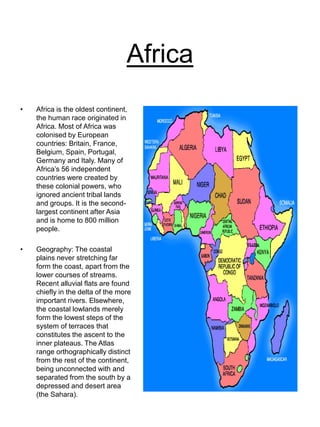
• Africa is the oldest continent,
the human race originated in
Africa. Most of Africa was
colonised by European
countries: Britain, France,
Belgium, Spain, Portugal,
Germany and Italy. Many of
Africa’s 56 independent
countries were created by
these colonial powers, who
ignored ancient tribal lands
and groups. It is the second-
largest continent after Asia
and is home to 800 million
people.
• Geography: The coastal
plains never stretching far
form the coast, apart from the
lower courses of streams.
Recent alluvial flats are found
chiefly in the delta of the more
important rivers. Elsewhere,
the coastal lowlands merely
form the lowest steps of the
system of terraces that
constitutes the ascent to the
inner plateaus. The Atlas
range orthographically distinct
from the rest of the continent,
being unconnected with and
separated from the south by a
depressed and desert area
(the Sahara).
Africa
• Foods: Some of the most distinct foods
are Akara, Chakalaka and Draw soup,
among others.
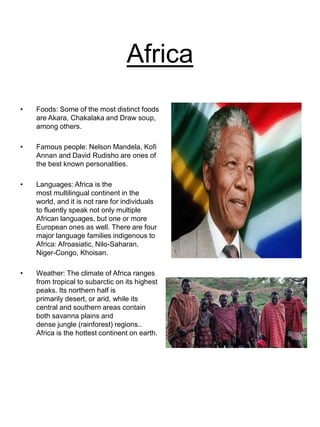
• Famous people: Nelson Mandela, Kofi
Annan and David Rudisho are ones of
the best known personalities.
• Languages: Africa is the
most multilingual continent in the
world, and it is not rare for individuals
to fluently speak not only multiple
African languages, but one or more
European ones as well. There are four
major language families indigenous to
Africa: Afroasiatic, Nilo-Saharan,
Niger-Congo, Khoisan.
• Weather: The climate of Africa ranges
from tropical to subarctic on its highest
peaks. Its northern half is
primarily desert, or arid, while its
central and southern areas contain
both savanna plains and
dense jungle (rainforest) regions..
Africa is the hottest continent on earth.
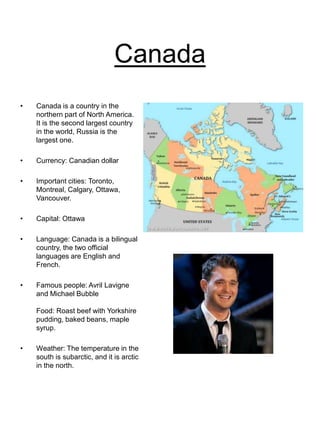
Canada
• Canada is a country in the
northern part of North America.
It is the second largest country
in the world, Russia is the
largest one.
• Currency: Canadian dollar
• Important cities: Toronto,
Montreal, Calgary, Ottawa,
Vancouver.
• Capital: Ottawa
• Language: Canada is a bilingual
country, the two official
languages are English and
French.
• Famous people: Avril Lavigne
and Michael Bubble
Food: Roast beef with Yorkshire
pudding, baked beans, maple
syrup.
• Weather: The temperature in the
south is subarctic, and it is arctic
in the north.
Canada
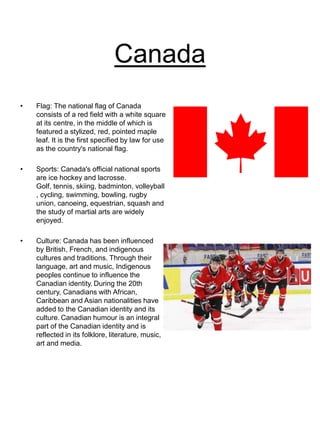
• Flag: The national flag of Canada
consists of a red field with a white square
at its centre, in the middle of which is
featured a stylized, red, pointed maple
leaf. It is the first specified by law for use
as the country's national flag.
• Sports: Canada's official national sports
are ice hockey and lacrosse.
Golf, tennis, skiing, badminton, volleyball
, cycling, swimming, bowling, rugby
union, canoeing, equestrian, squash and
the study of martial arts are widely
enjoyed.
• Culture: Canada has been influenced
by British, French, and indigenous
cultures and traditions. Through their
language, art and music, Indigenous
peoples continue to influence the
Canadian identity. During the 20th
century, Canadians with African,
Caribbean and Asian nationalities have
added to the Canadian identity and its
culture. Canadian humour is an integral
part of the Canadian identity and is
reflected in its folklore, literature, music,
art and media.
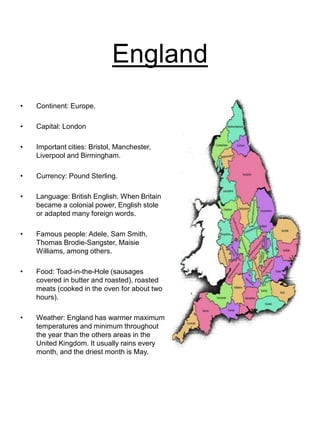
England
• Continent: Europe.
• Capital: London
• Important cities: Bristol, Manchester,
Liverpool and Birmingham.
• Currency: Pound Sterling.
• Language: British English. When Britain
became a colonial power, English stole
or adapted many foreign words.
• Famous people: Adele, Sam Smith,
Thomas Brodie-Sangster, Maisie
Williams, among others.
• Food: Toad-in-the-Hole (sausages
covered in butter and roasted), roasted
meats (cooked in the oven for about two
hours).
• Weather: England has warmer maximum
temperatures and minimum throughout
the year than the others areas in the
United Kingdom. It usually rains every
month, and the driest month is May.
England
• Geography: England is generally lower
and flatter than the rest of the United
Kingdom, but it has two main divisions
in its form. The lowland areas of the
South, East, and Midlands are the
more rugged. East Anglia is the lowest
area of England, having no high hills or
mountains and hosting an area of
Fens, the lower area of England. The
highest area of England is the North
West, which contains England’s
highest hills and mountains, including
its highest: Scafell Pike.
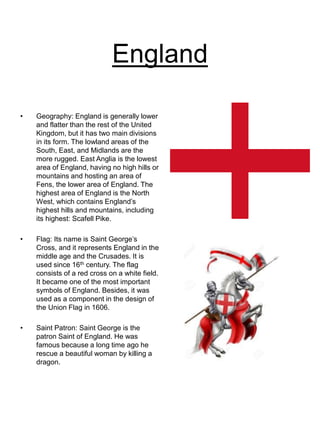
• Flag: Its name is Saint George’s
Cross, and it represents England in the
middle age and the Crusades. It is
used since 16th century. The flag
consists of a red cross on a white field.
It became one of the most important
symbols of England. Besides, it was
used as a component in the design of
the Union Flag in 1606.
• Saint Patron: Saint George is the
patron Saint of England. He was
famous because a long time ago he
rescue a beautiful woman by killing a
dragon.
India
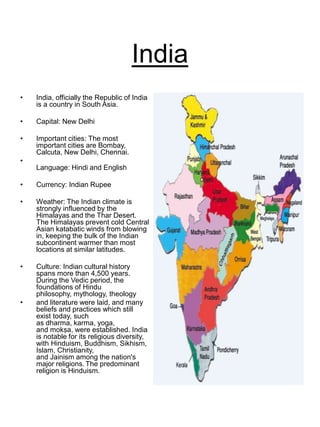
• India, officially the Republic of India
is a country in South Asia.
• Capital: New Delhi
• Important cities: The most
important cities are Bombay,
Calcuta, New Delhi, Chennai.
•
Language: Hindi and English
• Currency: Indian Rupee
• Weather: The Indian climate is
strongly influenced by the
Himalayas and the Thar Desert.
The Himalayas prevent cold Central
Asian katabatic winds from blowing
in, keeping the bulk of the Indian
subcontinent warmer than most
locations at similar latitudes.
• Culture: Indian cultural history
spans more than 4,500 years.
During the Vedic period, the
foundations of Hindu
philosophy, mythology, theology
• and literature were laid, and many
beliefs and practices which still
exist today, such
as dharma, karma, yoga,
and mokṣa, were established. India
is notable for its religious diversity,
with Hinduism, Buddhism, Sikhism,
Islam, Christianity,
and Jainism among the nation's
major religions. The predominant
religion is Hinduism.
India
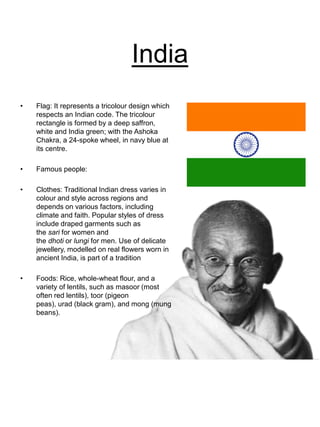
• Flag: It represents a tricolour design which
respects an Indian code. The tricolour
rectangle is formed by a deep saffron,
white and India green; with the Ashoka
Chakra, a 24-spoke wheel, in navy blue at
its centre.
• Famous people:
• Clothes: Traditional Indian dress varies in
colour and style across regions and
depends on various factors, including
climate and faith. Popular styles of dress
include draped garments such as
the sari for women and
the dhoti or lungi for men. Use of delicate
jewellery, modelled on real flowers worn in
ancient India, is part of a tradition
• Foods: Rice, whole-wheat flour, and a
variety of lentils, such as masoor (most
often red lentils), toor (pigeon
peas), urad (black gram), and mong (mung
beans).
Northern Ireland
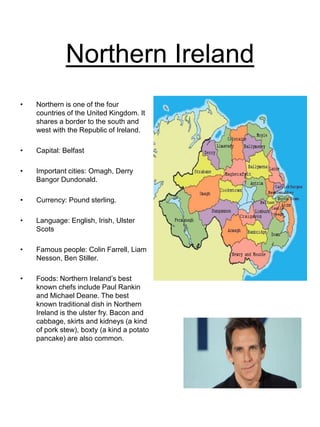
• Northern is one of the four
countries of the United Kingdom. It
shares a border to the south and
west with the Republic of Ireland.
• Capital: Belfast
• Important cities: Omagh, Derry
Bangor Dundonald.
• Currency: Pound sterling.
• Language: English, Irish, Ulster
Scots
• Famous people: Colin Farrell, Liam
Nesson, Ben Stiller.
• Foods: Northern Ireland’s best
known chefs include Paul Rankin
and Michael Deane. The best
known traditional dish in Northern
Ireland is the ulster fry. Bacon and
cabbage, skirts and kidneys (a kind
of pork stew), boxty (a kind a potato
pancake) are also common.
Northern Ireland
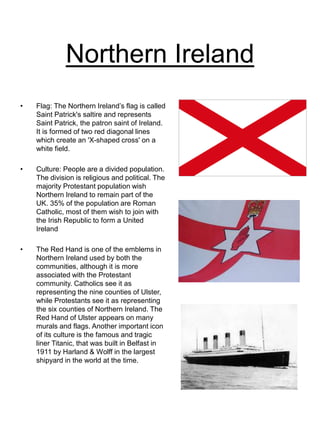
• Flag: The Northern Ireland’s flag is called
Saint Patrick's saltire and represents
Saint Patrick, the patron saint of Ireland.
It is formed of two red diagonal lines
which create an 'X-shaped cross' on a
white field.
• Culture: People are a divided population.
The division is religious and political. The
majority Protestant population wish
Northern Ireland to remain part of the
UK. 35% of the population are Roman
Catholic, most of them wish to join with
the Irish Republic to form a United
Ireland
• The Red Hand is one of the emblems in
Northern Ireland used by both the
communities, although it is more
associated with the Protestant
community. Catholics see it as
representing the nine counties of Ulster,
while Protestants see it as representing
the six counties of Northern Ireland. The
Red Hand of Ulster appears on many
murals and flags. Another important icon
of its culture is the famous and tragic
liner Titanic, that was built in Belfast in
1911 by Harland & Wolff in the largest
shipyard in the world at the time.
Oceania
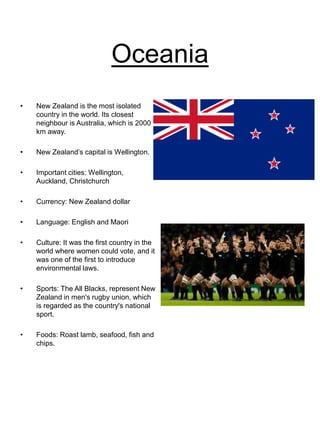
• New Zealand is the most isolated
country in the world. Its closest
neighbour is Australia, which is 2000
km away.
• New Zealand’s capital is Wellington.
• Important cities: Wellington,
Auckland, Christchurch
• Currency: New Zealand dollar
• Language: English and Maori
• Culture: It was the first country in the
world where women could vote, and it
was one of the first to introduce
environmental laws.
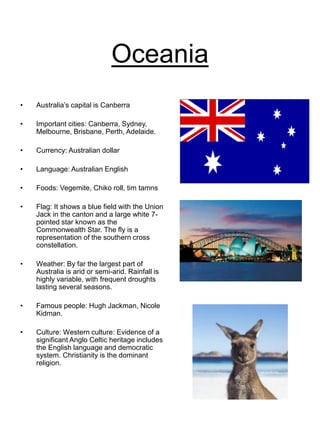
• Sports: The All Blacks, represent New
Zealand in men's rugby union, which
is regarded as the country's national
sport.
• Foods: Roast lamb, seafood, fish and
chips.
Oceania
• Australia’s capital is Canberra
• Important cities: Canberra, Sydney,
Melbourne, Brisbane, Perth, Adelaide.
• Currency: Australian dollar
• Language: Australian English
• Foods: Vegemite, Chiko roll, tim tamns
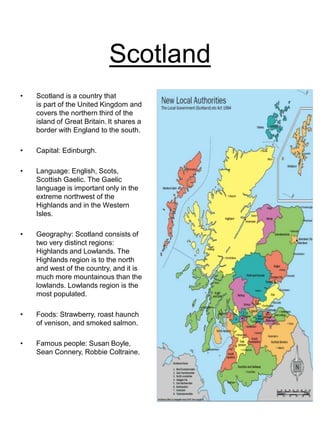
• Flag: It shows a blue field with the Union
Jack in the canton and a large white 7-
pointed star known as the
Commonwealth Star. The fly is a
representation of the southern cross
constellation.
• Weather: By far the largest part of
Australia is arid or semi-arid. Rainfall is
highly variable, with frequent droughts
lasting several seasons.
• Famous people: Hugh Jackman, Nicole
Kidman.
• Culture: Western culture: Evidence of a
significant Anglo Celtic heritage includes
the English language and democratic
system. Christianity is the dominant
religion.
Scotland
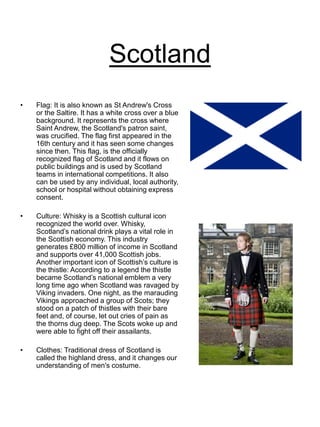
• Scotland is a country that
is part of the United Kingdom and
covers the northern third of the
island of Great Britain. It shares a
border with England to the south.
• Capital: Edinburgh.
• Language: English, Scots,
Scottish Gaelic. The Gaelic
language is important only in the
extreme northwest of the
Highlands and in the Western
Isles.
• Geography: Scotland consists of
two very distinct regions:
Highlands and Lowlands. The
Highlands region is to the north
and west of the country, and it is
much more mountainous than the
lowlands. Lowlands region is the
most populated.
• Foods: Strawberry, roast haunch
of venison, and smoked salmon.
• Famous people: Susan Boyle,
Sean Connery, Robbie Coltraine.
Scotland
• Flag: It is also known as St Andrew's Cross
or the Saltire. It has a white cross over a blue
background. It represents the cross where
Saint Andrew, the Scotland's patron saint,
was crucified. The flag first appeared in the
16th century and it has seen some changes
since then. This flag, is the officially
recognized flag of Scotland and it flows on
public buildings and is used by Scotland
teams in international competitions. It also
can be used by any individual, local authority,
school or hospital without obtaining express
consent.
• Culture: Whisky is a Scottish cultural icon
recognized the world over. Whisky,
Scotland’s national drink plays a vital role in
the Scottish economy. This industry
generates £800 million of income in Scotland
and supports over 41,000 Scottish jobs.
Another important icon of Scottish’s culture is
the thistle: According to a legend the thistle
became Scotland’s national emblem a very
long time ago when Scotland was ravaged by
Viking invaders. One night, as the marauding
Vikings approached a group of Scots; they
stood on a patch of thistles with their bare
feet and, of course, let out cries of pain as
the thorns dug deep. The Scots woke up and
were able to fight off their assailants.
• Clothes: Traditional dress of Scotland is
called the highland dress, and it changes our
understanding of men's costume.
The West Indies
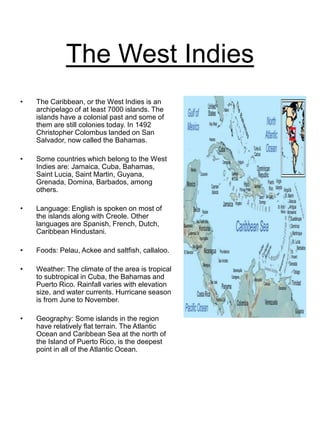
• The Caribbean, or the West Indies is an
archipelago of at least 7000 islands. The
islands have a colonial past and some of
them are still colonies today. In 1492
Christopher Colombus landed on San
Salvador, now called the Bahamas.
• Some countries which belong to the West
Indies are: Jamaica, Cuba, Bahamas,
Saint Lucia, Saint Martin, Guyana,
Grenada, Domina, Barbados, among
others.
• Language: English is spoken on most of
the islands along with Creole. Other
languages are Spanish, French, Dutch,
Caribbean Hindustani.
• Foods: Pelau, Ackee and saltfish, callaloo.
• Weather: The climate of the area is tropical
to subtropical in Cuba, the Bahamas and
Puerto Rico. Rainfall varies with elevation
size, and water currents. Hurricane season
is from June to November.
• Geography: Some islands in the region
have relatively flat terrain. The Atlantic
Ocean and Caribbean Sea at the north of
the Island of Puerto Rico, is the deepest
point in all of the Atlantic Ocean.
The West Indies
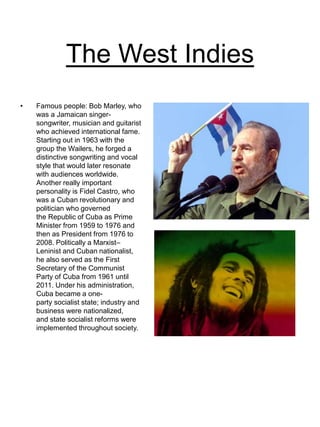
• Famous people: Bob Marley, who
was a Jamaican singer-
songwriter, musician and guitarist
who achieved international fame.
Starting out in 1963 with the
group the Wailers, he forged a
distinctive songwriting and vocal
style that would later resonate
with audiences worldwide.
Another really important
personality is Fidel Castro, who
was a Cuban revolutionary and
politician who governed
the Republic of Cuba as Prime
Minister from 1959 to 1976 and
then as President from 1976 to
2008. Politically a Marxist–
Leninist and Cuban nationalist,
he also served as the First
Secretary of the Communist
Party of Cuba from 1961 until
2011. Under his administration,
Cuba became a one-
party socialist state; industry and
business were nationalized,
and state socialist reforms were
implemented throughout society.
United Kingdom
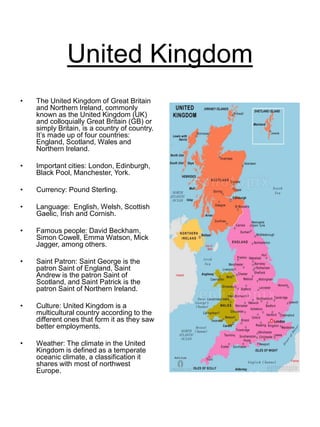
• The United Kingdom of Great Britain
and Northern Ireland, commonly
known as the United Kingdom (UK)
and colloquially Great Britain (GB) or
simply Britain, is a country of country.
It’s made up of four countries:
England, Scotland, Wales and
Northern Ireland.
• Important cities: London, Edinburgh,
Black Pool, Manchester, York.
• Currency: Pound Sterling.
• Language: English, Welsh, Scottish
Gaelic, Irish and Cornish.
• Famous people: David Beckham,
Simon Cowell, Emma Watson, Mick
Jagger, among others.
• Saint Patron: Saint George is the
patron Saint of England, Saint
Andrew is the patron Saint of
Scotland, and Saint Patrick is the
patron Saint of Northern Ireland.
• Culture: United Kingdom is a
multicultural country according to the
different ones that form it as they saw
better employments.
• Weather: The climate in the United
Kingdom is defined as a temperate
oceanic climate, a classification it
shares with most of northwest
Europe.
United Kingdom
• Religion: Although a majority of
citizens still identify with Christianity,
immigration and demographic change
have contributed to the growth of other
faiths, most notably Islam, that’s why
UK is a multi-faith country of countries.
• Sports: Football, tennis, rugby, golf,
boxing, netball and cricket.
• History: A single Kingdom of Great
Britain resulted from the Union of
Scotland and England (which already
comprised the present-day countries of
England and Wales) in 1707. More
than a hundred years before, in 1603,
King James VI, King of Scots, had
inherited the throne of England, but it
was not until 1707 that the Parliaments
of the two countries agreed to form a
unified state. In 1801, Great Britain
united with the neighbouring Kingdom
of Ireland, forming the United Kingdom
of Great Britain and Ireland, which was
renamed The United Kingdom of Great
Britain and Northern Ireland after the
Irish Free State seceded in 1922.
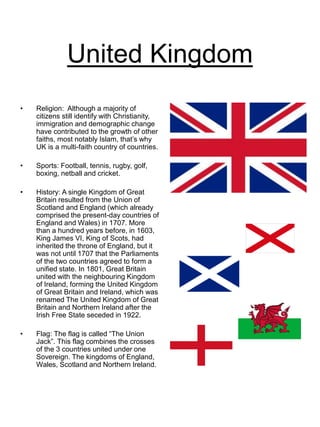
• Flag: The flag is called “The Union
Jack”. This flag combines the crosses
of the 3 countries united under one
Sovereign. The kingdoms of England,
Wales, Scotland and Northern Ireland.
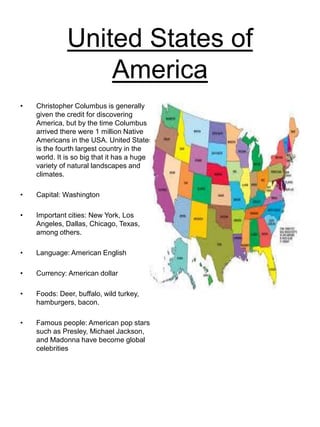
United States of
America
• Christopher Columbus is generally
given the credit for discovering
America, but by the time Columbus
arrived there were 1 million Native
Americans in the USA. United States
is the fourth largest country in the
world. It is so big that it has a huge
variety of natural landscapes and
climates.
• Capital: Washington
• Important cities: New York, Los
Angeles, Dallas, Chicago, Texas,
among others.
• Language: American English
• Currency: American dollar
• Foods: Deer, buffalo, wild turkey,
hamburgers, bacon.
• Famous people: American pop stars
such as Presley, Michael Jackson,
and Madonna have become global
celebrities
United States of
America
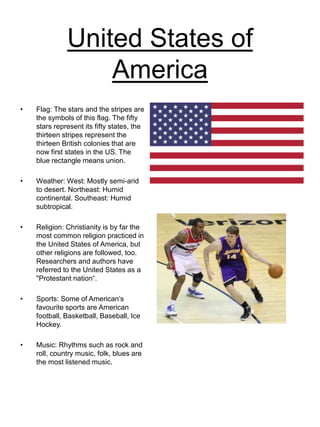
• Flag: The stars and the stripes are
the symbols of this flag. The fifty
stars represent its fifty states, the
thirteen stripes represent the
thirteen British colonies that are
now first states in the US. The
blue rectangle means union.
• Weather: West: Mostly semi-arid
to desert. Northeast: Humid
continental. Southeast: Humid
subtropical.
• Religion: Christianity is by far the
most common religion practiced in
the United States of America, but
other religions are followed, too.
Researchers and authors have
referred to the United States as a
"Protestant nation“.
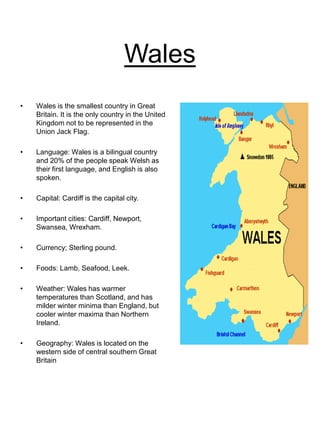
• Sports: Some of American’s
favourite sports are American
football, Basketball, Baseball, Ice
Hockey.
• Music: Rhythms such as rock and
roll, country music, folk, blues are
the most listened music.
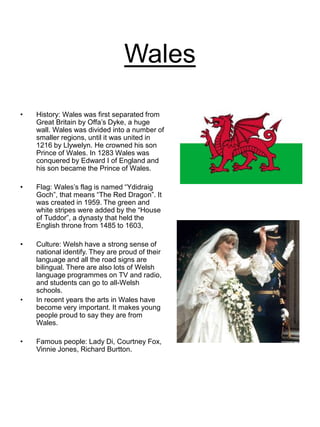
Wales
• Wales is the smallest country in Great
Britain. It is the only country in the United
Kingdom not to be represented in the
Union Jack Flag.
• Language: Wales is a bilingual country
and 20% of the people speak Welsh as
their first language, and English is also
spoken.
• Capital: Cardiff is the capital city.
• Important cities: Cardiff, Newport,
Swansea, Wrexham.
• Currency; Sterling pound.
• Foods: Lamb, Seafood, Leek.
• Weather: Wales has warmer
temperatures than Scotland, and has
milder winter minima than England, but
cooler winter maxima than Northern
Ireland.
• Geography: Wales is located on the
western side of central southern Great
Britain
Wales
• History: Wales was first separated from
Great Britain by Offa’s Dyke, a huge
wall. Wales was divided into a number of
smaller regions, until it was united in
1216 by Llywelyn. He crowned his son
Prince of Wales. In 1283 Wales was
conquered by Edward I of England and
his son became the Prince of Wales.
• Flag: Wales’s flag is named “Ydidraig
Goch”, that means “The Red Dragon”. It
was created in 1959. The green and
white stripes were added by the “House
of Tuddor”, a dynasty that held the
English throne from 1485 to 1603,
• Culture: Welsh have a strong sense of
national identify. They are proud of their
language and all the road signs are
bilingual. There are also lots of Welsh
language programmes on TV and radio,
and students can go to all-Welsh
schools.
• In recent years the arts in Wales have
become very important. It makes young
people proud to say they are from
Wales.
• Famous people: Lady Di, Courtney Fox,
Vinnie Jones, Richard Burtton.

Real world

  • 1.
    ISFD N°41 “Language andCulture 1” Longhi, Vanesa Rapanelli, Romina Group #11 (1°1°) 2017
  • 2.
    Index • Africa ………………………………………………………….Page 1 • Canada ………………………………………………………. Page 3 • England …………………………………………………….... Page 5 • India ………………………………………………………….. Page 7 • Northern Ireland …………………………………………….. Page 9 • Ocenia ……………………………………………………….. Page 11 • Scotland ……………………………………………………… Page 13 • The West Indies …………………………………………….. Page 15 • United Kingdom …………………………………………….. Page 17 • United States of America ………………………………….. Page 19 • Wales ………………………………………………………… Page 21
  • 3.
    Africa • Africa isthe oldest continent, the human race originated in Africa. Most of Africa was colonised by European countries: Britain, France, Belgium, Spain, Portugal, Germany and Italy. Many of Africa’s 56 independent countries were created by these colonial powers, who ignored ancient tribal lands and groups. It is the second- largest continent after Asia and is home to 800 million people. • Geography: The coastal plains never stretching far form the coast, apart from the lower courses of streams. Recent alluvial flats are found chiefly in the delta of the more important rivers. Elsewhere, the coastal lowlands merely form the lowest steps of the system of terraces that constitutes the ascent to the inner plateaus. The Atlas range orthographically distinct from the rest of the continent, being unconnected with and separated from the south by a depressed and desert area (the Sahara).
  • 4.
    Africa • Foods: Someof the most distinct foods are Akara, Chakalaka and Draw soup, among others. • Famous people: Nelson Mandela, Kofi Annan and David Rudisho are ones of the best known personalities. • Languages: Africa is the most multilingual continent in the world, and it is not rare for individuals to fluently speak not only multiple African languages, but one or more European ones as well. There are four major language families indigenous to Africa: Afroasiatic, Nilo-Saharan, Niger-Congo, Khoisan. • Weather: The climate of Africa ranges from tropical to subarctic on its highest peaks. Its northern half is primarily desert, or arid, while its central and southern areas contain both savanna plains and dense jungle (rainforest) regions.. Africa is the hottest continent on earth.
  • 5.
    Canada • Canada isa country in the northern part of North America. It is the second largest country in the world, Russia is the largest one. • Currency: Canadian dollar • Important cities: Toronto, Montreal, Calgary, Ottawa, Vancouver. • Capital: Ottawa • Language: Canada is a bilingual country, the two official languages are English and French. • Famous people: Avril Lavigne and Michael Bubble Food: Roast beef with Yorkshire pudding, baked beans, maple syrup. • Weather: The temperature in the south is subarctic, and it is arctic in the north.
  • 6.
    Canada • Flag: Thenational flag of Canada consists of a red field with a white square at its centre, in the middle of which is featured a stylized, red, pointed maple leaf. It is the first specified by law for use as the country's national flag. • Sports: Canada's official national sports are ice hockey and lacrosse. Golf, tennis, skiing, badminton, volleyball , cycling, swimming, bowling, rugby union, canoeing, equestrian, squash and the study of martial arts are widely enjoyed. • Culture: Canada has been influenced by British, French, and indigenous cultures and traditions. Through their language, art and music, Indigenous peoples continue to influence the Canadian identity. During the 20th century, Canadians with African, Caribbean and Asian nationalities have added to the Canadian identity and its culture. Canadian humour is an integral part of the Canadian identity and is reflected in its folklore, literature, music, art and media.
  • 7.
    England • Continent: Europe. •Capital: London • Important cities: Bristol, Manchester, Liverpool and Birmingham. • Currency: Pound Sterling. • Language: British English. When Britain became a colonial power, English stole or adapted many foreign words. • Famous people: Adele, Sam Smith, Thomas Brodie-Sangster, Maisie Williams, among others. • Food: Toad-in-the-Hole (sausages covered in butter and roasted), roasted meats (cooked in the oven for about two hours). • Weather: England has warmer maximum temperatures and minimum throughout the year than the others areas in the United Kingdom. It usually rains every month, and the driest month is May.
  • 8.
    England • Geography: Englandis generally lower and flatter than the rest of the United Kingdom, but it has two main divisions in its form. The lowland areas of the South, East, and Midlands are the more rugged. East Anglia is the lowest area of England, having no high hills or mountains and hosting an area of Fens, the lower area of England. The highest area of England is the North West, which contains England’s highest hills and mountains, including its highest: Scafell Pike. • Flag: Its name is Saint George’s Cross, and it represents England in the middle age and the Crusades. It is used since 16th century. The flag consists of a red cross on a white field. It became one of the most important symbols of England. Besides, it was used as a component in the design of the Union Flag in 1606. • Saint Patron: Saint George is the patron Saint of England. He was famous because a long time ago he rescue a beautiful woman by killing a dragon.
  • 9.
    India • India, officiallythe Republic of India is a country in South Asia. • Capital: New Delhi • Important cities: The most important cities are Bombay, Calcuta, New Delhi, Chennai. • Language: Hindi and English • Currency: Indian Rupee • Weather: The Indian climate is strongly influenced by the Himalayas and the Thar Desert. The Himalayas prevent cold Central Asian katabatic winds from blowing in, keeping the bulk of the Indian subcontinent warmer than most locations at similar latitudes. • Culture: Indian cultural history spans more than 4,500 years. During the Vedic period, the foundations of Hindu philosophy, mythology, theology • and literature were laid, and many beliefs and practices which still exist today, such as dharma, karma, yoga, and mokṣa, were established. India is notable for its religious diversity, with Hinduism, Buddhism, Sikhism, Islam, Christianity, and Jainism among the nation's major religions. The predominant religion is Hinduism.
  • 10.
    India • Flag: Itrepresents a tricolour design which respects an Indian code. The tricolour rectangle is formed by a deep saffron, white and India green; with the Ashoka Chakra, a 24-spoke wheel, in navy blue at its centre. • Famous people: • Clothes: Traditional Indian dress varies in colour and style across regions and depends on various factors, including climate and faith. Popular styles of dress include draped garments such as the sari for women and the dhoti or lungi for men. Use of delicate jewellery, modelled on real flowers worn in ancient India, is part of a tradition • Foods: Rice, whole-wheat flour, and a variety of lentils, such as masoor (most often red lentils), toor (pigeon peas), urad (black gram), and mong (mung beans).
  • 11.
    Northern Ireland • Northernis one of the four countries of the United Kingdom. It shares a border to the south and west with the Republic of Ireland. • Capital: Belfast • Important cities: Omagh, Derry Bangor Dundonald. • Currency: Pound sterling. • Language: English, Irish, Ulster Scots • Famous people: Colin Farrell, Liam Nesson, Ben Stiller. • Foods: Northern Ireland’s best known chefs include Paul Rankin and Michael Deane. The best known traditional dish in Northern Ireland is the ulster fry. Bacon and cabbage, skirts and kidneys (a kind of pork stew), boxty (a kind a potato pancake) are also common.
  • 12.
    Northern Ireland • Flag:The Northern Ireland’s flag is called Saint Patrick's saltire and represents Saint Patrick, the patron saint of Ireland. It is formed of two red diagonal lines which create an 'X-shaped cross' on a white field. • Culture: People are a divided population. The division is religious and political. The majority Protestant population wish Northern Ireland to remain part of the UK. 35% of the population are Roman Catholic, most of them wish to join with the Irish Republic to form a United Ireland • The Red Hand is one of the emblems in Northern Ireland used by both the communities, although it is more associated with the Protestant community. Catholics see it as representing the nine counties of Ulster, while Protestants see it as representing the six counties of Northern Ireland. The Red Hand of Ulster appears on many murals and flags. Another important icon of its culture is the famous and tragic liner Titanic, that was built in Belfast in 1911 by Harland & Wolff in the largest shipyard in the world at the time.
  • 13.
    Oceania • New Zealandis the most isolated country in the world. Its closest neighbour is Australia, which is 2000 km away. • New Zealand’s capital is Wellington. • Important cities: Wellington, Auckland, Christchurch • Currency: New Zealand dollar • Language: English and Maori • Culture: It was the first country in the world where women could vote, and it was one of the first to introduce environmental laws. • Sports: The All Blacks, represent New Zealand in men's rugby union, which is regarded as the country's national sport. • Foods: Roast lamb, seafood, fish and chips.
  • 14.
    Oceania • Australia’s capitalis Canberra • Important cities: Canberra, Sydney, Melbourne, Brisbane, Perth, Adelaide. • Currency: Australian dollar • Language: Australian English • Foods: Vegemite, Chiko roll, tim tamns • Flag: It shows a blue field with the Union Jack in the canton and a large white 7- pointed star known as the Commonwealth Star. The fly is a representation of the southern cross constellation. • Weather: By far the largest part of Australia is arid or semi-arid. Rainfall is highly variable, with frequent droughts lasting several seasons. • Famous people: Hugh Jackman, Nicole Kidman. • Culture: Western culture: Evidence of a significant Anglo Celtic heritage includes the English language and democratic system. Christianity is the dominant religion.
  • 15.
    Scotland • Scotland isa country that is part of the United Kingdom and covers the northern third of the island of Great Britain. It shares a border with England to the south. • Capital: Edinburgh. • Language: English, Scots, Scottish Gaelic. The Gaelic language is important only in the extreme northwest of the Highlands and in the Western Isles. • Geography: Scotland consists of two very distinct regions: Highlands and Lowlands. The Highlands region is to the north and west of the country, and it is much more mountainous than the lowlands. Lowlands region is the most populated. • Foods: Strawberry, roast haunch of venison, and smoked salmon. • Famous people: Susan Boyle, Sean Connery, Robbie Coltraine.
  • 16.
    Scotland • Flag: Itis also known as St Andrew's Cross or the Saltire. It has a white cross over a blue background. It represents the cross where Saint Andrew, the Scotland's patron saint, was crucified. The flag first appeared in the 16th century and it has seen some changes since then. This flag, is the officially recognized flag of Scotland and it flows on public buildings and is used by Scotland teams in international competitions. It also can be used by any individual, local authority, school or hospital without obtaining express consent. • Culture: Whisky is a Scottish cultural icon recognized the world over. Whisky, Scotland’s national drink plays a vital role in the Scottish economy. This industry generates £800 million of income in Scotland and supports over 41,000 Scottish jobs. Another important icon of Scottish’s culture is the thistle: According to a legend the thistle became Scotland’s national emblem a very long time ago when Scotland was ravaged by Viking invaders. One night, as the marauding Vikings approached a group of Scots; they stood on a patch of thistles with their bare feet and, of course, let out cries of pain as the thorns dug deep. The Scots woke up and were able to fight off their assailants. • Clothes: Traditional dress of Scotland is called the highland dress, and it changes our understanding of men's costume.
  • 17.
    The West Indies •The Caribbean, or the West Indies is an archipelago of at least 7000 islands. The islands have a colonial past and some of them are still colonies today. In 1492 Christopher Colombus landed on San Salvador, now called the Bahamas. • Some countries which belong to the West Indies are: Jamaica, Cuba, Bahamas, Saint Lucia, Saint Martin, Guyana, Grenada, Domina, Barbados, among others. • Language: English is spoken on most of the islands along with Creole. Other languages are Spanish, French, Dutch, Caribbean Hindustani. • Foods: Pelau, Ackee and saltfish, callaloo. • Weather: The climate of the area is tropical to subtropical in Cuba, the Bahamas and Puerto Rico. Rainfall varies with elevation size, and water currents. Hurricane season is from June to November. • Geography: Some islands in the region have relatively flat terrain. The Atlantic Ocean and Caribbean Sea at the north of the Island of Puerto Rico, is the deepest point in all of the Atlantic Ocean.
  • 18.
    The West Indies •Famous people: Bob Marley, who was a Jamaican singer- songwriter, musician and guitarist who achieved international fame. Starting out in 1963 with the group the Wailers, he forged a distinctive songwriting and vocal style that would later resonate with audiences worldwide. Another really important personality is Fidel Castro, who was a Cuban revolutionary and politician who governed the Republic of Cuba as Prime Minister from 1959 to 1976 and then as President from 1976 to 2008. Politically a Marxist– Leninist and Cuban nationalist, he also served as the First Secretary of the Communist Party of Cuba from 1961 until 2011. Under his administration, Cuba became a one- party socialist state; industry and business were nationalized, and state socialist reforms were implemented throughout society.
  • 19.
    United Kingdom • TheUnited Kingdom of Great Britain and Northern Ireland, commonly known as the United Kingdom (UK) and colloquially Great Britain (GB) or simply Britain, is a country of country. It’s made up of four countries: England, Scotland, Wales and Northern Ireland. • Important cities: London, Edinburgh, Black Pool, Manchester, York. • Currency: Pound Sterling. • Language: English, Welsh, Scottish Gaelic, Irish and Cornish. • Famous people: David Beckham, Simon Cowell, Emma Watson, Mick Jagger, among others. • Saint Patron: Saint George is the patron Saint of England, Saint Andrew is the patron Saint of Scotland, and Saint Patrick is the patron Saint of Northern Ireland. • Culture: United Kingdom is a multicultural country according to the different ones that form it as they saw better employments. • Weather: The climate in the United Kingdom is defined as a temperate oceanic climate, a classification it shares with most of northwest Europe.
  • 20.
    United Kingdom • Religion:Although a majority of citizens still identify with Christianity, immigration and demographic change have contributed to the growth of other faiths, most notably Islam, that’s why UK is a multi-faith country of countries. • Sports: Football, tennis, rugby, golf, boxing, netball and cricket. • History: A single Kingdom of Great Britain resulted from the Union of Scotland and England (which already comprised the present-day countries of England and Wales) in 1707. More than a hundred years before, in 1603, King James VI, King of Scots, had inherited the throne of England, but it was not until 1707 that the Parliaments of the two countries agreed to form a unified state. In 1801, Great Britain united with the neighbouring Kingdom of Ireland, forming the United Kingdom of Great Britain and Ireland, which was renamed The United Kingdom of Great Britain and Northern Ireland after the Irish Free State seceded in 1922. • Flag: The flag is called “The Union Jack”. This flag combines the crosses of the 3 countries united under one Sovereign. The kingdoms of England, Wales, Scotland and Northern Ireland.
  • 21.
    United States of America •Christopher Columbus is generally given the credit for discovering America, but by the time Columbus arrived there were 1 million Native Americans in the USA. United States is the fourth largest country in the world. It is so big that it has a huge variety of natural landscapes and climates. • Capital: Washington • Important cities: New York, Los Angeles, Dallas, Chicago, Texas, among others. • Language: American English • Currency: American dollar • Foods: Deer, buffalo, wild turkey, hamburgers, bacon. • Famous people: American pop stars such as Presley, Michael Jackson, and Madonna have become global celebrities
  • 22.
    United States of America •Flag: The stars and the stripes are the symbols of this flag. The fifty stars represent its fifty states, the thirteen stripes represent the thirteen British colonies that are now first states in the US. The blue rectangle means union. • Weather: West: Mostly semi-arid to desert. Northeast: Humid continental. Southeast: Humid subtropical. • Religion: Christianity is by far the most common religion practiced in the United States of America, but other religions are followed, too. Researchers and authors have referred to the United States as a "Protestant nation“. • Sports: Some of American’s favourite sports are American football, Basketball, Baseball, Ice Hockey. • Music: Rhythms such as rock and roll, country music, folk, blues are the most listened music.
  • 23.
    Wales • Wales isthe smallest country in Great Britain. It is the only country in the United Kingdom not to be represented in the Union Jack Flag. • Language: Wales is a bilingual country and 20% of the people speak Welsh as their first language, and English is also spoken. • Capital: Cardiff is the capital city. • Important cities: Cardiff, Newport, Swansea, Wrexham. • Currency; Sterling pound. • Foods: Lamb, Seafood, Leek. • Weather: Wales has warmer temperatures than Scotland, and has milder winter minima than England, but cooler winter maxima than Northern Ireland. • Geography: Wales is located on the western side of central southern Great Britain
  • 24.
    Wales • History: Waleswas first separated from Great Britain by Offa’s Dyke, a huge wall. Wales was divided into a number of smaller regions, until it was united in 1216 by Llywelyn. He crowned his son Prince of Wales. In 1283 Wales was conquered by Edward I of England and his son became the Prince of Wales. • Flag: Wales’s flag is named “Ydidraig Goch”, that means “The Red Dragon”. It was created in 1959. The green and white stripes were added by the “House of Tuddor”, a dynasty that held the English throne from 1485 to 1603, • Culture: Welsh have a strong sense of national identify. They are proud of their language and all the road signs are bilingual. There are also lots of Welsh language programmes on TV and radio, and students can go to all-Welsh schools. • In recent years the arts in Wales have become very important. It makes young people proud to say they are from Wales. • Famous people: Lady Di, Courtney Fox, Vinnie Jones, Richard Burtton.