Balancing your young adult LGBTQ+ 
collection 
Megan England 
Teen Services Coordinator, Atlantic City Free Public Library
 The goal: to give selectors of YA materials 
different lenses through which they can 
view queer young adult literature when 
reading reviews and cover copy for 
selection. 
 Subject heading searches will fail you when 
searching for queer literature and 
nonfiction. Major work is needed in the 
fields of cataloging and metadata to make 
our catalogs and vendor classification 
systems more LGBTQ+ friendly.
 LGBTQ+: Lesbian, Gay, Bisexual, 
Transgender, Queer/Questioning, 
Intersex, Pansexual, Asexual, & other 
marginalized identities relating to 
romantic/sexual orientation or gender 
identity and expression. 
 Transgender: biological sex assigned at 
birth does not match self-identified 
gender (vs. cisgender)
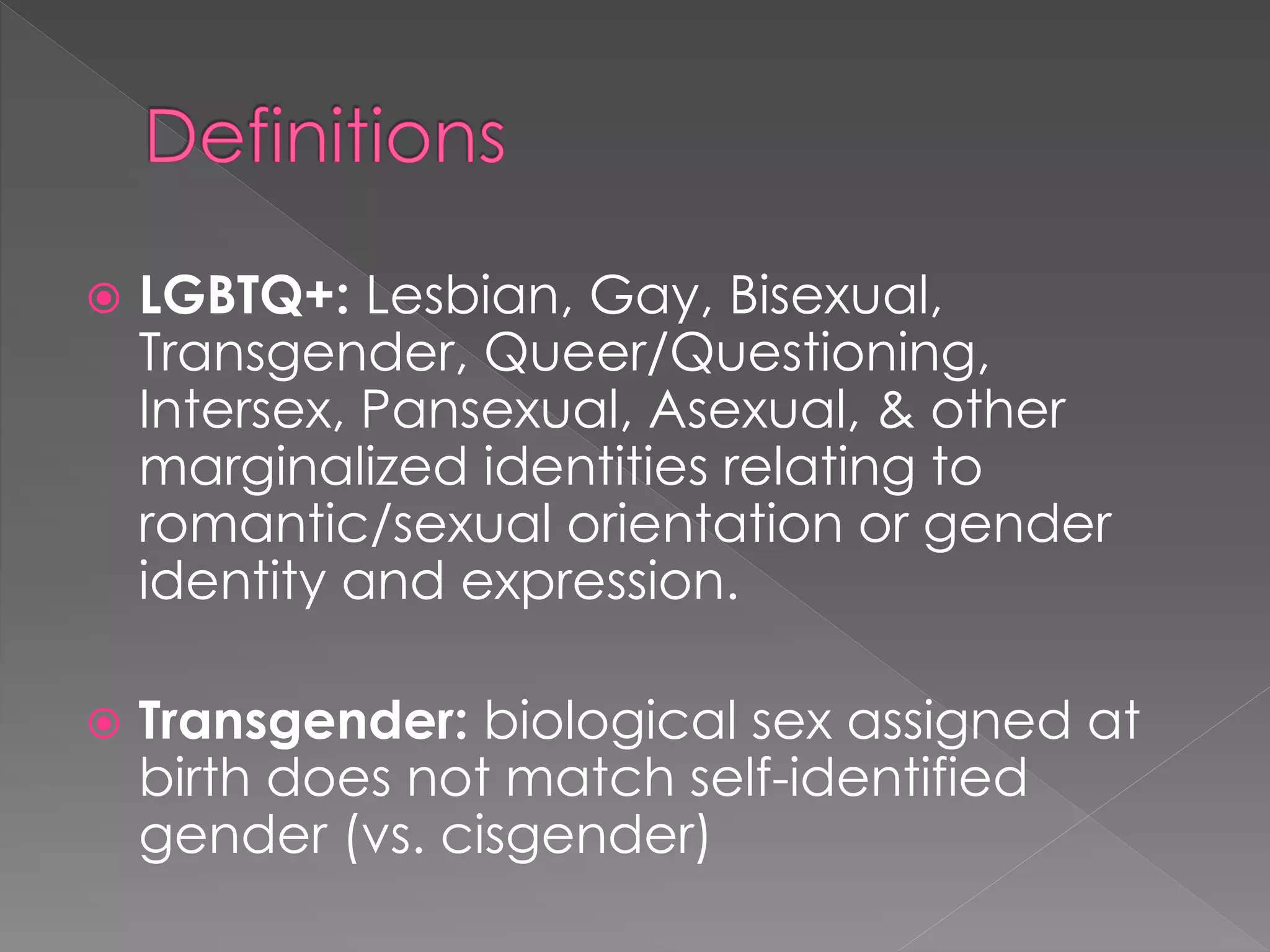
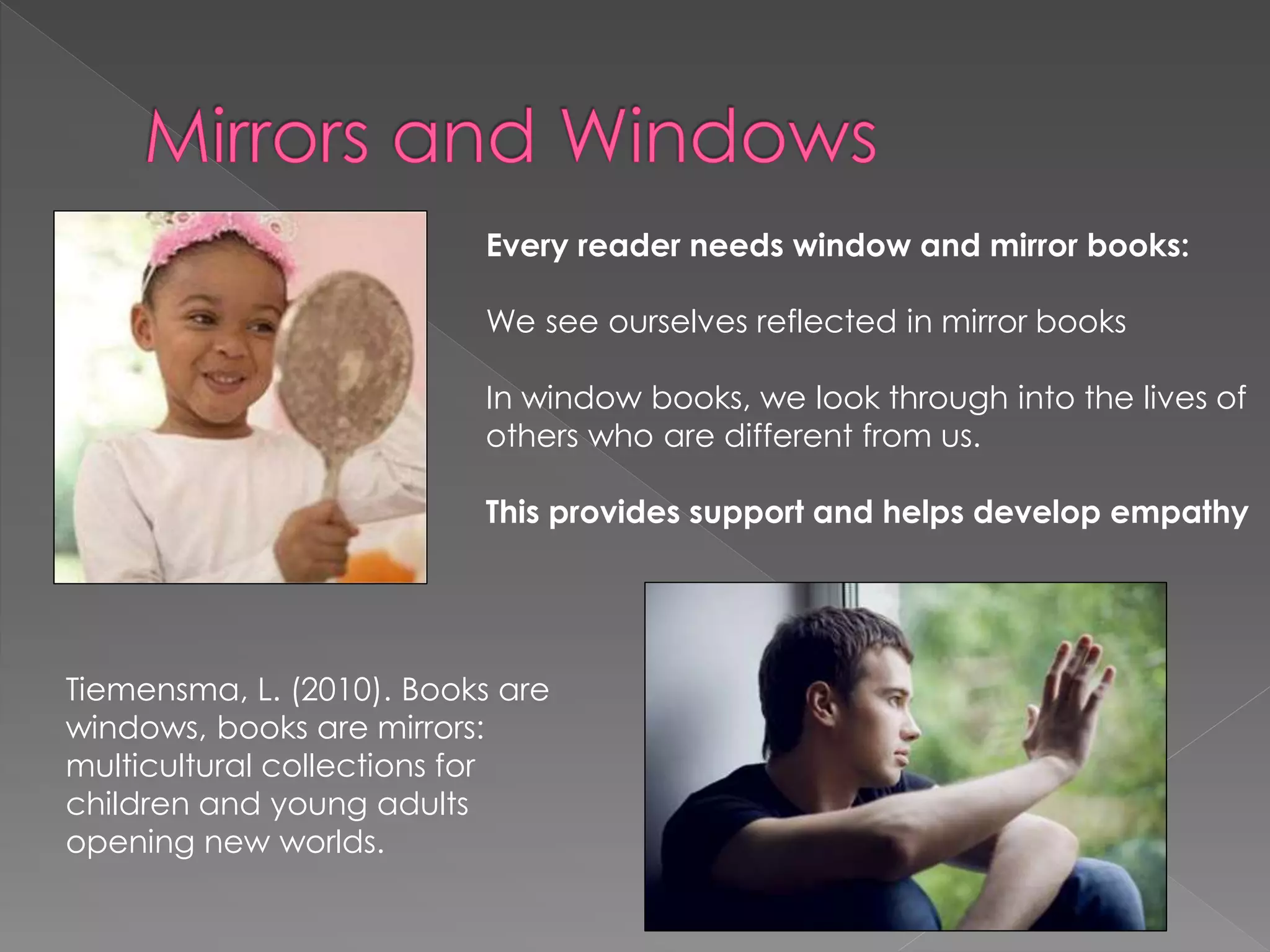
Every reader needs window and mirror books: 
We see ourselves reflected in mirror books 
In window books, we look through into the lives of 
others who are different from us. 
This provides support and helps develop empathy 
Tiemensma, L. (2010). Books are 
windows, books are mirrors: 
multicultural collections for 
children and young adults 
opening new worlds.
Malindalo.com 
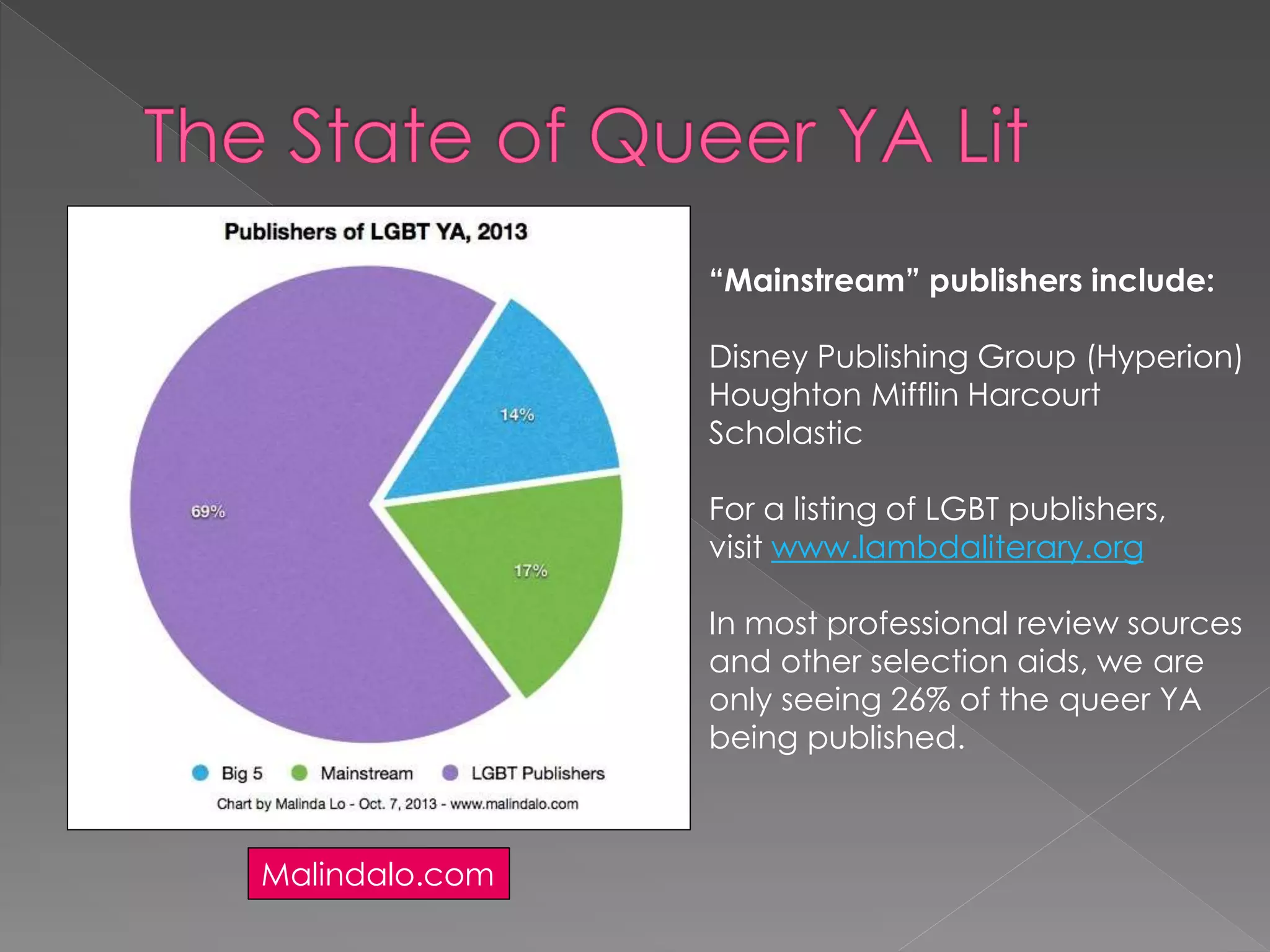
“Mainstream” publishers include: 
Disney Publishing Group (Hyperion) 
Houghton Mifflin Harcourt 
Scholastic 
For a listing of LGBT publishers, 
visit www.lambdaliterary.org 
In most professional review sources 
and other selection aids, we are 
only seeing 26% of the queer YA 
being published.
Malindalo.com 
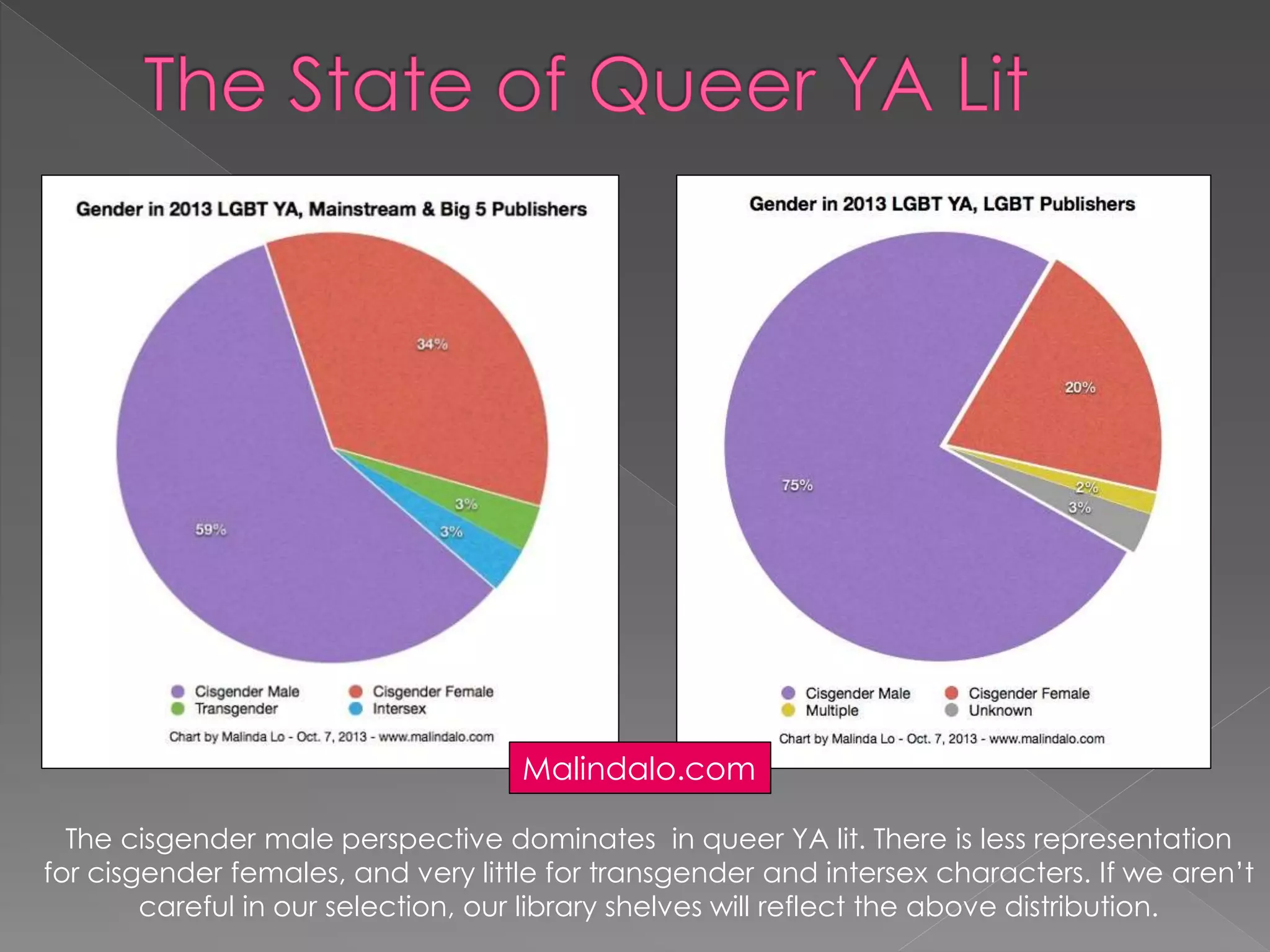
The cisgender male perspective dominates in queer YA lit. There is less representation 
for cisgender females, and very little for transgender and intersex characters. If we aren’t 
careful in our selection, our library shelves will reflect the above distribution.
 Gay and Lesbian 
› The easiest identities to find represented. Cisgender gay males 
still dominate both publishing and marketing, though, so be 
aware and purchase accordingly. 
 Bisexual and Pansexual Girls AND Guys 
› Bisexual and pansexuals are poorly represented in all media as 
greedy, selfish, slutty, confused, actually gay, actually straight, 
etc. Bisexual and pansexual are their own legitimate identities 
with very little fiction published to support them, especially for bi 
or pan males. Can be very difficult to find through reviews/copy. 
 Transgender 
› Male to Female transition stories have historically dominated 
› Female to Male stories are being published more and more. 
 Hard to Find Identities 
› Intersex 
› Asexual 
› Genderqueer 
› These identities rarely see any books published. Purchase them 
when you see them.
 Queer Secondary Characters (Outside looking in) 
› Important for developing empathy and 
displaying the true diversity of our world. 
 Queer Main Characters (Inside looking out) 
› Where real representation comes in. 
Almost Perfect by Brian Katcher or 
Luna by Julie Ann Peters 
vs. 
Beautiful Music for Ugly Children by Kirstin Cronn-Mills 
or 
Gracefully Grayson by Ami Polonski
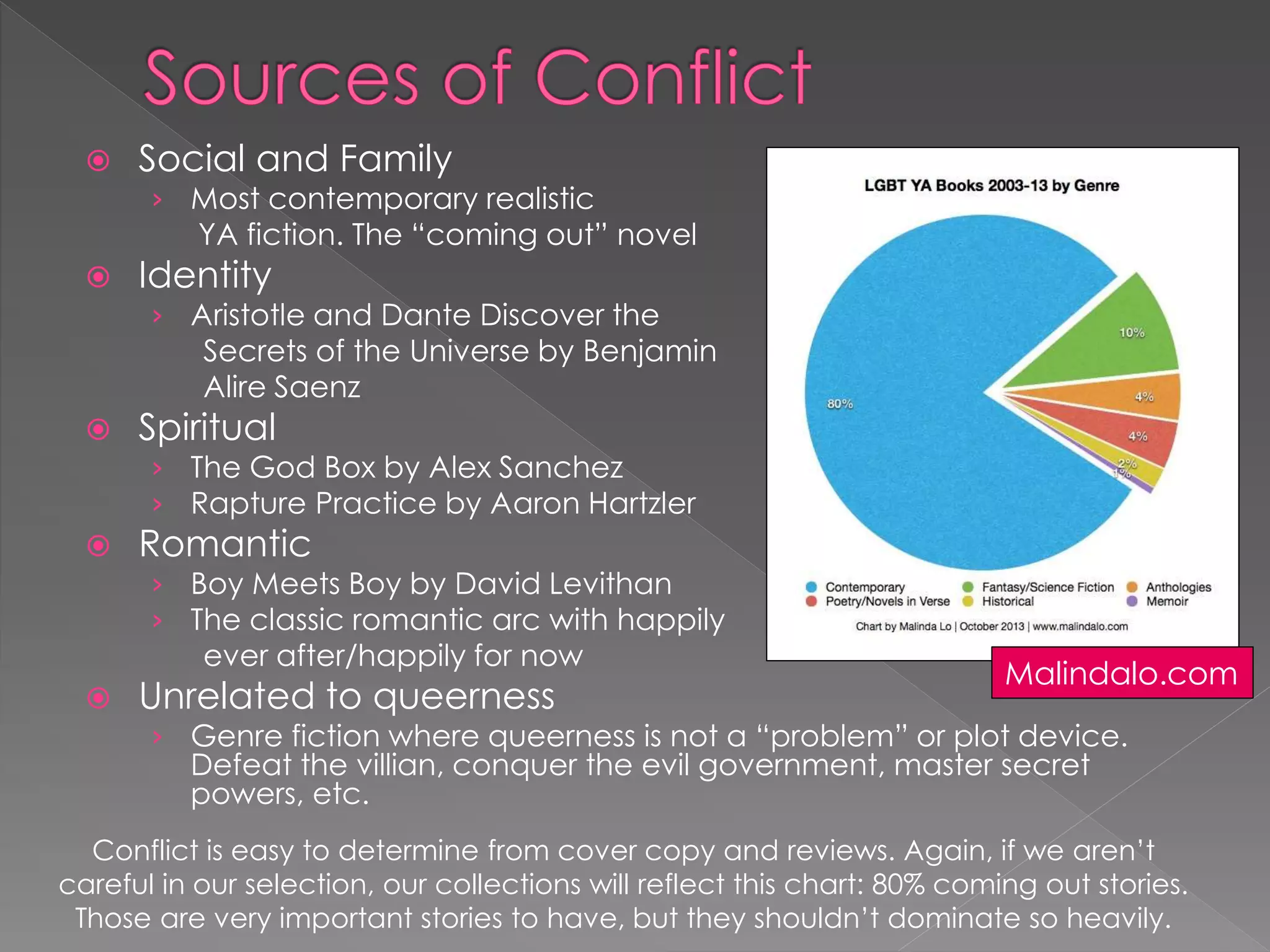
 Social and Family 
› Most contemporary realistic 
YA fiction. The “coming out” novel 
 Identity 
› Aristotle and Dante Discover the 
Secrets of the Universe by Benjamin 
Alire Saenz 
 Spiritual 
› The God Box by Alex Sanchez 
› Rapture Practice by Aaron Hartzler 
 Romantic 
› Boy Meets Boy by David Levithan 
› The classic romantic arc with happily 
ever after/happily for now 
 Unrelated to queerness 
Malindalo.com 
› Genre fiction where queerness is not a “problem” or plot device. 
Defeat the villian, conquer the evil government, master secret 
powers, etc. 
Conflict is easy to determine from cover copy and reviews. Again, if we aren’t 
careful in our selection, our collections will reflect this chart: 80% coming out stories. 
Those are very important stories to have, but they shouldn’t dominate so heavily.
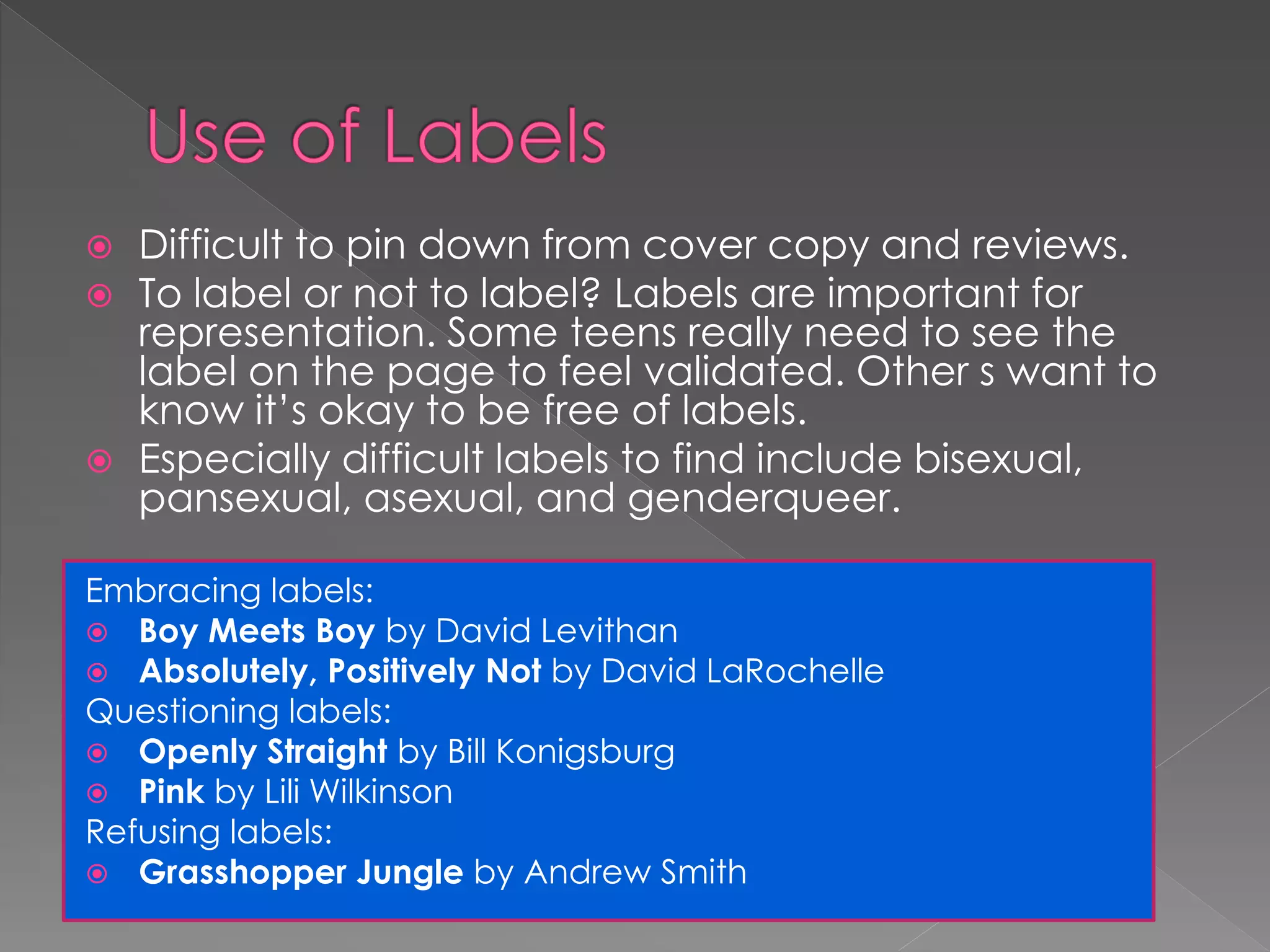
 Difficult to pin down from cover copy and reviews. 
 To label or not to label? Labels are important for 
representation. Some teens really need to see the 
label on the page to feel validated. Other s want to 
know it’s okay to be free of labels. 
 Especially difficult labels to find include bisexual, 
pansexual, asexual, and genderqueer. 
Embracing labels: 
 Boy Meets Boy by David Levithan 
 Absolutely, Positively Not by David LaRochelle 
Questioning labels: 
 Openly Straight by Bill Konigsburg 
 Pink by Lili Wilkinson 
Refusing labels: 
 Grasshopper Jungle by Andrew Smith
 Diversity in characters 
› Queer people with disabilities 
› Queer people of color 
› Queer people from ethnic and cultural 
minorities 
› Queer people from religious minorities 
 Diverse Authors 
› Including all of the above identities
#INeedDiverseGames 
IndieGoGo 
Campaign!
 Chambliss, W. J. (2003). How labels affect life: The saints and the 
roughnecks. Down to earth sociology: Introductory readings (12th 
ed.) (pp. 271–286). New York: Free Press. 
 Lo, M. (2011, September 14). I have numbers! Stats on LGBT Young Adult 
Books Published in the U.S. – Updated 9/15/11. Malinda Lo: Blog. 
Retrieved from http://www.malindalo.com/2011/09/i-have-numbers-stats- 
on-lgbt-young-adult-books-published-in-the-u-s/ 
 Lo, M. (2013, October 7). 2013 LGBT YA by the Numbers. Malinda Lo: 
Blog. Retrieved from http://www.malindalo.com/2013/10/2013-lgbt-ya-by- 
the-numbers/ 
 Lo, M. (2013, October 28). LGBT Young Adult Books 2003-2013: A Decade 
of Slow but Steady Change. Malinda Lo: Blog. Retrieved from 
http://www.malindalo.com/2013/10/lgbt-young-adult-books-2003-13-a-decade- 
of-slow-but-steady-change/
 Tiemensma, L. (2010). Books are windows, books are mirrors: 
multicultural collections for children and young adults 
opening new worlds. Libraries for Children and Young Adults 
& Library Services to Multicultural Populations . Meeting 
conducted at the World library and information congress: 
76th IFLA general conference and assembly, Gothenburg, 
Sweden. Retrieved from 
http://conference.ifla.org/past/ifla76/147-tiemensma-en.pdf

Real Representation: Balancing your young adult LGBTQ+ collection

  • 1.
    Balancing your youngadult LGBTQ+ collection Megan England Teen Services Coordinator, Atlantic City Free Public Library
  • 2.
     The goal:to give selectors of YA materials different lenses through which they can view queer young adult literature when reading reviews and cover copy for selection.  Subject heading searches will fail you when searching for queer literature and nonfiction. Major work is needed in the fields of cataloging and metadata to make our catalogs and vendor classification systems more LGBTQ+ friendly.
  • 3.
     LGBTQ+: Lesbian,Gay, Bisexual, Transgender, Queer/Questioning, Intersex, Pansexual, Asexual, & other marginalized identities relating to romantic/sexual orientation or gender identity and expression.  Transgender: biological sex assigned at birth does not match self-identified gender (vs. cisgender)
  • 4.
    Every reader needswindow and mirror books: We see ourselves reflected in mirror books In window books, we look through into the lives of others who are different from us. This provides support and helps develop empathy Tiemensma, L. (2010). Books are windows, books are mirrors: multicultural collections for children and young adults opening new worlds.
  • 5.
    Malindalo.com “Mainstream” publishersinclude: Disney Publishing Group (Hyperion) Houghton Mifflin Harcourt Scholastic For a listing of LGBT publishers, visit www.lambdaliterary.org In most professional review sources and other selection aids, we are only seeing 26% of the queer YA being published.
  • 6.
    Malindalo.com The cisgendermale perspective dominates in queer YA lit. There is less representation for cisgender females, and very little for transgender and intersex characters. If we aren’t careful in our selection, our library shelves will reflect the above distribution.
  • 7.
     Gay andLesbian › The easiest identities to find represented. Cisgender gay males still dominate both publishing and marketing, though, so be aware and purchase accordingly.  Bisexual and Pansexual Girls AND Guys › Bisexual and pansexuals are poorly represented in all media as greedy, selfish, slutty, confused, actually gay, actually straight, etc. Bisexual and pansexual are their own legitimate identities with very little fiction published to support them, especially for bi or pan males. Can be very difficult to find through reviews/copy.  Transgender › Male to Female transition stories have historically dominated › Female to Male stories are being published more and more.  Hard to Find Identities › Intersex › Asexual › Genderqueer › These identities rarely see any books published. Purchase them when you see them.
  • 8.
     Queer SecondaryCharacters (Outside looking in) › Important for developing empathy and displaying the true diversity of our world.  Queer Main Characters (Inside looking out) › Where real representation comes in. Almost Perfect by Brian Katcher or Luna by Julie Ann Peters vs. Beautiful Music for Ugly Children by Kirstin Cronn-Mills or Gracefully Grayson by Ami Polonski
  • 9.
     Social andFamily › Most contemporary realistic YA fiction. The “coming out” novel  Identity › Aristotle and Dante Discover the Secrets of the Universe by Benjamin Alire Saenz  Spiritual › The God Box by Alex Sanchez › Rapture Practice by Aaron Hartzler  Romantic › Boy Meets Boy by David Levithan › The classic romantic arc with happily ever after/happily for now  Unrelated to queerness Malindalo.com › Genre fiction where queerness is not a “problem” or plot device. Defeat the villian, conquer the evil government, master secret powers, etc. Conflict is easy to determine from cover copy and reviews. Again, if we aren’t careful in our selection, our collections will reflect this chart: 80% coming out stories. Those are very important stories to have, but they shouldn’t dominate so heavily.
  • 10.
     Difficult topin down from cover copy and reviews.  To label or not to label? Labels are important for representation. Some teens really need to see the label on the page to feel validated. Other s want to know it’s okay to be free of labels.  Especially difficult labels to find include bisexual, pansexual, asexual, and genderqueer. Embracing labels:  Boy Meets Boy by David Levithan  Absolutely, Positively Not by David LaRochelle Questioning labels:  Openly Straight by Bill Konigsburg  Pink by Lili Wilkinson Refusing labels:  Grasshopper Jungle by Andrew Smith
  • 11.
     Diversity incharacters › Queer people with disabilities › Queer people of color › Queer people from ethnic and cultural minorities › Queer people from religious minorities  Diverse Authors › Including all of the above identities
  • 13.
  • 14.
     Chambliss, W.J. (2003). How labels affect life: The saints and the roughnecks. Down to earth sociology: Introductory readings (12th ed.) (pp. 271–286). New York: Free Press.  Lo, M. (2011, September 14). I have numbers! Stats on LGBT Young Adult Books Published in the U.S. – Updated 9/15/11. Malinda Lo: Blog. Retrieved from http://www.malindalo.com/2011/09/i-have-numbers-stats- on-lgbt-young-adult-books-published-in-the-u-s/  Lo, M. (2013, October 7). 2013 LGBT YA by the Numbers. Malinda Lo: Blog. Retrieved from http://www.malindalo.com/2013/10/2013-lgbt-ya-by- the-numbers/  Lo, M. (2013, October 28). LGBT Young Adult Books 2003-2013: A Decade of Slow but Steady Change. Malinda Lo: Blog. Retrieved from http://www.malindalo.com/2013/10/lgbt-young-adult-books-2003-13-a-decade- of-slow-but-steady-change/
  • 15.
     Tiemensma, L.(2010). Books are windows, books are mirrors: multicultural collections for children and young adults opening new worlds. Libraries for Children and Young Adults & Library Services to Multicultural Populations . Meeting conducted at the World library and information congress: 76th IFLA general conference and assembly, Gothenburg, Sweden. Retrieved from http://conference.ifla.org/past/ifla76/147-tiemensma-en.pdf

Editor's Notes

  • #3 There are a lot of wonderful presentations happening this weekend about Queer issues and I hope you’ll attend those too. Both have some really great authors there whose work you should absolutely buy for your own libraries. My perspective for this presentation is as a YA librarian who does the book ordering for my library’s YA section. The goal of my paper and this presentation is to give librarians some different lenses through which they can view young adult queer literature when reading reviews and looking for items to purchase. Subject headings searches will fail you in this category. Major work is needed in making our library catalogs more LGBTQ friendly and more searchable, but that is a whole other presentation. For now, just know that if you or a patron were to search a catalog (at a library or through a vendor) for “bisexual”, you’ll miss a lot of stuff.
  • #6 I lean heavily on all of Malinda Lo’s outstanding work both as a researcher and organizer of the YA community. Links to her work are included at the end of this presentation. Pulling from her most recent data set, this is the breakdown of how LGBT novels are sourced. Disney-Hyperion, Scholastic, Houghton Mifflin Harcourt http://www.lambdaliterary.org for listing of publishers. this is the gender breakdown of queer YA books published in 2013. Of this pie, when we are looking at review magazines and B&T/Ingram advertising and what have you, we are getting only 26%
  • #8 If you just flip open your ingram catalog or your review magazine of choice, you’ll find lots of books on white gay teens, and some on white lesbian girls. This can usually be identified in reviews and cover copy, but not always, and especially not for genre fiction.
  • #10 Social and Family account for the vast majority of books. Bullying related to sexual orientation or gender identity, fear of social reprocussions, and struggles with family as a result of unfulfilled expectations or coming out. Aristotle and Dante Discover the Secrets of the Universe (personal identity) The God Box by Alex Sanchez (spiritual) Boy Meets Boy is the classic example, but there are more and more of these every year. I can never get enough out-and-out romance where the tension comes from the typical romance novel arc! (Romantic) Finally genre fiction. Defeat the villian, conquer the evil government, discover the secrets of magic Doesn’t have to be either-or – Hero by Perry Moore does both!
  • #13 Have you read Malinda Lo, Alex London, Steven dos Santos?
  • #14 Rather than giving you handouts today, I’d rather direct you to some of the wonderful living resources out there that are always updated. Support the IndieGoGo compaign, which helps bring diversity into classrooms, support diverse authors, develop a new Kidlit Diversity Festival, and more.