
Prepared for the
Real Estate developers
by
Eric Fedewa
1. Getting started: learning your market
finding prospects
2. Working for sellers
3. Working for buyers
4. Negotiating the purchase contract
5. Due diligence & closing
6. Ethics & professional practice
7. Continuing education
1. Please complete the Survey (handout #1)
2. Form into groups of threes (3s): decide who will be the
“broker”, the “prospective agent” and the “observer”.
Using the questions on the Survey, the broker will
interview the prospective agent (5 minutes) while the
observer listens.
Switch roles so that everyone has a different role and
repeat (5 minutes).
3. Prospective agents: If you were the broker,
would you hire yourself?
4. Brokers & Observers: What did you like best
about the Prospective Agents?
This interview may be similar to one you’ll
have in “real” life.
The rest of today’s class is designed to
prepare you to be as successful as you can be!
To be successful, you must know your market as well
or better than anyone else.
1. Develop a data base to organize information
2. Collect information in as much detail as possible
a. demographics
b. market size and activity
c. price range
3. Where are shopping, schools, recreational
facilities, etc. located?
4. What laws govern property use?
5. What laws govern real estate transactions?
6. What else do you need to know about your
market?
1. Professional wardrobe
2. Listing catalog
3. Brief case
4. Tape measure
5. Screwdriver, pliers
6. PDA or appointment book
7. Maps
8. Data base
9. Listing forms, contracts
10. Purchase contracts
11. Mortgage calculator
12. List of mortgage companies,
surveyors, etc.
13. Signs, lockboxes, etc.
14. Company policy manual
15. Buyer’s handbook
16. Seller’s handbook
17. ___________________
1. Develop an effective data base to retain
names, addresses, phone numbers, contact
history, etc.
2. List potential referral sources
a. Relatives
b. Friends
c. Business contacts
3. Contact referral sources
a. Send an announcement letter
b. Include your business card
c. Stay in touch: 4 times/year minimum
4. Join organizations: meet people = “social farming”
5. Establish a “geographic farm”: become the expert
(handout #2)
6. “Opportunity time”
7. Target likely prospects
a. Mailing lists/membership rosters
b. Announcements in newspapers
8. Increase your visibility
a. Develop & distribute a newsletter
b. Hold open houses
c. Advertising
9. “Cold calls”
1. Death
2. Divorce
3. Illness
4. Financial
pressures
5. Loss of
employment
6. Job transfer
7. Marriage
8. Birth
9. Promotion
10. Expression
11. Unexpected wealth
12. Prestige
13. Investment
1. Usually based on law/regulation/custom
2. Six primary “fiduciary” duties
a. Loyalty
b. Keep personal information confidential
c. Obedience
d. Reasonable skill & diligence
e. Disclose all known facts
f. Accounting for money & documents
1. Occur when the duties you owe to one person
conflict with the duties you owe to another
person, including yourself!
2. Conflict must be disclosed immediately and a
solution agreed upon; put the solution in
writing signed by both parties
3. If no solution can be agreed upon, terminate
one or both relationships
1. Fair and honest treatment
2. Disclosure of all known facts about the transaction
and property
3. Disclosure of fact you are expected to know
4. No misrepresentation: know the facts and don’t
guess
5. Fully explain any documents that require signatures
1. No discrimination
2. Provide competent service
3. Don’t undertake a job you’re not
qualified to perform
4. Do not do any advertising that’s false,
misleading or a misrepresentation
5. Do not do anything contrary to the law
1. Do not knowingly make false or
misleading statements about your
competitors
2. Do not take any action inconsistent with
the agency of another agent
3. Disclose your client relationship to other
agents at first contact
1. Geographic farming
2. Divorce/marriage
3. Death/illness
4. For-sale-by-owners
5. Expired listings
6. Foreclosure notices
7. Neighbors of new listings
8. Out-of-town owners
9. Advertising for specific
properties
10. Moving companies
11. “Furniture for sale”
12. Business transfers
13. Homebuilders
14. Social farming
15. Attorneys/bankers
16. Referrals
1. Prepare yourself
a. Dress professionally
b. Be prompt
c. Prepare CMA (handout #4)
2. Prepare prospective seller
a. Establish rapport
b. Agree on common agenda
c. Permission to ask questions
Using Seller’s Handbook (sample) as a guide
1. Discuss your role as advisor/advocate, your company &
yourself
2. Discuss your role as marketer
3. Discuss CMA (actives, solds, expireds) /importance of
pricing
4. Review seller’s options
5. Review listing contract (sample & CD)
6. Discuss how you & selling agent are paid
7. Determine seller’s motivation, timing
8. Discuss preparing the home for the buyer’s eyes (book)
Ask: “If we find a buyer today willing to pay your price,
are you ready to sell?”
Then either
A. Present the listing contract again and ask for their
signatures OR
B. Ask them to review all the information you’ve
provided and make an appointment to discuss any
questions and finalize the contract
1. Prepare MLS brochure for competitors
2. Put sign in yard, fill brochure box
3. Enlist seller’s help in keeping brochure box
full
4. Put key box on front door
5. Give office showing instructions
6. Create advertising: Internet, newspaper,
flyers
7. Prepare Property Guide for inside home
Communicate with your seller…even when there’s
“nothing” to say!
1. Tell the seller what you are doing to market the
property
2. Collect feedback from showings, tell the seller
3. Contact seller at least once a week
4. Review feedback with seller monthly, discuss
possible price change
5. Hold “open” houses
1. Your sellers!
2. If your sellers are not
buying here, refer them
to an agent to which
they’re moving
3. Geographic farming
4. Social farming
5. Referrals from
professionals, other
agents, friends, relatives
6. Your niche market
7. Home buying seminars
8. Your web site
9. Divorce/marriage
10. Expanding families
11. “Empty nesters”
12. Just promoted/fired
13. Hold open houses
14. “Opportunity time”
15. _______________
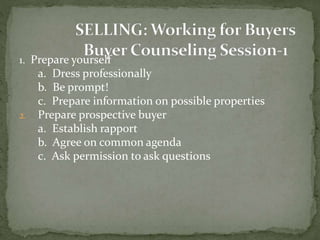
1. Prepare yourself
a. Dress professionally
b. Be prompt!
c. Prepare information on possible properties
2. Prepare prospective buyer
a. Establish rapport
b. Agree on common agenda
c. Ask permission to ask questions
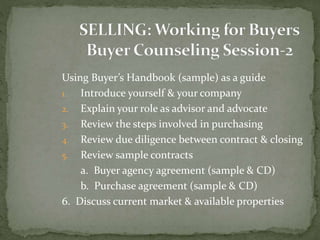
Using Buyer’s Handbook (sample) as a guide
1. Introduce yourself & your company
2. Explain your role as advisor and advocate
3. Review the steps involved in purchasing
4. Review due diligence between contract & closing
5. Review sample contracts
a. Buyer agency agreement (sample & CD)
b. Purchase agreement (sample & CD)
6. Discuss current market & available properties
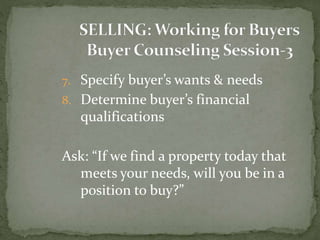
7. Specify buyer’s wants & needs
8. Determine buyer’s financial
qualifications
Ask: “If we find a property today that
meets your needs, will you be in a
position to buy?”
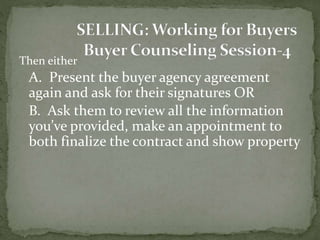
Then either
A. Present the buyer agency agreement
again and ask for their signatures OR
B. Ask them to review all the information
you’ve provided, make an appointment to
both finalize the contract and show property
Selecting and previewing properties
1. Match buyers’ wants and needs with
currently available properties
2. Preview matches
3. Make appointments to show “best”
matches
4. Plan “tour” route
1. Play the “priority” game: keep focused on just 2-3
properties
2. Compare pros/cons of properties
3. Encourage note taking
4. Encourage client opinions
5. Ask probing questions
6. Serve as a “sounding board”
7. Listen carefully
1. Always answer honestly
2. “I don’t know but I’ll find out.”
3. Restate objection as a question
4. Correct misinformation
5. Ask “why” questions carefully
6. Watch for “buying” signals
7. “Have I answered all your concerns or do you need
more information?”
!!!LISTEN!!!
Essential Elements
1. Competent parties
2. Timely acceptance
3. Unique legal
4. Consideration
5. Mutual consent
Terms & Provisions
1. Price
2. Possession
3. Personal property
4. Means of conveyance
5. Pro-rations of taxes &
insurance
6. Closing costs
7. Contingencies
8. Property disclosures
1. Provide seller with a complete “picture” of the
buyer:
2. Present terms of offer
3. Explain contingencies/special conditions
4. Present buyer’s financial capability
5. Encourage acceptance
6. If seller is unwilling to accept as is, negotiate
using counterproposals (sample)
1. Coordinate with listing agent
2. Prepare checklist of all steps & dates
3. Maintain transaction file of all meetings,
correspondence, documents, phone notes
4. Assist your client with timely information,
emotional support
5. Communicate regularly
6. Make sure all dates are met
7. Schedule & participate in closing
1. Perform with highest possible
professionalism during transaction
2. Call on client shortly after closing
3. Keep in touch at least 4 times each year
4. Establish yourself as their professional
REALTOR
a. For their future real estate needs
b. To refer friends/relatives/colleagues
1. It pays to do the right thing
2. Honest & ethical behavior bring rewards
3. The only answer to building a good, lasting
reputation
4. Never let the pursuit of money determine your
behavior
5. NAR’s Pathways to Professionalism (handout
#5): show respect to everyone!
1. List the topics you’d like to learn more about:
_________________________
2. Let’s make a combined list.
3. Continuing education and training are critical to
your success in real estate.
4. Sources
5. Designations
6. Have an education goal every year.
Real investing techniques with eric fedewa

Real investing techniques with eric fedewa

  • 1.
    Prepared for the RealEstate developers by Eric Fedewa
  • 2.
    1. Getting started:learning your market finding prospects 2. Working for sellers 3. Working for buyers 4. Negotiating the purchase contract 5. Due diligence & closing 6. Ethics & professional practice 7. Continuing education
  • 3.
    1. Please completethe Survey (handout #1) 2. Form into groups of threes (3s): decide who will be the “broker”, the “prospective agent” and the “observer”. Using the questions on the Survey, the broker will interview the prospective agent (5 minutes) while the observer listens. Switch roles so that everyone has a different role and repeat (5 minutes).
  • 4.
    3. Prospective agents:If you were the broker, would you hire yourself? 4. Brokers & Observers: What did you like best about the Prospective Agents? This interview may be similar to one you’ll have in “real” life. The rest of today’s class is designed to prepare you to be as successful as you can be!
  • 5.
    To be successful,you must know your market as well or better than anyone else. 1. Develop a data base to organize information 2. Collect information in as much detail as possible a. demographics b. market size and activity c. price range
  • 6.
    3. Where areshopping, schools, recreational facilities, etc. located? 4. What laws govern property use? 5. What laws govern real estate transactions? 6. What else do you need to know about your market?
  • 7.
    1. Professional wardrobe 2.Listing catalog 3. Brief case 4. Tape measure 5. Screwdriver, pliers 6. PDA or appointment book 7. Maps 8. Data base 9. Listing forms, contracts 10. Purchase contracts 11. Mortgage calculator 12. List of mortgage companies, surveyors, etc. 13. Signs, lockboxes, etc. 14. Company policy manual 15. Buyer’s handbook 16. Seller’s handbook 17. ___________________
  • 8.
    1. Develop aneffective data base to retain names, addresses, phone numbers, contact history, etc. 2. List potential referral sources a. Relatives b. Friends c. Business contacts
  • 9.
    3. Contact referralsources a. Send an announcement letter b. Include your business card c. Stay in touch: 4 times/year minimum 4. Join organizations: meet people = “social farming” 5. Establish a “geographic farm”: become the expert (handout #2)
  • 10.
    6. “Opportunity time” 7.Target likely prospects a. Mailing lists/membership rosters b. Announcements in newspapers 8. Increase your visibility a. Develop & distribute a newsletter b. Hold open houses c. Advertising 9. “Cold calls”
  • 11.
    1. Death 2. Divorce 3.Illness 4. Financial pressures 5. Loss of employment 6. Job transfer 7. Marriage 8. Birth 9. Promotion 10. Expression 11. Unexpected wealth 12. Prestige 13. Investment
  • 12.
    1. Usually basedon law/regulation/custom 2. Six primary “fiduciary” duties a. Loyalty b. Keep personal information confidential c. Obedience d. Reasonable skill & diligence e. Disclose all known facts f. Accounting for money & documents
  • 13.
    1. Occur whenthe duties you owe to one person conflict with the duties you owe to another person, including yourself! 2. Conflict must be disclosed immediately and a solution agreed upon; put the solution in writing signed by both parties 3. If no solution can be agreed upon, terminate one or both relationships
  • 14.
    1. Fair andhonest treatment 2. Disclosure of all known facts about the transaction and property 3. Disclosure of fact you are expected to know 4. No misrepresentation: know the facts and don’t guess 5. Fully explain any documents that require signatures
  • 15.
    1. No discrimination 2.Provide competent service 3. Don’t undertake a job you’re not qualified to perform 4. Do not do any advertising that’s false, misleading or a misrepresentation 5. Do not do anything contrary to the law
  • 16.
    1. Do notknowingly make false or misleading statements about your competitors 2. Do not take any action inconsistent with the agency of another agent 3. Disclose your client relationship to other agents at first contact
  • 17.
    1. Geographic farming 2.Divorce/marriage 3. Death/illness 4. For-sale-by-owners 5. Expired listings 6. Foreclosure notices 7. Neighbors of new listings 8. Out-of-town owners 9. Advertising for specific properties 10. Moving companies 11. “Furniture for sale” 12. Business transfers 13. Homebuilders 14. Social farming 15. Attorneys/bankers 16. Referrals
  • 18.
    1. Prepare yourself a.Dress professionally b. Be prompt c. Prepare CMA (handout #4) 2. Prepare prospective seller a. Establish rapport b. Agree on common agenda c. Permission to ask questions
  • 19.
    Using Seller’s Handbook(sample) as a guide 1. Discuss your role as advisor/advocate, your company & yourself 2. Discuss your role as marketer 3. Discuss CMA (actives, solds, expireds) /importance of pricing 4. Review seller’s options 5. Review listing contract (sample & CD) 6. Discuss how you & selling agent are paid 7. Determine seller’s motivation, timing 8. Discuss preparing the home for the buyer’s eyes (book)
  • 20.
    Ask: “If wefind a buyer today willing to pay your price, are you ready to sell?” Then either A. Present the listing contract again and ask for their signatures OR B. Ask them to review all the information you’ve provided and make an appointment to discuss any questions and finalize the contract
  • 21.
    1. Prepare MLSbrochure for competitors 2. Put sign in yard, fill brochure box 3. Enlist seller’s help in keeping brochure box full 4. Put key box on front door 5. Give office showing instructions 6. Create advertising: Internet, newspaper, flyers 7. Prepare Property Guide for inside home
  • 22.
    Communicate with yourseller…even when there’s “nothing” to say! 1. Tell the seller what you are doing to market the property 2. Collect feedback from showings, tell the seller 3. Contact seller at least once a week 4. Review feedback with seller monthly, discuss possible price change 5. Hold “open” houses
  • 23.
    1. Your sellers! 2.If your sellers are not buying here, refer them to an agent to which they’re moving 3. Geographic farming 4. Social farming 5. Referrals from professionals, other agents, friends, relatives 6. Your niche market 7. Home buying seminars 8. Your web site 9. Divorce/marriage 10. Expanding families 11. “Empty nesters” 12. Just promoted/fired 13. Hold open houses 14. “Opportunity time” 15. _______________
  • 24.
    1. Prepare yourself a.Dress professionally b. Be prompt! c. Prepare information on possible properties 2. Prepare prospective buyer a. Establish rapport b. Agree on common agenda c. Ask permission to ask questions
  • 25.
    Using Buyer’s Handbook(sample) as a guide 1. Introduce yourself & your company 2. Explain your role as advisor and advocate 3. Review the steps involved in purchasing 4. Review due diligence between contract & closing 5. Review sample contracts a. Buyer agency agreement (sample & CD) b. Purchase agreement (sample & CD) 6. Discuss current market & available properties
  • 26.
    7. Specify buyer’swants & needs 8. Determine buyer’s financial qualifications Ask: “If we find a property today that meets your needs, will you be in a position to buy?”
  • 27.
    Then either A. Presentthe buyer agency agreement again and ask for their signatures OR B. Ask them to review all the information you’ve provided, make an appointment to both finalize the contract and show property
  • 28.
    Selecting and previewingproperties 1. Match buyers’ wants and needs with currently available properties 2. Preview matches 3. Make appointments to show “best” matches 4. Plan “tour” route
  • 29.
    1. Play the“priority” game: keep focused on just 2-3 properties 2. Compare pros/cons of properties 3. Encourage note taking 4. Encourage client opinions 5. Ask probing questions 6. Serve as a “sounding board” 7. Listen carefully
  • 30.
    1. Always answerhonestly 2. “I don’t know but I’ll find out.” 3. Restate objection as a question 4. Correct misinformation 5. Ask “why” questions carefully 6. Watch for “buying” signals 7. “Have I answered all your concerns or do you need more information?”
  • 31.
  • 32.
    Essential Elements 1. Competentparties 2. Timely acceptance 3. Unique legal 4. Consideration 5. Mutual consent Terms & Provisions 1. Price 2. Possession 3. Personal property 4. Means of conveyance 5. Pro-rations of taxes & insurance 6. Closing costs 7. Contingencies 8. Property disclosures
  • 33.
    1. Provide sellerwith a complete “picture” of the buyer: 2. Present terms of offer 3. Explain contingencies/special conditions 4. Present buyer’s financial capability 5. Encourage acceptance 6. If seller is unwilling to accept as is, negotiate using counterproposals (sample)
  • 34.
    1. Coordinate withlisting agent 2. Prepare checklist of all steps & dates 3. Maintain transaction file of all meetings, correspondence, documents, phone notes 4. Assist your client with timely information, emotional support 5. Communicate regularly 6. Make sure all dates are met 7. Schedule & participate in closing
  • 35.
    1. Perform withhighest possible professionalism during transaction 2. Call on client shortly after closing 3. Keep in touch at least 4 times each year 4. Establish yourself as their professional REALTOR a. For their future real estate needs b. To refer friends/relatives/colleagues
  • 36.
    1. It paysto do the right thing 2. Honest & ethical behavior bring rewards 3. The only answer to building a good, lasting reputation 4. Never let the pursuit of money determine your behavior 5. NAR’s Pathways to Professionalism (handout #5): show respect to everyone!
  • 37.
    1. List thetopics you’d like to learn more about: _________________________ 2. Let’s make a combined list. 3. Continuing education and training are critical to your success in real estate. 4. Sources 5. Designations 6. Have an education goal every year.