Real Estate
Who is Estate Agent
• A real estate broker or a real estate agent is a
person who represents sellers or buyers of real
estate or real property. While a broker may work
independently, an agent usually work under a
licensed broker to represent clients.
• Brokers and agents are licensed by the state to
negotiate sales agreements and manage the
documentation required for closing real estate
transactions.
• In North America, some brokers and agents are
members of the National Association of Realtors (NAR),
the largest trade association for the industry.NAR
members are obligated by a code of ethics that go
above and beyond state legal requirements to work in
the best interest of the client.
• Buyers and sellers are generally advised to consult a
licensed real estate professional for a written definition
of an individual state's laws of agency, and many states
require written disclosures to be signed by all parties
outlining the duties and obligations.
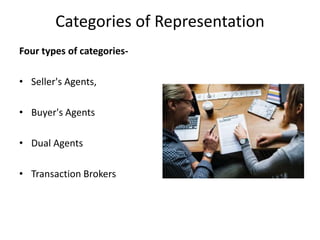
Categories of Representation
Four types of categories-
• Seller's Agents,
• Buyer's Agents
• Dual Agents
• Transaction Brokers
Licensing
• In the United States, real estate brokers and salespersons
are licensed by each state, not by the federal government.
Each state has a real estate “commission” who monitors
and licenses real estate brokers and agents.
• For example, some states only allow for lawyers to create
documentation to transfer real property. Where other
states allow the licensed real estate agent.
• Rules vary substantially as defined by the law from state to
state, for example, on subjects that include what legal
language is necessary to transfer real property, agency
relationships, inspections, disclosures, continuing
education, and other subjects.
• In most jurisdictions in the United States, a person must
have a license meaning they have studied real estate laws
before they may receive remuneration for services
rendered as a real estate broker or agent.
• There are state laws defining the types of relationships that
can exist between clients and real estate licensees, and the
lawful duties of real estate licensees to represent clients
and members of the public.
• Unlicensed activity is illegal and the state real estate
commission has authority to fine people who are acting as
real estate licensee, but buyers and sellers acting as
principals in the sale or purchase of real estate are usually
not required to be licensed.
• It is important to note that in some states, lawyers handle
real estate sales for compensation without being licensed
as brokers or agents.
Specific States Representation Laws
• Some state Real Estate Commissions - notably Florida's after 1992
(and extended in 2003) and Colorado's after 1994 (with changes in
2003) created the option of having no agency or fiduciary
relationship between brokers and sellers or buyers.
• As noted by the South Broward Board of Realtors, Inc. in a letter to
State of Florida legislative committees:
• "The Transaction Broker crafts a transaction by bringing a willing
buyer and a willing seller together and provides the legal
documentation of the details of the legal agreement between the
same.
• The Transaction Broker is not a fiduciary of any party, but must
abide by the law as well as professional and ethical standards."
(such as NAR Code of Ethics).
• In the case of both Floridaand Colorado, dual agency and sub-
agency (where both listing and selling agents represent the seller)
no longer exist.
• Other brokers and agents may focus on representing buyers or
tenants in a real estate transaction. However, licensing as a broker
or salesperson authorizes the licensee to legally represent parties
on either side of a transaction and providing the necessary
documentation for the legal transfer of real property.
• This business decision is for the licensee to decide. They are fines
for people acting as real estate agents when not licensed by the
state.
• In the United Kingdom, an estate agent is a person or business
entity whose business is to market real estate on behalf of clients.
There are significant differences between the actions, powers,
obligations, and liabilities of brokers and estate agents in each
country, as different countries take markedly different approaches
to the marketing and selling of real property.
Written agreement
• It is important to have a clear written legal documentation for an
agreement between the broker and the client, for the protection of
both of them.
• If the parties only have an oral agreement, it is more likely for a
dispute to arise concerning the agreement to represent clients and
for how real property being sold.
• Legal documentation is required to define whether the broker can
enforce the parties' compensation agreement, the duration of the
relationship, whether the relationship is "exclusive", and other
issues.
• Enforceability of oral agreements, what kinds of legal agreements
are required to be in writing, and other important issues vary from
state to state.
Real estate

Real estate

  • 1.
  • 2.
    Who is EstateAgent • A real estate broker or a real estate agent is a person who represents sellers or buyers of real estate or real property. While a broker may work independently, an agent usually work under a licensed broker to represent clients. • Brokers and agents are licensed by the state to negotiate sales agreements and manage the documentation required for closing real estate transactions.
  • 3.
    • In NorthAmerica, some brokers and agents are members of the National Association of Realtors (NAR), the largest trade association for the industry.NAR members are obligated by a code of ethics that go above and beyond state legal requirements to work in the best interest of the client. • Buyers and sellers are generally advised to consult a licensed real estate professional for a written definition of an individual state's laws of agency, and many states require written disclosures to be signed by all parties outlining the duties and obligations.
  • 4.
    Categories of Representation Fourtypes of categories- • Seller's Agents, • Buyer's Agents • Dual Agents • Transaction Brokers
  • 5.
    Licensing • In theUnited States, real estate brokers and salespersons are licensed by each state, not by the federal government. Each state has a real estate “commission” who monitors and licenses real estate brokers and agents. • For example, some states only allow for lawyers to create documentation to transfer real property. Where other states allow the licensed real estate agent. • Rules vary substantially as defined by the law from state to state, for example, on subjects that include what legal language is necessary to transfer real property, agency relationships, inspections, disclosures, continuing education, and other subjects.
  • 6.
    • In mostjurisdictions in the United States, a person must have a license meaning they have studied real estate laws before they may receive remuneration for services rendered as a real estate broker or agent. • There are state laws defining the types of relationships that can exist between clients and real estate licensees, and the lawful duties of real estate licensees to represent clients and members of the public. • Unlicensed activity is illegal and the state real estate commission has authority to fine people who are acting as real estate licensee, but buyers and sellers acting as principals in the sale or purchase of real estate are usually not required to be licensed. • It is important to note that in some states, lawyers handle real estate sales for compensation without being licensed as brokers or agents.
  • 7.
    Specific States RepresentationLaws • Some state Real Estate Commissions - notably Florida's after 1992 (and extended in 2003) and Colorado's after 1994 (with changes in 2003) created the option of having no agency or fiduciary relationship between brokers and sellers or buyers. • As noted by the South Broward Board of Realtors, Inc. in a letter to State of Florida legislative committees: • "The Transaction Broker crafts a transaction by bringing a willing buyer and a willing seller together and provides the legal documentation of the details of the legal agreement between the same. • The Transaction Broker is not a fiduciary of any party, but must abide by the law as well as professional and ethical standards." (such as NAR Code of Ethics).
  • 8.
    • In thecase of both Floridaand Colorado, dual agency and sub- agency (where both listing and selling agents represent the seller) no longer exist. • Other brokers and agents may focus on representing buyers or tenants in a real estate transaction. However, licensing as a broker or salesperson authorizes the licensee to legally represent parties on either side of a transaction and providing the necessary documentation for the legal transfer of real property. • This business decision is for the licensee to decide. They are fines for people acting as real estate agents when not licensed by the state. • In the United Kingdom, an estate agent is a person or business entity whose business is to market real estate on behalf of clients. There are significant differences between the actions, powers, obligations, and liabilities of brokers and estate agents in each country, as different countries take markedly different approaches to the marketing and selling of real property.
  • 9.
    Written agreement • Itis important to have a clear written legal documentation for an agreement between the broker and the client, for the protection of both of them. • If the parties only have an oral agreement, it is more likely for a dispute to arise concerning the agreement to represent clients and for how real property being sold. • Legal documentation is required to define whether the broker can enforce the parties' compensation agreement, the duration of the relationship, whether the relationship is "exclusive", and other issues. • Enforceability of oral agreements, what kinds of legal agreements are required to be in writing, and other important issues vary from state to state.