Chapter 8
Managing Conflict
in Relationships
• Describe the factors that lead to
productive conflict
• Identify conflict triggers in yourself
and others
• Explain the forces that influence how
people handle conflict
Chapter Outcomes
• Evaluate and employ strategies for
managing conflict in different
situations
• Compare levels of resolution in
conflict outcomes
Chapter Outcomes
(cont.)
A negative interaction
between two or
more interdependent
people, rooted in
some actual or
perceived
disagreement
Conflict
The way we engage
in conflict and address
disagreements with
our relational
partners
Conflict
Management
Unproductive Conflict
• Conflict that is managed poorly
• Has a negative impact on the
individuals and the relationship
• Can lead to health problems
• Leads to aggression in the
relationship
Productive Conflict
• Conflict that is managed effectively
• Fosters healthy debate when people
are actively engaged
• Leads to better decision making
• Spurs relationship growth
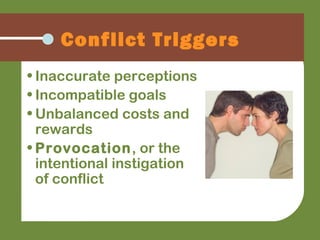
• Inaccurate perceptions
• Incompatible goals
• Unbalanced costs and
rewards
• Provocation, or the
intentional instigation
of conflict
Conflict Triggers
Conflict Triggers (cont.)
• Events that spark conflict:
– Aggression
– Identity management
– Lack of fairness
– Incompetence
– Relationship threats
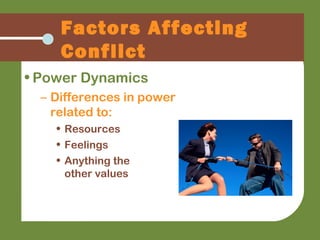
• Power Dynamics
– Differences in power
related to:
• Resources
• Feelings
• Anything the
other values
Factors Affecting
Conflict
• Culture and Conflict
– Individualistic cultures:
• Emphasize personal needs,
rights, and identity
• “I” attitude
– Collectivistic cultures:
• Emphasize group identity and needs
• “We” attitude
Factors Affecting
Conflict (cont.)
• Attitudes toward conflict:
– Affect how willing you are to discuss
disagreements
– Affect how productively you handle
conflict
– Affect willingness to discuss certain
topics (communication boundary
management)
Factors Affecting
Conflict (cont.)
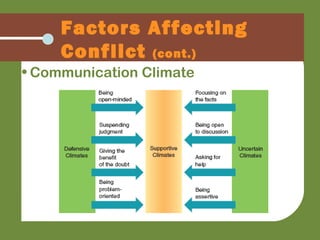
• Communication Climate
Factors Affecting
Conflict (cont.)
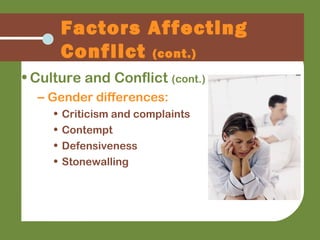
• Culture and Conflict (cont.)
– Gender differences:
• Criticism and complaints
• Contempt
• Defensiveness
• Stonewalling
Factors Affecting
Conflict (cont.)
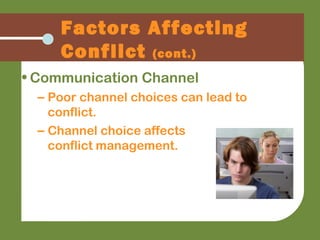
• Communication Channel
– Poor channel choices can lead to
conflict.
– Channel choice affects
conflict management.
Factors Affecting
Conflict (cont.)
Factors Affecting
Conflict (cont.)
• Online Anonymity and Conflict
– Electronic media has created new
sources of unproductive conflict.
• Flaming
• Trolling
• Cyberbullying
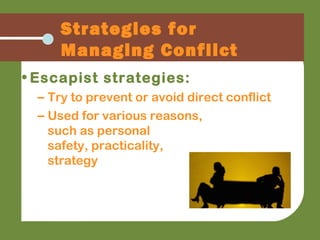
• Escapist strategies:
– Try to prevent or avoid direct conflict
– Used for various reasons,
such as personal
safety, practicality,
strategy
Strategies for
Managing Conflict
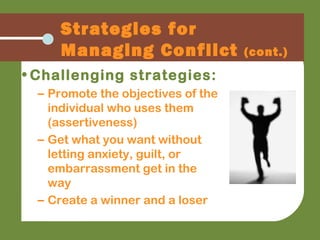
• Challenging strategies:
– Promote the objectives of the
individual who uses them
(assertiveness)
– Get what you want without
letting anxiety, guilt, or
embarrassment get in the
way
– Create a winner and a loser
Strategies for
Managing Conflict (cont.)
• Cooperative strategies:
– Focus on issues instead of verbal
aggressiveness
– Debate and argue using probing
questions or playing devil’s advocate
– Consider options and alternatives
– Consider the importance of the outcome
– Reassure your partner
Strategies for
Managing Conflict (cont.)
• Compromise
– Both sides give up a little to get a
little
– Can be arrived at through trading or
random selection
– Has disadvantages for long-term
important relationships
Conflict Outcomes
• Win-Win
– Both parties meet their
own goals.
– Each party helps the
other party with his/her
goals.
– The relationship is
improved.
Conflict Outcomes
(cont.)
• Lose-Lose
– Neither party gets what he/she wants.
• Separation
– Remove yourself from the situation to
end the conflict.
• Allocation of Power
– Take responsibility for some decisions.
Conflict Outcomes
(cont.)

Real comm2e ch8

  • 1.
  • 2.
    • Describe thefactors that lead to productive conflict • Identify conflict triggers in yourself and others • Explain the forces that influence how people handle conflict Chapter Outcomes
  • 3.
    • Evaluate andemploy strategies for managing conflict in different situations • Compare levels of resolution in conflict outcomes Chapter Outcomes (cont.)
  • 4.
    A negative interaction betweentwo or more interdependent people, rooted in some actual or perceived disagreement Conflict
  • 5.
    The way weengage in conflict and address disagreements with our relational partners Conflict Management
  • 6.
    Unproductive Conflict • Conflictthat is managed poorly • Has a negative impact on the individuals and the relationship • Can lead to health problems • Leads to aggression in the relationship
  • 7.
    Productive Conflict • Conflictthat is managed effectively • Fosters healthy debate when people are actively engaged • Leads to better decision making • Spurs relationship growth
  • 8.
    • Inaccurate perceptions •Incompatible goals • Unbalanced costs and rewards • Provocation, or the intentional instigation of conflict Conflict Triggers
  • 9.
    Conflict Triggers (cont.) •Events that spark conflict: – Aggression – Identity management – Lack of fairness – Incompetence – Relationship threats
  • 10.
    • Power Dynamics –Differences in power related to: • Resources • Feelings • Anything the other values Factors Affecting Conflict
  • 11.
    • Culture andConflict – Individualistic cultures: • Emphasize personal needs, rights, and identity • “I” attitude – Collectivistic cultures: • Emphasize group identity and needs • “We” attitude Factors Affecting Conflict (cont.)
  • 12.
    • Attitudes towardconflict: – Affect how willing you are to discuss disagreements – Affect how productively you handle conflict – Affect willingness to discuss certain topics (communication boundary management) Factors Affecting Conflict (cont.)
  • 13.
    • Communication Climate FactorsAffecting Conflict (cont.)
  • 14.
    • Culture andConflict (cont.) – Gender differences: • Criticism and complaints • Contempt • Defensiveness • Stonewalling Factors Affecting Conflict (cont.)
  • 15.
    • Communication Channel –Poor channel choices can lead to conflict. – Channel choice affects conflict management. Factors Affecting Conflict (cont.)
  • 16.
    Factors Affecting Conflict (cont.) •Online Anonymity and Conflict – Electronic media has created new sources of unproductive conflict. • Flaming • Trolling • Cyberbullying
  • 17.
    • Escapist strategies: –Try to prevent or avoid direct conflict – Used for various reasons, such as personal safety, practicality, strategy Strategies for Managing Conflict
  • 18.
    • Challenging strategies: –Promote the objectives of the individual who uses them (assertiveness) – Get what you want without letting anxiety, guilt, or embarrassment get in the way – Create a winner and a loser Strategies for Managing Conflict (cont.)
  • 19.
    • Cooperative strategies: –Focus on issues instead of verbal aggressiveness – Debate and argue using probing questions or playing devil’s advocate – Consider options and alternatives – Consider the importance of the outcome – Reassure your partner Strategies for Managing Conflict (cont.)
  • 20.
    • Compromise – Bothsides give up a little to get a little – Can be arrived at through trading or random selection – Has disadvantages for long-term important relationships Conflict Outcomes
  • 21.
    • Win-Win – Bothparties meet their own goals. – Each party helps the other party with his/her goals. – The relationship is improved. Conflict Outcomes (cont.)
  • 22.
    • Lose-Lose – Neitherparty gets what he/she wants. • Separation – Remove yourself from the situation to end the conflict. • Allocation of Power – Take responsibility for some decisions. Conflict Outcomes (cont.)