Chapter 16
Persuasive Speaking
• Define the goals of persuasive
speaking
• Develop a persuasive topic and
thesis
• Evaluate your listeners and tailor
your speech to them
Chapter Outcomes
• Explain three forms of rhetorical
proof: ethos, logos, and pathos
• Identify the logical fallacies,
deceptive forms of reasoning
• Choose an appropriate
organizational strategy for your
speech
Chapter Outcomes
(cont.)
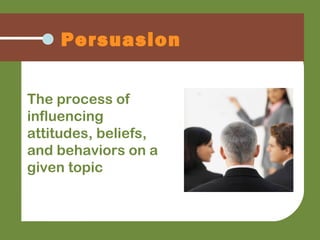
Persuasion
The process of
influencing
attitudes, beliefs,
and behaviors on a
given topic
The Goals of
Persuasive Speaking
• Influencing attitudes, beliefs, and
behaviors of your audience
– Attitudes are evaluations of people,
objects, ideas, or events.
– Beliefs are how people perceive reality.
– Behavior is how people act or function.
Developing a
Persuasive
Topic and Thesis• Your topic should…
– be somewhat controversial
– allow you to develop a message to bring
about change in the audience
Developing a
Persuasive
Topic and Thesis (cont.)
• A persuasive thesis may be
stated as a...
– proposition of fact
– proposition of value
– proposition of policy
Developing a
Persuasive
Topic and Thesis (cont.)• Propositions of Fact
– Claim what something is or what
something is not
– Involve issues that have conflicting
evidence or beliefs
• Goal: Align your audience’s perception
or opinion of the fact with your own.
Developing a
Persuasive
Topic and Thesis (cont.)• Propositions of Value
– Claim that something meets or does not
meet a specific standard of goodness
or quality or right or wrong
– Value statements reflect your opinion
• Goal: Align your audience’s beliefs and
attitudes with your own.
Developing a
Persuasive
Topic and Thesis (cont.)• Propositions of Policy
– Make claims about what goal, policy, or
course of action should be pursued
– Commonly used during election
campaigns
• Goal: Persuade your audience that a
current policy is or is not working.
Persuading Your
Audience
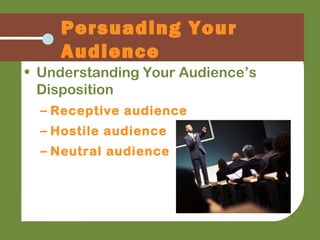
• Understanding Your Audience’s
Disposition
– Receptive audience
– Hostile audience
– Neutral audience
Persuading Your
Audience (cont.)
• Consider what you would like your
audience to do at the speech’s
conclusion.
– What is their anchor position at the
beginning of the speech?
– This determines their latitude of
acceptance and rejection.
Persuading Your
Audience (cont.)
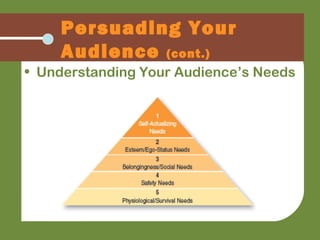
• Understanding Your Audience’s Needs
Persuading Your
Audience (cont.)
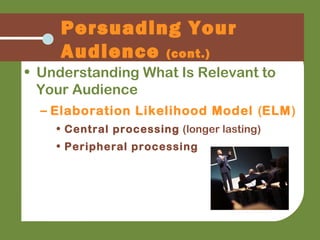
• Understanding What Is Relevant to
Your Audience
– Elaboration Likelihood Model (ELM)
• Central processing (longer lasting)
• Peripheral processing
Persuading Your
Audience (cont.)
• Determining relevance:
– Is your message relevant to listeners?
– Did you present the topic at the correct
level?
– Did you establish your credibility?
– Did you create a common bond?
Strategies for
Persuasive Speaking
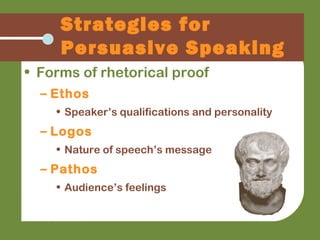
• Forms of rhetorical proof
– Ethos
• Speaker’s qualifications and personality
– Logos
• Nature of speech’s message
– Pathos
• Audience’s feelings
Strategies for
Persuasive Speaking
(cont.)
• Ethos (moral character)
– Credibility
– Character
– Trustworthiness
– Goodwill
Strategies for
Persuasive Speaking
(cont.)
• Logos (reasoning)
– Inductive reasoning draws general
conclusions based on evidence.
– Deductive reasoning proceeds from
the general to the specific.
• syllogism: major premise, minor premise,
conclusion
Strategies for
Persuasive Speaking
(cont.)
• Pathos (appeal to listener's
emotions)
– Should be combined with
logical appeals for lasting
effect
Strategies for
Persuasive Speaking
(cont.)
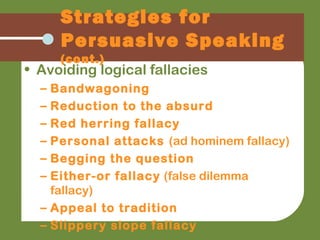
• Avoiding logical fallacies
– Bandwagoning
– Reduction to the absurd
– Red herring fallacy
– Personal attacks (ad hominem fallacy)
– Begging the question
– Either-or fallacy (false dilemma
fallacy)
– Appeal to tradition
– Slippery slope fallacy
Organizing Patterns
in Persuasive
Speaking
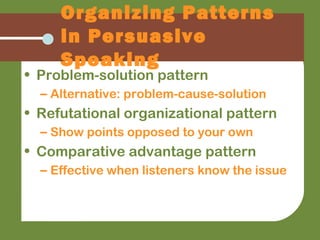
• Problem-solution pattern
– Alternative: problem-cause-solution
• Refutational organizational pattern
– Show points opposed to your own
• Comparative advantage pattern
– Effective when listeners know the issue
Organizing Patterns in
Persuasive Speaking
(cont.)
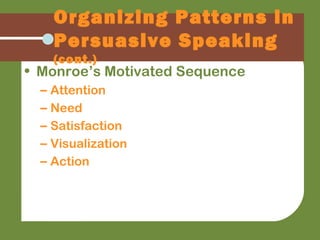
• Monroe’s Motivated Sequence
– Attention
– Need
– Satisfaction
– Visualization
– Action

Real comm2e ch16

  • 1.
  • 2.
    • Define thegoals of persuasive speaking • Develop a persuasive topic and thesis • Evaluate your listeners and tailor your speech to them Chapter Outcomes
  • 3.
    • Explain threeforms of rhetorical proof: ethos, logos, and pathos • Identify the logical fallacies, deceptive forms of reasoning • Choose an appropriate organizational strategy for your speech Chapter Outcomes (cont.)
  • 4.
    Persuasion The process of influencing attitudes,beliefs, and behaviors on a given topic
  • 5.
    The Goals of PersuasiveSpeaking • Influencing attitudes, beliefs, and behaviors of your audience – Attitudes are evaluations of people, objects, ideas, or events. – Beliefs are how people perceive reality. – Behavior is how people act or function.
  • 6.
    Developing a Persuasive Topic andThesis• Your topic should… – be somewhat controversial – allow you to develop a message to bring about change in the audience
  • 7.
    Developing a Persuasive Topic andThesis (cont.) • A persuasive thesis may be stated as a... – proposition of fact – proposition of value – proposition of policy
  • 8.
    Developing a Persuasive Topic andThesis (cont.)• Propositions of Fact – Claim what something is or what something is not – Involve issues that have conflicting evidence or beliefs • Goal: Align your audience’s perception or opinion of the fact with your own.
  • 9.
    Developing a Persuasive Topic andThesis (cont.)• Propositions of Value – Claim that something meets or does not meet a specific standard of goodness or quality or right or wrong – Value statements reflect your opinion • Goal: Align your audience’s beliefs and attitudes with your own.
  • 10.
    Developing a Persuasive Topic andThesis (cont.)• Propositions of Policy – Make claims about what goal, policy, or course of action should be pursued – Commonly used during election campaigns • Goal: Persuade your audience that a current policy is or is not working.
  • 11.
    Persuading Your Audience • UnderstandingYour Audience’s Disposition – Receptive audience – Hostile audience – Neutral audience
  • 12.
    Persuading Your Audience (cont.) •Consider what you would like your audience to do at the speech’s conclusion. – What is their anchor position at the beginning of the speech? – This determines their latitude of acceptance and rejection.
  • 13.
    Persuading Your Audience (cont.) •Understanding Your Audience’s Needs
  • 14.
    Persuading Your Audience (cont.) •Understanding What Is Relevant to Your Audience – Elaboration Likelihood Model (ELM) • Central processing (longer lasting) • Peripheral processing
  • 15.
    Persuading Your Audience (cont.) •Determining relevance: – Is your message relevant to listeners? – Did you present the topic at the correct level? – Did you establish your credibility? – Did you create a common bond?
  • 16.
    Strategies for Persuasive Speaking •Forms of rhetorical proof – Ethos • Speaker’s qualifications and personality – Logos • Nature of speech’s message – Pathos • Audience’s feelings
  • 17.
    Strategies for Persuasive Speaking (cont.) •Ethos (moral character) – Credibility – Character – Trustworthiness – Goodwill
  • 18.
    Strategies for Persuasive Speaking (cont.) •Logos (reasoning) – Inductive reasoning draws general conclusions based on evidence. – Deductive reasoning proceeds from the general to the specific. • syllogism: major premise, minor premise, conclusion
  • 19.
    Strategies for Persuasive Speaking (cont.) •Pathos (appeal to listener's emotions) – Should be combined with logical appeals for lasting effect
  • 20.
    Strategies for Persuasive Speaking (cont.) •Avoiding logical fallacies – Bandwagoning – Reduction to the absurd – Red herring fallacy – Personal attacks (ad hominem fallacy) – Begging the question – Either-or fallacy (false dilemma fallacy) – Appeal to tradition – Slippery slope fallacy
  • 21.
    Organizing Patterns in Persuasive Speaking •Problem-solution pattern – Alternative: problem-cause-solution • Refutational organizational pattern – Show points opposed to your own • Comparative advantage pattern – Effective when listeners know the issue
  • 22.
    Organizing Patterns in PersuasiveSpeaking (cont.) • Monroe’s Motivated Sequence – Attention – Need – Satisfaction – Visualization – Action