READING PROCESS WORKSHEET
GED0001
NAME: _Cadapan, Kyle Anthony___________________ SECTION: _BSCE-AV11___
TEXT TITLE: _Noam Chomsky: The False Promise of ChatGPT_________ DATE: __Nov. 29, 2024
TEXT TYPE: __Article__ AUTHOR:Noam Chomsky, Ian Roberts, and Jeffrey Watumull___
1
Prepared by: Helen C. Raymundo, HSC Faculty, FEU Tech
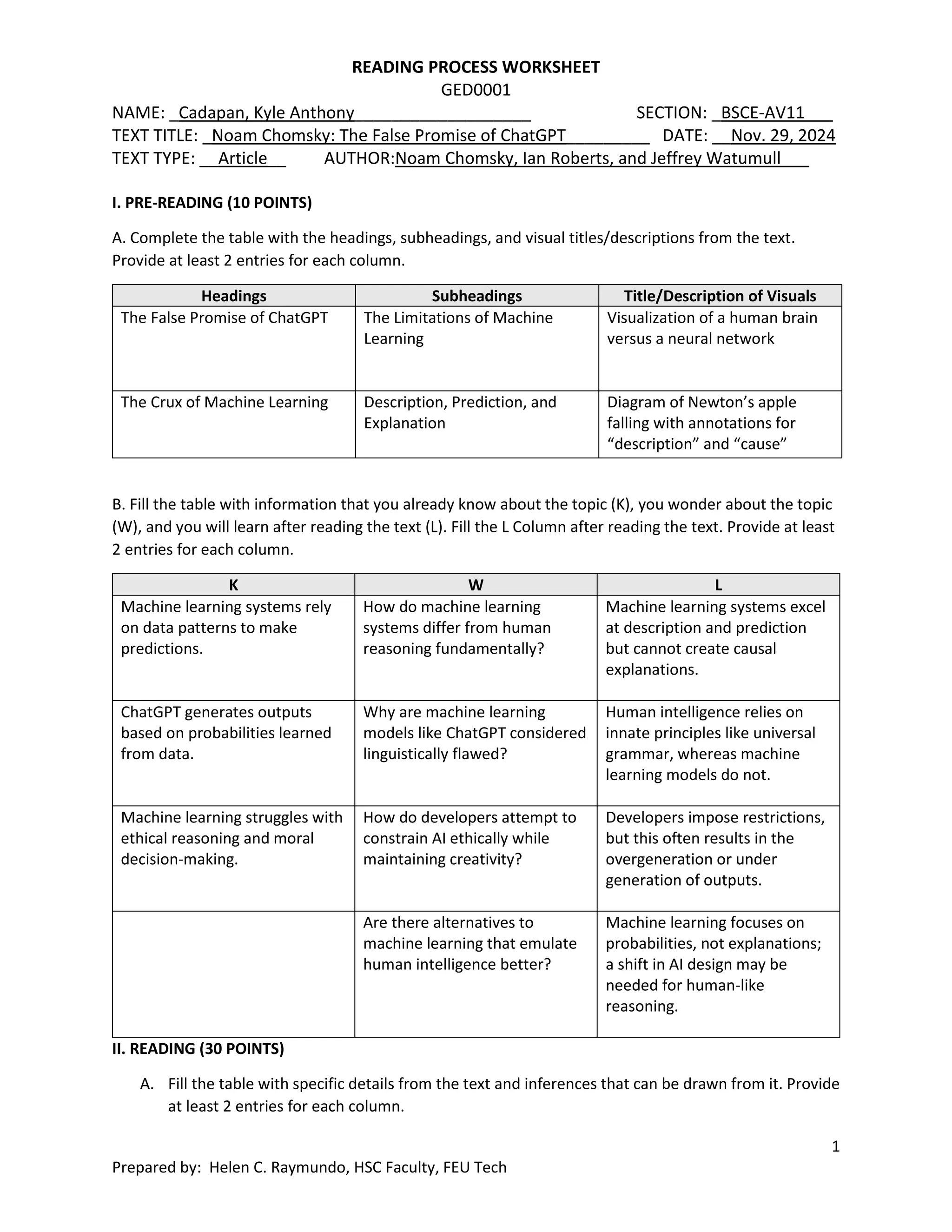
I. PRE-READING (10 POINTS)
A. Complete the table with the headings, subheadings, and visual titles/descriptions from the text.
Provide at least 2 entries for each column.
Headings Subheadings Title/Description of Visuals
The False Promise of ChatGPT The Limitations of Machine
Learning
Visualization of a human brain
versus a neural network
The Crux of Machine Learning Description, Prediction, and
Explanation
Diagram of Newton’s apple
falling with annotations for
“description” and “cause”
B. Fill the table with information that you already know about the topic (K), you wonder about the topic
(W), and you will learn after reading the text (L). Fill the L Column after reading the text. Provide at least
2 entries for each column.
K W L
Machine learning systems rely
on data patterns to make
predictions.
How do machine learning
systems differ from human
reasoning fundamentally?
Machine learning systems excel
at description and prediction
but cannot create causal
explanations.
ChatGPT generates outputs
based on probabilities learned
from data.
Why are machine learning
models like ChatGPT considered
linguistically flawed?
Human intelligence relies on
innate principles like universal
grammar, whereas machine
learning models do not.
Machine learning struggles with
ethical reasoning and moral
decision-making.
How do developers attempt to
constrain AI ethically while
maintaining creativity?
Developers impose restrictions,
but this often results in the
overgeneration or under
generation of outputs.
Are there alternatives to
machine learning that emulate
human intelligence better?
Machine learning focuses on
probabilities, not explanations;
a shift in AI design may be
needed for human-like
reasoning.
II. READING (30 POINTS)
A. Fill the table with specific details from the text and inferences that can be drawn from it. Provide
at least 2 entries for each column.
READING PROCESS WORKSHEET
GED0001
NAME: _Cadapan, Kyle Anthony___________________ SECTION: _BSCE-AV11___
TEXT TITLE: _Noam Chomsky: The False Promise of ChatGPT_________ DATE: __Nov. 29, 2024
TEXT TYPE: __Article__ AUTHOR:Noam Chomsky, Ian Roberts, and Jeffrey Watumull___
2
Prepared by: Helen C. Raymundo, HSC Faculty, FEU Tech
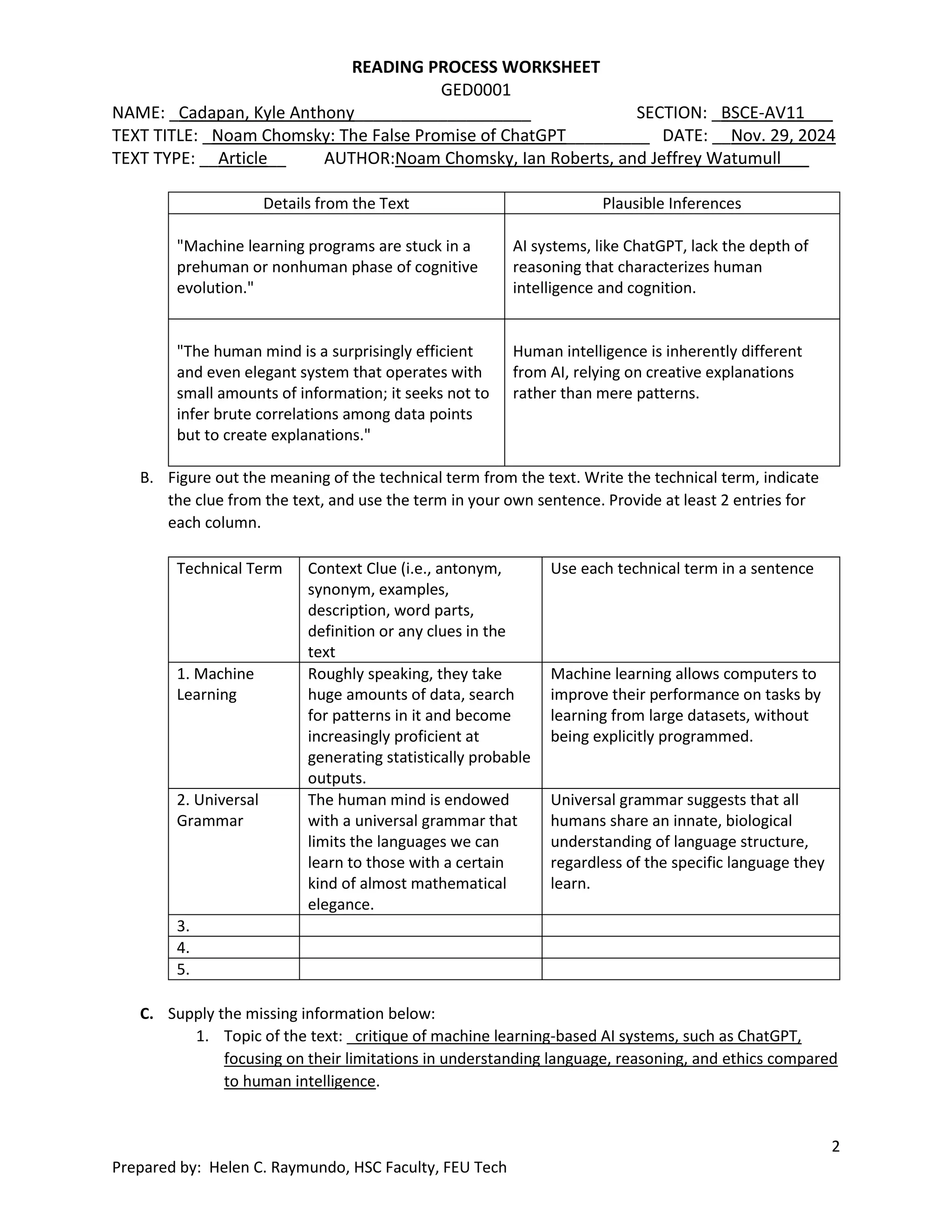
Details from the Text Plausible Inferences
"Machine learning programs are stuck in a
prehuman or nonhuman phase of cognitive
evolution."
AI systems, like ChatGPT, lack the depth of
reasoning that characterizes human
intelligence and cognition.
"The human mind is a surprisingly efficient
and even elegant system that operates with
small amounts of information; it seeks not to
infer brute correlations among data points
but to create explanations."
Human intelligence is inherently different
from AI, relying on creative explanations
rather than mere patterns.
B. Figure out the meaning of the technical term from the text. Write the technical term, indicate
the clue from the text, and use the term in your own sentence. Provide at least 2 entries for
each column.
Technical Term Context Clue (i.e., antonym,
synonym, examples,
description, word parts,
definition or any clues in the
text
Use each technical term in a sentence
1. Machine
Learning
Roughly speaking, they take
huge amounts of data, search
for patterns in it and become
increasingly proficient at
generating statistically probable
outputs.
Machine learning allows computers to
improve their performance on tasks by
learning from large datasets, without
being explicitly programmed.
2. Universal
Grammar
The human mind is endowed
with a universal grammar that
limits the languages we can
learn to those with a certain
kind of almost mathematical
elegance.
Universal grammar suggests that all
humans share an innate, biological
understanding of language structure,
regardless of the specific language they
learn.
3.
4.
5.
C. Supply the missing information below:
1. Topic of the text: _critique of machine learning-based AI systems, such as ChatGPT,
focusing on their limitations in understanding language, reasoning, and ethics compared
to human intelligence.
READING PROCESS WORKSHEET
GED0001
NAME: _Cadapan, Kyle Anthony___________________ SECTION: _BSCE-AV11___
TEXT TITLE: _Noam Chomsky: The False Promise of ChatGPT_________ DATE: __Nov. 29, 2024
TEXT TYPE: __Article__ AUTHOR:Noam Chomsky, Ian Roberts, and Jeffrey Watumull___
3
Prepared by: Helen C. Raymundo, HSC Faculty, FEU Tech
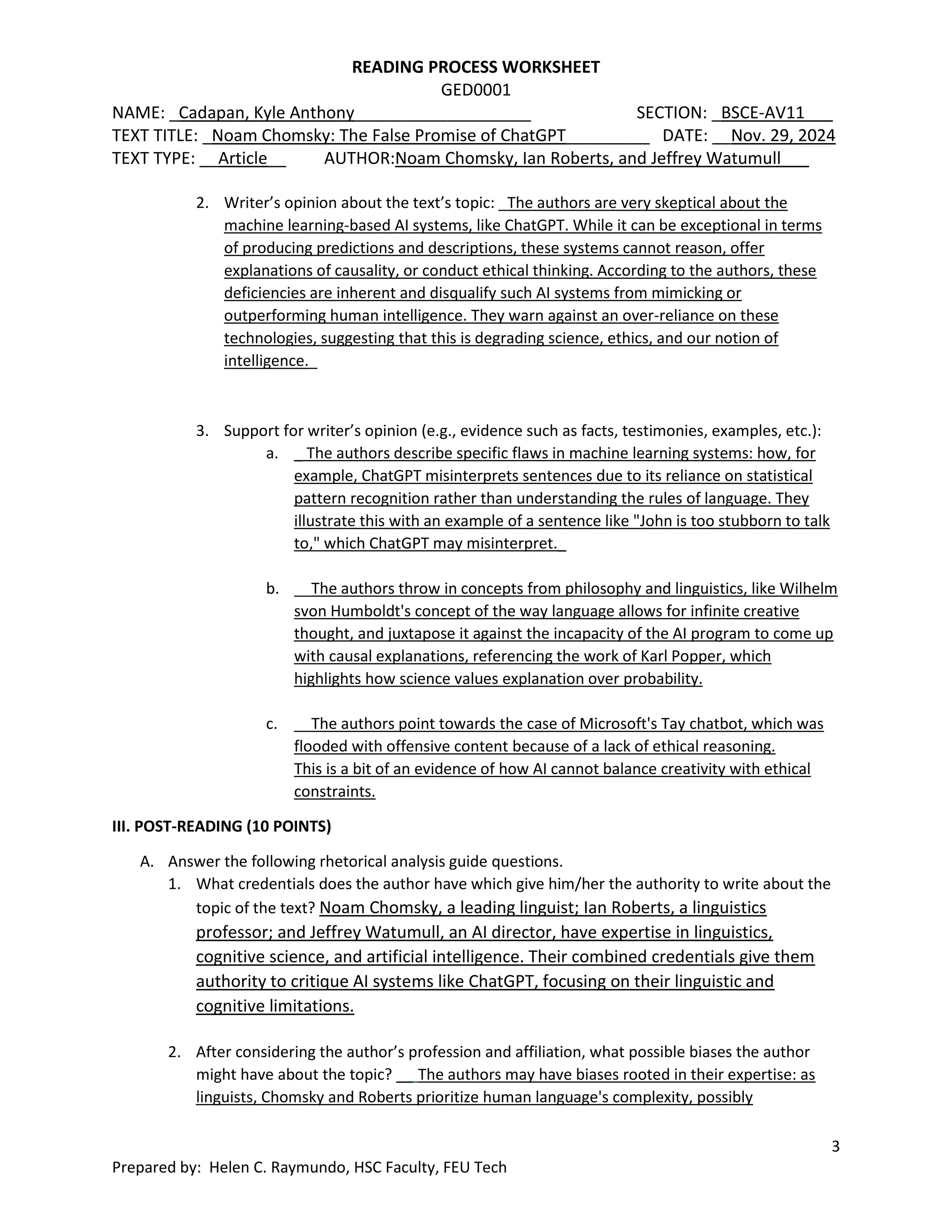
2. Writer’s opinion about the text’s topic: _The authors are very skeptical about the
machine learning-based AI systems, like ChatGPT. While it can be exceptional in terms
of producing predictions and descriptions, these systems cannot reason, offer
explanations of causality, or conduct ethical thinking. According to the authors, these
deficiencies are inherent and disqualify such AI systems from mimicking or
outperforming human intelligence. They warn against an over-reliance on these
technologies, suggesting that this is degrading science, ethics, and our notion of
intelligence._
3. Support for writer’s opinion (e.g., evidence such as facts, testimonies, examples, etc.):
a. _ The authors describe specific flaws in machine learning systems: how, for
example, ChatGPT misinterprets sentences due to its reliance on statistical
pattern recognition rather than understanding the rules of language. They
illustrate this with an example of a sentence like "John is too stubborn to talk
to," which ChatGPT may misinterpret._
b. __The authors throw in concepts from philosophy and linguistics, like Wilhelm
svon Humboldt's concept of the way language allows for infinite creative
thought, and juxtapose it against the incapacity of the AI program to come up
with causal explanations, referencing the work of Karl Popper, which
highlights how science values explanation over probability.
c. __The authors point towards the case of Microsoft's Tay chatbot, which was
flooded with offensive content because of a lack of ethical reasoning.
This is a bit of an evidence of how AI cannot balance creativity with ethical
constraints.
III. POST-READING (10 POINTS)
A. Answer the following rhetorical analysis guide questions.
1. What credentials does the author have which give him/her the authority to write about the
topic of the text? Noam Chomsky, a leading linguist; Ian Roberts, a linguistics
professor; and Jeffrey Watumull, an AI director, have expertise in linguistics,
cognitive science, and artificial intelligence. Their combined credentials give them
authority to critique AI systems like ChatGPT, focusing on their linguistic and
cognitive limitations.
2. After considering the author’s profession and affiliation, what possible biases the author
might have about the topic? __ The authors may have biases rooted in their expertise: as
linguists, Chomsky and Roberts prioritize human language's complexity, possibly
READING PROCESS WORKSHEET
GED0001
NAME: _Cadapan, Kyle Anthony___________________ SECTION: _BSCE-AV11___
TEXT TITLE: _Noam Chomsky: The False Promise of ChatGPT_________ DATE: __Nov. 29, 2024
TEXT TYPE: __Article__ AUTHOR:Noam Chomsky, Ian Roberts, and Jeffrey Watumull___
4
Prepared by: Helen C. Raymundo, HSC Faculty, FEU Tech
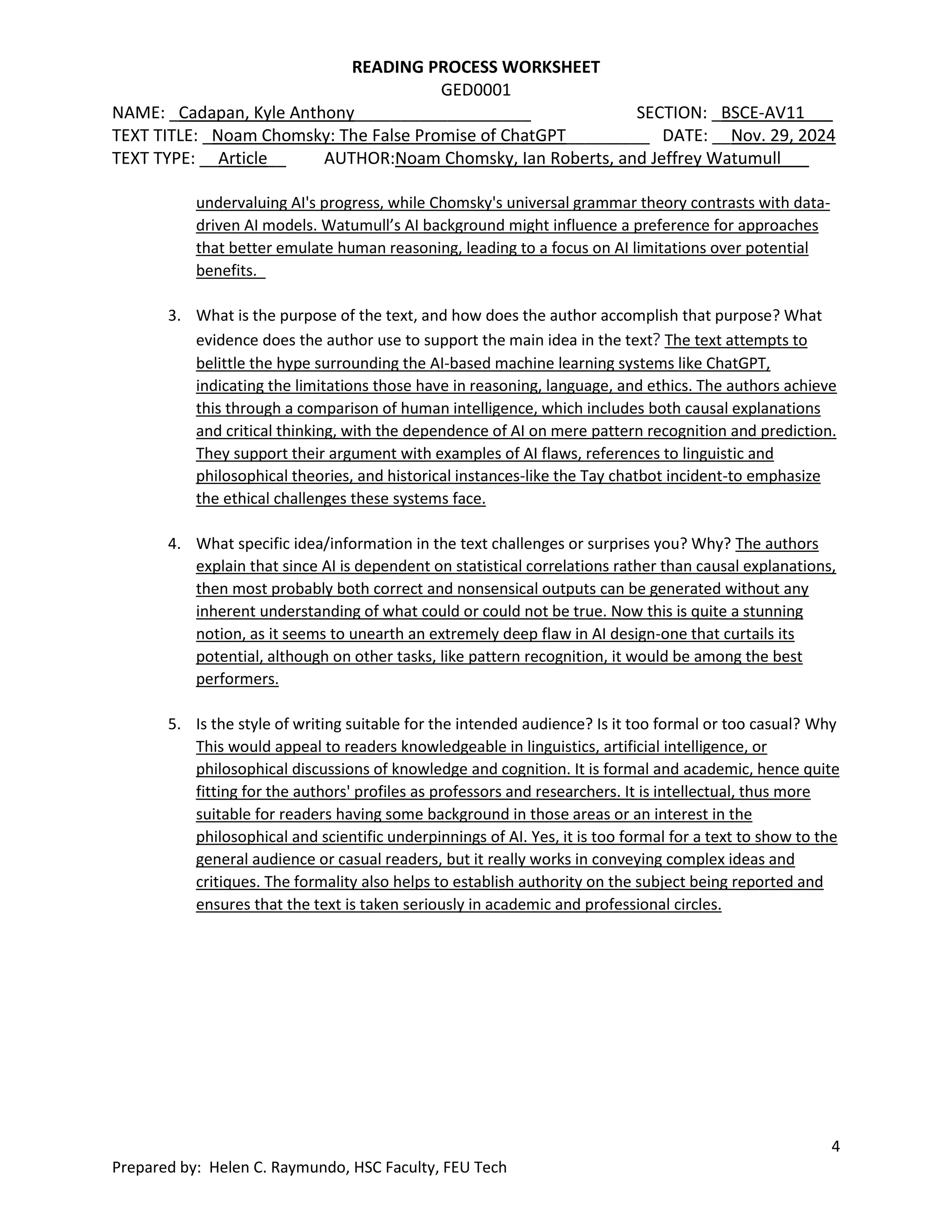
undervaluing AI's progress, while Chomsky's universal grammar theory contrasts with data-
driven AI models. Watumull’s AI background might influence a preference for approaches
that better emulate human reasoning, leading to a focus on AI limitations over potential
benefits._
3. What is the purpose of the text, and how does the author accomplish that purpose? What
evidence does the author use to support the main idea in the text? The text attempts to
belittle the hype surrounding the AI-based machine learning systems like ChatGPT,
indicating the limitations those have in reasoning, language, and ethics. The authors achieve
this through a comparison of human intelligence, which includes both causal explanations
and critical thinking, with the dependence of AI on mere pattern recognition and prediction.
They support their argument with examples of AI flaws, references to linguistic and
philosophical theories, and historical instances-like the Tay chatbot incident-to emphasize
the ethical challenges these systems face.
4. What specific idea/information in the text challenges or surprises you? Why? The authors
explain that since AI is dependent on statistical correlations rather than causal explanations,
then most probably both correct and nonsensical outputs can be generated without any
inherent understanding of what could or could not be true. Now this is quite a stunning
notion, as it seems to unearth an extremely deep flaw in AI design-one that curtails its
potential, although on other tasks, like pattern recognition, it would be among the best
performers.
5. Is the style of writing suitable for the intended audience? Is it too formal or too casual? Why
This would appeal to readers knowledgeable in linguistics, artificial intelligence, or
philosophical discussions of knowledge and cognition. It is formal and academic, hence quite
fitting for the authors' profiles as professors and researchers. It is intellectual, thus more
suitable for readers having some background in those areas or an interest in the
philosophical and scientific underpinnings of AI. Yes, it is too formal for a text to show to the
general audience or casual readers, but it really works in conveying complex ideas and
critiques. The formality also helps to establish authority on the subject being reported and
ensures that the text is taken seriously in academic and professional circles.

Reading Process Worksheet article 2.pdf

  • 1.
    READING PROCESS WORKSHEET GED0001 NAME:_Cadapan, Kyle Anthony___________________ SECTION: _BSCE-AV11___ TEXT TITLE: _Noam Chomsky: The False Promise of ChatGPT_________ DATE: __Nov. 29, 2024 TEXT TYPE: __Article__ AUTHOR:Noam Chomsky, Ian Roberts, and Jeffrey Watumull___ 1 Prepared by: Helen C. Raymundo, HSC Faculty, FEU Tech I. PRE-READING (10 POINTS) A. Complete the table with the headings, subheadings, and visual titles/descriptions from the text. Provide at least 2 entries for each column. Headings Subheadings Title/Description of Visuals The False Promise of ChatGPT The Limitations of Machine Learning Visualization of a human brain versus a neural network The Crux of Machine Learning Description, Prediction, and Explanation Diagram of Newton’s apple falling with annotations for “description” and “cause” B. Fill the table with information that you already know about the topic (K), you wonder about the topic (W), and you will learn after reading the text (L). Fill the L Column after reading the text. Provide at least 2 entries for each column. K W L Machine learning systems rely on data patterns to make predictions. How do machine learning systems differ from human reasoning fundamentally? Machine learning systems excel at description and prediction but cannot create causal explanations. ChatGPT generates outputs based on probabilities learned from data. Why are machine learning models like ChatGPT considered linguistically flawed? Human intelligence relies on innate principles like universal grammar, whereas machine learning models do not. Machine learning struggles with ethical reasoning and moral decision-making. How do developers attempt to constrain AI ethically while maintaining creativity? Developers impose restrictions, but this often results in the overgeneration or under generation of outputs. Are there alternatives to machine learning that emulate human intelligence better? Machine learning focuses on probabilities, not explanations; a shift in AI design may be needed for human-like reasoning. II. READING (30 POINTS) A. Fill the table with specific details from the text and inferences that can be drawn from it. Provide at least 2 entries for each column.
  • 2.
    READING PROCESS WORKSHEET GED0001 NAME:_Cadapan, Kyle Anthony___________________ SECTION: _BSCE-AV11___ TEXT TITLE: _Noam Chomsky: The False Promise of ChatGPT_________ DATE: __Nov. 29, 2024 TEXT TYPE: __Article__ AUTHOR:Noam Chomsky, Ian Roberts, and Jeffrey Watumull___ 2 Prepared by: Helen C. Raymundo, HSC Faculty, FEU Tech Details from the Text Plausible Inferences "Machine learning programs are stuck in a prehuman or nonhuman phase of cognitive evolution." AI systems, like ChatGPT, lack the depth of reasoning that characterizes human intelligence and cognition. "The human mind is a surprisingly efficient and even elegant system that operates with small amounts of information; it seeks not to infer brute correlations among data points but to create explanations." Human intelligence is inherently different from AI, relying on creative explanations rather than mere patterns. B. Figure out the meaning of the technical term from the text. Write the technical term, indicate the clue from the text, and use the term in your own sentence. Provide at least 2 entries for each column. Technical Term Context Clue (i.e., antonym, synonym, examples, description, word parts, definition or any clues in the text Use each technical term in a sentence 1. Machine Learning Roughly speaking, they take huge amounts of data, search for patterns in it and become increasingly proficient at generating statistically probable outputs. Machine learning allows computers to improve their performance on tasks by learning from large datasets, without being explicitly programmed. 2. Universal Grammar The human mind is endowed with a universal grammar that limits the languages we can learn to those with a certain kind of almost mathematical elegance. Universal grammar suggests that all humans share an innate, biological understanding of language structure, regardless of the specific language they learn. 3. 4. 5. C. Supply the missing information below: 1. Topic of the text: _critique of machine learning-based AI systems, such as ChatGPT, focusing on their limitations in understanding language, reasoning, and ethics compared to human intelligence.
  • 3.
    READING PROCESS WORKSHEET GED0001 NAME:_Cadapan, Kyle Anthony___________________ SECTION: _BSCE-AV11___ TEXT TITLE: _Noam Chomsky: The False Promise of ChatGPT_________ DATE: __Nov. 29, 2024 TEXT TYPE: __Article__ AUTHOR:Noam Chomsky, Ian Roberts, and Jeffrey Watumull___ 3 Prepared by: Helen C. Raymundo, HSC Faculty, FEU Tech 2. Writer’s opinion about the text’s topic: _The authors are very skeptical about the machine learning-based AI systems, like ChatGPT. While it can be exceptional in terms of producing predictions and descriptions, these systems cannot reason, offer explanations of causality, or conduct ethical thinking. According to the authors, these deficiencies are inherent and disqualify such AI systems from mimicking or outperforming human intelligence. They warn against an over-reliance on these technologies, suggesting that this is degrading science, ethics, and our notion of intelligence._ 3. Support for writer’s opinion (e.g., evidence such as facts, testimonies, examples, etc.): a. _ The authors describe specific flaws in machine learning systems: how, for example, ChatGPT misinterprets sentences due to its reliance on statistical pattern recognition rather than understanding the rules of language. They illustrate this with an example of a sentence like "John is too stubborn to talk to," which ChatGPT may misinterpret._ b. __The authors throw in concepts from philosophy and linguistics, like Wilhelm svon Humboldt's concept of the way language allows for infinite creative thought, and juxtapose it against the incapacity of the AI program to come up with causal explanations, referencing the work of Karl Popper, which highlights how science values explanation over probability. c. __The authors point towards the case of Microsoft's Tay chatbot, which was flooded with offensive content because of a lack of ethical reasoning. This is a bit of an evidence of how AI cannot balance creativity with ethical constraints. III. POST-READING (10 POINTS) A. Answer the following rhetorical analysis guide questions. 1. What credentials does the author have which give him/her the authority to write about the topic of the text? Noam Chomsky, a leading linguist; Ian Roberts, a linguistics professor; and Jeffrey Watumull, an AI director, have expertise in linguistics, cognitive science, and artificial intelligence. Their combined credentials give them authority to critique AI systems like ChatGPT, focusing on their linguistic and cognitive limitations. 2. After considering the author’s profession and affiliation, what possible biases the author might have about the topic? __ The authors may have biases rooted in their expertise: as linguists, Chomsky and Roberts prioritize human language's complexity, possibly
  • 4.
    READING PROCESS WORKSHEET GED0001 NAME:_Cadapan, Kyle Anthony___________________ SECTION: _BSCE-AV11___ TEXT TITLE: _Noam Chomsky: The False Promise of ChatGPT_________ DATE: __Nov. 29, 2024 TEXT TYPE: __Article__ AUTHOR:Noam Chomsky, Ian Roberts, and Jeffrey Watumull___ 4 Prepared by: Helen C. Raymundo, HSC Faculty, FEU Tech undervaluing AI's progress, while Chomsky's universal grammar theory contrasts with data- driven AI models. Watumull’s AI background might influence a preference for approaches that better emulate human reasoning, leading to a focus on AI limitations over potential benefits._ 3. What is the purpose of the text, and how does the author accomplish that purpose? What evidence does the author use to support the main idea in the text? The text attempts to belittle the hype surrounding the AI-based machine learning systems like ChatGPT, indicating the limitations those have in reasoning, language, and ethics. The authors achieve this through a comparison of human intelligence, which includes both causal explanations and critical thinking, with the dependence of AI on mere pattern recognition and prediction. They support their argument with examples of AI flaws, references to linguistic and philosophical theories, and historical instances-like the Tay chatbot incident-to emphasize the ethical challenges these systems face. 4. What specific idea/information in the text challenges or surprises you? Why? The authors explain that since AI is dependent on statistical correlations rather than causal explanations, then most probably both correct and nonsensical outputs can be generated without any inherent understanding of what could or could not be true. Now this is quite a stunning notion, as it seems to unearth an extremely deep flaw in AI design-one that curtails its potential, although on other tasks, like pattern recognition, it would be among the best performers. 5. Is the style of writing suitable for the intended audience? Is it too formal or too casual? Why This would appeal to readers knowledgeable in linguistics, artificial intelligence, or philosophical discussions of knowledge and cognition. It is formal and academic, hence quite fitting for the authors' profiles as professors and researchers. It is intellectual, thus more suitable for readers having some background in those areas or an interest in the philosophical and scientific underpinnings of AI. Yes, it is too formal for a text to show to the general audience or casual readers, but it really works in conveying complex ideas and critiques. The formality also helps to establish authority on the subject being reported and ensures that the text is taken seriously in academic and professional circles.