Reading day
National Reading Day is observed in India on June
19th to honour the life and work of Puthuvayil
Narayana Panicker, who is widely regarded as the
Father of India's Library Movement.
The Importance
of Reading
Reading makes you utilize your
brain, which in turn:
▪ improves concentration
▪ improves ability to pay attention
▪ improves ability to focus for
longer periods of time
1. Reading is a complex mental task.
▪ Making time for books everyday
improves discipline and is shown to be
personally rewarding over time.
▪ Reading helps you to use and even
improve your memory by remembering
details, characters, plots, and more.
2. Reading improves discipline and
memory.
▪ Reading more expands the amount of
knowledge you have.
▪ More knowledge leads to higher
confidence.
▪ Higher confidence boosts self-esteem.
3. Reading builds self-esteem.
▪ Reading about new things challenges
your brain to think in new ways.
▪ Reading helps to develop the creative
side of the brain by exposing it to
unique or unfamiliar ideas.
4. Reading improves creativity.
▪ Reading challenging books will expose
you to many new words.
▪ With the help of a dictionary and
context clues, you will be able to build
your vocabulary in no time.
5. Reading improves vocabulary.
▪ Reading strengthens and improves
imagination by putting the brain in new
situations.
▪ Our brain processes descriptions by
putting them into mental pictures.
▪ This also reduces boredom and
enhances activity.
6. Reading inceases imagination.
▪ Reading gives you an insight into
diversity and other cultures.
▪ It teaches you about people, places,
and events outside of your own
experiences.
▪ It teaches you about different beliefs
and ways of life that may be new to
7. Reading broadens your horizons.
▪ Reading helps us to develop empathy by
allowing us to feel what our characters feel and
put ourselves in someone else' shoes.
▪ It also builds a strong sense of compassion.
▪ Reading establishes a better understanding of
human nature.
8. Reading helps develop a strong sense of
character.
▪ It doesn't just improve English/Language
Arts, or even history. Avid readers got
better grades across all subjects, even
math.
▪ Avid readers also are known to get
better grades throughout middle, high
school, and college.
9. Reading improves school
performance.
▪ You speak thousands of words
everyday.
▪ Many people write something everyday.
▪ Avid readers find it easier to
communicate because of their expanded
vocabularies and practice of vocabulary
through reading.
10. Words are our everyday tools.
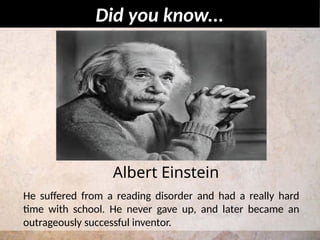
He suffered from a reading disorder and had a really hard
time with school. He never gave up, and later became an
outrageously successful inventor.
Did you know...
Albert Einstein
- He is an American politician who is the 44th and current president of United
States.
- He wrote 30 books.
Did you know...
Pres. Barack Obama
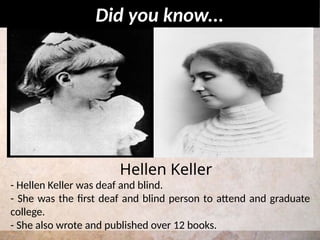
- Hellen Keller was deaf and blind.
- She was the first deaf and blind person to attend and graduate
college.
- She also wrote and published over 12 books.
Did you know...
Hellen Keller
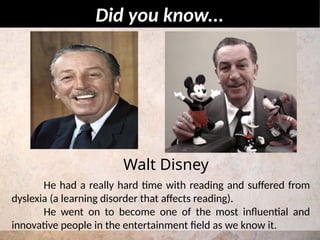
He had a really hard time with reading and suffered from
dyslexia (a learning disorder that affects reading).
He went on to become one of the most influential and
innovative people in the entertainment field as we know it.
Did you know...
Walt Disney
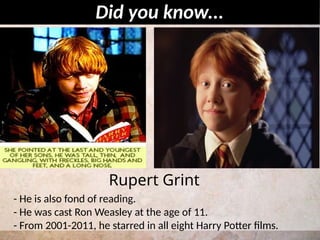
- He is also fond of reading.
- He was cast Ron Weasley at the age of 11.
- From 2001-2011, he starred in all eight Harry Potter films.
Did you know...
Rupert Grint
by Francis Bacon
“Reading makes a full
man.”

reading day.pptx explaining reading day.

  • 1.
    Reading day National ReadingDay is observed in India on June 19th to honour the life and work of Puthuvayil Narayana Panicker, who is widely regarded as the Father of India's Library Movement.
  • 3.
  • 4.
    Reading makes youutilize your brain, which in turn: ▪ improves concentration ▪ improves ability to pay attention ▪ improves ability to focus for longer periods of time 1. Reading is a complex mental task.
  • 5.
    ▪ Making timefor books everyday improves discipline and is shown to be personally rewarding over time. ▪ Reading helps you to use and even improve your memory by remembering details, characters, plots, and more. 2. Reading improves discipline and memory.
  • 6.
    ▪ Reading moreexpands the amount of knowledge you have. ▪ More knowledge leads to higher confidence. ▪ Higher confidence boosts self-esteem. 3. Reading builds self-esteem.
  • 7.
    ▪ Reading aboutnew things challenges your brain to think in new ways. ▪ Reading helps to develop the creative side of the brain by exposing it to unique or unfamiliar ideas. 4. Reading improves creativity.
  • 8.
    ▪ Reading challengingbooks will expose you to many new words. ▪ With the help of a dictionary and context clues, you will be able to build your vocabulary in no time. 5. Reading improves vocabulary.
  • 9.
    ▪ Reading strengthensand improves imagination by putting the brain in new situations. ▪ Our brain processes descriptions by putting them into mental pictures. ▪ This also reduces boredom and enhances activity. 6. Reading inceases imagination.
  • 10.
    ▪ Reading givesyou an insight into diversity and other cultures. ▪ It teaches you about people, places, and events outside of your own experiences. ▪ It teaches you about different beliefs and ways of life that may be new to 7. Reading broadens your horizons.
  • 11.
    ▪ Reading helpsus to develop empathy by allowing us to feel what our characters feel and put ourselves in someone else' shoes. ▪ It also builds a strong sense of compassion. ▪ Reading establishes a better understanding of human nature. 8. Reading helps develop a strong sense of character.
  • 12.
    ▪ It doesn'tjust improve English/Language Arts, or even history. Avid readers got better grades across all subjects, even math. ▪ Avid readers also are known to get better grades throughout middle, high school, and college. 9. Reading improves school performance.
  • 13.
    ▪ You speakthousands of words everyday. ▪ Many people write something everyday. ▪ Avid readers find it easier to communicate because of their expanded vocabularies and practice of vocabulary through reading. 10. Words are our everyday tools.
  • 14.
    He suffered froma reading disorder and had a really hard time with school. He never gave up, and later became an outrageously successful inventor. Did you know... Albert Einstein
  • 15.
    - He isan American politician who is the 44th and current president of United States. - He wrote 30 books. Did you know... Pres. Barack Obama
  • 16.
    - Hellen Kellerwas deaf and blind. - She was the first deaf and blind person to attend and graduate college. - She also wrote and published over 12 books. Did you know... Hellen Keller
  • 17.
    He had areally hard time with reading and suffered from dyslexia (a learning disorder that affects reading). He went on to become one of the most influential and innovative people in the entertainment field as we know it. Did you know... Walt Disney
  • 18.
    - He isalso fond of reading. - He was cast Ron Weasley at the age of 11. - From 2001-2011, he starred in all eight Harry Potter films. Did you know... Rupert Grint
  • 19.
    by Francis Bacon “Readingmakes a full man.”