Cross Disciplinary Studio Reading Presentation
Cartographies of the
Networked World
Team 3
Jianan Gu
Soham Khadatare
Brian L. Krohnengold
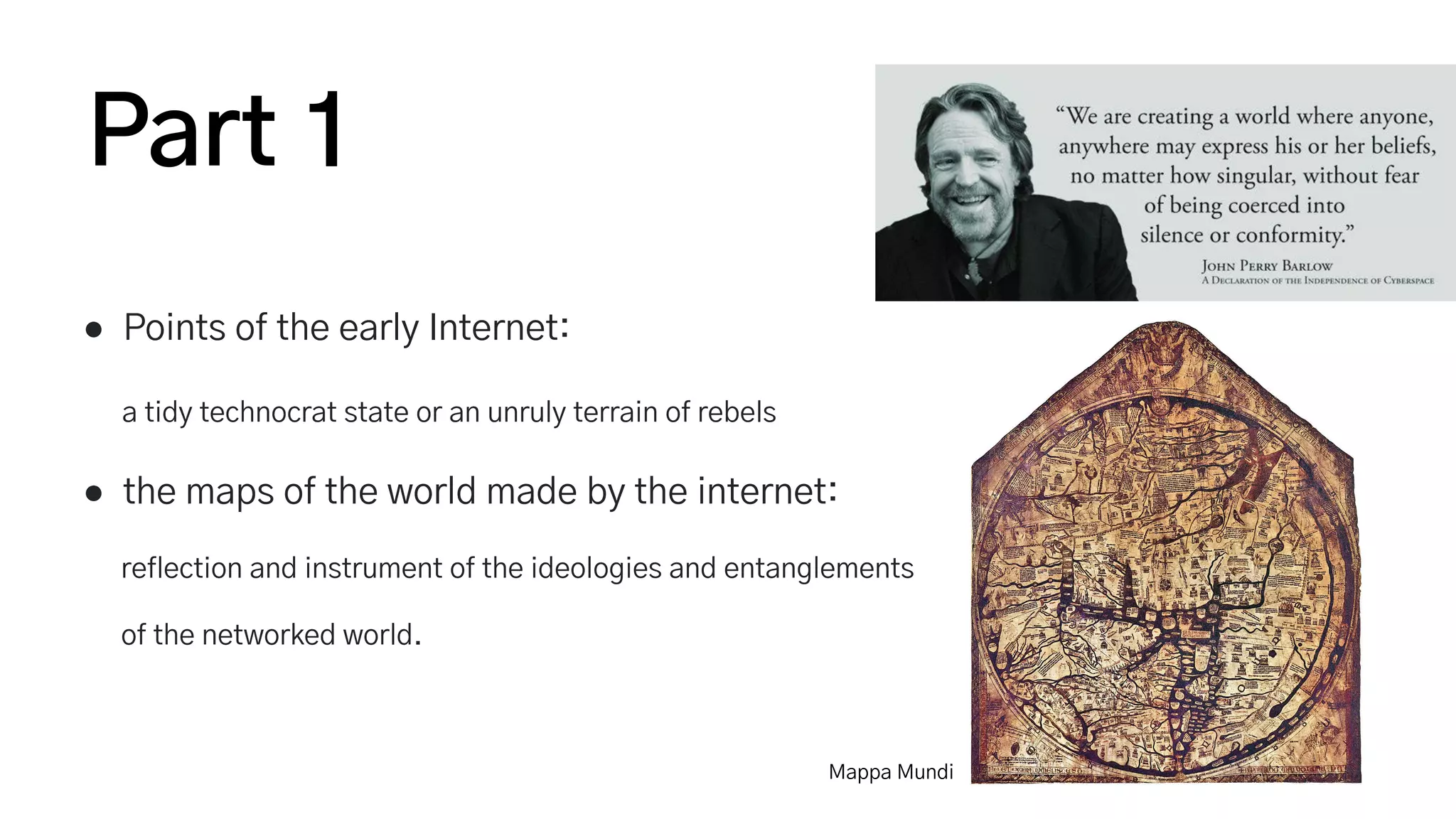
● Points of the early Internet:
a tidy technocrat state or an unruly terrain of rebels
● the maps of the world made by the internet:
reflection and instrument of the ideologies and entanglements
of the networked world.
Part 1
Mappa Mundi
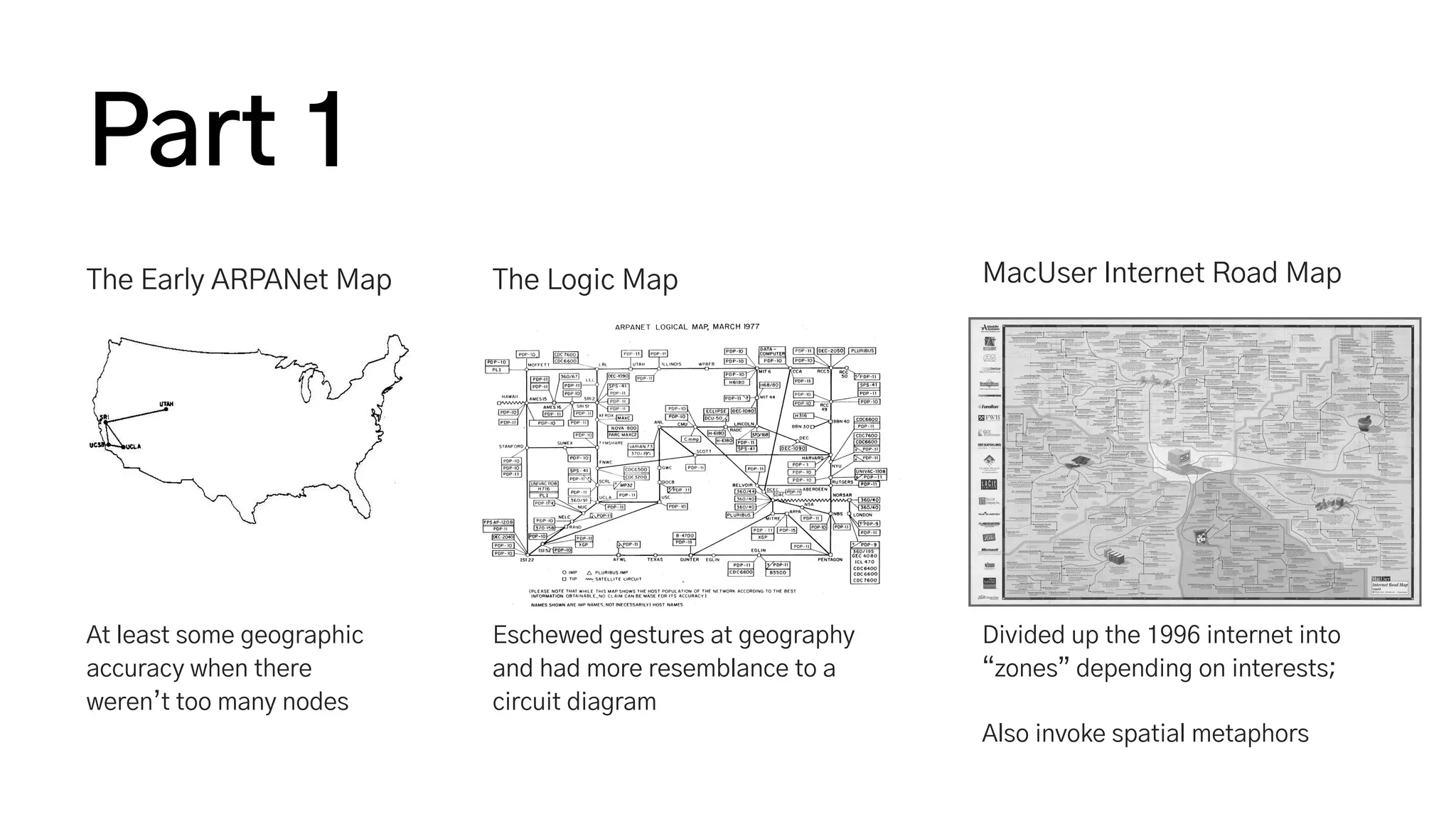
The Early ARPANet Map
At least some geographic
accuracy when there
weren’t too many nodes
The Logic Map
Eschewed gestures at geography
and had more resemblance to a
circuit diagram
MacUser Internet Road Map
Divided up the 1996 internet into
“zones” depending on interests;
Also invoke spatial metaphors
Part 1
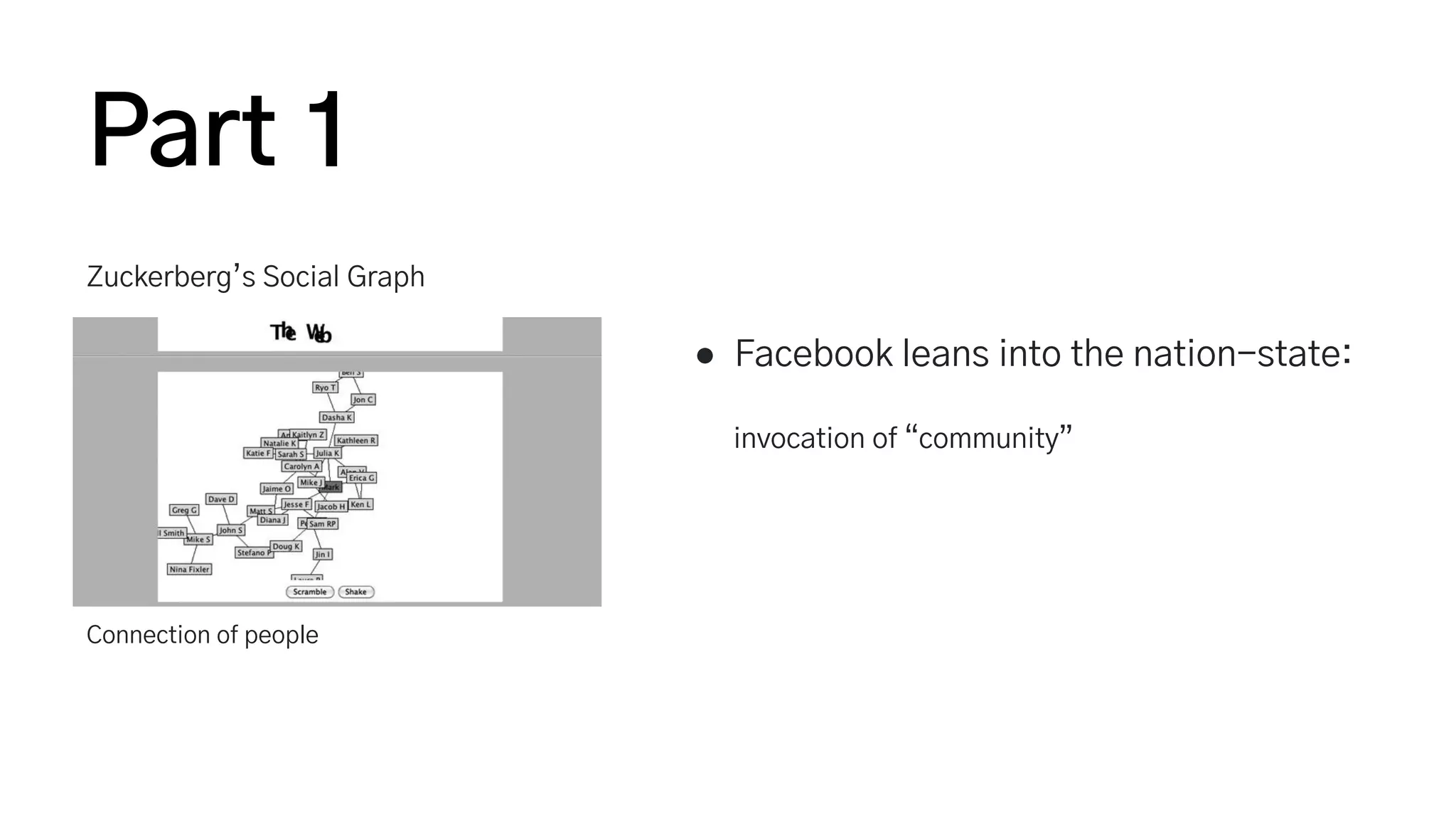
Zuckerberg’s Social Graph
Connection of people
Part 1
● Facebook leans into the nation-state:
invocation of “community”
Part 1
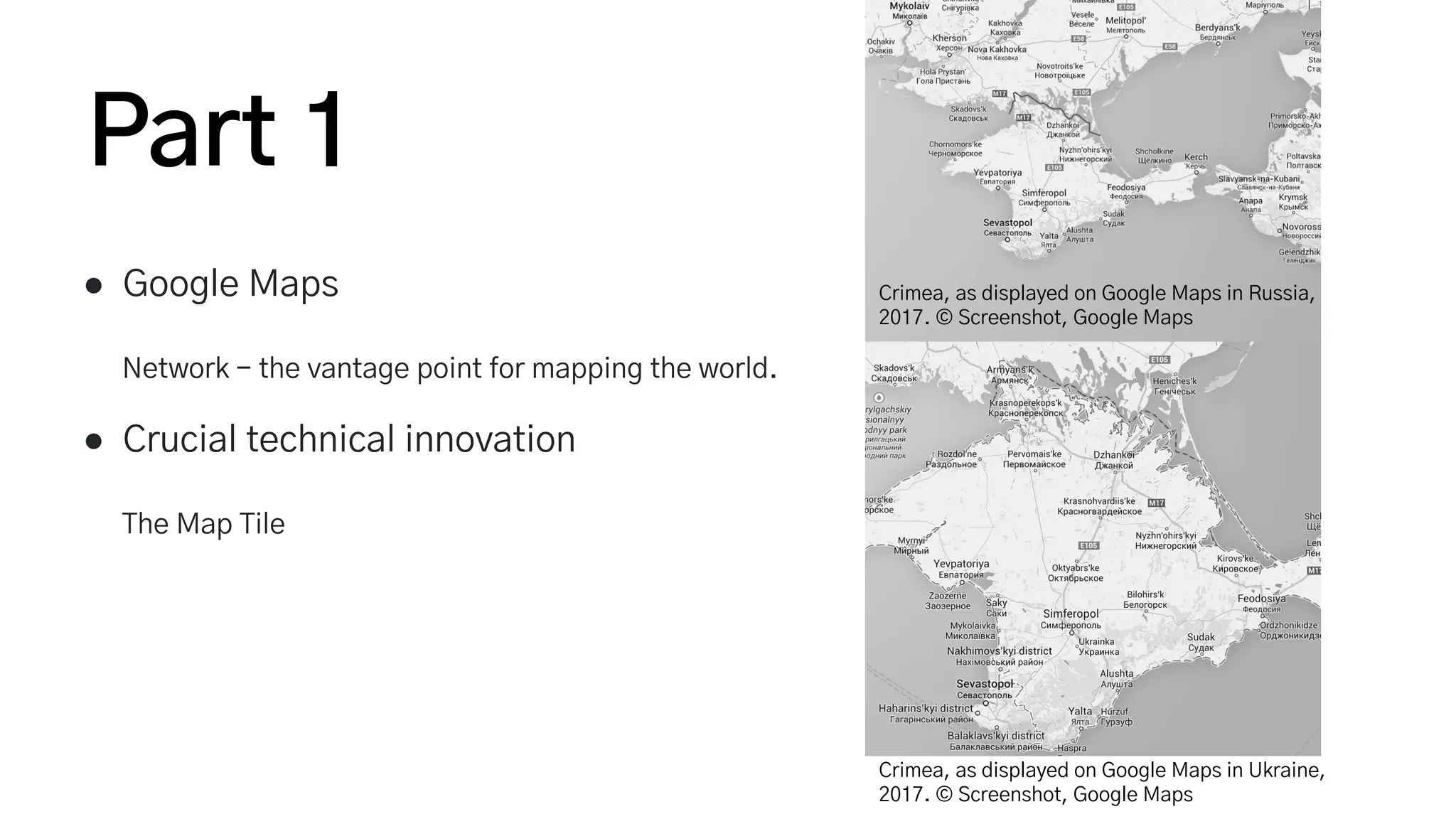
● Google Maps
Network - the vantage point for mapping the world.
● Crucial technical innovation
The Map Tile
Crimea, as displayed on Google Maps in Russia,
2017. © Screenshot, Google Maps
Crimea, as displayed on Google Maps in Ukraine,
2017. © Screenshot, Google Maps
● Google, technological innovation and a
new mode of mapping.
● The “slippy map” a seamless mapping
technology for viewing the entirety of
the earth’s surface.
● Created via utilization of individual tiles
which, independently loaded, allowed
user to pan across the entire globe.
● Increase in satellite visualization does
not however mean a full reduction in
obfuscation of reality.
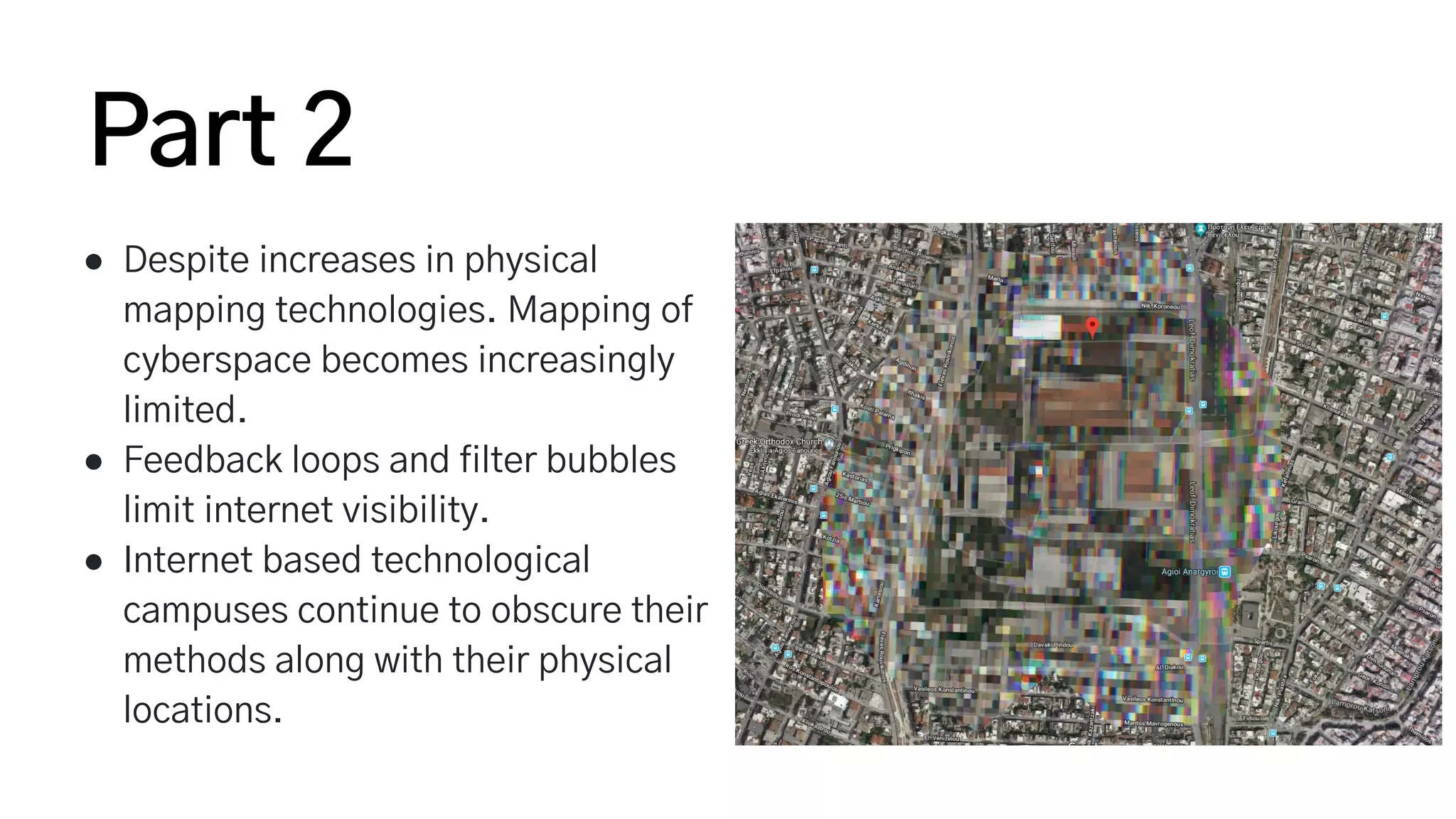
Part 2
● Despite increases in physical
mapping technologies. Mapping of
cyberspace becomes increasingly
limited.
● Feedback loops and filter bubbles
limit internet visibility.
● Internet based technological
campuses continue to obscure their
methods along with their physical
locations.
Part 2
● As internet based technological entities increase in size and influence, they
begin greater expansion into physical spaces.
● Trading resources gained from internet spaces to build physical spaces
catered to their growing needs and desires.
● The outsized influence of these giants in cyberspace begins to have
implications on our physical lives.
Part 2
● Visualization of people connected by Facebook and its redundancy in
representing the interactions in its platform.
● Propaganda of Facebookistan: Connectedness and darkness (China)
● Power of Companies over freedom of speech and governments.
● The purpose of a system is what it does. “A sovereign is only ever as stable
as its underworld, and it’s worth asking whether recent manipulation of
platforms to propagate misinformation and hate speech is an example of
transgressive use, or the platform working exactly as it was intended.”
Part 3
● Platforms making us dependent no their system while they work against our
own good. Slippage as Freefall.
● Physical entities that represent the content ‘created’ by Facebook and
Google needs to be destroyed/replaced.
● We need to create our own databases and maps.
Part 3
● What are the similarities and differences can be identified between Internet
world and a state during the development of mapping?
● If neither government agencies or corporate entities can be relied on to
provide a transparent view of the internet, how can individuals and society
design a better cyber system?
● What aspects of maps would be valued by us if we were to create it for
ourselves?
Additional Questions

Reading 3-Cartographies of the Networked World

  • 1.
    Cross Disciplinary StudioReading Presentation Cartographies of the Networked World Team 3 Jianan Gu Soham Khadatare Brian L. Krohnengold
  • 2.
    ● Points ofthe early Internet: a tidy technocrat state or an unruly terrain of rebels ● the maps of the world made by the internet: reflection and instrument of the ideologies and entanglements of the networked world. Part 1 Mappa Mundi
  • 3.
    The Early ARPANetMap At least some geographic accuracy when there weren’t too many nodes The Logic Map Eschewed gestures at geography and had more resemblance to a circuit diagram MacUser Internet Road Map Divided up the 1996 internet into “zones” depending on interests; Also invoke spatial metaphors Part 1
  • 4.
    Zuckerberg’s Social Graph Connectionof people Part 1 ● Facebook leans into the nation-state: invocation of “community”
  • 5.
    Part 1 ● GoogleMaps Network - the vantage point for mapping the world. ● Crucial technical innovation The Map Tile Crimea, as displayed on Google Maps in Russia, 2017. © Screenshot, Google Maps Crimea, as displayed on Google Maps in Ukraine, 2017. © Screenshot, Google Maps
  • 6.
    ● Google, technologicalinnovation and a new mode of mapping. ● The “slippy map” a seamless mapping technology for viewing the entirety of the earth’s surface. ● Created via utilization of individual tiles which, independently loaded, allowed user to pan across the entire globe. ● Increase in satellite visualization does not however mean a full reduction in obfuscation of reality. Part 2
  • 7.
    ● Despite increasesin physical mapping technologies. Mapping of cyberspace becomes increasingly limited. ● Feedback loops and filter bubbles limit internet visibility. ● Internet based technological campuses continue to obscure their methods along with their physical locations. Part 2
  • 8.
    ● As internetbased technological entities increase in size and influence, they begin greater expansion into physical spaces. ● Trading resources gained from internet spaces to build physical spaces catered to their growing needs and desires. ● The outsized influence of these giants in cyberspace begins to have implications on our physical lives. Part 2
  • 9.
    ● Visualization ofpeople connected by Facebook and its redundancy in representing the interactions in its platform. ● Propaganda of Facebookistan: Connectedness and darkness (China) ● Power of Companies over freedom of speech and governments. ● The purpose of a system is what it does. “A sovereign is only ever as stable as its underworld, and it’s worth asking whether recent manipulation of platforms to propagate misinformation and hate speech is an example of transgressive use, or the platform working exactly as it was intended.” Part 3
  • 10.
    ● Platforms makingus dependent no their system while they work against our own good. Slippage as Freefall. ● Physical entities that represent the content ‘created’ by Facebook and Google needs to be destroyed/replaced. ● We need to create our own databases and maps. Part 3
  • 11.
    ● What arethe similarities and differences can be identified between Internet world and a state during the development of mapping? ● If neither government agencies or corporate entities can be relied on to provide a transparent view of the internet, how can individuals and society design a better cyber system? ● What aspects of maps would be valued by us if we were to create it for ourselves? Additional Questions