



An Analytical Study
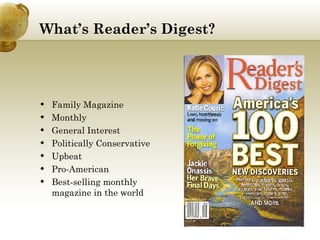
What’s Reader’s Digest? Family Magazine Monthly General Interest Politically Conservative Upbeat Pro-American Best-selling monthly magazine in the world
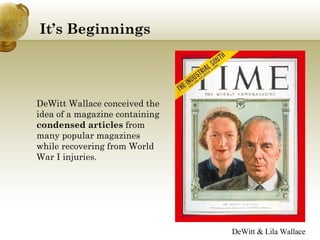
It’s Beginnings DeWitt Wallace conceived the idea of a magazine containing  condensed articles  from many popular magazines while recovering from World War I injuries.  DeWitt & Lila Wallace
It’s Beginnings – Facts & Figures First issue - February 5,  1922 First published from  home Initially  10¢  a copy by mail Newsstands –  1929 1 Million  Copies circulation was achieved in  1935  (US) 10 Billion  Copies –  1994  (US)
Vision The magazine's  mission  as set out by the Wallaces is to include  one article  for  each day  of the month Each article should be of " enduring value and interest "
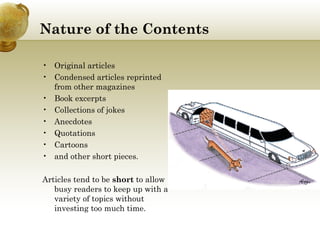
Nature of the Contents Original articles Condensed articles reprinted from other magazines Book excerpts Collections of jokes Anecdotes Quotations Cartoons and other short pieces. Articles tend to be  short  to allow busy readers to keep up with a variety of topics without investing too much time.
Topics & Regulars Regulars " Word Power “ - a vocabulary-building quiz " Life in These United States “ - a collection of humorous or profound reader-submitted anecdotes (US Edition) " Laughter, the Best Medicine " a collection of jokes submitted by readers True Stories People Columnists’ Sections National Interest Health Games & Humor RD Living » Food » Family » Home & Garden » Money
Editorial Procedures One of the  most carefully edited magazines  in the world Articles are  fact-checked  for authenticity and controlled by an elaborate editorial hierarchy to ensure that the final product is integrated into the  discourse  This discourse is highly  homogeneous  and articulates a very specific set of  conservative  values which the magazine deems to be important aspects of the dominant representation of American society The  Reader's Digest  model has been introduced in many countries around the world, in issues that are  customized to a certain extent with local content , without presenting the magazine as an American product.
Structure Usually one survival story (called "Drama in Real Life")  Normally at least one individual achievement story At least one medical article Several moralizing stories on human relations Several articles with practical advice Some politically inspired stories in which bureaucracy, crime, radical ideologies and other behavior inconsistent with the dominant ideology of the magazine are exposed
Internal   Structure Corresponds to an elaborate and fixed model. The survival stories have a blurb presenting the drama  in medias res  (in the middle), then return in time with an elaborate description of the initial situation. Rescue doesn't come at the very last paragraph: there is always time to restore the initial peace and formulate a lesson. The last sentences often thank the Lord or mention the medals awarded to the story's heroes.
The   Discourse Individual achievement.   Digest  characters are always struggling, against bad luck, against systems and regulations, against diseases, and their only weapons are their own courage, cooperation between individuals, and an occasional helping hand from God.  Optimism.  Most  Digest  stories have happy endings. There is only one other case: the article may acknowledge in the end that there are still many difficulties to overcome, and give advice.  Moral conservatism.  Though the  Digest  has from the beginning written very openly on sexuality, it has always been emphatically in favor of traditional marriage, loyalty to country, discipline and charity, and generally opposed to feminism, free love and affirmative action.  Free market economy.  In almost every issue, the magazine opposes taxes, government regulations, budget increases, labor unions and, for many decades, the Communist system.
International   editions First international edition –  United Kingdom, 1938 Worldwide circulation:  21 million  copies Readership over  1 billion  readers 49  foreign editions, accounting for about 50% of its trade volume
Localization   Procedures American articles are integrated within the local context  Local editions avoid reprinting articles which may touch on sensitive spots in the receiving culture Advertisement placement in the local editions are entirely managed by the local staff and reflect local products.  Considerable efforts are made to give the foreign editions a local look Selected articles are translated by local translators and the translations edited by the local editors to make them match the "well-educated informal" style of the American edition.
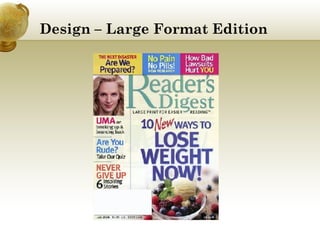
Other Editions Large-type edition called  Reader's Digest Large Type Hardcover "Condensed Books" issued 4 times a years, each one containing short condensations of several newly published novels or inspirational memoirs Readers Digest also sells recordings of early big band music, romantic ballads, and various other products
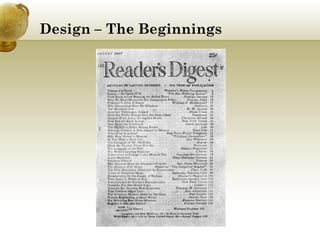
Design – The Beginnings
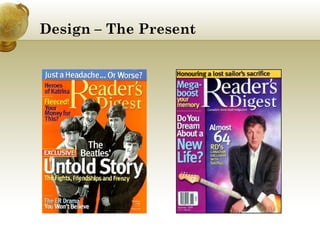
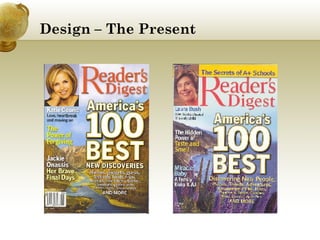
Design – The Present
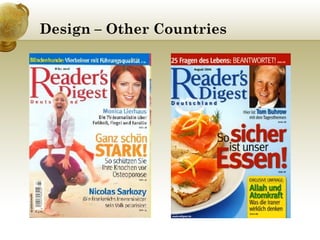
Design – Other Countries
Design – Large Format Edition
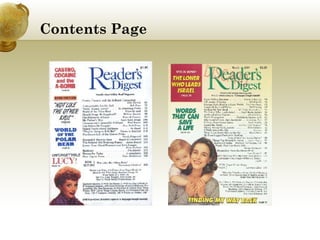
Contents Page
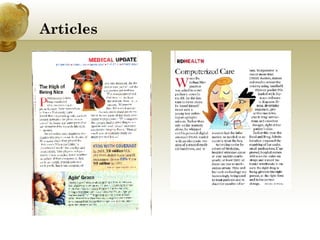
Articles
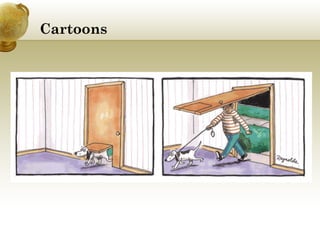
Cartoons
Thank You!

Reader's Digest - History, Content & Evolution

  • 1.
  • 2.
    What’s Reader’s Digest?Family Magazine Monthly General Interest Politically Conservative Upbeat Pro-American Best-selling monthly magazine in the world
  • 3.
    It’s Beginnings DeWittWallace conceived the idea of a magazine containing condensed articles from many popular magazines while recovering from World War I injuries. DeWitt & Lila Wallace
  • 4.
    It’s Beginnings –Facts & Figures First issue - February 5, 1922 First published from home Initially 10¢ a copy by mail Newsstands – 1929 1 Million Copies circulation was achieved in 1935 (US) 10 Billion Copies – 1994 (US)
  • 5.
    Vision The magazine's mission as set out by the Wallaces is to include one article for each day of the month Each article should be of " enduring value and interest "
  • 6.
    Nature of theContents Original articles Condensed articles reprinted from other magazines Book excerpts Collections of jokes Anecdotes Quotations Cartoons and other short pieces. Articles tend to be short to allow busy readers to keep up with a variety of topics without investing too much time.
  • 7.
    Topics & RegularsRegulars " Word Power “ - a vocabulary-building quiz " Life in These United States “ - a collection of humorous or profound reader-submitted anecdotes (US Edition) " Laughter, the Best Medicine " a collection of jokes submitted by readers True Stories People Columnists’ Sections National Interest Health Games & Humor RD Living » Food » Family » Home & Garden » Money
  • 8.
    Editorial Procedures Oneof the most carefully edited magazines in the world Articles are fact-checked for authenticity and controlled by an elaborate editorial hierarchy to ensure that the final product is integrated into the discourse This discourse is highly homogeneous and articulates a very specific set of conservative values which the magazine deems to be important aspects of the dominant representation of American society The Reader's Digest model has been introduced in many countries around the world, in issues that are customized to a certain extent with local content , without presenting the magazine as an American product.
  • 9.
    Structure Usually onesurvival story (called "Drama in Real Life") Normally at least one individual achievement story At least one medical article Several moralizing stories on human relations Several articles with practical advice Some politically inspired stories in which bureaucracy, crime, radical ideologies and other behavior inconsistent with the dominant ideology of the magazine are exposed
  • 10.
    Internal Structure Corresponds to an elaborate and fixed model. The survival stories have a blurb presenting the drama in medias res (in the middle), then return in time with an elaborate description of the initial situation. Rescue doesn't come at the very last paragraph: there is always time to restore the initial peace and formulate a lesson. The last sentences often thank the Lord or mention the medals awarded to the story's heroes.
  • 11.
    The Discourse Individual achievement. Digest characters are always struggling, against bad luck, against systems and regulations, against diseases, and their only weapons are their own courage, cooperation between individuals, and an occasional helping hand from God. Optimism. Most Digest stories have happy endings. There is only one other case: the article may acknowledge in the end that there are still many difficulties to overcome, and give advice. Moral conservatism. Though the Digest has from the beginning written very openly on sexuality, it has always been emphatically in favor of traditional marriage, loyalty to country, discipline and charity, and generally opposed to feminism, free love and affirmative action. Free market economy. In almost every issue, the magazine opposes taxes, government regulations, budget increases, labor unions and, for many decades, the Communist system.
  • 12.
    International editions First international edition – United Kingdom, 1938 Worldwide circulation: 21 million copies Readership over 1 billion readers 49 foreign editions, accounting for about 50% of its trade volume
  • 13.
    Localization Procedures American articles are integrated within the local context Local editions avoid reprinting articles which may touch on sensitive spots in the receiving culture Advertisement placement in the local editions are entirely managed by the local staff and reflect local products. Considerable efforts are made to give the foreign editions a local look Selected articles are translated by local translators and the translations edited by the local editors to make them match the "well-educated informal" style of the American edition.
  • 14.
    Other Editions Large-typeedition called Reader's Digest Large Type Hardcover "Condensed Books" issued 4 times a years, each one containing short condensations of several newly published novels or inspirational memoirs Readers Digest also sells recordings of early big band music, romantic ballads, and various other products
  • 15.
    Design – TheBeginnings
  • 16.
  • 17.
  • 18.
  • 19.
    Design – LargeFormat Edition
  • 20.
  • 21.
  • 22.
  • 23.