NEA Research
List of current affairs magazine
• 1. Time
• 2. The Economist
• 3. The spectator
• 4. The Atlantic
• 5. New Statesman
• 6. The Nation
Time
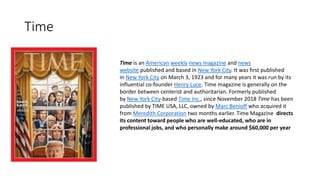
Time is an American weekly news magazine and news
website published and based in New York City. It was first published
in New York City on March 3, 1923 and for many years it was run by its
influential co-founder Henry Luce. Time magazine is generally on the
border between centerist and authoritarian. Formerly published
by New York City-based Time Inc., since November 2018 Time has been
published by TIME USA, LLC, owned by Marc Benioff who acquired it
from Meredith Corporation two months earlier. Time Magazine directs
its content toward people who are well-educated, who are in
professional jobs, and who personally make around $60,000 per year
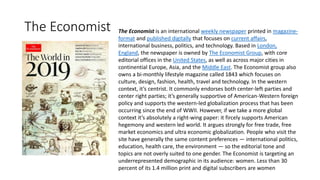
The Economist The Economist is an international weekly newspaper printed in magazine-
format and published digitally that focuses on current affairs,
international business, politics, and technology. Based in London,
England, the newspaper is owned by The Economist Group, with core
editorial offices in the United States, as well as across major cities in
continential Europe, Asia, and the Middle East. The Economist group also
owns a bi-monthly lifestyle magazine called 1843 which focuses on
culture, design, fashion, health, travel and technology. In the western
context, it’s centrist. It commonly endorses both center-left parties and
center right parties; it’s generally supportive of American-Western foreign
policy and supports the western-led globalization process that has been
occurring since the end of WWII. However, if we take a more global
context it’s absolutely a right-wing paper: it fircely supports American
hegemony and western led world. It argues strongly for free trade, free
market economics and ultra economic globalization. People who visit the
site have generally the same content preferences — international politics,
education, health care, the environment — so the editorial tone and
topics are not overly suited to one gender. The Economist is targeting an
underrepresented demographic in its audience: women. Less than 30
percent of its 1.4 million print and digital subscribers are women
The spectator
The Spectator is a weekly British magazine on politics, culture, and
current affairs.[1] It was first published in July 1828.[2] It is owned by David
and Frederick Barclay, who also own The Daily Telegraph newspaper,
via Press Holdings. Its principal subject areas are politics and culture. The
personal links between the paper's editors and the leadership of the
Conservative Party, along with the paper's generally right-wing stance
and influence over Conservative activists, have resulted in the paper
commonly being referred to, especially in Private Eye, as the Torygraph.
The Atlantic
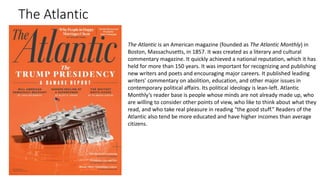
The Atlantic is an American magazine (founded as The Atlantic Monthly) in
Boston, Massachusetts, in 1857. It was created as a literary and cultural
commentary magazine. It quickly achieved a national reputation, which it has
held for more than 150 years. It was important for recognizing and publishing
new writers and poets and encouraging major careers. It published leading
writers' commentary on abolition, education, and other major issues in
contemporary political affairs. Its political ideology is lean-left. Atlantic
Monthly’s reader base is people whose minds are not already made up, who
are willing to consider other points of view, who like to think about what they
read, and who take real pleasure in reading “the good stuff.” Readers of the
Atlantic also tend be more educated and have higher incomes than average
citizens.
New Statesman
The New Statesman is a British political and cultural magazine published in
London.[2] Founded as a weekly review of politics and literature on 12 April
1913, it was connected then with Sidney and Beatrice Webb and other
leading members of the socialist Fabian Society, such as George Bernard
Shaw, who was a founding director. Today, the magazine is a print-digital
hybrid. According to its present self-description, it has a liberal, progressive
political position.[3] Jason Cowley, the magazine's editor, has described the
New Statesman as a publication "of the left, for the left"[4] but also as "a
political and literary magazine" with "skeptical" politics.
The Nation
The Nation is the oldest continuously published weekly magazine in the
United States, covering progressive political and cultural news, opinion, and
analysis. It was founded on July 6, 1865, as a successor to William Lloyd
Garrison's The Liberator,[3] an abolitionist newspaper that closed in 1865, after
ratification of the Thirteenth Amendment to the U.S. Constitution. Now that
the specific, urgent problem of slavery had been ended (The Liberator), one
could proceed to a broader topic, The Nation. The political ideology of the
nation is left wing
Sections included in time magazine
• U.S.
• Politics
• World
• Health
• Business
• Tech
• Entertainment
• Ideas
• Science
• History
• Newsfeed
• Sports
• The TIME Vault
• TIME for Kids
• TIME Edge
Sections included in The Economist
• The world this week
• Leaders
• Letters
• Briefing
• United States
• The Americas
• Asia
• China
• Middle East & Africa
• Europe
• Britain
• International
• Business
• Finance & economics
• Science & technology
• Books & arts
• Graphic detail
• Obituary
• Special reports
• Technology Quarterly
• By Invitation
• Schools brief
Sections in The Spectator
• Politics
• The Society
• International
• Book Reviews
• Art reviews
• Music Reviews
Sections in The Atlantic
Politics
Ideas
Photo
Science
Culture
Podcasts
Health
Education
Video
Technology
Family
Projects
Business
Global
Events
Books
Fiction
Newsletters
Sections in The New Statesman
•
HOME
• POLITICS
• CULTURE
• WORLD
• SCIENCE & TECH
• LONG READS
• EVENTS
• SPOTLIGHT
• COVID-19 UPDATES
The Nation Sections
• Politics
• World
• Climate
• Culture
List of contents in different magazines
• The Time Magazine
1. U.S.
• Dr. Fauci: States Reopening Early Risk 'Really Tempting' a Coronavirus Rebound
2. Politics
• U.S. Intelligence Agencies: Coronavirus Not Manmade, Still Studying China Lab Theory
3. World
• A German Photographer Captures Ordinary People Adapting to Life Under Lockdown
4. Health
Here's How Scientists and Public-Health Experts Recommend the U.S. Gets Back to 'Normal’
5. Business
• 30 Million Have Sought U.S. Jobless Aid Since Coronavirus Outbreak Began
6.Tech
• Scammers Could Be After Your Stimulus Check. Here's How to Avoid Them
7. Entertainment
• Netflix's Teen Dramedy The Half of It Is Sweet, Funny and Raw as a Scraped Knee
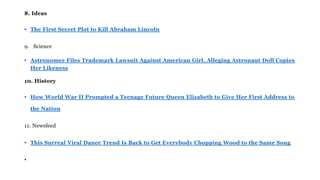
8. Ideas
• The First Secret Plot to Kill Abraham Lincoln
9. Science
• Astronomer Files Trademark Lawsuit Against American Girl, Alleging Astronaut Doll Copies
Her Likeness
10. History
• How World War II Prompted a Teenage Future Queen Elizabeth to Give Her First Address to
the Nation
11. Newsfeed
• This Surreal Viral Dance Trend Is Back to Get Everybody Chopping Wood to the Same Song
•
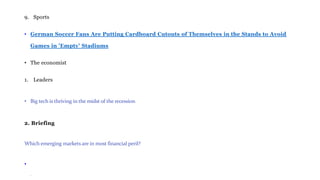
9. Sports
• German Soccer Fans Are Putting Cardboard Cutouts of Themselves in the Stands to Avoid
Games in 'Empty' Stadiums
• The economist
1. Leaders
• Big tech is thriving in the midst of the recession
2. Briefing
Which emerging markets are in most financial peril?
•
•
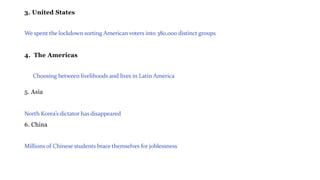
3. United States
We spent the lockdown sorting American voters into 380,000 distinct groups
4. The Americas
Choosing between livelihoods and lives in Latin America
5. Asia
North Korea’s dictator has disappeared
6. China
Millions of Chinese students brace themselves for joblessness
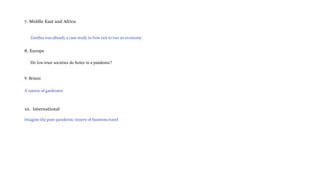
7. Middle East and Africa
Zambia was already a case study in how not to run an economy
8. Europe
Do low-trust societies do better in a pandemic?
9. Britain
A nation of gardeners
10. International
Imagine the post-pandemic misery of business travel
11. Business
Imagine the post-pandemic misery of business travel
12. Finance and Economics
In many ways, stockmarkets have been extraordinary in 2020
13. Science and Technology
The pieces of the puzzle of covid-19’s origin are coming to light
14. Books and Art
Remembering Romek Marber, a master visual craftsman
•
• The Spectator
1. Politics
• How the government plans to respond to ‘vaccine nationalism
2. Society
• The ridiculousness of the bookshelf police
3. International
Sweden tames its ‘R number’ without lockdown
4. Book Reviews
• From ‘divine Caesar’ to Hitler’s lapdog – the rise and fall of Benito Mussolini
•
l
5. Art Reviews
• The importance of sadism in writing a great screenplay
6. Music Reviews
• Why we love requiems

Nea research tasks

  • 1.
  • 2.
    List of currentaffairs magazine • 1. Time • 2. The Economist • 3. The spectator • 4. The Atlantic • 5. New Statesman • 6. The Nation
  • 3.
    Time Time is anAmerican weekly news magazine and news website published and based in New York City. It was first published in New York City on March 3, 1923 and for many years it was run by its influential co-founder Henry Luce. Time magazine is generally on the border between centerist and authoritarian. Formerly published by New York City-based Time Inc., since November 2018 Time has been published by TIME USA, LLC, owned by Marc Benioff who acquired it from Meredith Corporation two months earlier. Time Magazine directs its content toward people who are well-educated, who are in professional jobs, and who personally make around $60,000 per year
  • 4.
    The Economist TheEconomist is an international weekly newspaper printed in magazine- format and published digitally that focuses on current affairs, international business, politics, and technology. Based in London, England, the newspaper is owned by The Economist Group, with core editorial offices in the United States, as well as across major cities in continential Europe, Asia, and the Middle East. The Economist group also owns a bi-monthly lifestyle magazine called 1843 which focuses on culture, design, fashion, health, travel and technology. In the western context, it’s centrist. It commonly endorses both center-left parties and center right parties; it’s generally supportive of American-Western foreign policy and supports the western-led globalization process that has been occurring since the end of WWII. However, if we take a more global context it’s absolutely a right-wing paper: it fircely supports American hegemony and western led world. It argues strongly for free trade, free market economics and ultra economic globalization. People who visit the site have generally the same content preferences — international politics, education, health care, the environment — so the editorial tone and topics are not overly suited to one gender. The Economist is targeting an underrepresented demographic in its audience: women. Less than 30 percent of its 1.4 million print and digital subscribers are women
  • 5.
    The spectator The Spectatoris a weekly British magazine on politics, culture, and current affairs.[1] It was first published in July 1828.[2] It is owned by David and Frederick Barclay, who also own The Daily Telegraph newspaper, via Press Holdings. Its principal subject areas are politics and culture. The personal links between the paper's editors and the leadership of the Conservative Party, along with the paper's generally right-wing stance and influence over Conservative activists, have resulted in the paper commonly being referred to, especially in Private Eye, as the Torygraph.
  • 6.
    The Atlantic The Atlanticis an American magazine (founded as The Atlantic Monthly) in Boston, Massachusetts, in 1857. It was created as a literary and cultural commentary magazine. It quickly achieved a national reputation, which it has held for more than 150 years. It was important for recognizing and publishing new writers and poets and encouraging major careers. It published leading writers' commentary on abolition, education, and other major issues in contemporary political affairs. Its political ideology is lean-left. Atlantic Monthly’s reader base is people whose minds are not already made up, who are willing to consider other points of view, who like to think about what they read, and who take real pleasure in reading “the good stuff.” Readers of the Atlantic also tend be more educated and have higher incomes than average citizens.
  • 7.
    New Statesman The NewStatesman is a British political and cultural magazine published in London.[2] Founded as a weekly review of politics and literature on 12 April 1913, it was connected then with Sidney and Beatrice Webb and other leading members of the socialist Fabian Society, such as George Bernard Shaw, who was a founding director. Today, the magazine is a print-digital hybrid. According to its present self-description, it has a liberal, progressive political position.[3] Jason Cowley, the magazine's editor, has described the New Statesman as a publication "of the left, for the left"[4] but also as "a political and literary magazine" with "skeptical" politics.
  • 8.
    The Nation The Nationis the oldest continuously published weekly magazine in the United States, covering progressive political and cultural news, opinion, and analysis. It was founded on July 6, 1865, as a successor to William Lloyd Garrison's The Liberator,[3] an abolitionist newspaper that closed in 1865, after ratification of the Thirteenth Amendment to the U.S. Constitution. Now that the specific, urgent problem of slavery had been ended (The Liberator), one could proceed to a broader topic, The Nation. The political ideology of the nation is left wing
  • 9.
    Sections included intime magazine • U.S. • Politics • World • Health • Business • Tech • Entertainment • Ideas • Science • History • Newsfeed • Sports • The TIME Vault • TIME for Kids • TIME Edge
  • 10.
    Sections included inThe Economist • The world this week • Leaders • Letters • Briefing • United States • The Americas • Asia • China • Middle East & Africa • Europe • Britain • International • Business • Finance & economics • Science & technology • Books & arts • Graphic detail • Obituary • Special reports • Technology Quarterly • By Invitation • Schools brief
  • 11.
    Sections in TheSpectator • Politics • The Society • International • Book Reviews • Art reviews • Music Reviews
  • 12.
    Sections in TheAtlantic Politics Ideas Photo Science Culture Podcasts Health Education Video Technology Family Projects Business Global Events Books Fiction Newsletters
  • 13.
    Sections in TheNew Statesman • HOME • POLITICS • CULTURE • WORLD • SCIENCE & TECH • LONG READS • EVENTS • SPOTLIGHT • COVID-19 UPDATES
  • 14.
    The Nation Sections •Politics • World • Climate • Culture
  • 15.
    List of contentsin different magazines • The Time Magazine 1. U.S. • Dr. Fauci: States Reopening Early Risk 'Really Tempting' a Coronavirus Rebound 2. Politics • U.S. Intelligence Agencies: Coronavirus Not Manmade, Still Studying China Lab Theory 3. World • A German Photographer Captures Ordinary People Adapting to Life Under Lockdown
  • 16.
    4. Health Here's HowScientists and Public-Health Experts Recommend the U.S. Gets Back to 'Normal’ 5. Business • 30 Million Have Sought U.S. Jobless Aid Since Coronavirus Outbreak Began 6.Tech • Scammers Could Be After Your Stimulus Check. Here's How to Avoid Them 7. Entertainment • Netflix's Teen Dramedy The Half of It Is Sweet, Funny and Raw as a Scraped Knee
  • 17.
    8. Ideas • TheFirst Secret Plot to Kill Abraham Lincoln 9. Science • Astronomer Files Trademark Lawsuit Against American Girl, Alleging Astronaut Doll Copies Her Likeness 10. History • How World War II Prompted a Teenage Future Queen Elizabeth to Give Her First Address to the Nation 11. Newsfeed • This Surreal Viral Dance Trend Is Back to Get Everybody Chopping Wood to the Same Song •
  • 18.
    9. Sports • GermanSoccer Fans Are Putting Cardboard Cutouts of Themselves in the Stands to Avoid Games in 'Empty' Stadiums • The economist 1. Leaders • Big tech is thriving in the midst of the recession 2. Briefing Which emerging markets are in most financial peril? • •
  • 19.
    3. United States Wespent the lockdown sorting American voters into 380,000 distinct groups 4. The Americas Choosing between livelihoods and lives in Latin America 5. Asia North Korea’s dictator has disappeared 6. China Millions of Chinese students brace themselves for joblessness
  • 20.
    7. Middle Eastand Africa Zambia was already a case study in how not to run an economy 8. Europe Do low-trust societies do better in a pandemic? 9. Britain A nation of gardeners 10. International Imagine the post-pandemic misery of business travel
  • 21.
    11. Business Imagine thepost-pandemic misery of business travel 12. Finance and Economics In many ways, stockmarkets have been extraordinary in 2020 13. Science and Technology The pieces of the puzzle of covid-19’s origin are coming to light 14. Books and Art Remembering Romek Marber, a master visual craftsman •
  • 22.
    • The Spectator 1.Politics • How the government plans to respond to ‘vaccine nationalism 2. Society • The ridiculousness of the bookshelf police 3. International Sweden tames its ‘R number’ without lockdown 4. Book Reviews • From ‘divine Caesar’ to Hitler’s lapdog – the rise and fall of Benito Mussolini • l
  • 23.
    5. Art Reviews •The importance of sadism in writing a great screenplay 6. Music Reviews • Why we love requiems