Reaction101 and Yield101:
                    Two mobile apps for chemistry with pedagogical value


Authors:


Alex M. Clark (corresponding author)
       Molecular Materials Informatics, Inc.
       Montréal, Québec, Canada H3J2S1
       aclark@molmatinf.com
       http://molmatinf.com


Maurizio Bronzetti, Steven M. Muskal
       Eidogen-Sertanty, Inc.
       3460 Marron Road, Suite 103-475, Oceanside, CA 92056
       mbronzetti@eidogen-sertanty.com
       smuskal@eidogen-sertanty.com
       http://eidogen-sertanty.com


Abstract:
We describe the use of two mobile apps, Reaction101 and Yield101, in the context of a learning
environment. Reaction101 includes features for learning to balance reactions. Yield101 assists with
calculating quantities that are relevant for a laboratory preparation. While both apps have capabilities
that are useful to synthetic chemists at all stages of career development, they have been designed to be
specifically useful to students learning chemistry at high school and undergraduate level. These mobile
apps also facilitate communication of chemical data, in both digitally interpretable forms and
presentation-ready formats.
distinct component. Reaction components
Introduction                                       consist of a chemical structure sketch, name,
Mobile apps have become prevalent within an        and in the case of reactants and products,
incredibly broad segment of the population,        stoichiometry. The reaction editor is derived
including education at all levels. A modern        from the Mobile Molecular DataSheet app (8),
smartphone, music player or tablet computer the    and the structure diagram sketcher is described
size of a small book now delivers high             in detail in the literature (9).
performance graphics, storage, computational
                                                   Reaction101 is supplemented by useful reaction
capacity and access to the Internet. A growing
                                                   aids that are provided by server side content
number of educational institutions are adopting
                                                   from Eidogen-Sertanty. A public collection of
mobile devices as classroom tools (1). There are
                                                   common generic reactions, organized by name,
an increasing number of apps designed for
                                                   is available, and any one of them can be viewed
chemists at varying stages of professional
                                                   for reference purposes, or used as a starting
development, from high school students to
                                                   point for drawing a new reaction. Also,
graduates and beyond (2).
                                                   individual reaction components can be obtained
A recent review (3) describes a large number of    by searching the Mobile Reagents (10) database.
mobile apps for chemistry, many of them            Searching can be done by name, formula, exact
focused on education. There are also online        structure, substructure, and structural similarity.
resources, such as SciMobileApps (4), which
                                                   When a reaction is displayed onscreen, it is
provides a living resource that is regularly
                                                   checked to verify whether it is balanced. Both
updated by the community.
                                                   sides of the reaction - reactants and products -
In this article we describe two apps:              are tallied up by multiplying the molecular
Reaction101 (5) and Yield101 (6), which were       formula for each component by its
created with the needs of students in mind. Both   stoichiometry. For each element whose counts
of these apps are available for iOS based          are not equal on both sides, the excess is added
devices, specifically the iPhone, iPod and iPad    to the opposite side. In this way, it is made very
(7).                                               clear at a glance that a reaction is not balanced.
                                                   When a reaction is not balanced, it is because of
Reaction101                                        some combination of missing components,
Reaction balancing is a vital skill for students   incorrect stoichiometries, or incorrectly drawn
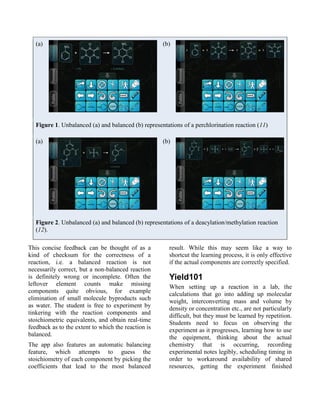
who intend to pursue any branch of chemistry,      reactants or products. Figure 1 and Figure 2
and it has traditionally been practiced by         show screen captures for two reactions, where
drawing out reactions on paper. Verifying          1(a) and 2(a) are not balanced, and the display is
whether a reaction is balanced is a relatively     annotated with the excess atoms on either side.
tedious calculation, and is prone to mistakes.     The screen captures shown in Figures 1(b) and
Complementing this approach with a computer-       2(b) show the analogous reactions, with all the
assisted solution that provides real-time          components included, and balanced. In these
feedback adds an important and valuable extra      cases, the element counts match, and so no
dimension to learning.                             excess atoms are denoted.

Addressing this challenge is one of the primary
motivations for designing Reaction101, a
mobile app centered around the drawing and
rendition of a single chemical reaction. A
reaction is represented as a set of reactants,
reagents and products, each of which is a
(a)                                               (b)


   Figure 1. Unbalanced (a) and balanced (b) representations of a perchlorination reaction (11)

   (a)                                               (b)


   Figure 2. Unbalanced (a) and balanced (b) representations of a deacylation/methylation reaction
   (12).

This concise feedback can be thought of as a           result. While this may seem like a way to
kind of checksum for the correctness of a              shortcut the learning process, it is only effective
reaction, i.e. a balanced reaction is not              if the actual components are correctly specified.
necessarily correct, but a non-balanced reaction
is definitely wrong or incomplete. Often the           Yield101
leftover element counts make missing                   When setting up a reaction in a lab, the
components quite obvious, for example                  calculations that go into adding up molecular
elimination of small molecule byproducts such          weight, interconverting mass and volume by
as water. The student is free to experiment by         density or concentration etc., are not particularly
tinkering with the reaction components and             difficult, but they must be learned by repetition.
stoichiometric equivalents, and obtain real-time       Students need to focus on observing the
feedback as to the extent to which the reaction is     experiment as it progresses, learning how to use
balanced.                                              the equipment, thinking about the actual
The app also features an automatic balancing           chemistry that is occurring, recording
feature, which attempts to guess the                   experimental notes legibly, scheduling timing in
stoichiometry of each component by picking the         order to workaround availability of shared
coefficients that lead to the most balanced            resources, getting the experiment finished
(a)                                                (b)


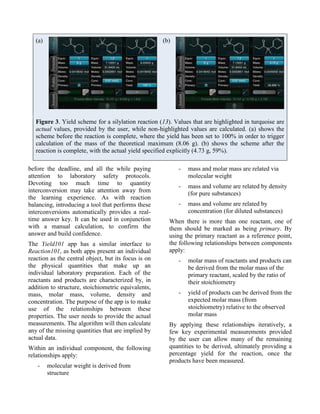
   Figure 3. Yield scheme for a silylation reaction (13). Values that are highlighted in turquoise are
   actual values, provided by the user, while non-highlighted values are calculated. (a) shows the
   scheme before the reaction is complete, where the yield has been set to 100% in order to trigger
   calculation of the mass of the theoretical maximum (8.06 g). (b) shows the scheme after the
   reaction is complete, with the actual yield specified explicitly (4.73 g, 59%).

before the deadline, and all the while paying               -   mass and molar mass are related via
attention to laboratory safety protocols.                       molecular weight
Devoting too much time to quantity                          -   mass and volume are related by density
interconversion may take attention away from                    (for pure substances)
the learning experience. As with reaction
balancing, introducing a tool that performs these           -   mass and volume are related by
interconversions automatically provides a real-                 concentration (for diluted substances)
time answer key. It can be used in conjunction          When there is more than one reactant, one of
with a manual calculation, to confirm the               them should be marked as being primary. By
answer and build confidence.                            using the primary reactant as a reference point,
The Yield101 app has a similar interface to             the following relationships between components
Reaction101, as both apps present an individual         apply:
reaction as the central object, but its focus is on         -   molar mass of reactants and products can
the physical quantities that make up an                         be derived from the molar mass of the
individual laboratory preparation. Each of the                  primary reactant, scaled by the ratio of
reactants and products are characterized by, in                 their stoichiometry
addition to structure, stoichiometric equivalents,
mass, molar mass, volume, density and                       -   yield of products can be derived from the
concentration. The purpose of the app is to make                expected molar mass (from
use of the relationships between these                          stoichiometry) relative to the observed
properties. The user needs to provide the actual                molar mass
measurements. The algorithm will then calculate         By applying these relationships iteratively, a
any of the missing quantities that are implied by       few key experimental measurements provided
actual data.                                            by the user can allow many of the remaining
Within an individual component, the following           quantities to be derived, ultimately providing a
relationships apply:                                    percentage yield for the reaction, once the
                                                        products have been measured.
   -     molecular weight is derived from
         structure
The app can be used to enter actual values as         Besides calculating the quantities of reactants
they become available, or it can be used in a         and products involved in an experiment,
more speculative way, e.g. by entering a value        Yield101 also introduces a calculated quantity
of 100% for a yield, the calculations will be         called process mass intensity (PMI). This is an
done in reverse, and the theoretical maximum          index that is often promoted in the context of
quantities will be filled out instead, as is          green chemistry (14). The calculation is very
illustrated in Figure 3(a). In Figure 3(b), the       simple: total mass of all reactants divided by
actual yield for the reaction has been entered.       total mass of desired products. Water is
                                                      typically excluded from both sides of the
Some quantities can be codependent, e.g.
                                                      reaction, and non-aqueous solvents are added to
providing mass, volume and density is allowed,
                                                      the product side only if they are recovered. The
but it introduces the possibility of inconsistency.
                                                      ideal "green reaction" has a PMI value of 1,
If the calculated and provided values do not
                                                      which means that there are no unused
match up, they are all highlighted in red,
                                                      byproducts other than water, and non-aqueous
indicating that a mistake has been made, and
some correction is required.                          solvents were either not used or recovered, and
                                                      the yield was 100%. While the PMI values for
The app also has the ability to print out a           two different reactions are not usually
quantity scheme (or create a PDF file), which is      comparable, smaller values are more desirable
a useful pre-laboratory exercise (see Figure 4).      from the point of view of waste and
Prior to beginning the experiment, the known          environmental side effects.
quantities and properties can be entered, which
                                                      Yield101 displays the PMI calculation at the
provides information on quantities of reaction
                                                      bottom of the screen, as shown in Figure 5, and
equivalents and theoretical yields. Once the
                                                      also displays the relative contribution for each
experiment is completed, actual values can be
                                                      of the components, in the form of a percentage
applied to produce a second scheme, either or
                                                      sidebar. Calculation of these metrics is not
both of which can be attached to the laboratory
                                                      typically a high priority in the laboratory
report, if this is allowed as part of the exercise.
                                                      environment, and so the always-on automatic
                                                      calculation of these properties is a way to
                                                      encourage students to start thinking about the
                                                      environmental implications of chemical


                                                         Figure 5. Yield scheme for a mercuration
                                                         reaction (15). All solvents are included on
Figure 4. Print-ready display of a reaction              the reaction side. The calculated PMI is
yield scheme.                                            6.836.
reactions early on in their careers, which is          attachments, either originating by email or from
likely to become an increasingly important skill.      a browser download, can be opened with either
                                                       app, if they are of a recognized format, which
Communication                                          includes the industry standard MDL RXN and
Both Reaction101 and Yield101 have strong              RDfiles (17). The ability to share reaction data
data sharing capabilities. App-to-app sharing          allows both of these apps to participate in the
can be accomplished via the open-with                  realm of cheminformatics, as they can both
functionality: both Reaction101 and Yield101           create and consume content.
are capable of sending and receiving reaction          Reaction images can be copied to the clipboard
content, so they can pass reaction schemes             in bitmap form, which allows them to be pasted
between each other. The same applies for any           into other apps on the device, e.g. Keynote (18).
other installed app that registers itself              As previously mentioned, Yield101 can be used
appropriately (16).                                    to generate a PDF file of the reaction/quantity
Both apps are capable of storing content on a          scheme, which can be viewed, printed or sent by
cloud-hosted server, which is associated with          email.
the device. Reactions or yield schemes can be
recalled for later use, and Yield101 is capable of     Conclusion
opening reactions stored by Reaction101, which         Both apps have features that are useful for
binds them together in a logical workflow:             professional chemists, but they have particular
                                                       value in a learning environment. Interactive
   -   use Reaction101 to draw and balance a
                                                       reaction balancing calculations and automatic
       reaction
                                                       calculation of related physical quantities
   -   use Yield101 to fill in quantity data, once     provides feedback and encourages learning by
       for each experiment                             trial and error. Determination of process mass
Reactions and yield schemes can be sent by             intensity (PMI) for reaction schemes encourages
email. An outgoing email message includes a            students to consider the environmental
picture of the reaction, and the actual data. If the   implications of each chemical reaction. The
recipient of the email message is running either       ability to create presentation quality graphics
of these apps, the content can be automatically        and communicate data encourages students to
extracted and opened within the selected app. If       collaborate and share, and also provides an
the recipient is using a generic email client, the     entrypoint into the wealth of digitized chemistry
attachment content can be downloaded and used          data that is available on the Internet.
by any compatible software. Incoming
References

1. (a) http://www.theipadfan.com/florida-school-giving-ipad-studn; (b) http://www.ndtv.com/article/world/more-schools-
embracing-ipad-as-learning-tool-77078; (c) http://www.idahoreporter.com/2010/school-district-hopes-30k-ipad-purchase-
will-improve-teacher-performance; (d) http://ipadnewshub.com/2011/07/ipad-dominance-will-surges-into-classrooms; (e)
http://mashable.com/2011/01/05/schools-ipad (accessed 20 September 2011).
2. Williams, A.J.; Pence, H.E. J. Chem. Educ. 2011, 88, 683-686.
3. Williams, A.J.; Ekins, S.; Clark, A.M.; Jack, J.J.; Apodaca, R.L. Drug Discov. Today 2011, in press.
(doi:10.1016/j.drudis.2011.09.002)
4. Scientific Mobile Applications wiki: http://scimobileapps.com (accessed 19 September 2011).
5. http://molmatinf.com/reaction101.html (accessed 19 September 2011).
6. http://molmatinf.com/yield101.html (accessed 19 September 2011)
7. Both of these apps are available on the Apple iTunes AppStore, which is the standard delivery mechanism for all iOS
based devices.
8. http://molmatinf.com/products.html (accessed 19 September 2011).
9. Clark, A.M. J. Cheminf. 2010, 2:8.
10. http://mobilereagents.com (accessed 19 September 2011).
11. (a) ChemSpider Synthetic Pages, http://cssp.chemspider.com/Article.aspx?id=483 (accessed 19 September 2011). (b)
Rosevear, J.; Wilshire, J.F. Aust. J. Chem. 1980, 33, 843-852.
12. (a) ChemSpider Synthetic Pages, http://cssp.chemspider.com/Article.aspx?id=425 (accessed 19 September 2011). (b)
Locksley, H.D.; Murray, I.G. J. Chem. Soc. C 1970, 392-398.
13. Lettan, R.B.; Milgram, B.C.; Scheidt, K.A. Org. Synth. 2007, 84, 22.
14. (a) Jimenez-Gonzalez, C.; Ponder, C.S.; Broxterman, Q.B.; Manley, J.B. Org. Proc. Res. Dev. 2011, 15, 912-917. (b)
http://portal.acs.org/portal/fileFetch/C/CTP_005585/pdf/CTP_005585.pdf (accessed 20 September 2011).
15. Clark, A.M.; Oliver, A.G.; Rickard, C.E.F.; Wright, L.J.; Roper, W.R. Acta Cryst. C 2000, 56, 26-27.
16. http://molmatinf.com/ipcappios.html (accessed 19 September 2011).
17. http://www.symyx.com/solutions/white_papers/ctfile_formats.jsp (accessed 19 September 2011).
18. Keynote for iOS: http://www.apple.com/support/ios/keynote (accessed 19 September 2011).

Reaction101 and Yield101: Two mobile apps with pedagogical value

  • 1.
    Reaction101 and Yield101: Two mobile apps for chemistry with pedagogical value Authors: Alex M. Clark (corresponding author) Molecular Materials Informatics, Inc. Montréal, Québec, Canada H3J2S1 aclark@molmatinf.com http://molmatinf.com Maurizio Bronzetti, Steven M. Muskal Eidogen-Sertanty, Inc. 3460 Marron Road, Suite 103-475, Oceanside, CA 92056 mbronzetti@eidogen-sertanty.com smuskal@eidogen-sertanty.com http://eidogen-sertanty.com Abstract: We describe the use of two mobile apps, Reaction101 and Yield101, in the context of a learning environment. Reaction101 includes features for learning to balance reactions. Yield101 assists with calculating quantities that are relevant for a laboratory preparation. While both apps have capabilities that are useful to synthetic chemists at all stages of career development, they have been designed to be specifically useful to students learning chemistry at high school and undergraduate level. These mobile apps also facilitate communication of chemical data, in both digitally interpretable forms and presentation-ready formats.
  • 2.
    distinct component. Reactioncomponents Introduction consist of a chemical structure sketch, name, Mobile apps have become prevalent within an and in the case of reactants and products, incredibly broad segment of the population, stoichiometry. The reaction editor is derived including education at all levels. A modern from the Mobile Molecular DataSheet app (8), smartphone, music player or tablet computer the and the structure diagram sketcher is described size of a small book now delivers high in detail in the literature (9). performance graphics, storage, computational Reaction101 is supplemented by useful reaction capacity and access to the Internet. A growing aids that are provided by server side content number of educational institutions are adopting from Eidogen-Sertanty. A public collection of mobile devices as classroom tools (1). There are common generic reactions, organized by name, an increasing number of apps designed for is available, and any one of them can be viewed chemists at varying stages of professional for reference purposes, or used as a starting development, from high school students to point for drawing a new reaction. Also, graduates and beyond (2). individual reaction components can be obtained A recent review (3) describes a large number of by searching the Mobile Reagents (10) database. mobile apps for chemistry, many of them Searching can be done by name, formula, exact focused on education. There are also online structure, substructure, and structural similarity. resources, such as SciMobileApps (4), which When a reaction is displayed onscreen, it is provides a living resource that is regularly checked to verify whether it is balanced. Both updated by the community. sides of the reaction - reactants and products - In this article we describe two apps: are tallied up by multiplying the molecular Reaction101 (5) and Yield101 (6), which were formula for each component by its created with the needs of students in mind. Both stoichiometry. For each element whose counts of these apps are available for iOS based are not equal on both sides, the excess is added devices, specifically the iPhone, iPod and iPad to the opposite side. In this way, it is made very (7). clear at a glance that a reaction is not balanced. When a reaction is not balanced, it is because of Reaction101 some combination of missing components, Reaction balancing is a vital skill for students incorrect stoichiometries, or incorrectly drawn who intend to pursue any branch of chemistry, reactants or products. Figure 1 and Figure 2 and it has traditionally been practiced by show screen captures for two reactions, where drawing out reactions on paper. Verifying 1(a) and 2(a) are not balanced, and the display is whether a reaction is balanced is a relatively annotated with the excess atoms on either side. tedious calculation, and is prone to mistakes. The screen captures shown in Figures 1(b) and Complementing this approach with a computer- 2(b) show the analogous reactions, with all the assisted solution that provides real-time components included, and balanced. In these feedback adds an important and valuable extra cases, the element counts match, and so no dimension to learning. excess atoms are denoted. Addressing this challenge is one of the primary motivations for designing Reaction101, a mobile app centered around the drawing and rendition of a single chemical reaction. A reaction is represented as a set of reactants, reagents and products, each of which is a
  • 3.
    (a) (b) Figure 1. Unbalanced (a) and balanced (b) representations of a perchlorination reaction (11) (a) (b) Figure 2. Unbalanced (a) and balanced (b) representations of a deacylation/methylation reaction (12). This concise feedback can be thought of as a result. While this may seem like a way to kind of checksum for the correctness of a shortcut the learning process, it is only effective reaction, i.e. a balanced reaction is not if the actual components are correctly specified. necessarily correct, but a non-balanced reaction is definitely wrong or incomplete. Often the Yield101 leftover element counts make missing When setting up a reaction in a lab, the components quite obvious, for example calculations that go into adding up molecular elimination of small molecule byproducts such weight, interconverting mass and volume by as water. The student is free to experiment by density or concentration etc., are not particularly tinkering with the reaction components and difficult, but they must be learned by repetition. stoichiometric equivalents, and obtain real-time Students need to focus on observing the feedback as to the extent to which the reaction is experiment as it progresses, learning how to use balanced. the equipment, thinking about the actual The app also features an automatic balancing chemistry that is occurring, recording feature, which attempts to guess the experimental notes legibly, scheduling timing in stoichiometry of each component by picking the order to workaround availability of shared coefficients that lead to the most balanced resources, getting the experiment finished
  • 4.
    (a) (b) Figure 3. Yield scheme for a silylation reaction (13). Values that are highlighted in turquoise are actual values, provided by the user, while non-highlighted values are calculated. (a) shows the scheme before the reaction is complete, where the yield has been set to 100% in order to trigger calculation of the mass of the theoretical maximum (8.06 g). (b) shows the scheme after the reaction is complete, with the actual yield specified explicitly (4.73 g, 59%). before the deadline, and all the while paying - mass and molar mass are related via attention to laboratory safety protocols. molecular weight Devoting too much time to quantity - mass and volume are related by density interconversion may take attention away from (for pure substances) the learning experience. As with reaction balancing, introducing a tool that performs these - mass and volume are related by interconversions automatically provides a real- concentration (for diluted substances) time answer key. It can be used in conjunction When there is more than one reactant, one of with a manual calculation, to confirm the them should be marked as being primary. By answer and build confidence. using the primary reactant as a reference point, The Yield101 app has a similar interface to the following relationships between components Reaction101, as both apps present an individual apply: reaction as the central object, but its focus is on - molar mass of reactants and products can the physical quantities that make up an be derived from the molar mass of the individual laboratory preparation. Each of the primary reactant, scaled by the ratio of reactants and products are characterized by, in their stoichiometry addition to structure, stoichiometric equivalents, mass, molar mass, volume, density and - yield of products can be derived from the concentration. The purpose of the app is to make expected molar mass (from use of the relationships between these stoichiometry) relative to the observed properties. The user needs to provide the actual molar mass measurements. The algorithm will then calculate By applying these relationships iteratively, a any of the missing quantities that are implied by few key experimental measurements provided actual data. by the user can allow many of the remaining Within an individual component, the following quantities to be derived, ultimately providing a relationships apply: percentage yield for the reaction, once the products have been measured. - molecular weight is derived from structure
  • 5.
    The app canbe used to enter actual values as Besides calculating the quantities of reactants they become available, or it can be used in a and products involved in an experiment, more speculative way, e.g. by entering a value Yield101 also introduces a calculated quantity of 100% for a yield, the calculations will be called process mass intensity (PMI). This is an done in reverse, and the theoretical maximum index that is often promoted in the context of quantities will be filled out instead, as is green chemistry (14). The calculation is very illustrated in Figure 3(a). In Figure 3(b), the simple: total mass of all reactants divided by actual yield for the reaction has been entered. total mass of desired products. Water is typically excluded from both sides of the Some quantities can be codependent, e.g. reaction, and non-aqueous solvents are added to providing mass, volume and density is allowed, the product side only if they are recovered. The but it introduces the possibility of inconsistency. ideal "green reaction" has a PMI value of 1, If the calculated and provided values do not which means that there are no unused match up, they are all highlighted in red, byproducts other than water, and non-aqueous indicating that a mistake has been made, and some correction is required. solvents were either not used or recovered, and the yield was 100%. While the PMI values for The app also has the ability to print out a two different reactions are not usually quantity scheme (or create a PDF file), which is comparable, smaller values are more desirable a useful pre-laboratory exercise (see Figure 4). from the point of view of waste and Prior to beginning the experiment, the known environmental side effects. quantities and properties can be entered, which Yield101 displays the PMI calculation at the provides information on quantities of reaction bottom of the screen, as shown in Figure 5, and equivalents and theoretical yields. Once the also displays the relative contribution for each experiment is completed, actual values can be of the components, in the form of a percentage applied to produce a second scheme, either or sidebar. Calculation of these metrics is not both of which can be attached to the laboratory typically a high priority in the laboratory report, if this is allowed as part of the exercise. environment, and so the always-on automatic calculation of these properties is a way to encourage students to start thinking about the environmental implications of chemical Figure 5. Yield scheme for a mercuration reaction (15). All solvents are included on Figure 4. Print-ready display of a reaction the reaction side. The calculated PMI is yield scheme. 6.836.
  • 6.
    reactions early onin their careers, which is attachments, either originating by email or from likely to become an increasingly important skill. a browser download, can be opened with either app, if they are of a recognized format, which Communication includes the industry standard MDL RXN and Both Reaction101 and Yield101 have strong RDfiles (17). The ability to share reaction data data sharing capabilities. App-to-app sharing allows both of these apps to participate in the can be accomplished via the open-with realm of cheminformatics, as they can both functionality: both Reaction101 and Yield101 create and consume content. are capable of sending and receiving reaction Reaction images can be copied to the clipboard content, so they can pass reaction schemes in bitmap form, which allows them to be pasted between each other. The same applies for any into other apps on the device, e.g. Keynote (18). other installed app that registers itself As previously mentioned, Yield101 can be used appropriately (16). to generate a PDF file of the reaction/quantity Both apps are capable of storing content on a scheme, which can be viewed, printed or sent by cloud-hosted server, which is associated with email. the device. Reactions or yield schemes can be recalled for later use, and Yield101 is capable of Conclusion opening reactions stored by Reaction101, which Both apps have features that are useful for binds them together in a logical workflow: professional chemists, but they have particular value in a learning environment. Interactive - use Reaction101 to draw and balance a reaction balancing calculations and automatic reaction calculation of related physical quantities - use Yield101 to fill in quantity data, once provides feedback and encourages learning by for each experiment trial and error. Determination of process mass Reactions and yield schemes can be sent by intensity (PMI) for reaction schemes encourages email. An outgoing email message includes a students to consider the environmental picture of the reaction, and the actual data. If the implications of each chemical reaction. The recipient of the email message is running either ability to create presentation quality graphics of these apps, the content can be automatically and communicate data encourages students to extracted and opened within the selected app. If collaborate and share, and also provides an the recipient is using a generic email client, the entrypoint into the wealth of digitized chemistry attachment content can be downloaded and used data that is available on the Internet. by any compatible software. Incoming
  • 7.
    References 1. (a) http://www.theipadfan.com/florida-school-giving-ipad-studn;(b) http://www.ndtv.com/article/world/more-schools- embracing-ipad-as-learning-tool-77078; (c) http://www.idahoreporter.com/2010/school-district-hopes-30k-ipad-purchase- will-improve-teacher-performance; (d) http://ipadnewshub.com/2011/07/ipad-dominance-will-surges-into-classrooms; (e) http://mashable.com/2011/01/05/schools-ipad (accessed 20 September 2011). 2. Williams, A.J.; Pence, H.E. J. Chem. Educ. 2011, 88, 683-686. 3. Williams, A.J.; Ekins, S.; Clark, A.M.; Jack, J.J.; Apodaca, R.L. Drug Discov. Today 2011, in press. (doi:10.1016/j.drudis.2011.09.002) 4. Scientific Mobile Applications wiki: http://scimobileapps.com (accessed 19 September 2011). 5. http://molmatinf.com/reaction101.html (accessed 19 September 2011). 6. http://molmatinf.com/yield101.html (accessed 19 September 2011) 7. Both of these apps are available on the Apple iTunes AppStore, which is the standard delivery mechanism for all iOS based devices. 8. http://molmatinf.com/products.html (accessed 19 September 2011). 9. Clark, A.M. J. Cheminf. 2010, 2:8. 10. http://mobilereagents.com (accessed 19 September 2011). 11. (a) ChemSpider Synthetic Pages, http://cssp.chemspider.com/Article.aspx?id=483 (accessed 19 September 2011). (b) Rosevear, J.; Wilshire, J.F. Aust. J. Chem. 1980, 33, 843-852. 12. (a) ChemSpider Synthetic Pages, http://cssp.chemspider.com/Article.aspx?id=425 (accessed 19 September 2011). (b) Locksley, H.D.; Murray, I.G. J. Chem. Soc. C 1970, 392-398. 13. Lettan, R.B.; Milgram, B.C.; Scheidt, K.A. Org. Synth. 2007, 84, 22. 14. (a) Jimenez-Gonzalez, C.; Ponder, C.S.; Broxterman, Q.B.; Manley, J.B. Org. Proc. Res. Dev. 2011, 15, 912-917. (b) http://portal.acs.org/portal/fileFetch/C/CTP_005585/pdf/CTP_005585.pdf (accessed 20 September 2011). 15. Clark, A.M.; Oliver, A.G.; Rickard, C.E.F.; Wright, L.J.; Roper, W.R. Acta Cryst. C 2000, 56, 26-27. 16. http://molmatinf.com/ipcappios.html (accessed 19 September 2011). 17. http://www.symyx.com/solutions/white_papers/ctfile_formats.jsp (accessed 19 September 2011). 18. Keynote for iOS: http://www.apple.com/support/ios/keynote (accessed 19 September 2011).