REACT NATIVE’S
NEW ARCHITECTURE
• What is React Native?
React Native’s current architecture
• How JavaScript code is understand from the OS?
Main thread
JavaScript thread
Shadow thread
• How UI is rendered?
• Common issues.
React Native’s new architecture
• JavaScript Interface (JSI)
• Fabric
• Turbo Modules
• Codegen
What to look for
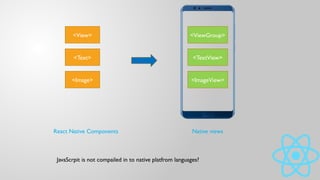
What is React Native
<View>
<Text>
<Image>
<ViewGroup>
<TextView>
<ImageView>
Native views
React Native Components
JavaScrpit is not compailed in to native platfrom languages?
How JavaScript code
is understand from the OS
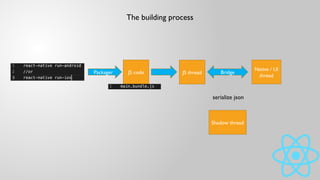
The building process
JS code JS thread
Native / UI
thread
Packager Bridge
Shadow thread
serialize json
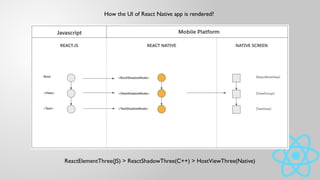
How the UI of React Native app is rendered?
ReactElementThree(JS) > ReactShadowThree(C++) > HostViewThree(Native)
React Native’s new architecture
Why?
• Bridge is gone
• Re-Rendering infrastructure is rewritten in more cross platform way
• Type Saftly (Codegen)
• React 18 is available only on the NEW ARCHITECTURE
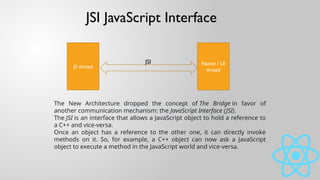
JS thread
Native / UI
thread
JSI
JSI JavaScript Interface
The New Architecture dropped the concept of The Bridge in favor of
another communication mechanism: the JavaScript Interface (JSI).
The JSI is an interface that allows a JavaScript object to hold a reference to
a C++ and vice-versa.
Once an object has a reference to the other one, it can directly invoke
methods on it. So, for example, a C++ object can now ask a JavaScript
object to execute a method in the JavaScript world and vice-versa.
•Synchronous execution: it is now possible to execute synchronously those functions
that should not have been asynchronous in the first place.
•Concurrency: it is possible from JavaScript to invoke functions that are executed on
different threads.
•Lower overhead: the New Architecture doesn't have to serialize/deserialize the data
anymore; therefore there are no serialization taxes to pay.
•Code sharing: by introducing C++, it is now possible to abstract all the platform
agnostic code and to share it with ease between the platforms.
•Type safety: to make sure that JS can properly invoke methods on C++ objects and
vice-versa, a layer of code automatically generated has been added. The code is
generated starting from some JS specification that must be typed through Flow or
TypeScript.
JSI JavaScript Interface
Pillars
• Fabric (new render)
• TurboModules (new native module system)
• Codegen (tool that can be used to avoid writing a lot of repetitive)
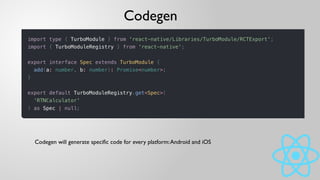
Codegen
Codegen will generate specific code for every platform:Android and iOS
Fabric
A Fabric Native Component is a Native Component rendered on the screen using the Fabric Render. Using
Fabric Native Components instead of Legacy Native Components allows us to reap all the benefits of
the New Architecture:
•Strongly typed interfaces that are consistent across platforms.
•The ability to write your code in C++, either exclusively or integrated with another native platform
language, hence reducing the need to duplicate implementations across platforms.
•The use of JSI, a JavaScript interface for native code, which allows for more efficient communication
between native and JavaScript code than the bridge.
Turbo Modules
Turbo Native Modules are the next iteration on Native Modules that provide a few extra benefits:
• Strongly typed interfaces that are consistent across platforms
• The ability to write your code in C++, either exclusively or integrated with another native
platform language, reducing the need to duplicate implementations across platforms
• Lazy loading of modules, allowing for faster app start-up
• The use of JSI, a JavaScript interface for native code, allows for more efficient communication
between native and JavaScript code than the bridge
What to look for
Timeline:
68 69 70
• New Architecure Support
• React 17
• React 18 Support
• Bundled Hermes
• CMake support
• Unified Codegen Config
• Fix all the transition from old to new architecture
in 68 and 69
https://reactnative.dev/versions
Build tools:
- React Native Gradele plugin will replace react.gradel
- Custom logic in Ruby for CocoaPods
Hermes will be recomendend JS engine
Bonus
• Maintain and improve high performance in react native app :
(profile the app, observe render patterns, apply memoization in the right places)
https://github.com/callstack/reassure
• @rnx-kit/dep-check manages React Native dependencies for a package, based on its needs and requirement
If you want to learn how dep-check is used at Microsoft,
and see a demo of how it works in a monorepo
"Improve all the repos – exploring Microsoft’s DevExp".

React Native new architecture Power Point

  • 1.
  • 2.
    • What isReact Native? React Native’s current architecture • How JavaScript code is understand from the OS? Main thread JavaScript thread Shadow thread • How UI is rendered? • Common issues. React Native’s new architecture • JavaScript Interface (JSI) • Fabric • Turbo Modules • Codegen What to look for
  • 3.
  • 4.
    <View> <Text> <Image> <ViewGroup> <TextView> <ImageView> Native views React NativeComponents JavaScrpit is not compailed in to native platfrom languages?
  • 5.
    How JavaScript code isunderstand from the OS
  • 6.
    The building process JScode JS thread Native / UI thread Packager Bridge Shadow thread serialize json
  • 7.
    How the UIof React Native app is rendered? ReactElementThree(JS) > ReactShadowThree(C++) > HostViewThree(Native)
  • 8.
  • 9.
    Why? • Bridge isgone • Re-Rendering infrastructure is rewritten in more cross platform way • Type Saftly (Codegen) • React 18 is available only on the NEW ARCHITECTURE
  • 10.
    JS thread Native /UI thread JSI JSI JavaScript Interface The New Architecture dropped the concept of The Bridge in favor of another communication mechanism: the JavaScript Interface (JSI). The JSI is an interface that allows a JavaScript object to hold a reference to a C++ and vice-versa. Once an object has a reference to the other one, it can directly invoke methods on it. So, for example, a C++ object can now ask a JavaScript object to execute a method in the JavaScript world and vice-versa.
  • 11.
    •Synchronous execution: itis now possible to execute synchronously those functions that should not have been asynchronous in the first place. •Concurrency: it is possible from JavaScript to invoke functions that are executed on different threads. •Lower overhead: the New Architecture doesn't have to serialize/deserialize the data anymore; therefore there are no serialization taxes to pay. •Code sharing: by introducing C++, it is now possible to abstract all the platform agnostic code and to share it with ease between the platforms. •Type safety: to make sure that JS can properly invoke methods on C++ objects and vice-versa, a layer of code automatically generated has been added. The code is generated starting from some JS specification that must be typed through Flow or TypeScript. JSI JavaScript Interface
  • 12.
    Pillars • Fabric (newrender) • TurboModules (new native module system) • Codegen (tool that can be used to avoid writing a lot of repetitive)
  • 13.
    Codegen Codegen will generatespecific code for every platform:Android and iOS
  • 14.
    Fabric A Fabric NativeComponent is a Native Component rendered on the screen using the Fabric Render. Using Fabric Native Components instead of Legacy Native Components allows us to reap all the benefits of the New Architecture: •Strongly typed interfaces that are consistent across platforms. •The ability to write your code in C++, either exclusively or integrated with another native platform language, hence reducing the need to duplicate implementations across platforms. •The use of JSI, a JavaScript interface for native code, which allows for more efficient communication between native and JavaScript code than the bridge.
  • 15.
    Turbo Modules Turbo NativeModules are the next iteration on Native Modules that provide a few extra benefits: • Strongly typed interfaces that are consistent across platforms • The ability to write your code in C++, either exclusively or integrated with another native platform language, reducing the need to duplicate implementations across platforms • Lazy loading of modules, allowing for faster app start-up • The use of JSI, a JavaScript interface for native code, allows for more efficient communication between native and JavaScript code than the bridge
  • 17.
    What to lookfor Timeline: 68 69 70 • New Architecure Support • React 17 • React 18 Support • Bundled Hermes • CMake support • Unified Codegen Config • Fix all the transition from old to new architecture in 68 and 69 https://reactnative.dev/versions Build tools: - React Native Gradele plugin will replace react.gradel - Custom logic in Ruby for CocoaPods Hermes will be recomendend JS engine
  • 18.
    Bonus • Maintain andimprove high performance in react native app : (profile the app, observe render patterns, apply memoization in the right places) https://github.com/callstack/reassure • @rnx-kit/dep-check manages React Native dependencies for a package, based on its needs and requirement If you want to learn how dep-check is used at Microsoft, and see a demo of how it works in a monorepo "Improve all the repos – exploring Microsoft’s DevExp".