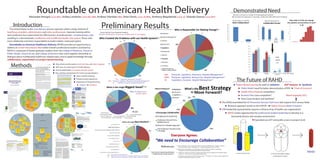
Preliminary Results
Physicians
Hospital Management
Lawyers
Researchers
Legislators
Bureaucrats
Patients
Everyone
Educators
Insurance
Health Businesses,
Industry Lobby, Media
Who Created the Problems with our Health System? *
75%
10%
8%
3% 4%
Encourage Collaboration
Congressional Leadership
Professions Should Find a
Middle Ground
Allow for a Market Approach
One Profession Should Create
a Strategy
45%
9%
36%
9%
Physicians
Educators
Legislators
Lawyers
Best StrategyWhat's the
Move Forward?to
13%
2%
5%
48%
7%
2%
5%
2%
2%
2%
12%
Lack of Access
Lack of Collaboration
Un- and Underinsured
Cost
Lack of Quality and Waste
Lack of Political Will Health Disparities
ACA
Lack of Preventive Care Physician Shortage
Systems-Based Problems
What is the single Biggest Issue? **
* Total count of responses by participants
** Categorized open-ended responses
4%
23%
16%
3%16%
6%
9%
5%
13%
2% 2%
What is the single Best Solution? **
Ensure Equal Access
Ensure Equal Treatment
Focus on Policy Solutions
There is No Single Solution
Cost Control
Collaborative Enterprise
Create Improved Delivery Models
Decrease Regulation
Increase Physician or Decrease Adminstration Pay
MD: “Everyone, Legislators, Physicians, Hospital Management”
MPH: “Everyone, Legislators, Bureaucrats, Hospital Management”
JD: “Legislators, Everyone, Hospital Management”
Everyone Agrees:
“We need to Encourage Collaboration”
“Cost is the Biggest Issue”
Everyone Agrees
Which Profession?
MD: “Policy Solutions, Single Payer, Other”
MPH: “Single Payer; Focus on Cultural Issues, Population Health or Other; Policy Solutions”
JD: “Single Payer; Focus on Cultural Issues, Population Health or Other; Policy Solutions”
MD: “Legislators, Bureaucrats, Everyone”
MPH: “Everyone, Legislators, Physicians and Hospital Management”
JD: “Legislators, Everyone, Hospital Management”
Survey Results From Graduate Students:
83 MPH, 93 MD, 20 JD, 19 Doctoral, 12 MBA, 8 PA, 11 Joint Degree
The United States health care delivery process operates within a large network of
healthcare providers, administrators and other professionals. Separate training within
each profession has undermined the effectiveness of professionals’ complementary roles
resulting in a decentralized, inneffective and innefficient health care system. These roles
must collaborate and share responsibility to build a better, improved system.
Roundtable on American Healthcare Delivery (RAHD) provides an opportunity to
address an unmet educational need within Drexel’s professional student constituency.
RAHD is composed of Drexel graduate students from the College of Medicine, School of
Public Health, School of Law, and College of Business that come together bimonthly to
dialogue about multifaceted healthcare-related topics and to apply knowledge through
collaborative, experiential and project-based learning.
Single Payer System
Focus on Cultural Issues, Population Health, or Other
(A)synchronous discussions, brainstorming, and value-mapping
360 view of current topics in health delivery
Diverse stakeholders, innovative thought streams
Non-member participation for broad conceptualization
Semi-monthly meetings
Problem-based experiences
Application of Design-thinking
Analysis Synthesis
References:
59
73
45
25
10265
39
152
35
Who is Responsible For Making Change? *
47
77
64
11785
39
103
11
23
Roundtable on American Health Delivery
Introduction 39%
32%
2%
27%
0%
5%
10%
15%
20%
25%
30%
35%
40%
45%
Yes Maybe No, I'm not
interested in
collaboration
No, for other
reasons
Wish you were part of a
Collaborative Group?
0%
10%
20%
30%
40%
50%
60%
70%
80%
90%
100%
Yes No Opinion
Do you believe in a need for
More Collaboration?
How vital is it that we change
the systems and practices of care?
1-10
0
10
20
30
40
50
60
70
1 2 3 4 5 6 7 8 9 10
N
We sent a survey to a number of Drexel graduate students
We received 235 responses in one week, mostly from MD, MPH and JD students
Demonstrated Need
The Future of RAHD
Methods
36%
24%
2%
37%
42%
39%
0%
19%
45%
30%
5%
20%
0%
5%
10%
15%
20%
25%
30%
35%
40%
45%
50%
Yes Maybe No, I'm not interested in
collaboration
No, for other reasons
MD
MPH
JD
Project-Based Learning focused on solutions 360 Analysis Synthesis
Public Health need for better demonstration of ROI Chart of Accounts
Health Policy Proposal competition
Business Plan case competition (Mammography SOC)
Root Cause Analysis and Synthesis
The AHRQ assembled the US Preventive Services Task Force with experts from various fields
Research approach similar to the USPSTF Higher Ground, Better Solutions
IOM leadership representative experts in diverse array of health care organizations
RAHD creates opportunities for professional student leadership to develop in a
necessarily diverse and complex environment
Expanded use of IT and public access to project work
1
2
3
Current Academic Silos University Setting With Engaged
Interdisciplinary Program
RAHD
1. Institute of Medicine. 2012. For the Public’s Health: Investing in a Healthier Future. Chapter 3, Informing
Investment in Better Health. Washington, D.C. <nap.edu/catalog.php?record_id=13268>
2. Baiada Incubator Competition / Ian J. Berg Business Plan Competition / Business Concept Paper
Competition, Drexel University Baiada Institute for Entrepreneurship
3. a. AAMC focus on Root Cause Analysis / Student Super-Utilizer Poster Competition at JU Population Health
Colloquium <https://www.aamc.org/initiatives/hotspotter/>
b. Call for Root Cause Analysis in Health Systems Auditing Szostek, J. et al. 2010. A Systems Approach to
Morbidity and Mortality Conference. Am J Med.
Alexander Krengel Cand: MPH, Ashley Landicho Cand: MD, MBA, Andrew Sheridan MBA, Viren Doshi, Cand: JD/MPH, Anthony Magdalinski Cand: JD, Yolande Greene Cand: MPH
o

RAHD Poster_LR

  • 1.
    Preliminary Results Physicians Hospital Management Lawyers Researchers Legislators Bureaucrats Patients Everyone Educators Insurance HealthBusinesses, Industry Lobby, Media Who Created the Problems with our Health System? * 75% 10% 8% 3% 4% Encourage Collaboration Congressional Leadership Professions Should Find a Middle Ground Allow for a Market Approach One Profession Should Create a Strategy 45% 9% 36% 9% Physicians Educators Legislators Lawyers Best StrategyWhat's the Move Forward?to 13% 2% 5% 48% 7% 2% 5% 2% 2% 2% 12% Lack of Access Lack of Collaboration Un- and Underinsured Cost Lack of Quality and Waste Lack of Political Will Health Disparities ACA Lack of Preventive Care Physician Shortage Systems-Based Problems What is the single Biggest Issue? ** * Total count of responses by participants ** Categorized open-ended responses 4% 23% 16% 3%16% 6% 9% 5% 13% 2% 2% What is the single Best Solution? ** Ensure Equal Access Ensure Equal Treatment Focus on Policy Solutions There is No Single Solution Cost Control Collaborative Enterprise Create Improved Delivery Models Decrease Regulation Increase Physician or Decrease Adminstration Pay MD: “Everyone, Legislators, Physicians, Hospital Management” MPH: “Everyone, Legislators, Bureaucrats, Hospital Management” JD: “Legislators, Everyone, Hospital Management” Everyone Agrees: “We need to Encourage Collaboration” “Cost is the Biggest Issue” Everyone Agrees Which Profession? MD: “Policy Solutions, Single Payer, Other” MPH: “Single Payer; Focus on Cultural Issues, Population Health or Other; Policy Solutions” JD: “Single Payer; Focus on Cultural Issues, Population Health or Other; Policy Solutions” MD: “Legislators, Bureaucrats, Everyone” MPH: “Everyone, Legislators, Physicians and Hospital Management” JD: “Legislators, Everyone, Hospital Management” Survey Results From Graduate Students: 83 MPH, 93 MD, 20 JD, 19 Doctoral, 12 MBA, 8 PA, 11 Joint Degree The United States health care delivery process operates within a large network of healthcare providers, administrators and other professionals. Separate training within each profession has undermined the effectiveness of professionals’ complementary roles resulting in a decentralized, inneffective and innefficient health care system. These roles must collaborate and share responsibility to build a better, improved system. Roundtable on American Healthcare Delivery (RAHD) provides an opportunity to address an unmet educational need within Drexel’s professional student constituency. RAHD is composed of Drexel graduate students from the College of Medicine, School of Public Health, School of Law, and College of Business that come together bimonthly to dialogue about multifaceted healthcare-related topics and to apply knowledge through collaborative, experiential and project-based learning. Single Payer System Focus on Cultural Issues, Population Health, or Other (A)synchronous discussions, brainstorming, and value-mapping 360 view of current topics in health delivery Diverse stakeholders, innovative thought streams Non-member participation for broad conceptualization Semi-monthly meetings Problem-based experiences Application of Design-thinking Analysis Synthesis References: 59 73 45 25 10265 39 152 35 Who is Responsible For Making Change? * 47 77 64 11785 39 103 11 23 Roundtable on American Health Delivery Introduction 39% 32% 2% 27% 0% 5% 10% 15% 20% 25% 30% 35% 40% 45% Yes Maybe No, I'm not interested in collaboration No, for other reasons Wish you were part of a Collaborative Group? 0% 10% 20% 30% 40% 50% 60% 70% 80% 90% 100% Yes No Opinion Do you believe in a need for More Collaboration? How vital is it that we change the systems and practices of care? 1-10 0 10 20 30 40 50 60 70 1 2 3 4 5 6 7 8 9 10 N We sent a survey to a number of Drexel graduate students We received 235 responses in one week, mostly from MD, MPH and JD students Demonstrated Need The Future of RAHD Methods 36% 24% 2% 37% 42% 39% 0% 19% 45% 30% 5% 20% 0% 5% 10% 15% 20% 25% 30% 35% 40% 45% 50% Yes Maybe No, I'm not interested in collaboration No, for other reasons MD MPH JD Project-Based Learning focused on solutions 360 Analysis Synthesis Public Health need for better demonstration of ROI Chart of Accounts Health Policy Proposal competition Business Plan case competition (Mammography SOC) Root Cause Analysis and Synthesis The AHRQ assembled the US Preventive Services Task Force with experts from various fields Research approach similar to the USPSTF Higher Ground, Better Solutions IOM leadership representative experts in diverse array of health care organizations RAHD creates opportunities for professional student leadership to develop in a necessarily diverse and complex environment Expanded use of IT and public access to project work 1 2 3 Current Academic Silos University Setting With Engaged Interdisciplinary Program RAHD 1. Institute of Medicine. 2012. For the Public’s Health: Investing in a Healthier Future. Chapter 3, Informing Investment in Better Health. Washington, D.C. <nap.edu/catalog.php?record_id=13268> 2. Baiada Incubator Competition / Ian J. Berg Business Plan Competition / Business Concept Paper Competition, Drexel University Baiada Institute for Entrepreneurship 3. a. AAMC focus on Root Cause Analysis / Student Super-Utilizer Poster Competition at JU Population Health Colloquium <https://www.aamc.org/initiatives/hotspotter/> b. Call for Root Cause Analysis in Health Systems Auditing Szostek, J. et al. 2010. A Systems Approach to Morbidity and Mortality Conference. Am J Med. Alexander Krengel Cand: MPH, Ashley Landicho Cand: MD, MBA, Andrew Sheridan MBA, Viren Doshi, Cand: JD/MPH, Anthony Magdalinski Cand: JD, Yolande Greene Cand: MPH o