This presentation coversthe implementation of the
Raft consensus algorithm in Python, focusing on the
command-line interface setup and key challenges
encountered during the process.
Introduction
Python CLI setup
Settingup a command-line interface (CLI) for the Raft algorithm
involves creating an interactive user experience. Using libraries like
argparse or click, you can define commands that will initialize the
server, manage client requests, and display logs for debugging
purposes. A well-structured CLI enhances usability and facilitates
easier interaction for testing and validation tasks.
5.
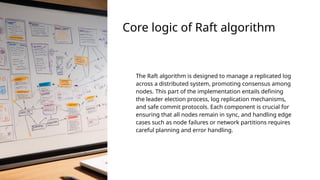
The Raft algorithmis designed to manage a replicated log
across a distributed system, promoting consensus among
nodes. This part of the implementation entails defining
the leader election process, log replication mechanisms,
and safe commit protocols. Each component is crucial for
ensuring that all nodes remain in sync, and handling edge
cases such as node failures or network partitions requires
careful planning and error handling.
Core logic of Raft algorithm
6.
Testing and validation
Testingthe Raft algorithm implementation is critical for ensuring
reliability and correctness. This involves unit testing individual
components, such as leader election and log replication, to confirm
they work as intended. Additionally, integration tests should verify
that the entire system functions correctly under various scenarios,
including network partitions and simultaneous requests. Automated
testing tools can assist in running multiple simulation scenarios
efficiently, helping to identify edge cases and unexpected behaviors.
Handling network failures
Oneof the significant challenges faced during Raft's
implementation is managing network failures. Since the algorithm
relies on node communication, any interruptions can lead to
inconsistencies. Implementing timeouts and retries for message
delivery can help mitigate issues. Additionally, establishing clear
rules for when a node should assume leadership or fallback to
follower state during failures is crucial for maintaining system
integrity.
9.
Consistency issues
Ensuring consistencyacross distributed nodes is a primary concern
in the Raft algorithm. During implementation, it's essential to
address cases where different nodes may receive client requests
simultaneously. Strategies such as using a single leader to handle
client communications and ensuring logs are committed only after
consensus can minimize inconsistencies. Regular log snapshots can
also be used to aid recovery from failures and ensure all nodes
reflect the same state.
10.
Optimizing the performanceof the Raft algorithm
implementation is vital for scalability, especially in high-
throughput systems. Techniques like batching messages and
efficient log storage formats can significantly enhance
responsiveness. Monitoring latencies and employing
algorithmic improvements, such as reducing quorum sizes or
enhancing network communication protocols, will also
contribute to better performance. Continuous profiling and
refining the implementation based on real-world usage patterns
are recommended to achieve optimal results.
Performance optimization
11.
The implementation ofthe Raft algorithm in Python via a
command-line interface presents both opportunities and
challenges. Through a structured approach that includes
thorough testing, effective handling of network failures, and
a focus on consistency and performance optimization,
developers can create a robust distributed system. The
experience gained from addressing these challenges
contributes to a deeper understanding of distributed
computing principles and prepares for future enhancements.
Conclusions
12.
CREDITS: This presentationtemplate was created by
Slidesgo, and includes icons, infographics & images by
Freepik
Thank you!
Do you have any questions?




![[Yu cheng lin]cloud presentation - Raft](https://cdn.slidesharecdn.com/ss_thumbnails/yu-chenglincloudpresentation-raft-170817043111-thumbnail.jpg?width=640&height=640&fit=bounds)


