




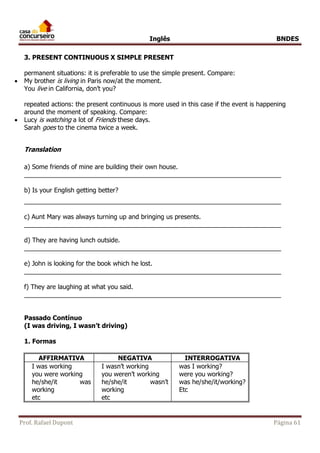
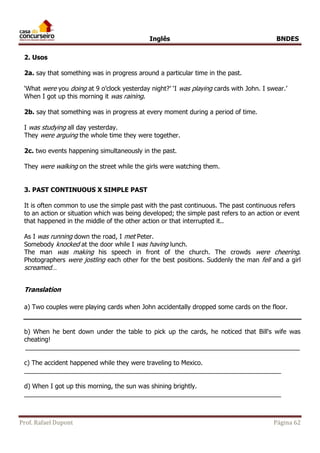
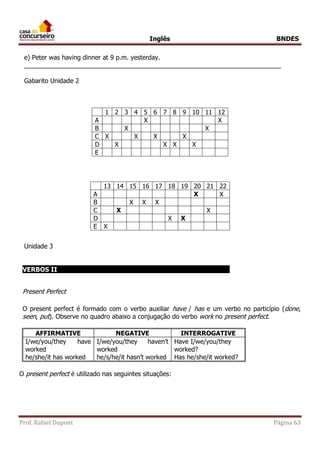
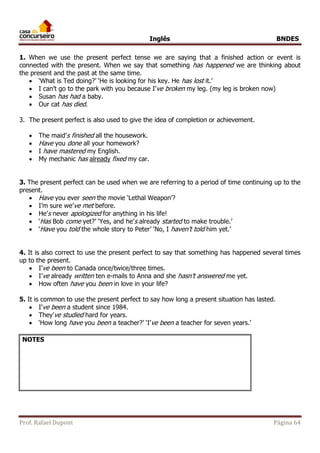
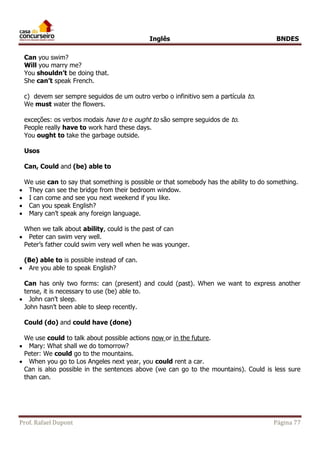
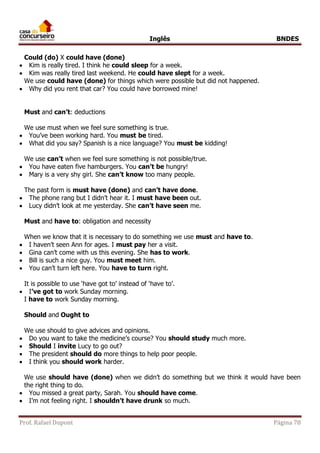
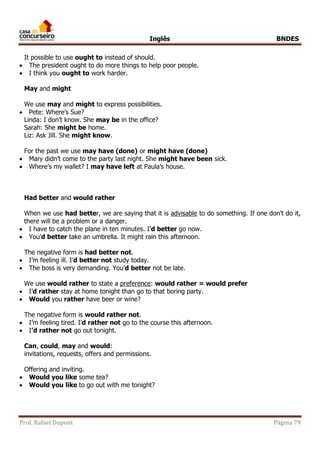
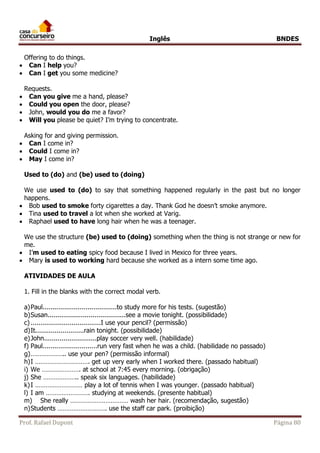
Língua Estrangeira - Inglês 
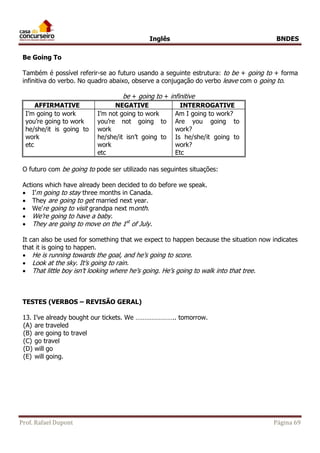
Prof.: Rafael Dupont
Inglês BNDES 
Inglês para Concursos 
Parte I – Vocabulário e Interpretação de texto 
Unidade 1 
Gêneros Textuais 
As provas de Inglês dos principais concursos no Brasil exigem do candidato a 
leitura e compreensão de textos de diferentes gêneros. Estes gêneros textuais 
possuem uma função comunicativa específica e se caracterizam por organização, 
estrutura gramatical e vocabulário específico. 
A familiaridade com o gênero textual possibilita ao candidato efetuar leituras 
mais eficientes e direcionadas, tornando mais fácil e rápida a localização das 
informações desejadas. Nosso objetivo nessa unidade é aprender a identificar, de 
maneira simples e eficaz, os diferentes tipos de texto das provas de Inglês. 
Os textos abaixo são de diferentes gêneros. Qual o objetivo do autor em cada 
um deles 
1 2 
PYRO Studio 
A complete, fully integrated 
hardware/software solution, PYRO A/V Link 
Studio provides the best value and the best 
components for capturing, editing and 
exporting both analog and digital video in 
real time. PYRO AV Link Studio hardware 
includes the PYRO 1394 PCI card and cable, 
and the PYRO AV Link, an external box that 
connects to your computer via FireWire. With 
Composite, S-Video and Component 
connectors, capture video from any source. 
For video editing, it includes Sony® 
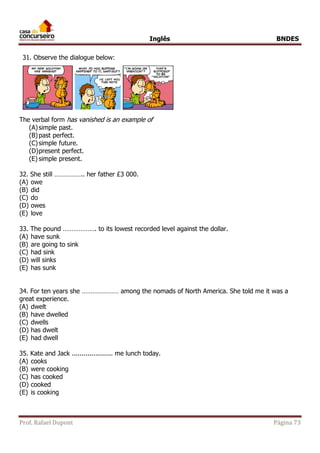
Vegas®+DVD Production Suite. The 
Vegas®+DVD Production Suite is a powerful 
set of three programs that seamlessly edits 
video and audio, produces 5.1 surround 
mixes, encodes to Dolby Digital® AC-3 file 
formats and authors DVDs. From short-form 
videos to widescreen 5.1 DVDs, Vegas+DVD 
software provides comprehensive video, 
audio, and DVD production features for the 
professional media producer. 
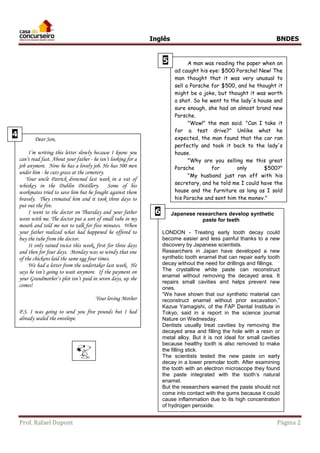
Snoopy is an extroverted beagle with a 
Walter Mitty complex. He is a virtuoso at 
every endeavor – at least in his daydreams 
atop his doghouse. He regards his master, 
Charlie Brown, as "that round-headed kid" 
who brings him his supper dish. He is 
fearless though prudently cautious about "the 
cat next door." He never speaks- that would 
be one human trait too many- but he 
manages to convey everything necessary in 
facial expressions and thought balloons. A 
one-man show with superior intelligence and 
vivid imagination, he has created such 
multiple personalities as: Joe Cool, World 
War I Flying Ace, Literary Ace, Flashbeagle, 
Vulture, Foreign Legionnaire, etc. 
3 
Prof. Rafael Dupont Página 1
Inglês BNDES 
Dear Son, 
I’m writing this letter slowly because I know you 
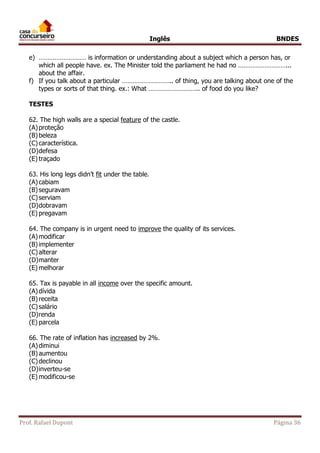
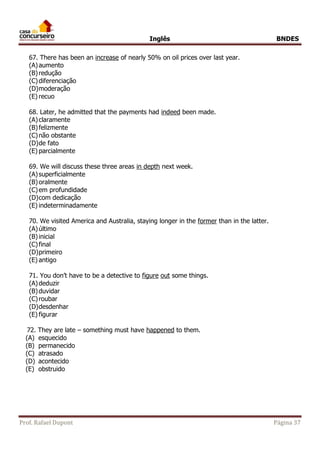
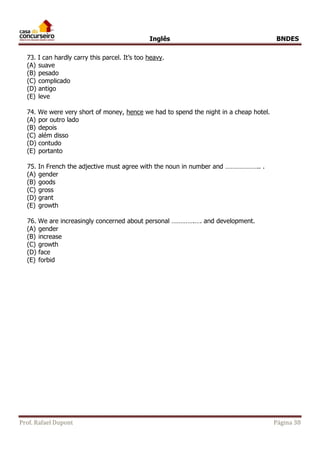
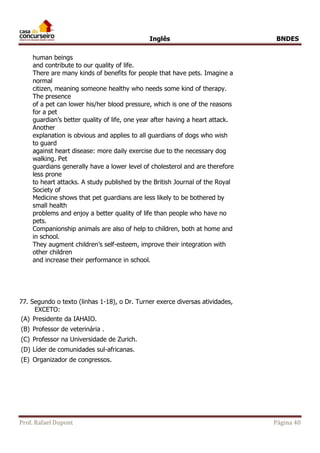
can’t read fast. About your father - he isn’t looking for a 
job anymore. Now he has a lovely job. He has 500 men 
under him - he cuts grass at the cemetery. 
Your uncle Patrick drowned last week in a vat of 
whiskey in the Dublin Distillery. Some of his 
workmates tried to save him but he fought against them 
bravely. They cremated him and it took three days to 
put out the fire. 
I went to the doctor on Thursday and your father 
went with me. The doctor put a sort of small tube in my 
mouth and told me not to talk for five minutes. When 
your father realized what had happened he offered to 
buy the tube from the doctor. 
It only rained twice this week, first for three days 
and then for four days. Monday was so windy that one 
of the chickens laid the same egg four times. 
We had a letter from the undertaker last week. He 
says he isn’t going to wait anymore. If the payment on 
your Grandmother’s plot isn’t paid in seven days, up she 
comes! 
Your loving Mother 
P.S. I was going to send you five pounds but I had 
already sealed the envelope. 
Prof. Rafael Dupont Página 2 
4 
A man was reading the paper when an 
ad caught his eye: $500 Porsche! New! The 
man thought that it was very unusual to 
sell a Porsche for $500, and he thought it 
might be a joke, but thought it was worth 
a shot. So he went to the lady's house and 
sure enough, she had an almost brand new 
Porsche. 
"Wow!" the man said. "Can I take it 
for a test drive?" Unlike what he 
expected, the man found that the car ran 
perfectly and took it back to the lady's 
house. 
"Why are you selling me this great 
Porsche for only $500?" 
"My husband just ran off with his 
secretary, and he told me I could have the 
house and the furniture as long as I sold 
his Porsche and sent him the money." 
5 
Japanese researchers develop synthetic 
paste for teeth 
LONDON - Treating early tooth decay could 
become easier and less painful thanks to a new 
discovery by Japanese scientists. 
Researchers in Japan have developed a new 
synthetic tooth enamel that can repair early tooth 
decay without the need for drillings and fillings. 
The crystalline white paste can reconstruct 
enamel without removing the decayed area. It 
repairs small cavities and helps prevent new 
ones. 
“We have shown that our synthetic material can 
reconstruct enamel without prior excavation,” 
Kazue Yamagishi, of the FAP Dental Institute in 
Tokyo, said in a report in the science journal 
Nature on Wednesday. 
Dentists usually treat cavities by removing the 
decayed area and filling the hole with a resin or 
metal alloy. But it is not ideal for small cavities 
because healthy tooth is also removed to make 
the filling stick. 
The scientists tested the new paste on early 
decay in a lower premolar tooth. After examining 
the tooth with an electron microscope they found 
the paste integrated with the tooth’s natural 
enamel. 
But the researchers warned the paste should not 
come into contact with the gums because it could 
cause inflammation due to its high concentration 
of hydrogen peroxide. 
6
Inglês BNDES 
INDICATIONS: For the temporary relief 
of minor aches and pains associated with the 
common Unidade cold, 2 
headache, toothache, 
muscular aches, backaches, for the minor 
pain of arthritis, for the pain of menstrual 
para leitura. 
cramps and for reduction of fever. 
Post-World War I and the Great Depression 
(1918–1940) 
Following World War I, the U.S. grew 
steadily in stature as an economic and military 
world power. The aftershock of Russia's October 
Revolution resulted in real fears of communism 
in the United States, leading to a three-year Red 
Scare. 
Prohibition agents destroyed barrels of 
alcohol in Chicago, 1921. The United States 
Senate did not ratify the Treaty of Versailles 
imposed by its Allies on the defeated Central 
Powers; instead, the United States chose to 
pursue unilateralism, if not isolationism. 
In 1920, the manufacture, sale, import and 
export of alcohol was prohibited by the 
Eighteenth Amendment to the United States 
Constitution. The "Prohibition" encouraged illegal 
breweries and dealers to make substantial 
amounts of money selling alcohol illegally. The 
Prohibition ended in 1933, a failure. 
During most of the 1920s, the United States 
enjoyed a period of unbalanced prosperity: farm 
prices and wages fell, while industrial profits 
grew. The boom was fueled by a rise in debt and 
an inflated stock market. The Wall Street Crash 
of 1929, the Dust Bowl, and the ensuing Great 
Depression led to government efforts to restart 
the economy and help its victims with Franklin D. 
Roosevelt's New Deal. The recovery was rapid in 
all areas except unemployment, which remained 
fairly high until 1940. 
8 
DIRECTIONS: Adults: Take 1 caplet 
every 4 to 6 hours while symptoms persist. If 
pain of fever does not respond to 1 caplet, 2 
caplets may be used but do not exceed 6 
caplets in 24 hours, unless directed by a 
doctor. The smallest effective dose should be 
used. 
7 
8 
Prof. Rafael Dupont Página 3
Inglês BNDES 
A 
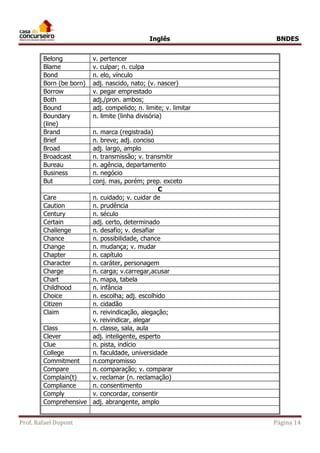
Able adj. capaz 
About prep. sobre; adv. por volta de 
Above adj.acima 
Abroad adv. exterior 
Accept v. aceitar 
Accomplish(ed) v. realizar; (realizado) 
Account n. relato 
Accurate adj. preciso 
Achieve(ment) v. alcançar, realizar (n. realização) 
Acquire v. adquirir 
Actual(ly) adj. verdadeiro (adv. realmente) 
Address n. discurso, endereço 
Advice n. conselho 
Advise v. aconselhar 
Affair n. assunto, caso 
Afford v. custear 
Afraid adj. amedrontado (medo) 
Age n. idade, época; v. envelhecer 
Agenda n. pauta 
Agree(ment) v. concordar (n. acordo) 
Aid n. ajuda 
Aim n. objetivo; v. visar 
Allow v. permitir 
Almost adv. quase 
Amend(ment) v. emendar, corrigir (n. melhoria) 
Amount n. quantia 
Ancient adj. antigo 
Apply v. candidatar-se 
Approach v. aproximar-se; n. abordagem 
Arrive v. chegar 
Article n. artigo 
Assemble v. reunir(-se) 
Asses(met) v. avaliar (n. avaliação) 
Asset(s) n. bem, trunfo (n. pl. bens) 
Assign(ment) v. atribuir, designar (n. tarefa, atribuilção) 
Assume v. presumir, supor 
Assure v. garantir 
Attach v. anexar 
Attend v. assistir, freqüentar, comparecer 
Attempt v. tentar 
Available adj. disponível 
Average n. média 
Prof. Rafael Dupont Página 4
Inglês BNDES 
Avoid v. evitar 
Aware adj. ciente 
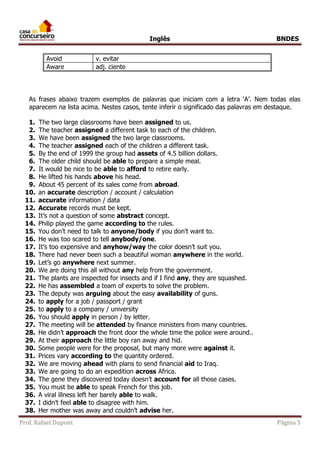
As frases abaixo trazem exemplos de palavras que iniciam com a letra ‘A’. Nem todas elas 
aparecem na lista acima. Nestes casos, tente inferir o significado das palavras em destaque. 
1. The two large classrooms have been assigned to us. 
2. The teacher assigned a different task to each of the children. 
3. We have been assigned the two large classrooms. 
4. The teacher assigned each of the children a different task. 
5. By the end of 1999 the group had assets of 4.5 billion dollars. 
6. The older child should be able to prepare a simple meal. 
7. It would be nice to be able to afford to retire early. 
8. He lifted his hands above his head. 
9. About 45 percent of its sales come from abroad. 
10. an accurate description / account / calculation 
11. accurate information / data 
12. Accurate records must be kept. 
13. It’s not a question of some abstract concept. 
14. Philip played the game according to the rules. 
15. You don’t need to talk to anyone/body if you don’t want to. 
16. He was too scared to tell anybody/one. 
17. It’s too expensive and anyhow/way the color doesn’t suit you. 
18. There had never been such a beautiful woman anywhere in the world. 
19. Let’s go anywhere next summer. 
20. We are doing this all without any help from the government. 
21. The plants are inspected for insects and if I find any, they are squashed. 
22. He has assembled a team of experts to solve the problem. 
23. The deputy was arguing about the easy availability of guns. 
24. to apply for a job / passport / grant 
25. to apply to a company / university 
26. You should apply in person / by letter. 
27. The meeting will be attended by finance ministers from many countries. 
28. He didn’t approach the front door the whole time the police were around.. 
29. At their approach the little boy ran away and hid. 
30. Some people were for the proposal, but many more were against it. 
31. Prices vary according to the quantity ordered. 
32. We are moving ahead with plans to send financial aid to Iraq. 
33. We are going to do an expedition across Africa. 
34. The gene they discovered today doesn’t account for all those cases. 
35. You must be able to speak French for this job. 
36. A viral illness left her barely able to walk. 
37. I didn’t feel able to disagree with him. 
38. Her mother was away and couldn’t advise her. 
Prof. Rafael Dupont Página 5
Inglês BNDES 
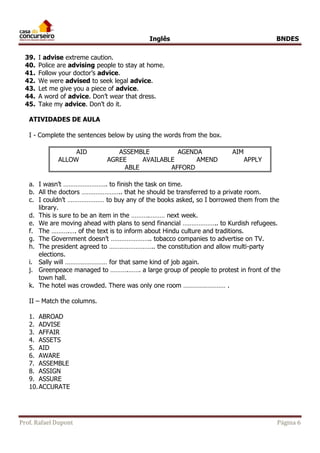
39. I advise extreme caution. 
40. Police are advising people to stay at home. 
41. Follow your doctor’s advice. 
42. We were advised to seek legal advice. 
43. Let me give you a piece of advice. 
44. A word of advice. Don’t wear that dress. 
45. Take my advice. Don’t do it. 
ATIVIDADES DE AULA 
I - Complete the sentences below by using the words from the box. 
AID ASSEMBLE AGENDA AIM 
ALLOW AGREE AVAILABLE AMEND APPLY 
ABLE AFFORD 
a. I wasn’t ……………………. to finish the task on time. 
b. All the doctors ………………….. that he should be transferred to a private room. 
c. I couldn’t ………………… to buy any of the books asked, so I borrowed them from the 
library. 
d. This is sure to be an item in the ……….……… next week. 
e. We are moving ahead with plans to send financial ……………….. to Kurdish refugees. 
f. The ……….…. of the text is to inform about Hindu culture and traditions. 
g. The Government doesn’t ………………….. tobacco companies to advertise on TV. 
h. The president agreed to …………………….. the constitution and allow multi-party 
elections. 
i. Sally will …………………… for that same kind of job again. 
j. Greenpeace managed to ……….……. a large group of people to protest in front of the 
town hall. 
k. The hotel was crowded. There was only one room …………………… . 
II – Match the columns. 
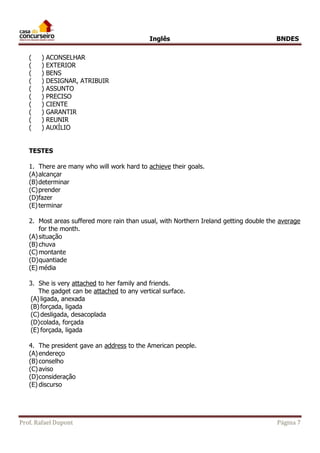
1. ABROAD 
2. ADVISE 
3. AFFAIR 
4. ASSETS 
5. AID 
6. AWARE 
7. ASSEMBLE 
8. ASSIGN 
9. ASSURE 
10. ACCURATE 
Prof. Rafael Dupont Página 6
Inglês BNDES 
( ) ACONSELHAR 
( ) EXTERIOR 
( ) BENS 
( ) DESIGNAR, ATRIBUIR 
( ) ASSUNTO 
( ) PRECISO 
( ) CIENTE 
( ) GARANTIR 
( ) REUNIR 
( ) AUXÍLIO 
TESTES 
1. There are many who will work hard to achieve their goals. 
(A) alcançar 
(B) determinar 
(C) prender 
(D) fazer 
(E) terminar 
2. Most areas suffered more rain than usual, with Northern Ireland getting double the average 
for the month. 
(A) situação 
(B) chuva 
(C) montante 
(D) quantiade 
(E) média 
3. She is very attached to her family and friends. 
The gadget can be attached to any vertical surface. 
(A) ligada, anexada 
(B) forçada, ligada 
(C) desligada, desacoplada 
(D) colada, forçada 
(E) forçada, ligada 
4. The president gave an address to the American people. 
(A) endereço 
(B) conselho 
(C) aviso 
(D) consideração 
(E) discurso 
Prof. Rafael Dupont Página 7
Inglês BNDES 
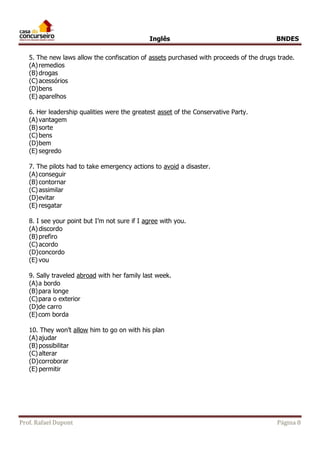
5. The new laws allow the confiscation of assets purchased with proceeds of the drugs trade. 
(A) remedios 
(B) drogas 
(C) acessórios 
(D) bens 
(E) aparelhos 
6. Her leadership qualities were the greatest asset of the Conservative Party. 
(A) vantagem 
(B) sorte 
(C) bens 
(D) bem 
(E) segredo 
7. The pilots had to take emergency actions to avoid a disaster. 
(A) conseguir 
(B) contornar 
(C) assimilar 
(D) evitar 
(E) resgatar 
8. I see your point but I’m not sure if I agree with you. 
(A) discordo 
(B) prefiro 
(C) acordo 
(D) concordo 
(E) vou 
9. Sally traveled abroad with her family last week. 
(A) a bordo 
(B) para longe 
(C) para o exterior 
(D) de carro 
(E) com borda 
10. They won’t allow him to go on with his plan 
(A) ajudar 
(B) possibilitar 
(C) alterar 
(D) corroborar 
(E) permitir 
Prof. Rafael Dupont Página 8
Inglês BNDES 
11. Have you read this newspaper article? 
(A) jornal 
(B) entrevista 
(C) venda 
(D) artigo 
(E) relato 
12. I’ll call you tomorrow night about ten o’clock. 
(A) em ponto 
(B) depois das 
(C) sobre as 
(D) por volta das 
(E) antes das 
13. This a National Security affair. 
(A) necessidade 
(B) perigo 
(C) assunto 
(D) afeto 
(E) questionamento 
14. He gave me a superficial account of what happened that night. 
(A) conta 
(B) relato 
(C) acordo 
(D) reportagem 
(E) abordagem 
15. If we all work together, I think we’ll achieve our goal. 
(A) terminar 
(B) recomeçar 
(C) alcançar 
(D) otimizar 
(E) marcar 
16. We approach the end of the year with the economy slowing and little sign of cheer. 
(A) abservamos 
(B) aproximamos 
(C) terminamos 
(D) começamos 
(E) permitimos 
Prof. Rafael Dupont Página 9
Inglês BNDES 
17. I can assure you that this is a safe sport. 
(A) assumir 
(B) comparar 
(C) garantir 
(D) recomndar 
(E) competir 
18. The minister was unable to attend his friend’s funeral. 
(A) festejar 
(B) comparecer 
(C) atender 
(D) lamenter 
(E) compreender 
Unidade 3 
Para não sermos surpreendidos com o vocabulário dos textos, é imprescindível que a 
leitura das questões – principalmente as de interpretação – seja feita antes da primeira leitura 
do texto. Desse modo, ao lermos o texto, já teremos uma noção acerca do seu assunto e das 
informações que devemos encontrar durante a leitura. 
Além das questões de interpretação, é comum encontrarmos questões de referência 
pronominal ou numérica. Elas exigem do candidato a habilidade de relacionar pronomes e 
números a substantivos encontrados no texto. Vale lembrar que utilizamos pronomes para 
evitar a repetição de substantivos. 
Leia as questões abaixo e reflita sobre o possível assunto do texto. Logo após, sublinhe 
nos textos o pronome citado em cada uma das questões de referência. Finalmente, faça uma 
leitura atenta do texto para responder às questões. 
TEXTO I 
19. The main purpose of the text is to 
(A) inform about a new product. 
(B) show how drivers are imprudent. 
(C) inform the rate of accidents caused by distracted drivers. 
(D) explain how one can avoid accidents. 
(E) show the problem of distracted drivers. 
20. According to the text, AutoVue 
(A) is a system that avoids all kinds of accidents. 
(B) goes off every time the driver change lanes. 
(C) is a system controlled by a computer 
(D) is a system developed to reduce accidents. 
(E) emits a sound if the driver is distracted. 
Prof. Rafael Dupont Página 10
Inglês BNDES 
21. The word it refers to 
(A) this camera 
(B) roadsides 
(C) dashboard 
(D) this system 
(E) accidents 
Help For Distracted Drivers 
The rate of automobile accidents caused by distracted is destined to decline, thanks to a new 
invention to alert drivers before they go off the road. Called AutoVue, this camera and computer 
combination can be attached to the dashboard of a car. When the car makes an unsignalled turn, 
this system emits a sound similar to the rumbling noise already caused by raised strips on 
roadsides. It will not go off if drivers indicate that they are changing lanes. 
TEXTO II 
22. The text doesn’t inform that: 
(A) Nokia is a huge company 
(B) The final price of the N-Gage 
(C) You can play games in the N-Gage 
(D) You can make phone calls with the N-Gage 
(E) The new N-Gage might compete with the Game Boy Advance 
23. The word its refers to 
(A) phone 
(B) mobile phone 
(C) Nokia 
(D) Nintendo 
(E) Game Boy Advance 
A Giant Gets Bigger 
Nintendo’s Game Boy Advance may have some pretty hot competition coming up. Before the end 
of the year, mobile phone giant Nokia plans to expand its horizons with N-Gage, a GSM mobile 
phone on which you can also play videogames stored on tiny memory cards. The cost has yet to 
be determined, but estimates vary from $100 to $200. 
Prof. Rafael Dupont Página 11
Inglês BNDES 
TEXTO III 
24. The best title for the text above is 
(A) For Women Only 
(B) Sites For Women 
(C) Internet’s New Challenges 
(D) The Best On The Internet 
(E) Online Issues For All 
Though women’s Day has come and gone, here is a site that truly celebrates the gentler sex. The 
cleverly-named www.handbag.com offers in-depth coverage of issues of great interest and 
importance to women. There’s a career expert, for example, to help you with your job change and 
an online house-price predictor to get you through those messy property issues. But you’ll also 
find some lighter editorial content, like the latest in celebrity gossip, fitness trends and beauty 
products. Definitely worth a visit! 
TEXTO IV 
25. According to the last lines of the text, it can be inferred that 
(A) The site will be removed from the net due to the Vice President’s complain. 
(B) There’s a real picture of the Vice President’s wife with a clown nose. 
(C) The Vice President’s wife works as a clown. 
(D) The site responded by sending the Vice President a doctored picture of his wife. 
(E) The site will be maintained besides the complaints received. 
26. The words it and her refers respectively to 
(A) the site – the Vice President 
(B) portraits – Lynne Cheney 
(C) portraits – the Vice President’s wife 
(D) office – Lynne Cheney 
(E) the site – Lynne Cheney 
Humor or Disrespect? 
“Courage. Passion. Faith. Petroleum. Xenophobia.” That’s how one extremely popular satiric web 
site (www.whitehouse.org) sums up the Bush administration. a lampoon of the White House’s 
official web site (www.whitehouse.gov), whitehouse.org has been under fire lately for its less-than- 
lovely portraits of Lynne Cheney, the Vice President’s wife, that prompted the Vice 
President’s office to send a letter to the site requesting that it removes her satiric biography 
(pictures and all). The site’s response: to devilishly doctor her picture with a clown nose and black 
tooth. 
Prof. Rafael Dupont Página 12
Inglês BNDES 
TEXTO V 
27. According to the text 
(A) the American dream is the SUV. 
(B) the SUV models consume more oil than cars. 
(C) cars are under attack by environmentalists. 
(D) cars are wasteful vehicles. 
(E) not many people in the United States have an SUV. 
28. The words which refers respectively to 
(A) SUV – cars 
(B) American Dream – SUV 
(C) car – wasteful models 
(D) automobile – SUV 
(E) car – SUV 
Even if the automobile is one of the most powerful symbols of the American Dream, the recent 
war in Iraq led many people to question the country’s dependence on oil. It wasn’t the car itself 
which came under attack from environmentalists so much as some of the most wasteful models. 
The massive SUV, or Sports Utility Vehicle, which is a truck on wheels, rather than a car, is a 
particular object of hate: the Hummer, for example, gives you as little as 12 miles per gallon, 
whereas a Toyota Prius can do 52 and this led the Union of Concerned Scientists to observe: “If 
everybody in the US who drives an SUV drove a car instead, we could cut out Middle Eastern oil 
imports entirely.” 
Unidade 4 
Observe com atenção a lista de palavras abaixo. Todas elas iniciam com as letras ‘’B’’ e “C” e 
foram extraídas de textos de vestibulares. Esta é a continuação da lista básica de vocabulário 
para concursos. 
B 
Back n. costas; v. mover para trás; adj. de trás; adv. atrás, no 
passado, de volta 
Background n. formação, experiência 
Basis n. pl. base, parte principal 
Before prep. diante de, perante; conj. antes que; adv. na frente de 
Behave v. comportar-se, agir 
Being n. existência, se; v. (+ing) sendo, estando, ser, estar 
Belief n. crença 
Believe v. acreditar 
Prof. Rafael Dupont Página 13
Inglês BNDES 
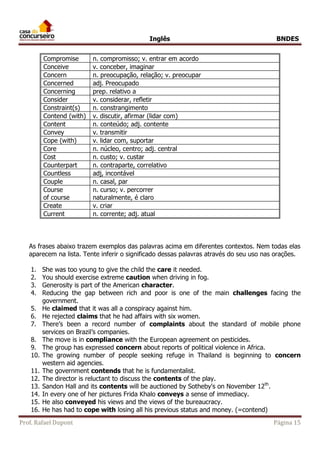
Belong v. pertencer 
Blame v. culpar; n. culpa 
Bond n. elo, vínculo 
Born (be born) adj. nascido, nato; (v. nascer) 
Borrow v. pegar emprestado 
Both adj./pron. ambos; 
Bound adj. compelido; n. limite; v. limitar 
Boundary 
n. limite (linha divisória) 
(line) 
Brand n. marca (registrada) 
Brief n. breve; adj. conciso 
Broad adj. largo, amplo 
Broadcast n. transmissão; v. transmitir 
Bureau n. agência, departamento 
Business n. negócio 
But conj. mas, porém; prep. exceto 
C 
Care n. cuidado; v. cuidar de 
Caution n. prudência 
Century n. século 
Certain adj. certo, determinado 
Challenge n. desafio; v. desafiar 
Chance n. possibilidade, chance 
Change n. mudança; v. mudar 
Chapter n. capítulo 
Character n. caráter, personagem 
Charge n. carga; v.carregar,acusar 
Chart n. mapa, tabela 
Childhood n. infância 
Choice n. escolha; adj. escolhido 
Citizen n. cidadão 
Claim n. reivindicação, alegação; 
v. reivindicar, alegar 
Class n. classe, sala, aula 
Clever adj. inteligente, esperto 
Clue n. pista, indício 
College n. faculdade, universidade 
Commitment n.compromisso 
Compare n. comparação; v. comparar 
Complain(t) v. reclamar (n. reclamação) 
Compliance n. consentimento 
Comply v. concordar, consentir 
Comprehensive adj. abrangente, amplo 
Prof. Rafael Dupont Página 14
Inglês BNDES 
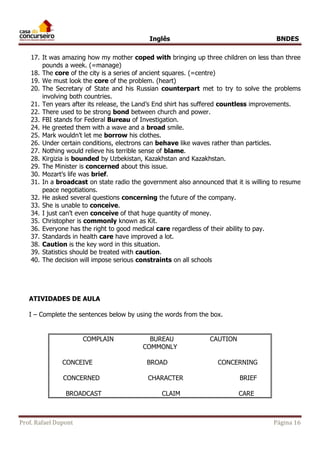
Compromise n. compromisso; v. entrar em acordo 
Conceive v. conceber, imaginar 
Concern n. preocupação, relação; v. preocupar 
Concerned adj. Preocupado 
Concerning prep. relativo a 
Consider v. considerar, refletir 
Constraint(s) n. constrangimento 
Contend (with) v. discutir, afirmar (lidar com) 
Content n. conteúdo; adj. contente 
Convey v. transmitir 
Cope (with) v. lidar com, suportar 
Core n. núcleo, centro; adj. central 
Cost n. custo; v. custar 
Counterpart n. contraparte, correlativo 
Countless adj, incontável 
Couple n. casal, par 
Course 
n. curso; v. percorrer 
of course 
naturalmente, é claro 
Create v. criar 
Current n. corrente; adj. atual 
As frases abaixo trazem exemplos das palavras acima em diferentes contextos. Nem todas elas 
aparecem na lista. Tente inferir o significado dessas palavras através do seu uso nas orações. 
1. She was too young to give the child the care it needed. 
2. You should exercise extreme caution when driving in fog. 
3. Generosity is part of the American character. 
4. Reducing the gap between rich and poor is one of the main challenges facing the 
government. 
5. He claimed that it was all a conspiracy against him. 
6. He rejected claims that he had affairs with six women. 
7. There’s been a record number of complaints about the standard of mobile phone 
services on Brazil’s companies. 
8. The move is in compliance with the European agreement on pesticides. 
9. The group has expressed concern about reports of political violence in Africa. 
10. The growing number of people seeking refuge in Thailand is beginning to concern 
western aid agencies. 
11. The government contends that he is fundamentalist. 
12. The director is reluctant to discuss the contents of the play. 
13. Sandon Hall and its contents will be auctioned by Sotheby's on November 12th. 
14. In every one of her pictures Frida Khalo conveys a sense of immediacy. 
15. He also conveyed his views and the views of the bureaucracy. 
16. He has had to cope with losing all his previous status and money. (=contend) 
Prof. Rafael Dupont Página 15
Inglês BNDES 
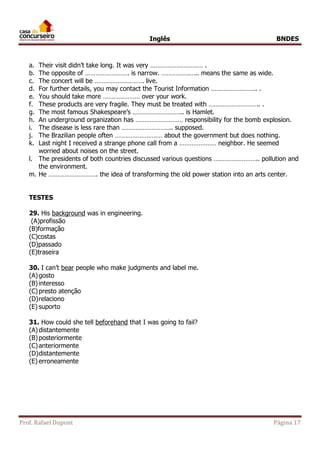
17. It was amazing how my mother coped with bringing up three children on less than three 
pounds a week. (=manage) 
18. The core of the city is a series of ancient squares. (=centre) 
19. We must look the core of the problem. (heart) 
20. The Secretary of State and his Russian counterpart met to try to solve the problems 
involving both countries. 
21. Ten years after its release, the Land’s End shirt has suffered countless improvements. 
22. There used to be strong bond between church and power. 
23. FBI stands for Federal Bureau of Investigation. 
24. He greeted them with a wave and a broad smile. 
25. Mark wouldn’t let me borrow his clothes. 
26. Under certain conditions, electrons can behave like waves rather than particles. 
27. Nothing would relieve his terrible sense of blame. 
28. Kirgizia is bounded by Uzbekistan, Kazakhstan and Kazakhstan. 
29. The Minister is concerned about this issue. 
30. Mozart’s life was brief. 
31. In a broadcast on state radio the government also announced that it is willing to resume 
peace negotiations. 
32. He asked several questions concerning the future of the company. 
33. She is unable to conceive. 
34. I just can’t even conceive of that huge quantity of money. 
35. Christopher is commonly known as Kit. 
36. Everyone has the right to good medical care regardless of their ability to pay. 
37. Standards in health care have improved a lot. 
38. Caution is the key word in this situation. 
39. Statistics should be treated with caution. 
40. The decision will impose serious constraints on all schools 
ATIVIDADES DE AULA 
I – Complete the sentences below by using the words from the box. 
COMPLAIN BUREAU CAUTION 
COMMONLY 
CONCEIVE BROAD CONCERNING 
CONCERNED CHARACTER BRIEF 
BROADCAST CLAIM CARE 
Prof. Rafael Dupont Página 16
Inglês BNDES 
a. Their visit didn’t take long. It was very ………………………… . 
b. The opposite of ……………………. is narrow. …………….….. means the same as wide. 
c. The concert will be ………………………. live. 
d. For further details, you may contact the Tourist Information …………………….. . 
e. You should take more ………………… over your work. 
f. These products are very fragile. They must be treated with ……………………….. . 
g. The most famous Shakespeare’s ……………………….. is Hamlet. 
h. An underground organization has ……………………… responsibility for the bomb explosion. 
i. The disease is less rare than ……………………….. supposed. 
j. The Brazilian people often ……………………… about the government but does nothing. 
k. Last night I received a strange phone call from a ………………… neighbor. He seemed 
worried about noises on the street. 
l. The presidents of both countries discussed various questions …………………….. pollution and 
the environment. 
m. He ………………………. the idea of transforming the old power station into an arts center. 
TESTES 
29. His background was in engineering. 
(A)profissão 
(B)formação 
(C)costas 
(D)passado 
(E)traseira 
30. I can’t bear people who make judgments and label me. 
(A) gosto 
(B) interesso 
(C) presto atenção 
(D) relaciono 
(E) suporto 
31. How could she tell beforehand that I was going to fail? 
(A) distantemente 
(B) posteriormente 
(C) anteriormente 
(D) distantemente 
(E) erroneamente 
Prof. Rafael Dupont Página 17
Inglês BNDES 
32. One billion people throughout the world are Muslins, united by belief in one God. 
(A) favor 
(B) lado 
(C) culpa 
(D) crença 
(E) marca 
33. She has many qualities besides being very beautiful. 
(A) ao lado de 
(B) além de 
(C) acima de 
(D) contanto que 
(E) perto de 
34. The commission is expected to blame the army for many o the atrocities. 
(A) acusar 
(B) aceitar 
(C) cobrar 
(D) negociar 
(E) amparar 
35. The agreement strengthened the bonds between the two countries. 
(A) desavença 
(B) acordo 
(C) ligação 
(D) disputa 
(E) negócio 
36. The new treatment could save Emma’s life and the lives of countless others. 
(A) poucas 
(B) contáveis 
(C) incontáveis 
(D) sempre 
(E) mais 
37. Brazil is free to adopt policies to bolster its economy. 
(A) prejudicar 
(B) incrementar 
(C) melhorar 
(D) amparar 
(E) suportar 
Prof. Rafael Dupont Página 18
Inglês BNDES 
38. That incredible experience created a very special bond between us. 
(A) distância 
(B) reação 
(C) elo 
(D) negócio 
(E) paixão 
39. Drug traffickers operate across national and international boundaries. 
(A) territórios 
(B) divisas 
(C) guardas 
(D) facções 
(E) correntes 
40. The local branch of Bank of America is having serious problems with its shareholders. 
(A) matriz 
(B) quartel-general 
(C) banco 
(D) repartição 
(E) filial 
41. Nike is a brand of Tennis-shoes. 
(A) loja 
(B) seção 
(C) marca 
(D) repartição 
(E) filial 
42. ………….. is very important in this situation. 
(A) Claim 
(B) Complain 
(C) Conceive 
(D) Core 
(E) Caution 
43. Those residents expressed …………………… about the crime statistic. 
(A) Conceive 
(B) Concern 
(C) Chance 
(D) Contend 
(E) Complain 
Prof. Rafael Dupont Página 19
Inglês BNDES 
Unidade 5 
Vamos colocar em prática nosso conhecimento. 
Instrução: As questões de número 1 a 4 referem-se ao texto abaixo. 
Not Just Sex and Sangria 
1 
2 
3 
4 
5 
6 
7 
8 
9 
10 
11 
12 
13 
14 
15 
16 
17 
It's just after sunset on a recent Friday, a quiet time in the off season on 
the island of Ibiza. The $200-a-week package tours from the north of England 
have not begun to descend on San Antonio Bay, which resembles a mini-Miami 
Beach on the Spanish Mediterranean. 
Ibiza owes its life to tourism. When holiday makers from Europe began flocking 
to the arid and impoverished island 30 years ago, they saved it from collapse. 
Their dollars helped compensate for the stagnant salt, fishing and agriculture 
industries. But to tourism grew too much, too fast. Ibiza became synonymous 
with sun, sex and sangria. Thousands of young Europeans descended upon the 
island each summer, threatening to destroy the local culture and the people's 
peaceful life. 
Now the island is fighting back. The government is desperately trying to 
take tourism in a new direction, by inviting more capital from up-market tourists 
and promoting cultural tourism to attract selected groups of culture-hungry 
tourists so as to avoid the damaging effects of uncontrolled tourist trade. It is 
also setting high standards for hotels and restaurants, and forbidding new 
construction close to the water. 
extracted and reduced from a report by 
Stryker McGuire in NEWSWEEK, May 12,1997 
44. Ibiza is located 
(A) near Miami Beach 
(B) on the Spanish Mediterranean 
(C) on San Antonio Bay 
(D) in the north of England 
(E) on the Continent 
45. Ibiza owes its life to tourism because 
(A) tourists invested their dollars in fishing 
(B) it contributed to develop Ibiza's culture 
(C) in the past, tourists worked in the arid fields 
(D) it compensated for the weakness of the industry 
(E) the island can only live on agriculture 
Prof. Rafael Dupont Página 20
Inglês BNDES 
46. “But tourism grew too much and too fast". The growth of mass tourism in Ibiza is described as 
(A) a necessary and agreeable occurrence 
(B) a policy established by the government 
(C) a danger for the local people's life-style 
(D) a problem for the young European tourists. 
(E) a desirable thing for everyone on the island 
47. Now, the Government intends to 
(A) promote a better kind of controlled tourism 
(B) change the directors of the tourism industry 
(C) increase the constructions near the bay 
(D) send tourists to several other places 
(E) forbid the entrance of culture-hungry people 
Instrução: As questões de número 5 a 10 referem-se ao texto abaixo. 
Development, democracy, and village telephone 
1 
2 
3 
4 
5 
6 
7 
8 
9 
10 
11 
12 
13 
14 
15 
16 
17 
18 
19 
20 
21 
22 
23 
24 
25 
I was born in 1942 and raised in a poor village in one of the poorest areas 
of rural India, a place with kerosene lamps and no running water. In 1980, at 
38, I was a U.S. citizen and a self-made telecommunications millionaire. By 
1990, I was 47 years old and nearing the end of nearly a decade back in India 
as leader of a controversial but largely successful effort to build an Indian 
information industry and begin the immense task of extending digital 
telecommunications to every corner of my native country, even to villages like 
the one where I was born. 
That effort persists today at an increased pace, but it remains 
controversial. Some of the controversy has centered on me and my methods. 
Most of it focuses on the efficacy and logic of bringing information technology to 
people who are in global terms the poorest of the poor. Common sense and 
accepted thinking about economic development have long held it ridiculous to 
supply Third-World villages with modern technology. What subsistence farmers 
need is not high-tech science and complex systems, the argument goes, but 
basic literacy, disease resistant cereals and oilseeds, that is, all the "appropriate" 
technologies that the unsophisticated rural poor can use and understand. 
For me, modern telecommunications and electronic information systems 
are appropriate technologies even in those regions of the world that still lack 
adequate water, food, and power. The reason is simply that modern 
telecommunications is an indispensable a id in meeting basic needs. Wouldn't a 
telephone help a poor community if a natural calamity, like fire or flood, 
happened? 
Technology can eliminate cultural barriers, affect economic inequalities, even 
compensate for intellectual disparities. In short, high technology can put unequal 
Prof. Rafael Dupont Página 21
Inglês BNDES 
26 
27 
human beings on an equal footing, and that makes it the most potent 
democratizing tool ever devised. 
extracted and reduced from an article by Sam Pitroda 
48. The writer's life has 
(A) always been poor and difficult 
(B) gone from poverty into richness 
(C) never changed in any way. 
(D) shown a very poor development 
(E) become a sad and dull one 
49. Some years after having become an American citizen, the writer 
(A) didn't even think about his village in India 
(B) decided to become a farmer in his village 
(C) chose not to think about the poor people's needs 
(D) decided to work only for the poor areas in the U.S. 
E) began fighting for telecommunications in India 
50. The writer's project for telecommunications in his native country is controversial because 
(A) people there really hate the leader of the project 
(B) the leader wants to receive a great amount of money 
(C) the propositions in the project seem inappropriate 
(D) the project will only protect the poorest people 
(E)the villagers consider the project unsophisticated 
51. From the writer's viewpoint, telecommunications is 
(A) an ineffective tool for the the villagers' work 
(B) a superfluous economic tool for poor farmers 
(C) a disaster for democratic systems of government 
(D) a basic aid for socio-cultural and economic equality 
(E) a ridiculous element in the life of poor communities 
52. The expression at an increased pace (l. 7) indicates that the project in India is now being 
carried out with 
(A) greater delay 
(B) weaker enthusiasm 
(C) fewer people involved 
(D) more rigorous control 
(E) greater speed 
Prof. Rafael Dupont Página 22
Inglês BNDES 
53. Technology can eliminate cultural barriers... (L. 18) – In this sentence, the modal verb can 
indicates that the writer considers the elimination of cultural barriers 
(A) doubtful 
(B) impossible 
(C) hypothetical 
(D) unconvincing 
(E) probable 
Unidade 6 
Observe com atenção a lista de palavras abaixo. Todas elas iniciam com as letras ‘D e “E” e 
foram extraídas de textos de concursos. Esta é a continuação da lista de palavras essenciais 
para o vestibular. 
D 
Damage n. dano; v. danificar 
Data n. pl. (de datum) dados 
Deal (with) n. acordo; v. negociar (lidar com) 
Dealing(s) n. negócio(s), procedimento 
Death n. morte 
Decrease n. decréscimo; v. diminuir 
Deep n. profundidade; adj. profundo, intenso 
Defeat n. derrota; v. derrotar 
Definetly adv. Definitivamente 
Degree n. grau, diploma 
Delay n. atraso; v. adiar 
Deliver(y) v. entregar, dar a luz (n. entrega) 
Demand n. demanda; v. demandar 
Deny v.negar 
Depth n. profundidade 
Deserve v. merecer, ser digno de, ter direito a 
Design n. projeto, desenho 
v. projetar, desenhar 
Desire n. desejo, vontade; v. desejar 
Develop v. desenvolver 
Device n. dispositivo, aparelho 
Disease n. doença, enfermidade; v. infectar 
Display n. exibição; v. exibir 
Double n. dobro, duplo 
Doubt n. dúvida; v. duvidar 
Drop n. gota; v. gotejar, deixar cair 
Duty n. dever, taxa, imposto 
Prof. Rafael Dupont Página 23
Inglês BNDES 
E 
Each adj. cada (um), cada qual 
Earn v. ganhar, receber, merecer 
Ease n. sossego, facilidade; v. aliviar, abrandar 
Eastern n./adj. Oriental 
Edge n. extremidade, beira, limite, vantagem; v. margear, avançar 
devagar 
Effect n. efeito, resultado; v. efetuar, causar 
Effort n. esforço, empenho 
Either adj. um ou outro; adv. também, em vez de; conj. ou, senão 
Emphasize v. enfatizar 
Employ v. empregar 
Enable v. permitir, capacitar 
Enhance v. aumentar, melhorar 
Enough n. o suficiente;adj. bastante 
Entire adj. inteiro; n. o todo 
Establish v. estabelecer, determinar 
Eventually adv. eventualmente, finalmente 
Ever adv. sempre, alguma vez 
Excerpt n. excerto; v. extrair 
Exchange n. troca; v. trocar 
Expect v. esperar 
Expense n. despesa 
Explain v. explicar 
1. Jack doesn’t want to damage his reputation as a politician. 
2. The proposal was defeated by just one vote. 
3. The government has denied that there was a plot to kill the president. 
4. Those workers deserve to make more than minimum wage. 
5. We may be able to design a course to suit your particular needs. 
6. All countries, it was predicted, would develop and develop fast. 
7. Jack’s duty is to look after the animals. 
8. We need helpers of all types, engineers, scientists (e.g. geologists), teachers, … 
9. Each year, hundreds of animal are killed in tropical forests. 
10. Companies must earn a reputation for honesty. 
11. She passed her exam with ease. 
12. That’s a typical eastern custom. 
13. Don’t put that cup so near to the edge of the table – it will fall off! 
14. The effort of climbing the hill made the old man very tired. 
15. The money I inherited enabled me to go on a world cruise. 
16. These clothes do nothing to enhance her appearance. 
17. They enjoy playing tennis. 
18. Men and Women should enjoy equal rights. 
19. Don’t start it again! We have enough problems already. 
20. He had spent his entire life in China as a doctor. 
Prof. Rafael Dupont Página 24
Inglês BNDES 
21. If the warranty is limited, the term may entitle you to a replacement or a refound. 
22. Pupils in our schools are taught in a safe, secure environment. 
23. We have a duty to persuade others to respect the environment. 
24. The UN has established detailed criteria for who should be allowed to vote. 
25. The human race has enough weapons to annihilate itself. 
26. The committee was established in 1912 
1. Complete the sentences below by using the words from the box. 
DELIVER ENOUGH 
DEFEAT DERIVE 
DECREASE EVENTUALLY DELAY 
DESIGN DEVICE 
DEPTH DATA 
ENHANCE 
a. The study was based on ………………………….. from 2,100 men and women. 
b. You must gradually …….………………….. the amount of vitamin C you are taking. 
c. Cesar’s guerrillas …………………… the colonial army in 1968. 
d. For sentimental reasons I wanted to ………………………… my departure until February. 
e. The Canadians plan to …………………. more food to southern Somalia next summer. 
f. This is an opportunity to ………………….. the reputation of the company. 
g. The smallest lake in this region ranges from ten to fifteen feet in .………………. . 
h. The word Easter ……………….. from Eostre, the pagan goddess of spring. 
i. They wanted to ……………………a machine that was both practical and attractive. 
j. They were selling an electronic ……….……… that protects your vehicle 24 hours a day. 
k. Is there …………….. room for me? 
l. She hopes to get a job on the local newspaper and ………………...work for ‘The Times’. 
2. Match the columns. 
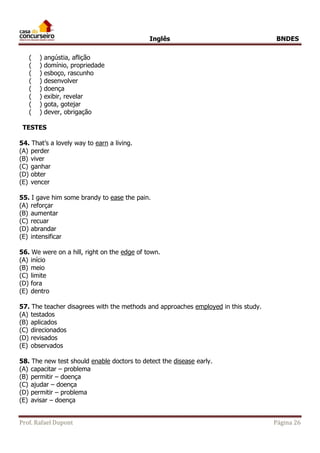
(F) develop 
(G) disease 
(H) display 
(I) distress 
(J) domain 
(K) draft 
(L) drop 
(M) duty 
Prof. Rafael Dupont Página 25
Inglês BNDES 
( ) angústia, aflição 
( ) domínio, propriedade 
( ) esboço, rascunho 
( ) desenvolver 
( ) doença 
( ) exibir, revelar 
( ) gota, gotejar 
( ) dever, obrigação 
TESTES 
54. That’s a lovely way to earn a living. 
(A) perder 
(B) viver 
(C) ganhar 
(D) obter 
(E) vencer 
55. I gave him some brandy to ease the pain. 
(A) reforçar 
(B) aumentar 
(C) recuar 
(D) abrandar 
(E) intensificar 
56. We were on a hill, right on the edge of town. 
(A) início 
(B) meio 
(C) limite 
(D) fora 
(E) dentro 
57. The teacher disagrees with the methods and approaches employed in this study. 
(A) testados 
(B) aplicados 
(C) direcionados 
(D) revisados 
(E) observados 
58. The new test should enable doctors to detect the disease early. 
(A) capacitar – problema 
(B) permitir – doença 
(C) ajudar – doença 
(D) permitir – problema 
(E) avisar – doença 
Prof. Rafael Dupont Página 26
Inglês BNDES 
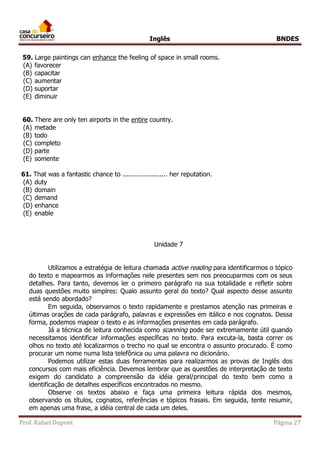
59. Large paintings can enhance the feeling of space in small rooms. 
(A) favorecer 
(B) capacitar 
(C) aumentar 
(D) suportar 
(E) diminuir 
60. There are only ten airports in the entire country. 
(A) metade 
(B) todo 
(C) completo 
(D) parte 
(E) somente 
61. That was a fantastic chance to ....................... her reputation. 
(A) duty 
(B) domain 
(C) demand 
(D) enhance 
(E) enable 
Unidade 7 
Utilizamos a estratégia de leitura chamada active reading para identificarmos o tópico 
do texto e mapearmos as informações nele presentes sem nos preocuparmos com os seus 
detalhes. Para tanto, devemos ler o primeiro parágrafo na sua totalidade e refletir sobre 
duas questões muito simplres: Qualo assunto geral do texto? Qual aspecto desse assunto 
está sendo abordado? 
Em seguida, observamos o texto rapidamente e prestamos atenção nas primeiras e 
últimas orações de cada parágrafo, palavras e expressões em itálico e nos cognatos. Dessa 
forma, podemos mapear o texto e as informações presentes em cada parágrafo. 
Já a técnica de leitura conhecida como scanning pode ser extremamente útil quando 
necessitamos identificar informações específicas no texto. Para excuta-la, basta correr os 
olhos no texto até localizarmos o trecho no qual se encontra o assunto procurado. É como 
procurar um nome numa lista telefônica ou uma palavra no dicionário. 
Podemos utilizar estas duas ferramentas para realizarmos as provas de Inglês dos 
concursos com mais eficiência. Devemos lembrar que as questões de interpretação de texto 
exigem do candidato a compreensão da idéia geral/principal do texto bem como a 
identificação de detalhes específicos encontrados no mesmo. 
Observe os textos abaixo e faça uma primeira leitura rápida dos mesmos, 
observando os títulos, cognatos, referências e tópicos frasais. Em seguida, tente resumir, 
em apenas uma frase, a idéia central de cada um deles. 
Prof. Rafael Dupont Página 27
Inglês BNDES 
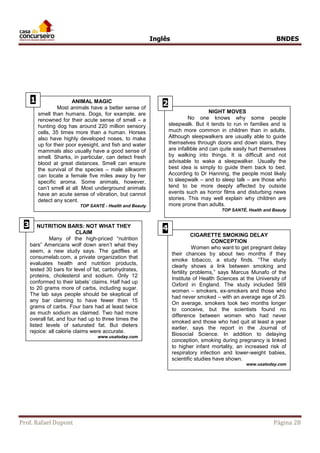
ANIMAL mAGIS 
1 ANIMAL MAGIC 
2 
Most animals have a better sense of 
smell than humans. Dogs, for example, are 
renowned for their acute sense of smell – a 
hunting dog has around 220 million sensory 
cells, 35 times more than a human. Horses 
also have highly developed noses, to make 
up for their poor eyesight, and fish and water 
mammals also usually have a good sense of 
smell. Sharks, in particular, can detect fresh 
blood at great distances. Smell can ensure 
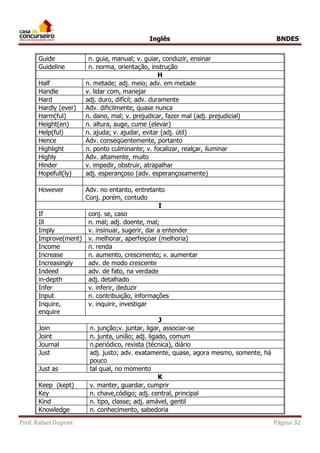
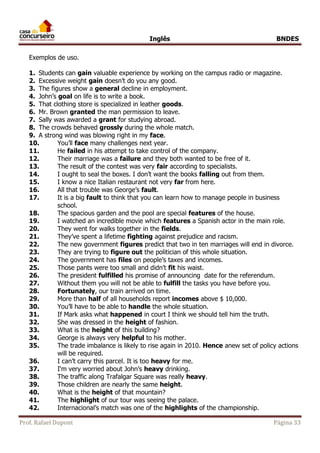
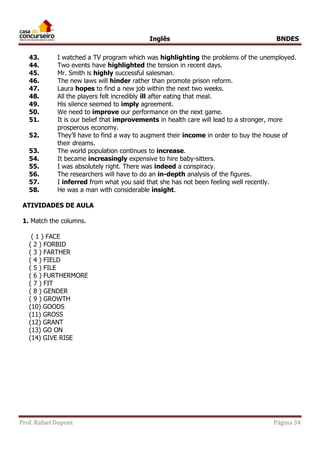
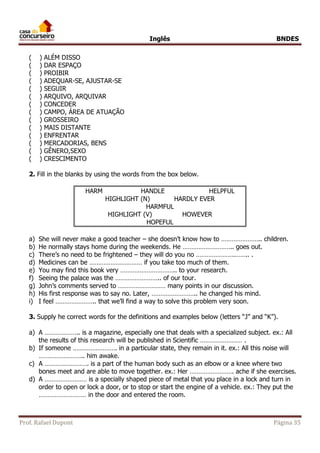
the survival of the species – male silkworm 
can locate a female five miles away by her 
specific aroma. Some animals, however, 
can’t smell at all. Most underground animals 
have an acute sense of vibration, but cannot 
detect any scent. 
TOP SANTÉ - Health and Beauty 
NIGHT MOVES 
No one knows why some people 
sleepwalk. But it tends to run in families and is 
much more common in children than in adults. 
Although sleepwalkers are usually able to guide 
themselves through doors and down stairs, they 
are infallible and can quite easily hurt themselves 
by walking into things. It is difficult and not 
advisable to wake a sleepwalker. Usually the 
best idea is simply to guide them back to bed. 
According to Dr Hanning, the people most likely 
to sleepwalk – and to sleep talk – are those who 
tend to be more deeply affected by outside 
events such as horror films and disturbing news 
stories. This may well explain why children are 
more prone than adults. 
TOP SANTÉ, Health and Beauty 
NUTRITION BARS: NOT WHAT THEY 
CLAIM 
Many of the high-priced “nutrition 
bars” Americans wolf down aren’t what they 
seem, a new study says. The gadflies at 
consumelab.com, a private organization that 
evaluates health and nutrition products, 
tested 30 bars for level of fat, carbohydrates, 
proteins, cholesterol and sodium. Only 12 
conformed to their labels’ claims. Half had up 
to 20 grams more of carbs, including sugar. 
The lab says people should be skeptical of 
any bar claiming to have fewer than 15 
grams of carbs. Four bars had at least twice 
as much sodium as claimed. Two had more 
overall fat, and four had up to three times the 
listed levels of saturated fat. But dieters 
rejoice: all calorie claims were accurate. 
www.usatoday.com 
3 
CIGARETTE SMOKING DELAY 
CONCEPTION 
Women who want to get pregnant delay 
their chances by about two months if they 
smoke tobacco, a study finds. “The study 
clearly shows a link between smoking and 
fertility problems,” says Marcus Munafo of the 
Institute of Health Sciences at the University of 
Oxford in England. The study included 569 
women – smokers, ex-smokers and those who 
had never smoked – with an average age of 29. 
On average, smokers took two months longer 
to conceive, but the scientists found no 
difference between women who had never 
smoked and those who had quit at least a year 
earlier, says the report in the Journal of 
Biosocial Science. In addition to delaying 
conception, smoking during pregnancy is linked 
to higher infant mortality, an increased risk of 
respiratory infection and lower-weight babies, 
scientific studies have shown. 
www.usatoday.com 
4 
8 
Prof. Rafael Dupont Página 28
Inglês BNDES 
IDÉIA CENTRAL 
1: ___________________________________________________________ 
2: ___________________________________________________________ 
3: ___________________________________________________________ 
4: ___________________________________________________________ 
Agora, vamos mapear o texto abaixo e descobrir o seu tema principal: 
The widespread destruction of tropical rainforest 
ecosystems and the consequent extinction of numerous 
plant and animal species is happening before we know 
even the most basic facts about what we are losing. 
5 Covering only 6 percent of the Earth's surface, 
tropical moist forests contain at least half of all species. 
The abundant botanical resources of tropical forests 
have already provided substantial medical advances; yet 
only 1 percent of the known plant and animal species 
10 have been carefully examined for their medicinal 
potentials. Meanwhile, 2 percent of the world's rainforests 
are irreparably damaged each year. Scientists estimate 
that, at the accelerating rate at which rainforests are now 
being destroyed, as much as 20 or 25 percent of the 
15 world's plant species will soon be extinct. 
Approximately 7,000 medical compounds 
prescribed by Western doctors are obtained from plants. 
These drugs had an estimated retail value of US$ 43 
billion some years ago. Seventy percent of the 3,000 
20 plants identified by the United States National Cancer 
Institute as having potential anti-cancer properties are 
characteristic of the rainforest. Tropical forest species 
serve Western surgery and internal medicine in three 
ways. First, extracts from organisms can be used directly 
25 as drugs. For maladies ranging from persistent headaches 
to lethal contagions such as malaria, rainforest medicines 
have provided modern society with a variety of cures and 
pain relievers. 
Prof. Rafael Dupont Página 29
Inglês BNDES 
Secondly, chemical structures of forest organisms 
30 sometimes serve as models from which scientists and 
researchers can chemically synthesize drug compounds. 
For example, the blueprint for aspirin comes from extracts 
of willow trees found in the rainforest. Neostigmine, a 
chemical obtained from the Calabar bean and used to 
35 treat glaucoma in West Africa, also provides the blueprint 
for synthetic insecticides. However, the chemical 
structures of most natural drugs are very complex, and 
simple extraction is usually less expensive than synthesis. 
Ninety percent of the prescription drugs that are based on 
40 higher plants include direct extractions from plants. 
Finally, rainforest plants provide aids for research. 
Certain plant compounds enable scientists to understand 
how cancer cells grow, while others serve as testing 
agents for potentially harmful food and drug products. 
45 Tropical forests offer hope for safer contraceptives for 
both women and men. The exponential growth of world 
population clearly demonstrates the need for more reliable 
and effective birth control methods. Worldwide, 
approximately 4,000 plant species have been shown to 
50 offer contraceptive possibilities. The rainforest also holds 
secrets for safer pesticides for farmers. Two species of 
potatoes have leaves that produce a sticky substance 
that traps and kills predatory insects. This natural self-defense 
mechanism could potentially reduce the need 
55 for using pesticides on potatoes. Who knows what other 
tricks the rainforest might have up its leaves? 
http://www.ran.org/info_center/factsheets/05f.html 
1995-2003 Rainforest Action Network 
Prof. Rafael Dupont Página 30
Inglês BNDES 
Unidade 8 
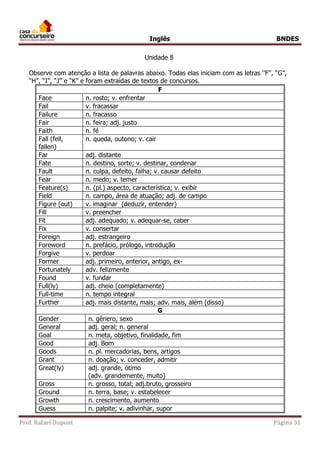
Observe com atenção a lista de palavras abaixo. Todas elas iniciam com as letras ‘’F’’, “G”, 
“H”, “I”, “J” e “K” e foram extraídas de textos de concursos. 
F 
Face n. rosto; v. enfrentar 
Fail v. fracassar 
Failure n. fracasso 
Fair n. feira; adj. justo 
Faith n. fé 
Fall (fell, 
fallen) 
n. queda, outono; v. cair 
Far adj. distante 
Fate n. destino, sorte; v. destinar, condenar 
Fault n. culpa, defeito, falha; v. causar defeito 
Fear n. medo; v. temer 
Feature(s) n. (pl.) aspecto, característica; v. exibir 
Field n. campo, área de atuação; adj. de campo 
Figure (out) v. imaginar (deduzir, entender) 
Fill v. preencher 
Fit adj. adequado; v. adequar-se, caber 
Fix v. consertar 
Foreign adj. estrangeiro 
Foreword n. prefácio, prólogo, introdução 
Forgive v. perdoar 
Former adj. primeiro, anterior, antigo, ex- 
Fortunately adv. felizmente 
Found v. fundar 
Full(ly) adj. cheio (completamente) 
Full-time n. tempo integral 
Further adj. mais distante, mais; adv. mais, além (disso) 
G 
Gender n. gênero, sexo 
General adj. geral; n. general 
Goal n. meta, objetivo, finalidade, fim 
Good adj. Bom 
Goods n. pl. mercadorias, bens, artigos 
Grant n. doação; v. conceder, admitir 
Great(ly) adj. grande, ótimo 
(adv. grandemente, muito) 
Gross n. grosso, total; adj.bruto, grosseiro 
Ground n. terra, base; v. estabelecer 
Growth n. crescimento, aumento 
Guess n. palpite; v. adivinhar, supor 
Prof. Rafael Dupont Página 31
Inglês BNDES 
Guide n. guia, manual; v. guiar, conduzir, ensinar 
Guideline n. norma, orientação, instrução 
H 
Half n. metade; adj. meio; adv. em metade 
Handle v. lidar com, manejar 
Hard adj. duro, difícil; adv. duramente 
Hardly (ever) Adv. dificilmente, quase nunca 
Harm(ful) n. dano, mal; v. prejudicar, fazer mal (adj. prejudicial) 
Height(en) n. altura, auge, cume (elevar) 
Help(ful) n. ajuda; v. ajudar, evitar (adj. útil) 
Hence Adv. conseqüentemente, portanto 
Highlight n. ponto culminante; v. focalizar, realçar, iluminar 
Highly Adv. altamente, muito 
Hinder v. impedir, obstruir, atrapalhar 
Hopefull(ly) adj. esperançoso (adv. esperançosamente) 
However Adv. no entanto, entretanto 
Conj. porém, contudo 
I 
If conj. se, caso 
Ill n. mal; adj. doente, mal; 
Imply v. insinuar, sugerir, dar a entender 
Improve(ment) v. melhorar, aperfeiçoar (melhoria) 
Income n. renda 
Increase n. aumento, crescimento; v. aumentar 
Increasingly adv. de modo crescente 
Indeed adv. de fato, na verdade 
in-depth adj. detalhado 
Infer v. inferir, deduzir 
Input n. contribuição, informações 
Inquire, 
v. inquirir, investigar 
enquire 
J 
Join n. junção;v. juntar, ligar, associar-se 
Joint n. junta, união; adj. ligado, comum 
Journal n.periódico, revista (técnica), diário 
Just adj. justo; adv. exatamente, quase, agora mesmo, somente, há 
pouco 
Just as tal qual, no momento 
K 
Keep (kept) v. manter, guardar, cumprir 
Key n. chave,código; adj. central, principal 
Kind n. tipo, classe; adj. amável, gentil 
Knowledge n. conhecimento, sabedoria 
Prof. Rafael Dupont Página 32
Inglês BNDES 
Exemplos de uso. 
1. Students can gain valuable experience by working on the campus radio or magazine. 
2. Excessive weight gain doesn’t do you any good. 
3. The figures show a general decline in employment. 
4. John’s goal on life is to write a book. 
5. That clothing store is specialized in leather goods. 
6. Mr. Brown granted the man permission to leave. 
7. Sally was awarded a grant for studying abroad. 
8. The crowds behaved grossly during the whole match. 
9. A strong wind was blowing right in my face. 
10. You’ll face many challenges next year. 
11. He failed in his attempt to take control of the company. 
12. Their marriage was a failure and they both wanted to be free of it. 
13. The result of the contest was very fair according to specialists. 
14. I ought to seal the boxes. I don’t want the books falling out from them. 
15. I know a nice Italian restaurant not very far from here. 
16. All that trouble was George’s fault. 
17. It is a big fault to think that you can learn how to manage people in business 
school. 
18. The spacious garden and the pool are special features of the house. 
19. I watched an incredible movie which features a Spanish actor in the main role. 
20. They went for walks together in the fields. 
21. They’ve spent a lifetime fighting against prejudice and racism. 
22. The new government figures predict that two in ten marriages will end in divorce. 
23. They are trying to figure out the politician of this whole situation. 
24. The government has files on people’s taxes and incomes. 
25. Those pants were too small and didn’t fit his waist. 
26. The president fulfilled his promise of announcing date for the referendum. 
27. Without them you will not be able to fulfill the tasks you have before you. 
28. Fortunately, our train arrived on time. 
29. More than half of all households report incomes above $ 10,000. 
30. You’ll have to be able to handle the whole situation. 
31. If Mark asks what happened in court I think we should tell him the truth. 
32. She was dressed in the height of fashion. 
33. What is the height of this building? 
34. George is always very helpful to his mother. 
35. The trade imbalance is likely to rise again in 2010. Hence anew set of policy actions 
will be required. 
36. I can’t carry this parcel. It is too heavy for me. 
37. I‘m very worried about John’s heavy drinking. 
38. The traffic along Trafalgar Square was really heavy. 
39. Those children are nearly the same height. 
40. What is the height of that mountain? 
41. The highlight of our tour was seeing the palace. 
42. Internacional’s match was one of the highlights of the championship. 
Prof. Rafael Dupont Página 33
Inglês BNDES 
43. I watched a TV program which was highlighting the problems of the unemployed. 
44. Two events have highlighted the tension in recent days. 
45. Mr. Smith is highly successful salesman. 
46. The new laws will hinder rather than promote prison reform. 
47. Laura hopes to find a new job within the next two weeks. 
48. All the players felt incredibly ill after eating that meal. 
49. His silence seemed to imply agreement. 
50. We need to improve our performance on the next game. 
51. It is our belief that improvements in health care will lead to a stronger, more 
prosperous economy. 
52. They’ll have to find a way to augment their income in order to buy the house of 
their dreams. 
53. The world population continues to increase. 
54. It became increasingly expensive to hire baby-sitters. 
55. I was absolutely right. There was indeed a conspiracy. 
56. The researchers will have to do an in-depth analysis of the figures. 
57. I inferred from what you said that she has not been feeling well recently. 
58. He was a man with considerable insight. 
ATIVIDADES DE AULA 
1. Match the columns. 
( 1 ) FACE 
( 2 ) FORBID 
( 3 ) FARTHER 
( 4 ) FIELD 
( 5 ) FILE 
( 6 ) FURTHERMORE 
( 7 ) FIT 
( 8 ) GENDER 
( 9 ) GROWTH 
(10) GOODS 
(11) GROSS 
(12) GRANT 
(13) GO ON 
(14) GIVE RISE 
Prof. Rafael Dupont Página 34
Inglês BNDES 
( ) ALÉM DISSO 
( ) DAR ESPAÇO 
( ) PROIBIR 
( ) ADEQUAR-SE, AJUSTAR-SE 
( ) SEGUIR 
( ) ARQUIVO, ARQUIVAR 
( ) CONCEDER 
( ) CAMPO, ÁREA DE ATUAÇÃO 
( ) GROSSEIRO 
( ) MAIS DISTANTE 
( ) ENFRENTAR 
( ) MERCADORIAS, BENS 
( ) GÊNERO,SEXO 
( ) CRESCIMENTO 
2. Fill in the blanks by using the words from the box below. 
HARM HANDLE HELPFUL 
HIGHLIGHT (N) HARDLY EVER 
HARMFUL 
HIGHLIGHT (V) HOWEVER 
HOPEFUL 
a) She will never make a good teacher – she doesn’t know how to ………………….. children. 
b) He normally stays home during the weekends. He ……………………….. goes out. 
c) There’s no need to be frightened – they will do you no ………………….…….. . 
d) Medicines can be ………………………… if you take too much of them. 
e) You may find this book very ………………………….. to your research. 
f) Seeing the palace was the …………………….. of our tour. 
g) John’s comments served to ……………………… many points in our discussion. 
h) His first response was to say no. Later, …………………….. he changed his mind. 
i) I feel ………………….. that we’ll find a way to solve this problem very soon. 
3. Supply he correct words for the definitions and examples below (letters “J” and “K”). 
a) A ……………….. is a magazine, especially one that deals with a specialized subject. ex.: All 
the results of this research will be published in Scientific …………………… . 
b) If someone ……………………. in a particular state, they remain in it. ex.: All this noise will 
…………………….. him awake. 
c) A ……………………. is a part of the human body such as an elbow or a knee where two 
bones meet and are able to move together. ex.: Her ……………………. ache if she exercises. 
d) A …………………… is a specially shaped piece of metal that you place in a lock and turn in 
order to open or lock a door, or to stop or start the engine of a vehicle. ex.: They put the 
……………………… in the door and entered the room. 
Prof. Rafael Dupont Página 35
Inglês BNDES 
e) ……………………… is information or understanding about a subject which a person has, or 
which all people have. ex. The Minister told the parliament he had no ………………………... 
about the affair. 
f) If you talk about a particular ……………………….. of thing, you are talking about one of the 
types or sorts of that thing. ex.: What ……………………….. of food do you like? 
TESTES 
62. The high walls are a special feature of the castle. 
(A) proteção 
(B) beleza 
(C) característica. 
(D) defesa 
(E) traçado 
63. His long legs didn’t fit under the table. 
(A) cabiam 
(B) seguravam 
(C) serviam 
(D) dobravam 
(E) pregavam 
64. The company is in urgent need to improve the quality of its services. 
(A) modificar 
(B) implementer 
(C) alterar 
(D) manter 
(E) melhorar 
65. Tax is payable in all income over the specific amount. 
(A) dívida 
(B) receita 
(C) salário 
(D) renda 
(E) parcela 
66. The rate of inflation has increased by 2%. 
(A) diminui 
(B) aumentou 
(C) declinou 
(D) inverteu-se 
(E) modificou-se 
Prof. Rafael Dupont Página 36
Inglês BNDES 
67. There has been an increase of nearly 50% on oil prices over last year. 
(A) aumento 
(B) redução 
(C) diferenciação 
(D) moderação 
(E) recuo 
68. Later, he admitted that the payments had indeed been made. 
(A) claramente 
(B) felizmente 
(C) não obstante 
(D) de fato 
(E) parcialmente 
69. We will discuss these three areas in depth next week. 
(A) superficialmente 
(B) oralmente 
(C) em profundidade 
(D) com dedicação 
(E) indeterminadamente 
70. We visited America and Australia, staying longer in the former than in the latter. 
(A) último 
(B) inicial 
(C) final 
(D) primeiro 
(E) antigo 
71. You don’t have to be a detective to figure out some things. 
(A) deduzir 
(B) duvidar 
(C) roubar 
(D) desdenhar 
(E) figurar 
72. They are late – something must have happened to them. 
(A) esquecido 
(B) permanecido 
(C) atrasado 
(D) acontecido 
(E) obstruido 
Prof. Rafael Dupont Página 37
Inglês BNDES 
73. I can hardly carry this parcel. It’s too heavy. 
(A) suave 
(B) pesado 
(C) complicado 
(D) antigo 
(E) leve 
74. We were very short of money, hence we had to spend the night in a cheap hotel. 
(A) por outro lado 
(B) depois 
(C) além disso 
(D) contudo 
(E) portanto 
75. In French the adjective must agree with the noun in number and ……………….. . 
(A) gender 
(B) goods 
(C) gross 
(D) grant 
(E) growth 
76. We are increasingly concerned about personal ………….…. and development. 
(A) gender 
(B) increase 
(C) growth 
(D) face 
(E) forbid 
Prof. Rafael Dupont Página 38
Inglês BNDES 
Unidade 9 
Time to practice!!! 
PETS PROVIDE HEALING FOR THE XXI CENTURY 
By Margrit Oyens 
The Umbrella , Vol. X, Novembro de 2004 
5 
10 
15 
20 
25 
30 
In an interview given by Dr. Tennis Turner, president of the 
International 
Association of Human-Animal Integration Organizations (IAHAIO) and 
professor for 
veterinary science at the University of Zurich, he stated that the 
company of cats 
and dogs is essential to human quality of life. He has been trying to 
convince 
authorities, from ministers of health of First World countries to leaders 
of small 
South African communities, to invest in programs of Animal Assisted 
Therapy 
(AAT). 
Dr. Turner has stated that “the company of pets benefits not only 
those physically or 
mentally ill, but also all ordinary human beings, regardless of their 
family income. It 
is good not only for the health of the individual but for public health as 
well. Animal 
Assisted Therapy represents a tremendous economy to public health, 
as it often 
succeeds in cases where traditional medical treatment has failed.” 
In his quality of president of IAHAIO, Dr. Turner organizes 
conferences in major 
cities, which are attended by doctors from all over the world, with the 
intention of 
divulging the results of studies and experiments where animals have 
acted as 
therapists to children, juvenile delinquents, the elderly, women 
suffering from breast 
cancer, the mentally deficient, and even couples undergoing a crisis in 
their 
relationship. 
Knowing the physical and psychological needs of cats and dogs helps 
us to treat 
them better. Only happy and healthy pets can be good company for 
Prof. Rafael Dupont Página 39
Inglês BNDES 
human beings 
and contribute to our quality of life. 
There are many kinds of benefits for people that have pets. Imagine a 
normal 
citizen, meaning someone healthy who needs some kind of therapy. 
The presence 
of a pet can lower his/her blood pressure, which is one of the reasons 
for a pet 
guardian’s better quality of life, one year after having a heart attack. 
Another 
explanation is obvious and applies to all guardians of dogs who wish 
to guard 
against heart disease: more daily exercise due to the necessary dog 
walking. Pet 
guardians generally have a lower level of cholesterol and are therefore 
less prone 
to heart attacks. A study published by the British Journal of the Royal 
Society of 
Medicine shows that pet guardians are less likely to be bothered by 
small health 
problems and enjoy a better quality of life than people who have no 
pets. 
Companionship animals are also of help to children, both at home and 
in school. 
They augment children’s self-esteem, improve their integration with 
other children 
and increase their performance in school. 
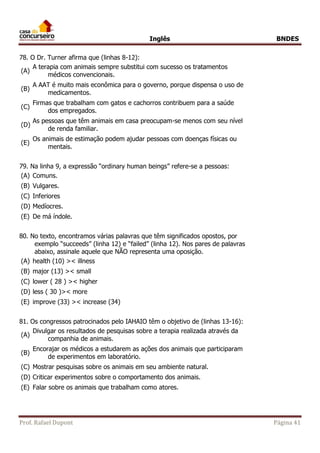
77. Segundo o texto (linhas 1-18), o Dr. Turner exerce diversas atividades, 
EXCETO: 
(A) Presidente da IAHAIO. 
(B) Professor de veterinária . 
(C) Professor na Universidade de Zurich. 
(D) Líder de comunidades sul-africanas. 
(E) Organizador de congressos. 
Prof. Rafael Dupont Página 40
Inglês BNDES 
78. O Dr. Turner afirma que (linhas 8-12): 
(A) 
A terapia com animais sempre substitui com sucesso os tratamentos 
médicos convencionais. 
(B) 
A AAT é muito mais econômica para o governo, porque dispensa o uso de 
medicamentos. 
(C) 
Firmas que trabalham com gatos e cachorros contribuem para a saúde 
dos empregados. 
(D) 
As pessoas que têm animais em casa preocupam-se menos com seu nível 
de renda familiar. 
(E) 
Os animais de estimação podem ajudar pessoas com doenças físicas ou 
mentais. 
79. Na linha 9, a expressão “ordinary human beings” refere-se a pessoas: 
(A) Comuns. 
(B) Vulgares. 
(C) Inferiores 
(D) Medíocres. 
(E) De má índole. 
80. No texto, encontramos várias palavras que têm significados opostos, por 
exemplo “succeeds” (linha 12) e “failed” (linha 12). Nos pares de palavras 
abaixo, assinale aquele que NÃO representa uma oposição. 
(A) health (10) >< illness 
(B) major (13) >< small 
(C) lower ( 28 ) >< higher 
(D) less ( 30 )>< more 
(E) improve (33) >< increase (34) 
81. Os congressos patrocinados pelo IAHAIO têm o objetivo de (linhas 13-16): 
(A) 
Divulgar os resultados de pesquisas sobre a terapia realizada através da 
companhia de animais. 
(B) 
Encorajar os médicos a estudarem as ações dos animais que participaram 
de experimentos em laboratório. 
(C) Mostrar pesquisas sobre os animais em seu ambiente natural. 
(D) Criticar experimentos sobre o comportamento dos animais. 
(E) Falar sobre os animais que trabalham como atores. 
Prof. Rafael Dupont Página 41
Inglês BNDES 
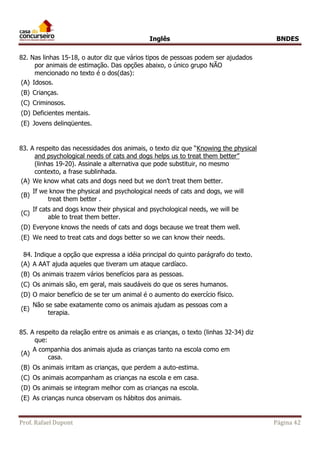
82. Nas linhas 15-18, o autor diz que vários tipos de pessoas podem ser ajudados 
por animais de estimação. Das opções abaixo, o único grupo NÃO 
mencionado no texto é o dos(das): 
(A) Idosos. 
(B) Crianças. 
(C) Criminosos. 
(D) Deficientes mentais. 
(E) Jovens delinqüentes. 
83. A respeito das necessidades dos animais, o texto diz que “Knowing the physical 
and psychological needs of cats and dogs helps us to treat them better” 
(linhas 19-20). Assinale a alternativa que pode substituir, no mesmo 
contexto, a frase sublinhada. 
(A) We know what cats and dogs need but we don’t treat them better. 
(B) 
If we know the physical and psychological needs of cats and dogs, we will 
treat them better . 
(C) 
If cats and dogs know their physical and psychological needs, we will be 
able to treat them better. 
(D) Everyone knows the needs of cats and dogs because we treat them well. 
(E) We need to treat cats and dogs better so we can know their needs. 
84. Indique a opção que expressa a idéia principal do quinto parágrafo do texto. 
(A) A AAT ajuda aqueles que tiveram um ataque cardíaco. 
(B) Os animais trazem vários benefícios para as pessoas. 
(C) Os animais são, em geral, mais saudáveis do que os seres humanos. 
(D) O maior benefício de se ter um animal é o aumento do exercício físico. 
(E) 
Não se sabe exatamente como os animais ajudam as pessoas com a 
terapia. 
85. A respeito da relação entre os animais e as crianças, o texto (linhas 32-34) diz 
que: 
(A) 
A companhia dos animais ajuda as crianças tanto na escola como em 
casa. 
(B) Os animais irritam as crianças, que perdem a auto-estima. 
(C) Os animais acompanham as crianças na escola e em casa. 
(D) Os animais se integram melhor com as crianças na escola. 
(E) As crianças nunca observam os hábitos dos animais. 
Prof. Rafael Dupont Página 42
Inglês BNDES 
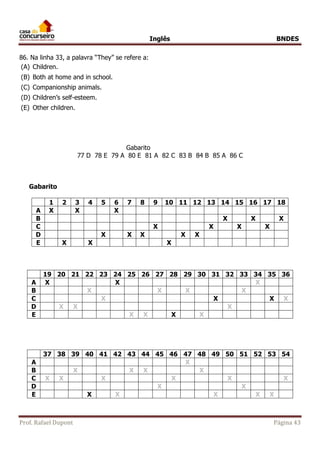
86. Na linha 33, a palavra “They” se refere a: 
(A) Children. 
(B) Both at home and in school. 
(C) Companionship animals. 
(D) Children’s self-esteem. 
(E) Other children. 
Gabarito 
77 D 78 E 79 A 80 E 81 A 82 C 83 B 84 B 85 A 86 C 
Gabarito 
1 2 3 4 5 6 7 8 9 10 11 12 13 14 15 16 17 18 
A X X X 
B X X X 
C X X X X 
D X X X X X 
E X X X 
19 20 21 22 23 24 25 26 27 28 29 30 31 32 33 34 35 36 
A X X X 
B X X X X 
C X X X X 
D X X X 
E X X X X 
37 38 39 40 41 42 43 44 45 46 47 48 49 50 51 52 53 54 
A X 
B X X X X 
C X X X X X X 
D X X 
E X X X X X 
Prof. Rafael Dupont Página 43
Inglês BNDES 
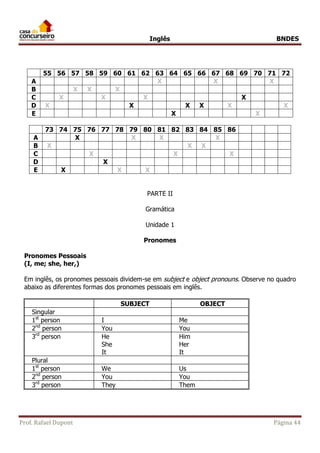
55 56 57 58 59 60 61 62 63 64 65 66 67 68 69 70 71 72 
A X X X 
B X X X 
C X X X X 
D X X X X X X 
E X X 
73 74 75 76 77 78 79 80 81 82 83 84 85 86 
A X X X X 
B X X X 
C X X X 
D X 
E X X X 
PARTE II 
Gramática 
Unidade 1 
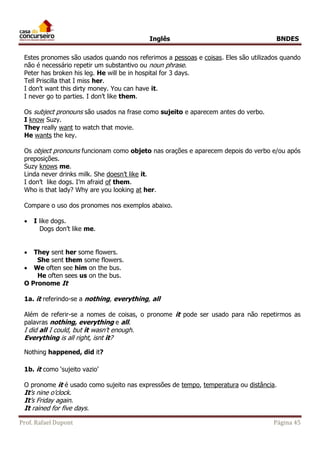
Pronomes 
Pronomes Pessoais 
(I, me; she, her,) 
Em inglês, os pronomes pessoais dividem-se em subject e object pronouns. Observe no quadro 
abaixo as diferentes formas dos pronomes pessoais em inglês. 
SUBJECT OBJECT 
Singular 
1st person I Me 
2nd person You You 
3rd person He 
She 
It 
Him 
Her 
It 
Plural 
1st person We Us 
2nd person You You 
3rd person They Them 
Prof. Rafael Dupont Página 44
Inglês BNDES 
Estes pronomes são usados quando nos referimos a pessoas e coisas. Eles são utilizados quando 
não é necessário repetir um substantivo ou noun phrase. 
Peter has broken his leg. He will be in hospital for 3 days. 
Tell Priscilla that I miss her. 
I don’t want this dirty money. You can have it. 
I never go to parties. I don’t like them. 
Os subject pronouns são usados na frase como sujeito e aparecem antes do verbo. 
I know Suzy. 
They really want to watch that movie. 
He wants the key. 
Os object pronouns funcionam como objeto nas orações e aparecem depois do verbo e/ou após 
preposições. 
Suzy knows me. 
Linda never drinks milk. She doesn’t like it. 
I don’t like dogs. I’m afraid of them. 
Who is that lady? Why are you looking at her. 
Compare o uso dos pronomes nos exemplos abaixo. 
 I like dogs. 
Dogs don’t like me. 
 They sent her some flowers. 
She sent them some flowers. 
 We often see him on the bus. 
He often sees us on the bus. 
O Pronome It 
1a. it referindo-se a nothing, everything, all 
Além de referir-se a nomes de coisas, o pronome it pode ser usado para não repetirmos as 
palavras nothing, everything e all. 
I did all I could, but it wasn’t enough. 
Everything is all right, isnt it? 
Nothing happened, did it? 
1b. it como ‘sujeito vazio’ 
O pronome it é usado como sujeito nas expressões de tempo, temperatura ou distância. 
It’s nine o’clock. 
It’s Friday again. 
It rained for five days. 
Prof. Rafael Dupont Página 45
Inglês BNDES 
It’s twenty degrees. 
O Pronome One 
1c. One 
One pode ser usado para falar de pessoas em geral. 
One always thinks other people’s lives are more interesting. 
One can’t learn a language in three months. 
One can usually find people who speak English in Brazil. 
Pronomes Possessivos 
(my, mine; her, hers; his, his) 
Os pronomes possessivos dividem-se em possessive adjectives e possessive pronouns. Observe 
no quadro abaixo as diferentes formas dos pronomes possessivos em inglês. 
ADJECTIVES 
POSSESSIVES 
Singular 
1st person My Mine 
2nd person Your Yours 
3rd person His 
Her 
Its 
His 
Hers 
Its 
Plural 
1st person Our Ours 
2nd person Your Yours 
3rd person Their Theirs 
Os possessive adjectives aparecem antes de substantivos e noun phrases. 
They have lost their keys. 
Sarah and her husband live in Kew York. 
Have you seen my new coat? 
Can you lend me your car? 
Os possessive pronouns são usados para não repetirmos estruturas como my car, your keys, 
their books. 
My flat is close to downtown. Where’s yours? (yours = your flat) 
Our dog is smaller than theirs. (theirs = their dog) 
Your house is older than mine. (mine = my house) 
My car is faster than yours. (yours = your car) 
Prof. Rafael Dupont Página 46
Inglês BNDES 
Compare o uso dos diferentes pronomes possessivos nas frases abaixo. 
My book is on her table. Hers is on mine. 
Take a look at our car. It’s much nicer than yours. 
The dog wags its tail when it sees its master. 
Pronomes Reflexivos 
(myself, herself, himself) 
Na língua inglesa, os pronomes reflexivos são: myself, yourself, himself, herself, itself, 
oneself, ourselves, yourselves, themselves. O uso mais comum destes pronomes é para 
falar de ações onde o sujeito e o objeto são a mesma pessoa. 
She cut herself last weekend. 
I’m going to the mall to get myself some new clothes. 
Pronomes reflexivos podem se referir a outras coisas além do sujeito: 
His letters are all about himself. 
I’ll tell her a few things about herself. 
She loves him for himself, not for his money. 
Uso enfático 
Podemos usar pronomes reflexivos para enfatizar sujeitos ou objetos. 
The manager spoke to me himself. 
It’s quicker if you do it yourself. 
The house itself is big, but the backyard’s very small. 
I’ll go and see the Minister himself if I have to. 
Expressão 
by oneself 
By myself/yourself etc. pode ter dois sentidos: ‘alone, without company’ ou ‘without help’. 
They often like to spend time by themselves. 
‘Do you need any help?’ ‘No, thanks. I can do it by myself. 
ATIVIDADES DE AULA 
1. Substitua as palavras entre parêntesis por possessive pronouns. 
a) Her house is bigger than (her house). 
________________________________ 
b) Your watch is more expensive than (my watch). 
________________________________________ 
c) Our exams are more difficult than (their exams). 
________________________________________ 
Prof. Rafael Dupont Página 47
Inglês BNDES 
d) Her job is harder than (his job). 
___________________________ 
e) My father is stronger than (your father). 
__________________________________ 
2. Reescreva as frases abaixo substutuindo as palavras sublinhadas por pronomes. 
a) Paul and I saw Peter yesterday. He bought Paul and me a cup of coffee. 
__________________________________________________________________________ 
b) I’m looking for Sally. Have you seen Sally. Sally isn’t at home. 
__________________________________________________________________________ 
c) Sally and Ie saw a film called ‘The Hedgehog’ yesterday. Have you seen this film? 
__________________________________________________________________________ 
d) Paul and Ringo are meeting George today. George is having dinner with Paul and Ringo. 
__________________________________________________________________________ 
e) Come to the garden with Susan and me. Susan and I are having fun here. 
__________________________________________________________________________ 
3. Assinale as frases onde as estruturas sublinhadas contenham erro e corrija. 
a) Look at the sky. Its going to rain. 
__________________________________________________________________________ 
b) Those tickets for the cinema are hers. 
__________________________________________________________________________ 
c) Shall we give the cat it’s food. 
__________________________________________________________________________ 
d) I can’t do this exercise. Its very difficult. 
__________________________________________________________________________ 
f) I’ve just found this wallet. Is it yours? 
__________________________________________________________________________ 
Prof. Rafael Dupont Página 48
Inglês BNDES 
TESTES 
1. Susan knows ……… lesson well. 
(A) hers 
(B) its 
(C) her 
(D) mine 
(E) she 
2. I drove all the way to Chicago by …………. 
(A) yourself 
(B) me 
(C) hers 
(D) myself 
(E) mine 
3. Each dog has ………. own dish for food and water. 
(A) its 
(B) theirs 
(C) his 
(D) hers 
(E) it 
4. I miss Mary. I used to see ......…. everyday at school. 
(A) hers 
(B) her 
(C) me 
(D) it 
(E) him 
5. Paul knows both of ……. very well. 
(A) we 
(B) us 
(C) he 
(D) they 
(E) their 
6. He wants to talk with ………… 
(A) we. 
(B) I. 
(C) me. 
(D) yours. 
(E) his. 
Prof. Rafael Dupont Página 49
Inglês BNDES 
7. Na frase A scorpion comes along and asks the toad to take him to the other side of the pond, 
a palavra sublinhada se refere a 
(A) scorpion 
(B) pond 
(C) toad 
(D) along 
(E) asks 
8. Technology for young people today is new, …. is exciting, and … is the difference between 
… and he older generation. 
(A) he – he – their 
(B) it – it – they 
(C) its – its – them 
(D) she – she – they 
(E) it – it – them 
9. With Tel-net services a user could connect to another computer anywhere in the world and 
use ………. as if were sitting on …..… own desktop. 
(A) he – its 
(B) it – him 
(C) he – its 
(D) it – his 
(E) him – it 
10. Doris hurt ……. on a piece of glass. 
(A) herself 
(B) itself 
(C) sheself 
(D) oneself 
(E) herself’s 
11. Every student should keep …… dictionary nearby for reference. 
(A) it 
(B) their 
(C) his 
(D) hers 
(E) its 
12. ‘Is this John’s room?’ ‘Yes, it is ……..’ 
(A) my. 
(B) hers. 
(C) they. 
(D) him. 
(E) his. 
Prof. Rafael Dupont Página 50
Inglês BNDES 
13. Tel .............. ................... gifts are on those shelves. 
(A) her – her 
(B) he – him 
(C) me – mine 
(D) her – hers 
(E) them – them 
14. These CDs aren’t …………… . They are ……………… . 
(A) their – ours 
(B) them – us 
(C) his – her 
(D) hers – mine 
(E) ours – them 
GABARITO UNIDADE 1 
1 2 3 4 5 6 7 8 9 10 11 12 13 14 
A X X X X 
B X X 
C X X X 
D X X X 
E X X 
Unidade 2 
VERBOS 
Presente Simples 
(I go, I don’t go) 
O presente simples é formado pela forma infinitiva dos verbos menos a partícula to. Na terceira 
pessoa do singular acrescentamos o -s nos verbos. Observe no quadro abaixo a sua conjugação 
na forma afirmativa. 
I DRIVE 
YOU DRIVE 
HE/SHE/IT 
DRIVES 
WE DRIVE 
YOU DRIVE 
THEY DRIVE 
Prof. Rafael Dupont Página 51
Inglês BNDES 
Nas formas negativas e interrogativas, usamos o verbo auxiliar do/does + verbo. Note que o 
verbo principal permanece sempre no infinitivo. 
I/WE/YOU/TH 
EY 
DON’T 
WORK 
DO 
DRIVE 
HE/SHE/IT 
DOESN’T 
WORK 
DO 
DRIVE 
DO 
I/WE/YOU/TH 
EY 
WORK? 
DO? 
DRIVE? 
DOES 
HE/SHE/IT 
WORK? 
DO? 
DRIVE? 
Os usos mais comuns do presente simples são os seguintes: 
 Falar de ações habituais que acontecem o tempo todo ou repetidamente. Nestes casos, é 
comum o uso de advérbios de freqüência ou locuções adverbiais de freqüência como :always; 
often;, usually; sometimes; seldom, never; every day; on Sundays; once a week; twice a week; 
three times a week; etc. 
I usually go to the beach on weekends. 
Sheila plays tennis twice a week. 
They never drink coffee. 
I always take a bus to come to school 
The new treatment for influenza doesn’t appear to work. 
The new science museum currently attracts 10,000 visitors a month. 
Their school uniform consists of black trousers and a dark green jumper. 
 Verdades universais. 
The sun sets in the west. 
Water boils at 100º C. 
 Instruções. 
A: How do I get to the nearest bus stop? 
B: You go straight on to the traffic lights, then you turn right… 
Prof. Rafael Dupont Página 52
Inglês BNDES 
ATIVIDADES DE AULA 
1. Coloque os verbos entre parênteses na sua forma correta. 
a) Jane ______________ tea very often. (drink) 
b) The sun ______________ in the east. (rise) 
c) Peter _____________________ French. (not/speak) 
d) They ________________ in Ireland. (live) 
e) Paul and George _________________ their homes at 7 a.m. every morning. (leave) 
f) She ____________ to Sydney once a month. (fly) 
2. Escreva perguntas no simple present com as palavras entre parênteses. 
a) (They/listen/to the radio) 
_________________________________________________________________________ 
b) (He/drink/tea) 
_________________________________________________________________________ 
TESTES 
1. Chose the best alternative to complete the sentences below. 
Bad driving ……………. many accidents. 
Vegetarians …………………… eat meat. 
Peter never ………..……………….. beer. 
The world cup ………... every four years. 
(A) cause – doesn’t – drink – take place 
(B) causes – don’t – doesn’t drink – takes place 
(C) causes – don’t – drinks – takes place 
(D) causes – doesn’t – drinks – take place. 
(E) caused – doesn’t – drinks – taken place 
2. Chose the best alternative to complete the sentences below. 
That restaurant is very good. I ……………it. 
My parents ………….. in a huge apartment. 
A catholic ……………. in God. 
(A) suggest – lives – believes 
(B) recommend – lives – believe 
(C) suggest – live – believe. 
(D) recommend – live – believes 
(E) recommend – lives – believes 
Prof. Rafael Dupont Página 53
Inglês BNDES 
3. Once a week, from eight till nine o’clock or later, Paul goes to Victor’s to watch television. 
A ação descrita, 
(A) acaba de acontecer. 
(B) acontece regularmente. 
(C) vinha acontecendo. 
(D) aconteceu uma vez. 
(E) aconteceu no passado. 
4. She ________________ movies. She ______________ to the cinema five times a week. 
(A) love - go 
(B) hates - gos 
(C) loves - goes 
(D) loves - going 
(E) hated – go 
5. A: Where _________ you ________________? 
B: I ________________ at Royal school. 
(A) do – study – study 
(B) does – study – studies 
(C) do – studies – study 
(D) do – study – studys 
(E) does – studies – study 
6. __________ he _____________ to drink beer? 
(A) Does – likes 
(B) Do – likes 
(C) Does – like 
(D) Do – like 
(E) Do – liking 
7. I _____________ to go to the cinema but my father ______________ to go. 
(A) want – don't want 
(B) wants – doesn't want 
(C) want – don't wants 
(D) want – doesn't want 
(E) wants – don't want 
8. Mary ___________ a big house but she ____________ a car. 
(A) have – doesn't have 
(B) have – doesn't has 
(C) has – doesn't have 
(D) have – doesn't have 
(E) has – doesn't has 
Prof. Rafael Dupont Página 54
Inglês BNDES 
9. Peter never __________ his homework. He ____________ to _______________. 
(A) does – doesn't like – studies 
(B) do – don't like – studies 
(C) does – doesn't like – study 
(D) does – don't like – studies 
(E) do – doesn't like – study 
10. Os verbos TEACH, STUDY, PLAY, KISS e GO, na terceira pessoa do singular do simple 
present ficariam, respectivamente: 
(A) teachs – studys – plays – kisses – goes 
(B) teaches – studys – plaies – kisses – goes 
(C) teaches – studies – plays – kiss – goes 
(D) teaches – studies – plays – kisses – goes 
(E) teaches – studys – plaies – kisses – gos 
Passado Simples 
(I played/I didn’t play) 
O simple past é usado para falar de ações e acontecimentos no passado que já estão 
encerrados. Os verbos são geralmente acompanhados de expressões temporais (advérbios) que 
determinam quando tal ação aconteceu. Quando estas expressões não aparecem na frase, os 
falantes sabem quando a ação do verbo ocorreu. As formas afirmativa, negativa e interrogativa 
do passado simplest estão no quadro abaixo. Note que nas estruturas negativas e interrogativas, 
utilizamos o verbo auxiliar did e colocamos o verbo principal no infinitivo. 
AFFIRMATIVE NEGATIVE INTERROGATIV 
E 
I worked 
You worked 
He/She/It 
worked 
We worked 
You worked 
They worked 
Full form 
I did not work 
You did not work 
He/She/It did not 
work 
We did not work 
You did not work 
They did not work 
Short form 
I didn’t work 
You didn’t work 
He/she/it didn’t 
work 
We didn’t work 
You didn’t work 
They didn’t work 
Did I work? 
Did you work? 
Did he/she/it 
work? 
Did we work? 
Did you work? 
Did they work? 
Os verbos do quadro abaixo são regulares. Eles formam o passado com o acréscimo da 
terminação -ed no seu final. 
live – lived walk – 
walked 
cook – cooked ask – 
asked 
Prof. Rafael Dupont Página 55
Inglês BNDES 
Usos 
Os usos mais comuns do simple past são os seguintes: 
 ação ocorrida em um tempo definido no passado. 
I studied English last year. 
Did you see my sister yesterday? 
 ação que ocupou um certo espaço de tempo no passado. 
She studied here for 6 years. 
Mr. Brown worked in New York from 1992 to 1996. 
 ações consecutivas no passado 
When I went to New York, I visited Sarah. 
 para contar histórias e narrar eventos no passado (story-telling). 
One morning, the prince decided that he didn’t like spending all day in the castle, so he told his 
father that he wanted to start an adventure… 
ATIVIDADES DA AULA 
1. Leia o texto abaixo. 
Charles Bukowski is a famous American writer. He was born in Andernach, Germany. His 
father was an American soldier and he met his mother in Germany. His parents went to the 
United States when he was three. He grew up in Los Angeles and lived there for fifty years. He 
published his first story in 1944 when he was twenty-four and began writing poetry at the age of 
thirty five. During his lifetime he published more than forty-five books of poetry and prose. He 
died in San Pedro, California on March 9, 1994 at the age of seventy-three.. 
Adapted from: ‘Women’, ECCO. 
Reescreva as frases abaixo de acordo com o texto. 
a) Charles Bukowski was Born in America. 
He wasn’t born in America. He was born in Germany . 
b) His father was German. 
_________________________________________________________________________ 
c) He went to the United States when he was five. 
_________________________________________________________________________ 
d) He grew up in Germany. 
_________________________________________________________________________ 
Prof. Rafael Dupont Página 56
Inglês BNDES 
e) He began writing poetry at the age of twenty-four. 
_________________________________________________________________________ 
f) He died in Germany. 
_________________________________________________________________________ 
2. Complete o texto com o passado dos verbos abaixo: 
1. Love _______ 
2. Be _________ 
3. Have _______ 
4. Pass _______ 
4. Grow _______ 
5. Find ________ 
“I have always loved animals. I ________ them deeply, from the very first days of my life. When 
I ____ young, we always ____ many animals in our house, and so I used to spend most of my 
days playing with them and taking care of them. As the years ______, I _______ into a quiet, 
gentle man, and my love for animals ______ too. I ________ that they ______ more friendly, 
more honest than most men. Animals ______ always my best friends.” 
Adapted from: ‘Tales of Mystery and Imagination’, Oxford University Press 
3. Escreva perguntas para as respostas abaixo. 
Ex. 
a) I went to Africa in 1997. 
When did you go to Africa? 
b) I stayed in the Dolphin Hotel. 
Where___________________________________________________________________? 
c) We stayed there for one moth. 
How long_________________________________________________________________? 
d) It rained yesterday. 
________________________________________________________________________? 
Prof. Rafael Dupont Página 57
Inglês BNDES 
TESTES 
11. Chose the best alternative to complete the sentences below. 
She ……………… that cap when she traveled to Europe. 
John ……….…. his job at 9:00 last night. 
They both …..….…. the movie last night. 
He’s not home. He ……… to the park one hour ago. 
(A) buys – leaves – watched – left 
(B) bought – left – saw – went 
(C) bought – left – watched – goes 
(D) bought – leaves – saw – went 
(E) buys – left – saw – went 
12. Read what Suzy says about a typical day in her life: 
Suzy: I usually get up at 8 o’clock and have breakfast. I take a bus to work and I arrive at the 
office at 9 o’clock. I never have lunch. I finish work at 6 o’clock and I generally go to the 
University after it. I go to bed around 10 o’clock every night. 
Yesterday was a typical day for Suzy. Complete the sentences based on the information given. 
She _________ up at 8 o’clock. She ________ a bus to work. She _________ there at 9 a.m. 
She _________ lunch. She __________ work at 6 p.m. and probably __________ to the 
University after it. She _________ to bed around 10 p.m. 
(A) got – took – arrived – had – finished – went – went 
(B) gets – took – arrive – has – finished – went – went 
(C) got – took – arrived – has – finished – gone – gone 
(D) got – taken – arrived – had – finished – gone – gone 
(E) got – took – arrived – has – finished – went – went 
13. I was surprised because I …………….. to see him again. 
(A) don’t expect 
(B) expects 
(C) expecting 
(D) was expect 
(E) did not expect. 
14. Assinale a alternativa em que todos os verbos estão no simple past. 
(A) bought – cut – see – sold 
(B) said – put – ran – sell 
(C) drank – ate – slept – read 
(D) came – meet – saw – sold 
(E) won – wrote – has – gave 
Prof. Rafael Dupont Página 58
Inglês BNDES 
15. When I went to England I ……………. three English courses. 
(A) take 
(B) took 
(C) was take 
(D) taked 
(E) takes 
16. The murderer ………………….. the room and …………………. the old woman. 
(A) enters – shot 
(B) entered – shooted 
(C) enter – shot 
(D) entered – shoots 
(E) entered – shot 
17. We ……………….. to the cinema, but we ………………….. the movie. 
(A) didn’t go – enjoy 
(B) went – didn’t enjoy 
(C) goes – enjoyed 
(D) went – enjoy 
(E) went – didn’t enjoyed 
18. I …………………. Rod was busy, so I ………………………. him. 
(A) know – disturbs 
(B) know – didn’t disturb 
(C) knew – don’t disturbed 
(D) knew – didn’t disturb 
(E) knew – didn’t disturbed 
19. The hotel wasn’t expensive. It ……………………….. very much. 
(A) costed 
(B) cost 
(C) didn’t costed 
(D) didn’t cost 
(E) did costed 
20. Sheila was very thirsty. She …………………… the water quickly 
(A) drank 
(B) drinks 
(C) didn’t drank 
(D) drink 
(E) doesn’t drink 
Prof. Rafael Dupont Página 59
Inglês BNDES 
21. John ……………………….. the stairs and ……………………. his leg. 
(A) fall – broke 
(B) fell – breaks 
(C) fell – broke 
(D) fells – brokes 
(E) falls – broke 
22. Assinale a alternativa em que todos os verbos estão no simple past. 
(A) drove – cut – got – put 
(B) kept – putted – said – taught 
(C) sang – sat – lose – paid 
(D) throw – thought – brought - cut 
(E) spent – sing – stood – blew 
Presente Contínuo 
(I’m driving, I’m not driving) 
1. Formas 
to be + -ing 
AFFIRMATIVA NEGATIVA INTERROGATIVA 
I am working 
you are working 
etc 
I’m not working 
you aren’t working 
etc 
Am I working? 
Are you working? 
Etc 
2. Usos 
2a. temporary actions and situations that are going on ‘around now’: before, during and after 
the moment of speaking. 
Jill is waiting for you outside. 
‘What are you doing?’ ‘I’m just looking at some porn magazines!’ 
I’m reading a very good book. 
He’s working in Iraq at the moment. 
2b. future 
What are you doing Saturday night? 
I’m leaving the city tomorrow. 
Prof. Rafael Dupont Página 60
Inglês BNDES 
3. PRESENT CONTINUOUS X SIMPLE PRESENT 
permanent situations: it is preferable to use the simple present. Compare: 
 My brother is living in Paris now/at the moment. 
You live in California, don’t you? 
repeated actions: the present continuous is more used in this case if the event is happening 
around the moment of speaking. Compare: 
 Lucy is watching a lot of Friends these days. 
Sarah goes to the cinema twice a week. 
Translation 
a) Some friends of mine are building their own house. 
_________________________________________________________________________ 
b) Is your English getting better? 
_________________________________________________________________________ 
c) Aunt Mary was always turning up and bringing us presents. 
_________________________________________________________________________ 
d) They are having lunch outside. 
_________________________________________________________________________ 
e) John is looking for the book which he lost. 
_________________________________________________________________________ 
f) They are laughing at what you said. 
_________________________________________________________________________ 
Passado Contínuo 
(I was driving, I wasn’t driving) 
1. Formas 
AFFIRMATIVA NEGATIVA INTERROGATIVA 
I was working 
you were working 
he/she/it was 
working 
etc 
I wasn’t working 
you weren’t working 
he/she/it wasn’t 
working 
etc 
was I working? 
were you working? 
was he/she/it/working? 
Etc 
Prof. Rafael Dupont Página 61
Inglês BNDES 
2. Usos 
2a. say that something was in progress around a particular time in the past. 
‘What were you doing at 9 o’clock yesterday night?’ ‘I was playing cards with John. I swear.’ 
When I got up this morning it was raining. 
2b. say that something was in progress at every moment during a period of time. 
I was studying all day yesterday. 
They were arguing the whole time they were together. 
2c. two events happening simultaneously in the past. 
They were walking on the street while the girls were watching them. 
3. PAST CONTINUOUS X SIMPLE PAST 
It is often common to use the simple past with the past continuous. The past continuous refers 
to an action or situation which was being developed; the simple past refers to an action or event 
that happened in the middle of the other action or that interrupted it.. 
As I was running down the road, I met Peter. 
Somebody knocked at the door while I was having lunch. 
The man was making his speech in front of the church. The crowds were cheering. 
Photographers were jostling each other for the best positions. Suddenly the man fell and a girl 
screamed… 
Translation 
a) Two couples were playing cards when John accidentally dropped some cards on the floor. 
b) When he bent down under the table to pick up the cards, he noticed that Bill's wife was 
cheating! 
______________________________________________________________________________ 
c) The accident happened while they were traveling to Mexico. 
_________________________________________________________________________ 
d) When I got up this morning, the sun was shining brightly. 
_________________________________________________________________________ 
Prof. Rafael Dupont Página 62
Inglês BNDES 
e) Peter was having dinner at 9 p.m. yesterday. 
_________________________________________________________________________ 
Gabarito Unidade 2 
1 2 3 4 5 6 7 8 9 10 11 12 
A X X 
B X X 
C X X X X 
D X X X X 
E 
Unidade 3 
13 14 15 16 17 18 19 20 21 22 
A X X 
B X X X 
C X X 
D X X 
E X 
VERBOS II CCerijidjfijvjdfijvnfjin,j fn fndvijfnivjnfijvnfijv;nijfnvi 
Present Perfect 
O present perfect é formado com o verbo auxiliar have / has e um verbo no particípio (done, 
seen, put). Observe no quadro abaixo a conjugação do verbo work no present perfect. 
AFFIRMATIVE NEGATIVE INTERROGATIVE 
I/we/you/they have 
worked 
he/she/it has worked 
I/we/you/they haven’t 
worked 
he/s/he/it hasn’t worked 
Have I/we/you/they 
worked? 
Has he/she/it worked? 
O present perfect é utilizado nas seguintes situações: 
Prof. Rafael Dupont Página 63
Inglês BNDES 
1. When we use the present perfect tense we are saying that a finished action or event is 
connected with the present. When we say that something has happened we are thinking about 
the present and the past at the same time. 
 ‘What is Ted doing?’ ‘He is looking for his key. He has lost it.’ 
 I can’t go to the park with you because I’ve broken my leg. (my leg is broken now) 
 Susan has had a baby. 
 Our cat has died. 
3. The present perfect is also used to give the idea of completion or achievement. 
 The maid’s finished all the housework. 
 Have you done all your homework? 
 I have mastered my English. 
 My mechanic has already fixed my car. 
3. The present perfect can be used when we are referring to a period of time continuing up to the 
present. 
 Have you ever seen the movie ‘Lethal Weapon’? 
 I’m sure we’ve met before. 
 He’s never apologized for anything in his life! 
 ‘Has Bob come yet?’ ‘Yes, and he’s already started to make trouble.’ 
 ‘Have you told the whole story to Peter’ ‘No, I haven’t told him yet.’ 
4. It is also correct to use the present perfect to say that something has happened several times 
up to the present. 
 I’ve been to Canada once/twice/three times. 
 I’ve already written ten e-mails to Anna and she hasn’t answered me yet. 
 How often have you been in love in your life? 
5. It is common to use the present perfect to say how long a present situation has lasted. 
 I’ve been a student since 1984. 
 They’ve studied hard for years. 
 ‘How long have you been a teacher?’ ‘I’ve been a teacher for seven years.’ 
NOTES 
Prof. Rafael Dupont Página 64
Inglês BNDES 
TESTES 
1. I know now I shall never write a book better than the ones I …………… 
(A) did write 
(B) have written 
(C) had write 
(D) have writing 
(E) wrote 
2. Choose the alternative which presents all the verbs in the past participle. 
(A) cut – readed – played – put 
(B) hung – read –put – come 
(C) cutted – putted – readed – came 
(D) read – put – come – sang 
(E) drank – read – come – put 
3. Mexico …………... many difficult crisis in history, but now it …………… its own Future. 
(A) has faced – is shaping 
(B) faced – was shaped 
(C) have faced – shapes 
(D) have been facing – shaped 
(E) faces – has been shaped 
4. Choose the alternative which presents all the verbs in the past participle 
(A) fed – fought – fall – hurted – taught 
(B) won – hurt – hit – let – sat 
(C) sat – slept – drunk – grew - taught 
(D) hurt – led – made – set – sang 
(E) threw – letted – setted – hurt – fed 
5. The word that could be placed between have and seen in the sentence I have seen that 
play many times is 
(A) never 
(B) yet 
(C) still 
(D) ever 
(E) already 
6. O tempo verbal expresso por She’s learnt many new words é 
(A) present continuous. 
(B) simple past. 
(C) past continuous. 
(D) present perfect. 
(E) simple present. 
Prof. Rafael Dupont Página 65
Inglês BNDES 
7. Among the magazines and newspapers that ………... electronic recently ………….. Time, The 
Los Angeles Times and Wired. 
(A) have gone – are 
(B) have go – will be 
(C) have been going – been 
(D) had went – were 
(E) has gone – are 
8. A resposta certa para a pergunta Have we reached the point where we can no longer be sure 
of the security information? é 
(A) Yes, we had. 
(B) Yes, we have. 
(C) Yes, we has. 
(D) Yes, we did. 
(E) Yes, we could. 
9. My mother has not visited us since we ……….. the new house. 
(A) had built 
(B) built 
(C) have built 
(D) building 
(E) having built 
10. Escolha a melhor tradução para a frase Martha has gone crazy. 
(A) Martha foi uma louca. 
(B) Martha foi para a loucura. 
(C) Martha enlouqueceu. 
(D) Martha foi visitar uma louca. 
(E) Martha é louca. 
11. He ................ home yet. 
(A) hasn’t’ arrived 
(B) has arrived 
(C) have arrived 
(D) has arrive 
(E) isn’t arrived 
12. Assinale a alternativa onde todos os verbos encontram-se no particípio passado. 
(A) hurt – lent – founded – fell 
(B) hit – hid – costed – grew 
(C) hidden – cut – cost – bet 
(D) grown – hit – found – knew 
(E) hurted – hit – known - given 
Prof. Rafael Dupont Página 66
Inglês BNDES 
Past Perfect 
O past perfect é formado com o verbo auxiliar had e um verbo no particípio (done, seen, put). 
Observe no quadro abaixo a conjugação do verbo work no present perfect. 
AFFIRMATIVE NEGATIVE INTERROGATIVE 
I had worked 
you had worked 
etc 
I hadn’t worked 
you hadn’t worked 
etc 
had I worked? 
had you worked? 
Etc 
O past perfect pode ser utilizado nas seguintes situações: 
2. The past perfect is used to talk about an action or situation which happened before another 
one in he past. The past perfect is an ‘earlier past’. 
 When Mary arrived home, Peter had left. 
 She realized that they had met before. 
 When I got home, my sister had just left. 
3. The past perfect is commonly used after verbs of saying and thinking, to talk about things that 
had happened before that saying or thinking took place. 
 I told him I had sold the car. 
 I thought I had paid you. 
 I wondered who had left the window open 
PRESENT PERFECT X PAST PERFECT 
Compare the sentences: 
 Who is that woman? I have never seen her. 
 I didn’t know who that woman was. I had never seen her. 
 We aren’t hungry. We have just had lunch. 
 We weren’t hungry. We had just had lunch. 
ATIVIDADES DE AULA 
Complete the blanks in text below by using the verbs from the box. You may use each verb just 
once and put them into the simple past tense or the past perfect tense. 
BECOME BUY 
REALIZE 
BE BEGIN 
Prof. Rafael Dupont Página 67
Inglês BNDES 
Paul Auster was born in Newark, New Jersey on 3 February 1947. He is a contemporary 
American novelist of Jewish origin. His father, Samuel Auster, was a landlord, who owned 
buildings with his brothers in Jersey City. His mother, Queenie Auster, was some 13 years younger 
than her husband. The family was middle-class, the parents' marriage an unhappy one. Queenie 
…………………………….., even before the end of the honeymoon, that the marriage 
……………………….…….. a mistake, but her pregnancy made escape impossible. 
Auster grew up in the Newark suburbs of South Orange and Maplewood. When he was 3½ 
years old, a younger sister was born. When she was five, her psychological instability 
……………………….. apparent, and in later years she would be debilitated by mental breakdowns. 
In 1959 his parents …………………... a large house in their town's most prestigious 
neighborhood. It was here that Auster's uncle, the skilled translator Allen Mandelbaum, left 
several boxes of books in storage while he traveled to Europe. The young Auster read the books 
enthusiastically. 
Instead of attending his high-school graduation, Auster headed for Europe. He visited Italy, 
Spain, Paris, and Dublin. While he traveled he continued working on a novel he 
………………………….. some time before. 
Futuro 
Futuro Simples 
O futuro simples (simple future) é formado com os verbos modais/auxiliaries shall e will 
acrescido de um verbo na forma infinitiva (do, play, see, put). Observe no quadro abaixo a 
conjugação do verbo put no futuro simples. 
shall / will + infinitive 
AFFIRMATIVE NEGATIVE INTERROGATIVE 
I will put 
you will put 
he/she/it will put 
etc 
I will not put 
you won’t put 
he/she/it won’t put 
etc 
Will I put? 
Will you put? 
Will he/she/it put? 
Etc 
O futuro simples é comumente utilizado nas seguintes situações: 
1. Shall and will are used when we are simply giving information about the future, or predicting 
future events which are not already decided. 
 It’s too cold here. I will light the fire. 
 In 2050, people will be able to fly. 
 I shall probably be at Mary’s late at night 
 I think Manchester United will win. 
 Maybe I’ll return later. I haven’t decided yet. 
2. It can also be used for actions that we decide to do NOW, at the moment of speaking. 
 Considering these five options I think I’ll take the red one. 
 I like this red coat. I’ll buy it. 
Prof. Rafael Dupont Página 68
Inglês BNDES 
Be Going To 
Também é possível referir-se ao futuro usando a seguinte estrutura: to be + going to + forma 
infinitiva do verbo. No quadro abaixo, observe a conjugação do verbo leave com o going to. 
be + going to + infinitive 
AFFIRMATIVE NEGATIVE INTERROGATIVE 
I’m going to work 
you’re going to work 
he/she/it is going to 
work 
etc 
I’m not going to work 
you’re not going to 
work 
he/she/it isn’t going to 
work 
etc 
Am I going to work? 
Are you going to 
work? 
Is he/she/it going to 
work? 
Etc 
O futuro com be going to pode ser utilizado nas seguintes situações: 
Actions which have already been decided to do before we speak. 
 I’m going to stay three months in Canada. 
 They are going to get married next year. 
 We’re going to visit grandpa next month. 
 We’re going to have a baby. 
 They are going to move on the 1st of July. 
It can also be used for something that we expect to happen because the situation now indicates 
that it is going to happen. 
 He is running towards the goal, and he’s going to score. 
 Look at the sky. It’s going to rain. 
 That little boy isn’t looking where he’s going. He’s going to walk into that tree. 
TESTES (VERBOS – REVISÃO GERAL) 
13. I’ve already bought our tickets. We ………………….. tomorrow. 
(A) are traveled 
(B) are going to travel 
(C) go travel 
(D) will go 
(E) will going. 
Prof. Rafael Dupont Página 69
Inglês BNDES 
14. I’m too tired to walk home. I think I ………………….. a taxi. 
(A) am getting 
(B) will got 
(C) will get 
(D) am going to get 
(E) shall getting 
15. I’m worried about Paul. I wonder what ……………………. to him. 
(A) is going to happened 
(B) will happens 
(C) shall happened 
(D) will happen 
(E) is happened 
16. ‘Let’s have a party?’ 
‘Great idea! We …...……. a lot of people. 
(A) will invite 
(B) invite 
(C) invited 
(D) have invited 
(E) are going to invite 
17. Mary and I have decided to have a party. We …………..…………… a lot of people. 
(A) has invited 
(B) will invite 
(C) are going to invite 
(D) invite 
(E) shall invite 
18. They ……………….. the train at Grand Station two hours ago. We …..….. ….….. them if we 
run. 
(A) catch – will get 
(B) caught – will got 
(C) caught – may get 
(D) catch – may got 
(E) caught – will gotten 
19. The bell ……………. 30 minutes ago. I’m pretty sure we ……….. late. 
(A) rung – are 
(B) rings – are 
(C) rang – is 
(D) rang – are 
(E) rings – will be 
Prof. Rafael Dupont Página 70
Inglês BNDES 
20. They ….………. to take their vacation in June. They …...…. ………. money so that they can 
go to Thailand. 
(A) have planned – are saving 
(B) plan – are saves 
(C) intend – is saves 
(D) planned – are saving 
(E) intends – will save 
21. We’d ………… a very good time at the pic nic before Kevin ………… us with his spoiled 
children. 
(A) have – join 
(B) had - joins 
(C) has - joined 
(D) had – joined 
(E) have – will join 
22. Mr. Smith ……………. to China to work. Last week, I ………… his partner and he …………….. 
me that he is going there too . There are rumors that Mr. Smith is becoming rich. 
(A) went – met – told 
(B) goes – met – told 
(C) went – meets – tells 
(D) has gone – met - tell 
(E) has gone – met - told 
23. I first …………….. Music of Chance when I was in high school. I ……………… it several times 
since then. I ………… ............... it again pretty soon. I love that book. 
(A) read – has read – am reading 
(B) read – have read – will read 
(C) have read – have read – will read 
(D) read – read – read 
(E) have read – read – will read 
24. When the bell ……. all the students ………… from their seats and ………….. towards the 
streets. 
(A) rang – jumped – ran 
(B) has rang – jumped – run 
(C) rings – jumps – has ran 
(D) rang – has jumped – run 
(E) rings – had jumped – runs 
Prof. Rafael Dupont Página 71
Inglês BNDES 
25. We are now ……………….. on 50th street where we ………………… since 2004. 
(A) living - live 
(B) living – have lived 
(C) living – left 
(D) live – have lived 
(E) living – had left 
26. The first world war ……………… in 1914 and …………… in 1918. 
(A) begun – ends 
(B) begins – ends 
(C) began – ended 
(D) begin - ended 
(E) began – has ended 
27. We …………… many new words in this course. 
(A) have learn 
(B) learnt 
(C) learn 
(D) had learn 
(E) have learned 
28. Marianne says that she ………………. his pocketbook. 
(A) has lost 
(B) had lost 
(C) loses 
(D) lost 
(E) had lose 
29. They ………………… in the restaurant on the corner when I saw …………….. . 
(A) were eating – him 
(B) ate – theirs 
(C) are eating – him 
(D) were eating – them 
(E) eat - theirs 
30. John …………….. us ……………. . Something …….……… to him. 
(A) has called – yet – must have happened 
(B) hasn’t called – yet – must have happened 
(C) hasn’t called – already – must have happened 
(D) has called – already – happen 
(E) called – today – happen 
Prof. Rafael Dupont Página 72
Inglês BNDES 
31. Observe the dialogue below: 
The verbal form has vanished is an example of 
(A) simple past. 
(B) past perfect. 
(C) simple future. 
(D) present perfect. 
(E) simple present. 
32. She still …………….. her father £3 000. 
(A) owe 
(B) did 
(C) do 
(D) owes 
(E) love 
33. The pound ………………. to its lowest recorded level against the dollar. 
(A) have sunk 
(B) are going to sink 
(C) had sink 
(D) will sinks 
(E) has sunk 
34. For ten years she ………………… among the nomads of North America. She told me it was a 
great experience. 
(A) dwelt 
(B) have dwelled 
(C) dwells 
(D) has dwelt 
(E) had dwell 
35. Kate and Jack ..................... me lunch today. 
(A) cooks 
(B) were cooking 
(C) has cooked 
(D) cooked 
(E) is cooking 
Prof. Rafael Dupont Página 73
Inglês BNDES 
36. At that time John ………………… England. 
(A) rules 
(B) is ruling 
(C) ruled 
(D) has rule 
(E) had rule 
37. When he bought the book, he told that he …………….. for it everywhere. 
(A) had look 
(B) has looked 
(C) looks 
(D) had looked 
(E) have looked 
38. Mary asked me why I ……………...…. the party so early. 
(A) had gone 
(B) had left 
(C) have leave 
(D) had leave 
(E) have left 
39. What did she say she ………….. with the money? 
(A) had did 
(B) have done 
(C) has done 
(D) had done 
(E) had do 
40. Peter wanted to know what ………….. to his car. 
(A) had happened 
(B) has happened 
(C) have happens 
(D) had happen 
(E) had happens 
41. When I first saw Lucy, I ………….….. that I ……….….. her before. 
(A) feel – have met 
(B) felt – had met 
(C) had felt – have seen 
(D) feel – had met 
(E) had felt – met 
Prof. Rafael Dupont Página 74
Inglês BNDES 
41. It …….….. clear that Paul …………. us the wrong address. 
(A) is – had gave 
(B) was – has given 
(C) were – had given 
(D) is – has gave 
(E) was – had given 
42. When I got to the station I realized that I ……………… the front door opened. 
(A) leave 
(B) had left 
(C) has left 
(D) left 
(E) leaves 
43. If I ..................... enough money, I would have flown to Florida. 
(A) had had 
(B) has 
(C) have 
(D) had 
(E) will have 
44. If I ……………………… your message, I would have come at once. 
(A) receives 
(B) had received 
(C) have received 
(D) received 
(E) receive 
45. We would have gone to the beach if the weather …………………. nice yesterday. 
(A) were 
(B) was 
(C) had been 
(D) is 
(E) are 
Prof. Rafael Dupont Página 75
Inglês BNDES 
Gabarito Unidade 3 
1 2 3 4 5 6 7 8 9 10 11 12 13 14 15 16 17 18 19 20 21 22 
A X X X X X 
B X X X X X X 
C X X X X X 
D X X X X 
E X X 
23 24 25 26 27 28 29 30 31 32 33 34 35 36 37 38 39 40 
A X X X X 
B X X X X X 
C X X 
D X X X X X X 
E X 
41 42 43 44 45 
A X 
B X X 
C X 
D 
E X 
Unidade 4 
Verbos modais 
Os verbos can, could, should, may, etc são chamados ‘verbos modais auxiliares’. Eles sempre 
aparecem antes de outros verbos no infinitivo e adicionam diferentes significados como certeza, 
obrigação, etc. Suas principais características são as seguintes: 
a) não levam -s na terceira pessoa do singular. São invariáveis. 
He may know our address. 
b) não necessitam verbo auxiliar em frases negativas e interrogatives. 
Prof. Rafael Dupont Página 76
Inglês BNDES 
Can you swim? 
Will you marry me? 
You shouldn’t be doing that. 
She can’t speak French. 
c) devem ser sempre seguidos de um outro verbo o infinitivo sem a partícula to. 
We must water the flowers. 
exceções: os verbos modais have to e ought to são sempre seguidos de to. 
People really have to work hard these days. 
You ought to take the garbage outside. 
Usos 
Can, Could and (be) able to 
We use can to say that something is possible or that somebody has the ability to do something. 
 They can see the bridge from their bedroom window. 
 I can come and see you next weekend if you like. 
 Can you speak English? 
 Mary can’t speak any foreign language. 
When we talk about ability, could is the past of can 
 Peter can swim very well. 
Peter’s father could swim very well when he was younger. 
(Be) able to is possible instead of can. 
 Are you able to speak English? 
Can has only two forms: can (present) and could (past). When we want to express another 
tense, it is necessary to use (be) able to. 
 John can’t sleep. 
John hasn’t been able to sleep recently. 
Could (do) and could have (done) 
We use could to talk about possible actions now or in the future. 
 Mary: What shall we do tomorrow? 
Peter: We could go to the mountains. 
 When you go to Los Angeles next year, you could rent a car. 
Can is also possible in the sentences above (we can go to the mountains). Could is less sure 
than can. 
Prof. Rafael Dupont Página 77
Inglês BNDES 
Could (do) X could have (done) 
 Kim is really tired. I think he could sleep for a week. 
 Kim was really tired last weekend. He could have slept for a week. 
We use could have (done) for things which were possible but did not happened. 
 Why did you rent that car? You could have borrowed mine! 
Must and can’t: deductions 
We use must when we feel sure something is true. 
 You’ve been working hard. You must be tired. 
 What did you say? Spanish is a nice language? You must be kidding! 
We use can’t when we feel sure something is not possible/true. 
 You have eaten five hamburgers. You can’t be hungry! 
 Mary is a very shy girl. She can’t know too many people. 
The past form is must have (done) and can’t have done. 
 The phone rang but I didn’t hear it. I must have been out. 
 Lucy didn’t look at me yesterday. She can’t have seen me. 
Must and have to: obligation and necessity 
When we know that it is necessary to do something we use must and have to. 
 I haven’t seen Ann for ages. I must pay her a visit. 
 Gina can’t come with us this evening. She has to work. 
 Bill is such a nice guy. You must meet him. 
 You can’t turn left here. You have to turn right. 
It is possible to use ‘have got to’ instead of ‘have to’. 
 I’ve got to work Sunday morning. 
I have to work Sunday morning. 
Should and Ought to 
We use should to give advices and opinions. 
 Do you want to take the medicine’s course? You should study much more. 
 Should I invite Lucy to go out? 
 The president should do more things to help poor people. 
 I think you should work harder. 
We use should have (done) when we didn’t do something but we think it would have been 
the right thing to do. 
 You missed a great party, Sarah. You should have come. 
 I’m not feeling right. I shouldn’t have drunk so much. 
Prof. Rafael Dupont Página 78
Inglês BNDES 
It possible to use ought to instead of should. 
 The president ought to do more things to help poor people. 
 I think you ought to work harder. 
May and might 
We use may and might to express possibilities. 
 Pete: Where’s Sue? 
Linda: I don’t know. She may be in the office? 
Sarah: She might be home. 
Liz: Ask Jill. She might know. 
For the past we use may have (done) or might have (done) 
 Mary didn’t come to the party last night. She might have been sick. 
 Where’s my wallet? I may have left at Paula’s house. 
Had better and would rather 
When we use had better, we are saying that it is advisable to do something. If one don’t do it, 
there will be a problem or a danger. 
 I have to catch the plane in ten minutes. I’d better go now. 
 You’d better take an umbrella. It might rain this afternoon. 
The negative form is had better not. 
 I’m feeling ill. I’d better not study today. 
 The boss is very demanding. You’d better not be late. 
We use would rather to state a preference: would rather = would prefer 
 I’d rather stay at home tonight than go to that boring party. 
 Would you rather have beer or wine? 
The negative form is would rather not. 
 I’m feeling tired. I’d rather not go to the course this afternoon. 
 I’d rather not go out tonight. 
Can, could, may and would: 
invitations, requests, offers and permissions. 
Offering and inviting. 
 Would you like some tea? 
 Would you like to go out with me tonight? 
Prof. Rafael Dupont Página 79
Inglês BNDES 
Offering to do things. 
 Can I help you? 
 Can I get you some medicine? 
Requests. 
 Can you give me a hand, please? 
 Could you open the door, please? 
 John, would you do me a favor? 
 Will you please be quiet? I’m trying to concentrate. 
Asking for and giving permission. 
 Can I come in? 
 Could I come in? 
 May I come in? 
Used to (do) and (be) used to (doing) 
We use used to (do) to say that something happened regularly in the past but no longer 
happens. 
 Bob used to smoke forty cigarettes a day. Thank God he doesn’t smoke anymore. 
 Tina used to travel a lot when she worked at Varig. 
 Raphael used to have long hair when he was a teenager. 
We use the structure (be) used to (doing) something when the thing is not strange or new for 
me. 
 I’m used to eating spicy food because I lived in Mexico for three years. 
 Mary is used to working hard because she worked as a intern some time ago. 
ATIVIDADES DE AULA 
1. Fill in the blanks with the correct modal verb. 
a) Paul......................................to study more for his tests. (sugestão) 
b) Susan........................................see a movie tonight. (possibilidade) 
c) ....................................I use your pencil? (permissão) 
d) It.........................rain tonight. (possibilidade) 
e) John...........................play soccer very well. (habilidade) 
f) Paul............................run very fast when he was a child. (habilidade no passado) 
g) ……………….. use your pen? (permissão informal) 
h) I …………………………. get up very early when I worked there. (passado habitual) 
i) We …………………. at school at 7:45 every morning. (obrigação) 
j) She ……………….. speak six languages. (habilidade) 
k) I ……………………… play a lot of tennis when I was younger. (passado habitual) 
l) I am ……………………. studying at weekends. (presente habitual) 
m) She really …………………………… wash her hair. (recomendação, sugestão) 
n) Students ………………………. use the staff car park. (proibição) 
Prof. Rafael Dupont Página 80
Inglês BNDES 
2. Relacione as colunas. 
1 - SHOULD 
2 - MAY 
3 - MIGHT 
4 - WOULD 
5 - COULD 
6 - MUST 
7 - MUST NOT 
8 - CAN 
( ) ability in the past 
( ) obligation 
( ) recommendation 
( ) ability in the present/informal permission 
( ) prohibition 
( ) weak possibility 
( ) polite request (conditional) 
( ) permission (formal) 
TESTES 
1. A frase excessive government spending may be the most important nos dá a idéia de 
(A) possibilidade. 
(B) certeza. 
(C) dúvida. 
(D) necessidade. 
(E) obrigação. 
2. ……………. carry me to other side of the pond, please? 
(A) Should you 
(B) Must you 
(C) Are you 
(D) Do you 
(E) Could you 
3. By visiting colleges and writing to parents, the police will ………………… to help improve 
surveilance. 
(A) can 
(B) be able 
(C) many 
(D) to be able 
(E) able 
Prof. Rafael Dupont Página 81
Inglês BNDES 
4. A frase I can’t speak French pode ser substituída, conservando o mesmo sentido, por 
(A) I mustn’t speak French. 
(B) I am not able to speak French. 
(C) I ought not to speak French. 
(D) I may not speak French. 
(E) I shall not speak French. 
5. You ought to stay, means 
(A) You might stay. 
(B) You should stay. 
(C) You have to stay. 
(D) You must stay. 
(E) You may stay. 
6. You must study, means 
(A) You have to study. 
(B) You ought to study. 
(C) You could study. 
(D) You should study. 
(E) You may study. 
7. You may enter, means 
(A) You must enter. 
(B) You should enter. 
(C) You ought to enter. 
(D) You can enter. 
(E) You have to enter. 
8. A frase I’d rather have my money back indica 
(A) imposição. 
(B) obrigação. 
(C) necessidade. 
(D) possibilidade. 
(E) preferência. 
9. The teacher helped the boy …….. the exercise because he ….…. it alone. 
(A) did – can’t do 
(B) to do – wasn’t able to do 
(C) to do – couldn’t to do 
(D) did – isn’t able of do 
(E) do – is able to doing 
Prof. Rafael Dupont Página 82
Inglês BNDES 
10. I ………….. a lazy student, but now I know I was just wasting my time. 
(A) was used to be 
(B) used to being 
(C) used to be 
(D) am used to be 
(E) use to 
11. She ……. in the park every day when she was younger. 
(A) used to walk 
(B) was walking 
(C) has been walking 
(D) walks 
(E) has walked 
12. She’s used to …… on the left because he lived in Britain. 
(A) drive 
(B) driven 
(C) drove 
(D) driving 
(E) drives 
13. ………. you open the door, please? 
(A) Can 
(B) Might 
(C) Must 
(D) Would 
(E) A e D estão corretas. 
14. They’re used to …………….. hard at weekends. 
(A) study 
(B) working 
(C) plays 
(D) traveling 
(E) got 
15. I ……………. find my book. I ……...................... it on the bus. 
(A) may not – might buy 
(B) will – will left 
(C) can't – must have left 
(D) can’t – shall left 
(E) may have – must have left 
Prof. Rafael Dupont Página 83
Inglês BNDES 
16. They don’t answer their telephone. They …………………. away somewhere. 
(A) must go 
(B) may have 
(C) must have gone 
(D) may have go 
(E) should go 
17. They think now that the jewels ……………………….. by one of the servants. 
(A) might have been stolen 
(B) must steal 
(C) might have stole 
(D) may have stolen 
(E) may steal 
18. George seems exhausted. He ……………………… a lot. 
(A) might have work 
(B) must have worked 
(C) might been working 
(D) may worked 
(E) may have been worked 
Gabarito Unidade 4 
1 2 3 4 5 6 7 8 9 10 11 12 13 14 15 16 17 18 
A X X X X 
B X X X X X X 
C X X X 
D X X 
E X X X 
Prof. Rafael Dupont Página 84
Inglês BNDES 
Unidade 5 
Linking Words 
What Are Linking words? 
They are words that link other words, phrases, or clauses. 
linking word 
I went to bed early because I was very tired. 
clause clause 
They not only join clauses. They also show how the meanings of the two clauses are related. 
He was pure but he was honest. (contrast) 
The boys brought the food and the girls supplied the drink. (addition) 
I’ll phone you when I arrive. (time) 
We can go to the beach or wee can stay here. (alternative). 
Let’s have a look at a list of Linking words according to their meanings. 
Time 
As, when and while are used to refer to one action taking place at the same time as another. 
 When my alarm rings at 6 a.m. I immediately get up. 
 While you were out, John rang. 
 As I was looking out of the window, they arrived. 
 The play started as I got there. 
 All the jury’s eyes were on him as he continued speaking. 
 Paul had a heart attack while he was driving. 
After, as soon as, before and when are used to refer to an action taking place immediately after 
another. 
 As soon as I saw him on TV, I changed channel. 
 After I left high-school, I went abroad. 
 The customer left the store before I could give him an explanation. 
 When I finished doing the homework, I went out. 
Until / till is used to refer to the length of time a situation continues. 
 I can’t go out until my parents return. 
 Stir with a metal spoon until the sugar has dissolved. 
 You shouldn’t change your car till you finish paying for it. 
 Why are you leaving? You’ve said you’d stay till tomorrow. 
Prof. Rafael Dupont Página 85
Inglês BNDES 
Contrast 
Although, though and even though are used before a subject and a verb to opposing or 
contrasting statements. 
 Although he is a good writer, he’s never published a book. 
 Although the shooting has stopped for now, the destruction left behind is enormous. 
 Even though there’s a speed limit, drivers rarely respect it. 
 Even though we played well, we lost the game. 
 Though George studied hard last week, he didn’t manage to pass the exam. 
 George studied hard. He didn’t manage to pass his exam though. 
Despite or in spite of are also used to opposing or contrasting statements, but they always come 
before nouns, pronouns or gerunds. 
 Despite the traffic, we managed to reach the theatre on time. 
 In spite of the weather, we decided to go out anyway. 
 Despite his shyness, he invited Sally to go out. 
 I’m not hungry, in spite of not eating all day. 
 Mary didn’t call, in spite of being late. 
NOTE 
Notwithstanding can be used with the same meaning as in spite of. 
 Notwithstanding a decline in numbers, the company has had a good year. 
 The contract is invalid, notwithstanding the goods have been delivered. 
While and whereas are used to refer to contrast between two statements. 
 It was raining in the city, while the weather was lovely in the country. 
 John loves to eat vegetables, while Linda hates it. 
 We can never agree on what film to watch. You like comedies, whereas I prefer thrillers. 
 My old flat was very old, whereas my new one is brand new. 
But, however, nevertheless, nonetheless, yet and notwithstanding are used to give an idea of 
contrast between clauses, sentences and words. 
 He not only wants to be taken seriously as a musician, but as a poet too. 
 I’m sorry, but I have to tell you something. 
 Sally said she would never meet Paul again. However, the next morning, she called him. 
 Most marriages fail after eight years. Nevertheless, people continue to get married. 
 There was still a long way to go. Nonetheless, a huge progress had been made. 
 It was a simple yet beautiful dress. 
 I couldn’t remember meeting him before, yet his face seemed familiar. 
Cause and Effect 
Thus, hence, so, consequently, therefore and then are used to refer to the result of something. 
 Some people are more capable and thus better paid than others. 
 The Minister had to attend an urgent call. Hence, he had to cancel other appointments. 
 Paul has exams all next week, so he can’t go out in the mornings. 
Prof. Rafael Dupont Página 86
Inglês BNDES 
 He was a careless driver. Consequently, he spent all his life in a wheelchair. 
 He is out of the country and therefore unable to attend the meeting. 
 My car broke down and consequently I arrived late. 
Since, because, because of, as and for are used to refer to reasons for doing something. 
 Since I have nothing else to say, I shall leave now. 
 There are no workers in that company because of the strike. 
 As it was raining, I took an umbrella. 
 Since the president is abroad, the vice-president is taking his place. 
 We listened to him with attention, for he was bringing important news. 
The expression due to is also used to give an idea of cause (= because of). 
 Peter is absent due to his illness. 
 The team’s success was largely due to John’s efforts. 
 Due to your help, I will survive. 
Condition 
The words if, whether, unless, otherwise and the expressions as long as and provided that are 
used in sentences to give an idea of condition. 
 I don’t know whether I’ll be able to come. 
 We’ll be told tomorrow whether we are needed or not. 
 I’ll only stay if you offer me more money. 
 You’ll fail your exams unless you work harder. 
 Unless something unexpected happens, I’ll see you tomorrow. 
 I had no problem, otherwise I would have telephoned you. 
 As long as it doesn’t rain we’ll play outside. 
 I’ll agree to go provided that my expenses are paid. 
 Provided you have the money in your account, you may withdraw up to $ 1,000 a day. 
Addition 
Besides (that), furthermore, moreover, in addition to and beyond (that) are used to add 
information. 
 There will be five of us for dinner, besides the children. 
 They knew the painting was a forgery. Moreover, they knew who painted it. 
 In addition to these arrangements, thirty ambulances will be on duty till midnight. 
 We shall not go inside. Furthermore, the boss claims that any interference will be useless. 
And is used in the same meaning of in addition to / also. 
 You can find bread and butter in the kitchen. 
 Although she is a child, she’s able to read and write. 
Too and as well are generally used at the end of sentences, while also is commonly used in the 
middle. They all have the same meaning. 
Prof. Rafael Dupont Página 87
Inglês BNDES 
 She speaks French and Portuguese and also a little Spanish. 
 They have a huge house and a castle too. 
 I’ve read the book and I’ve seen the film as well. 
Purposes and Results 
The expressions in order to / so as to + infinitive are used to talk about the purpose of an 
action. 
 John took those courses in order to get a better job. 
 Trees are being planted on the roadside so as to reduce traffic noise. 
 They are training hard in order to win the championship. 
The expressions in order that / so that are also used to express purposes. They are followed 
by a subject and a verb. 
 She stayed at work late in order that she could complete the report. 
 I hid the presents so that Judy wouldn’t find them. 
 Advice is given in order that students can choose the best course. 
 Edward cut the cake carefully into slices, so that everybody had their fair share. 
Expressions 
Both… and… is used to ‘include’ two things. 
 Sally is both pretty and clever. 
 Both Robert and Jimmy wanted to play together again. 
 I spoke to both the principal and the teacher. 
The expression either… or… is used to express a choice of two alternatives. 
 She’s either Spanish or French. 
 You can either phone or send an e-mail to buy those books. 
 You can either have soda or beer. 
The structure neither… nor… is used to join two negative ideas. 
 I neither smoke nor drink. 
 She neither smiled, spoke, nor looked at us. 
 Neither Paul nor George wanted to play together again. 
ATIVIDADES DE AULA 
1. Choose the correct conjunction to complete the sentence. 
a) Please sign the contract if/unless you’re happy with the conditions. 
b) I don’t want to be disturbed, so don’t call me unless/if it’s something important. 
c) There was still a long way to go. Nonetheless/Thus some progress has been made. 
Prof. Rafael Dupont Página 88
Inglês BNDES 
d) It’s completely waterproof, yet/hence light and comfortable. 
e) The trade imbalance is likely to rise again next year. Hence/Furthermore a new set of policy 
actions will be required soon. 
f) Muscle cells need lots of fuel and therefore/although burn a lot of calories. 
g) I like traveling by sea as long as/unless it is not rough. 
h) We’re not very close friends despite/although we’ve known each other for a long time. 
i) Although/Despite I was only six, I can remember that summer perfectly. 
j) The National Health Service has clearly deteriorated, despite/although increased 
spending from the government. 
k) The other banks are going to be eager to help, provided that/unless they see the company 
has a specific goal. 
l) Enjoy the first hour of the day. This is important as/then it sets the mood for the rest of the 
day. 
m) The country’s economic problems are largely due to/in order to the weakness of the 
government. 
n) I think she has many qualities besides/despite being very beautiful. 
o) Moreover/Despite his achievements, he remains sad and unhappy. 
p) Please report to reception if/when you arrive. 
q) Franklin told Rose to hurry; otherwise/as long as they’d miss their train. 
r) Most schools are extremely unwilling to cut down on staff in order to/in order that reduce 
costs. 
s) According to/Beyond that his wife, Bill was at home when the accident happened. 
Prof. Rafael Dupont Página 89
Inglês BNDES 
TESTS 
1. A expressão furthermore pode introduzir uma idéia de 
(A) resultado. 
(B) conseqüência. 
(C) condição. 
(D) oposição. 
(E) acréscimo. 
2. Na frase Yet both species continue to be hunted, a melhor tradução para a palavra yet é 
(A) também. 
(B) apesar de. 
(C) já. 
(D) devido a. 
(E) contudo. 
3. Em despite official bans on the trade, a palavra sublinhada pode ser traduzida por 
(A) despeito. 
(B) desrespeitar. 
(C) despistar. 
(D) com respeito a. 
(E) a despeito de. 
4. A palavra therefore pode ser substituída por 
(A) Moreover. 
(B) consequently. 
(C) however. 
(D) although. 
(E) nevertheless. 
5. A expressão even though pode ser traduzida por 
(A) Embora. 
(B) mas também. 
(C) portanto. 
(D) mesmo assim. 
(E) a não ser que. 
6. A expressão in order to introduz uma idéia de 
(A) comparação. 
(B) resultado. 
(C) seqüência. 
(D) conseqüência. 
(E) finalidade. 
Prof. Rafael Dupont Página 90
Inglês BNDES 
7. .......... its stimulating effect on the central nervous system, coffee is a popular drink. 
(A) Although 
(B) Thus 
(C) However 
(D) Nevertheless 
(E) Despite 
8. I can’t travel this weekend ………… my parents are sick. 
(A) but 
(B) why 
(C) until 
(D) however 
(E) because 
9. A expressão que completa corretamente a frase 
Banners can injure spectators: …………….. they are offensive weapons , é 
(A) even. 
(B) however. 
(C) despite. 
(D) unless. 
(E) thus. 
10. In the sentence We came back home because we ran out of money, the underlined word 
could be replaced without any change in meaning by 
(A) furthermore 
(B) and 
(C) nevertheless 
(D) for 
(E) although 
11.A palavra hence pode ser substituída por 
(A) moreover. 
(B) consequently. 
(C) however. 
(D) despite. 
(E) yet. 
12. Grandpa had sustained a broken back while working in the mines. ……………………. he spent 
the rest of his life in a wheelchair. 
(A) beside 
(B) furthermore 
(C) nonetheless 
(D) yet 
(E) consequently 
Prof. Rafael Dupont Página 91
Inglês BNDES 
13. He said he had not discussed the matter with her. …………………….., he had not even 
contacted her. 
(A) although 
(B) furthermore 
(C) in spite of 
(D) however 
(E) if 
14. ………………………these arrangements, extra ambulances will be on duty until midnight. 
(A) in addition to 
(B) thus 
(C) however 
(D) but 
(E) even though 
15. We thought the figures were correct. ………………., we have now discovered some errors. 
(A) hence 
(B) so 
(C) if 
(D) however 
(E) consequently 
16. …………………… the guitar was expensive, he decided to buy it. 
(A) If 
(B) Due to 
(C) Although 
(D) Despite 
(E) Because 
GABARITO Unidade 5 
1 2 3 4 5 6 7 8 9 10 11 12 13 14 15 16 
A X X 
B X X 
C X 
D X X X X 
E X X X X X X X 
Prof. Rafael Dupont Página 92

Rafael dupont-apostila-bndes-ingles

  • 1.
    Língua Estrangeira -Inglês Prof.: Rafael Dupont
  • 2.
    Inglês BNDES Inglêspara Concursos Parte I – Vocabulário e Interpretação de texto Unidade 1 Gêneros Textuais As provas de Inglês dos principais concursos no Brasil exigem do candidato a leitura e compreensão de textos de diferentes gêneros. Estes gêneros textuais possuem uma função comunicativa específica e se caracterizam por organização, estrutura gramatical e vocabulário específico. A familiaridade com o gênero textual possibilita ao candidato efetuar leituras mais eficientes e direcionadas, tornando mais fácil e rápida a localização das informações desejadas. Nosso objetivo nessa unidade é aprender a identificar, de maneira simples e eficaz, os diferentes tipos de texto das provas de Inglês. Os textos abaixo são de diferentes gêneros. Qual o objetivo do autor em cada um deles 1 2 PYRO Studio A complete, fully integrated hardware/software solution, PYRO A/V Link Studio provides the best value and the best components for capturing, editing and exporting both analog and digital video in real time. PYRO AV Link Studio hardware includes the PYRO 1394 PCI card and cable, and the PYRO AV Link, an external box that connects to your computer via FireWire. With Composite, S-Video and Component connectors, capture video from any source. For video editing, it includes Sony® Vegas®+DVD Production Suite. The Vegas®+DVD Production Suite is a powerful set of three programs that seamlessly edits video and audio, produces 5.1 surround mixes, encodes to Dolby Digital® AC-3 file formats and authors DVDs. From short-form videos to widescreen 5.1 DVDs, Vegas+DVD software provides comprehensive video, audio, and DVD production features for the professional media producer. Snoopy is an extroverted beagle with a Walter Mitty complex. He is a virtuoso at every endeavor – at least in his daydreams atop his doghouse. He regards his master, Charlie Brown, as "that round-headed kid" who brings him his supper dish. He is fearless though prudently cautious about "the cat next door." He never speaks- that would be one human trait too many- but he manages to convey everything necessary in facial expressions and thought balloons. A one-man show with superior intelligence and vivid imagination, he has created such multiple personalities as: Joe Cool, World War I Flying Ace, Literary Ace, Flashbeagle, Vulture, Foreign Legionnaire, etc. 3 Prof. Rafael Dupont Página 1
  • 3.
    Inglês BNDES DearSon, I’m writing this letter slowly because I know you can’t read fast. About your father - he isn’t looking for a job anymore. Now he has a lovely job. He has 500 men under him - he cuts grass at the cemetery. Your uncle Patrick drowned last week in a vat of whiskey in the Dublin Distillery. Some of his workmates tried to save him but he fought against them bravely. They cremated him and it took three days to put out the fire. I went to the doctor on Thursday and your father went with me. The doctor put a sort of small tube in my mouth and told me not to talk for five minutes. When your father realized what had happened he offered to buy the tube from the doctor. It only rained twice this week, first for three days and then for four days. Monday was so windy that one of the chickens laid the same egg four times. We had a letter from the undertaker last week. He says he isn’t going to wait anymore. If the payment on your Grandmother’s plot isn’t paid in seven days, up she comes! Your loving Mother P.S. I was going to send you five pounds but I had already sealed the envelope. Prof. Rafael Dupont Página 2 4 A man was reading the paper when an ad caught his eye: $500 Porsche! New! The man thought that it was very unusual to sell a Porsche for $500, and he thought it might be a joke, but thought it was worth a shot. So he went to the lady's house and sure enough, she had an almost brand new Porsche. "Wow!" the man said. "Can I take it for a test drive?" Unlike what he expected, the man found that the car ran perfectly and took it back to the lady's house. "Why are you selling me this great Porsche for only $500?" "My husband just ran off with his secretary, and he told me I could have the house and the furniture as long as I sold his Porsche and sent him the money." 5 Japanese researchers develop synthetic paste for teeth LONDON - Treating early tooth decay could become easier and less painful thanks to a new discovery by Japanese scientists. Researchers in Japan have developed a new synthetic tooth enamel that can repair early tooth decay without the need for drillings and fillings. The crystalline white paste can reconstruct enamel without removing the decayed area. It repairs small cavities and helps prevent new ones. “We have shown that our synthetic material can reconstruct enamel without prior excavation,” Kazue Yamagishi, of the FAP Dental Institute in Tokyo, said in a report in the science journal Nature on Wednesday. Dentists usually treat cavities by removing the decayed area and filling the hole with a resin or metal alloy. But it is not ideal for small cavities because healthy tooth is also removed to make the filling stick. The scientists tested the new paste on early decay in a lower premolar tooth. After examining the tooth with an electron microscope they found the paste integrated with the tooth’s natural enamel. But the researchers warned the paste should not come into contact with the gums because it could cause inflammation due to its high concentration of hydrogen peroxide. 6
  • 4.
    Inglês BNDES INDICATIONS:For the temporary relief of minor aches and pains associated with the common Unidade cold, 2 headache, toothache, muscular aches, backaches, for the minor pain of arthritis, for the pain of menstrual para leitura. cramps and for reduction of fever. Post-World War I and the Great Depression (1918–1940) Following World War I, the U.S. grew steadily in stature as an economic and military world power. The aftershock of Russia's October Revolution resulted in real fears of communism in the United States, leading to a three-year Red Scare. Prohibition agents destroyed barrels of alcohol in Chicago, 1921. The United States Senate did not ratify the Treaty of Versailles imposed by its Allies on the defeated Central Powers; instead, the United States chose to pursue unilateralism, if not isolationism. In 1920, the manufacture, sale, import and export of alcohol was prohibited by the Eighteenth Amendment to the United States Constitution. The "Prohibition" encouraged illegal breweries and dealers to make substantial amounts of money selling alcohol illegally. The Prohibition ended in 1933, a failure. During most of the 1920s, the United States enjoyed a period of unbalanced prosperity: farm prices and wages fell, while industrial profits grew. The boom was fueled by a rise in debt and an inflated stock market. The Wall Street Crash of 1929, the Dust Bowl, and the ensuing Great Depression led to government efforts to restart the economy and help its victims with Franklin D. Roosevelt's New Deal. The recovery was rapid in all areas except unemployment, which remained fairly high until 1940. 8 DIRECTIONS: Adults: Take 1 caplet every 4 to 6 hours while symptoms persist. If pain of fever does not respond to 1 caplet, 2 caplets may be used but do not exceed 6 caplets in 24 hours, unless directed by a doctor. The smallest effective dose should be used. 7 8 Prof. Rafael Dupont Página 3
  • 5.
    Inglês BNDES A Able adj. capaz About prep. sobre; adv. por volta de Above adj.acima Abroad adv. exterior Accept v. aceitar Accomplish(ed) v. realizar; (realizado) Account n. relato Accurate adj. preciso Achieve(ment) v. alcançar, realizar (n. realização) Acquire v. adquirir Actual(ly) adj. verdadeiro (adv. realmente) Address n. discurso, endereço Advice n. conselho Advise v. aconselhar Affair n. assunto, caso Afford v. custear Afraid adj. amedrontado (medo) Age n. idade, época; v. envelhecer Agenda n. pauta Agree(ment) v. concordar (n. acordo) Aid n. ajuda Aim n. objetivo; v. visar Allow v. permitir Almost adv. quase Amend(ment) v. emendar, corrigir (n. melhoria) Amount n. quantia Ancient adj. antigo Apply v. candidatar-se Approach v. aproximar-se; n. abordagem Arrive v. chegar Article n. artigo Assemble v. reunir(-se) Asses(met) v. avaliar (n. avaliação) Asset(s) n. bem, trunfo (n. pl. bens) Assign(ment) v. atribuir, designar (n. tarefa, atribuilção) Assume v. presumir, supor Assure v. garantir Attach v. anexar Attend v. assistir, freqüentar, comparecer Attempt v. tentar Available adj. disponível Average n. média Prof. Rafael Dupont Página 4
  • 6.
    Inglês BNDES Avoidv. evitar Aware adj. ciente As frases abaixo trazem exemplos de palavras que iniciam com a letra ‘A’. Nem todas elas aparecem na lista acima. Nestes casos, tente inferir o significado das palavras em destaque. 1. The two large classrooms have been assigned to us. 2. The teacher assigned a different task to each of the children. 3. We have been assigned the two large classrooms. 4. The teacher assigned each of the children a different task. 5. By the end of 1999 the group had assets of 4.5 billion dollars. 6. The older child should be able to prepare a simple meal. 7. It would be nice to be able to afford to retire early. 8. He lifted his hands above his head. 9. About 45 percent of its sales come from abroad. 10. an accurate description / account / calculation 11. accurate information / data 12. Accurate records must be kept. 13. It’s not a question of some abstract concept. 14. Philip played the game according to the rules. 15. You don’t need to talk to anyone/body if you don’t want to. 16. He was too scared to tell anybody/one. 17. It’s too expensive and anyhow/way the color doesn’t suit you. 18. There had never been such a beautiful woman anywhere in the world. 19. Let’s go anywhere next summer. 20. We are doing this all without any help from the government. 21. The plants are inspected for insects and if I find any, they are squashed. 22. He has assembled a team of experts to solve the problem. 23. The deputy was arguing about the easy availability of guns. 24. to apply for a job / passport / grant 25. to apply to a company / university 26. You should apply in person / by letter. 27. The meeting will be attended by finance ministers from many countries. 28. He didn’t approach the front door the whole time the police were around.. 29. At their approach the little boy ran away and hid. 30. Some people were for the proposal, but many more were against it. 31. Prices vary according to the quantity ordered. 32. We are moving ahead with plans to send financial aid to Iraq. 33. We are going to do an expedition across Africa. 34. The gene they discovered today doesn’t account for all those cases. 35. You must be able to speak French for this job. 36. A viral illness left her barely able to walk. 37. I didn’t feel able to disagree with him. 38. Her mother was away and couldn’t advise her. Prof. Rafael Dupont Página 5
  • 7.
    Inglês BNDES 39.I advise extreme caution. 40. Police are advising people to stay at home. 41. Follow your doctor’s advice. 42. We were advised to seek legal advice. 43. Let me give you a piece of advice. 44. A word of advice. Don’t wear that dress. 45. Take my advice. Don’t do it. ATIVIDADES DE AULA I - Complete the sentences below by using the words from the box. AID ASSEMBLE AGENDA AIM ALLOW AGREE AVAILABLE AMEND APPLY ABLE AFFORD a. I wasn’t ……………………. to finish the task on time. b. All the doctors ………………….. that he should be transferred to a private room. c. I couldn’t ………………… to buy any of the books asked, so I borrowed them from the library. d. This is sure to be an item in the ……….……… next week. e. We are moving ahead with plans to send financial ……………….. to Kurdish refugees. f. The ……….…. of the text is to inform about Hindu culture and traditions. g. The Government doesn’t ………………….. tobacco companies to advertise on TV. h. The president agreed to …………………….. the constitution and allow multi-party elections. i. Sally will …………………… for that same kind of job again. j. Greenpeace managed to ……….……. a large group of people to protest in front of the town hall. k. The hotel was crowded. There was only one room …………………… . II – Match the columns. 1. ABROAD 2. ADVISE 3. AFFAIR 4. ASSETS 5. AID 6. AWARE 7. ASSEMBLE 8. ASSIGN 9. ASSURE 10. ACCURATE Prof. Rafael Dupont Página 6
  • 8.
    Inglês BNDES () ACONSELHAR ( ) EXTERIOR ( ) BENS ( ) DESIGNAR, ATRIBUIR ( ) ASSUNTO ( ) PRECISO ( ) CIENTE ( ) GARANTIR ( ) REUNIR ( ) AUXÍLIO TESTES 1. There are many who will work hard to achieve their goals. (A) alcançar (B) determinar (C) prender (D) fazer (E) terminar 2. Most areas suffered more rain than usual, with Northern Ireland getting double the average for the month. (A) situação (B) chuva (C) montante (D) quantiade (E) média 3. She is very attached to her family and friends. The gadget can be attached to any vertical surface. (A) ligada, anexada (B) forçada, ligada (C) desligada, desacoplada (D) colada, forçada (E) forçada, ligada 4. The president gave an address to the American people. (A) endereço (B) conselho (C) aviso (D) consideração (E) discurso Prof. Rafael Dupont Página 7
  • 9.
    Inglês BNDES 5.The new laws allow the confiscation of assets purchased with proceeds of the drugs trade. (A) remedios (B) drogas (C) acessórios (D) bens (E) aparelhos 6. Her leadership qualities were the greatest asset of the Conservative Party. (A) vantagem (B) sorte (C) bens (D) bem (E) segredo 7. The pilots had to take emergency actions to avoid a disaster. (A) conseguir (B) contornar (C) assimilar (D) evitar (E) resgatar 8. I see your point but I’m not sure if I agree with you. (A) discordo (B) prefiro (C) acordo (D) concordo (E) vou 9. Sally traveled abroad with her family last week. (A) a bordo (B) para longe (C) para o exterior (D) de carro (E) com borda 10. They won’t allow him to go on with his plan (A) ajudar (B) possibilitar (C) alterar (D) corroborar (E) permitir Prof. Rafael Dupont Página 8
  • 10.
    Inglês BNDES 11.Have you read this newspaper article? (A) jornal (B) entrevista (C) venda (D) artigo (E) relato 12. I’ll call you tomorrow night about ten o’clock. (A) em ponto (B) depois das (C) sobre as (D) por volta das (E) antes das 13. This a National Security affair. (A) necessidade (B) perigo (C) assunto (D) afeto (E) questionamento 14. He gave me a superficial account of what happened that night. (A) conta (B) relato (C) acordo (D) reportagem (E) abordagem 15. If we all work together, I think we’ll achieve our goal. (A) terminar (B) recomeçar (C) alcançar (D) otimizar (E) marcar 16. We approach the end of the year with the economy slowing and little sign of cheer. (A) abservamos (B) aproximamos (C) terminamos (D) começamos (E) permitimos Prof. Rafael Dupont Página 9
  • 11.
    Inglês BNDES 17.I can assure you that this is a safe sport. (A) assumir (B) comparar (C) garantir (D) recomndar (E) competir 18. The minister was unable to attend his friend’s funeral. (A) festejar (B) comparecer (C) atender (D) lamenter (E) compreender Unidade 3 Para não sermos surpreendidos com o vocabulário dos textos, é imprescindível que a leitura das questões – principalmente as de interpretação – seja feita antes da primeira leitura do texto. Desse modo, ao lermos o texto, já teremos uma noção acerca do seu assunto e das informações que devemos encontrar durante a leitura. Além das questões de interpretação, é comum encontrarmos questões de referência pronominal ou numérica. Elas exigem do candidato a habilidade de relacionar pronomes e números a substantivos encontrados no texto. Vale lembrar que utilizamos pronomes para evitar a repetição de substantivos. Leia as questões abaixo e reflita sobre o possível assunto do texto. Logo após, sublinhe nos textos o pronome citado em cada uma das questões de referência. Finalmente, faça uma leitura atenta do texto para responder às questões. TEXTO I 19. The main purpose of the text is to (A) inform about a new product. (B) show how drivers are imprudent. (C) inform the rate of accidents caused by distracted drivers. (D) explain how one can avoid accidents. (E) show the problem of distracted drivers. 20. According to the text, AutoVue (A) is a system that avoids all kinds of accidents. (B) goes off every time the driver change lanes. (C) is a system controlled by a computer (D) is a system developed to reduce accidents. (E) emits a sound if the driver is distracted. Prof. Rafael Dupont Página 10
  • 12.
    Inglês BNDES 21.The word it refers to (A) this camera (B) roadsides (C) dashboard (D) this system (E) accidents Help For Distracted Drivers The rate of automobile accidents caused by distracted is destined to decline, thanks to a new invention to alert drivers before they go off the road. Called AutoVue, this camera and computer combination can be attached to the dashboard of a car. When the car makes an unsignalled turn, this system emits a sound similar to the rumbling noise already caused by raised strips on roadsides. It will not go off if drivers indicate that they are changing lanes. TEXTO II 22. The text doesn’t inform that: (A) Nokia is a huge company (B) The final price of the N-Gage (C) You can play games in the N-Gage (D) You can make phone calls with the N-Gage (E) The new N-Gage might compete with the Game Boy Advance 23. The word its refers to (A) phone (B) mobile phone (C) Nokia (D) Nintendo (E) Game Boy Advance A Giant Gets Bigger Nintendo’s Game Boy Advance may have some pretty hot competition coming up. Before the end of the year, mobile phone giant Nokia plans to expand its horizons with N-Gage, a GSM mobile phone on which you can also play videogames stored on tiny memory cards. The cost has yet to be determined, but estimates vary from $100 to $200. Prof. Rafael Dupont Página 11
  • 13.
    Inglês BNDES TEXTOIII 24. The best title for the text above is (A) For Women Only (B) Sites For Women (C) Internet’s New Challenges (D) The Best On The Internet (E) Online Issues For All Though women’s Day has come and gone, here is a site that truly celebrates the gentler sex. The cleverly-named www.handbag.com offers in-depth coverage of issues of great interest and importance to women. There’s a career expert, for example, to help you with your job change and an online house-price predictor to get you through those messy property issues. But you’ll also find some lighter editorial content, like the latest in celebrity gossip, fitness trends and beauty products. Definitely worth a visit! TEXTO IV 25. According to the last lines of the text, it can be inferred that (A) The site will be removed from the net due to the Vice President’s complain. (B) There’s a real picture of the Vice President’s wife with a clown nose. (C) The Vice President’s wife works as a clown. (D) The site responded by sending the Vice President a doctored picture of his wife. (E) The site will be maintained besides the complaints received. 26. The words it and her refers respectively to (A) the site – the Vice President (B) portraits – Lynne Cheney (C) portraits – the Vice President’s wife (D) office – Lynne Cheney (E) the site – Lynne Cheney Humor or Disrespect? “Courage. Passion. Faith. Petroleum. Xenophobia.” That’s how one extremely popular satiric web site (www.whitehouse.org) sums up the Bush administration. a lampoon of the White House’s official web site (www.whitehouse.gov), whitehouse.org has been under fire lately for its less-than- lovely portraits of Lynne Cheney, the Vice President’s wife, that prompted the Vice President’s office to send a letter to the site requesting that it removes her satiric biography (pictures and all). The site’s response: to devilishly doctor her picture with a clown nose and black tooth. Prof. Rafael Dupont Página 12
  • 14.
    Inglês BNDES TEXTOV 27. According to the text (A) the American dream is the SUV. (B) the SUV models consume more oil than cars. (C) cars are under attack by environmentalists. (D) cars are wasteful vehicles. (E) not many people in the United States have an SUV. 28. The words which refers respectively to (A) SUV – cars (B) American Dream – SUV (C) car – wasteful models (D) automobile – SUV (E) car – SUV Even if the automobile is one of the most powerful symbols of the American Dream, the recent war in Iraq led many people to question the country’s dependence on oil. It wasn’t the car itself which came under attack from environmentalists so much as some of the most wasteful models. The massive SUV, or Sports Utility Vehicle, which is a truck on wheels, rather than a car, is a particular object of hate: the Hummer, for example, gives you as little as 12 miles per gallon, whereas a Toyota Prius can do 52 and this led the Union of Concerned Scientists to observe: “If everybody in the US who drives an SUV drove a car instead, we could cut out Middle Eastern oil imports entirely.” Unidade 4 Observe com atenção a lista de palavras abaixo. Todas elas iniciam com as letras ‘’B’’ e “C” e foram extraídas de textos de vestibulares. Esta é a continuação da lista básica de vocabulário para concursos. B Back n. costas; v. mover para trás; adj. de trás; adv. atrás, no passado, de volta Background n. formação, experiência Basis n. pl. base, parte principal Before prep. diante de, perante; conj. antes que; adv. na frente de Behave v. comportar-se, agir Being n. existência, se; v. (+ing) sendo, estando, ser, estar Belief n. crença Believe v. acreditar Prof. Rafael Dupont Página 13
  • 15.
    Inglês BNDES Belongv. pertencer Blame v. culpar; n. culpa Bond n. elo, vínculo Born (be born) adj. nascido, nato; (v. nascer) Borrow v. pegar emprestado Both adj./pron. ambos; Bound adj. compelido; n. limite; v. limitar Boundary n. limite (linha divisória) (line) Brand n. marca (registrada) Brief n. breve; adj. conciso Broad adj. largo, amplo Broadcast n. transmissão; v. transmitir Bureau n. agência, departamento Business n. negócio But conj. mas, porém; prep. exceto C Care n. cuidado; v. cuidar de Caution n. prudência Century n. século Certain adj. certo, determinado Challenge n. desafio; v. desafiar Chance n. possibilidade, chance Change n. mudança; v. mudar Chapter n. capítulo Character n. caráter, personagem Charge n. carga; v.carregar,acusar Chart n. mapa, tabela Childhood n. infância Choice n. escolha; adj. escolhido Citizen n. cidadão Claim n. reivindicação, alegação; v. reivindicar, alegar Class n. classe, sala, aula Clever adj. inteligente, esperto Clue n. pista, indício College n. faculdade, universidade Commitment n.compromisso Compare n. comparação; v. comparar Complain(t) v. reclamar (n. reclamação) Compliance n. consentimento Comply v. concordar, consentir Comprehensive adj. abrangente, amplo Prof. Rafael Dupont Página 14
  • 16.
    Inglês BNDES Compromisen. compromisso; v. entrar em acordo Conceive v. conceber, imaginar Concern n. preocupação, relação; v. preocupar Concerned adj. Preocupado Concerning prep. relativo a Consider v. considerar, refletir Constraint(s) n. constrangimento Contend (with) v. discutir, afirmar (lidar com) Content n. conteúdo; adj. contente Convey v. transmitir Cope (with) v. lidar com, suportar Core n. núcleo, centro; adj. central Cost n. custo; v. custar Counterpart n. contraparte, correlativo Countless adj, incontável Couple n. casal, par Course n. curso; v. percorrer of course naturalmente, é claro Create v. criar Current n. corrente; adj. atual As frases abaixo trazem exemplos das palavras acima em diferentes contextos. Nem todas elas aparecem na lista. Tente inferir o significado dessas palavras através do seu uso nas orações. 1. She was too young to give the child the care it needed. 2. You should exercise extreme caution when driving in fog. 3. Generosity is part of the American character. 4. Reducing the gap between rich and poor is one of the main challenges facing the government. 5. He claimed that it was all a conspiracy against him. 6. He rejected claims that he had affairs with six women. 7. There’s been a record number of complaints about the standard of mobile phone services on Brazil’s companies. 8. The move is in compliance with the European agreement on pesticides. 9. The group has expressed concern about reports of political violence in Africa. 10. The growing number of people seeking refuge in Thailand is beginning to concern western aid agencies. 11. The government contends that he is fundamentalist. 12. The director is reluctant to discuss the contents of the play. 13. Sandon Hall and its contents will be auctioned by Sotheby's on November 12th. 14. In every one of her pictures Frida Khalo conveys a sense of immediacy. 15. He also conveyed his views and the views of the bureaucracy. 16. He has had to cope with losing all his previous status and money. (=contend) Prof. Rafael Dupont Página 15
  • 17.
    Inglês BNDES 17.It was amazing how my mother coped with bringing up three children on less than three pounds a week. (=manage) 18. The core of the city is a series of ancient squares. (=centre) 19. We must look the core of the problem. (heart) 20. The Secretary of State and his Russian counterpart met to try to solve the problems involving both countries. 21. Ten years after its release, the Land’s End shirt has suffered countless improvements. 22. There used to be strong bond between church and power. 23. FBI stands for Federal Bureau of Investigation. 24. He greeted them with a wave and a broad smile. 25. Mark wouldn’t let me borrow his clothes. 26. Under certain conditions, electrons can behave like waves rather than particles. 27. Nothing would relieve his terrible sense of blame. 28. Kirgizia is bounded by Uzbekistan, Kazakhstan and Kazakhstan. 29. The Minister is concerned about this issue. 30. Mozart’s life was brief. 31. In a broadcast on state radio the government also announced that it is willing to resume peace negotiations. 32. He asked several questions concerning the future of the company. 33. She is unable to conceive. 34. I just can’t even conceive of that huge quantity of money. 35. Christopher is commonly known as Kit. 36. Everyone has the right to good medical care regardless of their ability to pay. 37. Standards in health care have improved a lot. 38. Caution is the key word in this situation. 39. Statistics should be treated with caution. 40. The decision will impose serious constraints on all schools ATIVIDADES DE AULA I – Complete the sentences below by using the words from the box. COMPLAIN BUREAU CAUTION COMMONLY CONCEIVE BROAD CONCERNING CONCERNED CHARACTER BRIEF BROADCAST CLAIM CARE Prof. Rafael Dupont Página 16
  • 18.
    Inglês BNDES a.Their visit didn’t take long. It was very ………………………… . b. The opposite of ……………………. is narrow. …………….….. means the same as wide. c. The concert will be ………………………. live. d. For further details, you may contact the Tourist Information …………………….. . e. You should take more ………………… over your work. f. These products are very fragile. They must be treated with ……………………….. . g. The most famous Shakespeare’s ……………………….. is Hamlet. h. An underground organization has ……………………… responsibility for the bomb explosion. i. The disease is less rare than ……………………….. supposed. j. The Brazilian people often ……………………… about the government but does nothing. k. Last night I received a strange phone call from a ………………… neighbor. He seemed worried about noises on the street. l. The presidents of both countries discussed various questions …………………….. pollution and the environment. m. He ………………………. the idea of transforming the old power station into an arts center. TESTES 29. His background was in engineering. (A)profissão (B)formação (C)costas (D)passado (E)traseira 30. I can’t bear people who make judgments and label me. (A) gosto (B) interesso (C) presto atenção (D) relaciono (E) suporto 31. How could she tell beforehand that I was going to fail? (A) distantemente (B) posteriormente (C) anteriormente (D) distantemente (E) erroneamente Prof. Rafael Dupont Página 17
  • 19.
    Inglês BNDES 32.One billion people throughout the world are Muslins, united by belief in one God. (A) favor (B) lado (C) culpa (D) crença (E) marca 33. She has many qualities besides being very beautiful. (A) ao lado de (B) além de (C) acima de (D) contanto que (E) perto de 34. The commission is expected to blame the army for many o the atrocities. (A) acusar (B) aceitar (C) cobrar (D) negociar (E) amparar 35. The agreement strengthened the bonds between the two countries. (A) desavença (B) acordo (C) ligação (D) disputa (E) negócio 36. The new treatment could save Emma’s life and the lives of countless others. (A) poucas (B) contáveis (C) incontáveis (D) sempre (E) mais 37. Brazil is free to adopt policies to bolster its economy. (A) prejudicar (B) incrementar (C) melhorar (D) amparar (E) suportar Prof. Rafael Dupont Página 18
  • 20.
    Inglês BNDES 38.That incredible experience created a very special bond between us. (A) distância (B) reação (C) elo (D) negócio (E) paixão 39. Drug traffickers operate across national and international boundaries. (A) territórios (B) divisas (C) guardas (D) facções (E) correntes 40. The local branch of Bank of America is having serious problems with its shareholders. (A) matriz (B) quartel-general (C) banco (D) repartição (E) filial 41. Nike is a brand of Tennis-shoes. (A) loja (B) seção (C) marca (D) repartição (E) filial 42. ………….. is very important in this situation. (A) Claim (B) Complain (C) Conceive (D) Core (E) Caution 43. Those residents expressed …………………… about the crime statistic. (A) Conceive (B) Concern (C) Chance (D) Contend (E) Complain Prof. Rafael Dupont Página 19
  • 21.
    Inglês BNDES Unidade5 Vamos colocar em prática nosso conhecimento. Instrução: As questões de número 1 a 4 referem-se ao texto abaixo. Not Just Sex and Sangria 1 2 3 4 5 6 7 8 9 10 11 12 13 14 15 16 17 It's just after sunset on a recent Friday, a quiet time in the off season on the island of Ibiza. The $200-a-week package tours from the north of England have not begun to descend on San Antonio Bay, which resembles a mini-Miami Beach on the Spanish Mediterranean. Ibiza owes its life to tourism. When holiday makers from Europe began flocking to the arid and impoverished island 30 years ago, they saved it from collapse. Their dollars helped compensate for the stagnant salt, fishing and agriculture industries. But to tourism grew too much, too fast. Ibiza became synonymous with sun, sex and sangria. Thousands of young Europeans descended upon the island each summer, threatening to destroy the local culture and the people's peaceful life. Now the island is fighting back. The government is desperately trying to take tourism in a new direction, by inviting more capital from up-market tourists and promoting cultural tourism to attract selected groups of culture-hungry tourists so as to avoid the damaging effects of uncontrolled tourist trade. It is also setting high standards for hotels and restaurants, and forbidding new construction close to the water. extracted and reduced from a report by Stryker McGuire in NEWSWEEK, May 12,1997 44. Ibiza is located (A) near Miami Beach (B) on the Spanish Mediterranean (C) on San Antonio Bay (D) in the north of England (E) on the Continent 45. Ibiza owes its life to tourism because (A) tourists invested their dollars in fishing (B) it contributed to develop Ibiza's culture (C) in the past, tourists worked in the arid fields (D) it compensated for the weakness of the industry (E) the island can only live on agriculture Prof. Rafael Dupont Página 20
  • 22.
    Inglês BNDES 46.“But tourism grew too much and too fast". The growth of mass tourism in Ibiza is described as (A) a necessary and agreeable occurrence (B) a policy established by the government (C) a danger for the local people's life-style (D) a problem for the young European tourists. (E) a desirable thing for everyone on the island 47. Now, the Government intends to (A) promote a better kind of controlled tourism (B) change the directors of the tourism industry (C) increase the constructions near the bay (D) send tourists to several other places (E) forbid the entrance of culture-hungry people Instrução: As questões de número 5 a 10 referem-se ao texto abaixo. Development, democracy, and village telephone 1 2 3 4 5 6 7 8 9 10 11 12 13 14 15 16 17 18 19 20 21 22 23 24 25 I was born in 1942 and raised in a poor village in one of the poorest areas of rural India, a place with kerosene lamps and no running water. In 1980, at 38, I was a U.S. citizen and a self-made telecommunications millionaire. By 1990, I was 47 years old and nearing the end of nearly a decade back in India as leader of a controversial but largely successful effort to build an Indian information industry and begin the immense task of extending digital telecommunications to every corner of my native country, even to villages like the one where I was born. That effort persists today at an increased pace, but it remains controversial. Some of the controversy has centered on me and my methods. Most of it focuses on the efficacy and logic of bringing information technology to people who are in global terms the poorest of the poor. Common sense and accepted thinking about economic development have long held it ridiculous to supply Third-World villages with modern technology. What subsistence farmers need is not high-tech science and complex systems, the argument goes, but basic literacy, disease resistant cereals and oilseeds, that is, all the "appropriate" technologies that the unsophisticated rural poor can use and understand. For me, modern telecommunications and electronic information systems are appropriate technologies even in those regions of the world that still lack adequate water, food, and power. The reason is simply that modern telecommunications is an indispensable a id in meeting basic needs. Wouldn't a telephone help a poor community if a natural calamity, like fire or flood, happened? Technology can eliminate cultural barriers, affect economic inequalities, even compensate for intellectual disparities. In short, high technology can put unequal Prof. Rafael Dupont Página 21
  • 23.
    Inglês BNDES 26 27 human beings on an equal footing, and that makes it the most potent democratizing tool ever devised. extracted and reduced from an article by Sam Pitroda 48. The writer's life has (A) always been poor and difficult (B) gone from poverty into richness (C) never changed in any way. (D) shown a very poor development (E) become a sad and dull one 49. Some years after having become an American citizen, the writer (A) didn't even think about his village in India (B) decided to become a farmer in his village (C) chose not to think about the poor people's needs (D) decided to work only for the poor areas in the U.S. E) began fighting for telecommunications in India 50. The writer's project for telecommunications in his native country is controversial because (A) people there really hate the leader of the project (B) the leader wants to receive a great amount of money (C) the propositions in the project seem inappropriate (D) the project will only protect the poorest people (E)the villagers consider the project unsophisticated 51. From the writer's viewpoint, telecommunications is (A) an ineffective tool for the the villagers' work (B) a superfluous economic tool for poor farmers (C) a disaster for democratic systems of government (D) a basic aid for socio-cultural and economic equality (E) a ridiculous element in the life of poor communities 52. The expression at an increased pace (l. 7) indicates that the project in India is now being carried out with (A) greater delay (B) weaker enthusiasm (C) fewer people involved (D) more rigorous control (E) greater speed Prof. Rafael Dupont Página 22
  • 24.
    Inglês BNDES 53.Technology can eliminate cultural barriers... (L. 18) – In this sentence, the modal verb can indicates that the writer considers the elimination of cultural barriers (A) doubtful (B) impossible (C) hypothetical (D) unconvincing (E) probable Unidade 6 Observe com atenção a lista de palavras abaixo. Todas elas iniciam com as letras ‘D e “E” e foram extraídas de textos de concursos. Esta é a continuação da lista de palavras essenciais para o vestibular. D Damage n. dano; v. danificar Data n. pl. (de datum) dados Deal (with) n. acordo; v. negociar (lidar com) Dealing(s) n. negócio(s), procedimento Death n. morte Decrease n. decréscimo; v. diminuir Deep n. profundidade; adj. profundo, intenso Defeat n. derrota; v. derrotar Definetly adv. Definitivamente Degree n. grau, diploma Delay n. atraso; v. adiar Deliver(y) v. entregar, dar a luz (n. entrega) Demand n. demanda; v. demandar Deny v.negar Depth n. profundidade Deserve v. merecer, ser digno de, ter direito a Design n. projeto, desenho v. projetar, desenhar Desire n. desejo, vontade; v. desejar Develop v. desenvolver Device n. dispositivo, aparelho Disease n. doença, enfermidade; v. infectar Display n. exibição; v. exibir Double n. dobro, duplo Doubt n. dúvida; v. duvidar Drop n. gota; v. gotejar, deixar cair Duty n. dever, taxa, imposto Prof. Rafael Dupont Página 23
  • 25.
    Inglês BNDES E Each adj. cada (um), cada qual Earn v. ganhar, receber, merecer Ease n. sossego, facilidade; v. aliviar, abrandar Eastern n./adj. Oriental Edge n. extremidade, beira, limite, vantagem; v. margear, avançar devagar Effect n. efeito, resultado; v. efetuar, causar Effort n. esforço, empenho Either adj. um ou outro; adv. também, em vez de; conj. ou, senão Emphasize v. enfatizar Employ v. empregar Enable v. permitir, capacitar Enhance v. aumentar, melhorar Enough n. o suficiente;adj. bastante Entire adj. inteiro; n. o todo Establish v. estabelecer, determinar Eventually adv. eventualmente, finalmente Ever adv. sempre, alguma vez Excerpt n. excerto; v. extrair Exchange n. troca; v. trocar Expect v. esperar Expense n. despesa Explain v. explicar 1. Jack doesn’t want to damage his reputation as a politician. 2. The proposal was defeated by just one vote. 3. The government has denied that there was a plot to kill the president. 4. Those workers deserve to make more than minimum wage. 5. We may be able to design a course to suit your particular needs. 6. All countries, it was predicted, would develop and develop fast. 7. Jack’s duty is to look after the animals. 8. We need helpers of all types, engineers, scientists (e.g. geologists), teachers, … 9. Each year, hundreds of animal are killed in tropical forests. 10. Companies must earn a reputation for honesty. 11. She passed her exam with ease. 12. That’s a typical eastern custom. 13. Don’t put that cup so near to the edge of the table – it will fall off! 14. The effort of climbing the hill made the old man very tired. 15. The money I inherited enabled me to go on a world cruise. 16. These clothes do nothing to enhance her appearance. 17. They enjoy playing tennis. 18. Men and Women should enjoy equal rights. 19. Don’t start it again! We have enough problems already. 20. He had spent his entire life in China as a doctor. Prof. Rafael Dupont Página 24
  • 26.
    Inglês BNDES 21.If the warranty is limited, the term may entitle you to a replacement or a refound. 22. Pupils in our schools are taught in a safe, secure environment. 23. We have a duty to persuade others to respect the environment. 24. The UN has established detailed criteria for who should be allowed to vote. 25. The human race has enough weapons to annihilate itself. 26. The committee was established in 1912 1. Complete the sentences below by using the words from the box. DELIVER ENOUGH DEFEAT DERIVE DECREASE EVENTUALLY DELAY DESIGN DEVICE DEPTH DATA ENHANCE a. The study was based on ………………………….. from 2,100 men and women. b. You must gradually …….………………….. the amount of vitamin C you are taking. c. Cesar’s guerrillas …………………… the colonial army in 1968. d. For sentimental reasons I wanted to ………………………… my departure until February. e. The Canadians plan to …………………. more food to southern Somalia next summer. f. This is an opportunity to ………………….. the reputation of the company. g. The smallest lake in this region ranges from ten to fifteen feet in .………………. . h. The word Easter ……………….. from Eostre, the pagan goddess of spring. i. They wanted to ……………………a machine that was both practical and attractive. j. They were selling an electronic ……….……… that protects your vehicle 24 hours a day. k. Is there …………….. room for me? l. She hopes to get a job on the local newspaper and ………………...work for ‘The Times’. 2. Match the columns. (F) develop (G) disease (H) display (I) distress (J) domain (K) draft (L) drop (M) duty Prof. Rafael Dupont Página 25
  • 27.
    Inglês BNDES () angústia, aflição ( ) domínio, propriedade ( ) esboço, rascunho ( ) desenvolver ( ) doença ( ) exibir, revelar ( ) gota, gotejar ( ) dever, obrigação TESTES 54. That’s a lovely way to earn a living. (A) perder (B) viver (C) ganhar (D) obter (E) vencer 55. I gave him some brandy to ease the pain. (A) reforçar (B) aumentar (C) recuar (D) abrandar (E) intensificar 56. We were on a hill, right on the edge of town. (A) início (B) meio (C) limite (D) fora (E) dentro 57. The teacher disagrees with the methods and approaches employed in this study. (A) testados (B) aplicados (C) direcionados (D) revisados (E) observados 58. The new test should enable doctors to detect the disease early. (A) capacitar – problema (B) permitir – doença (C) ajudar – doença (D) permitir – problema (E) avisar – doença Prof. Rafael Dupont Página 26
  • 28.
    Inglês BNDES 59.Large paintings can enhance the feeling of space in small rooms. (A) favorecer (B) capacitar (C) aumentar (D) suportar (E) diminuir 60. There are only ten airports in the entire country. (A) metade (B) todo (C) completo (D) parte (E) somente 61. That was a fantastic chance to ....................... her reputation. (A) duty (B) domain (C) demand (D) enhance (E) enable Unidade 7 Utilizamos a estratégia de leitura chamada active reading para identificarmos o tópico do texto e mapearmos as informações nele presentes sem nos preocuparmos com os seus detalhes. Para tanto, devemos ler o primeiro parágrafo na sua totalidade e refletir sobre duas questões muito simplres: Qualo assunto geral do texto? Qual aspecto desse assunto está sendo abordado? Em seguida, observamos o texto rapidamente e prestamos atenção nas primeiras e últimas orações de cada parágrafo, palavras e expressões em itálico e nos cognatos. Dessa forma, podemos mapear o texto e as informações presentes em cada parágrafo. Já a técnica de leitura conhecida como scanning pode ser extremamente útil quando necessitamos identificar informações específicas no texto. Para excuta-la, basta correr os olhos no texto até localizarmos o trecho no qual se encontra o assunto procurado. É como procurar um nome numa lista telefônica ou uma palavra no dicionário. Podemos utilizar estas duas ferramentas para realizarmos as provas de Inglês dos concursos com mais eficiência. Devemos lembrar que as questões de interpretação de texto exigem do candidato a compreensão da idéia geral/principal do texto bem como a identificação de detalhes específicos encontrados no mesmo. Observe os textos abaixo e faça uma primeira leitura rápida dos mesmos, observando os títulos, cognatos, referências e tópicos frasais. Em seguida, tente resumir, em apenas uma frase, a idéia central de cada um deles. Prof. Rafael Dupont Página 27
  • 29.
    Inglês BNDES ANIMALmAGIS 1 ANIMAL MAGIC 2 Most animals have a better sense of smell than humans. Dogs, for example, are renowned for their acute sense of smell – a hunting dog has around 220 million sensory cells, 35 times more than a human. Horses also have highly developed noses, to make up for their poor eyesight, and fish and water mammals also usually have a good sense of smell. Sharks, in particular, can detect fresh blood at great distances. Smell can ensure the survival of the species – male silkworm can locate a female five miles away by her specific aroma. Some animals, however, can’t smell at all. Most underground animals have an acute sense of vibration, but cannot detect any scent. TOP SANTÉ - Health and Beauty NIGHT MOVES No one knows why some people sleepwalk. But it tends to run in families and is much more common in children than in adults. Although sleepwalkers are usually able to guide themselves through doors and down stairs, they are infallible and can quite easily hurt themselves by walking into things. It is difficult and not advisable to wake a sleepwalker. Usually the best idea is simply to guide them back to bed. According to Dr Hanning, the people most likely to sleepwalk – and to sleep talk – are those who tend to be more deeply affected by outside events such as horror films and disturbing news stories. This may well explain why children are more prone than adults. TOP SANTÉ, Health and Beauty NUTRITION BARS: NOT WHAT THEY CLAIM Many of the high-priced “nutrition bars” Americans wolf down aren’t what they seem, a new study says. The gadflies at consumelab.com, a private organization that evaluates health and nutrition products, tested 30 bars for level of fat, carbohydrates, proteins, cholesterol and sodium. Only 12 conformed to their labels’ claims. Half had up to 20 grams more of carbs, including sugar. The lab says people should be skeptical of any bar claiming to have fewer than 15 grams of carbs. Four bars had at least twice as much sodium as claimed. Two had more overall fat, and four had up to three times the listed levels of saturated fat. But dieters rejoice: all calorie claims were accurate. www.usatoday.com 3 CIGARETTE SMOKING DELAY CONCEPTION Women who want to get pregnant delay their chances by about two months if they smoke tobacco, a study finds. “The study clearly shows a link between smoking and fertility problems,” says Marcus Munafo of the Institute of Health Sciences at the University of Oxford in England. The study included 569 women – smokers, ex-smokers and those who had never smoked – with an average age of 29. On average, smokers took two months longer to conceive, but the scientists found no difference between women who had never smoked and those who had quit at least a year earlier, says the report in the Journal of Biosocial Science. In addition to delaying conception, smoking during pregnancy is linked to higher infant mortality, an increased risk of respiratory infection and lower-weight babies, scientific studies have shown. www.usatoday.com 4 8 Prof. Rafael Dupont Página 28
  • 30.
    Inglês BNDES IDÉIACENTRAL 1: ___________________________________________________________ 2: ___________________________________________________________ 3: ___________________________________________________________ 4: ___________________________________________________________ Agora, vamos mapear o texto abaixo e descobrir o seu tema principal: The widespread destruction of tropical rainforest ecosystems and the consequent extinction of numerous plant and animal species is happening before we know even the most basic facts about what we are losing. 5 Covering only 6 percent of the Earth's surface, tropical moist forests contain at least half of all species. The abundant botanical resources of tropical forests have already provided substantial medical advances; yet only 1 percent of the known plant and animal species 10 have been carefully examined for their medicinal potentials. Meanwhile, 2 percent of the world's rainforests are irreparably damaged each year. Scientists estimate that, at the accelerating rate at which rainforests are now being destroyed, as much as 20 or 25 percent of the 15 world's plant species will soon be extinct. Approximately 7,000 medical compounds prescribed by Western doctors are obtained from plants. These drugs had an estimated retail value of US$ 43 billion some years ago. Seventy percent of the 3,000 20 plants identified by the United States National Cancer Institute as having potential anti-cancer properties are characteristic of the rainforest. Tropical forest species serve Western surgery and internal medicine in three ways. First, extracts from organisms can be used directly 25 as drugs. For maladies ranging from persistent headaches to lethal contagions such as malaria, rainforest medicines have provided modern society with a variety of cures and pain relievers. Prof. Rafael Dupont Página 29
  • 31.
    Inglês BNDES Secondly,chemical structures of forest organisms 30 sometimes serve as models from which scientists and researchers can chemically synthesize drug compounds. For example, the blueprint for aspirin comes from extracts of willow trees found in the rainforest. Neostigmine, a chemical obtained from the Calabar bean and used to 35 treat glaucoma in West Africa, also provides the blueprint for synthetic insecticides. However, the chemical structures of most natural drugs are very complex, and simple extraction is usually less expensive than synthesis. Ninety percent of the prescription drugs that are based on 40 higher plants include direct extractions from plants. Finally, rainforest plants provide aids for research. Certain plant compounds enable scientists to understand how cancer cells grow, while others serve as testing agents for potentially harmful food and drug products. 45 Tropical forests offer hope for safer contraceptives for both women and men. The exponential growth of world population clearly demonstrates the need for more reliable and effective birth control methods. Worldwide, approximately 4,000 plant species have been shown to 50 offer contraceptive possibilities. The rainforest also holds secrets for safer pesticides for farmers. Two species of potatoes have leaves that produce a sticky substance that traps and kills predatory insects. This natural self-defense mechanism could potentially reduce the need 55 for using pesticides on potatoes. Who knows what other tricks the rainforest might have up its leaves? http://www.ran.org/info_center/factsheets/05f.html 1995-2003 Rainforest Action Network Prof. Rafael Dupont Página 30
  • 32.
    Inglês BNDES Unidade8 Observe com atenção a lista de palavras abaixo. Todas elas iniciam com as letras ‘’F’’, “G”, “H”, “I”, “J” e “K” e foram extraídas de textos de concursos. F Face n. rosto; v. enfrentar Fail v. fracassar Failure n. fracasso Fair n. feira; adj. justo Faith n. fé Fall (fell, fallen) n. queda, outono; v. cair Far adj. distante Fate n. destino, sorte; v. destinar, condenar Fault n. culpa, defeito, falha; v. causar defeito Fear n. medo; v. temer Feature(s) n. (pl.) aspecto, característica; v. exibir Field n. campo, área de atuação; adj. de campo Figure (out) v. imaginar (deduzir, entender) Fill v. preencher Fit adj. adequado; v. adequar-se, caber Fix v. consertar Foreign adj. estrangeiro Foreword n. prefácio, prólogo, introdução Forgive v. perdoar Former adj. primeiro, anterior, antigo, ex- Fortunately adv. felizmente Found v. fundar Full(ly) adj. cheio (completamente) Full-time n. tempo integral Further adj. mais distante, mais; adv. mais, além (disso) G Gender n. gênero, sexo General adj. geral; n. general Goal n. meta, objetivo, finalidade, fim Good adj. Bom Goods n. pl. mercadorias, bens, artigos Grant n. doação; v. conceder, admitir Great(ly) adj. grande, ótimo (adv. grandemente, muito) Gross n. grosso, total; adj.bruto, grosseiro Ground n. terra, base; v. estabelecer Growth n. crescimento, aumento Guess n. palpite; v. adivinhar, supor Prof. Rafael Dupont Página 31
  • 33.
    Inglês BNDES Guiden. guia, manual; v. guiar, conduzir, ensinar Guideline n. norma, orientação, instrução H Half n. metade; adj. meio; adv. em metade Handle v. lidar com, manejar Hard adj. duro, difícil; adv. duramente Hardly (ever) Adv. dificilmente, quase nunca Harm(ful) n. dano, mal; v. prejudicar, fazer mal (adj. prejudicial) Height(en) n. altura, auge, cume (elevar) Help(ful) n. ajuda; v. ajudar, evitar (adj. útil) Hence Adv. conseqüentemente, portanto Highlight n. ponto culminante; v. focalizar, realçar, iluminar Highly Adv. altamente, muito Hinder v. impedir, obstruir, atrapalhar Hopefull(ly) adj. esperançoso (adv. esperançosamente) However Adv. no entanto, entretanto Conj. porém, contudo I If conj. se, caso Ill n. mal; adj. doente, mal; Imply v. insinuar, sugerir, dar a entender Improve(ment) v. melhorar, aperfeiçoar (melhoria) Income n. renda Increase n. aumento, crescimento; v. aumentar Increasingly adv. de modo crescente Indeed adv. de fato, na verdade in-depth adj. detalhado Infer v. inferir, deduzir Input n. contribuição, informações Inquire, v. inquirir, investigar enquire J Join n. junção;v. juntar, ligar, associar-se Joint n. junta, união; adj. ligado, comum Journal n.periódico, revista (técnica), diário Just adj. justo; adv. exatamente, quase, agora mesmo, somente, há pouco Just as tal qual, no momento K Keep (kept) v. manter, guardar, cumprir Key n. chave,código; adj. central, principal Kind n. tipo, classe; adj. amável, gentil Knowledge n. conhecimento, sabedoria Prof. Rafael Dupont Página 32
  • 34.
    Inglês BNDES Exemplosde uso. 1. Students can gain valuable experience by working on the campus radio or magazine. 2. Excessive weight gain doesn’t do you any good. 3. The figures show a general decline in employment. 4. John’s goal on life is to write a book. 5. That clothing store is specialized in leather goods. 6. Mr. Brown granted the man permission to leave. 7. Sally was awarded a grant for studying abroad. 8. The crowds behaved grossly during the whole match. 9. A strong wind was blowing right in my face. 10. You’ll face many challenges next year. 11. He failed in his attempt to take control of the company. 12. Their marriage was a failure and they both wanted to be free of it. 13. The result of the contest was very fair according to specialists. 14. I ought to seal the boxes. I don’t want the books falling out from them. 15. I know a nice Italian restaurant not very far from here. 16. All that trouble was George’s fault. 17. It is a big fault to think that you can learn how to manage people in business school. 18. The spacious garden and the pool are special features of the house. 19. I watched an incredible movie which features a Spanish actor in the main role. 20. They went for walks together in the fields. 21. They’ve spent a lifetime fighting against prejudice and racism. 22. The new government figures predict that two in ten marriages will end in divorce. 23. They are trying to figure out the politician of this whole situation. 24. The government has files on people’s taxes and incomes. 25. Those pants were too small and didn’t fit his waist. 26. The president fulfilled his promise of announcing date for the referendum. 27. Without them you will not be able to fulfill the tasks you have before you. 28. Fortunately, our train arrived on time. 29. More than half of all households report incomes above $ 10,000. 30. You’ll have to be able to handle the whole situation. 31. If Mark asks what happened in court I think we should tell him the truth. 32. She was dressed in the height of fashion. 33. What is the height of this building? 34. George is always very helpful to his mother. 35. The trade imbalance is likely to rise again in 2010. Hence anew set of policy actions will be required. 36. I can’t carry this parcel. It is too heavy for me. 37. I‘m very worried about John’s heavy drinking. 38. The traffic along Trafalgar Square was really heavy. 39. Those children are nearly the same height. 40. What is the height of that mountain? 41. The highlight of our tour was seeing the palace. 42. Internacional’s match was one of the highlights of the championship. Prof. Rafael Dupont Página 33
  • 35.
    Inglês BNDES 43.I watched a TV program which was highlighting the problems of the unemployed. 44. Two events have highlighted the tension in recent days. 45. Mr. Smith is highly successful salesman. 46. The new laws will hinder rather than promote prison reform. 47. Laura hopes to find a new job within the next two weeks. 48. All the players felt incredibly ill after eating that meal. 49. His silence seemed to imply agreement. 50. We need to improve our performance on the next game. 51. It is our belief that improvements in health care will lead to a stronger, more prosperous economy. 52. They’ll have to find a way to augment their income in order to buy the house of their dreams. 53. The world population continues to increase. 54. It became increasingly expensive to hire baby-sitters. 55. I was absolutely right. There was indeed a conspiracy. 56. The researchers will have to do an in-depth analysis of the figures. 57. I inferred from what you said that she has not been feeling well recently. 58. He was a man with considerable insight. ATIVIDADES DE AULA 1. Match the columns. ( 1 ) FACE ( 2 ) FORBID ( 3 ) FARTHER ( 4 ) FIELD ( 5 ) FILE ( 6 ) FURTHERMORE ( 7 ) FIT ( 8 ) GENDER ( 9 ) GROWTH (10) GOODS (11) GROSS (12) GRANT (13) GO ON (14) GIVE RISE Prof. Rafael Dupont Página 34
  • 36.
    Inglês BNDES () ALÉM DISSO ( ) DAR ESPAÇO ( ) PROIBIR ( ) ADEQUAR-SE, AJUSTAR-SE ( ) SEGUIR ( ) ARQUIVO, ARQUIVAR ( ) CONCEDER ( ) CAMPO, ÁREA DE ATUAÇÃO ( ) GROSSEIRO ( ) MAIS DISTANTE ( ) ENFRENTAR ( ) MERCADORIAS, BENS ( ) GÊNERO,SEXO ( ) CRESCIMENTO 2. Fill in the blanks by using the words from the box below. HARM HANDLE HELPFUL HIGHLIGHT (N) HARDLY EVER HARMFUL HIGHLIGHT (V) HOWEVER HOPEFUL a) She will never make a good teacher – she doesn’t know how to ………………….. children. b) He normally stays home during the weekends. He ……………………….. goes out. c) There’s no need to be frightened – they will do you no ………………….…….. . d) Medicines can be ………………………… if you take too much of them. e) You may find this book very ………………………….. to your research. f) Seeing the palace was the …………………….. of our tour. g) John’s comments served to ……………………… many points in our discussion. h) His first response was to say no. Later, …………………….. he changed his mind. i) I feel ………………….. that we’ll find a way to solve this problem very soon. 3. Supply he correct words for the definitions and examples below (letters “J” and “K”). a) A ……………….. is a magazine, especially one that deals with a specialized subject. ex.: All the results of this research will be published in Scientific …………………… . b) If someone ……………………. in a particular state, they remain in it. ex.: All this noise will …………………….. him awake. c) A ……………………. is a part of the human body such as an elbow or a knee where two bones meet and are able to move together. ex.: Her ……………………. ache if she exercises. d) A …………………… is a specially shaped piece of metal that you place in a lock and turn in order to open or lock a door, or to stop or start the engine of a vehicle. ex.: They put the ……………………… in the door and entered the room. Prof. Rafael Dupont Página 35
  • 37.
    Inglês BNDES e)……………………… is information or understanding about a subject which a person has, or which all people have. ex. The Minister told the parliament he had no ………………………... about the affair. f) If you talk about a particular ……………………….. of thing, you are talking about one of the types or sorts of that thing. ex.: What ……………………….. of food do you like? TESTES 62. The high walls are a special feature of the castle. (A) proteção (B) beleza (C) característica. (D) defesa (E) traçado 63. His long legs didn’t fit under the table. (A) cabiam (B) seguravam (C) serviam (D) dobravam (E) pregavam 64. The company is in urgent need to improve the quality of its services. (A) modificar (B) implementer (C) alterar (D) manter (E) melhorar 65. Tax is payable in all income over the specific amount. (A) dívida (B) receita (C) salário (D) renda (E) parcela 66. The rate of inflation has increased by 2%. (A) diminui (B) aumentou (C) declinou (D) inverteu-se (E) modificou-se Prof. Rafael Dupont Página 36
  • 38.
    Inglês BNDES 67.There has been an increase of nearly 50% on oil prices over last year. (A) aumento (B) redução (C) diferenciação (D) moderação (E) recuo 68. Later, he admitted that the payments had indeed been made. (A) claramente (B) felizmente (C) não obstante (D) de fato (E) parcialmente 69. We will discuss these three areas in depth next week. (A) superficialmente (B) oralmente (C) em profundidade (D) com dedicação (E) indeterminadamente 70. We visited America and Australia, staying longer in the former than in the latter. (A) último (B) inicial (C) final (D) primeiro (E) antigo 71. You don’t have to be a detective to figure out some things. (A) deduzir (B) duvidar (C) roubar (D) desdenhar (E) figurar 72. They are late – something must have happened to them. (A) esquecido (B) permanecido (C) atrasado (D) acontecido (E) obstruido Prof. Rafael Dupont Página 37
  • 39.
    Inglês BNDES 73.I can hardly carry this parcel. It’s too heavy. (A) suave (B) pesado (C) complicado (D) antigo (E) leve 74. We were very short of money, hence we had to spend the night in a cheap hotel. (A) por outro lado (B) depois (C) além disso (D) contudo (E) portanto 75. In French the adjective must agree with the noun in number and ……………….. . (A) gender (B) goods (C) gross (D) grant (E) growth 76. We are increasingly concerned about personal ………….…. and development. (A) gender (B) increase (C) growth (D) face (E) forbid Prof. Rafael Dupont Página 38
  • 40.
    Inglês BNDES Unidade9 Time to practice!!! PETS PROVIDE HEALING FOR THE XXI CENTURY By Margrit Oyens The Umbrella , Vol. X, Novembro de 2004 5 10 15 20 25 30 In an interview given by Dr. Tennis Turner, president of the International Association of Human-Animal Integration Organizations (IAHAIO) and professor for veterinary science at the University of Zurich, he stated that the company of cats and dogs is essential to human quality of life. He has been trying to convince authorities, from ministers of health of First World countries to leaders of small South African communities, to invest in programs of Animal Assisted Therapy (AAT). Dr. Turner has stated that “the company of pets benefits not only those physically or mentally ill, but also all ordinary human beings, regardless of their family income. It is good not only for the health of the individual but for public health as well. Animal Assisted Therapy represents a tremendous economy to public health, as it often succeeds in cases where traditional medical treatment has failed.” In his quality of president of IAHAIO, Dr. Turner organizes conferences in major cities, which are attended by doctors from all over the world, with the intention of divulging the results of studies and experiments where animals have acted as therapists to children, juvenile delinquents, the elderly, women suffering from breast cancer, the mentally deficient, and even couples undergoing a crisis in their relationship. Knowing the physical and psychological needs of cats and dogs helps us to treat them better. Only happy and healthy pets can be good company for Prof. Rafael Dupont Página 39
  • 41.
    Inglês BNDES humanbeings and contribute to our quality of life. There are many kinds of benefits for people that have pets. Imagine a normal citizen, meaning someone healthy who needs some kind of therapy. The presence of a pet can lower his/her blood pressure, which is one of the reasons for a pet guardian’s better quality of life, one year after having a heart attack. Another explanation is obvious and applies to all guardians of dogs who wish to guard against heart disease: more daily exercise due to the necessary dog walking. Pet guardians generally have a lower level of cholesterol and are therefore less prone to heart attacks. A study published by the British Journal of the Royal Society of Medicine shows that pet guardians are less likely to be bothered by small health problems and enjoy a better quality of life than people who have no pets. Companionship animals are also of help to children, both at home and in school. They augment children’s self-esteem, improve their integration with other children and increase their performance in school. 77. Segundo o texto (linhas 1-18), o Dr. Turner exerce diversas atividades, EXCETO: (A) Presidente da IAHAIO. (B) Professor de veterinária . (C) Professor na Universidade de Zurich. (D) Líder de comunidades sul-africanas. (E) Organizador de congressos. Prof. Rafael Dupont Página 40
  • 42.
    Inglês BNDES 78.O Dr. Turner afirma que (linhas 8-12): (A) A terapia com animais sempre substitui com sucesso os tratamentos médicos convencionais. (B) A AAT é muito mais econômica para o governo, porque dispensa o uso de medicamentos. (C) Firmas que trabalham com gatos e cachorros contribuem para a saúde dos empregados. (D) As pessoas que têm animais em casa preocupam-se menos com seu nível de renda familiar. (E) Os animais de estimação podem ajudar pessoas com doenças físicas ou mentais. 79. Na linha 9, a expressão “ordinary human beings” refere-se a pessoas: (A) Comuns. (B) Vulgares. (C) Inferiores (D) Medíocres. (E) De má índole. 80. No texto, encontramos várias palavras que têm significados opostos, por exemplo “succeeds” (linha 12) e “failed” (linha 12). Nos pares de palavras abaixo, assinale aquele que NÃO representa uma oposição. (A) health (10) >< illness (B) major (13) >< small (C) lower ( 28 ) >< higher (D) less ( 30 )>< more (E) improve (33) >< increase (34) 81. Os congressos patrocinados pelo IAHAIO têm o objetivo de (linhas 13-16): (A) Divulgar os resultados de pesquisas sobre a terapia realizada através da companhia de animais. (B) Encorajar os médicos a estudarem as ações dos animais que participaram de experimentos em laboratório. (C) Mostrar pesquisas sobre os animais em seu ambiente natural. (D) Criticar experimentos sobre o comportamento dos animais. (E) Falar sobre os animais que trabalham como atores. Prof. Rafael Dupont Página 41
  • 43.
    Inglês BNDES 82.Nas linhas 15-18, o autor diz que vários tipos de pessoas podem ser ajudados por animais de estimação. Das opções abaixo, o único grupo NÃO mencionado no texto é o dos(das): (A) Idosos. (B) Crianças. (C) Criminosos. (D) Deficientes mentais. (E) Jovens delinqüentes. 83. A respeito das necessidades dos animais, o texto diz que “Knowing the physical and psychological needs of cats and dogs helps us to treat them better” (linhas 19-20). Assinale a alternativa que pode substituir, no mesmo contexto, a frase sublinhada. (A) We know what cats and dogs need but we don’t treat them better. (B) If we know the physical and psychological needs of cats and dogs, we will treat them better . (C) If cats and dogs know their physical and psychological needs, we will be able to treat them better. (D) Everyone knows the needs of cats and dogs because we treat them well. (E) We need to treat cats and dogs better so we can know their needs. 84. Indique a opção que expressa a idéia principal do quinto parágrafo do texto. (A) A AAT ajuda aqueles que tiveram um ataque cardíaco. (B) Os animais trazem vários benefícios para as pessoas. (C) Os animais são, em geral, mais saudáveis do que os seres humanos. (D) O maior benefício de se ter um animal é o aumento do exercício físico. (E) Não se sabe exatamente como os animais ajudam as pessoas com a terapia. 85. A respeito da relação entre os animais e as crianças, o texto (linhas 32-34) diz que: (A) A companhia dos animais ajuda as crianças tanto na escola como em casa. (B) Os animais irritam as crianças, que perdem a auto-estima. (C) Os animais acompanham as crianças na escola e em casa. (D) Os animais se integram melhor com as crianças na escola. (E) As crianças nunca observam os hábitos dos animais. Prof. Rafael Dupont Página 42
  • 44.
    Inglês BNDES 86.Na linha 33, a palavra “They” se refere a: (A) Children. (B) Both at home and in school. (C) Companionship animals. (D) Children’s self-esteem. (E) Other children. Gabarito 77 D 78 E 79 A 80 E 81 A 82 C 83 B 84 B 85 A 86 C Gabarito 1 2 3 4 5 6 7 8 9 10 11 12 13 14 15 16 17 18 A X X X B X X X C X X X X D X X X X X E X X X 19 20 21 22 23 24 25 26 27 28 29 30 31 32 33 34 35 36 A X X X B X X X X C X X X X D X X X E X X X X 37 38 39 40 41 42 43 44 45 46 47 48 49 50 51 52 53 54 A X B X X X X C X X X X X X D X X E X X X X X Prof. Rafael Dupont Página 43
  • 45.
    Inglês BNDES 5556 57 58 59 60 61 62 63 64 65 66 67 68 69 70 71 72 A X X X B X X X C X X X X D X X X X X X E X X 73 74 75 76 77 78 79 80 81 82 83 84 85 86 A X X X X B X X X C X X X D X E X X X PARTE II Gramática Unidade 1 Pronomes Pronomes Pessoais (I, me; she, her,) Em inglês, os pronomes pessoais dividem-se em subject e object pronouns. Observe no quadro abaixo as diferentes formas dos pronomes pessoais em inglês. SUBJECT OBJECT Singular 1st person I Me 2nd person You You 3rd person He She It Him Her It Plural 1st person We Us 2nd person You You 3rd person They Them Prof. Rafael Dupont Página 44
  • 46.
    Inglês BNDES Estespronomes são usados quando nos referimos a pessoas e coisas. Eles são utilizados quando não é necessário repetir um substantivo ou noun phrase. Peter has broken his leg. He will be in hospital for 3 days. Tell Priscilla that I miss her. I don’t want this dirty money. You can have it. I never go to parties. I don’t like them. Os subject pronouns são usados na frase como sujeito e aparecem antes do verbo. I know Suzy. They really want to watch that movie. He wants the key. Os object pronouns funcionam como objeto nas orações e aparecem depois do verbo e/ou após preposições. Suzy knows me. Linda never drinks milk. She doesn’t like it. I don’t like dogs. I’m afraid of them. Who is that lady? Why are you looking at her. Compare o uso dos pronomes nos exemplos abaixo.  I like dogs. Dogs don’t like me.  They sent her some flowers. She sent them some flowers.  We often see him on the bus. He often sees us on the bus. O Pronome It 1a. it referindo-se a nothing, everything, all Além de referir-se a nomes de coisas, o pronome it pode ser usado para não repetirmos as palavras nothing, everything e all. I did all I could, but it wasn’t enough. Everything is all right, isnt it? Nothing happened, did it? 1b. it como ‘sujeito vazio’ O pronome it é usado como sujeito nas expressões de tempo, temperatura ou distância. It’s nine o’clock. It’s Friday again. It rained for five days. Prof. Rafael Dupont Página 45
  • 47.
    Inglês BNDES It’stwenty degrees. O Pronome One 1c. One One pode ser usado para falar de pessoas em geral. One always thinks other people’s lives are more interesting. One can’t learn a language in three months. One can usually find people who speak English in Brazil. Pronomes Possessivos (my, mine; her, hers; his, his) Os pronomes possessivos dividem-se em possessive adjectives e possessive pronouns. Observe no quadro abaixo as diferentes formas dos pronomes possessivos em inglês. ADJECTIVES POSSESSIVES Singular 1st person My Mine 2nd person Your Yours 3rd person His Her Its His Hers Its Plural 1st person Our Ours 2nd person Your Yours 3rd person Their Theirs Os possessive adjectives aparecem antes de substantivos e noun phrases. They have lost their keys. Sarah and her husband live in Kew York. Have you seen my new coat? Can you lend me your car? Os possessive pronouns são usados para não repetirmos estruturas como my car, your keys, their books. My flat is close to downtown. Where’s yours? (yours = your flat) Our dog is smaller than theirs. (theirs = their dog) Your house is older than mine. (mine = my house) My car is faster than yours. (yours = your car) Prof. Rafael Dupont Página 46
  • 48.
    Inglês BNDES Compareo uso dos diferentes pronomes possessivos nas frases abaixo. My book is on her table. Hers is on mine. Take a look at our car. It’s much nicer than yours. The dog wags its tail when it sees its master. Pronomes Reflexivos (myself, herself, himself) Na língua inglesa, os pronomes reflexivos são: myself, yourself, himself, herself, itself, oneself, ourselves, yourselves, themselves. O uso mais comum destes pronomes é para falar de ações onde o sujeito e o objeto são a mesma pessoa. She cut herself last weekend. I’m going to the mall to get myself some new clothes. Pronomes reflexivos podem se referir a outras coisas além do sujeito: His letters are all about himself. I’ll tell her a few things about herself. She loves him for himself, not for his money. Uso enfático Podemos usar pronomes reflexivos para enfatizar sujeitos ou objetos. The manager spoke to me himself. It’s quicker if you do it yourself. The house itself is big, but the backyard’s very small. I’ll go and see the Minister himself if I have to. Expressão by oneself By myself/yourself etc. pode ter dois sentidos: ‘alone, without company’ ou ‘without help’. They often like to spend time by themselves. ‘Do you need any help?’ ‘No, thanks. I can do it by myself. ATIVIDADES DE AULA 1. Substitua as palavras entre parêntesis por possessive pronouns. a) Her house is bigger than (her house). ________________________________ b) Your watch is more expensive than (my watch). ________________________________________ c) Our exams are more difficult than (their exams). ________________________________________ Prof. Rafael Dupont Página 47
  • 49.
    Inglês BNDES d)Her job is harder than (his job). ___________________________ e) My father is stronger than (your father). __________________________________ 2. Reescreva as frases abaixo substutuindo as palavras sublinhadas por pronomes. a) Paul and I saw Peter yesterday. He bought Paul and me a cup of coffee. __________________________________________________________________________ b) I’m looking for Sally. Have you seen Sally. Sally isn’t at home. __________________________________________________________________________ c) Sally and Ie saw a film called ‘The Hedgehog’ yesterday. Have you seen this film? __________________________________________________________________________ d) Paul and Ringo are meeting George today. George is having dinner with Paul and Ringo. __________________________________________________________________________ e) Come to the garden with Susan and me. Susan and I are having fun here. __________________________________________________________________________ 3. Assinale as frases onde as estruturas sublinhadas contenham erro e corrija. a) Look at the sky. Its going to rain. __________________________________________________________________________ b) Those tickets for the cinema are hers. __________________________________________________________________________ c) Shall we give the cat it’s food. __________________________________________________________________________ d) I can’t do this exercise. Its very difficult. __________________________________________________________________________ f) I’ve just found this wallet. Is it yours? __________________________________________________________________________ Prof. Rafael Dupont Página 48
  • 50.
    Inglês BNDES TESTES 1. Susan knows ……… lesson well. (A) hers (B) its (C) her (D) mine (E) she 2. I drove all the way to Chicago by …………. (A) yourself (B) me (C) hers (D) myself (E) mine 3. Each dog has ………. own dish for food and water. (A) its (B) theirs (C) his (D) hers (E) it 4. I miss Mary. I used to see ......…. everyday at school. (A) hers (B) her (C) me (D) it (E) him 5. Paul knows both of ……. very well. (A) we (B) us (C) he (D) they (E) their 6. He wants to talk with ………… (A) we. (B) I. (C) me. (D) yours. (E) his. Prof. Rafael Dupont Página 49
  • 51.
    Inglês BNDES 7.Na frase A scorpion comes along and asks the toad to take him to the other side of the pond, a palavra sublinhada se refere a (A) scorpion (B) pond (C) toad (D) along (E) asks 8. Technology for young people today is new, …. is exciting, and … is the difference between … and he older generation. (A) he – he – their (B) it – it – they (C) its – its – them (D) she – she – they (E) it – it – them 9. With Tel-net services a user could connect to another computer anywhere in the world and use ………. as if were sitting on …..… own desktop. (A) he – its (B) it – him (C) he – its (D) it – his (E) him – it 10. Doris hurt ……. on a piece of glass. (A) herself (B) itself (C) sheself (D) oneself (E) herself’s 11. Every student should keep …… dictionary nearby for reference. (A) it (B) their (C) his (D) hers (E) its 12. ‘Is this John’s room?’ ‘Yes, it is ……..’ (A) my. (B) hers. (C) they. (D) him. (E) his. Prof. Rafael Dupont Página 50
  • 52.
    Inglês BNDES 13.Tel .............. ................... gifts are on those shelves. (A) her – her (B) he – him (C) me – mine (D) her – hers (E) them – them 14. These CDs aren’t …………… . They are ……………… . (A) their – ours (B) them – us (C) his – her (D) hers – mine (E) ours – them GABARITO UNIDADE 1 1 2 3 4 5 6 7 8 9 10 11 12 13 14 A X X X X B X X C X X X D X X X E X X Unidade 2 VERBOS Presente Simples (I go, I don’t go) O presente simples é formado pela forma infinitiva dos verbos menos a partícula to. Na terceira pessoa do singular acrescentamos o -s nos verbos. Observe no quadro abaixo a sua conjugação na forma afirmativa. I DRIVE YOU DRIVE HE/SHE/IT DRIVES WE DRIVE YOU DRIVE THEY DRIVE Prof. Rafael Dupont Página 51
  • 53.
    Inglês BNDES Nasformas negativas e interrogativas, usamos o verbo auxiliar do/does + verbo. Note que o verbo principal permanece sempre no infinitivo. I/WE/YOU/TH EY DON’T WORK DO DRIVE HE/SHE/IT DOESN’T WORK DO DRIVE DO I/WE/YOU/TH EY WORK? DO? DRIVE? DOES HE/SHE/IT WORK? DO? DRIVE? Os usos mais comuns do presente simples são os seguintes:  Falar de ações habituais que acontecem o tempo todo ou repetidamente. Nestes casos, é comum o uso de advérbios de freqüência ou locuções adverbiais de freqüência como :always; often;, usually; sometimes; seldom, never; every day; on Sundays; once a week; twice a week; three times a week; etc. I usually go to the beach on weekends. Sheila plays tennis twice a week. They never drink coffee. I always take a bus to come to school The new treatment for influenza doesn’t appear to work. The new science museum currently attracts 10,000 visitors a month. Their school uniform consists of black trousers and a dark green jumper.  Verdades universais. The sun sets in the west. Water boils at 100º C.  Instruções. A: How do I get to the nearest bus stop? B: You go straight on to the traffic lights, then you turn right… Prof. Rafael Dupont Página 52
  • 54.
    Inglês BNDES ATIVIDADESDE AULA 1. Coloque os verbos entre parênteses na sua forma correta. a) Jane ______________ tea very often. (drink) b) The sun ______________ in the east. (rise) c) Peter _____________________ French. (not/speak) d) They ________________ in Ireland. (live) e) Paul and George _________________ their homes at 7 a.m. every morning. (leave) f) She ____________ to Sydney once a month. (fly) 2. Escreva perguntas no simple present com as palavras entre parênteses. a) (They/listen/to the radio) _________________________________________________________________________ b) (He/drink/tea) _________________________________________________________________________ TESTES 1. Chose the best alternative to complete the sentences below. Bad driving ……………. many accidents. Vegetarians …………………… eat meat. Peter never ………..……………….. beer. The world cup ………... every four years. (A) cause – doesn’t – drink – take place (B) causes – don’t – doesn’t drink – takes place (C) causes – don’t – drinks – takes place (D) causes – doesn’t – drinks – take place. (E) caused – doesn’t – drinks – taken place 2. Chose the best alternative to complete the sentences below. That restaurant is very good. I ……………it. My parents ………….. in a huge apartment. A catholic ……………. in God. (A) suggest – lives – believes (B) recommend – lives – believe (C) suggest – live – believe. (D) recommend – live – believes (E) recommend – lives – believes Prof. Rafael Dupont Página 53
  • 55.
    Inglês BNDES 3.Once a week, from eight till nine o’clock or later, Paul goes to Victor’s to watch television. A ação descrita, (A) acaba de acontecer. (B) acontece regularmente. (C) vinha acontecendo. (D) aconteceu uma vez. (E) aconteceu no passado. 4. She ________________ movies. She ______________ to the cinema five times a week. (A) love - go (B) hates - gos (C) loves - goes (D) loves - going (E) hated – go 5. A: Where _________ you ________________? B: I ________________ at Royal school. (A) do – study – study (B) does – study – studies (C) do – studies – study (D) do – study – studys (E) does – studies – study 6. __________ he _____________ to drink beer? (A) Does – likes (B) Do – likes (C) Does – like (D) Do – like (E) Do – liking 7. I _____________ to go to the cinema but my father ______________ to go. (A) want – don't want (B) wants – doesn't want (C) want – don't wants (D) want – doesn't want (E) wants – don't want 8. Mary ___________ a big house but she ____________ a car. (A) have – doesn't have (B) have – doesn't has (C) has – doesn't have (D) have – doesn't have (E) has – doesn't has Prof. Rafael Dupont Página 54
  • 56.
    Inglês BNDES 9.Peter never __________ his homework. He ____________ to _______________. (A) does – doesn't like – studies (B) do – don't like – studies (C) does – doesn't like – study (D) does – don't like – studies (E) do – doesn't like – study 10. Os verbos TEACH, STUDY, PLAY, KISS e GO, na terceira pessoa do singular do simple present ficariam, respectivamente: (A) teachs – studys – plays – kisses – goes (B) teaches – studys – plaies – kisses – goes (C) teaches – studies – plays – kiss – goes (D) teaches – studies – plays – kisses – goes (E) teaches – studys – plaies – kisses – gos Passado Simples (I played/I didn’t play) O simple past é usado para falar de ações e acontecimentos no passado que já estão encerrados. Os verbos são geralmente acompanhados de expressões temporais (advérbios) que determinam quando tal ação aconteceu. Quando estas expressões não aparecem na frase, os falantes sabem quando a ação do verbo ocorreu. As formas afirmativa, negativa e interrogativa do passado simplest estão no quadro abaixo. Note que nas estruturas negativas e interrogativas, utilizamos o verbo auxiliar did e colocamos o verbo principal no infinitivo. AFFIRMATIVE NEGATIVE INTERROGATIV E I worked You worked He/She/It worked We worked You worked They worked Full form I did not work You did not work He/She/It did not work We did not work You did not work They did not work Short form I didn’t work You didn’t work He/she/it didn’t work We didn’t work You didn’t work They didn’t work Did I work? Did you work? Did he/she/it work? Did we work? Did you work? Did they work? Os verbos do quadro abaixo são regulares. Eles formam o passado com o acréscimo da terminação -ed no seu final. live – lived walk – walked cook – cooked ask – asked Prof. Rafael Dupont Página 55
  • 57.
    Inglês BNDES Usos Os usos mais comuns do simple past são os seguintes:  ação ocorrida em um tempo definido no passado. I studied English last year. Did you see my sister yesterday?  ação que ocupou um certo espaço de tempo no passado. She studied here for 6 years. Mr. Brown worked in New York from 1992 to 1996.  ações consecutivas no passado When I went to New York, I visited Sarah.  para contar histórias e narrar eventos no passado (story-telling). One morning, the prince decided that he didn’t like spending all day in the castle, so he told his father that he wanted to start an adventure… ATIVIDADES DA AULA 1. Leia o texto abaixo. Charles Bukowski is a famous American writer. He was born in Andernach, Germany. His father was an American soldier and he met his mother in Germany. His parents went to the United States when he was three. He grew up in Los Angeles and lived there for fifty years. He published his first story in 1944 when he was twenty-four and began writing poetry at the age of thirty five. During his lifetime he published more than forty-five books of poetry and prose. He died in San Pedro, California on March 9, 1994 at the age of seventy-three.. Adapted from: ‘Women’, ECCO. Reescreva as frases abaixo de acordo com o texto. a) Charles Bukowski was Born in America. He wasn’t born in America. He was born in Germany . b) His father was German. _________________________________________________________________________ c) He went to the United States when he was five. _________________________________________________________________________ d) He grew up in Germany. _________________________________________________________________________ Prof. Rafael Dupont Página 56
  • 58.
    Inglês BNDES e)He began writing poetry at the age of twenty-four. _________________________________________________________________________ f) He died in Germany. _________________________________________________________________________ 2. Complete o texto com o passado dos verbos abaixo: 1. Love _______ 2. Be _________ 3. Have _______ 4. Pass _______ 4. Grow _______ 5. Find ________ “I have always loved animals. I ________ them deeply, from the very first days of my life. When I ____ young, we always ____ many animals in our house, and so I used to spend most of my days playing with them and taking care of them. As the years ______, I _______ into a quiet, gentle man, and my love for animals ______ too. I ________ that they ______ more friendly, more honest than most men. Animals ______ always my best friends.” Adapted from: ‘Tales of Mystery and Imagination’, Oxford University Press 3. Escreva perguntas para as respostas abaixo. Ex. a) I went to Africa in 1997. When did you go to Africa? b) I stayed in the Dolphin Hotel. Where___________________________________________________________________? c) We stayed there for one moth. How long_________________________________________________________________? d) It rained yesterday. ________________________________________________________________________? Prof. Rafael Dupont Página 57
  • 59.
    Inglês BNDES TESTES 11. Chose the best alternative to complete the sentences below. She ……………… that cap when she traveled to Europe. John ……….…. his job at 9:00 last night. They both …..….…. the movie last night. He’s not home. He ……… to the park one hour ago. (A) buys – leaves – watched – left (B) bought – left – saw – went (C) bought – left – watched – goes (D) bought – leaves – saw – went (E) buys – left – saw – went 12. Read what Suzy says about a typical day in her life: Suzy: I usually get up at 8 o’clock and have breakfast. I take a bus to work and I arrive at the office at 9 o’clock. I never have lunch. I finish work at 6 o’clock and I generally go to the University after it. I go to bed around 10 o’clock every night. Yesterday was a typical day for Suzy. Complete the sentences based on the information given. She _________ up at 8 o’clock. She ________ a bus to work. She _________ there at 9 a.m. She _________ lunch. She __________ work at 6 p.m. and probably __________ to the University after it. She _________ to bed around 10 p.m. (A) got – took – arrived – had – finished – went – went (B) gets – took – arrive – has – finished – went – went (C) got – took – arrived – has – finished – gone – gone (D) got – taken – arrived – had – finished – gone – gone (E) got – took – arrived – has – finished – went – went 13. I was surprised because I …………….. to see him again. (A) don’t expect (B) expects (C) expecting (D) was expect (E) did not expect. 14. Assinale a alternativa em que todos os verbos estão no simple past. (A) bought – cut – see – sold (B) said – put – ran – sell (C) drank – ate – slept – read (D) came – meet – saw – sold (E) won – wrote – has – gave Prof. Rafael Dupont Página 58
  • 60.
    Inglês BNDES 15.When I went to England I ……………. three English courses. (A) take (B) took (C) was take (D) taked (E) takes 16. The murderer ………………….. the room and …………………. the old woman. (A) enters – shot (B) entered – shooted (C) enter – shot (D) entered – shoots (E) entered – shot 17. We ……………….. to the cinema, but we ………………….. the movie. (A) didn’t go – enjoy (B) went – didn’t enjoy (C) goes – enjoyed (D) went – enjoy (E) went – didn’t enjoyed 18. I …………………. Rod was busy, so I ………………………. him. (A) know – disturbs (B) know – didn’t disturb (C) knew – don’t disturbed (D) knew – didn’t disturb (E) knew – didn’t disturbed 19. The hotel wasn’t expensive. It ……………………….. very much. (A) costed (B) cost (C) didn’t costed (D) didn’t cost (E) did costed 20. Sheila was very thirsty. She …………………… the water quickly (A) drank (B) drinks (C) didn’t drank (D) drink (E) doesn’t drink Prof. Rafael Dupont Página 59
  • 61.
    Inglês BNDES 21.John ……………………….. the stairs and ……………………. his leg. (A) fall – broke (B) fell – breaks (C) fell – broke (D) fells – brokes (E) falls – broke 22. Assinale a alternativa em que todos os verbos estão no simple past. (A) drove – cut – got – put (B) kept – putted – said – taught (C) sang – sat – lose – paid (D) throw – thought – brought - cut (E) spent – sing – stood – blew Presente Contínuo (I’m driving, I’m not driving) 1. Formas to be + -ing AFFIRMATIVA NEGATIVA INTERROGATIVA I am working you are working etc I’m not working you aren’t working etc Am I working? Are you working? Etc 2. Usos 2a. temporary actions and situations that are going on ‘around now’: before, during and after the moment of speaking. Jill is waiting for you outside. ‘What are you doing?’ ‘I’m just looking at some porn magazines!’ I’m reading a very good book. He’s working in Iraq at the moment. 2b. future What are you doing Saturday night? I’m leaving the city tomorrow. Prof. Rafael Dupont Página 60
  • 62.
    Inglês BNDES 3.PRESENT CONTINUOUS X SIMPLE PRESENT permanent situations: it is preferable to use the simple present. Compare:  My brother is living in Paris now/at the moment. You live in California, don’t you? repeated actions: the present continuous is more used in this case if the event is happening around the moment of speaking. Compare:  Lucy is watching a lot of Friends these days. Sarah goes to the cinema twice a week. Translation a) Some friends of mine are building their own house. _________________________________________________________________________ b) Is your English getting better? _________________________________________________________________________ c) Aunt Mary was always turning up and bringing us presents. _________________________________________________________________________ d) They are having lunch outside. _________________________________________________________________________ e) John is looking for the book which he lost. _________________________________________________________________________ f) They are laughing at what you said. _________________________________________________________________________ Passado Contínuo (I was driving, I wasn’t driving) 1. Formas AFFIRMATIVA NEGATIVA INTERROGATIVA I was working you were working he/she/it was working etc I wasn’t working you weren’t working he/she/it wasn’t working etc was I working? were you working? was he/she/it/working? Etc Prof. Rafael Dupont Página 61
  • 63.
    Inglês BNDES 2.Usos 2a. say that something was in progress around a particular time in the past. ‘What were you doing at 9 o’clock yesterday night?’ ‘I was playing cards with John. I swear.’ When I got up this morning it was raining. 2b. say that something was in progress at every moment during a period of time. I was studying all day yesterday. They were arguing the whole time they were together. 2c. two events happening simultaneously in the past. They were walking on the street while the girls were watching them. 3. PAST CONTINUOUS X SIMPLE PAST It is often common to use the simple past with the past continuous. The past continuous refers to an action or situation which was being developed; the simple past refers to an action or event that happened in the middle of the other action or that interrupted it.. As I was running down the road, I met Peter. Somebody knocked at the door while I was having lunch. The man was making his speech in front of the church. The crowds were cheering. Photographers were jostling each other for the best positions. Suddenly the man fell and a girl screamed… Translation a) Two couples were playing cards when John accidentally dropped some cards on the floor. b) When he bent down under the table to pick up the cards, he noticed that Bill's wife was cheating! ______________________________________________________________________________ c) The accident happened while they were traveling to Mexico. _________________________________________________________________________ d) When I got up this morning, the sun was shining brightly. _________________________________________________________________________ Prof. Rafael Dupont Página 62
  • 64.
    Inglês BNDES e)Peter was having dinner at 9 p.m. yesterday. _________________________________________________________________________ Gabarito Unidade 2 1 2 3 4 5 6 7 8 9 10 11 12 A X X B X X C X X X X D X X X X E Unidade 3 13 14 15 16 17 18 19 20 21 22 A X X B X X X C X X D X X E X VERBOS II CCerijidjfijvjdfijvnfjin,j fn fndvijfnivjnfijvnfijv;nijfnvi Present Perfect O present perfect é formado com o verbo auxiliar have / has e um verbo no particípio (done, seen, put). Observe no quadro abaixo a conjugação do verbo work no present perfect. AFFIRMATIVE NEGATIVE INTERROGATIVE I/we/you/they have worked he/she/it has worked I/we/you/they haven’t worked he/s/he/it hasn’t worked Have I/we/you/they worked? Has he/she/it worked? O present perfect é utilizado nas seguintes situações: Prof. Rafael Dupont Página 63
  • 65.
    Inglês BNDES 1.When we use the present perfect tense we are saying that a finished action or event is connected with the present. When we say that something has happened we are thinking about the present and the past at the same time.  ‘What is Ted doing?’ ‘He is looking for his key. He has lost it.’  I can’t go to the park with you because I’ve broken my leg. (my leg is broken now)  Susan has had a baby.  Our cat has died. 3. The present perfect is also used to give the idea of completion or achievement.  The maid’s finished all the housework.  Have you done all your homework?  I have mastered my English.  My mechanic has already fixed my car. 3. The present perfect can be used when we are referring to a period of time continuing up to the present.  Have you ever seen the movie ‘Lethal Weapon’?  I’m sure we’ve met before.  He’s never apologized for anything in his life!  ‘Has Bob come yet?’ ‘Yes, and he’s already started to make trouble.’  ‘Have you told the whole story to Peter’ ‘No, I haven’t told him yet.’ 4. It is also correct to use the present perfect to say that something has happened several times up to the present.  I’ve been to Canada once/twice/three times.  I’ve already written ten e-mails to Anna and she hasn’t answered me yet.  How often have you been in love in your life? 5. It is common to use the present perfect to say how long a present situation has lasted.  I’ve been a student since 1984.  They’ve studied hard for years.  ‘How long have you been a teacher?’ ‘I’ve been a teacher for seven years.’ NOTES Prof. Rafael Dupont Página 64
  • 66.
    Inglês BNDES TESTES 1. I know now I shall never write a book better than the ones I …………… (A) did write (B) have written (C) had write (D) have writing (E) wrote 2. Choose the alternative which presents all the verbs in the past participle. (A) cut – readed – played – put (B) hung – read –put – come (C) cutted – putted – readed – came (D) read – put – come – sang (E) drank – read – come – put 3. Mexico …………... many difficult crisis in history, but now it …………… its own Future. (A) has faced – is shaping (B) faced – was shaped (C) have faced – shapes (D) have been facing – shaped (E) faces – has been shaped 4. Choose the alternative which presents all the verbs in the past participle (A) fed – fought – fall – hurted – taught (B) won – hurt – hit – let – sat (C) sat – slept – drunk – grew - taught (D) hurt – led – made – set – sang (E) threw – letted – setted – hurt – fed 5. The word that could be placed between have and seen in the sentence I have seen that play many times is (A) never (B) yet (C) still (D) ever (E) already 6. O tempo verbal expresso por She’s learnt many new words é (A) present continuous. (B) simple past. (C) past continuous. (D) present perfect. (E) simple present. Prof. Rafael Dupont Página 65
  • 67.
    Inglês BNDES 7.Among the magazines and newspapers that ………... electronic recently ………….. Time, The Los Angeles Times and Wired. (A) have gone – are (B) have go – will be (C) have been going – been (D) had went – were (E) has gone – are 8. A resposta certa para a pergunta Have we reached the point where we can no longer be sure of the security information? é (A) Yes, we had. (B) Yes, we have. (C) Yes, we has. (D) Yes, we did. (E) Yes, we could. 9. My mother has not visited us since we ……….. the new house. (A) had built (B) built (C) have built (D) building (E) having built 10. Escolha a melhor tradução para a frase Martha has gone crazy. (A) Martha foi uma louca. (B) Martha foi para a loucura. (C) Martha enlouqueceu. (D) Martha foi visitar uma louca. (E) Martha é louca. 11. He ................ home yet. (A) hasn’t’ arrived (B) has arrived (C) have arrived (D) has arrive (E) isn’t arrived 12. Assinale a alternativa onde todos os verbos encontram-se no particípio passado. (A) hurt – lent – founded – fell (B) hit – hid – costed – grew (C) hidden – cut – cost – bet (D) grown – hit – found – knew (E) hurted – hit – known - given Prof. Rafael Dupont Página 66
  • 68.
    Inglês BNDES PastPerfect O past perfect é formado com o verbo auxiliar had e um verbo no particípio (done, seen, put). Observe no quadro abaixo a conjugação do verbo work no present perfect. AFFIRMATIVE NEGATIVE INTERROGATIVE I had worked you had worked etc I hadn’t worked you hadn’t worked etc had I worked? had you worked? Etc O past perfect pode ser utilizado nas seguintes situações: 2. The past perfect is used to talk about an action or situation which happened before another one in he past. The past perfect is an ‘earlier past’.  When Mary arrived home, Peter had left.  She realized that they had met before.  When I got home, my sister had just left. 3. The past perfect is commonly used after verbs of saying and thinking, to talk about things that had happened before that saying or thinking took place.  I told him I had sold the car.  I thought I had paid you.  I wondered who had left the window open PRESENT PERFECT X PAST PERFECT Compare the sentences:  Who is that woman? I have never seen her.  I didn’t know who that woman was. I had never seen her.  We aren’t hungry. We have just had lunch.  We weren’t hungry. We had just had lunch. ATIVIDADES DE AULA Complete the blanks in text below by using the verbs from the box. You may use each verb just once and put them into the simple past tense or the past perfect tense. BECOME BUY REALIZE BE BEGIN Prof. Rafael Dupont Página 67
  • 69.
    Inglês BNDES PaulAuster was born in Newark, New Jersey on 3 February 1947. He is a contemporary American novelist of Jewish origin. His father, Samuel Auster, was a landlord, who owned buildings with his brothers in Jersey City. His mother, Queenie Auster, was some 13 years younger than her husband. The family was middle-class, the parents' marriage an unhappy one. Queenie …………………………….., even before the end of the honeymoon, that the marriage ……………………….…….. a mistake, but her pregnancy made escape impossible. Auster grew up in the Newark suburbs of South Orange and Maplewood. When he was 3½ years old, a younger sister was born. When she was five, her psychological instability ……………………….. apparent, and in later years she would be debilitated by mental breakdowns. In 1959 his parents …………………... a large house in their town's most prestigious neighborhood. It was here that Auster's uncle, the skilled translator Allen Mandelbaum, left several boxes of books in storage while he traveled to Europe. The young Auster read the books enthusiastically. Instead of attending his high-school graduation, Auster headed for Europe. He visited Italy, Spain, Paris, and Dublin. While he traveled he continued working on a novel he ………………………….. some time before. Futuro Futuro Simples O futuro simples (simple future) é formado com os verbos modais/auxiliaries shall e will acrescido de um verbo na forma infinitiva (do, play, see, put). Observe no quadro abaixo a conjugação do verbo put no futuro simples. shall / will + infinitive AFFIRMATIVE NEGATIVE INTERROGATIVE I will put you will put he/she/it will put etc I will not put you won’t put he/she/it won’t put etc Will I put? Will you put? Will he/she/it put? Etc O futuro simples é comumente utilizado nas seguintes situações: 1. Shall and will are used when we are simply giving information about the future, or predicting future events which are not already decided.  It’s too cold here. I will light the fire.  In 2050, people will be able to fly.  I shall probably be at Mary’s late at night  I think Manchester United will win.  Maybe I’ll return later. I haven’t decided yet. 2. It can also be used for actions that we decide to do NOW, at the moment of speaking.  Considering these five options I think I’ll take the red one.  I like this red coat. I’ll buy it. Prof. Rafael Dupont Página 68
  • 70.
    Inglês BNDES BeGoing To Também é possível referir-se ao futuro usando a seguinte estrutura: to be + going to + forma infinitiva do verbo. No quadro abaixo, observe a conjugação do verbo leave com o going to. be + going to + infinitive AFFIRMATIVE NEGATIVE INTERROGATIVE I’m going to work you’re going to work he/she/it is going to work etc I’m not going to work you’re not going to work he/she/it isn’t going to work etc Am I going to work? Are you going to work? Is he/she/it going to work? Etc O futuro com be going to pode ser utilizado nas seguintes situações: Actions which have already been decided to do before we speak.  I’m going to stay three months in Canada.  They are going to get married next year.  We’re going to visit grandpa next month.  We’re going to have a baby.  They are going to move on the 1st of July. It can also be used for something that we expect to happen because the situation now indicates that it is going to happen.  He is running towards the goal, and he’s going to score.  Look at the sky. It’s going to rain.  That little boy isn’t looking where he’s going. He’s going to walk into that tree. TESTES (VERBOS – REVISÃO GERAL) 13. I’ve already bought our tickets. We ………………….. tomorrow. (A) are traveled (B) are going to travel (C) go travel (D) will go (E) will going. Prof. Rafael Dupont Página 69
  • 71.
    Inglês BNDES 14.I’m too tired to walk home. I think I ………………….. a taxi. (A) am getting (B) will got (C) will get (D) am going to get (E) shall getting 15. I’m worried about Paul. I wonder what ……………………. to him. (A) is going to happened (B) will happens (C) shall happened (D) will happen (E) is happened 16. ‘Let’s have a party?’ ‘Great idea! We …...……. a lot of people. (A) will invite (B) invite (C) invited (D) have invited (E) are going to invite 17. Mary and I have decided to have a party. We …………..…………… a lot of people. (A) has invited (B) will invite (C) are going to invite (D) invite (E) shall invite 18. They ……………….. the train at Grand Station two hours ago. We …..….. ….….. them if we run. (A) catch – will get (B) caught – will got (C) caught – may get (D) catch – may got (E) caught – will gotten 19. The bell ……………. 30 minutes ago. I’m pretty sure we ……….. late. (A) rung – are (B) rings – are (C) rang – is (D) rang – are (E) rings – will be Prof. Rafael Dupont Página 70
  • 72.
    Inglês BNDES 20.They ….………. to take their vacation in June. They …...…. ………. money so that they can go to Thailand. (A) have planned – are saving (B) plan – are saves (C) intend – is saves (D) planned – are saving (E) intends – will save 21. We’d ………… a very good time at the pic nic before Kevin ………… us with his spoiled children. (A) have – join (B) had - joins (C) has - joined (D) had – joined (E) have – will join 22. Mr. Smith ……………. to China to work. Last week, I ………… his partner and he …………….. me that he is going there too . There are rumors that Mr. Smith is becoming rich. (A) went – met – told (B) goes – met – told (C) went – meets – tells (D) has gone – met - tell (E) has gone – met - told 23. I first …………….. Music of Chance when I was in high school. I ……………… it several times since then. I ………… ............... it again pretty soon. I love that book. (A) read – has read – am reading (B) read – have read – will read (C) have read – have read – will read (D) read – read – read (E) have read – read – will read 24. When the bell ……. all the students ………… from their seats and ………….. towards the streets. (A) rang – jumped – ran (B) has rang – jumped – run (C) rings – jumps – has ran (D) rang – has jumped – run (E) rings – had jumped – runs Prof. Rafael Dupont Página 71
  • 73.
    Inglês BNDES 25.We are now ……………….. on 50th street where we ………………… since 2004. (A) living - live (B) living – have lived (C) living – left (D) live – have lived (E) living – had left 26. The first world war ……………… in 1914 and …………… in 1918. (A) begun – ends (B) begins – ends (C) began – ended (D) begin - ended (E) began – has ended 27. We …………… many new words in this course. (A) have learn (B) learnt (C) learn (D) had learn (E) have learned 28. Marianne says that she ………………. his pocketbook. (A) has lost (B) had lost (C) loses (D) lost (E) had lose 29. They ………………… in the restaurant on the corner when I saw …………….. . (A) were eating – him (B) ate – theirs (C) are eating – him (D) were eating – them (E) eat - theirs 30. John …………….. us ……………. . Something …….……… to him. (A) has called – yet – must have happened (B) hasn’t called – yet – must have happened (C) hasn’t called – already – must have happened (D) has called – already – happen (E) called – today – happen Prof. Rafael Dupont Página 72
  • 74.
    Inglês BNDES 31.Observe the dialogue below: The verbal form has vanished is an example of (A) simple past. (B) past perfect. (C) simple future. (D) present perfect. (E) simple present. 32. She still …………….. her father £3 000. (A) owe (B) did (C) do (D) owes (E) love 33. The pound ………………. to its lowest recorded level against the dollar. (A) have sunk (B) are going to sink (C) had sink (D) will sinks (E) has sunk 34. For ten years she ………………… among the nomads of North America. She told me it was a great experience. (A) dwelt (B) have dwelled (C) dwells (D) has dwelt (E) had dwell 35. Kate and Jack ..................... me lunch today. (A) cooks (B) were cooking (C) has cooked (D) cooked (E) is cooking Prof. Rafael Dupont Página 73
  • 75.
    Inglês BNDES 36.At that time John ………………… England. (A) rules (B) is ruling (C) ruled (D) has rule (E) had rule 37. When he bought the book, he told that he …………….. for it everywhere. (A) had look (B) has looked (C) looks (D) had looked (E) have looked 38. Mary asked me why I ……………...…. the party so early. (A) had gone (B) had left (C) have leave (D) had leave (E) have left 39. What did she say she ………….. with the money? (A) had did (B) have done (C) has done (D) had done (E) had do 40. Peter wanted to know what ………….. to his car. (A) had happened (B) has happened (C) have happens (D) had happen (E) had happens 41. When I first saw Lucy, I ………….….. that I ……….….. her before. (A) feel – have met (B) felt – had met (C) had felt – have seen (D) feel – had met (E) had felt – met Prof. Rafael Dupont Página 74
  • 76.
    Inglês BNDES 41.It …….….. clear that Paul …………. us the wrong address. (A) is – had gave (B) was – has given (C) were – had given (D) is – has gave (E) was – had given 42. When I got to the station I realized that I ……………… the front door opened. (A) leave (B) had left (C) has left (D) left (E) leaves 43. If I ..................... enough money, I would have flown to Florida. (A) had had (B) has (C) have (D) had (E) will have 44. If I ……………………… your message, I would have come at once. (A) receives (B) had received (C) have received (D) received (E) receive 45. We would have gone to the beach if the weather …………………. nice yesterday. (A) were (B) was (C) had been (D) is (E) are Prof. Rafael Dupont Página 75
  • 77.
    Inglês BNDES GabaritoUnidade 3 1 2 3 4 5 6 7 8 9 10 11 12 13 14 15 16 17 18 19 20 21 22 A X X X X X B X X X X X X C X X X X X D X X X X E X X 23 24 25 26 27 28 29 30 31 32 33 34 35 36 37 38 39 40 A X X X X B X X X X X C X X D X X X X X X E X 41 42 43 44 45 A X B X X C X D E X Unidade 4 Verbos modais Os verbos can, could, should, may, etc são chamados ‘verbos modais auxiliares’. Eles sempre aparecem antes de outros verbos no infinitivo e adicionam diferentes significados como certeza, obrigação, etc. Suas principais características são as seguintes: a) não levam -s na terceira pessoa do singular. São invariáveis. He may know our address. b) não necessitam verbo auxiliar em frases negativas e interrogatives. Prof. Rafael Dupont Página 76
  • 78.
    Inglês BNDES Canyou swim? Will you marry me? You shouldn’t be doing that. She can’t speak French. c) devem ser sempre seguidos de um outro verbo o infinitivo sem a partícula to. We must water the flowers. exceções: os verbos modais have to e ought to são sempre seguidos de to. People really have to work hard these days. You ought to take the garbage outside. Usos Can, Could and (be) able to We use can to say that something is possible or that somebody has the ability to do something.  They can see the bridge from their bedroom window.  I can come and see you next weekend if you like.  Can you speak English?  Mary can’t speak any foreign language. When we talk about ability, could is the past of can  Peter can swim very well. Peter’s father could swim very well when he was younger. (Be) able to is possible instead of can.  Are you able to speak English? Can has only two forms: can (present) and could (past). When we want to express another tense, it is necessary to use (be) able to.  John can’t sleep. John hasn’t been able to sleep recently. Could (do) and could have (done) We use could to talk about possible actions now or in the future.  Mary: What shall we do tomorrow? Peter: We could go to the mountains.  When you go to Los Angeles next year, you could rent a car. Can is also possible in the sentences above (we can go to the mountains). Could is less sure than can. Prof. Rafael Dupont Página 77
  • 79.
    Inglês BNDES Could(do) X could have (done)  Kim is really tired. I think he could sleep for a week.  Kim was really tired last weekend. He could have slept for a week. We use could have (done) for things which were possible but did not happened.  Why did you rent that car? You could have borrowed mine! Must and can’t: deductions We use must when we feel sure something is true.  You’ve been working hard. You must be tired.  What did you say? Spanish is a nice language? You must be kidding! We use can’t when we feel sure something is not possible/true.  You have eaten five hamburgers. You can’t be hungry!  Mary is a very shy girl. She can’t know too many people. The past form is must have (done) and can’t have done.  The phone rang but I didn’t hear it. I must have been out.  Lucy didn’t look at me yesterday. She can’t have seen me. Must and have to: obligation and necessity When we know that it is necessary to do something we use must and have to.  I haven’t seen Ann for ages. I must pay her a visit.  Gina can’t come with us this evening. She has to work.  Bill is such a nice guy. You must meet him.  You can’t turn left here. You have to turn right. It is possible to use ‘have got to’ instead of ‘have to’.  I’ve got to work Sunday morning. I have to work Sunday morning. Should and Ought to We use should to give advices and opinions.  Do you want to take the medicine’s course? You should study much more.  Should I invite Lucy to go out?  The president should do more things to help poor people.  I think you should work harder. We use should have (done) when we didn’t do something but we think it would have been the right thing to do.  You missed a great party, Sarah. You should have come.  I’m not feeling right. I shouldn’t have drunk so much. Prof. Rafael Dupont Página 78
  • 80.
    Inglês BNDES Itpossible to use ought to instead of should.  The president ought to do more things to help poor people.  I think you ought to work harder. May and might We use may and might to express possibilities.  Pete: Where’s Sue? Linda: I don’t know. She may be in the office? Sarah: She might be home. Liz: Ask Jill. She might know. For the past we use may have (done) or might have (done)  Mary didn’t come to the party last night. She might have been sick.  Where’s my wallet? I may have left at Paula’s house. Had better and would rather When we use had better, we are saying that it is advisable to do something. If one don’t do it, there will be a problem or a danger.  I have to catch the plane in ten minutes. I’d better go now.  You’d better take an umbrella. It might rain this afternoon. The negative form is had better not.  I’m feeling ill. I’d better not study today.  The boss is very demanding. You’d better not be late. We use would rather to state a preference: would rather = would prefer  I’d rather stay at home tonight than go to that boring party.  Would you rather have beer or wine? The negative form is would rather not.  I’m feeling tired. I’d rather not go to the course this afternoon.  I’d rather not go out tonight. Can, could, may and would: invitations, requests, offers and permissions. Offering and inviting.  Would you like some tea?  Would you like to go out with me tonight? Prof. Rafael Dupont Página 79
  • 81.
    Inglês BNDES Offeringto do things.  Can I help you?  Can I get you some medicine? Requests.  Can you give me a hand, please?  Could you open the door, please?  John, would you do me a favor?  Will you please be quiet? I’m trying to concentrate. Asking for and giving permission.  Can I come in?  Could I come in?  May I come in? Used to (do) and (be) used to (doing) We use used to (do) to say that something happened regularly in the past but no longer happens.  Bob used to smoke forty cigarettes a day. Thank God he doesn’t smoke anymore.  Tina used to travel a lot when she worked at Varig.  Raphael used to have long hair when he was a teenager. We use the structure (be) used to (doing) something when the thing is not strange or new for me.  I’m used to eating spicy food because I lived in Mexico for three years.  Mary is used to working hard because she worked as a intern some time ago. ATIVIDADES DE AULA 1. Fill in the blanks with the correct modal verb. a) Paul......................................to study more for his tests. (sugestão) b) Susan........................................see a movie tonight. (possibilidade) c) ....................................I use your pencil? (permissão) d) It.........................rain tonight. (possibilidade) e) John...........................play soccer very well. (habilidade) f) Paul............................run very fast when he was a child. (habilidade no passado) g) ……………….. use your pen? (permissão informal) h) I …………………………. get up very early when I worked there. (passado habitual) i) We …………………. at school at 7:45 every morning. (obrigação) j) She ……………….. speak six languages. (habilidade) k) I ……………………… play a lot of tennis when I was younger. (passado habitual) l) I am ……………………. studying at weekends. (presente habitual) m) She really …………………………… wash her hair. (recomendação, sugestão) n) Students ………………………. use the staff car park. (proibição) Prof. Rafael Dupont Página 80
  • 82.
    Inglês BNDES 2.Relacione as colunas. 1 - SHOULD 2 - MAY 3 - MIGHT 4 - WOULD 5 - COULD 6 - MUST 7 - MUST NOT 8 - CAN ( ) ability in the past ( ) obligation ( ) recommendation ( ) ability in the present/informal permission ( ) prohibition ( ) weak possibility ( ) polite request (conditional) ( ) permission (formal) TESTES 1. A frase excessive government spending may be the most important nos dá a idéia de (A) possibilidade. (B) certeza. (C) dúvida. (D) necessidade. (E) obrigação. 2. ……………. carry me to other side of the pond, please? (A) Should you (B) Must you (C) Are you (D) Do you (E) Could you 3. By visiting colleges and writing to parents, the police will ………………… to help improve surveilance. (A) can (B) be able (C) many (D) to be able (E) able Prof. Rafael Dupont Página 81
  • 83.
    Inglês BNDES 4.A frase I can’t speak French pode ser substituída, conservando o mesmo sentido, por (A) I mustn’t speak French. (B) I am not able to speak French. (C) I ought not to speak French. (D) I may not speak French. (E) I shall not speak French. 5. You ought to stay, means (A) You might stay. (B) You should stay. (C) You have to stay. (D) You must stay. (E) You may stay. 6. You must study, means (A) You have to study. (B) You ought to study. (C) You could study. (D) You should study. (E) You may study. 7. You may enter, means (A) You must enter. (B) You should enter. (C) You ought to enter. (D) You can enter. (E) You have to enter. 8. A frase I’d rather have my money back indica (A) imposição. (B) obrigação. (C) necessidade. (D) possibilidade. (E) preferência. 9. The teacher helped the boy …….. the exercise because he ….…. it alone. (A) did – can’t do (B) to do – wasn’t able to do (C) to do – couldn’t to do (D) did – isn’t able of do (E) do – is able to doing Prof. Rafael Dupont Página 82
  • 84.
    Inglês BNDES 10.I ………….. a lazy student, but now I know I was just wasting my time. (A) was used to be (B) used to being (C) used to be (D) am used to be (E) use to 11. She ……. in the park every day when she was younger. (A) used to walk (B) was walking (C) has been walking (D) walks (E) has walked 12. She’s used to …… on the left because he lived in Britain. (A) drive (B) driven (C) drove (D) driving (E) drives 13. ………. you open the door, please? (A) Can (B) Might (C) Must (D) Would (E) A e D estão corretas. 14. They’re used to …………….. hard at weekends. (A) study (B) working (C) plays (D) traveling (E) got 15. I ……………. find my book. I ……...................... it on the bus. (A) may not – might buy (B) will – will left (C) can't – must have left (D) can’t – shall left (E) may have – must have left Prof. Rafael Dupont Página 83
  • 85.
    Inglês BNDES 16.They don’t answer their telephone. They …………………. away somewhere. (A) must go (B) may have (C) must have gone (D) may have go (E) should go 17. They think now that the jewels ……………………….. by one of the servants. (A) might have been stolen (B) must steal (C) might have stole (D) may have stolen (E) may steal 18. George seems exhausted. He ……………………… a lot. (A) might have work (B) must have worked (C) might been working (D) may worked (E) may have been worked Gabarito Unidade 4 1 2 3 4 5 6 7 8 9 10 11 12 13 14 15 16 17 18 A X X X X B X X X X X X C X X X D X X E X X X Prof. Rafael Dupont Página 84
  • 86.
    Inglês BNDES Unidade5 Linking Words What Are Linking words? They are words that link other words, phrases, or clauses. linking word I went to bed early because I was very tired. clause clause They not only join clauses. They also show how the meanings of the two clauses are related. He was pure but he was honest. (contrast) The boys brought the food and the girls supplied the drink. (addition) I’ll phone you when I arrive. (time) We can go to the beach or wee can stay here. (alternative). Let’s have a look at a list of Linking words according to their meanings. Time As, when and while are used to refer to one action taking place at the same time as another.  When my alarm rings at 6 a.m. I immediately get up.  While you were out, John rang.  As I was looking out of the window, they arrived.  The play started as I got there.  All the jury’s eyes were on him as he continued speaking.  Paul had a heart attack while he was driving. After, as soon as, before and when are used to refer to an action taking place immediately after another.  As soon as I saw him on TV, I changed channel.  After I left high-school, I went abroad.  The customer left the store before I could give him an explanation.  When I finished doing the homework, I went out. Until / till is used to refer to the length of time a situation continues.  I can’t go out until my parents return.  Stir with a metal spoon until the sugar has dissolved.  You shouldn’t change your car till you finish paying for it.  Why are you leaving? You’ve said you’d stay till tomorrow. Prof. Rafael Dupont Página 85
  • 87.
    Inglês BNDES Contrast Although, though and even though are used before a subject and a verb to opposing or contrasting statements.  Although he is a good writer, he’s never published a book.  Although the shooting has stopped for now, the destruction left behind is enormous.  Even though there’s a speed limit, drivers rarely respect it.  Even though we played well, we lost the game.  Though George studied hard last week, he didn’t manage to pass the exam.  George studied hard. He didn’t manage to pass his exam though. Despite or in spite of are also used to opposing or contrasting statements, but they always come before nouns, pronouns or gerunds.  Despite the traffic, we managed to reach the theatre on time.  In spite of the weather, we decided to go out anyway.  Despite his shyness, he invited Sally to go out.  I’m not hungry, in spite of not eating all day.  Mary didn’t call, in spite of being late. NOTE Notwithstanding can be used with the same meaning as in spite of.  Notwithstanding a decline in numbers, the company has had a good year.  The contract is invalid, notwithstanding the goods have been delivered. While and whereas are used to refer to contrast between two statements.  It was raining in the city, while the weather was lovely in the country.  John loves to eat vegetables, while Linda hates it.  We can never agree on what film to watch. You like comedies, whereas I prefer thrillers.  My old flat was very old, whereas my new one is brand new. But, however, nevertheless, nonetheless, yet and notwithstanding are used to give an idea of contrast between clauses, sentences and words.  He not only wants to be taken seriously as a musician, but as a poet too.  I’m sorry, but I have to tell you something.  Sally said she would never meet Paul again. However, the next morning, she called him.  Most marriages fail after eight years. Nevertheless, people continue to get married.  There was still a long way to go. Nonetheless, a huge progress had been made.  It was a simple yet beautiful dress.  I couldn’t remember meeting him before, yet his face seemed familiar. Cause and Effect Thus, hence, so, consequently, therefore and then are used to refer to the result of something.  Some people are more capable and thus better paid than others.  The Minister had to attend an urgent call. Hence, he had to cancel other appointments.  Paul has exams all next week, so he can’t go out in the mornings. Prof. Rafael Dupont Página 86
  • 88.
    Inglês BNDES He was a careless driver. Consequently, he spent all his life in a wheelchair.  He is out of the country and therefore unable to attend the meeting.  My car broke down and consequently I arrived late. Since, because, because of, as and for are used to refer to reasons for doing something.  Since I have nothing else to say, I shall leave now.  There are no workers in that company because of the strike.  As it was raining, I took an umbrella.  Since the president is abroad, the vice-president is taking his place.  We listened to him with attention, for he was bringing important news. The expression due to is also used to give an idea of cause (= because of).  Peter is absent due to his illness.  The team’s success was largely due to John’s efforts.  Due to your help, I will survive. Condition The words if, whether, unless, otherwise and the expressions as long as and provided that are used in sentences to give an idea of condition.  I don’t know whether I’ll be able to come.  We’ll be told tomorrow whether we are needed or not.  I’ll only stay if you offer me more money.  You’ll fail your exams unless you work harder.  Unless something unexpected happens, I’ll see you tomorrow.  I had no problem, otherwise I would have telephoned you.  As long as it doesn’t rain we’ll play outside.  I’ll agree to go provided that my expenses are paid.  Provided you have the money in your account, you may withdraw up to $ 1,000 a day. Addition Besides (that), furthermore, moreover, in addition to and beyond (that) are used to add information.  There will be five of us for dinner, besides the children.  They knew the painting was a forgery. Moreover, they knew who painted it.  In addition to these arrangements, thirty ambulances will be on duty till midnight.  We shall not go inside. Furthermore, the boss claims that any interference will be useless. And is used in the same meaning of in addition to / also.  You can find bread and butter in the kitchen.  Although she is a child, she’s able to read and write. Too and as well are generally used at the end of sentences, while also is commonly used in the middle. They all have the same meaning. Prof. Rafael Dupont Página 87
  • 89.
    Inglês BNDES She speaks French and Portuguese and also a little Spanish.  They have a huge house and a castle too.  I’ve read the book and I’ve seen the film as well. Purposes and Results The expressions in order to / so as to + infinitive are used to talk about the purpose of an action.  John took those courses in order to get a better job.  Trees are being planted on the roadside so as to reduce traffic noise.  They are training hard in order to win the championship. The expressions in order that / so that are also used to express purposes. They are followed by a subject and a verb.  She stayed at work late in order that she could complete the report.  I hid the presents so that Judy wouldn’t find them.  Advice is given in order that students can choose the best course.  Edward cut the cake carefully into slices, so that everybody had their fair share. Expressions Both… and… is used to ‘include’ two things.  Sally is both pretty and clever.  Both Robert and Jimmy wanted to play together again.  I spoke to both the principal and the teacher. The expression either… or… is used to express a choice of two alternatives.  She’s either Spanish or French.  You can either phone or send an e-mail to buy those books.  You can either have soda or beer. The structure neither… nor… is used to join two negative ideas.  I neither smoke nor drink.  She neither smiled, spoke, nor looked at us.  Neither Paul nor George wanted to play together again. ATIVIDADES DE AULA 1. Choose the correct conjunction to complete the sentence. a) Please sign the contract if/unless you’re happy with the conditions. b) I don’t want to be disturbed, so don’t call me unless/if it’s something important. c) There was still a long way to go. Nonetheless/Thus some progress has been made. Prof. Rafael Dupont Página 88
  • 90.
    Inglês BNDES d)It’s completely waterproof, yet/hence light and comfortable. e) The trade imbalance is likely to rise again next year. Hence/Furthermore a new set of policy actions will be required soon. f) Muscle cells need lots of fuel and therefore/although burn a lot of calories. g) I like traveling by sea as long as/unless it is not rough. h) We’re not very close friends despite/although we’ve known each other for a long time. i) Although/Despite I was only six, I can remember that summer perfectly. j) The National Health Service has clearly deteriorated, despite/although increased spending from the government. k) The other banks are going to be eager to help, provided that/unless they see the company has a specific goal. l) Enjoy the first hour of the day. This is important as/then it sets the mood for the rest of the day. m) The country’s economic problems are largely due to/in order to the weakness of the government. n) I think she has many qualities besides/despite being very beautiful. o) Moreover/Despite his achievements, he remains sad and unhappy. p) Please report to reception if/when you arrive. q) Franklin told Rose to hurry; otherwise/as long as they’d miss their train. r) Most schools are extremely unwilling to cut down on staff in order to/in order that reduce costs. s) According to/Beyond that his wife, Bill was at home when the accident happened. Prof. Rafael Dupont Página 89
  • 91.
    Inglês BNDES TESTS 1. A expressão furthermore pode introduzir uma idéia de (A) resultado. (B) conseqüência. (C) condição. (D) oposição. (E) acréscimo. 2. Na frase Yet both species continue to be hunted, a melhor tradução para a palavra yet é (A) também. (B) apesar de. (C) já. (D) devido a. (E) contudo. 3. Em despite official bans on the trade, a palavra sublinhada pode ser traduzida por (A) despeito. (B) desrespeitar. (C) despistar. (D) com respeito a. (E) a despeito de. 4. A palavra therefore pode ser substituída por (A) Moreover. (B) consequently. (C) however. (D) although. (E) nevertheless. 5. A expressão even though pode ser traduzida por (A) Embora. (B) mas também. (C) portanto. (D) mesmo assim. (E) a não ser que. 6. A expressão in order to introduz uma idéia de (A) comparação. (B) resultado. (C) seqüência. (D) conseqüência. (E) finalidade. Prof. Rafael Dupont Página 90
  • 92.
    Inglês BNDES 7........... its stimulating effect on the central nervous system, coffee is a popular drink. (A) Although (B) Thus (C) However (D) Nevertheless (E) Despite 8. I can’t travel this weekend ………… my parents are sick. (A) but (B) why (C) until (D) however (E) because 9. A expressão que completa corretamente a frase Banners can injure spectators: …………….. they are offensive weapons , é (A) even. (B) however. (C) despite. (D) unless. (E) thus. 10. In the sentence We came back home because we ran out of money, the underlined word could be replaced without any change in meaning by (A) furthermore (B) and (C) nevertheless (D) for (E) although 11.A palavra hence pode ser substituída por (A) moreover. (B) consequently. (C) however. (D) despite. (E) yet. 12. Grandpa had sustained a broken back while working in the mines. ……………………. he spent the rest of his life in a wheelchair. (A) beside (B) furthermore (C) nonetheless (D) yet (E) consequently Prof. Rafael Dupont Página 91
  • 93.
    Inglês BNDES 13.He said he had not discussed the matter with her. …………………….., he had not even contacted her. (A) although (B) furthermore (C) in spite of (D) however (E) if 14. ………………………these arrangements, extra ambulances will be on duty until midnight. (A) in addition to (B) thus (C) however (D) but (E) even though 15. We thought the figures were correct. ………………., we have now discovered some errors. (A) hence (B) so (C) if (D) however (E) consequently 16. …………………… the guitar was expensive, he decided to buy it. (A) If (B) Due to (C) Although (D) Despite (E) Because GABARITO Unidade 5 1 2 3 4 5 6 7 8 9 10 11 12 13 14 15 16 A X X B X X C X D X X X X E X X X X X X X Prof. Rafael Dupont Página 92