Radio Waves Beyond Broadcasting Christopher Devey P11253950
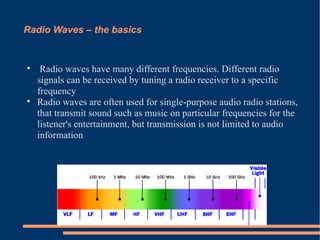
Radio Waves – the basics Radio waves have many different frequencies. Different radio signals can be received by tuning a radio receiver to a specific frequency Radio waves are often used for single-purpose audio radio stations, that transmit sound such as music on particular frequencies for the listener's entertainment, but transmission is not limited to audio information
Radio Waves in Everyday Life Radio waves play an important part of an everyday modern life. They are often used for social communication, e.g. wi-fi, mobile phones, and also play an important part in business, government, law-enforcement and the military. Radio waves make communication between two or more entities fast, efficient and easy. They are often taken for granted due to their widespread and oft-used applications
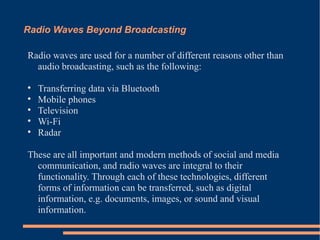
Radio Waves Beyond Broadcasting Radio waves are used for a number of different reasons other than audio broadcasting, such as the following: Transferring data via Bluetooth Mobile phones Television Wi-Fi Radar These are all important and modern methods of social and media communication, and radio waves are integral to their functionality. Through each of these technologies, different forms of information can be transferred, such as digital information, e.g. documents, images, or sound and visual information.
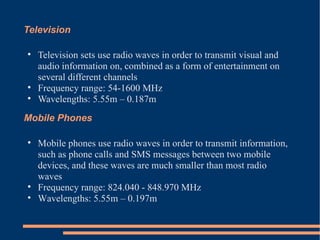
Television Television sets use radio waves in order to transmit visual and audio information on, combined as a form of entertainment on several different channels Frequency range: 54-1600 MHz Wavelengths: 5.55m – 0.187m Mobile Phones Mobile phones use radio waves in order to transmit information, such as phone calls and SMS messages between two mobile devices, and these waves are much smaller than most radio waves Frequency range: 824.040 - 848.970 MHz Wavelengths: 5.55m – 0.197m
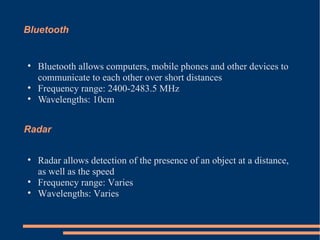
Bluetooth Bluetooth allows computers, mobile phones and other devices to communicate to each other over short distances Frequency range: 2400-2483.5 MHz Wavelengths: 10cm Radar Radar allows detection of the presence of an object at a distance, as well as the speed Frequency range: Varies Wavelengths: Varies
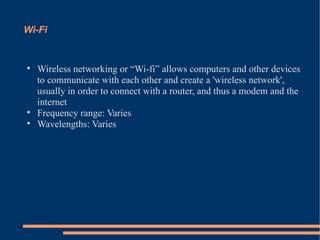
Wi-Fi Wireless networking or “Wi-fi” allows computers and other devices to communicate with each other and create a 'wireless network', usually in order to connect with a router, and thus a modem and the internet Frequency range: Varies Wavelengths: Varies
Bibliography http://science.hq.nasa.gov/kids/imagers/ems/radio.html http://www.howstuffworks.com/wireless-network.htm http://hyperphysics.phy-astr.gsu.edu/hbase/ems2.html http://www.mobileinfo.com/Bluetooth/air_&_band.htm http://www.howstuffworks.com/radio-spectrum.htm http://www.howstuffworks.com/radar.htm

Radio Waves beyond Broadcasting

  • 1.
    Radio Waves BeyondBroadcasting Christopher Devey P11253950
  • 2.
    Radio Waves –the basics Radio waves have many different frequencies. Different radio signals can be received by tuning a radio receiver to a specific frequency Radio waves are often used for single-purpose audio radio stations, that transmit sound such as music on particular frequencies for the listener's entertainment, but transmission is not limited to audio information
  • 3.
    Radio Waves inEveryday Life Radio waves play an important part of an everyday modern life. They are often used for social communication, e.g. wi-fi, mobile phones, and also play an important part in business, government, law-enforcement and the military. Radio waves make communication between two or more entities fast, efficient and easy. They are often taken for granted due to their widespread and oft-used applications
  • 4.
    Radio Waves BeyondBroadcasting Radio waves are used for a number of different reasons other than audio broadcasting, such as the following: Transferring data via Bluetooth Mobile phones Television Wi-Fi Radar These are all important and modern methods of social and media communication, and radio waves are integral to their functionality. Through each of these technologies, different forms of information can be transferred, such as digital information, e.g. documents, images, or sound and visual information.
  • 5.
    Television Television setsuse radio waves in order to transmit visual and audio information on, combined as a form of entertainment on several different channels Frequency range: 54-1600 MHz Wavelengths: 5.55m – 0.187m Mobile Phones Mobile phones use radio waves in order to transmit information, such as phone calls and SMS messages between two mobile devices, and these waves are much smaller than most radio waves Frequency range: 824.040 - 848.970 MHz Wavelengths: 5.55m – 0.197m
  • 6.
    Bluetooth Bluetooth allowscomputers, mobile phones and other devices to communicate to each other over short distances Frequency range: 2400-2483.5 MHz Wavelengths: 10cm Radar Radar allows detection of the presence of an object at a distance, as well as the speed Frequency range: Varies Wavelengths: Varies
  • 7.
    Wi-Fi Wireless networkingor “Wi-fi” allows computers and other devices to communicate with each other and create a 'wireless network', usually in order to connect with a router, and thus a modem and the internet Frequency range: Varies Wavelengths: Varies
  • 8.
    Bibliography http://science.hq.nasa.gov/kids/imagers/ems/radio.html http://www.howstuffworks.com/wireless-network.htmhttp://hyperphysics.phy-astr.gsu.edu/hbase/ems2.html http://www.mobileinfo.com/Bluetooth/air_&_band.htm http://www.howstuffworks.com/radio-spectrum.htm http://www.howstuffworks.com/radar.htm