RADAR
TECHNIQUES
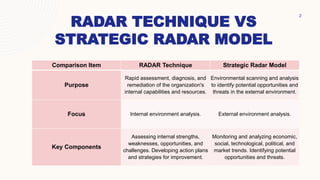
RADAR TECHNIQUE VS
STRATEGIC RADAR MODEL
2
Comparison Item RADAR Technique Strategic Radar Model
Purpose
Rapid assessment, diagnosis, and
remediation of the organization's
internal capabilities and resources.
Environmental scanning and analysis
to identify potential opportunities and
threats in the external environment.
Focus Internal environment analysis. External environment analysis.
Key Components
Assessing internal strengths,
weaknesses, opportunities, and
challenges. Developing action plans
and strategies for improvement.
Monitoring and analyzing economic,
social, technological, political, and
market trends. Identifying potential
opportunities and threats.
3
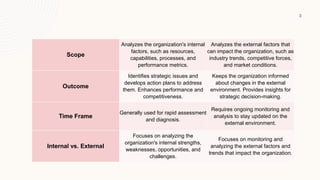
Scope
Analyzes the organization's internal
factors, such as resources,
capabilities, processes, and
performance metrics.
Analyzes the external factors that
can impact the organization, such as
industry trends, competitive forces,
and market conditions.
Outcome
Identifies strategic issues and
develops action plans to address
them. Enhances performance and
competitiveness.
Keeps the organization informed
about changes in the external
environment. Provides insights for
strategic decision-making.
Time Frame
Generally used for rapid assessment
and diagnosis.
Requires ongoing monitoring and
analysis to stay updated on the
external environment.
Internal vs. External
Focuses on analyzing the
organization's internal strengths,
weaknesses, opportunities, and
challenges.
Focuses on monitoring and
analyzing the external factors and
trends that impact the organization.
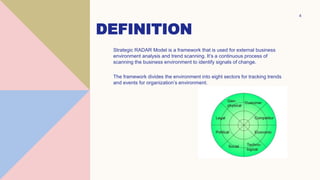
DEFINITION
Strategic RADAR Model is a framework that is used for external business
environment analysis and trend scanning. It’s a continuous process of
scanning the business environment to identify signals of change.
The framework divides the environment into eight sectors for tracking trends
and events for organization’s environment.
4
8 STRATEGIC
RADAR SECTORS
CUSTOMER ENVIRONMENT
6
• Customers involve all stakeholders' identities, needs, and values.
• Customers type (business, individual) and demographics.
• Customers attitude towards entities, policies.
• Patterns, educations, buying behaviors, and change impact.
• The sector is concerned with understanding the customers better and anticipating their needs to
translate those needs to values in the business
COMPETITOR ENVIRONMENT
7
• Competitor’s identities, motives, strengths, weaknesses, and potential behaviors.
• How competitors array position themselves in the industry and approaching customers.
• Position among competitors.
• Alliances formations behaviors. Acquisitions.
• How competitors are utilizing technology.
• Are there any global competitors.
ECONOMIC ENVIRONMENT
8
• Dynamics of markets, prices, costs, currency, national economy, and international trades.
• Critical economic factors that affect demand.
• Interest rates, tax policies and return on investments.
• Critical materials availability.
• Sorting the economic environment into primary and secondary effects according to impact.
TECHNOLOGICAL ENVIRONMENT
9
• Range of technological events and solutions that can improve the organization capability to create value.
• Are the products dependent on rising or dying technology and transfer into opportunity or threat .
• Position among competitors.
• Investing in technology to restructure or increase efficiency.
• How competitors are utilizing technology.
SOCIAL ENVIRONMENT
10
• Customers preferences and cultural patterns.
• Corporate social responsibility effect.
• Civil rights, ethics, family values, and role of media.
• Patterns, educations, buying behaviors, and change impact.
POLITICAL ENVIRONMENT
11
• Processes of local governments and various power groups .
• Government intervention in industries.
• Legislation changes, regulations and trade practices.
• Political situation stability.
• How competitors are utilizing technology.
LEGAL ENVIRONMENT
12
• Patents, copyrights, trademarks, and intellectual property.
• Trade protectionism.
• Environmental liability.
• Employment laws.
GEOPHYSICAL ENVIRONMENT
13
• Facilities, operations, and national resources.
• Availability of raw materials, and transportation options.
• Susceptibility of natural disasters.
• Geolocation and proximity to distributions.
THANK YOU
Presented by:​
Mohamed Ossama
Mohamed Hassan
Haytham El-Gazzar
Islam Nazlawi

RADAR Technique-1.pptx

  • 1.
  • 2.
    RADAR TECHNIQUE VS STRATEGICRADAR MODEL 2 Comparison Item RADAR Technique Strategic Radar Model Purpose Rapid assessment, diagnosis, and remediation of the organization's internal capabilities and resources. Environmental scanning and analysis to identify potential opportunities and threats in the external environment. Focus Internal environment analysis. External environment analysis. Key Components Assessing internal strengths, weaknesses, opportunities, and challenges. Developing action plans and strategies for improvement. Monitoring and analyzing economic, social, technological, political, and market trends. Identifying potential opportunities and threats.
  • 3.
    3 Scope Analyzes the organization'sinternal factors, such as resources, capabilities, processes, and performance metrics. Analyzes the external factors that can impact the organization, such as industry trends, competitive forces, and market conditions. Outcome Identifies strategic issues and develops action plans to address them. Enhances performance and competitiveness. Keeps the organization informed about changes in the external environment. Provides insights for strategic decision-making. Time Frame Generally used for rapid assessment and diagnosis. Requires ongoing monitoring and analysis to stay updated on the external environment. Internal vs. External Focuses on analyzing the organization's internal strengths, weaknesses, opportunities, and challenges. Focuses on monitoring and analyzing the external factors and trends that impact the organization.
  • 4.
    DEFINITION Strategic RADAR Modelis a framework that is used for external business environment analysis and trend scanning. It’s a continuous process of scanning the business environment to identify signals of change. The framework divides the environment into eight sectors for tracking trends and events for organization’s environment. 4
  • 5.
  • 6.
    CUSTOMER ENVIRONMENT 6 • Customersinvolve all stakeholders' identities, needs, and values. • Customers type (business, individual) and demographics. • Customers attitude towards entities, policies. • Patterns, educations, buying behaviors, and change impact. • The sector is concerned with understanding the customers better and anticipating their needs to translate those needs to values in the business
  • 7.
    COMPETITOR ENVIRONMENT 7 • Competitor’sidentities, motives, strengths, weaknesses, and potential behaviors. • How competitors array position themselves in the industry and approaching customers. • Position among competitors. • Alliances formations behaviors. Acquisitions. • How competitors are utilizing technology. • Are there any global competitors.
  • 8.
    ECONOMIC ENVIRONMENT 8 • Dynamicsof markets, prices, costs, currency, national economy, and international trades. • Critical economic factors that affect demand. • Interest rates, tax policies and return on investments. • Critical materials availability. • Sorting the economic environment into primary and secondary effects according to impact.
  • 9.
    TECHNOLOGICAL ENVIRONMENT 9 • Rangeof technological events and solutions that can improve the organization capability to create value. • Are the products dependent on rising or dying technology and transfer into opportunity or threat . • Position among competitors. • Investing in technology to restructure or increase efficiency. • How competitors are utilizing technology.
  • 10.
    SOCIAL ENVIRONMENT 10 • Customerspreferences and cultural patterns. • Corporate social responsibility effect. • Civil rights, ethics, family values, and role of media. • Patterns, educations, buying behaviors, and change impact.
  • 11.
    POLITICAL ENVIRONMENT 11 • Processesof local governments and various power groups . • Government intervention in industries. • Legislation changes, regulations and trade practices. • Political situation stability. • How competitors are utilizing technology.
  • 12.
    LEGAL ENVIRONMENT 12 • Patents,copyrights, trademarks, and intellectual property. • Trade protectionism. • Environmental liability. • Employment laws.
  • 13.
    GEOPHYSICAL ENVIRONMENT 13 • Facilities,operations, and national resources. • Availability of raw materials, and transportation options. • Susceptibility of natural disasters. • Geolocation and proximity to distributions.
  • 14.
    THANK YOU Presented by:​ MohamedOssama Mohamed Hassan Haytham El-Gazzar Islam Nazlawi