Poem analysis
                        by: Rachel
“LOVE’S DEITY”          Fulton

       By: John Donne
STANZA 1

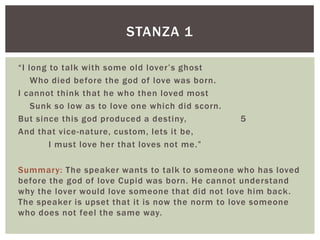
“I long to talk with some old lover’s ghost
    Who died before the god of love was born.
I cannot think that he who then loved most
    Sunk so low as to love one which did scorn.
But since this god produced a destiny,            5
And that vice-nature, custom, lets it be,
        I must love her that loves not me.”

Summary: The speaker wants to talk to someone who has loved
before the god of love Cupid was born. He cannot understand
why the lover would love someone that did not love him back.
The speaker is upset that it is now the norm to love someone
who does not feel the same way.
STANZA 2

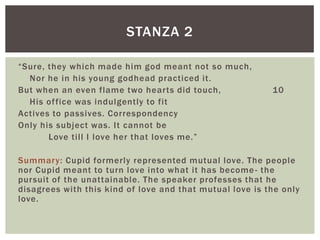
“Sure, they which made him god meant not so much,
  Nor he in his young godhead practiced it.
But when an even flame two hearts did touch,              10
  His of fice was indulgently to fit
Actives to passives. Correspondency
Only his subject was. It cannot be
       Love till I love her that loves me.”

Summary: Cupid formerly represented mutual love. The people
nor Cupid meant to turn love into what it has become - the
pursuit of the unattainable. The speaker professes that he
disagrees with this kind of love and that mutual love is the only
love.
STANZA 3

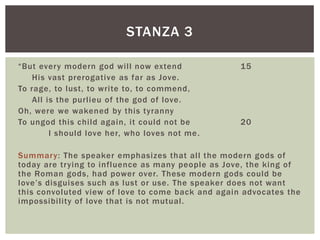
“But every modern god will now extend              15
    His vast prerogative as far as Jove.
To rage, to lust, to write to, to commend,
    All is the purlieu of the god of love.
Oh, were we wakened by this tyranny
To ungod this child again, it could not be         20
         I should love her, who loves not me .

Summar y: The speaker emphasizes that all the modern gods of
today are trying to influence as many people as Jove, the king of
the Roman gods, had power over. These modern gods could be
love’s disguises such as lust or use. The speaker does not want
this convoluted view of love to come back and again advocates the
impossibility of love that is not mutual.
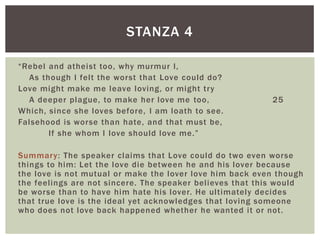
STANZA 4

“Rebel and atheist too, why murmur I,
  As though I felt the worst that Love could do?
Love might make me leave loving, or might try
  A deeper plague, to make her love me too,               25
Which, since she loves before, I am loath to see.
Falsehood is worse than hate, and that must be,
       If she whom I love should love me.”

Summar y: The speaker claims that Love could do two even worse
things to him: Let the love die between he and his lover because
the love is not mutual or make the lover love him back even though
the feelings are not sincere. The speaker believes that this would
be worse than to have him hate his lover. He ultimately decides
that true love is the ideal yet acknowledges that loving someone
who does not love back happened whether he wanted it or not.
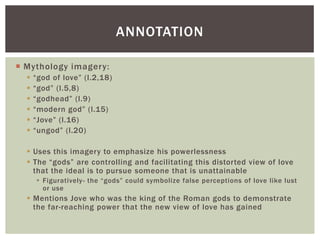
ANNOTATION

 Mythology imagery:
     “god of love” (l.2,18)
     “god” (l.5,8)
     “godhead” (l.9)
     “modern god” (l.15)
     “Jove” (l.16)
     “ungod” (l.20)

   Uses this imagery to emphasize his powerlessness
   The “gods” are controlling and facilitating this distorted view of love
    that the ideal is to pursue someone that is unattainable
       Figuratively- the “gods” could symbolize false perceptions of love like lust
        or use
   Mentions Jove who was the king of the Roman gods to demonstrate
    the far-reaching power that the new view of love has gained
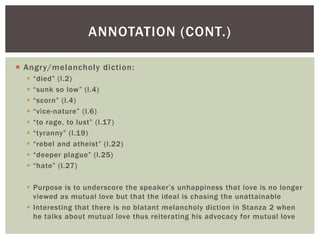
ANNOTATION (CONT.)

 Angry/melancholy diction:
     “died” (l.2)
     “sunk so low” (l.4)
     “scorn” (l.4)
     “vice-nature” (l.6)
     “to rage, to lust” (l.17)
     “tyranny” (l.19)
     “rebel and atheist” (l.22)
     “deeper plague” (l.25)
     “hate” (l.27)

   Purpose is to underscore the speaker’s unhappiness that love is no longer
    viewed as mutual love but that the ideal is chasing the unattainable
   Interesting that there is no blatant melancholy diction in Stanza 2 when
    he talks about mutual love thus reiterating his advocacy for mutual love
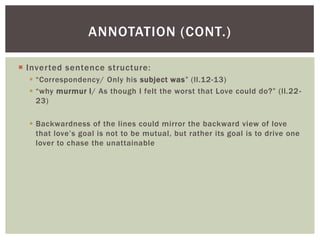
ANNOTATION (CONT.)

 Inverted sentence structure:
   “Correspondency/ Only his subject was” (ll.12-13)
   “why murmur I/ As though I felt the worst that Love could do?” (ll.22 -
    23)

   Backwardness of the lines could mirror the backward view of love
    that love’s goal is not to be mutual, but rather its goal is to drive one
    lover to chase the unattainable
ANNOTATION (CONT.)

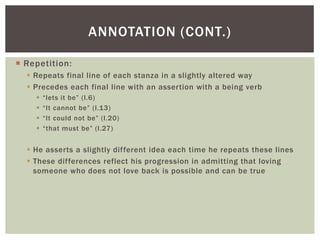
 Repetition:
   Repeats final line of each stanza in a slightly altered way
   Precedes each final line with an assertion with a being verb
       “lets it be” (l.6)
       “It cannot be” (l.13)
       “It could not be” (l.20)
       “that must be” (l.27)


   He asserts a slightly different idea each time he repeats these lines
   These differences reflect his progression in admitting that loving
    someone who does not love back is possible and can be true
ANNOTATION (CONT.)

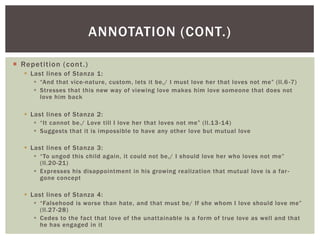
 Repetition (cont.)
   Last lines of Stanza 1:
      “And that vice-nature, custom, lets it be,/ I must love her that loves not me” (ll.6 -7)
      Stresses that this new way of viewing love makes him love someone that does not
       love him back

   Last lines of Stanza 2:
      “It cannot be./ Love till I love her that loves not me” (ll.13 -14)
      Suggests that it is impossible to have any other love but mutual love

   Last lines of Stanza 3:
      “To ungod this child again, it could not be,/ I should love her who loves not me”
       (ll.20-21)
      Expresses his disappointment in his growing realization that mutual love is a far -
       gone concept

   Last lines of Stanza 4:
      “Falsehood is worse than hate, and that must be/ If she whom I love should love me”
       (ll.27-28)
      Cedes to the fact that love of the unattainable is a form of true love as well and that
       he has engaged in it
ANNOTATION (CONT.)

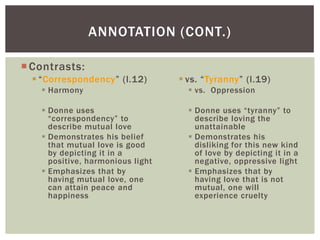
 Contrasts:
   “Correspondency” (l.12)         vs. “Tyranny” (l.19)
     Harmony                         vs. Oppression

     Donne uses                      Donne uses “tyranny” to
      “correspondency” to              describe loving the
      describe mutual love             unattainable
     Demonstrates his belief         Demonstrates his
      that mutual love is good         disliking for this new kind
      by depicting it in a             of love by depicting it in a
      positive, harmonious light       negative, oppressive light
     Emphasizes that by              Emphasizes that by
      having mutual love, one          having love that is not
      can attain peace and             mutual, one will
      happiness                        experience cruelty
ANNOTATION (CONT.)

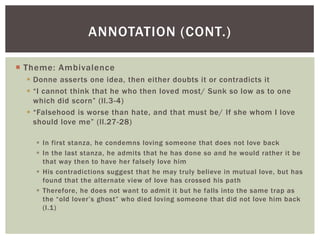
 Theme: Ambivalence
   Donne asserts one idea, then either doubts it or contradicts it
   “I cannot think that he who then loved most/ Sunk so low as to one
    which did scorn” (ll.3-4)
   “Falsehood is worse than hate, and that must be/ If she whom I love
    should love me” (ll.27-28)

     In first stanza, he condemns loving someone that does not love back
     In the last stanza, he admits that he has done so and he would rather it be
      that way then to have her falsely love him
     His contradictions suggest that he may truly believe in mutual love, but has
      found that the alternate view of love has crossed his path
     Therefore, he does not want to admit it but he falls into the same trap as
      the “old lover’s ghost” who died loving someone that did not love him back
      (l.1)
Great or
EVALUATING THE POEM   not so
                      great?
EVALUATION

 Three questions to consider:
   1. What was its central purpose?
   2. How fully has this purpose been accomplished?
   3. How important is this purpose?

   1. Central purpose of “Love’s Deity” – to differentiate between mutual
    love and loving the unattainable
     To persuade readers that mutual love is better because it represents
      harmony and that love that is not mutual is cruel and oppressive

   2. Fully accomplished? Yes. He uses effective organization. Each
    stanza represents a slightly different thought.
     Indenting the last lines of each stanza draws the readers attention to his
      progression in accepting love of the unattainable
     His diction is carefully selected to persuade us to love mutually or to
      dissuade us from loving someone that does not love back
EVALUATION (CONT.)

 3. Important? Very.
     Love is universal to humankind
     Love is what makes people happy and what causes people to be sad
     The joys and sorrows of love unite humans
      His experience with love is not only important to him, but can serve
      readers in two ways:
       1. If readers have experienced a similar feeling of loving someone that
        does not love back, this poem allows them to relate to Donne and realize
        they are not alone.
       2. It provides readers with a wake-up call to rethink what they consider
        love to be and decide whether or not they want to find someone who loves
        mutually, or chase the unattainable.
EVALUATION (CONT.)

 Is it excellent?
   Yes:
      Though Donne’s poem is sad in that he loves someone that does not love
       him back, the poem is by no means tear -jerking. Therefore: it is not
       SENTIMENTAL.
      He does not use grandiose language that takes away from the beauty of
       the poem itself. He uses straightforward language and gets to his point.
       Therefore: it is not RHETORICAL.
      Though he holds the belief that love should be mutual, he does not force
       this idea on readers. He explains why he thinks so, but does not make his
       poem a lesson for readers. Instead, it is more a reflection of his internal
       mindset. Therefore: it is not DIDACTIC.
EVALUATION (CONT.)

 “If I read a book and it    Donne’s poem moves
  makes my whole body          readers to empathy. After
  so cold no fire can          reading the last line, I felt
  warm me, I know that         as if my heart had been left
  is poetry. If I feel         loving.
  physically as if the top    In reading the second
  of my head were taken        stanza, I found myself
  off, I know that is          smiling as I pictured two
  poetry. These are the        lovers huddled around a
  only ways I know it. Is      small, but warm candle
  there any other way?”        flame.
  – Emily Dickinson
EVALUATION (CONT.)

 “If I read a book and it    I felt myself connecting
  makes my whole body          on an emotional level
  so cold no fire can          because of his choice to
                               speak in the first person.
  warm me, I know that         In reading aloud, I felt as
  is poetry. If I feel         if I was the only
  physically as if the top     experiencing this love
  of my head were taken        dilemma.
  off, I know that is         His choice of words like
  poetry. These are the        “tyranny” caused me to
                               feel betrayed and
  only ways I know it. Is      oppressed. Thus, his
  there any other way?”        diction made me feel as
  – Emily Dickinson            if I were a part of the
                               poem.
EVALUATION (CONT.)

 In her quote, it is obvious that Dickinson believed that poetry
  should leave a permanent and dramatic impact.
 Donne’s poem leaves a permanent impact in that
  experiencing love is permanent in society
   Generations before us and generations after us have experienced and
    will experience these two forms of love . Therefore, his message is
    one of permanence in that mutual love is what one should strive for,
    yet sometimes one cannot help loving someone who does not love
    him or her back.
 His poem leaves a dramatic impact in that readers can
  empathize with him
   It also may stir something inside of us to turn inward and think about
    the distorted views our society today views love just as he did.
Conclusion
  Overall, I vow that this poem is great. It
   has achieved its purpose, has caused
   readers to re-evaluate their views of love,   THANK
   and has left them feeling as if they were     YOU!
   the lover in the poem.
  His conversation with himself relates to
   conversations we may have with ourselves
   when stuck in a problematic situation.
  His poem is not four stanzas arguing why
   mutual love is the only love. Instead, each
   stanza represents his fluctuating attitude
   towards the views of love. This
   ambivalence and soul-searching relates to
   us readers because as we mature and
   grow, our ideas change.

Rachel's Final Poetry Analysis

  • 1.
    Poem analysis by: Rachel “LOVE’S DEITY” Fulton By: John Donne
  • 2.
    STANZA 1 “I longto talk with some old lover’s ghost Who died before the god of love was born. I cannot think that he who then loved most Sunk so low as to love one which did scorn. But since this god produced a destiny, 5 And that vice-nature, custom, lets it be, I must love her that loves not me.” Summary: The speaker wants to talk to someone who has loved before the god of love Cupid was born. He cannot understand why the lover would love someone that did not love him back. The speaker is upset that it is now the norm to love someone who does not feel the same way.
  • 3.
    STANZA 2 “Sure, theywhich made him god meant not so much, Nor he in his young godhead practiced it. But when an even flame two hearts did touch, 10 His of fice was indulgently to fit Actives to passives. Correspondency Only his subject was. It cannot be Love till I love her that loves me.” Summary: Cupid formerly represented mutual love. The people nor Cupid meant to turn love into what it has become - the pursuit of the unattainable. The speaker professes that he disagrees with this kind of love and that mutual love is the only love.
  • 4.
    STANZA 3 “But everymodern god will now extend 15 His vast prerogative as far as Jove. To rage, to lust, to write to, to commend, All is the purlieu of the god of love. Oh, were we wakened by this tyranny To ungod this child again, it could not be 20 I should love her, who loves not me . Summar y: The speaker emphasizes that all the modern gods of today are trying to influence as many people as Jove, the king of the Roman gods, had power over. These modern gods could be love’s disguises such as lust or use. The speaker does not want this convoluted view of love to come back and again advocates the impossibility of love that is not mutual.
  • 5.
    STANZA 4 “Rebel andatheist too, why murmur I, As though I felt the worst that Love could do? Love might make me leave loving, or might try A deeper plague, to make her love me too, 25 Which, since she loves before, I am loath to see. Falsehood is worse than hate, and that must be, If she whom I love should love me.” Summar y: The speaker claims that Love could do two even worse things to him: Let the love die between he and his lover because the love is not mutual or make the lover love him back even though the feelings are not sincere. The speaker believes that this would be worse than to have him hate his lover. He ultimately decides that true love is the ideal yet acknowledges that loving someone who does not love back happened whether he wanted it or not.
  • 6.
    ANNOTATION  Mythology imagery:  “god of love” (l.2,18)  “god” (l.5,8)  “godhead” (l.9)  “modern god” (l.15)  “Jove” (l.16)  “ungod” (l.20)  Uses this imagery to emphasize his powerlessness  The “gods” are controlling and facilitating this distorted view of love that the ideal is to pursue someone that is unattainable  Figuratively- the “gods” could symbolize false perceptions of love like lust or use  Mentions Jove who was the king of the Roman gods to demonstrate the far-reaching power that the new view of love has gained
  • 7.
    ANNOTATION (CONT.)  Angry/melancholydiction:  “died” (l.2)  “sunk so low” (l.4)  “scorn” (l.4)  “vice-nature” (l.6)  “to rage, to lust” (l.17)  “tyranny” (l.19)  “rebel and atheist” (l.22)  “deeper plague” (l.25)  “hate” (l.27)  Purpose is to underscore the speaker’s unhappiness that love is no longer viewed as mutual love but that the ideal is chasing the unattainable  Interesting that there is no blatant melancholy diction in Stanza 2 when he talks about mutual love thus reiterating his advocacy for mutual love
  • 8.
    ANNOTATION (CONT.)  Invertedsentence structure:  “Correspondency/ Only his subject was” (ll.12-13)  “why murmur I/ As though I felt the worst that Love could do?” (ll.22 - 23)  Backwardness of the lines could mirror the backward view of love that love’s goal is not to be mutual, but rather its goal is to drive one lover to chase the unattainable
  • 9.
    ANNOTATION (CONT.)  Repetition:  Repeats final line of each stanza in a slightly altered way  Precedes each final line with an assertion with a being verb  “lets it be” (l.6)  “It cannot be” (l.13)  “It could not be” (l.20)  “that must be” (l.27)  He asserts a slightly different idea each time he repeats these lines  These differences reflect his progression in admitting that loving someone who does not love back is possible and can be true
  • 10.
    ANNOTATION (CONT.)  Repetition(cont.)  Last lines of Stanza 1:  “And that vice-nature, custom, lets it be,/ I must love her that loves not me” (ll.6 -7)  Stresses that this new way of viewing love makes him love someone that does not love him back  Last lines of Stanza 2:  “It cannot be./ Love till I love her that loves not me” (ll.13 -14)  Suggests that it is impossible to have any other love but mutual love  Last lines of Stanza 3:  “To ungod this child again, it could not be,/ I should love her who loves not me” (ll.20-21)  Expresses his disappointment in his growing realization that mutual love is a far - gone concept  Last lines of Stanza 4:  “Falsehood is worse than hate, and that must be/ If she whom I love should love me” (ll.27-28)  Cedes to the fact that love of the unattainable is a form of true love as well and that he has engaged in it
  • 11.
    ANNOTATION (CONT.)  Contrasts:  “Correspondency” (l.12)  vs. “Tyranny” (l.19)  Harmony  vs. Oppression  Donne uses  Donne uses “tyranny” to “correspondency” to describe loving the describe mutual love unattainable  Demonstrates his belief  Demonstrates his that mutual love is good disliking for this new kind by depicting it in a of love by depicting it in a positive, harmonious light negative, oppressive light  Emphasizes that by  Emphasizes that by having mutual love, one having love that is not can attain peace and mutual, one will happiness experience cruelty
  • 12.
    ANNOTATION (CONT.)  Theme:Ambivalence  Donne asserts one idea, then either doubts it or contradicts it  “I cannot think that he who then loved most/ Sunk so low as to one which did scorn” (ll.3-4)  “Falsehood is worse than hate, and that must be/ If she whom I love should love me” (ll.27-28)  In first stanza, he condemns loving someone that does not love back  In the last stanza, he admits that he has done so and he would rather it be that way then to have her falsely love him  His contradictions suggest that he may truly believe in mutual love, but has found that the alternate view of love has crossed his path  Therefore, he does not want to admit it but he falls into the same trap as the “old lover’s ghost” who died loving someone that did not love him back (l.1)
  • 13.
    Great or EVALUATING THEPOEM not so great?
  • 14.
    EVALUATION  Three questionsto consider:  1. What was its central purpose?  2. How fully has this purpose been accomplished?  3. How important is this purpose?  1. Central purpose of “Love’s Deity” – to differentiate between mutual love and loving the unattainable  To persuade readers that mutual love is better because it represents harmony and that love that is not mutual is cruel and oppressive  2. Fully accomplished? Yes. He uses effective organization. Each stanza represents a slightly different thought.  Indenting the last lines of each stanza draws the readers attention to his progression in accepting love of the unattainable  His diction is carefully selected to persuade us to love mutually or to dissuade us from loving someone that does not love back
  • 15.
    EVALUATION (CONT.)  3.Important? Very.  Love is universal to humankind  Love is what makes people happy and what causes people to be sad  The joys and sorrows of love unite humans  His experience with love is not only important to him, but can serve readers in two ways:  1. If readers have experienced a similar feeling of loving someone that does not love back, this poem allows them to relate to Donne and realize they are not alone.  2. It provides readers with a wake-up call to rethink what they consider love to be and decide whether or not they want to find someone who loves mutually, or chase the unattainable.
  • 16.
    EVALUATION (CONT.)  Isit excellent?  Yes:  Though Donne’s poem is sad in that he loves someone that does not love him back, the poem is by no means tear -jerking. Therefore: it is not SENTIMENTAL.  He does not use grandiose language that takes away from the beauty of the poem itself. He uses straightforward language and gets to his point. Therefore: it is not RHETORICAL.  Though he holds the belief that love should be mutual, he does not force this idea on readers. He explains why he thinks so, but does not make his poem a lesson for readers. Instead, it is more a reflection of his internal mindset. Therefore: it is not DIDACTIC.
  • 17.
    EVALUATION (CONT.)  “IfI read a book and it  Donne’s poem moves makes my whole body readers to empathy. After so cold no fire can reading the last line, I felt warm me, I know that as if my heart had been left is poetry. If I feel loving. physically as if the top  In reading the second of my head were taken stanza, I found myself off, I know that is smiling as I pictured two poetry. These are the lovers huddled around a only ways I know it. Is small, but warm candle there any other way?” flame. – Emily Dickinson
  • 18.
    EVALUATION (CONT.)  “IfI read a book and it  I felt myself connecting makes my whole body on an emotional level so cold no fire can because of his choice to speak in the first person. warm me, I know that In reading aloud, I felt as is poetry. If I feel if I was the only physically as if the top experiencing this love of my head were taken dilemma. off, I know that is  His choice of words like poetry. These are the “tyranny” caused me to feel betrayed and only ways I know it. Is oppressed. Thus, his there any other way?” diction made me feel as – Emily Dickinson if I were a part of the poem.
  • 19.
    EVALUATION (CONT.)  Inher quote, it is obvious that Dickinson believed that poetry should leave a permanent and dramatic impact.  Donne’s poem leaves a permanent impact in that experiencing love is permanent in society  Generations before us and generations after us have experienced and will experience these two forms of love . Therefore, his message is one of permanence in that mutual love is what one should strive for, yet sometimes one cannot help loving someone who does not love him or her back.  His poem leaves a dramatic impact in that readers can empathize with him  It also may stir something inside of us to turn inward and think about the distorted views our society today views love just as he did.
  • 20.
    Conclusion  Overall,I vow that this poem is great. It has achieved its purpose, has caused readers to re-evaluate their views of love, THANK and has left them feeling as if they were YOU! the lover in the poem.  His conversation with himself relates to conversations we may have with ourselves when stuck in a problematic situation.  His poem is not four stanzas arguing why mutual love is the only love. Instead, each stanza represents his fluctuating attitude towards the views of love. This ambivalence and soul-searching relates to us readers because as we mature and grow, our ideas change.