History of Seventh-day
Adventist Views on the
Trinity
-Merlin D. Burt
The anti-Trinitarian agitation within
the Seventh-day Adventist in the last
decade has seen increasing.
Though this agitation is significant, it has
remained on the margins of the movement.
1. The availability of
information through the
Internet has provided a
platform to disseminate
anti-Trinitarian perspective
more effectively.
There are perhaps many reasons for the increased interest in the Trinity, some of
these reasons according to Merlin Burt are the following:
2. Several other Adventist
groups that emerged from
the Millerite movement
have continued to hold to
an anti-Trinitarian
perspective.
Examples include the Church of
God, Seventh Day (Marion Party);
the now defunct World-wide
Church of God, etc.
Reasons of increasing
interest in the Trinity
There are perhaps many reasons for the increased interest in the Trinity, some of
these reasons according to Merlin Burt are the following:
It should be noted that the
Advent Christians, like Seventh-
day Adventists, have embraced
the Trinitarian view.
3. Perhaps most significant,
over the last few decades
some Seventh-day Adventists
have thought to return to a
historical Adventist faith or
what might be called
neo-restorationism.
Adventists have always
sought a clearer
understanding of Bible
truth. Throughout their
history, their doctrines
have grown from their
original distinctive core of
the Three Angel’s message
and kindred concepts.
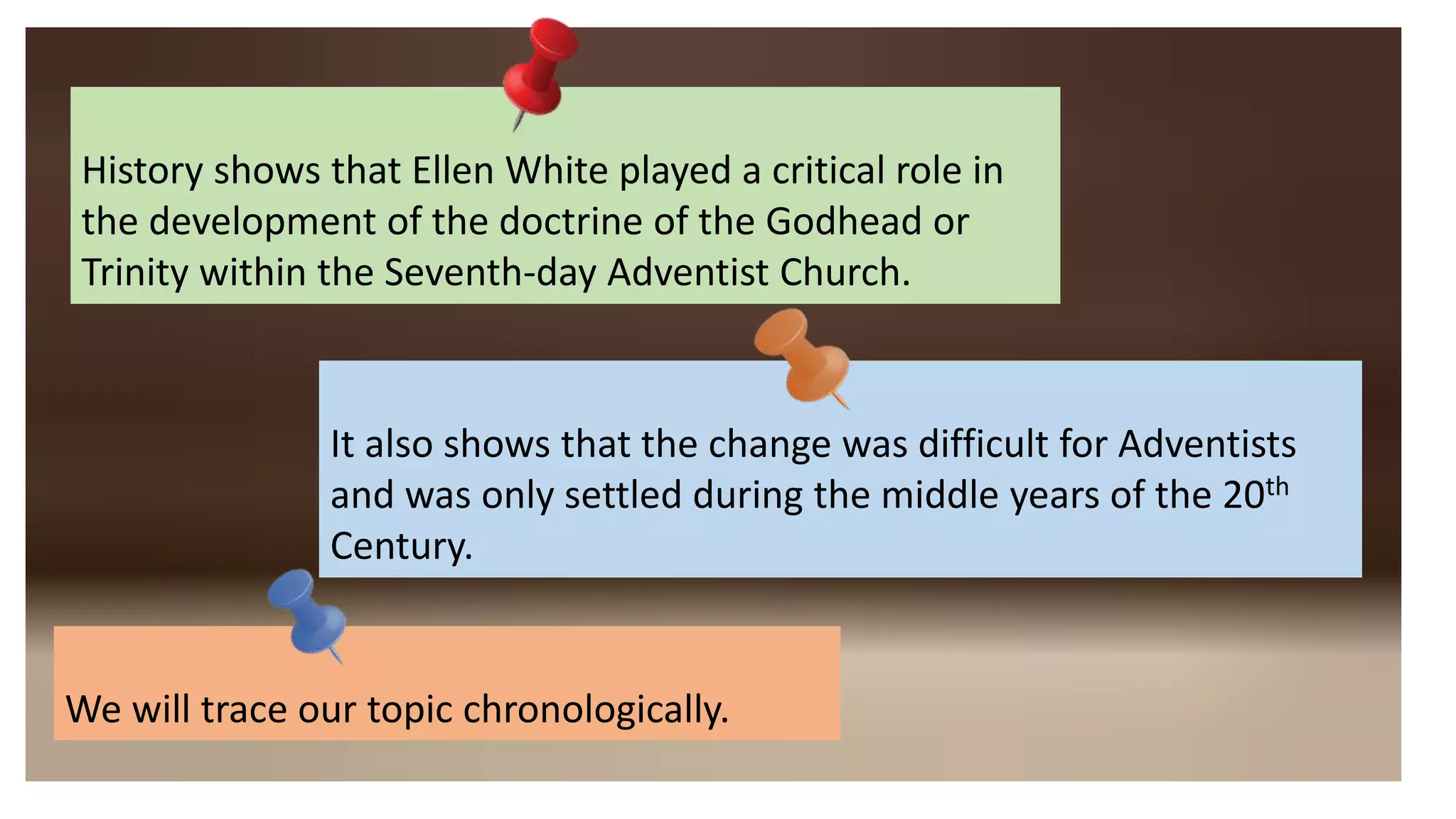
History shows that Ellen White played a critical role in
the development of the doctrine of the Godhead or
Trinity within the Seventh-day Adventist Church.
It also shows that the change was difficult for Adventists
and was only settled during the middle years of the 20th
Century.
We will trace our topic chronologically.
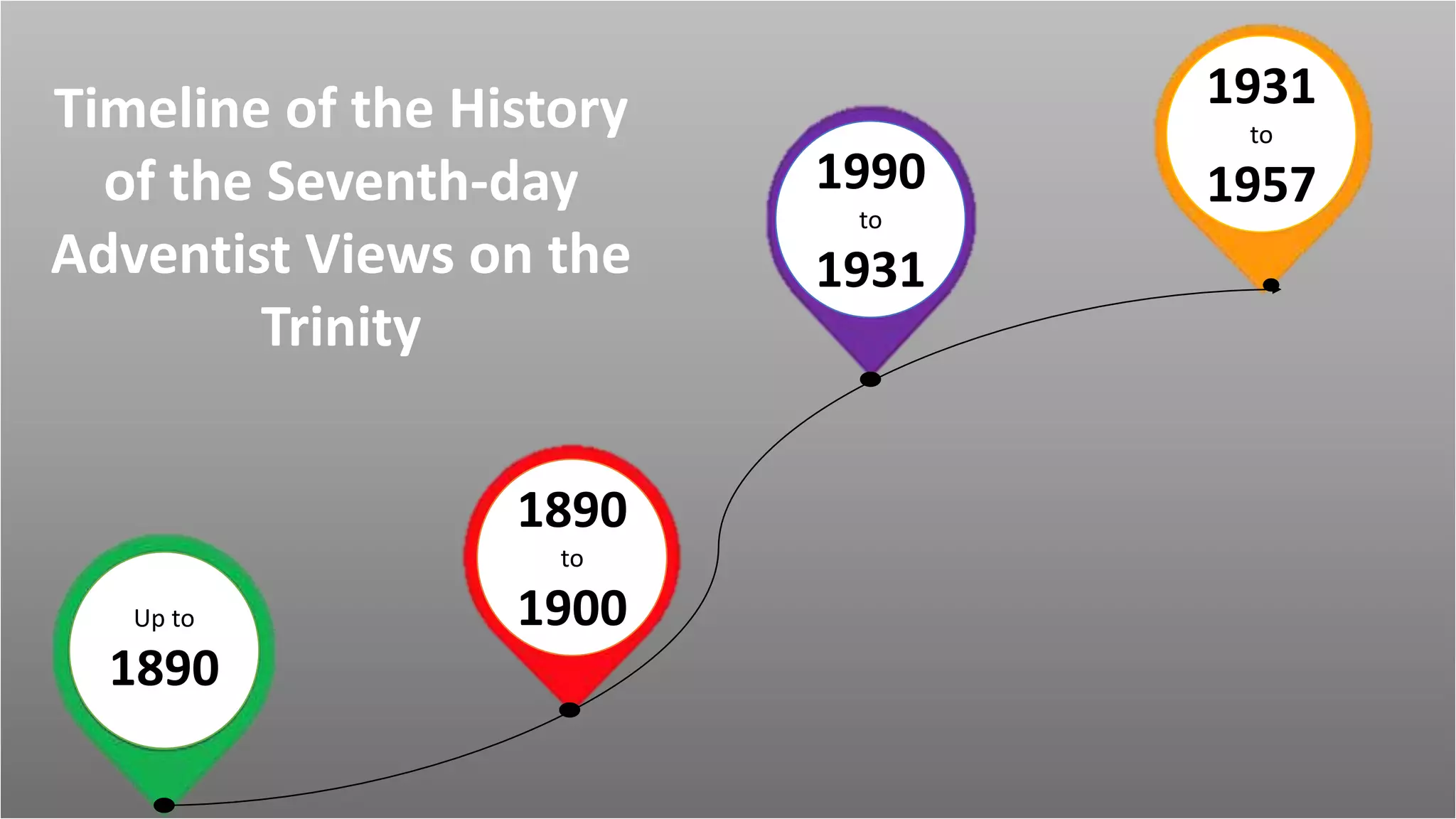
Up to
1890
1890
to
1900
1990
to
1931
1931
to
1957
Timeline of the History
of the Seventh-day
Adventist Views on the
Trinity
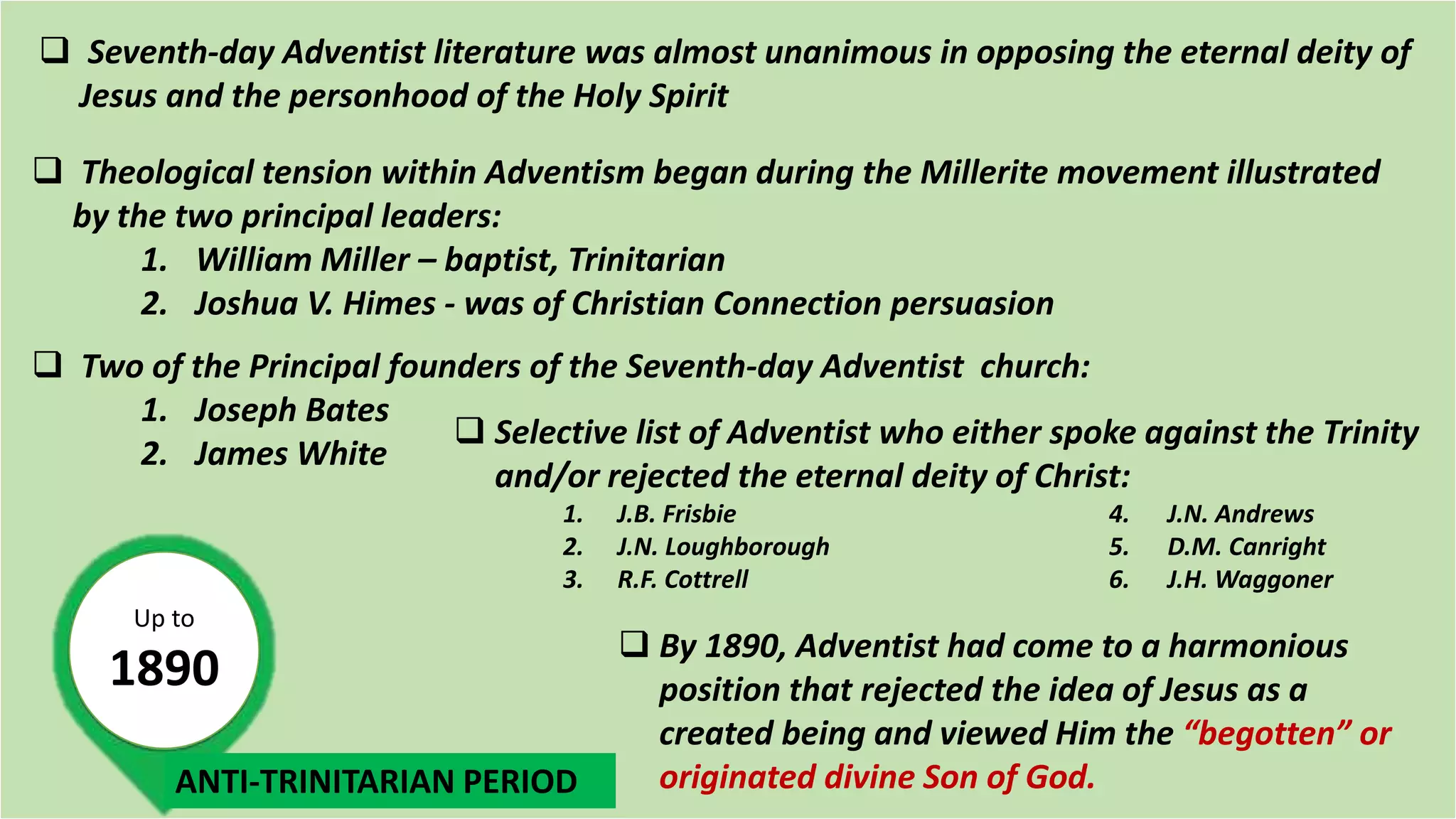
Up to
1890
 Seventh-day Adventist literature was almost unanimous in opposing the eternal deity of
Jesus and the personhood of the Holy Spirit
 Theological tension within Adventism began during the Millerite movement illustrated
by the two principal leaders:
1. William Miller – baptist, Trinitarian
2. Joshua V. Himes - was of Christian Connection persuasion
 Two of the Principal founders of the Seventh-day Adventist church:
1. Joseph Bates
2. James White
 Selective list of Adventist who either spoke against the Trinity
and/or rejected the eternal deity of Christ:
1. J.B. Frisbie 4. J.N. Andrews
2. J.N. Loughborough 5. D.M. Canright
3. R.F. Cottrell 6. J.H. Waggoner
 By 1890, Adventist had come to a harmonious
position that rejected the idea of Jesus as a
created being and viewed Him the “begotten” or
originated divine Son of God.ANTI-TRINITARIAN PERIOD
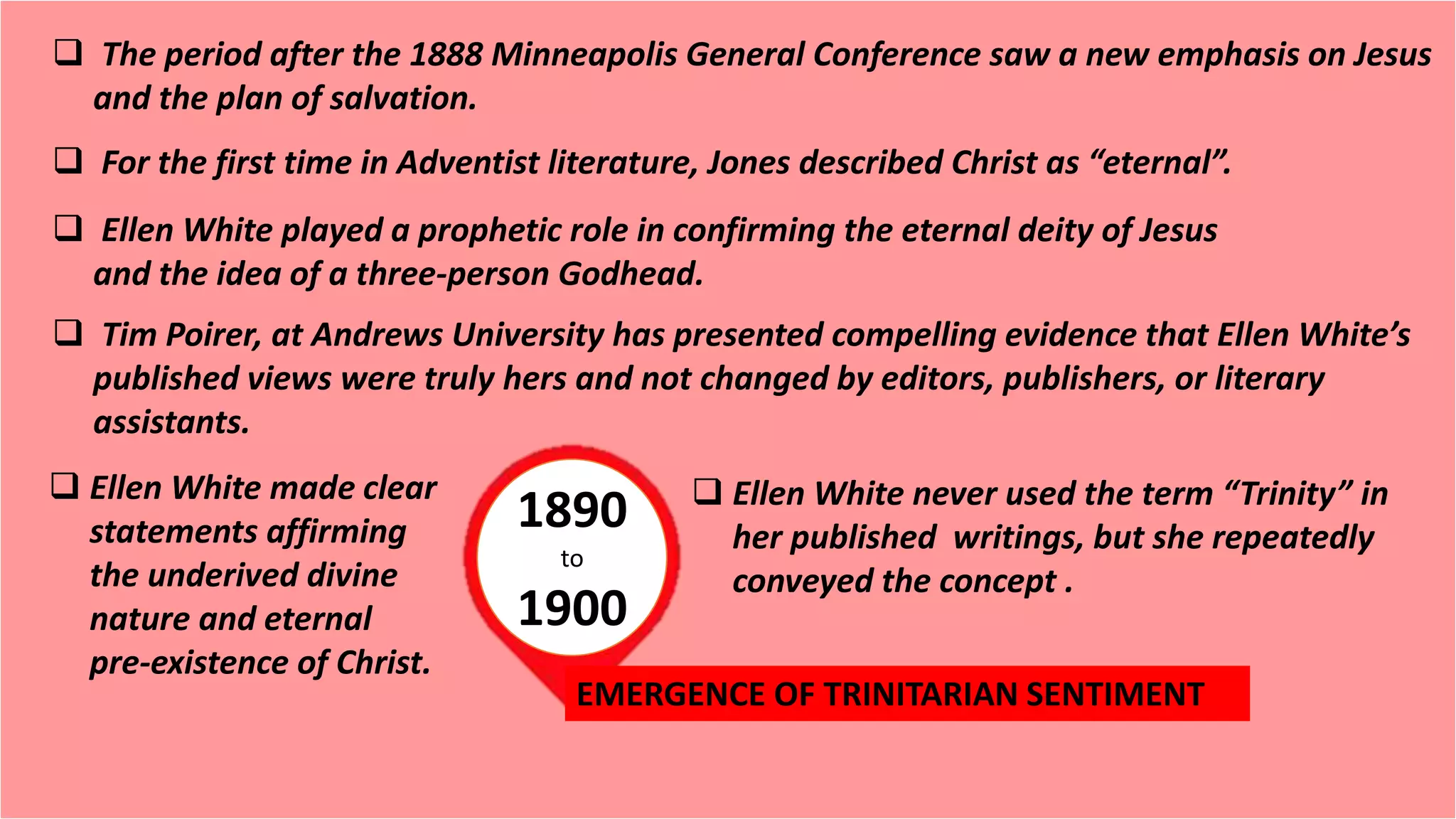
1890
to
1900
 The period after the 1888 Minneapolis General Conference saw a new emphasis on Jesus
and the plan of salvation.
 For the first time in Adventist literature, Jones described Christ as “eternal”.
 Ellen White played a prophetic role in confirming the eternal deity of Jesus
and the idea of a three-person Godhead.
 Tim Poirer, at Andrews University has presented compelling evidence that Ellen White’s
published views were truly hers and not changed by editors, publishers, or literary
assistants.
 Ellen White made clear
statements affirming
the underived divine
nature and eternal
pre-existence of Christ.
 Ellen White never used the term “Trinity” in
her published writings, but she repeatedly
conveyed the concept .
EMERGENCE OF TRINITARIAN SENTIMENT
1900
to
1931
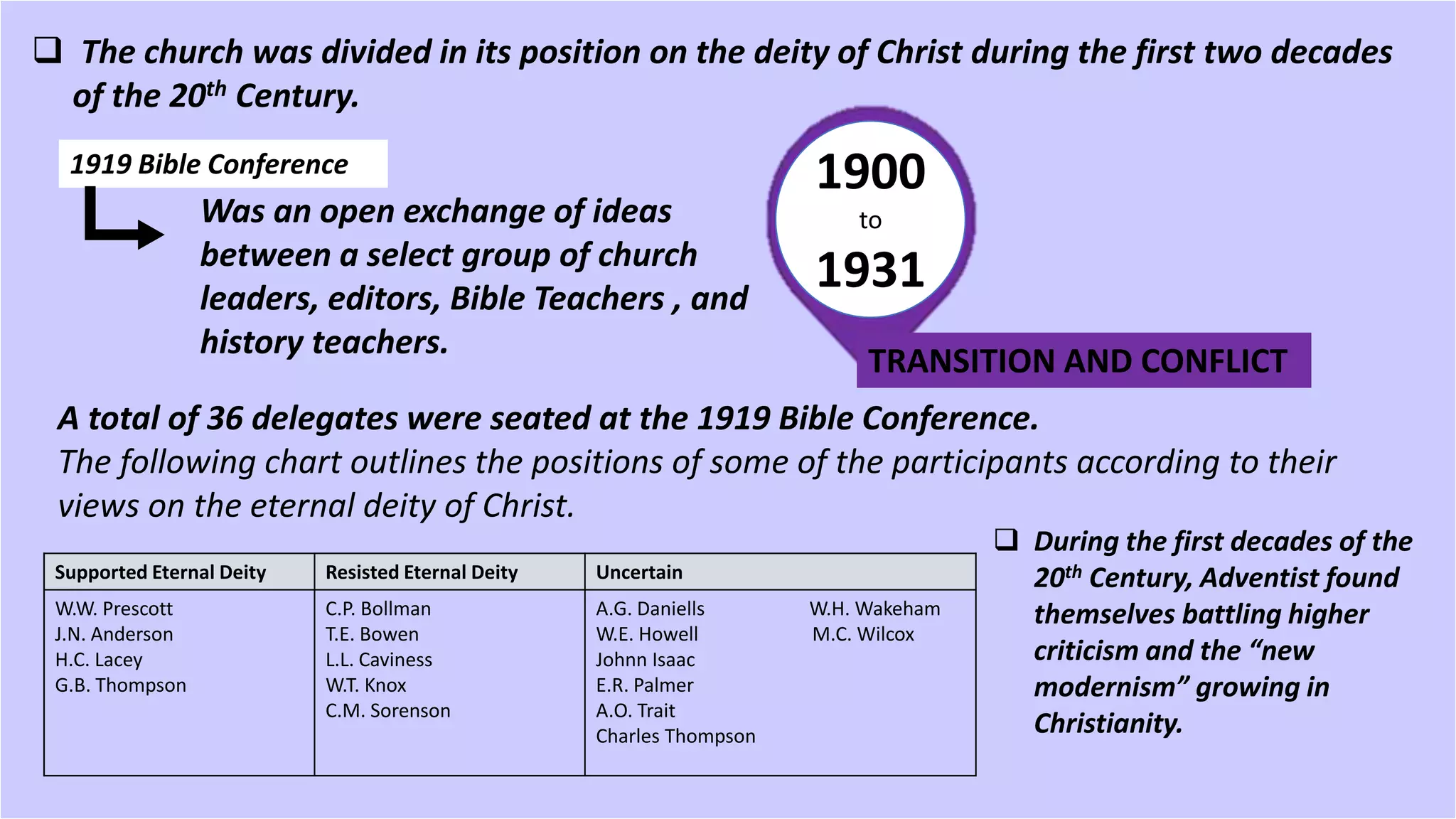
 The church was divided in its position on the deity of Christ during the first two decades
of the 20th Century.
1919 Bible Conference
Was an open exchange of ideas
between a select group of church
leaders, editors, Bible Teachers , and
history teachers.
A total of 36 delegates were seated at the 1919 Bible Conference.
The following chart outlines the positions of some of the participants according to their
views on the eternal deity of Christ.
Supported Eternal Deity Resisted Eternal Deity Uncertain
W.W. Prescott
J.N. Anderson
H.C. Lacey
G.B. Thompson
C.P. Bollman
T.E. Bowen
L.L. Caviness
W.T. Knox
C.M. Sorenson
A.G. Daniells W.H. Wakeham
W.E. Howell M.C. Wilcox
Johnn Isaac
E.R. Palmer
A.O. Trait
Charles Thompson
TRANSITION AND CONFLICT
 During the first decades of the
20th Century, Adventist found
themselves battling higher
criticism and the “new
modernism” growing in
Christianity.
1931
to
1957
ACCEPTANCE OF THE TRINITARIAN VIEW
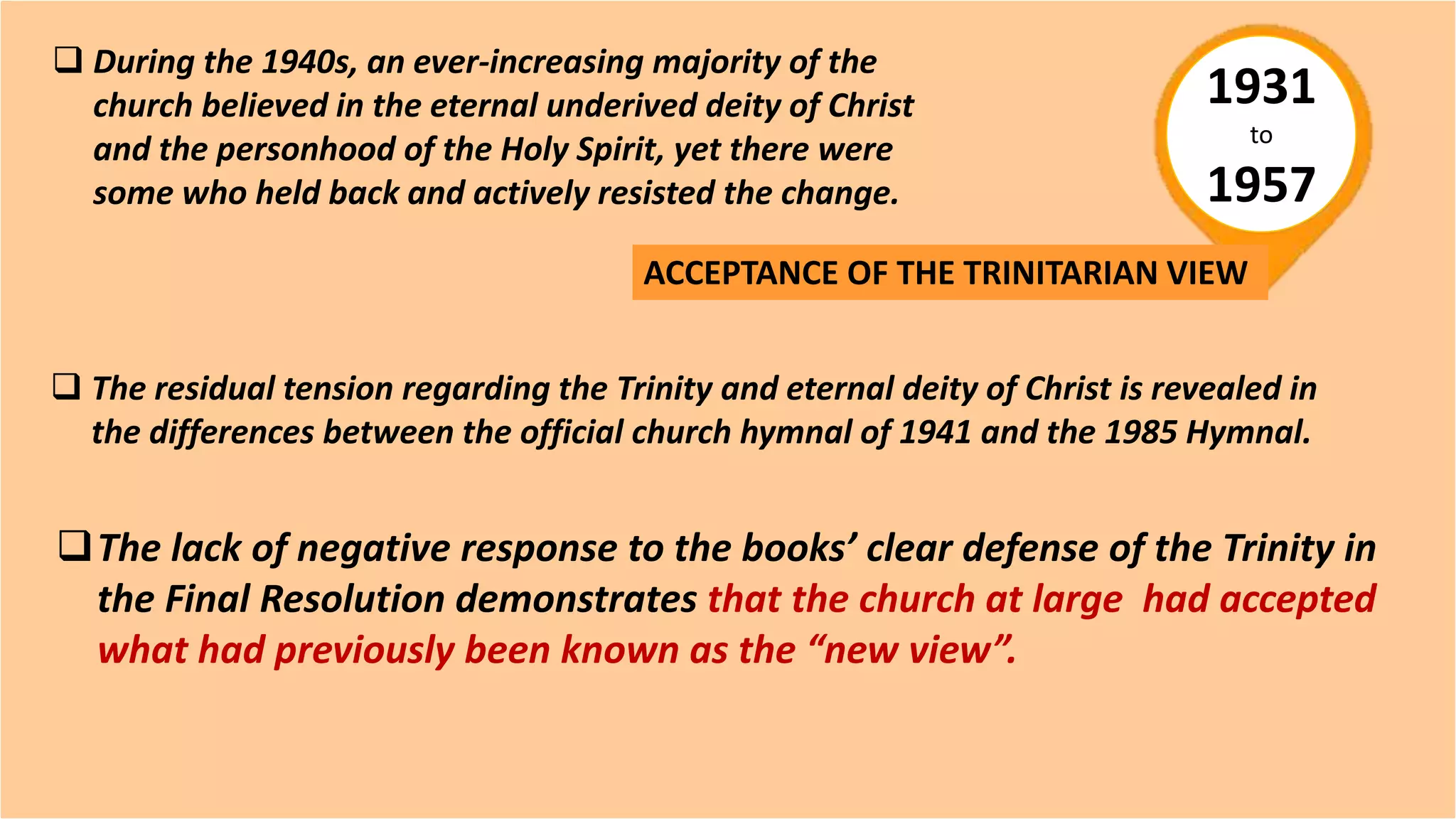
 During the 1940s, an ever-increasing majority of the
church believed in the eternal underived deity of Christ
and the personhood of the Holy Spirit, yet there were
some who held back and actively resisted the change.
 The residual tension regarding the Trinity and eternal deity of Christ is revealed in
the differences between the official church hymnal of 1941 and the 1985 Hymnal.
The lack of negative response to the books’ clear defense of the Trinity in
the Final Resolution demonstrates that the church at large had accepted
what had previously been known as the “new view”.
1931
to
1957
ACCEPTANCE OF THE TRINITARIAN VIEW
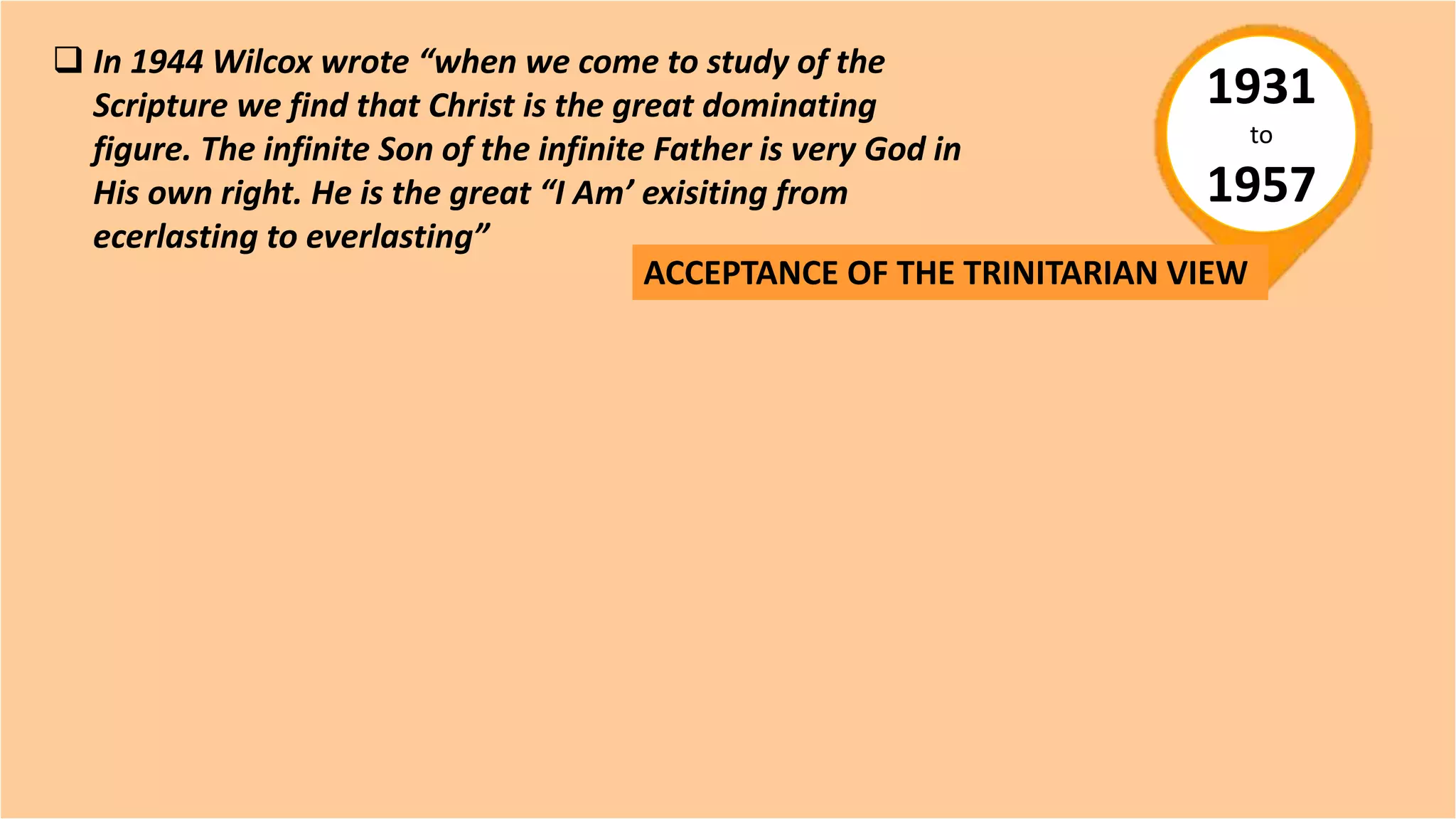
 In 1944 Wilcox wrote “when we come to study of the
Scripture we find that Christ is the great dominating
figure. The infinite Son of the infinite Father is very God in
His own right. He is the great “I Am’ exisiting from
ecerlasting to everlasting”
CONCLUSION
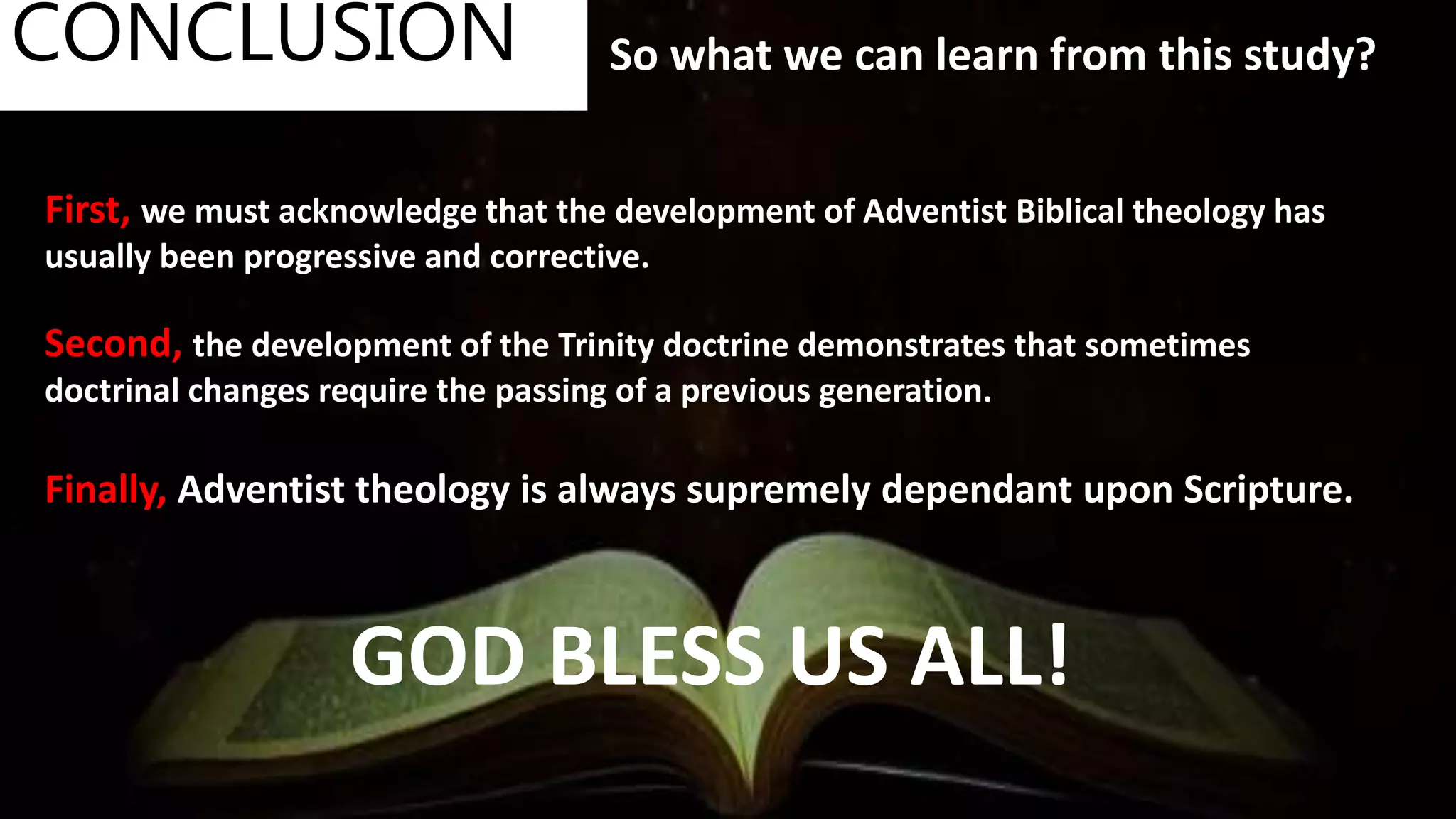
First, we must acknowledge that the development of Adventist Biblical theology has
usually been progressive and corrective.
Second, the development of the Trinity doctrine demonstrates that sometimes
doctrinal changes require the passing of a previous generation.
Finally, Adventist theology is always supremely dependant upon Scripture.
So what we can learn from this study?
GOD BLESS US ALL!

R5. sda views on trinity

  • 1.
    History of Seventh-day AdventistViews on the Trinity -Merlin D. Burt
  • 2.
    The anti-Trinitarian agitationwithin the Seventh-day Adventist in the last decade has seen increasing. Though this agitation is significant, it has remained on the margins of the movement.
  • 3.
    1. The availabilityof information through the Internet has provided a platform to disseminate anti-Trinitarian perspective more effectively. There are perhaps many reasons for the increased interest in the Trinity, some of these reasons according to Merlin Burt are the following: 2. Several other Adventist groups that emerged from the Millerite movement have continued to hold to an anti-Trinitarian perspective. Examples include the Church of God, Seventh Day (Marion Party); the now defunct World-wide Church of God, etc. Reasons of increasing interest in the Trinity
  • 4.
    There are perhapsmany reasons for the increased interest in the Trinity, some of these reasons according to Merlin Burt are the following: It should be noted that the Advent Christians, like Seventh- day Adventists, have embraced the Trinitarian view. 3. Perhaps most significant, over the last few decades some Seventh-day Adventists have thought to return to a historical Adventist faith or what might be called neo-restorationism. Adventists have always sought a clearer understanding of Bible truth. Throughout their history, their doctrines have grown from their original distinctive core of the Three Angel’s message and kindred concepts.
  • 5.
    History shows thatEllen White played a critical role in the development of the doctrine of the Godhead or Trinity within the Seventh-day Adventist Church. It also shows that the change was difficult for Adventists and was only settled during the middle years of the 20th Century. We will trace our topic chronologically.
  • 6.
    Up to 1890 1890 to 1900 1990 to 1931 1931 to 1957 Timeline ofthe History of the Seventh-day Adventist Views on the Trinity
  • 7.
    Up to 1890  Seventh-dayAdventist literature was almost unanimous in opposing the eternal deity of Jesus and the personhood of the Holy Spirit  Theological tension within Adventism began during the Millerite movement illustrated by the two principal leaders: 1. William Miller – baptist, Trinitarian 2. Joshua V. Himes - was of Christian Connection persuasion  Two of the Principal founders of the Seventh-day Adventist church: 1. Joseph Bates 2. James White  Selective list of Adventist who either spoke against the Trinity and/or rejected the eternal deity of Christ: 1. J.B. Frisbie 4. J.N. Andrews 2. J.N. Loughborough 5. D.M. Canright 3. R.F. Cottrell 6. J.H. Waggoner  By 1890, Adventist had come to a harmonious position that rejected the idea of Jesus as a created being and viewed Him the “begotten” or originated divine Son of God.ANTI-TRINITARIAN PERIOD
  • 8.
    1890 to 1900  The periodafter the 1888 Minneapolis General Conference saw a new emphasis on Jesus and the plan of salvation.  For the first time in Adventist literature, Jones described Christ as “eternal”.  Ellen White played a prophetic role in confirming the eternal deity of Jesus and the idea of a three-person Godhead.  Tim Poirer, at Andrews University has presented compelling evidence that Ellen White’s published views were truly hers and not changed by editors, publishers, or literary assistants.  Ellen White made clear statements affirming the underived divine nature and eternal pre-existence of Christ.  Ellen White never used the term “Trinity” in her published writings, but she repeatedly conveyed the concept . EMERGENCE OF TRINITARIAN SENTIMENT
  • 9.
    1900 to 1931  The churchwas divided in its position on the deity of Christ during the first two decades of the 20th Century. 1919 Bible Conference Was an open exchange of ideas between a select group of church leaders, editors, Bible Teachers , and history teachers. A total of 36 delegates were seated at the 1919 Bible Conference. The following chart outlines the positions of some of the participants according to their views on the eternal deity of Christ. Supported Eternal Deity Resisted Eternal Deity Uncertain W.W. Prescott J.N. Anderson H.C. Lacey G.B. Thompson C.P. Bollman T.E. Bowen L.L. Caviness W.T. Knox C.M. Sorenson A.G. Daniells W.H. Wakeham W.E. Howell M.C. Wilcox Johnn Isaac E.R. Palmer A.O. Trait Charles Thompson TRANSITION AND CONFLICT  During the first decades of the 20th Century, Adventist found themselves battling higher criticism and the “new modernism” growing in Christianity.
  • 10.
    1931 to 1957 ACCEPTANCE OF THETRINITARIAN VIEW  During the 1940s, an ever-increasing majority of the church believed in the eternal underived deity of Christ and the personhood of the Holy Spirit, yet there were some who held back and actively resisted the change.  The residual tension regarding the Trinity and eternal deity of Christ is revealed in the differences between the official church hymnal of 1941 and the 1985 Hymnal. The lack of negative response to the books’ clear defense of the Trinity in the Final Resolution demonstrates that the church at large had accepted what had previously been known as the “new view”.
  • 11.
    1931 to 1957 ACCEPTANCE OF THETRINITARIAN VIEW  In 1944 Wilcox wrote “when we come to study of the Scripture we find that Christ is the great dominating figure. The infinite Son of the infinite Father is very God in His own right. He is the great “I Am’ exisiting from ecerlasting to everlasting”
  • 12.
    CONCLUSION First, we mustacknowledge that the development of Adventist Biblical theology has usually been progressive and corrective. Second, the development of the Trinity doctrine demonstrates that sometimes doctrinal changes require the passing of a previous generation. Finally, Adventist theology is always supremely dependant upon Scripture. So what we can learn from this study? GOD BLESS US ALL!