PRACTICE: Distinguir entre some, any y a/an
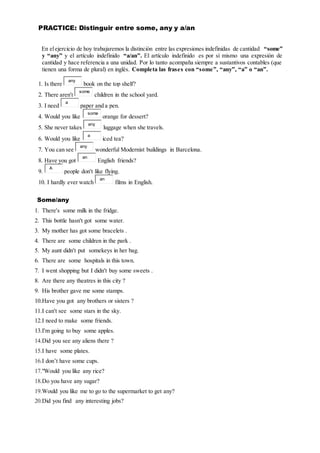
En elejercicio de hoy trabajaremos la distinción entre las expresiones indefinidas de cantidad “some”
y “any” y el artículo indefinido “a/an”. El artículo indefinido es por sí mismo una expresión de
cantidad y hace referencia a una unidad. Por lo tanto acompaña siempre a sustantivos contables (que
tienen una forma de plural) en inglés. Completa las frases con “some”, “any”, “a” o “an”.
1. Is there
any
book on the top shelf?
2. There aren't
some
children in the school yard.
3. I need
a
paper and a pen.
4. Would you like
some
orange for dessert?
5. She never takes
any
luggage when she travels.
6. Would you like
a
iced tea?
7. You can see
any
wonderful Modernist buildings in Barcelona.
8. Have you got
an
English friends?
9.
A
people don't like flying.
10. I hardly ever watch
an
films in English.
Some/any
1. There's some milk in the fridge.
2. This bottle hasn't got some water.
3. My mother has got some bracelets .
4. There are some children in the park .
5. My aunt didn't put somekeys in her bag.
6. There are some hospitals in this town.
7. I went shopping but I didn't buy some sweets .
8. Are there any theatres in this city ?
9. His brother gave me some stamps.
10.Have you got any brothers or sisters ?
11.I can't see some stars in the sky.
12.I need to make some friends.
13.I'm going to buy some apples.
14.Did you see any aliens there ?
15.I have some plates.
16.I don’t have some cups.
17."Would you like any rice?
18.Do you have any sugar?
19.Would you like me to go to the supermarket to get any?
20.Did you find any interesting jobs?
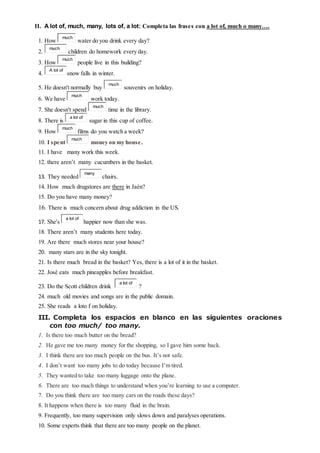
II. A lot of, much, many, lots of, a lot: Completa las frases con a lot of, much o many….
1. How
much
water do you drink every day?
2.
much
children do homework every day.
3. How
much
people live in this building?
4.
A lot of
snow falls in winter.
5. He doesn't normally buy
much
souvenirs on holiday.
6. We have
much
work today.
7. She doesn't spend
much
time in the library.
8. There is
a lot of
sugar in this cup of coffee.
9. How
much
films do you watch a week?
10. I spent
much
money on my house.
11. I have many work this week.
12. there aren’t many cucumbers in the basket.
13. They needed
many
chairs.
14. How much drugstores are there in Jaén?
15. Do you have many money?
16. There is much concern about drug addiction in the US.
17. She's
a lot of
happier now than she was.
18. There aren’t many students here today.
19. Are there much stores near your house?
20. many stars are in the sky tonight.
21. Is there much bread in the basket? Yes, there is a lot of it in the basket.
22. José eats much pineapples before breakfast.
23. Do the Scott children drink
a lot of
?
24. much old movies and songs are in the public domain.
25. She reads a loto f on holiday.
III. Completa los espacios en blanco en las siguientes oraciones
con too much/ too many.
1. Is there too much butter on the bread?
2. He gave me too many money for the shopping, so I gave him some back.
3. I think there are too much people on the bus. It’s not safe.
4. I don’t want too many jobs to do today because I’m tired.
5. They wanted to take too many luggage onto the plane.
6. There are too much things to understand when you’re learning to use a computer.
7. Do you think there are too many cars on the roads these days?
8. It happens when there is too many fluid in the brain.
9. Frequently, too many supervision only slows down and paralyses operations.
10. Some experts think that there are too many people on the planet.
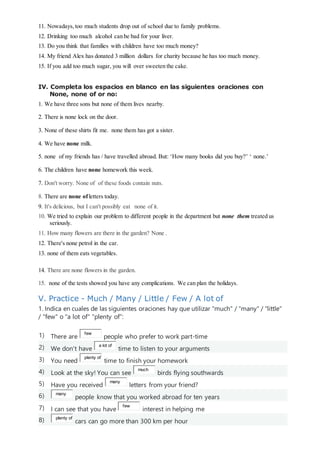
11. Nowadays, too much students drop out of school due to family problems.
12. Drinking too much alcohol can be bad for your liver.
13. Do you think that families with children have too much money?
14. My friend Alex has donated 3 million dollars for charity because he has too much money.
15. If you add too much sugar, you will over sweeten the cake.
IV. Completa los espacios en blanco en las siguientes oraciones con
None, none of or no:
1. We have three sons but none of them lives nearby.
2. There is none lock on the door.
3. None of these shirts fit me. none them has got a sister.
4. We have none milk.
5. none of my friends has / have travelled abroad. But: ‘How many books did you buy?’ ‘ none.’
6. The children have none homework this week.
7. Don't worry. None of of these foods contain nuts.
8. There are none ofletters today.
9. It's delicious, but I can't possibly eat none of it.
10. We tried to explain our problem to different people in the department but none them treated us
seriously.
11. How many flowers are there in the garden? None .
12. There's none petrol in the car.
13. none of them eats vegetables.
14. There are none flowers in the garden.
15. none of the tests showed you have any complications. We can plan the holidays.
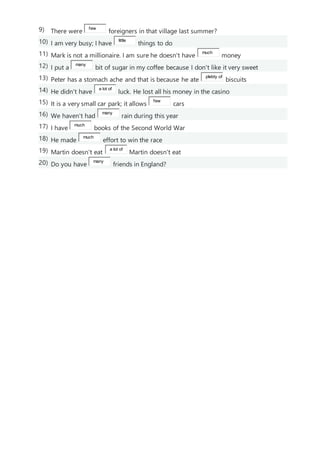
V. Practice - Much / Many / Little / Few / A lot of
1. Indica en cuales de las siguientes oraciones hay que utilizar "much" / "many" / "little"
/ "few" o "a lot of" “plenty of”:
1) There are
few
people who prefer to work part-time
2) We don't have
a lot of
time to listen to your arguments
3) You need
plenty of
time to finish your homework
4) Look at the sky! You can see
much
birds flying southwards
5) Have you received
many
letters from your friend?
6) many
people know that you worked abroad for ten years
7) I can see that you have
few
interest in helping me
8) plenty of
cars can go more than 300 km per hour
9) There were
few
foreigners in that village last summer?
10) I am very busy; I have
little
things to do
11) Mark is not a millionaire. I am sure he doesn't have
much
money
12) I put a
many
bit of sugar in my coffee because I don't like it very sweet
13) Peter has a stomach ache and that is because he ate
plebty of
biscuits
14) He didn't have
a lot of
luck. He lost all his money in the casino
15) It is a very small car park; it allows
few
cars
16) We haven't had
many
rain during this year
17) I have
much
books of the Second World War
18) He made
much
effort to win the race
19) Martin doesn't eat
a lot of
Martin doesn't eat
20) Do you have
many
friends in England?

Quiz(1) de ingles (2).docx

  • 1.
    PRACTICE: Distinguir entresome, any y a/an En elejercicio de hoy trabajaremos la distinción entre las expresiones indefinidas de cantidad “some” y “any” y el artículo indefinido “a/an”. El artículo indefinido es por sí mismo una expresión de cantidad y hace referencia a una unidad. Por lo tanto acompaña siempre a sustantivos contables (que tienen una forma de plural) en inglés. Completa las frases con “some”, “any”, “a” o “an”. 1. Is there any book on the top shelf? 2. There aren't some children in the school yard. 3. I need a paper and a pen. 4. Would you like some orange for dessert? 5. She never takes any luggage when she travels. 6. Would you like a iced tea? 7. You can see any wonderful Modernist buildings in Barcelona. 8. Have you got an English friends? 9. A people don't like flying. 10. I hardly ever watch an films in English. Some/any 1. There's some milk in the fridge. 2. This bottle hasn't got some water. 3. My mother has got some bracelets . 4. There are some children in the park . 5. My aunt didn't put somekeys in her bag. 6. There are some hospitals in this town. 7. I went shopping but I didn't buy some sweets . 8. Are there any theatres in this city ? 9. His brother gave me some stamps. 10.Have you got any brothers or sisters ? 11.I can't see some stars in the sky. 12.I need to make some friends. 13.I'm going to buy some apples. 14.Did you see any aliens there ? 15.I have some plates. 16.I don’t have some cups. 17."Would you like any rice? 18.Do you have any sugar? 19.Would you like me to go to the supermarket to get any? 20.Did you find any interesting jobs?
  • 2.
    II. A lotof, much, many, lots of, a lot: Completa las frases con a lot of, much o many…. 1. How much water do you drink every day? 2. much children do homework every day. 3. How much people live in this building? 4. A lot of snow falls in winter. 5. He doesn't normally buy much souvenirs on holiday. 6. We have much work today. 7. She doesn't spend much time in the library. 8. There is a lot of sugar in this cup of coffee. 9. How much films do you watch a week? 10. I spent much money on my house. 11. I have many work this week. 12. there aren’t many cucumbers in the basket. 13. They needed many chairs. 14. How much drugstores are there in Jaén? 15. Do you have many money? 16. There is much concern about drug addiction in the US. 17. She's a lot of happier now than she was. 18. There aren’t many students here today. 19. Are there much stores near your house? 20. many stars are in the sky tonight. 21. Is there much bread in the basket? Yes, there is a lot of it in the basket. 22. José eats much pineapples before breakfast. 23. Do the Scott children drink a lot of ? 24. much old movies and songs are in the public domain. 25. She reads a loto f on holiday. III. Completa los espacios en blanco en las siguientes oraciones con too much/ too many. 1. Is there too much butter on the bread? 2. He gave me too many money for the shopping, so I gave him some back. 3. I think there are too much people on the bus. It’s not safe. 4. I don’t want too many jobs to do today because I’m tired. 5. They wanted to take too many luggage onto the plane. 6. There are too much things to understand when you’re learning to use a computer. 7. Do you think there are too many cars on the roads these days? 8. It happens when there is too many fluid in the brain. 9. Frequently, too many supervision only slows down and paralyses operations. 10. Some experts think that there are too many people on the planet.
  • 3.
    11. Nowadays, toomuch students drop out of school due to family problems. 12. Drinking too much alcohol can be bad for your liver. 13. Do you think that families with children have too much money? 14. My friend Alex has donated 3 million dollars for charity because he has too much money. 15. If you add too much sugar, you will over sweeten the cake. IV. Completa los espacios en blanco en las siguientes oraciones con None, none of or no: 1. We have three sons but none of them lives nearby. 2. There is none lock on the door. 3. None of these shirts fit me. none them has got a sister. 4. We have none milk. 5. none of my friends has / have travelled abroad. But: ‘How many books did you buy?’ ‘ none.’ 6. The children have none homework this week. 7. Don't worry. None of of these foods contain nuts. 8. There are none ofletters today. 9. It's delicious, but I can't possibly eat none of it. 10. We tried to explain our problem to different people in the department but none them treated us seriously. 11. How many flowers are there in the garden? None . 12. There's none petrol in the car. 13. none of them eats vegetables. 14. There are none flowers in the garden. 15. none of the tests showed you have any complications. We can plan the holidays. V. Practice - Much / Many / Little / Few / A lot of 1. Indica en cuales de las siguientes oraciones hay que utilizar "much" / "many" / "little" / "few" o "a lot of" “plenty of”: 1) There are few people who prefer to work part-time 2) We don't have a lot of time to listen to your arguments 3) You need plenty of time to finish your homework 4) Look at the sky! You can see much birds flying southwards 5) Have you received many letters from your friend? 6) many people know that you worked abroad for ten years 7) I can see that you have few interest in helping me 8) plenty of cars can go more than 300 km per hour
  • 4.
    9) There were few foreignersin that village last summer? 10) I am very busy; I have little things to do 11) Mark is not a millionaire. I am sure he doesn't have much money 12) I put a many bit of sugar in my coffee because I don't like it very sweet 13) Peter has a stomach ache and that is because he ate plebty of biscuits 14) He didn't have a lot of luck. He lost all his money in the casino 15) It is a very small car park; it allows few cars 16) We haven't had many rain during this year 17) I have much books of the Second World War 18) He made much effort to win the race 19) Martin doesn't eat a lot of Martin doesn't eat 20) Do you have many friends in England?