QUESTIONS I
ASK BEFORE
SAYING YES
Graham Zahoruiko
ZAHORUIKO.COM
no matter what the inquiry is. Maybe
you’re a people-pleaser, or just like
taking on new tasks for the experience.
While both of these approaches to life
can yield many benefits, it's important
to ask yourself certain questions before
agreeing to any commitments.
SOME PEOPLE
ARE EAGER TO
ANSWER IN THE
AFFIRMATIVE
ZAHORUIKO.COM
WHAT WILL IT COST? 
When friends are asking for favors or a colleague is making a request at work, you
probably often think that you are obligated to do it. However, you need to ask yourself
what it will cost you. Taking a friend to the airport could lead to traffic delays and a
rush to work in the morning. Taking on a colleague's work project could lead to an
unfair hourly wage. While surrendering time and money once in awhile might be
worth it, you need to know what you’re getting into, each time. 
CAN IT BE
REASONABLY
FOLLOWED
THROUGH? 
Thinking before answering is important
because it prevents you from making
commitments that they realistically
cannot keep. People who keep a planner
or frequently-updated calendar may be
better suited to answer such requests.
You can look to see what you have going
on that day and assess if fitting in
another commitment is possible. It's
better to say no now than to agree and
have to break the agreement later, which
just makes you look bad and unreliable. 
ZAHORUIKO.COM
In addition to knowing if the request can be fulfilled, you must also know if the request
itself is reasonable. For example, if someone is asking to borrow a large sum of money, you
could decline but offer a smaller sum. Keeping in mind that it is also possible to negotiate
with the requester is often an important component of these conversations. And, just
because you can do something doesn’t necessarily mean that you should.
Is the request reasonable? 
IS THERE A
REASON FOR IT? 
Questioning the purpose of any
request is important. Some people
constantly try to shove their
responsibilities off on others, and
this situation does not elicit a
reason to agree. In other cases, you
might get some personal gain from
exploring a new opportunity, or you
may really alleviate a one-time
burden that a loved one is feeling.
Those are much more valid reasons
and ones you probably feel
comfortable with.
ZAHORUIKO.COM
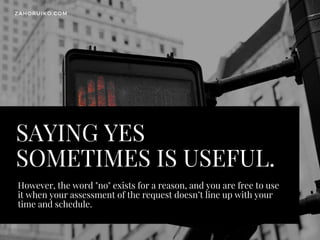
SAYING YES
SOMETIMES IS USEFUL.
However, the word "no" exists for a reason, and you are free to use
it when your assessment of the request doesn’t line up with your
time and schedule.
ZAHORUIKO.COM
THANK YOU
FOR
VIEWING!
For more blogs from Graham,
visit his website at
Zahoruiko.com
ZAHORUIKO.COM

Questions I Ask Before Saying Yes

  • 1.
    QUESTIONS I ASK BEFORE SAYINGYES Graham Zahoruiko ZAHORUIKO.COM
  • 2.
    no matter whatthe inquiry is. Maybe you’re a people-pleaser, or just like taking on new tasks for the experience. While both of these approaches to life can yield many benefits, it's important to ask yourself certain questions before agreeing to any commitments. SOME PEOPLE ARE EAGER TO ANSWER IN THE AFFIRMATIVE ZAHORUIKO.COM
  • 3.
    WHAT WILL ITCOST?  When friends are asking for favors or a colleague is making a request at work, you probably often think that you are obligated to do it. However, you need to ask yourself what it will cost you. Taking a friend to the airport could lead to traffic delays and a rush to work in the morning. Taking on a colleague's work project could lead to an unfair hourly wage. While surrendering time and money once in awhile might be worth it, you need to know what you’re getting into, each time. 
  • 4.
    CAN IT BE REASONABLY FOLLOWED THROUGH?  Thinkingbefore answering is important because it prevents you from making commitments that they realistically cannot keep. People who keep a planner or frequently-updated calendar may be better suited to answer such requests. You can look to see what you have going on that day and assess if fitting in another commitment is possible. It's better to say no now than to agree and have to break the agreement later, which just makes you look bad and unreliable.  ZAHORUIKO.COM
  • 5.
    In addition toknowing if the request can be fulfilled, you must also know if the request itself is reasonable. For example, if someone is asking to borrow a large sum of money, you could decline but offer a smaller sum. Keeping in mind that it is also possible to negotiate with the requester is often an important component of these conversations. And, just because you can do something doesn’t necessarily mean that you should. Is the request reasonable? 
  • 6.
    IS THERE A REASONFOR IT?  Questioning the purpose of any request is important. Some people constantly try to shove their responsibilities off on others, and this situation does not elicit a reason to agree. In other cases, you might get some personal gain from exploring a new opportunity, or you may really alleviate a one-time burden that a loved one is feeling. Those are much more valid reasons and ones you probably feel comfortable with. ZAHORUIKO.COM
  • 7.
    SAYING YES SOMETIMES ISUSEFUL. However, the word "no" exists for a reason, and you are free to use it when your assessment of the request doesn’t line up with your time and schedule. ZAHORUIKO.COM
  • 8.
    THANK YOU FOR VIEWING! For moreblogs from Graham, visit his website at Zahoruiko.com ZAHORUIKO.COM