FIST Project: Fire Propagation Under Varying Pressures and Oxygen Concentrations
Kevin Pacheco, Danielle Kirchmeyer, Carlos Fernandez-Pello, Ph.D.
Department of Mechanical Engineering, University of California, Berkeley, 94704
Conclusion/Discussion
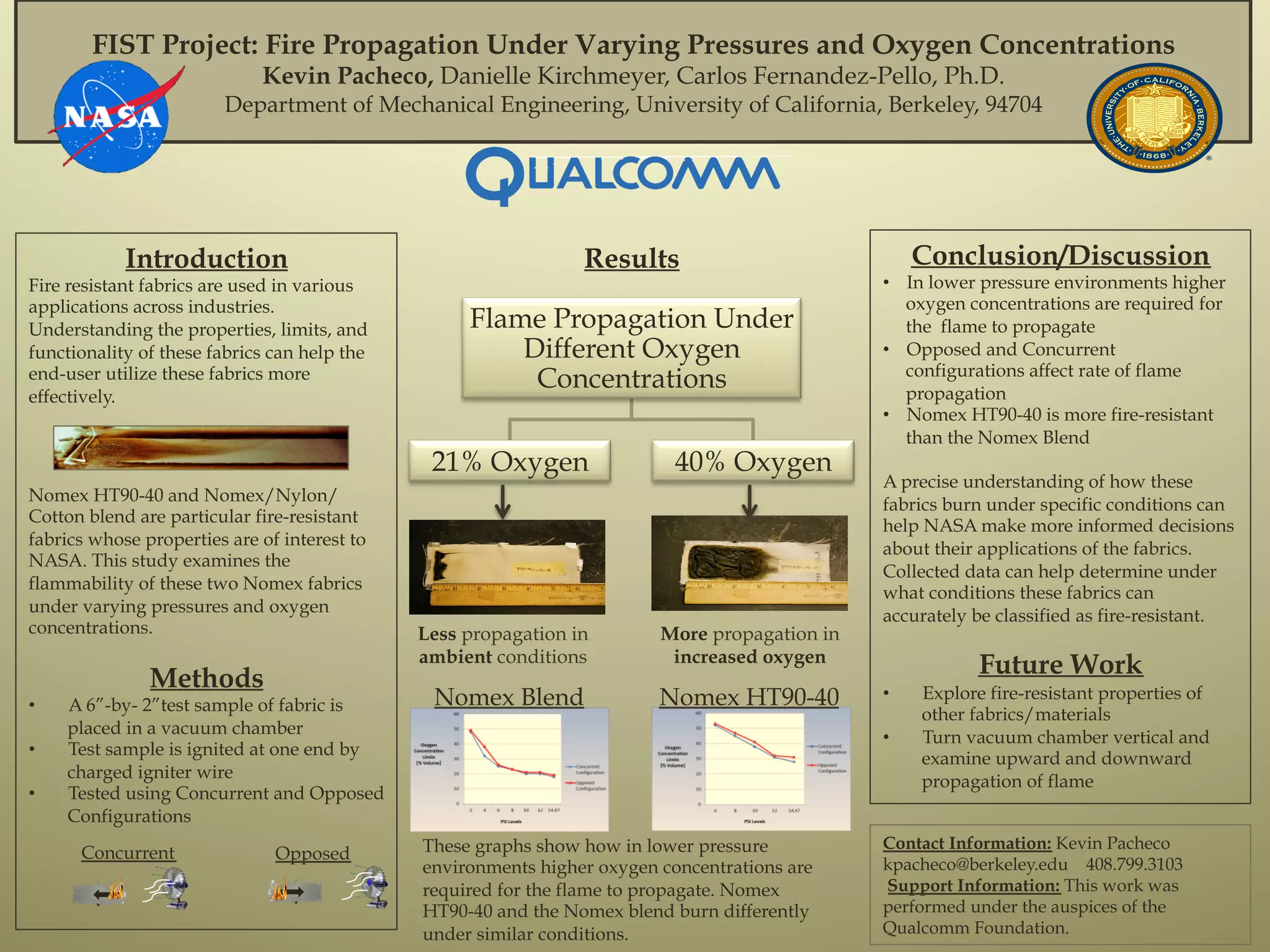
•  In lower pressure environments higher
oxygen concentrations are required for
the flame to propagate
•  Opposed and Concurrent
configurations affect rate of flame
propagation
•  Nomex HT90-40 is more fire-resistant
than the Nomex Blend
A precise understanding of how these
fabrics burn under specific conditions can
help NASA make more informed decisions
about their applications of the fabrics.
Collected data can help determine under
what conditions these fabrics can
accurately be classified as fire-resistant.
Future Work
•  Explore fire-resistant properties of
other fabrics/materials
•  Turn vacuum chamber vertical and
examine upward and downward
propagation of flame
Introduction
Fire resistant fabrics are used in various
applications across industries.
Understanding the properties, limits, and
functionality of these fabrics can help the
end-user utilize these fabrics more
effectively.
Nomex HT90-40 and Nomex/Nylon/
Cotton blend are particular fire-resistant
fabrics whose properties are of interest to
NASA. This study examines the
flammability of these two Nomex fabrics
under varying pressures and oxygen
concentrations.
Methods
•  A 6”-by- 2”test sample of fabric is
placed in a vacuum chamber
•  Test sample is ignited at one end by
charged igniter wire
•  Tested using Concurrent and Opposed
Configurations
Flame Propagation Under
Different Oxygen
Concentrations
21% Oxygen 40% Oxygen
Results
Less propagation in
ambient conditions
More propagation in
increased oxygen
Nomex Blend Nomex HT90-40
These graphs show how in lower pressure
environments higher oxygen concentrations are
required for the flame to propagate. Nomex
HT90-40 and the Nomex blend burn differently
under similar conditions.
Concurrent Opposed
Contact Information: Kevin Pacheco
kpacheco@berkeley.edu 408.799.3103
Support Information: This work was
performed under the auspices of the
Qualcomm Foundation.

QUEST Poster

  • 1.
    FIST Project: FirePropagation Under Varying Pressures and Oxygen Concentrations Kevin Pacheco, Danielle Kirchmeyer, Carlos Fernandez-Pello, Ph.D. Department of Mechanical Engineering, University of California, Berkeley, 94704 Conclusion/Discussion •  In lower pressure environments higher oxygen concentrations are required for the flame to propagate •  Opposed and Concurrent configurations affect rate of flame propagation •  Nomex HT90-40 is more fire-resistant than the Nomex Blend A precise understanding of how these fabrics burn under specific conditions can help NASA make more informed decisions about their applications of the fabrics. Collected data can help determine under what conditions these fabrics can accurately be classified as fire-resistant. Future Work •  Explore fire-resistant properties of other fabrics/materials •  Turn vacuum chamber vertical and examine upward and downward propagation of flame Introduction Fire resistant fabrics are used in various applications across industries. Understanding the properties, limits, and functionality of these fabrics can help the end-user utilize these fabrics more effectively. Nomex HT90-40 and Nomex/Nylon/ Cotton blend are particular fire-resistant fabrics whose properties are of interest to NASA. This study examines the flammability of these two Nomex fabrics under varying pressures and oxygen concentrations. Methods •  A 6”-by- 2”test sample of fabric is placed in a vacuum chamber •  Test sample is ignited at one end by charged igniter wire •  Tested using Concurrent and Opposed Configurations Flame Propagation Under Different Oxygen Concentrations 21% Oxygen 40% Oxygen Results Less propagation in ambient conditions More propagation in increased oxygen Nomex Blend Nomex HT90-40 These graphs show how in lower pressure environments higher oxygen concentrations are required for the flame to propagate. Nomex HT90-40 and the Nomex blend burn differently under similar conditions. Concurrent Opposed Contact Information: Kevin Pacheco kpacheco@berkeley.edu 408.799.3103 Support Information: This work was performed under the auspices of the Qualcomm Foundation.