Quantifying model related risks


  A nested-model framework


          Quantifying model related risks   1
Content

• Formalizing the building blocks
• An example: Black-Scholes nested into Heston
• Statistics for model specification risk
• Statistics for assumption risks
• Non-parameterized models
• Advantages/draw-backs


                Quantifying model related risks   2
Formalizing the building blocks

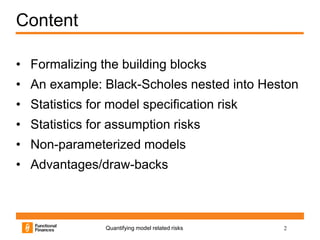
• Let M(a_1,a_2,…,a_n) be a parameterized model
  with finitely many parameters


• Let N(a_1,a_2,…,a_n,b_1,b_2,…,b_m) be an
  extension of M(a_1,a_2,…,a_n) , i.e. let
     N(a_1,…,a_n,0,…,0) = M(a_1,…,a_n)


               Quantifying model related risks   3
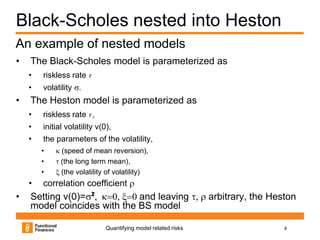
Black-Scholes nested into Heston
An example of nested models
•   The Black-Scholes model is parameterized as
    •   riskless rate r
    •   volatility s.
•   The Heston model is parameterized as
    •   riskless rate r ,
    •   initial volatility v(0),
    •   the parameters of the volatility,
        •   k (speed of mean reversion),
        •   t (the long term mean),
        •   x (the volatility of volatility)
    •   correlation coefficient r
•   Setting v(0)=s², k=0, x=0 and leaving t, r arbitrary, the Heston
    model coincides with the BS model

                              Quantifying model related risks    4
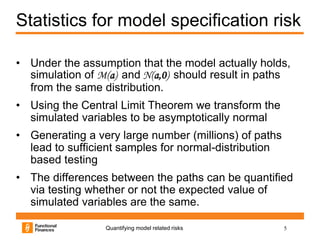
Statistics for model specification risk

• Under the assumption that the model actually holds,
  simulation of M(a) and N(a,0) should result in paths
  from the same distribution.
• Using the Central Limit Theorem we transform the
  simulated variables to be asymptotically normal
• Generating a very large number (millions) of paths
  lead to sufficient samples for normal-distribution
  based testing
• The differences between the paths can be quantified
  via testing whether or not the expected value of
  simulated variables are the same.

                 Quantifying model related risks       5
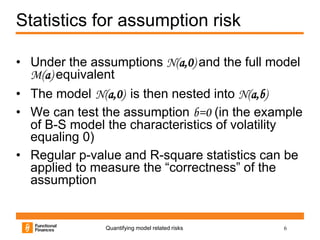
Statistics for assumption risk

• Under the assumptions N(a,0) and the full model
  M(a) equivalent
• The model N(a,0) is then nested into N(a,b)
• We can test the assumption b=0 (in the example
  of B-S model the characteristics of volatility
  equaling 0)
• Regular p-value and R-square statistics can be
  applied to measure the “correctness” of the
  assumption


               Quantifying model related risks   6
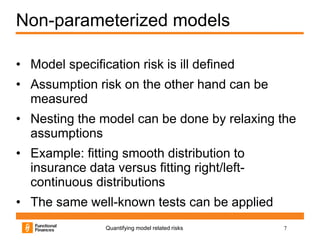
Non-parameterized models

• Model specification risk is ill defined
• Assumption risk on the other hand can be
  measured
• Nesting the model can be done by relaxing the
  assumptions
• Example: fitting smooth distribution to
  insurance data versus fitting right/left-
  continuous distributions
• The same well-known tests can be applied
                Quantifying model related risks   7
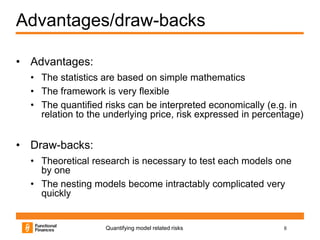
Advantages/draw-backs

• Advantages:
  • The statistics are based on simple mathematics
  • The framework is very flexible
  • The quantified risks can be interpreted economically (e.g. in
    relation to the underlying price, risk expressed in percentage)


• Draw-backs:
  • Theoretical research is necessary to test each models one
    by one
  • The nesting models become intractably complicated very
    quickly


                   Quantifying model related risks            8

Quantifying Model Related Risks

  • 1.
    Quantifying model relatedrisks A nested-model framework Quantifying model related risks 1
  • 2.
    Content • Formalizing thebuilding blocks • An example: Black-Scholes nested into Heston • Statistics for model specification risk • Statistics for assumption risks • Non-parameterized models • Advantages/draw-backs Quantifying model related risks 2
  • 3.
    Formalizing the buildingblocks • Let M(a_1,a_2,…,a_n) be a parameterized model with finitely many parameters • Let N(a_1,a_2,…,a_n,b_1,b_2,…,b_m) be an extension of M(a_1,a_2,…,a_n) , i.e. let N(a_1,…,a_n,0,…,0) = M(a_1,…,a_n) Quantifying model related risks 3
  • 4.
    Black-Scholes nested intoHeston An example of nested models • The Black-Scholes model is parameterized as • riskless rate r • volatility s. • The Heston model is parameterized as • riskless rate r , • initial volatility v(0), • the parameters of the volatility, • k (speed of mean reversion), • t (the long term mean), • x (the volatility of volatility) • correlation coefficient r • Setting v(0)=s², k=0, x=0 and leaving t, r arbitrary, the Heston model coincides with the BS model Quantifying model related risks 4
  • 5.
    Statistics for modelspecification risk • Under the assumption that the model actually holds, simulation of M(a) and N(a,0) should result in paths from the same distribution. • Using the Central Limit Theorem we transform the simulated variables to be asymptotically normal • Generating a very large number (millions) of paths lead to sufficient samples for normal-distribution based testing • The differences between the paths can be quantified via testing whether or not the expected value of simulated variables are the same. Quantifying model related risks 5
  • 6.
    Statistics for assumptionrisk • Under the assumptions N(a,0) and the full model M(a) equivalent • The model N(a,0) is then nested into N(a,b) • We can test the assumption b=0 (in the example of B-S model the characteristics of volatility equaling 0) • Regular p-value and R-square statistics can be applied to measure the “correctness” of the assumption Quantifying model related risks 6
  • 7.
    Non-parameterized models • Modelspecification risk is ill defined • Assumption risk on the other hand can be measured • Nesting the model can be done by relaxing the assumptions • Example: fitting smooth distribution to insurance data versus fitting right/left- continuous distributions • The same well-known tests can be applied Quantifying model related risks 7
  • 8.
    Advantages/draw-backs • Advantages: • The statistics are based on simple mathematics • The framework is very flexible • The quantified risks can be interpreted economically (e.g. in relation to the underlying price, risk expressed in percentage) • Draw-backs: • Theoretical research is necessary to test each models one by one • The nesting models become intractably complicated very quickly Quantifying model related risks 8