Quantified Self
A Guide to Tools, Trends, and
Applications
NYU ITP
June 7, 2013
by @andrewcpaulus
Who I am and why I’m here
-Product based startup background:
Savored  Groupon  Basno
-Co-Organizer of the NY Quantified Self Group
-Experience with a variety of QS tools
-Excited about helping people better understand
themselves and empower them with useful tools
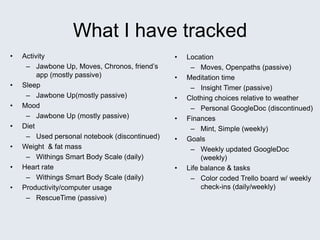
What I have tracked
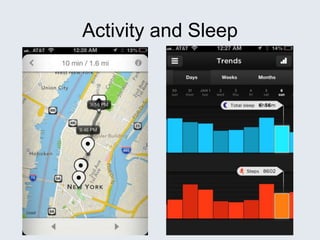
• Activity
– Jawbone Up, Moves, Chronos, friend’s
app (mostly passive)
• Sleep
– Jawbone Up(mostly passive)
• Mood
– Jawbone Up (mostly passive)
• Diet
– Used personal notebook (discontinued)
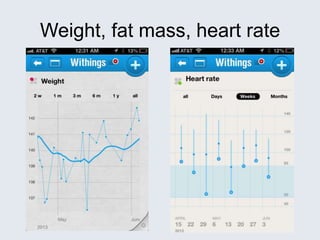
• Weight & fat mass
– Withings Smart Body Scale (daily)
• Heart rate
– Withings Smart Body Scale (daily)
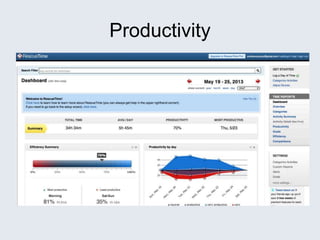
• Productivity/computer usage
– RescueTime (passive)
• Location
– Moves, Openpaths (passive)
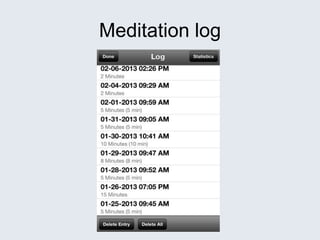
• Meditation time
– Insight Timer (passive)
• Clothing choices relative to weather
– Personal GoogleDoc (discontinued)
• Finances
– Mint, Simple (weekly)
• Goals
– Weekly updated GoogleDoc
(weekly)
• Life balance & tasks
– Color coded Trello board w/ weekly
check-ins (daily/weekly)
Activity and Sleep
Weight, fat mass, heart rate
Meditation log
Productivity
Agenda
• What is Quantified Self
• How quantified self got started
• The state of quantified self today
• Tools & apps
• Trends
• Hacking your own QS tools and projects
What Is The Quantified Self?
Original definition: self knowledge through numbers
• Recently it has been a catch-all term in the media for
anything where information relevant to an individual
is tracked
• At its core QS is curious introspection about the self
as well as the methods and meaning of self tracking
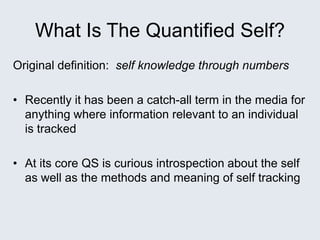
Image by whitney erin boesel for Cyborgology
How it began
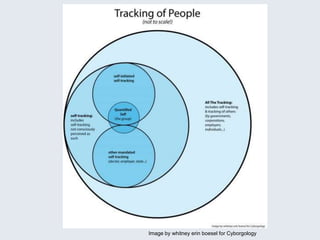
First QS Meetup at Kevin Kelly’s house in September 2007
(image credit: Kevin Kelly)
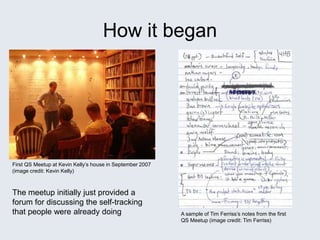
A sample of Tim Ferriss’s notes from the first
QS Meetup (image credit: Tim Ferriss)
The meetup initially just provided a
forum for discussing the self-tracking
that people were already doing
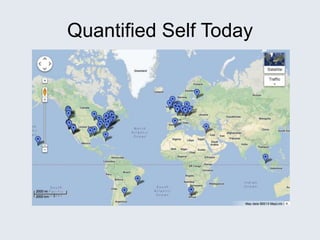
Quantified Self Today
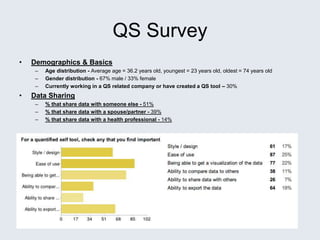
QS Survey
• Demographics & Basics
– Age distribution - Average age = 36.2 years old, youngest = 23 years old, oldest = 74 years old
– Gender distribution - 67% male / 33% female
– Currently working in a QS related company or have created a QS tool – 30%
• Data Sharing
– % that share data with someone else - 51%
– % that share data with a spouse/partner - 39%
– % that share data with a health professional - 14%
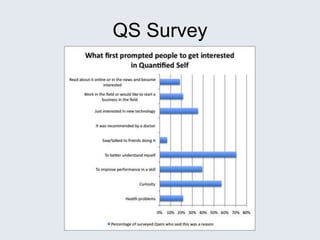
QS Survey
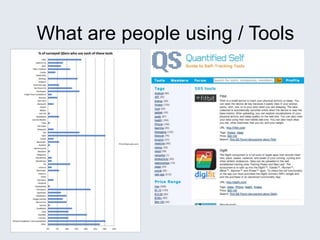
What are people using / Tools
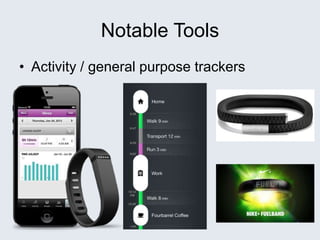
Notable Tools
• Activity / general purpose trackers
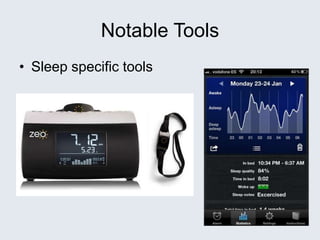
Notable Tools
• Sleep specific tools
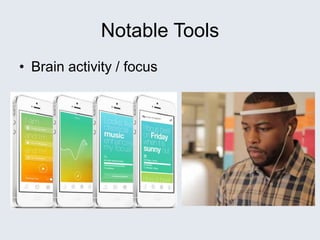
Notable Tools
• Brain activity / focus
Notable tools
• Genetic sequencing
Notable Tools
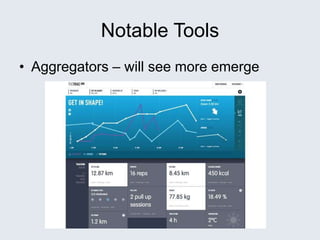
• Aggregators – will see more emerge
Notable Tools
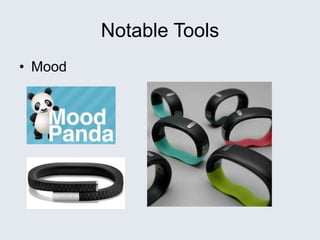
• Mood
Notable Tools
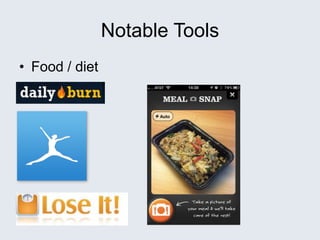
• Food / diet
Notable Tools
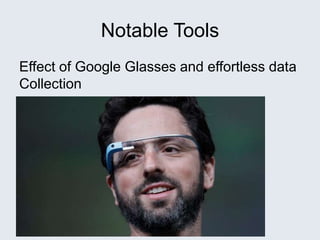
Effect of Google Glasses and effortless data
Collection
What do we do with all this?
The QS world Gary Wolf would like to live in:
• Data can be exported from the various systems
we use into a simple format for exploration.
• We can store and backup our data using whatever
method we want.
• We can share our data with whomever we want.
• We can rescind permission to look at our data.
• We can flow our data into diverse visualization
templates and analytical systems.
Where is QS going?
• Moving from manual data entry to passive
data collection will continue to bring it into
the mainstream as tech improves
• Brave vs. reckless with new technology, its
methods and meaning
• Increasing pressure to make data
standardized, exportable, user owned
• Boom of DIY data science
What can you do / hack yourself
• Typically useful to start with a hypothesis or a
question/problem you really care about since most
tech still requires some effort
• There are tools for everything, just start tracking
and iterate as you reflect on the data
• Look for interesting combinations
– Weight and Foursquare check-ins
– Meditation time and mood
– Sleep and productivity
– Sleep and activity
– Exercise and productivity
– Key is to stick with it and standardize your data
collection methods
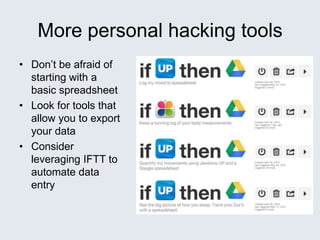
More personal hacking tools
• Don’t be afraid of
starting with a
basic spreadsheet
• Look for tools that
allow you to export
your data
• Consider
leveraging IFTT to
automate data
entry
…what do you want to find out?

Quantified Self: A Guide to Tools, Trends, and Applications

  • 1.
    Quantified Self A Guideto Tools, Trends, and Applications NYU ITP June 7, 2013 by @andrewcpaulus
  • 2.
    Who I amand why I’m here -Product based startup background: Savored  Groupon  Basno -Co-Organizer of the NY Quantified Self Group -Experience with a variety of QS tools -Excited about helping people better understand themselves and empower them with useful tools
  • 3.
    What I havetracked • Activity – Jawbone Up, Moves, Chronos, friend’s app (mostly passive) • Sleep – Jawbone Up(mostly passive) • Mood – Jawbone Up (mostly passive) • Diet – Used personal notebook (discontinued) • Weight & fat mass – Withings Smart Body Scale (daily) • Heart rate – Withings Smart Body Scale (daily) • Productivity/computer usage – RescueTime (passive) • Location – Moves, Openpaths (passive) • Meditation time – Insight Timer (passive) • Clothing choices relative to weather – Personal GoogleDoc (discontinued) • Finances – Mint, Simple (weekly) • Goals – Weekly updated GoogleDoc (weekly) • Life balance & tasks – Color coded Trello board w/ weekly check-ins (daily/weekly)
  • 4.
  • 5.
  • 6.
  • 7.
  • 8.
    Agenda • What isQuantified Self • How quantified self got started • The state of quantified self today • Tools & apps • Trends • Hacking your own QS tools and projects
  • 9.
    What Is TheQuantified Self? Original definition: self knowledge through numbers • Recently it has been a catch-all term in the media for anything where information relevant to an individual is tracked • At its core QS is curious introspection about the self as well as the methods and meaning of self tracking
  • 10.
    Image by whitneyerin boesel for Cyborgology
  • 11.
    How it began FirstQS Meetup at Kevin Kelly’s house in September 2007 (image credit: Kevin Kelly) A sample of Tim Ferriss’s notes from the first QS Meetup (image credit: Tim Ferriss) The meetup initially just provided a forum for discussing the self-tracking that people were already doing
  • 12.
  • 13.
    QS Survey • Demographics& Basics – Age distribution - Average age = 36.2 years old, youngest = 23 years old, oldest = 74 years old – Gender distribution - 67% male / 33% female – Currently working in a QS related company or have created a QS tool – 30% • Data Sharing – % that share data with someone else - 51% – % that share data with a spouse/partner - 39% – % that share data with a health professional - 14%
  • 14.
  • 17.
    What are peopleusing / Tools
  • 18.
    Notable Tools • Activity/ general purpose trackers
  • 19.
  • 20.
    Notable Tools • Brainactivity / focus
  • 21.
  • 22.
    Notable Tools • Aggregators– will see more emerge
  • 23.
  • 24.
  • 25.
    Notable Tools Effect ofGoogle Glasses and effortless data Collection
  • 26.
    What do wedo with all this? The QS world Gary Wolf would like to live in: • Data can be exported from the various systems we use into a simple format for exploration. • We can store and backup our data using whatever method we want. • We can share our data with whomever we want. • We can rescind permission to look at our data. • We can flow our data into diverse visualization templates and analytical systems.
  • 27.
    Where is QSgoing? • Moving from manual data entry to passive data collection will continue to bring it into the mainstream as tech improves • Brave vs. reckless with new technology, its methods and meaning • Increasing pressure to make data standardized, exportable, user owned • Boom of DIY data science
  • 28.
    What can youdo / hack yourself • Typically useful to start with a hypothesis or a question/problem you really care about since most tech still requires some effort • There are tools for everything, just start tracking and iterate as you reflect on the data • Look for interesting combinations – Weight and Foursquare check-ins – Meditation time and mood – Sleep and productivity – Sleep and activity – Exercise and productivity – Key is to stick with it and standardize your data collection methods
  • 29.
    More personal hackingtools • Don’t be afraid of starting with a basic spreadsheet • Look for tools that allow you to export your data • Consider leveraging IFTT to automate data entry
  • 30.
    …what do youwant to find out?

Editor's Notes

  • #3 Why > How > What
  • #13 -Dozens of Meetups-Thousands of members-Massive recent press-Rapidly changing technology forcing continual re-examination of the scope