Grant Aid for Building Conservation
‘Quanta’ Research
September 2011
Prepared by Carrig Conservation International Ltd in association with
Louise Harrington & Integral Finance Technology Ltd.
Upon instruction from the Heritage Council, Department of the Environment, Heritage
and Local Government and Department of Finance
Grant Aid for Building Conservation ‘Quanta’ Research September 2011
Carrig Conservation International Ltd, in association with Louise Harrington and Integral Finance and Technology, for the
Heritage Council, the Department of the Environment Heritage and Local Government, and the Department of Finance 1
Grant Aid for Building Conservation ‘Quanta’ Research September 2011
Carrig Conservation International Ltd, in association with Louise Harrington and Integral Finance and Technology, for the
Heritage Council, the Department of the Environment Heritage and Local Government, and the Department of Finance 2
Contents
Acknowledgements … … 3
Foreword … … 4
Key Findings … … 6
1. Context … … 8
2. Analysis of the Schemes with regard to the 22 Study Criteria … … 11
3. Policy Discussions ... ... 22
4. Recommendations ... ... 32
5. Quanta Tables … … 49
Appendices … … 51
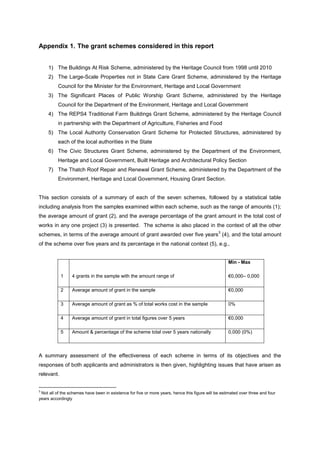
Appendix 1.The grant schemes considered in this report … …
Appendix 2Criteria for the Analysis of the Effectiveness of Grant
Schemes for Building Conservation … …
Grant Aid for Building Conservation ‘Quanta’ Research September 2011
Carrig Conservation International Ltd, in association with Louise Harrington and Integral Finance and Technology, for the
Heritage Council, the Department of the Environment Heritage and Local Government, and the Department of Finance 3
1. Acknowledgements
The authors would like to thank Mr Colm Murray, Architecture Officer of the Heritage Council, for his
assistance in the preparation of this document, and the Policy Responses section, and the
Architecture Committee of the Heritage Council.
Ten administrators of seven schemes agreed to participate in questionnaire interviews, these included
Ms Anna Meenan, Project Manager, REPS4 Traditional Farm Buildings for the Heritage Council and
the Department of Agriculture, Fisheries and Food; Mr Colm Murray, Architecture Officer, the Heritage
Council; Ms Suzanne Nally, Higher Executive Officer, Department of the Environment, Heritage and
Local Government, Built Heritage and Architectural Policy Section; Mr John J Kelly, Ms Alice
McAndrew, Ms Breda Mulhern, Department of the Environment, Heritage and Local Government,
Housing Section, Ballina; Ms Aine Doyle, Conservation Officer, Kilkenny County Council; Ms Ann
Marie Laffan, Assistant Staff Officer, Wexford County Council; Ms Rose Ryall, Conservation Officer,
Waterford County Council; Mr Pat Ruane, Conservation Officer, and Mr Jeremy Ward, Senior
Executive Planner, Cork City Council. We are grateful for their time and co-operation.
The participation of over fifty applicants of the different schemes, including house owners, community
groups, administrators and guardians such as the clergy, the Representative Church Body of the
Church of Ireland, the Irish Landmark Trust and local authorities, including Dublin City Council and
Galway County Council, as well as agents and contractors is greatly appreciated.
Ms Catherine Delaney, Department of the Environment, Heritage and Local Government, Built
Heritage and Architectural Policy Section, and Ms Amanda Ryan, Grants Officer, the Heritage
Council, also provided assistance in the compiling of data for different schemes.
Grant Aid for Building Conservation ‘Quanta’ Research September 2011
Carrig Conservation International Ltd, in association with Louise Harrington and Integral Finance and Technology, for the
Heritage Council, the Department of the Environment Heritage and Local Government, and the Department of Finance 4
Foreword
The legislation to protect the architectural heritage is supported by grants for the maintenance and
conservation of structures of special importance. Grant-giving has helped the programme to gain
broad acceptance among the owners of structures that have become protected. Policy 18 of the
Government Policy on Architecture intends to review how grant aid is administered to support this:
Action 18
Building on existing initiatives, the Department of the Environment, Heritage and
Local Government, in consultation with the Department of Finance, will carry out an
analysis of the operation and efficiency of existing grant-aid and tax relief
programmes supporting architectural heritage protection. The analysis will examine
the range of initiatives supported since 2000 and recommend how the experience
gained can be best utilised in the interests of heritage protection.
This study is intended to inform future discussion of Action 18 by establishing a relevant analysis of
the facts of existing grant-giving. It emphasises that different amounts of funding can achieve different
aims – from providing moral support to the owners of buildings of heritage value, through support for
employment, skills diversification and material supplied, as well as keeping the weather out in familiar
and cherished buildings. The Heritage Council has produced a review on this subject in 2003 –
‘Financial Support for Architectural Conservation in Ireland‟ (the ‘Leargas review’). It recommended,
inter alia, that the State’s role in providing financial support for the conservation of the architectural
heritage should be examined to ensure co-ordination and co-operation, with the objective of achieving
a consistent approach to the standards of conservation achieved, adequate quality control, equality of
opportunity and value for money.
Council has been involved in grant giving through its Buildings at Risk scheme since 1998.
Additionally, it has been centrally involved in administering further grant schemes such as the
Traditional Farm Buildings for REPS4 farmers, The Significant Places of Public Worship Fund, and
Large-Scale Grants to Properties not in State Care. These have spanned the scale of amounts of
funding from grants of €5,000 for Traditional Farm Buildings (and, in some cases, smaller amounts
under Buildings at Risk) up to multi-annual grants of up to €2,000,000 for Special Conservation
Grants.
In 2009, Council thoroughly revised its programme of grant aid, to align with the organisation’s new
strategies, and to remain relevant in addressing the needs of Ireland’s heritage and its public value as
an agency. Instead of the Buildings at Risk scheme, Council now offers grants from its core budget
under three broad and cross-sectoral headings – Heritage Management, Heritage Research and
Heritage Education, Community and Outreach. This was necessary to streamline the grant-giving
process and to ensure that all aspects of heritage were respected in the grant assessment process.
In addition, it has constituted a working group dealing with ‘Valuing Heritage’, which sets out to:
“…make heritage accessible, and enjoyable and understood. To do this we want to
influence others regarding the significance and relevance of the national heritage, its
conservation and management, to our economy, our employment and our quality of
life. We want others to value heritage and share those values.”
Council is producing economic research in parallel with this study on the value of its grants in terms of
support for the heritage sector, and in particular, the provision or maintenance of employment.
There are currently seven State sources of grant aid for building conservation in Ireland
Grant Aid for Building Conservation ‘Quanta’ Research September 2011
Carrig Conservation International Ltd, in association with Louise Harrington and Integral Finance and Technology, for the
Heritage Council, the Department of the Environment Heritage and Local Government, and the Department of Finance 5
(a) Heritage Council ‘Buildings at Risk' (recently discontinued)
(b) Department of the Environment, Heritage and Local Government ‘Civic Structures’
(c) Local Authority ‘National Conservation grant scheme’
(d) Department of the Environment, Heritage and Local Government ‘Thatching Grant’
(e) Heritage Council / Department of the Environment, Heritage and Local Government
‘Significant Places of Public Worship Fund’ grant scheme
(f) Heritage Council / Department of the Environment, Heritage and Local Government ‘Large-
Scale Grants to Properties not in State Care’ grant scheme
(g) Heritage Council / Department of Agriculture, Forestry and Food ‘Traditional Farm Building’
grants
Additionally, tax relief is offered to buildings of National significance through the S.482 of the Taxes
Consolidation Acts. It is not proposed to study tax relief at this time.
This project was initiated by the Heritage Council, and supported by funding from the Department of
the Environment, Heritage and Local Government under the Government Policy on Architecture 2009
- 2015. The Steering Committee contained representatives of the Department of the Environment
Heritage and Local Government, the Department of Finance, the Association of Architectural
Conservation Officers and the Architecture Committee of the Heritage Council.
This study, through its following of the criteria set out in 2003, and through its exploration of the
criteria set in 2011 (see appendix) breaks new ground in the assessment of the relevance and value
of grant giving for the conservation of the built environment.
****
Colm Murray
Architecture Officer
The Heritage Council
September 2011
Grant Aid for Building Conservation ‘Quanta’ Research September 2011
Carrig Conservation International Ltd, in association with Louise Harrington and Integral Finance and Technology, for the
Heritage Council, the Department of the Environment Heritage and Local Government, and the Department of Finance 6
Key findings
Grant schemes for the conservation of buildings share a headline objective, but differ in both
their aims and outcomes as a result of changes of emphasis in criteria and administrative
arrangements. Among the schemes examined, the following benefits can be identified: -
(a) Safeguarding and weatherproofing buildings and other structures as cultural, social,
economic and environmental resources (all)
(b) Fostering a market in building conservation contracting (all)
(c) Fostering a market in the supply of traditional building materials (all)
(d) Maintaining and enhancing the tourism resource (all, but in particular, Large-Scale
Properties not in State Care, Significant Places of Public Worship Fund)
(e) Enhancement of landscapes and streetscapes (contribution to the landscape is a
specific criterion of the Traditional Farm Building grant scheme)
(f) Providing professional advice and moral support to the owners and occupants of
special buildings for their role as custodians of the architectural heritage (most
notable in small-scale grants to owner-occupiers)
(g) Encouraging owners to enhance their construction and conservation skills
(encouraged in the Traditional Farm Building grant scheme)
(h) Transmission of concepts of conservation, care and stewardship to owners and
guardians of special places ( especially Local Authority Protected Structures grants)
(i) Fostering a market in professional conservation advice
(j) Encouraging good practice in building conservation by standard-setting through grant
conditions
(k) Encouraging the expenditure of private sector funding through matching expenditure
conditions, making resource conservation a more attractive option than resource-
intensive ‘knock-down and rebuild’ options.
(l) Fulfilling the State’s undertakings as a signatory of international conventions,
especially the Granada Convention on the Conservation of the Architectural Heritage.
In light of the multiple social benefits outlined above, grant-giving for architectural heritage
conservation can be seen to achieve value for money
The provision of grant aid was critical to 90% of applicants who carried out conservation
works. 66% of successful applicants said that they could not have proceeded without grant
funding.
Grant-aid is an important good-will gesture in recognising the role of building owners as
custodians and guardians who maintain our architectural heritage.
Grant Aid for Building Conservation ‘Quanta’ Research September 2011
Carrig Conservation International Ltd, in association with Louise Harrington and Integral Finance and Technology, for the
Heritage Council, the Department of the Environment Heritage and Local Government, and the Department of Finance 7
Applicants for the seven schemes in the State are generally happy with their experience of
the process and think that it is fair.
Complying with the conditions and standard for a grant-aided project is perceived to have
additional cost implications over and above conventional repair work (whether or not
conventional repairs are technically appropriate)
VAT is an additional cost on grant-aided works which reduces the actual assistance of the
grant unless an applicant is registered for VAT.
The input of technically-qualified grant administrators from grant-funding agencies,
professional agents and specialist contractors has a positive impact on the outcome and
success of each of the schemes.
The schemes have a wider benefit than the conservation of historic structures alone; they are
a vehicle for the provision of information and services to building owners and guardians, they
foster specialist skills and indirectly encourage craft employment skills training, and through
the continued usage of assets, make a contribution to sustainable development.
Information on all of grant schemes and the process of assessment of applications is
considered clear. Systems of prioritisation, marking and screening applications are working
effectively, where they are in place.
Levels of co-ordination and co-operation between grant-giving authorities are adequate to
good.
Most schemes achieve adequate levels of control over the quality of the conservation project,
except the Thatch Housing grant, which does not have a heritage conservation objective.
Most grant schemes provide equally accessible to all applicants, except the Large-Scale
Properties not in State Care, Significant Places of Public Worship Fund, where the objectives
are to aid buildings of national importance
The different schemes are achieving their objectives except that funding is progressively less
available.
Public procurement requirements only affects a very small proportion of recipients in the
larger schemes
Grant Aid for Building Conservation ‘Quanta’ Research September 2011
Carrig Conservation International Ltd, in association with Louise Harrington and Integral Finance and Technology, for the
Heritage Council, the Department of the Environment Heritage and Local Government, and the Department of Finance 8
1.1 Context
This study was commissioned in the context of Action 18 of the Government’s Policy on Architecture
which seeks an „analysis of the efficiency of existing grant-aid supporting architectural heritage
protection‟, so as to „inform future discussion of the action by establishing an analysis of the facts of
existing grant-giving‟ in the State.
In preparation for the full review of grant-funding anticipated in Action 18, a classification of grants by
amount was reviewed and assessed with regard to the seven state-sourced schemes in operation in
Ireland. All of the schemes are broadly similar in that they offered to support the conservation of the
architectural heritage but differ principally in terms of: -
amount of funding available to successful applicants,
maximum percentage of state-funding allowable in any one project,
type and size of building or structure,
eligibility due to ownership of and access to the structure (public, private dwelling, and
function), and the type of repairs being considered,
and to a lesser degree, the stipulations regarding the standard of work and the use of
specialised agents and contractors
agency operating the scheme,
1.2 Study Aims
The principal aim of this study is to assess the usefulness of classifying the existing seven schemes
according to amount by examining the appropriateness or otherwise of the current administrative
requirements, grant conditions and the efficacy of different grant amounts in achieving the
conservation objectives of the grant giving-body. The study brief also suggested that each of the
schemes be analysed according to 22 criteria that fall under the headings
Scale & grant amount range
Timeframe for support
Application evaluation
Administration requirements and conditions
Further issues such other values of the schemes
with particular reference to
whether or not the amount of grant offered was crucial to the decision to carry out the
conservation works,
whether the project works could be characterized as preventative maintenance or the remedy
of neglect, and whether assessment criteria provide a clear and rational basis for decision
making in this regard,
Grant Aid for Building Conservation ‘Quanta’ Research September 2011
Carrig Conservation International Ltd, in association with Louise Harrington and Integral Finance and Technology, for the
Heritage Council, the Department of the Environment Heritage and Local Government, and the Department of Finance 9
whether or not the works grant-aided ensured that the structure remains socially useful,
the proportion of matching funding from other State, or non-State sources,
whether stipulations regarding public procurement procedures have an impact on outcomes.
The value of the grant-giving process is also to be considered, not just in terms of measurable
financial and economic benefits but also in terms of wider social values such as education, training,
and up-skilling.
1.3 Method & Structure
The study brief stipulated that the data for the study would be sourced by direct consultation with the
administrators of the seven schemes, a sample of case studies from each, and comment from
applicants of each of the schemes. A minimum of 45 case files from across the seven schemes was
to be examined. Comparison of amounts granted, criteria and schemes of priorities used and overall
budgets reveals key differences, strengths and weaknesses of the schemes.
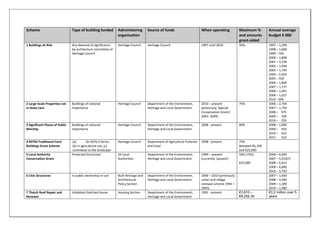
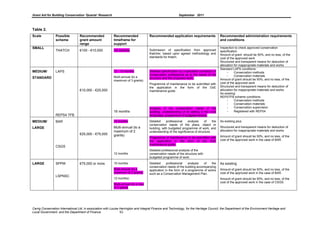
The schemes are set out in the table following, which identifies their key characteristics.
Scheme Type of building funded Administering
organisation
Source of funds When operating Maximum %
and amounts
grant-aided
Annual average
budget € 000
1 Buildings At Risk Any deemed of significance
by architecture committee of
Heritage Council
Heritage Council Heritage Council 1997 until 2010 50% 1997 – 1,299
1998 – 1,068
1999 – 591
2000 – 1,898
2001 – 3,238
2002 – 1,948
2003 – 1,799
2004 – 2,054
2005 – 920
2006 – 1,804
2007 – 1,737
2008 – 1,091
2009 – 1,027
2010 - 599
2 Large-Scale Properties not
in State Care
Buildings of national
importance
Heritage Council Department of the Environment,
Heritage and Local Government
2010 – present
(previously ‘Special
Conservation Grants’
2003 -2009)
75% 2006 – 2,704
2007 – 1,750
2008 – 975
2009 – 100
2010 – 250
3 Significant Places of Public
Worship
Buildings of national
importance
Heritage Council Department of the Environment,
Heritage and Local Government
2008 - present 80% 2008 – 1,900
2009 – 450
2010 – 623
2011 - 510
4 REPS4 Traditional Farm
Buildings Grant Scheme
(a) On REPS 4 farms,
(b) in agricultural use, (c)
contribute to the landscape
Heritage Council Department of Agriculture Fisheries
and Food
2008 - present 75%
Between €6,700
and €25,000
5 Local Authority
Conservation Grant
Protected Structures 34 Local
Authorities
Department of the Environment,
Heritage and Local Government
1999 – present
(currently ‘paused’)
50% (75%)
€25,000
2006 – 6,000
2007 – 5,910(?)
2008 – 6,915
2009 – 4,000
2010 – 3,750
6 Civic Structures In public ownership or use Built Heritage and
Architectural
Policy Section
Department of the Environment,
Heritage and Local Government
2006 – 2010 (previously
urban and village
renewal scheme 1994 –
2005)
2007 – 1,600
2008 – 3,500
2009 – 1,300
2010 – 1,380
7 Thatch Roof Repair and
Renewal
Inhabited thatched house Housing Section Department of the Environment,
Heritage and Local Government
1991 - present €3,810 –
€8,252.30
€3.2 million over 5
years
Grant Aid for Building Conservation ‘Quanta’ Research September 2011
Carrig Conservation International Ltd, in association with Louise Harrington and Integral Finance and Technology, for the Heritage Council, the Department of the Environment Heritage and
Local Government, and the Department of Finance 11
Four local authority grant administrators were consulted representing two local authorities with
conservation officers, one urban, two rural and an authority without a conservation officer. At an initial
meeting with the Steering Committee, it was also recommended that a sample of unsuccessful
applicants should also be contacted, as well as professionals working on the different schemes and
representatives from grant recipient organisations (such as the Representative Church Body of the
Church of Ireland and the Irish Landmark Trust) which had experience of dealing with the different
schemes.
Stage one of the project involved data collection. The project team developed a questionnaire for
both the administrators and applicants of all the schemes, incorporating the 22 criteria specified in the
brief. This provided a basis for structured interviews which collected qualitative data. An administrator
from each of the schemes and one from each of the four local authorities were interviewed in person
(two of the ten administrators completed the questionnaire by post). A sample of five case studies
was then taken from each of the schemes with a basic data sheet compiled for each (amounts, type
of works, applicant details and address). Contact was then made with the applicants of each case
study to complete a telephone questionnaire to ascertain their views of the relevant scheme.
Stage two began once the data had been collected and questionnaires completed. It was then
possible to begin
A statistical analysis of the figures across the schemes
An evaluative analysis of the questionnaire and interview feedback
The report is structured to present data on each of the schemes in the first section. An analysis of the
questionnaire surveys under the 22 headings of the project brief is contained in the second section.
The third and final section assesses the proposed Quanta Table or classification of grant schemes by
amount and makes recommendations in relation to the findings of the report.
Grant Aid for Building Conservation ‘Quanta’ Research September 2011
Carrig Conservation International Ltd, in association with Louise Harrington and Integral Finance and Technology, for the
Heritage Council, the Department of the Environment Heritage and Local Government, and the Department of Finance 13
2. Analysis of the Schemes with regard to the 22 Study Criteria
This section presents an analysis of the study data with regard to the 22 criteria set out in the study
brief. They are divided under the five headings of
Scale & grant amount range
Timeframe for support
Application evaluation
Administration requirements and conditions
Further issues such other values of the schemes
Grant Aid for Building Conservation ‘Quanta’ Research September 2011
Carrig Conservation International Ltd, in association with Louise Harrington and Integral Finance and Technology, for the
Heritage Council, the Department of the Environment Heritage and Local Government, and the Department of Finance 14
Scale and Grant Amount Range
2.1 Range of amounts normally administered
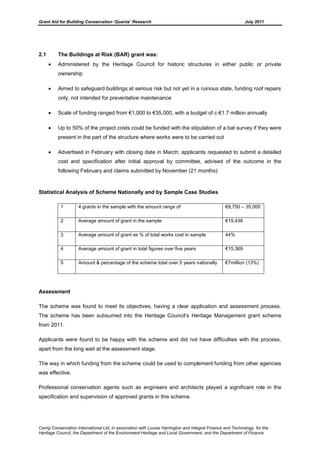
Over a period of five years, an average of 91 grants were allocated in the Buildings At Risk
Grant Scheme, with a high of 110 in 2007 and a low of 80 in 2010. The range of grant
amount was between €116.48 and €126,974.00
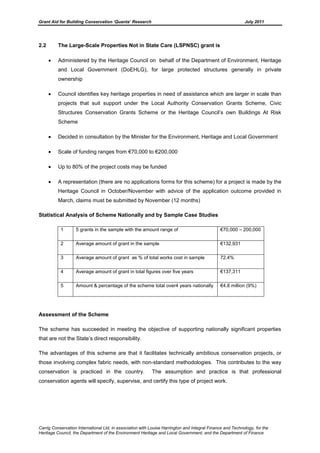
Over a five year period, the Large Scale Properties Not in State Care Grant Scheme allocated
an average of 7 grants per year with a high of 12 in 2006 and a low of 3 in 2010. The range
of grant amount was between €50,000 and €1,314,266.
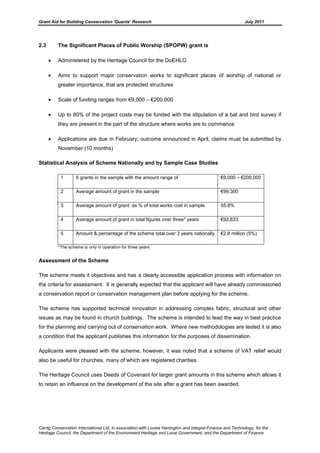
Over a three year period, 16, eight and six grants were awarded as part of the Significant
Places of Public Worship Grant Scheme. The range of grant amount was between €10,000
and €142,682.
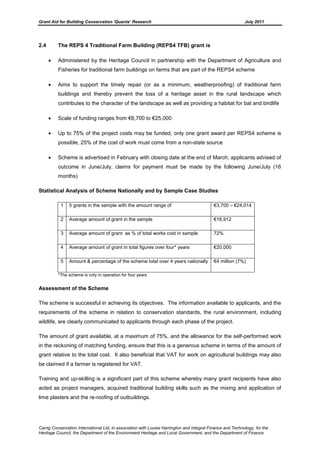
Over a four year period, the fixed allocation for the REPS4 Traditional Farm Building Grant
Scheme was €1,000,000 awarded to between 40 to 60 projects per annum with an average
amount of €20,000. The maximum amount granted was €25,000 and the minimum €6,700.
Over the four year period of its operation, the Civic Structures Grant Scheme allocated an
average of 78 grants per annum with a high of 121 in 2008 and a low of 41 in 2009. The
range of grant amount was between €2,500 and €50,000.
Over a five year period, 143 grants per annum have been allocated as part of the Thatched
Roof Repair and Renewal Scheme, with a high of 183 in 2008 and a low of 109 in 2010, with
an average amount of €4,400.
In Wexford County Council the allocation for the Conservation Grant Scheme in 2010 was
€110,000 with grants ranging between €2,000 and €13,000.
In Waterford County Council the allocation for the Conservation Grant Scheme in 2010 was
€113,000. The range of grant amount was between €600 and €13,000.
In Cork City Council the allocation for the Conservation Grant Scheme in 2010 was €102,000.
An average of 24 – 49 grants per annum were awarded, based upon the annual allocation,
with an average of amount of €2,000 to €10,000.
In Kilkenny County Council the annual allocation for 2010 was €103,000 with 13 grants
awarded (down from €220,000 in 2007 when 25 grants were awarded).
Grant Aid for Building Conservation ‘Quanta’ Research September 2011
Carrig Conservation International Ltd, in association with Louise Harrington and Integral Finance and Technology, for the
Heritage Council, the Department of the Environment Heritage and Local Government, and the Department of Finance 15
2.2 Whether or not the amount of grant offered was crucial to the decision to carry
out the conservation works project
In the sample of 50 case studies, the provision of grant-aid was critical to 90% of applicants who
carried out conservation work. 66% of successful applicants said that they could not have proceeded
without the grant funding, a further 24% had to go ahead regardless but would have done less without
the funding.
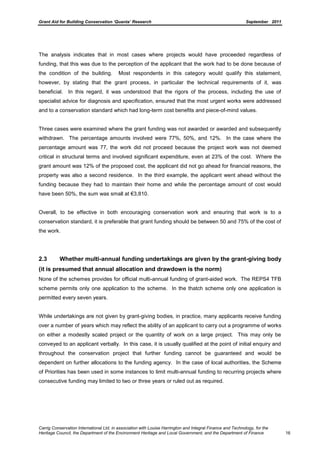
The following table reports the amount of grant as a percentage of the overall cost of a project and
within each percentage range the breakdown of how many projects this categorised in the sample 50
projects. In particular, it considers whether or not the amount of grant affected the decision to
proceed with work.
Grant amount as a
percentage proportion of
project cost
Percentage of projects in
the sample with this
proportion
Proportion who answered
they could not have gone
ahead without the funding
proportion who answered
that they would have gone
ahead regardless
1 – 14% 16% 57% 43%
15% - 44% 22% 80% 20%
45% - 74% 33% 53% 47%
75% - 100% 29% 77% 23%
The following table presents an analysis of the category of applicant in the sample 50 case studies
that would have proceeded without funding and why.
Grant amount as a
percentage proportion
of project cost
Reasons given as to why work would have proceeded regardless
1 – 14% In two instances the applicants responded that this was because the grant amount was so small
that it made no difference anyway.
Another project would have gone ahead without the grant because the proportion of funding from
other sources made up most of the actual cost.
15% - 44% In one project the work was critical so ‘something’ would have been done, even if that was only
the taking down of a dangerous element without resolving the conservation issues.
Another was unsure as to how they would have proceeded but felt that they would have had to
anyway.
45% - 74% The majority of applicants in this category, felt that they had to do something regardless because
of the condition of elements in a building be they in public or private use.
One applicant responded that they had been tackling issues piecemeal regardless of funding.
Another felt that the funding was a ‘catalyst’ for work that would have gone ahead anyway.
75% - 100% All of the applicants in this category, felt that they had to do something regardless of funding
because of the condition of a building.
The analysis confirms that where the percentage of grant amount is very low relative to the cost of a
project, in the region of 1 – 14%, that the awarding of a grant is no longer a deciding factor in the
decision to proceed with work.
Grant Aid for Building Conservation ‘Quanta’ Research September 2011
Carrig Conservation International Ltd, in association with Louise Harrington and Integral Finance and Technology, for the
Heritage Council, the Department of the Environment Heritage and Local Government, and the Department of Finance 16
The analysis indicates that in most cases where projects would have proceeded regardless of
funding, that this was due to the perception of the applicant that the work had to be done because of
the condition of the building. Most respondents in this category would qualify this statement,
however, by stating that the grant process, in particular the technical requirements of it, was
beneficial. In this regard, it was understood that the rigors of the process, including the use of
specialist advice for diagnosis and specification, ensured that the most urgent works were addressed
and to a conservation standard which had long-term cost benefits and piece-of-mind values.
Three cases were examined where the grant funding was not awarded or awarded and subsequently
withdrawn. The percentage amounts involved were 77%, 50%, and 12%. In the case where the
percentage amount was 77, the work did not proceed because the project work was not deemed
critical in structural terms and involved significant expenditure, even at 23% of the cost. Where the
grant amount was 12% of the proposed cost, the applicant did not go ahead for financial reasons, the
property was also a second residence. In the third example, the applicant went ahead without the
funding because they had to maintain their home and while the percentage amount of cost would
have been 50%, the sum was small at €3,810.
Overall, to be effective in both encouraging conservation work and ensuring that work is to a
conservation standard, it is preferable that grant funding should be between 50 and 75% of the cost of
the work.
2.3 Whether multi-annual funding undertakings are given by the grant-giving body
(it is presumed that annual allocation and drawdown is the norm)
None of the schemes provides for official multi-annual funding of grant-aided work. The REPS4 TFB
scheme permits only one application to the scheme. In the thatch scheme only one application is
permitted every seven years.
While undertakings are not given by grant-giving bodies, in practice, many applicants receive funding
over a number of years which may reflect the ability of an applicant to carry out a programme of works
on either a modestly scaled project or the quantity of work on a large project. This may only be
conveyed to an applicant verbally. In this case, it is usually qualified at the point of initial enquiry and
throughout the conservation project that further funding cannot be guaranteed and would be
dependent on further allocations to the funding agency. In the case of local authorities, the Scheme
of Priorities has been used in some instances to limit multi-annual funding to recurring projects where
consecutive funding may limited to two or three years or ruled out as required.
Grant Aid for Building Conservation ‘Quanta’ Research September 2011
Carrig Conservation International Ltd, in association with Louise Harrington and Integral Finance and Technology, for the
Heritage Council, the Department of the Environment Heritage and Local Government, and the Department of Finance 17
Clarification on multi-annual funding is important for both large-scale and small-scale projects to allow
for budgeting and to approach different problems on different sized buildings. The suggestion of one
local authority administrator that a five year budget for the authority would be preferable as a means
of allowing a coherent and consistent approach to the work during the life of a project is a good idea.
The opposite of structured ongoing investment over a long period can result in crisis and a building
reaching a critical stage, affecting the conservation outcome and the quality of the work where people
cannot plan for work. A budgeted programme of works such as one arising from a Conservation
Management Plan is a useful tool for large-scale projects to anticipate possible funding for a
prioritized list of projects. On smaller scale projects, an analysis of a building should inform the
programme of work so that even if multi-annual funding cannot be guaranteed, at least an
understanding of the critical needs of the building could determine how conservation is phased.
Grant Aid for Building Conservation ‘Quanta’ Research September 2011
Carrig Conservation International Ltd, in association with Louise Harrington and Integral Finance and Technology, for the
Heritage Council, the Department of the Environment Heritage and Local Government, and the Department of Finance 18
Application Evaluation
2.4 Whether the project works can be characterised as preventative maintenance
or the remedy of neglect
Preventative maintenance describes how a building may be kept in good working order by addressing
repairs as they arise. In large part, it will involve maintaining features that prevent the weathering of
the structure from the elements, in particular, the removal of water away from surfaces. These
features include rainwater goods and membranes, such as lead, that cover flat surfaces and bridge
angles between different surfaces. Preventative maintenance may also include localised repairs so
as to avoid more extensive works and costs in the future, if left unresolved. For instance, repairing
the bottom rail of a sliding sash window, which is usually most susceptible to weathering, may save
the window from further deterioration and the necessity to replace an entire window. Equally,
addressing problems on a roof, such as a leaking chimney, will prevent potential problems such as
dry and wet rot.
Neglect arises when preventative maintenance is not carried out over extended periods. This results
in problems escalating, the extent of deterioration multiplying, along with the cost of repairs and the
potential loss of significant historic fabric. The funding required to conserve the building is usually far
greater than preventative maintenance. The analysis and specification for the conservation work is
also more complex as a single issue develops into other problems. A project arising from neglect
tends to require urgent critical attention.
The distinction between the two reasons for conservation work is not always clear-cut. It is not as
though an agency or an applicant decides upon a prioritisation of preventative maintenance, nor is it
the case that the same owner will apply for conservation funding after deliberately letting a property
deteriorate. The Department of the Environment and Local Government circular PD5/99 introducing
the local authority grant scheme stated that „The scheme is not intended to assist in carrying out
routine maintenance…‟. In this regard, it should be noted that many properties that are the subject of
grant-aid are recently bought by a new owner where a new owner decides to make good the neglect
of a previous owner. A sensible measure for all schemes would be the encouragement of a
programme of maintenance after conservation works are completed by requesting this information at
the time of application as is done in some cases already.
The following is a summary of how the amount of grant funding is broken down between preventative
maintenance and the remedy of neglect in each scheme.
Officially the BAR Scheme did not pay for preventative maintenance which is not to say that
rewarding a lack of preventative maintenance was the objective of the scheme and that there
were not cases where preventative maintenance was involved in projects.
Grant Aid for Building Conservation ‘Quanta’ Research September 2011
Carrig Conservation International Ltd, in association with Louise Harrington and Integral Finance and Technology, for the
Heritage Council, the Department of the Environment Heritage and Local Government, and the Department of Finance 19
The Civic Structures Scheme dealt mostly with projects that are the remedy of neglect but
may also fund works that prevent future deterioration as per the definition above.
The Significant Places of Public Worship Scheme, targeted at significant, often-complex old
buildings recognised the difficulties of managing the fabric but insisted that comprehensive
plans for improving its condition were the basis for application and evaluation. This approach
allowed scope for the resolution of past neglect and future preventative maintenance.
The Large Scale Properties not in State Care Scheme dealt with the remedy of neglect due to
the size and complexity of these buildings of national importance, and the capacity of
individual owners to mobilise resources for ongoing maintenance and guardianship.
The REPS4 TFB Scheme deals with both, and it was estimated that the proportion of
preventative maintenance projects to those dealing with the remedy of neglect is 60% to 40%.
The Thatching Scheme was the only scheme where the administrators felt that the proportion
of preventative maintenance work far exceeded the remedy of neglect at a proportion of 80%
to 20% respectively. This may be due to the fact that it is a housing grant or because of the
nature of a thatch roof which has traditionally required ongoing maintenance. It may also be
because of the amount of funding available which realistically can only address repairs.
Severe damage caused by storms or prolonged neglect (due, for instance, to the sale of a
property, or inheritance) leads to situations where repairs are no longer an option. Funding is
then used for the remedy of neglect.
In the local authority scheme the variety of building type, owner/guardian and the amount of
funding provided (which can range from €1,500 to €25,000), means that it deals with
conservation both as the remedy of neglect and measures of preventative maintenance.
Small amounts may very usefully be directed towards rainwater goods repair, or renewal, and
the resolution of drainage issues, even on a medium-sized church. Three local authority
respondents considered that funding was spent on both, two estimated that this was split
50/50 between the two and the third respondent indicated while it was both the authority had
a preference for works of preventative maintenance. In the fourth case, the administrator
responded that 100% of work was the remedy of neglect.
2.4 … and whether grant scheme ‘Schemes of Priority’ (required of local authorities
by Circular PD 5/99) or other criteria provide a clear and rational basis for decision
making in this regard
Grant Aid for Building Conservation ‘Quanta’ Research September 2011
Carrig Conservation International Ltd, in association with Louise Harrington and Integral Finance and Technology, for the
Heritage Council, the Department of the Environment Heritage and Local Government, and the Department of Finance 20
The Scheme of Priorities for local authorities is a list of priorities that includes considerations by
means of which the authority may prioritise applications, given that the requested funding will
invariably exceed the allocation available to the local authority. Exemplary priorities were laid out in
PD5/99, with the recommendation that each local authority would formally adopt their own. The
headings in a Scheme may include considerations such as the urgency of work, the desirability of
conserving locally characteristic features, the capacity of the applicant to carry out the work within the
time-frame, the promotion of conservation standards in areas where a project may serve as a pilot, or
the provision of support for model and innovative repairs to common problems. Marking applications
in accordance with the Scheme is helpful to ensure fairness and consistency and is increasingly
important as funding allocations are reduced. Reviewing the Scheme of Priorities is useful as a
means of checking the progress of the grant scheme in achieving certain outcomes and whether
having done so, if priorities should be changed to reflect the changing capacity of owners, availability
of skilled trades people and growth in conservation expertise. Three of the four local authority
respondents agreed that the Scheme of Priorities provides a clear and rational basis for decision
making while one disagreed.
In the Civic Structures Conservation Grant Scheme applications are marked by a panel of
independent conservation experts who score applications based on a desk-based assessment under
the headings of the significance of the structure, the priority/urgency of the works, the project
methodology and quality of the proposal. The applications are rated as 4 – excellent, 3 – good, 2 –
fair, 1 – not sufficient, and 0 – not eligible. Thus projects were scored, with a maximum possible
score of 12.
The Significant Places of Public Worship Scheme evaluated applications in accordance with the
significance of the building, the urgency of works, the existence of a Conservation Management Plan
for the project, the conservation standards and specification, the impact on the cultural fabric or
collections of the church, the capacity of the applicant to deliver within the timeframe, and the ability of
the applicant to meet the 20% matching funding requirement of the scheme.
The REPS4 TFB Scheme uses the following criteria for the assessment of applications: conservation
standards, the necessity for the works, the nomination of a conservation supervisor, the heritage
interest of the building, evidence of its contribution to the landscape, interior features and protection
status.
The Buildings At Risk Scheme based the criteria for assessment upon the materials and methods
proposed for the project, whether or not the building was, or was intended to be, occupied or in use,
and expert input on the project.
Grant Aid for Building Conservation ‘Quanta’ Research September 2011
Carrig Conservation International Ltd, in association with Louise Harrington and Integral Finance and Technology, for the
Heritage Council, the Department of the Environment Heritage and Local Government, and the Department of Finance 21
Thatching grant applications, which are housing grants first and foremost, are judged by a set of
criteria that include eligibility, tax clearance, a thatcher’s quote, and the inclusion of work to
weatherproof the roof of a house. Once eligibility is established a site inspection is made and any
additional works that are required are specified with a conditional approval to the applicant.
Schemes of Priority and other criteria may emphasise critical work, which will usually be the remedy
of neglect, and/or preventative maintenance. The BAR Scheme is the only one that aims to deal with
the remedy of neglect as a priority over works of preventative maintenance. Once the essential
criteria regarding capacity to match funding, conservation standards and specification have been met,
there will be some overlap in using a Scheme of Priorities as every project may score equally over a
number of headings, hypothetically negating the benefits of marking. This is why review of such
marking schemes is useful.
2.5 Degree of control over the specification by the grant-giving body
All of the seven schemes, with the exception of the thatching grant, require a conservation
specification that accords with best practice as a minimum.
The LAPS Scheme requires a conservation specification by either a specialist contractor or
professional, depending upon the works proposed. If this information is absent the administrator will
seek clarification as the applications are being assessed. Provisional grants may be conditional upon
supervision by a conservation professional. One local authority correspondent clarified that even with
the correct specification and provisions for supervision, the work may still be carried out
inappropriately.
The REPS4 TFB, BAR and CSG schemes require conservation specification and supervision. Where
any details are not clear, inappropriate or missing, clarification is sought or the application is rejected.
The LSPNC and SPPW schemes require a detailed conservation analysis and specification as well as
a programme of works to be prepared in anticipation of the application. A Conservation Management
Plan is specified in the SPPW or equivalent conservation report. Given the emphasis in these two
schemes on technical innovation and conservation standards, the expectation is that conservation
reports will be to such a standard that requirements for clarification should be minimal.
The priority of the Thatching Scheme is that funded projects ensure the durability of a dwelling. As
such the specification provided at the time of application is assessed in terms of the adequacy of a
proposed project to ensure the viability of the house. A thatcher provides the specification. The type
of thatch (i.e., type and Irish or imported) is left to the thatcher. This is a major difference between
Grant Aid for Building Conservation ‘Quanta’ Research September 2011
Carrig Conservation International Ltd, in association with Louise Harrington and Integral Finance and Technology, for the
Heritage Council, the Department of the Environment Heritage and Local Government, and the Department of Finance 22
this scheme and all of the other schemes. The fact that a thatched house owner may, depending on
eligibility, claim funding under three schemes, means that there is a significant difference in the
expectation on the part of the agencies as to how work is to be carried out, in particular, with
reference to the material used and the retention of original roof fabric.
2.6 Whether or not the works grant-aided ensured that the structure remains
socially useful
The consensus amongst respondents was that grant-aided works ensure that structures remains
socially useful.
In relation to the Buildings at Risk Scheme, it was noted that a conserved building which is
occupied is likely to survive better. The conservation of the architectural heritage also
contributes to people’s functioning in society by contributing to its infrastructure.
The REPS4 Traditional Farm Building Scheme deals with working farm buildings which are to
be used into the future and thus contribute to the rural landscape and fabric of the community.
The Civic Structures Grant Scheme secures the conservation of publicly owned structures
which form part of the built environment and which are often developed as projects by
community groups providing multiple uses to those groups.
The Large Scale Properties not in State Care Scheme and Significant Places of Public
Worship Grant Schemes were also deemed to contribute to keeping buildings socially useful,
particularly, those landmark buildings that are of national importance and often open to the
public.
The respondent for the Thatch Scheme agreed that the grant funding ensured that buildings
remained socially useful because it allowed people, especially OAP’s , to stay in their homes
instead of having to resort to living in a retirement centre, thus contributing to the fabric and
structure of society.
All of the local authority respondents were very much in agreement that the grant ensures that
a structure remains socially useful. Two respondents pointed to the multiplier-effect of grant
giving whereby not only was the future of a building secured through grant-aid but that the
project gave the impetus to neighbouring properties to carry out improvement works even
without grant funding.
2.7 Type of conservation documentation and justification required from applicant
(assuming that application form, costings & photographs are standard), e.g. detailed
analysis of building condition, prioritisation of repairs, multi-annual phased approach
to the works
Grant Aid for Building Conservation ‘Quanta’ Research September 2011
Carrig Conservation International Ltd, in association with Louise Harrington and Integral Finance and Technology, for the
Heritage Council, the Department of the Environment Heritage and Local Government, and the Department of Finance 23
The schemes may be divided into three in terms of the documentation required. In the first category,
the Local Authorities Protected Structures Scheme requires a conservation specification by a
specialist contractor or professional. While this may include a detailed analysis of the building
condition, prioritisation of repairs and references to funding, it is not always necessary. Typically,
specification by a contractor will only include a method statement clarifying how work will be
completed, materials to be used and the cost. If an agent is involved, phasing of work and condition
analysis will be part of a conservation report.
In the second category, the REPS4 Traditional Farm Buildings, the Buildings at Risk and Civic
Structures Grant Schemes require a conservation report by a conservation professional which will
include fabric analysis, quotes from specialist or other contractors, and a programme of works. Some
of appraisal of the heritage importance of a structure is also included in these reports.
In the third category, the Large Scale Properties not in State Care and Significant Places of Public
Worship Schemes require comprehensive conservation reports or management plans to be in place
so as to allow for the programming of often complex and extensive works over a longer period of time.
This is so as to ensure that the most urgent works are targeted according to an understanding of the
overall requirements of the building. Such reports are also likely to include fabric-analysis by
specialists and quotes from specialist contractors. These reports or plans will include, or follow on
from, comprehensive study of the significance of a building.
Conservation documentation or justification is not required in the Thatching Scheme.
In each of the three categories, the intervention of technical administrator in the form of guidance and
clarification on what type of information required is critical.
2.8 Whether or not the project funded consisted of composite works packages that
could have been achieved in smaller-scale phases
Over 35% of projects took a phased approach to the completion of works. This was due to applicants’
financial circumstances, the breadth and scope of the works to the completed, and the availability of
grant funding. At times agents advised applicants to phase the works for either logistical reasons or to
benefit from the various grant schemes in order to address financial issues.
The nature of the Thatching Scheme is such that works could not be broken up into any smaller scale
phases without affecting the quality of the conservation outcome, i.e., the work necessary to make a
thatch roof secure could not be broken down into further phases without affecting the conservation
outcomes. Only one application in the lifetime of the REPS4 Traditional Farm Buildings Scheme is
Grant Aid for Building Conservation ‘Quanta’ Research September 2011
Carrig Conservation International Ltd, in association with Louise Harrington and Integral Finance and Technology, for the
Heritage Council, the Department of the Environment Heritage and Local Government, and the Department of Finance 24
permitted, therefore, works cannot be phased. However, it is possible that the range of works that
could be carried out to conserve an outbuilding could be phased into the different parts of the building
such as roof, joinery and masonry repairs. The same could be said of the Local Authorities Protected
Structures Scheme and this is what happens in practice in many projects. The size of the grant
amounts in this Scheme and the option of applying over a number of years, means that the carrying
out of work in smaller-scale phases as a practice is already in place.
Works in the Buildings at Risk Scheme could not be broken into smaller phases. This is due to the
type of work and the associated terms and conditions of the scheme. The larger amount of grant
awarded in the scheme reflects this fact. The Civic Structures Grant Scheme awards grants to a
variety of projects, some of which could be broken down into smaller phases and some that couldn’t.
For instance, the conservation of a public monument, such as a statue or fountain, could not be
broken down into smaller phases while a Civic Structures Grant Scheme award could be used along
with other grants to fund phases of works in a larger building such as a cathedral.
The Large Scale Properties not in State Care and Significant Places of Public Worship Schemes
involve larger amounts for larger projects. In practical terms, dividing works on a large building can
incur additional costs such as scaffolding and results in poor value for money in the longer term. For
this reason, the larger amount is used to maximum effect.
2.9 Whether voluntary effort contributed to the management of the project …
Voluntary effort is considered in the reckoning of costs for most of the schemes in the form of skilled
and unskilled labour and project management.
The REPS4 Traditional Farm Buildings provides an hourly labour rate and timesheet for farmers to be
signed off by the project agent. In the thatch scheme, many owners have traditionally carried out their
own repairs and this is always reckoned according to a fixed amount. The Civic Structures Grant
Scheme does take voluntary effort into account, involving many community and civic projects as it
does, provided that the work carried out would have otherwise been subject to a contract and
payment for specialised services.
All of the local authorities take voluntary work into account which might be in the form of project
management costs, or self-performed works by a contractor such as a cabinet-maker, for example.
Only 16% of applicants indicated that some of the works to their properties were completed with
voluntary or self-performed labour with a general response that the understanding was that only
formal contracts and labour could be reckoned.
Grant Aid for Building Conservation ‘Quanta’ Research September 2011
Carrig Conservation International Ltd, in association with Louise Harrington and Integral Finance and Technology, for the
Heritage Council, the Department of the Environment Heritage and Local Government, and the Department of Finance 25
The trend and the practice has been to encourage the inclusion of voluntary work in cost estimates,
however, it appears that this needs to be better communicated to applicants as there appears to be a
general misunderstanding or lack of knowledge on this point from the point of view of applicants.
2.10 For projects where the conservation works are part of a development proposal
(for example, including new building), whether the overall development assessed or
just the conservation works to the structure of special interest
None of the grant schemes consider development of an extended site in receipt of grant-aid.
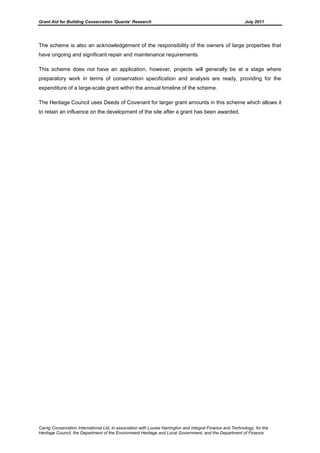
In the Large Scale Properties not in State Care scheme, the Heritage Council may agree a deed of
covenant with building owners or guardians to ensure their involvement in future decisions affecting
the heritage building. The Council would also try to exert a positive influence in development
decisions affecting projects in receipt of Significant Places of Public Worship funding. Because the
REPS4 Traditional Farm Buildings scheme deals with farm outbuildings, works are considered to be
exempted agricultural development, therefore, this issue does not arise (unless the building is part of
a protected structure). However, as the funding for this scheme comes under the Rural Development
Programme, and is strictly for agricultural improvement, the administrator is obliged to take note of an
indications that the building would have the potential to be used for any other purpose during the five
year time span of the REPS 4 contract.
In the case of local authorities, it was felt by one respondent that the role of the conservation officer in
both the planning process and the conservation grant scheme ensured that scenarios of inappropriate
development being carried out adjacent to or on the same site as a grant-funded project by the same
developer were impossible. Another local authority respondent indicated that the grant could be seen
as a goodwill gesture which was not means-tested and that in awarding it to a developer, it was a way
of highlighting that conservation and development are not mutually exclusive. Another respondent
indicated that due to the complexities of development, it could happen and in the one instance where
it did occur, the authority threatened to withdraw the funding.
This issue does not affect the thatching scheme, however, there is a clause in the scheme that
thatched houses rented as holiday homes are ineligible for funding.
2.11 Ease and Efficacy of application process (effect of rigorous or demanding
application processes on grant outcomes)
All of the schemes require that an applicant must include standard information on the proposed
programme of work. Depending on the requirements for this specification, and the quality of the
information supplied, the easy and efficacy of the grant application process is generally streamlined.
Grant Aid for Building Conservation ‘Quanta’ Research September 2011
Carrig Conservation International Ltd, in association with Louise Harrington and Integral Finance and Technology, for the
Heritage Council, the Department of the Environment Heritage and Local Government, and the Department of Finance 26
In the schemes that award smaller to medium-sized amounts, there is generally an allowance made
for the clarification of details at application stage. The Buildings at Risk scheme appears to have
been unique in that application was a two-stage process. An initial application form could be
completed with ease by a building owner without professional assistance. After Council screening,
further more detailed information could be elicited to complete the application, with an understanding
that the project, if properly set up, would be fundable. This greatly reduced the risk of needless
expenditure for applicants. In the medium to larger schemes, a single stage application was
implemented. The Civic Structures Grant Scheme, Large Scale Properties not in State Care and
Significant Places of Public Worship Fund , the standard of information required is clarified in the pre-
application information provided to applicants, and applications were rejected if they were not
satisfactorily documented. This preparatory work greatly increases the likelihood of the successful
draw-down of the grant and improves conservation outcomes.
Most applicants thought that the grant application process was fair and efficient and understood how it
was judged. There was some concern expressed, however, that better information could be provided
to applicants as to what the requirements of the application, in terms of specifications and reports,
could cost. Pressure to meet time-frames within the schemes can impact on the conservation
outcomes. This was a concern in the Local Authority Protected Structures Scheme where the
delayed announcement of allocations to authorities, could effectively reduce the time in which works
could be carried out to a matter of two to three months when builders’ availability and weather were
taken into account. This could result in work being carried out in a hurried fashion and in poor
conditions or the failure of the applicant to meet the deadline and the loss of the grant.
It was also recorded that some owners delayed the commencement of work so as to reduce the wait
for payment because they had to pay for 100% of the work to claim the grant. This could have
adverse impacts on the condition of a building and is not a good practice.
Grant Aid for Building Conservation ‘Quanta’ Research September 2011
Carrig Conservation International Ltd, in association with Louise Harrington and Integral Finance and Technology, for the
Heritage Council, the Department of the Environment Heritage and Local Government, and the Department of Finance 27
Administration requirements and conditions
2.12 What assessment, evaluation and authorization procedures are applied, and
whether these have an impact on conservation outcomes
In only three instances were the administrators interviewed not responsible for the assessment of
grants. These were the Civic Structures Grant Scheme, one of Local Authority Protected Structures
and the Thatch schemes. All of the schemes provide for the checking of eligibility, tax clearance and
conservation specifications, bar the thatching scheme. Assessors may seek clarification on
application details in all of the schemes. The REPS4 Traditional Farm Buildings uses a two stage
process to check for eligibility in the first instance and once this has been established for clarification
on specifications and supervision.
In the case of the Civic Structures Grant Scheme, an independent panel of experts assesses
applications by use of a points system using the aforementioned criteria. In case of the Thatching
Scheme the application is assessed initially from the office (for eligibility) and subsequently by a
separate technical officer on site who makes a recommendation. In one of the local authorities the
initial technical assessment is outsourced to a consultant.
Within the Heritage Council, the recommendations of the appropriate officer are taken to committee
level for review and further recommendation and finally approved by full council for three of the four
schemes; in the case of the LSPNSC, the Minister for the Environment, Heritage and Local
Government makes the final decision on the technical recommendation. The Significant Places of
Public Worship Scheme includes members of the four main churches on the committee.
In three local authorities, the technical recommendation is taken to the Director of Service for approval
(including one via an Senior Executive Planner line-manager), and further, by manager’s order for
administrative payment purposes, in one instance. In the fourth, the technical officer makes the final
decision in accordance with the Scheme of Priorities.
The provision of adequate specification followed by intervention to seek clarification on the
programme and type of work, as required, is critical to the conservation outcome of a project
2.13 Proportion of matching funding from other State sources, and non-State
sources
All of the agencies direct applicants to seek other sources of funding and in many instances actively
encourage them. An analysis of the case projects studied under each of the schemes shows that
grant amounts were matched by private funding including bank loans and savings, fund-raising in the
case of churches and community projects and other grants.
Grant Aid for Building Conservation ‘Quanta’ Research September 2011
Carrig Conservation International Ltd, in association with Louise Harrington and Integral Finance and Technology, for the
Heritage Council, the Department of the Environment Heritage and Local Government, and the Department of Finance 28
Just over half the grants awarded were matched by private funding, most of which was at a rate of
50% of the total cost. One quarter of projects in this category met the cost with an average of 22%
private funding and the other quarter matching the grant amount with 75%, or over, of the cost.
Where church projects were involved (25% of the case studies), funding was matched by way of fund-
raising in the parish or community. The number of cases with a proportion of matching funding of 25-
60%, 50-60% and 70-90% divided evenly between these three categories. In one instance, the
church community encouraged members to take advantage of the tax relief available to PAYE
workers on donations of over €250. In another, the municipal authority had loaned the church money
for the specific purpose of matching grant awards.
In under a quarter of case studies, the source of matching funding was another grant or the
combination of another grant and community funding. In this category, half received funding of
between 15 and 75% from other funding sources. The other half received funding from a combination
of community fundraising and other grants. The proportion of matching funding provided by the
applicant in this second category varied from 3 – 80%.
Most of the schemes set a limit on the amount of combined state funding any project may receive.
The Civic Structures Grant Scheme and Significant Places of Public Worship Fund Schemes set a
limit of 80% of the total cost, the REPS4 Traditional Farm Building a limit of 75%, the Local Authority
Protected Structures an average of 50% with an exceptional maximum of 75% and the BAR Scheme
50%. The LSPNSC Scheme may contribute between 80 and 100% of the total cost of the work. The
Thatch Scheme does not have a percentage limit but it is qualified that applicants must indicate
whether they intend to apply for further funding or if they have already been allocated other grants.
The Thatch grant will then be revised downwards, if necessary, to ensure that any applicant receives
no more than 75% of state funding towards their costs.
2.14 Whether stipulations regarding public procurement procedures have an impact
on outcomes (as, for example, when end-of-year deadlines also apply)
The responses of applicants and administrators indicated that public procurement procedures did not
have an impact on the processing of schemes or conservation outcomes. In the Buildings at Risk
Scheme this issue does not arise, as no more than 50% of the cost of works is ever given to an
applicant which is also the case for the Significant Places of Public Worship and Large Scale
Properties not in State Care schemes. Given the annual timeframe for the Significant Places of Public
Worship, the administrator thought that this was just as well. He also noted that the professionals
working on a site could bring the best value in terms of the knowledge of contractors who had already
worked on a project with both their specialisations and familiarity with a site. In the case of the Civic
Structures Grant Scheme the respondent was not aware of this having an impact, although the
Grant Aid for Building Conservation ‘Quanta’ Research September 2011
Carrig Conservation International Ltd, in association with Louise Harrington and Integral Finance and Technology, for the
Heritage Council, the Department of the Environment Heritage and Local Government, and the Department of Finance 29
application documentation does recommend that ‘the contract for project works might be awarded on
the basis of responses to specifications to at least three suppliers or service providers’ under the
heading of procurement. One of the applicant respondents in this scheme did indicate this
procurement requirement did add pressure to the deadlines of getting complicated specialised work
completed within the existing timeframes.
The amounts involved in the REPS4 Traditional Farm Buildings, Local Authority Protected Structures
and Thatch Schemes mean that public procurement is not an issue. One respondent noted that
public procurement procedures may not be the best approach for conservation projects given the
highly specialised nature of some projects, such as the repair of spire masonry with lime mortars, for
example.
2.15 Quality of financial reporting (incl. form of documentation or certification
required)
Every scheme requires that the tax affairs of both the applicant and their contractors are in order.
This is requested by means of tax clearance certificates and social security numbers as relevant.
To process claims the Significant Places of Public Worship, LSPNSC, Buildings at Risk and Civic
Structures Grant Schemes require certification by a professional agent as well as receipts for amounts
paid and photographs of completed works. The REPS4 Traditional Farm Buildings, Local Authority
Protected Structures and Thatching Scheme require receipts for work completed and timesheets
signed-off, as well as photographs of the completed works. One local authority respondent noted that
it can sometimes be difficult to obtain a receipt rather than an invoice from applicants but that
payments are only processed with receipts.
All of the Heritage Council schemes are subject to internal audit as well as the Thatching and local
authority schemes. One local authority had been subject to a DoEHLG external audit and it was
found that the process was quite useful. Four projects in the Civic Structures Grant Schemes are
chosen at random for audit annually. There have been no issues to date.
2.16 Inspection and supervision procedures and standards
In three of the seven schemes, three inspections are carried out, these are for the larger Heritage
Council schemes. Two inspections are made in most other instances, before the works commence
and after they have been completed. One administrator respondent said that the number could vary
according to the complexity of the conservation problem or if a contractor needed direction on specific
detailing.
Grant Aid for Building Conservation ‘Quanta’ Research September 2011
Carrig Conservation International Ltd, in association with Louise Harrington and Integral Finance and Technology, for the
Heritage Council, the Department of the Environment Heritage and Local Government, and the Department of Finance 30
Only in the REPS4 Traditional Farm Buildings Scheme is there a set procedure in relation to poor
works and this involved revising the amount of grant downwards according to the use of the wrong or
cheaper materials, and after clear communication on the issue. This situation does not arise in the
CSGS because a conservation architect must certify the completed work.
2.17 Quality of conservation outcomes (including cross-compliance in conservation
of non-building heritage features)
In cases where a specification has been assessed and approved by an agency the conservation work
is usually successful. In the REPS4 Traditional Farm Building and Local Authority Protected
Structures schemes this is generally the rule, including where an agent is not engaged for
supervision. Administrators for both schemes did report problems with some outcomes and
specifically provided case studies where the conservation outcome had not been 100% as desired.
This was due to the use of the wrong material, the incorrect design for restored elements, or problems
with the style of thatching and material used for some thatched houses. The officer may have
intervened to give direction but advice was ignored and usually cost the applicant. The longer a
scheme is in operation the greater the expectation and delivery of quality conservation standards.
The Civic Structures Grant Schemes will generally involve certification by a conservation professional
and in all projects for the Buildings at Risk, Significant Places of Public Worship Fund and LSPNSC
schemes.
In the Thatching Scheme a final inspection is made by a Departmental inspector who checks that the
work has been completed, that the any works specified in the original application have been carried
out and that the workmanship, finish and depth of thatch are appropriate, and that the chimneys have
been finished with flashings, etc. The main focus of this scheme is the weather-proofing of houses
with thatched roofs rather than the conservation of historic fabric or other heritage aspects as such.
There is an ongoing debate, however, as to the appropriateness of the use of imported materials on
thatched roofs where this is a major consideration for work funded through the Heritage Council
Buildings at Risk Scheme and many local authorities but not so with other local authorities and the
Thatching Scheme.
Issues surrounding the conservation of thatched roofs include local availability of materials
traditionally used for thatching and the black market in the supply of Irish reed which make the
requirements for tax compliance in all the schemes problematic in the reckoning of costs and the
reliability of such contractors or suppliers. The conservation of historic thatch and roof joinery is also
a concern.
The Buildings at Risk, Significant Places of Public Worship Fund, LSPNSC require cross-compliance
with other non-building heritage features such as bat surveys and an assessment of the impact of the
Grant Aid for Building Conservation ‘Quanta’ Research September 2011
Carrig Conservation International Ltd, in association with Louise Harrington and Integral Finance and Technology, for the
Heritage Council, the Department of the Environment Heritage and Local Government, and the Department of Finance 31
proposed work on Cultural Fabric/Collections of a church for the Significant Places of Public Worship
Fund.
2.18 Whether conditions increase costs, change conservation or other practice,
create problems or demand cross-compliance
Applicants generally felt that there is a lack of information about conservation grants, not only
regarding the schemes and funds available to those who wish to do works, but also regarding the
deadlines for different schemes, and the stipulations and possible hidden costs associated with taking
up grant funding. Applicants were specifically concerned that more information about the importance,
and even existence of proper conservation methodologies, should be better publicised. Furthermore,
applicants were concerned that where a technical officer was not available to advise on conservation,
this had a bearing on the facility with which they were progress projects.
2.19 Cost of administration
Administration of the seven schemes is dealt with by administrative and technical officers in each of
the agencies. In one local authority where a conservation officer was not employed the cost of
outsourcing the technical assessment of the scheme is 10,000 per annum. In all other cases, the
costs of administration in each of the schemes relates to the time spent by technical and
administrative officers relative to the time spent on other aspects of their job description.
The REPS4 Traditional Farm Building project manager works full-time on this scheme. The local
authority conservation officer spends a significant portion of their time on the scheme but must also
advise the planning authority in relation to other architectural conservation matters. The Buildings at
Risk, LSPNSC and Significant Places of Public Worship Fund schemes are administered by the
architecture officer in the Heritage Council. The Thatching scheme has a staff of three administrators
and a number of departmental inspectors who carry out the site inspections for applications.
2.20 Responsiveness of monitoring procedures (degree to which criteria change in
response to applicants’ feedback, or changing policy)
The Buildings at Risk, Civic Structures Grant Schemes and REPS4 Traditional Farm Buildings
schemes review the information and application forms annually; as a result of this a stage one
screening process was developed for the REPS4 Traditional Farm Buildings due to the volume of
applications. In the case of the Buildings at Risk , the Architecture Committee of the Heritage Council
may review criteria, however, significant changes to the scheme would have to go to full council. The
LSPNSC or the Significant Places of Public Worship have not yet been reviewed but it was agreed
that this might be a good idea. The thatch scheme does not have review mechanisms in place.
Grant Aid for Building Conservation ‘Quanta’ Research September 2011
Carrig Conservation International Ltd, in association with Louise Harrington and Integral Finance and Technology, for the
Heritage Council, the Department of the Environment Heritage and Local Government, and the Department of Finance 32
Within the local authority scheme, the Scheme of Priorities is the main means of review; however, this
had not been done in any of the authorities. One local authority administrator also felt that a review of
the timescale nationally would be most useful.
Grant Aid for Building Conservation ‘Quanta’ Research September 2011
Carrig Conservation International Ltd, in association with Louise Harrington and Integral Finance and Technology, for the
Heritage Council, the Department of the Environment Heritage and Local Government, and the Department of Finance 33
Further Issues
2.21 ‘Downstream’ effect of the grant spend (local labour, support for local produce,
conservation skills support)
The existence of the seven schemes unquestionably supports the fostering of specialist skills. While
every job on a project will not necessarily require a specialist contractor, it is necessary that ‘ordinary’
contractors understand the differences between a modern building and a historic structure, in
particular, the role of traditional methods and materials.
It is essential that appropriately skilled workers are available to carry out repairs and restoration. The
grant schemes provide a steady amount of work to support the livelihoods of specialised contractors
and justify the training of apprentices. Fostering traditional skills, that can be ‘handed down’ is an
added heritage and economic value of the grant-aid.
It was felt that there was more than value for money at stake when it came to considering the value of
the schemes. In particular, most administrators felt that the process of working with the owners and
guardians of properties or communities was immensely valuable in creating a resource of technical
knowledge for the future; in providing an understanding as to why the architectural heritage should be
protected; in providing training and up-skilling; and in creating goodwill.
Four of the ten respondents on the seven schemes felt that the relationship developed with grant
applicants through the process of telephone contact, advice, correspondence and meeting on-site, is
a hugely important part of the value of the scheme. This process involves the initial ‘cold contact’ with
the grant-aiding body and the technical administrator where advice is given as to how work might be
prioritised, what other funding might be available, who might be able to carry out the work and if
phasing is a good idea. It is an educational process for applicants and often their agents where a
rapport develops. Essentially, this is a project management skill which may also contribute to the
cost-effectiveness of work, the delivery of completed projects within a schedule and the
understanding of the correct materials and methods.
2.22 ‘Upstream’ effect of grant spend (whether or not the perception that structures
can attract grant-aid affects their economic, cultural or social value)
All of the respondents agreed that the schemes make a big contribution to raising awareness of the
architectural heritage. In this process, the value of a structure of architectural interest may be
highlighted as part of tourism development, urban and rural regeneration, and environmental amenity
improvements. In each of these instances the physical work to a structure is a visible manifestation of
Grant Aid for Building Conservation ‘Quanta’ Research September 2011
Carrig Conservation International Ltd, in association with Louise Harrington and Integral Finance and Technology, for the
Heritage Council, the Department of the Environment Heritage and Local Government, and the Department of Finance 34
efforts at policy, community and private levels in planning and developing projects that are far greater
than the conservation of a single structure alone.
The tourism value of the architectural heritage as an attraction for visitors is accepted. This may
include landmark sites with individual monuments; or the draw of historic towns and cities that
preserve their scale and character in the conservation of historic buildings and features; or the
enjoyment of the countryside with traditional buildings of all sizes, forms and functions.
In terms of urban and rural regeneration, the grant-aid for the conservation of architectural structures,
may also be part of other initiatives to regenerate an area that is in economic decline. The
architectural heritage of an area may be used to support the case for developing business or industry
in an area, and in the past, for the use of targeted tax incentives for development. Closely related to
this is the role of conservation in environmental improvements both in the countryside and in the
public realm of towns and villages. A grant-aided project may be one of the visible improvements in
an area along with paving, road re-surfacing, new lighting and planting schemes in an urban area.
Grant-aid to structures where communities are involved may also serve to develop the capacity of
community groups in the area of project management which a useful experience in tackling other
projects in the future.
In all of these respects, grant-aided conservation projects contribute to a model of sustainable
development which encompasses environmental enhancement and protection, economic
development, and informed stakeholder (community, agency, private individual) participation.
2.23 Support for thatched buildings
The existing Housing grant scheme for thatched roofs is anomalous with all the other architectural
grant funding sources because it is categorised as a housing grant scheme and yet the reason for its
existence is because of the special (conservation) interest of the houses which is thatch. The amount
of grant has not been increased to reflect rising costs and changes in the market. Within the table of
quanta, categorising grant amounts, the thatching scheme was initially placed in the ‘small’ grant
amount. This does not reflect the actual cost of thatching conservation. The amount should be
adjusted to c.€10,000 which would place the scheme in a more appropriate category. It is
recommended that a working group be established to set up the new scheme based upon
collaboration between existing agencies. The scheme should establish standard amounts for areas
such as thatching, ridges, chimney flashing and so on.
One of the challenges for successfully securing the future of our thatching housing stock will be
assisting the owners of those houses, particularly, if a significant proportion of that demographic is
over 65. Owners must be assisted in increasing their capacity to deal with contractors and funding
Grant Aid for Building Conservation ‘Quanta’ Research September 2011
Carrig Conservation International Ltd, in association with Louise Harrington and Integral Finance and Technology, for the
Heritage Council, the Department of the Environment Heritage and Local Government, and the Department of Finance 35
agencies. A number of reports have been written on the theme of thatch and its conservation. It is
recommended that an owners’ manual with lists of common repairs, thatchers, useful contacts and be
published based upon the existing information from the various reports.
It is also suggested here that a debate and agreement on the appropriateness of thatching material
should take place which addresses problems of the perceived poor endurance of Irish reed, the
difficulty of finding it, the black market associated with sourcing thatch and the problems this brings,
and whether or not Irish reed is always the correct material. It is unreasonable and impractical to
expect individual applicants to have to reconcile these issues.
However, the range of issues facing thatched houses owners and their homes, which they maintain
as part of our heritage, are outside the scope of any one current scheme and are very close to a point
of no return in terms of the demographic and financial capacity of owners, the supply of thatchers and
the difficulties obtaining home insurance. Unless something radical is done to assist this group of
custodians, we face dramatic losses of our thatched houses.
2.24 VAT
The cost of VAT versus the amount of grant funding used on capital works in a conservation project
was raised as a matter of concern in terms of the efficacy of grant amounts by a number of
respondents. The following hypothetical case illustrates how VAT costs may add up in a project,
taking from the value of state funding.
Cost of conservation work to a structure (materials & labour) €50,000
VAT at 13.5% on materials and labour €6,750
Agents’ fee for specification, supervision, certification @ 8% €4,000
VAT at 21% on agents fee €840
Total cost of project €61,590
Grant sum €25,000
VAT sum €7,590
VAT as percentage of cost of project 12.32%
VAT as percentage of value of grant 30.36%
In this hypothetical case, VAT amounted to just over 12% of the cost of the project and 30% of the
value of the grant. On larger scale projects, where the grant-funded work may be part of a larger
conservation programme, it is possible that the value of grant funding may be cancelled by VAT
charges. For instance, if a programme of work cost €250,000 and part of it was funded to the sum of
€40,000 the VAT could owing could cancel out the value of the grant. Registered charities such as
voluntary and church groups must also pay VAT.
Grant Aid for Building Conservation ‘Quanta’ Research September 2011
Carrig Conservation International Ltd, in association with Louise Harrington and Integral Finance and Technology, for the
Heritage Council, the Department of the Environment Heritage and Local Government, and the Department of Finance 36
It is, therefore, recommended that a reckoning should be made of the value of lowering VAT on
conservation work and services. This may be as effective as grant-funding is some projects. A
universal lowering of VAT in this area could also stimulate employment.
Grant Aid for Building Conservation ‘Quanta’ Research September 2011
Carrig Conservation International Ltd, in association with Louise Harrington and Integral Finance and Technology, for the
Heritage Council, the Department of the Environment Heritage and Local Government, and the Department of Finance 37
3 Policy responses to key questions
The following section sets out to provide a context for policy discussion regarding grant giving for the
conservation of the architectural heritage in Ireland. It examines four of the key questions raised as an
agenda for a comprehensive review of grant-giving (these are set out in Appendix 2).
3.1 Whether or not the amount of grant offered was crucial to the decision to carry out
the conservation works project
Building conservation grants are generally seen as a stimulus for a form of economic activity that has
public benefits – the maintenance of cultural resources for personal, social, economic (particularly
touristic) and environmental reasons. It is a basic principle that where the State offers help to improve
property that the beneficiary of the improvement must make a parallel contribution to the
improvement. Grants are rarely offered which fully pay for the cost of the works being applied for.
The Local Authority Protected Structures grant scheme required that 50% of the funding came from
other sources (except with Ministerial consent when it could rise to 75%). The amounts in this scheme
normally do not exceed €13,000, (or €25,000 with Ministerial consent). Similarly, the Buildings at Risk
grant scheme required the applicant to match its grant with an equal amount. The Civic Structures
scheme required that the applicants come up with 25% from other sources. For the larger scale grants
(Significant Places of Public Worship, Large-Scale Properties not in State Care, Civic Structures), an
80% threshold was set. The REPS 4 Traditional Farm Building grant scheme requires that no other
state source of funding be used to match its 75% grant, and that the grantee had to produce the
funding from his or her own resources. These relatively generous matching-funding requirements
raise the question of over-subsidising this form of economic activity. The reality of allocating grant
amounts to projects is, however, that administrators seek to distribute resources equitably among
eligible applicants, and that these thresholds are rarely even approached when offers are made.
In The Heritage Council’s experience with the Buildings at Risk scheme, a principal rationale for
offering grants was to stimulate projects to happen that would not otherwise have happened. With its
50% matching funding condition, it could point to the resources mobilised to carry out works and
demonstrate the added value that its financial stimulus was generating. As one of the first schemes to
support building repair in Ireland, it succeeded in incentivising the conservation approach to building
repair, through careful assessment of condition and applying the principle of minimum intervention to
the specifications proposed. It did not differentiate between applicants on the basis of their financial
capacity to rescue the building. Grant aid made conservation projects possible that would not
otherwise have occurred, that would have been much smaller in scope, or that would not have
respected conservation principles, and thereby threaten to quench the cultural value embedded in the
historic building being repaired. The focus was exclusively on the needs of the buildings, the
conservation of which was seen as a straightforward public good. As one of the earliest reliable
Grant Aid for Building Conservation ‘Quanta’ Research September 2011
Carrig Conservation International Ltd, in association with Louise Harrington and Integral Finance and Technology, for the
Heritage Council, the Department of the Environment Heritage and Local Government, and the Department of Finance 38
sources of funding for architectural heritage conservation, it precipitated the rescue of many buildings
in precarious condition – literally ‘Buildings at Risk’.
Grant-giving supports the commitments made by the State when it ratified the Granada Convention.
When first introduced, the local authority grant scheme for repairs to protected structures was seen as
the practical balancing of the legal burden of protection with a reward or incentive for conformity with
the new protective legislation. For many, it was a symbolic demonstration of support, satisfactory for
this reason alone, and an unexpected bonus to help them to do works that they thought were
necessary in any case. In the DoELG’s Explanatory Memorandum of 1999, one of the criterion that
could be taken into account when allocating grants was ‘the amount of any other public funding which
has already been paid or is being applied for in respect of the works concerned‟ (para. 4.4). As the
Heritage Council grant procedures had a long lead-in time, and offers were announced early in the
year, local authorities could ensure they were not double-incentivising projects that would go ahead
anyway.
For some protected structures owners, the financial assistance ‘righted’ the original ‘wrong’ of
designation, and all the responsibilities that came with it, and grants were seen as a subsidy for the
owners of buildings for accepting their protected status. In these circumstances, the question of
whether the offering of a grant would stimulate the owner to carry out works that would not otherwise
be done would have been a low priority. But the grants are awarded only in the context of works
projects so the building must benefit for the transaction to be completed. The experience of
architectural conservation officers is that their relations with the owners of protected structures are
greatly eased by the possibility of a grant, no matter how small. In effect, a secondary, but
nonetheless significant, purpose of grant-giving in these circumstances is to establish trust and to
facilitate cordial relations between the planning authority and the owner of the protected structure.
Where this occurs, fruitful and informative discussions about good conservation practice can take
place, and the ethics of conservation are promoted.
In some local authorities, the grants are seen as the ‘carrot’ to go with the ‘stick’ of enforcement; in
these contexts, neglected buildings are targeted for grant aid, and failure to take up the offer of
financial help bolsters the case of the planning authority in bringing enforcement proceedings against
a recalcitrant owner.
In Sweden, grant offers are calculated in a specific way: the State will pay for half of the difference
between the cost of the works when done to a conservation standard and if they were not. In this
regime, the owner will be rewarded with a grant only after setting up the works project to achieve his
or her functional and performance objectives for the building, and applying for partial assistance to
help in achieving the conservation standard that the regulatory regime required
1
. Implementing an
assessment criterion such as this requires either that the applicant does a considerable amount of
1
Erika Sjoberg, pers. comm., 2001
Grant Aid for Building Conservation ‘Quanta’ Research September 2011
Carrig Conservation International Ltd, in association with Louise Harrington and Integral Finance and Technology, for the
Heritage Council, the Department of the Environment Heritage and Local Government, and the Department of Finance 39
research on costings, or that the assessment panel has extensive and up-to-the-minute information
on the cost of building repairs. The system of grant aid makes the owner take what is essentially a
financial decision on proceeding with a works project.
The Heritage Council’s experience with offering the Traditional Farm Buildings grant scheme, which
focuses attention on a previously taken-for-granted aspect of the built heritage, is that the mere
existence of the grant scheme communicates that the targeted agricultural buildings have a positive
value. This in itself can lead to positive outcomes. One potential applicant for this grant communicated
to Council that he felt vindicated that he had resisted family pressure to demolish an ‘old shed’
because it was now the type of thing that could be supported by public funds, and was of a type that
was celebrated in the information booklet for the scheme. In this case whether or not he applied for or
availed of the scheme, it had achieved a beneficial outcome – a greater socio-economic value was
given to the building by its owner.
The scheme, which is targeted at REPS 4 farmers, allows contributions-in-kind in the form of certified
labour or project management resources committed by the grantee to the project. This permitted one
of the stated aims of that grant scheme, which was the acquisition of conservation skills by farmers.
This, in itself, offered an incentive to some applicants to carry out conservation works which was non-
monetary.
In the thatching grant administered by the Department of the Environment, Heritage and Local
Government Housing section, the grant is automatic once the three basic criteria
2
are met. Over time,
its relative value to the cost of the works project has fallen. In terms of owners making decisions as to
whether or not to go ahead with works, a grant to which one is entitled gets taken for granted – it can
be relied on to ease the burden of repairs. Due to the 15-25 year cycle of renewal which results from
the organic nature of thatch as a material to provide a crucial sheltering element for a dwelling,
perhaps this is appropriate. It means, however, that neither heritage value nor conservation
specifications are fundamental criteria or conditions in the scheme. However, this source of funding is
usually (but not always) used in conjunction with other conservation sources (Buildings at Risk, Local
Authority Conservation Grant), and thus conservation standards are applied to the project. This
requires diligent co-ordination between the relevant grant-giving authorities (Heritage Council,
Department of the Environment Heritage and Local Government Housing Section, the local authority).
Because grant aid under this scheme is generally a small proportion of the cost of the works, it is
usually not crucial to the decision to go ahead with works.
2
These are that (a) that the building is a dwelling all the year around, (b) that it is over ten years old, and (c)
that it is inspected prior to the works taking place
Grant Aid for Building Conservation ‘Quanta’ Research September 2011
Carrig Conservation International Ltd, in association with Louise Harrington and Integral Finance and Technology, for the
Heritage Council, the Department of the Environment Heritage and Local Government, and the Department of Finance 40
It might be assumed that the failure to draw down (or take up) grant offers is indicative of how
important the grant amount is to the viability of the project. But there are several types of reason why
this is not so, not all of them to do with the amount of funding. Draw-down stipulations (most
prominently proof of tax compliance status on the part of the contractor) may not be met. The works
may not have achieved the requisite conservation standard. The grantee may not have the project
management (indeed paper management) skills to demonstrate conformity with the grant conditions.
The deadlines for completion of the works may be too short. The scheme of priorities or criteria of the
grant scheme may lead to offers being made to reluctant project promoters (for example, who are
delaying enforcement proceedings by pretending to initiate works).
But the most important reason why projects might not go ahead is because of failures of financial
planning – for example, inaccurate initial costings leading to the works not being realisable after the
grant offer is made, or the project being dependent on several sources of grant aid all of which must
come to fruition for the project to be commenced. In conservation officers’ experience, it difficult – nay
impossible – to predict which grant-offered projects will go ahead from among any given list of offers.
It is difficult to refuse an offer of ‘free’ money. Many recipients consider carefully the conditions
attached to a grant offer, especially the financial ones, and establish the minimum they must do to be
eligible to draw down the grant amount. This, leads in some cases, to the partial completion of the
works applied for. With good conservation advice, this can lead to the prioritisation of the works that
the building really needs to keep it watertight, and serve the conservation principle of minimum
intervention. If grant administrators are aware of this dynamic, and it is informed by an understanding
of how a project can be sub-divided into batches of works that can achieve good results, they can
ensure that the grant-giving process produces value for money and economic efficiency.
3.2 ‘Whether the project works can be characterised as preventative maintenance or
the remedy of neglect’
3.2.1. Reflection on the Buildings at Risk scheme and the remedy of neglect
The Heritage Council’s Buildings at Risk grant scheme preceded the sea change in architectural
heritage protection related to the Planning and Development (Amendment) Act 1999. It continued to
be available to buildings of heritage interest, whether or not they were protected. The appraisal of
aspects of the built environment as being worthy of conservation is open-ended. It is therefore
necessary that there is a grant-giving body with the capacity to support the conservation of new types
of heritage place, for example, structures which haven’t been protected by the planning authority for
one reason or another, or overlooked forms of heritage such as farm buildings, town walls or ruins.
Until positive appraisal occurs, such structures will, almost by definition, be neglected.
As a result of this open-ended approach to valuation, the Heritage Council has funded many projects
that amounted to the remedy of neglect. Considered, intense, programmed and managed packages
Grant Aid for Building Conservation ‘Quanta’ Research September 2011
Carrig Conservation International Ltd, in association with Louise Harrington and Integral Finance and Technology, for the
Heritage Council, the Department of the Environment Heritage and Local Government, and the Department of Finance 41
of works that achieved defined conservation objectives – the repair of a roof to prevent water ingress
into an inhabited or beautiful interior below being a typical, and later predominant, example – could
receive grant-aid. The ‘repairs’ were sometimes radical, including replacement of the element, and
sometimes minimal, for example, the replacement of perished lead-lined gutters. What was conserved
– given a prolonged lease of life – was, oftentimes, the building interior below, more so than the roof
itself. In these instances, projects that admittedly ‘remedied neglect’ were also the introduction of a
new generation of Irish citizens to the concepts of conservation and stewardship of the architectural
heritage, economic maintenance of buildings, and all the procedures and standards that go with doing
these things well.
The Buildings at Risk grant scheme has sustained or generated the craft skill of thatching across
Ireland, for example, with a group of skilled conservation thatchers, and a body of successfully-
conserved thatched houses as exemplars in all areas.
The Heritage Council operated the Buildings at Risk grant scheme from 1998 until 2010 to help
owners prevent buildings with special heritage interest from being lost. Over time, the Architecture
Committee of the Heritage Council realised that there was a tension between competing conservation
principles at issue in its deliberations – between, on the one hand, responding to cases of urgent
need expressed in grant applications, where the condition of the building had reached a crisis stage,
and, on the other hand, wishing to spend small amounts of money wisely on avoiding future
deterioration through advocating preventative maintenance. The criteria and procedures for the grant
scheme best suited building owners whose buildings had deteriorated most. Proposals that were too
modest because they involved prudent routine maintenance secured less grant-aid or none at all,
whereas more grants were given to larger-scale works that addressed years of neglect, and brought
buildings back from the brink of ruin. This could be characterised as a bias in favour of the ‘project’,
with clearly defined aims (to restore the building) and involving expert diagnosis, specification and
substantial, concentrated works. There was a beginning, a middle and an end to the process that
satisfied the grant-giving authority. A regime of preventative maintenance, in contrast, could involve
carrying out observation or monitoring for an extended period to correctly analyse the building’s
defects, and, when well done, involve minimal, but strategically-focussed, expenditure.
‘Routine maintenance’ is excluded from the grant schemes run by the local authorities. This is set out
explicitly in para. 4.1 of the Department of Environment and Local Government’s circular PD5/99, and
is reflected in many ‘Schemes of Priorities’ subsequently adopted by local authorities as required by
the circular.
This issue is relevant for any grant-giving authority which aims to provide funding for the most
strategic conservation aims possible. The mode, and amounts, of funding have an effect on the ethic
of conservation that the scheme embodies. Where there are few financial resources available they will
most efficiently be used to support small-scale strategic repair projects. By the criteria which are
actually used to select projects, a certain type or range of interventions is preferred, and, perhaps,
Grant Aid for Building Conservation ‘Quanta’ Research September 2011
Carrig Conservation International Ltd, in association with Louise Harrington and Integral Finance and Technology, for the
Heritage Council, the Department of the Environment Heritage and Local Government, and the Department of Finance 42
others are made less viable. Thus, the conservation ideal of cost-effective ‘preventative maintenance’
might fall foul of the strictures of existing grant-giving process.
The organisation of a grant-giving regime which puts preventative maintenance as a priority would
have markedly different characteristics. The amounts of grant-aid requested might be small, and the
time-frames for diagnosis and action should, ideally, be freed from the annual deadlines that come
with most forms of State funding. The best approach might consist of a mixture of research and
action, at the discretion of a responsible, knowledgeable and ethically-motivated supervisor. But the
rigour of current grant application and assessment processes often demand clarity as to whether they
constitute either research or action. The availability of grant funding for substantial projects has
prompted over-cautious and owner- (rather than building-) centred specification. For example, the
expensive complete re-slating of a leaking roof was sometimes seen to be a more grant-worthy
project than parsimonious patch repair of individual slates or lead flashings.
3.2.2 Duties of owners to protect from endangerment
In Council’s Buildings at Risk scheme, grant aid was not restricted to the owners of protected
structures. A different perspective emerges in the case of the local authority conservation grant
scheme, which was specifically for the repair and conservation of protected structures. The Planning
and Development (Amendment) Act 1999 imposes a duty on the owner and occupant of a protected
structure to protect it from endangerment. („Each owner and each occupier shall … ensure that the
structure, or any element of it that contributes to its special …interest … is not endangered‟ - S.58(1),
2000 Act). If the wording of S.58 was replaced by the positive ‘is maintained in good repair’ the duty
would be so much clearer and enforceable – and perhaps unacceptably stark. Whilst the intention of
the legislators is reasonably clear insofar as it goes, it is difficult for a planning authority, architectural
conservation officer or the courts decide beyond doubt that this legal obligation has been breached.
The processes of building deterioration are often slow-acting, invisible, or related to the capacities or
intentions of the owners or occupiers. There is vagueness in the negatively-expressed phrase ‘is not
endangered’ that makes it difficult to decide conclusively whether a threshold has been crossed. This
clause can thus only realistically be invoked where there is a flagrant violation. Due to the difference
between the legal sanction for ‘prevention of endangerment’, rather than the positive ‘maintain in good
repair’, a grant-giving body will not find, in the primary legislation governing this area, a threshold
between preventative maintenance and the remedy of neglect that can work as a criterion to establish
its grant-giving policy.
The discretion to act, or not to act, either as a regulator or as a grant-giver, is an important element of
the scope of the local authority architectural conservation officer to both cajole and incentivise good
results in the effort to persuade building owners towards responsible stewardship. For this reason, the
‘grey area’ may be of value in negotiations between owners and planning authority. The advice about
other aspects of a building’s condition that an attentive architectural conservation officer can give in
the course of grant inspections secures the sense of heritage buildings being important, and promotes
Grant Aid for Building Conservation ‘Quanta’ Research September 2011
Carrig Conservation International Ltd, in association with Louise Harrington and Integral Finance and Technology, for the
Heritage Council, the Department of the Environment Heritage and Local Government, and the Department of Finance 43
the ethic of conservation. The administration of grants by local authorities is of critical importance if
this form of communication is to be facilitated. Interactions that result from the supervision of grant-
aided projects have a strong awareness-raising, or ‘educational’ component. The ‘hands on’ grant
supervisors who visit sites and who have technical competence in relation to building conservation,
bring stewardship ethics to building owners.
3.2.3 Moral hazard?
In grant-giving for building conservation, ‘moral hazard’ could be said to arise when funding is given to
remedy wilful neglects that owner or occupant or custodian should have avoided if they had complied
with their statutory duties. Moral hazard clearly does not arise where a new owner with good
conservationist intentions takes custodianship of a building of architectural heritage value that is in
poor condition. He or she cannot be held responsible for the actions or inactions of a predecessor.
3.2.4 Restoration and conservation
The best description of what conservation is about is ‘prolonging the cultural life of an artefact’. It
accepts the artefact (or building) as it is inherited or has come into our possession, with all the traces
it might bear of the passage of time, the marks of previous alterations, irreversible changes and
dilapidations, for good or ill. The Heritage Council takes the condition of the artefact as a starting
point, and all the qualities it currently possesses, including evidence of intermediate or wayward
episodes in its existence, if they have any positive value, are to be accepted and passed to the future.
‘Restoration’, which means reinstating a thing to a previous state, is judged by how precisely the
restoration matches the previous state. In many conservation philosophies, restoration is a course of
action that is only justified by the high art value of the original artefact. Conservation is more easily
achieved and tends to be less wasteful. In State grant-giving, restoration is less satisfactory than
conservation, and since it competes with other forms of public goods, it tends to be de-prioritised, and
is less likely to attract funding.
Proposals for restorations are usually presented to a grant-giving body in the context of development -
significant programmes to re-use a building or its curtilage. Development that is justified by it capacity
to enhance the value of the existing building is often termed ‘Enabling Development’. Development
proposals can also be exploitative of the heritage value of a building, or even destructive of that value.
Few of the grant schemes examined in this research required that information be submitted about any
enabling development. The vast majority of grant applications for the conservation of buildings set out
to maintain the current use – for example, churches and houses. Very few relate to projects where a
change of use is intended. Consequently, the application processes for most grant schemes do not
ask about the development context. A criterion of the Buildings at Risk scheme gave priority to
buildings that would be occupied in the future. Conditions of grant offer for many schemes demanded
that future development proposals be notified to the grant-giving authority. But few assessed the merit
Grant Aid for Building Conservation ‘Quanta’ Research September 2011
Carrig Conservation International Ltd, in association with Louise Harrington and Integral Finance and Technology, for the
Heritage Council, the Department of the Environment Heritage and Local Government, and the Department of Finance 44
of a grant application in the context of information about development proposals submitted with the
application.
In striking contrast, with LEADER grant funding, which seeks to exploit existing resources to create
economic development, the building as an economic asset is the starting point in the consideration of
the merits of the application. LEADER grant funding in Ireland is predicated on the generation of
economic activity, although the potential for these funds to serve conservation objectives has not
been fully explored, despite the Rural Development Plan containing aspirations regarding heritage.
Similarly, the UK Heritage Lottery Fund has sought to fund heritage-led regeneration projects, where
the criteria demand that the building conservation project serves an economic purpose.
3.2.5 Preventative maintenance
Carrying out regular preventative maintenance works are the most obvious instance of positively
discharging this duty - ‘a stitch in time saves nine’. These small-scale works ought to be carried out on
an annual cycle (or a five-yearly – quinquennial- cycle for complex buildings) and as the sensible
investment of any conscientious owner of a property, whether or not it has architectural heritage
value. Whilst the Heritage Council has consistently advocated preventative maintenance, its past
Buildings at Risk grant criteria specifically excluded these works, because of the difficulty in
satisfactorily defining the extent and anticipated cost of such a project, and of administering what in
many instances would have been the small amounts of money involved. Instead it has promoted a
systematic approach of making available an inspection and ‘on-the-spot’ repair service to support
conscientious owners. Preventative maintenance is the subject of a proposed action in the
Government Policy on Architecture 2009-2015. Giving grants for preventative maintenance would
require a degree of discretion and flexibility on the part of the grant assessors as regards a project’s
scope of works.
3.2.6 Never-ending responsibility
On large, complex and very old buildings like cathedrals, the maintenance of the fabric is a full-time
process. There are new batches of work to be carried out each year. A quinquennial inspection
reviews the performance of the building and re-assesses priorities, taking into account the changing
demands of users, regulations, or as the focus of interest in the qualities of the building shifts (from
spire to memorial to choir to floor) and even the role of the structure as an aesthetic or symbolic
signifier. Who could criticise the board of guardians of a cathedral or the owner of a mansion of
‘endangerment’ if they can point to an annual allocation of funds for the repair and maintenance of
their building, even if their work is never done? It is in this context that the Heritage Council offers
large grants to complex buildings of national importance, thorough the Large-Scale Properties and the
Significant Places of Public Worship grants schemes.
Grant Aid for Building Conservation ‘Quanta’ Research September 2011
Carrig Conservation International Ltd, in association with Louise Harrington and Integral Finance and Technology, for the
Heritage Council, the Department of the Environment Heritage and Local Government, and the Department of Finance 45
3.3 Whether or not the works grant-aided ensured that the structure remains socially
useful
Public value, social value
In Irish society, many of the connotations that buildings have for us are inextricably linked to our ideas
about property, and the strong rights and privileges that cluster around private property. Buildings
belong to individuals, or families, and outsiders have little say in how their owners ought to treat them.
An architect friend of mine once asked the hypothetical question „If you owned a building in the middle
of miles of land, what business is it of anyone outside what you do with it?‟
There are few enough buildings that we feel a communal sense of possession about, with the notable
exception of our many churches, and hardly any buildings that no-one owns. However, the majority of
buildings outlast us, and as a result, no matter how firmly we guard what we own, we will nearly
always pass them on to someone else. Beginning with this narrow observation, we can see how they
become, in a sense, a matter of at least some public interest. They are inheritable resources that can
be sustained by being used. When seen in this way, looking ‘over the shoulders’ of the temporal
owners, and beyond their property interests, there is a case to be made that we maintain their value in
the public interest.
Different types of public interest are served by prolonging the life of built heritage assets:
(a) Maintain the economic resource of buildings as functional entities
(b) Support private owners as custodians of the architectural heritage for future generations
(c) Support public and community authorities as exemplary leaders in their duty to protect the
architectural heritage
(d) Buildings which have specific fabric needs that require traditional building crafts and methods
support the high value-added skilled labour market
(e) Contribute to the distinctiveness and authenticity of the historic environment as a contributor
to the quality of life of inhabitants and visitors
(f) Maintenance of the capacity to sustain a vernacular tradition
(g) Foster a culture of preventative maintenance as a resource which is itself a social good
outside the arena of cultural heritage
All or some of these social objectives are served by building conservation, but the first is the easiest to
justify objectively. The Traditional Farm Buildings grant scheme insists that building remain in
agricultural use – if not, they do not receive funding.
The Heritage Council’s Buildings at Risk scheme gave priority to helping to conserve occupied
buildings, on the basis that the investment of grant aid in these buildings would be better value, as
their occupants would have a self-interest in their upkeep and maintenance after the grant money has
Grant Aid for Building Conservation ‘Quanta’ Research September 2011
Carrig Conservation International Ltd, in association with Louise Harrington and Integral Finance and Technology, for the
Heritage Council, the Department of the Environment Heritage and Local Government, and the Department of Finance 46
been spent, and securing its long-term value. It also gave practical expression to a policy of seeing
the architectural heritage not in terms of ‘museum pieces’, but as something living, as an intrinsic part
of a traditional viable way of life. And yet, the breadth of responsibility of the state to its entire
architectural heritage must surely include taking care of great buildings that are becoming less socially
useful, or have, for whatever reason, for the time being, fallen out of use. To invest in such buildings,
accepting the risks that in the short term it is uncertain how they will be cared for, is an act of faith that
in the future we will have greater respect for, and use for, our inheritance from the past. Examples of
the types of buildings that are falling out of use include small houses in both town and countryside,
churches, very large country houses, and banks. It must remain a valid objective of grant-giving policy
that it achieves the aim of leaving a bequest to future generations, even where there is no prospect
that in the medium-term it will serve a purpose.
The primary value of buildings will always be utilitarian - they are needed by people for some reason
or another. The motivation to conserve a building and put it to a new use is often a result of the high
cultural (symbolic, associative, social) value ascribed to it, in addition to its utilitarian value. Where this
happens, building conservation can claim to be contributing to socially-sustainable development.
Buildings were built for people to satisfy a functional, utilitarian, symbolic, or ritual demand. They are
tools for living that contribute to environmental sustainability by continuing to be exploited. They
contribute to our sense of identity with a place, and some can even make us happy, just by existing.
3.4 Proportion of matching funding from other State sources, and non-State sources
For applicants and grantees, this question is closely related to question 2 above, and the decision
whether or not to carry out works. For grant-giving authorities, it is a question of gauging how much
financial stimulus is needed to ensure conservation works are carried out, and that they are carried of
a sufficiently high standard. The Department of the Environment and Local Government circular of
May 1999 required that local authorities take into account „(d) the amount of any other public funding
which has already been paid or is being applied for in respect of the works concerned, and (e) the
ability of the applicant to meet the cost of the works.‟
The percentage limits for project funding set out in the discussion of Question 2 above are rarely
reached in individual offers of grant from individual agencies. Shrewd financial planning by applicants,
which takes into account the different timescales of application, offer and completion deadlines for
projects can allow the promoters to benefit from several public funding sources. This does not
necessarily represent an inefficiency, or over-subsidisation, if sufficiently different aims are met in the
grant-giving agencies criteria. For example, the Thatch Housing Grant intends to keep people warm
and dry, whilst Buildings at Risk funding for the same project set out to conserve social and cultural
values for the building as a part of the public realm or the national heritage.
Grant Aid for Building Conservation ‘Quanta’ Research September 2011
Carrig Conservation International Ltd, in association with Louise Harrington and Integral Finance and Technology, for the
Heritage Council, the Department of the Environment Heritage and Local Government, and the Department of Finance 47
Because many projects could utilise more than one source of funding, formal and informal checking
procedures are in place to prevent double-counting of expenditure, double-subsidisation and to
maximise the value of grant sign-off inspections. The details of grant offers from the Heritage Council
and the DoEHLG are made public, and communicated directly to local authorities. Because the
Buildings at Risk funding was considered to be from the National Lottery, it could be matched with the
Local Authority Conservation grant scheme, although there are double funding happened less
frequently than might be expected. The research in part one of this report identifies that two sources
of State funding were used in 25% of the cases examined (total sample 45). When it does happen,
the second grant-giving body is usually aware of the further objectives that can be achieved by the
extra stimulus. This usually means that the next prioritised package of works is commenced in a
project where multiple repairs or phases have been identified. For example, a Buildings at Risk grant
being used to repair the roof, whilst the Local Authority Conservation Scheme grant was used on
windows.
This question related to the resources of the State, which, by its lead, mobilises further funds in the
private sector to the cause of building conservation. It may also be important to consider whether
spending in conservation is displaced from another, perhaps more socially-advantageous, sector, and
whether there is an opportunity cost associated with the conservation of the architectural heritage. In
such an assessment, the higher proportion of labour costs of conservation works should be seen to
contain greater amounts of socio-economic value. This contributes to local (as opposed to national or
international) economies. It is also be necessary to recognise the self-interest that private owners
have in spending on their own property, and whether there was an alternative stimulus for them to
spend that would incur an equal public good. As a rule, the lower the proportion of State spend in a
grant-aided project, the more efficient the grant is in achieving its aims. By the relatively small-scale,
or fine-grained, approach to spending that is achieved in the conservation sector, with clear but
workable conditions, and attentive oversight regarding agreed specifications and the careful
evaluation of outcomes, it could said that this form of spending is targeted and efficient, and tends not
to have unintended consequences or undesirable side-effects. In contrast, where State aid comes in
quanta that are larger by a scale of magnitude, it is less certain that precise objectives without side-
effects are achieved. The application of the conservation principle of minimum intervention to grant-
giving itself should yield a positive evaluation.
Grant Aid for Building Conservation ‘Quanta’ Research September 2011
Carrig Conservation International Ltd, in association with Louise Harrington and Integral Finance and Technology, for the
Heritage Council, the Department of the Environment Heritage and Local Government, and the Department of Finance 48
4. Recommendations
The report recommendations deal with points that have arisen in the analysis of the study brief criteria
and a revision of the proposed classification of grant schemes by amount. Many of these
recommendations suggest the provision greater amounts of information at grant application stage, to
secure greater control over outcomes. However, making it easy to apply for a grant is, for many
custodians of heritage buildings, an important quality of a grant scheme. It is recognised that this
impulse may reduce the accessibility of some grant schemes whose pre-eminent quality is ease of
access to the public, and the absence of a bureaucratic approach. A balance has to be struck,
perhaps differently in different schemes. Depending on the origins of the schemes, different grant-
giving authorities have different degrees of capacity to act with discretion, to facilitate the process of
grant support. These recommendations are therefore not intended to be applied to all new grant
schemes. There is a tension between requiring that grant funding should all the ideals and objectives
that a conservation grant might achieve, and cross-compliance with good heritage practice generally,
but this must be balanced with the danger of making the process burdensome, or too awkward (or
indeed expensive) for the average applicant to negotiate.
4.1. The importance of the variety of grant amounts
The state should support a coherent overall strategy for grant giving for the conservation of the
architectural heritage that includes a framework of ‘quanta’ of grant aid which recognises that different
amounts of funding can achieve different objectives, and that the State aspires to meet these different
requirements through the schemes that it fosters. The national grant-giving policy framework should
ensure the conservation of (a) structures of national significance that require large-scale funding, and
(b) structures that are not yet recognised as being of sufficient heritage value to be included in
Records of Protected Structures, but which may do so in the future.
4.2 Agencies to administer grant for the conservation of the architectural heritage
The State framework should recognise the value the multiplicity of objectives that were achieved by
the differing criteria of schemes, from assistance in the regular re-thatching of roofs to specialist works
packages for complex buildings. And that the differing emphases and procedures that different
agencies bring to the process of grant-giving is a strength rather than a weakness. In particular, the
Local Authority Protected Structures grant scheme achieves significant non-monetary objectives in
the provision of services and information to the owners of protected structures. Consideration,
however, could be given to aligning the Department of the Environment, Communities and Local
Government Housing Section thatching grant more strongly with conservation objectives, or bringing
its administration under the aegis of one of the mainstream grant-giving authorities with experience of
funding conservation.
Grant Aid for Building Conservation ‘Quanta’ Research September 2011
Carrig Conservation International Ltd, in association with Louise Harrington and Integral Finance and Technology, for the
Heritage Council, the Department of the Environment Heritage and Local Government, and the Department of Finance 49
4.3 Preventative Maintenance
It is recommended that, along with demonstrating an understanding of the needs of the building,
applicants to all schemes, should provide a maintenance plan for their properties. The Department of
the Environment, Heritage and Local Government’s Maintenance Guide, could be used in this regard
and the checklist enclosed at the rear of the document included with applications.
4.4 Voluntary effort
It is recommended that voluntary effort by non-owners be reckonable as a valid contribution to
matching costs in grant schemes. This recognises the social value of the The Heritage Council’s new
on-line grant schemes demonstrates good practice in this regard. The criteria or conditions for each
scheme should show how, and under what conditions, voluntary work is to valued, and that it is
clearly articulated to applicants.
4.5 Thatching
It is recommended that there should be a single thatching grant scheme which would rationalise the
various current funding sources and build on existing expertise and experience. It is further
recommended that a working group be established to set up the new scheme based upon
collaboration between existing agencies. The scheme should establish standard amounts for areas
such as thatching, ridges, chimney flashing and so on. It is also suggested here that a debate and
agreement on the appropriateness of thatching material should take place which addresses problems
of the perceived poor endurance of Irish reed, the difficulty of finding it, the black market associated
with sourcing thatch and the problems this brings, and whether or not Irish reed is always the correct
material. It is unreasonable and impractical to expect individual applicants to have to reconcile these
issues.
4.6 VAT
It is recommended that VAT be lowered on conservation work and services.
4.7 Conservation planning for projects
It was found that the phasing of conservation work was a necessity in both large and small-scale
projects. It is recommended that all projects that are the subject of grant applications should have a
plan of work, or programme, for the project for which grant assistance is being sought, sub-divided
into independently-achievable works packages if necessary, but also indicating future phases of work
perceived as necessary to secure the conservation of the structure. This plan should take into
account the condition of the building and prioritise works according to urgency.
4.8 Information on conservation methodologies and agents’ fees
Grant Aid for Building Conservation ‘Quanta’ Research September 2011
Carrig Conservation International Ltd, in association with Louise Harrington and Integral Finance and Technology, for the
Heritage Council, the Department of the Environment Heritage and Local Government, and the Department of Finance 50
It is recommended that the necessity for conservation methods and supervision, and the reasons for
it, be clearly articulated in all grant scheme information. It should also be clarified that conservation
supervision will incur additional expense and a guideline as to the percentage of costs should be
mentioned.
4.9 Dissemination of information
There is currently no award scheme for achievements in grant-aided projects. A national scheme
could draw attention to different categories of work in various scale projects and buildings. The
publication of a brochure or leaflet could highlight the ‘before and after’ interest in conserving
buildings and the benefits of the schemes in nurturing traditional skills and supporting employment as
well as the environmental improvements that are a spin-off of grant-funded works.
4.10 Central repository for grant scheme information
It is recommended that there should be a single website containing summary information on all the
current schemes available with links to the grant agency sites. This site should be reviewed and
updated regularly. It should accompany or replace the current Department of the Environment,
Heritage and Local Government leaflet A Guide to Architectural Conservation Grants in Ireland. This
portal should also include links to the Department’s other publications on conservation.
4.11 Timeframe for Local Authority Protected Structures Grant Scheme
In relation to small-medium grants such as those awarded through the Local Authority Protected
Structures scheme, a longer timeframe of 12 – 15 months is recommended. The current
administrative requirements to return claims for grants paid out within a ten month timeframe is too
short. The actual time for the awarding, carrying out of work and paying out of funding are even
shorter if allocations are announced later. This leads to a rushing of projects which is not good for
specialised work. It is also poor for the planning of phases of work in the longer term. The
announcement of allocations should also be as early as possible.
4.12 Categorization of grant by amounts or quanta
The study brief required that a classification of schemes according to their amounts, in the form of a
table of quanta, should be reviewed. The table considers the seven schemes with regard to the scale
of the amount given, the timeframe involved and the expectations of each, in terms of conservations
outcomes and conditions. The classification table (on the following page) was reviewed and amended
to include the findings of the data collated on each scheme.
The main findings of this exercise were that the table is useful in placing each of the schemes in
context and highlighted where adjustments should be made if an overall strategy is to be adopted in
terms of the State’s funding of architectural conservation. The second table (in the following section)
revises the original table and includes recommendations according to the findings of the study.
Grant Aid for Building Conservation ‘Quanta’ Research September 2011
Carrig Conservation International Ltd, in association with Louise Harrington and Integral Finance and Technology, for the
Heritage Council, the Department of the Environment Heritage and Local Government, and the Department of Finance 51
Overall the recommendations reflect concerns in relation to:
the efficacy of current timeframes, in terms of conservation outcomes and the overall
feasibility of administering schemes
the current lack of a prescribed programme of maintenance which is recommended both as
an application requirement, in the form of the checklist included in the Maintenance Guide
published by the Department of the Environment, Heritage and Local Government; and as a
condition of the grant, to serve as a basis for developing a programme of works. This would
also serve to up-skill owners and guardians and add value to the schemes in the longer term
the awarding of minimum proportions of grant amount for each of the schemes to ensure the
viability of projects for owners and that schemes achieve their objectives.
In tandem with the previous comments on thatch, (see 2.23 and 3.9 above), it is also recommended
that the amount of grant is increased for a revised thatch scheme which should reflect an increased
concern for conservation and a more accessible process and standard for applicants.
Finally, the placing of schemes according to scale has also been revised.
Table 1.
Scale Current
Scheme
Total amount
per scheme*
Current grant
amount range
Current amount
as proportion of
cost
Current
timeframe
Application requirements Administration
requirements and
conditions
SMALL THATCH: €3,179,067
€3,810 – €8252
Standard: €3,810
Average:
-over 5 yrs: €4,446
-in sample 3810
N/A
= 72.4%
12 – 18
months
(open)
Thatcher specification to indicate
condition of existing thatch and timbers,
proposed style of thatching and material
to be used.
Minimal:
- Payment upon receipt
of receipts
- Departmental
inspection.
- Documentation in
accordance application.
SMALL
-
MEDIUM
LAPS: €27,176,565
€1,500 - €25,000
Standard: €13,000
Average:
-over 5 yrs €9,000**
-in sample €8,823
= 50%
= 40%
6 – 9
months
Detailed specification by a specialist
contractor or conservation professional
as to the needs of the structure and the
proposed work.
Standard LAPS conditions:
- Conservation methods
- Conservation materials
MEDIUM BAR:
REPS4
TFB:
CSGS:
€7,054,327
€4,000,000
€6,664,139
€25,000 - €75,000
Average:
-over 5 yrs: €15,369
-in sample: €19,438
€5,000 - €25,000
Average:
-over 4 yrs: €20,000
-in sample: €16,912
€1,310 - €40,000
Average:
-over 4 yrs: €21,223
-in sample: €24,662
= 50%
= 44%
= 75%
= 72%
= 80%
= 45.4%
21 months
16 months
10 months
Detailed professional analysis of the
conservation needs of the place, object
or building, with budgeted programme
of work, and understanding of the
significance of structure.
Analysis of the conservation needs of
the building, understanding of its setting
in the rural landscape, programme of
budgeted works.
Detailed professional analysis of the
conservation needs of the structure with
budgeted programme of work.
BAR scheme conditions:
- Conservation methods
- Conservation materials
- Conservation
supervision
EU tendering procedures for
amounts over €50,000 where
grant-aid is more than 50% of
budget.
REPSTFB scheme conditions:
- Conservation methods
- Conservation materials
- Conservation
supervision
- Registered with REPS4
SGS conditions: as per BAR
EU tendering procedures for
amounts over €50,000 where
grant-aid is more than 50% of
budget.
LARGE
SPPW:
LSPNSC:
€2,785,000
€4,805,875
€9,000 – €200,000
Average:
-over 3 yrs: €92,833
-in sample: €99,300
€70,000 – €200,000
Average:
-over 5 yrs: €137,111
-in sample €132,931
= 80%
= 55.8%
= 80%
= 72.4%
10 months
12 months
Detailed professional analysis of the
conservation needs of the building
accompanying application in the form of
a programme of works such as a
Conservation Management Plan.
No application, however, it is
understood that all of the above will be
in place.
As per BAR scheme conditions.
Deed of Covenant for amounts
over €100,000.
Grant Aid for Building Conservation ‘Quanta’ Research September 2011
Carrig Conservation International Ltd, in association with Louise Harrington and Integral Finance and Technology, for the Heritage Council, the Department of the Environment Heritage and
Local Government, and the Department of Finance 53
Table 2.
Scale Possible
scheme
Recommended
grant amount
range
Recommended
timeframe for
support
Recommended application requirements Recommended administration requirements
and conditions
SMALL
THATCH €100 - €10,000 18 months Submission of specification from approved
thatcher, based upon agreed methodology and
standards for thatch.
Inspection to check approved conservation
specification.
Amount of grant should be 50%, and no less, of the
cost of the approved work
Structured and transparent means for deduction of
allocation for inappropriate materials and works
MEDIUM/
STANDARD
LAPS
REPS4 TFB
€10,000 - €25,000
12 - 15 months
Multi-annual (to a
maximum of 3 grants)
16 months
Detailed specification by a specialist contractor or
conservation professional as to the needs of the
structure and the proposed work.
Programme of maintenance to be submitted with
the application in the form of the DoE
maintenance guide.
Analysis of the conservation needs of the
building, understanding of its setting in the rural
landscape, programme of budgeted works.
Standard LAPS conditions:
- Conservation methods
- Conservation materials
Amount of grant should be 50%, and no less, of the
cost of the approved work
Structured and transparent means for deduction of
allocation for inappropriate materials and works
As existing:
REPSTFB scheme conditions:
- Conservation methods
- Conservation materials
- Conservation supervision
- Registered with REPS4
MEDIUM/
LARGE
BAR
CSGS
€25,000 - €75,000
18 months
Multi-annual (to a
maximum of 2
grants)
12 months
Detailed professional analysis of the
conservation needs of the place, object or
building, with budgeted programme of work, and
understanding of the significance of structure.
Programme of maintenance to be submitted with
the application in the form of the DoE
maintenance guide.
Detailed professional analysis of the
conservation needs of the structure with
budgeted programme of work.
As existing plus:
Structured and transparent means for deduction of
allocation for inappropriate materials and works
Amount of grant should be 50%, and no less, of the
cost of the approved work in the case of BAR.
LARGE SPPW
LSPNSC
€75,000 or more 10 months
Multi-annual (to a
maximum of 2 grants)
12 months)
Multi-annual (to a max
of 2 grants
Detailed professional analysis of the
conservation needs of the building accompanying
application in the form of a programme of works
such as a Conservation Management Plan.
As existing
Amount of grant should be 50%, and no less, of the
cost of the approved work in the case of BAR.
Amount of grant should be 50%, and no less, of the
cost of the approved work in the case of CSGS.
Appendices
Appendix 1. The grant schemes considered in this report
1) The Buildings At Risk Scheme, administered by the Heritage Council from 1998 until 2010
2) The Large-Scale Properties not in State Care Grant Scheme, administered by the Heritage
Council for the Minister for the Environment, Heritage and Local Government
3) The Significant Places of Public Worship Grant Scheme, administered by the Heritage
Council for the Department of the Environment, Heritage and Local Government
4) The REPS4 Traditional Farm Buildings Grant Scheme, administered by the Heritage Council
in partnership with the Department of Agriculture, Fisheries and Food
5) The Local Authority Conservation Grant Scheme for Protected Structures, administered by
each of the local authorities in the State
6) The Civic Structures Grant Scheme, administered by the Department of the Environment,
Heritage and Local Government, Built Heritage and Architectural Policy Section
7) The Thatch Roof Repair and Renewal Grant Scheme, administered by the Department of the
Environment, Heritage and Local Government, Housing Grant Section.
This section consists of a summary of each of the seven schemes, followed by a statistical table
including analysis from the samples examined within each scheme, such as the range of amounts (1);
the average amount of grant (2), and the average percentage of the grant amount in the total cost of
works in any one project (3) is presented. The scheme is also placed in the context of all the other
schemes, in terms of the average amount of grant awarded over five years
3
(4), and the total amount
of the scheme over five years and its percentage in the national context (5), e.g.,
1 4 grants in the sample with the amount range of
Min - Max
€0,000– 0,000
2 Average amount of grant in the sample €0,000
3 Average amount of grant as % of total works cost in the sample 0%
4 Average amount of grant in total figures over 5 years €0,000
5 Amount & percentage of the scheme total over 5 years nationally 0,000 (0%)
A summary assessment of the effectiveness of each scheme in terms of its objectives and the
responses of both applicants and administrators is then given, highlighting issues that have arisen as
relevant.
3
Not all of the schemes have been in existence for five or more years, hence this figure will be estimated over three and four
years accordingly
Grant Aid for Building Conservation ‘Quanta’ Research July 2011
Carrig Conservation International Ltd, in association with Louise Harrington and Integral Finance and Technology, for the
Heritage Council, the Department of the Environment Heritage and Local Government, and the Department of Finance
2.1 The Buildings at Risk (BAR) grant was:
Administered by the Heritage Council for historic structures in either public or private
ownership
Aimed to safeguard buildings at serious risk but not yet in a ruinous state, funding roof repairs
only, not intended for preventative maintenance
Scale of funding ranged from €1,000 to €35,000, with a budget of c.€1.7 million annually
Up to 50% of the project costs could be funded with the stipulation of a bat survey if they were
present in the part of the structure where works were to be carried out
Advertised in February with closing date in March; applicants requested to submit a detailed
cost and specification after initial approval by committee, advised of the outcome in the
following February and claims submitted by November (21 months)
Statistical Analysis of Scheme Nationally and by Sample Case Studies
1 4 grants in the sample with the amount range of €8,750 – 35,000
2 Average amount of grant in the sample €19,438
3 Average amount of grant as % of total works cost in sample 44%
4 Average amount of grant in total figures over five years €15,369
5 Amount & percentage of the scheme total over 5 years nationally €7million (13%)
Assessment
The scheme was found to meet its objectives, having a clear application and assessment process.
The scheme has been subsumed into the Heritage Council’s Heritage Management grant scheme
from 2011.
Applicants were found to be happy with the scheme and did not have difficulties with the process,
apart from the long wait at the assessment stage.
The way in which funding from the scheme could be used to complement funding from other agencies
was effective.
Professional conservation agents such as engineers and architects played a significant role in the
specification and supervision of approved grants in this scheme.
Grant Aid for Building Conservation ‘Quanta’ Research July 2011
Carrig Conservation International Ltd, in association with Louise Harrington and Integral Finance and Technology, for the
Heritage Council, the Department of the Environment Heritage and Local Government, and the Department of Finance
2.2 The Large-Scale Properties Not in State Care (LSPNSC) grant is
Administered by the Heritage Council on behalf of the Department of Environment, Heritage
and Local Government (DoEHLG), for large protected structures generally in private
ownership
Council identifies key heritage properties in need of assistance which are larger in scale than
projects that suit support under the Local Authority Conservation Grants Scheme, Civic
Structures Conservation Grants Scheme or the Heritage Council’s own Buildings At Risk
Scheme
Decided in consultation by the Minister for the Environment, Heritage and Local Government
Scale of funding ranges from €70,000 to €200,000
Up to 80% of the project costs may be funded
A representation (there are no applications forms for this scheme) for a project is made by the
Heritage Council in October/November with advice of the application outcome provided in
March, claims must be submitted by November (12 months)
Statistical Analysis of Scheme Nationally and by Sample Case Studies
1 5 grants in the sample with the amount range of €70,000 – 200,000
2 Average amount of grant in the sample €132,931
3 Average amount of grant as % of total works cost in sample 72.4%
4 Average amount of grant in total figures over five years €137,311
5 Amount & percentage of the scheme total over4 years nationally €4.8 million (9%)
Assessment of the Scheme
The scheme has succeeded in meeting the objective of supporting nationally significant properties
that are not the State’s direct responsibility.
The advantages of this scheme are that it facilitates technically ambitious conservation projects, or
those involving complex fabric needs, with non-standard methodologies. This contributes to the way
conservation is practiced in the country. The assumption and practice is that professional
conservation agents will specify, supervise, and certify this type of project work.
Grant Aid for Building Conservation ‘Quanta’ Research July 2011
Carrig Conservation International Ltd, in association with Louise Harrington and Integral Finance and Technology, for the
Heritage Council, the Department of the Environment Heritage and Local Government, and the Department of Finance
The scheme is also an acknowledgement of the responsibility of the owners of large properties that
have ongoing and significant repair and maintenance requirements.
This scheme does not have an application, however, projects will generally be at a stage where
preparatory work in terms of conservation specification and analysis are ready, providing for the
expenditure of a large-scale grant within the annual timeline of the scheme.
The Heritage Council uses Deeds of Covenant for larger grant amounts in this scheme which allows it
to retain an influence on the development of the site after a grant has been awarded.
Grant Aid for Building Conservation ‘Quanta’ Research July 2011
Carrig Conservation International Ltd, in association with Louise Harrington and Integral Finance and Technology, for the
Heritage Council, the Department of the Environment Heritage and Local Government, and the Department of Finance
2.3 The Significant Places of Public Worship (SPOPW) grant is
Administered by the Heritage Council for the DoEHLG
Aims to support major conservation works to significant places of worship of national or
greater importance, that are protected structures
Scale of funding ranges from €9,000 – €200,000
Up to 80% of the project costs may be funded with the stipulation of a bat and bird survey if
they are present in the part of the structure where works are to commence
Applications are due in February; outcome announced in April, claims must be submitted by
November (10 months)
Statistical Analysis of Scheme Nationally and by Sample Case Studies
1 5 grants in the sample with the amount range of €9,000 – €200,000
2 Average amount of grant in the sample €99,300
3 Average amount of grant as % of total works cost in sample 55.8%
4 Average amount of grant in total figures over three* years €92,833
5 Amount & percentage of the scheme total over 3 years nationally €2.8 million (5%)
*The scheme is only in operation for three years
Assessment of the Scheme
The scheme meets it objectives and has a clearly accessible application process with information on
the criteria for assessment. It is generally expected that the applicant will have already commissioned
a conservation report or conservation management plan before applying for the scheme.
The scheme has supported technical innovation in addressing complex fabric, structural and other
issues as may be found in church buildings. The scheme is intended to lead the way in best practice
for the planning and carrying out of conservation work. Where new methodologies are tested it is also
a condition that the applicant publishes this information for the purposes of dissemination.
Applicants were pleased with the scheme, however, it was noted that a scheme of VAT relief would
also be useful for churches, many of which are registered charities.
The Heritage Council uses Deeds of Covenant for larger grant amounts in this scheme which allows it
to retain an influence on the development of the site after a grant has been awarded.
Grant Aid for Building Conservation ‘Quanta’ Research July 2011
Carrig Conservation International Ltd, in association with Louise Harrington and Integral Finance and Technology, for the
Heritage Council, the Department of the Environment Heritage and Local Government, and the Department of Finance
2.4 The REPS 4 Traditional Farm Building (REPS4 TFB) grant is
Administered by the Heritage Council in partnership with the Department of Agriculture and
Fisheries for traditional farm buildings on farms that are part of the REPS4 scheme
Aims to support the timely repair (or as a minimum, weatherproofing) of traditional farm
buildings and thereby prevent the loss of a heritage asset in the rural landscape which
contributes to the character of the landscape as well as providing a habitat for bat and birdlife
Scale of funding ranges from €6,700 to €25,000
Up to 75% of the project costs may be funded, only one grant award per REPS4 scheme is
possible, 25% of the cost of work must come from a non-state source
Scheme is advertised in February with closing date at the end of March; applicants advised of
outcome in June/July, claims for payment must be made by the following June/July (16
months)
Statistical Analysis of Scheme Nationally and by Sample Case Studies
1 5 grants in the sample with the amount range of €3,700 – €24,014
2 Average amount of grant in the sample €16,912
3 Average amount of grant as % of total works cost in sample 72%
4 Average amount of grant in total figures over four* years €20,000
5 Amount & percentage of the scheme total over 4 years nationally €4 million (7%)
*The scheme is only in operation for four years
Assessment of the Scheme
The scheme is successful in achieving its objectives. The information available to applicants, and the
requirements of the scheme in relation to conservation standards, the rural environment, including
wildlife, are clearly communicated to applicants through each phase of the project.
The amount of grant available, at a maximum of 75%, and the allowance for the self-performed work
in the reckoning of matching funding, ensure that this is a generous scheme in terms of the amount of
grant relative to the total cost. It also beneficial that VAT for work on agricultural buildings may also
be claimed if a farmer is registered for VAT.
Training and up-skilling is a significant part of this scheme whereby many grant recipients have also
acted as project managers, acquired traditional building skills such as the mixing and application of
lime plasters and the re-roofing of outbuildings.
Grant Aid for Building Conservation ‘Quanta’ Research July 2011
Carrig Conservation International Ltd, in association with Louise Harrington and Integral Finance and Technology, for the
Heritage Council, the Department of the Environment Heritage and Local Government, and the Department of Finance
Professional agents play an important role in this scheme at very reasonable rates, although it was
suggested that there should be a built-in fee for this work as it was currently almost below-cost.
It is notable that although the scheme promotes and allows applicants to carry out the conservation
building works, this has rarely happened. The active role that many applicants undertake in this
scheme is as a project manager and in materials procurement.
Grant Aid for Building Conservation ‘Quanta’ Research July 2011
Carrig Conservation International Ltd, in association with Louise Harrington and Integral Finance and Technology, for the
Heritage Council, the Department of the Environment Heritage and Local Government, and the Department of Finance
2.5 The Local Authority Protected Structures Conservation Grant Scheme (LAPS) is
Administered by the local county councils for protected structures in private ownership
Aims to support the private owners of protected structures to meet their legal obligations to
protect the built heritage, to support the essential works required to secure the conservation
of structures but not to assist in carrying out routine maintenance, alterations or
improvements
Scale of funding ranges from €1,500 to €13,000, on average, and €25,000, in exceptional
circumstances
Up to 50% of the cost of approved works, subject to a maximum of 75%, in exceptional
circumstances, authorities have a Scheme of Priorities by which applications are prioritised
Advertised in January/February with a closing date in February/March, applicants notified of
outcome in June/July (depending on announcement of official allocation by the DoEHLG) and
claims must be submitted by October (10 months)
Statistical Analysis of Scheme Nationally and by Sample Case Studies
1 20 grants in the sample with the amount range of €1,500 – €25,000
2 Average amount of grant in the sample €8,823
3 Average amount of grant as % of total works cost in sample 40%
4 Average amount of grant in total figures over five years* €9,059
5 Amount & percentage of the scheme total over5 years nationally €27 million (49%)
*based upon national figures for two years only – 2006 and 2008
Assessment of the Scheme
The scheme has been very successful in supporting applicants to conserve protected structures, and
in more than just financial terms. The service provided by a technical administrator is greatly
appreciated in terms of guiding an applicant/owner through the issues involved in conservation works
and in explaining why a building might be of historical and architectural importance, often the first
point of contact for the owner of a heritage building or structure.
The biggest problem for administrators and applicants which has the potential to affect the standard of
work, the goodwill of participants and the feasibility of the scheme, is the delay in notifying authorities
of their allocation which in effect may leave only two months to complete the work which, of its nature,
really should not be rushed.
Grant Aid for Building Conservation ‘Quanta’ Research July 2011
Carrig Conservation International Ltd, in association with Louise Harrington and Integral Finance and Technology, for the
Heritage Council, the Department of the Environment Heritage and Local Government, and the Department of Finance
The decrease in budgets for grant aid has led many applicants and administrators to question if the
scheme is to be successful into the future.
The scale of projects in the scheme varies because protected structures status ensures that any
building, no matter how big or small, is eligible. For this reason, nationally significant country houses
or cathedrals may be the subject of an application for the same amount as small to medium-sized
houses. Applicants are not required to have a specification by a conservation professional in every
instance. Where work is limited to specific repairs of a single element such as window joinery or iron-
work, the specification of a specialist contractor to the standards of the scheme will suffice. The
specification of a conservation professional will be required for works that are part of larger
conservation schemes to a building and where a technical understanding of the condition and failings
of an element or building have to be understood before any remedial work may be carried out. 60%
of projects in the case studies involved specification by a conservation professional, especially where
churches or castles were involved and where a conservation officer was not employed by a planning
authority.
A Scheme of Priorities is drafted by each local authority for the prioritisation of the scheme. The
Scheme should then be adopted and may be reviewed at intervals. The Scheme will typically consist
of a list of considerations that may be used in prioritising evaluations of applications in one year and a
points systems may be used to mark the applications under each of the headings. Considerations
may include:
The urgency of the proposed works
Works that contribute to the long-term conservation of a structure
Works that encourage a high standard of conservation practice
Works that will conserve local architectural styles and features
Whether funding is available from other sources
Works of preventative maintenance
The potential of the building to act as a demonstration project to others in an area
The ability of the applicant to meet the costs.
Applications are rated according to priority. Applications may then be weighted in accordance to their
relevance to the Scheme. In practice, there is generally a degree of overlap. An authority may also
have an objective to ‘spread’ funding over a greater number of projects rather than award larger
amounts to a smaller number of projects. This can be critical to the amount of grant that is offered
and an applicant’s decision to proceed, especially if they are dependent on the funding, i.e., at a
certain point the amount of grant is too small relative to the cost of the project.
The scheme has had both the largest expenditure, totalling over €27 million – 49% of the €55.5 million
on all of the schemes together. It has also had the largest number of grants allocated, an estimated
Grant Aid for Building Conservation ‘Quanta’ Research July 2011
Carrig Conservation International Ltd, in association with Louise Harrington and Integral Finance and Technology, for the
Heritage Council, the Department of the Environment Heritage and Local Government, and the Department of Finance
3,000 of the total 4,753 and, therefore, may be said to have the biggest impact of all the schemes.
Grant Aid for Building Conservation ‘Quanta’ Research July 2011
Carrig Conservation International Ltd, in association with Louise Harrington and Integral Finance and Technology, for the
Heritage Council, the Department of the Environment Heritage and Local Government, and the Department of Finance
2.6 The Civic Structures (CSGS) grant is
Administered by the Department of the Environment, Heritage and Local Government for
structures in public ownership
Aims to support the restoration and conservation of buildings of significant architectural
heritage merit in civic ownership or occupation
Scale of funding ranges from €1,310 to €40,000
Up to 80% of the project costs may be funded
Advertised in January/February with closing date in February/March, applicants advised of the
outcome in March, claims must be submitted by November (10 months)
Statistical Analysis of Scheme Nationally and by Sample Case Studies
1 5 grants in the sample with the amount range of €10,000 – 34,000
2 Average amount of grant in the sample €24,662
3 Average amount of grant as % of total works cost over in sample 45.4%
4 Average amount of grant in total figures over four years €21,223
5 Amount & percentage of the scheme total over 4 years nationally €4.6 million (12%)
*The scheme is only in operation for four years
Assessment of the Scheme
The scheme was found to meet its objectives, having a clear application and assessment process,
including the criteria for assessment. Applications are marked by an independent panel of experts.
Applicants were found to be happy with the scheme and did not have difficulties with the process.
The scheme has a positive community impact.
In local authorities, it was found that the grant provided training for officers who do not usually deal
with conservation, having the effect of ‘demystifying’ architectural conservation issues, bringing it into
the mainstream, and also creating an opportunity to conserve structures such as fountains and
bridges.
Churches of all denominations feature prominently in this scheme: in 2010, 53% of funding was for
churches; in 2009, 34%; in 2008, 41%; and in 2007, 65%.
Professional conservation agents such as engineers and architects play a significant role in the
specification and supervision of approved grants in this scheme
Grant Aid for Building Conservation ‘Quanta’ Research July 2011
Carrig Conservation International Ltd, in association with Louise Harrington and Integral Finance and Technology, for the
Heritage Council, the Department of the Environment Heritage and Local Government, and the Department of Finance
2.7 The Repair and Renewal of Thatch grant scheme (Thatch) is
Administered by the Housing section of the DoEHLG for inhabited thatched structures in
private ownership
Aims to ensure people can remain in their homes, to preserve the architectural heritage of
thatched houses, traditions and crafts, and to conserve a distinctive aspect of the rural
countryside
Standard grant is for €3,810, with additional considerations, according to means and location,
up to a maximum of €8,252.30
Applicant must reside in the house which must be at least ten years old
Applications may be made in January/February, if eligible, an inspection is made within two
weeks of receipt of the application, a certificate of approval is given for the work, when work is
completed the thatcher signs it and it is returned, payment is made within two months further
to a final inspection
Statistical Analysis of Scheme Nationally and by Sample Case Studies
1 5 grants in the sample with the amount range of €3,810 – €8,252.30
2 Average amount of grant in the sample €3,810
3 Average amount of grant in total figures over five years €4,446
4 Average amount of grant as % of total works cost in sample 72.4%
5 Amount & percentage of the scheme total over5 years nationally €3.2 million (6%)
Assessment of the Scheme
The scheme was established largely to provide a housing grant to thatched house owners.
Applicants found it fair and accessible.
The specification is a matter for the applicant and their thatcher, the roof has to be weather-proofed to
meet the criteria of the scheme and the building has to be structurally sound.
70% of applicants are old age pensioners (OAPs).
Applicants are dependent on a relatively small pool of thatchers. Assessment or specification by a
conservation agent such as an architect or engineer is not required.
Grant Aid for Building Conservation ‘Quanta’ Research July 2011
Carrig Conservation International Ltd, in association with Louise Harrington and Integral Finance and Technology, for the
Heritage Council, the Department of the Environment Heritage and Local Government, and the Department of Finance
The amount of grant has not increased since 2001. Where €7,000 might have re-thatched a roof in
1996, it would only pay for the repair of a ridge now.
Owners may also apply for funding from the local authority protected structures grant scheme and the
Heritage Council’s Buildings at Risk scheme. Liaison between agencies on maximum percentages of
state funding permissible was formalised to avoid scenarios where combined grants exceed the total
cost of work.
This scheme has been in operation for 20 years. It is useful as an automatic entitlement and a pool of
knowledge has been built up within the administration whose officers are keenly aware of the issues
facing owners.
Grant Aid for Building Conservation ‘Quanta’ Research July 2011
Carrig Conservation International Ltd, in association with Louise Harrington and Integral Finance and Technology, for the
Heritage Council, the Department of the Environment Heritage and Local Government, and the Department of Finance
Appendix 2
CRITERIA FOR THE ANALYSIS OF THE EFFECTIVENESS OF GRANT SCHEMES FOR
BUILDING CONSERVATION
It is proposed to analyse grants given under these schemes in accordance with the following criteria.
The six highlighted issues (2),(4),(6),(13),(14),(19) are a priority.
Scale & Grant amount range
(1) Range of amounts normally administered
(2) Whether or not the amount of grant offered was crucial to the decision to carry out the
conservation works project
Timeframe for support
(3) Whether multi-annual funding undertakings are given by the grant-giving body (it is presumed
that annual allocation and drawdown is the norm)
Application evaluation
(4) Whether the project works can be characterised as preventative maintenance or the remedy
of neglect, and whether grant scheme ‘Schemes of Priority’ (required of local authorities by
Circular PD 5/99) or other criteria provide a clear and rational basis for decision making in
this regard
(5) Degree of control over the specification exercised by the grant-giving body
(6) Whether or not the works grant-aided ensured that the structure remains socially useful
(7) Type of conservation documentation and justification required from applicant (assuming that
application form, costings & photographs are standard), e.g. detailed analysis of building
condition, prioritisation of repairs, multi-annual phased approach to the works,
(8) Whether or not the project funded consisted of composite works packages that could have
been achieved in smaller-scale phases
(9) Whether voluntary effort contributed to the management of the project is taken into account
(10) For projects where the conservation works are part of a development proposal (for example,
including new building), whether the overall development assessed or just the conservation
works to the structure of special interest
(11) Ease and efficacy of application process (effect of rigorous or demanding application
processes on grant outcomes)
Administration requirements and conditions
(12) What assessment, evaluation and authorisation procedures are applied, and whether these
have an impact on conservation outcomes
(13) Proportion of matching funding from other State sources, and non-State sources
(14) Whether stipulations regarding public procurement procedures have an impact on outcomes
(as, for example, when end-of-year grant deadlines also apply)
(15) Quality of financial reporting (incl. form of documentation or certification required)
(16) Inspection and supervision procedures and standards
(17) Quality of conservation outcomes (including ‘cross-compliance’ in conservation of non-
building heritage features)
(18) Whether conditions increase costs, change conservation or other practice, create problems
or demand cross-compliance
Grant Aid for Building Conservation ‘Quanta’ Research July 2011
Carrig Conservation International Ltd, in association with Louise Harrington and Integral Finance and Technology, for the
Heritage Council, the Department of the Environment Heritage and Local Government, and the Department of Finance
(19) Cost of administration
(20) Responsiveness of monitoring procedures (degree to which criteria change in response to
applicants’ feedback, or changing policy)
Further issues (to be reported on incidentally)
(21) ‘Downstream’ effect of the grant spend (local labour, support for local produce, conservation
skills support)
(22) ‘Upstream’ effect of grant spend (whether or not the perception that structures can attract
grant-aid affects their economic, cultural or social value)

Quanta_Report_Sept_2011

  • 1.
    Grant Aid forBuilding Conservation ‘Quanta’ Research September 2011 Prepared by Carrig Conservation International Ltd in association with Louise Harrington & Integral Finance Technology Ltd. Upon instruction from the Heritage Council, Department of the Environment, Heritage and Local Government and Department of Finance
  • 2.
    Grant Aid forBuilding Conservation ‘Quanta’ Research September 2011 Carrig Conservation International Ltd, in association with Louise Harrington and Integral Finance and Technology, for the Heritage Council, the Department of the Environment Heritage and Local Government, and the Department of Finance 1
  • 3.
    Grant Aid forBuilding Conservation ‘Quanta’ Research September 2011 Carrig Conservation International Ltd, in association with Louise Harrington and Integral Finance and Technology, for the Heritage Council, the Department of the Environment Heritage and Local Government, and the Department of Finance 2 Contents Acknowledgements … … 3 Foreword … … 4 Key Findings … … 6 1. Context … … 8 2. Analysis of the Schemes with regard to the 22 Study Criteria … … 11 3. Policy Discussions ... ... 22 4. Recommendations ... ... 32 5. Quanta Tables … … 49 Appendices … … 51 Appendix 1.The grant schemes considered in this report … … Appendix 2Criteria for the Analysis of the Effectiveness of Grant Schemes for Building Conservation … …
  • 4.
    Grant Aid forBuilding Conservation ‘Quanta’ Research September 2011 Carrig Conservation International Ltd, in association with Louise Harrington and Integral Finance and Technology, for the Heritage Council, the Department of the Environment Heritage and Local Government, and the Department of Finance 3 1. Acknowledgements The authors would like to thank Mr Colm Murray, Architecture Officer of the Heritage Council, for his assistance in the preparation of this document, and the Policy Responses section, and the Architecture Committee of the Heritage Council. Ten administrators of seven schemes agreed to participate in questionnaire interviews, these included Ms Anna Meenan, Project Manager, REPS4 Traditional Farm Buildings for the Heritage Council and the Department of Agriculture, Fisheries and Food; Mr Colm Murray, Architecture Officer, the Heritage Council; Ms Suzanne Nally, Higher Executive Officer, Department of the Environment, Heritage and Local Government, Built Heritage and Architectural Policy Section; Mr John J Kelly, Ms Alice McAndrew, Ms Breda Mulhern, Department of the Environment, Heritage and Local Government, Housing Section, Ballina; Ms Aine Doyle, Conservation Officer, Kilkenny County Council; Ms Ann Marie Laffan, Assistant Staff Officer, Wexford County Council; Ms Rose Ryall, Conservation Officer, Waterford County Council; Mr Pat Ruane, Conservation Officer, and Mr Jeremy Ward, Senior Executive Planner, Cork City Council. We are grateful for their time and co-operation. The participation of over fifty applicants of the different schemes, including house owners, community groups, administrators and guardians such as the clergy, the Representative Church Body of the Church of Ireland, the Irish Landmark Trust and local authorities, including Dublin City Council and Galway County Council, as well as agents and contractors is greatly appreciated. Ms Catherine Delaney, Department of the Environment, Heritage and Local Government, Built Heritage and Architectural Policy Section, and Ms Amanda Ryan, Grants Officer, the Heritage Council, also provided assistance in the compiling of data for different schemes.
  • 5.
    Grant Aid forBuilding Conservation ‘Quanta’ Research September 2011 Carrig Conservation International Ltd, in association with Louise Harrington and Integral Finance and Technology, for the Heritage Council, the Department of the Environment Heritage and Local Government, and the Department of Finance 4 Foreword The legislation to protect the architectural heritage is supported by grants for the maintenance and conservation of structures of special importance. Grant-giving has helped the programme to gain broad acceptance among the owners of structures that have become protected. Policy 18 of the Government Policy on Architecture intends to review how grant aid is administered to support this: Action 18 Building on existing initiatives, the Department of the Environment, Heritage and Local Government, in consultation with the Department of Finance, will carry out an analysis of the operation and efficiency of existing grant-aid and tax relief programmes supporting architectural heritage protection. The analysis will examine the range of initiatives supported since 2000 and recommend how the experience gained can be best utilised in the interests of heritage protection. This study is intended to inform future discussion of Action 18 by establishing a relevant analysis of the facts of existing grant-giving. It emphasises that different amounts of funding can achieve different aims – from providing moral support to the owners of buildings of heritage value, through support for employment, skills diversification and material supplied, as well as keeping the weather out in familiar and cherished buildings. The Heritage Council has produced a review on this subject in 2003 – ‘Financial Support for Architectural Conservation in Ireland‟ (the ‘Leargas review’). It recommended, inter alia, that the State’s role in providing financial support for the conservation of the architectural heritage should be examined to ensure co-ordination and co-operation, with the objective of achieving a consistent approach to the standards of conservation achieved, adequate quality control, equality of opportunity and value for money. Council has been involved in grant giving through its Buildings at Risk scheme since 1998. Additionally, it has been centrally involved in administering further grant schemes such as the Traditional Farm Buildings for REPS4 farmers, The Significant Places of Public Worship Fund, and Large-Scale Grants to Properties not in State Care. These have spanned the scale of amounts of funding from grants of €5,000 for Traditional Farm Buildings (and, in some cases, smaller amounts under Buildings at Risk) up to multi-annual grants of up to €2,000,000 for Special Conservation Grants. In 2009, Council thoroughly revised its programme of grant aid, to align with the organisation’s new strategies, and to remain relevant in addressing the needs of Ireland’s heritage and its public value as an agency. Instead of the Buildings at Risk scheme, Council now offers grants from its core budget under three broad and cross-sectoral headings – Heritage Management, Heritage Research and Heritage Education, Community and Outreach. This was necessary to streamline the grant-giving process and to ensure that all aspects of heritage were respected in the grant assessment process. In addition, it has constituted a working group dealing with ‘Valuing Heritage’, which sets out to: “…make heritage accessible, and enjoyable and understood. To do this we want to influence others regarding the significance and relevance of the national heritage, its conservation and management, to our economy, our employment and our quality of life. We want others to value heritage and share those values.” Council is producing economic research in parallel with this study on the value of its grants in terms of support for the heritage sector, and in particular, the provision or maintenance of employment. There are currently seven State sources of grant aid for building conservation in Ireland
  • 6.
    Grant Aid forBuilding Conservation ‘Quanta’ Research September 2011 Carrig Conservation International Ltd, in association with Louise Harrington and Integral Finance and Technology, for the Heritage Council, the Department of the Environment Heritage and Local Government, and the Department of Finance 5 (a) Heritage Council ‘Buildings at Risk' (recently discontinued) (b) Department of the Environment, Heritage and Local Government ‘Civic Structures’ (c) Local Authority ‘National Conservation grant scheme’ (d) Department of the Environment, Heritage and Local Government ‘Thatching Grant’ (e) Heritage Council / Department of the Environment, Heritage and Local Government ‘Significant Places of Public Worship Fund’ grant scheme (f) Heritage Council / Department of the Environment, Heritage and Local Government ‘Large- Scale Grants to Properties not in State Care’ grant scheme (g) Heritage Council / Department of Agriculture, Forestry and Food ‘Traditional Farm Building’ grants Additionally, tax relief is offered to buildings of National significance through the S.482 of the Taxes Consolidation Acts. It is not proposed to study tax relief at this time. This project was initiated by the Heritage Council, and supported by funding from the Department of the Environment, Heritage and Local Government under the Government Policy on Architecture 2009 - 2015. The Steering Committee contained representatives of the Department of the Environment Heritage and Local Government, the Department of Finance, the Association of Architectural Conservation Officers and the Architecture Committee of the Heritage Council. This study, through its following of the criteria set out in 2003, and through its exploration of the criteria set in 2011 (see appendix) breaks new ground in the assessment of the relevance and value of grant giving for the conservation of the built environment. **** Colm Murray Architecture Officer The Heritage Council September 2011
  • 7.
    Grant Aid forBuilding Conservation ‘Quanta’ Research September 2011 Carrig Conservation International Ltd, in association with Louise Harrington and Integral Finance and Technology, for the Heritage Council, the Department of the Environment Heritage and Local Government, and the Department of Finance 6 Key findings Grant schemes for the conservation of buildings share a headline objective, but differ in both their aims and outcomes as a result of changes of emphasis in criteria and administrative arrangements. Among the schemes examined, the following benefits can be identified: - (a) Safeguarding and weatherproofing buildings and other structures as cultural, social, economic and environmental resources (all) (b) Fostering a market in building conservation contracting (all) (c) Fostering a market in the supply of traditional building materials (all) (d) Maintaining and enhancing the tourism resource (all, but in particular, Large-Scale Properties not in State Care, Significant Places of Public Worship Fund) (e) Enhancement of landscapes and streetscapes (contribution to the landscape is a specific criterion of the Traditional Farm Building grant scheme) (f) Providing professional advice and moral support to the owners and occupants of special buildings for their role as custodians of the architectural heritage (most notable in small-scale grants to owner-occupiers) (g) Encouraging owners to enhance their construction and conservation skills (encouraged in the Traditional Farm Building grant scheme) (h) Transmission of concepts of conservation, care and stewardship to owners and guardians of special places ( especially Local Authority Protected Structures grants) (i) Fostering a market in professional conservation advice (j) Encouraging good practice in building conservation by standard-setting through grant conditions (k) Encouraging the expenditure of private sector funding through matching expenditure conditions, making resource conservation a more attractive option than resource- intensive ‘knock-down and rebuild’ options. (l) Fulfilling the State’s undertakings as a signatory of international conventions, especially the Granada Convention on the Conservation of the Architectural Heritage. In light of the multiple social benefits outlined above, grant-giving for architectural heritage conservation can be seen to achieve value for money The provision of grant aid was critical to 90% of applicants who carried out conservation works. 66% of successful applicants said that they could not have proceeded without grant funding. Grant-aid is an important good-will gesture in recognising the role of building owners as custodians and guardians who maintain our architectural heritage.
  • 8.
    Grant Aid forBuilding Conservation ‘Quanta’ Research September 2011 Carrig Conservation International Ltd, in association with Louise Harrington and Integral Finance and Technology, for the Heritage Council, the Department of the Environment Heritage and Local Government, and the Department of Finance 7 Applicants for the seven schemes in the State are generally happy with their experience of the process and think that it is fair. Complying with the conditions and standard for a grant-aided project is perceived to have additional cost implications over and above conventional repair work (whether or not conventional repairs are technically appropriate) VAT is an additional cost on grant-aided works which reduces the actual assistance of the grant unless an applicant is registered for VAT. The input of technically-qualified grant administrators from grant-funding agencies, professional agents and specialist contractors has a positive impact on the outcome and success of each of the schemes. The schemes have a wider benefit than the conservation of historic structures alone; they are a vehicle for the provision of information and services to building owners and guardians, they foster specialist skills and indirectly encourage craft employment skills training, and through the continued usage of assets, make a contribution to sustainable development. Information on all of grant schemes and the process of assessment of applications is considered clear. Systems of prioritisation, marking and screening applications are working effectively, where they are in place. Levels of co-ordination and co-operation between grant-giving authorities are adequate to good. Most schemes achieve adequate levels of control over the quality of the conservation project, except the Thatch Housing grant, which does not have a heritage conservation objective. Most grant schemes provide equally accessible to all applicants, except the Large-Scale Properties not in State Care, Significant Places of Public Worship Fund, where the objectives are to aid buildings of national importance The different schemes are achieving their objectives except that funding is progressively less available. Public procurement requirements only affects a very small proportion of recipients in the larger schemes
  • 9.
    Grant Aid forBuilding Conservation ‘Quanta’ Research September 2011 Carrig Conservation International Ltd, in association with Louise Harrington and Integral Finance and Technology, for the Heritage Council, the Department of the Environment Heritage and Local Government, and the Department of Finance 8 1.1 Context This study was commissioned in the context of Action 18 of the Government’s Policy on Architecture which seeks an „analysis of the efficiency of existing grant-aid supporting architectural heritage protection‟, so as to „inform future discussion of the action by establishing an analysis of the facts of existing grant-giving‟ in the State. In preparation for the full review of grant-funding anticipated in Action 18, a classification of grants by amount was reviewed and assessed with regard to the seven state-sourced schemes in operation in Ireland. All of the schemes are broadly similar in that they offered to support the conservation of the architectural heritage but differ principally in terms of: - amount of funding available to successful applicants, maximum percentage of state-funding allowable in any one project, type and size of building or structure, eligibility due to ownership of and access to the structure (public, private dwelling, and function), and the type of repairs being considered, and to a lesser degree, the stipulations regarding the standard of work and the use of specialised agents and contractors agency operating the scheme, 1.2 Study Aims The principal aim of this study is to assess the usefulness of classifying the existing seven schemes according to amount by examining the appropriateness or otherwise of the current administrative requirements, grant conditions and the efficacy of different grant amounts in achieving the conservation objectives of the grant giving-body. The study brief also suggested that each of the schemes be analysed according to 22 criteria that fall under the headings Scale & grant amount range Timeframe for support Application evaluation Administration requirements and conditions Further issues such other values of the schemes with particular reference to whether or not the amount of grant offered was crucial to the decision to carry out the conservation works, whether the project works could be characterized as preventative maintenance or the remedy of neglect, and whether assessment criteria provide a clear and rational basis for decision making in this regard,
  • 10.
    Grant Aid forBuilding Conservation ‘Quanta’ Research September 2011 Carrig Conservation International Ltd, in association with Louise Harrington and Integral Finance and Technology, for the Heritage Council, the Department of the Environment Heritage and Local Government, and the Department of Finance 9 whether or not the works grant-aided ensured that the structure remains socially useful, the proportion of matching funding from other State, or non-State sources, whether stipulations regarding public procurement procedures have an impact on outcomes. The value of the grant-giving process is also to be considered, not just in terms of measurable financial and economic benefits but also in terms of wider social values such as education, training, and up-skilling. 1.3 Method & Structure The study brief stipulated that the data for the study would be sourced by direct consultation with the administrators of the seven schemes, a sample of case studies from each, and comment from applicants of each of the schemes. A minimum of 45 case files from across the seven schemes was to be examined. Comparison of amounts granted, criteria and schemes of priorities used and overall budgets reveals key differences, strengths and weaknesses of the schemes. The schemes are set out in the table following, which identifies their key characteristics.
  • 11.
    Scheme Type ofbuilding funded Administering organisation Source of funds When operating Maximum % and amounts grant-aided Annual average budget € 000 1 Buildings At Risk Any deemed of significance by architecture committee of Heritage Council Heritage Council Heritage Council 1997 until 2010 50% 1997 – 1,299 1998 – 1,068 1999 – 591 2000 – 1,898 2001 – 3,238 2002 – 1,948 2003 – 1,799 2004 – 2,054 2005 – 920 2006 – 1,804 2007 – 1,737 2008 – 1,091 2009 – 1,027 2010 - 599 2 Large-Scale Properties not in State Care Buildings of national importance Heritage Council Department of the Environment, Heritage and Local Government 2010 – present (previously ‘Special Conservation Grants’ 2003 -2009) 75% 2006 – 2,704 2007 – 1,750 2008 – 975 2009 – 100 2010 – 250 3 Significant Places of Public Worship Buildings of national importance Heritage Council Department of the Environment, Heritage and Local Government 2008 - present 80% 2008 – 1,900 2009 – 450 2010 – 623 2011 - 510 4 REPS4 Traditional Farm Buildings Grant Scheme (a) On REPS 4 farms, (b) in agricultural use, (c) contribute to the landscape Heritage Council Department of Agriculture Fisheries and Food 2008 - present 75% Between €6,700 and €25,000 5 Local Authority Conservation Grant Protected Structures 34 Local Authorities Department of the Environment, Heritage and Local Government 1999 – present (currently ‘paused’) 50% (75%) €25,000 2006 – 6,000 2007 – 5,910(?) 2008 – 6,915 2009 – 4,000 2010 – 3,750 6 Civic Structures In public ownership or use Built Heritage and Architectural Policy Section Department of the Environment, Heritage and Local Government 2006 – 2010 (previously urban and village renewal scheme 1994 – 2005) 2007 – 1,600 2008 – 3,500 2009 – 1,300 2010 – 1,380 7 Thatch Roof Repair and Renewal Inhabited thatched house Housing Section Department of the Environment, Heritage and Local Government 1991 - present €3,810 – €8,252.30 €3.2 million over 5 years
  • 12.
    Grant Aid forBuilding Conservation ‘Quanta’ Research September 2011 Carrig Conservation International Ltd, in association with Louise Harrington and Integral Finance and Technology, for the Heritage Council, the Department of the Environment Heritage and Local Government, and the Department of Finance 11
  • 13.
    Four local authoritygrant administrators were consulted representing two local authorities with conservation officers, one urban, two rural and an authority without a conservation officer. At an initial meeting with the Steering Committee, it was also recommended that a sample of unsuccessful applicants should also be contacted, as well as professionals working on the different schemes and representatives from grant recipient organisations (such as the Representative Church Body of the Church of Ireland and the Irish Landmark Trust) which had experience of dealing with the different schemes. Stage one of the project involved data collection. The project team developed a questionnaire for both the administrators and applicants of all the schemes, incorporating the 22 criteria specified in the brief. This provided a basis for structured interviews which collected qualitative data. An administrator from each of the schemes and one from each of the four local authorities were interviewed in person (two of the ten administrators completed the questionnaire by post). A sample of five case studies was then taken from each of the schemes with a basic data sheet compiled for each (amounts, type of works, applicant details and address). Contact was then made with the applicants of each case study to complete a telephone questionnaire to ascertain their views of the relevant scheme. Stage two began once the data had been collected and questionnaires completed. It was then possible to begin A statistical analysis of the figures across the schemes An evaluative analysis of the questionnaire and interview feedback The report is structured to present data on each of the schemes in the first section. An analysis of the questionnaire surveys under the 22 headings of the project brief is contained in the second section. The third and final section assesses the proposed Quanta Table or classification of grant schemes by amount and makes recommendations in relation to the findings of the report.
  • 14.
    Grant Aid forBuilding Conservation ‘Quanta’ Research September 2011 Carrig Conservation International Ltd, in association with Louise Harrington and Integral Finance and Technology, for the Heritage Council, the Department of the Environment Heritage and Local Government, and the Department of Finance 13 2. Analysis of the Schemes with regard to the 22 Study Criteria This section presents an analysis of the study data with regard to the 22 criteria set out in the study brief. They are divided under the five headings of Scale & grant amount range Timeframe for support Application evaluation Administration requirements and conditions Further issues such other values of the schemes
  • 15.
    Grant Aid forBuilding Conservation ‘Quanta’ Research September 2011 Carrig Conservation International Ltd, in association with Louise Harrington and Integral Finance and Technology, for the Heritage Council, the Department of the Environment Heritage and Local Government, and the Department of Finance 14 Scale and Grant Amount Range 2.1 Range of amounts normally administered Over a period of five years, an average of 91 grants were allocated in the Buildings At Risk Grant Scheme, with a high of 110 in 2007 and a low of 80 in 2010. The range of grant amount was between €116.48 and €126,974.00 Over a five year period, the Large Scale Properties Not in State Care Grant Scheme allocated an average of 7 grants per year with a high of 12 in 2006 and a low of 3 in 2010. The range of grant amount was between €50,000 and €1,314,266. Over a three year period, 16, eight and six grants were awarded as part of the Significant Places of Public Worship Grant Scheme. The range of grant amount was between €10,000 and €142,682. Over a four year period, the fixed allocation for the REPS4 Traditional Farm Building Grant Scheme was €1,000,000 awarded to between 40 to 60 projects per annum with an average amount of €20,000. The maximum amount granted was €25,000 and the minimum €6,700. Over the four year period of its operation, the Civic Structures Grant Scheme allocated an average of 78 grants per annum with a high of 121 in 2008 and a low of 41 in 2009. The range of grant amount was between €2,500 and €50,000. Over a five year period, 143 grants per annum have been allocated as part of the Thatched Roof Repair and Renewal Scheme, with a high of 183 in 2008 and a low of 109 in 2010, with an average amount of €4,400. In Wexford County Council the allocation for the Conservation Grant Scheme in 2010 was €110,000 with grants ranging between €2,000 and €13,000. In Waterford County Council the allocation for the Conservation Grant Scheme in 2010 was €113,000. The range of grant amount was between €600 and €13,000. In Cork City Council the allocation for the Conservation Grant Scheme in 2010 was €102,000. An average of 24 – 49 grants per annum were awarded, based upon the annual allocation, with an average of amount of €2,000 to €10,000. In Kilkenny County Council the annual allocation for 2010 was €103,000 with 13 grants awarded (down from €220,000 in 2007 when 25 grants were awarded).
  • 16.
    Grant Aid forBuilding Conservation ‘Quanta’ Research September 2011 Carrig Conservation International Ltd, in association with Louise Harrington and Integral Finance and Technology, for the Heritage Council, the Department of the Environment Heritage and Local Government, and the Department of Finance 15 2.2 Whether or not the amount of grant offered was crucial to the decision to carry out the conservation works project In the sample of 50 case studies, the provision of grant-aid was critical to 90% of applicants who carried out conservation work. 66% of successful applicants said that they could not have proceeded without the grant funding, a further 24% had to go ahead regardless but would have done less without the funding. The following table reports the amount of grant as a percentage of the overall cost of a project and within each percentage range the breakdown of how many projects this categorised in the sample 50 projects. In particular, it considers whether or not the amount of grant affected the decision to proceed with work. Grant amount as a percentage proportion of project cost Percentage of projects in the sample with this proportion Proportion who answered they could not have gone ahead without the funding proportion who answered that they would have gone ahead regardless 1 – 14% 16% 57% 43% 15% - 44% 22% 80% 20% 45% - 74% 33% 53% 47% 75% - 100% 29% 77% 23% The following table presents an analysis of the category of applicant in the sample 50 case studies that would have proceeded without funding and why. Grant amount as a percentage proportion of project cost Reasons given as to why work would have proceeded regardless 1 – 14% In two instances the applicants responded that this was because the grant amount was so small that it made no difference anyway. Another project would have gone ahead without the grant because the proportion of funding from other sources made up most of the actual cost. 15% - 44% In one project the work was critical so ‘something’ would have been done, even if that was only the taking down of a dangerous element without resolving the conservation issues. Another was unsure as to how they would have proceeded but felt that they would have had to anyway. 45% - 74% The majority of applicants in this category, felt that they had to do something regardless because of the condition of elements in a building be they in public or private use. One applicant responded that they had been tackling issues piecemeal regardless of funding. Another felt that the funding was a ‘catalyst’ for work that would have gone ahead anyway. 75% - 100% All of the applicants in this category, felt that they had to do something regardless of funding because of the condition of a building. The analysis confirms that where the percentage of grant amount is very low relative to the cost of a project, in the region of 1 – 14%, that the awarding of a grant is no longer a deciding factor in the decision to proceed with work.
  • 17.
    Grant Aid forBuilding Conservation ‘Quanta’ Research September 2011 Carrig Conservation International Ltd, in association with Louise Harrington and Integral Finance and Technology, for the Heritage Council, the Department of the Environment Heritage and Local Government, and the Department of Finance 16 The analysis indicates that in most cases where projects would have proceeded regardless of funding, that this was due to the perception of the applicant that the work had to be done because of the condition of the building. Most respondents in this category would qualify this statement, however, by stating that the grant process, in particular the technical requirements of it, was beneficial. In this regard, it was understood that the rigors of the process, including the use of specialist advice for diagnosis and specification, ensured that the most urgent works were addressed and to a conservation standard which had long-term cost benefits and piece-of-mind values. Three cases were examined where the grant funding was not awarded or awarded and subsequently withdrawn. The percentage amounts involved were 77%, 50%, and 12%. In the case where the percentage amount was 77, the work did not proceed because the project work was not deemed critical in structural terms and involved significant expenditure, even at 23% of the cost. Where the grant amount was 12% of the proposed cost, the applicant did not go ahead for financial reasons, the property was also a second residence. In the third example, the applicant went ahead without the funding because they had to maintain their home and while the percentage amount of cost would have been 50%, the sum was small at €3,810. Overall, to be effective in both encouraging conservation work and ensuring that work is to a conservation standard, it is preferable that grant funding should be between 50 and 75% of the cost of the work. 2.3 Whether multi-annual funding undertakings are given by the grant-giving body (it is presumed that annual allocation and drawdown is the norm) None of the schemes provides for official multi-annual funding of grant-aided work. The REPS4 TFB scheme permits only one application to the scheme. In the thatch scheme only one application is permitted every seven years. While undertakings are not given by grant-giving bodies, in practice, many applicants receive funding over a number of years which may reflect the ability of an applicant to carry out a programme of works on either a modestly scaled project or the quantity of work on a large project. This may only be conveyed to an applicant verbally. In this case, it is usually qualified at the point of initial enquiry and throughout the conservation project that further funding cannot be guaranteed and would be dependent on further allocations to the funding agency. In the case of local authorities, the Scheme of Priorities has been used in some instances to limit multi-annual funding to recurring projects where consecutive funding may limited to two or three years or ruled out as required.
  • 18.
    Grant Aid forBuilding Conservation ‘Quanta’ Research September 2011 Carrig Conservation International Ltd, in association with Louise Harrington and Integral Finance and Technology, for the Heritage Council, the Department of the Environment Heritage and Local Government, and the Department of Finance 17 Clarification on multi-annual funding is important for both large-scale and small-scale projects to allow for budgeting and to approach different problems on different sized buildings. The suggestion of one local authority administrator that a five year budget for the authority would be preferable as a means of allowing a coherent and consistent approach to the work during the life of a project is a good idea. The opposite of structured ongoing investment over a long period can result in crisis and a building reaching a critical stage, affecting the conservation outcome and the quality of the work where people cannot plan for work. A budgeted programme of works such as one arising from a Conservation Management Plan is a useful tool for large-scale projects to anticipate possible funding for a prioritized list of projects. On smaller scale projects, an analysis of a building should inform the programme of work so that even if multi-annual funding cannot be guaranteed, at least an understanding of the critical needs of the building could determine how conservation is phased.
  • 19.
    Grant Aid forBuilding Conservation ‘Quanta’ Research September 2011 Carrig Conservation International Ltd, in association with Louise Harrington and Integral Finance and Technology, for the Heritage Council, the Department of the Environment Heritage and Local Government, and the Department of Finance 18 Application Evaluation 2.4 Whether the project works can be characterised as preventative maintenance or the remedy of neglect Preventative maintenance describes how a building may be kept in good working order by addressing repairs as they arise. In large part, it will involve maintaining features that prevent the weathering of the structure from the elements, in particular, the removal of water away from surfaces. These features include rainwater goods and membranes, such as lead, that cover flat surfaces and bridge angles between different surfaces. Preventative maintenance may also include localised repairs so as to avoid more extensive works and costs in the future, if left unresolved. For instance, repairing the bottom rail of a sliding sash window, which is usually most susceptible to weathering, may save the window from further deterioration and the necessity to replace an entire window. Equally, addressing problems on a roof, such as a leaking chimney, will prevent potential problems such as dry and wet rot. Neglect arises when preventative maintenance is not carried out over extended periods. This results in problems escalating, the extent of deterioration multiplying, along with the cost of repairs and the potential loss of significant historic fabric. The funding required to conserve the building is usually far greater than preventative maintenance. The analysis and specification for the conservation work is also more complex as a single issue develops into other problems. A project arising from neglect tends to require urgent critical attention. The distinction between the two reasons for conservation work is not always clear-cut. It is not as though an agency or an applicant decides upon a prioritisation of preventative maintenance, nor is it the case that the same owner will apply for conservation funding after deliberately letting a property deteriorate. The Department of the Environment and Local Government circular PD5/99 introducing the local authority grant scheme stated that „The scheme is not intended to assist in carrying out routine maintenance…‟. In this regard, it should be noted that many properties that are the subject of grant-aid are recently bought by a new owner where a new owner decides to make good the neglect of a previous owner. A sensible measure for all schemes would be the encouragement of a programme of maintenance after conservation works are completed by requesting this information at the time of application as is done in some cases already. The following is a summary of how the amount of grant funding is broken down between preventative maintenance and the remedy of neglect in each scheme. Officially the BAR Scheme did not pay for preventative maintenance which is not to say that rewarding a lack of preventative maintenance was the objective of the scheme and that there were not cases where preventative maintenance was involved in projects.
  • 20.
    Grant Aid forBuilding Conservation ‘Quanta’ Research September 2011 Carrig Conservation International Ltd, in association with Louise Harrington and Integral Finance and Technology, for the Heritage Council, the Department of the Environment Heritage and Local Government, and the Department of Finance 19 The Civic Structures Scheme dealt mostly with projects that are the remedy of neglect but may also fund works that prevent future deterioration as per the definition above. The Significant Places of Public Worship Scheme, targeted at significant, often-complex old buildings recognised the difficulties of managing the fabric but insisted that comprehensive plans for improving its condition were the basis for application and evaluation. This approach allowed scope for the resolution of past neglect and future preventative maintenance. The Large Scale Properties not in State Care Scheme dealt with the remedy of neglect due to the size and complexity of these buildings of national importance, and the capacity of individual owners to mobilise resources for ongoing maintenance and guardianship. The REPS4 TFB Scheme deals with both, and it was estimated that the proportion of preventative maintenance projects to those dealing with the remedy of neglect is 60% to 40%. The Thatching Scheme was the only scheme where the administrators felt that the proportion of preventative maintenance work far exceeded the remedy of neglect at a proportion of 80% to 20% respectively. This may be due to the fact that it is a housing grant or because of the nature of a thatch roof which has traditionally required ongoing maintenance. It may also be because of the amount of funding available which realistically can only address repairs. Severe damage caused by storms or prolonged neglect (due, for instance, to the sale of a property, or inheritance) leads to situations where repairs are no longer an option. Funding is then used for the remedy of neglect. In the local authority scheme the variety of building type, owner/guardian and the amount of funding provided (which can range from €1,500 to €25,000), means that it deals with conservation both as the remedy of neglect and measures of preventative maintenance. Small amounts may very usefully be directed towards rainwater goods repair, or renewal, and the resolution of drainage issues, even on a medium-sized church. Three local authority respondents considered that funding was spent on both, two estimated that this was split 50/50 between the two and the third respondent indicated while it was both the authority had a preference for works of preventative maintenance. In the fourth case, the administrator responded that 100% of work was the remedy of neglect. 2.4 … and whether grant scheme ‘Schemes of Priority’ (required of local authorities by Circular PD 5/99) or other criteria provide a clear and rational basis for decision making in this regard
  • 21.
    Grant Aid forBuilding Conservation ‘Quanta’ Research September 2011 Carrig Conservation International Ltd, in association with Louise Harrington and Integral Finance and Technology, for the Heritage Council, the Department of the Environment Heritage and Local Government, and the Department of Finance 20 The Scheme of Priorities for local authorities is a list of priorities that includes considerations by means of which the authority may prioritise applications, given that the requested funding will invariably exceed the allocation available to the local authority. Exemplary priorities were laid out in PD5/99, with the recommendation that each local authority would formally adopt their own. The headings in a Scheme may include considerations such as the urgency of work, the desirability of conserving locally characteristic features, the capacity of the applicant to carry out the work within the time-frame, the promotion of conservation standards in areas where a project may serve as a pilot, or the provision of support for model and innovative repairs to common problems. Marking applications in accordance with the Scheme is helpful to ensure fairness and consistency and is increasingly important as funding allocations are reduced. Reviewing the Scheme of Priorities is useful as a means of checking the progress of the grant scheme in achieving certain outcomes and whether having done so, if priorities should be changed to reflect the changing capacity of owners, availability of skilled trades people and growth in conservation expertise. Three of the four local authority respondents agreed that the Scheme of Priorities provides a clear and rational basis for decision making while one disagreed. In the Civic Structures Conservation Grant Scheme applications are marked by a panel of independent conservation experts who score applications based on a desk-based assessment under the headings of the significance of the structure, the priority/urgency of the works, the project methodology and quality of the proposal. The applications are rated as 4 – excellent, 3 – good, 2 – fair, 1 – not sufficient, and 0 – not eligible. Thus projects were scored, with a maximum possible score of 12. The Significant Places of Public Worship Scheme evaluated applications in accordance with the significance of the building, the urgency of works, the existence of a Conservation Management Plan for the project, the conservation standards and specification, the impact on the cultural fabric or collections of the church, the capacity of the applicant to deliver within the timeframe, and the ability of the applicant to meet the 20% matching funding requirement of the scheme. The REPS4 TFB Scheme uses the following criteria for the assessment of applications: conservation standards, the necessity for the works, the nomination of a conservation supervisor, the heritage interest of the building, evidence of its contribution to the landscape, interior features and protection status. The Buildings At Risk Scheme based the criteria for assessment upon the materials and methods proposed for the project, whether or not the building was, or was intended to be, occupied or in use, and expert input on the project.
  • 22.
    Grant Aid forBuilding Conservation ‘Quanta’ Research September 2011 Carrig Conservation International Ltd, in association with Louise Harrington and Integral Finance and Technology, for the Heritage Council, the Department of the Environment Heritage and Local Government, and the Department of Finance 21 Thatching grant applications, which are housing grants first and foremost, are judged by a set of criteria that include eligibility, tax clearance, a thatcher’s quote, and the inclusion of work to weatherproof the roof of a house. Once eligibility is established a site inspection is made and any additional works that are required are specified with a conditional approval to the applicant. Schemes of Priority and other criteria may emphasise critical work, which will usually be the remedy of neglect, and/or preventative maintenance. The BAR Scheme is the only one that aims to deal with the remedy of neglect as a priority over works of preventative maintenance. Once the essential criteria regarding capacity to match funding, conservation standards and specification have been met, there will be some overlap in using a Scheme of Priorities as every project may score equally over a number of headings, hypothetically negating the benefits of marking. This is why review of such marking schemes is useful. 2.5 Degree of control over the specification by the grant-giving body All of the seven schemes, with the exception of the thatching grant, require a conservation specification that accords with best practice as a minimum. The LAPS Scheme requires a conservation specification by either a specialist contractor or professional, depending upon the works proposed. If this information is absent the administrator will seek clarification as the applications are being assessed. Provisional grants may be conditional upon supervision by a conservation professional. One local authority correspondent clarified that even with the correct specification and provisions for supervision, the work may still be carried out inappropriately. The REPS4 TFB, BAR and CSG schemes require conservation specification and supervision. Where any details are not clear, inappropriate or missing, clarification is sought or the application is rejected. The LSPNC and SPPW schemes require a detailed conservation analysis and specification as well as a programme of works to be prepared in anticipation of the application. A Conservation Management Plan is specified in the SPPW or equivalent conservation report. Given the emphasis in these two schemes on technical innovation and conservation standards, the expectation is that conservation reports will be to such a standard that requirements for clarification should be minimal. The priority of the Thatching Scheme is that funded projects ensure the durability of a dwelling. As such the specification provided at the time of application is assessed in terms of the adequacy of a proposed project to ensure the viability of the house. A thatcher provides the specification. The type of thatch (i.e., type and Irish or imported) is left to the thatcher. This is a major difference between
  • 23.
    Grant Aid forBuilding Conservation ‘Quanta’ Research September 2011 Carrig Conservation International Ltd, in association with Louise Harrington and Integral Finance and Technology, for the Heritage Council, the Department of the Environment Heritage and Local Government, and the Department of Finance 22 this scheme and all of the other schemes. The fact that a thatched house owner may, depending on eligibility, claim funding under three schemes, means that there is a significant difference in the expectation on the part of the agencies as to how work is to be carried out, in particular, with reference to the material used and the retention of original roof fabric. 2.6 Whether or not the works grant-aided ensured that the structure remains socially useful The consensus amongst respondents was that grant-aided works ensure that structures remains socially useful. In relation to the Buildings at Risk Scheme, it was noted that a conserved building which is occupied is likely to survive better. The conservation of the architectural heritage also contributes to people’s functioning in society by contributing to its infrastructure. The REPS4 Traditional Farm Building Scheme deals with working farm buildings which are to be used into the future and thus contribute to the rural landscape and fabric of the community. The Civic Structures Grant Scheme secures the conservation of publicly owned structures which form part of the built environment and which are often developed as projects by community groups providing multiple uses to those groups. The Large Scale Properties not in State Care Scheme and Significant Places of Public Worship Grant Schemes were also deemed to contribute to keeping buildings socially useful, particularly, those landmark buildings that are of national importance and often open to the public. The respondent for the Thatch Scheme agreed that the grant funding ensured that buildings remained socially useful because it allowed people, especially OAP’s , to stay in their homes instead of having to resort to living in a retirement centre, thus contributing to the fabric and structure of society. All of the local authority respondents were very much in agreement that the grant ensures that a structure remains socially useful. Two respondents pointed to the multiplier-effect of grant giving whereby not only was the future of a building secured through grant-aid but that the project gave the impetus to neighbouring properties to carry out improvement works even without grant funding. 2.7 Type of conservation documentation and justification required from applicant (assuming that application form, costings & photographs are standard), e.g. detailed analysis of building condition, prioritisation of repairs, multi-annual phased approach to the works
  • 24.
    Grant Aid forBuilding Conservation ‘Quanta’ Research September 2011 Carrig Conservation International Ltd, in association with Louise Harrington and Integral Finance and Technology, for the Heritage Council, the Department of the Environment Heritage and Local Government, and the Department of Finance 23 The schemes may be divided into three in terms of the documentation required. In the first category, the Local Authorities Protected Structures Scheme requires a conservation specification by a specialist contractor or professional. While this may include a detailed analysis of the building condition, prioritisation of repairs and references to funding, it is not always necessary. Typically, specification by a contractor will only include a method statement clarifying how work will be completed, materials to be used and the cost. If an agent is involved, phasing of work and condition analysis will be part of a conservation report. In the second category, the REPS4 Traditional Farm Buildings, the Buildings at Risk and Civic Structures Grant Schemes require a conservation report by a conservation professional which will include fabric analysis, quotes from specialist or other contractors, and a programme of works. Some of appraisal of the heritage importance of a structure is also included in these reports. In the third category, the Large Scale Properties not in State Care and Significant Places of Public Worship Schemes require comprehensive conservation reports or management plans to be in place so as to allow for the programming of often complex and extensive works over a longer period of time. This is so as to ensure that the most urgent works are targeted according to an understanding of the overall requirements of the building. Such reports are also likely to include fabric-analysis by specialists and quotes from specialist contractors. These reports or plans will include, or follow on from, comprehensive study of the significance of a building. Conservation documentation or justification is not required in the Thatching Scheme. In each of the three categories, the intervention of technical administrator in the form of guidance and clarification on what type of information required is critical. 2.8 Whether or not the project funded consisted of composite works packages that could have been achieved in smaller-scale phases Over 35% of projects took a phased approach to the completion of works. This was due to applicants’ financial circumstances, the breadth and scope of the works to the completed, and the availability of grant funding. At times agents advised applicants to phase the works for either logistical reasons or to benefit from the various grant schemes in order to address financial issues. The nature of the Thatching Scheme is such that works could not be broken up into any smaller scale phases without affecting the quality of the conservation outcome, i.e., the work necessary to make a thatch roof secure could not be broken down into further phases without affecting the conservation outcomes. Only one application in the lifetime of the REPS4 Traditional Farm Buildings Scheme is
  • 25.
    Grant Aid forBuilding Conservation ‘Quanta’ Research September 2011 Carrig Conservation International Ltd, in association with Louise Harrington and Integral Finance and Technology, for the Heritage Council, the Department of the Environment Heritage and Local Government, and the Department of Finance 24 permitted, therefore, works cannot be phased. However, it is possible that the range of works that could be carried out to conserve an outbuilding could be phased into the different parts of the building such as roof, joinery and masonry repairs. The same could be said of the Local Authorities Protected Structures Scheme and this is what happens in practice in many projects. The size of the grant amounts in this Scheme and the option of applying over a number of years, means that the carrying out of work in smaller-scale phases as a practice is already in place. Works in the Buildings at Risk Scheme could not be broken into smaller phases. This is due to the type of work and the associated terms and conditions of the scheme. The larger amount of grant awarded in the scheme reflects this fact. The Civic Structures Grant Scheme awards grants to a variety of projects, some of which could be broken down into smaller phases and some that couldn’t. For instance, the conservation of a public monument, such as a statue or fountain, could not be broken down into smaller phases while a Civic Structures Grant Scheme award could be used along with other grants to fund phases of works in a larger building such as a cathedral. The Large Scale Properties not in State Care and Significant Places of Public Worship Schemes involve larger amounts for larger projects. In practical terms, dividing works on a large building can incur additional costs such as scaffolding and results in poor value for money in the longer term. For this reason, the larger amount is used to maximum effect. 2.9 Whether voluntary effort contributed to the management of the project … Voluntary effort is considered in the reckoning of costs for most of the schemes in the form of skilled and unskilled labour and project management. The REPS4 Traditional Farm Buildings provides an hourly labour rate and timesheet for farmers to be signed off by the project agent. In the thatch scheme, many owners have traditionally carried out their own repairs and this is always reckoned according to a fixed amount. The Civic Structures Grant Scheme does take voluntary effort into account, involving many community and civic projects as it does, provided that the work carried out would have otherwise been subject to a contract and payment for specialised services. All of the local authorities take voluntary work into account which might be in the form of project management costs, or self-performed works by a contractor such as a cabinet-maker, for example. Only 16% of applicants indicated that some of the works to their properties were completed with voluntary or self-performed labour with a general response that the understanding was that only formal contracts and labour could be reckoned.
  • 26.
    Grant Aid forBuilding Conservation ‘Quanta’ Research September 2011 Carrig Conservation International Ltd, in association with Louise Harrington and Integral Finance and Technology, for the Heritage Council, the Department of the Environment Heritage and Local Government, and the Department of Finance 25 The trend and the practice has been to encourage the inclusion of voluntary work in cost estimates, however, it appears that this needs to be better communicated to applicants as there appears to be a general misunderstanding or lack of knowledge on this point from the point of view of applicants. 2.10 For projects where the conservation works are part of a development proposal (for example, including new building), whether the overall development assessed or just the conservation works to the structure of special interest None of the grant schemes consider development of an extended site in receipt of grant-aid. In the Large Scale Properties not in State Care scheme, the Heritage Council may agree a deed of covenant with building owners or guardians to ensure their involvement in future decisions affecting the heritage building. The Council would also try to exert a positive influence in development decisions affecting projects in receipt of Significant Places of Public Worship funding. Because the REPS4 Traditional Farm Buildings scheme deals with farm outbuildings, works are considered to be exempted agricultural development, therefore, this issue does not arise (unless the building is part of a protected structure). However, as the funding for this scheme comes under the Rural Development Programme, and is strictly for agricultural improvement, the administrator is obliged to take note of an indications that the building would have the potential to be used for any other purpose during the five year time span of the REPS 4 contract. In the case of local authorities, it was felt by one respondent that the role of the conservation officer in both the planning process and the conservation grant scheme ensured that scenarios of inappropriate development being carried out adjacent to or on the same site as a grant-funded project by the same developer were impossible. Another local authority respondent indicated that the grant could be seen as a goodwill gesture which was not means-tested and that in awarding it to a developer, it was a way of highlighting that conservation and development are not mutually exclusive. Another respondent indicated that due to the complexities of development, it could happen and in the one instance where it did occur, the authority threatened to withdraw the funding. This issue does not affect the thatching scheme, however, there is a clause in the scheme that thatched houses rented as holiday homes are ineligible for funding. 2.11 Ease and Efficacy of application process (effect of rigorous or demanding application processes on grant outcomes) All of the schemes require that an applicant must include standard information on the proposed programme of work. Depending on the requirements for this specification, and the quality of the information supplied, the easy and efficacy of the grant application process is generally streamlined.
  • 27.
    Grant Aid forBuilding Conservation ‘Quanta’ Research September 2011 Carrig Conservation International Ltd, in association with Louise Harrington and Integral Finance and Technology, for the Heritage Council, the Department of the Environment Heritage and Local Government, and the Department of Finance 26 In the schemes that award smaller to medium-sized amounts, there is generally an allowance made for the clarification of details at application stage. The Buildings at Risk scheme appears to have been unique in that application was a two-stage process. An initial application form could be completed with ease by a building owner without professional assistance. After Council screening, further more detailed information could be elicited to complete the application, with an understanding that the project, if properly set up, would be fundable. This greatly reduced the risk of needless expenditure for applicants. In the medium to larger schemes, a single stage application was implemented. The Civic Structures Grant Scheme, Large Scale Properties not in State Care and Significant Places of Public Worship Fund , the standard of information required is clarified in the pre- application information provided to applicants, and applications were rejected if they were not satisfactorily documented. This preparatory work greatly increases the likelihood of the successful draw-down of the grant and improves conservation outcomes. Most applicants thought that the grant application process was fair and efficient and understood how it was judged. There was some concern expressed, however, that better information could be provided to applicants as to what the requirements of the application, in terms of specifications and reports, could cost. Pressure to meet time-frames within the schemes can impact on the conservation outcomes. This was a concern in the Local Authority Protected Structures Scheme where the delayed announcement of allocations to authorities, could effectively reduce the time in which works could be carried out to a matter of two to three months when builders’ availability and weather were taken into account. This could result in work being carried out in a hurried fashion and in poor conditions or the failure of the applicant to meet the deadline and the loss of the grant. It was also recorded that some owners delayed the commencement of work so as to reduce the wait for payment because they had to pay for 100% of the work to claim the grant. This could have adverse impacts on the condition of a building and is not a good practice.
  • 28.
    Grant Aid forBuilding Conservation ‘Quanta’ Research September 2011 Carrig Conservation International Ltd, in association with Louise Harrington and Integral Finance and Technology, for the Heritage Council, the Department of the Environment Heritage and Local Government, and the Department of Finance 27 Administration requirements and conditions 2.12 What assessment, evaluation and authorization procedures are applied, and whether these have an impact on conservation outcomes In only three instances were the administrators interviewed not responsible for the assessment of grants. These were the Civic Structures Grant Scheme, one of Local Authority Protected Structures and the Thatch schemes. All of the schemes provide for the checking of eligibility, tax clearance and conservation specifications, bar the thatching scheme. Assessors may seek clarification on application details in all of the schemes. The REPS4 Traditional Farm Buildings uses a two stage process to check for eligibility in the first instance and once this has been established for clarification on specifications and supervision. In the case of the Civic Structures Grant Scheme, an independent panel of experts assesses applications by use of a points system using the aforementioned criteria. In case of the Thatching Scheme the application is assessed initially from the office (for eligibility) and subsequently by a separate technical officer on site who makes a recommendation. In one of the local authorities the initial technical assessment is outsourced to a consultant. Within the Heritage Council, the recommendations of the appropriate officer are taken to committee level for review and further recommendation and finally approved by full council for three of the four schemes; in the case of the LSPNSC, the Minister for the Environment, Heritage and Local Government makes the final decision on the technical recommendation. The Significant Places of Public Worship Scheme includes members of the four main churches on the committee. In three local authorities, the technical recommendation is taken to the Director of Service for approval (including one via an Senior Executive Planner line-manager), and further, by manager’s order for administrative payment purposes, in one instance. In the fourth, the technical officer makes the final decision in accordance with the Scheme of Priorities. The provision of adequate specification followed by intervention to seek clarification on the programme and type of work, as required, is critical to the conservation outcome of a project 2.13 Proportion of matching funding from other State sources, and non-State sources All of the agencies direct applicants to seek other sources of funding and in many instances actively encourage them. An analysis of the case projects studied under each of the schemes shows that grant amounts were matched by private funding including bank loans and savings, fund-raising in the case of churches and community projects and other grants.
  • 29.
    Grant Aid forBuilding Conservation ‘Quanta’ Research September 2011 Carrig Conservation International Ltd, in association with Louise Harrington and Integral Finance and Technology, for the Heritage Council, the Department of the Environment Heritage and Local Government, and the Department of Finance 28 Just over half the grants awarded were matched by private funding, most of which was at a rate of 50% of the total cost. One quarter of projects in this category met the cost with an average of 22% private funding and the other quarter matching the grant amount with 75%, or over, of the cost. Where church projects were involved (25% of the case studies), funding was matched by way of fund- raising in the parish or community. The number of cases with a proportion of matching funding of 25- 60%, 50-60% and 70-90% divided evenly between these three categories. In one instance, the church community encouraged members to take advantage of the tax relief available to PAYE workers on donations of over €250. In another, the municipal authority had loaned the church money for the specific purpose of matching grant awards. In under a quarter of case studies, the source of matching funding was another grant or the combination of another grant and community funding. In this category, half received funding of between 15 and 75% from other funding sources. The other half received funding from a combination of community fundraising and other grants. The proportion of matching funding provided by the applicant in this second category varied from 3 – 80%. Most of the schemes set a limit on the amount of combined state funding any project may receive. The Civic Structures Grant Scheme and Significant Places of Public Worship Fund Schemes set a limit of 80% of the total cost, the REPS4 Traditional Farm Building a limit of 75%, the Local Authority Protected Structures an average of 50% with an exceptional maximum of 75% and the BAR Scheme 50%. The LSPNSC Scheme may contribute between 80 and 100% of the total cost of the work. The Thatch Scheme does not have a percentage limit but it is qualified that applicants must indicate whether they intend to apply for further funding or if they have already been allocated other grants. The Thatch grant will then be revised downwards, if necessary, to ensure that any applicant receives no more than 75% of state funding towards their costs. 2.14 Whether stipulations regarding public procurement procedures have an impact on outcomes (as, for example, when end-of-year deadlines also apply) The responses of applicants and administrators indicated that public procurement procedures did not have an impact on the processing of schemes or conservation outcomes. In the Buildings at Risk Scheme this issue does not arise, as no more than 50% of the cost of works is ever given to an applicant which is also the case for the Significant Places of Public Worship and Large Scale Properties not in State Care schemes. Given the annual timeframe for the Significant Places of Public Worship, the administrator thought that this was just as well. He also noted that the professionals working on a site could bring the best value in terms of the knowledge of contractors who had already worked on a project with both their specialisations and familiarity with a site. In the case of the Civic Structures Grant Scheme the respondent was not aware of this having an impact, although the
  • 30.
    Grant Aid forBuilding Conservation ‘Quanta’ Research September 2011 Carrig Conservation International Ltd, in association with Louise Harrington and Integral Finance and Technology, for the Heritage Council, the Department of the Environment Heritage and Local Government, and the Department of Finance 29 application documentation does recommend that ‘the contract for project works might be awarded on the basis of responses to specifications to at least three suppliers or service providers’ under the heading of procurement. One of the applicant respondents in this scheme did indicate this procurement requirement did add pressure to the deadlines of getting complicated specialised work completed within the existing timeframes. The amounts involved in the REPS4 Traditional Farm Buildings, Local Authority Protected Structures and Thatch Schemes mean that public procurement is not an issue. One respondent noted that public procurement procedures may not be the best approach for conservation projects given the highly specialised nature of some projects, such as the repair of spire masonry with lime mortars, for example. 2.15 Quality of financial reporting (incl. form of documentation or certification required) Every scheme requires that the tax affairs of both the applicant and their contractors are in order. This is requested by means of tax clearance certificates and social security numbers as relevant. To process claims the Significant Places of Public Worship, LSPNSC, Buildings at Risk and Civic Structures Grant Schemes require certification by a professional agent as well as receipts for amounts paid and photographs of completed works. The REPS4 Traditional Farm Buildings, Local Authority Protected Structures and Thatching Scheme require receipts for work completed and timesheets signed-off, as well as photographs of the completed works. One local authority respondent noted that it can sometimes be difficult to obtain a receipt rather than an invoice from applicants but that payments are only processed with receipts. All of the Heritage Council schemes are subject to internal audit as well as the Thatching and local authority schemes. One local authority had been subject to a DoEHLG external audit and it was found that the process was quite useful. Four projects in the Civic Structures Grant Schemes are chosen at random for audit annually. There have been no issues to date. 2.16 Inspection and supervision procedures and standards In three of the seven schemes, three inspections are carried out, these are for the larger Heritage Council schemes. Two inspections are made in most other instances, before the works commence and after they have been completed. One administrator respondent said that the number could vary according to the complexity of the conservation problem or if a contractor needed direction on specific detailing.
  • 31.
    Grant Aid forBuilding Conservation ‘Quanta’ Research September 2011 Carrig Conservation International Ltd, in association with Louise Harrington and Integral Finance and Technology, for the Heritage Council, the Department of the Environment Heritage and Local Government, and the Department of Finance 30 Only in the REPS4 Traditional Farm Buildings Scheme is there a set procedure in relation to poor works and this involved revising the amount of grant downwards according to the use of the wrong or cheaper materials, and after clear communication on the issue. This situation does not arise in the CSGS because a conservation architect must certify the completed work. 2.17 Quality of conservation outcomes (including cross-compliance in conservation of non-building heritage features) In cases where a specification has been assessed and approved by an agency the conservation work is usually successful. In the REPS4 Traditional Farm Building and Local Authority Protected Structures schemes this is generally the rule, including where an agent is not engaged for supervision. Administrators for both schemes did report problems with some outcomes and specifically provided case studies where the conservation outcome had not been 100% as desired. This was due to the use of the wrong material, the incorrect design for restored elements, or problems with the style of thatching and material used for some thatched houses. The officer may have intervened to give direction but advice was ignored and usually cost the applicant. The longer a scheme is in operation the greater the expectation and delivery of quality conservation standards. The Civic Structures Grant Schemes will generally involve certification by a conservation professional and in all projects for the Buildings at Risk, Significant Places of Public Worship Fund and LSPNSC schemes. In the Thatching Scheme a final inspection is made by a Departmental inspector who checks that the work has been completed, that the any works specified in the original application have been carried out and that the workmanship, finish and depth of thatch are appropriate, and that the chimneys have been finished with flashings, etc. The main focus of this scheme is the weather-proofing of houses with thatched roofs rather than the conservation of historic fabric or other heritage aspects as such. There is an ongoing debate, however, as to the appropriateness of the use of imported materials on thatched roofs where this is a major consideration for work funded through the Heritage Council Buildings at Risk Scheme and many local authorities but not so with other local authorities and the Thatching Scheme. Issues surrounding the conservation of thatched roofs include local availability of materials traditionally used for thatching and the black market in the supply of Irish reed which make the requirements for tax compliance in all the schemes problematic in the reckoning of costs and the reliability of such contractors or suppliers. The conservation of historic thatch and roof joinery is also a concern. The Buildings at Risk, Significant Places of Public Worship Fund, LSPNSC require cross-compliance with other non-building heritage features such as bat surveys and an assessment of the impact of the
  • 32.
    Grant Aid forBuilding Conservation ‘Quanta’ Research September 2011 Carrig Conservation International Ltd, in association with Louise Harrington and Integral Finance and Technology, for the Heritage Council, the Department of the Environment Heritage and Local Government, and the Department of Finance 31 proposed work on Cultural Fabric/Collections of a church for the Significant Places of Public Worship Fund. 2.18 Whether conditions increase costs, change conservation or other practice, create problems or demand cross-compliance Applicants generally felt that there is a lack of information about conservation grants, not only regarding the schemes and funds available to those who wish to do works, but also regarding the deadlines for different schemes, and the stipulations and possible hidden costs associated with taking up grant funding. Applicants were specifically concerned that more information about the importance, and even existence of proper conservation methodologies, should be better publicised. Furthermore, applicants were concerned that where a technical officer was not available to advise on conservation, this had a bearing on the facility with which they were progress projects. 2.19 Cost of administration Administration of the seven schemes is dealt with by administrative and technical officers in each of the agencies. In one local authority where a conservation officer was not employed the cost of outsourcing the technical assessment of the scheme is 10,000 per annum. In all other cases, the costs of administration in each of the schemes relates to the time spent by technical and administrative officers relative to the time spent on other aspects of their job description. The REPS4 Traditional Farm Building project manager works full-time on this scheme. The local authority conservation officer spends a significant portion of their time on the scheme but must also advise the planning authority in relation to other architectural conservation matters. The Buildings at Risk, LSPNSC and Significant Places of Public Worship Fund schemes are administered by the architecture officer in the Heritage Council. The Thatching scheme has a staff of three administrators and a number of departmental inspectors who carry out the site inspections for applications. 2.20 Responsiveness of monitoring procedures (degree to which criteria change in response to applicants’ feedback, or changing policy) The Buildings at Risk, Civic Structures Grant Schemes and REPS4 Traditional Farm Buildings schemes review the information and application forms annually; as a result of this a stage one screening process was developed for the REPS4 Traditional Farm Buildings due to the volume of applications. In the case of the Buildings at Risk , the Architecture Committee of the Heritage Council may review criteria, however, significant changes to the scheme would have to go to full council. The LSPNSC or the Significant Places of Public Worship have not yet been reviewed but it was agreed that this might be a good idea. The thatch scheme does not have review mechanisms in place.
  • 33.
    Grant Aid forBuilding Conservation ‘Quanta’ Research September 2011 Carrig Conservation International Ltd, in association with Louise Harrington and Integral Finance and Technology, for the Heritage Council, the Department of the Environment Heritage and Local Government, and the Department of Finance 32 Within the local authority scheme, the Scheme of Priorities is the main means of review; however, this had not been done in any of the authorities. One local authority administrator also felt that a review of the timescale nationally would be most useful.
  • 34.
    Grant Aid forBuilding Conservation ‘Quanta’ Research September 2011 Carrig Conservation International Ltd, in association with Louise Harrington and Integral Finance and Technology, for the Heritage Council, the Department of the Environment Heritage and Local Government, and the Department of Finance 33 Further Issues 2.21 ‘Downstream’ effect of the grant spend (local labour, support for local produce, conservation skills support) The existence of the seven schemes unquestionably supports the fostering of specialist skills. While every job on a project will not necessarily require a specialist contractor, it is necessary that ‘ordinary’ contractors understand the differences between a modern building and a historic structure, in particular, the role of traditional methods and materials. It is essential that appropriately skilled workers are available to carry out repairs and restoration. The grant schemes provide a steady amount of work to support the livelihoods of specialised contractors and justify the training of apprentices. Fostering traditional skills, that can be ‘handed down’ is an added heritage and economic value of the grant-aid. It was felt that there was more than value for money at stake when it came to considering the value of the schemes. In particular, most administrators felt that the process of working with the owners and guardians of properties or communities was immensely valuable in creating a resource of technical knowledge for the future; in providing an understanding as to why the architectural heritage should be protected; in providing training and up-skilling; and in creating goodwill. Four of the ten respondents on the seven schemes felt that the relationship developed with grant applicants through the process of telephone contact, advice, correspondence and meeting on-site, is a hugely important part of the value of the scheme. This process involves the initial ‘cold contact’ with the grant-aiding body and the technical administrator where advice is given as to how work might be prioritised, what other funding might be available, who might be able to carry out the work and if phasing is a good idea. It is an educational process for applicants and often their agents where a rapport develops. Essentially, this is a project management skill which may also contribute to the cost-effectiveness of work, the delivery of completed projects within a schedule and the understanding of the correct materials and methods. 2.22 ‘Upstream’ effect of grant spend (whether or not the perception that structures can attract grant-aid affects their economic, cultural or social value) All of the respondents agreed that the schemes make a big contribution to raising awareness of the architectural heritage. In this process, the value of a structure of architectural interest may be highlighted as part of tourism development, urban and rural regeneration, and environmental amenity improvements. In each of these instances the physical work to a structure is a visible manifestation of
  • 35.
    Grant Aid forBuilding Conservation ‘Quanta’ Research September 2011 Carrig Conservation International Ltd, in association with Louise Harrington and Integral Finance and Technology, for the Heritage Council, the Department of the Environment Heritage and Local Government, and the Department of Finance 34 efforts at policy, community and private levels in planning and developing projects that are far greater than the conservation of a single structure alone. The tourism value of the architectural heritage as an attraction for visitors is accepted. This may include landmark sites with individual monuments; or the draw of historic towns and cities that preserve their scale and character in the conservation of historic buildings and features; or the enjoyment of the countryside with traditional buildings of all sizes, forms and functions. In terms of urban and rural regeneration, the grant-aid for the conservation of architectural structures, may also be part of other initiatives to regenerate an area that is in economic decline. The architectural heritage of an area may be used to support the case for developing business or industry in an area, and in the past, for the use of targeted tax incentives for development. Closely related to this is the role of conservation in environmental improvements both in the countryside and in the public realm of towns and villages. A grant-aided project may be one of the visible improvements in an area along with paving, road re-surfacing, new lighting and planting schemes in an urban area. Grant-aid to structures where communities are involved may also serve to develop the capacity of community groups in the area of project management which a useful experience in tackling other projects in the future. In all of these respects, grant-aided conservation projects contribute to a model of sustainable development which encompasses environmental enhancement and protection, economic development, and informed stakeholder (community, agency, private individual) participation. 2.23 Support for thatched buildings The existing Housing grant scheme for thatched roofs is anomalous with all the other architectural grant funding sources because it is categorised as a housing grant scheme and yet the reason for its existence is because of the special (conservation) interest of the houses which is thatch. The amount of grant has not been increased to reflect rising costs and changes in the market. Within the table of quanta, categorising grant amounts, the thatching scheme was initially placed in the ‘small’ grant amount. This does not reflect the actual cost of thatching conservation. The amount should be adjusted to c.€10,000 which would place the scheme in a more appropriate category. It is recommended that a working group be established to set up the new scheme based upon collaboration between existing agencies. The scheme should establish standard amounts for areas such as thatching, ridges, chimney flashing and so on. One of the challenges for successfully securing the future of our thatching housing stock will be assisting the owners of those houses, particularly, if a significant proportion of that demographic is over 65. Owners must be assisted in increasing their capacity to deal with contractors and funding
  • 36.
    Grant Aid forBuilding Conservation ‘Quanta’ Research September 2011 Carrig Conservation International Ltd, in association with Louise Harrington and Integral Finance and Technology, for the Heritage Council, the Department of the Environment Heritage and Local Government, and the Department of Finance 35 agencies. A number of reports have been written on the theme of thatch and its conservation. It is recommended that an owners’ manual with lists of common repairs, thatchers, useful contacts and be published based upon the existing information from the various reports. It is also suggested here that a debate and agreement on the appropriateness of thatching material should take place which addresses problems of the perceived poor endurance of Irish reed, the difficulty of finding it, the black market associated with sourcing thatch and the problems this brings, and whether or not Irish reed is always the correct material. It is unreasonable and impractical to expect individual applicants to have to reconcile these issues. However, the range of issues facing thatched houses owners and their homes, which they maintain as part of our heritage, are outside the scope of any one current scheme and are very close to a point of no return in terms of the demographic and financial capacity of owners, the supply of thatchers and the difficulties obtaining home insurance. Unless something radical is done to assist this group of custodians, we face dramatic losses of our thatched houses. 2.24 VAT The cost of VAT versus the amount of grant funding used on capital works in a conservation project was raised as a matter of concern in terms of the efficacy of grant amounts by a number of respondents. The following hypothetical case illustrates how VAT costs may add up in a project, taking from the value of state funding. Cost of conservation work to a structure (materials & labour) €50,000 VAT at 13.5% on materials and labour €6,750 Agents’ fee for specification, supervision, certification @ 8% €4,000 VAT at 21% on agents fee €840 Total cost of project €61,590 Grant sum €25,000 VAT sum €7,590 VAT as percentage of cost of project 12.32% VAT as percentage of value of grant 30.36% In this hypothetical case, VAT amounted to just over 12% of the cost of the project and 30% of the value of the grant. On larger scale projects, where the grant-funded work may be part of a larger conservation programme, it is possible that the value of grant funding may be cancelled by VAT charges. For instance, if a programme of work cost €250,000 and part of it was funded to the sum of €40,000 the VAT could owing could cancel out the value of the grant. Registered charities such as voluntary and church groups must also pay VAT.
  • 37.
    Grant Aid forBuilding Conservation ‘Quanta’ Research September 2011 Carrig Conservation International Ltd, in association with Louise Harrington and Integral Finance and Technology, for the Heritage Council, the Department of the Environment Heritage and Local Government, and the Department of Finance 36 It is, therefore, recommended that a reckoning should be made of the value of lowering VAT on conservation work and services. This may be as effective as grant-funding is some projects. A universal lowering of VAT in this area could also stimulate employment.
  • 38.
    Grant Aid forBuilding Conservation ‘Quanta’ Research September 2011 Carrig Conservation International Ltd, in association with Louise Harrington and Integral Finance and Technology, for the Heritage Council, the Department of the Environment Heritage and Local Government, and the Department of Finance 37 3 Policy responses to key questions The following section sets out to provide a context for policy discussion regarding grant giving for the conservation of the architectural heritage in Ireland. It examines four of the key questions raised as an agenda for a comprehensive review of grant-giving (these are set out in Appendix 2). 3.1 Whether or not the amount of grant offered was crucial to the decision to carry out the conservation works project Building conservation grants are generally seen as a stimulus for a form of economic activity that has public benefits – the maintenance of cultural resources for personal, social, economic (particularly touristic) and environmental reasons. It is a basic principle that where the State offers help to improve property that the beneficiary of the improvement must make a parallel contribution to the improvement. Grants are rarely offered which fully pay for the cost of the works being applied for. The Local Authority Protected Structures grant scheme required that 50% of the funding came from other sources (except with Ministerial consent when it could rise to 75%). The amounts in this scheme normally do not exceed €13,000, (or €25,000 with Ministerial consent). Similarly, the Buildings at Risk grant scheme required the applicant to match its grant with an equal amount. The Civic Structures scheme required that the applicants come up with 25% from other sources. For the larger scale grants (Significant Places of Public Worship, Large-Scale Properties not in State Care, Civic Structures), an 80% threshold was set. The REPS 4 Traditional Farm Building grant scheme requires that no other state source of funding be used to match its 75% grant, and that the grantee had to produce the funding from his or her own resources. These relatively generous matching-funding requirements raise the question of over-subsidising this form of economic activity. The reality of allocating grant amounts to projects is, however, that administrators seek to distribute resources equitably among eligible applicants, and that these thresholds are rarely even approached when offers are made. In The Heritage Council’s experience with the Buildings at Risk scheme, a principal rationale for offering grants was to stimulate projects to happen that would not otherwise have happened. With its 50% matching funding condition, it could point to the resources mobilised to carry out works and demonstrate the added value that its financial stimulus was generating. As one of the first schemes to support building repair in Ireland, it succeeded in incentivising the conservation approach to building repair, through careful assessment of condition and applying the principle of minimum intervention to the specifications proposed. It did not differentiate between applicants on the basis of their financial capacity to rescue the building. Grant aid made conservation projects possible that would not otherwise have occurred, that would have been much smaller in scope, or that would not have respected conservation principles, and thereby threaten to quench the cultural value embedded in the historic building being repaired. The focus was exclusively on the needs of the buildings, the conservation of which was seen as a straightforward public good. As one of the earliest reliable
  • 39.
    Grant Aid forBuilding Conservation ‘Quanta’ Research September 2011 Carrig Conservation International Ltd, in association with Louise Harrington and Integral Finance and Technology, for the Heritage Council, the Department of the Environment Heritage and Local Government, and the Department of Finance 38 sources of funding for architectural heritage conservation, it precipitated the rescue of many buildings in precarious condition – literally ‘Buildings at Risk’. Grant-giving supports the commitments made by the State when it ratified the Granada Convention. When first introduced, the local authority grant scheme for repairs to protected structures was seen as the practical balancing of the legal burden of protection with a reward or incentive for conformity with the new protective legislation. For many, it was a symbolic demonstration of support, satisfactory for this reason alone, and an unexpected bonus to help them to do works that they thought were necessary in any case. In the DoELG’s Explanatory Memorandum of 1999, one of the criterion that could be taken into account when allocating grants was ‘the amount of any other public funding which has already been paid or is being applied for in respect of the works concerned‟ (para. 4.4). As the Heritage Council grant procedures had a long lead-in time, and offers were announced early in the year, local authorities could ensure they were not double-incentivising projects that would go ahead anyway. For some protected structures owners, the financial assistance ‘righted’ the original ‘wrong’ of designation, and all the responsibilities that came with it, and grants were seen as a subsidy for the owners of buildings for accepting their protected status. In these circumstances, the question of whether the offering of a grant would stimulate the owner to carry out works that would not otherwise be done would have been a low priority. But the grants are awarded only in the context of works projects so the building must benefit for the transaction to be completed. The experience of architectural conservation officers is that their relations with the owners of protected structures are greatly eased by the possibility of a grant, no matter how small. In effect, a secondary, but nonetheless significant, purpose of grant-giving in these circumstances is to establish trust and to facilitate cordial relations between the planning authority and the owner of the protected structure. Where this occurs, fruitful and informative discussions about good conservation practice can take place, and the ethics of conservation are promoted. In some local authorities, the grants are seen as the ‘carrot’ to go with the ‘stick’ of enforcement; in these contexts, neglected buildings are targeted for grant aid, and failure to take up the offer of financial help bolsters the case of the planning authority in bringing enforcement proceedings against a recalcitrant owner. In Sweden, grant offers are calculated in a specific way: the State will pay for half of the difference between the cost of the works when done to a conservation standard and if they were not. In this regime, the owner will be rewarded with a grant only after setting up the works project to achieve his or her functional and performance objectives for the building, and applying for partial assistance to help in achieving the conservation standard that the regulatory regime required 1 . Implementing an assessment criterion such as this requires either that the applicant does a considerable amount of 1 Erika Sjoberg, pers. comm., 2001
  • 40.
    Grant Aid forBuilding Conservation ‘Quanta’ Research September 2011 Carrig Conservation International Ltd, in association with Louise Harrington and Integral Finance and Technology, for the Heritage Council, the Department of the Environment Heritage and Local Government, and the Department of Finance 39 research on costings, or that the assessment panel has extensive and up-to-the-minute information on the cost of building repairs. The system of grant aid makes the owner take what is essentially a financial decision on proceeding with a works project. The Heritage Council’s experience with offering the Traditional Farm Buildings grant scheme, which focuses attention on a previously taken-for-granted aspect of the built heritage, is that the mere existence of the grant scheme communicates that the targeted agricultural buildings have a positive value. This in itself can lead to positive outcomes. One potential applicant for this grant communicated to Council that he felt vindicated that he had resisted family pressure to demolish an ‘old shed’ because it was now the type of thing that could be supported by public funds, and was of a type that was celebrated in the information booklet for the scheme. In this case whether or not he applied for or availed of the scheme, it had achieved a beneficial outcome – a greater socio-economic value was given to the building by its owner. The scheme, which is targeted at REPS 4 farmers, allows contributions-in-kind in the form of certified labour or project management resources committed by the grantee to the project. This permitted one of the stated aims of that grant scheme, which was the acquisition of conservation skills by farmers. This, in itself, offered an incentive to some applicants to carry out conservation works which was non- monetary. In the thatching grant administered by the Department of the Environment, Heritage and Local Government Housing section, the grant is automatic once the three basic criteria 2 are met. Over time, its relative value to the cost of the works project has fallen. In terms of owners making decisions as to whether or not to go ahead with works, a grant to which one is entitled gets taken for granted – it can be relied on to ease the burden of repairs. Due to the 15-25 year cycle of renewal which results from the organic nature of thatch as a material to provide a crucial sheltering element for a dwelling, perhaps this is appropriate. It means, however, that neither heritage value nor conservation specifications are fundamental criteria or conditions in the scheme. However, this source of funding is usually (but not always) used in conjunction with other conservation sources (Buildings at Risk, Local Authority Conservation Grant), and thus conservation standards are applied to the project. This requires diligent co-ordination between the relevant grant-giving authorities (Heritage Council, Department of the Environment Heritage and Local Government Housing Section, the local authority). Because grant aid under this scheme is generally a small proportion of the cost of the works, it is usually not crucial to the decision to go ahead with works. 2 These are that (a) that the building is a dwelling all the year around, (b) that it is over ten years old, and (c) that it is inspected prior to the works taking place
  • 41.
    Grant Aid forBuilding Conservation ‘Quanta’ Research September 2011 Carrig Conservation International Ltd, in association with Louise Harrington and Integral Finance and Technology, for the Heritage Council, the Department of the Environment Heritage and Local Government, and the Department of Finance 40 It might be assumed that the failure to draw down (or take up) grant offers is indicative of how important the grant amount is to the viability of the project. But there are several types of reason why this is not so, not all of them to do with the amount of funding. Draw-down stipulations (most prominently proof of tax compliance status on the part of the contractor) may not be met. The works may not have achieved the requisite conservation standard. The grantee may not have the project management (indeed paper management) skills to demonstrate conformity with the grant conditions. The deadlines for completion of the works may be too short. The scheme of priorities or criteria of the grant scheme may lead to offers being made to reluctant project promoters (for example, who are delaying enforcement proceedings by pretending to initiate works). But the most important reason why projects might not go ahead is because of failures of financial planning – for example, inaccurate initial costings leading to the works not being realisable after the grant offer is made, or the project being dependent on several sources of grant aid all of which must come to fruition for the project to be commenced. In conservation officers’ experience, it difficult – nay impossible – to predict which grant-offered projects will go ahead from among any given list of offers. It is difficult to refuse an offer of ‘free’ money. Many recipients consider carefully the conditions attached to a grant offer, especially the financial ones, and establish the minimum they must do to be eligible to draw down the grant amount. This, leads in some cases, to the partial completion of the works applied for. With good conservation advice, this can lead to the prioritisation of the works that the building really needs to keep it watertight, and serve the conservation principle of minimum intervention. If grant administrators are aware of this dynamic, and it is informed by an understanding of how a project can be sub-divided into batches of works that can achieve good results, they can ensure that the grant-giving process produces value for money and economic efficiency. 3.2 ‘Whether the project works can be characterised as preventative maintenance or the remedy of neglect’ 3.2.1. Reflection on the Buildings at Risk scheme and the remedy of neglect The Heritage Council’s Buildings at Risk grant scheme preceded the sea change in architectural heritage protection related to the Planning and Development (Amendment) Act 1999. It continued to be available to buildings of heritage interest, whether or not they were protected. The appraisal of aspects of the built environment as being worthy of conservation is open-ended. It is therefore necessary that there is a grant-giving body with the capacity to support the conservation of new types of heritage place, for example, structures which haven’t been protected by the planning authority for one reason or another, or overlooked forms of heritage such as farm buildings, town walls or ruins. Until positive appraisal occurs, such structures will, almost by definition, be neglected. As a result of this open-ended approach to valuation, the Heritage Council has funded many projects that amounted to the remedy of neglect. Considered, intense, programmed and managed packages
  • 42.
    Grant Aid forBuilding Conservation ‘Quanta’ Research September 2011 Carrig Conservation International Ltd, in association with Louise Harrington and Integral Finance and Technology, for the Heritage Council, the Department of the Environment Heritage and Local Government, and the Department of Finance 41 of works that achieved defined conservation objectives – the repair of a roof to prevent water ingress into an inhabited or beautiful interior below being a typical, and later predominant, example – could receive grant-aid. The ‘repairs’ were sometimes radical, including replacement of the element, and sometimes minimal, for example, the replacement of perished lead-lined gutters. What was conserved – given a prolonged lease of life – was, oftentimes, the building interior below, more so than the roof itself. In these instances, projects that admittedly ‘remedied neglect’ were also the introduction of a new generation of Irish citizens to the concepts of conservation and stewardship of the architectural heritage, economic maintenance of buildings, and all the procedures and standards that go with doing these things well. The Buildings at Risk grant scheme has sustained or generated the craft skill of thatching across Ireland, for example, with a group of skilled conservation thatchers, and a body of successfully- conserved thatched houses as exemplars in all areas. The Heritage Council operated the Buildings at Risk grant scheme from 1998 until 2010 to help owners prevent buildings with special heritage interest from being lost. Over time, the Architecture Committee of the Heritage Council realised that there was a tension between competing conservation principles at issue in its deliberations – between, on the one hand, responding to cases of urgent need expressed in grant applications, where the condition of the building had reached a crisis stage, and, on the other hand, wishing to spend small amounts of money wisely on avoiding future deterioration through advocating preventative maintenance. The criteria and procedures for the grant scheme best suited building owners whose buildings had deteriorated most. Proposals that were too modest because they involved prudent routine maintenance secured less grant-aid or none at all, whereas more grants were given to larger-scale works that addressed years of neglect, and brought buildings back from the brink of ruin. This could be characterised as a bias in favour of the ‘project’, with clearly defined aims (to restore the building) and involving expert diagnosis, specification and substantial, concentrated works. There was a beginning, a middle and an end to the process that satisfied the grant-giving authority. A regime of preventative maintenance, in contrast, could involve carrying out observation or monitoring for an extended period to correctly analyse the building’s defects, and, when well done, involve minimal, but strategically-focussed, expenditure. ‘Routine maintenance’ is excluded from the grant schemes run by the local authorities. This is set out explicitly in para. 4.1 of the Department of Environment and Local Government’s circular PD5/99, and is reflected in many ‘Schemes of Priorities’ subsequently adopted by local authorities as required by the circular. This issue is relevant for any grant-giving authority which aims to provide funding for the most strategic conservation aims possible. The mode, and amounts, of funding have an effect on the ethic of conservation that the scheme embodies. Where there are few financial resources available they will most efficiently be used to support small-scale strategic repair projects. By the criteria which are actually used to select projects, a certain type or range of interventions is preferred, and, perhaps,
  • 43.
    Grant Aid forBuilding Conservation ‘Quanta’ Research September 2011 Carrig Conservation International Ltd, in association with Louise Harrington and Integral Finance and Technology, for the Heritage Council, the Department of the Environment Heritage and Local Government, and the Department of Finance 42 others are made less viable. Thus, the conservation ideal of cost-effective ‘preventative maintenance’ might fall foul of the strictures of existing grant-giving process. The organisation of a grant-giving regime which puts preventative maintenance as a priority would have markedly different characteristics. The amounts of grant-aid requested might be small, and the time-frames for diagnosis and action should, ideally, be freed from the annual deadlines that come with most forms of State funding. The best approach might consist of a mixture of research and action, at the discretion of a responsible, knowledgeable and ethically-motivated supervisor. But the rigour of current grant application and assessment processes often demand clarity as to whether they constitute either research or action. The availability of grant funding for substantial projects has prompted over-cautious and owner- (rather than building-) centred specification. For example, the expensive complete re-slating of a leaking roof was sometimes seen to be a more grant-worthy project than parsimonious patch repair of individual slates or lead flashings. 3.2.2 Duties of owners to protect from endangerment In Council’s Buildings at Risk scheme, grant aid was not restricted to the owners of protected structures. A different perspective emerges in the case of the local authority conservation grant scheme, which was specifically for the repair and conservation of protected structures. The Planning and Development (Amendment) Act 1999 imposes a duty on the owner and occupant of a protected structure to protect it from endangerment. („Each owner and each occupier shall … ensure that the structure, or any element of it that contributes to its special …interest … is not endangered‟ - S.58(1), 2000 Act). If the wording of S.58 was replaced by the positive ‘is maintained in good repair’ the duty would be so much clearer and enforceable – and perhaps unacceptably stark. Whilst the intention of the legislators is reasonably clear insofar as it goes, it is difficult for a planning authority, architectural conservation officer or the courts decide beyond doubt that this legal obligation has been breached. The processes of building deterioration are often slow-acting, invisible, or related to the capacities or intentions of the owners or occupiers. There is vagueness in the negatively-expressed phrase ‘is not endangered’ that makes it difficult to decide conclusively whether a threshold has been crossed. This clause can thus only realistically be invoked where there is a flagrant violation. Due to the difference between the legal sanction for ‘prevention of endangerment’, rather than the positive ‘maintain in good repair’, a grant-giving body will not find, in the primary legislation governing this area, a threshold between preventative maintenance and the remedy of neglect that can work as a criterion to establish its grant-giving policy. The discretion to act, or not to act, either as a regulator or as a grant-giver, is an important element of the scope of the local authority architectural conservation officer to both cajole and incentivise good results in the effort to persuade building owners towards responsible stewardship. For this reason, the ‘grey area’ may be of value in negotiations between owners and planning authority. The advice about other aspects of a building’s condition that an attentive architectural conservation officer can give in the course of grant inspections secures the sense of heritage buildings being important, and promotes
  • 44.
    Grant Aid forBuilding Conservation ‘Quanta’ Research September 2011 Carrig Conservation International Ltd, in association with Louise Harrington and Integral Finance and Technology, for the Heritage Council, the Department of the Environment Heritage and Local Government, and the Department of Finance 43 the ethic of conservation. The administration of grants by local authorities is of critical importance if this form of communication is to be facilitated. Interactions that result from the supervision of grant- aided projects have a strong awareness-raising, or ‘educational’ component. The ‘hands on’ grant supervisors who visit sites and who have technical competence in relation to building conservation, bring stewardship ethics to building owners. 3.2.3 Moral hazard? In grant-giving for building conservation, ‘moral hazard’ could be said to arise when funding is given to remedy wilful neglects that owner or occupant or custodian should have avoided if they had complied with their statutory duties. Moral hazard clearly does not arise where a new owner with good conservationist intentions takes custodianship of a building of architectural heritage value that is in poor condition. He or she cannot be held responsible for the actions or inactions of a predecessor. 3.2.4 Restoration and conservation The best description of what conservation is about is ‘prolonging the cultural life of an artefact’. It accepts the artefact (or building) as it is inherited or has come into our possession, with all the traces it might bear of the passage of time, the marks of previous alterations, irreversible changes and dilapidations, for good or ill. The Heritage Council takes the condition of the artefact as a starting point, and all the qualities it currently possesses, including evidence of intermediate or wayward episodes in its existence, if they have any positive value, are to be accepted and passed to the future. ‘Restoration’, which means reinstating a thing to a previous state, is judged by how precisely the restoration matches the previous state. In many conservation philosophies, restoration is a course of action that is only justified by the high art value of the original artefact. Conservation is more easily achieved and tends to be less wasteful. In State grant-giving, restoration is less satisfactory than conservation, and since it competes with other forms of public goods, it tends to be de-prioritised, and is less likely to attract funding. Proposals for restorations are usually presented to a grant-giving body in the context of development - significant programmes to re-use a building or its curtilage. Development that is justified by it capacity to enhance the value of the existing building is often termed ‘Enabling Development’. Development proposals can also be exploitative of the heritage value of a building, or even destructive of that value. Few of the grant schemes examined in this research required that information be submitted about any enabling development. The vast majority of grant applications for the conservation of buildings set out to maintain the current use – for example, churches and houses. Very few relate to projects where a change of use is intended. Consequently, the application processes for most grant schemes do not ask about the development context. A criterion of the Buildings at Risk scheme gave priority to buildings that would be occupied in the future. Conditions of grant offer for many schemes demanded that future development proposals be notified to the grant-giving authority. But few assessed the merit
  • 45.
    Grant Aid forBuilding Conservation ‘Quanta’ Research September 2011 Carrig Conservation International Ltd, in association with Louise Harrington and Integral Finance and Technology, for the Heritage Council, the Department of the Environment Heritage and Local Government, and the Department of Finance 44 of a grant application in the context of information about development proposals submitted with the application. In striking contrast, with LEADER grant funding, which seeks to exploit existing resources to create economic development, the building as an economic asset is the starting point in the consideration of the merits of the application. LEADER grant funding in Ireland is predicated on the generation of economic activity, although the potential for these funds to serve conservation objectives has not been fully explored, despite the Rural Development Plan containing aspirations regarding heritage. Similarly, the UK Heritage Lottery Fund has sought to fund heritage-led regeneration projects, where the criteria demand that the building conservation project serves an economic purpose. 3.2.5 Preventative maintenance Carrying out regular preventative maintenance works are the most obvious instance of positively discharging this duty - ‘a stitch in time saves nine’. These small-scale works ought to be carried out on an annual cycle (or a five-yearly – quinquennial- cycle for complex buildings) and as the sensible investment of any conscientious owner of a property, whether or not it has architectural heritage value. Whilst the Heritage Council has consistently advocated preventative maintenance, its past Buildings at Risk grant criteria specifically excluded these works, because of the difficulty in satisfactorily defining the extent and anticipated cost of such a project, and of administering what in many instances would have been the small amounts of money involved. Instead it has promoted a systematic approach of making available an inspection and ‘on-the-spot’ repair service to support conscientious owners. Preventative maintenance is the subject of a proposed action in the Government Policy on Architecture 2009-2015. Giving grants for preventative maintenance would require a degree of discretion and flexibility on the part of the grant assessors as regards a project’s scope of works. 3.2.6 Never-ending responsibility On large, complex and very old buildings like cathedrals, the maintenance of the fabric is a full-time process. There are new batches of work to be carried out each year. A quinquennial inspection reviews the performance of the building and re-assesses priorities, taking into account the changing demands of users, regulations, or as the focus of interest in the qualities of the building shifts (from spire to memorial to choir to floor) and even the role of the structure as an aesthetic or symbolic signifier. Who could criticise the board of guardians of a cathedral or the owner of a mansion of ‘endangerment’ if they can point to an annual allocation of funds for the repair and maintenance of their building, even if their work is never done? It is in this context that the Heritage Council offers large grants to complex buildings of national importance, thorough the Large-Scale Properties and the Significant Places of Public Worship grants schemes.
  • 46.
    Grant Aid forBuilding Conservation ‘Quanta’ Research September 2011 Carrig Conservation International Ltd, in association with Louise Harrington and Integral Finance and Technology, for the Heritage Council, the Department of the Environment Heritage and Local Government, and the Department of Finance 45 3.3 Whether or not the works grant-aided ensured that the structure remains socially useful Public value, social value In Irish society, many of the connotations that buildings have for us are inextricably linked to our ideas about property, and the strong rights and privileges that cluster around private property. Buildings belong to individuals, or families, and outsiders have little say in how their owners ought to treat them. An architect friend of mine once asked the hypothetical question „If you owned a building in the middle of miles of land, what business is it of anyone outside what you do with it?‟ There are few enough buildings that we feel a communal sense of possession about, with the notable exception of our many churches, and hardly any buildings that no-one owns. However, the majority of buildings outlast us, and as a result, no matter how firmly we guard what we own, we will nearly always pass them on to someone else. Beginning with this narrow observation, we can see how they become, in a sense, a matter of at least some public interest. They are inheritable resources that can be sustained by being used. When seen in this way, looking ‘over the shoulders’ of the temporal owners, and beyond their property interests, there is a case to be made that we maintain their value in the public interest. Different types of public interest are served by prolonging the life of built heritage assets: (a) Maintain the economic resource of buildings as functional entities (b) Support private owners as custodians of the architectural heritage for future generations (c) Support public and community authorities as exemplary leaders in their duty to protect the architectural heritage (d) Buildings which have specific fabric needs that require traditional building crafts and methods support the high value-added skilled labour market (e) Contribute to the distinctiveness and authenticity of the historic environment as a contributor to the quality of life of inhabitants and visitors (f) Maintenance of the capacity to sustain a vernacular tradition (g) Foster a culture of preventative maintenance as a resource which is itself a social good outside the arena of cultural heritage All or some of these social objectives are served by building conservation, but the first is the easiest to justify objectively. The Traditional Farm Buildings grant scheme insists that building remain in agricultural use – if not, they do not receive funding. The Heritage Council’s Buildings at Risk scheme gave priority to helping to conserve occupied buildings, on the basis that the investment of grant aid in these buildings would be better value, as their occupants would have a self-interest in their upkeep and maintenance after the grant money has
  • 47.
    Grant Aid forBuilding Conservation ‘Quanta’ Research September 2011 Carrig Conservation International Ltd, in association with Louise Harrington and Integral Finance and Technology, for the Heritage Council, the Department of the Environment Heritage and Local Government, and the Department of Finance 46 been spent, and securing its long-term value. It also gave practical expression to a policy of seeing the architectural heritage not in terms of ‘museum pieces’, but as something living, as an intrinsic part of a traditional viable way of life. And yet, the breadth of responsibility of the state to its entire architectural heritage must surely include taking care of great buildings that are becoming less socially useful, or have, for whatever reason, for the time being, fallen out of use. To invest in such buildings, accepting the risks that in the short term it is uncertain how they will be cared for, is an act of faith that in the future we will have greater respect for, and use for, our inheritance from the past. Examples of the types of buildings that are falling out of use include small houses in both town and countryside, churches, very large country houses, and banks. It must remain a valid objective of grant-giving policy that it achieves the aim of leaving a bequest to future generations, even where there is no prospect that in the medium-term it will serve a purpose. The primary value of buildings will always be utilitarian - they are needed by people for some reason or another. The motivation to conserve a building and put it to a new use is often a result of the high cultural (symbolic, associative, social) value ascribed to it, in addition to its utilitarian value. Where this happens, building conservation can claim to be contributing to socially-sustainable development. Buildings were built for people to satisfy a functional, utilitarian, symbolic, or ritual demand. They are tools for living that contribute to environmental sustainability by continuing to be exploited. They contribute to our sense of identity with a place, and some can even make us happy, just by existing. 3.4 Proportion of matching funding from other State sources, and non-State sources For applicants and grantees, this question is closely related to question 2 above, and the decision whether or not to carry out works. For grant-giving authorities, it is a question of gauging how much financial stimulus is needed to ensure conservation works are carried out, and that they are carried of a sufficiently high standard. The Department of the Environment and Local Government circular of May 1999 required that local authorities take into account „(d) the amount of any other public funding which has already been paid or is being applied for in respect of the works concerned, and (e) the ability of the applicant to meet the cost of the works.‟ The percentage limits for project funding set out in the discussion of Question 2 above are rarely reached in individual offers of grant from individual agencies. Shrewd financial planning by applicants, which takes into account the different timescales of application, offer and completion deadlines for projects can allow the promoters to benefit from several public funding sources. This does not necessarily represent an inefficiency, or over-subsidisation, if sufficiently different aims are met in the grant-giving agencies criteria. For example, the Thatch Housing Grant intends to keep people warm and dry, whilst Buildings at Risk funding for the same project set out to conserve social and cultural values for the building as a part of the public realm or the national heritage.
  • 48.
    Grant Aid forBuilding Conservation ‘Quanta’ Research September 2011 Carrig Conservation International Ltd, in association with Louise Harrington and Integral Finance and Technology, for the Heritage Council, the Department of the Environment Heritage and Local Government, and the Department of Finance 47 Because many projects could utilise more than one source of funding, formal and informal checking procedures are in place to prevent double-counting of expenditure, double-subsidisation and to maximise the value of grant sign-off inspections. The details of grant offers from the Heritage Council and the DoEHLG are made public, and communicated directly to local authorities. Because the Buildings at Risk funding was considered to be from the National Lottery, it could be matched with the Local Authority Conservation grant scheme, although there are double funding happened less frequently than might be expected. The research in part one of this report identifies that two sources of State funding were used in 25% of the cases examined (total sample 45). When it does happen, the second grant-giving body is usually aware of the further objectives that can be achieved by the extra stimulus. This usually means that the next prioritised package of works is commenced in a project where multiple repairs or phases have been identified. For example, a Buildings at Risk grant being used to repair the roof, whilst the Local Authority Conservation Scheme grant was used on windows. This question related to the resources of the State, which, by its lead, mobilises further funds in the private sector to the cause of building conservation. It may also be important to consider whether spending in conservation is displaced from another, perhaps more socially-advantageous, sector, and whether there is an opportunity cost associated with the conservation of the architectural heritage. In such an assessment, the higher proportion of labour costs of conservation works should be seen to contain greater amounts of socio-economic value. This contributes to local (as opposed to national or international) economies. It is also be necessary to recognise the self-interest that private owners have in spending on their own property, and whether there was an alternative stimulus for them to spend that would incur an equal public good. As a rule, the lower the proportion of State spend in a grant-aided project, the more efficient the grant is in achieving its aims. By the relatively small-scale, or fine-grained, approach to spending that is achieved in the conservation sector, with clear but workable conditions, and attentive oversight regarding agreed specifications and the careful evaluation of outcomes, it could said that this form of spending is targeted and efficient, and tends not to have unintended consequences or undesirable side-effects. In contrast, where State aid comes in quanta that are larger by a scale of magnitude, it is less certain that precise objectives without side- effects are achieved. The application of the conservation principle of minimum intervention to grant- giving itself should yield a positive evaluation.
  • 49.
    Grant Aid forBuilding Conservation ‘Quanta’ Research September 2011 Carrig Conservation International Ltd, in association with Louise Harrington and Integral Finance and Technology, for the Heritage Council, the Department of the Environment Heritage and Local Government, and the Department of Finance 48 4. Recommendations The report recommendations deal with points that have arisen in the analysis of the study brief criteria and a revision of the proposed classification of grant schemes by amount. Many of these recommendations suggest the provision greater amounts of information at grant application stage, to secure greater control over outcomes. However, making it easy to apply for a grant is, for many custodians of heritage buildings, an important quality of a grant scheme. It is recognised that this impulse may reduce the accessibility of some grant schemes whose pre-eminent quality is ease of access to the public, and the absence of a bureaucratic approach. A balance has to be struck, perhaps differently in different schemes. Depending on the origins of the schemes, different grant- giving authorities have different degrees of capacity to act with discretion, to facilitate the process of grant support. These recommendations are therefore not intended to be applied to all new grant schemes. There is a tension between requiring that grant funding should all the ideals and objectives that a conservation grant might achieve, and cross-compliance with good heritage practice generally, but this must be balanced with the danger of making the process burdensome, or too awkward (or indeed expensive) for the average applicant to negotiate. 4.1. The importance of the variety of grant amounts The state should support a coherent overall strategy for grant giving for the conservation of the architectural heritage that includes a framework of ‘quanta’ of grant aid which recognises that different amounts of funding can achieve different objectives, and that the State aspires to meet these different requirements through the schemes that it fosters. The national grant-giving policy framework should ensure the conservation of (a) structures of national significance that require large-scale funding, and (b) structures that are not yet recognised as being of sufficient heritage value to be included in Records of Protected Structures, but which may do so in the future. 4.2 Agencies to administer grant for the conservation of the architectural heritage The State framework should recognise the value the multiplicity of objectives that were achieved by the differing criteria of schemes, from assistance in the regular re-thatching of roofs to specialist works packages for complex buildings. And that the differing emphases and procedures that different agencies bring to the process of grant-giving is a strength rather than a weakness. In particular, the Local Authority Protected Structures grant scheme achieves significant non-monetary objectives in the provision of services and information to the owners of protected structures. Consideration, however, could be given to aligning the Department of the Environment, Communities and Local Government Housing Section thatching grant more strongly with conservation objectives, or bringing its administration under the aegis of one of the mainstream grant-giving authorities with experience of funding conservation.
  • 50.
    Grant Aid forBuilding Conservation ‘Quanta’ Research September 2011 Carrig Conservation International Ltd, in association with Louise Harrington and Integral Finance and Technology, for the Heritage Council, the Department of the Environment Heritage and Local Government, and the Department of Finance 49 4.3 Preventative Maintenance It is recommended that, along with demonstrating an understanding of the needs of the building, applicants to all schemes, should provide a maintenance plan for their properties. The Department of the Environment, Heritage and Local Government’s Maintenance Guide, could be used in this regard and the checklist enclosed at the rear of the document included with applications. 4.4 Voluntary effort It is recommended that voluntary effort by non-owners be reckonable as a valid contribution to matching costs in grant schemes. This recognises the social value of the The Heritage Council’s new on-line grant schemes demonstrates good practice in this regard. The criteria or conditions for each scheme should show how, and under what conditions, voluntary work is to valued, and that it is clearly articulated to applicants. 4.5 Thatching It is recommended that there should be a single thatching grant scheme which would rationalise the various current funding sources and build on existing expertise and experience. It is further recommended that a working group be established to set up the new scheme based upon collaboration between existing agencies. The scheme should establish standard amounts for areas such as thatching, ridges, chimney flashing and so on. It is also suggested here that a debate and agreement on the appropriateness of thatching material should take place which addresses problems of the perceived poor endurance of Irish reed, the difficulty of finding it, the black market associated with sourcing thatch and the problems this brings, and whether or not Irish reed is always the correct material. It is unreasonable and impractical to expect individual applicants to have to reconcile these issues. 4.6 VAT It is recommended that VAT be lowered on conservation work and services. 4.7 Conservation planning for projects It was found that the phasing of conservation work was a necessity in both large and small-scale projects. It is recommended that all projects that are the subject of grant applications should have a plan of work, or programme, for the project for which grant assistance is being sought, sub-divided into independently-achievable works packages if necessary, but also indicating future phases of work perceived as necessary to secure the conservation of the structure. This plan should take into account the condition of the building and prioritise works according to urgency. 4.8 Information on conservation methodologies and agents’ fees
  • 51.
    Grant Aid forBuilding Conservation ‘Quanta’ Research September 2011 Carrig Conservation International Ltd, in association with Louise Harrington and Integral Finance and Technology, for the Heritage Council, the Department of the Environment Heritage and Local Government, and the Department of Finance 50 It is recommended that the necessity for conservation methods and supervision, and the reasons for it, be clearly articulated in all grant scheme information. It should also be clarified that conservation supervision will incur additional expense and a guideline as to the percentage of costs should be mentioned. 4.9 Dissemination of information There is currently no award scheme for achievements in grant-aided projects. A national scheme could draw attention to different categories of work in various scale projects and buildings. The publication of a brochure or leaflet could highlight the ‘before and after’ interest in conserving buildings and the benefits of the schemes in nurturing traditional skills and supporting employment as well as the environmental improvements that are a spin-off of grant-funded works. 4.10 Central repository for grant scheme information It is recommended that there should be a single website containing summary information on all the current schemes available with links to the grant agency sites. This site should be reviewed and updated regularly. It should accompany or replace the current Department of the Environment, Heritage and Local Government leaflet A Guide to Architectural Conservation Grants in Ireland. This portal should also include links to the Department’s other publications on conservation. 4.11 Timeframe for Local Authority Protected Structures Grant Scheme In relation to small-medium grants such as those awarded through the Local Authority Protected Structures scheme, a longer timeframe of 12 – 15 months is recommended. The current administrative requirements to return claims for grants paid out within a ten month timeframe is too short. The actual time for the awarding, carrying out of work and paying out of funding are even shorter if allocations are announced later. This leads to a rushing of projects which is not good for specialised work. It is also poor for the planning of phases of work in the longer term. The announcement of allocations should also be as early as possible. 4.12 Categorization of grant by amounts or quanta The study brief required that a classification of schemes according to their amounts, in the form of a table of quanta, should be reviewed. The table considers the seven schemes with regard to the scale of the amount given, the timeframe involved and the expectations of each, in terms of conservations outcomes and conditions. The classification table (on the following page) was reviewed and amended to include the findings of the data collated on each scheme. The main findings of this exercise were that the table is useful in placing each of the schemes in context and highlighted where adjustments should be made if an overall strategy is to be adopted in terms of the State’s funding of architectural conservation. The second table (in the following section) revises the original table and includes recommendations according to the findings of the study.
  • 52.
    Grant Aid forBuilding Conservation ‘Quanta’ Research September 2011 Carrig Conservation International Ltd, in association with Louise Harrington and Integral Finance and Technology, for the Heritage Council, the Department of the Environment Heritage and Local Government, and the Department of Finance 51 Overall the recommendations reflect concerns in relation to: the efficacy of current timeframes, in terms of conservation outcomes and the overall feasibility of administering schemes the current lack of a prescribed programme of maintenance which is recommended both as an application requirement, in the form of the checklist included in the Maintenance Guide published by the Department of the Environment, Heritage and Local Government; and as a condition of the grant, to serve as a basis for developing a programme of works. This would also serve to up-skill owners and guardians and add value to the schemes in the longer term the awarding of minimum proportions of grant amount for each of the schemes to ensure the viability of projects for owners and that schemes achieve their objectives. In tandem with the previous comments on thatch, (see 2.23 and 3.9 above), it is also recommended that the amount of grant is increased for a revised thatch scheme which should reflect an increased concern for conservation and a more accessible process and standard for applicants. Finally, the placing of schemes according to scale has also been revised.
  • 53.
    Table 1. Scale Current Scheme Totalamount per scheme* Current grant amount range Current amount as proportion of cost Current timeframe Application requirements Administration requirements and conditions SMALL THATCH: €3,179,067 €3,810 – €8252 Standard: €3,810 Average: -over 5 yrs: €4,446 -in sample 3810 N/A = 72.4% 12 – 18 months (open) Thatcher specification to indicate condition of existing thatch and timbers, proposed style of thatching and material to be used. Minimal: - Payment upon receipt of receipts - Departmental inspection. - Documentation in accordance application. SMALL - MEDIUM LAPS: €27,176,565 €1,500 - €25,000 Standard: €13,000 Average: -over 5 yrs €9,000** -in sample €8,823 = 50% = 40% 6 – 9 months Detailed specification by a specialist contractor or conservation professional as to the needs of the structure and the proposed work. Standard LAPS conditions: - Conservation methods - Conservation materials MEDIUM BAR: REPS4 TFB: CSGS: €7,054,327 €4,000,000 €6,664,139 €25,000 - €75,000 Average: -over 5 yrs: €15,369 -in sample: €19,438 €5,000 - €25,000 Average: -over 4 yrs: €20,000 -in sample: €16,912 €1,310 - €40,000 Average: -over 4 yrs: €21,223 -in sample: €24,662 = 50% = 44% = 75% = 72% = 80% = 45.4% 21 months 16 months 10 months Detailed professional analysis of the conservation needs of the place, object or building, with budgeted programme of work, and understanding of the significance of structure. Analysis of the conservation needs of the building, understanding of its setting in the rural landscape, programme of budgeted works. Detailed professional analysis of the conservation needs of the structure with budgeted programme of work. BAR scheme conditions: - Conservation methods - Conservation materials - Conservation supervision EU tendering procedures for amounts over €50,000 where grant-aid is more than 50% of budget. REPSTFB scheme conditions: - Conservation methods - Conservation materials - Conservation supervision - Registered with REPS4 SGS conditions: as per BAR EU tendering procedures for amounts over €50,000 where grant-aid is more than 50% of budget. LARGE SPPW: LSPNSC: €2,785,000 €4,805,875 €9,000 – €200,000 Average: -over 3 yrs: €92,833 -in sample: €99,300 €70,000 – €200,000 Average: -over 5 yrs: €137,111 -in sample €132,931 = 80% = 55.8% = 80% = 72.4% 10 months 12 months Detailed professional analysis of the conservation needs of the building accompanying application in the form of a programme of works such as a Conservation Management Plan. No application, however, it is understood that all of the above will be in place. As per BAR scheme conditions. Deed of Covenant for amounts over €100,000.
  • 54.
    Grant Aid forBuilding Conservation ‘Quanta’ Research September 2011 Carrig Conservation International Ltd, in association with Louise Harrington and Integral Finance and Technology, for the Heritage Council, the Department of the Environment Heritage and Local Government, and the Department of Finance 53 Table 2. Scale Possible scheme Recommended grant amount range Recommended timeframe for support Recommended application requirements Recommended administration requirements and conditions SMALL THATCH €100 - €10,000 18 months Submission of specification from approved thatcher, based upon agreed methodology and standards for thatch. Inspection to check approved conservation specification. Amount of grant should be 50%, and no less, of the cost of the approved work Structured and transparent means for deduction of allocation for inappropriate materials and works MEDIUM/ STANDARD LAPS REPS4 TFB €10,000 - €25,000 12 - 15 months Multi-annual (to a maximum of 3 grants) 16 months Detailed specification by a specialist contractor or conservation professional as to the needs of the structure and the proposed work. Programme of maintenance to be submitted with the application in the form of the DoE maintenance guide. Analysis of the conservation needs of the building, understanding of its setting in the rural landscape, programme of budgeted works. Standard LAPS conditions: - Conservation methods - Conservation materials Amount of grant should be 50%, and no less, of the cost of the approved work Structured and transparent means for deduction of allocation for inappropriate materials and works As existing: REPSTFB scheme conditions: - Conservation methods - Conservation materials - Conservation supervision - Registered with REPS4 MEDIUM/ LARGE BAR CSGS €25,000 - €75,000 18 months Multi-annual (to a maximum of 2 grants) 12 months Detailed professional analysis of the conservation needs of the place, object or building, with budgeted programme of work, and understanding of the significance of structure. Programme of maintenance to be submitted with the application in the form of the DoE maintenance guide. Detailed professional analysis of the conservation needs of the structure with budgeted programme of work. As existing plus: Structured and transparent means for deduction of allocation for inappropriate materials and works Amount of grant should be 50%, and no less, of the cost of the approved work in the case of BAR. LARGE SPPW LSPNSC €75,000 or more 10 months Multi-annual (to a maximum of 2 grants) 12 months) Multi-annual (to a max of 2 grants Detailed professional analysis of the conservation needs of the building accompanying application in the form of a programme of works such as a Conservation Management Plan. As existing Amount of grant should be 50%, and no less, of the cost of the approved work in the case of BAR. Amount of grant should be 50%, and no less, of the cost of the approved work in the case of CSGS.
  • 55.
  • 56.
    Appendix 1. Thegrant schemes considered in this report 1) The Buildings At Risk Scheme, administered by the Heritage Council from 1998 until 2010 2) The Large-Scale Properties not in State Care Grant Scheme, administered by the Heritage Council for the Minister for the Environment, Heritage and Local Government 3) The Significant Places of Public Worship Grant Scheme, administered by the Heritage Council for the Department of the Environment, Heritage and Local Government 4) The REPS4 Traditional Farm Buildings Grant Scheme, administered by the Heritage Council in partnership with the Department of Agriculture, Fisheries and Food 5) The Local Authority Conservation Grant Scheme for Protected Structures, administered by each of the local authorities in the State 6) The Civic Structures Grant Scheme, administered by the Department of the Environment, Heritage and Local Government, Built Heritage and Architectural Policy Section 7) The Thatch Roof Repair and Renewal Grant Scheme, administered by the Department of the Environment, Heritage and Local Government, Housing Grant Section. This section consists of a summary of each of the seven schemes, followed by a statistical table including analysis from the samples examined within each scheme, such as the range of amounts (1); the average amount of grant (2), and the average percentage of the grant amount in the total cost of works in any one project (3) is presented. The scheme is also placed in the context of all the other schemes, in terms of the average amount of grant awarded over five years 3 (4), and the total amount of the scheme over five years and its percentage in the national context (5), e.g., 1 4 grants in the sample with the amount range of Min - Max €0,000– 0,000 2 Average amount of grant in the sample €0,000 3 Average amount of grant as % of total works cost in the sample 0% 4 Average amount of grant in total figures over 5 years €0,000 5 Amount & percentage of the scheme total over 5 years nationally 0,000 (0%) A summary assessment of the effectiveness of each scheme in terms of its objectives and the responses of both applicants and administrators is then given, highlighting issues that have arisen as relevant. 3 Not all of the schemes have been in existence for five or more years, hence this figure will be estimated over three and four years accordingly
  • 57.
    Grant Aid forBuilding Conservation ‘Quanta’ Research July 2011 Carrig Conservation International Ltd, in association with Louise Harrington and Integral Finance and Technology, for the Heritage Council, the Department of the Environment Heritage and Local Government, and the Department of Finance 2.1 The Buildings at Risk (BAR) grant was: Administered by the Heritage Council for historic structures in either public or private ownership Aimed to safeguard buildings at serious risk but not yet in a ruinous state, funding roof repairs only, not intended for preventative maintenance Scale of funding ranged from €1,000 to €35,000, with a budget of c.€1.7 million annually Up to 50% of the project costs could be funded with the stipulation of a bat survey if they were present in the part of the structure where works were to be carried out Advertised in February with closing date in March; applicants requested to submit a detailed cost and specification after initial approval by committee, advised of the outcome in the following February and claims submitted by November (21 months) Statistical Analysis of Scheme Nationally and by Sample Case Studies 1 4 grants in the sample with the amount range of €8,750 – 35,000 2 Average amount of grant in the sample €19,438 3 Average amount of grant as % of total works cost in sample 44% 4 Average amount of grant in total figures over five years €15,369 5 Amount & percentage of the scheme total over 5 years nationally €7million (13%) Assessment The scheme was found to meet its objectives, having a clear application and assessment process. The scheme has been subsumed into the Heritage Council’s Heritage Management grant scheme from 2011. Applicants were found to be happy with the scheme and did not have difficulties with the process, apart from the long wait at the assessment stage. The way in which funding from the scheme could be used to complement funding from other agencies was effective. Professional conservation agents such as engineers and architects played a significant role in the specification and supervision of approved grants in this scheme.
  • 58.
    Grant Aid forBuilding Conservation ‘Quanta’ Research July 2011 Carrig Conservation International Ltd, in association with Louise Harrington and Integral Finance and Technology, for the Heritage Council, the Department of the Environment Heritage and Local Government, and the Department of Finance 2.2 The Large-Scale Properties Not in State Care (LSPNSC) grant is Administered by the Heritage Council on behalf of the Department of Environment, Heritage and Local Government (DoEHLG), for large protected structures generally in private ownership Council identifies key heritage properties in need of assistance which are larger in scale than projects that suit support under the Local Authority Conservation Grants Scheme, Civic Structures Conservation Grants Scheme or the Heritage Council’s own Buildings At Risk Scheme Decided in consultation by the Minister for the Environment, Heritage and Local Government Scale of funding ranges from €70,000 to €200,000 Up to 80% of the project costs may be funded A representation (there are no applications forms for this scheme) for a project is made by the Heritage Council in October/November with advice of the application outcome provided in March, claims must be submitted by November (12 months) Statistical Analysis of Scheme Nationally and by Sample Case Studies 1 5 grants in the sample with the amount range of €70,000 – 200,000 2 Average amount of grant in the sample €132,931 3 Average amount of grant as % of total works cost in sample 72.4% 4 Average amount of grant in total figures over five years €137,311 5 Amount & percentage of the scheme total over4 years nationally €4.8 million (9%) Assessment of the Scheme The scheme has succeeded in meeting the objective of supporting nationally significant properties that are not the State’s direct responsibility. The advantages of this scheme are that it facilitates technically ambitious conservation projects, or those involving complex fabric needs, with non-standard methodologies. This contributes to the way conservation is practiced in the country. The assumption and practice is that professional conservation agents will specify, supervise, and certify this type of project work.
  • 59.
    Grant Aid forBuilding Conservation ‘Quanta’ Research July 2011 Carrig Conservation International Ltd, in association with Louise Harrington and Integral Finance and Technology, for the Heritage Council, the Department of the Environment Heritage and Local Government, and the Department of Finance The scheme is also an acknowledgement of the responsibility of the owners of large properties that have ongoing and significant repair and maintenance requirements. This scheme does not have an application, however, projects will generally be at a stage where preparatory work in terms of conservation specification and analysis are ready, providing for the expenditure of a large-scale grant within the annual timeline of the scheme. The Heritage Council uses Deeds of Covenant for larger grant amounts in this scheme which allows it to retain an influence on the development of the site after a grant has been awarded.
  • 60.
    Grant Aid forBuilding Conservation ‘Quanta’ Research July 2011 Carrig Conservation International Ltd, in association with Louise Harrington and Integral Finance and Technology, for the Heritage Council, the Department of the Environment Heritage and Local Government, and the Department of Finance 2.3 The Significant Places of Public Worship (SPOPW) grant is Administered by the Heritage Council for the DoEHLG Aims to support major conservation works to significant places of worship of national or greater importance, that are protected structures Scale of funding ranges from €9,000 – €200,000 Up to 80% of the project costs may be funded with the stipulation of a bat and bird survey if they are present in the part of the structure where works are to commence Applications are due in February; outcome announced in April, claims must be submitted by November (10 months) Statistical Analysis of Scheme Nationally and by Sample Case Studies 1 5 grants in the sample with the amount range of €9,000 – €200,000 2 Average amount of grant in the sample €99,300 3 Average amount of grant as % of total works cost in sample 55.8% 4 Average amount of grant in total figures over three* years €92,833 5 Amount & percentage of the scheme total over 3 years nationally €2.8 million (5%) *The scheme is only in operation for three years Assessment of the Scheme The scheme meets it objectives and has a clearly accessible application process with information on the criteria for assessment. It is generally expected that the applicant will have already commissioned a conservation report or conservation management plan before applying for the scheme. The scheme has supported technical innovation in addressing complex fabric, structural and other issues as may be found in church buildings. The scheme is intended to lead the way in best practice for the planning and carrying out of conservation work. Where new methodologies are tested it is also a condition that the applicant publishes this information for the purposes of dissemination. Applicants were pleased with the scheme, however, it was noted that a scheme of VAT relief would also be useful for churches, many of which are registered charities. The Heritage Council uses Deeds of Covenant for larger grant amounts in this scheme which allows it to retain an influence on the development of the site after a grant has been awarded.
  • 61.
    Grant Aid forBuilding Conservation ‘Quanta’ Research July 2011 Carrig Conservation International Ltd, in association with Louise Harrington and Integral Finance and Technology, for the Heritage Council, the Department of the Environment Heritage and Local Government, and the Department of Finance 2.4 The REPS 4 Traditional Farm Building (REPS4 TFB) grant is Administered by the Heritage Council in partnership with the Department of Agriculture and Fisheries for traditional farm buildings on farms that are part of the REPS4 scheme Aims to support the timely repair (or as a minimum, weatherproofing) of traditional farm buildings and thereby prevent the loss of a heritage asset in the rural landscape which contributes to the character of the landscape as well as providing a habitat for bat and birdlife Scale of funding ranges from €6,700 to €25,000 Up to 75% of the project costs may be funded, only one grant award per REPS4 scheme is possible, 25% of the cost of work must come from a non-state source Scheme is advertised in February with closing date at the end of March; applicants advised of outcome in June/July, claims for payment must be made by the following June/July (16 months) Statistical Analysis of Scheme Nationally and by Sample Case Studies 1 5 grants in the sample with the amount range of €3,700 – €24,014 2 Average amount of grant in the sample €16,912 3 Average amount of grant as % of total works cost in sample 72% 4 Average amount of grant in total figures over four* years €20,000 5 Amount & percentage of the scheme total over 4 years nationally €4 million (7%) *The scheme is only in operation for four years Assessment of the Scheme The scheme is successful in achieving its objectives. The information available to applicants, and the requirements of the scheme in relation to conservation standards, the rural environment, including wildlife, are clearly communicated to applicants through each phase of the project. The amount of grant available, at a maximum of 75%, and the allowance for the self-performed work in the reckoning of matching funding, ensure that this is a generous scheme in terms of the amount of grant relative to the total cost. It also beneficial that VAT for work on agricultural buildings may also be claimed if a farmer is registered for VAT. Training and up-skilling is a significant part of this scheme whereby many grant recipients have also acted as project managers, acquired traditional building skills such as the mixing and application of lime plasters and the re-roofing of outbuildings.
  • 62.
    Grant Aid forBuilding Conservation ‘Quanta’ Research July 2011 Carrig Conservation International Ltd, in association with Louise Harrington and Integral Finance and Technology, for the Heritage Council, the Department of the Environment Heritage and Local Government, and the Department of Finance Professional agents play an important role in this scheme at very reasonable rates, although it was suggested that there should be a built-in fee for this work as it was currently almost below-cost. It is notable that although the scheme promotes and allows applicants to carry out the conservation building works, this has rarely happened. The active role that many applicants undertake in this scheme is as a project manager and in materials procurement.
  • 63.
    Grant Aid forBuilding Conservation ‘Quanta’ Research July 2011 Carrig Conservation International Ltd, in association with Louise Harrington and Integral Finance and Technology, for the Heritage Council, the Department of the Environment Heritage and Local Government, and the Department of Finance 2.5 The Local Authority Protected Structures Conservation Grant Scheme (LAPS) is Administered by the local county councils for protected structures in private ownership Aims to support the private owners of protected structures to meet their legal obligations to protect the built heritage, to support the essential works required to secure the conservation of structures but not to assist in carrying out routine maintenance, alterations or improvements Scale of funding ranges from €1,500 to €13,000, on average, and €25,000, in exceptional circumstances Up to 50% of the cost of approved works, subject to a maximum of 75%, in exceptional circumstances, authorities have a Scheme of Priorities by which applications are prioritised Advertised in January/February with a closing date in February/March, applicants notified of outcome in June/July (depending on announcement of official allocation by the DoEHLG) and claims must be submitted by October (10 months) Statistical Analysis of Scheme Nationally and by Sample Case Studies 1 20 grants in the sample with the amount range of €1,500 – €25,000 2 Average amount of grant in the sample €8,823 3 Average amount of grant as % of total works cost in sample 40% 4 Average amount of grant in total figures over five years* €9,059 5 Amount & percentage of the scheme total over5 years nationally €27 million (49%) *based upon national figures for two years only – 2006 and 2008 Assessment of the Scheme The scheme has been very successful in supporting applicants to conserve protected structures, and in more than just financial terms. The service provided by a technical administrator is greatly appreciated in terms of guiding an applicant/owner through the issues involved in conservation works and in explaining why a building might be of historical and architectural importance, often the first point of contact for the owner of a heritage building or structure. The biggest problem for administrators and applicants which has the potential to affect the standard of work, the goodwill of participants and the feasibility of the scheme, is the delay in notifying authorities of their allocation which in effect may leave only two months to complete the work which, of its nature, really should not be rushed.
  • 64.
    Grant Aid forBuilding Conservation ‘Quanta’ Research July 2011 Carrig Conservation International Ltd, in association with Louise Harrington and Integral Finance and Technology, for the Heritage Council, the Department of the Environment Heritage and Local Government, and the Department of Finance The decrease in budgets for grant aid has led many applicants and administrators to question if the scheme is to be successful into the future. The scale of projects in the scheme varies because protected structures status ensures that any building, no matter how big or small, is eligible. For this reason, nationally significant country houses or cathedrals may be the subject of an application for the same amount as small to medium-sized houses. Applicants are not required to have a specification by a conservation professional in every instance. Where work is limited to specific repairs of a single element such as window joinery or iron- work, the specification of a specialist contractor to the standards of the scheme will suffice. The specification of a conservation professional will be required for works that are part of larger conservation schemes to a building and where a technical understanding of the condition and failings of an element or building have to be understood before any remedial work may be carried out. 60% of projects in the case studies involved specification by a conservation professional, especially where churches or castles were involved and where a conservation officer was not employed by a planning authority. A Scheme of Priorities is drafted by each local authority for the prioritisation of the scheme. The Scheme should then be adopted and may be reviewed at intervals. The Scheme will typically consist of a list of considerations that may be used in prioritising evaluations of applications in one year and a points systems may be used to mark the applications under each of the headings. Considerations may include: The urgency of the proposed works Works that contribute to the long-term conservation of a structure Works that encourage a high standard of conservation practice Works that will conserve local architectural styles and features Whether funding is available from other sources Works of preventative maintenance The potential of the building to act as a demonstration project to others in an area The ability of the applicant to meet the costs. Applications are rated according to priority. Applications may then be weighted in accordance to their relevance to the Scheme. In practice, there is generally a degree of overlap. An authority may also have an objective to ‘spread’ funding over a greater number of projects rather than award larger amounts to a smaller number of projects. This can be critical to the amount of grant that is offered and an applicant’s decision to proceed, especially if they are dependent on the funding, i.e., at a certain point the amount of grant is too small relative to the cost of the project. The scheme has had both the largest expenditure, totalling over €27 million – 49% of the €55.5 million on all of the schemes together. It has also had the largest number of grants allocated, an estimated
  • 65.
    Grant Aid forBuilding Conservation ‘Quanta’ Research July 2011 Carrig Conservation International Ltd, in association with Louise Harrington and Integral Finance and Technology, for the Heritage Council, the Department of the Environment Heritage and Local Government, and the Department of Finance 3,000 of the total 4,753 and, therefore, may be said to have the biggest impact of all the schemes.
  • 66.
    Grant Aid forBuilding Conservation ‘Quanta’ Research July 2011 Carrig Conservation International Ltd, in association with Louise Harrington and Integral Finance and Technology, for the Heritage Council, the Department of the Environment Heritage and Local Government, and the Department of Finance 2.6 The Civic Structures (CSGS) grant is Administered by the Department of the Environment, Heritage and Local Government for structures in public ownership Aims to support the restoration and conservation of buildings of significant architectural heritage merit in civic ownership or occupation Scale of funding ranges from €1,310 to €40,000 Up to 80% of the project costs may be funded Advertised in January/February with closing date in February/March, applicants advised of the outcome in March, claims must be submitted by November (10 months) Statistical Analysis of Scheme Nationally and by Sample Case Studies 1 5 grants in the sample with the amount range of €10,000 – 34,000 2 Average amount of grant in the sample €24,662 3 Average amount of grant as % of total works cost over in sample 45.4% 4 Average amount of grant in total figures over four years €21,223 5 Amount & percentage of the scheme total over 4 years nationally €4.6 million (12%) *The scheme is only in operation for four years Assessment of the Scheme The scheme was found to meet its objectives, having a clear application and assessment process, including the criteria for assessment. Applications are marked by an independent panel of experts. Applicants were found to be happy with the scheme and did not have difficulties with the process. The scheme has a positive community impact. In local authorities, it was found that the grant provided training for officers who do not usually deal with conservation, having the effect of ‘demystifying’ architectural conservation issues, bringing it into the mainstream, and also creating an opportunity to conserve structures such as fountains and bridges. Churches of all denominations feature prominently in this scheme: in 2010, 53% of funding was for churches; in 2009, 34%; in 2008, 41%; and in 2007, 65%. Professional conservation agents such as engineers and architects play a significant role in the specification and supervision of approved grants in this scheme
  • 67.
    Grant Aid forBuilding Conservation ‘Quanta’ Research July 2011 Carrig Conservation International Ltd, in association with Louise Harrington and Integral Finance and Technology, for the Heritage Council, the Department of the Environment Heritage and Local Government, and the Department of Finance 2.7 The Repair and Renewal of Thatch grant scheme (Thatch) is Administered by the Housing section of the DoEHLG for inhabited thatched structures in private ownership Aims to ensure people can remain in their homes, to preserve the architectural heritage of thatched houses, traditions and crafts, and to conserve a distinctive aspect of the rural countryside Standard grant is for €3,810, with additional considerations, according to means and location, up to a maximum of €8,252.30 Applicant must reside in the house which must be at least ten years old Applications may be made in January/February, if eligible, an inspection is made within two weeks of receipt of the application, a certificate of approval is given for the work, when work is completed the thatcher signs it and it is returned, payment is made within two months further to a final inspection Statistical Analysis of Scheme Nationally and by Sample Case Studies 1 5 grants in the sample with the amount range of €3,810 – €8,252.30 2 Average amount of grant in the sample €3,810 3 Average amount of grant in total figures over five years €4,446 4 Average amount of grant as % of total works cost in sample 72.4% 5 Amount & percentage of the scheme total over5 years nationally €3.2 million (6%) Assessment of the Scheme The scheme was established largely to provide a housing grant to thatched house owners. Applicants found it fair and accessible. The specification is a matter for the applicant and their thatcher, the roof has to be weather-proofed to meet the criteria of the scheme and the building has to be structurally sound. 70% of applicants are old age pensioners (OAPs). Applicants are dependent on a relatively small pool of thatchers. Assessment or specification by a conservation agent such as an architect or engineer is not required.
  • 68.
    Grant Aid forBuilding Conservation ‘Quanta’ Research July 2011 Carrig Conservation International Ltd, in association with Louise Harrington and Integral Finance and Technology, for the Heritage Council, the Department of the Environment Heritage and Local Government, and the Department of Finance The amount of grant has not increased since 2001. Where €7,000 might have re-thatched a roof in 1996, it would only pay for the repair of a ridge now. Owners may also apply for funding from the local authority protected structures grant scheme and the Heritage Council’s Buildings at Risk scheme. Liaison between agencies on maximum percentages of state funding permissible was formalised to avoid scenarios where combined grants exceed the total cost of work. This scheme has been in operation for 20 years. It is useful as an automatic entitlement and a pool of knowledge has been built up within the administration whose officers are keenly aware of the issues facing owners.
  • 69.
    Grant Aid forBuilding Conservation ‘Quanta’ Research July 2011 Carrig Conservation International Ltd, in association with Louise Harrington and Integral Finance and Technology, for the Heritage Council, the Department of the Environment Heritage and Local Government, and the Department of Finance Appendix 2 CRITERIA FOR THE ANALYSIS OF THE EFFECTIVENESS OF GRANT SCHEMES FOR BUILDING CONSERVATION It is proposed to analyse grants given under these schemes in accordance with the following criteria. The six highlighted issues (2),(4),(6),(13),(14),(19) are a priority. Scale & Grant amount range (1) Range of amounts normally administered (2) Whether or not the amount of grant offered was crucial to the decision to carry out the conservation works project Timeframe for support (3) Whether multi-annual funding undertakings are given by the grant-giving body (it is presumed that annual allocation and drawdown is the norm) Application evaluation (4) Whether the project works can be characterised as preventative maintenance or the remedy of neglect, and whether grant scheme ‘Schemes of Priority’ (required of local authorities by Circular PD 5/99) or other criteria provide a clear and rational basis for decision making in this regard (5) Degree of control over the specification exercised by the grant-giving body (6) Whether or not the works grant-aided ensured that the structure remains socially useful (7) Type of conservation documentation and justification required from applicant (assuming that application form, costings & photographs are standard), e.g. detailed analysis of building condition, prioritisation of repairs, multi-annual phased approach to the works, (8) Whether or not the project funded consisted of composite works packages that could have been achieved in smaller-scale phases (9) Whether voluntary effort contributed to the management of the project is taken into account (10) For projects where the conservation works are part of a development proposal (for example, including new building), whether the overall development assessed or just the conservation works to the structure of special interest (11) Ease and efficacy of application process (effect of rigorous or demanding application processes on grant outcomes) Administration requirements and conditions (12) What assessment, evaluation and authorisation procedures are applied, and whether these have an impact on conservation outcomes (13) Proportion of matching funding from other State sources, and non-State sources (14) Whether stipulations regarding public procurement procedures have an impact on outcomes (as, for example, when end-of-year grant deadlines also apply) (15) Quality of financial reporting (incl. form of documentation or certification required) (16) Inspection and supervision procedures and standards (17) Quality of conservation outcomes (including ‘cross-compliance’ in conservation of non- building heritage features) (18) Whether conditions increase costs, change conservation or other practice, create problems or demand cross-compliance
  • 70.
    Grant Aid forBuilding Conservation ‘Quanta’ Research July 2011 Carrig Conservation International Ltd, in association with Louise Harrington and Integral Finance and Technology, for the Heritage Council, the Department of the Environment Heritage and Local Government, and the Department of Finance (19) Cost of administration (20) Responsiveness of monitoring procedures (degree to which criteria change in response to applicants’ feedback, or changing policy) Further issues (to be reported on incidentally) (21) ‘Downstream’ effect of the grant spend (local labour, support for local produce, conservation skills support) (22) ‘Upstream’ effect of grant spend (whether or not the perception that structures can attract grant-aid affects their economic, cultural or social value)