Community Housing Options Workshop Agenda
            (1 Hour Time Limit)


1.   Welcome and introductions (Henry - 5 mins)

2.   Outline of Community Land Trusts (Barry - 5 mins)
     The type of community housing options the workshop will
     focus on are what come under the broad umbrella title of
     Community Land Trusts or CLTs. In essence, CLTs are
     community based organisations run by volunteers that develop
     housing or other assets for the benefit of the community
     concerned.

     It is a cost-driven model, where the CLT ensures that
     the occupiers to pay for the use of buildings and services at
     prices they can afford. The difference between the cost of the
     home or asset and the market value are permanently locked in
     by the CLT who holds the asset or equity in trust for long-term
     community benefit.

     It is a model that originated in the USA and which is being
     increasingly adopted here in the UK. The model is well
     established in Scotland where, for example, in 1997 the
     inhabitants of the Isle of Eigg’s became pioneers in land
     reform by buying the island from absentee landlords, thereby
     giving islanders control of their future for the first time. Since
     the buy out, Eigg now has the first completely wind, water and
     sun-powered electricity grid in the world. Scotland now has a
     great number and variety of CLTs and the model is
     underpinned by a legal framework and financial and practical
     support.

                                                                          1
The model is less advanced in the rest of the UK but it is
     gradually speading with more and more community affordable
     housing projects being set up, most notably in Cornwall, where
     locals are priced out of their local communities due to the
     impact on property values of incomers and the growth in
     second and holiday home ownership. Northumberland is
     another notable area of activity where the Lindisfarne
     Community Development Trust became the first CLT in
     England to obtain a Government grant to help pay for an
     affordable housing development for local people.

     The current Housing Minister, Grant Schapps, has repeatedly
     professed his admiration for the CLT model, even suggesting
     while still in opposition that they could be the answer to
     Britain’s housing crisis. That might be stretching it a bit far but
     here at Norfolk RCC we believe there is a significant role for
     them in meeting housing need in our rural communities.

3.   Explanation of background housing situation nationally
     and locally via statistics (Henry - 10 mins)

     What is the problem? Well, in short, there is a general
     shortage of available housing, especially in rural areas, so
     local people often find themselves priced out of their local
     housing market, forcing them to move away. The main
     reasons for this include:

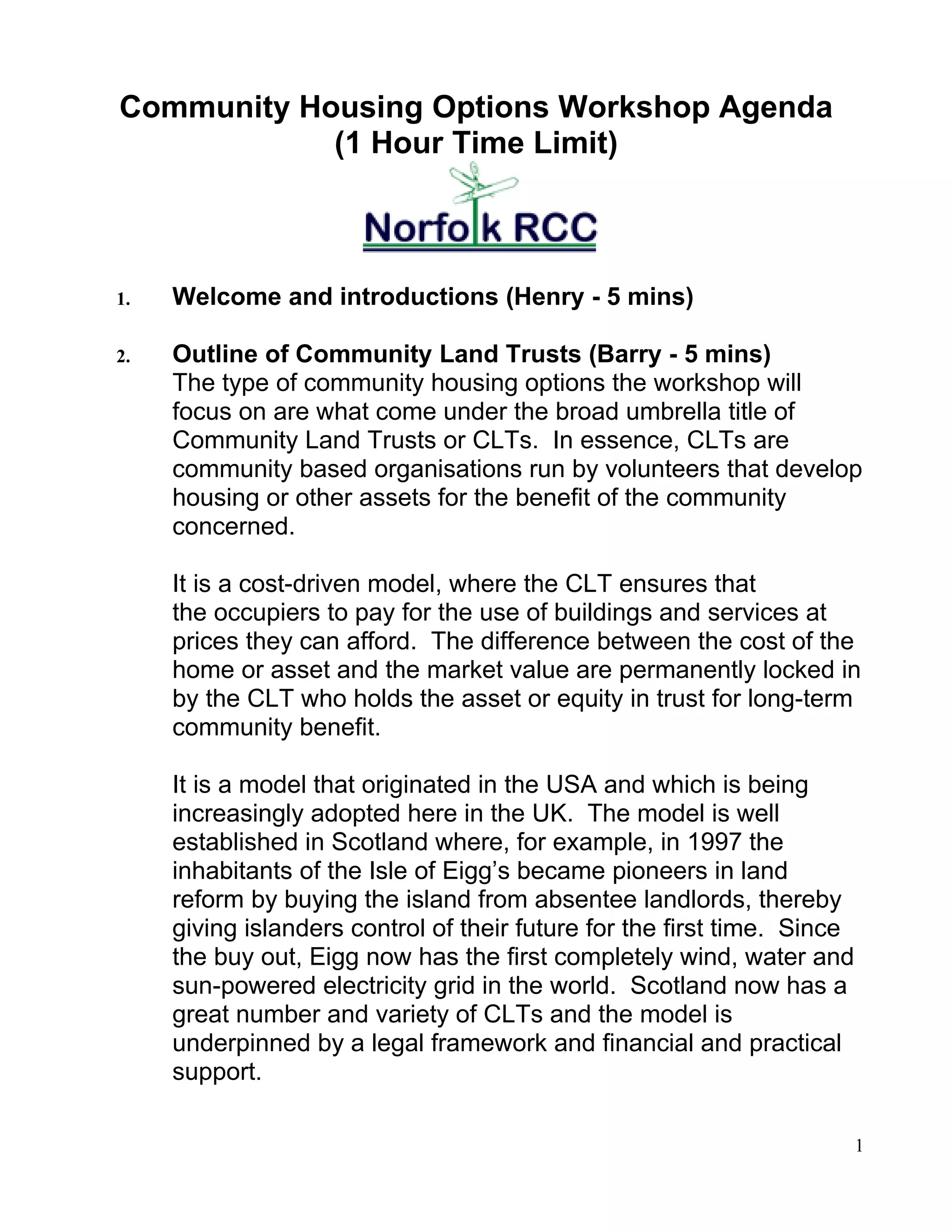
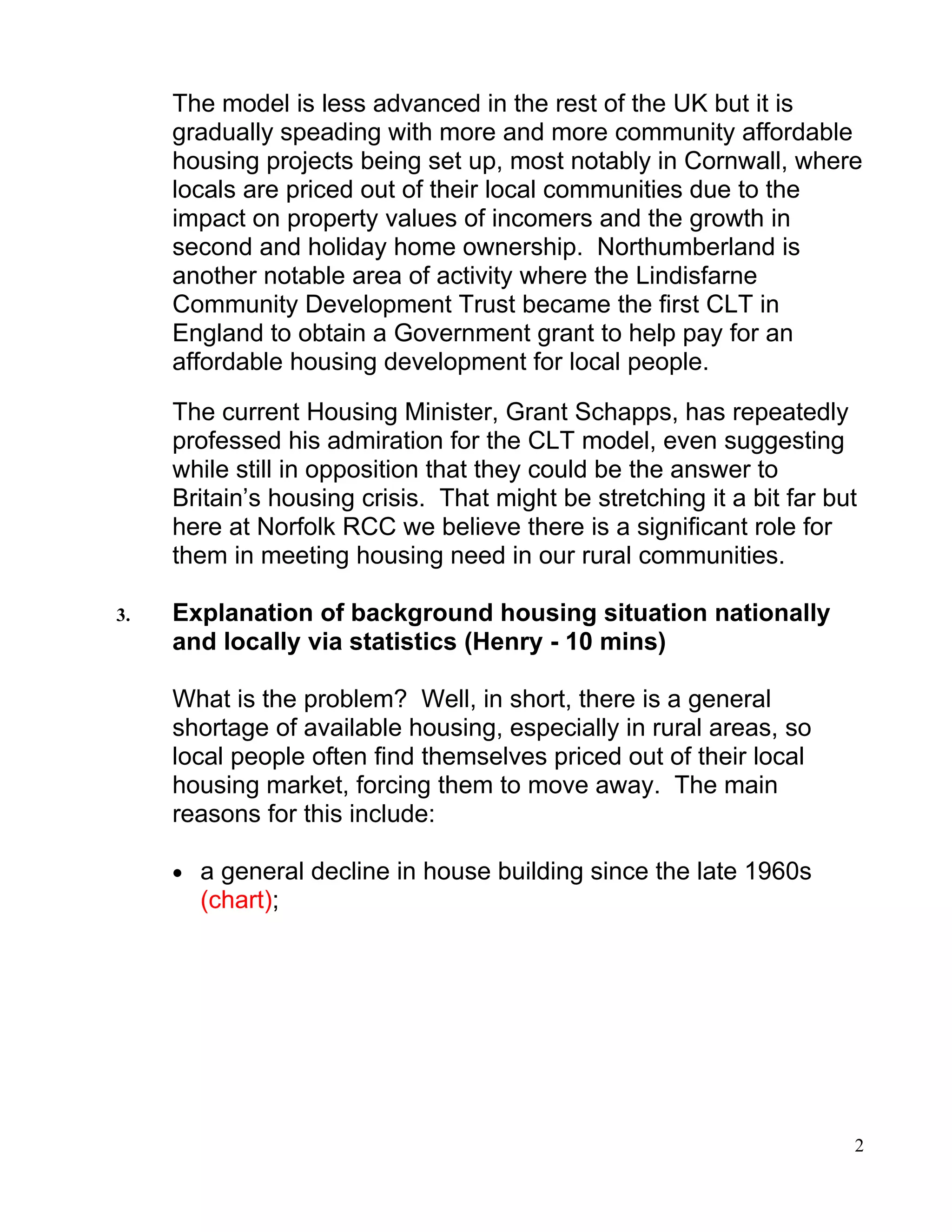
     • a general decline in house building since the late 1960s
       (chart);


                                                                       2
• the loss of former council houses sold under ‘Right to Buy’
  and the failure to replace them;
• relatively low rural incomes;

                                                                3
• increased demand and prices due to wealthier people
  moving to the countryside from urban areas;and,
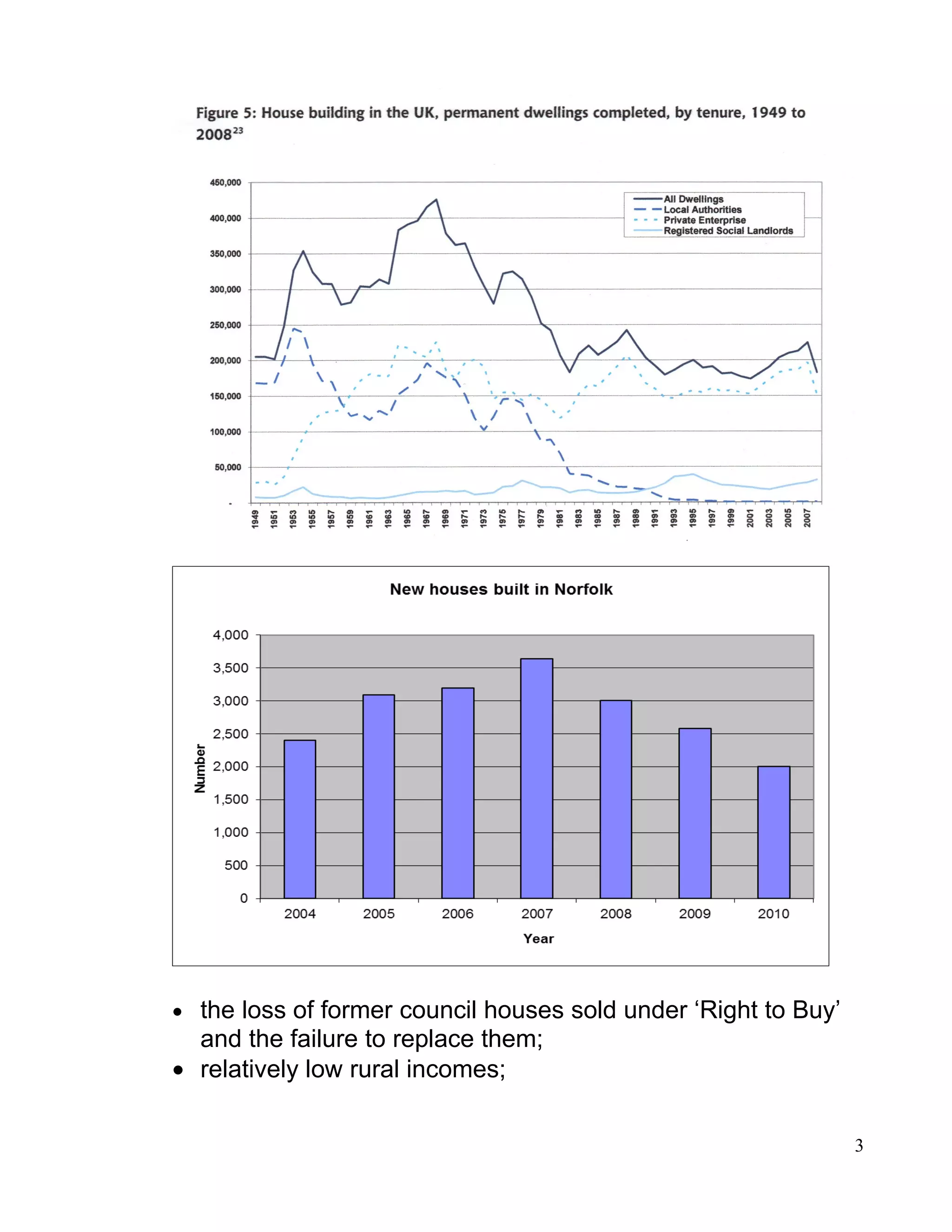
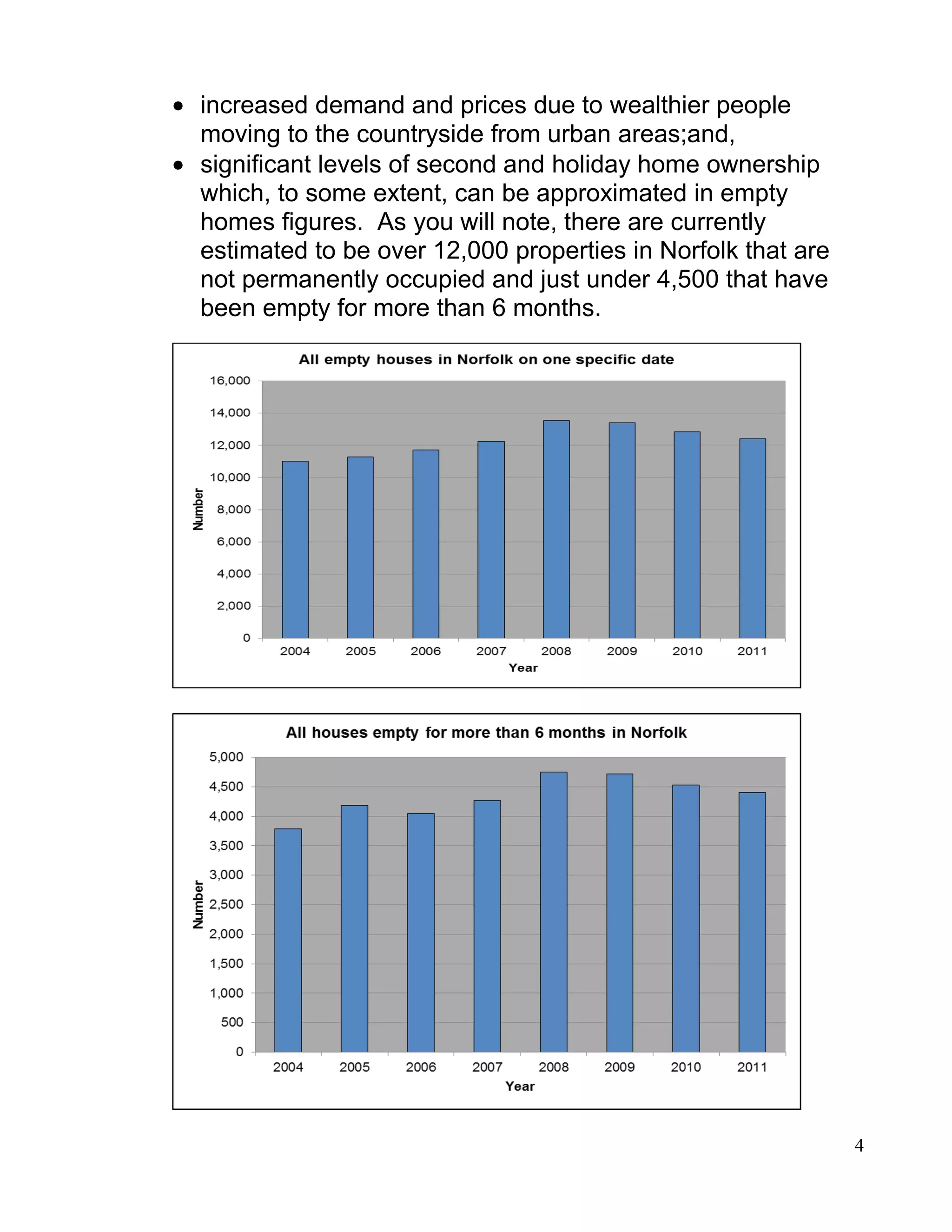
• significant levels of second and holiday home ownership
  which, to some extent, can be approximated in empty
  homes figures. As you will note, there are currently
  estimated to be over 12,000 properties in Norfolk that are
  not permanently occupied and just under 4,500 that have
  been empty for more than 6 months.


                                                               4
As a result, it is fairly typical to find that average property
prices in rural Norfolk are such as to require a mortgage the
equivalent of 10 times the average rural income. In some
areas with very high levels of second and holiday home
ownership, such as on the North Norfolk coast, the ratio of
property prices to local incomes is substantially higher still.
Thus, home ownership is clearly not an option for many and
the lack of rental alternatives, affordable or otherwise, leaves
little option but to look elsewhere.

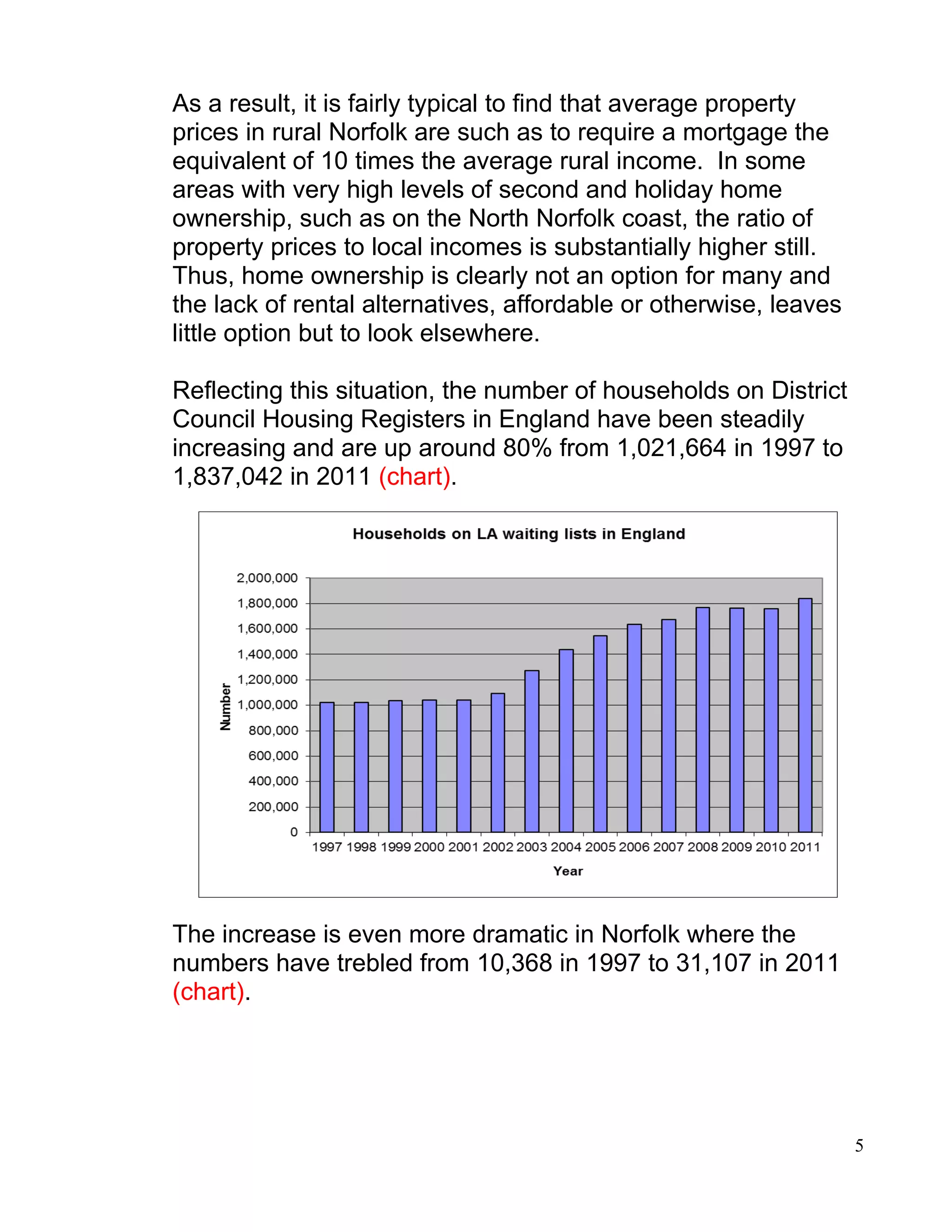
Reflecting this situation, the number of households on District
Council Housing Registers in England have been steadily
increasing and are up around 80% from 1,021,664 in 1997 to
1,837,042 in 2011 (chart).


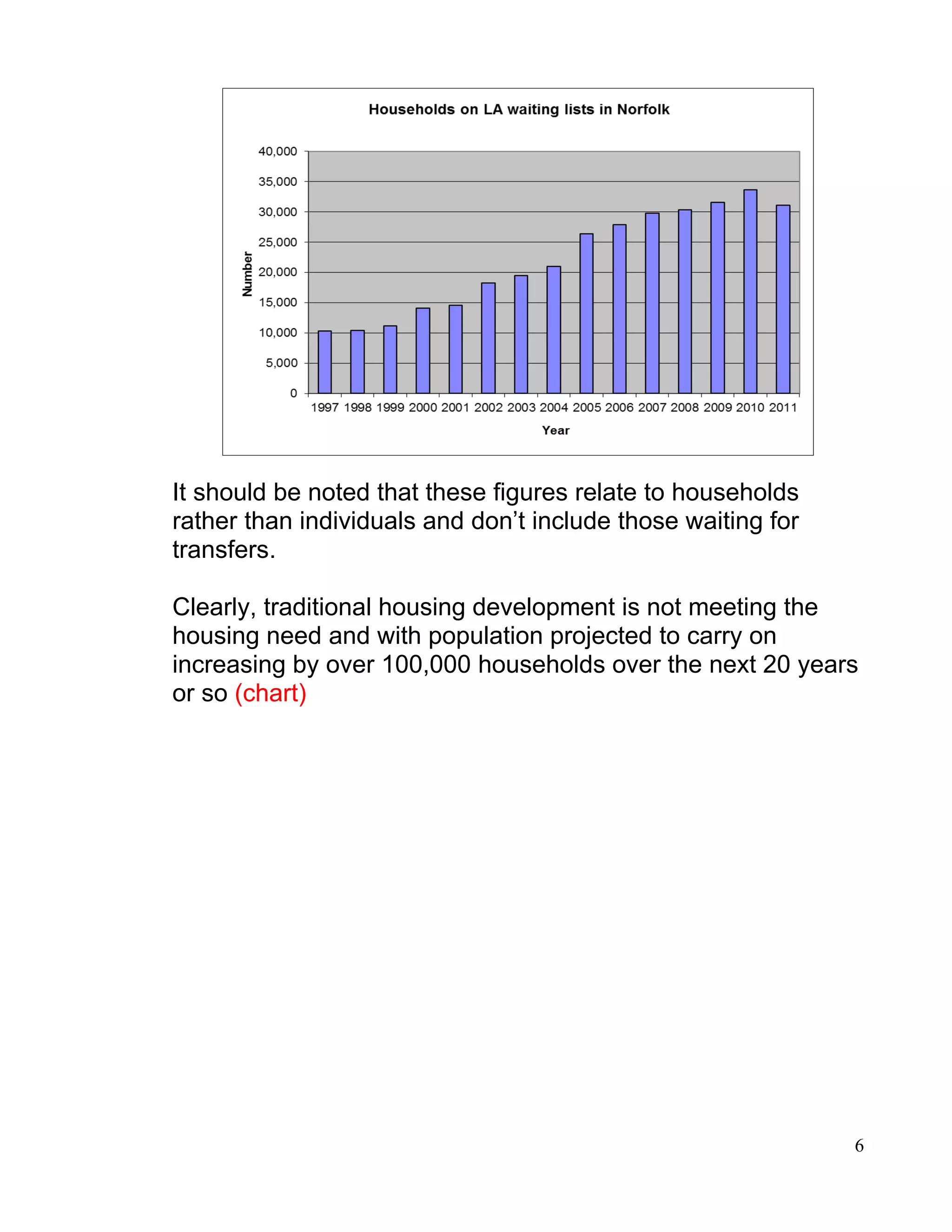
The increase is even more dramatic in Norfolk where the
numbers have trebled from 10,368 in 1997 to 31,107 in 2011
(chart).


                                                                   5
It should be noted that these figures relate to households
rather than individuals and don’t include those waiting for
transfers.

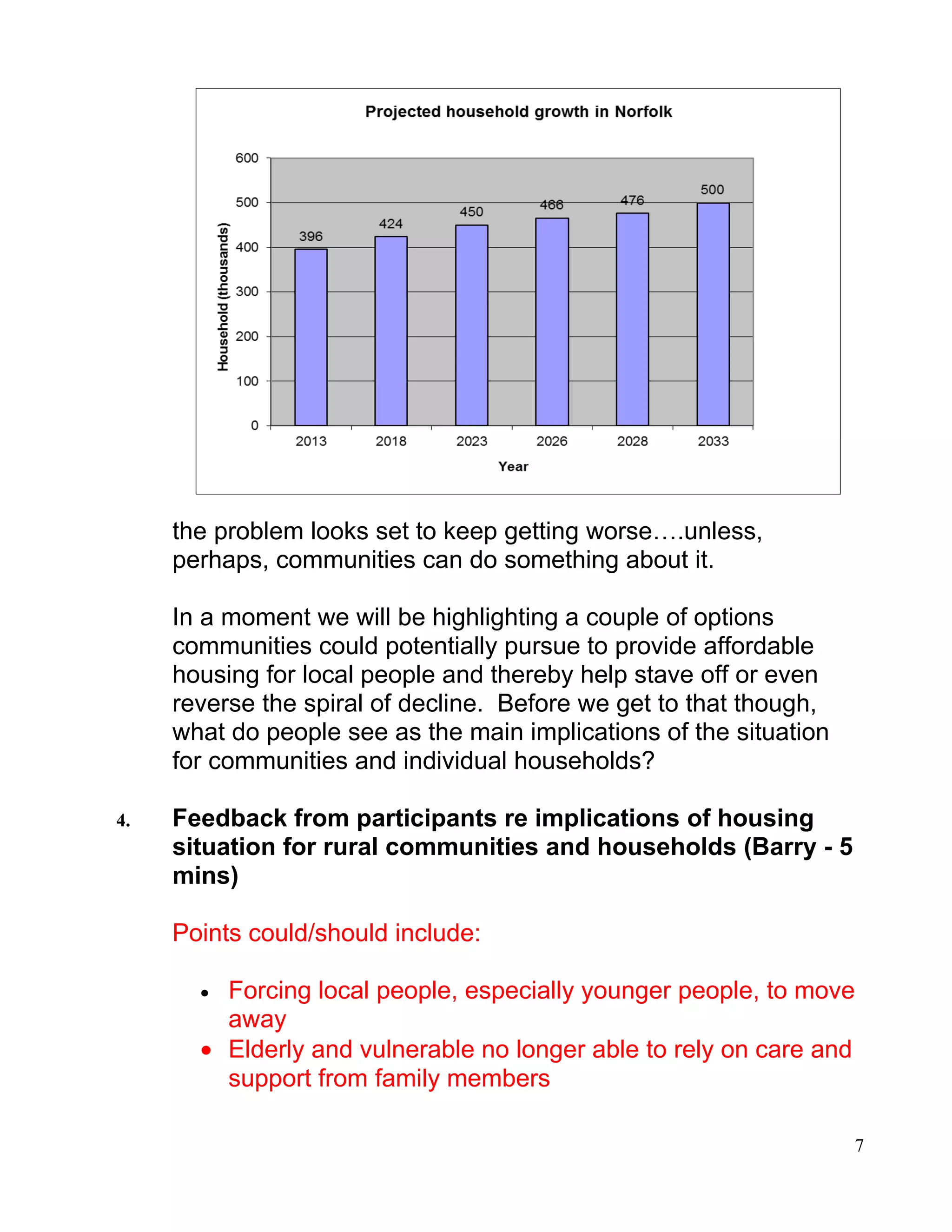
Clearly, traditional housing development is not meeting the
housing need and with population projected to carry on
increasing by over 100,000 households over the next 20 years
or so (chart)


                                                              6
the problem looks set to keep getting worse….unless,
     perhaps, communities can do something about it.

     In a moment we will be highlighting a couple of options
     communities could potentially pursue to provide affordable
     housing for local people and thereby help stave off or even
     reverse the spiral of decline. Before we get to that though,
     what do people see as the main implications of the situation
     for communities and individual households?

4.   Feedback from participants re implications of housing
     situation for rural communities and households (Barry - 5
     mins)

     Points could/should include:

       • Forcing local people, especially younger people, to move
         away
       • Elderly and vulnerable no longer able to rely on care and
         support from family members

                                                                    7
•   More difficult for local schools, POs, shops and other
              businesses and services to remain viable due to loss of
              customers/users and potential staff
          •   Social networks and community cohesion suffers
          •   People forced into living in overcrowded, insecure and/or
              substandard conditions
          •   Health problems due to overcrowding, damp and
              disrepair
          •   Children with no room to play or study adversely affecting
              life chances
          •   Homelessness

5.   Outline of some Community Housing Trust type options

     a)   2nd homes model (eg. Homes For Wells) (Barry - 5 mins)
          This model was initially based on finding absentee owners
          of second and holiday homes who were willing to let their
          properties to local tenants at affordable rents and then
          matching up landlords and tenants. It was set up in such a
          way that it could simply provide owners with a tenant finding
          service or it could include a property lettings/management
          service too if that’s what owners preferred. As seen in the
          empty homes charts, we are potentially talking about
          significant numbers of properties that could be brought back
          into use.

          The model can also extend to property development, by
          utilising existing empty homes and other properties and
          surplus land for local lettings. For example, larger houses
          could be turned into several flats and larger gardens could
          be built on.

          Norfolk RCC currently has a project roughly following the
          Homes For Wells model by looking to extend it to other
          areas where there are high levels of second and holiday
          home ownership.
                                                                        8
b)   Poor’s Trusts (Henry - 5 mins)
     A key issue with CLT type housing schemes is how they are
     financed. Typically the finance will be a combination of
     grants, loans and subsidy. One way to help make
     community housing schemes affordable is by securing
     development land at low, or no, price. Norfolk RCC is just
     about to roll out a project that will aim to utilise Poor’s Trust/
     Relief Charity land holdings that exist in pretty much every
     parish.

     These Poor’s Trusts were set up at the time of the Land
     Enclosures, mostly between about 1760 and 1820.
     Basically, wealthy landowners gained possession of public
     or common land through individual Acts of Enclosure
     covering one or more parishes. As part of each Act of
     Enclosure there was usually a requirement to set aside
     some land for the benefit of the poor. In effect, the Acts set
     of parish level trusts to administer the Poor’s Land, typically
     (but not exclusively) by renting it out and using the income
     to provide fuel or alms for the poor of the parish.

     Nowadays, the majority of Poor’s Trusts seem to generate
     very little income (some as little as £30 or £40 per year)
     and, with the advent of the modern welfare state, they often
     struggle to identify poor people to distribute whatever fuel or
     funds they do generate. Therefore, they often aren’t really
     able to fulfill very effectively what we would now term their
     charitable purposes. We at Norfolk RCC saw an
     opportunity to help some of them to help the modern poor of
     the parish by either converting them to CLTs or by making
     the Poor’s Land available to a purpose built CLT to provide
     affordable housing for local people who may otherwise be
     forced to move away.

c)   Ashwellthorpe scheme (Barry - 5 mins)
                                                                       9
This model was based on subsidy from market housing –
         insert Barry’s piece

6.   Exercise (Henry - 10 mins)

     There are certain fundamental issues that any community
     housing solution is likely to involve so how do you think
     communities could go about the following? (some suggested
     answers in red)

     •   Getting people involved to drive the project forward (ie. set
         up a Community Housing Trust type organisation) – raise
         with PC, identify who is already active in community, who is
         interested in issue, who works in housing/property/planning
         and/or who has relevant skills (development, finance,
         project management, etc)
     •   Identifying local housing need – see if anyone knows of
         anyone who needs local housing, ask whoever runs LA
         housing register for info re people who have expressed an
         interest in local housing, do survey (always)
     •   Finding/securing suitable properties/land – identify local
         property owners (especially absentees) and landowners,
         including poors/relief charities, with aim of securing
         properties/land cheaply or even free, requires having some
         understand of land suitability both for development and
         planning purposes
     •   Undertaking development – DIY, employ developer such as
         Housing Association
     •   Obtaining development funding, where needed - HCA, other
         grant providers, loans, land/property sales
     •   Getting planning permission, if required - basically become
         familiar with planning rules or (consult/employ someone
         who is) and consult LA planning dept, under Localism Act
         communities may be able to give planning approval via
         majority vote in local ballot

                                                                    10
•   Dealing with objectors/objections (try to anticipate the sorts
         of objections that could arise and possible responses) –
         need to try to keep people happy as far as possible but
         ultimately the only objections that count relate to planning
         policies, rules and regulations
     •   Setting rents/prices – need to be below market level (80%
         or less)
     •   Deciding who gets the properties – fair/transparent
         allocations policy and procedures
     •   Ensuring they are retained for local people in perpetuity –
         rules preventing outright purchase and sale of share to non-
         locals or transfers to non-locals
     •   Managing and maintaining rental properties – DIY or
         employ staff/contractor

     Please note that Norfolk RCC can now offer guidance and
     support on these sorts of issues.

7.   Questions and close (Barry - 10 mins)
     At end, invite participants to contact Norfolk RCC (put number
     on flipchart agenda) if they or anyone they know may be
     interested in setting up a local housing trust to meet local
     need.


                                                                     11

Community Housing options

  • 1.
    Community Housing OptionsWorkshop Agenda (1 Hour Time Limit) 1. Welcome and introductions (Henry - 5 mins) 2. Outline of Community Land Trusts (Barry - 5 mins) The type of community housing options the workshop will focus on are what come under the broad umbrella title of Community Land Trusts or CLTs. In essence, CLTs are community based organisations run by volunteers that develop housing or other assets for the benefit of the community concerned. It is a cost-driven model, where the CLT ensures that the occupiers to pay for the use of buildings and services at prices they can afford. The difference between the cost of the home or asset and the market value are permanently locked in by the CLT who holds the asset or equity in trust for long-term community benefit. It is a model that originated in the USA and which is being increasingly adopted here in the UK. The model is well established in Scotland where, for example, in 1997 the inhabitants of the Isle of Eigg’s became pioneers in land reform by buying the island from absentee landlords, thereby giving islanders control of their future for the first time. Since the buy out, Eigg now has the first completely wind, water and sun-powered electricity grid in the world. Scotland now has a great number and variety of CLTs and the model is underpinned by a legal framework and financial and practical support. 1
  • 2.
    The model isless advanced in the rest of the UK but it is gradually speading with more and more community affordable housing projects being set up, most notably in Cornwall, where locals are priced out of their local communities due to the impact on property values of incomers and the growth in second and holiday home ownership. Northumberland is another notable area of activity where the Lindisfarne Community Development Trust became the first CLT in England to obtain a Government grant to help pay for an affordable housing development for local people. The current Housing Minister, Grant Schapps, has repeatedly professed his admiration for the CLT model, even suggesting while still in opposition that they could be the answer to Britain’s housing crisis. That might be stretching it a bit far but here at Norfolk RCC we believe there is a significant role for them in meeting housing need in our rural communities. 3. Explanation of background housing situation nationally and locally via statistics (Henry - 10 mins) What is the problem? Well, in short, there is a general shortage of available housing, especially in rural areas, so local people often find themselves priced out of their local housing market, forcing them to move away. The main reasons for this include: • a general decline in house building since the late 1960s (chart); 2
  • 3.
    • the lossof former council houses sold under ‘Right to Buy’ and the failure to replace them; • relatively low rural incomes; 3
  • 4.
    • increased demandand prices due to wealthier people moving to the countryside from urban areas;and, • significant levels of second and holiday home ownership which, to some extent, can be approximated in empty homes figures. As you will note, there are currently estimated to be over 12,000 properties in Norfolk that are not permanently occupied and just under 4,500 that have been empty for more than 6 months. 4
  • 5.
    As a result,it is fairly typical to find that average property prices in rural Norfolk are such as to require a mortgage the equivalent of 10 times the average rural income. In some areas with very high levels of second and holiday home ownership, such as on the North Norfolk coast, the ratio of property prices to local incomes is substantially higher still. Thus, home ownership is clearly not an option for many and the lack of rental alternatives, affordable or otherwise, leaves little option but to look elsewhere. Reflecting this situation, the number of households on District Council Housing Registers in England have been steadily increasing and are up around 80% from 1,021,664 in 1997 to 1,837,042 in 2011 (chart). The increase is even more dramatic in Norfolk where the numbers have trebled from 10,368 in 1997 to 31,107 in 2011 (chart). 5
  • 6.
    It should benoted that these figures relate to households rather than individuals and don’t include those waiting for transfers. Clearly, traditional housing development is not meeting the housing need and with population projected to carry on increasing by over 100,000 households over the next 20 years or so (chart) 6
  • 7.
    the problem looksset to keep getting worse….unless, perhaps, communities can do something about it. In a moment we will be highlighting a couple of options communities could potentially pursue to provide affordable housing for local people and thereby help stave off or even reverse the spiral of decline. Before we get to that though, what do people see as the main implications of the situation for communities and individual households? 4. Feedback from participants re implications of housing situation for rural communities and households (Barry - 5 mins) Points could/should include: • Forcing local people, especially younger people, to move away • Elderly and vulnerable no longer able to rely on care and support from family members 7
  • 8.
    More difficult for local schools, POs, shops and other businesses and services to remain viable due to loss of customers/users and potential staff • Social networks and community cohesion suffers • People forced into living in overcrowded, insecure and/or substandard conditions • Health problems due to overcrowding, damp and disrepair • Children with no room to play or study adversely affecting life chances • Homelessness 5. Outline of some Community Housing Trust type options a) 2nd homes model (eg. Homes For Wells) (Barry - 5 mins) This model was initially based on finding absentee owners of second and holiday homes who were willing to let their properties to local tenants at affordable rents and then matching up landlords and tenants. It was set up in such a way that it could simply provide owners with a tenant finding service or it could include a property lettings/management service too if that’s what owners preferred. As seen in the empty homes charts, we are potentially talking about significant numbers of properties that could be brought back into use. The model can also extend to property development, by utilising existing empty homes and other properties and surplus land for local lettings. For example, larger houses could be turned into several flats and larger gardens could be built on. Norfolk RCC currently has a project roughly following the Homes For Wells model by looking to extend it to other areas where there are high levels of second and holiday home ownership. 8
  • 9.
    b) Poor’s Trusts (Henry - 5 mins) A key issue with CLT type housing schemes is how they are financed. Typically the finance will be a combination of grants, loans and subsidy. One way to help make community housing schemes affordable is by securing development land at low, or no, price. Norfolk RCC is just about to roll out a project that will aim to utilise Poor’s Trust/ Relief Charity land holdings that exist in pretty much every parish. These Poor’s Trusts were set up at the time of the Land Enclosures, mostly between about 1760 and 1820. Basically, wealthy landowners gained possession of public or common land through individual Acts of Enclosure covering one or more parishes. As part of each Act of Enclosure there was usually a requirement to set aside some land for the benefit of the poor. In effect, the Acts set of parish level trusts to administer the Poor’s Land, typically (but not exclusively) by renting it out and using the income to provide fuel or alms for the poor of the parish. Nowadays, the majority of Poor’s Trusts seem to generate very little income (some as little as £30 or £40 per year) and, with the advent of the modern welfare state, they often struggle to identify poor people to distribute whatever fuel or funds they do generate. Therefore, they often aren’t really able to fulfill very effectively what we would now term their charitable purposes. We at Norfolk RCC saw an opportunity to help some of them to help the modern poor of the parish by either converting them to CLTs or by making the Poor’s Land available to a purpose built CLT to provide affordable housing for local people who may otherwise be forced to move away. c) Ashwellthorpe scheme (Barry - 5 mins) 9
  • 10.
    This model wasbased on subsidy from market housing – insert Barry’s piece 6. Exercise (Henry - 10 mins) There are certain fundamental issues that any community housing solution is likely to involve so how do you think communities could go about the following? (some suggested answers in red) • Getting people involved to drive the project forward (ie. set up a Community Housing Trust type organisation) – raise with PC, identify who is already active in community, who is interested in issue, who works in housing/property/planning and/or who has relevant skills (development, finance, project management, etc) • Identifying local housing need – see if anyone knows of anyone who needs local housing, ask whoever runs LA housing register for info re people who have expressed an interest in local housing, do survey (always) • Finding/securing suitable properties/land – identify local property owners (especially absentees) and landowners, including poors/relief charities, with aim of securing properties/land cheaply or even free, requires having some understand of land suitability both for development and planning purposes • Undertaking development – DIY, employ developer such as Housing Association • Obtaining development funding, where needed - HCA, other grant providers, loans, land/property sales • Getting planning permission, if required - basically become familiar with planning rules or (consult/employ someone who is) and consult LA planning dept, under Localism Act communities may be able to give planning approval via majority vote in local ballot 10
  • 11.
    Dealing with objectors/objections (try to anticipate the sorts of objections that could arise and possible responses) – need to try to keep people happy as far as possible but ultimately the only objections that count relate to planning policies, rules and regulations • Setting rents/prices – need to be below market level (80% or less) • Deciding who gets the properties – fair/transparent allocations policy and procedures • Ensuring they are retained for local people in perpetuity – rules preventing outright purchase and sale of share to non- locals or transfers to non-locals • Managing and maintaining rental properties – DIY or employ staff/contractor Please note that Norfolk RCC can now offer guidance and support on these sorts of issues. 7. Questions and close (Barry - 10 mins) At end, invite participants to contact Norfolk RCC (put number on flipchart agenda) if they or anyone they know may be interested in setting up a local housing trust to meet local need. 11