Office of
Performance
Improvement
Quality
Improvement Plans
A How to Guide
December 3 and 4, 2013
Office of
Performance
Improvement
Agenda
• Welcome and introductions of presenters
• Quality Improvement basics
• Characteristics of a good QI Plan
• Presentations from local CHB’s on how they
developed their QI Plans
• Cass County Health and Human Services
• Fillmore-Houston Community Health Board
• MDH process for QI Plans
2
Office of
Performance
Improvement
Objectives
3
• Define Quality Improvement and a quality culture
• Identify the characteristics of a good QI Plan
• Understand how to fit those characteristics into a
QI plan that meets your CHB’s needs
• Learn from local CHB’s how they developed their
QI plans
• Describe how MDH will review the QI plans
submitted
• Learn what resources are available from MDH
and others to help develop a QI plan
Office of
Performance
Improvement
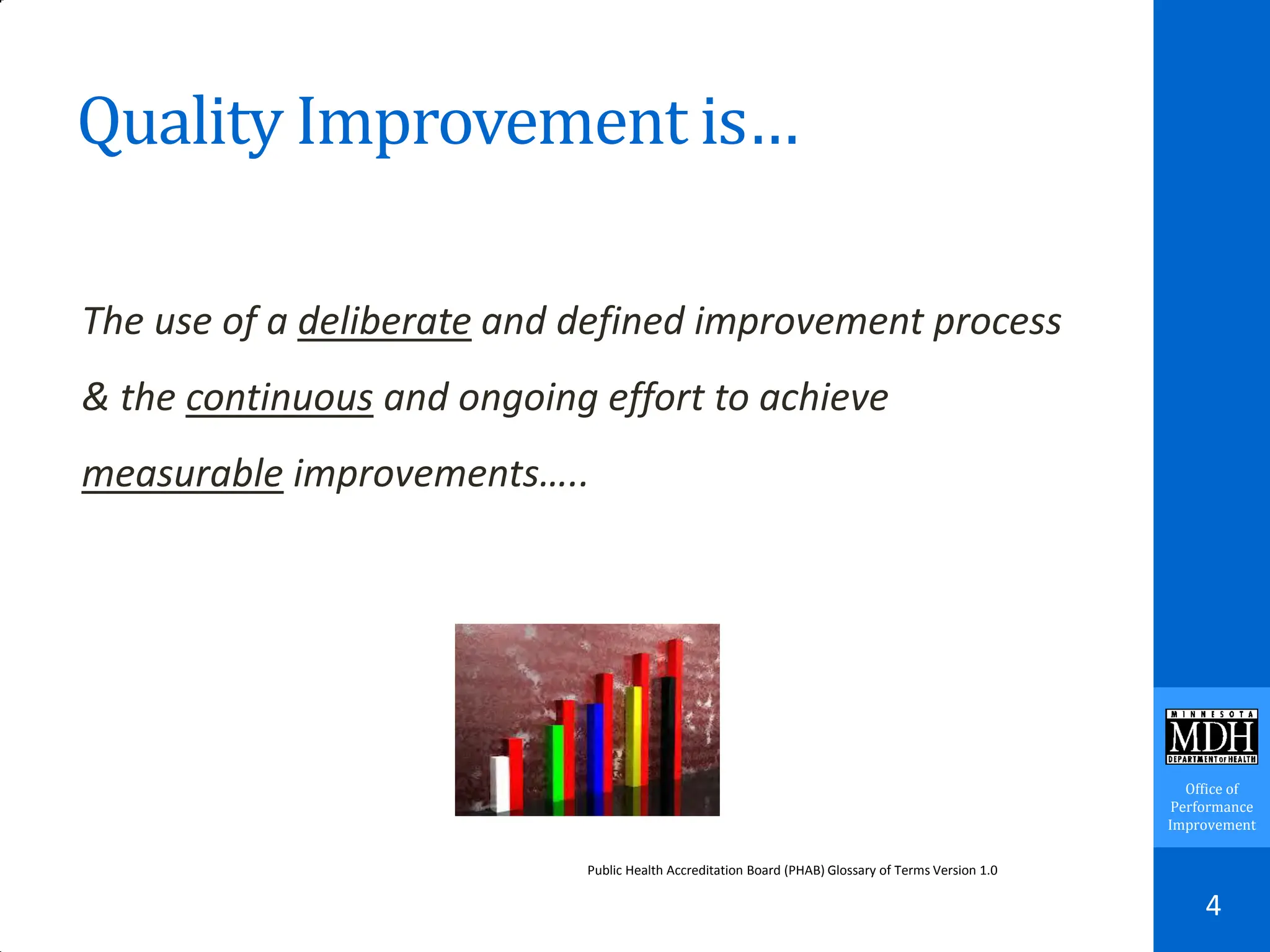
Quality Improvement is…
The use of a deliberate and defined improvement process
& the continuous and ongoing effort to achieve
measurable improvements…..
4
Public Health Accreditation Board (PHAB) Glossary of Terms Version 1.0
Office of
Performance
Improvement
Guiding principles of QI:
5
Continually
improve all
processes
Develop a strong
customer focus
Involve employees
Use data, facts and
team knowledge to
make decisions
Office of
Performance
Improvement
Quality Improvement is NOT
• Quality Assurance
• Measurement of performance relative to
standards
• Traditionally, human error viewed as problem
• Reactive approach – meet standards,
deficiencies corrected
• Program Planning and Evaluation, Research
• Intervention is fixed/constant
• Before and after data collection
6
Courtesy
of:
North
Carolina's
Center
for
Public
Health
Quality
Office of
Performance
Improvement
Ultimate Goal - Continuous QI
Courtesy of: North Carolina’s Center for Public Health Quality
Office of
Performance
Improvement
What is a QI Plan?
“Basic guidance document about how a
Public Health Department will manage,
deploy, and review quality throughout the
organization.”
• Ty Kane, Community Health Analyst, Sedgwick County Health Department, John Moran, Senior Quality Advisor,
Public Health Foundation, Sonja Armbruster, Community Health Assessment Coordinator, Sedgwick County Health
Department
8
Office of
Performance
Improvement
Why is a QI plan important?
• What gets measured gets done
• Good plans lead to implementation
• Schedule for implementing QI efforts
• Schedule for reporting QI efforts to all
stakeholders
• Meet National Standards
9
Office of
Performance
Improvement
Difference between QI Plan
and QI Project
Quality Improvement
Plan
Quality Improvement
Project
Agency/organization/system
Focus
Process/product/service
Focus
Written document to describe
the QI approach in the agency
Using QI methods and tools to
improve
Planning for QI Doing QI
Big QI Little qi
10
Office of
Performance
Improvement
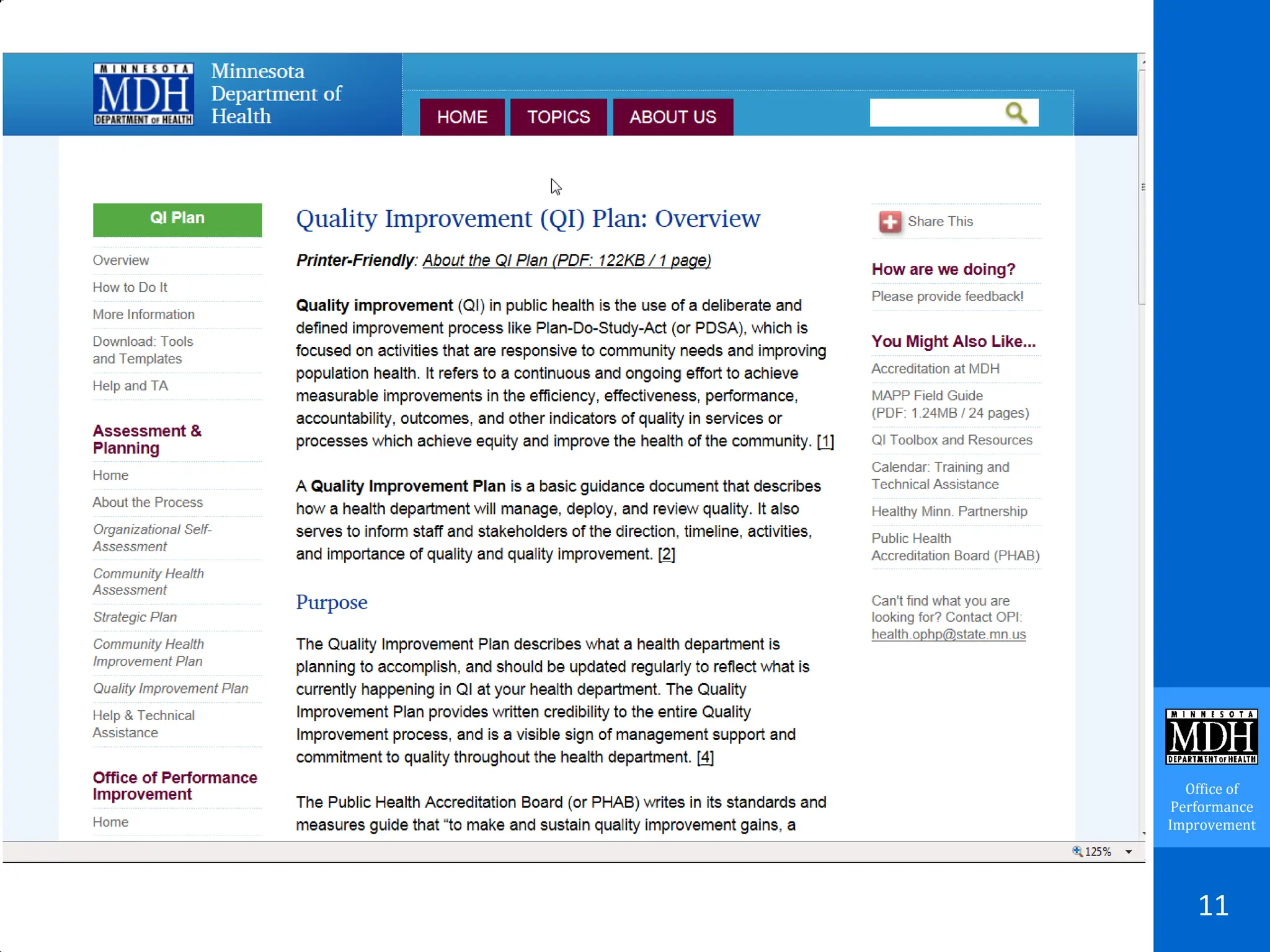
MDH QI Plan Website
11
Office of
Performance
Improvement
Characteristics of a Good QI
Plan
• Purpose Statement
• Structure of Agency’s QI Program
• Describe the Process for QI Projects
• Goals, Objectives and Measures
• Monitor Progress and Results
• Training and Support
• Communication Plan
• Evaluation
12
Office of
Performance
Improvement
Purpose Statement
• What is the mission/vision/goals of quality within the
organization?
• What is the current quality culture within the
organization and where do we want it to be?
• Why is there a need for QI within the organization?
• What is the scope of QI in the organization?
This is often the place to describe key terms and/or
definitions
13
Office of
Performance
Improvement
Structure of your QI Program
• Oversight and direction for QI activities
• QI Council/oversight team structure
• Leadership and staff
• Resources for QI work
• Connection to agency wide activities and performance
management system if one is in place
This is often the place where you would have appendices
of QI council charter, and/or a QI org chart
14
Office of
Performance
Improvement
Describe the Process for QI
Projects
• How to identify and prioritize QI projects
• How those projects connect to:
• Strategic Plan
• Mission/vision
• Other performance measures
This is often the place where you could include
prioritization criteria for projects, submission forms, list of
QI projects to be implemented
15
Office of
Performance
Improvement
Goals, Objectives and Measures
• Organizational, not project specific
• Identify through QI maturity tool or NACCHO’s QI
Roadmap
When goals, objectives and measures are identified, can
include:
• The performance measure to be achieved
• Who is responsible, the time frame
• Activities associated with each objective
16
Office of
Performance
Improvement
Example of Goals, Objectives
and Measures
• Organizational Goal:
Improve the QI culture in the organization
• Organizational Objective:
Raise the organization’s QI maturity score from 3.4 in 2013 to 4.0 in
2014.
All staff attend one of the biennial QI 101 trainings by January 2014
Implement consistent customer satisfaction surveys across all
programs
• Performance Measure:
The QI maturity score
The % of staff attending the QI 101 training
The % of programs that implement consistent customer satisfaction
surveys
17
Office of
Performance
Improvement
Monitor Progress and Results
Specific to organizational goals, objectives and measures
• Describes the process for reporting progress
• How data is collected and analyzed
• Actions to make improvements based on this feedback
18
Office of
Performance
Improvement
Training and Support
• What is going to be required for employees – may
distinguish between requirements for leadership,
program staff and all staff
• What will be offered for employees
• If you have details, you can list them, i.e., new
employee orientation, online course for all staff, etc.
19
Office of
Performance
Improvement
Communication Plan
• How the QI activities will be communicated
• Type of communication –newsletters, meeting updates…
• Person responsible – director, QI council…
• Frequency of reporting – monthly, quarterly…
• Targeted audience – staff, board members…
This is often the place where you could include a
Communications Plan Calendar or chart
20
Office of
Performance
Improvement
Evaluation
• Assess the effectiveness of the QI plan and
activities
• Progress towards goals and objectives for the QI Plan
and QI activities
• Lessons learned
• Customer/stakeholder satisfaction surveys from QI
activities
• Revision and updates
21
Cass County Health, Human &
Veterans Services
Public Health
Jeri Seegmiller PHN
County Team Leader
Prevention Services
Our Quality Improvement Team
Initially:
Jamie Richter – PHN Public Health
Director
Renee Lukkason – PHN County Team
Lead – Family Health
Jeri Seegmiller – PHN County Team
Lead – Adult Health
Merilee Payne – PHN Family Health
Policy
Development
Cass County Health, Human andVeterans Services
Public Health Division
QUALITY IMPROVEMENT PLAN
_______________________________________________________
 ISSUE: Cass County Public Health in efforts to become
accredited in Public Health must comply with Standard 9.2 for
Quality Improvement Plan requirements for policies and
demonstration of Quality Improvement within division.
 PURPOSE:To implement Quality Improvement Committee and
Quality Improvement efforts within Cass County Public Health
division.
Culture of QI
OurVision
 The Quality Improvement
Committee (QIC) will aid in
creating, implementing, maintaining,
and evaluating the quality
improvement (QI) efforts at Cass
County HHVS Public Health
(CCPH) with the intent to improve
the level of performance of key
processes and outcomes
Our Quality Improvement
Committee
 Consists of cross-sectional representatives from
Director of Public Health Nursing, Public Health
Supervisor, program coordinators, and line staff.
 Ad hoc members will be added to the committee as
necessary.
 Chair(s) will be selected by the QIC committee for a
two year term with a staggered rotation.
 The QIC meets on a regular basis and maintains
records and minutes of all meetings.
 The QIC reports toThe CCHHVS Director and
CCHHVS Advisory Board.
Goals:
The Quality Improvement Committee goals in
supporting this effort are:
 Identify, review, monitor and make
recommendations on QI processes/efforts
 Review QI Plan at least annually and adjust as
required
 Identify and meet QI training needs
 Provide guidance, support, and resources for QI
efforts
 Recognize and acknowledge QI efforts
Training
 QI training at our all staff/agency retreats
 Ongoing agenda item at staff public health
staff meetings
 QI projects are reviewed at least Annually
with our Advisory group
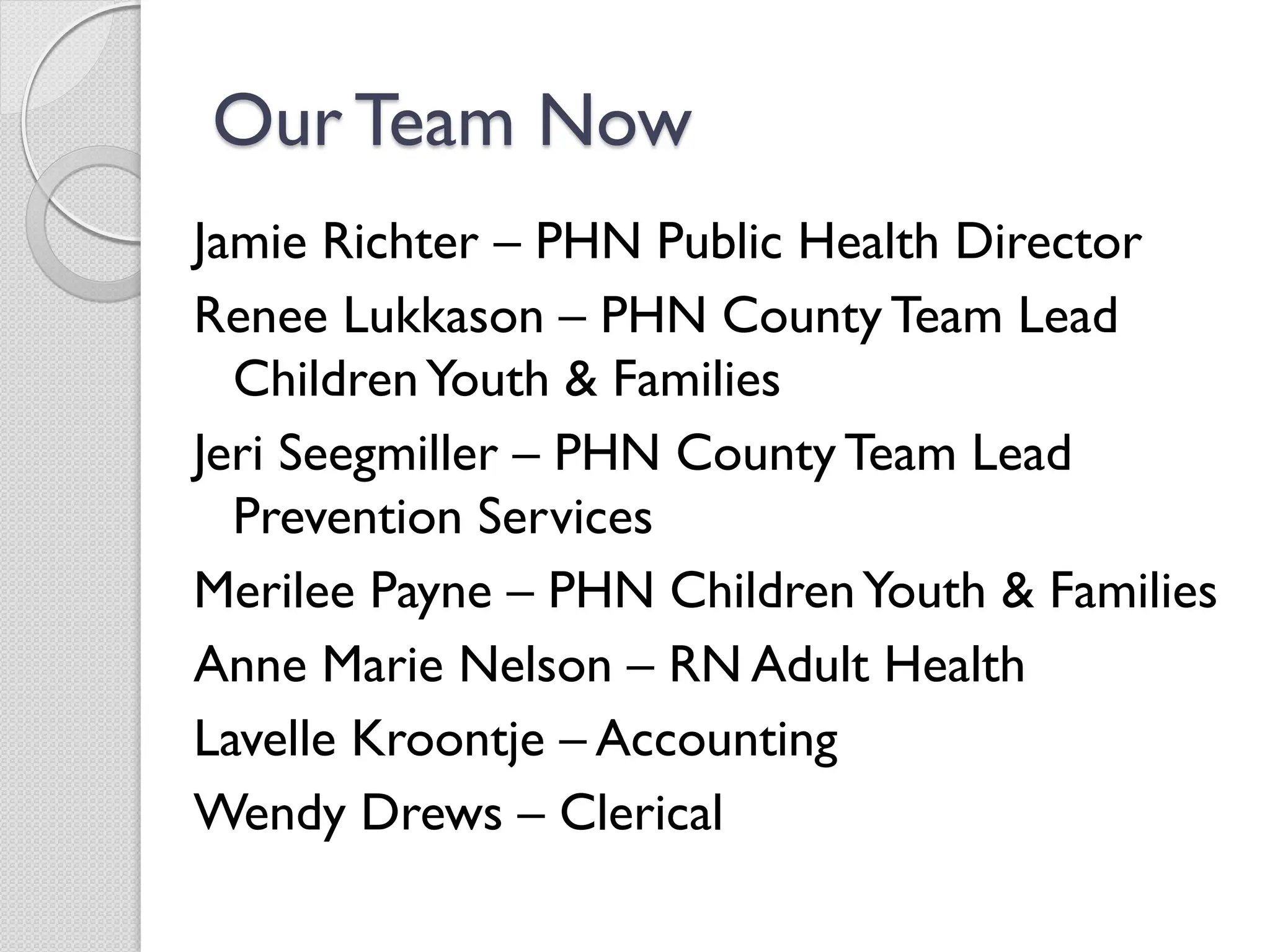
Our Team Now
Jamie Richter – PHN Public Health Director
Renee Lukkason – PHN County Team Lead
ChildrenYouth & Families
Jeri Seegmiller – PHN County Team Lead
Prevention Services
Merilee Payne – PHN ChildrenYouth & Families
Anne Marie Nelson – RN Adult Health
Lavelle Kroontje – Accounting
Wendy Drews – Clerical
• We utilize the Plan
Do Check Act
(PDCA) model of
practice
•Anyone can bring a
project idea for
improvement forward
• As a committee we
review the ideas and
set forth an action
plan
PROJECT ELIMINATE SOS
• Initial 1 month pilot project
with 2 nursing staff – no
problems found
2nd pilot project with select staff
from 2 other program areas –
no problems found
Able to cease the use SOS
forms within 3 months and rely
on reporting for error tacking
• Monthly reports were run
by to verify accuracy.
• Errors found were:
• dailies without intervention
or
• interventions without dailies
corrected by responsible
parties.
• Eliminate 2066 sheets of paper
• Reduce clerical time approx 12
hrs
• Not required by any regulating
entity
• Going Green
• Accurate reporting from PHDoc
to capture charting data from
accounting
• Evaluation during April 2012
Dailies/Intervention Reports
• Dailies with no Charting intervention
• Charting No Daily
• Total Unduplicated = 19 errors out
of 828 billable visits.
• Now has become an ongoing
monthly project
Act Plan
Do
Check
Where are we now
 We have successfully completed 2
projects
 We have 3 projects in various stages of
the process
 We have 3 projects that are ongoing –
customer satisfaction, accreditation,
charting/dailies
 And we are looking at committee make-
up and structure
Thank you!
Brenda Leigh Pohlman, BS,MPH
Health Educator
507-765-2636
bpohlman@co.fillmore.mn.us
FILLMORE-HOUSTON
QUALITY
IMPROVEMENT
PLAN
“Partnering for a Healthy Bluff Country.”
FILLMORE-HOUSTON QIP TIMELINE
• Summer 2011 - Began with participation in the Quality
Improvement Leadership Collaborative sponsored by
MDH. True collaboration for one joint QI plan.
• February 2012 – Draft plan review by MDH.
• March 2012 – Final version of plan, charter, and
associated documents which consist of a
organizational structure, calendar, timeline, project
submission form, project status form, project log,
training log, and glossary of terms.
• November 2012 – Annual QI report and document
updates.
• March 2013 – Plan and document revisions based upon
two QI specialist recommendations to align with PHAB.
• November 2013 - Annual QI report and document
updates.
FILLMORE-HOUSTON QI STRUCTURE
• Each county has a local QI council and also participates
in the joint QI council.
• There are currently six members on the joint council
• There two co-chairs representing each county.
• QI and CHA meetings are rotated every month
• County board and staff also have roles in the plan.
FILLMORE-HOUSTON QI PLAN COMPONENTS
• Defines purpose and scope of QI
• Establishes an organizational structure and roles
• Lists resources and funding for QI efforts
• Provides a framework for developing a QI culture
through staff engagement, training, communications,
QI project selection and management, and
sustainability.
• Guidance for evaluation and revision of QI Plan.
• The QI Plan and Projects are aligned with the Six Areas
of Public Health Responsibility
INDICATORS
• Think of indicators as areas of health you wish to
monitor over a long period of time. Indicators may
lead to projects but projects are not indicators!
• Fillmore and Houston County took the MDH indicator
listing and categorized them into the Six Areas of Public
Health Responsibility
• One indicator from each of the Six Areas of Public
Health Responsibility was selected for long-term
monitoring. For example, radon levels are monitored
for the environmental health area.
GOALS
• A goal is a future event toward
which a committed endeavor is
directed. It should be realistic
yet challenging!
• Your QI goal may be to develop
a quality improvement plan and
submit it to MDH by February
2015.
• Individual projects may also
have goals like reducing
childhood obesity.
• The broader the goal the more
QI projects or project cycles
may be needed to reach the
goal.
OBJECTIVES
• Objectives are the steps to be
taken in pursuit of a goal.
• Your QI objective may be to
identify and manage QI
projects under your QI plan or
provide staff training about QI.
• Individual projects may also
have goals like creating policy,
system, and environmental
changes that impact obesity.
• Objectives often involve many
steps, actions, or activities.
TIPS FOR SUCCESS – BIG QI
• Think about how your QI,
Strategic, and Community Health
Improvement Plans are going to fit
together.
• QI is a process that is dynamic in
nature!
• Work as a team!
• Borrow QI planning documents
and ideas from others.
• Clearly define indicators, goals,
and objectives for the Quality
Improvement Planning Process.
• Use technology for meetings once
QI council is established.
TIPS FOR SUCCESS – LITTLE QI
• Put QI plan documents in place
before taking on projects.
• Projects should be supported by
data and have a concrete AIM
Statement!
• Projects should be completed
within six months. If need be,
break the larger project into
smaller ones.
• Provide a mentor to keep QI teams
and projects on target. Make sure
the team meets at least bi-monthly.
• Learn from unsuccessful and
successful endeavors and
document both because it helps
other to achieve their goal.
RESOURCES
• The Fillmore-Houston CHS Quality Improvement Plan is available
along with other examples on the MDH OPI website at:
http://www.health.state.mn.us/divs/opi/pm/lphap/qiplan/moreinfo.
html#downloads
QUESTIONS?
Brenda Leigh Pohlman, BS,MPH
Health Educator
507-765-2636
bpohlman@co.fillmore.mn.us
Office of
Performance
Improvement
MDH and QI Plans
• MDH Process [www.health.state.mn.us/lphap]
• Review against a checklist for completeness
• This is not a pass/fail
• No need to redo your plan
• CHB’s indicated they wanted feedback from MDH for
required deliverables to MDH
• Assist MDH with TA and training offered by the
Office of Performance Improvement
46
Office of
Performance
Improvement
Additional Resources
MDH Office of Performance Improvement (OPI): QI consultation,
facilitation, training and resources
Public Health Accreditation Board: National standards
National Network of Public Health Institutes –NNPHI: TA and resources on
quality improvement
NACCHO - Quality Improvement: Webinars, toolbox, trainings, publications
around quality improvement
Public Health Foundation: Training and TA on quality improvement,
performance management, performance measures and strengthening
public health workforce.
Washington State Department of Health: Example QI Plans, QI tools and
Resources.
47
Office of
Performance
Improvement
Thank you for joining us!
Minnesota Department of Health
Office of Performance Improvement
http://www.health.state.mn.us/divs/opi/
48
This presentation was supported by funds made available from the Centers for Disease Control and Prevention, Office for State, Tribal, Local and
Territorial Support, under 5U58CD001287-04
The content of this presentation are those of the authors and do not necessarily represent the official position of or endorsement by the Centers for
Disease Control and Prevention.
Office of
Performance
Improvement
MDH Contact Information
Minnesota Department of Health
Office of Performance Improvement
Susan Brace-Adkins
susan.brace-adkins@state.mn.us
651-201-3875
49

quality improvement plans qi managements

  • 1.
  • 2.
    Office of Performance Improvement Agenda • Welcomeand introductions of presenters • Quality Improvement basics • Characteristics of a good QI Plan • Presentations from local CHB’s on how they developed their QI Plans • Cass County Health and Human Services • Fillmore-Houston Community Health Board • MDH process for QI Plans 2
  • 3.
    Office of Performance Improvement Objectives 3 • DefineQuality Improvement and a quality culture • Identify the characteristics of a good QI Plan • Understand how to fit those characteristics into a QI plan that meets your CHB’s needs • Learn from local CHB’s how they developed their QI plans • Describe how MDH will review the QI plans submitted • Learn what resources are available from MDH and others to help develop a QI plan
  • 4.
    Office of Performance Improvement Quality Improvementis… The use of a deliberate and defined improvement process & the continuous and ongoing effort to achieve measurable improvements….. 4 Public Health Accreditation Board (PHAB) Glossary of Terms Version 1.0
  • 5.
    Office of Performance Improvement Guiding principlesof QI: 5 Continually improve all processes Develop a strong customer focus Involve employees Use data, facts and team knowledge to make decisions
  • 6.
    Office of Performance Improvement Quality Improvementis NOT • Quality Assurance • Measurement of performance relative to standards • Traditionally, human error viewed as problem • Reactive approach – meet standards, deficiencies corrected • Program Planning and Evaluation, Research • Intervention is fixed/constant • Before and after data collection 6 Courtesy of: North Carolina's Center for Public Health Quality
  • 7.
    Office of Performance Improvement Ultimate Goal- Continuous QI Courtesy of: North Carolina’s Center for Public Health Quality
  • 8.
    Office of Performance Improvement What isa QI Plan? “Basic guidance document about how a Public Health Department will manage, deploy, and review quality throughout the organization.” • Ty Kane, Community Health Analyst, Sedgwick County Health Department, John Moran, Senior Quality Advisor, Public Health Foundation, Sonja Armbruster, Community Health Assessment Coordinator, Sedgwick County Health Department 8
  • 9.
    Office of Performance Improvement Why isa QI plan important? • What gets measured gets done • Good plans lead to implementation • Schedule for implementing QI efforts • Schedule for reporting QI efforts to all stakeholders • Meet National Standards 9
  • 10.
    Office of Performance Improvement Difference betweenQI Plan and QI Project Quality Improvement Plan Quality Improvement Project Agency/organization/system Focus Process/product/service Focus Written document to describe the QI approach in the agency Using QI methods and tools to improve Planning for QI Doing QI Big QI Little qi 10
  • 11.
  • 12.
    Office of Performance Improvement Characteristics ofa Good QI Plan • Purpose Statement • Structure of Agency’s QI Program • Describe the Process for QI Projects • Goals, Objectives and Measures • Monitor Progress and Results • Training and Support • Communication Plan • Evaluation 12
  • 13.
    Office of Performance Improvement Purpose Statement •What is the mission/vision/goals of quality within the organization? • What is the current quality culture within the organization and where do we want it to be? • Why is there a need for QI within the organization? • What is the scope of QI in the organization? This is often the place to describe key terms and/or definitions 13
  • 14.
    Office of Performance Improvement Structure ofyour QI Program • Oversight and direction for QI activities • QI Council/oversight team structure • Leadership and staff • Resources for QI work • Connection to agency wide activities and performance management system if one is in place This is often the place where you would have appendices of QI council charter, and/or a QI org chart 14
  • 15.
    Office of Performance Improvement Describe theProcess for QI Projects • How to identify and prioritize QI projects • How those projects connect to: • Strategic Plan • Mission/vision • Other performance measures This is often the place where you could include prioritization criteria for projects, submission forms, list of QI projects to be implemented 15
  • 16.
    Office of Performance Improvement Goals, Objectivesand Measures • Organizational, not project specific • Identify through QI maturity tool or NACCHO’s QI Roadmap When goals, objectives and measures are identified, can include: • The performance measure to be achieved • Who is responsible, the time frame • Activities associated with each objective 16
  • 17.
    Office of Performance Improvement Example ofGoals, Objectives and Measures • Organizational Goal: Improve the QI culture in the organization • Organizational Objective: Raise the organization’s QI maturity score from 3.4 in 2013 to 4.0 in 2014. All staff attend one of the biennial QI 101 trainings by January 2014 Implement consistent customer satisfaction surveys across all programs • Performance Measure: The QI maturity score The % of staff attending the QI 101 training The % of programs that implement consistent customer satisfaction surveys 17
  • 18.
    Office of Performance Improvement Monitor Progressand Results Specific to organizational goals, objectives and measures • Describes the process for reporting progress • How data is collected and analyzed • Actions to make improvements based on this feedback 18
  • 19.
    Office of Performance Improvement Training andSupport • What is going to be required for employees – may distinguish between requirements for leadership, program staff and all staff • What will be offered for employees • If you have details, you can list them, i.e., new employee orientation, online course for all staff, etc. 19
  • 20.
    Office of Performance Improvement Communication Plan •How the QI activities will be communicated • Type of communication –newsletters, meeting updates… • Person responsible – director, QI council… • Frequency of reporting – monthly, quarterly… • Targeted audience – staff, board members… This is often the place where you could include a Communications Plan Calendar or chart 20
  • 21.
    Office of Performance Improvement Evaluation • Assessthe effectiveness of the QI plan and activities • Progress towards goals and objectives for the QI Plan and QI activities • Lessons learned • Customer/stakeholder satisfaction surveys from QI activities • Revision and updates 21
  • 22.
    Cass County Health,Human & Veterans Services Public Health Jeri Seegmiller PHN County Team Leader Prevention Services
  • 23.
    Our Quality ImprovementTeam Initially: Jamie Richter – PHN Public Health Director Renee Lukkason – PHN County Team Lead – Family Health Jeri Seegmiller – PHN County Team Lead – Adult Health Merilee Payne – PHN Family Health
  • 24.
  • 25.
    Cass County Health,Human andVeterans Services Public Health Division QUALITY IMPROVEMENT PLAN _______________________________________________________  ISSUE: Cass County Public Health in efforts to become accredited in Public Health must comply with Standard 9.2 for Quality Improvement Plan requirements for policies and demonstration of Quality Improvement within division.  PURPOSE:To implement Quality Improvement Committee and Quality Improvement efforts within Cass County Public Health division.
  • 26.
    Culture of QI OurVision The Quality Improvement Committee (QIC) will aid in creating, implementing, maintaining, and evaluating the quality improvement (QI) efforts at Cass County HHVS Public Health (CCPH) with the intent to improve the level of performance of key processes and outcomes
  • 27.
    Our Quality Improvement Committee Consists of cross-sectional representatives from Director of Public Health Nursing, Public Health Supervisor, program coordinators, and line staff.  Ad hoc members will be added to the committee as necessary.  Chair(s) will be selected by the QIC committee for a two year term with a staggered rotation.  The QIC meets on a regular basis and maintains records and minutes of all meetings.  The QIC reports toThe CCHHVS Director and CCHHVS Advisory Board.
  • 28.
    Goals: The Quality ImprovementCommittee goals in supporting this effort are:  Identify, review, monitor and make recommendations on QI processes/efforts  Review QI Plan at least annually and adjust as required  Identify and meet QI training needs  Provide guidance, support, and resources for QI efforts  Recognize and acknowledge QI efforts
  • 29.
    Training  QI trainingat our all staff/agency retreats  Ongoing agenda item at staff public health staff meetings  QI projects are reviewed at least Annually with our Advisory group
  • 30.
    Our Team Now JamieRichter – PHN Public Health Director Renee Lukkason – PHN County Team Lead ChildrenYouth & Families Jeri Seegmiller – PHN County Team Lead Prevention Services Merilee Payne – PHN ChildrenYouth & Families Anne Marie Nelson – RN Adult Health Lavelle Kroontje – Accounting Wendy Drews – Clerical
  • 31.
    • We utilizethe Plan Do Check Act (PDCA) model of practice •Anyone can bring a project idea for improvement forward • As a committee we review the ideas and set forth an action plan
  • 32.
    PROJECT ELIMINATE SOS •Initial 1 month pilot project with 2 nursing staff – no problems found 2nd pilot project with select staff from 2 other program areas – no problems found Able to cease the use SOS forms within 3 months and rely on reporting for error tacking • Monthly reports were run by to verify accuracy. • Errors found were: • dailies without intervention or • interventions without dailies corrected by responsible parties. • Eliminate 2066 sheets of paper • Reduce clerical time approx 12 hrs • Not required by any regulating entity • Going Green • Accurate reporting from PHDoc to capture charting data from accounting • Evaluation during April 2012 Dailies/Intervention Reports • Dailies with no Charting intervention • Charting No Daily • Total Unduplicated = 19 errors out of 828 billable visits. • Now has become an ongoing monthly project Act Plan Do Check
  • 33.
    Where are wenow  We have successfully completed 2 projects  We have 3 projects in various stages of the process  We have 3 projects that are ongoing – customer satisfaction, accreditation, charting/dailies  And we are looking at committee make- up and structure
  • 34.
  • 35.
    Brenda Leigh Pohlman,BS,MPH Health Educator 507-765-2636 bpohlman@co.fillmore.mn.us FILLMORE-HOUSTON QUALITY IMPROVEMENT PLAN “Partnering for a Healthy Bluff Country.”
  • 36.
    FILLMORE-HOUSTON QIP TIMELINE •Summer 2011 - Began with participation in the Quality Improvement Leadership Collaborative sponsored by MDH. True collaboration for one joint QI plan. • February 2012 – Draft plan review by MDH. • March 2012 – Final version of plan, charter, and associated documents which consist of a organizational structure, calendar, timeline, project submission form, project status form, project log, training log, and glossary of terms. • November 2012 – Annual QI report and document updates. • March 2013 – Plan and document revisions based upon two QI specialist recommendations to align with PHAB. • November 2013 - Annual QI report and document updates.
  • 37.
    FILLMORE-HOUSTON QI STRUCTURE •Each county has a local QI council and also participates in the joint QI council. • There are currently six members on the joint council • There two co-chairs representing each county. • QI and CHA meetings are rotated every month • County board and staff also have roles in the plan.
  • 38.
    FILLMORE-HOUSTON QI PLANCOMPONENTS • Defines purpose and scope of QI • Establishes an organizational structure and roles • Lists resources and funding for QI efforts • Provides a framework for developing a QI culture through staff engagement, training, communications, QI project selection and management, and sustainability. • Guidance for evaluation and revision of QI Plan. • The QI Plan and Projects are aligned with the Six Areas of Public Health Responsibility
  • 39.
    INDICATORS • Think ofindicators as areas of health you wish to monitor over a long period of time. Indicators may lead to projects but projects are not indicators! • Fillmore and Houston County took the MDH indicator listing and categorized them into the Six Areas of Public Health Responsibility • One indicator from each of the Six Areas of Public Health Responsibility was selected for long-term monitoring. For example, radon levels are monitored for the environmental health area.
  • 40.
    GOALS • A goalis a future event toward which a committed endeavor is directed. It should be realistic yet challenging! • Your QI goal may be to develop a quality improvement plan and submit it to MDH by February 2015. • Individual projects may also have goals like reducing childhood obesity. • The broader the goal the more QI projects or project cycles may be needed to reach the goal.
  • 41.
    OBJECTIVES • Objectives arethe steps to be taken in pursuit of a goal. • Your QI objective may be to identify and manage QI projects under your QI plan or provide staff training about QI. • Individual projects may also have goals like creating policy, system, and environmental changes that impact obesity. • Objectives often involve many steps, actions, or activities.
  • 42.
    TIPS FOR SUCCESS– BIG QI • Think about how your QI, Strategic, and Community Health Improvement Plans are going to fit together. • QI is a process that is dynamic in nature! • Work as a team! • Borrow QI planning documents and ideas from others. • Clearly define indicators, goals, and objectives for the Quality Improvement Planning Process. • Use technology for meetings once QI council is established.
  • 43.
    TIPS FOR SUCCESS– LITTLE QI • Put QI plan documents in place before taking on projects. • Projects should be supported by data and have a concrete AIM Statement! • Projects should be completed within six months. If need be, break the larger project into smaller ones. • Provide a mentor to keep QI teams and projects on target. Make sure the team meets at least bi-monthly. • Learn from unsuccessful and successful endeavors and document both because it helps other to achieve their goal.
  • 44.
    RESOURCES • The Fillmore-HoustonCHS Quality Improvement Plan is available along with other examples on the MDH OPI website at: http://www.health.state.mn.us/divs/opi/pm/lphap/qiplan/moreinfo. html#downloads
  • 45.
    QUESTIONS? Brenda Leigh Pohlman,BS,MPH Health Educator 507-765-2636 bpohlman@co.fillmore.mn.us
  • 46.
    Office of Performance Improvement MDH andQI Plans • MDH Process [www.health.state.mn.us/lphap] • Review against a checklist for completeness • This is not a pass/fail • No need to redo your plan • CHB’s indicated they wanted feedback from MDH for required deliverables to MDH • Assist MDH with TA and training offered by the Office of Performance Improvement 46
  • 47.
    Office of Performance Improvement Additional Resources MDHOffice of Performance Improvement (OPI): QI consultation, facilitation, training and resources Public Health Accreditation Board: National standards National Network of Public Health Institutes –NNPHI: TA and resources on quality improvement NACCHO - Quality Improvement: Webinars, toolbox, trainings, publications around quality improvement Public Health Foundation: Training and TA on quality improvement, performance management, performance measures and strengthening public health workforce. Washington State Department of Health: Example QI Plans, QI tools and Resources. 47
  • 48.
    Office of Performance Improvement Thank youfor joining us! Minnesota Department of Health Office of Performance Improvement http://www.health.state.mn.us/divs/opi/ 48 This presentation was supported by funds made available from the Centers for Disease Control and Prevention, Office for State, Tribal, Local and Territorial Support, under 5U58CD001287-04 The content of this presentation are those of the authors and do not necessarily represent the official position of or endorsement by the Centers for Disease Control and Prevention.
  • 49.
    Office of Performance Improvement MDH ContactInformation Minnesota Department of Health Office of Performance Improvement Susan Brace-Adkins susan.brace-adkins@state.mn.us 651-201-3875 49