QUALITATIVE
APPROACH
QUANTITATIVE
APPROACH
QUALITATIVE
APPROACH
QUANTITATIVE
APPROACH
QUANTITATIVE
APPROACH
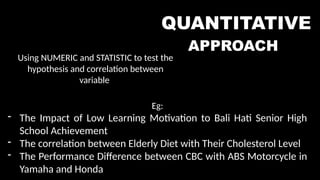
Using NUMERIC and STATISTIC to test the
hypothesis and correlation between
variable
Eg:
- The Impact of Low Learning Motivation to Bali Hati Senior High
School Achievement
- The correlation between Elderly Diet with Their Cholesterol Level
- The Performance Difference between CBC with ABS Motorcycle in
Yamaha and Honda
QUALITATIVE
APPROACH
QUANTITATIVE
APPROACH
QUALITATIVE
APPROACH
QUANTITATIVE
APPROACH
QUALITATIVE
APPROACH
QUANTITATIVE
APPROACH
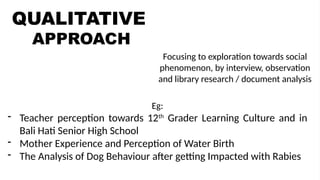
Focusing to exploration towards social
phenomenon, by interview, observation
and library research / document analysis
Eg:
- Teacher perception towards 12th
Grader Learning Culture and in
Bali Hati Senior High School
- Mother Experience and Perception of Water Birth
- The Analysis of Dog Behaviour after getting Impacted with Rabies
QUALITATIVE
APPROACH
QUANTITATIVE
APPROACH
QUALITATIVE
APPROACH
QUANTITATIVE
APPROACH
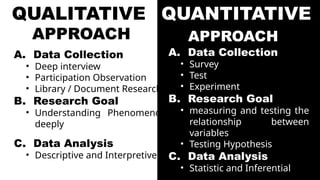
A. Data Collection
• Deep interview
• Participation Observation
• Library / Document Research
B. Research Goal
• Understanding Phenomenon
deeply
C. Data Analysis
• Descriptive and Interpretive
A. Data Collection
• Survey
• Test
• Experiment
B. Research Goal
• measuring and testing the
relationship between
variables
• Testing Hypothesis
C. Data Analysis
• Statistic and Inferential
QUALITATIVE
APPROACH
QUANTITATIVE
APPROACH
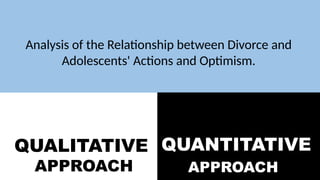
Analysis of the Relationship between Divorce and
Adolescents' Actions and Optimism.
QUALITATIVE
APPROACH
QUANTITATIVE
APPROACH
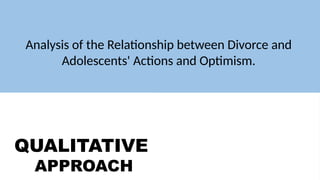
Analysis of the Relationship between Divorce and
Adolescents' Actions and Optimism.
QUALITATIVE
APPROACH
QUANTITATIVE
APPROACH
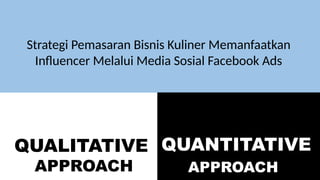
Strategi Pemasaran Bisnis Kuliner Memanfaatkan
Influencer Melalui Media Sosial Facebook Ads
QUALITATIVE
APPROACH
QUANTITATIVE
APPROACH
Strategi Pemasaran Bisnis Kuliner Memanfaatkan
Influencer Melalui Media Sosial Facebook Ads
QUALITATIVE
APPROACH
QUANTITATIVE
APPROACH
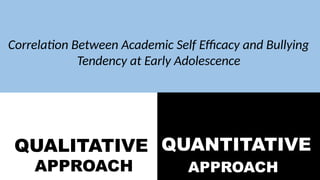
Correlation Between Academic Self Efficacy and Bullying
Tendency at Early Adolescence
QUALITATIVE
APPROACH
QUANTITATIVE
APPROACH
Correlation Between Academic Self Efficacy and Bullying
Tendency at Early Adolesence
QUALITATIVE
APPROACH
QUANTITATIVE
APPROACH
Efektivitas pemberian vitamin pada tanaman Anggrek
Bulan terhadap pertumbuhannya
QUALITATIVE
APPROACH
QUANTITATIVE
APPROACH
Efektivitas pemberian vitamin pada tanaman Anggrek
Bulan terhadap pertumbuhannya
QUALITATIVE
APPROACH
QUANTITATIVE
APPROACH
The Endorsement Phenomenon on Instagram Social
Media in Consumer Society
QUALITATIVE
APPROACH
QUANTITATIVE
APPROACH
The Endorsement Phenomenon on Instagram Social
Media in Consumer Society
QUALITATIVE
APPROACH
QUANTITATIVE
APPROACH
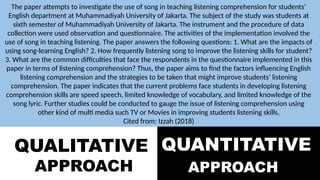
The paper attempts to investigate the use of song in teaching listening comprehension for students’
English department at Muhammadiyah University of Jakarta. The subject of the study was students at
sixth semester of Muhammadiyah University of Jakarta. The instrument and the procedure of data
collection were used observation and questionnaire. The activities of the implementation involved the
use of song in teaching listening. The paper answers the following questions: 1. What are the impacts of
using song-learning English? 2. How frequently listening song to improve the listening skills for student?
3. What are the common difficulties that face the respondents in the questionnaire implemented in this
paper in terms of listening comprehension? Thus, the paper aims to find the factors influencing English
listening comprehension and the strategies to be taken that might improve students’ listening
comprehension. The paper indicates that the current problems face students in developing listening
comprehension skills are speed speech, limited knowledge of vocabulary, and limited knowledge of the
song lyric. Further studies could be conducted to gauge the issue of listening comprehension using
other kind of multi media such TV or Movies in improving students listening skills.
Cited from: Izzah (2018)
QUALITATIVE
APPROACH
QUANTITATIVE
APPROACH
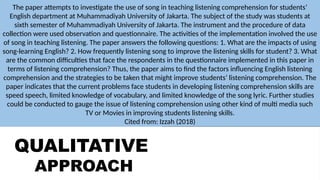
The paper attempts to investigate the use of song in teaching listening comprehension for students’
English department at Muhammadiyah University of Jakarta. The subject of the study was students at
sixth semester of Muhammadiyah University of Jakarta. The instrument and the procedure of data
collection were used observation and questionnaire. The activities of the implementation involved the use
of song in teaching listening. The paper answers the following questions: 1. What are the impacts of using
song-learning English? 2. How frequently listening song to improve the listening skills for student? 3. What
are the common difficulties that face the respondents in the questionnaire implemented in this paper in
terms of listening comprehension? Thus, the paper aims to find the factors influencing English listening
comprehension and the strategies to be taken that might improve students’ listening comprehension. The
paper indicates that the current problems face students in developing listening comprehension skills are
speed speech, limited knowledge of vocabulary, and limited knowledge of the song lyric. Further studies
could be conducted to gauge the issue of listening comprehension using other kind of multi media such
TV or Movies in improving students listening skills.

Cited from: Izzah (2018)
QUALITATIVE
APPROACH
QUANTITATIVE
APPROACH
This study challenged the widely accepted theory that shadowing is most effective when using easier
materials. This is experiment-based research with 73 learners in total. To examine if difficult materials
can improve learners’ listening comprehension skills, two experiments were conducted. The first study
investigated whether learners’ listening comprehension skills would improve by shadowing with difficult
high school materials and what aspects of listening comprehension skills they would improve by the
shadowing training. 44 Japanese first year high school students participated in the first study. 13 lessons
were taught using a high level English textbook from a Japanese publisher, Crown I. The second study
used authentic difficult materials to support the result of the first study and examine the effectiveness of
difficult materials from a different perspective. 29 high school third year students participated in the
second study and practiced 17 sets of passages in Obama speech collection. Furthermore, potential
problems of shadowing were analyzed descriptively. The results suggest that shadowing with difficult
textbooks can improve students’ listening comprehension skills, and the problems the students have in
listening after short-term shadowing training are addressed.
Cited from: Hamada (2011)
QUALITATIVE
APPROACH
QUANTITATIVE
APPROACH
This study challenged the widely accepted theory that shadowing is most effective when using easier
materials. This is experiment-based research with 73 learners in total. To examine if difficult materials
can improve learners’ listening comprehension skills, two experiments were conducted. The first study
investigated whether learners’ listening comprehension skills would improve by shadowing with difficult
high school materials and what aspects of listening comprehension skills they would improve by the
shadowing training. 44 Japanese first year high school students participated in the first study. 13 lessons
were taught using a high level English textbook from a Japanese publisher, Crown I. The second study
used authentic difficult materials to support the result of the first study and examine the effectiveness of
difficult materials from a different perspective. 29 high school third year students participated in the
second study and practiced 17 sets of passages in Obama speech collection. Furthermore, potential
problems of shadowing were analyzed descriptively. The results suggest that shadowing with difficult
textbooks can improve students’ listening comprehension skills, and the problems the students have in
listening after short-term shadowing training are addressed.
Cited from: Hamada (2011)
THANK YOU

Qualitative Vs Quantitative study about research methodology in simple way

  • 1.
  • 2.
  • 3.
    QUANTITATIVE APPROACH Using NUMERIC andSTATISTIC to test the hypothesis and correlation between variable Eg: - The Impact of Low Learning Motivation to Bali Hati Senior High School Achievement - The correlation between Elderly Diet with Their Cholesterol Level - The Performance Difference between CBC with ABS Motorcycle in Yamaha and Honda
  • 4.
  • 5.
  • 6.
    QUALITATIVE APPROACH QUANTITATIVE APPROACH Focusing to explorationtowards social phenomenon, by interview, observation and library research / document analysis Eg: - Teacher perception towards 12th Grader Learning Culture and in Bali Hati Senior High School - Mother Experience and Perception of Water Birth - The Analysis of Dog Behaviour after getting Impacted with Rabies
  • 7.
  • 8.
    QUALITATIVE APPROACH QUANTITATIVE APPROACH A. Data Collection •Deep interview • Participation Observation • Library / Document Research B. Research Goal • Understanding Phenomenon deeply C. Data Analysis • Descriptive and Interpretive A. Data Collection • Survey • Test • Experiment B. Research Goal • measuring and testing the relationship between variables • Testing Hypothesis C. Data Analysis • Statistic and Inferential
  • 9.
    QUALITATIVE APPROACH QUANTITATIVE APPROACH Analysis of theRelationship between Divorce and Adolescents' Actions and Optimism.
  • 10.
    QUALITATIVE APPROACH QUANTITATIVE APPROACH Analysis of theRelationship between Divorce and Adolescents' Actions and Optimism.
  • 11.
    QUALITATIVE APPROACH QUANTITATIVE APPROACH Strategi Pemasaran BisnisKuliner Memanfaatkan Influencer Melalui Media Sosial Facebook Ads
  • 12.
    QUALITATIVE APPROACH QUANTITATIVE APPROACH Strategi Pemasaran BisnisKuliner Memanfaatkan Influencer Melalui Media Sosial Facebook Ads
  • 13.
    QUALITATIVE APPROACH QUANTITATIVE APPROACH Correlation Between AcademicSelf Efficacy and Bullying Tendency at Early Adolescence
  • 14.
    QUALITATIVE APPROACH QUANTITATIVE APPROACH Correlation Between AcademicSelf Efficacy and Bullying Tendency at Early Adolesence
  • 15.
    QUALITATIVE APPROACH QUANTITATIVE APPROACH Efektivitas pemberian vitaminpada tanaman Anggrek Bulan terhadap pertumbuhannya
  • 16.
    QUALITATIVE APPROACH QUANTITATIVE APPROACH Efektivitas pemberian vitaminpada tanaman Anggrek Bulan terhadap pertumbuhannya
  • 17.
    QUALITATIVE APPROACH QUANTITATIVE APPROACH The Endorsement Phenomenonon Instagram Social Media in Consumer Society
  • 18.
    QUALITATIVE APPROACH QUANTITATIVE APPROACH The Endorsement Phenomenonon Instagram Social Media in Consumer Society
  • 19.
    QUALITATIVE APPROACH QUANTITATIVE APPROACH The paper attemptsto investigate the use of song in teaching listening comprehension for students’ English department at Muhammadiyah University of Jakarta. The subject of the study was students at sixth semester of Muhammadiyah University of Jakarta. The instrument and the procedure of data collection were used observation and questionnaire. The activities of the implementation involved the use of song in teaching listening. The paper answers the following questions: 1. What are the impacts of using song-learning English? 2. How frequently listening song to improve the listening skills for student? 3. What are the common difficulties that face the respondents in the questionnaire implemented in this paper in terms of listening comprehension? Thus, the paper aims to find the factors influencing English listening comprehension and the strategies to be taken that might improve students’ listening comprehension. The paper indicates that the current problems face students in developing listening comprehension skills are speed speech, limited knowledge of vocabulary, and limited knowledge of the song lyric. Further studies could be conducted to gauge the issue of listening comprehension using other kind of multi media such TV or Movies in improving students listening skills. Cited from: Izzah (2018)
  • 20.
    QUALITATIVE APPROACH QUANTITATIVE APPROACH The paper attemptsto investigate the use of song in teaching listening comprehension for students’ English department at Muhammadiyah University of Jakarta. The subject of the study was students at sixth semester of Muhammadiyah University of Jakarta. The instrument and the procedure of data collection were used observation and questionnaire. The activities of the implementation involved the use of song in teaching listening. The paper answers the following questions: 1. What are the impacts of using song-learning English? 2. How frequently listening song to improve the listening skills for student? 3. What are the common difficulties that face the respondents in the questionnaire implemented in this paper in terms of listening comprehension? Thus, the paper aims to find the factors influencing English listening comprehension and the strategies to be taken that might improve students’ listening comprehension. The paper indicates that the current problems face students in developing listening comprehension skills are speed speech, limited knowledge of vocabulary, and limited knowledge of the song lyric. Further studies could be conducted to gauge the issue of listening comprehension using other kind of multi media such TV or Movies in improving students listening skills. Cited from: Izzah (2018)
  • 21.
    QUALITATIVE APPROACH QUANTITATIVE APPROACH This study challengedthe widely accepted theory that shadowing is most effective when using easier materials. This is experiment-based research with 73 learners in total. To examine if difficult materials can improve learners’ listening comprehension skills, two experiments were conducted. The first study investigated whether learners’ listening comprehension skills would improve by shadowing with difficult high school materials and what aspects of listening comprehension skills they would improve by the shadowing training. 44 Japanese first year high school students participated in the first study. 13 lessons were taught using a high level English textbook from a Japanese publisher, Crown I. The second study used authentic difficult materials to support the result of the first study and examine the effectiveness of difficult materials from a different perspective. 29 high school third year students participated in the second study and practiced 17 sets of passages in Obama speech collection. Furthermore, potential problems of shadowing were analyzed descriptively. The results suggest that shadowing with difficult textbooks can improve students’ listening comprehension skills, and the problems the students have in listening after short-term shadowing training are addressed. Cited from: Hamada (2011)
  • 22.
    QUALITATIVE APPROACH QUANTITATIVE APPROACH This study challengedthe widely accepted theory that shadowing is most effective when using easier materials. This is experiment-based research with 73 learners in total. To examine if difficult materials can improve learners’ listening comprehension skills, two experiments were conducted. The first study investigated whether learners’ listening comprehension skills would improve by shadowing with difficult high school materials and what aspects of listening comprehension skills they would improve by the shadowing training. 44 Japanese first year high school students participated in the first study. 13 lessons were taught using a high level English textbook from a Japanese publisher, Crown I. The second study used authentic difficult materials to support the result of the first study and examine the effectiveness of difficult materials from a different perspective. 29 high school third year students participated in the second study and practiced 17 sets of passages in Obama speech collection. Furthermore, potential problems of shadowing were analyzed descriptively. The results suggest that shadowing with difficult textbooks can improve students’ listening comprehension skills, and the problems the students have in listening after short-term shadowing training are addressed. Cited from: Hamada (2011)
  • 23.