Question Answer Relationships
(QAR):
A Framework for Improving
Literacy Teaching and Learning
Taffy E. Raphael, Ph.D.
University of Illinois at Chicago
Spring, 2005
Focus for Today
• What is QAR?
• Why use QAR
• How can QAR support comprehension
instruction that connects across grade
levels and subject areas and enhances
test-taking?
What is QAR?
“Why Not Tell Them Where
Information Comes From?”
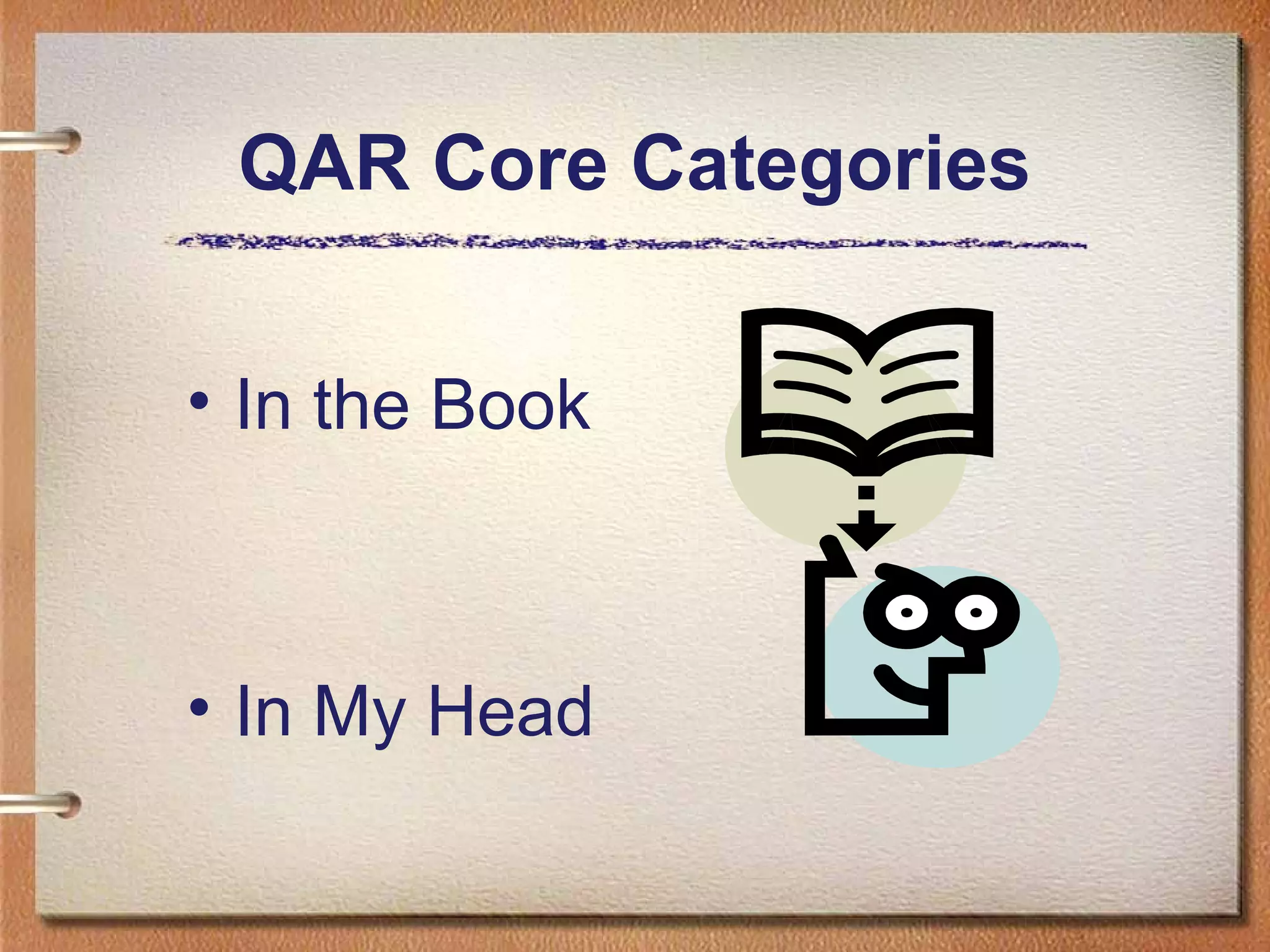
QAR Core Categories
• In the Book
• In My Head
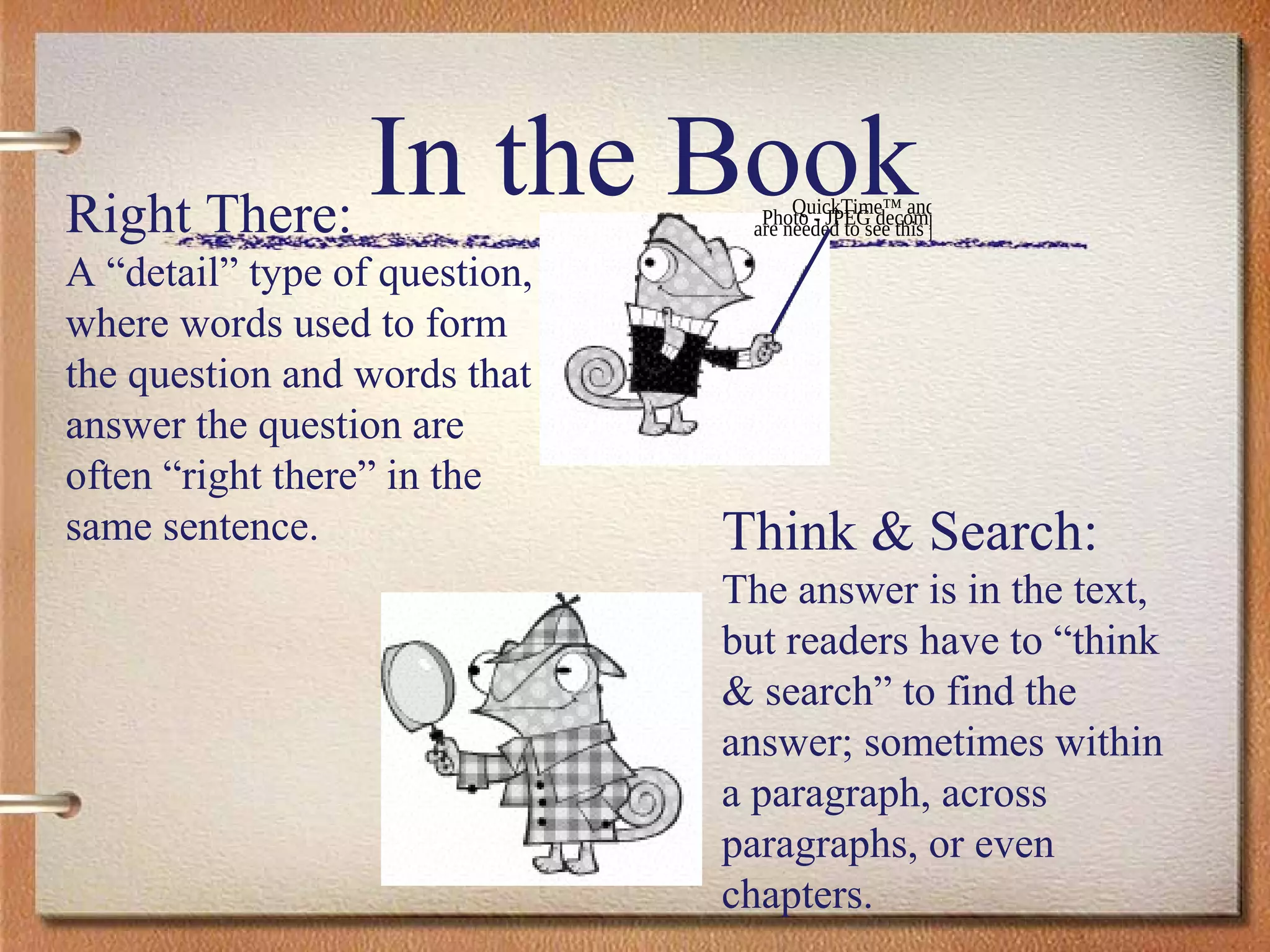
In the BookRight There:
A “detail” type of question,
where words used to form
the question and words that
answer the question are
often “right there” in the
same sentence.
QuickTime™ and aPhoto - JPEG decompressor
are needed to see this picture.
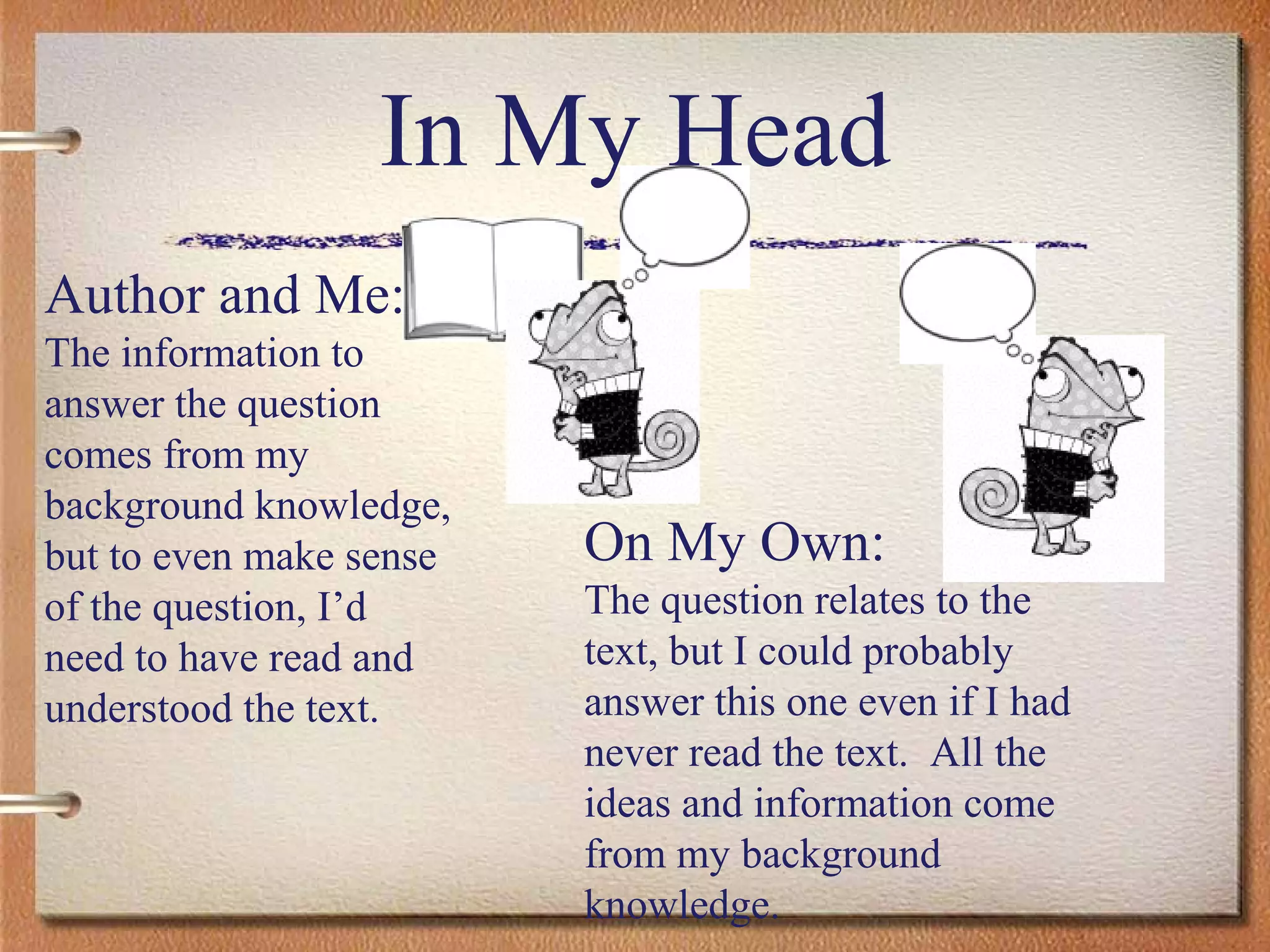
Think & Search:
The answer is in the text,
but readers have to “think
& search” to find the
answer; sometimes within
a paragraph, across
paragraphs, or even
chapters.
In My Head
On My Own:
The question relates to the
text, but I could probably
answer this one even if I had
never read the text. All the
ideas and information come
from my background
knowledge.
Author and Me:
The information to
answer the question
comes from my
background knowledge,
but to even make sense
of the question, I’d
need to have read and
understood the text.
Why Use QAR?
1. A language for ALL to use in talking about
strategies and their use in context
2. A developmental progression that is
visible to students and teachers across
grade levels
3. A logical way to organize comprehension
strategies
4. A valuable approach to test preparation
Thus, QAR Provides a
Common Language
Within grade levels
Across grade levels
Across subject areas
QAR
A Developmental Progression Builds
Coherence Across Grades
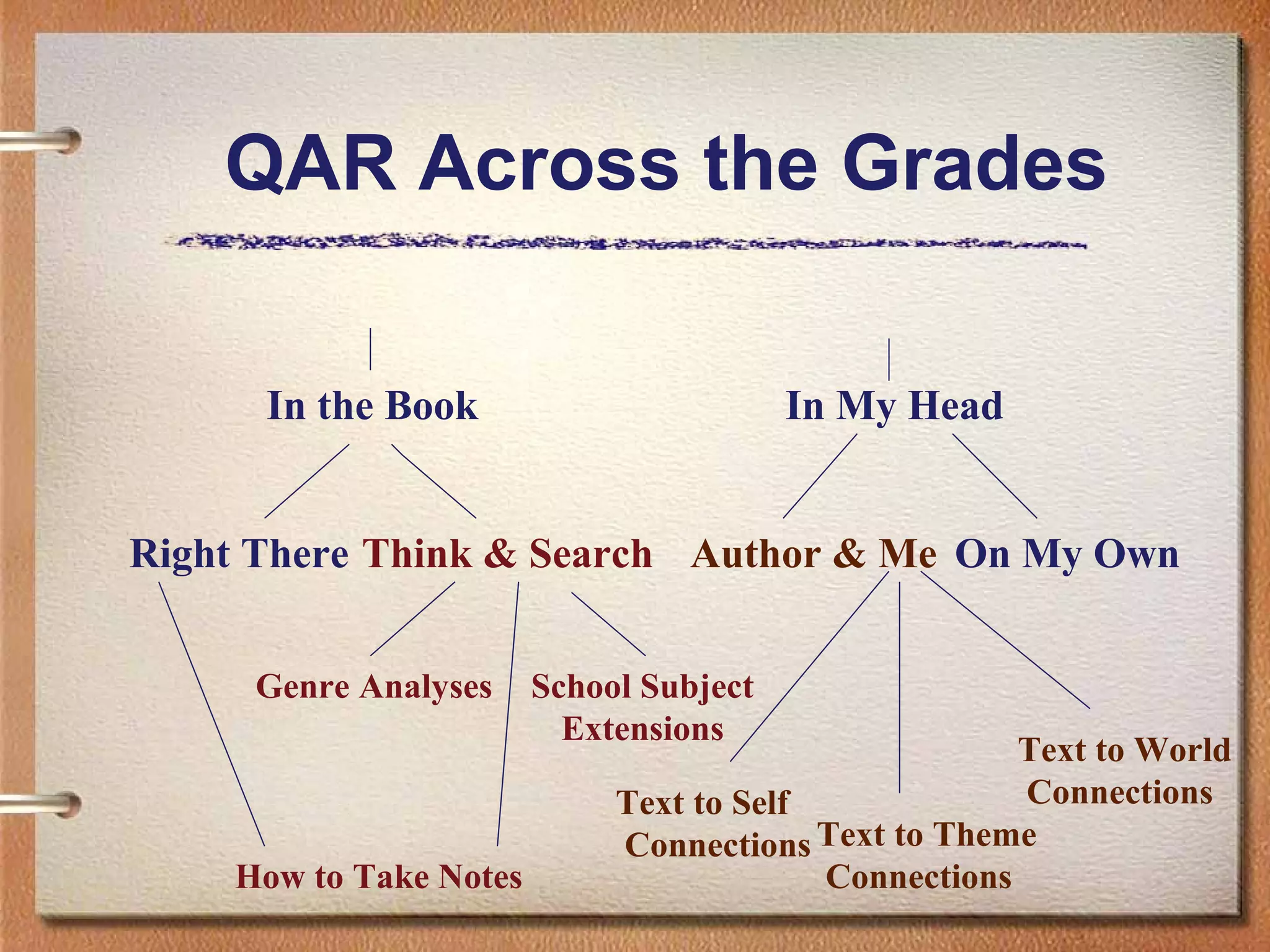
QAR Across the Grades
In the Book In My Head
Right There Think & Search Author & Me On My Own
Genre Analyses School Subject
Extensions
Text to Self
Connections
Text to World
Connections
Text to Theme
ConnectionsHow to Take Notes
Beginning Focus
• Contrast Book / Head
• Consider how knowledge gets into our heads
Individual Accountability
and Reflection
• What do I know about sources of information?
• How can I represent this to someone else?
Picture of Students’ Representations of
In the Book and In My Head QARs
Tools for Primary Grades
• Poster with definitions
• How to use post-its
• Flip Chart for every-pupil
response
Tools in Middle Grades
• Picture of Right There versus Think and
Search definitions
• Picture of Comprehension Strategies
for each QAR
Links to Content Learning
(e.g., science)
• Showing language
connections
– Activating prior
knowledge = making
observations
– Predicting = Stating
a hypothesis
– Taking notes =
Keeping data
Picture of Science
Teacher’s Chart
*Au, K. H. (in press). Multicultural issues and literacy achievement. Mahwah
NJ: Erlbaum.)
*Raphael, T. E., & Au, K. H. (in press). The Standards-Based Change
Process. The California Reader.
Getting Organized for
Comprehension
Instruction
“Staircase” versus “Christmas Tree”
Where Does QAR Fit?
• Identifying Important Information*
• Summarizing
• Making Inferences
– Predicting
– Visualizing
• Questioning
• Monitoring
• Critique and Evaluation
Introduce Students to the
Reading Cycle and the
Role of QAR
Before  During  After Reading
Before Reading
• On My Own: From the title or the topic,
what do I already know that can
connect me to the story/text?
• Author and Me: From the topic, title,
illustrations, and/or book cover, what
might this story/text be about?
DURING READING
• Author and Me:
– What do I think will happen next?
– How would you describe the mood of the story and why is this
important?
• Think and Search
– What is the problem and how is it resolved?
– What role do [insert characters’ names] play in the story?
– What are the important events? (literary, informational)
• Right There: [locate and recall details]
– Who is the main character? (literary)
– Identify the topic sentence in this paragraph (informational)
– What are some words that describe the setting? (literary)
AFTER READING
• Author and Me
– What is the author’s message?
– What is the theme and how is it connected to the
world beyond the story?
– How can I synthesize the information with what I
know from other sources?
– How well does the author make his/her argument?
– How is the author using particular language to
influence our beliefs?
• Think and Search
– Find evidence in the text to support an argument.
Align Strategies to QAR
Categories
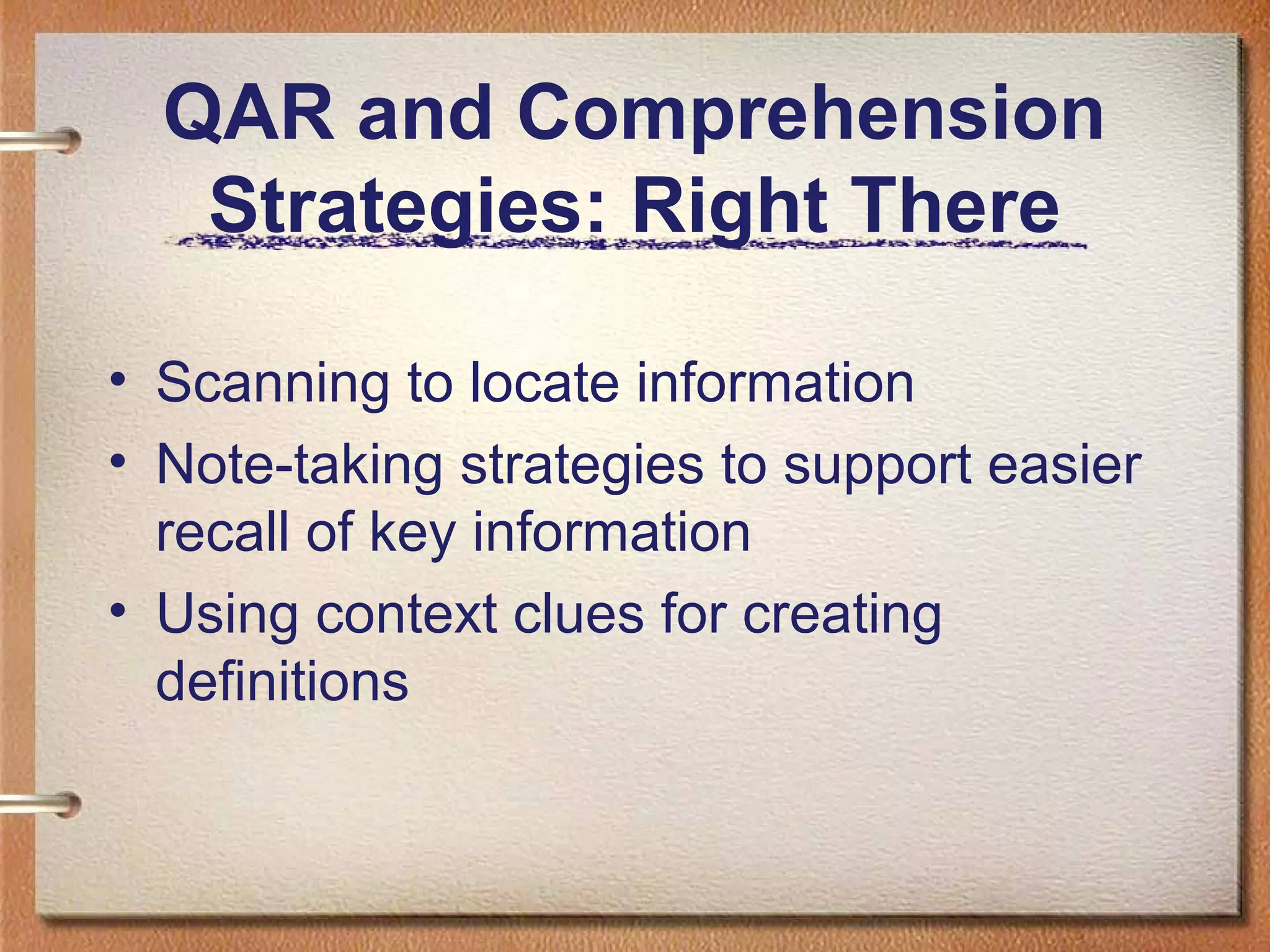
QAR and Comprehension
Strategies: Right There
• Scanning to locate information
• Note-taking strategies to support easier
recall of key information
• Using context clues for creating
definitions
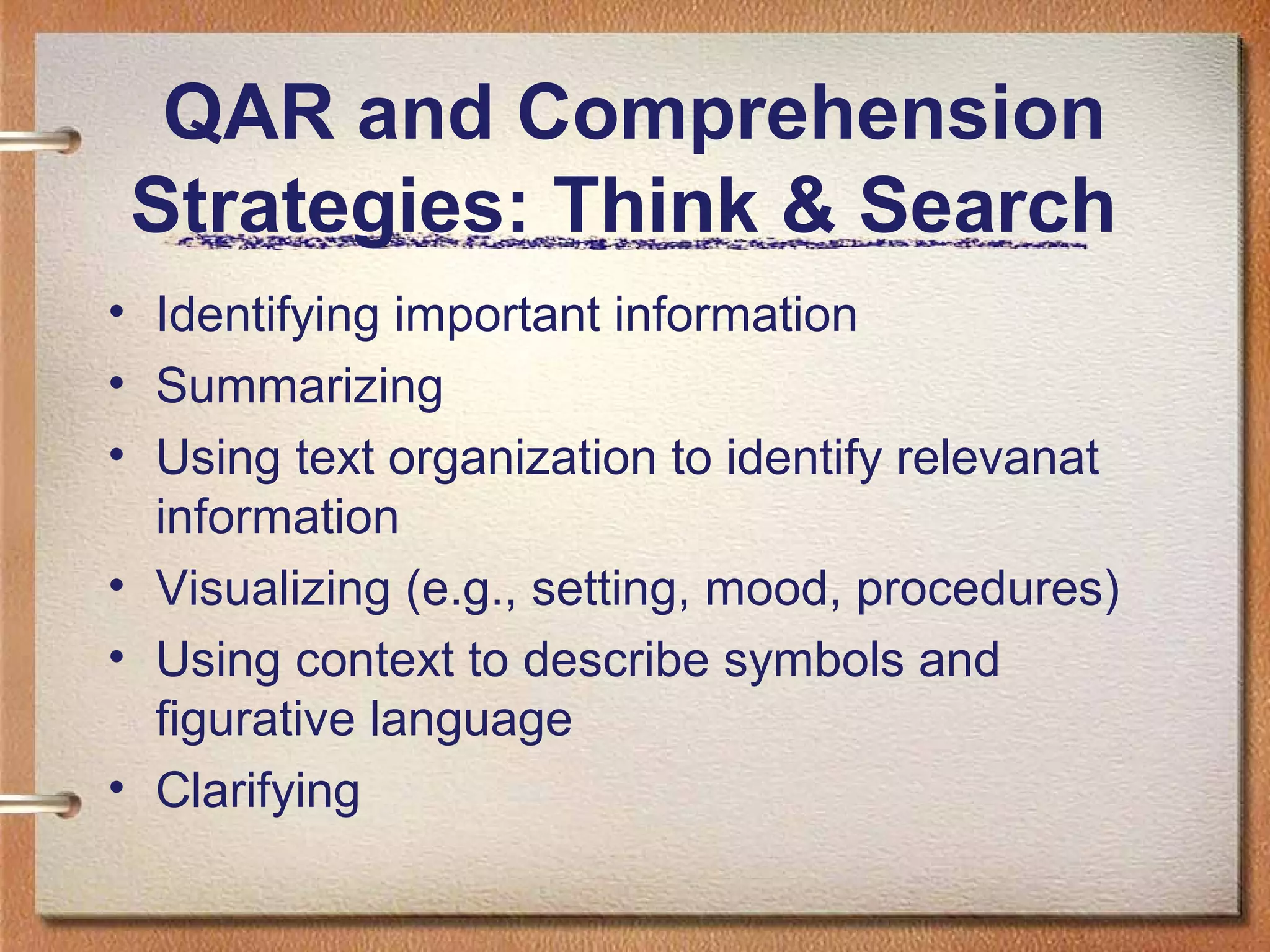
QAR and Comprehension
Strategies: Think & Search
• Identifying important information
• Summarizing
• Using text organization to identify relevanat
information
• Visualizing (e.g., setting, mood, procedures)
• Using context to describe symbols and
figurative language
• Clarifying
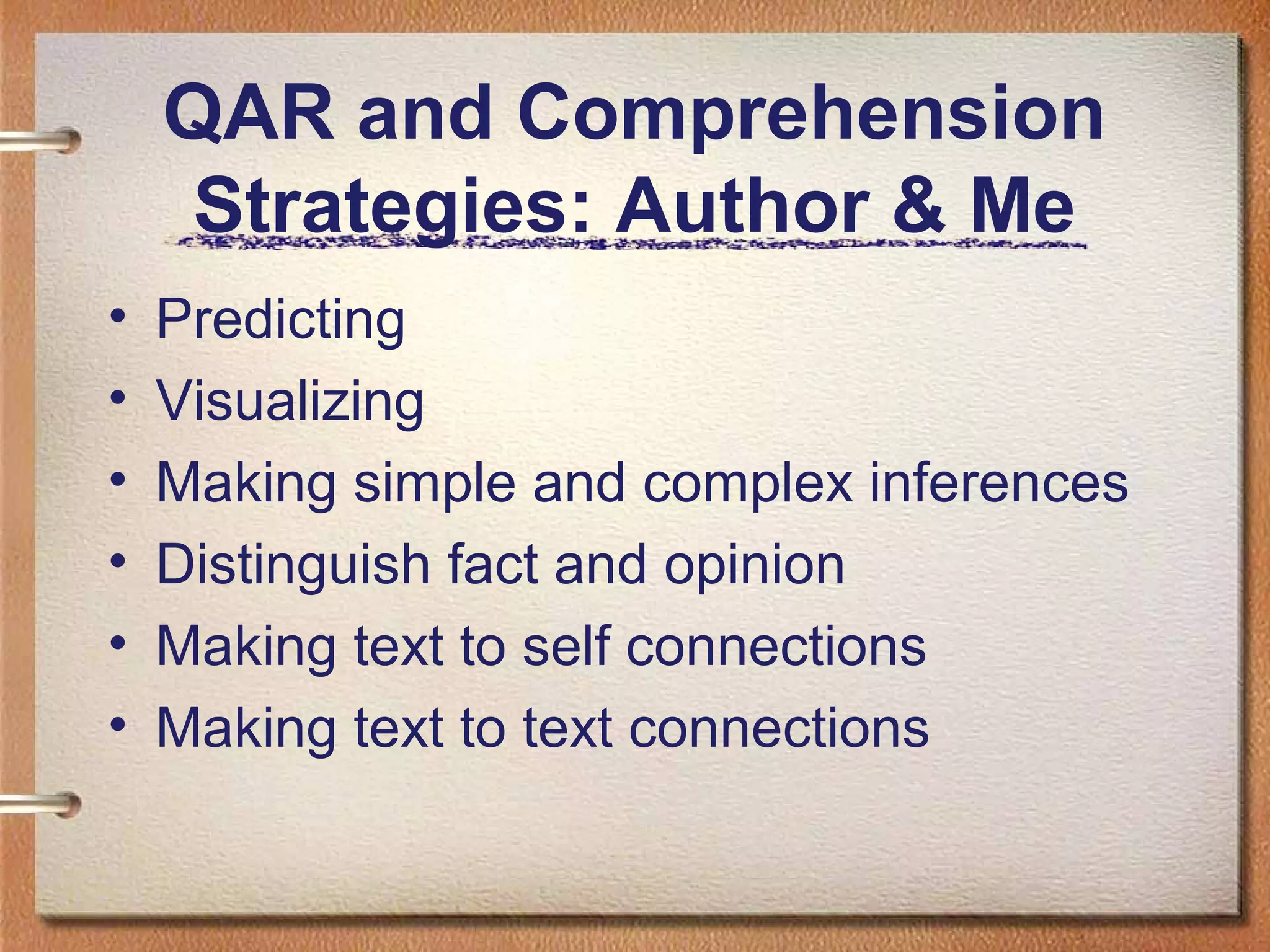
QAR and Comprehension
Strategies: Author & Me
• Predicting
• Visualizing
• Making simple and complex inferences
• Distinguish fact and opinion
• Making text to self connections
• Making text to text connections
QAR and Comprehension
Strategies: On My own
• Activating prior knowledge (about
genre, experiences, authors, etc.)
• Connecting to the topic (self-to-text)
Making QAR Part of the
Fabric of the Classroom
Embedding QAR Language in a Book
Club Setting
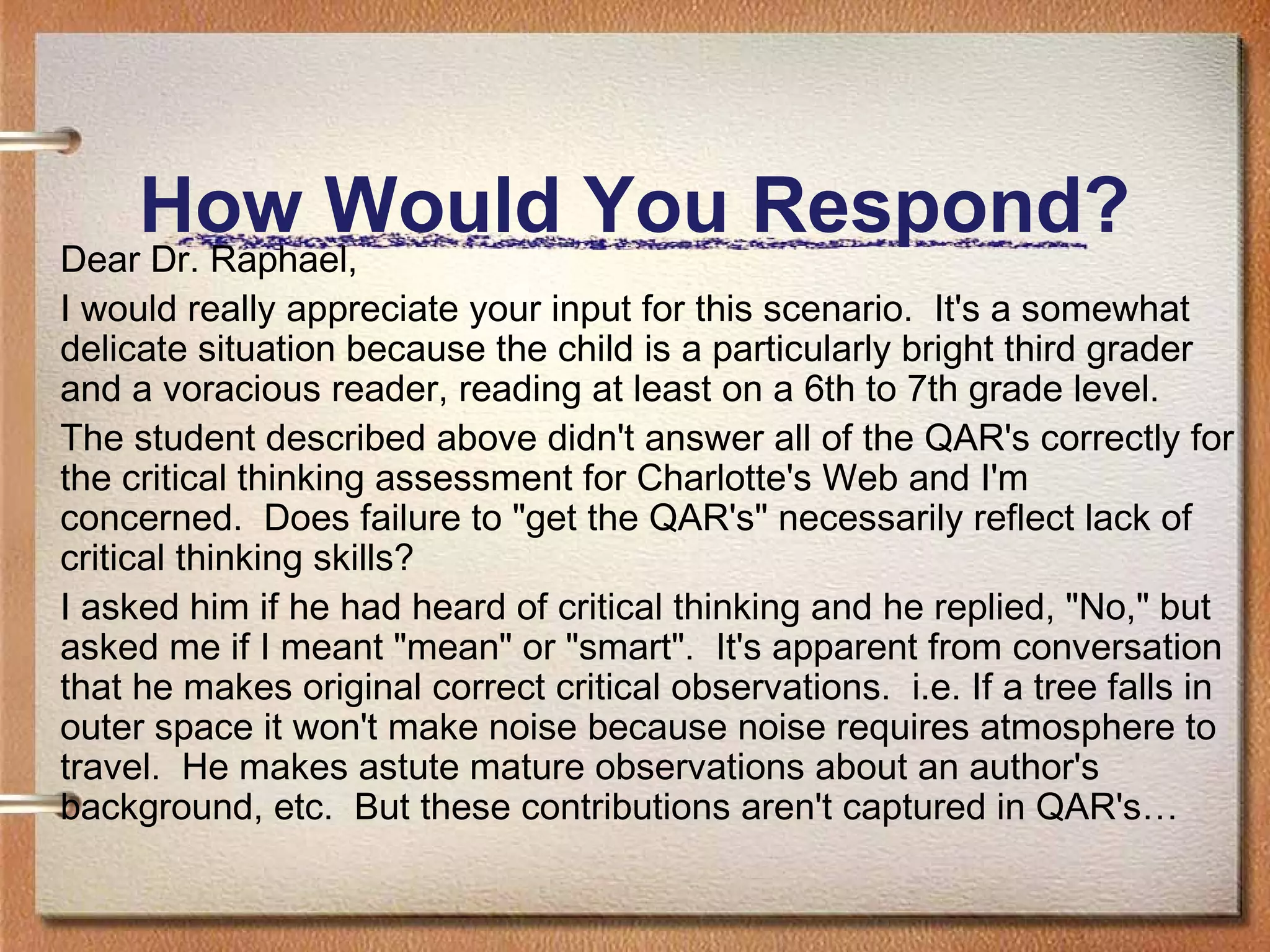
Dear Dr. Raphael,
I would really appreciate your input for this scenario. It's a somewhat
delicate situation because the child is a particularly bright third grader
and a voracious reader, reading at least on a 6th to 7th grade level.
The student described above didn't answer all of the QAR's correctly for
the critical thinking assessment for Charlotte's Web and I'm
concerned.  Does failure to "get the QAR's" necessarily reflect lack of
critical thinking skills?  
I asked him if he had heard of critical thinking and he replied, "No," but
asked me if I meant "mean" or "smart". It's apparent from conversation
that he makes original correct critical observations. i.e. If a tree falls in
outer space it won't make noise because noise requires atmosphere to
travel. He makes astute mature observations about an author's
background, etc. But these contributions aren't captured in QAR's…
How Would You Respond?
End-of-Presentation Goals
• I can describe to my colleagues a process of
bringing coherence to our comprehension
program.
• I can describe at least three ways that QAR can
help improve my own and my school’s
comprehension instruction across grades and
school subjects.
• I can make my literacy instructional goals more
visible to my students and their families
• I can create instructional tools for improving
comprehension instruction in my classroom or
school.
Related Resources
Raphael, T.E. & Au, K. H. (in press). QAR:
Enhancing Comprehension and Test-taking Across
Grades and Content Areas, The Reading Teacher.
Raphael, T. E. & Au, K. H. Super QAR for Testwise
Students. Wright Group/McGraw-Hill
http://www.litd.psch.uic.edu/pr
taffy@uic.edu

QAR A Framework for Improving Literacy Teaching and Learning

  • 1.
    Question Answer Relationships (QAR): AFramework for Improving Literacy Teaching and Learning Taffy E. Raphael, Ph.D. University of Illinois at Chicago Spring, 2005
  • 2.
    Focus for Today •What is QAR? • Why use QAR • How can QAR support comprehension instruction that connects across grade levels and subject areas and enhances test-taking?
  • 3.
    What is QAR? “WhyNot Tell Them Where Information Comes From?”
  • 4.
    QAR Core Categories •In the Book • In My Head
  • 5.
    In the BookRightThere: A “detail” type of question, where words used to form the question and words that answer the question are often “right there” in the same sentence. QuickTime™ and aPhoto - JPEG decompressor are needed to see this picture. Think & Search: The answer is in the text, but readers have to “think & search” to find the answer; sometimes within a paragraph, across paragraphs, or even chapters.
  • 6.
    In My Head OnMy Own: The question relates to the text, but I could probably answer this one even if I had never read the text. All the ideas and information come from my background knowledge. Author and Me: The information to answer the question comes from my background knowledge, but to even make sense of the question, I’d need to have read and understood the text.
  • 7.
    Why Use QAR? 1.A language for ALL to use in talking about strategies and their use in context 2. A developmental progression that is visible to students and teachers across grade levels 3. A logical way to organize comprehension strategies 4. A valuable approach to test preparation
  • 8.
    Thus, QAR Providesa Common Language Within grade levels Across grade levels Across subject areas
  • 9.
    QAR A Developmental ProgressionBuilds Coherence Across Grades
  • 10.
    QAR Across theGrades In the Book In My Head Right There Think & Search Author & Me On My Own Genre Analyses School Subject Extensions Text to Self Connections Text to World Connections Text to Theme ConnectionsHow to Take Notes
  • 11.
    Beginning Focus • ContrastBook / Head • Consider how knowledge gets into our heads
  • 12.
    Individual Accountability and Reflection •What do I know about sources of information? • How can I represent this to someone else? Picture of Students’ Representations of In the Book and In My Head QARs
  • 13.
    Tools for PrimaryGrades • Poster with definitions • How to use post-its • Flip Chart for every-pupil response
  • 14.
    Tools in MiddleGrades • Picture of Right There versus Think and Search definitions • Picture of Comprehension Strategies for each QAR
  • 15.
    Links to ContentLearning (e.g., science) • Showing language connections – Activating prior knowledge = making observations – Predicting = Stating a hypothesis – Taking notes = Keeping data Picture of Science Teacher’s Chart
  • 16.
    *Au, K. H.(in press). Multicultural issues and literacy achievement. Mahwah NJ: Erlbaum.) *Raphael, T. E., & Au, K. H. (in press). The Standards-Based Change Process. The California Reader. Getting Organized for Comprehension Instruction “Staircase” versus “Christmas Tree”
  • 17.
    Where Does QARFit? • Identifying Important Information* • Summarizing • Making Inferences – Predicting – Visualizing • Questioning • Monitoring • Critique and Evaluation
  • 18.
    Introduce Students tothe Reading Cycle and the Role of QAR Before  During  After Reading
  • 19.
    Before Reading • OnMy Own: From the title or the topic, what do I already know that can connect me to the story/text? • Author and Me: From the topic, title, illustrations, and/or book cover, what might this story/text be about?
  • 20.
    DURING READING • Authorand Me: – What do I think will happen next? – How would you describe the mood of the story and why is this important? • Think and Search – What is the problem and how is it resolved? – What role do [insert characters’ names] play in the story? – What are the important events? (literary, informational) • Right There: [locate and recall details] – Who is the main character? (literary) – Identify the topic sentence in this paragraph (informational) – What are some words that describe the setting? (literary)
  • 21.
    AFTER READING • Authorand Me – What is the author’s message? – What is the theme and how is it connected to the world beyond the story? – How can I synthesize the information with what I know from other sources? – How well does the author make his/her argument? – How is the author using particular language to influence our beliefs? • Think and Search – Find evidence in the text to support an argument.
  • 22.
    Align Strategies toQAR Categories
  • 23.
    QAR and Comprehension Strategies:Right There • Scanning to locate information • Note-taking strategies to support easier recall of key information • Using context clues for creating definitions
  • 24.
    QAR and Comprehension Strategies:Think & Search • Identifying important information • Summarizing • Using text organization to identify relevanat information • Visualizing (e.g., setting, mood, procedures) • Using context to describe symbols and figurative language • Clarifying
  • 25.
    QAR and Comprehension Strategies:Author & Me • Predicting • Visualizing • Making simple and complex inferences • Distinguish fact and opinion • Making text to self connections • Making text to text connections
  • 26.
    QAR and Comprehension Strategies:On My own • Activating prior knowledge (about genre, experiences, authors, etc.) • Connecting to the topic (self-to-text)
  • 27.
    Making QAR Partof the Fabric of the Classroom Embedding QAR Language in a Book Club Setting
  • 28.
    Dear Dr. Raphael, Iwould really appreciate your input for this scenario. It's a somewhat delicate situation because the child is a particularly bright third grader and a voracious reader, reading at least on a 6th to 7th grade level. The student described above didn't answer all of the QAR's correctly for the critical thinking assessment for Charlotte's Web and I'm concerned.  Does failure to "get the QAR's" necessarily reflect lack of critical thinking skills?   I asked him if he had heard of critical thinking and he replied, "No," but asked me if I meant "mean" or "smart". It's apparent from conversation that he makes original correct critical observations. i.e. If a tree falls in outer space it won't make noise because noise requires atmosphere to travel. He makes astute mature observations about an author's background, etc. But these contributions aren't captured in QAR's… How Would You Respond?
  • 29.
    End-of-Presentation Goals • Ican describe to my colleagues a process of bringing coherence to our comprehension program. • I can describe at least three ways that QAR can help improve my own and my school’s comprehension instruction across grades and school subjects. • I can make my literacy instructional goals more visible to my students and their families • I can create instructional tools for improving comprehension instruction in my classroom or school.
  • 30.
    Related Resources Raphael, T.E.& Au, K. H. (in press). QAR: Enhancing Comprehension and Test-taking Across Grades and Content Areas, The Reading Teacher. Raphael, T. E. & Au, K. H. Super QAR for Testwise Students. Wright Group/McGraw-Hill http://www.litd.psch.uic.edu/pr taffy@uic.edu