THE R WORD:
RESOLUTIONS
FIVE KEY INSIGHTS TO
GUIDE US
IN 2023
INTRO TO EQUITY
COMPENSATION
IN THIS ISSUE
Quarterly Newsletter
Our insights on the markets, economy, and
financial planning
Q4 2022 NEWSLETTER VOL. 68
There’s no sugarcoating it, the 2022 stock market performance was
just dreadful. It was the worst performance of the S&P 500 in 14
years. As you are aware, our accounts (yours and mine) took a
nosedive last year. Painful. We know from experience that last year’s
draw-down is temporary in nature and is usual collateral damage
from the business cycle. We have seen this before, but it’s been a
while and it is tough to stomach.
I consider myself a glass half full sort of man. I have a knack for
seeing a difficult situation for what it is, but I also looking for any
positives that I can find within to help navigate toward a solution.
When it comes to the stock market performance of 2022, I’m still
seeing a half full glass, but the solution is counterintuitive. The
answer is to find a way to tough out what will surely involve continued
choppy water ahead in 2023. It will take commitment to stay the
course. It will take guts. So, I’ve put together a New Year’s Resolution
list to help us in 2023:
The R-Word:
Resolutions
by Mike Booker, CFP®, ChFC®, CFS®
4400 Post Oak Pkwy, Suite 200, Houston, TX 77027 | 713-623-6600 | info@finsyn.com | finsyn.com
...continued on next page
THE SECURE ACT 2.0
HAPPY NEW YEAR!
Q4 2022 VOL. 68
I will ignore my golf buddies or bridge partners who say they made money last year in their stock account. While it might
be true that they had a stock that made money in 2022, they also told you they made money on their trip to Las Vegas last
spring!
If it has been 10 years or more since I updated my wills and account beneficiaries, I will update them in 2023. This is
something that is often overlooked by clients and should be an integral part of any financial check-up.
I will avoid listening to the financial gurus. In a recent study on the accuracy of private-sector economic forecasts, IMF
economist Prakash Loungani concluded: “The record of failure to predict recessions is virtually unblemished.” This was
written before the dotcom crash and the Great Recession, both of which took most experts by surprise.
Financial writer Charles Morris examined a decade of forecasts from the White House Council of Economic Advisors, a
collection of the most brilliant minds in the economic profession with access to all the latest data. He found that, over and
over again, their forecasts were wildly wrong. The most famous and spectacular failure was the council’s forecast for
2008, the year of the global financial crisis when the US economy shifted from spectacular growth to devastation.
Investment adviser Peter Mallouk suggests in his book The Path, that "Anytime you hear a bold stock market or economic
prediction, just add the words ‘or not’ at the end of it!”
I will expect a bumpy 2023, keeping my expectations positive and reasonable. I will therefore be pleasantly surprised if
returns on my portfolio exceed my expectations. I will not be anxious when my account takes periodic dips and I will
remind myself that it is keeping a long-term perspective that will assure my financial success. Short-term movements in
the market, up or down, are meaningless. Mamdouh Medhat of Dimensional Fund Advisors put it well in the Financial
Times recently, “You can easily get caught up in the short-term movements. It’s like a ping-pong match and commentating
on every hit of the ball.” Easily the most difficult part of investing is simply holding your nerve through the bad times.
Thinking more long-term is a great resolution for any year when it comes to the stock market, but especially sensible for
this upcoming market year.
If things get too bumpy, I will contact my Financial Synergies Advisor instead of worrying alone. We are a team and its
always good for teammates to have regular contact. Financial Synergies advisors are investment advisors and therefore
we can advise you on your investment account. But we are more than that. We are financial advisors who can advise you
on other financial factors of your life and how your investments fit in with them. There is no need to “go it alone”.
We are honored to work with you and to be your Advisor. From all of us at Financial Synergies Wealth Advisors, thank you
for your continued trust and confidence. Happy New Year!
Financial Synergies Quarterly Newsletter | Q4 2022 2
Q4 2022 VOL. 68
While most Americans were shopping for last minute gifts or wrapping presents before Christmas, our congressional delegates were
hard at work on Capitol Hill voting on a $1.7 trillion omnibus spending bill, that included the SECURE Act 2.0. The bill, which has since
been signed by President Biden, includes a multitude of provisions aiming to increase many Americans’ retirement savings potential
and encourage small business to adopt retirement plans.
Here is a summary of the most relevant changes:
RMD age increased: The Required Minimum Distribution Age, or the age at which account holders must begin annual withdraws from
qualified accounts, has increased from 72 to 73 in 2023. There will be another increase in 2029 to 74, and the final increase will be in
2032 to 75. While RMDs give Uncle Sam a chance to collect tax revenue, delaying the RMD age will give retirees more time to benefit
from tax deferred savings before they must begin withdrawals.
Stronger catch-up contributions: For Americans who are 60 to 63, the additional 401(k) or 403(b) contribution allowance, known as a
catch-up contribution, has increased from $6,500 to $10,000.
Rothification of matching contributions: Employees with access to Roth retirement accounts will now be able to elect for Roth
treatment of employer matching contributions. Previously, employer contributions into sponsored plans were treated as pre-tax
contributions, meaning the earnings would eventually be subject to taxes. Under the new legislation, both employee and employer
contributions will be able to grow tax-free.
Extra help for student loan holders: Workers who are making student loan payments in lieu of saving for retirement now can still
benefit from employer matching contributions. Companies can match student loan payments and deposit the match into the
employee’s retirement account, even if they made no contributions of their own.
Stricter automatic enrollment: Beginning in 2025, new eligible employees will automatically enroll in qualified, employer-sponsored
plans at a 3% contribution rate, instead of having to opting-in to 401(k) or 403(b) plans. They can, of course, choose to opt-out, but the
provision seeks to make saving for retirement the default instead of the exception.
Enhanced tax credit for small businesses: To help cover the cost of adopting a new retirement plan, the new law includes a 100%
start-up tax credit for employers with 50 or fewer employees. Prior to the bill’s passing, the tax credit was only 50%. This change aims
to make it easier for small business to offer retirement benefits.
529s can convert to Roth IRAs: After 15 years, a 529 can be converted into a Roth IRA for the beneficiary. The conversion is subject to
the annual Roth contribution limits and a lifetime limit of $35,000. The new Roth IRA will still be subject to the 5-year qualified
withdraw rules, but the new legislation may make education planning with a 529 more attractive.
In its entirety, the bill passed was more than 4,000 pages, so there are many provisions not included here. With a little something for
everyone, the SECURE Act 2.0 will continue to make waves as its changes take effect in the years to come.
Financial Synergies Quarterly Newsletter | Q4 2022 3
The SECURE Act 2.0: What Does
it Mean for You?
by Rachel Buckhoff
Q4 2022 VOL. 68
2022 was the most challenging year for investors since the Financial Crisis of 2008. Markets fell into bear market
territory and experienced their worst annual performance in 14 years.
The S&P 500, Dow Jones, and Nasdaq declined 19.4%, 8.8% and 33.1%, respectively, last year. Interest rates swung
wildly with the 10-year Treasury yield jumping from 1.51% at the start of the year to a high of 4.24%, before ending at
3.88%. This mirrored inflation as the Consumer Price Index climbed to a 40-year high of 9.1% in September.
As a result, the Fed hiked rates seven consecutive times from 0% last March to 4.25% in December. Along the way, a
myriad of other events impacted markets from the war in Ukraine to China’s zero-Covid policy, affecting everything from
oil prices to the U.S. dollar.
These market swings can cause whiplash for even the most experienced investors. Much of what drove markets last
year was the result of the pandemic and its rapid recovery over the past three years. Like an earthquake that then
causes a tsunami, the sudden drop and resurgence in business and consumer demand, fiscal and monetary stimulus,
and global supply chain capacity created shock waves across the financial system. While they do cause immediate
damage, even the largest shocks eventually settle.
Despite these historic shifts in the economy and markets over the past year, the principles of long-term investing
haven’t changed. Staying disciplined, diversified and focused on longer time horizons is more important than ever.
For some, it may feel as if markets can’t catch a break, but this is how it felt in March of 2020 before the unprecedented
recovery, in 2008 before a decade-long expansion, and during countless other times across history. Keeping one’s
footing as markets rock back and forth is still the best way to achieve financial goals.
Below, we review five insights from the past year that can help investors to maintain a proper long-term perspective in
2023.
Financial Synergies Quarterly Newsletter | Q4 2022 4
...continued on next page
5 Key Insights To Guide Us In 2023
by Mike Minter, CFP®, CFS®
Q4 2022 VOL. 68
1. The historic surge in interest rates impacted both stocks and bonds
Stock and Bond Annual Returns
The Fed hiked rates across seven
consecutive meetings in 2022 including
four 75 basis point hikes in a row. At a
range of 4.25% to 4.50%, the fed funds
rate is now the highest since the housing
bubble prior to 2008. In its
communication, the Fed has remained
committed to raising rates further and
keeping them higher for longer in order to
fight inflation.
Current market-based measures suggest
that the Fed could push policy rates to 5%
by mid-2023. The central bank continues
to face a balancing act between inflation
and a possible recession.
.
Financial Synergies Quarterly Newsletter | Q4 2022 5
...continued on next page
Beneath all of the headlines and day-to-day
market noise, one key factor drove markets:
the surge in interest rates broke their 40-year
declining trend. Since the late 1980s, falling
rates have helped to boost both stock and
bond prices. Over the past year, the jump in
inflation pushed nominal rates higher and
forced the Fed to hike policy rates. This led
to declines across asset classes at the same
time.
While this has created challenges for
diversification, there is also reason for
optimism. Most inflation measures are
showing signs of easing, even if they are still
elevated. This has allowed interest rates to
settle back down in recent months even as
the Fed continues to hike rates. While still
highly uncertain, most economists expect
inflation and rates to stabilize over the next
year rather than repeat the patterns of 2022
2. The Fed raised rates at a historically fast pace
Federal Funds Rate
Despite two negative quarters of GDP growth in the first half of 2022, few consider the economy to be in recession already.
Instead, some forecasters expect the U.S. and many other countries to experience a recession in 2023, although most also
expect it to be shallow. Slowing growth may mean that the Fed takes its foot off the brake pedal sooner.
Q4 2022 VOL. 68
This is where the market arguably had unrealistic expectations last year. The market rally from June to August and again
in October and November occurred when investors believed the Fed might begin loosening policy. When these hopes
were dashed, markets promptly reversed, causing several back-and-forth swings over the course of the year. These
episodes show that good news that is supported by data can be priced in quickly but that investors should not get ahead
of themselves.
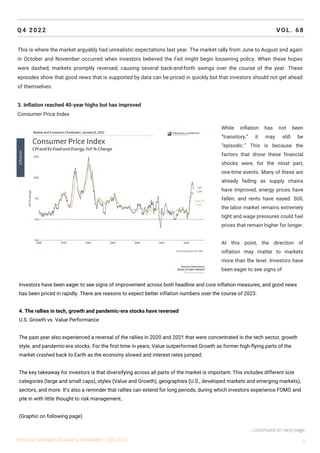
3. Inflation reached 40-year highs but has improved
Consumer Price Index
Financial Synergies Quarterly Newsletter | Q4 2022 6
While inflation has not been
“transitory,” it may still be
“episodic.” This is because the
factors that drove these financial
shocks were, for the most part,
one-time events. Many of these are
already fading as supply chains
have improved, energy prices have
fallen, and rents have eased. Still,
the labor market remains extremely
tight and wage pressures could fuel
prices that remain higher for longer.
At this point, the direction of
inflation may matter to markets
more than the level. Investors have
been eager to see signs of
...continued on next page
Investors have been eager to see signs of improvement across both headline and core inflation measures, and good news
has been priced in rapidly. There are reasons to expect better inflation numbers over the course of 2023.
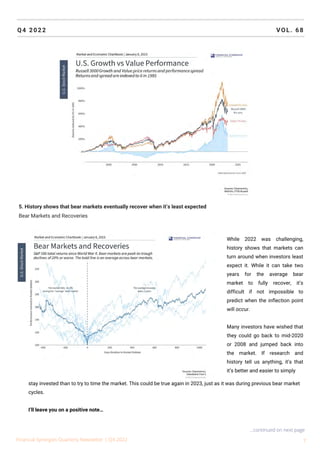
4. The rallies in tech, growth and pandemic-era stocks have reversed
U.S. Growth vs. Value Performance
The past year also experienced a reversal of the rallies in 2020 and 2021 that were concentrated in the tech sector, growth
style, and pandemic-era stocks. For the first time in years, Value outperformed Growth as former high-flying parts of the
market crashed back to Earth as the economy slowed and interest rates jumped.
The key takeaway for investors is that diversifying across all parts of the market is important. This includes different size
categories (large and small caps), styles (Value and Growth), geographies (U.S., developed markets and emerging markets),
sectors, and more. It’s also a reminder that rallies can extend for long periods, during which investors experience FOMO and
pile in with little thought to risk management..
(Graphic on following page)
Q4 2022 VOL. 68
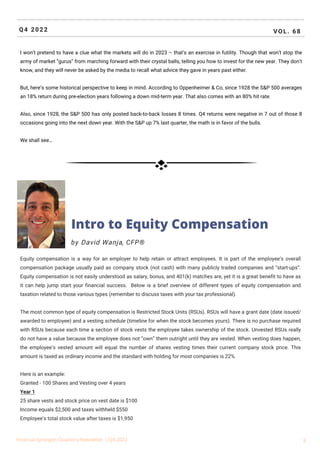
5. History shows that bear markets eventually recover when it’s least expected
Bear Markets and Recoveries
Financial Synergies Quarterly Newsletter | Q4 2022 7
...continued on next page
While 2022 was challenging,
history shows that markets can
turn around when investors least
expect it. While it can take two
years for the average bear
market to fully recover, it’s
difficult if not impossible to
predict when the inflection point
will occur.
Many investors have wished that
they could go back to mid-2020
or 2008 and jumped back into
the market. If research and
history tell us anything, it’s that
it’s better and easier to simply
stay invested than to try to time the market. This could be true again in 2023, just as it was during previous bear market
cycles.
I’ll leave you on a positive note…
Q4 2022 VOL. 68
Financial Synergies Quarterly Newsletter | Q4 2022 8
I won’t pretend to have a clue what the markets will do in 2023 – that’s an exercise in futility. Though that won’t stop the
army of market “gurus” from marching forward with their crystal balls, telling you how to invest for the new year. They don’t
know, and they will never be asked by the media to recall what advice they gave in years past either.
But, here’s some historical perspective to keep in mind. According to Oppenheimer & Co, since 1928 the S&P 500 averages
an 18% return during pre-election years following a down mid-term year. That also comes with an 80% hit rate.
Also, since 1928, the S&P 500 has only posted back-to-back losses 8 times. Q4 returns were negative in 7 out of those 8
occasions going into the next down year. With the S&P up 7% last quarter, the math is in favor of the bulls.
We shall see…
Intro to Equity Compensation
by David Wanja, CFP®
Equity compensation is a way for an employer to help retain or attract employees. It is part of the employee’s overall
compensation package usually paid as company stock (not cash) with many publicly traded companies and “start-ups”.
Equity compensation is not easily understood as salary, bonus, and 401(k) matches are, yet it is a great benefit to have as
it can help jump start your financial success. Below is a brief overview of different types of equity compensation and
taxation related to those various types (remember to discuss taxes with your tax professional).
The most common type of equity compensation is Restricted Stock Units (RSUs). RSUs will have a grant date (date issued/
awarded to employee) and a vesting schedule (timeline for when the stock becomes yours). There is no purchase required
with RSUs because each time a section of stock vests the employee takes ownership of the stock. Unvested RSUs really
do not have a value because the employee does not “own” them outright until they are vested. When vesting does happen,
the employee’s vested amount will equal the number of shares vesting times their current company stock price. This
amount is taxed as ordinary income and the standard with holding for most companies is 22%.
Here is an example:
Granted - 100 Shares and Vesting over 4 years
Year 1
25 share vests and stock price on vest date is $100
Income equals $2,500 and taxes withheld $550
Employee’s total stock value after taxes is $1,950
Q4 2022 VOL. 68
Financial Synergies Quarterly Newsletter | Q4 2022 9
This would happen over year 2, 3, and 4 until all the shares have been vested. Additionally, you might have to pay taxes
when you sell your shares. The amount of tax you will pay will depend on if the stock has a gain as well as long you held the
position from the vesting date.
Stock options are another type of equity compensation usually in the form or either incentive stock options (ISO) and
nonqualified stock options (NQSO). Incentive Stock Options and Nonqualified Stock Options are similar in that they allow
you to purchase company stock at a specified price for a certain amount of time. The major difference between the two of
them is how they are taxed.
With ISOs, if you hold the stock two years from the date of grant and one year from the date of exercise you’ll get special
tax treatment, meaning you will not trigger a taxable event when exercising your options (unless you trigger Alternative
Minimum Tax - visit with a tax advisor to see if this is related to your financial situation ). However, you will owe taxes when
you sell your stock. If you sell within one year, then your gain is taxed at ordinary income rates. If you sell after one year and
a day, then your gain is taxed at long term capital gains rates.
Nonqualified Stock Options do not possess the same favorable treatment as Incentive Stock Options. You will owe taxes
when your exercise your options. Also, you will owe taxes when you sell your stock and the holding period from exercise
date will determine if the gain is taxed as short term or long term.
Lastly, employee stock purchase plan (ESPP) is another type of equity opportunity a company can provide to its employees.
ESPP plans allow employees the right to buy stock at a discounted price. The discount offered is usually somewhere
between 5% - 15%.
There are many factors to consider when engaging with a new employer or evaluating incentives with your existing one. Our
advisors can help educate you about your specific equity compensation plan as well as work with you to align this benefit
to help you reach your financial goals. If you or a family member have questions about this topic, please feel free to contact
us!

Q4 2022 Newsletter

  • 1.
    THE R WORD: RESOLUTIONS FIVEKEY INSIGHTS TO GUIDE US IN 2023 INTRO TO EQUITY COMPENSATION IN THIS ISSUE Quarterly Newsletter Our insights on the markets, economy, and financial planning Q4 2022 NEWSLETTER VOL. 68 There’s no sugarcoating it, the 2022 stock market performance was just dreadful. It was the worst performance of the S&P 500 in 14 years. As you are aware, our accounts (yours and mine) took a nosedive last year. Painful. We know from experience that last year’s draw-down is temporary in nature and is usual collateral damage from the business cycle. We have seen this before, but it’s been a while and it is tough to stomach. I consider myself a glass half full sort of man. I have a knack for seeing a difficult situation for what it is, but I also looking for any positives that I can find within to help navigate toward a solution. When it comes to the stock market performance of 2022, I’m still seeing a half full glass, but the solution is counterintuitive. The answer is to find a way to tough out what will surely involve continued choppy water ahead in 2023. It will take commitment to stay the course. It will take guts. So, I’ve put together a New Year’s Resolution list to help us in 2023: The R-Word: Resolutions by Mike Booker, CFP®, ChFC®, CFS® 4400 Post Oak Pkwy, Suite 200, Houston, TX 77027 | 713-623-6600 | info@finsyn.com | finsyn.com ...continued on next page THE SECURE ACT 2.0 HAPPY NEW YEAR!
  • 2.
    Q4 2022 VOL.68 I will ignore my golf buddies or bridge partners who say they made money last year in their stock account. While it might be true that they had a stock that made money in 2022, they also told you they made money on their trip to Las Vegas last spring! If it has been 10 years or more since I updated my wills and account beneficiaries, I will update them in 2023. This is something that is often overlooked by clients and should be an integral part of any financial check-up. I will avoid listening to the financial gurus. In a recent study on the accuracy of private-sector economic forecasts, IMF economist Prakash Loungani concluded: “The record of failure to predict recessions is virtually unblemished.” This was written before the dotcom crash and the Great Recession, both of which took most experts by surprise. Financial writer Charles Morris examined a decade of forecasts from the White House Council of Economic Advisors, a collection of the most brilliant minds in the economic profession with access to all the latest data. He found that, over and over again, their forecasts were wildly wrong. The most famous and spectacular failure was the council’s forecast for 2008, the year of the global financial crisis when the US economy shifted from spectacular growth to devastation. Investment adviser Peter Mallouk suggests in his book The Path, that "Anytime you hear a bold stock market or economic prediction, just add the words ‘or not’ at the end of it!” I will expect a bumpy 2023, keeping my expectations positive and reasonable. I will therefore be pleasantly surprised if returns on my portfolio exceed my expectations. I will not be anxious when my account takes periodic dips and I will remind myself that it is keeping a long-term perspective that will assure my financial success. Short-term movements in the market, up or down, are meaningless. Mamdouh Medhat of Dimensional Fund Advisors put it well in the Financial Times recently, “You can easily get caught up in the short-term movements. It’s like a ping-pong match and commentating on every hit of the ball.” Easily the most difficult part of investing is simply holding your nerve through the bad times. Thinking more long-term is a great resolution for any year when it comes to the stock market, but especially sensible for this upcoming market year. If things get too bumpy, I will contact my Financial Synergies Advisor instead of worrying alone. We are a team and its always good for teammates to have regular contact. Financial Synergies advisors are investment advisors and therefore we can advise you on your investment account. But we are more than that. We are financial advisors who can advise you on other financial factors of your life and how your investments fit in with them. There is no need to “go it alone”. We are honored to work with you and to be your Advisor. From all of us at Financial Synergies Wealth Advisors, thank you for your continued trust and confidence. Happy New Year! Financial Synergies Quarterly Newsletter | Q4 2022 2
  • 3.
    Q4 2022 VOL.68 While most Americans were shopping for last minute gifts or wrapping presents before Christmas, our congressional delegates were hard at work on Capitol Hill voting on a $1.7 trillion omnibus spending bill, that included the SECURE Act 2.0. The bill, which has since been signed by President Biden, includes a multitude of provisions aiming to increase many Americans’ retirement savings potential and encourage small business to adopt retirement plans. Here is a summary of the most relevant changes: RMD age increased: The Required Minimum Distribution Age, or the age at which account holders must begin annual withdraws from qualified accounts, has increased from 72 to 73 in 2023. There will be another increase in 2029 to 74, and the final increase will be in 2032 to 75. While RMDs give Uncle Sam a chance to collect tax revenue, delaying the RMD age will give retirees more time to benefit from tax deferred savings before they must begin withdrawals. Stronger catch-up contributions: For Americans who are 60 to 63, the additional 401(k) or 403(b) contribution allowance, known as a catch-up contribution, has increased from $6,500 to $10,000. Rothification of matching contributions: Employees with access to Roth retirement accounts will now be able to elect for Roth treatment of employer matching contributions. Previously, employer contributions into sponsored plans were treated as pre-tax contributions, meaning the earnings would eventually be subject to taxes. Under the new legislation, both employee and employer contributions will be able to grow tax-free. Extra help for student loan holders: Workers who are making student loan payments in lieu of saving for retirement now can still benefit from employer matching contributions. Companies can match student loan payments and deposit the match into the employee’s retirement account, even if they made no contributions of their own. Stricter automatic enrollment: Beginning in 2025, new eligible employees will automatically enroll in qualified, employer-sponsored plans at a 3% contribution rate, instead of having to opting-in to 401(k) or 403(b) plans. They can, of course, choose to opt-out, but the provision seeks to make saving for retirement the default instead of the exception. Enhanced tax credit for small businesses: To help cover the cost of adopting a new retirement plan, the new law includes a 100% start-up tax credit for employers with 50 or fewer employees. Prior to the bill’s passing, the tax credit was only 50%. This change aims to make it easier for small business to offer retirement benefits. 529s can convert to Roth IRAs: After 15 years, a 529 can be converted into a Roth IRA for the beneficiary. The conversion is subject to the annual Roth contribution limits and a lifetime limit of $35,000. The new Roth IRA will still be subject to the 5-year qualified withdraw rules, but the new legislation may make education planning with a 529 more attractive. In its entirety, the bill passed was more than 4,000 pages, so there are many provisions not included here. With a little something for everyone, the SECURE Act 2.0 will continue to make waves as its changes take effect in the years to come. Financial Synergies Quarterly Newsletter | Q4 2022 3 The SECURE Act 2.0: What Does it Mean for You? by Rachel Buckhoff
  • 4.
    Q4 2022 VOL.68 2022 was the most challenging year for investors since the Financial Crisis of 2008. Markets fell into bear market territory and experienced their worst annual performance in 14 years. The S&P 500, Dow Jones, and Nasdaq declined 19.4%, 8.8% and 33.1%, respectively, last year. Interest rates swung wildly with the 10-year Treasury yield jumping from 1.51% at the start of the year to a high of 4.24%, before ending at 3.88%. This mirrored inflation as the Consumer Price Index climbed to a 40-year high of 9.1% in September. As a result, the Fed hiked rates seven consecutive times from 0% last March to 4.25% in December. Along the way, a myriad of other events impacted markets from the war in Ukraine to China’s zero-Covid policy, affecting everything from oil prices to the U.S. dollar. These market swings can cause whiplash for even the most experienced investors. Much of what drove markets last year was the result of the pandemic and its rapid recovery over the past three years. Like an earthquake that then causes a tsunami, the sudden drop and resurgence in business and consumer demand, fiscal and monetary stimulus, and global supply chain capacity created shock waves across the financial system. While they do cause immediate damage, even the largest shocks eventually settle. Despite these historic shifts in the economy and markets over the past year, the principles of long-term investing haven’t changed. Staying disciplined, diversified and focused on longer time horizons is more important than ever. For some, it may feel as if markets can’t catch a break, but this is how it felt in March of 2020 before the unprecedented recovery, in 2008 before a decade-long expansion, and during countless other times across history. Keeping one’s footing as markets rock back and forth is still the best way to achieve financial goals. Below, we review five insights from the past year that can help investors to maintain a proper long-term perspective in 2023. Financial Synergies Quarterly Newsletter | Q4 2022 4 ...continued on next page 5 Key Insights To Guide Us In 2023 by Mike Minter, CFP®, CFS®
  • 5.
    Q4 2022 VOL.68 1. The historic surge in interest rates impacted both stocks and bonds Stock and Bond Annual Returns The Fed hiked rates across seven consecutive meetings in 2022 including four 75 basis point hikes in a row. At a range of 4.25% to 4.50%, the fed funds rate is now the highest since the housing bubble prior to 2008. In its communication, the Fed has remained committed to raising rates further and keeping them higher for longer in order to fight inflation. Current market-based measures suggest that the Fed could push policy rates to 5% by mid-2023. The central bank continues to face a balancing act between inflation and a possible recession. . Financial Synergies Quarterly Newsletter | Q4 2022 5 ...continued on next page Beneath all of the headlines and day-to-day market noise, one key factor drove markets: the surge in interest rates broke their 40-year declining trend. Since the late 1980s, falling rates have helped to boost both stock and bond prices. Over the past year, the jump in inflation pushed nominal rates higher and forced the Fed to hike policy rates. This led to declines across asset classes at the same time. While this has created challenges for diversification, there is also reason for optimism. Most inflation measures are showing signs of easing, even if they are still elevated. This has allowed interest rates to settle back down in recent months even as the Fed continues to hike rates. While still highly uncertain, most economists expect inflation and rates to stabilize over the next year rather than repeat the patterns of 2022 2. The Fed raised rates at a historically fast pace Federal Funds Rate Despite two negative quarters of GDP growth in the first half of 2022, few consider the economy to be in recession already. Instead, some forecasters expect the U.S. and many other countries to experience a recession in 2023, although most also expect it to be shallow. Slowing growth may mean that the Fed takes its foot off the brake pedal sooner.
  • 6.
    Q4 2022 VOL.68 This is where the market arguably had unrealistic expectations last year. The market rally from June to August and again in October and November occurred when investors believed the Fed might begin loosening policy. When these hopes were dashed, markets promptly reversed, causing several back-and-forth swings over the course of the year. These episodes show that good news that is supported by data can be priced in quickly but that investors should not get ahead of themselves. 3. Inflation reached 40-year highs but has improved Consumer Price Index Financial Synergies Quarterly Newsletter | Q4 2022 6 While inflation has not been “transitory,” it may still be “episodic.” This is because the factors that drove these financial shocks were, for the most part, one-time events. Many of these are already fading as supply chains have improved, energy prices have fallen, and rents have eased. Still, the labor market remains extremely tight and wage pressures could fuel prices that remain higher for longer. At this point, the direction of inflation may matter to markets more than the level. Investors have been eager to see signs of ...continued on next page Investors have been eager to see signs of improvement across both headline and core inflation measures, and good news has been priced in rapidly. There are reasons to expect better inflation numbers over the course of 2023. 4. The rallies in tech, growth and pandemic-era stocks have reversed U.S. Growth vs. Value Performance The past year also experienced a reversal of the rallies in 2020 and 2021 that were concentrated in the tech sector, growth style, and pandemic-era stocks. For the first time in years, Value outperformed Growth as former high-flying parts of the market crashed back to Earth as the economy slowed and interest rates jumped. The key takeaway for investors is that diversifying across all parts of the market is important. This includes different size categories (large and small caps), styles (Value and Growth), geographies (U.S., developed markets and emerging markets), sectors, and more. It’s also a reminder that rallies can extend for long periods, during which investors experience FOMO and pile in with little thought to risk management.. (Graphic on following page)
  • 7.
    Q4 2022 VOL.68 5. History shows that bear markets eventually recover when it’s least expected Bear Markets and Recoveries Financial Synergies Quarterly Newsletter | Q4 2022 7 ...continued on next page While 2022 was challenging, history shows that markets can turn around when investors least expect it. While it can take two years for the average bear market to fully recover, it’s difficult if not impossible to predict when the inflection point will occur. Many investors have wished that they could go back to mid-2020 or 2008 and jumped back into the market. If research and history tell us anything, it’s that it’s better and easier to simply stay invested than to try to time the market. This could be true again in 2023, just as it was during previous bear market cycles. I’ll leave you on a positive note…
  • 8.
    Q4 2022 VOL.68 Financial Synergies Quarterly Newsletter | Q4 2022 8 I won’t pretend to have a clue what the markets will do in 2023 – that’s an exercise in futility. Though that won’t stop the army of market “gurus” from marching forward with their crystal balls, telling you how to invest for the new year. They don’t know, and they will never be asked by the media to recall what advice they gave in years past either. But, here’s some historical perspective to keep in mind. According to Oppenheimer & Co, since 1928 the S&P 500 averages an 18% return during pre-election years following a down mid-term year. That also comes with an 80% hit rate. Also, since 1928, the S&P 500 has only posted back-to-back losses 8 times. Q4 returns were negative in 7 out of those 8 occasions going into the next down year. With the S&P up 7% last quarter, the math is in favor of the bulls. We shall see… Intro to Equity Compensation by David Wanja, CFP® Equity compensation is a way for an employer to help retain or attract employees. It is part of the employee’s overall compensation package usually paid as company stock (not cash) with many publicly traded companies and “start-ups”. Equity compensation is not easily understood as salary, bonus, and 401(k) matches are, yet it is a great benefit to have as it can help jump start your financial success. Below is a brief overview of different types of equity compensation and taxation related to those various types (remember to discuss taxes with your tax professional). The most common type of equity compensation is Restricted Stock Units (RSUs). RSUs will have a grant date (date issued/ awarded to employee) and a vesting schedule (timeline for when the stock becomes yours). There is no purchase required with RSUs because each time a section of stock vests the employee takes ownership of the stock. Unvested RSUs really do not have a value because the employee does not “own” them outright until they are vested. When vesting does happen, the employee’s vested amount will equal the number of shares vesting times their current company stock price. This amount is taxed as ordinary income and the standard with holding for most companies is 22%. Here is an example: Granted - 100 Shares and Vesting over 4 years Year 1 25 share vests and stock price on vest date is $100 Income equals $2,500 and taxes withheld $550 Employee’s total stock value after taxes is $1,950
  • 9.
    Q4 2022 VOL.68 Financial Synergies Quarterly Newsletter | Q4 2022 9 This would happen over year 2, 3, and 4 until all the shares have been vested. Additionally, you might have to pay taxes when you sell your shares. The amount of tax you will pay will depend on if the stock has a gain as well as long you held the position from the vesting date. Stock options are another type of equity compensation usually in the form or either incentive stock options (ISO) and nonqualified stock options (NQSO). Incentive Stock Options and Nonqualified Stock Options are similar in that they allow you to purchase company stock at a specified price for a certain amount of time. The major difference between the two of them is how they are taxed. With ISOs, if you hold the stock two years from the date of grant and one year from the date of exercise you’ll get special tax treatment, meaning you will not trigger a taxable event when exercising your options (unless you trigger Alternative Minimum Tax - visit with a tax advisor to see if this is related to your financial situation ). However, you will owe taxes when you sell your stock. If you sell within one year, then your gain is taxed at ordinary income rates. If you sell after one year and a day, then your gain is taxed at long term capital gains rates. Nonqualified Stock Options do not possess the same favorable treatment as Incentive Stock Options. You will owe taxes when your exercise your options. Also, you will owe taxes when you sell your stock and the holding period from exercise date will determine if the gain is taxed as short term or long term. Lastly, employee stock purchase plan (ESPP) is another type of equity opportunity a company can provide to its employees. ESPP plans allow employees the right to buy stock at a discounted price. The discount offered is usually somewhere between 5% - 15%. There are many factors to consider when engaging with a new employer or evaluating incentives with your existing one. Our advisors can help educate you about your specific equity compensation plan as well as work with you to align this benefit to help you reach your financial goals. If you or a family member have questions about this topic, please feel free to contact us!