LUCILLE JOY V. DADULLA
Lesson
2 Music of Latin America
“Music is the greatest unifier, an incredible
force. Something that people who differ on
everything and anything else can have in
common.” – Sarah Dessen, Just Listen. United
States: Viking, 2006.
• This quote speaks of the way Africans consider
music because they believe that music serves
as a link of the actual world with that of the
spiritual world.
•Music is indeed a vital part of everyday life in
Africa.
•The music of Latin America is the product
of three major influences – Indigenous,
Spanish-Portuguese, and African.
•Sometimes called Latin music; it includes
the countries that have a colonial history
from Spain and Portugal, divided into the
following areas of Andean Region, Central
America, Caribbean and Brazil.
INFLUENCES ON LATIN AMERICAN MUSIC
1.Indigenous Latin-American Music – The natives
were found to be using local drum and percussion
instruments. The indigenous music of Latin America
was largely functional in nature, being used for
religious worships and ceremonies.
2.Native American/ Indian Music - The ethnic and
cultural groups of the principal Native Americans
share many similar yet distinctive music elements.
Songs had a wide range of volume levels. Songs
celebrate themes like harvest, planting season or
other important events or occasions of the year.
3. Afro-Latin American Music - The African
influence on Latin American music is most
pronounced in its rich and varied rhythmic
patterns produced by drums and various
percussion instruments.
4. Euro-Latin American Music - The different
regions of Latin America adopted various
characteristics from their European colonizers.
Melodies of the Renaissance period were used in
Southern Chile and the Colombian Pacific coasts.
5. Mixed American Music - The result of the
massive infusion of African culture also brought
about the introduction of other music and dance
forms such as the Afro-Cuban rumba, Jamaican
reggae, Colombian cumbia, and the Brazilian
samba.
Popular Latin American Music
1.Samba - It is a dance form of African origins around 1838 which
evolved into an African-Brazilian invention in the working class and
slum districts of Rio de Janeiro. Its lively rhythm was meant to be
executed for singing, dancing, and parading in the carnival.
2.Son – It is a fusion of the popular music or canciones (songs) of Spain
and the African rumba rhythms of Bantu origin. Originating in Cuba,
it is usually played with the guitar, contrabass, bongos, maracas, and
claves. Its most important legacy is its influence to present-day Latin
American music, particularly as the forerunner of the salsa.
3.Salsa – It is a social dance with marked influences from Cuba and
Puerto Rico that started in New York in the mid 1970’s. Its style
contains elements from the swing dance and hustle as well as the
complex Afro-Cuban and Afro-Caribbean dance forms of pachanga
and guaguanco.
MUSICAL INSTRUMENTS OF LATIN
AMERICA
•The varied cultures developed in Latin
America gave rise to different types of
wind and percussion instruments. As
some instruments were considered holy
and music was supposed to glorify the
gods, mistakes in playing these
instruments were considered offensive
and insulting to them.
A. Aztec and Mayan Instruments
• These are instruments that were during the Aztec
Empire (c. 1345-1521 CE) and Mayan Civilization (1800
BC – AD 950). Aztec and Mayan people are people
who lived in Southern Mexico and Northern Central
America Central.
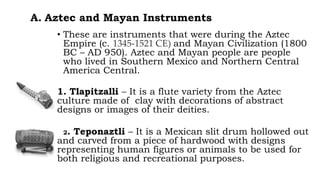
1. Tlapitzalli – It is a flute variety from the Aztec
culture made of clay with decorations of abstract
designs or images of their deities.
2. Teponaztli – It is a Mexican slit drum hollowed out
and carved from a piece of hardwood with designs
representing human figures or animals to be used for
both religious and recreational purposes.
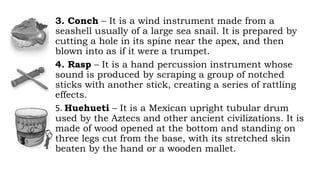
3. Conch – It is a wind instrument made from a
seashell usually of a large sea snail. It is prepared by
cutting a hole in its spine near the apex, and then
blown into as if it were a trumpet.
4. Rasp – It is a hand percussion instrument whose
sound is produced by scraping a group of notched
sticks with another stick, creating a series of rattling
effects.
5. Huehueti – It is a Mexican upright tubular drum
used by the Aztecs and other ancient civilizations. It is
made of wood opened at the bottom and standing on
three legs cut from the base, with its stretched skin
beaten by the hand or a wooden mallet.
B. Incan Instruments
•These are instrument that were being
played during the civilization of Inca
between c. 1400 and 1533 CE in Pre-
Columbian America, which was
centered in what is now Peru. The
Incas built one of the largest, most
tightly controlled empires the world has
ever known.
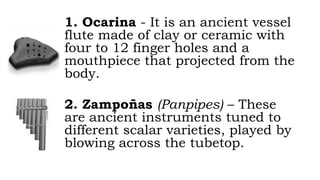
1. Ocarina - It is an ancient vessel
flute made of clay or ceramic with
four to 12 finger holes and a
mouthpiece that projected from the
body.
2. Zampoñas (Panpipes) – These
are ancient instruments tuned to
different scalar varieties, played by
blowing across the tubetop.
C. Andean Instruments
These are the instruments that were
being played during the Andean
Civilization (c. 3000 BCE – 1537). This
civilization is considered indigenous and
not derived from other civilizations
mainly because they came from the
river valleys of the coastal desserts of
Peru.
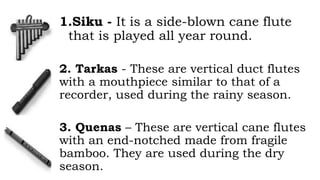
1.Siku - It is a side-blown cane flute
that is played all year round.
2. Tarkas - These are vertical duct flutes
with a mouthpiece similar to that of a
recorder, used during the rainy season.
3. Quenas – These are vertical cane flutes
with an end-notched made from fragile
bamboo. They are used during the dry
season.
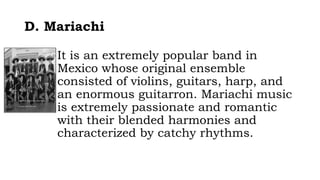
D. Mariachi
It is an extremely popular band in
Mexico whose original ensemble
consisted of violins, guitars, harp, and
an enormous guitarron. Mariachi music
is extremely passionate and romantic
with their blended harmonies and
characterized by catchy rhythms.
Image from bestliveentertainment.com
in Sunico, et.al, 2015, p.61.
ACTIVITY 2
Essay. The musical instruments of Latin
America were divided into three main groups
namely, Aztec and Mayan instruments, Incan
instruments and Andean instruments. Based on
the discussion and musical excerpts that you
have listened to, what do you think do they
have in common? What can you say about the
characteristics and features of Latin American
instruments in general? Elaborate your answer.
Your essay will be graded based on the following rubric:
•Holistic Rubric for the Essay (5 points)
•5 points – The main idea is well-focused and properly developed by
relevant, accurate and substantial evidence.
•4 points – The main idea is clearly presented with relevant and
accurate supporting evidences.
•3 points – The main idea is understandable but with minimal
supporting evidences
•2 points – The main idea is present but not well expressed with
slightly inconsistent evidences
•1 point – There is no clear main idea which the essay revolves on
and the supporting ideas are inconsistent.

Q2-LESSON-2-MUSIC.pptx

  • 1.
    LUCILLE JOY V.DADULLA Lesson 2 Music of Latin America
  • 2.
    “Music is thegreatest unifier, an incredible force. Something that people who differ on everything and anything else can have in common.” – Sarah Dessen, Just Listen. United States: Viking, 2006. • This quote speaks of the way Africans consider music because they believe that music serves as a link of the actual world with that of the spiritual world. •Music is indeed a vital part of everyday life in Africa.
  • 3.
    •The music ofLatin America is the product of three major influences – Indigenous, Spanish-Portuguese, and African. •Sometimes called Latin music; it includes the countries that have a colonial history from Spain and Portugal, divided into the following areas of Andean Region, Central America, Caribbean and Brazil.
  • 4.
    INFLUENCES ON LATINAMERICAN MUSIC 1.Indigenous Latin-American Music – The natives were found to be using local drum and percussion instruments. The indigenous music of Latin America was largely functional in nature, being used for religious worships and ceremonies. 2.Native American/ Indian Music - The ethnic and cultural groups of the principal Native Americans share many similar yet distinctive music elements. Songs had a wide range of volume levels. Songs celebrate themes like harvest, planting season or other important events or occasions of the year.
  • 5.
    3. Afro-Latin AmericanMusic - The African influence on Latin American music is most pronounced in its rich and varied rhythmic patterns produced by drums and various percussion instruments. 4. Euro-Latin American Music - The different regions of Latin America adopted various characteristics from their European colonizers. Melodies of the Renaissance period were used in Southern Chile and the Colombian Pacific coasts.
  • 6.
    5. Mixed AmericanMusic - The result of the massive infusion of African culture also brought about the introduction of other music and dance forms such as the Afro-Cuban rumba, Jamaican reggae, Colombian cumbia, and the Brazilian samba.
  • 7.
    Popular Latin AmericanMusic 1.Samba - It is a dance form of African origins around 1838 which evolved into an African-Brazilian invention in the working class and slum districts of Rio de Janeiro. Its lively rhythm was meant to be executed for singing, dancing, and parading in the carnival. 2.Son – It is a fusion of the popular music or canciones (songs) of Spain and the African rumba rhythms of Bantu origin. Originating in Cuba, it is usually played with the guitar, contrabass, bongos, maracas, and claves. Its most important legacy is its influence to present-day Latin American music, particularly as the forerunner of the salsa. 3.Salsa – It is a social dance with marked influences from Cuba and Puerto Rico that started in New York in the mid 1970’s. Its style contains elements from the swing dance and hustle as well as the complex Afro-Cuban and Afro-Caribbean dance forms of pachanga and guaguanco.
  • 8.
    MUSICAL INSTRUMENTS OFLATIN AMERICA •The varied cultures developed in Latin America gave rise to different types of wind and percussion instruments. As some instruments were considered holy and music was supposed to glorify the gods, mistakes in playing these instruments were considered offensive and insulting to them.
  • 9.
    A. Aztec andMayan Instruments • These are instruments that were during the Aztec Empire (c. 1345-1521 CE) and Mayan Civilization (1800 BC – AD 950). Aztec and Mayan people are people who lived in Southern Mexico and Northern Central America Central. 1. Tlapitzalli – It is a flute variety from the Aztec culture made of clay with decorations of abstract designs or images of their deities. 2. Teponaztli – It is a Mexican slit drum hollowed out and carved from a piece of hardwood with designs representing human figures or animals to be used for both religious and recreational purposes.
  • 10.
    3. Conch –It is a wind instrument made from a seashell usually of a large sea snail. It is prepared by cutting a hole in its spine near the apex, and then blown into as if it were a trumpet. 4. Rasp – It is a hand percussion instrument whose sound is produced by scraping a group of notched sticks with another stick, creating a series of rattling effects. 5. Huehueti – It is a Mexican upright tubular drum used by the Aztecs and other ancient civilizations. It is made of wood opened at the bottom and standing on three legs cut from the base, with its stretched skin beaten by the hand or a wooden mallet.
  • 11.
    B. Incan Instruments •Theseare instrument that were being played during the civilization of Inca between c. 1400 and 1533 CE in Pre- Columbian America, which was centered in what is now Peru. The Incas built one of the largest, most tightly controlled empires the world has ever known.
  • 12.
    1. Ocarina -It is an ancient vessel flute made of clay or ceramic with four to 12 finger holes and a mouthpiece that projected from the body. 2. Zampoñas (Panpipes) – These are ancient instruments tuned to different scalar varieties, played by blowing across the tubetop.
  • 13.
    C. Andean Instruments Theseare the instruments that were being played during the Andean Civilization (c. 3000 BCE – 1537). This civilization is considered indigenous and not derived from other civilizations mainly because they came from the river valleys of the coastal desserts of Peru.
  • 14.
    1.Siku - Itis a side-blown cane flute that is played all year round. 2. Tarkas - These are vertical duct flutes with a mouthpiece similar to that of a recorder, used during the rainy season. 3. Quenas – These are vertical cane flutes with an end-notched made from fragile bamboo. They are used during the dry season.
  • 15.
    D. Mariachi It isan extremely popular band in Mexico whose original ensemble consisted of violins, guitars, harp, and an enormous guitarron. Mariachi music is extremely passionate and romantic with their blended harmonies and characterized by catchy rhythms. Image from bestliveentertainment.com in Sunico, et.al, 2015, p.61.
  • 16.
    ACTIVITY 2 Essay. Themusical instruments of Latin America were divided into three main groups namely, Aztec and Mayan instruments, Incan instruments and Andean instruments. Based on the discussion and musical excerpts that you have listened to, what do you think do they have in common? What can you say about the characteristics and features of Latin American instruments in general? Elaborate your answer.
  • 17.
    Your essay willbe graded based on the following rubric: •Holistic Rubric for the Essay (5 points) •5 points – The main idea is well-focused and properly developed by relevant, accurate and substantial evidence. •4 points – The main idea is clearly presented with relevant and accurate supporting evidences. •3 points – The main idea is understandable but with minimal supporting evidences •2 points – The main idea is present but not well expressed with slightly inconsistent evidences •1 point – There is no clear main idea which the essay revolves on and the supporting ideas are inconsistent.