7
Lesson Exemplar
for Science
Quarter 2
Lesson
3
2
Development Team
Writer:
 Kristine N. Busmion (Siliman University)
Validator:
 Genelita S. Garcia (Philippine Normal University)
Management Team
Philippine Normal University
Research Institute for Teacher Quality
SiMMER National Research Centre
Lesson Exemplar for Science Grade 7
Quarter 2: Lesson 3 (Week 3)
S.Y. 2024-2025
This material is intended exclusively for the use of teachers participating in the implementation of the MATATAG K to 10 Curriculum during the School
Year 2024-2025. It aims to assist in delivering the curriculum content, standards, and lesson competencies. Any unauthorized reproduction, distribution,
modification, or utilization of this material beyond the designated scope is strictly prohibited and may result in appropriate legal actions and disciplinary
measures.
Borrowed content included in this material are owned by their respective copyright holders. Every effort has been made to locate and obtain
permission to use these materials from their respective copyright owners. The publisher and development team do not represent nor claim ownership over
them.
Every care has been taken to ensure the accuracy of the information provided in this material. For inquiries or feedback, please write or call the Office
of the Director of the Bureau of Learning Resources via telephone numbers (02) 8634-1072 and 8631-6922 or by email at blr.od@deped.gov.ph.
1
SCIENCE (BIOLOGY) / QUARTER 2 / GRADE 7
I. CURRICULUM CONTENT, STANDARDS, AND LESSON COMPETENCIES
1. Content
Standards
1. Familiarity and proper use of a compound microscope are essential to observe cells.
2. The organelles of plant and animal cells can be identified using a compound microscope.
3. Cells are the basic unit of life and mitosis, and meiosis are the basic forms of cell division.
2. Performance
Standards
By the end of the Quarter, learners will be able to create a visual representation, such as poster, model, or e-poster,
explaining the trophic level in a chosen ecosystem.
3. Learning
Competencies
and Objectives
1. Identify the parts and functions, and demonstrate proper handling and storing of a compound microscope
Lesson Objective 1: Identify the parts of a compound microscope and the function of each part.
Lesson Objective 2: Demonstrate the proper handling and storing of a compound microscope
2. Use proper techniques in observing and identifying the parts of a cell with a microscope such as the cell
membrane, nucleus, cytoplasm, mitochondria, chloroplasts, and ribosomes
Lesson Objective 1: Use proper techniques when observing the parts of a cell under a microscope.
Lesson Objective 2: Identify the parts of a cell, such as the cell membrane, nucleus, and cytoplasm, with a
microscope
3. Differentiate plant and animal cells based on their organelles
Lesson Objective 1: Identify the parts of a plant cell and the function of each.
Lesson Objective 2: Identify the parts of an animal cell and the function of each.
Lesson Objective 3: Compare and contrast plant and animal cells based on their organelles.
4. Recognize that some organisms consist of a single cell (unicellular) like in bacteria and some consist of
many cells (multicellular) like in a human
Lesson Objective 1: Describe unicellular and multicellular organisms
Lesson Objective 2: Identify examples of unicellular and multicellular organisms
4. Content 1. Science equipment: The Compound Microscope
● Parts and Functions
● Using of Microscope
2
2. Plant and animal cells
● Parts and Functions
● Similarities and Differences
5. Integration  Utilization of a microscope in investigating microorganism and their roles in the ecosystem
 Distribution of plant and animal cells relating to global diversity patterns
 The intricate pattern of plant and animal cells for inspiration for artistic pieces
II. LEARNING RESOURCES
 Amazon (2024). Wonderattheworld.com. https://wonderattheworld.com/wp-content/uploads/2023/12/Amazon-lap-book.jpg
 Ananya Mandal. (2019, June 5). What is Staphylococcus Aureus? News-Medical.net. https://www.news-medical.net/health/What-is Staphylococcus-
Aureus.aspx
 Batul, A. (2013, January 17). Rhizopus bread mold under microscope. World under Microscope.
https://worldundermicroscope.wordpress.com/2013/01/17/rhizopus-bread-mold-under-microscope/
 FuseSchool - Global Education. (2018). Unicellular vs Multicellular | Cells | Biology | FuseSchool.
https://www.youtube.com/watch?v=1hrkwJ_HuR0&ab_channel=FuseSchool-GlobalEducation
 FuseSchool - Global Education. (2018). Unicellular vs Multicellular | Cells | Biology | FuseSchool. In YouTube.
https://www.youtube.com/watch?v=1hrkwJ_HuR0
 Lumen Learning. (2019). Prokaryotes and Eukaryotes | Biology for Majors I. Lumenlearning.com. https://courses.lumenlearning.com/suny-
wmopen-biology1/chapter/prokaryotes-and-eukaryotes/
 Molnar, C., & Gair, J. (2019). 1.1 Themes and Concepts of Biology – Concepts of Biology-1st Canadian Edition. Opentextbc.ca.
https://opentextbc.ca/biology/chapter/1-1-themes-and-concepts-of-biology/
 National Geographic Society. (2022b, May 20). Unicellular vs. Multicellular | National Geographic Society. Education.nationalgeographic.org.
https://education.nationalgeographic.org/resource/unicellular-vs-multicellular/
 National Geographic. (2020, March 13). Tardigrade, facts and photos. National Geographic.
https://www.nationalgeographic.com/animals/invertebrates/facts/tardigrades-water-bears
 Southern Biological. (n.d.). Introduction to Euglena. Www.southernbiological.com. https://www.southernbiological.com/introduction to-euglena/
 TED-Ed. (2016). What is the biggest single-celled organism? - Murry Gans. In YouTube. https://www.youtube.com/watch?v=FK9xHry877U
 Vedantu. (n.d.). Give examples of unicellular and multicellular organisms. Www.vedantu.com. https://www.vedantu.com/question answer/give-
examples-of-unicellular-and-multicellular-class-11-biology-cbse-5f8a7c6e2331d1505cd0f44d
3
III. TEACHING AND LEARNING PROCEDURE NOTES TO TEACHERS
A. Activating
Prior Knowledge
Short Review
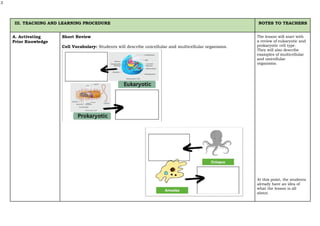
Cell Vocabulary: Students will describe unicellular and multicellular organisms.
The lesson will start with
a review of eukaryotic and
prokaryotic cell type.
They will also describe
examples of multicellular
and unicellular
organisms.
At this point, the students
already have an idea of
what the lesson is all
about.
4
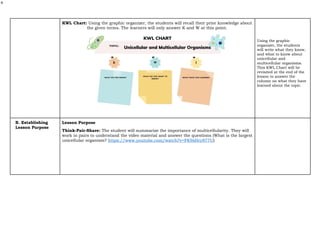
KWL Chart: Using the graphic organizer, the students will recall their prior knowledge about
the given terms. The learners will only answer K and W at this point.
Using the graphic
organizer, the students
will write what they know,
and what to know about
unicellular and
multicellular organisms.
This KWL Chart will be
revisited at the end of the
lesson to answer the
column on what they have
learned about the topic.
B. Establishing
Lesson Purpose
Lesson Purpose
Think-Pair-Share: The student will summarize the importance of multicellularity. They will
work in pairs to understand the video material and answer the questions (What is the largest
unicellular organism? https://www.youtube.com/watch?v=FK9xHry877U)
5
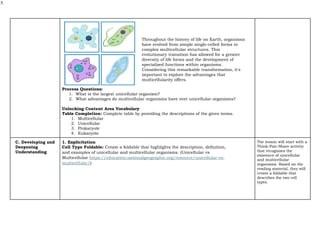
Throughout the history of life on Earth, organisms
have evolved from simple single-celled forms to
complex multicellular structures. This
evolutionary transition has allowed for a greater
diversity of life forms and the development of
specialized functions within organisms.
Considering this remarkable transformation, it's
important to explore the advantages that
multicellularity offers.
Process Questions:
1. What is the largest unicellular organism?
2. What advantages do multicellular organisms have over unicellular organisms?
Unlocking Content Area Vocabulary
Table Completion: Complete table by providing the descriptions of the given terms.
1. Multicellular
2. Unicellular
3. Prokaryote
4. Eukaryote
C. Developing and
Deepening
Understanding
1. Explicitation
Cell Type Foldable: Create a foldable that highlights the description, definition,
and examples of unicellular and multicellular organisms. (Unicellular vs
Multicellular https://education.nationalgeographic.org/resource/unicellular-vs-
multicellular/)
The lesson will start with a
Think-Pair-Share activity
that recognizes the
existence of unicellular
and multicellular
organisms. Based on the
reading material, they will
create a foldable that
describes the two cell
types.
6
2. Worked Example
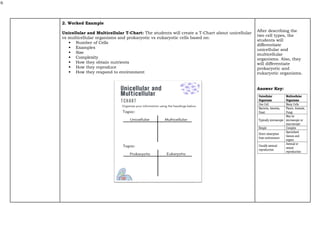
Unicellular and Multicellular T-Chart: The students will create a T-Chart about unicellular
vs multicellular organisms and prokaryotic vs eukaryotic cells based on:
 Number of Cells
 Examples
 Size
 Complexity
 How they obtain nutrients
 How they reproduce
 How they respond to environment
After describing the
two cell types, the
students will
differentiate
unicellular and
multicellular
organisms. Also, they
will differentiate
prokaryotic and
eukaryotic organisms.
Answer Key:
7
3. Lesson Activity
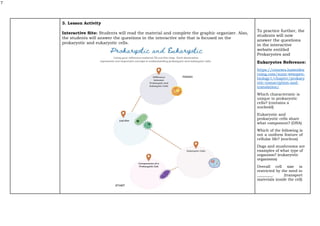
Interactive Site: Students will read the material and complete the graphic organizer. Also,
the students will answer the questions in the interactive site that is focused on the
prokaryotic and eukaryotic cells.
To practice further, the
students will now
answer the questions
in the interactive
website entitled
Prokaryotes and
Eukaryotes Reference:
https://courses.lumenlea
rning.com/suny-wmopen-
biology1/chapter/prokary
otic-transcription-and-
translation/
Which characteristic is
unique to prokaryotic
cells? (contains a
nucleoid)
Eukaryotic and
prokaryotic cells share
what component? (DNA)
Which of the following is
not a uniform feature of
cellular life? (nucleus)
Dogs and mushrooms are
examples of what type of
organism? (eukaryotic
organisms)
Overall cell size is
restricted by the need to
. (transport
materials inside the cell)
8
D. Making
Generalizations
Learners’ Takeaways
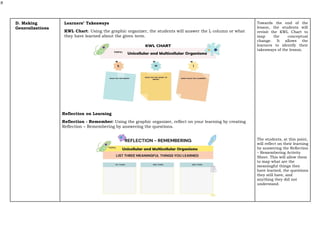
KWL Chart: Using the graphic organizer, the students will answer the L column or what
they have learned about the given term.
Reflection on Learning
Reflection - Remember: Using the graphic organizer, reflect on your learning by creating
Reflection – Remembering by answering the questions.
Towards the end of the
lesson, the students will
revisit the KWL Chart to
map the conceptual
change. It allows the
learners to identify their
takeaways of the lesson.
The students, at this point,
will reflect on their learning
by answering the Reflection
– Remembering Activity
Sheet. This will allow them
to map what are the
meaningful things they
have learned, the questions
they still have, and
anything they did not
understand.
9
IV. EVALUATING LEARNING: FORMATIVE ASSESSMENT AND TEACHER’S REFLECTION NOTES TO
TEACHERS
A. Evaluating
Learning
1. Formative Assessment
A. Multiple Choice. Write the letter that corresponds to the correct answer.
Teachers may
encourage learners to
have a quiz notebook
to monitor learners’
academic progress.
The quiz
notebook may also
serve as homework
notebook.
Answer Key:
1. d) Made up of
many specialized
cells
2. c) They consist of
a single cell
3. d) Capacity to
replace or repair
damaged cells
4. d) They consist of
many specialized
cells working
together
5. d) Ability to
reproduce
asexually
1. Which of the following is a characteristic of multicellular organisms?
a) Composed of a single cell
b) Lack specialized cells
c) Can only reproduce asexually
d) Made up of many specialized cells
2. What is a defining feature of unicellular organisms?
a) They have complex structures and systems
b) They reproduce sexually
c) They consist of a single cell
d) They are unable to adapt to different environments
3. What enables multicellular organisms to have longer lifespans than most unicellular
organisms?
a) Ability to hibernate
b) Specialized cells
c) Ability to reproduce sexually
d) Capacity to replace or repair damaged cells
4. Why do multicellular organisms have increased complexity compared to unicellular
organisms?
a) They have more DNA
b) They lack cell specialization
c) They have a larger surface area-to-volume ratio
d) They consist of many specialized cells working together
5. What is the primary advantage of unicellular organisms?
a) Ability to perform specialized functions
b) Adaptability to different environments
c) Larger size
d) Ability to reproduce asexually
10
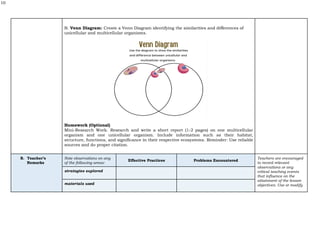
B. Venn Diagram: Create a Venn Diagram identifying the similarities and differences of
unicellular and multicellular organisms.
Homework (Optional)
Mini-Research Work. Research and write a short report (1-2 pages) on one multicellular
organism and one unicellular organism. Include information such as their habitat,
structure, functions, and significance in their respective ecosystems. Reminder: Use reliable
sources and do proper citation.
B. Teacher’s
Remarks
Note observations on any
of the following areas:
Effective Practices Problems Encountered
Teachers are encouraged
to record relevant
observations or any
critical teaching events
that influence on the
attainment of the lesson
objectives. Use or modify
strategies explored
materials used
11
learner engagement/
interaction
the provided template in
recording the notable
instructional areas or
concerns.
In addition, notes here
can also be on tasks that
will be continued the next
day or additional
activities needed.
Others
C. Teacher’s
Reflection Reflection guide or prompt can be on:
▪ principles behind the teaching
What principles and beliefs informed my lesson?
Why did I teach the lesson the way I did?
▪ students
What roles did my students play in my lesson?
What did my students learn? How did they learn?
▪ ways forward
What could I have done differently?
What can I explore in the next lesson?
Entries in this section are
the teacher’s reflections
about the implementation
of the whole lesson,
which will serve as
inputs for the LAC
sessions. Use or modify
the provided guide
questions in
eliciting teacher’s
insights.

Q2_LE_Science7_Lesson-3_Week 3 (1).docx.

  • 1.
  • 2.
    2 Development Team Writer:  KristineN. Busmion (Siliman University) Validator:  Genelita S. Garcia (Philippine Normal University) Management Team Philippine Normal University Research Institute for Teacher Quality SiMMER National Research Centre Lesson Exemplar for Science Grade 7 Quarter 2: Lesson 3 (Week 3) S.Y. 2024-2025 This material is intended exclusively for the use of teachers participating in the implementation of the MATATAG K to 10 Curriculum during the School Year 2024-2025. It aims to assist in delivering the curriculum content, standards, and lesson competencies. Any unauthorized reproduction, distribution, modification, or utilization of this material beyond the designated scope is strictly prohibited and may result in appropriate legal actions and disciplinary measures. Borrowed content included in this material are owned by their respective copyright holders. Every effort has been made to locate and obtain permission to use these materials from their respective copyright owners. The publisher and development team do not represent nor claim ownership over them. Every care has been taken to ensure the accuracy of the information provided in this material. For inquiries or feedback, please write or call the Office of the Director of the Bureau of Learning Resources via telephone numbers (02) 8634-1072 and 8631-6922 or by email at blr.od@deped.gov.ph.
  • 3.
    1 SCIENCE (BIOLOGY) /QUARTER 2 / GRADE 7 I. CURRICULUM CONTENT, STANDARDS, AND LESSON COMPETENCIES 1. Content Standards 1. Familiarity and proper use of a compound microscope are essential to observe cells. 2. The organelles of plant and animal cells can be identified using a compound microscope. 3. Cells are the basic unit of life and mitosis, and meiosis are the basic forms of cell division. 2. Performance Standards By the end of the Quarter, learners will be able to create a visual representation, such as poster, model, or e-poster, explaining the trophic level in a chosen ecosystem. 3. Learning Competencies and Objectives 1. Identify the parts and functions, and demonstrate proper handling and storing of a compound microscope Lesson Objective 1: Identify the parts of a compound microscope and the function of each part. Lesson Objective 2: Demonstrate the proper handling and storing of a compound microscope 2. Use proper techniques in observing and identifying the parts of a cell with a microscope such as the cell membrane, nucleus, cytoplasm, mitochondria, chloroplasts, and ribosomes Lesson Objective 1: Use proper techniques when observing the parts of a cell under a microscope. Lesson Objective 2: Identify the parts of a cell, such as the cell membrane, nucleus, and cytoplasm, with a microscope 3. Differentiate plant and animal cells based on their organelles Lesson Objective 1: Identify the parts of a plant cell and the function of each. Lesson Objective 2: Identify the parts of an animal cell and the function of each. Lesson Objective 3: Compare and contrast plant and animal cells based on their organelles. 4. Recognize that some organisms consist of a single cell (unicellular) like in bacteria and some consist of many cells (multicellular) like in a human Lesson Objective 1: Describe unicellular and multicellular organisms Lesson Objective 2: Identify examples of unicellular and multicellular organisms 4. Content 1. Science equipment: The Compound Microscope ● Parts and Functions ● Using of Microscope
  • 4.
    2 2. Plant andanimal cells ● Parts and Functions ● Similarities and Differences 5. Integration  Utilization of a microscope in investigating microorganism and their roles in the ecosystem  Distribution of plant and animal cells relating to global diversity patterns  The intricate pattern of plant and animal cells for inspiration for artistic pieces II. LEARNING RESOURCES  Amazon (2024). Wonderattheworld.com. https://wonderattheworld.com/wp-content/uploads/2023/12/Amazon-lap-book.jpg  Ananya Mandal. (2019, June 5). What is Staphylococcus Aureus? News-Medical.net. https://www.news-medical.net/health/What-is Staphylococcus- Aureus.aspx  Batul, A. (2013, January 17). Rhizopus bread mold under microscope. World under Microscope. https://worldundermicroscope.wordpress.com/2013/01/17/rhizopus-bread-mold-under-microscope/  FuseSchool - Global Education. (2018). Unicellular vs Multicellular | Cells | Biology | FuseSchool. https://www.youtube.com/watch?v=1hrkwJ_HuR0&ab_channel=FuseSchool-GlobalEducation  FuseSchool - Global Education. (2018). Unicellular vs Multicellular | Cells | Biology | FuseSchool. In YouTube. https://www.youtube.com/watch?v=1hrkwJ_HuR0  Lumen Learning. (2019). Prokaryotes and Eukaryotes | Biology for Majors I. Lumenlearning.com. https://courses.lumenlearning.com/suny- wmopen-biology1/chapter/prokaryotes-and-eukaryotes/  Molnar, C., & Gair, J. (2019). 1.1 Themes and Concepts of Biology – Concepts of Biology-1st Canadian Edition. Opentextbc.ca. https://opentextbc.ca/biology/chapter/1-1-themes-and-concepts-of-biology/  National Geographic Society. (2022b, May 20). Unicellular vs. Multicellular | National Geographic Society. Education.nationalgeographic.org. https://education.nationalgeographic.org/resource/unicellular-vs-multicellular/  National Geographic. (2020, March 13). Tardigrade, facts and photos. National Geographic. https://www.nationalgeographic.com/animals/invertebrates/facts/tardigrades-water-bears  Southern Biological. (n.d.). Introduction to Euglena. Www.southernbiological.com. https://www.southernbiological.com/introduction to-euglena/  TED-Ed. (2016). What is the biggest single-celled organism? - Murry Gans. In YouTube. https://www.youtube.com/watch?v=FK9xHry877U  Vedantu. (n.d.). Give examples of unicellular and multicellular organisms. Www.vedantu.com. https://www.vedantu.com/question answer/give- examples-of-unicellular-and-multicellular-class-11-biology-cbse-5f8a7c6e2331d1505cd0f44d
  • 5.
    3 III. TEACHING ANDLEARNING PROCEDURE NOTES TO TEACHERS A. Activating Prior Knowledge Short Review Cell Vocabulary: Students will describe unicellular and multicellular organisms. The lesson will start with a review of eukaryotic and prokaryotic cell type. They will also describe examples of multicellular and unicellular organisms. At this point, the students already have an idea of what the lesson is all about.
  • 6.
    4 KWL Chart: Usingthe graphic organizer, the students will recall their prior knowledge about the given terms. The learners will only answer K and W at this point. Using the graphic organizer, the students will write what they know, and what to know about unicellular and multicellular organisms. This KWL Chart will be revisited at the end of the lesson to answer the column on what they have learned about the topic. B. Establishing Lesson Purpose Lesson Purpose Think-Pair-Share: The student will summarize the importance of multicellularity. They will work in pairs to understand the video material and answer the questions (What is the largest unicellular organism? https://www.youtube.com/watch?v=FK9xHry877U)
  • 7.
    5 Throughout the historyof life on Earth, organisms have evolved from simple single-celled forms to complex multicellular structures. This evolutionary transition has allowed for a greater diversity of life forms and the development of specialized functions within organisms. Considering this remarkable transformation, it's important to explore the advantages that multicellularity offers. Process Questions: 1. What is the largest unicellular organism? 2. What advantages do multicellular organisms have over unicellular organisms? Unlocking Content Area Vocabulary Table Completion: Complete table by providing the descriptions of the given terms. 1. Multicellular 2. Unicellular 3. Prokaryote 4. Eukaryote C. Developing and Deepening Understanding 1. Explicitation Cell Type Foldable: Create a foldable that highlights the description, definition, and examples of unicellular and multicellular organisms. (Unicellular vs Multicellular https://education.nationalgeographic.org/resource/unicellular-vs- multicellular/) The lesson will start with a Think-Pair-Share activity that recognizes the existence of unicellular and multicellular organisms. Based on the reading material, they will create a foldable that describes the two cell types.
  • 8.
    6 2. Worked Example Unicellularand Multicellular T-Chart: The students will create a T-Chart about unicellular vs multicellular organisms and prokaryotic vs eukaryotic cells based on:  Number of Cells  Examples  Size  Complexity  How they obtain nutrients  How they reproduce  How they respond to environment After describing the two cell types, the students will differentiate unicellular and multicellular organisms. Also, they will differentiate prokaryotic and eukaryotic organisms. Answer Key:
  • 9.
    7 3. Lesson Activity InteractiveSite: Students will read the material and complete the graphic organizer. Also, the students will answer the questions in the interactive site that is focused on the prokaryotic and eukaryotic cells. To practice further, the students will now answer the questions in the interactive website entitled Prokaryotes and Eukaryotes Reference: https://courses.lumenlea rning.com/suny-wmopen- biology1/chapter/prokary otic-transcription-and- translation/ Which characteristic is unique to prokaryotic cells? (contains a nucleoid) Eukaryotic and prokaryotic cells share what component? (DNA) Which of the following is not a uniform feature of cellular life? (nucleus) Dogs and mushrooms are examples of what type of organism? (eukaryotic organisms) Overall cell size is restricted by the need to . (transport materials inside the cell)
  • 10.
    8 D. Making Generalizations Learners’ Takeaways KWLChart: Using the graphic organizer, the students will answer the L column or what they have learned about the given term. Reflection on Learning Reflection - Remember: Using the graphic organizer, reflect on your learning by creating Reflection – Remembering by answering the questions. Towards the end of the lesson, the students will revisit the KWL Chart to map the conceptual change. It allows the learners to identify their takeaways of the lesson. The students, at this point, will reflect on their learning by answering the Reflection – Remembering Activity Sheet. This will allow them to map what are the meaningful things they have learned, the questions they still have, and anything they did not understand.
  • 11.
    9 IV. EVALUATING LEARNING:FORMATIVE ASSESSMENT AND TEACHER’S REFLECTION NOTES TO TEACHERS A. Evaluating Learning 1. Formative Assessment A. Multiple Choice. Write the letter that corresponds to the correct answer. Teachers may encourage learners to have a quiz notebook to monitor learners’ academic progress. The quiz notebook may also serve as homework notebook. Answer Key: 1. d) Made up of many specialized cells 2. c) They consist of a single cell 3. d) Capacity to replace or repair damaged cells 4. d) They consist of many specialized cells working together 5. d) Ability to reproduce asexually 1. Which of the following is a characteristic of multicellular organisms? a) Composed of a single cell b) Lack specialized cells c) Can only reproduce asexually d) Made up of many specialized cells 2. What is a defining feature of unicellular organisms? a) They have complex structures and systems b) They reproduce sexually c) They consist of a single cell d) They are unable to adapt to different environments 3. What enables multicellular organisms to have longer lifespans than most unicellular organisms? a) Ability to hibernate b) Specialized cells c) Ability to reproduce sexually d) Capacity to replace or repair damaged cells 4. Why do multicellular organisms have increased complexity compared to unicellular organisms? a) They have more DNA b) They lack cell specialization c) They have a larger surface area-to-volume ratio d) They consist of many specialized cells working together 5. What is the primary advantage of unicellular organisms? a) Ability to perform specialized functions b) Adaptability to different environments c) Larger size d) Ability to reproduce asexually
  • 12.
    10 B. Venn Diagram:Create a Venn Diagram identifying the similarities and differences of unicellular and multicellular organisms. Homework (Optional) Mini-Research Work. Research and write a short report (1-2 pages) on one multicellular organism and one unicellular organism. Include information such as their habitat, structure, functions, and significance in their respective ecosystems. Reminder: Use reliable sources and do proper citation. B. Teacher’s Remarks Note observations on any of the following areas: Effective Practices Problems Encountered Teachers are encouraged to record relevant observations or any critical teaching events that influence on the attainment of the lesson objectives. Use or modify strategies explored materials used
  • 13.
    11 learner engagement/ interaction the providedtemplate in recording the notable instructional areas or concerns. In addition, notes here can also be on tasks that will be continued the next day or additional activities needed. Others C. Teacher’s Reflection Reflection guide or prompt can be on: ▪ principles behind the teaching What principles and beliefs informed my lesson? Why did I teach the lesson the way I did? ▪ students What roles did my students play in my lesson? What did my students learn? How did they learn? ▪ ways forward What could I have done differently? What can I explore in the next lesson? Entries in this section are the teacher’s reflections about the implementation of the whole lesson, which will serve as inputs for the LAC sessions. Use or modify the provided guide questions in eliciting teacher’s insights.