WHAT IS PYTHON?
Pythonis a general purpose, dynamic, high-level, and interpreted
programming language. It supports Object Oriented programming
approach to develop applications. It is simple and easy to learn and
provides lots of high-level data structures.
3.
WHY PYTHON?
• Pythonis easy to learn yet powerful and versatile scripting language, which makes it
attractive for Application Development.
• Python's syntax and dynamic typing with its interpreted nature make it an ideal language
for scripting and rapid application development.
• Python supports multiple programming pattern, including object-oriented, imperative, and
functional or procedural programming styles.
• Python is not intended to work in a particular area, such as web programming. That is
why it is known as multipurpose programming language because it can be used with web,
enterprise, 3D CAD, etc.
4.
WHY PYTHON?
• Wedon't need to use data types to declare variable because it is dynamically typed so we
can write a=10 to assign an integer value in an integer variable.
• Python makes the development and debugging fast because there is no compilation step
included in Python development, and edit-test-debug cycle is very fast.
5.
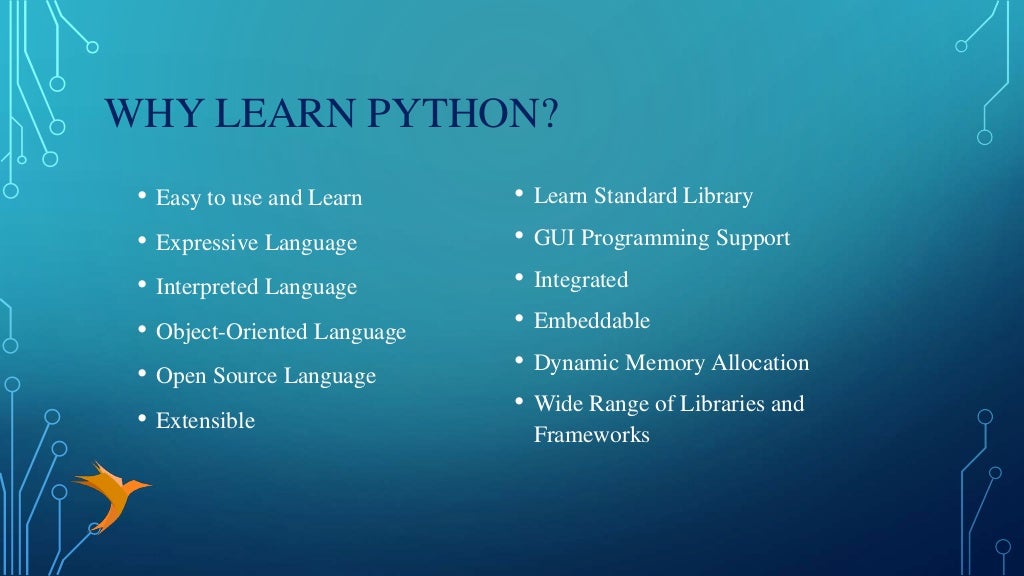
WHY LEARN PYTHON?
•Easy to use and Learn
• Expressive Language
• Interpreted Language
• Object-Oriented Language
• Open Source Language
• Extensible
• Learn Standard Library
• GUI Programming Support
• Integrated
• Embeddable
• Dynamic Memory Allocation
• Wide Range of Libraries and
Frameworks
6.
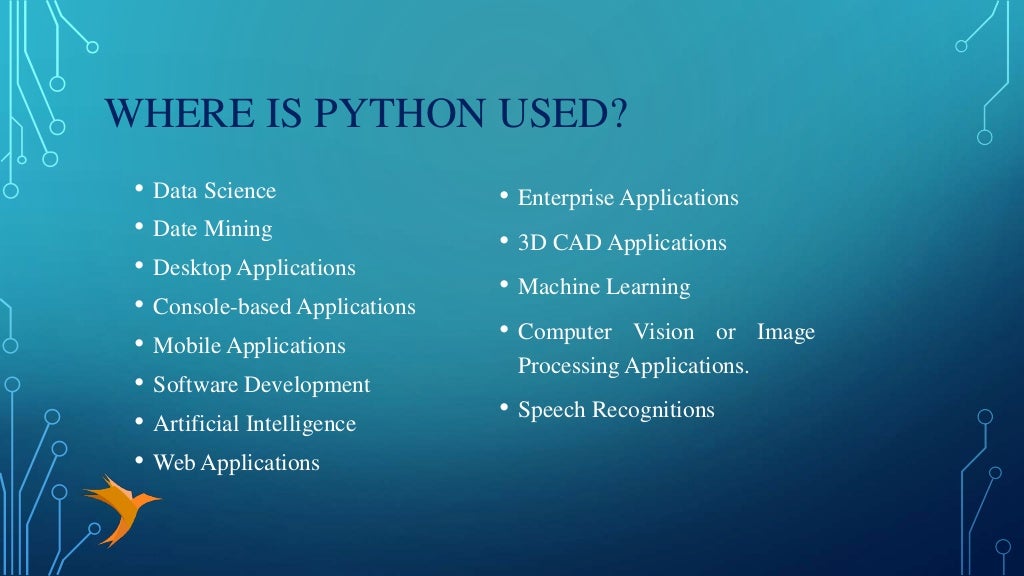
WHERE IS PYTHONUSED?
• Data Science
• Date Mining
• Desktop Applications
• Console-based Applications
• Mobile Applications
• Software Development
• Artificial Intelligence
• Web Applications
• Enterprise Applications
• 3D CAD Applications
• Machine Learning
• Computer Vision or Image
Processing Applications.
• Speech Recognitions
7.
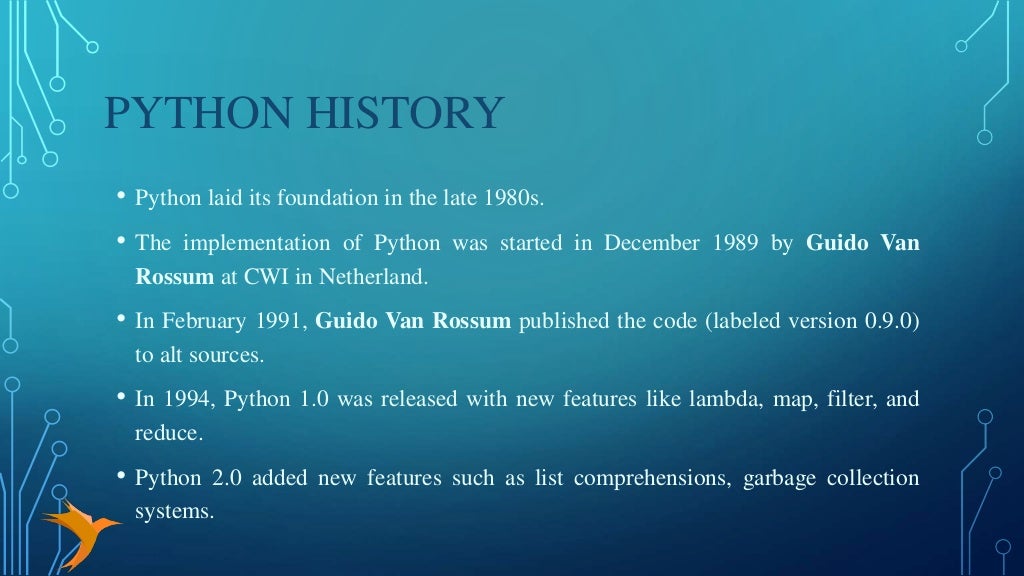
PYTHON HISTORY
• Pythonlaid its foundation in the late 1980s.
• The implementation of Python was started in December 1989 by Guido Van
Rossum at CWI in Netherland.
• In February 1991, Guido Van Rossum published the code (labeled version 0.9.0)
to alt sources.
• In 1994, Python 1.0 was released with new features like lambda, map, filter, and
reduce.
• Python 2.0 added new features such as list comprehensions, garbage collection
systems.