Python ProgrammingPython Programming
Crash Course WorkshopCrash Course Workshop
behzadimbehzadim mariebehzadimariebehzadi mariebehzadimariebehzadi
26-Nov-2018
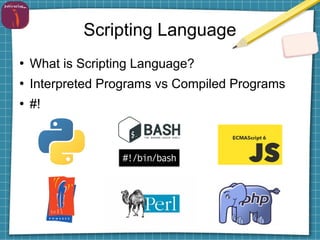
Scripting Language
●
What is Scripting Language?
●
Interpreted Programs vs Compiled Programs
●
#!
What is Python?
●
Created in 1990 by Guido van Rossum
●
Rossum was BDFL until 2018
●
Origin name from British comedy group Monty Python
●
An important goal of Python's developers is keeping it fun to use
●
Interpreted high-level programming language
●
General-purpose language
●
Paradigm
– Object-oriented
– Imperative
– Functional
– Procedural
– Reflective
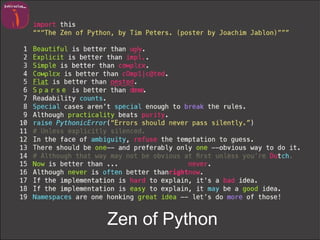
Zen of Python
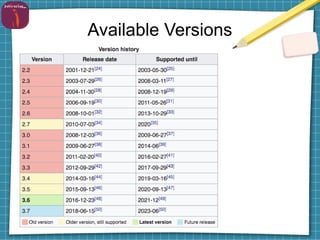
Available Versions
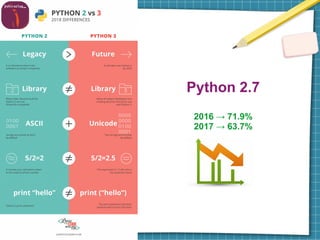
Python 2.7
2016 → 71.9%
2017 → 63.7%
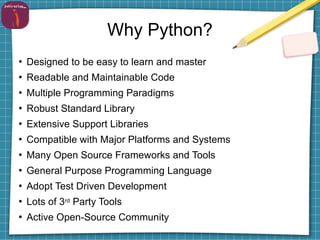
Why Python?
●
Designed to be easy to learn and master
●
Readable and Maintainable Code
●
Multiple Programming Paradigms
●
Robust Standard Library
●
Extensive Support Libraries
●
Compatible with Major Platforms and Systems
●
Many Open Source Frameworks and Tools
●
General Purpose Programming Language
●
Adopt Test Driven Development
●
Lots of 3rd Party Tools
●
Active Open-Source Community
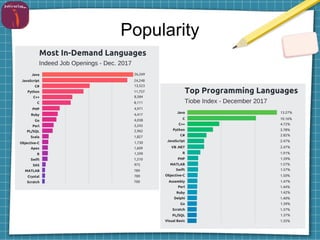
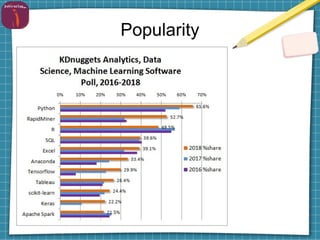
Popularity
Popularity
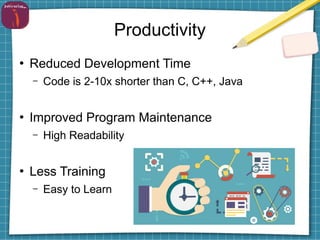
Productivity
●
Reduced Development Time
– Code is 2-10x shorter than C, C++, Java
●
Improved Program Maintenance
– High Readability
●
Less Training
– Easy to Learn
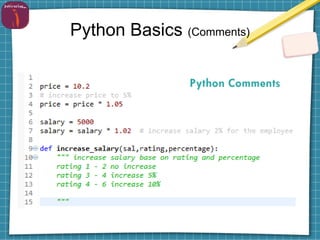
Python Basics (Comments)
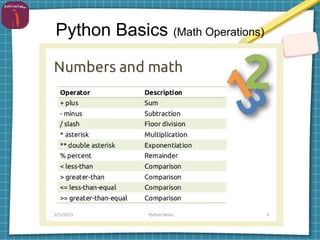
Python Basics (Math Operations)
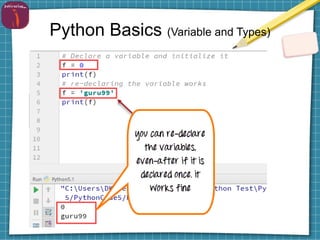
Python Basics (Variable and Types)
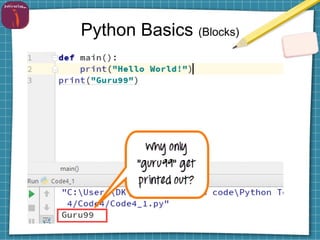
Python Basics (Blocks)
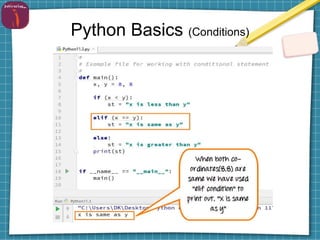
Python Basics (Conditions)
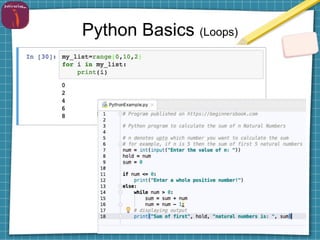
Python Basics (Loops)
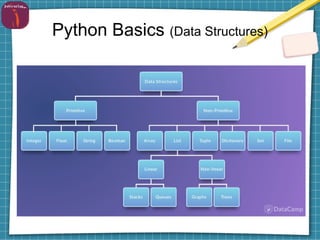
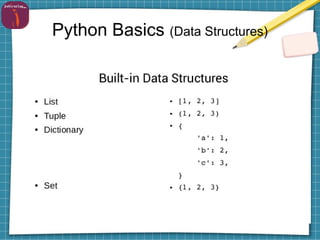
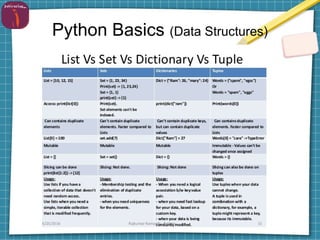
Python Basics (Data Structures)
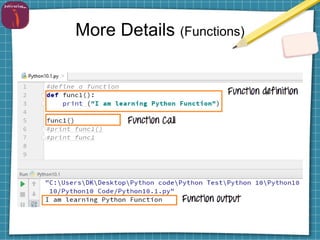
More Details (Functions)
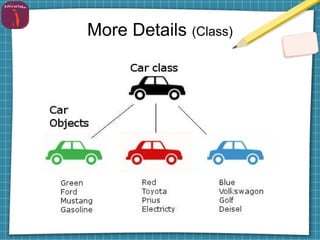
More Details (Class)
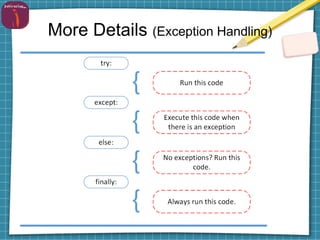
More Details (Exception Handling)
More Details (Module)
●
logically organize your Python code
●
Grouping related code → easy, high readability
●
Simply, a module is a file consisting of Python code
●
A module can define functions, classes and variables.
●
A module can also include runnable code.
The Python Standard Library
●
Python comes standard with a set of modules, known as the “standard
library”
●
Incredibly rich and diverse functionality available from the standard library
●
All common internet protocols, sockets, CGI, OS services, GUI services
(via Tcl/Tk), database, Berkeley style databases, calendar, Python parser,
file globbing/searching, debugger, profiler, threading and synchronisation,
persistency, etc
https://docs.python.org/3/library/
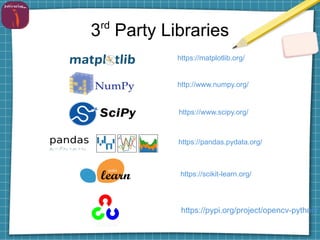
3rd
Party Libraries
http://www.numpy.org/
https://www.scipy.org/
https://matplotlib.org/
https://pandas.pydata.org/
https://scikit-learn.org/
https://pypi.org/project/opencv-python/
Numpy
●
Numerical Python
●
Why NumPy?
●
Designed for scientific computing
●
Open-Source
●
ndarray is the core object
●
Advanced functions to work with arrays
●
Universal Functions (ufunc)
●
Basic Linear Algebra
●
Basic Statistical Operations
●
Random Simulation
●
discrete Fourier transforms
●
mathematical, logical, shape manipulation
●
Numeric + Numarray ~ NumPy
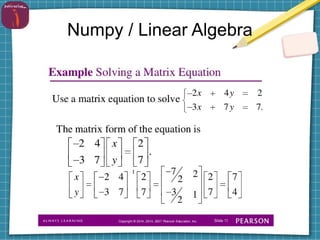
Numpy / Linear Algebra
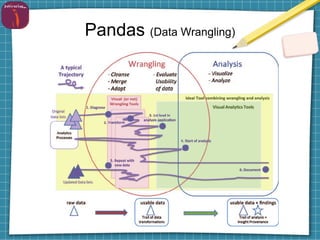
Pandas
●
data manipulation and analysis
●
data structures and operations for manipulating
numerical tables and time series
●
The name is derived from the term "panel data"
●
DataFrame is the Core Object
●
Suitable for Data Wrangling
●
Open-Source
Pandas (Data Wrangling)
scikit-learn
●
free software machine learning library for the Python
●
Used in data mining and data analysis
●
Built on NumPy, SciPy, and matplotlib
●
Open-Source
●
classification, regression and clustering algorithms
– support vector machines
– random forests
– gradient boosting
– k-means
– DBSCAN
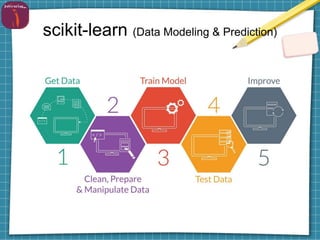
scikit-learn (Data Modeling & Prediction)
Python workshop

Python workshop