COMPUTER SCIENCE SYLLABUS
By:
Sanjeev Bhadauria
PGT CS
KV Barabanki
FOR XI AND XII
LEARNING OUTCOMES
• Ability to understand and apply basic computational thinking.
• Ability to understand the notion of data types and data structures and
apply in different situations.
• Ability to appreciate the notion of an algorithm and apply its structure
including how algorithms handle corner cases.
• Ability to develop a basic understanding of computer systems -
architecture, operating system, mobile and cloud computing.
• Ability to work in the cyber world with understanding of cyber ethics,
cyber safety and cybercrime
• Ability to make use the value of technology in societies, gender and
disability issues and the technology behind biometric ids.
CLASS XI
DISTRIBUTION OF MARKS
UNIT
No.
UNIT NAME Theory
Marks
Periods
Theory Practical
I. Computer Systems and Organisation 10 10 5
II. Computational Thinking and Programming - 1 45 50 35
III. Society, Law and Ethics 15 20 --
Total 70 80 40
CLASS XI
UNIT I: COMPUTER SYSTEMS AND ORGANIZATION
• Basic computer organization: description of a computer system and
mobile system, CPU, memory, hard disk, I/O, battery.
• Types of software: Application software, System software and Utility
software.
• Memory Units: bit, byte, MB, GB, TB, and PB.
• Boolean logic: NOT, AND, OR, NAND, NOR, XOR, NOT, truth tables and
De-Morgan’s Laws, Logic circuits
• Number System: numbers in base 2, 8, 16 and binary addition.
• Encoding Schemes : ASCII, ISCII and Unicode.
• Concept of Compiler and Interpreter
• Operating System (OS) - need for an operating system, brief introduction
• to functions of OS, user interface.
CLASS XI
UNIT II: COMPUTATIONAL THINKING AND PROGRAMMING - 1
• Execution of a program, errors- syntax error, run-time error and logical
error.
• Conditional statements: if, if-else, if-elif-else; simple programs: e.g.:
absolute value, sort 3 numbers and divisibility of a number.
• Notion of iterative computation and control flow: for(range(),len()), while,
using flowcharts, suggested programs: calculation of simple and
compound interests, finding the factorial of a positive number etc.
• Strings: Traversal, operations – concatenation, repetition, membership;
functions/methods–len(), capitalize(), title(), upper(), lower(), count(),
find(),index(), isalnum(), islower(), isupper(), isspace(), isalpha(), isdigit(),
split(),partition(), strip(), lstrip(), rstrip(), replace(); String slicing.
• Lists: Definition, Creation of a list, Traversal of a list. Operations on a list -
concatenation, repetition, membership; functions/methods–len(), list(),
append(), extend(), insert(), count(), index(), remove(), pop(), reverse(),
sort(), min(), max(), sum(); Lists Slicing; Nested lists; finding the maximum,
minimum, mean of numeric values stored in a list; linear search on list of
numbers and counting the frequency of elements in a list.
CLASS XI
UNIT II: COMPUTATIONAL THINKING AND PROGRAMMING - 1
• Introduction to Problem solving: Problem solving cycle - Analyzing a problem,
designing algorithms and representation of algorithm using flowchart and
pseudo-code.
• Familiarization with the basics of Python programming: a simple “hello world“
program, the process of writing a program (Interactive & Script mode),
running it and print statements; simple data-types: integer, float and string.
• Features of Python, Python Character Set, Token & Identifiers, Keywords,
Literals, Delimiters, Operators.
• Comments: (Single line & Multiline/ Continuation statements), Clarity &
Simplification of expression
• Introduce the notion of a variable and methods to manipulate it (concept of
L-value and R-value even if not taught explicitly).
• Knowledge of data types and operators: accepting input from the console,
assignment statement, expressions, operators and their precedence.
• Operators & types: Binary operators-Arithmetic, Relational Operators Logical
Operators, Augmented Assignment Operators.
CLASS XI
UNIT II: COMPUTATIONAL THINKING AND PROGRAMMING - 1
• Tuples: Definition, Creation of a Tuple, Traversal of a tuple. Operations on
a tuple - concatenation, repetition, membership; functions/methods –
len(), tuple(), count(), index(), sorted(), min(), max(), sum(); Nested tuple;
Tuple slicing; finding the minimum, maximum, mean of values stored in a
tuple; linear search on a tuple of numbers, counting the frequency of
elements in a tuple.
• Dictionary: Definition, Creation, Accessing elements of a dictionary, add
an item, modify an item in a dictionary; Traversal, functions/methods –
len(), dict(), keys(), values(), items(), get(), update(), del(), del, clear(),
fromkeys(), copy(), pop(), popitem(), setdefault(), max(), min(), count(),
sorted() copy(); Suggested programs : count the number of times a
character appears in a given string using a dictionary, create a
dictionary with names of employees, their salary and access them.
• Introduction to Python modules: Importing math module (pi, e, sqrt, ceil,
floor, pow, fabs, sin, cos, tan); random module (random, randint,
randrange), statistics module (mean, median, mode).
CLASS XI
UNIT III: SOCIETY, LAW AND ETHICS
• Cyber safety: safely browsing the web, identity protection, confidentiality, social
networks, cyber trolls and bullying.
• Appropriate usage of social networks: spread of rumors, and common social
networking sites (Twitter, LinkedIn, and Facebook) and specific usage rules.
• Safely accessing web sites: adware, malware, viruses, trojans
• Safely communicating data: secure connections, eavesdropping, phishing and
identity verification.
• Intellectual property rights, plagiarism, digital rights management, and licensing
(Creative Commons, GPL and Apache), open source, open data, privacy.
• Privacy laws, fraud; cyber-crime- phishing, illegal downloads, child pornography,
scams; cyber forensics, IT Act, 2000.
• Technology and society:
• Understanding of societal issues and cultural changes induced by technology.
• E-waste management: proper disposal of used electronic gadgets.
• Identity theft, unique ids and biometrics.
• Gender and disability issues while teaching and using computers.
CLASS XI
PRACTICAL
S.
N
Area Marks
(Total:2
0)
1. Lab Test (12 Marks)
Python Program (60% Logic + 20% Documentation+20%
Code Quality)
12
2. Report File + Viva (10 Marks)
Report File: Min 20 Programs
Viva Voice
7
3
3. Project (8 Marks)
(that uses most of the concepts that have been learnt See
CS-XII for the rules regarding the projects)
8
CLASS XI
LEARNING OUTCOMES
• Apply the concept of functions.
• Ability to use Python libraries.
• Apply the concept of file handling.
• Ability to use basic data structures: Stacks.
• Explain the basics of computer networks.
• Ability to use connectivity between Python and SQL.
CLASS XII
DISTRIBUTION OF MARKS
UNIT
No.
UNIT NAME Theory
Marks
Periods
Theory Practical
I. Computational Thinking and Programming – 2 40 50 30
II. Computer Networks 10 10 --
III. Database Management 20 20 10
Total 70 80 40
CLASS XI
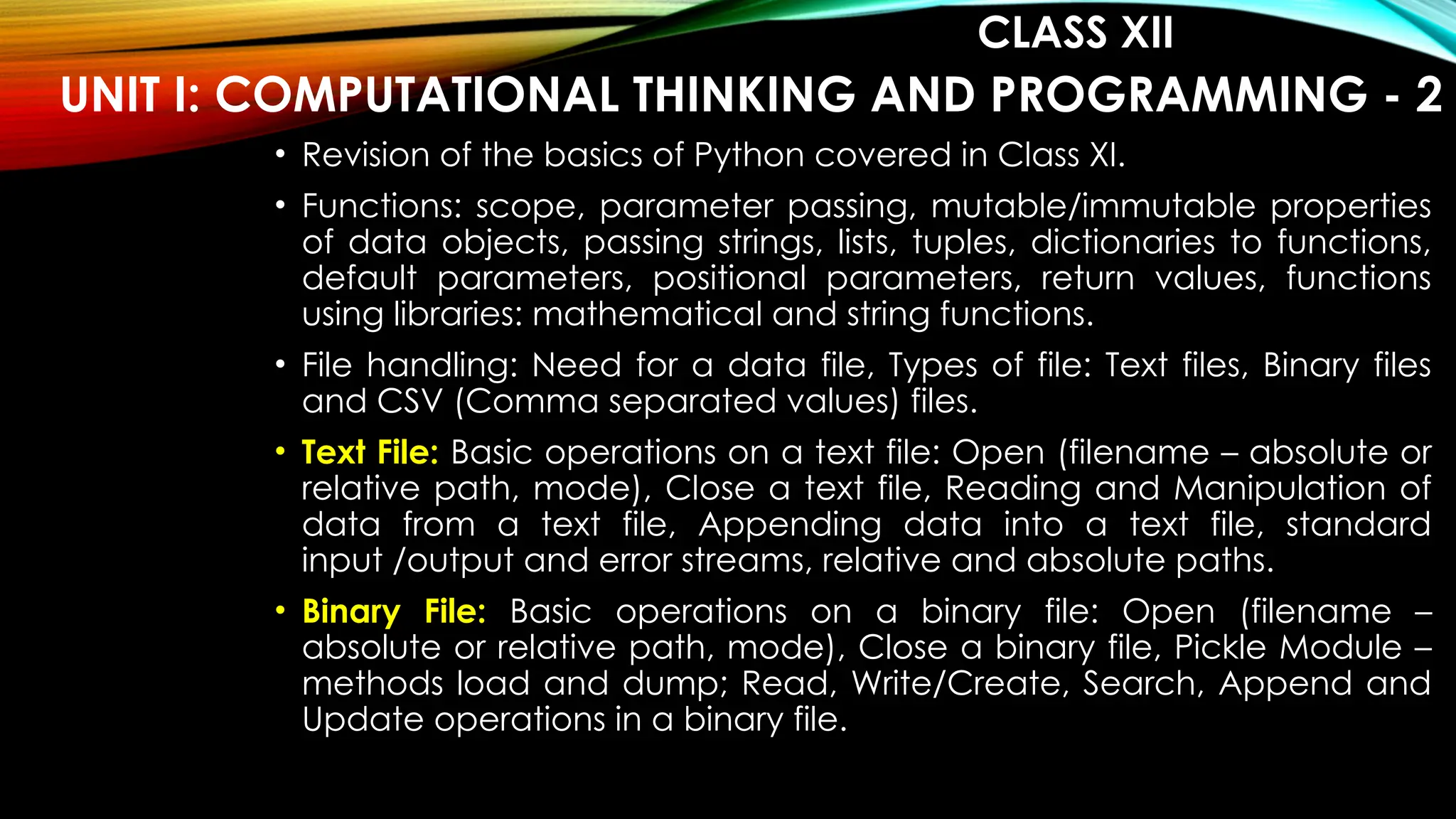
UNIT I: COMPUTATIONAL THINKING AND PROGRAMMING - 2
• Revision of the basics of Python covered in Class XI.
• Functions: scope, parameter passing, mutable/immutable properties
of data objects, passing strings, lists, tuples, dictionaries to functions,
default parameters, positional parameters, return values, functions
using libraries: mathematical and string functions.
• File handling: Need for a data file, Types of file: Text files, Binary files
and CSV (Comma separated values) files.
• Text File: Basic operations on a text file: Open (filename – absolute or
relative path, mode), Close a text file, Reading and Manipulation of
data from a text file, Appending data into a text file, standard
input /output and error streams, relative and absolute paths.
• Binary File: Basic operations on a binary file: Open (filename –
absolute or relative path, mode), Close a binary file, Pickle Module –
methods load and dump; Read, Write/Create, Search, Append and
Update operations in a binary file.
CLASS XII
UNIT I: COMPUTATIONAL THINKING AND PROGRAMMING - 2
• CSV File: Import csv module, functions – Open, Close a csv file, Read
from a csv file and Write into a csv file using csv.reader ( ) and
csv.writerow( ).
• Using Python libraries: Import Python libraries.
• Data-structures: Lists as covered in Class XI, Stacks – Push, Pop using a
list.
CLASS XII
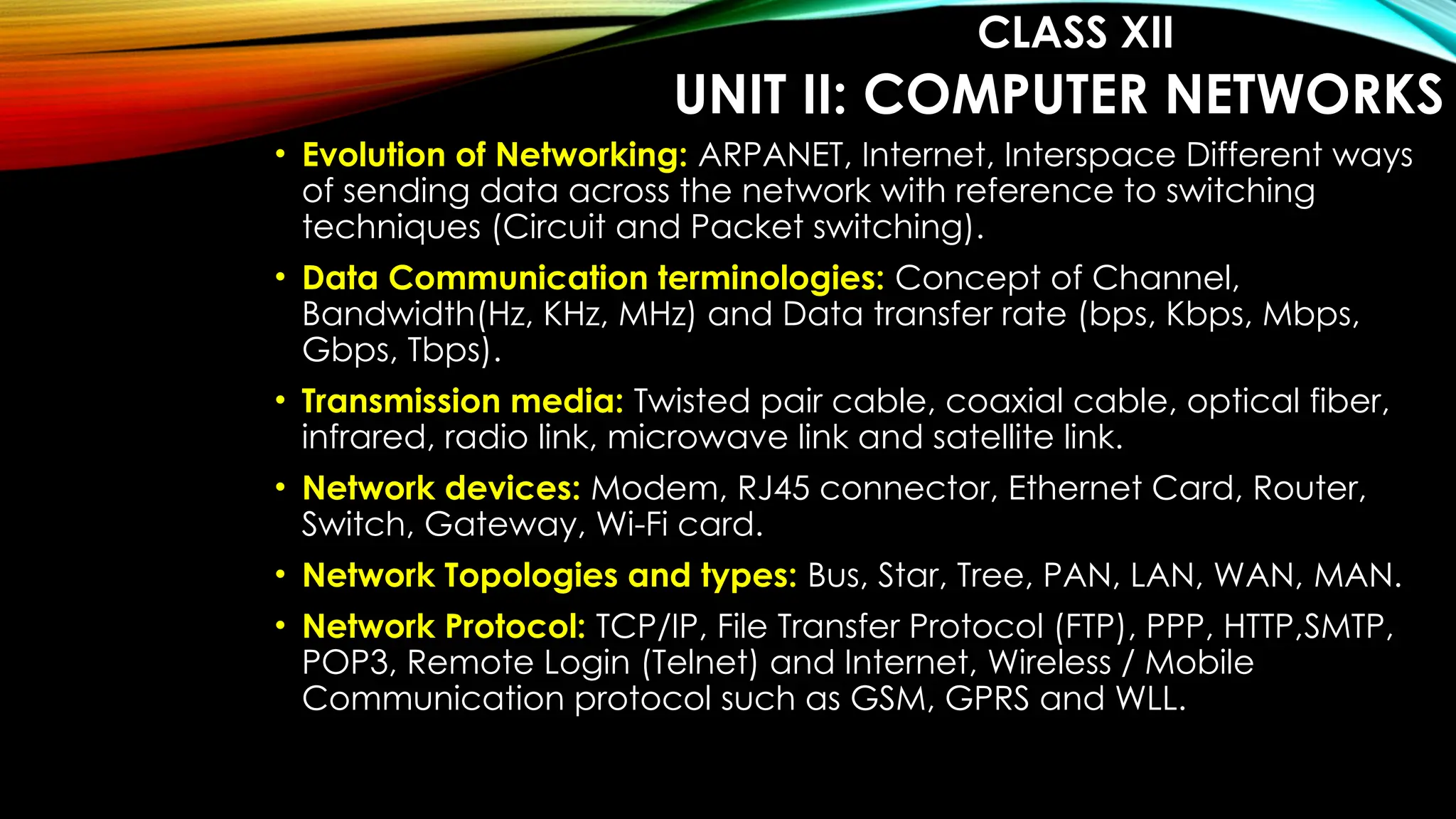
UNIT II: COMPUTER NETWORKS
• Evolution of Networking: ARPANET, Internet, Interspace Different ways
of sending data across the network with reference to switching
techniques (Circuit and Packet switching).
• Data Communication terminologies: Concept of Channel,
Bandwidth(Hz, KHz, MHz) and Data transfer rate (bps, Kbps, Mbps,
Gbps, Tbps).
• Transmission media: Twisted pair cable, coaxial cable, optical fiber,
infrared, radio link, microwave link and satellite link.
• Network devices: Modem, RJ45 connector, Ethernet Card, Router,
Switch, Gateway, Wi-Fi card.
• Network Topologies and types: Bus, Star, Tree, PAN, LAN, WAN, MAN.
• Network Protocol: TCP/IP, File Transfer Protocol (FTP), PPP, HTTP,SMTP,
POP3, Remote Login (Telnet) and Internet, Wireless / Mobile
Communication protocol such as GSM, GPRS and WLL.
CLASS XII
UNIT II: COMPUTER NETWORKS
• Mobile Telecommunication Technologies: 1G, 2G, 3G, 4G and 5G,
Mobile processors;
• Electronic mail protocols such as SMTP, POP3, Protocols for Chat and
Video Conferencing: VoIP, Wireless technologies such as Wi-Fi and Wi-
Max
• Network Security Concepts: Threats and prevention from Viruses,
Worms, Trojan horse, Spams Use of Cookies, Protection using Firewall,
https; India IT Act, Cyber Law, Cyber Crimes, IPR issues, hacking.
• Introduction To Web services: WWW, Hyper Text Markup Language
(HTML), Extensible Markup Language (XML); Hyper Text Transfer
Protocol (HTTP); Domain Names; URL; Website, Web browser, Web
Servers; Web Hosting.
CLASS XII
UNIT III: DATABASE MANAGEMENT
• Database Concepts: Introduction to database concepts and its need.
• Relational data model: Concept of domain, relation, tuple, attribute, degree,
cardinality, key, primary key, candidate key, alternate key and foreign key;
• Structured Query Language:
• General Concepts: Advantages of using SQL, Data Definition Language and Data
Manipulation Language;
• Data Types: number / decimal, character / varchar / varchar2, date;
• SQL commands covered in class XI (2019-20)
• SELECT, DISTINCT, FROM, WHERE, IN, BETWEEN, LIKE, NULL / IS NULL, ORDER BY,GROUP
BY, HAVING;
• SQL functions: SUM ( ), AVG ( ), COUNT ( ), MAX ( ) and MIN ( );
• Joins: equi-join and natural join
• Interface of Python with an SQL database
- Connecting SQL with Python
- Creating Database connectivity Applications
- Performing Insert, Update, Delete queries
- Display data by using fetchone(),fetchall(),rowcount
CLASS XII
PRACTICAL
S.
N
Area Marks
(Total:30)
1. Lab Test:
1. Python program (60% logic + 20% documentation +
20% code quality)
2. Small Python program that sends a SQL query to a
database and displays the result. A stubprogram can be
provided.
7
5
2. Report file: Minimum 20 Python programs. Out of this at
least 4 programs should send SQL commands to a
database and retrieve the result
7
3. Project (that uses the concepts that have been learnt in
Class 11 and 12)
8
4. Viva- Voice 3
CLASS XII
TOPICS REDUCED
• Unit I: Computer Systems and Organisation
• Encoding Schemes : UTF8, UTF32
• Concept of cloud computing and cloud services (SaaS,IaaS,PaaS),
cloud (public/private), Blockchain technology
• Unit II: Computational Thinking and Programming - 1
• Decomposition – concept, need for decomposing a problem, examples
of problem solving using decomposition.
• Sorting algorithm: bubble and insertion sort; count the number of
operations while sorting.
• Suggested Practical List Input a list of elements, sort in ascending/
descending order using
• Bubble/ Insertion sort.
CLASS XI
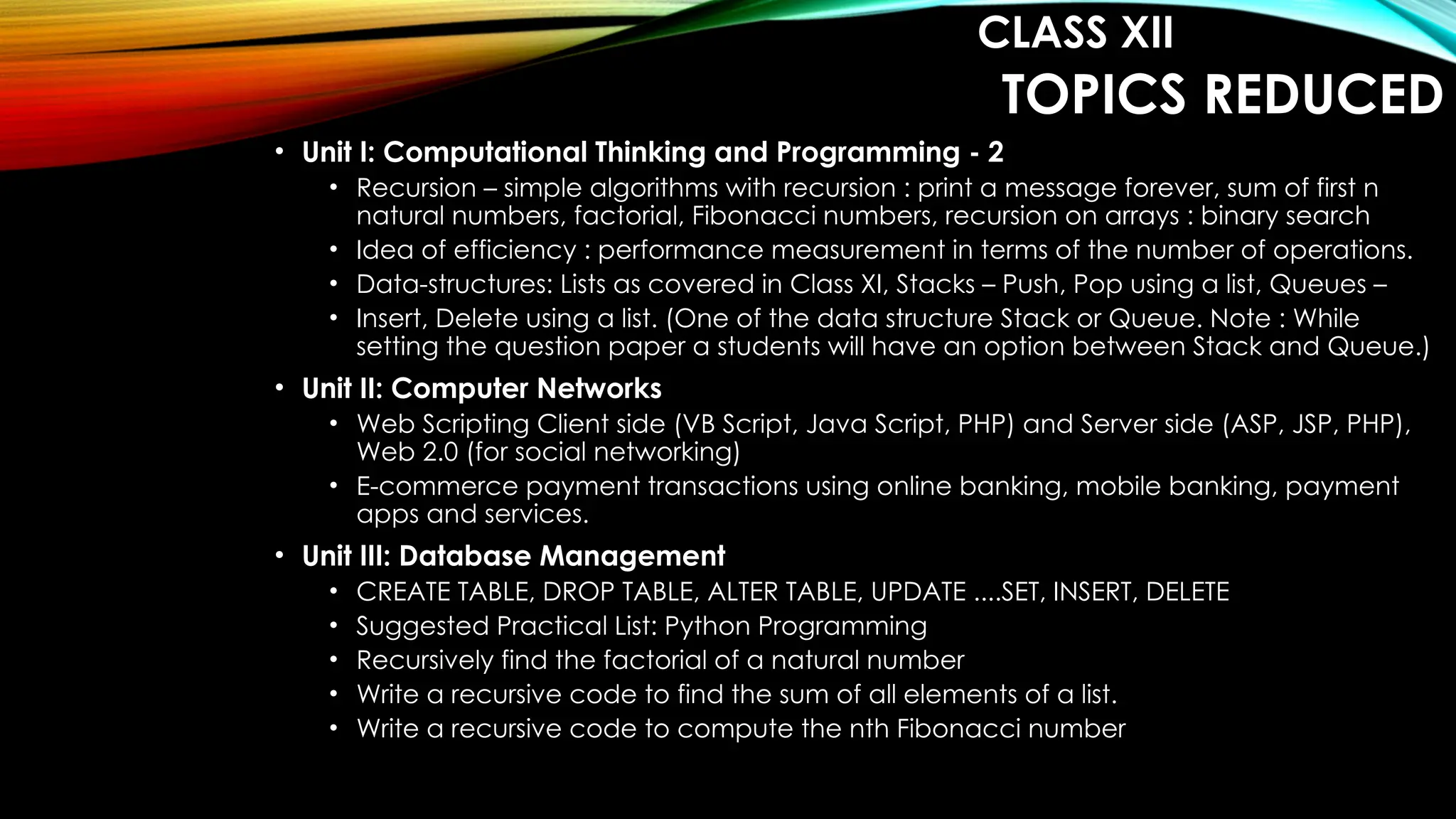
TOPICS REDUCED
• Unit I: Computational Thinking and Programming - 2
• Recursion – simple algorithms with recursion : print a message forever, sum of first n
natural numbers, factorial, Fibonacci numbers, recursion on arrays : binary search
• Idea of efficiency : performance measurement in terms of the number of operations.
• Data-structures: Lists as covered in Class XI, Stacks – Push, Pop using a list, Queues –
• Insert, Delete using a list. (One of the data structure Stack or Queue. Note : While
setting the question paper a students will have an option between Stack and Queue.)
• Unit II: Computer Networks
• Web Scripting Client side (VB Script, Java Script, PHP) and Server side (ASP, JSP, PHP),
Web 2.0 (for social networking)
• E-commerce payment transactions using online banking, mobile banking, payment
apps and services.
• Unit III: Database Management
• CREATE TABLE, DROP TABLE, ALTER TABLE, UPDATE ....SET, INSERT, DELETE
• Suggested Practical List: Python Programming
• Recursively find the factorial of a natural number
• Write a recursive code to find the sum of all elements of a list.
• Write a recursive code to compute the nth Fibonacci number
CLASS XII
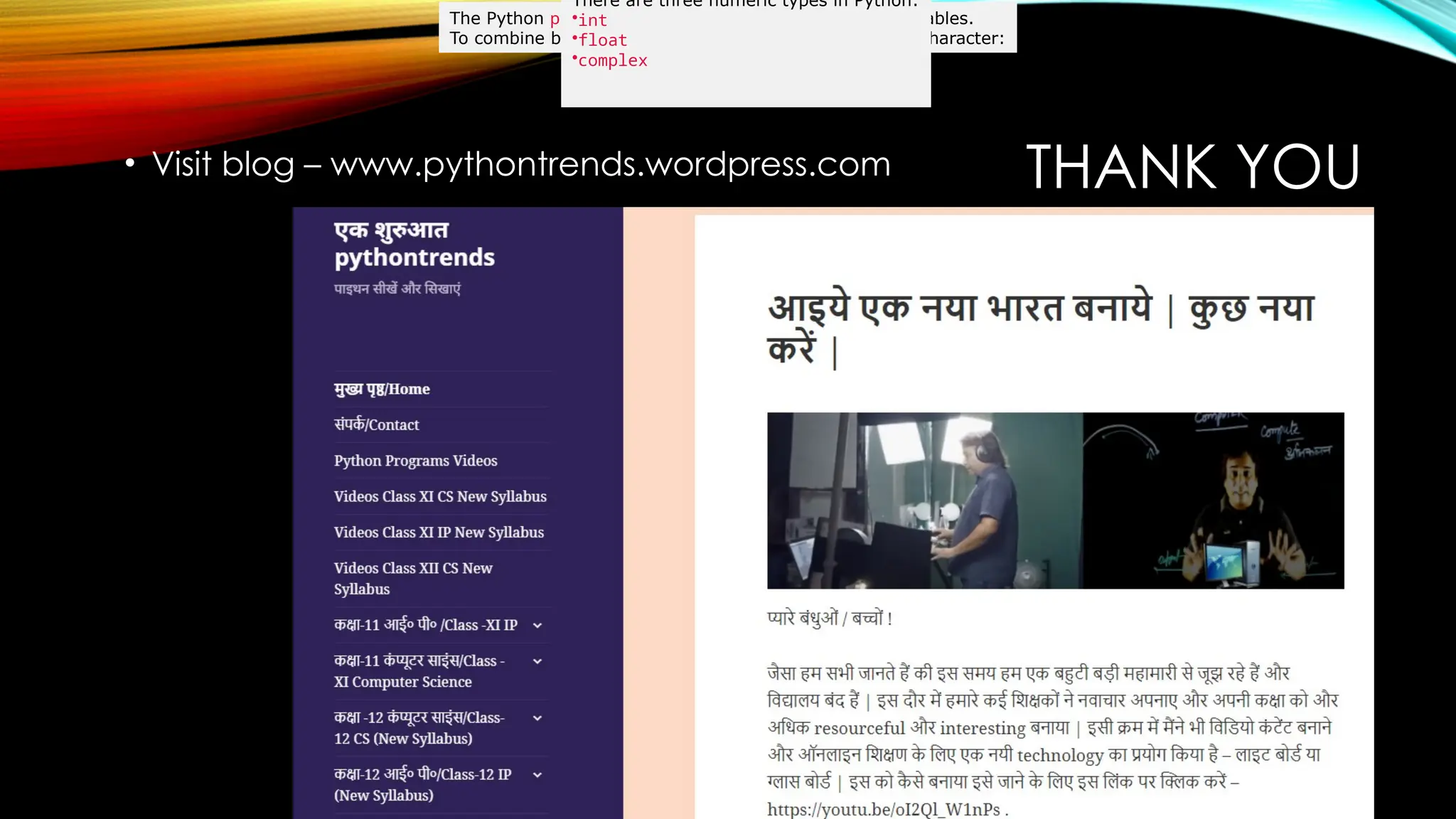
THANK YOU
The Python print statement is often used to output variables.
To combine both text and a variable, Python uses the + character:
There are three numeric types in Python:
•int
•float
•complex
• Visit blog – www.pythontrends.wordpress.com

Python Syllabus for Class XI and XII school

  • 1.
    COMPUTER SCIENCE SYLLABUS By: SanjeevBhadauria PGT CS KV Barabanki FOR XI AND XII
  • 2.
    LEARNING OUTCOMES • Abilityto understand and apply basic computational thinking. • Ability to understand the notion of data types and data structures and apply in different situations. • Ability to appreciate the notion of an algorithm and apply its structure including how algorithms handle corner cases. • Ability to develop a basic understanding of computer systems - architecture, operating system, mobile and cloud computing. • Ability to work in the cyber world with understanding of cyber ethics, cyber safety and cybercrime • Ability to make use the value of technology in societies, gender and disability issues and the technology behind biometric ids. CLASS XI
  • 3.
    DISTRIBUTION OF MARKS UNIT No. UNITNAME Theory Marks Periods Theory Practical I. Computer Systems and Organisation 10 10 5 II. Computational Thinking and Programming - 1 45 50 35 III. Society, Law and Ethics 15 20 -- Total 70 80 40 CLASS XI
  • 4.
    UNIT I: COMPUTERSYSTEMS AND ORGANIZATION • Basic computer organization: description of a computer system and mobile system, CPU, memory, hard disk, I/O, battery. • Types of software: Application software, System software and Utility software. • Memory Units: bit, byte, MB, GB, TB, and PB. • Boolean logic: NOT, AND, OR, NAND, NOR, XOR, NOT, truth tables and De-Morgan’s Laws, Logic circuits • Number System: numbers in base 2, 8, 16 and binary addition. • Encoding Schemes : ASCII, ISCII and Unicode. • Concept of Compiler and Interpreter • Operating System (OS) - need for an operating system, brief introduction • to functions of OS, user interface. CLASS XI
  • 5.
    UNIT II: COMPUTATIONALTHINKING AND PROGRAMMING - 1 • Execution of a program, errors- syntax error, run-time error and logical error. • Conditional statements: if, if-else, if-elif-else; simple programs: e.g.: absolute value, sort 3 numbers and divisibility of a number. • Notion of iterative computation and control flow: for(range(),len()), while, using flowcharts, suggested programs: calculation of simple and compound interests, finding the factorial of a positive number etc. • Strings: Traversal, operations – concatenation, repetition, membership; functions/methods–len(), capitalize(), title(), upper(), lower(), count(), find(),index(), isalnum(), islower(), isupper(), isspace(), isalpha(), isdigit(), split(),partition(), strip(), lstrip(), rstrip(), replace(); String slicing. • Lists: Definition, Creation of a list, Traversal of a list. Operations on a list - concatenation, repetition, membership; functions/methods–len(), list(), append(), extend(), insert(), count(), index(), remove(), pop(), reverse(), sort(), min(), max(), sum(); Lists Slicing; Nested lists; finding the maximum, minimum, mean of numeric values stored in a list; linear search on list of numbers and counting the frequency of elements in a list. CLASS XI
  • 6.
    UNIT II: COMPUTATIONALTHINKING AND PROGRAMMING - 1 • Introduction to Problem solving: Problem solving cycle - Analyzing a problem, designing algorithms and representation of algorithm using flowchart and pseudo-code. • Familiarization with the basics of Python programming: a simple “hello world“ program, the process of writing a program (Interactive & Script mode), running it and print statements; simple data-types: integer, float and string. • Features of Python, Python Character Set, Token & Identifiers, Keywords, Literals, Delimiters, Operators. • Comments: (Single line & Multiline/ Continuation statements), Clarity & Simplification of expression • Introduce the notion of a variable and methods to manipulate it (concept of L-value and R-value even if not taught explicitly). • Knowledge of data types and operators: accepting input from the console, assignment statement, expressions, operators and their precedence. • Operators & types: Binary operators-Arithmetic, Relational Operators Logical Operators, Augmented Assignment Operators. CLASS XI
  • 7.
    UNIT II: COMPUTATIONALTHINKING AND PROGRAMMING - 1 • Tuples: Definition, Creation of a Tuple, Traversal of a tuple. Operations on a tuple - concatenation, repetition, membership; functions/methods – len(), tuple(), count(), index(), sorted(), min(), max(), sum(); Nested tuple; Tuple slicing; finding the minimum, maximum, mean of values stored in a tuple; linear search on a tuple of numbers, counting the frequency of elements in a tuple. • Dictionary: Definition, Creation, Accessing elements of a dictionary, add an item, modify an item in a dictionary; Traversal, functions/methods – len(), dict(), keys(), values(), items(), get(), update(), del(), del, clear(), fromkeys(), copy(), pop(), popitem(), setdefault(), max(), min(), count(), sorted() copy(); Suggested programs : count the number of times a character appears in a given string using a dictionary, create a dictionary with names of employees, their salary and access them. • Introduction to Python modules: Importing math module (pi, e, sqrt, ceil, floor, pow, fabs, sin, cos, tan); random module (random, randint, randrange), statistics module (mean, median, mode). CLASS XI
  • 8.
    UNIT III: SOCIETY,LAW AND ETHICS • Cyber safety: safely browsing the web, identity protection, confidentiality, social networks, cyber trolls and bullying. • Appropriate usage of social networks: spread of rumors, and common social networking sites (Twitter, LinkedIn, and Facebook) and specific usage rules. • Safely accessing web sites: adware, malware, viruses, trojans • Safely communicating data: secure connections, eavesdropping, phishing and identity verification. • Intellectual property rights, plagiarism, digital rights management, and licensing (Creative Commons, GPL and Apache), open source, open data, privacy. • Privacy laws, fraud; cyber-crime- phishing, illegal downloads, child pornography, scams; cyber forensics, IT Act, 2000. • Technology and society: • Understanding of societal issues and cultural changes induced by technology. • E-waste management: proper disposal of used electronic gadgets. • Identity theft, unique ids and biometrics. • Gender and disability issues while teaching and using computers. CLASS XI
  • 9.
    PRACTICAL S. N Area Marks (Total:2 0) 1. LabTest (12 Marks) Python Program (60% Logic + 20% Documentation+20% Code Quality) 12 2. Report File + Viva (10 Marks) Report File: Min 20 Programs Viva Voice 7 3 3. Project (8 Marks) (that uses most of the concepts that have been learnt See CS-XII for the rules regarding the projects) 8 CLASS XI
  • 10.
    LEARNING OUTCOMES • Applythe concept of functions. • Ability to use Python libraries. • Apply the concept of file handling. • Ability to use basic data structures: Stacks. • Explain the basics of computer networks. • Ability to use connectivity between Python and SQL. CLASS XII
  • 11.
    DISTRIBUTION OF MARKS UNIT No. UNITNAME Theory Marks Periods Theory Practical I. Computational Thinking and Programming – 2 40 50 30 II. Computer Networks 10 10 -- III. Database Management 20 20 10 Total 70 80 40 CLASS XI
  • 12.
    UNIT I: COMPUTATIONALTHINKING AND PROGRAMMING - 2 • Revision of the basics of Python covered in Class XI. • Functions: scope, parameter passing, mutable/immutable properties of data objects, passing strings, lists, tuples, dictionaries to functions, default parameters, positional parameters, return values, functions using libraries: mathematical and string functions. • File handling: Need for a data file, Types of file: Text files, Binary files and CSV (Comma separated values) files. • Text File: Basic operations on a text file: Open (filename – absolute or relative path, mode), Close a text file, Reading and Manipulation of data from a text file, Appending data into a text file, standard input /output and error streams, relative and absolute paths. • Binary File: Basic operations on a binary file: Open (filename – absolute or relative path, mode), Close a binary file, Pickle Module – methods load and dump; Read, Write/Create, Search, Append and Update operations in a binary file. CLASS XII
  • 13.
    UNIT I: COMPUTATIONALTHINKING AND PROGRAMMING - 2 • CSV File: Import csv module, functions – Open, Close a csv file, Read from a csv file and Write into a csv file using csv.reader ( ) and csv.writerow( ). • Using Python libraries: Import Python libraries. • Data-structures: Lists as covered in Class XI, Stacks – Push, Pop using a list. CLASS XII
  • 14.
    UNIT II: COMPUTERNETWORKS • Evolution of Networking: ARPANET, Internet, Interspace Different ways of sending data across the network with reference to switching techniques (Circuit and Packet switching). • Data Communication terminologies: Concept of Channel, Bandwidth(Hz, KHz, MHz) and Data transfer rate (bps, Kbps, Mbps, Gbps, Tbps). • Transmission media: Twisted pair cable, coaxial cable, optical fiber, infrared, radio link, microwave link and satellite link. • Network devices: Modem, RJ45 connector, Ethernet Card, Router, Switch, Gateway, Wi-Fi card. • Network Topologies and types: Bus, Star, Tree, PAN, LAN, WAN, MAN. • Network Protocol: TCP/IP, File Transfer Protocol (FTP), PPP, HTTP,SMTP, POP3, Remote Login (Telnet) and Internet, Wireless / Mobile Communication protocol such as GSM, GPRS and WLL. CLASS XII
  • 15.
    UNIT II: COMPUTERNETWORKS • Mobile Telecommunication Technologies: 1G, 2G, 3G, 4G and 5G, Mobile processors; • Electronic mail protocols such as SMTP, POP3, Protocols for Chat and Video Conferencing: VoIP, Wireless technologies such as Wi-Fi and Wi- Max • Network Security Concepts: Threats and prevention from Viruses, Worms, Trojan horse, Spams Use of Cookies, Protection using Firewall, https; India IT Act, Cyber Law, Cyber Crimes, IPR issues, hacking. • Introduction To Web services: WWW, Hyper Text Markup Language (HTML), Extensible Markup Language (XML); Hyper Text Transfer Protocol (HTTP); Domain Names; URL; Website, Web browser, Web Servers; Web Hosting. CLASS XII
  • 16.
    UNIT III: DATABASEMANAGEMENT • Database Concepts: Introduction to database concepts and its need. • Relational data model: Concept of domain, relation, tuple, attribute, degree, cardinality, key, primary key, candidate key, alternate key and foreign key; • Structured Query Language: • General Concepts: Advantages of using SQL, Data Definition Language and Data Manipulation Language; • Data Types: number / decimal, character / varchar / varchar2, date; • SQL commands covered in class XI (2019-20) • SELECT, DISTINCT, FROM, WHERE, IN, BETWEEN, LIKE, NULL / IS NULL, ORDER BY,GROUP BY, HAVING; • SQL functions: SUM ( ), AVG ( ), COUNT ( ), MAX ( ) and MIN ( ); • Joins: equi-join and natural join • Interface of Python with an SQL database - Connecting SQL with Python - Creating Database connectivity Applications - Performing Insert, Update, Delete queries - Display data by using fetchone(),fetchall(),rowcount CLASS XII
  • 17.
    PRACTICAL S. N Area Marks (Total:30) 1. LabTest: 1. Python program (60% logic + 20% documentation + 20% code quality) 2. Small Python program that sends a SQL query to a database and displays the result. A stubprogram can be provided. 7 5 2. Report file: Minimum 20 Python programs. Out of this at least 4 programs should send SQL commands to a database and retrieve the result 7 3. Project (that uses the concepts that have been learnt in Class 11 and 12) 8 4. Viva- Voice 3 CLASS XII
  • 18.
    TOPICS REDUCED • UnitI: Computer Systems and Organisation • Encoding Schemes : UTF8, UTF32 • Concept of cloud computing and cloud services (SaaS,IaaS,PaaS), cloud (public/private), Blockchain technology • Unit II: Computational Thinking and Programming - 1 • Decomposition – concept, need for decomposing a problem, examples of problem solving using decomposition. • Sorting algorithm: bubble and insertion sort; count the number of operations while sorting. • Suggested Practical List Input a list of elements, sort in ascending/ descending order using • Bubble/ Insertion sort. CLASS XI
  • 19.
    TOPICS REDUCED • UnitI: Computational Thinking and Programming - 2 • Recursion – simple algorithms with recursion : print a message forever, sum of first n natural numbers, factorial, Fibonacci numbers, recursion on arrays : binary search • Idea of efficiency : performance measurement in terms of the number of operations. • Data-structures: Lists as covered in Class XI, Stacks – Push, Pop using a list, Queues – • Insert, Delete using a list. (One of the data structure Stack or Queue. Note : While setting the question paper a students will have an option between Stack and Queue.) • Unit II: Computer Networks • Web Scripting Client side (VB Script, Java Script, PHP) and Server side (ASP, JSP, PHP), Web 2.0 (for social networking) • E-commerce payment transactions using online banking, mobile banking, payment apps and services. • Unit III: Database Management • CREATE TABLE, DROP TABLE, ALTER TABLE, UPDATE ....SET, INSERT, DELETE • Suggested Practical List: Python Programming • Recursively find the factorial of a natural number • Write a recursive code to find the sum of all elements of a list. • Write a recursive code to compute the nth Fibonacci number CLASS XII
  • 20.
    THANK YOU The Pythonprint statement is often used to output variables. To combine both text and a variable, Python uses the + character: There are three numeric types in Python: •int •float •complex • Visit blog – www.pythontrends.wordpress.com