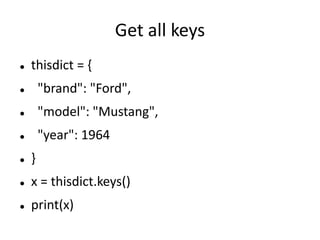
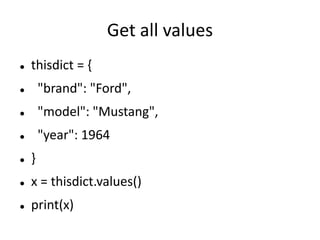
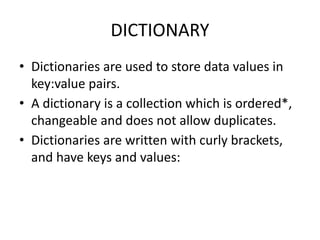
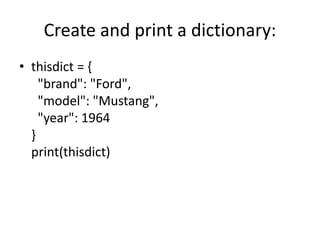
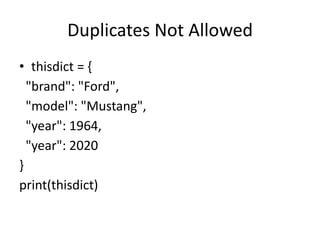
Dictionaries in Python are used to store data in key-value pairs. A dictionary is an unordered collection of key-value pairs where keys must be unique, but values can be duplicated. Dictionaries are written with curly brackets and contain keys and values separated by colons. Items in a dictionary can be accessed, added, or removed using their key.
![Dictionary Items
• thisdict = {
"brand": "Ford",
"model": "Mustang",
"year": 1964
}
print(thisdict["brand"])](https://image.slidesharecdn.com/pythondictionary-210305170433/85/Python-dictionary-4-320.jpg)
![Accessing Items
thisdict = {
"brand": "Ford",
"model": "Mustang",
"year": 1964
}
x = thisdict["model"]
Another way using get method
x = thisdict.get("model")](https://image.slidesharecdn.com/pythondictionary-210305170433/85/Python-dictionary-6-320.jpg)